Christmas, Day 12: The Brown King

LOOK: Breaking Point, etc., by Rosa-Johan Uddoh
Uddoh, Rosa-Johan_Breaking Point
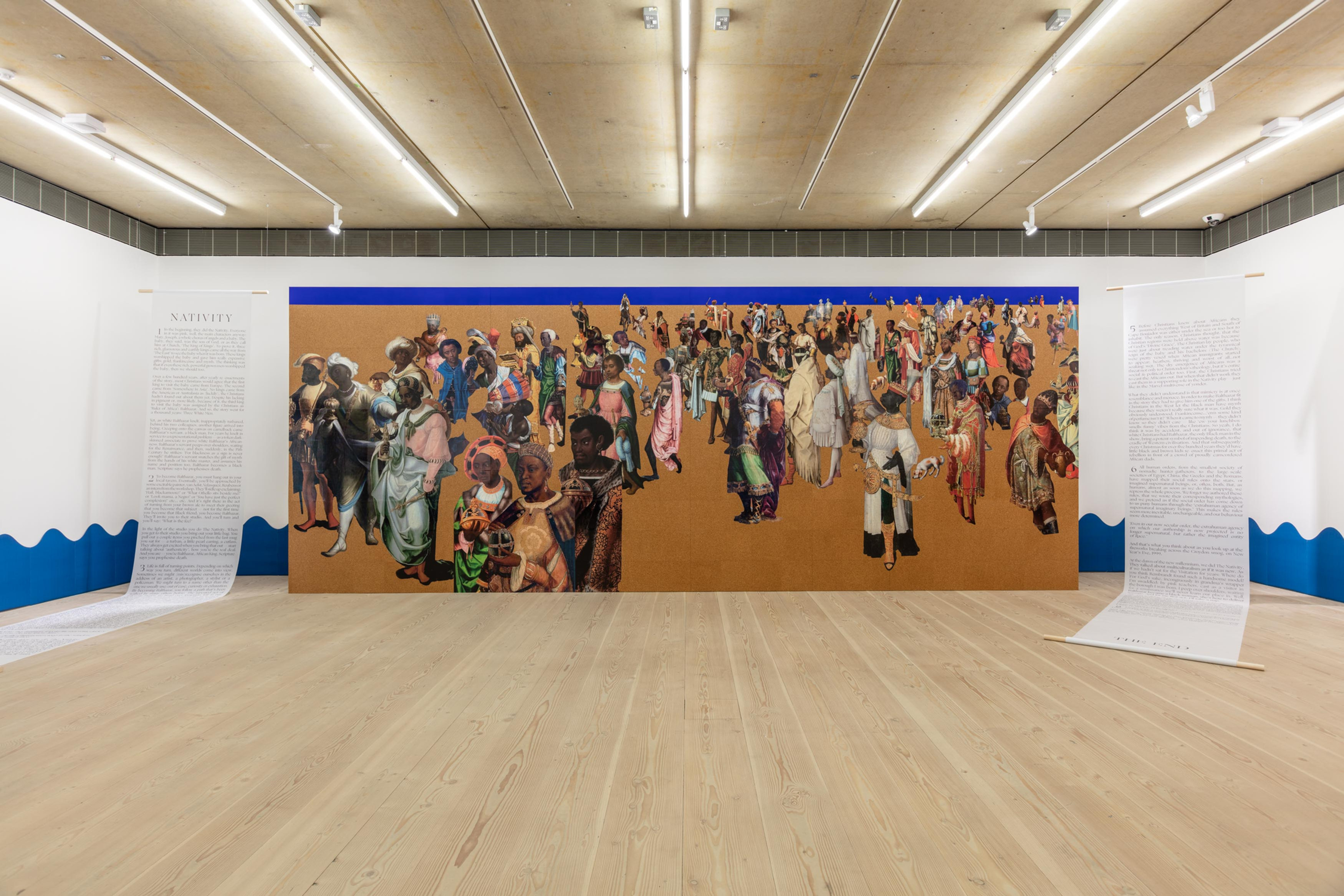
Rosa-Johan Uddoh (British, 1993–), Breaking Point, 2021. Billboard-style collage. Photo: Anna Lukala, from Practice Makes Perfect, Focal Point Gallery, Southend-on-Sea, England, May 18–August 28, 2021.

Uddoh, Rosa-Johan_Breaking Point (detail)
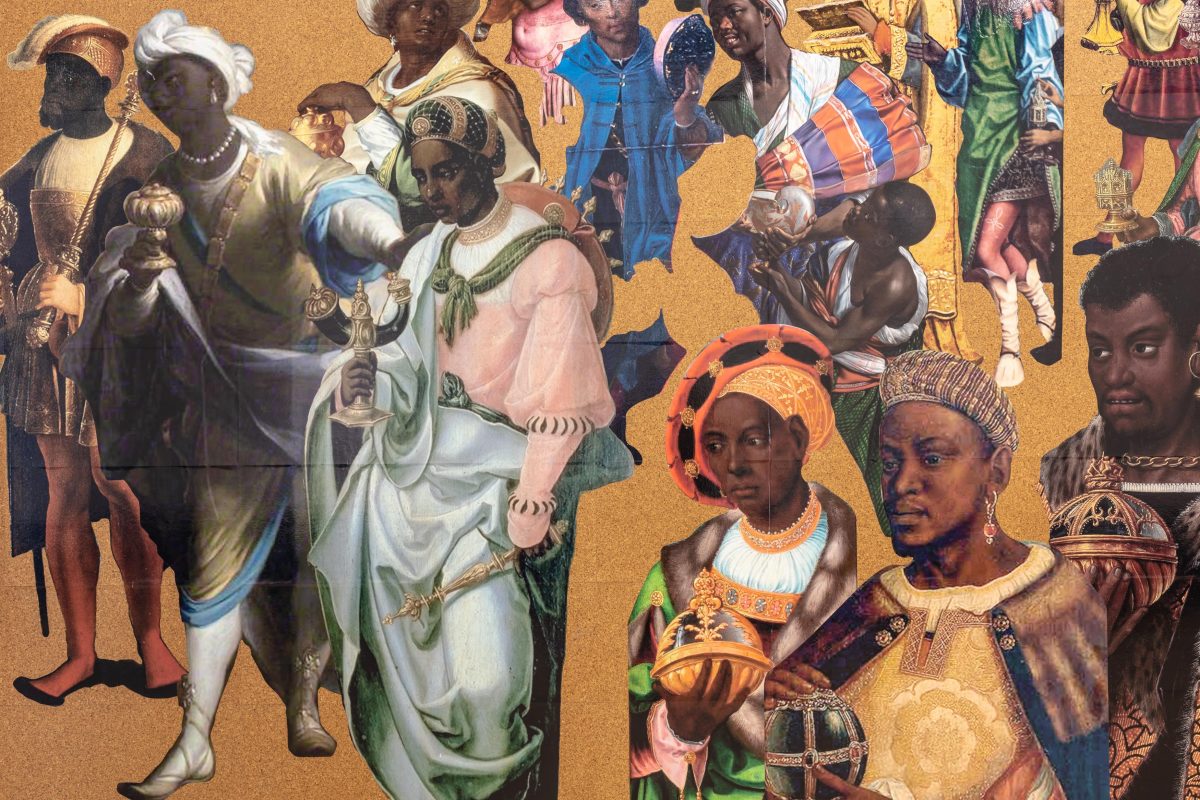
Rosa-Johan Uddoh, Breaking Point (detail)

Rosa-Johan Uddoh is an interdisciplinary artist based in London who, “through performance, writing and multimedia installation, . . . explores places, objects and celebrities in British popular culture, and their effects on self-formation,” she writes on her website.

In her first institutional solo show, Practice Makes Perfect at Focal Point Gallery in Southend-on-Sea, she explored how the white European imagination constructed Blackness through the figure of Balthazar, who according to Christian tradition was one of the three magi who visited the infant Jesus, offering him the gift of myrrh. Since the fifteenth century Balthazar has typically been depicted as Black, as it was imagined that he came from Africa (whereas the other two magi were supposedly from Europe and Asia, the three known continents at the time). Uddoh notes that Balthazar is one of the first Black people of importance that British schoolchildren encounter, and in fact the first public performance she ever gave was as Balthazar in a primary-school Nativity play, a role she had been cast in by her teacher.

The centerpiece of the Practice Makes Perfect exhibition was Breaking Point, a billboard-sized mural that depicts 150 Black Balthazars extracted from European paintings from the late Middle Ages onward and rearranged into friendship groups. These groupings “allow Balthazar to escape the isolation associated with being the only Black character of importance in Christian iconography whilst also highlighting that the Black figures behind the artistic imagery were real sitters, which is also a testament to early African immigration into Europe, a phenomenon often overlooked in mainstream history.”

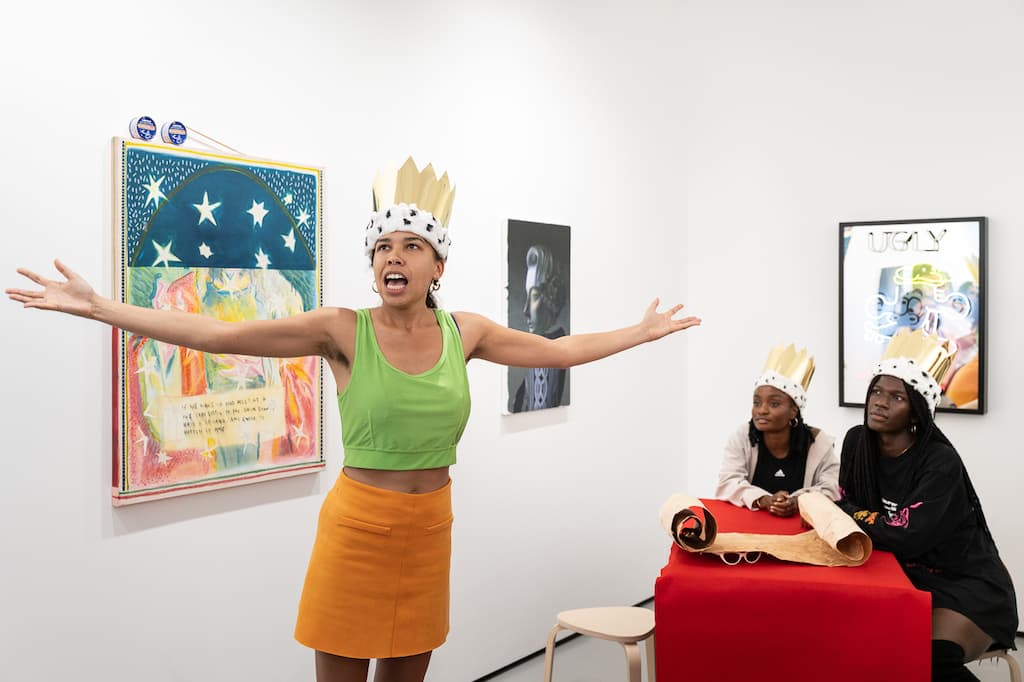
Installed on either side of Breaking Point was a scroll bearing a piece of experimental writing by Uddoh, titled Nativity. (She later performed this text in 2022 at the London art gallery Workplace, with Adeola Yemitan and Ebunoluwa Sodipo.) It opens, “In the beginning, they did the Nativity. Everyone in it was pink; well, the main characters anyway . . .”
Uddoh, Rosa-Johan_Nativity
Nativity, 2022, performance by Rose-Johan Uddoh with Adeola Yemitan and Ebunoluwa Sodipo at Workplace, London. Photo: Damian Griffiths.

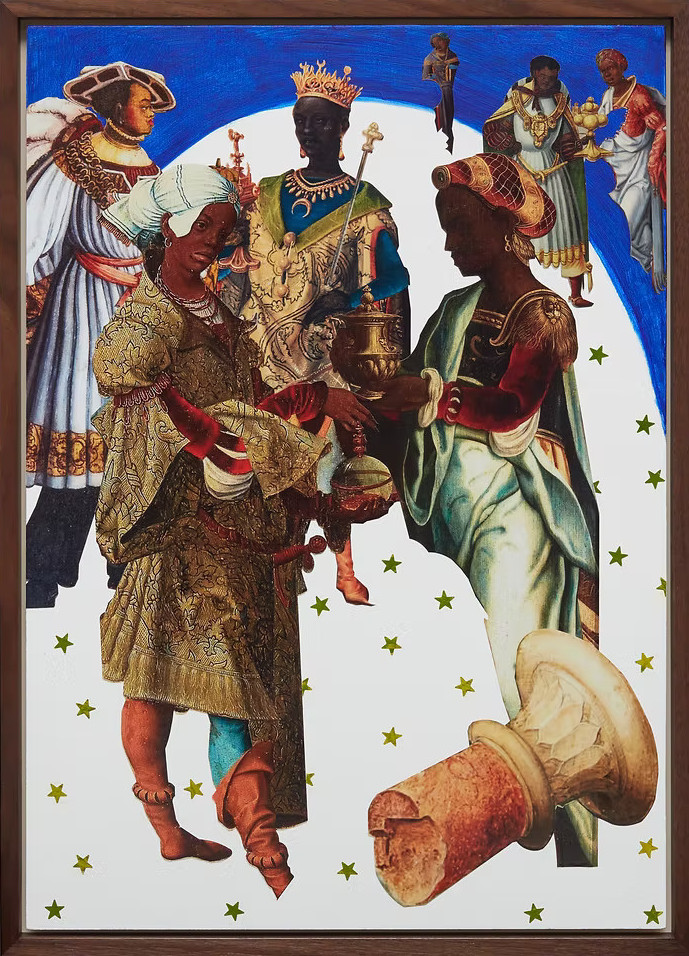
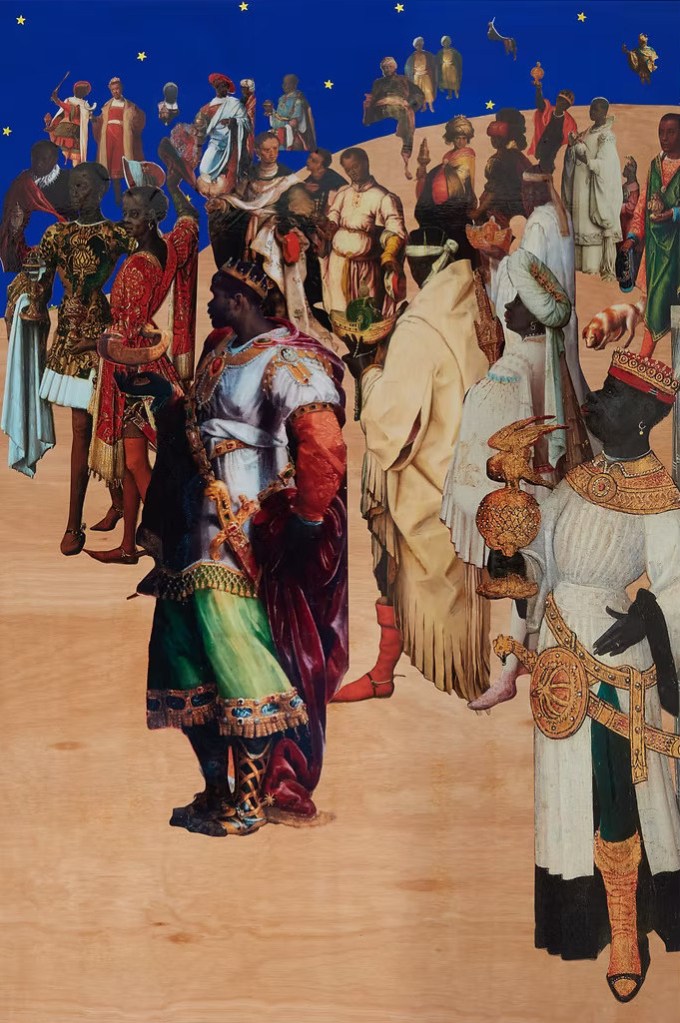
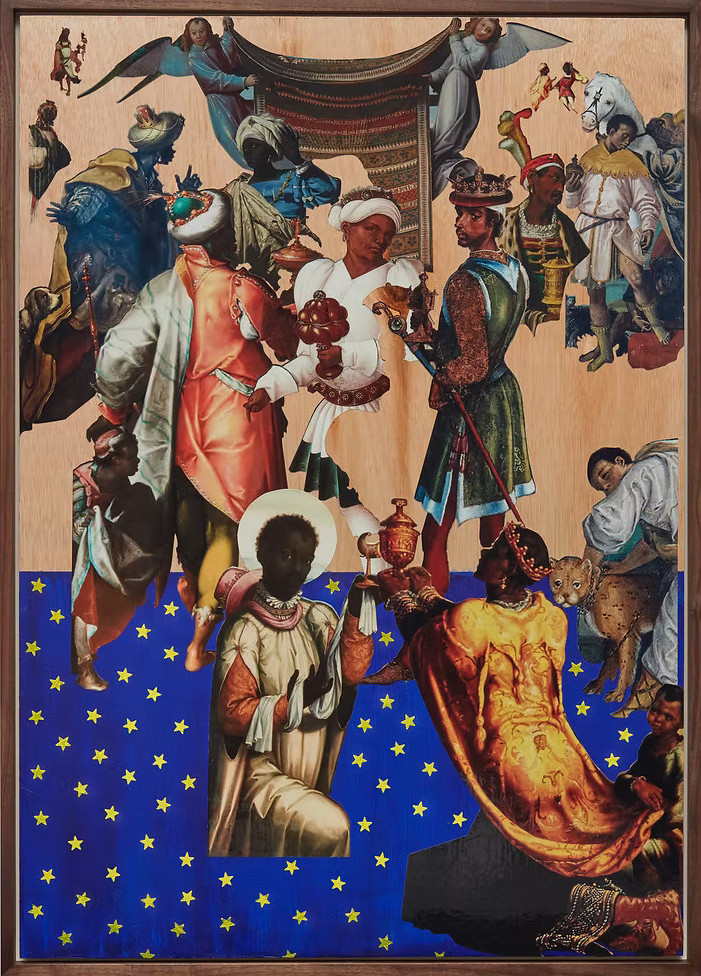
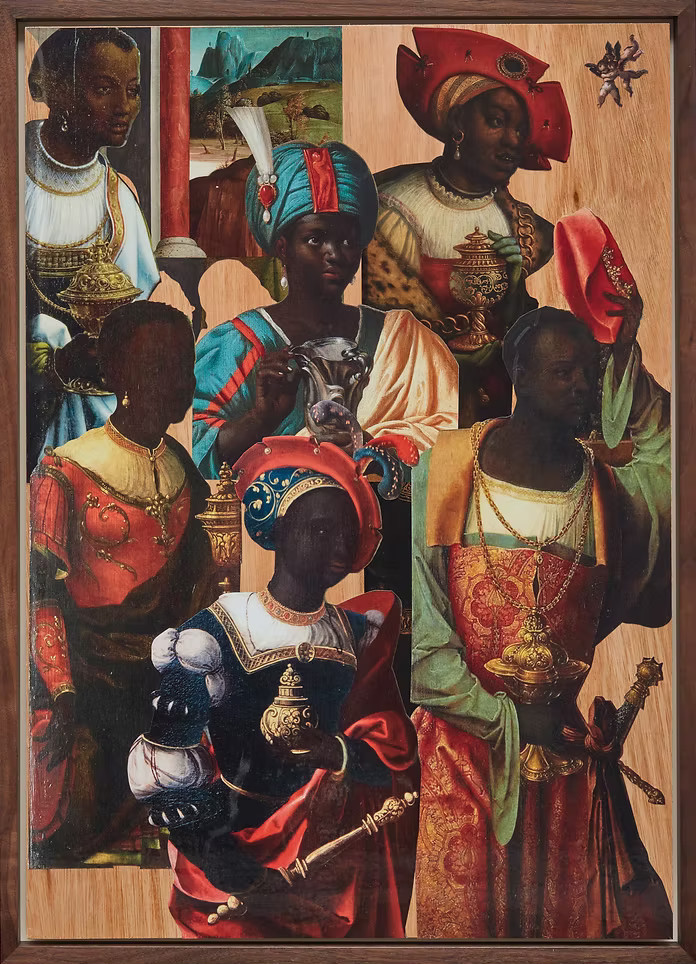
In 2022 Uddoh expanded this body of work with another solo show, Star Power at Workplace. It featured the series You Can Go Ahead and Talk Straight to Me and I Sell the Shadow to Support the Substance (scroll through select images below), the artworks made of acrylic and vinyl on board. The former title is a quote from Toni Morrison’s 1975 speech “A Humanist View,” given at Portland State University as part of a public forum on the theme of the American Dream. The latter is a quote from Sojourner Truth—she wrote the phrase on the bottom of a self-portrait she took, selling copies of it across America to raise funds for her abolitionist activism.
  • Uddoh, Rosa-Johan_Star Power
  • Uddoh, Rosa-Johan_Star Power
  • Uddoh, Rosa-Johan_Star Power
  • Uddoh, Rosa-Johan_Star Power

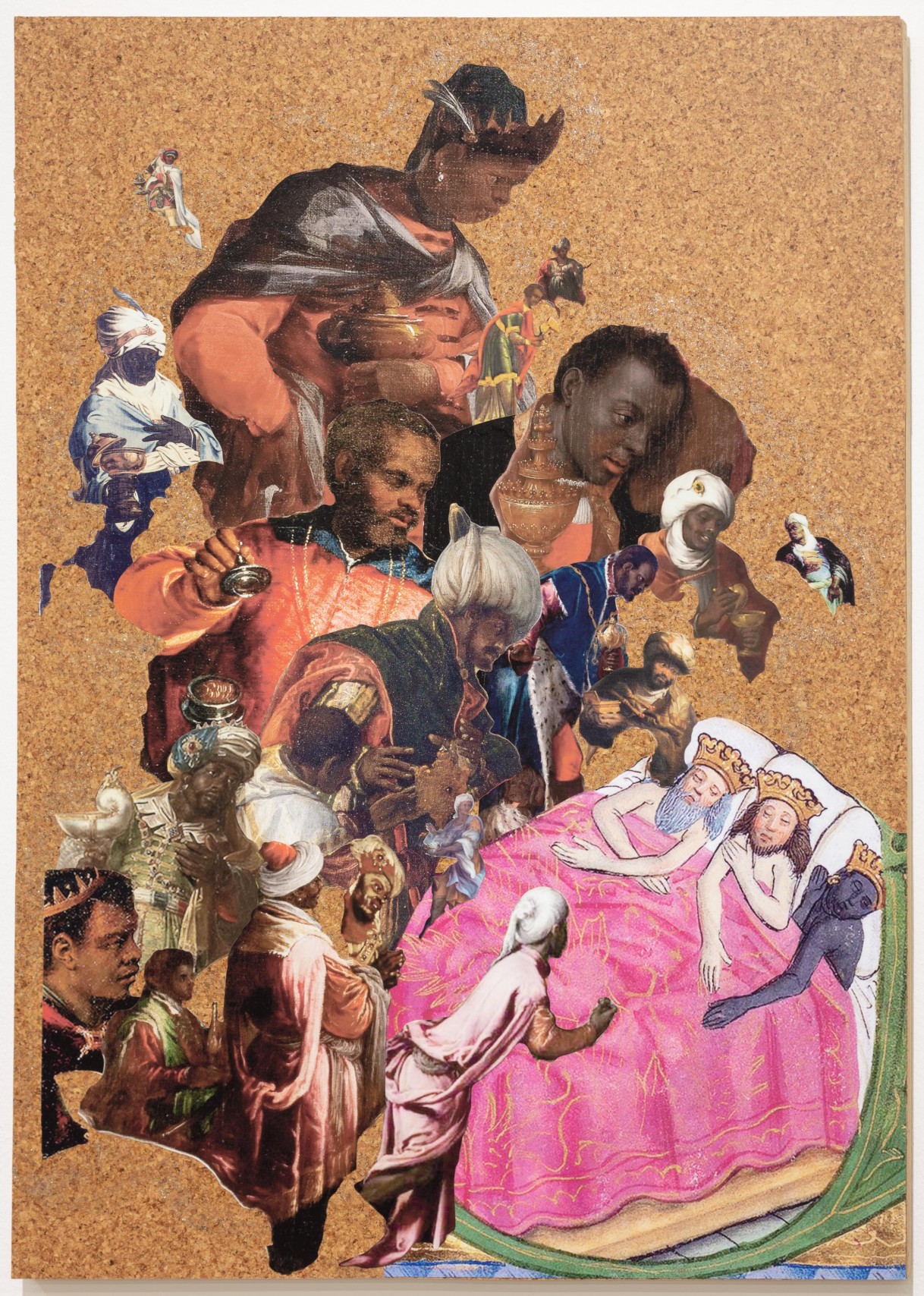
Lastly, here’s an amusing collage from Practice Makes Perfect:
Uddoh, Rosa-Johan_Get up mate, we're going to the protest
Rosa-Johan Uddoh, Get up mate, we’re going to the protest, 2021

The image of the three kings in bed is taken from the ca. 1480 Salzburg Missal. (In the original they’re inside an initial E, which introduces the text for the introit for the Feast of Epiphany, “Ecce advenit dominator dominus.”) In the Middle Ages it was common for artists to depict the magi in bed together when they receive the angelic warning not to reveal the location of the baby Jesus to King Herod, who intends to harm him (Matt. 2:12). There’s nothing sexual about it—it’s just a compositional practicality, to show the three men in one space, having the same dream at the same time.

In Uddoh’s playful remix, she has a slew of Balthazars leaning over the bed to wake up their sleeping comrade so that he can join them in a protest for racial justice.

LISTEN: The Ballad of the Brown King by Margaret Bonds, 1954, rev. 1960 | Words by Langston Hughes, 1954/60 | Arranged by Malcolm J. Merriweather for strings, harp, and organ, 2018 | Performed by the Dessoff Choirs and Orchestra, dir. Malcolm J. Merriweather, on Margaret Bonds: The Ballad of the Brown King and Selected Songs, 2019 (soloists: Laquita Mitchell, soprano; Noah Stewart, tenor; Lucia Bradford, mezzo-soprano; Ashley Jackson, harpist)

I encourage you to listen to all nine movements! (The piece is twenty-five minutes long.) But if you want just a taste for now, here are two selections: movements 1 and 7.

I. Of the Three Wise Men

Of the three wise men who came to the King
One was a brown man, so they sing
Alleluia, Alleluia

Of the three wise men who followed the star
One was a brown king from afar
Alleluia, Alleluia

. . .

VII. Oh, Sing of the King Who Was Tall and Brown

Oh sing of the king who was tall and brown
Crossing the desert from a distant town
Crossing the desert on a caravan
His gifts to bring from a distant land
His gifts to bring from a palm tree land
Across the sand by caravan
With a single star to guide his way to Bethlehem
To Bethlehem where the Christ child lay

Oh sing of the king who was tall and brown
And the other kings that this king found
Who came to put their presents down
In a lowly manger in Bethlehem town
Where the King of kings a babe was found
The King of kings a babe was found
Three kings who came to the King of kings
And one was tall and brown

Margaret Bonds (1913–1972) was an African American composer, pianist, arranger, and teacher, best remembered for her popular arrangements of African American spirituals and her frequent collaborations with her friend Langston Hughes, especially the cantata The Ballad of the Brown King.

Dedicated to Rev. Dr. Martin Luther King Jr., The Ballad of the Brown King honors the African king Balthazar of Christian tradition, a figure extrapolated from the Gospel of Matthew’s account of the “wise men from the east” who came to worship the Christ child and bestow gifts. Bonds wanted to celebrate the wisdom and devotion of this dark-skinned brother, and his active presence at the Nativity, giving “the dark youth of America a cantata which makes them proud to sing,” she wrote in a letter.

She commissioned Hughes to write the libretto. She wrote to him, “It is a great mission to tell Negroes how great they are.” Remember, this was at the burgeoning of the civil rights movement. There were very few images of Black wealth and admirability being projected by mainstream culture at the time. Balthazar was an exception.

The Grammy-nominated conductor Malcolm J. Merriweather, who fueled a revival of interest in Bonds’s work (more on him below), said in an interview with Presto Music:

Regardless of the racial accuracy, this narrative [of an African king participating in the story of Christ’s birth] gives African Americans a positive image rarely portrayed in history, books, and art. A brown sovereign, traveling in majesty and splendor? It is unheard of. African Americans are not just descendants of slaves; we come from great kings or queens that ruled kingdoms with sophisticated political and economic systems on the continent of Africa.

The initial version of The Ballad of the Brown King premiered in December 1954, but Bonds and Hughes later revised and expanded it. The new version premiered December 11, 1960, at the Clark Auditorium of the YWCA in New York, sung by the Westminster Choir of the Church of the Master. The concert was presented as a benefit for the Southern Christian Leadership Conference.

The cantata is made up of nine movements with parts for soprano, tenor, baritone, and choir. Stylistically, the work has been described as neo-Romantic, but it also draws on gospel, jazz, blues, and calypso traditions.

The only commercial recording ever made of it is the one released by Avie Records in 2019. Newly arranged by Malcolm J. Merriweather, the piece is performed there by the Dessoff Choirs and Orchestra under Merriweather’s direction.

Bonds had scored the cantata for full orchestra—brass, woodwinds, strings (including harp), and percussion. But because hiring an orchestra of that size is expensive and he wants to see this work more widely performed, including in church contexts, Merriweather arranged the piece for a pared-down ensemble of harp, strings, and organ, omitting the winds and brass (whose parts he essentially absorbed into the new organ part). He also enlivened the harp part to add texture.

For more context on Bonds and on this most popular cantata of hers, here’s a great thirty-minute conversation between John Banther and Evan Keeley from a 2022 episode of the Classical Breakdown podcast, produced by WETA Classical in Washington, DC:
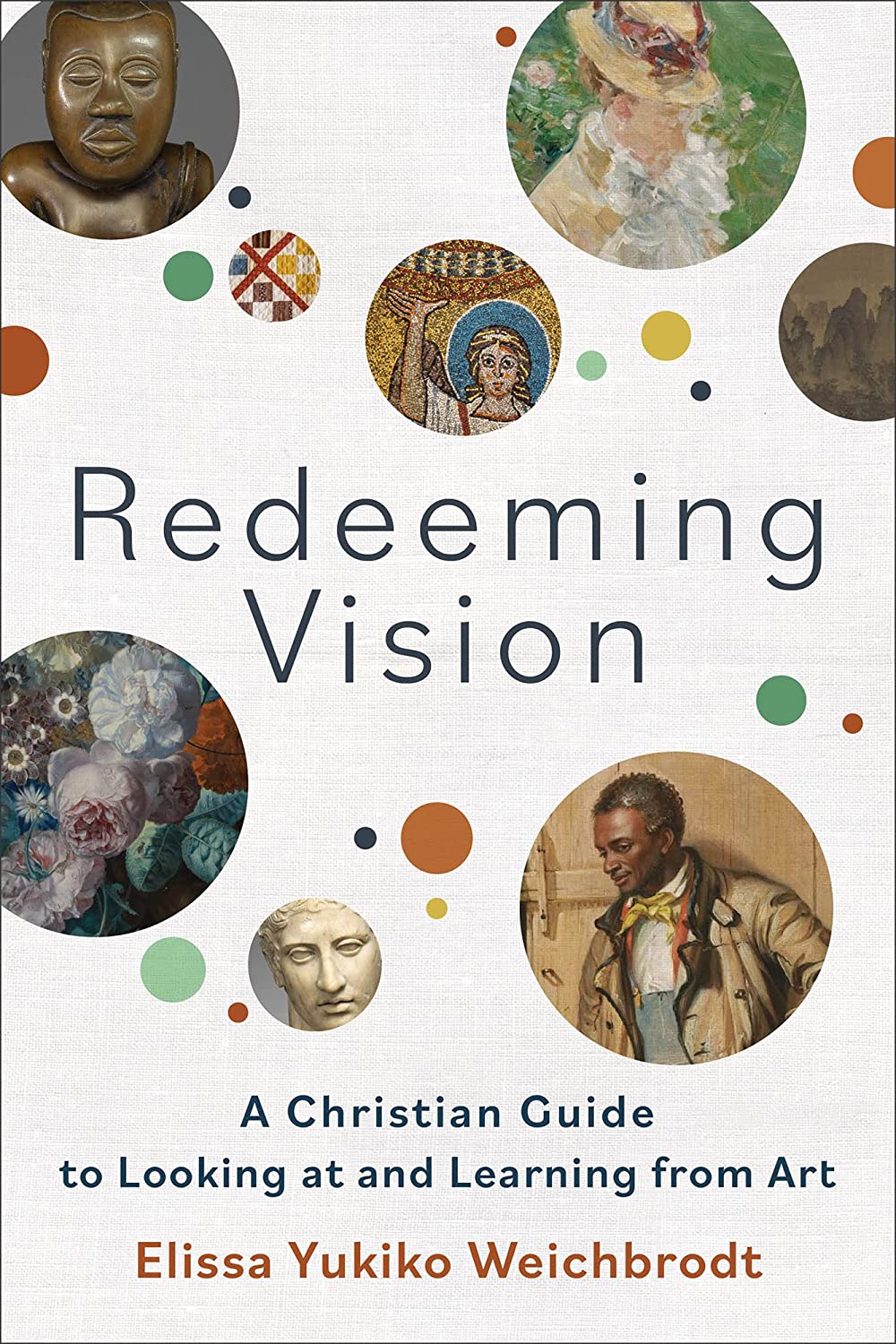
Book Review: Redeeming Vision: A Christian Guide to Looking at and Learning from Art by Elissa Yukiko Weichbrodt

Let’s say you’re visiting London. You buy a ticket to the Tate Modern, because hey, the tourist guides call it a must-see. You enter the enormous Turbine Hall and witness, across the five-hundred-foot downward concrete ramp that is the floor, a giant crack. No, it’s not a foundation problem. It’s a contemporary art installation by Doris Salcedo.* What in the world does this artwork have to offer? How do you engage meaningfully with it?

Dr. Elissa Yukiko Weichbrodt’s book Redeeming Vision: A Christian Guide to Looking at and Learning from Art (Baker Academic, 2023) equips Christians to look closely and well—with a posture of humility and generosity—at works from across the spectrum of art history, including ones like Salcedo’s Shibboleth that may initially evoke only puzzlement or an eye roll, and others that may at first glance seem run-of-the-mill and uninteresting (a marble head, a vase of flowers, an old family photograph). When we close ourselves off to art that doesn’t immediately touch us, we reject potential opportunities for transformation, transformation of how we see and how we love. Regardless of the personal faith commitments of its makers, Weichbrodt says, art can grow our love for both God and neighbor.

In order to love, we must first look. Weichbrodt gives examples of God’s looking in scripture to establish a “model of redemptive looking,” which “is utterly different from the objectifying gaze that is so common in our contemporary culture. Too often we look to consume, to surveil, to control, and to condemn. But as the beloved of God, we are called to mimic his gaze” (19). What if instead of letting personal judgments, stylistic, moral, or otherwise, dominate our approach to art, we were to adopt a primary posture of love?

When it comes to viewing art and visual culture, our faith doesn’t offer us a fence. It provides a path.

Elissa Yukiko Weichbrodt, Redeeming Vision, p. 10

Weichbrodt wants to move us beyond a facile thumbs-up or thumbs-down approach to looking at art, encouraging us to press in to unfamiliar (and too-familiar!) or even off-putting works with curiosity and openness, asking questions of them and allowing them to interrogate us as well. What stories, and whose stories, do the images tell and not tell?

She introduces the notion of “the archive,” the mental collection of images we have seen, which we subconsciously file into categories and access to help us interpret new images. Some examples of categories are “Mother,” “Poor,” “Black,” “Beautiful,” “Villain.” The problem is, our archives are inherently limited. For example,

Why do we have so many mental images of mothers in Africa living in poverty and so few mental images of successful, smiling African women who are business owners and community leaders? Why do we have so many images in our archive of good white mothers and so few of loving, strong, generous Latina mothers? A richly textured, robust, and varied archive is necessary if we are going to learn to see others—of all races, ethnicities, genders, and social classes—as God sees them. (62)

Expand your archive, Weichbrodt urges.

She demonstrates how archives work through a brilliant engagement with Dorothea Lange’s Migrant Mother (1936), an iconic photograph that I remember studying in a high school American history class but which Weichbrodt really opened up for me.

Weichbrodt is an associate professor of art and art history at Covenant College in Lookout Mountain, Georgia. Besides an intro-level Western art survey course, she also teaches courses such as “Race in American Art and Visual Culture,” “Women, Art, and Culture,” “Art and the Church,” “Grace in American Art,” “History and Theory of Photography,” “Global Modernisms,” and “Contemporary Art and Theory.” The facility with which she’s able to guide nonspecialists deeper into her subject is amply evidenced in this book, which is low-shelf academic, geared toward educated readers who may or may not have an art background.

Blue Room (Suzanne Valadon)
In chapter 9 of Redeeming Vision, on the mundane, Weichbrodt discusses how Suzanne Valadon’s Blue Room (1923) complicates a familiar art historical trope.

The most illuminating analyses in Redeeming Vision have to do with race, gender, and/or class; those are the topics where Weichbrodt’s primary research interests lie, and it’s where she really shines. She complexifies images that we might be inclined to take at face value, not think much about.

A highlight of the book is how Weichbrodt joins together fine art and contemporary visual culture more broadly, drawing Instagram selfies, memes, advertisements, news photos, propaganda posters, and such into conversation with paintings, sculptures, and other artworks that you’re likely to find in a museum. The tools she provides for performing visual analysis—chapter 1 unpacks that toolbox, giving us language (and a handy chart!) for describing an image’s visual qualities—can be applied just as well to a friend’s iPhone photo as to a multimillion-dollar oil painting that’s been the subject of multiple monographs.  

As would any art historian, Weichbrodt emphasizes the importance of understanding artworks within their historical contexts; “even if we can’t find all the answers, we should remember to ask questions about the image or object’s original audience and purpose” (62). But where she differs from some academics in the field is that she also acknowledges that our backgrounds—who we are, what we aspire to be, what experiences we carry with us, our cultural conditioning—are not irrelevant to the process of looking at art. She invites us to take stock of associations that come up for us in response to certain images, not to make them an authoritative lens but to prompt queries that bring us closer to truth. We need to recognize the limitations of how we see, but we need not get ourselves entirely out of the way when it comes to art, as if pure objectivity were even possible.

In Weichbrodt’s discussion of specific artworks, I appreciate the balance of attention between the work’s formal qualities, content, historical situatedness, and meaning. She also reminds us to consider a work’s physical context. In chapter 3, for example, she uses Caravaggio’s Deposition to discuss the differences between experiencing an artwork in situ (that is, in the place for which it was created; in this case, a chapel), in a museum, and online—and what questions to ask in each situation.

Caravaggio chapter opener

Chapters 4–10 each conclude with a “For Further Looking” page that lists artworks related to the theme of the chapter and offers guided questions. For example, in chapter 9, “Allowing for Complexity: Art of the Everyday,” the “For Further Looking” section includes the headings “Nineteenth-Century American Genre Painting” (How do these works reinforce certain gender roles or racial hierarchies?), “Genre Works by Black American Artists” (How do these works celebrate the normalcy of Black life and achievement?), and “The History of the Female Nude in Western Art” (How have artists borrowed, developed, and critiqued this trope?). I found these end-of-chapter sidebars to be incredibly helpful, quenching my desire for wider exploration and deeper reflection.

Some of the topics Weichbrodt covers in the book include:

God’s Transcendence. In chapter 5 she contrasts a medieval church mosaic, with its golden resplendence, placed above the head to an abstract expressionist painting by Kandinsky, an explosion of color and movement and indefinable forms—two very different ways, and over a millennium apart, to convey the same idea.

Portraiture. In chapter 7 she addresses the possibilities and pitfalls of the portrait genre. From a Spanish count-duke to a Kuba nyim (king) from Central Africa to the anguished Vincent van Gogh to a mourning Missouri father with his two daughters and nurse, Weichbrodt discusses the physical self, the symbolic self, the public self, the private self, and the relational self. She also comments on how the portraits we see of others on social media shape our self-perception and self-representation.

Landscape. In chapter 8 she considers humanity’s relationship to nature by looking at two mountain views: a Chinese ink on silk from the Northern Song Dynasty, influenced by the principles of Confucianism, and a painting of the American West made during the era of westward expansion.

Weichbrodt encourages us to think critically about the stories we tell through images. Take, for example, this before-and-after photograph of Hastiin To’Haali, a resident of the federally funded Carlisle Indian Industrial School (1879–1918) in Carlisle, Pennsylvania, which gutted me:

Choate, John_Tom Torlino
John Choate, “Tom Torlino—Navajo. As he entered the school in 1882. As he appeared three years later,” in Souvenir of the Carlisle Indian School (Carlisle, PA: J. N. Choate, 1902)

Founder Richard Henry Pratt hired the commercial photographer John Choate to document the residential school’s so-called success in “kill[ing] the Indian, . . . sav[ing] the man,” as Pratt put it, and these are two of the hundreds of photos he took of the students. What do we do when images lie?

One of my favorite chapters in the book is chapter 10, “Learning to Lament: The Art of History.” Here Weichbrodt discusses an ancient Assyrian stone relief carving of a soldier conducting captives across a river, a widely distributed revolutionary-era engraving of the Boston Massacre by Paul Revere, and From Here I Saw What Happened and I Cried by Carrie Mae Weems (1995).

“History is not simply a documentation of the past,” Weichbrodt writes. “It is the story we tell about past events. What do we include? What gets left out? Who has our empathy? Who can be vilified?” (215). She continues:

What stories do we weave about who we are and who we are not? Does our telling of history—and the images we use to support it—ignore brokenness in favor of self-congratulation? What are the images and objects that direct us to lament? We lament not to wallow in despair or guilt or recriminations but because we have the freedom to weep as children of God. Ours can be a productive grief. (232–33)

Hospitable, expansive, and full of insight, Redeeming Vision helps Christians identify the ways in which images form us and teaches us how to skillfully analyze them. Art viewing, Weichbrodt writes, is not necessarily a passive activity; it requires something of us and can be generative. “Our gaze,” she says, “can open up something new” (11), leading to doxology, confession, empathy, understanding, lament, shared delight, or love.

Visit the book’s website at https://www.redeemingvision.com/. You can order a copy from Amazon or Baker Publishing Group, and sign up to participate in the guided chapter-by-chapter reading community that Weichbrodt is leading from August 28 to November 17, 2023. Follow her on Instagram @elissabrodt.

* This artwork is no longer on display; the crack was filled in in 2008.


Note: On November 11, 2023, the Eliot Society in Annapolis, Maryland, is hosting a lecture by Elissa Yukiko Weichbrodt titled “Rupture as Invitation: Generosity and Contemporary Art,” and I’ll be moderating the Q&A. I hope you can come out! Register here. (Update: Listen to the talk.)

Elissa Yukiko Weichbrodt