Advent, Day 15: Great Joy River

Then I saw a new heaven and a new earth, for the first heaven and the first earth had passed away, and the sea was no more. And I saw the holy city, the new Jerusalem, coming down out of heaven from God . . .

It has a great, high wall with twelve gates, and at the gates twelve angels, . . . and the twelve gates are twelve pearls. . . .

I saw no temple in the city, for its temple is the Lord God the Almighty and the Lamb. And the city has no need of sun or moon to shine on it, for the glory of God is its light, and its lamp is the Lamb. The nations will walk by its light, and the kings of the earth will bring their glory into it. Its gates will never be shut by day—and there will be no night there. . . .

Then the angel showed me the river of the water of life, bright as crystal, flowing from the throne of God and of the Lamb through the middle of the street of the city. On either side of the river is the tree of life with its twelve kinds of fruit, producing its fruit each month, and the leaves of the tree are for the healing of the nations. Nothing accursed will be found there any more. But the throne of God and of the Lamb will be in it, and his servants will worship him; they will see his face, and his name will be on their foreheads. And there will be no more night; they need no light of lamp or sun, for the Lord God will be their light, and they will reign forever and ever.

—Revelation 21:1–2, 12, 21–25; 22:1–5

LOOK: The New Heaven by Leroy Almon
Almon, Leroy_The New Heaven
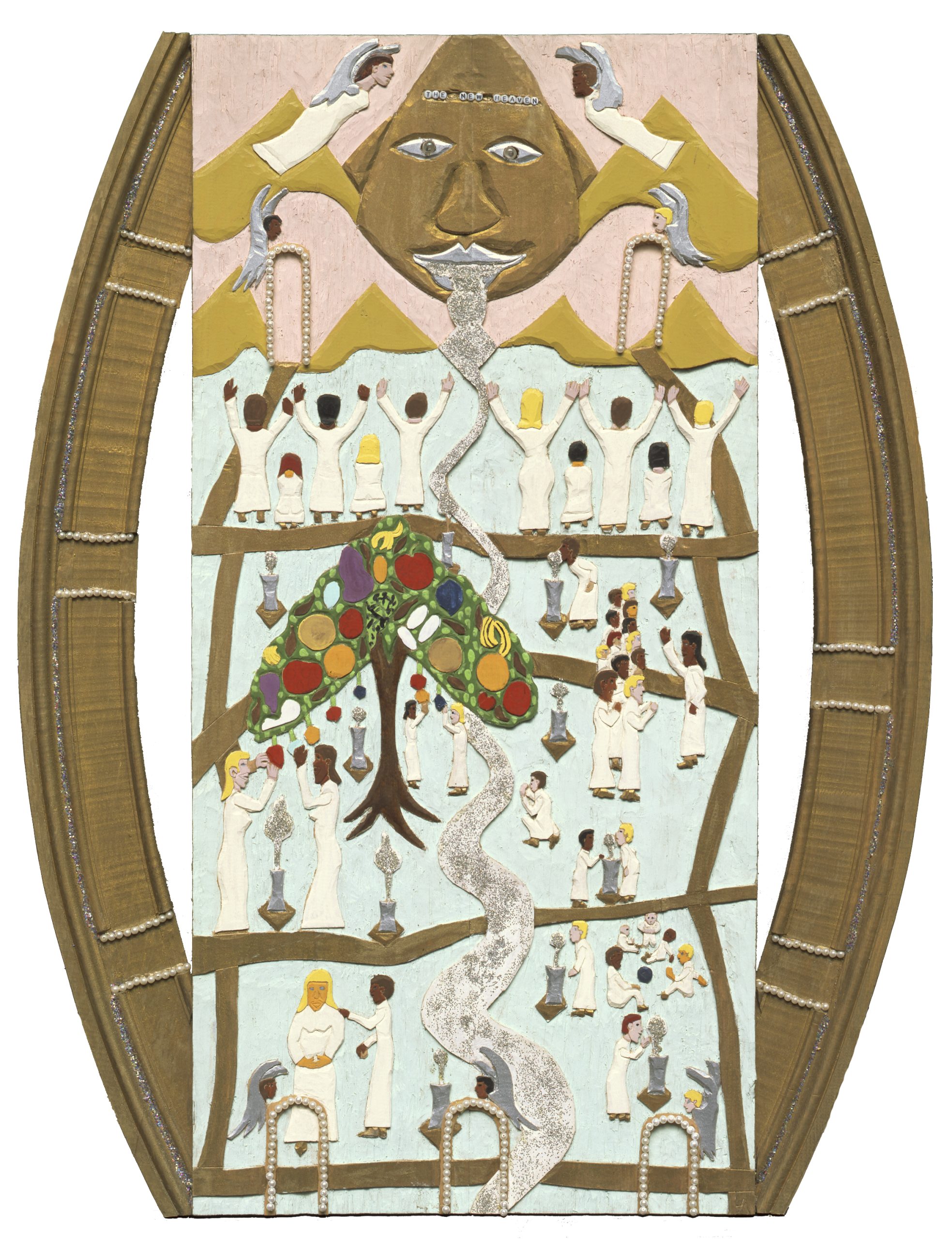
Leroy Almon (American, 1938–1997), The New Heaven, 1984. Carved wood, light bulbs, artificial pearls, glue, glitter, plastic letters, paint, 36 × 28 in. (91.4 × 71.1 cm). Toledo Museum of Art, Ohio. [object record]

This mixed-media depiction of heaven by African American folk artist Leroy Almon draws on imagery from the book of Revelation, showing centrally a crystal-bright river, the water of life, flowing forth from the mouth of God (Rev. 22:1–2). It courses through the paradisal scene, past the tree with its twelve fruits and healing leaves, and is pumped into twelve fountains, from which Black and white people drink together. Across lines of race, the new-city dwellers unite in worship, fellowship, and play. Notice the group of children with the ball in the bottom register!

For a framing device, Almon has used two wooden doors that bow out, as if the scene in all its fullness cannot be contained; as if the borders of the new city must bend to embrace the multitudes and their joy. The shape communicates an expansiveness that is the heart of God.

God is shown as majestic, mountain-like, and yet bearing a tender expression. The plastic beads on his forehead are printed with letters that read, “THE NEW HEAVEN,” and his eyes (not lit in this photo) are battery-powered light bulbs! He is, as John the Revelator tells us, the unending light dispelling all darkness. 

Almon was born in 1938, so for about the first three decades of his life, he lived in a country where racial segregation was enforced legally in many states and socially in others. By and large, Blacks and whites were made to live in separate neighborhoods, attend separate schools, swim in separate pools, eat at separate restaurants, drink from separate water fountains, pass through separate public building entrances, wait in separate waiting rooms, sit in separate sections of the bus and the theater and even (woe is us) the church, and so on. Even after the passage of the Civil Rights Act in 1964, mandating desegregation, racial prejudices and hostilities continued to persist, as they do today. And because sinful human beings create and run systems (criminal legal, economic, educational, medical, etc.), it’s no surprise that the sin of racism can be found there as well.

Almon longed to see racial justice and (re)conciliation, and he knew Jesus has the power to make it happen. Almon’s preaching ministry went hand-in-hand with his art making. Through both, he shared the good news that Jesus, through his life, death, and resurrection, calls us to a new way of being in the world, which involves repentance of sin and turning to the divine light of love that knows no bounds. His New Heaven envisions a world saved and transformed by Christ’s love, where power is shared equally, forgiveness sought and granted, and friendship is the order of the day, as is a shared rejoicing in the greatness of God. In The New Heaven, Black and white praise Jesus side-by-side, eat at the tree of life together, and put their lips to the same bubbling fount of living water.

And not only are relationships healed and humanity restored to its original harmony in the new heaven, but also personal sorrows and hardships are no more. Physically, mentally, emotionally, spiritually, socially, we flourish in the light of God that never dims.

For more on Leroy Almon, see this Art & Theology Lenten devotional post from earlier this year.

LISTEN: “Great Rejoicing” by Thad Cockrell, on To Be Loved (2009) | Performed by Rain for Roots, feat. Sandra McCracken and Skye Peterson, on Waiting Songs (2015)

There’s gonna be a great rejoicing (2×)

The troubles of this world
Will wither up and die
That river of tears made by the lonely
Someday will be dry
There’s gonna be a great rejoicing

There’s gonna be a great joy river (2×)

Questions of this world
Someday will be known
Who’s robbing you of peace
And who’s the giver

There’s gonna be a great joy river

Someday you will find me
Guarded in His fortress
Open heart and wings
That never touch the ground
Someday we will gather
In a grand reunion
Debts of this old world
Are nowhere to be found
Nowhere to be found

There’s gonna be a great rejoicing (5×)

We are now halfway through Advent! Many of the songs featured in this Advent series, including today’s, appear on my Advent Playlist. I also have a companion Christmastide Playlist, which has been revised and expanded since last year to include some choral selections.
Roundup: Norman Rockwell updated; snow-crystal photography; Good Samaritan icon; and more

Freedom of Worship by Hank Willis Thomas and Emily Shur
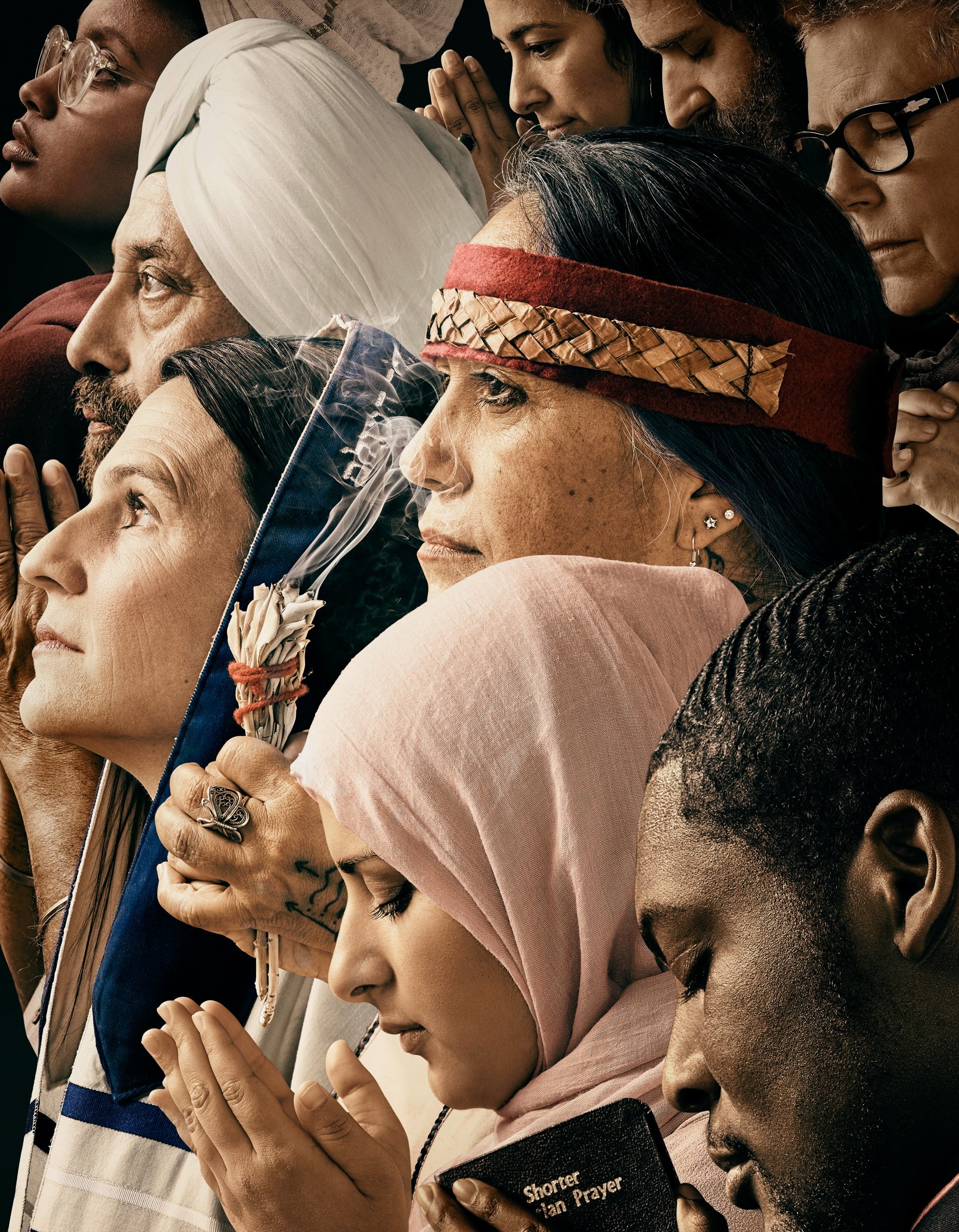
Hank Willis Thomas (American, 1976–) and Emily Shur (American), Freedom of Worship, 2018. While Norman Rockwell’s illustration of the same name contains specific representations of Protestantism, Catholicism, and Judaism, this reinterpretation goes even further to include Islam, Native American spirituality, and Sikhism.

NEW PHOTOGRAPH SERIES: “The Four Freedoms” by Hank Willis Thomas and Emily Shur: In his 1941 State of the Union address, President Franklin D. Roosevelt insisted that people in all nations share Americans’ entitlement to four basic freedoms: freedom of speech, freedom of worship, freedom from want, and freedom from fear. This famous speech became the basis for Norman Rockwell’s set of four illustrations, originally published in the Saturday Evening Post in 1943, that have become some of history’s most iconic representations of the American idea.

Artist Hank Willis Thomas and photographer Emily Shur decided to reimagine these scenes with a cast that’s more representative of American diversity. One of the eighty-two final images they created is published on the cover of the current issue of Time magazine. It and others will form the backbone of a national billboard campaign by the nonpartisan organization For Freedoms to encourage civic engagement. “We believe that if artists’ voices replace advertising across the country, public discourse will become more nuanced,” their website says.

+++

IN CONCERT: Eric and I went to see brother-sister folk duo The Oh Hellos (Tyler Heath and Maggie Heath Chance) in Baltimore earlier this month and had a great time. My favorite song from their set list was “Soldier, Poet, King,” which describes Jesus’s coming in all three roles—perfectly appropriate for the upcoming Advent season! Jesus, the Word of God, comes to tear down Satan’s kingdom and establish his just rule in our lives and world (1 John 3:8bRev. 19:11–16). The final verse affirms Jesus’s status as Messiah, the waited-for “Anointed One,” and celebrates his power marked by humility, even unto death. The blood he wears into battle is his own.

There will come a soldier
Who carries a mighty sword
He will tear your city down
O lei o lai o lord

There will come a poet
Whose weapon is his word
He will slay you with his tongue
O lei o lai o lord

There will come a ruler
Whose brow is laid in thorn
Smeared with oil like David’s boy
O lei o lai o lord

The Oh Hellos’ nationwide tour continues through the end of the year, so visit their website to see if they’ll be stopping near you.

+++

NEW ALBUM: Crumbs by Liturgical Folk: Liturgical Folk (previously here and here) released its third album this month, which “build[s] on the themes of eucharist and the mission of the church to bring peace and reconciliation to the world.” The title comes from the track “Prayer of Humble Access,” a verbatim setting from the “Holy Eucharist Rite I” in the Book of Common Prayer that alludes to the story of the Syrophoenician woman.


Most of the song texts on the album come from that traditional Anglican prayer-book and were set to music by Ryan Flanigan, though a few texts are contemporary. “Lord, Lord, Lord,” for example, was written in the wake of the August 9, 2014, shooting of Michael Brown in Ferguson, Missouri, and amid the subsequent escalation of racial tensions in the country. “As a privileged, white, middle class, American man,” Flanigan wrote,

I felt for the first time in my life the systemic injustice against black males in our country. What I found most troubling, besides death itself, was the response of some white, privileged people to the shooting, particularly the response of some Christians on social media and the News. When we should have been mourning with those who mourn, confessing our fears and sins, and seeking reconciliation, many of us turned a blind eye or, worse, assumed a posture of defensiveness and denial. I wrote this song as a corporate confession of sin to God and our fellow men, a plea for God to forgive us and restore our broken trust with him and with those we’ve failed to love.

+++

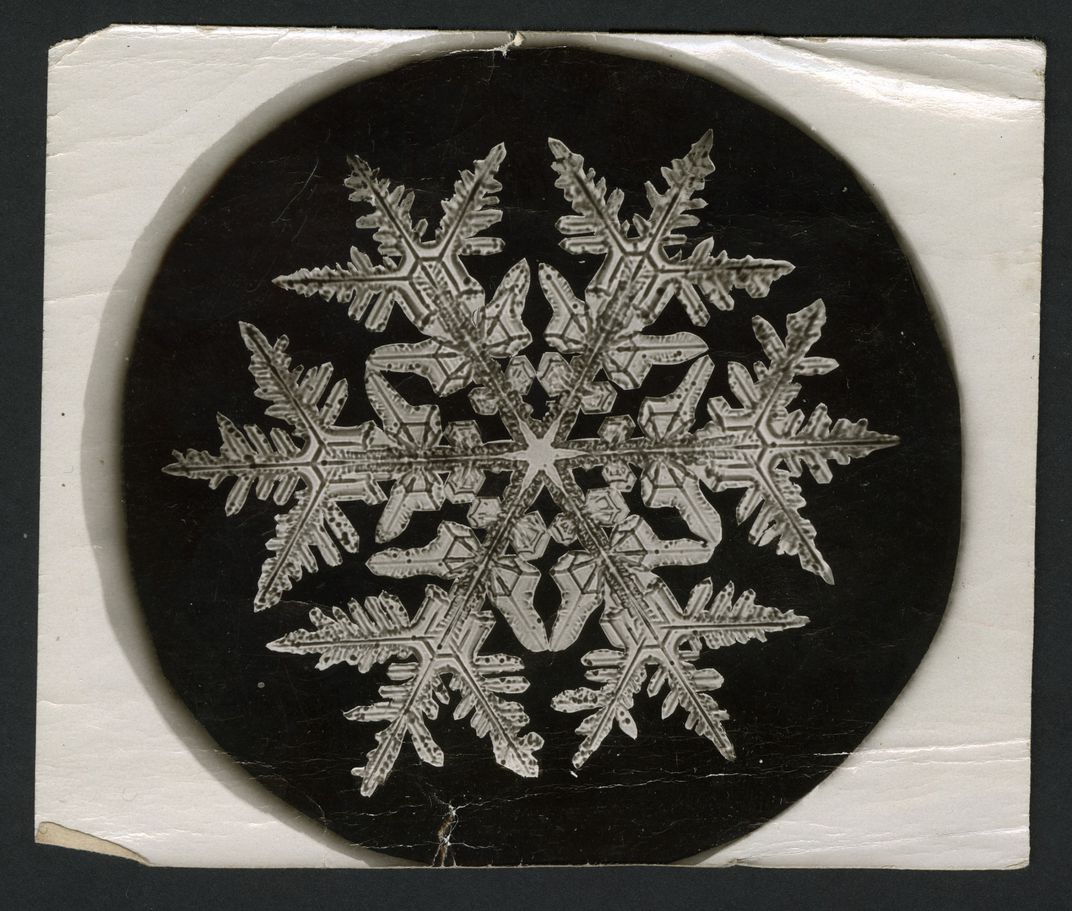
WORLD’S FIRST SNOWFLAKE PHOTOS: “The Man Who Revealed the Hidden Structure of Falling Snowflakes”: Maryland saw its first snow of the season this week, as did most of the East Coast, which means Twitter saw a flurry of snowflake images! The Smithsonian posted about Wilson “Snowflake” Bentley (1865–1931), whose perfection of innovative photomicrographic equipment and techniques (which included chilled velvet and a turkey feather) enabled him to photograph thousands of individual snowflakes without their melting, providing valuable scientific records of snow crystals and their many types.

The first person to photograph a single snowflake, . . . Wilson A. Bentley used a microscope with his bellows camera—plus years of trial and error—to get a photo of one flake in 1885. But he didn’t stop there. Bentley went on to take thousands more, . . . which helped support the belief that no two snowflakes are alike. In 1903, he sent 500 prints of his snowflakes to the Smithsonian, hoping they might be of interest to our Secretary. The images are now part of the Smithsonian Archives.

Snowflake photo by Wilson Bentley

Snowflake photo by Wilson Bentley

+++

BALKAN ICON: “Transforming a Parable: The Good Samaritan”: Run by David Coomler, a museum researcher, Icons and Their Interpretations discusses aspects of traditional Russian, Greek, and Balkan iconography, inviting people to submit photos of icons for identification of subject or meaning, and translation of inscriptions. Recently he wrote about a fourteenth-century Serbian Orthodox fresco that, like many of the church fathers, promotes an allegorical reading of the parable of the good Samaritan. In this interpretation, the man en route to Jerusalem is Adam, or Everyman, who is beaten by demons; the priest and the Levite represent the law of Moses and the priesthood of Aaron, which cannot help the wounded man. But the “good Samaritan,” Jesus, stoops down to save, carrying the man not on a beast of burden but on his own back, to an “inn,” the church. He hands two “coins,” the Bible and tradition, to the innkeeper, and promises to return. See further image details and commentary at the web link above.

Good Samaritan fresco (Balkans)
Parable of the Good Samaritan (see bottom register), 14th century. Fresco in the narthex of the Patriarchal of Pech, a Serbian Orthodox monastery in Kosovo.

Good Samaritan fresco (Balkans) (detail)

+++

OBITUARY: Christian composer Kurt Kaiser dies at 83: On November 12, Kaiser passed away at his home in Waco, Texas, after a six-decade-long career in composing, playing, arranging, and producing Christian music. A Gospel Music Hall of Famer and a progenitor of CCM, he’s best known for his song “Pass It On,” but I know him for “Oh How He Loves You and Me,” two renditions of which are posted below; the first is a solo performance by Vanessa Williams with gospel piano accompaniment by Richard Smallwood, and the second is performed a capella in four-part harmony by Kaoma Chende with the use of overdubbing.

When Brothers Dwell in Unity (Artful Devotion)

All of Mankind by William Walker
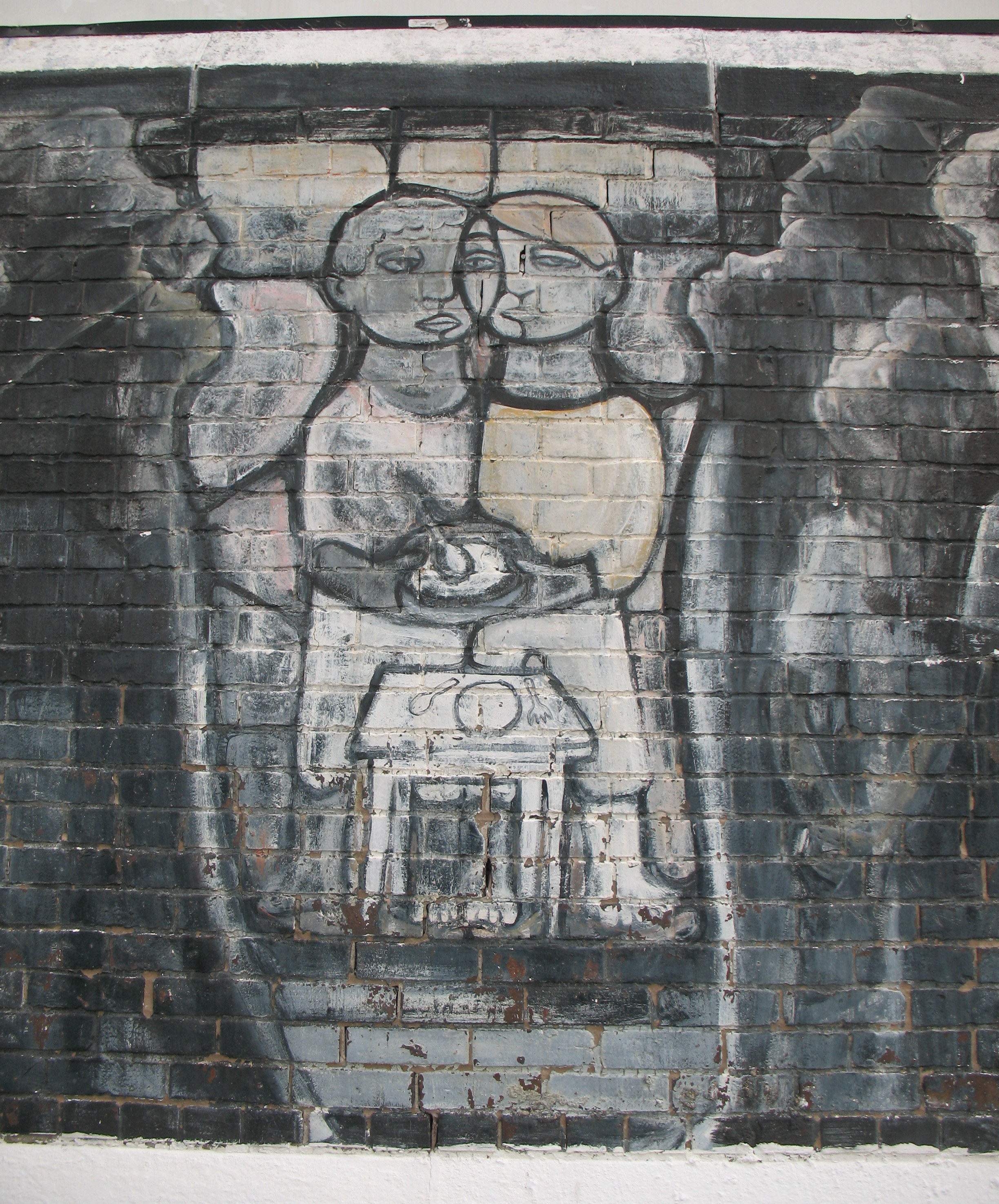
North facade of the former Stranger’s Home Missionary Baptist Church in Chicago, with mural by William Walker, 1972. (The mural was painted over in 2015.) Photo: Gabriel X. Michael/Chicago Patterns.

Behold, how good and pleasant it is
when brothers dwell in unity!

It is like the precious oil on the head,
running down on the beard,
on the beard of Aaron,
running down on the collar of his robes!

It is like the dew of Hermon,
which falls on the mountains of Zion!
For there the Lord has commanded the blessing,
life forevermore.

—Psalm 133

+++

SONG: “Together (Psalm 133)” by James Zeller | Performed by David Potter, on The Good Life by the Psalter Project (2017)

All of Mankind by William Walker
William Walker (American, 1927–2011), All of Mankind mural detail, 1972 (now lost). Stranger’s Home Missionary Baptist Church, Chicago. Photo courtesy of the Chicago Public Art Group.

All of Mankind by William Walker
William Walker (American, 1927–2011), All of Mankind mural detail, 1972 (now lost). Stranger’s Home Missionary Baptist Church, Chicago. Photo courtesy of the Chicago Public Art Group.

For more info on Walker’s mural, see my review of Painting the Gospel.

+++

This weekend we witnessed how bad and destructive it is when brothers dwell in disunity. For congregations seeking resources for responding prayerfully to the racist attack carried out in Charlottesville, Virginia, Rich Villodas has written a litany:

Leader: Lord Jesus, your Kingdom is good news for a world caught in racial hostility. We ask that you would give us grace for the deep challenges facing our country.


Congregation: O Lord, only you can make all things new.


Leader: Lord, we confess our anger, our deep sadness, and our collective sense of weakness to see this world healed through our own strength.


Congregation: O Lord, only you can make all things new.


Leader: Lord, we honestly confess that our country has a long history of racial oppression, that racism has been a strategy of evil powers and principalities.


Congregation: O Lord, only you can make all things new.


Leader: Lord, we confess that the gospel is good news for the oppressed and the oppressor. Both are raised up. Both are liberated, but in different ways. The oppressed are raised up from the harsh burden of inferiority. The oppressor from the destructive illusion of superiority.


Congregation: O Lord, only you can make all things new.


Leader: Lord, we confess that the gospel is your power to form a new people not identified by dominance and superiority, but by unity in the Spirit.


Congregation: O Lord, only you can make all things new.


Leader: Lord, we ask that you would help us name our part in this country’s story of racial oppression and hostility. Whether we have sinned against others by seeing them as inferior, or whether we have been silent in the face of evil. Forgive us of our sin.


Congregation: O Lord, only you can make all things new.


Leader: Lord, we pray for our enemies. For those who have allowed Satanic powers to work through them. Grant them deliverance through your mighty power.


Congregation: O Lord, only you can make all things new.


Leader: Lord, we ask that you would form us to be us peacemakers. May we be people who speak the truth in love as we work for a reconciled world.


Congregation: O Lord, only you can make all things new.


Leader: Lord, we commit our lives to you, believing that you are working in the world in spite of destructive powers and principalities. Bring healing to those who are hurt, peace to those who are anxious, and love to those who are fearful. We wait for you, O Lord. Make haste to help us.


Congregation: O Lord, only you can make all things new.


This post belongs to the weekly series Artful Devotion. If you can’t view the music player in your email or RSS reader, try opening the post in your browser.

To view all the Revised Common Lectionary scripture readings for Proper 15, cycle A, click here.