Roundup: Medieval reading recommendations, “Christ Our Lover,” and more

SUBSTACK POST: “Read something medieval this year” by Grace Hamman: One of the most frequently asked questions that medievalist Grace Hamman receives is: “What books should I read from the past?” She gives recommendations for the following six scenarios (including specific translations/editions!).

  1. I have never read anything medieval before! Where do I start?
  2. I have not read any medieval literature, but I did read Confessions in college. How about something a little later, a little more “medieval”?
  3. I want to read some medieval theology.
  4. I’ve read Bernard. Give me a theology deep cut!
  5. No thanks on the monastic theology. Give me poetry! Give me drama and beauty and weirdness!
  6. I’m a stubborn cuss / good millennial hipster / professional troublemaker. I want to read what no one else is reading casually. Make it super hard and dialectical and confusing (but awesome).

+++

LECTURE: “Christ Our Lover: Medieval Art and Poetry of Jesus the Bridegroom” by Grace Hamman: Last fall I had the pleasure of inviting Dr. Grace Hamman (see previous roundup item) to my neck of the woods to speak for the Eliot Society, a Maryland nonprofit I serve on the board of. She gave this wonderful lecture on one of the popular medieval metaphors for Christ in theology and the arts, which was Jesus as bridegroom, or lover. For medieval people, “the union between God and the human soul was . . . a marriage made in mutual desire, joy, and even mutual submission,” she says. Hamman explores a few different pieces belonging to this tradition, including the fourteenth-century poem “Quia Amore Langueo” (Because I Languish for Love) and the fascinating fifteenth-century verse and image sequence Christus und die minnende Seele (Christ and the Loving Soul).
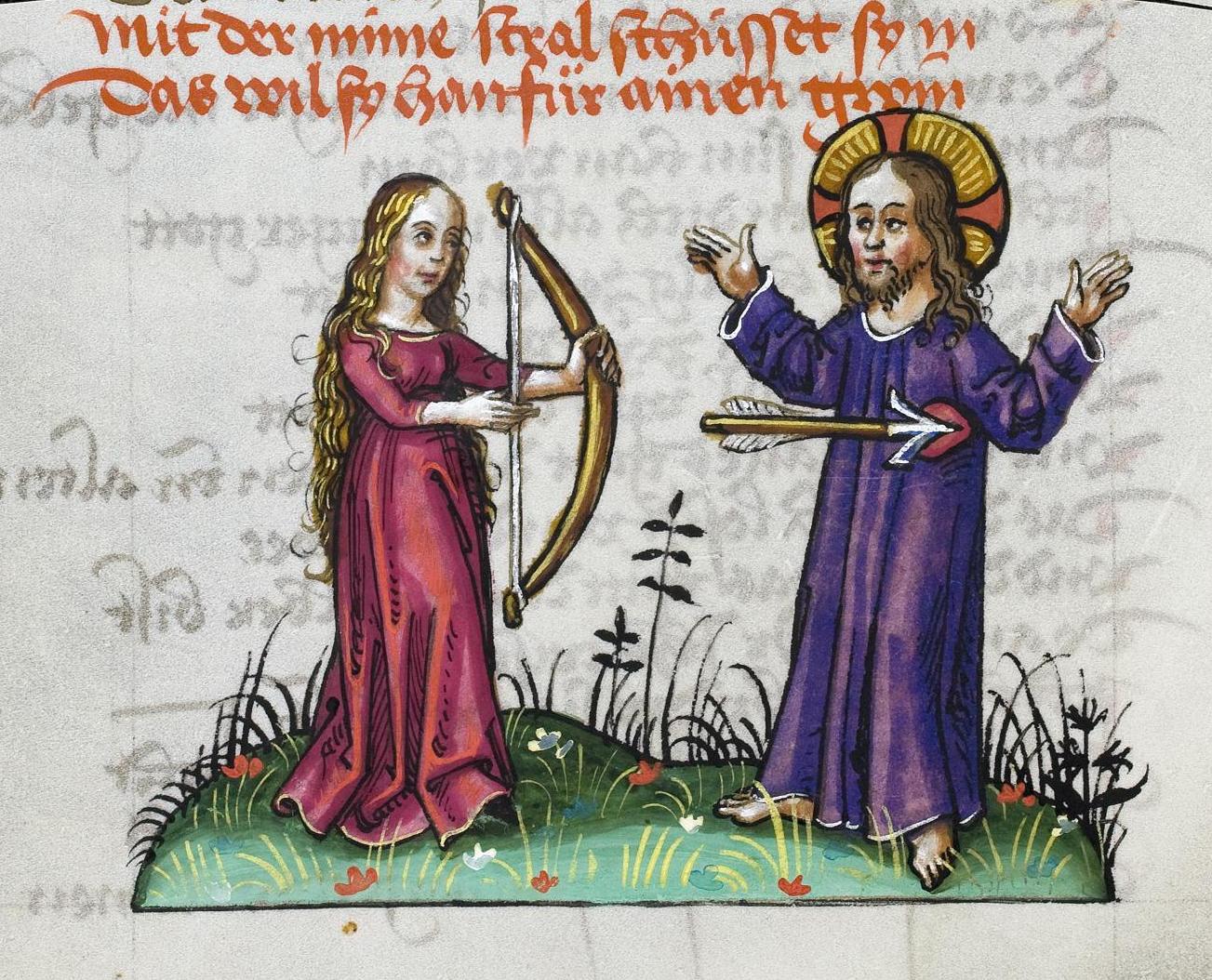
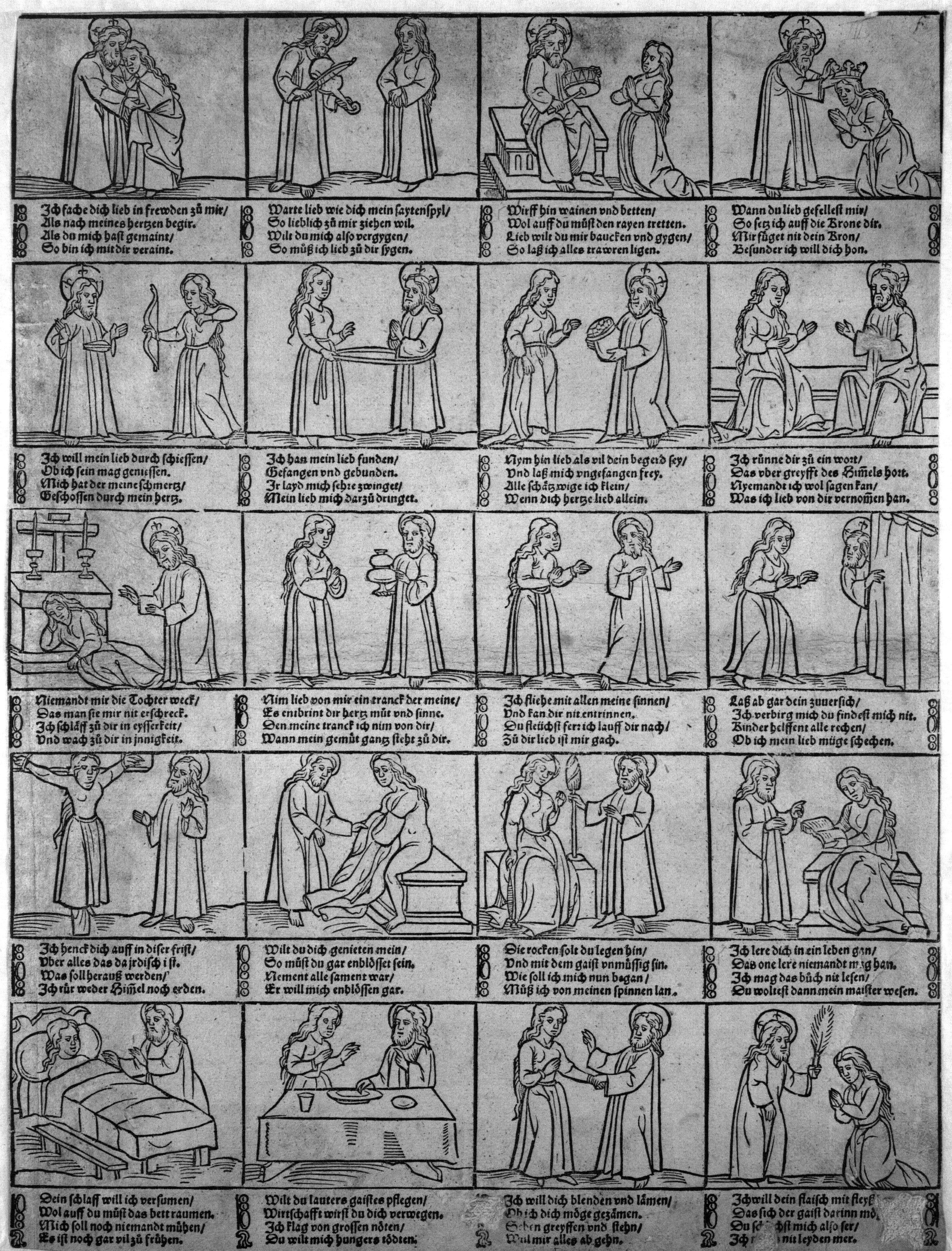
Christ and the Loving Soul (arrow of love)
Illustration by Rudolf Stahel (ca. 1448–1528) from a copy of Christus und die minnende Seele, Constance, Germany, ca. 1495. Karlsruhe, Badische Landesbibliothek, Cod. Donaueschingen 106, fol. 26v. Amber L. Griffioen provides this caption: “The Soul takes up her bow, draws her minne stral (or ‘arrow of love’), and goes on the hunt. She shoots and wounds Christ in the side, capturing him as her prize in order to ‘enjoy him’ forever.”

Christ and the Loving Soul broadsheet
Christus und die minnende Seele, from the printing house of Matthäus Franck in Augsburg, Germany, 1559–68. Woodcut, 35.5 × 27 cm. Munich, Bayerische Staatsbibliothek, Einblatt III, 52f.

+++

SONGS:

Inspired by Hamman’s talk, I’d like to turn your attention to the following two songs: one Jewish, the other Christian.

>> “Et Dodim Kala (Time for Lovers)”: The Hebrew text of this song, drawn from the biblical book the Song of Songs, is traditional Jewish (the video attributes it to Rabbi Haim Ben Sahl of the tenth century), and the music is a traditional gnawa melody (gnawa is a genre of Moroccan religious music marked by repetition). The performance is led by Lala Tamar on vocals and guembri (three-stringed bass plucked lute), and she’s joined by Ella Greenbaum and Imanouelle Harel on background vocals and krakebs (hand cymbals) and Tal Avraham on trumpet.

Tamar is an Israeli musician of Moroccan and Brazilian descent who performs Moroccan Jewish liturgical poems as well as contemporary music in Moroccan Arabic and Ladino.

Turn on closed captioning (CC) in the above video for the lyrics and their English translation, which is basically, “A time for lovers, my bride: / The vine has blossomed, / The pomegranates have budded.” The song is also available on Spotify.

>> “The Heavenly Courtier”: The anonymous words of this hymn were first published in 1694, and the tune is from The Christian Harmony (1805), a shape-note hymnal compiled by Jeremiah Ingalls. The song speaks of “Christ the glorious lover” who comes to earth “to woo himself a bride, resolving for to win her.” At first she’s resistant to his romantic entreaties, preferring instead the company of other lovers. But when she sees him for who he truly is—receives “one glimpse of [his] love and power”—she is overcome with ecstasy and accepts his proposal. The song ends with a wedding feast and mutual embrace. Read the full lyrics here, and listen to the Boston Camerata, directed by Joel Cohen, perform the piece on their album An American Christmas (1993); the vocalist is Joel Frederiksen.

I wouldn’t commend this hymn for a worship service, at least not without adaptation: while I’m on board with most of it, its Christ is in parts coercive, threatening violence, and there’s an overemphasis on the bride’s wretchedness and shame, with Christ the wooer breaking her down by revealing how “filthy” and unworthy she is. The Boston Camerata removes two of the more problematic verses, but I still think further tweaking needs to be done, more nuancing around the doctrines of sin and salvation (literarily, of course, preserving the extended metaphor!), to faithfully communicate the gospel through this song.

Regardless, I find it interesting as an artifact of early American Christian worship (it was sung congregationally in New England) and as an elaboration of the biblical picture of Christ the Bridegroom, not to mention poetically and musically charming. As I gathered from Grace Hamman’s lecture posted above, we can still appreciate creative works from the past and be moved or instructed by aspects of them without embracing them wholesale. It’s important for us Christians to be able to step outside our own cultural, historical, and denominational contexts with humble curiosity.

+++

2025 CALVIN SYMPOSIUM ON WORSHIP:

Calvin University’s annual Symposium on Worship was held last week. I wasn’t able to go this year, but I enjoyed tuning in virtually to the services that were livestreamed, now archived on the “Live” tab of the Calvin Institute of Christian Worship YouTube page. Here are two examples.

>> “Vesper: I Will Lift Mine Eyes,” led by Kate Williams and Tony Alonso: “Inspired by ancient and modern contemplative texts, this Vespers service is an invitation to come into the quiet and discover the eternal beauty of God’s consoling presence.” View the song credits in the YouTube video description.

>> “Worship Service: The Rich Man and Lazarus”: The Calvin University Gospel Choir, under the direction of Nate Glasper and with some songs guest-conducted by Raymond Wise, leads the musical portion of this service, and Rev. Dr. Dennis R. Edwards preaches on Luke 16:19–31, Jesus’s parable of the rich man and Lazarus. I especially enjoyed Wise’s original gospel song “Make a Joyful Noise” at 16:30, based on Psalm 100:1, and, also new to me, “Poor Man Lazarus” at 36:46, a traditional African American spiritual arranged by Jester Hairston. See additional song credits in the YouTube video description.
Roundup: Ecotheology, “Kadosh,” black church music, and more

I didn’t post an Artful Devotion this week, as I struggled to satisfactorily put together image and song for any of the readings, but I’ve now cycled through all three lectionary years on the blog, which are stored in the archives. For content on Sunday’s lectionary reading from the psalms, Psalm 133, see “When Brothers Dwell in Unity (Artful Devotion)” (featuring a Chicago mural by William Walker and a joyful new psalm setting from the Psalter Project); see also the poem “Aaron’s Beard” by Eugene Peterson.

+++

NEW ALBUM: Quarantine Sessions by Eric Marshall: Eric Marshall is the frontman of and songwriter for the meditative art rock band Young Oceans. During the COVID-19 quarantine he recorded eleven of the band’s old songs acoustically in his home studio—just his voice and guitar—and has released them digitally on Bandcamp. Several music artists have been making stripped-down records during this season, and I’m digging it!

+++

ART COMMENTARIES from ART/S AND THEOLOGY AUSTRALIA

Art/s and Theology Australia is an online publication that aims to provoke public reflection and promote research on conversations between the arts and theology, predominantly in Australian contexts. Here are a few articles from the recent past that I particularly enjoyed.

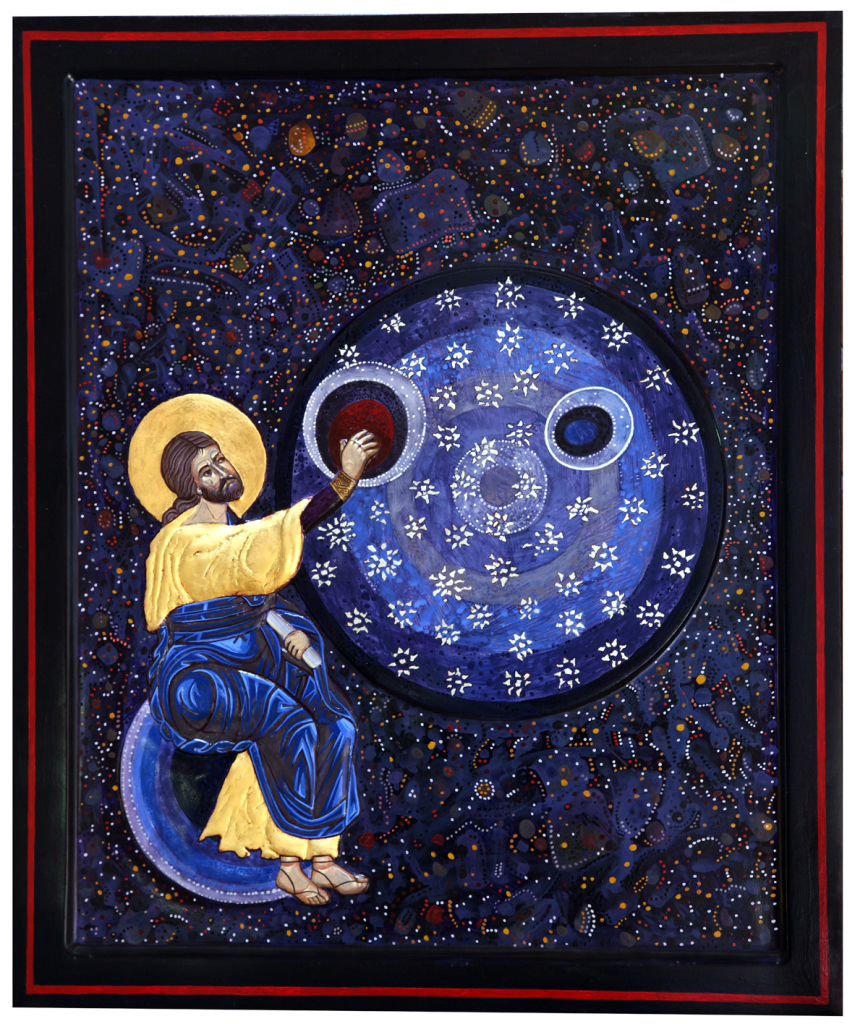
Galovic, Michael_Creation of Light in the Heavens
Michael Galovic (Serbian Australian, 1949–), Creation of Lights in the Heavens, n.d.

^^ “Jesus Dreaming: A Theological Reaction to Michael Galovic’s Creation of Lights in the Heavens by Merv Duffy: Creation of Lights in the Heavens by contemporary artist and iconographer Michael Galovic is an authentically Australian reading and rewriting of one of the Byzantine creation mosaics at Monreale Cathedral. Like its visual referent, it shows the Logos-Christ seated on the cosmos, hanging the sun in place (medieval artists tended to show God the Son, who is depictable, as Creator), but the gold background, used in icons to represent the eternal uncreated light of God, is replaced with dots, curves, and circles that represent the Dreamtime of Aboriginal theology, the origin of time and eternity.

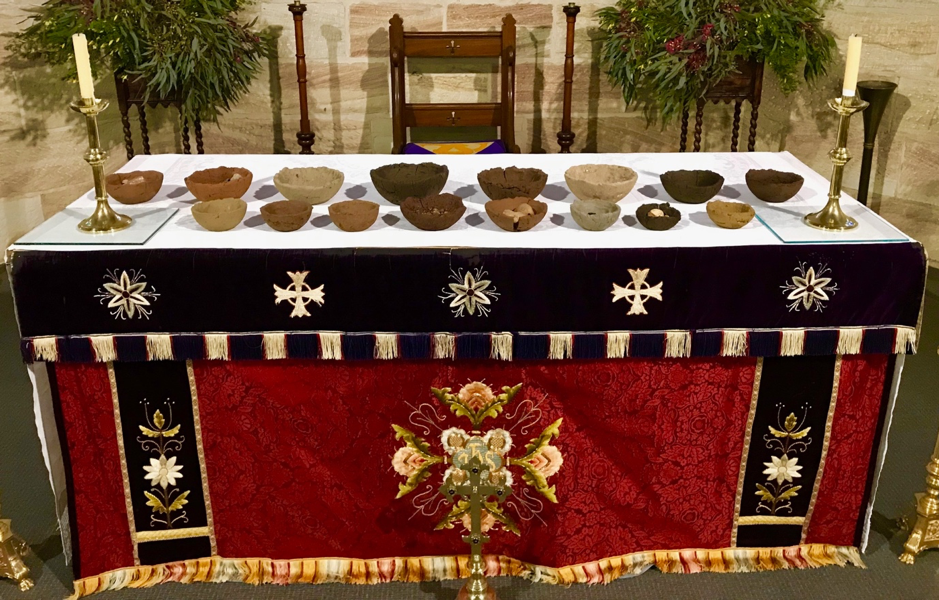
Dunstan, Penny_Sixteen Earth Bowls
Penny Dunstan, Sixteen Earth Bowls, 2018. Installed at Holy Trinity Anglican Church, Merriwa, for the Festival of the Fleeces.

^^ “Sixteen Earth Bowls” by Penny Dunstan: Soil scientist and visual artist Penny Dunstan has crafted bowls out of topsoil from rehabilitated coal mines in the Hunter Valley in Warkworth, New South Wales, which she exhibits in churches, among other places. “Making earth bowls is a way of thinking about my ethical responses to soil use in a post-mining landscape,” she writes. “It is a way of thinking with my heart and not just my head. As I work with each Hunter Valley topsoil, I come to understand each as an individual, a special part of God’s creation. Each soil behaves according to its own chemical nature and historical past when I fashion it into a bowl shape. . . .

“These soils, full of tiny lives, are responsible for growing our food, making our air and storing atmospheric carbon. Our very lives as humans on the earth depend on them. By fashioning these soils into bowls and placing them in sacred places, I hope to remind us to honour the earth that we stand upon, that earth that speaks to us by pushing back at our feet.” (Note: See also Rod Pattenden’s ArtWay visual meditation on Dunstan’s work.)

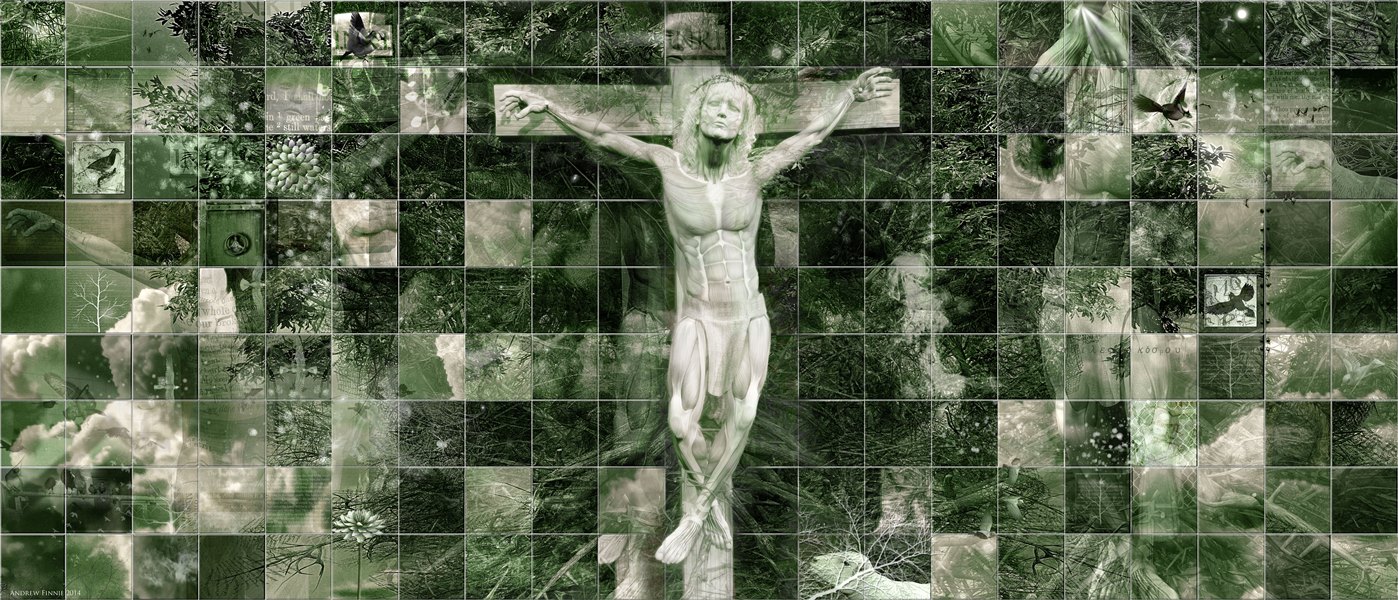
Finnie, Andrew_The Body of Christ, the Tree of Life
Andrew Finnie (Australian, 1957–), The Body of Christ, The Tree of Life, 2014. Pigment print on Hahnemuhle paper, 78 × 182 cm.

^^ “The Cross and the Tree of Life” by Rod Pattenden: “One of the pressing questions for the Church is how we see Christology being renewed in the face of climate change and the potential for the quality of life on this planet to decline,” writes art historian Rod Pattenden [previously]. “Who is Jesus for us in the midst of the profound changes that are occurring to the earth, water, and air of our world? . . .

Andrew Finnie’s image The Body of Christ, The Tree of Life”—a large-scale ecotheological digital collage—“is an attempt to re-imagine the figure of Christ in conversation with the earth and the networks that sustain human life in all its thriving beauty. Here, the traditional figure of the cross has become entwined in the roots of the tree, a tree of life that is giving form to the variety and beauty of the natural world.”

+++

SONG: “Kadosh” by Wally Brath, sung by Nikki Lerner: The Kedushah is part of the Amidah, the central prayer of the Jewish liturgy. Its first verse is taken from the song of the seraphim in Isaiah 6:3: “Holy, holy, holy, is the LORD of hosts; the whole earth is full of his glory!” (Kadosh means “holy.”) In this original composition for voice, piano, and string quartet, Wally Brath [previously] has combined this Hebrew exclamation from the book of the prophets with an English excerpt from the Lord’s Prayer taught by Jesus in Matthew 6:10: “Thy kingdom come, thy will be done on earth as it is in heaven.” [HT: Multicultural Worship Leaders Network]

The performance captured in this video, featuring Nikki Lerner, took place at Winona Lake Grace Brethren Church in Winona Lake, Indiana, on July 11, 2020. A full list of performers is given in the YouTube description.

+++

CONCERT FILM: Amen! Music of the Black Church: Recorded before a live audience at the Second Baptist Church in Bloomington, Indiana, and airing April 26, this PBS special explores the rich traditions, historical significance, and meaning of black church music. Dr. Raymond Wise leads the Indiana University African American Choral Ensemble in twenty-one spirituals, hymns, and gospel songs, showing how black church music is not monolithic. He demonstrates the stylistic spectrum you can find among black church communities using a song text derived from Psalm 24:7–10 (“Lift up your heads . . .”): one performed with the European aesthetic preferred in more affluent congregations, one a classical-gospel hybrid, and one pure gospel. One thing I learned from the program is that there is a tradition of shape-note singing in the black church! (See, e.g., The Colored Sacred Harp.) [HT: Global Christian Worship]

Music of the Black Church

Here’s the set list:

  • “We’ve Come This Far by Faith” by Albert Goodson
  • “Kumbaya”
  • “Run, Mary, Run”
  • “Oh Freedom”
  • “What a Happy Time” by J. M. Henson and J. T. Cook
  • “Amazing Grace” by John Newton
  • “Ain’t Got Time to Die” by Hall Johnson
  • “I’ve Been ’Buked”
  • “Lift Up Your Heads” by Emma Louise Ashford, arr. Lani Smith
  • “Lift Up Your Heads” by Clinton Hubert Utterbach
  • “Lift Up Your Heads, All Ye Gates” by Raymond Wise
  • “Glory, Glory, Hallelujah”
  • “Jesus on the Mainline”
  • “I Need Thee Every Hour” by Annie S. Hawks and Robert Lowry
  • “You Can’t Beat God Giving” by Doris Akers
  • “Come to Jesus” by E. R. Latta and J. H. Tenney
  • “We Shall Overcome” by Charles Tindley
  • “Lord, Keep Me Day by Day” by Eddie Williams
  • “Lord, Do It for Me” by James Cleveland
  • “Oh Happy Day” by Edwin Hawkins
  • “I’ve Got a Robe” by Raymond Wise
  • “Hallelujah, Praise the Lord, Amen” by Raymond Wise

+++

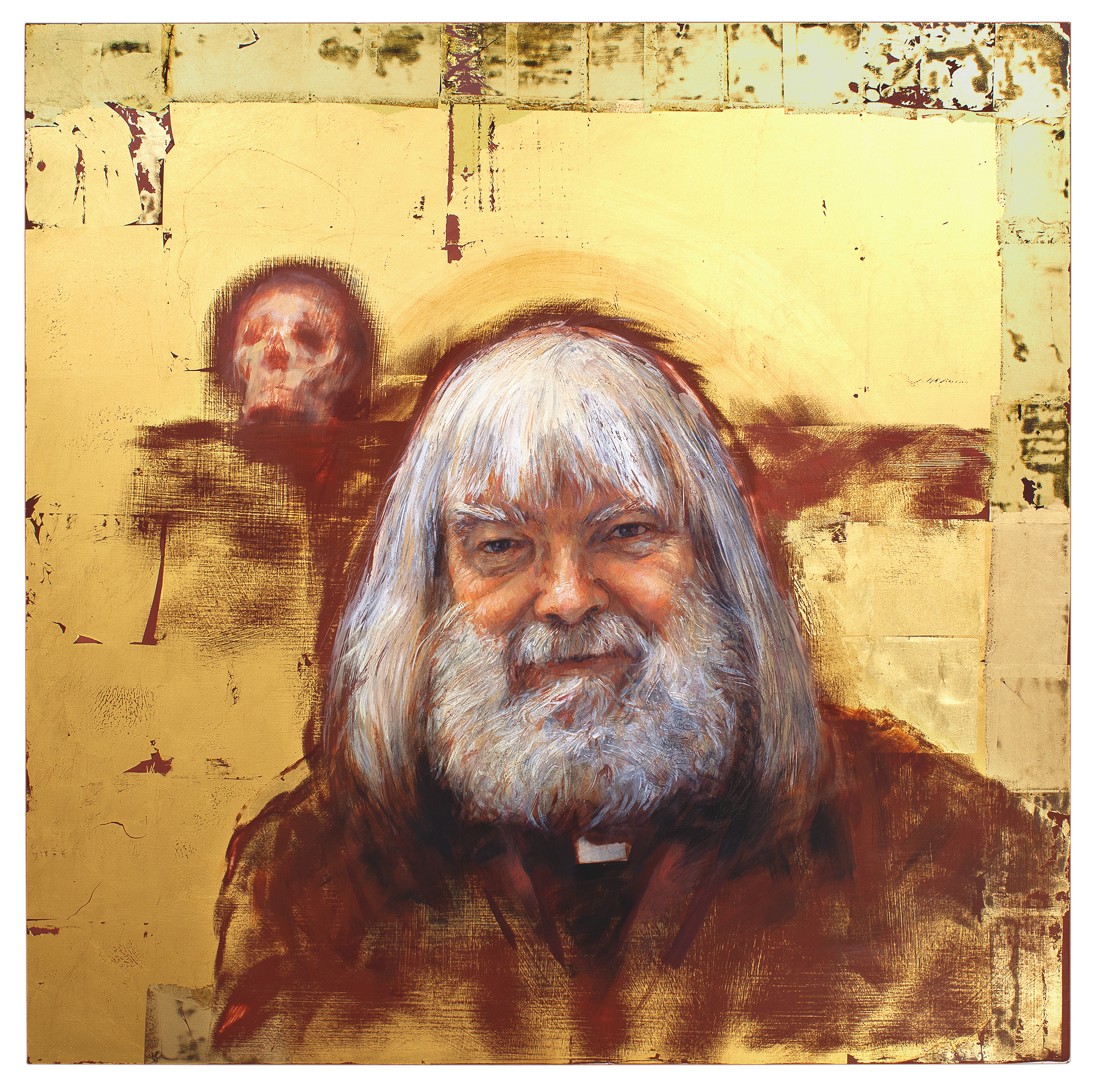
INTERVIEW: Last September The Cultivating Project interviewed Malcolm Guite [previously] on his latest poetry collection After Prayer, the poet-priest George Herbert, the life of a writer, art as faithful service, doubt and despair, his Ordinary Saints collaboration with Bruce Herman and J.A.C. Redford, his friendship with Michael Ward (author of Planet Narnia), the blessing of seasons (both earthly and liturgical), and making room for joy. The interview includes three of Guite’s poems: “Christ’s side-piercing spear,” “A Portrait of the Artist,” and “St. Augustine and the Reapers.”

Herman, Bruce_Malcolm Guite
Bruce Herman (American, 1953–), Malcolm Guite, 2016. Oil on panel with gold leaf, 30 × 30 in.