
Early on the first day of the week, while it was still dark, Mary Magdalene came to the tomb and saw that the stone had been removed from the tomb. . . . [She] stood weeping. . . .
As she wept, she bent over to look into the tomb, and she saw two angels in white sitting where the body of Jesus had been lying, one at the head and the other at the feet. They said to her, “Woman, why are you weeping?”
She said to them, “They have taken away my Lord, and I do not know where they have laid him.” When she had said this, she turned around and saw Jesus standing there, but she did not know that it was Jesus.
Jesus said to her, “Woman, why are you weeping? Whom are you looking for?”
Supposing him to be the gardener, she said to him, “Sir, if you have carried him away, tell me where you have laid him, and I will take him away.”
Jesus said to her, “Mary!”
She turned and said to him in Hebrew, “Rabbouni!” (which means Teacher).
Jesus said to her, “. . . Go to my brothers and say to them, ‘I am ascending to my Father and your Father, to my God and your God.’”
Mary Magdalene went and announced to the disciples, “I have seen the Lord,” and she told them that he had said these things to her.
—John 20:1, 11–18
LOOK: ‘Woman, Why Are You Weeping?’ by Rebekah Pryor

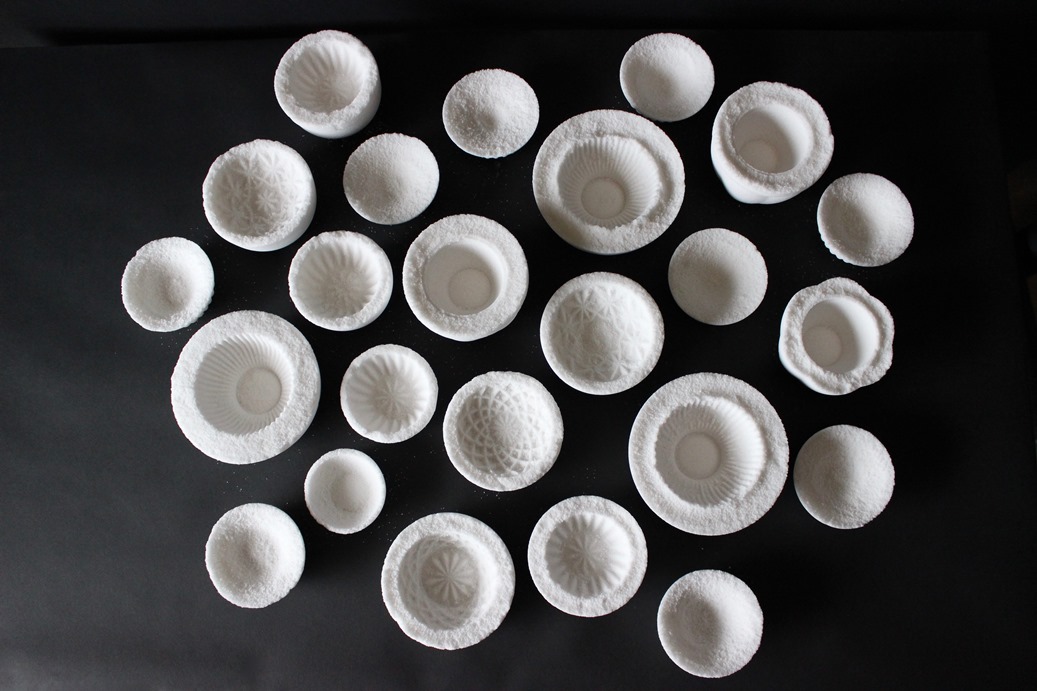
Dr. Rebekah Pryor [previously] is a visual artist, curator, scholar, and member of Australian Collaborators in Feminist Theologies. In this photograph of hers, she poses as Mary Magdalene in the garden of the resurrection at the moment when the risen Christ appears to her. Having wept copious tears, represented by the mounds of salt in front of her, Mary kneels in the soil as she converses with this man whom she at first supposes to be the gardener. Pryor writes that “dawn light and the horizon of regrowth suggest the possibility of ‘a new heaven and a new earth’ in which death, dying, mourning and crying will be no more (Revelation 21:1-5).”
LISTEN: “Still Thy Sorrow, Magdalena!” | Original Latin words (title: “Pone luctum Magdalena”) attributed to Adam of St. Victor, 12th century; English translation by Edward A. Washburn, 1868 | Music by Jon Green, 2023 | Performed on Resurrect, vol. 2, a Cardiphonia Music compilation
Still thy sorrow, Magdalena!
Wipe the teardrops from thine eyes;
Not at Simon’s board thou kneelest,
Pouring thy repentant sighs.
All with thy glad heart rejoices;
All things sing, with happy voices,
Hallelujah! Hallelujah! Hallelujah!Laugh with rapture, Magdalena!
Be thy drooping forehead bright:
Banished now is every anguish,
Breaks anew thy morning light.
Christ from death the world hath freed;
He is risen, is risen indeed:
Hallelujah! Hallelujah! Hallelujah!Joy! exult, O Magdalena!
For he hath burst the rocky prison.
Ended are the days of darkness:
Conqueror hath he arisen.
Mourn no more the Christ departed;
Run to welcome him, glad-hearted:
Hallelujah! Hallelujah! Hallelujah!Lift thine eyes, O Magdalena!
See! thy living Master stands;
See his face, as ever, smiling;
See those wounds upon his hands,
On his feet, his sacred side—
Gems that deck the Glorified:
Hallelujah! Hallelujah! Hallelujah!
Live, now live, O Magdalena!
This medieval Easter hymn was retuned by Jon Green, a Texan living in Edinburgh, Scotland, as part of a Cardiphonia project spearheaded by Bruce Benedict to bring new life to some of the old texts found in Resurgit: A Collection of Hymns and Songs of the Resurrection (Boston, 1879). The lyrics follow a longstanding tradition in the church of conflating the identities of two Marys in the Gospels (Mary of Magdala and Mary of Bethany) and that of the “sinful woman” in Luke 7; all three women become Mary Magdalene, characterized as a penitent who scandalously anoints Christ’s feet with expensive perfume and her own tears during a supper at the house of Simon the Pharisee.
None of the Gospels indicates that this anointer was Mary Magdalene. (Matthew, Mark, and Luke do not name her at all, and John identifies her as the sister of Lazarus and Martha.) But popular tradition ascribes to Mary Magdalene this role—hence the references in the first stanza of the hymn.
What we do know, though, is that Mary Magdalene came early Sunday morning to Jesus’s tomb with the intention of anointing his body, only to find the tomb empty. John 20 is, I think, one of the most glorious chapters in all of scripture. John’s is the only Gospel that recounts Mary’s intimate encounter with the postresurrection Jesus. He tells us that she is distraught over the absence of Jesus’s body, which she presumes someone moved to some unknown location. She had wanted to say her proper goodbyes—he had been taken so suddenly—and, as a gesture of honor, to finish the job of treating his corpse with myrrh and aloes that had been hastily performed by Joseph and Nicodemus on Friday. Now unable to do either, she weeps.
It’s then that Jesus comes to her, alive and in the flesh, revealing himself as her Lord and as conqueror of the grave. He bids her to weep no more.
The gladness of this moment is palpable in the hymn text by Adam of St. Victor. “Laugh with rapture, Magdalena! . . . Joy! exult . . . ! . . . Live, now live.” We are called to do the same.
 Art & Theology