Roundup: Worship album by Parchman inmates, major new acquisition at Toledo Museum of Art, and more

SPOTIFY PLAYLIST: November 2023 (Art & Theology): In this month’s playlist I nod, in part, to All Saints’ Day (November 1), Christ the King Sunday (November 26), and world events. It includes “Ad Ana” (How Long), a setting of Psalm 13 in its original Hebrew by Miqedem (a Tel Aviv–based band made up of Shai Sol [previously] and three other musical artists from a mix of Jewish and Christian backgrounds), and “Touba” (Blessed), a sung recitation of the Beatitudes in Arabic by the Sakhnini Brothers [previously], Arab Christians from Nazareth, with oud and keyboard accompaniment.

As American Thanksgiving is November 23, you may also want to check out my Thanksgiving Playlist, comprising songs of gratitude. Originally created in 2021, each year I add to and remix the list as I encounter new recordings. One of the newer additions is “He Has Made Me Glad” by Leona Von Brethorst, based on Psalm 100, as arranged and performed on organ by the amazing Cory Henry.

The Christian life consists of both praise and lament, both tears and laughter—which is why in any given worship service or Art & Theology playlist or blog post, as in the biblical psalter, you can find songs that express joy and others, heaviness. They don’t negate one another but rather give fuller expression to the breadth of religious experience.

+++

NEW ALBUM: Some Mississippi Sunday Morning by Parchman Prison Prayer: After a bureaucratic process that took over three years, music producer Ian Brennan was finally granted permission in February to record a Sunday worship service at the Mississippi State Penitentiary, aka Parchman Farm, a notorious prison with a rich musical history. The prison chaplains convened a unique service of inmate singers from various Christian denominations ranging in age from twenties to seventies, who were given turns at the mic and even collaborated on a few tracks. Brennan said he wanted to give the men a platform for their voices to be heard. All profits from the album benefit the Mississippi Department of Corrections Chaplain Services.

Here’s “You Did Not Leave Me, You Bless Me Still,” a cover of a Melvin Williams gospel song sung by J. Sherman, age sixty-three.

“You can hear the way Sunday services are particularly restorative for someone incarcerated – not simply because of the promise of redemption, but the solace of not being alone,” writes Sheldon Pearce for the Guardian. “Some Mississippi Sunday Morning feels like these men reaching out for the things such a barbaric system tries to deny them: compassion, intimacy, and mercy. The songs are not just purges of anxieties accrued on the inside or calls for the Lord’s embrace, but also pleas to be acknowledged as a person and not an ID number.”

(Thanks to Art & Theology reader Ted Olsen for alerting me to this! He compared the album to Angola Prison Spirituals, recorded in the 1950s.)

+++

PODCAST EPISODE: “Sarah Clarkson: The Gift of Beauty,” Life with God: A Renovaré Podcast, October 20, 2023: Sarah Clarkson, author of This Beautiful Truth: How God’s Goodness Breaks into Our Darkness, speaks with Renovaré community life director Nathan Foster about her struggle with OCD and, amid the great suffering wrought by that illness, how God’s goodness has been mediated to her by beauty—in nature, poetry, music, story, tea, ritual, and so on. Responding to the idea that beauty is a luxury for the affluent, she says, “Well, [it is] if beauty is about having a perfect house. But beauty is healing those who have been hurt in a war zone. It’s creating shelters where children can have refuge. It’s rebuilding what has been destroyed. . . . Beauty is a defiance of the forces of evil and disorder and destruction because it is [their] opposite: where evil tears down, beauty creates; where there is absence, beauty fills.”

+++

PRESS RELEASE: “Toledo Museum of Art Adds Armenian Gospel Manuscript with 46 Paintings to the Collection”: After centuries passing through private collections, in June the Pozzi Gospels, a sixteenth-century illuminated manuscript from Armenia, entered the collection of the Toledo Museum of Art, which will make it more accessible to the public. (I’m not sure when the book will go on display. And it doesn’t have an object page on the museum’s website yet.) The artist and scribe of this extraordinary, sumptuous manuscript was Hakob Jughayets’i. His forty-six full-page miniatures and marginal decorations combine Christian iconography with Byzantine, Islamic, and Buddhist design elements. 

The Sam Fogg gallery, which exhibited the manuscript last year as part of The Medieval Body, created this short video about it, narrated by art historian Jack Hartnell:

Creation of Eve and Temptation (Pozzi Gospels)
Hakob Jughayets’i (Armenian, ca. 1550–1613), The Pozzi Gospels, 1586. Paper with blind-stamped brown leather binding, 403 folios with 46 full-page illuminations and numerous marginal miniatures, 7 3/4 × 5 3/4 in. (19.8 × 14.5 cm). This spread shows the Creation of Eve and the Temptation of Eve.

The Pozzi Gospels is one of nine extant illuminated manuscripts by Hakob. For more information, see Hakob’s Gospels: The Life and Work of an Armenian Artist of the Sixteenth Century by Timothy Greenwood and Edda Vardanyan (2006).

+++

VIRTUAL MUSIC COLLECTION: Armenian Spiritual Music Special Vol. 1: NTS Radio in London has curated ninety minutes of traditional Armenian Christian music. (They’ve done the same for Byzantine chant, Welsh hymns, Hildegard von Bingen, and numerous other categories.) I wish the lyrics and translations were provided, but regardless of my understanding of the words, what beauty. [HT: ImageUpdate]

Roundup: Psalms and the arts, Ukrainian Easter Choir, and more

BLOG POST: “An open letter to pastors (A non-mom speaks about Mother’s Day)” by Amy Young: There’s disagreement among church leaders on whether Hallmark holidays, such as Mother’s Day, should be recognized during a worship service, and if so, how. Having mothers stand (while women who are not mothers in the conventional sense remain seated) can be very othering and bring up feelings of sadness or shame. It’s also a day when people are thinking about their own mothers, which can evoke a complex range of emotions.

Amy Young believes there is a way to honor mothers in church without alienating others, as well as to acknowledge the breadth of experiences associated with mothering. She has drafted a pastoral address that I find so wise and compassionate. Some women are estranged from their children. Some have experienced miscarriage or abortion. Some have had failed adoptions, or failed IVF treatments. Some placed a child for adoption. Some have been surrogate mothers. Some are foster mothers, or are the primary guardian of a relative’s child. Some are spiritual moms. Some women want to be mothers but have no partner or have had trouble conceiving. Some were abused by their mothers. Some have lost mothers. Some never met their mother. Young puts her arms around all these people who are potentially in the pews on Mother’s Day, making room for the complexity of the day—which does include celebration!

+++

VIDEO: “United with Beauty: The Psalms, the Arts, and the Human Experience” by Mallory Johnson: Mallory Johnson graduated last weekend with a bachelor’s in music and worship (concentration: voice) from Samford University in Birmingham, Alabama. (In the fall she will be starting an MDiv program at Beeson Divinity School.) All the seniors in the Samford School of the Arts are required to complete a capstone project tailored to their individual interests and career goals. As Johnson’s interests center on theology, history, and the arts, she created a twenty-minute video rooted in the Psalms that integrates music, poetry, short excerpts of fiction, visual art, and quotes from van Gogh, Tchaikovsky, Goethe, Luther, and others, resulting in a contemplative multimedia experience.

I resonate so much with Johnson’s approach of bringing together works from different artistic disciplines to interpret one another and to invite the viewer into worship. Her curation is stellar! To cite just one example, the contemporary choral work Stars by Ēriks Ešenvalds plays as we see, among other images, an Aboriginal dot painting of the constellations Orion and Canis and a nighttime landscape by realist painter Józef Chełmoński. Another: John Adams’s double piano composition “Hallelujah Junction” is brought into conversation with Psalm 150 and a painting by Jewish artist Richard Bee of David dancing before the ark.

Józef Chełmoński (Polish, 1849–1914), Starry Night, 1888. Oil on canvas, 22 13/16 × 28 3/4 in. (58 × 73 cm). National Museum in Kraków, Poland.

The video opens with the theme of awe and wonder—expanses of sky and sea and field; the beauty and vastness of God mirrored in the natural world—and then moves to lament—of the prospering of the wicked; of exhaustion, anxiety, and other forms of mental or spiritual anguish and their causes; of personal sin—and finally ends with an assurance of grace and with exultation. Johnson shows how the longings of modern people overlap with those of the biblical psalmists. Here’s her description:

In his famous work titled Confessions, St. Augustine writes this: “Yet to praise you, God, is the desire of every human.” Is this true? What does this look like?

During my time at Samford, I have felt my heart and mind overflow with love for the arts. As a Christian, they have played a devotional role in my life. I find such joy in seeing connections between music, art, and literature that may seem unrelated on the surface. I believe that all humans have a longing for the goodness of God and we find “echoes” of Him everywhere, and most beautifully in artistic expression.

I wanted to show others how I understand the world as a Christian artist. This project is a journey through the Psalms, using art to reinforce the idea that the Psalms capture the full universal human experience. Across time and space, we have all felt the same things and we have all had the same deep longing for “something higher.”

I hope you can allow this project to wash over you. Make time to watch it alone or with someone you love, distraction-free. Turn the lights out, light a candle, watch it on a big screen with the volume up loud. Be cozy under a blanket with a cup of coffee, or grab a journal and write down anything that sticks out to you! It is my earnest desire that you will be moved by the artistic expression of humanity, and that you may realize that God has always been the goodness you most deeply desire.

+++

SONGS:

>> “Broken Healers” by Elise Massa: Singer-songwriter Elise Massa is the assistant director of music and worship arts at Church of the Ascension in Pittsburgh. A meditation on Christ as Wounded Healer, this song from her 2014 album of demos, We Are All Rough Drafts, was inspired by an Eastertide sermon.

Here’s the final stanza (the full lyrics are at the Bandcamp link):

Broken healers are we all
In a living world, decayed
With broken speech we stutter, “Glory”
As broken fingers mend what’s frayed
Holy Spirit, come, anoint us
As you anointed Christ the King
Who wore the crown of the oppressed
Who bears the scars of suffering

>> “Agnus Dei” by Michael W. Smith, performed by the Ukrainian Easter Choir: This is one of the few CCM songs I listened to as a young teen (Third Day’s version from a WOW CD!) that I’m still really fond of. In this video that premiered April 17, an eighty-person choir conducted by Sergiy Yakobchuk was assembled from multiple churches in Ukraine to perform for an Easter service in Lviv organized by the Billy Graham Evangelistic Association. Michael W. Smith’s “Agnus Dei” is one of three songs they sang, in both English and Ukrainian. The name of the soloist is not given. Many of the vocalists in the choir have been displaced from their homes by the current war with Russia. One of them says, “With the war, celebrating the Resurrection means for us now life above death, good above evil.”

+++

PRAYER EXERCISE: “Visio Divina: A 20-Minute Guided Prayer Reflection for the Crisis in Ukraine”: Visio divina, Latin for “divine seeing,” is a spiritual practice of engaging prayerfully with an image, usually an artwork—allowing the visual to invite you into communion with God. On March 17 Vivianne David led a virtual visio divina exercise with Natalya Rusetska’s Crucifixion, hosted by Renovaré. I caught up with the video afterward and found it a very meaningful experience. As the painting is by a Ukrainian artist and represents Christ’s passion, the war in Ukraine is a natural connection point.

I appreciate David’s wise guidance, which includes these reminders:

  • Stay with the image, regardless of whether or not you ​“feel” something happening right away. There is something beautiful about faithfully waiting with that space, having dedicated it to God as a time of prayer.
  • Notice what draws your attention, what invites you into the image—let that become a space for conversation with Christ.
  • Notice what sort of emotions arise as you stay with the image. How does it awaken desire? Let these emotions lead you back to continued dialogue with God.

This kind of quiet, focused looking with an openness to encounter is something I encourage on the blog. Any of David’s three tips above I would also suggest for any art image I post—a corrective to hasty scrolling habits. Stick around for the last four minutes of the video to see dozens and dozens of impressions from participants, which may reveal new aspects of the painting to you.

Roundup: Formational films, Mary Magdalene exhibition, and more

WEBINAR: “Formational Films Round-Up: Movies That Matter,” hosted by Renovaré: Recorded August 24, this is an excellent eighty-minute conversation with film critic and professor Jeffrey Overstreet [previously], minister Catherine Barsotti, and theologian Chris Hall, led by Carolyn Arends [previously]. Each of the three guests identifies and discusses five films that have been spiritually formative to them—and what great selections! (Though there are four I have not yet seen.) Barsotti’s number one is one of my all-time favorites.

Because the movie ratings issue (that is, content like violence, sex, and/or profanity) is almost always raised by Christian audiences, Arends asks, “Are there some films that are bad for you to watch, and if so, why?” The question is wisely addressed from 34:52 to 49:40.

+++

INTERVIEW: “We must become poetry,” Still Life: For the September 13, 2021, edition of his weekly Still Life letter, Michael Wright [previously] interviewed Christian author Paul J. Pastor, having been intrigued by a recent tweet of his, which asks, “Where are the bardic preachers, wild at the eye, speaking not just to mind or heart, but to gut?” Pastor talks about the connection between the seen and the unseen; the relationality of poetry and finding shelter in the words, images, and emotions of another; holistic knowing; the disservice of reducing the Bible’s poetry to moral lessons with tidy applications; the nearness of Walt Whitman’s poetic vision to the Christian vision of sanctification; and more.

“My passion is for Christians to reclaim our way’s remarkable resources for living virtuously, beautifully, and well,” he says. Mine too!

To subscribe to Still Life, distributed for free every Monday over email, click here.

+++

Lecture by David Brinker for the 8th Catholic Arts Biennial, Verostko Center for the Arts at Saint Vincent College, Latrobe, PA, September 12, 2021: I mentioned the call for entries for this exhibition back in June. Of the 396 entries from artists from around the country, MOCRA director and guest juror David Brinker has selected 52. In this talk given the weekend after the exhibition’s opening (which starts at 14:47), he discusses the following three questions, pulling in artworks from the current exhibition and from his twenty-five-plus years as an art curator at a Catholic institution.

  • What identifies contemporary art as “Catholic”?
  • What contributions can Catholic art and artists offer to the broader contemporary art world?
  • What can Catholic art and artists receive from the broader art world?
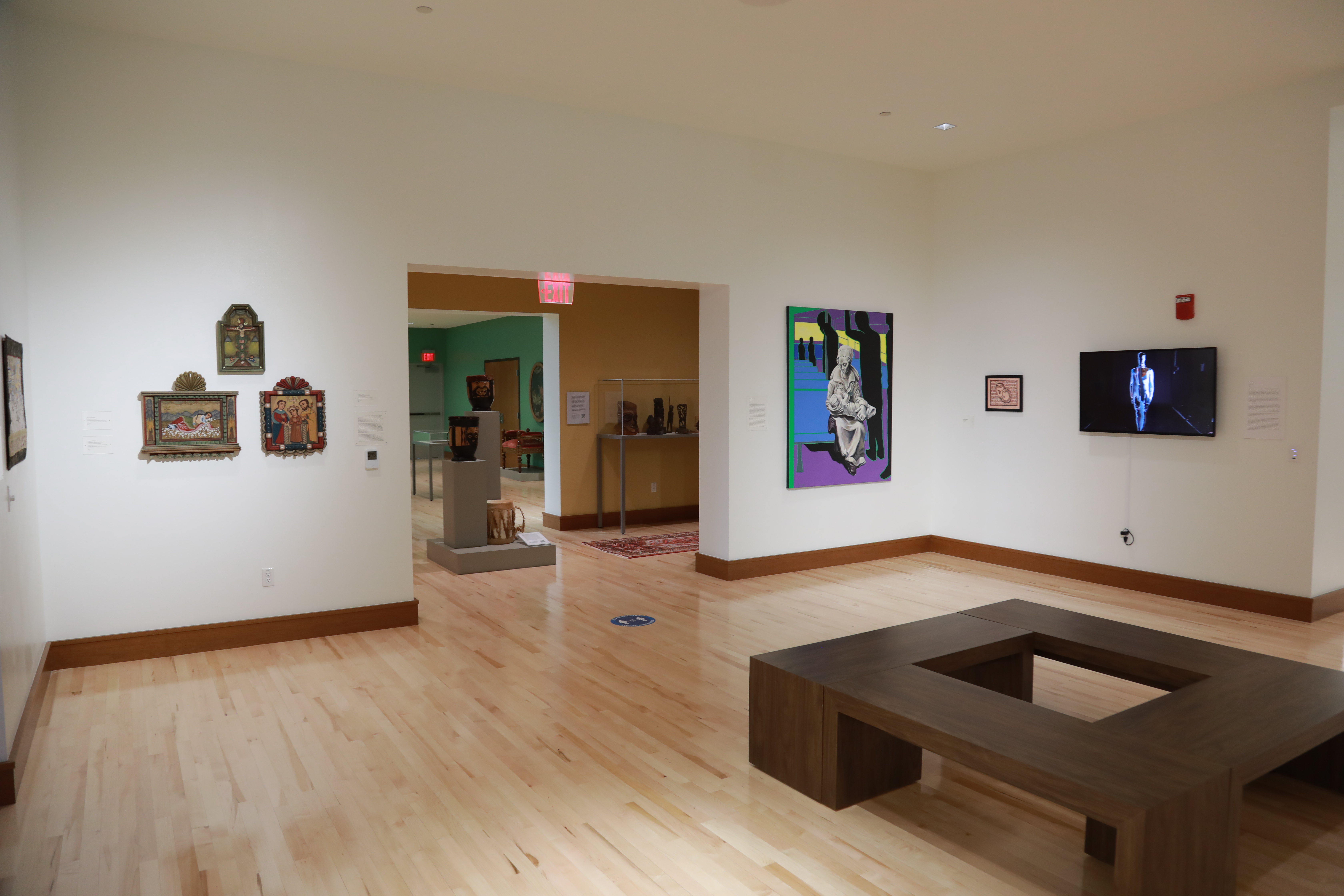
8th Catholic Arts Biennial
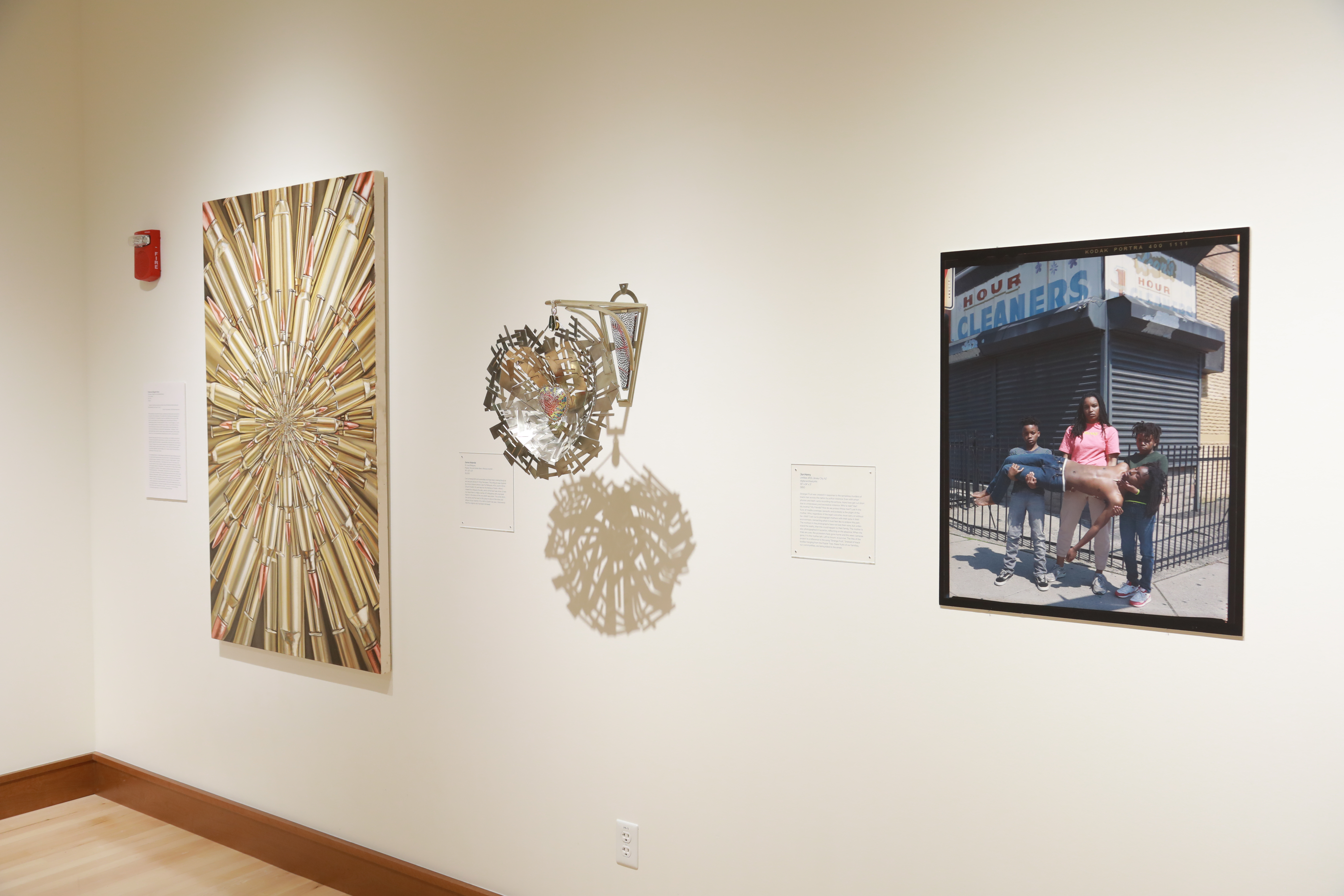
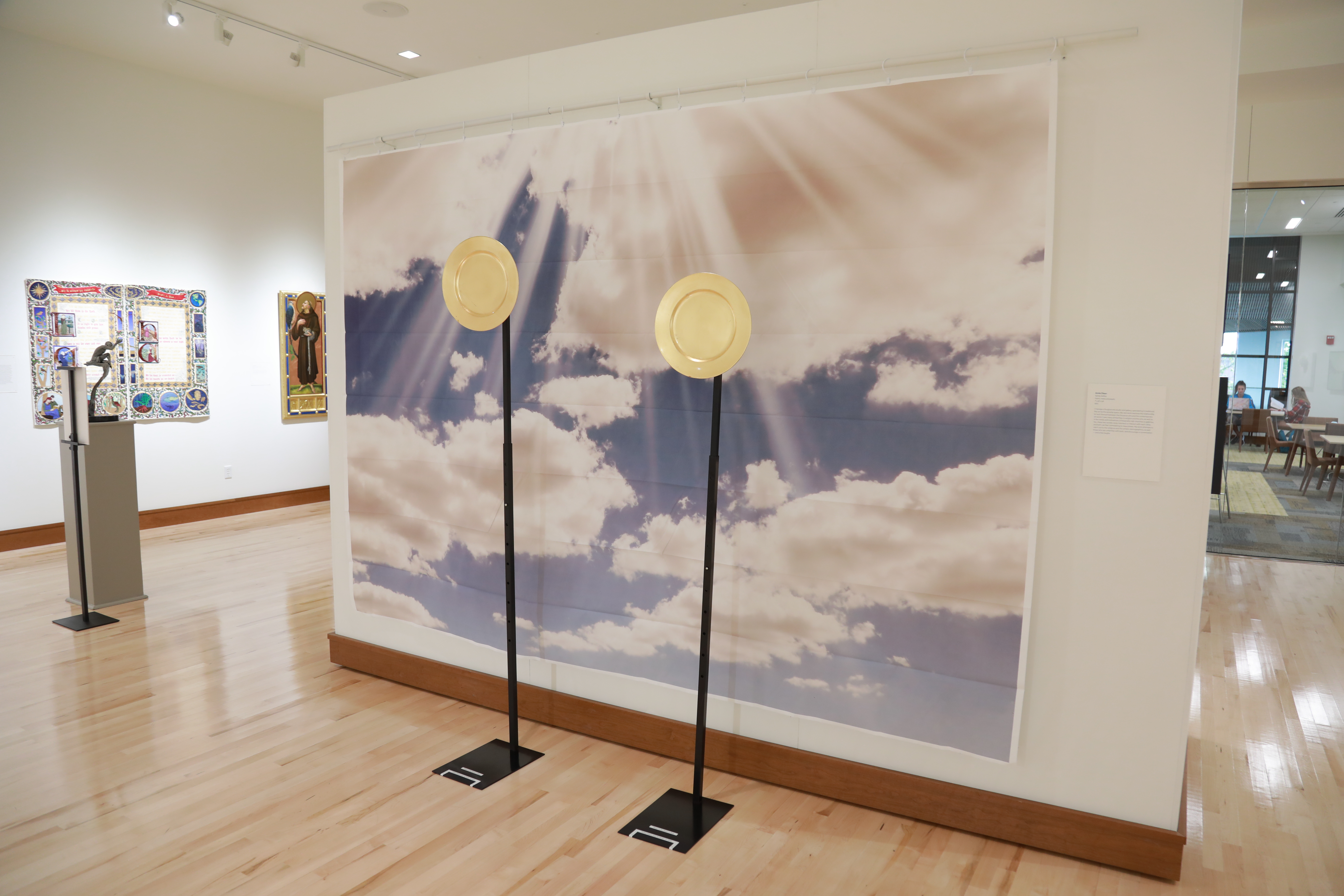
Exhibition view, 8th Catholic Arts Biennial. From left to right are three retablos by Vicente Telles, Maternidad by Piki Mendizabal, Iesu in Utero by Rebecca Spilecki, and The Living Temple by Jesse Klassen.

8th Catholic Arts Biennial
The Heart of Man by Kristen van Diggelen Sloan; St. Laud Reliquary by James Malenda; Untitled, #33, Jersey City, NJ by Jon Henry

8th Catholic Arts Biennial
Foreground: Saintly Selfies by Annie Dixon

(The three photos above are provided courtesy of the Verostko Center for the Arts.)

Saint Vincent’s 8th Catholic Arts Biennial exhibition is on view through October 29, 2021; off-campus visitors are asked to make an appointment by emailing verostkocenter@stvincent.edu. While you’re in the area, you might also want to visit the Fred Rogers Center at Saint Vincent College, which houses artifacts from Mister Rogers’ Neighborhood as part of a larger permanent exhibition on his life, work, and influence. (Latrobe was Fred Rogers’s hometown.) And Pittsburgh is just an hour away!

+++

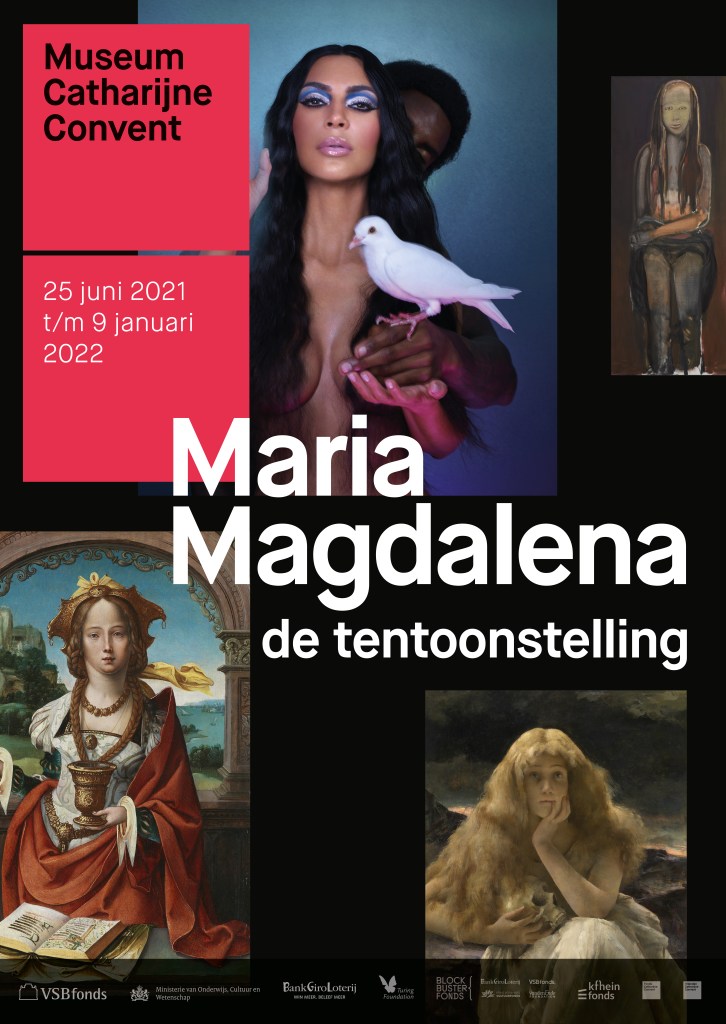
EXHIBITION: Maria Magdalena (Mary Magdalene), Museum Catharijneconvent, Utrecht, Netherlands, June 25, 2021–January 9, 2022: Curated by Lieke Wijnia. “Mary Magdalene is one of the most enigmatic women from the New Testament. Through a trans-historical display of artistic representations from the eleventh century to the present day, this exhibition explores the enduring fascination for this mysterious saint.” The catalog, Mary Magdalene: Chief Witness, Sinner, Feminist, is available in Dutch or English from the publisher Waanders. In addition to the exhibition page on the museum’s website, which hosts select images and a series of videos, resources in Dutch include an audio tour (with images), a podcast episode and accompanying article, and a video preview with commentary by Karin Haanappel.

Maria Magdalena art exhibition

I’m fascinated by Mary Magdalene, and while I won’t get to see this exhibition, it appears that it does an excellent job of exploring the many facets of her life and identity (including both before meeting Jesus and after his ascension), as told through canonical and apocryphal texts, and her complicated reception history. It addresses her role as the first witness to Jesus’s resurrection; the so-called Gnostic Gospel of Mary, which has Peter saying, “Sister, we know that the Savior loved you more than the rest of the women. Tell us the words of the Savior which you remember—which you know (but) we do not, nor have we heard them”; the legacy of Pope Gregory the Great’s infamous Easter sermon of 591 CE, which, in its (many would say erroneous) conflation of the Magdalen with other New Testament women, identified her as a converted prostitute; the development of legends about her later life in southern France, as an evangelist, a miracle-worker, and a penitent, cave-dwelling ascetic; modern films and literature that cast her as a romantic lover, or even the wife, of Jesus; and Pope Francis’s elevation of her liturgical commemoration from an obligatory memorial to a feast day in 2016, in which she is to be celebrated not as a fallen woman doing penance but as the “apostle to the apostles,” a title of hers dating back to the High Middle Ages.

The poster above features Mary Magdalene Receives the Holy Spirit by American photographer David LaChapelle, Magdalena by contemporary South African artist Marlene Dumas, The Magdalen from a sixteenth-century Flemish workshop, and Mary Magdalene by nineteenth-century Belgian artist Alfred Stevens.

+++

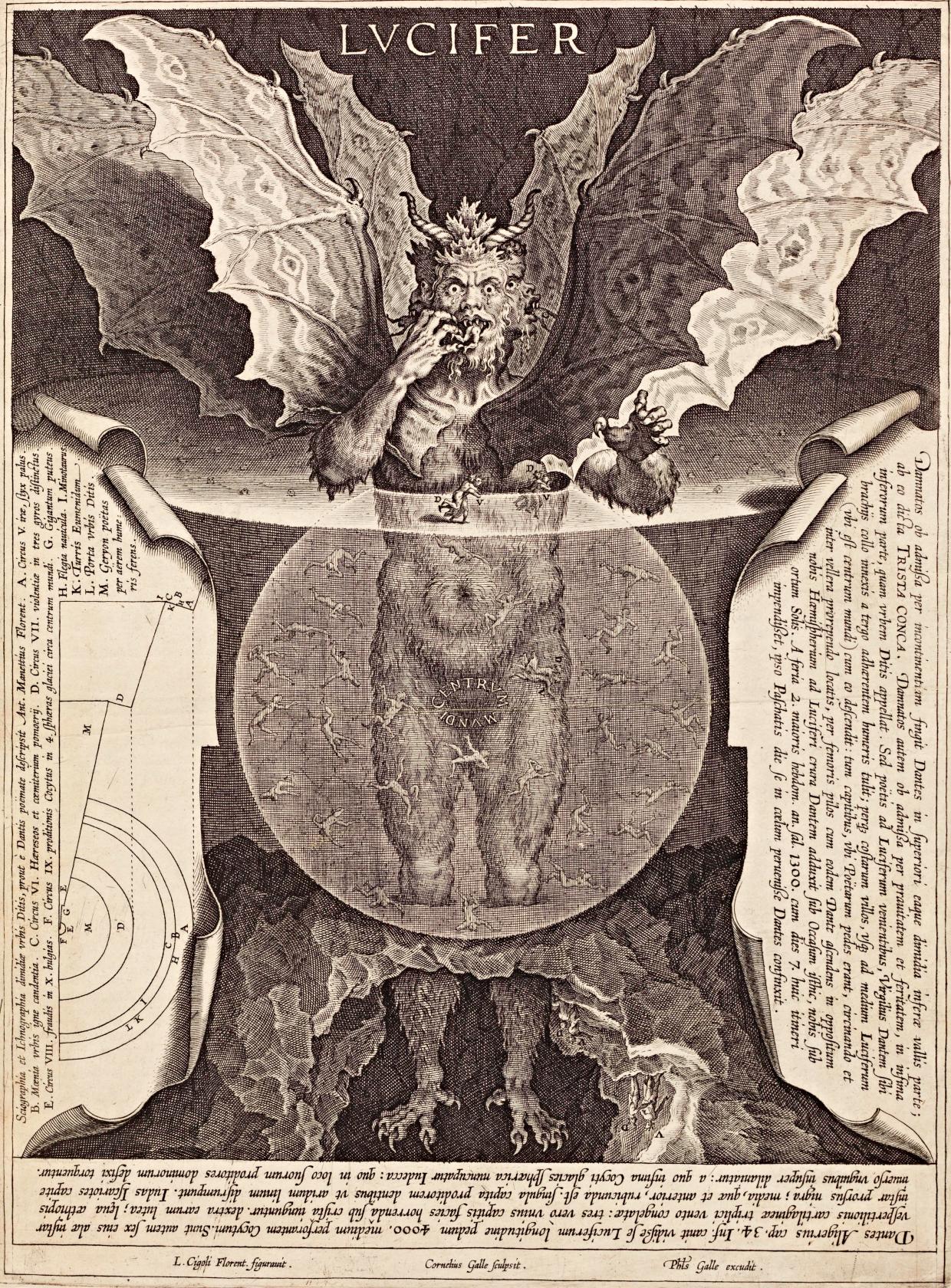
ARTICLE: “700 Years of Dante’s Divine Comedy in Art”: In honor of the seven hundredth anniversary of the Italian poet Dante Alighieri’s death on September 14, the Public Domain Review has collected art directly inspired by his Commedia from over the last seven centuries—on the nine circles of hell, the beatific vision, and much more. Under the tutelage of literature professor Stefano Gidari, I read and studied Dante’s groundbreaking afterlife-adventure trilogy—in Italian!—in 2009 while living in Florence, where it was written, which was such an invaluable experience.

Galle I, Cornelis_Lucifer
Cornelis Galle I (Flemish, 1576–1650), Lucifer, after Stradanus, ca. 1595. Engraving, 27.5 × 20 cm.

Eagle of Justice
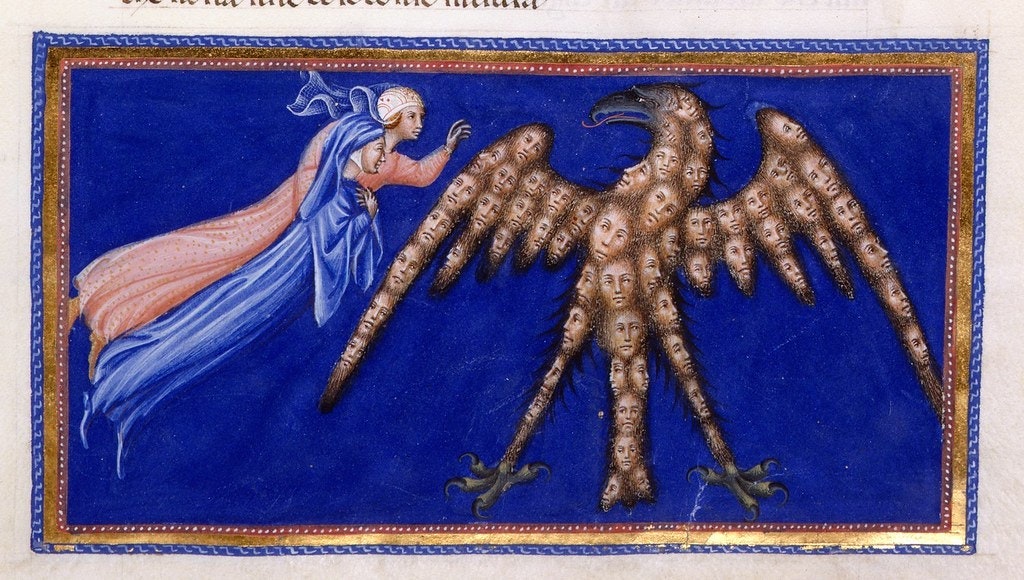
Giovanni di Paolo (Italian, ca. 1403–1482), Dante and Beatrice before the Eagle of Justice, ca. 1450. From Yates Thompson 36, fol. 162, British Library, London.

Roundup: Conferences, recorded talks by Jyoti Sahi and Patty Wickman, and the arts in spiritual formation

UPCOMING CONFERENCES:

>> (Virtual) Christian Fellowship of Art Music Composers, October 23, 2021: The CFAMC is soliciting videos of live musical performances (or works designed with videography), original hymns, and papers. Twelve art music pieces will be chosen to be shown at the conference, followed by conversations about each, as will three hymns, to be sung during a time of worship.

>> (In Person) Transcend, CIVA Biennale, November 4–6, 2021, Austin, Texas: I’ll be attending! “Beauty is compelling. It binds itself to the Truth and the Good in such a way that, as Dante said, ‘Beauty awakens the soul to act.’ It moves us from the rooted realities of canvas, clay, notes, or language into the transcendental nature of God Himself, our Beautiful, True, and Good Creator. Join CIVA [Christians in the Visual Arts] as artists, pastors, curators, and cultural leaders explore the divine spark of the image of God in each of us that initiates and propels our journey to perceiving anew an intuitive, expressive, and fulfilling reality.” The conference will include a juried art show, plenary talks, paper presentations, times of worship, workshops, portfolio reviews and mentoring sessions, author signings, “explore groups” around the city (I signed up for the Blanton Museum of Art and Ellsworth Kelly’s Austin), and artists’ show and tell.

+++

ARTIST PRESENTATIONS:

It can be so illuminating to hear an artist discuss their work—their influences, their process, how particular artworks came about. Below are two virtual talks I attended last month and really enjoyed, both by artists who are Catholic.

>> Jyoti Sahi, June 19, 2021: In this virtual talk organized by the UK organization Christians Aware, my friend Jyoti Sahi [previously] shares several of the paintings he has produced during the past year in quarantine in and around his home in Silvepura Village in Karnataka, South India, inspired by the local landscapes and vegetation. Over the years Jyoti has developed a Christian spirituality that is very earthy, one that sees the natural world as reflective of, and even participating in, the divine mysteries. His Jesus is in and of the land. Images start at 11:20.

Sahi, Jyoti_Flight of the Holy Family
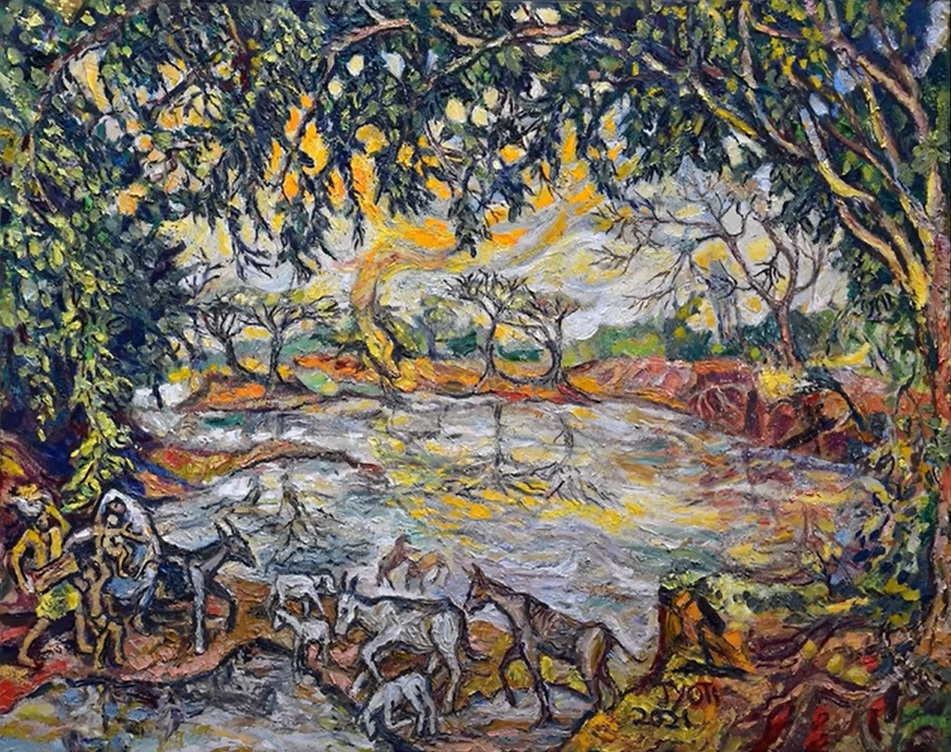
Jyoti Sahi (Indian, 1944–), Flight of the Holy Family, 2021. Oil and acrylic on canvas.

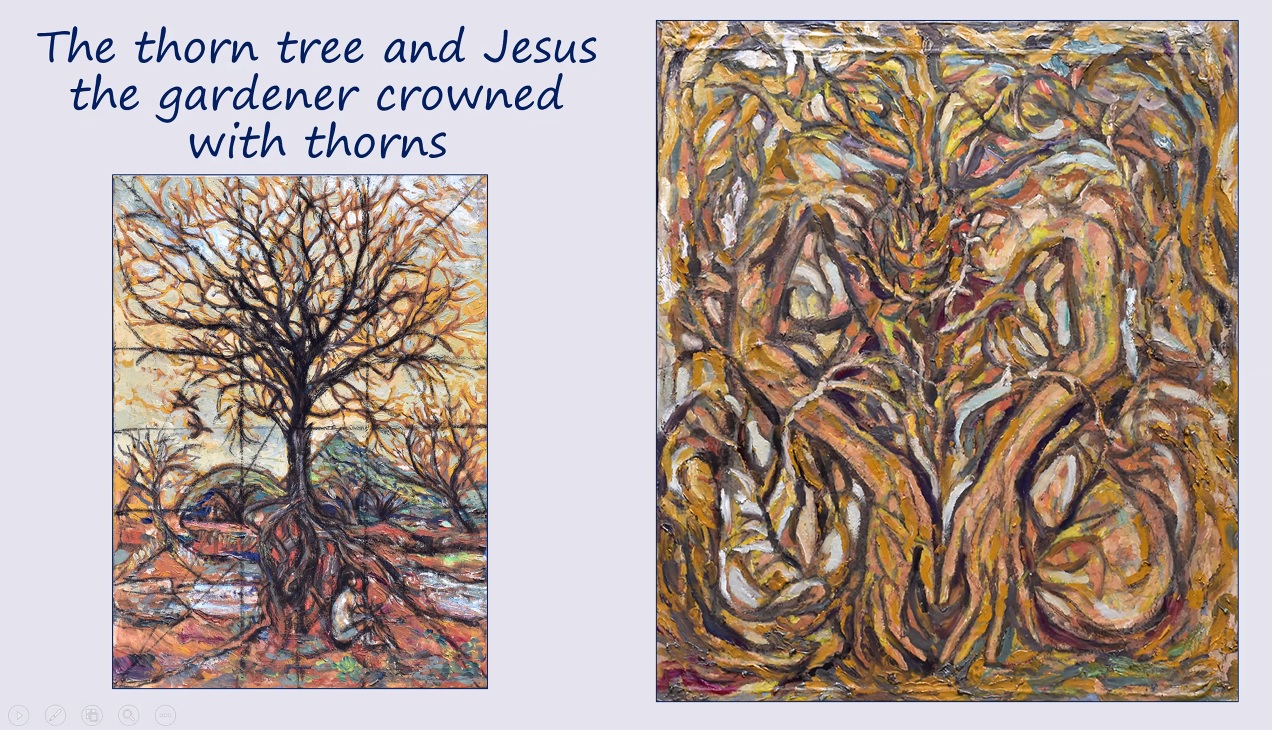
Sahi, Jyoti_Jesus the Gardener

In his recent body of work, Jyoti shows, among other things:

  • Jesus being born in a makeshift encampment beside a kere (manmade lake), among the brick kilns, a child of migrant laborers.
  • Jesus giving a sermon in a sacred grove underneath a yellow bodhi tree, where herdsmen graze their flocks. The snake-stones, erected by the Adivasi (tribal peoples of India), allude to healing and to Jesus’s being lifted up on the cross like the serpent on Moses’s staff (John 3:14–15; cf. Num. 21:4–9).
  • Jesus entering Jerusalem, his face gloriously framed by palm fronds. He’s reminiscent of the leafy-headed Green Man present in the mythologies of many ancient cultures but found particularly in medieval English church carvings.
  • Christ crucified in the palash tree, the “flame of the forest.” (Jyoti notes that in the Sanskrit epic poem the Mahabharata, the hero’s wounds are compared to the flowers of the palash tree.)
  • Jesus in the garden of the resurrection, standing in front of a flowering datura tree, which is poisonous but also medicinal. (“Poison can be a way of discovering healing,” Jyoti says—a truth that has implications for a theology of the cross.)
  • The journey to Emmaus, showing two of Jesus’s disciples entering the garden, a metaphor for wholeness or home.

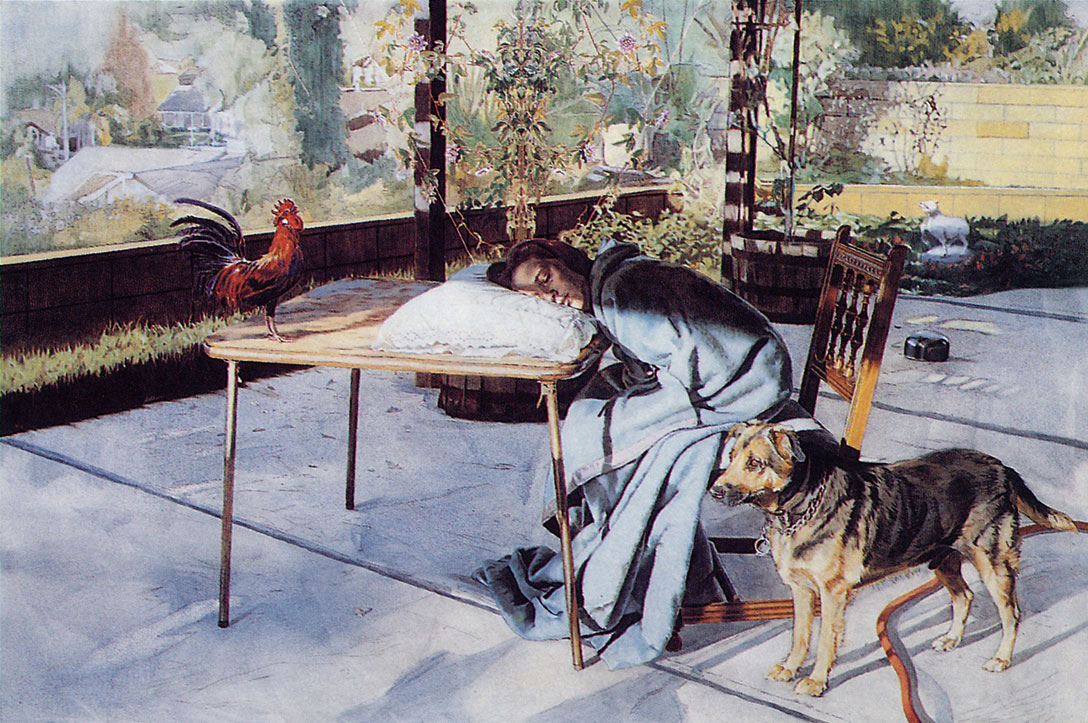
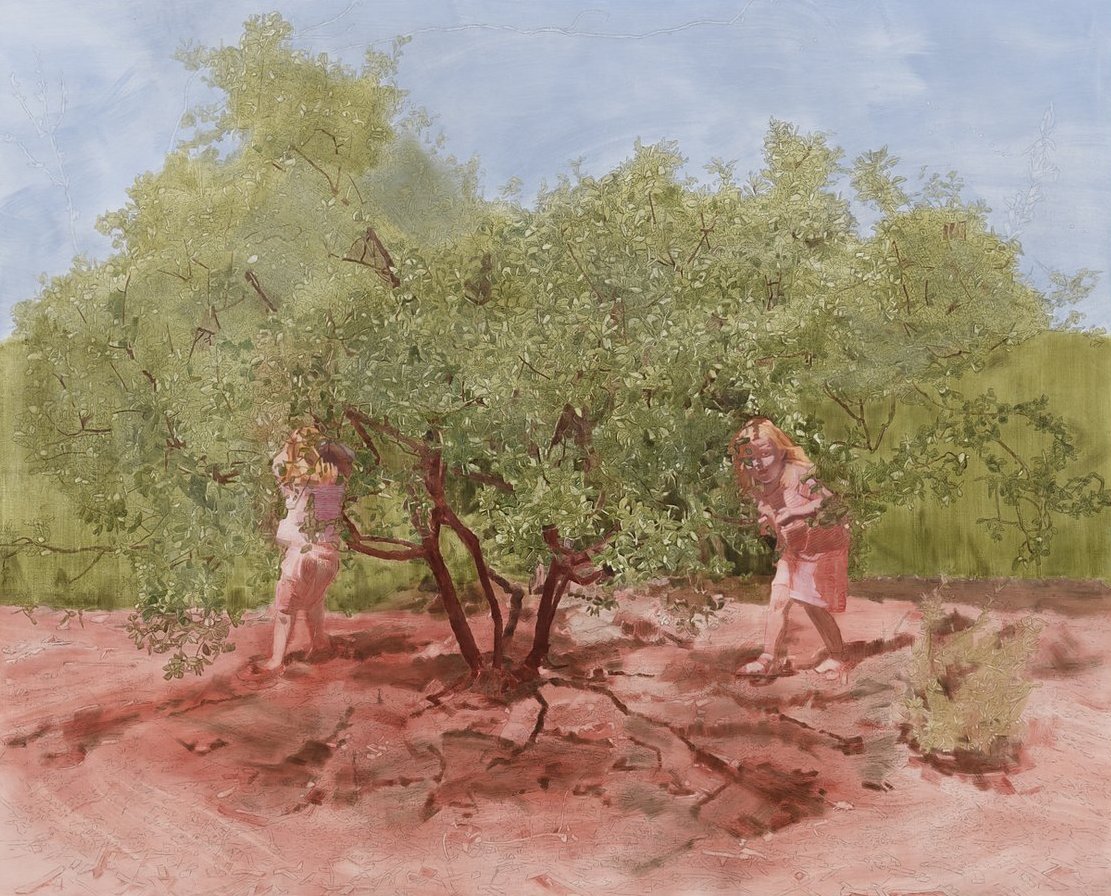
>> “Gift Paintings: The Invitation to See Anew” with Patty Wickman, June 24, 2021: As part of its Art & Faith series, Holy Family Church in South Pasadena, California, hosted a virtual talk by one of its members, Patty Wickman [previously], a nationally exhibited artist and longtime professor in UCLA’s art department. Her paintings are figural, and she describes several of them as “gifts,” sparked by things like the discovery of one of her mother’s unusual rest rituals, encounters with unhoused persons in San Jose, a cut-paper environment inside a Disney World ride, flea market finds, a plate of dirt her young daughter served her, and a little boy’s eating apples stark naked on a hot summer day in her backyard.

Among her influences are Shaker gift drawings and worship spaces; Victorian hair wreaths; the illuminations of Hildegard of Bingen; performance art pieces by Joseph Beuys, Chris Burden, and Ana Mendieta; Cindy Sherman’s photographic self-portraits; and historical religious paintings by Fra Angelico, Piero della Francesca, Georges de La Tour, Geertgen tot Sint Jans, Caravaggio, and others.

At twenty-four minutes in she starts discussing her own work, with reference to specific artworks that informed her. Compare her Entheos, for example, to Caravaggio’s Crucifixion of Saint Peter; her Struggle Garden to frescoes by Giotto of Anne and Joachim at the golden gate, and Judas betraying Jesus in Gethsemane; and her A Thief in the Night to Peter Menzel’s Material World project. When her early days of motherhood prevented her from having the time to plan and execute large-scale paintings like these, she painted smaller, quicker works—daily during Lent—with subjects including dust bunnies, daddy longlegs, a stick of incense, and a birdbath with the first blooms from her camellia tree having fallen inside. Her work has a sacramental quality to it that’s really compelling.

Wickman, Patty_Passion Painting
Patty Wickman (American, 1959–), Passion Painting, 1997. Oil on canvas, 60 × 90 in.

Wickman, Patty_Circumscribe
Patty Wickman (American, 1959–), Circumscribe, 2017–19. Oil on linen, 84 × 104 in.

The last half-hour of the video is Q&A.

+++

ARTICLE: “Artful Discipleship: The Role of the Arts in Spiritual Formation” by Carolyn Arends: Singer-songwriter Carolyn Arends discusses four ways the arts are important in our training to follow Jesus: (1) the arts help us train to pay attention; (2) the arts help us train in longing; (3) the arts help us train for the renewing of our minds; and (4) the arts help us train to appreciate things (and especially people) for more than their ​“usefulness.” She closes with a list of suggestions for practicing intentional engagement with the arts.

(See also a recent interview with Arends, “Art and Spiritual Formation,” on the Art & Faith Conversations podcast.)