Thomas in the dark

John 20:24–26 tells us that Thomas wasn’t with the disciples when Jesus appeared to them the day of his resurrection. It wasn’t until eight days later—the following Sunday—that Jesus came to Thomas. In that span of time, Thomas was left to wrestle with his doubt. “He is risen!” he heard from the other disciples. “We saw him!” But Thomas had not been granted any such encounter. Thinking it ridiculous that a dead man should rise from the grave, he chalked up the claims to mere gossip. Hallucinations, maybe. And he stewed uncomfortably in his disappointment and confusion. That is, until Jesus approached him and gave him the physical confirmation he needed.

Why did Jesus wait so long to seek out Thomas? Maybe to give him time to think over the events of the previous week—and even further back, to Jesus’s teachings about himself, his prophecies. Maybe Thomas needed to be kept in the dark a little longer than the others so that certain truths could settle in his heart and mind, so that he would be ready to receive the proof par excellence.

Imagining what these eight days of not knowing must have been like, Jess Strantz, lead vocalist for the folk soul duo Von Strantz, wrote a song called “Oh Tom.” Written from Thomas’s perspective, it takes us for a ride on his roller coaster of emotions following the death of Jesus—insecurity, hurt, fear—before pulling at last into the station of confident faith.   Continue reading “Thomas in the dark”

She mistook him for the gardener

In his Gospel John records that on the Sunday morning following Jesus’s crucifixion, Mary Magdalene went to the tomb and, finding it empty, started to weep, for she thought someone had taken the body. In her worry and frustration, she “turned around and saw Jesus standing, but she did not know that it was Jesus . . . supposing him to be the gardener” (John 20:14–15). It isn’t until he says her name that she recognizes him.

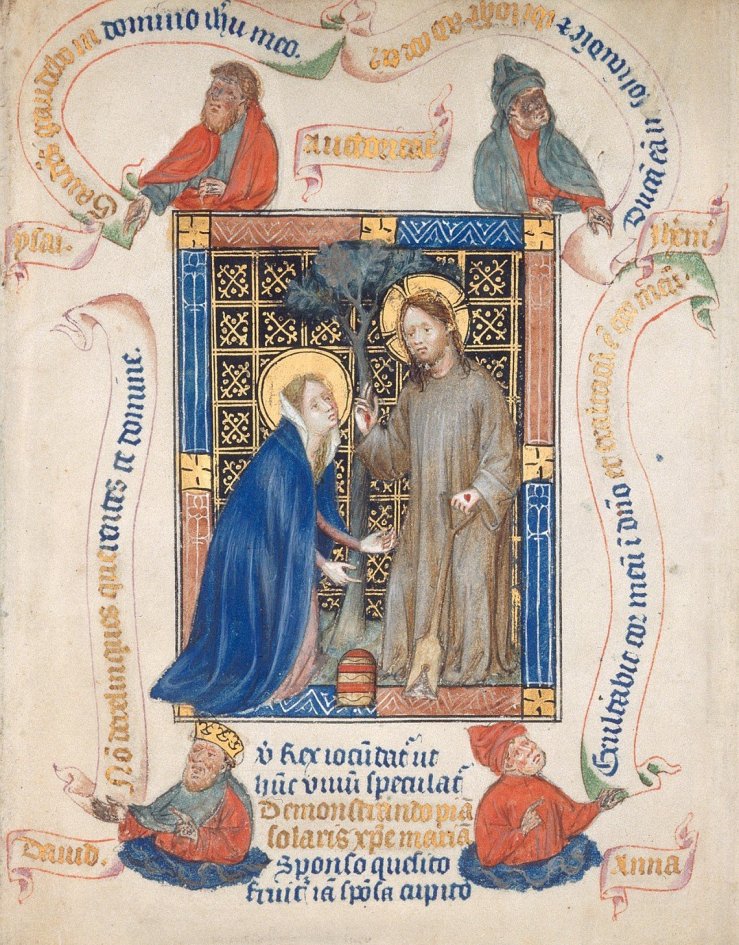
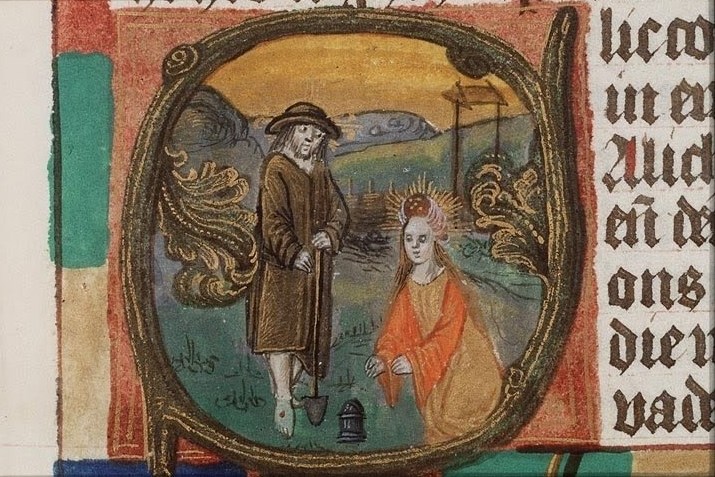
Artists—mainly from the fifteenth and sixteenth centuries—have latched onto this detail of mistaken identity, representing Jesus carrying gardening tools, like a shovel or a hoe, and sometimes sporting a floppy gardener’s hat. A few artists, such as Lavinia Fontana, Rembrandt, and the illuminators of the book of hours and passional shown below, have even shown Jesus in full-out gardener’s getup. (In her commentary on John, Dr. Jo-Ann A. Brant mentions that the fact that Jesus left his burial clothes in the tomb, coupled with Mary’s confusion, might provoke the “fanciful speculation” that Jesus actually borrowed the gardener’s clothes. Nevertheless, a different understanding is more likely behind the artistic representations; read on.)

Noli me tangere by Jacopo di Cione
Attributed to Jacopo di Cione (Italian, 1365–1398/1400), Noli me tangere, ca. 1368–70. Pinnacle panel from a Florentine altarpiece, now in the collection of the National Gallery, London.
Jesus Appears to Mary Magdalene
Jesus Appears to Mary Magdalene, from a Biblia Pauperum (typological picture book), ca. 1405, Netherlands. British Library, London.
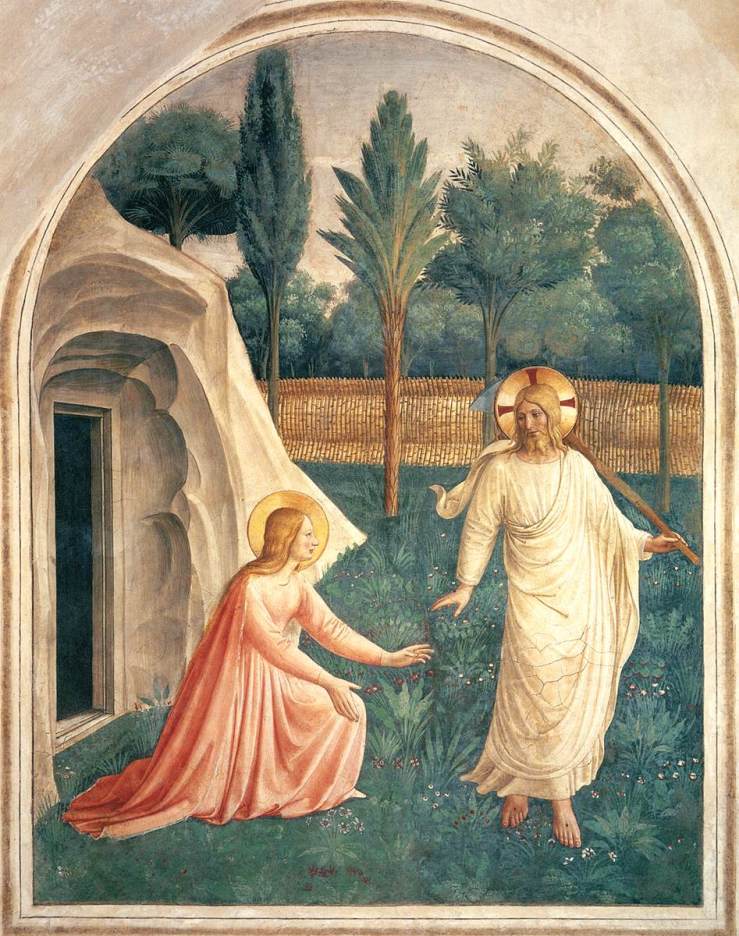
Noli me tangere by Fra Angelico
Fra Angelico (Italian, ca. 1395–1455), Noli me tangere, 1440–42. Fresco from the convent of San Marco, Florence, Italy. [commentary by Georges Didi-Huberman]
Noli me tangere by Israhel van Meckenem
Israhel van Meckenem (German, ca. 1445–1503), Noli me tangere, 1460–1500. Engraving. British Museum, London.
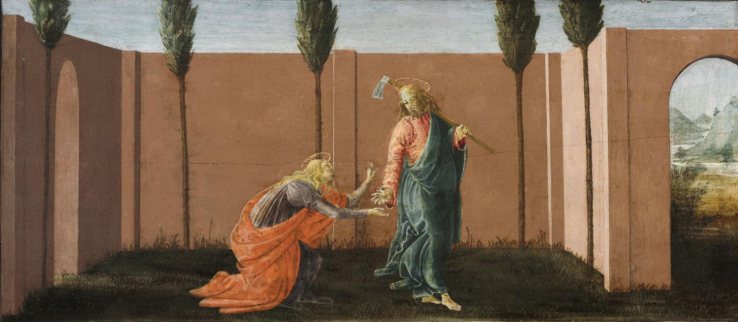
Noli me tangere by Sandro Botticelli
Sandro Botticelli (Italian, 1445–1510), Noli me tangere, ca. 1484–91. Predella panel from an altarpiece from the convent of Sant’Elisabetta delle Convertite, Florence, Italy, in the collection of the Philadelphia Museum of Art.
Jesus as Gardener (Book of Hours)
Master of the Dark Eyes, “Christ Appears to St. Mary Magdalene as a Gardener,” from The Hours of the Eternal Wisdom: Lauds (KB, 76 G 9), fol. 88r, ca. 1490. Koninklijke Bibliotheek (National Library of the Netherlands), The Hague.
Jesus as Gardener (cca. 1503)
“Christ Appears to Mary Magdalene as a Gardener” (detail), ca. 1503–1504, England. Fol. 134v, Vaux Passional (Peniarth 482D), National Library of Wales.

Continue reading “She mistook him for the gardener”

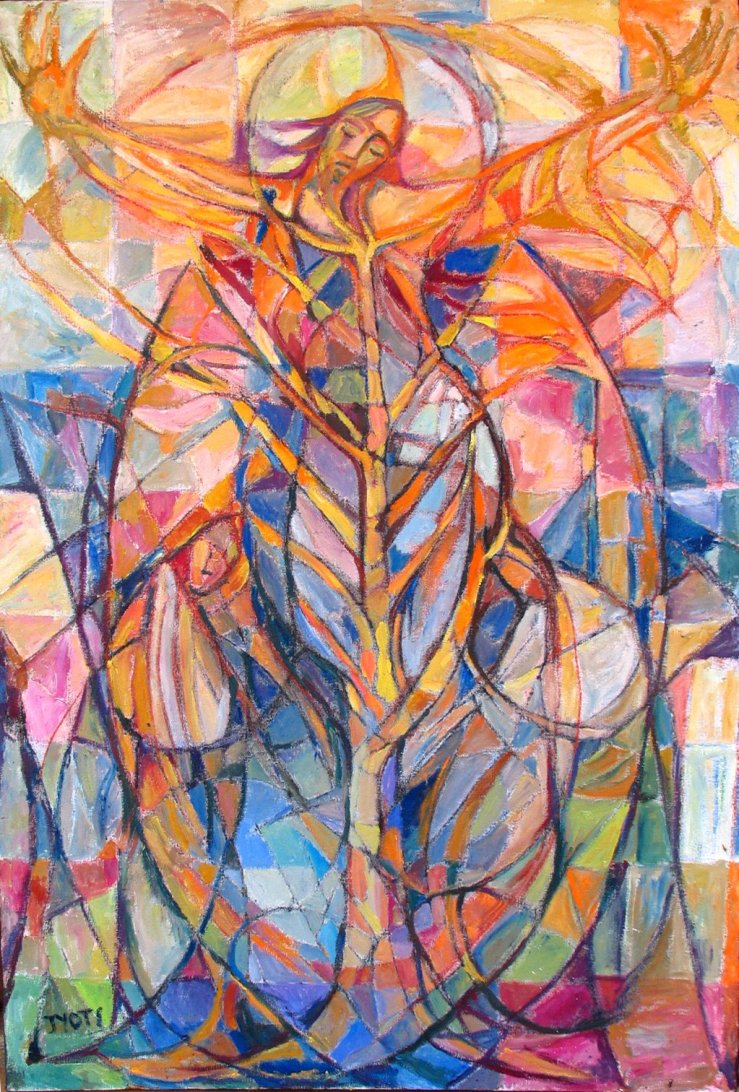
Three Resurrection paintings by Indian artist Jyoti Sahi

The chocolate bunnies and plastic grass may have moved to the out-of-sight discount racks of stores, but Easter isn’t over! Because the Resurrection is a truth that’s not easily plumbed or quickly exhausted, the liturgical calendar designates fifty days for its celebration, a season known as Eastertide. In this period we are invited to linger over the gift of Jesus’s Resurrection—to spend time admiring it and becoming familiar with it and letting its power infuse our lives. So through May 14, the content at Art & Theology will focus on this bright season.

First up: three Resurrection paintings by Jyoti Sahi, who runs an art ashram in Silvepura Village, Karnataka, in India, just outside Bangalore. Of all the painters of biblical themes active today, Sahi is definitely one of the most inventive. An artist since the late 1960s, he has been instrumental in developing a visual gospel language that’s contextualized to Indian culture and in fostering Hindu-Christian dialogue. Here are three different approaches he’s taken to depict that notoriously difficult-to-depict subject: the Resurrection of Christ.

Jesus as the Greater Jonah

This is an example of an image that rewards deep looking, being so chock-full of symbols. I encourage you, before reading on, to just gaze at the image for one full minute, and see what you see.

Resurrection by Jyoti Sahi
Jyoti Sahi (Indian, 1944–), Resurrection, 2007. Oil on canvas, 178 × 122 cm.

First I notice the outstretched arms of Christ—a pose that deliberately references the Crucifixion. Here, though, those extremities are not pinned down to a cross. They are utterly open and free, embracing the world in risen glory. It’s common for artists to hint at the Crucifixion in Resurrection images. There’s a theological reason for that: the Crucifixion and Resurrection are two sides of the same coin, one great unified event, neither of which can be understood in isolation from the other. Sahi strengthens this link by including a human figure on each side of Christ. In Crucifixion images, these spots are traditionally occupied by the Virgin Mary and the apostle John, but here the abstracted figures double as two of the Marys at the tomb. They look down to where they had laid the body two days ago but find only an empty stone bench. They have yet to encounter the enormous presence behind them.   Continue reading “Three Resurrection paintings by Indian artist Jyoti Sahi”

A string octet for Easter Sunday

Hallelujah, Christ is risen!

I first heard Felix Mendelssohn’s Octet in E-flat Major, Op. 20, when a shortened form of its first movement was performed as a postlude several years ago at an Easter Sunday church service by the talented musicians at Citylife Presbyterian in Boston. Ever since then, I have associated it with Easter.

Having scoured the web, I’ve determined that the following recording, brought to you by Avrotros Klassiek, is the best of all those available for free listening:

The performance took place at the TivoliVredenburg in Utrecht, the Netherlands, during the International Chamber Music Festival on June 25, 2014. It features Boris Brovtsyn, Julian Rachlin, Julia-Maria Kretz, and Vilde Frang on violin; Amihai Grosz and Lawrence Power on viola; Jens Peter Maintz on cello; and Rick Stotijn on double bass (replacing the second cello in Mendelssohn’s original score).

Mendelssohn composed his Octet in E-flat Major in 1825 when he was just sixteen and with it opened up brand-new possibilities for the eight-piece string ensemble. Whereas his contemporary Louis (born Ludwig) Spohr, who also composed string octets, simply had two quartets operate as independent units, Mendelssohn took a much more integrated approach, using all eight instruments in multiple interactive permutations throughout the entire work.

Music critic Conrad Wilson notes of the piece that “its youthful verve, brilliance and perfection make it one of the miracles of nineteenth-century music”—its first movement especially, which is one of four but lasts twice as long as any other, through 13:54 of the video above. Played Allegro moderato ma con fuoco (“moderately fast but with fire”), it evokes for me Resurrection joy and vitality.

Resurrection by Stephen A. Wilson
Stephen A. Wilson (American, 1952–), Resurrection, 2008. Stained glass clerestory window, 10 × 40 ft. St. Agnes Catholic Church, Shepherdstown, West Virginia. Click on the image to read the artist’s description.

Christ is risen indeed!