
“Jesus, Savior, Pilot Me”: Three tunes and multiple stylings

Jesus, Savior, pilot me,
Over life’s tempestuous sea;
Unknown waves before me roll,
Hiding rock and treach’rous shoal;
Chart and compass come from Thee:
Jesus, Savior, pilot me!

As a mother stills her child,
Thou canst hush the ocean wild;
Boist’rous waves obey Thy will
When Thou say’st to them, “Be still!”
Wondrous Sov’reign of the sea,
Jesus, Savior, pilot me!

When at last I near the shore,
And the fearful breakers roar
’Twixt me and the peaceful rest,
Then, while leaning on Thy breast,
May I hear Thee say to me,
“Fear not, I will pilot thee!”

The hymn text “Jesus, Savior, Pilot Me” was written in 1871 by Edward Hopper (1818–1888), pastor of the Church of Sea and Land in New York Harbor. Hopper ministered to sailors coming and going, many of whom became lost at sea; his was thus a transient congregation, and one well acquainted with grief and uncertainty.

This is the only hymn of Hopper’s to have survived. It uses nautical imagery to speak of how Christ guides us through life’s stormy waters, all the way safe to the other shore, heaven. It is a petitionary hymn that beseeches Jesus to be present and active, but it is also a hymn of consolation.

Though it has been published in a number of hymnals, I first encountered “Jesus, Savior, Pilot Me” through the Bifrost Arts retune released on the collective’s first album in 2008. In fact, several artists have composed new melodies for the hymn or revamped it since it was first set to music by John E. Gould a few months after the publication of Hopper’s text, and it continues to live on even in nonmaritime contexts.

I’m really interested in how hymns evolve. How one text can inspire a variety of musical settings and arrangements—and how they move around the globe into different languages and cultural contexts! The original tune of “Jesus, Savior” doesn’t particularly resonate with me, but the creative arrangements of it, and some of the modern retunes, do.  

1. Music by John E. Gould, 1871

I found a straightforward choral rendition of Gould that was performed in 2012 by a choir from Salt Lake University, but it’s very bland.

So for an introduction to the hymn’s original tune, as reproduced in hymnals, I actually recommend this video by Siviwe Mhlomi and friends, who sing the hymn a cappella in four-part harmony in the Bantu language of Xhosa:

The Xhosa title is “Yesu Nkosi Ndiqhube,” and it’s widely popular in South Africa.

Xhosa uses the Roman alphabet, but the letters c, x, and q are pronounced with clicks that linguists call dental, lateral, and alveolar, respectively—so that’s why you hear some clicking speech sounds in the song.

>> Gospel

Mahalia Jackson recorded a slower, gospelized rendition with lush orchestral accompaniment in 1960:

The original tune is more difficult to recognize in the heavily stylized arrangement by the Roberta Martin Singers from 1968, which features Delois Barrett-Campbell on lead—but Gould was still used as the basis:

>> Country/Bluegrass

The hymn has been performed in a bluegrass idiom since at least the fifties. I don’t know who first arranged it in this style, but Lester Flatt and Earl Scruggs recorded it with their band the Foggy Mountain Boys in 1951 (see them perform the song at the Grand Ole Opry in Nashville in 1961 in the video below). In addition to using bluegrass instrumentation, their arrangement changes the traditional 3/4 meter (with dotted eighth notes) to 4/4 and adds more space between phrases. The Stanley Brothers recording from Hymns of the Cross (1964) follows this arrangement pretty closely—and Ralph Stanley later revisited the song with the Clinch Mountain Boys in 1977.

I first encountered the bluegrass version through the album A Hymn Revival, volume 1 by the sacred music collective The Lower Lights. They perform the song live in the following video, with Sarah Sample and Ryan Tanner on vocals (their singing style is more “indie folk” than bluegrass):

Other artists have sung “Jesus, Savior” with the 4/4 time signature popularized by Flatt & Scruggs, including Rumbi Lee, self-accompanied on ukulele:

(Lee puts out lots of hymn-sing videos on her YouTube channel.)

2. Music by Robbie Seay, 2004

Here’s CCM artist Robbie Seay in 2020 performing his retuned version of the hymn, which churches can license through CCLI:

It does a good job drawing out the emotion of the lyrics, especially the aspect of mournful yearning.

For an album recording, see Aaron Hale’s Lenten Hymns, volume 1 (2011)—or watch Hale lead the song from his living room for a virtual worship service in 2020.

3. Music by Isaac Wardell and Joseph Pensak, 2008

Like I said, although I grew up in church, I never heard of “Jesus, Savior, Pilot Me” until Bifrost Arts released it with a fresh tune in 2008. It was written by the cofounders of the collective, Isaac Wardell (a worship leader who now heads up The Porter’s Gate) and Joseph Pensak (a pastor from Vermont who ran a community art gallery for eight years and whose latest musical album, from 2019, is Hallowell). Laura Gibson is the vocalist on the recording, and Matthew Kay created this charming little stop-motion animation video for it:

Since its premiere, this tune has also been recorded by Pacific Gold (formerly Wayfarer) (2012) and Door of Hope (2012), among others.

Ride On, Ride On (Artful Devotion)

Sahi, Jyoti_Entry into Jerusalem
Jyoti Sahi (Indian, 1944–), Entry into Jerusalem, 2012. Oil and acrylic on canvas. Photo courtesy of the artist.

. . . Most of the crowd spread their cloaks on the road, and others cut branches from the trees and spread them on the road. And the crowds that went before him and that followed him were shouting, “Hosanna to the Son of David! Blessed is he who comes in the name of the Lord! Hosanna in the highest!” And when he entered Jerusalem, the whole city was stirred up, saying, “Who is this?” And the crowds said, “This is the prophet Jesus, from Nazareth of Galilee.”

—Matthew 21:8–11

+++

SONG: “Ride On, Ride On in Majesty!” | Words by Henry H. Milman, 1827 | Music by John Hatfield, 2017

Can’t view the embedded podcast player? Access the episode at https://hymnistry.simplecast.com/episodes/ride-on-ride-on-in-majesty-fae373c8. There you can also find a chord chart.

Ride on, ride on in majesty!
Hark! all the tribes hosanna cry;
O Savior meek, pursue thy road
with palms and scattered garments strowed.

Ride on, ride on in majesty!
In lowly pomp ride on to die:
O Christ, thy triumphs now begin
o’er captive death and conquered sin.

Ride on, ride on in majesty!
The angel armies of the sky
look down with sad and wond’ring eyes
to see th’approaching sacrifice.

Ride on, ride on in majesty!
Thy last and fiercest strife is nigh;
the Father on his sapphire throne
expects his own anointed Son.

Ride on, ride on in majesty!
In lowly pomp ride on to die;
bow thy meek head to mortal pain,
then take, O Christ, thy pow’r and reign.

This year’s Palm Sunday music selection comes from Hymnistry, an excellent podcast that ran from 2015 to 2018. I’ve always liked Henry H. Milman’s hymn text “Ride On, Ride On in Majesty!,” but not the traditional tunes it’s typically paired with. So I was thrilled to hear this contemporary setting by John Hatfield. Hatfield’s introduction to the hymn starts at 5:51. He discusses the cognitive dissonance of Palm Sunday, a celebratory occasion with somber undertones, because we’re really cheering Jesus on to his death. He’s hailed as king, Hatfield says, and “his first act in office is to give himself up for us.” Milman’s text captures this paradox of victory through a cross, and Hatfield seeks to do so as well in his retuning, maintaining a happy energy throughout but sneaking in a minor chord. The actual hymn starts at 10:32.

In the first half of the episode, the Rev. Jacob Paul Breeze, pastor of Holy Family in downtown Houston, gives some illuminating historical background. He says that when Jesus entered Jerusalem during Passover, the Israelites took out the Hanukkah decorations (palm branches) instead! Why were they getting their holidays mixed up? Well, they weren’t. Waving palm branches, which were a symbol of prosperity and triumph in Judaism, is how they celebrated their ancestor Judah Maccabee’s cleansing of the temple in the second century BCE. (He recaptured Jerusalem from the Syrian Greeks and restored Jewish temple worship, which gave way to the first Hanukkah, really a belated celebration of the fall festival of Sukkot; see 2 Maccabees 10:1–8, cf. 1 Maccabees 4:54–60.) The Israelites’ waving of date palms as Jesus processed into their most holy city was their way of affirming him as their chosen one, Breeze says, to lead a revolt against the Romans and secure their freedom.

+++

I love the colorful flurry of excitement in Jyoti Sahi’s painting Entry into Jerusalem, where crowds gather in effusive praise of their new liberator. Birds and angels wing overhead, while green palm branches spill forth from the bottom right to carpet Jesus’s path.

Jyoti told me he started this painting after visiting Jerusalem for an interfaith meeting—his first trip to the Holy Land—where he presented a paper on art and meditation. He was fascinated by the surrounding landscape. The theme of Christ entering Jerusalem is related to the idea of Christ entering the human heart, he says.

The painting was acquired in 2018 by a visiting Italian monk for a Christian chapel in Sicily.

+++

Palm Sunday–related posts from the Art & Theology archives:

+++

This is the first in a series of eight Artful Devotions I’ve planned—one for each day of Holy Week and the Paschal Triduum. I’m posting this one several days ahead because it’s more substantial than the others; the rest I will endeavor to post in the early morning of the given day, from next Monday through Sunday (Easter!). Most of the world will be spending Holy Week at home this year due to the COVID-19 pandemic. Paul Neeley of Global Christian Worship has compiled a great list of resources to help individuals and families honor these days while in quarantine: https://globalworship.tumblr.com/post/613778966717841408/holy-week-at-home. I’m sure there are many more ideas and materials out there as well.

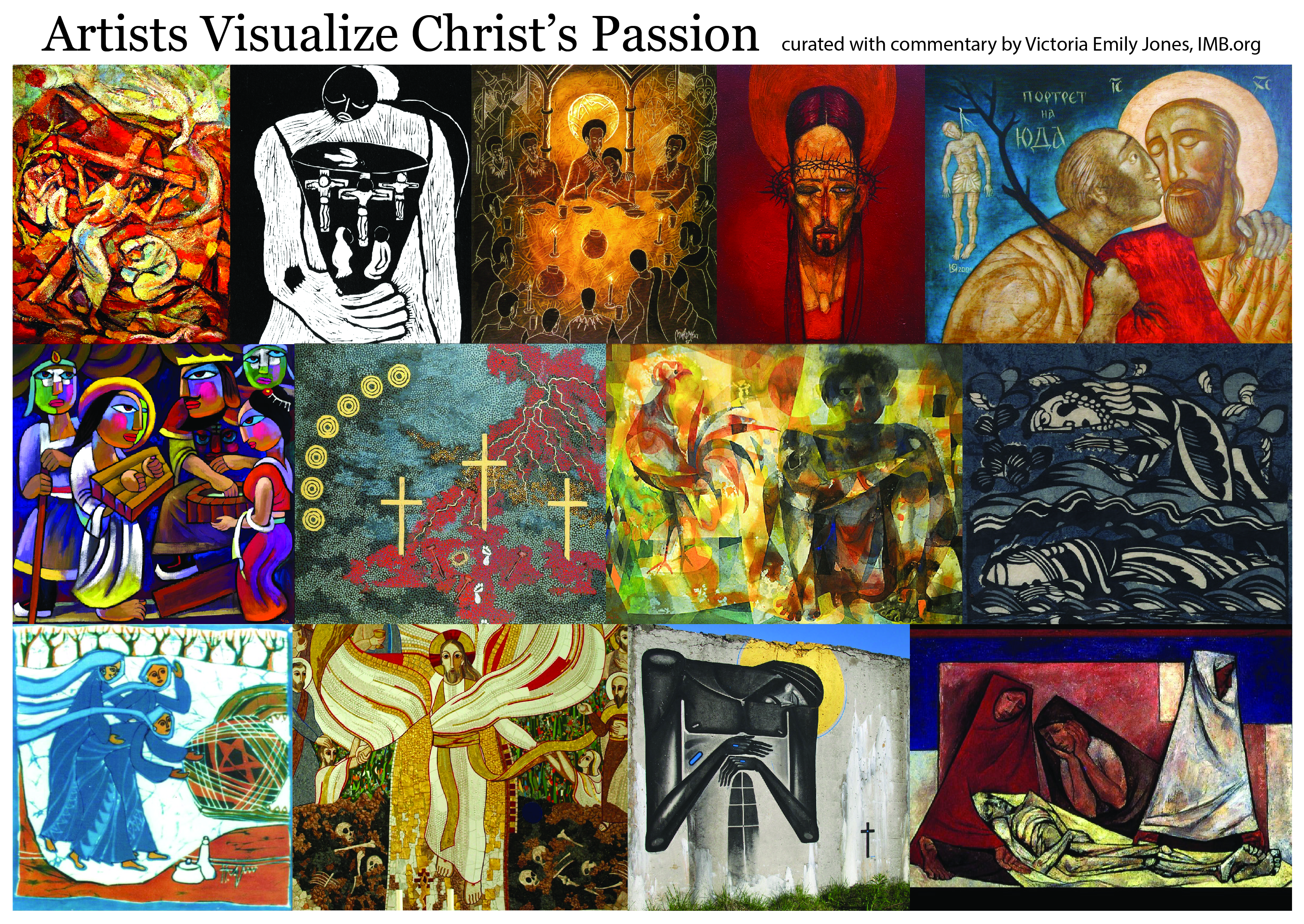
Also for Holy Week, I’d like to remind you of a digital gallery of contemporary global art I curated and commented on for the International Mission Board in 2017, with selections spanning six continents: https://www.imb.org/2017/04/07/journey-cross-artists-visualize-christs-passion-part-1/; https://www.imb.org/2017/04/12/journey-cross-artists-visualize-christs-passion-part-2/.

Holy Week art at IMB.org


This post belongs to the weekly series Artful Devotion. If you can’t view the music player in your email or RSS reader, try opening the post in your browser.

To view all the Revised Common Lectionary scripture readings for Palm Sunday, cycle A, click here.