
Roundup: Doubting Thomas, practicing stillness, living with grief, and more

SPOTIFY PLAYLIST: October 2023 (Art & Theology): Each month I compile a nonthematic mix of thirty faith-inflected songs from a range of sources. October’s playlist is now live. One track I’ll draw your attention to, with a live performance video below, is the soul-baring prayer “Doubting Thomas” by Chris Thile of Nickel Creek; read the lyrics, with annotations, here. (Also, Paul Demer has a nice cover of this song on YouTube.)

+++

MEDITATION EXERCISE: “Stillness—Richard Rohr’s Daily Meditations”: From the Center for Action and Contemplation comes this one-minute video that takes the most memorable line from Psalm 46, progressively paring it down and creating meditative space around each subtraction.

Be still and know that I am God
Be still and know that I am
Be still and know
Be still
Be

The Rev. Dr. Cynthia Bourgeault, an Episcopal priest, writer, and retreat leader, mentions this chant in her book Chanting the Psalms. “Each time the line is repeated,” she writes, “key words are taken away. The result is a funnel-like effect that leads straight down into silence. . . . Each phrase expresses its own unique meaning and understanding as the prayer moves toward utter simplicity” (185). Bourgeault recommends working with the recording “Be Still and Know” found on the album Songs of Presence: Contemplative Chants for the New Millennium from Praxis Publishing House; I couldn’t find the audio online, but I did find a song by The River’s Voice (Trish and Richard Bruxvoort Colligan) that’s also based on this exercise of Fr. Rohr’s: “Be (Still and Know That I Am God)”:

+++

PODCAST EPISODES: Here are two podcast episodes I caught up with recently and enjoyed. Both links include transcripts.

>> “Jan Richardson: Stubborn Hope,” Everything Happens with Kate Bowler, October 27, 2020: Kate Bowler, a historian and cancer survivor who has done much academic work on the prosperity gospel, talks with spiritual writer Jan Richardson [previously], whose husband died unexpectedly in 2013, about the hidden rooms of grief, being disciplined by hope, and how the concept of blessing in the Jewish and Christian traditions differs from the #blessed culture of social media. Don’t miss the three discussion questions in the show notes.

>> “Esau McCaulley: How Far to the Promised Land?,” No Small Endeavor, September 14, 2023: Lee C. Camp interviews public theologian Esau McCaulley, a professor of New Testament at Wheaton College and a New York Times opinion writer, about his new memoir, How Far to the Promised Land: One Black Family’s Story of Hope and Survival in the American South. I’ve heard rave reviews from multiple corners about this book, and this conversation has really whetted my appetite to read it!

+++

POEM COMMENTARY: “Learning about Constellations” by Saddiq Dzukogi, commentary by Pádraig Ó Tuama: On this episode of On Being’s Poetry Unbound podcast, host Pádraig Ó Tuama unpacks a poem written by Saddiq Dzukogi in the aftermath of his one-year-old daughter’s death. It’s from his 2021 collection Your Crib, My Qibla.
Lent, Day 2

To you, silence is praise, O God . . .

—Psalm 65:1*

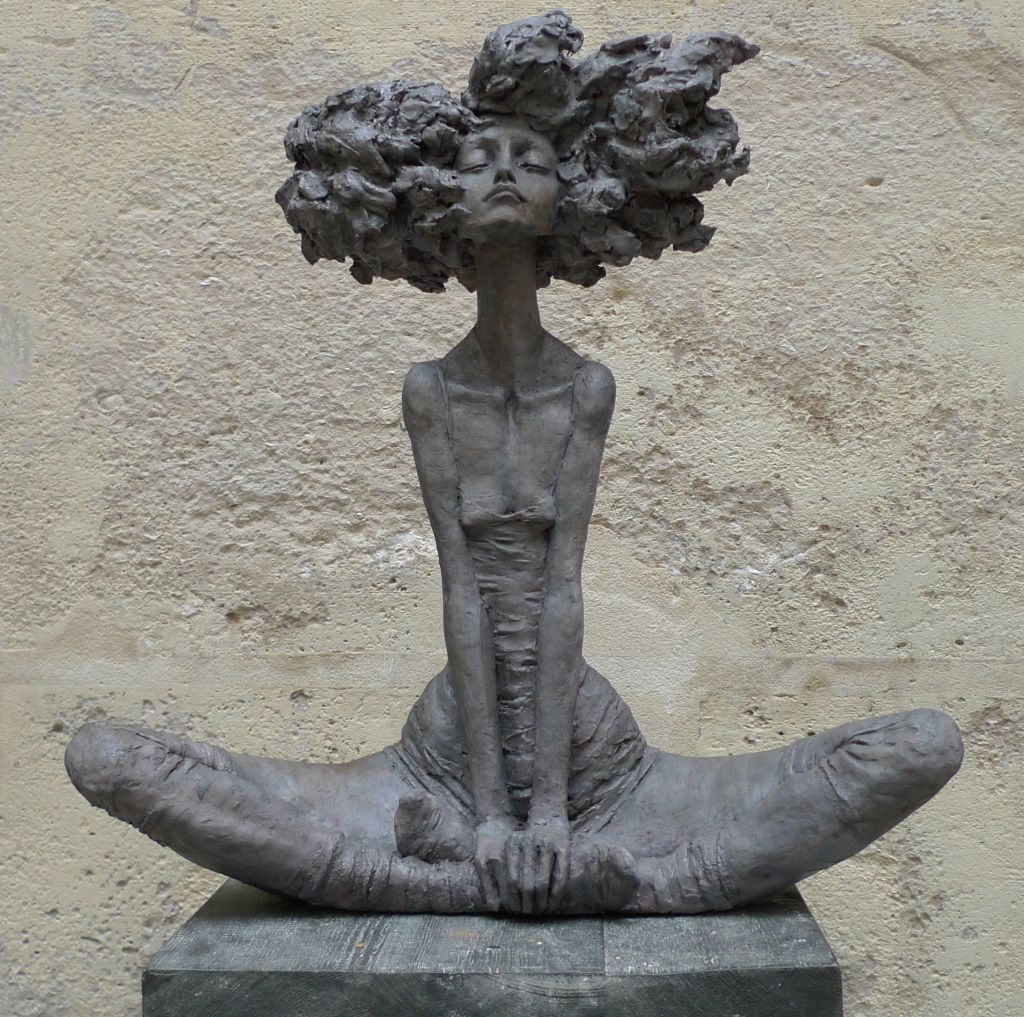
LOOK: Valérie Hadida (French, 1965–), Nuage (Cloud), 2013. Hadida is a contemporary figurative sculptor from France who works mainly in bronze and clay. Many of her “petites bonnes femmes” (little women) sculptures are available for sale through websites like Artsper and Artsy. View process photos on the artist’s Facebook page.

Hadida, Valérie_Nuage

LISTEN: “Dumiyah” by Richard Bruxvoort Colligan, on Our Roots Are in You: Short, Quiet Psalms (2013), feat. Trish Bruxvoort Colligan

Dumiyah
Tibi silens laus

English Translation:
Silence
For you, silence is praise

Dumiyyah (alternatively transliterated as dumiyah, dumiyya, or dûmîyâ) is one of several Hebrew words for “silence.” It’s used four times in the Psalms, most famously in Psalm 62:1—“For God alone my soul waits in silence; from him comes my salvation”—but also in Psalm 65:1. In addition to its straightforward sense, the word implies waiting or repose.

(Related post: “The savasana of Lent”)

The song above is a contemplative setting of the opening phrase of Psalm 65 in two languages. It layers the Hebrew dumiyyah with the Latin Vulgate translation of Leka dumiyyah tehillah.

In “Mystery of the Missing Silence,” Christian spirituality writer Carl McColman ponders why so many English translations of Psalm 65:1 eliminate or obscure the word dumiyyah that’s in the original text. The few well-established ones (in Christian circles) that retain it are:

  • The Darby Bible (DBY): “Praise waiteth for thee in silence, O God, in Zion . . .”
  • The New American Standard Bible (NASB): “There will be silence before You, and praise in Zion, O God . . .”
  • The GOD’S WORD Translation (GW): “You are praised with silence in Zion, O God . . .”
  • The English Standard Version (ESV) has “Praise is due you,” but a footnote provides the alternate translation “Praise waits for you in silence.”

McColman’s word study led him to reach out to Jewish friends with a familiarity of Hebrew, including one in rabbinical school, who pointed him to the Stone Edition Tanach from ArtScroll. First published in 1996, this translation by an international team of Torah scholars renders Psalm 65:1a as “To you, silence is praise, O God in Zion.” (Other modern Jewish translations, like Rabbi A.J. Rosenberg’s, have something similar.) A footnote in the Stone Edition cites commentary from the medieval rabbinic scholar Rashi (1040–1105), who said, “The praises of infinite God can never be exhausted. Silence is his most eloquent praise, since elaboration must leave glaring omissions.”

“Dumiyah” by Richard Bruxvoort Colligan is featured on the Art & Theology Lent Playlist on Spotify.

* Note: In most modern Jewish translations, which tend to count the original headings in the Psalms as verses, this is Psalm 65:2. In the Vulgate and in Eastern Orthodox Bibles, which follow the Septuagint numbering system instead of the Hebrew (Masoretic) one, it is Psalm 64:2. However, for consistency, I refer to it throughout this post as Psalm 65:1, following the numbering in Protestant Bibles.