
Roundup: “Poetry for All” podcast, startling Crashaw poem, despair and grace, and more

SPOTIFY PLAYLIST: October 2025 (Art & Theology)

+++

PODCAST: Poetry for All, hosted by Joanne Diaz and Abram Van Engen: Poetry for All “is for those who already love poetry and for those who know very little about it. In this podcast, we read a poem, discuss it, see what makes it tick, learn how it works, grow from it, and then read it one more time.” I’ve consistently enjoyed this podcast since its launch in 2020, having learned about it through cohost Abram Van Engen [previously], an academic who often writes and speaks about poetry for general Christian audiences. Here are some of my favorite episodes of the ninety-seven that have been released to date:

  • Three haiku by Kobayashi Issa, translated from the Japanese by Robert Hass: The first: “The snow is melting / and the village is flooded / with children.” Learn the characteristics of what Joanne Diaz calls “the perfect poetic form.”
  • “spring song” by Lucille Clifton: One of my favorite poems by one of my favorite poets. “This joyful poem caps a sequence of sixteen poems called ‘some jesus,’ which walks through biblical characters (beginning with Adam and Eve) and ends on four poems for Holy Week and Easter. [Clifton] wrote other poems on the Bible as well, including ‘john’ and ‘my dream about the second coming,’ which reimagine a way into biblical characters to make their stories fresh.”
  • “Elegy for My Mother’s Mind” by Laura Van Prooyen: This episode is unique in that it has the poet herself on to read and discuss the poem, which in this case navigates the complexities of memory, loss, and familial relationships.
  • “View but This Tulip” by Hester Pulter: Ashamedly, I had never heard of this seventeenth-century female poet before listening to this episode, so I’m grateful to guest Wendy Wall, cocreator of the award-winning Pulter Project website, for introducing me to her! “In this episode we discuss [Pulter’s] work with emblems, her scientific chemistry experiment with flowers, and her wonderment (both worried and confident, doubtful and awestruck) about the resurrection of the body and its reunification with the soul after death.”
  • “From Blossoms” by Li-Young Lee: A much-anthologized poem ostensibly about eating summer peaches, but more deeply, it’s about joy. “One of the things that draws me to this poem,” says Van Engen, “is that joy is actually very hard to write about . . . without it sounding naive or sentimental or withdrawn or unaware.”
  • “Primary Care” by Rafael Campo: Dr. Rafael Campo is both a poet and a practicing physician. Here he uses blank verse to explore the experience of illness and suffering.

+++

POEMS:

>> “For V. the Bag Lady, Great in the Kingdom of Heaven,” “Damascus Road,” “The Sower,” and “Crosses” by Paul J. Pastor: The Rabbit Room received permission to reproduce four poems from Paul J. Pastor’s [previously] new poetry collection, The Locust Years, which “explores a world of mystery and sorrow, desolation and love. Rooted in the Pacific Northwest, these poems offer readers an invitation to walk along a path pebbled with profound joy and deep loss.” I’ll be sharing another on the blog next week, courtesy of Wiseblood Books.

>> “Undone” by Michael Stalcup: The rise of blogging in the aughts and its descendant, Substacking, in the last few years has meant that poets and other writers can share their work directly with their reading publics and give them insight into their creative process if they wish. On his Substack, the Thai American poet Michael Stalcup [previously] recently shared one of his new poems that’s based on the story of the woman caught in adultery in John 8:1–11. He explains how the poem’s form, a blend of the Petrarchan sonnet and the chiasmus, contributes to its meaning.
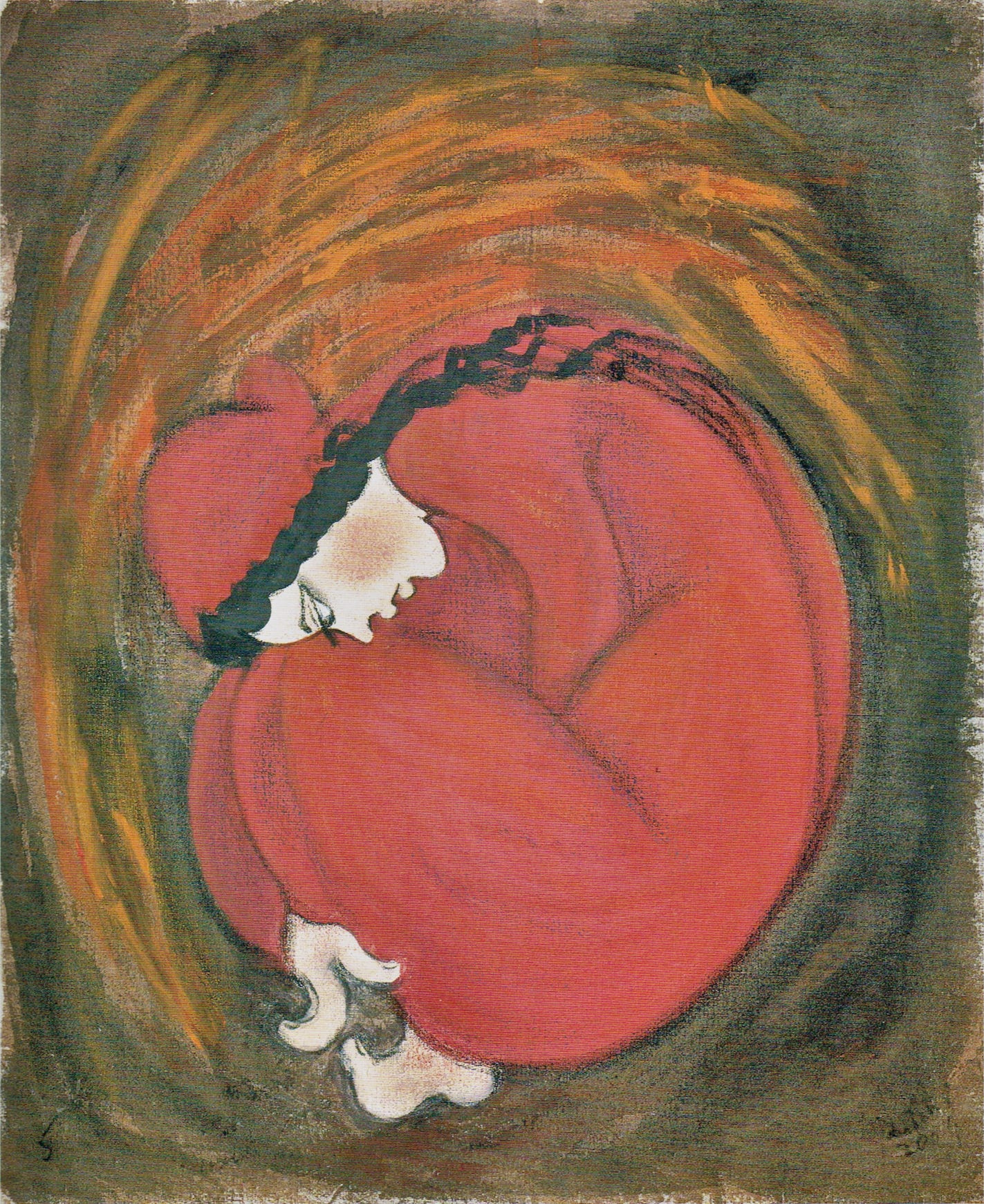
Jayasuriya, Nalini_Go, Sin No More
Nalini Jayasuriya (Sri Lankan, 1927–2014), Go, Sin No More, 2004. Mixed media on cloth, 23 × 19 in. Published in The Christian Story: Five Asian Artists Today, ed. Patricia C. Pongracz, Volker Küster, and John W. Cook (Museum of Biblical Art, 2007), p. 119.

+++

POEM COMMENTARY: “The Crèche and the Brothel: The Poetic Turn in Crashaw’s Infamous Epigram” by Kimberly Johnson, Voltage Poetry: The seventeenth-century Anglican-turned-Catholic poet Richard Crashaw [previously] was a master of the epigram, and this is one of my favorites of his:

Blessed be the paps which Thou hast sucked.
    —Luke 11:27

Suppose he had been Tabled at thy Teats,
Thy hunger feels not what he eats:
He’ll have his Teat ere long (a bloody one).
The Mother then must suck the Son.

Scholar Kimberly Johnson [previously] unpacks these four lines about the body of Christ, who as an infant drank milk from his mother’s breast, and whose sacrificial death opened up his own breast whence flows the blood that nourishes us all. Johnson teases out the overlap of physical and spiritual in the poem, highlighting the maternal sharing of one’s own substance that links both couplets. At the eucharistic table, we are bidden to come and eat; or, in the stark metaphorical language of Crashaw, come and suck Christ’s bloody teat.

I plan to write an essay sometime about Christ as a nursing mother, as I’ve seen the image pop up in medieval writings and some visual art, including from Kongo and Ethiopia. In the meantime, here’s an illumination of the sixth vision in part 2 of Hildegard of Bingen’s Scivias (Know the Ways), painted under the supervision of Hildy herself. It shows the crucified Christ feeding Ecclesia (his bride, the church) with blood from his breast.
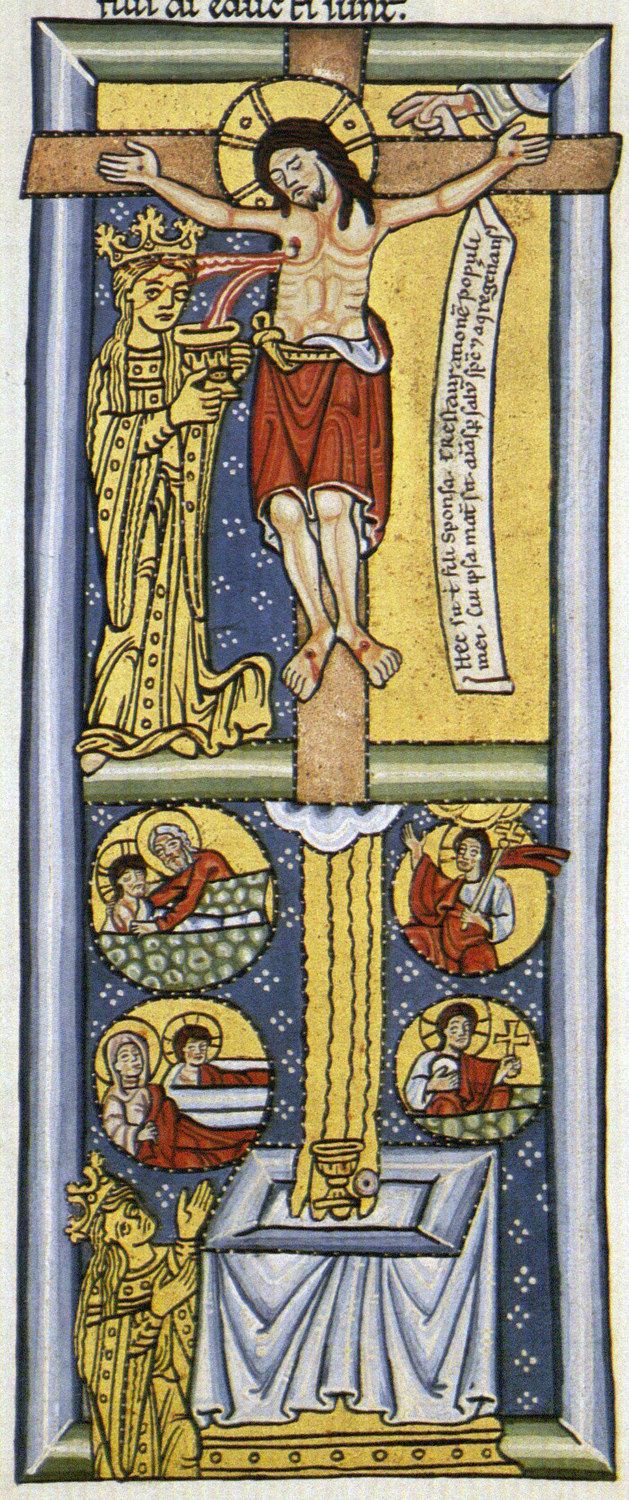
Hildegard of Bingen_Crucifixion
“The Crucifixion and the Eucharist,” from Scivias (Know the Ways) II.6, Rupertsberg Abbey, Germany, before 1179. Rupertsberg Codex, fol. 86r, Hildegard Abbey, Eibingen, Germany. The original manuscript from Hildegard’s lifetime was lost in 1945, but a faithful copy was made in 1927–33, which is the source of the color reproductions now available.

+++

ESSAY: “Only One Heart: The Poetry of Franz Wright as Emblem of God’s Grace” by Bonnie Rubrecht, Curator: “Are You / just a word? // Are we beheld, or am I all alone?” These three lines typify the poetry of Franz Wright (1953–2015), the Pulitzer Prize–winning author of Walking to Martha’s Vineyard, God’s Silence, and other collections. “Wright’s work is often described as confessional, colored by irony and humor. His irreverence, juxtaposed with honesty and humility, make his poetic voice unique in addressing God. Writers and poets often traffic in spiritual themes, but few modern poets echo the prophetic Old Testament tradition of crying out, approaching God with the concision and raw emotion that Wright does. He excels in voicing the concerns and ruminations of the human experience of suffering, while simultaneously shifting towards his own embodiment of grace.”
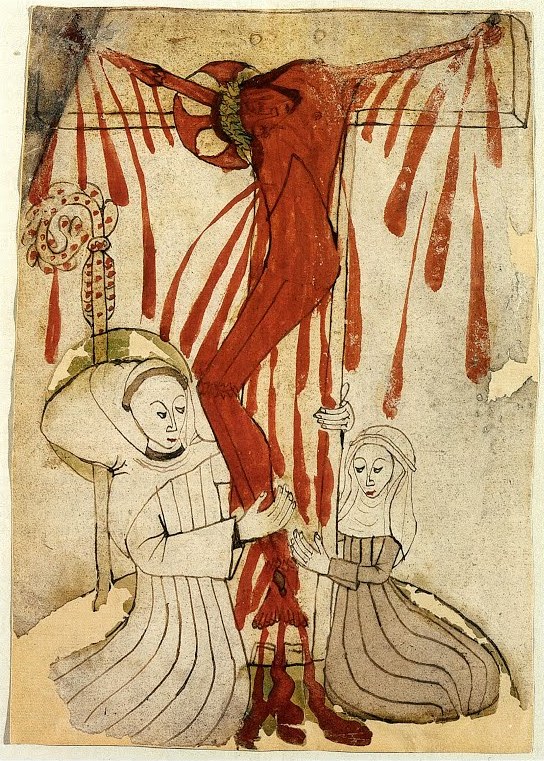
“Upon the Bleeding Crucifix” by Richard Crashaw (poem)

Vision of St. Bernard (Crucifixion)
Vision of Saint Bernard (Blood Crucifix), by a nun from the Lower Rhine, 14th century. Ink and colored washes on paper, 25.5 × 18 cm. Museum Schnütgen, Cologne.

Jesu, no more! It is full tide;
From thy hands and from thy feet,
From thy head, and from thy side,
All the purple rivers meet.

What need thy fair head bear a part
In showers, as if thine eyes had none?
What need they help to drown thy heart,
That strives in torrents of its own?

Water’d by the showers they bring,
The thorns that thy blest brow encloses
(A cruel and a costly spring)
Conceive proud hopes of proving roses.

Thy restless feet now cannot go
For us and our eternal good,
As they were ever wont. What though?
They swim, alas! in their own flood.

Thy hand to give thou canst not lift,
Yet will thy hand still giving be.
It gives, but O, itself’s the gift,
It gives though bound, though bound ’tis free.

But, O thy side, thy deep-digg’d side,
That hath a double Nilus going:
Nor ever was the Pharian tide
Half so fruitful, half so flowing.

No hair so small, but pays his river
To this Red Sea of thy blood;
Their little channels can deliver
Something to the general flood.

But while I speak, whither are run
All the rivers named before?
I counted wrong: there is but one;
But O that one is one all o’er.

Rain-swol’n rivers may rise proud,
Bent all to drown and overflow;
But when indeed all’s overflow’d,
They themselves are drowned too.

This thy blood’s deluge (a dire chance,
Dear Lord, to thee) to us is found
A deluge of deliverance,
A deluge lest we should be drown’d.

Ne’er wast thou in a sense so sadly true,
The well of living waters, Lord, till now.

This poem was published in the second edition of Steps to the Temple: Sacred Poems, with Other Delights of the Muses (London, 1648) under the title “On the Bleeding Body of Our Crucified Lord”; an earlier version appeared in the book’s first edition in 1646 under the title “On the Bleeding Wounds of Our Crucified Lord.” I use the title by which it is most commonly known, “Upon the Bleeding Crucifix,” first assigned to it in Crashaw’s posthumously published collection Carmen Deo Nostro (Paris, 1652). I’ve modernized the spellings.


Richard Crashaw (1612–1649) was one of the major Metaphysical poets of seventeenth-century England, a movement marked by the use of elaborate figurative language, original conceits, paradoxes, and philosophical exploration. He was also a priest. Ordained in the Church of England in 1638, he was installed as curate of the Church of St Mary the Less in Cambridge, embracing the high-church reforms of Archbishop William Laud, for which he was persecuted. In 1643, during the English Civil War, Oliver Cromwell and his Puritan posse forced Crashaw into exile in France, where he converted to Roman Catholicism. Waiting for a papal retainer, he struggled with poverty and ill health. Pope Innocent X finally granted Crashaw a post at a seminary in Rome in 1647, and two years later he was given a cathedral benefice in Loreto, where he died of a fever at age thirty-six. He published two collections of poetry during his lifetime.

For more Crashaw on the blog, see the article “The ‘Nothing’ that won our salvation.”

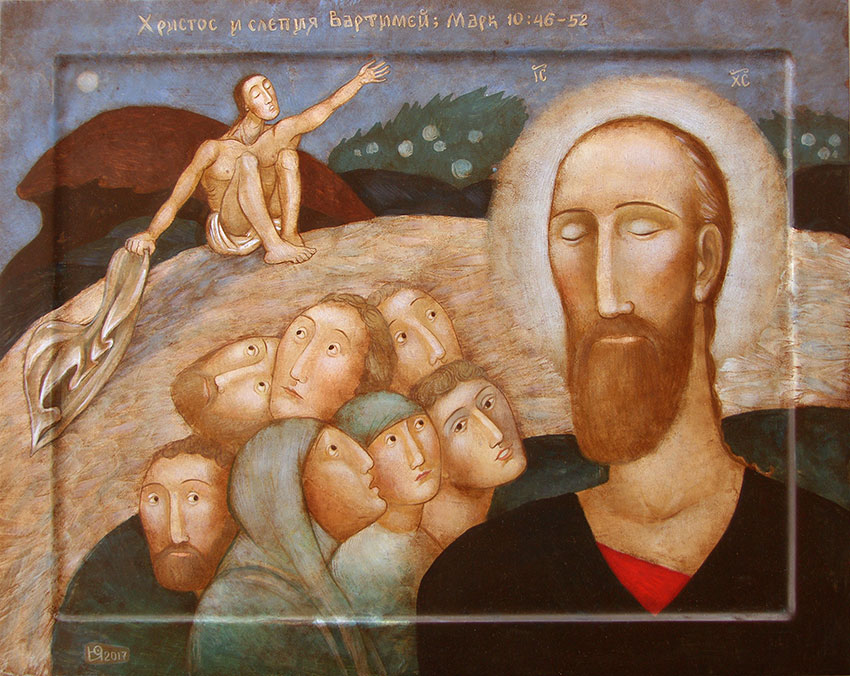
Son of David, I Want to See (Artful Devotion)

Christ and Bartimaeus by Julia Stankova
Julia Stankova (Bulgarian, 1954–), Christ and Bartimaeus, 2017. Tempera on primed wooden panel and lacquer technique, 36 × 45 cm.

And they came to Jericho. And as he was leaving Jericho with his disciples and a great crowd, Bartimaeus, a blind beggar, the son of Timaeus, was sitting by the roadside. And when he heard that it was Jesus of Nazareth, he began to cry out and say, “Jesus, Son of David, have mercy on me!” And many rebuked him, telling him to be silent. But he cried out all the more, “Son of David, have mercy on me!” And Jesus stopped and said, “Call him.” And they called the blind man, saying to him, “Take heart. Get up; he is calling you.” And throwing off his cloak, he sprang up and came to Jesus. And Jesus said to him, “What do you want me to do for you?” And the blind man said to him, “Rabbi, let me recover my sight.” And Jesus said to him, “Go your way; your faith has made you well.” And immediately he recovered his sight and followed him on the way.

—Mark 10:46–52 (cf. Matthew 20:29–34; Luke 18:35–43)

+++

SONG: “Son of David” by Ghost Ship, on The Good King (2013)

Here’s an introduction and acoustic performance by band leader Cam Huxford, who cowrote “Son of David” with fellow Ghost Ship member Shay Carlucci:

+++

“The Blind Suppliant” by Richard Crashaw

Silence, silence, O vile crowd;
Yea, I will now cry aloud:
He comes near, Who is to me
Light and life and liberty.
Silence seek ye? yes, I’ll be
Silent when He speaks to me,
He my Hope; ah, meek and still,
I shall ’bide His holy will.
O crowd, ye it may surprise,
But His voice holdeth my eyes:
O have pity on my night,
By the day that gives glad light;
O have pity on my night,
By the day would lose its light,
If it gat not of Thee sight;
O have pity on my night,
By day of faith upspringing bright;
That day within my soul that burns,
And for eyes’ day unto Thee turns.
Lord, O Lord, give me this day,
Nor do Thou take that away.


This post belongs to the weekly series Artful Devotion. If you can’t view the music player in your email or RSS reader, try opening the post in your browser.

To view all the Revised Common Lectionary scripture readings for Proper 25, cycle B, click here.

The “Nothing” that won our salvation

Now Jesus stood before the governor, and the governor asked him, “Are you the King of the Jews?” Jesus said, “You have said so.” But when he was accused by the chief priests and elders, he gave no answer. Then Pilate said to him, “Do you not hear how many things they testify against you?” But he gave him no answer, not even to a single charge, so that the governor was greatly amazed.

—Matthew 27:11–14

Consider the incredible self-control Jesus exercises in his appearance before Pilate. He has just come from his religious trial, where he was passed from Annas to Caiaphas to the Sanhedrin and found guilty of blasphemy. But the Sanhedrin does not have the authority to issue death sentences, so they turn Jesus over to the civil authorities, claiming he’s a threat to Roman power, guilty of sedition.

Both charges are false, and yet Jesus gives no defense against either one. Why? Why not prove that he truly is the Son of God, and that he’s no insurrectionist? Why not clear his name? In John’s account of the trial before Pilate (18:33–38), Jesus is more verbal; he explains, “My kingdom is not of this world.” But still, he offers no hard evidence, calls no witnesses (they’ve scattered anyway). He essentially sits back and lets the judgment fall.

English poet and clergyman Richard Crashaw (1612–1649) was inspired by Christ’s silence under pressure to pen an epigrammatic verse unpacking its significance. As a teenager attending Charterhouse School in London, he and his fellow students were required to write epigrams based on the epistle and Gospel readings from the day’s chapel services, and it’s a practice Crashaw continued throughout his life. The following was originally published in Steps to the Temple: Sacred Poems, with Other Delights of the Muses in 1646.

“Matthew 27” by Richard Crashaw

And he answered them nothing.

O Mighty Nothing! unto thee,
Nothing, we owe all things that be.
God spake once when he all things made,
He sav’d all when he Nothing said.
The world was made of Nothing then;
’Tis made by Nothing now again.

In “Matthew 27,” Crashaw apostrophizes the word Nothing. (Apostrophe is a poetic device in which the speaker addresses an absent person, an abstract idea, or a thing; Paul does it, for example, in 1 Corinthians 15:55: “O death, where is thy sting? O grave, where is thy victory?”) He plays on its opposite: everything. By no thing comes all things.   Continue reading “The “Nothing” that won our salvation”