
LOOK: Nativity by Judith Tutin
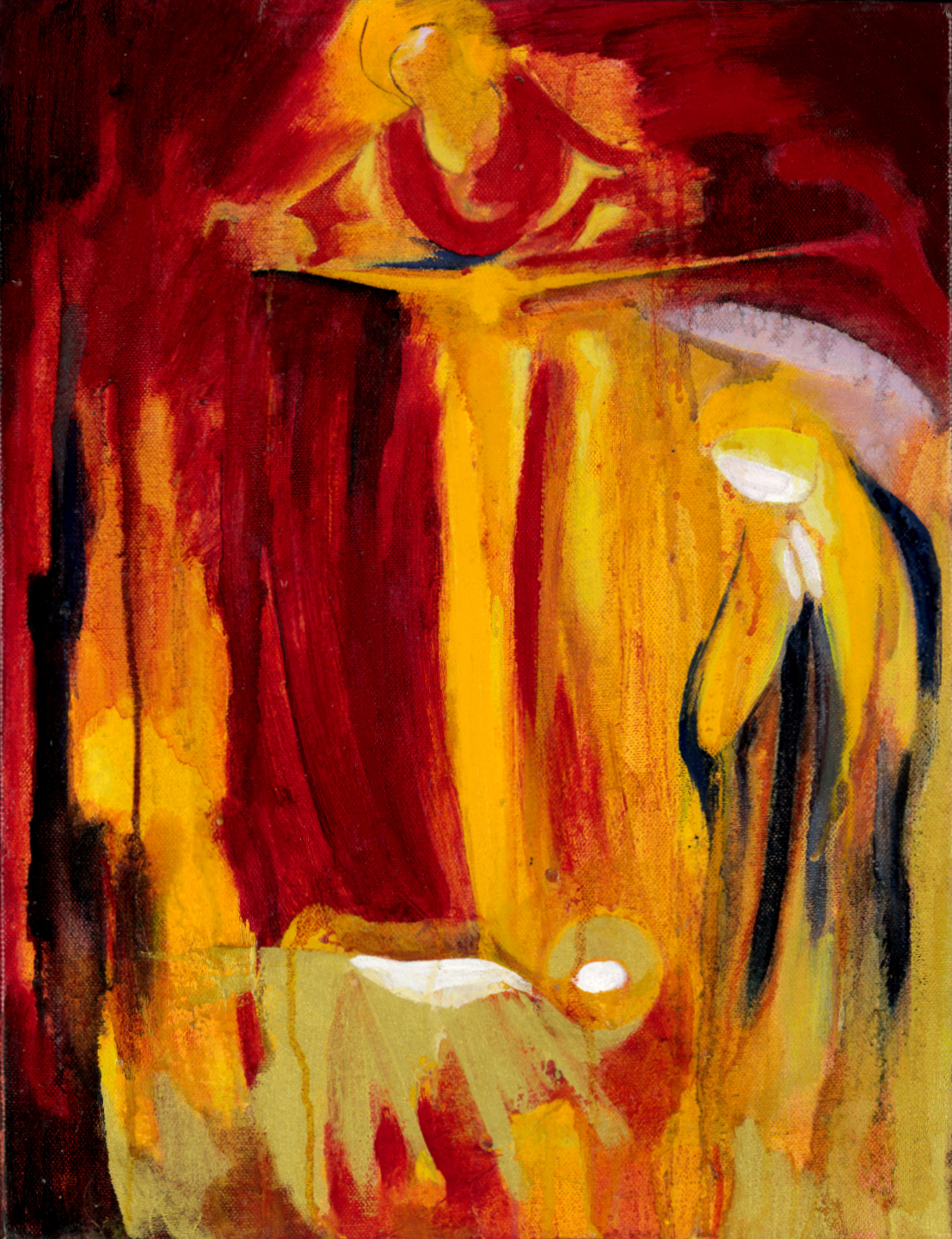
In this semiabstract Nativity painting by Judith Tutin, Mary and Joseph adore the newborn Christ child as God the Father looks down from above, holding in his arms a portent: the traces of a cross. One might also see, overlapping the intimation of a crossbar, the outstretched wings of the Holy Spirit as dove, hovering over the earthly scene below.
This central triad of Father, (crucified) Son, and Spirit evokes the Gnadenstuhl, or “Throne of Mercy,” an iconography of the Trinity that emerged in twelfth-century Europe. Tutin innovates on this type by showing, at the base of the cross, the Son in his infancy, thus drawing together the doctrines of the incarnation and the atonement.
Applied in broad, loose brushstrokes, the deep crimsons and golds further underscore the themes of blood and glory.
LISTEN: “A Stable Lamp Is Lighted” | Words by Richard Wilbur, 1958 | Music by Jennifer Wyatt, 2002 | Performed by Ardyth & Jennifer on WinterFire, 2002
A stable-lamp is lighted
Whose glow shall wake the sky;
The stars shall bend their voices,
And every stone shall cry.
And every stone shall cry,
And straw like gold shall shine;
A barn shall harbor heaven,
A stall become a shrine.This child through David’s city
Shall ride in triumph by;
The palm shall strew its branches,
And every stone shall cry.
And every stone shall cry,
Though heavy, dull, and dumb,
And lie within the roadway
To pave his kingdom come.Yet he shall be forsaken,
And yielded up to die;
The sky shall groan and darken,
And every stone shall cry.
And every stone shall cry
For stony hearts of men:
God’s blood upon the spear-head,
God’s love refused again.But now, as at the ending,
The low is lifted high;
The stars shall bend their voices,
And every stone shall cry.
And every stone shall cry,
In praises of the Child
By whose descent among us
The worlds are reconciled.
Richard Wilbur (1921–2017) [previously] was a major American poet, serving as the nation’s second poet laureate and winning two Pulitzer Prizes and a National Medal of Arts. He was a champion of formalist poetry, working within the constraints of meter and rhyme.
He wrote this text to be sung at a December 7, 1958, candlelight service in the Memorial Chapel of Wesleyan University in Middletown, Connecticut, where he was a professor in the English Department. It premiered with a choral setting by Richard Winslow, director of the university’s choral society. Wilbur also sent out the text in his family Christmas cards that year.
A few years later, it was published in his collection Advice to a Prophet (1961) as “A Christmas Hymn,” with Luke 19:39–40 as an epigraph: “And some of the Pharisees from among the multitude said unto him, Master, rebuke thy disciples. And he answered and said unto them, I tell you that, if these should hold their peace, the stones would immediately cry out.” This passage takes place upon Jesus’s entry into Jerusalem the week of his death. People were lauding him as a king who came in the name of the Lord, which the Pharisees considered blasphemous. When they demand that Jesus repudiate such ridiculous claims, he instead validates them, replying that even the inanimate stones know his kingship and would shout, “Hosanna!” if human voices failed to.
The hymn stretches from Christmas to Palm Sunday to Good Friday, then circles back to Christmas, covering the span of Christ’s life.
“Not many other major poets in the past seventy years have written Christmas hymns, classic, straightforward Nativity celebrations with no irony to them, and which work beautifully in a traditional church service,” notes Bruce Michelson in Wilbur’s Poetry: Music in a Scattering Time. Wilbur is an example of a modern poet who was very accomplished at his craft and respected by the establishment as well as being a person of Christian faith.
“A Stable Lamp Is Lighted” appears in a few dozen hymnals. The standard tune for it is ANDÚJAR by David Hurd from 1983, but I prefer the one by Ardyth & Jennifer, Celtic harp and vocal duo Ardyth Robinson and Jennifer Wyatt, based in Shad Bay, Nova Scotia.
This post is part of a daily Christmas series that goes through January 6. View all the posts here, and the accompanying Spotify playlist here.

 Art & Theology