“I Thirst” by Frances Ellen Watkins Harper (poem)

Knight, Chad_Release
Digital concept for outdoor fountain by Chad Knight, 2017 [purchase]

FIRST VOICE.

I thirst, but earth cannot allay
The fever coursing through my veins.
The healing stream is far away—
It flows through Salem’s lovely plains.
The murmurs of its crystal flow
Break ever o’er this world of strife;
My heart is weary, let me go,
To bathe it in the stream of life;
For many worn and weary hearts
Have bathed in this pure healing stream,
And felt their griefs and cares depart,
E’en like some sad forgotten dream.
SECOND VOICE.
“The Word is nigh thee, even in thy heart.”
Say not, within thy weary heart,
Who shall ascend above,
To bring unto thy fever’d lips
The fount of joy and love.
Nor do thou seek to vainly delve
Where death’s pale angels tread,
To hear the murmur of its flow
Around the silent dead.
Within, in thee’s one living fount,
Fed from the springs above;
There quench thy thirst till thou shalt bathe
In God’s own sea of love.

This poem was originally published in Sketches of Southern Life (1872) (revised and expanded from an earlier version in Forest Leaves [1845]) and is in the public domain.


Tired and disheartened, the speaker in the first half of “I Thirst” by Frances Ellen Watkins Harper longs to be with God in the New Jerusalem (Salem for short). She thirsts for another world, away from the brokenness and suffering endured on earth. She can faintly hear the rush of living waters somewhere above and beyond her, and she wants desperately to plunge in. Essentially, she wishes to die, to enter the eternal presence of the Lord, where true life is.

But then a wise voice gently reprimands her escapist attitude, reminding her that God is with her in the Spirit right now, pouring his life into her, even residing within her. She has intimate access to the Divine. While full beatitude still lies on the horizon, in the meantime, we can quench our thirst for that “something more” by communing with God interiorly, through prayer and the word, and in corporate worship with our fellow pilgrims on the way. We receive a foretaste of the heavenly feast at the Lord’s Table, and throughout the week God nourishes us again and again so that, overflowing with the Holy Spirit, we may nourish others, pointing them to the Source.

This second half of the poem is based on Romans 10:6–8: “The righteousness which is of faith speaketh on this wise: ‘Say not in thine heart, “Who shall ascend into heaven?” (That is, to bring Christ down from above.) Or, “Who shall descend into the deep?” (That is, to bring up Christ again from the dead.)’ But what saith it? ‘The word is nigh thee, even in thy mouth, and in thy heart: that is, the word of faith . . .’” (KJV). There’s an echo of Jesus’s words to his disciples that “neither shall they say, ‘Lo here!’ or, ‘lo there!’ for, behold, the kingdom of God is within you” (Luke 17:21). There’s also an implicit connection to John 4:13–14 and 7:38, which says that springs of living water—that is, Spirit-powered life—flow forth from the hearts of believers unto eternity.

[Related post: “‘River’ by Eugene McDaniels (song)”]


Frances Ellen Watkins Harper (1825–1911) was a best-selling poet, fiction writer, essayist, traveling lecturer, and prominent political activist who advocated for abolitionism, temperance, and women’s suffrage. Born to free African American parents in Baltimore, Maryland (a slave state), she was orphaned at age three and subsequently raised by her maternal uncle, William Watkins, an AME minister and educator. In her twenties she moved to Philadelphia, and a letter she wrote to a friend in April 1858 describes how, against orders, she refused to give up her seat on a city trolley to a white person. At the forefront of nineteenth-century Black political thought and action, Harper founded, supported, and held high office in several national progressive organizations, including the National Association of Colored Women. She was also at the forefront of the early African American literary tradition, publishing ten volumes of poetry during her lifetime, which sold in the tens of thousands—in addition to her short stories and novels.

Advent, Day 19: Behold

“They will hunger no more and thirst no more;
    the sun will not strike them,
    nor any scorching heat,
for the Lamb at the center of the throne will be their shepherd,
    and he will guide them to springs of the water of life,
and God will wipe away every tear from their eyes.”

—Revelation 7:16–17

Then the angel showed me the river of the water of life, bright as crystal, flowing from the throne of God and of the Lamb through the middle of the street of the city. On either side of the river is the tree of life with its twelve kinds of fruit, producing its fruit each month, and the leaves of the tree are for the healing of the nations. Nothing accursed will be found there any more. But the throne of God and of the Lamb will be in it, and his servants will worship him; they will see his face, and his name will be on their foreheads. And there will be no more night; they need no light of lamp or sun, for the Lord God will be their light, and they will reign forever and ever.

And he said to me, “These words are trustworthy and true, for the Lord, the God of the spirits of the prophets, has sent his angel to show his servants what must soon take place.”

 “See, I am coming soon! Blessed is the one who keeps the words of the prophecy of this book.”

—Revelation 22:1–7

LOOK: The Supper of the Lamb by Wayne Forte

Forte, Wayne_The Supper of the Lamb
Wayne Forte (Filipino American, 1950–), The Supper of the Lamb, 2004. Oil on canvas, 60 × 48 in.

In this eschatological painting by Wayne Forte, the slain and risen Lamb reopens Eden, welcoming us all to the feast. He holds a palm branch, symbol of the martyr’s victory, and stands atop a table set with bread, wine, and the fruits of the tree of life. A river issues forth, further underscoring that this is a place of refreshment.

In the foreground, the iron grillwork of the gate depicts key events from salvation history: the Fall and Expulsion, Noah’s Ark, the Sacrifice of Isaac, the Exodus, the Nativity, the Crucifixion, and the Resurrection. Originating in the early Christian era, the IHS monogram at the top denotes the first three letters of the Greek name of Jesus, ΙΗΣΟΥΣ: iota, eta, sigma. Later it came to be mistakenly (but appropriately!) interpreted as an acronym for the Latin Jesus Hominum Salvator, “Jesus, Savior of Humanity.”

LISTEN: “Behold, Behold” by Caroline Cobb, performed with Sean Carter on A Home and a Hunger: Songs of Kingdom Hope (2017)

I see a city coming down
Like a bride in whitest gown
Purely dressed
I see the pilgrims coming home
All creation finds shalom
The promised rest
The Lamb of God will be her light
The sun will have no need to shine

Refrain:
Behold, behold
God makes his home with us
He’ll take his throne, forever glorious
Behold, behold
God makes his home with us
He’ll take his throne, forever glorious
The curse will be undone
O come, Lord Jesus, come

The Lord will banish every sin
All that’s broken he will mend
And make new
And we will see him face to face
As he wipes our tears away
And death is through
And all the ransomed and redeemed
From every tongue and tribe will sing

[Refrain]

At last the darkness will surrender to the light
But we, unveiled in glory, will forever shine
At last the powers of hell will drown in lakes of fire
But we will freely drink the crystal streams of life

Come, thirsty, taste and see
Come, hungry, to the feast
Come, weary, find your peace
The Bride and Spirit sing
Come!
Come!

[Refrain]

Based on Revelation 21–22, “Behold, Behold” is the last song on Caroline Cobb’s album A Home and a Hunger, which traces kingdom hope from Genesis to Revelation, each song focusing on a different biblical book.


This post is part of a daily Advent series from December 2 to 24, 2023 (with Christmas to follow through January 6, 2024). View all the posts here, and the accompanying Spotify playlist here.

Roundup: Kristin Asbjørnsen interprets the spirituals, photos from Skid Row, and more

SPOTIFY PLAYLIST: July 2023 (Art & Theology): This month’s Spotify mix that I put together for you all includes a Shona worship song from Zimbabwe; “Adonai Is for Me,” a song in Hebrew by Shai Sol; a Black gospel rendition of the children’s classic “Jesus Loves Me”; a new setting of the Lord’s Prayer by Jon Guerra; a composition for clarinet and piano by Jessie Montgomery, written in April 2020 to try to make peace with the sadness brought about by the pandemic-prompted quarantine orders; a country-style setting of Psalm 121 by Julie Lee; and a benediction by Bob Dylan that I heard Leslie Odom Jr. sing in concert recently—its refrain, “May you stay forever young,” is not an anti-aging wish but rather a call to childlike faith, wonder, and curiosity in perpetuity.

The playlist also includes the following two songs.

>> “Come Go with Me”: A lesser-known African American spiritual performed by the Norwegian jazz singer-songwriter Kristin Asbjørnsen, from her excellent album Wayfaring Stranger: A Spiritual Songbook. She describes the spirituals as “existential expressions of life: songs of longing, mourning, struggling, loneliness, hopefulness and joyful travelling.” This particular one is about walking that pilgrim path to heaven, a path on which Satan lays stones to obstruct our progress but which Jesus, our “bosom friend,” clears away.

>> “Love, More Love”: A short Shaker hymn that opens with a common Shaker greeting: “More love!” “Our parents above” refers, I believe, to the elders of the faith who have passed on. The hymn uses horticultural imagery to describe the qualities of communal love—something planted and grown, becoming stronger and fuller and more beautiful as it is nurtured.

Love, more love
A spirit of blessing I would be possessing
For this is the call of our parents above

We will plant it and sow it
And every day grow it
And thus we will build up an arbor of love

The Shakers are a Christian sect founded in 1747, but because celibacy is one of their tenets (and thus they cannot rely on procreation for the community’s continuation), there are only two Shakers left: Sister June and Brother Arnold, who live in Dwellinghouse, Maine. But there has long been a historical interest in Shaker religious culture and aesthetics—which is why, for example, the Enfield Shaker Singers was formed, to preserve the hymnody.

+++

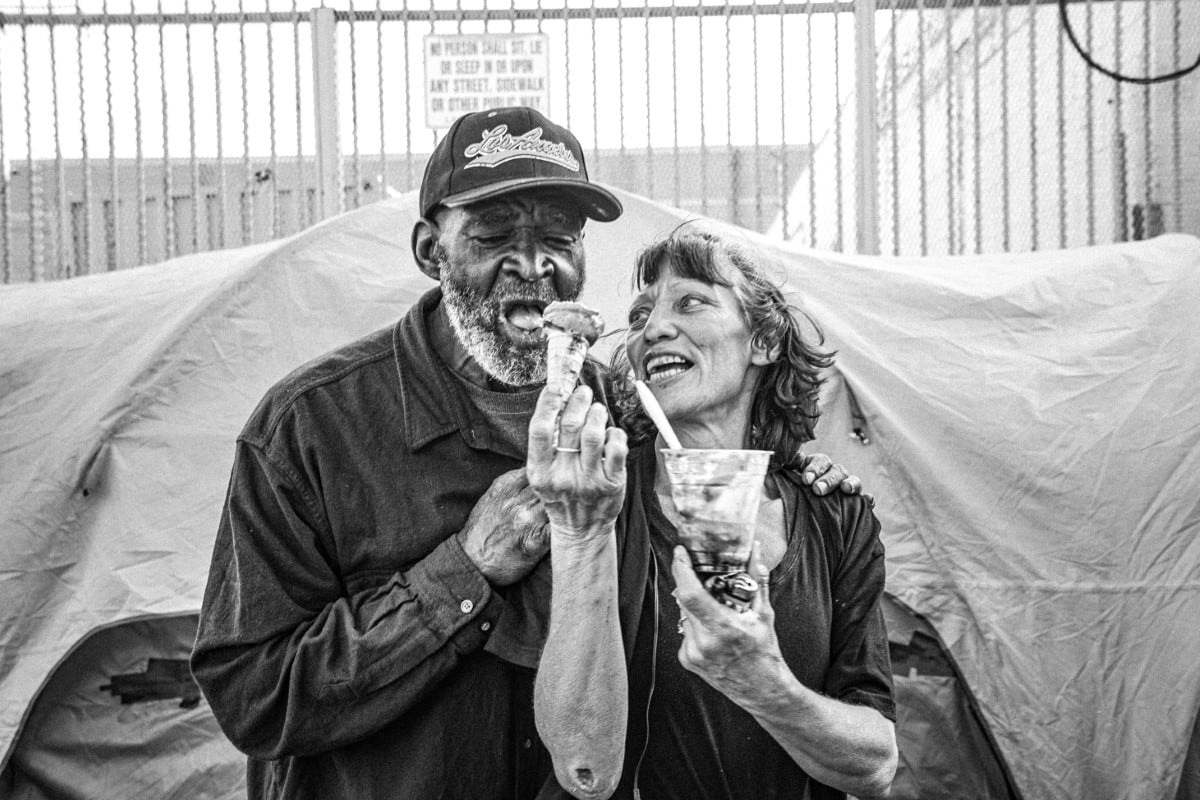
INTERVIEW + PHOTOS: “Photographer Shows the Raw, Unflinching Reality of Life on Skid Row”: For the past decade, anonymous street photographer Suitcase Joe has been spending time on Skid Row in downtown Los Angeles, a neighborhood inhabited by the largest unhoused community in America. He slowly developed trust and built relationships with the people in that community, learning more about their stories, and they granted him unprecedented access to their daily lives, allowing him to capture them on camera. Hear him talk about the experience, and about misconceptions people tend to have about those experiencing homelessness, in this interview, which also includes a sampling of photos. Even though the headline hawks “Raw!” and “Unflinching!,” I was more struck by how the photographs show experiences of joy and friendship.  

Photo by Suitcase Joe
Photograph by Suitcase Joe, Skid Row, Los Angeles

To find out ways to help meet the needs of those living on Skid Row, visit https://suitcasejoefoundation.org/.

+++

POEM WITH COMMENTARY: “The Rungs” by Benjamin Gucciardi, commentary by Pádraig Ó Tuama: Each week on the Poetry Unbound podcast, Ó Tuama reads and reflects on a different contemporary poem. In this episode’s featured poem, “a social worker holds a group for teenagers at a school. They only half pay attention to him. Then something happens, and they pay attention to each other.” The poem is from Gucciardi’s latest collection, West Portal.

+++

ARTICLE: Dool-Hoff: A Dutch Maze with New Jerusalem at its Centre (1705)”: The Public Domain Review is always uncovering unique, amusing prints and other artistic and literary curiosities from centuries past. Here they look at an early eighteenth-century religious maze published in Haarlem, Netherlands, whose pathways are filled with didactic verse, some leading to dead ends but others leading to heaven at the center.

Dool-Hoff (Dutch maze)
Dool-hoff (maze), signed by the Dutch Catholic printer Claes Braau, 1705. Photo courtesy of the Rijksmuseum, Amsterdam.

+++

SONG: “Home Inside” by Valerie June, performed by the Good Shepherd Collective: This Valerie June cover is sung so gorgeously by Sowmya Somanath with Kate Gungor, Bea Gungor, Jayne Sugg, Liz Vice, and Diana Gameros, and John Arndt accompanies on piano. It premiered in Good Shepherd New York’s March 12 digital service. The song is a prayer for belonging more fully to ourselves, to God, and to this earth; its speaker asks that she might be sensitive to the divine breath in all living things, and be soothed and refreshed by that great stream of water that flows from God’s heart. (Reminds me a bit of Universal Jones’s “River”!)

Here is the original recording by Valerie June.

Easter, Day 5: Vidi aquam

LOOK: Paschal Candlestand by Thomas Mpira

Mpira, Thomas_Paschal Candlestand
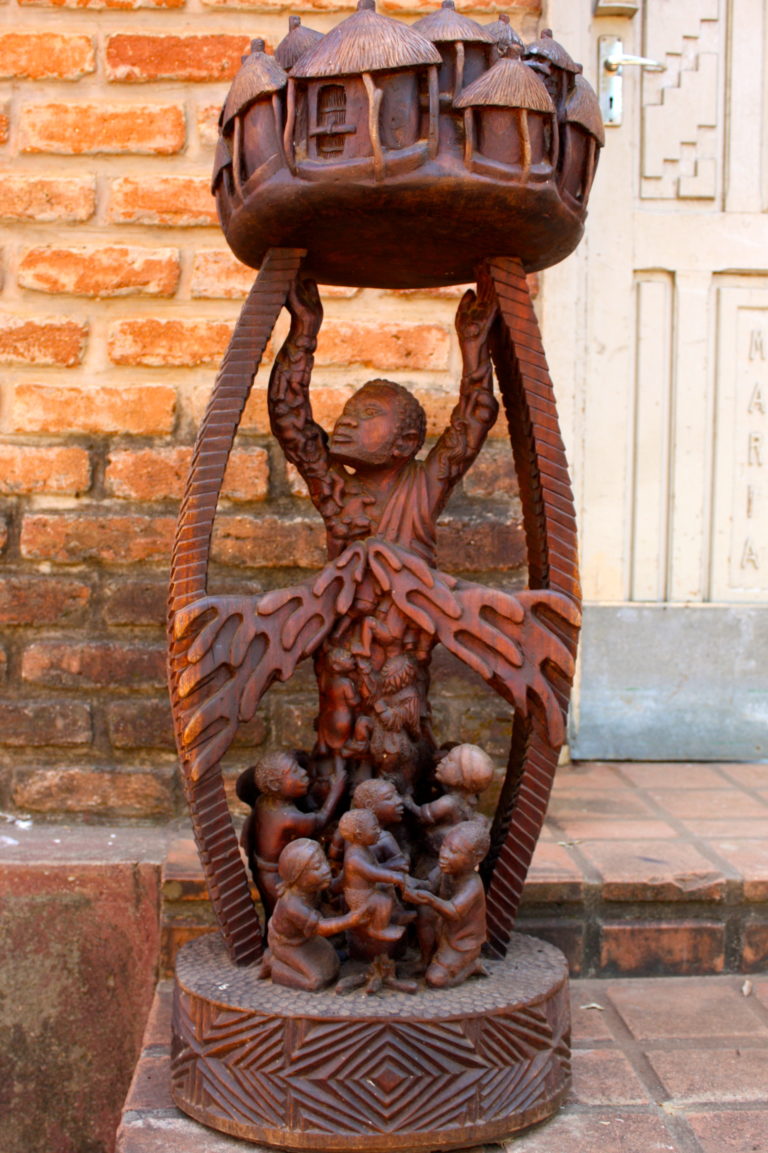
Thomas Mpira, Paschal Candlestand, 1990. Tangatanga wood, height 104 cm. Mua Parish Church, Mua, Malawi.

This large Paschal candlestand was made by Thomas Mpira, a master carver at the Kungoni Centre of Culture and Art in Mua, Malawi. Founded in 1976 by Father Claude Boucher Chisale, this center employed over 120 carvers at its height and is remarkable for how it synthesizes Christian faith and African culture. It is still active, with many locally produced artworks put on display at the center’s Chamare Museum. Others, like this one, are used in the liturgies at the Mua parish church in the diocese of Dedza, whose services are in Chichewa.

Traditionally, the Paschal candle is lit during the Easter Vigil on the night of Holy Saturday, representing the light of Christ’s resurrection expelling the darkness. It is raised and leads a procession, with the lighting blessing referencing

Christ, that Morning Star,
who came back from the dead,
and shed his peaceful light on all humanity,
[God’s] Son, who lives and reigns for ever and ever.

The candle is then placed on the stand and remains lit at all worship services throughout the Easter season, and during baptisms and funerals at any time of the year.

The central figure of Mpira’s carving is the risen Christ, his body constituted of people who’ve been incorporated by his death and resurrection into the “celestial village” he holds aloft, the kingdom of God. From his Sacred Heart gushes a river of life that waters a Chewa village, where a newborn is being passed over a fire to welcome him into the community. (Some Chewa Christians have adapted this ritual such that the child is passed over a lit candle at baptism.) Powerful and regenerating, Christ’s Spirit pours out over the villagers and their daily lives.

The arched forms that support the top of the stand are stylized rainbows, symbolic of God’s promise.

LISTEN: “Vidi aquam” (Wolof: “Gis Na Deh”) by the Monks of Keur Moussa Abbey, from Keur Moussa: Sacred Chant and African Rhythms from Senegal (1997)

English translation:

I saw water flowing out of the temple, from its right side, alleluia:
And all to whom this water came were saved,
And they exclaim, “Alleluia, alleluia!”

Glory to the Father and to the Son and to the Holy Spirit:
As it was in the beginning, now and forever.

I saw water flowing out of the temple, from its right side, alleluia:
And all to whom this water came were saved,
And they exclaim, “Alleluia, alleluia!”

“Vidi aquam” (“I saw the water”) is a joyful Easter chant for the asperges ritual at the beginning of Mass, in which the altar, the clergy, and the congregation are sprinkled with holy water. The Latin word “asperges” is taken from Psalm 51:3, “Asperges me hyssopo” (Thou shalt sprinkle me with hyssop), which is intoned during the rite for most of the year—except during Eastertide, when this text is replaced with one based on Ezekiel 47, in which the prophet sees a sanctifying flood issuing forth from the temple in Jerusalem:

Then he brought me back to the entrance of the temple; there water was flowing from below the entryway of the temple toward the east. . . . Wherever the river goes, every living creature that swarms will live . . . (vv. 1, 9)

(Related posts: “‘River’ by Eugene McDaniels”; “Music making at Keur Moussa Abbey, Senegal”)

This sensory ritual celebrates the cleansing power of Christ, from whose speared side, on the cross, gushed water and blood, a fount of life.

The monks of Keur Moussa Abbey in Senegal use a Wolof translation of the Vidi aquam, which they’ve set to music inspired by a diola melody from Casamance, southern Senegal. In this recording, they sing accompanied by two tom-toms.

“River” by Eugene McDaniels (song)

There’s a river somewhere
That flows through the lives of everyone
I know it flows through the valleys
And the mountains and the meadows of time
Yes, it do

There’s a star in the sky
That shines in the lives of everyone
You know it shines in the valleys
And the mountains and the meadows of time
Yes, it do

There’s a voice from the past
That speaks through the lives of everyone
You know it speaks through the valleys
And the mountains and the meadows of time
Yes, it do

There’s a smile in your eyes
That brightens the lives of everyone
It brightens the valleys
And the mountains and the meadows of time
Yes, it do

There is a short song of love
That sings through the lives of everyone
You know it sings through the valleys
And the mountains and the meadows of time
Yes, it do

There’s a river somewhere
That flows through the lives of everyone
I know it flows through the valleys
And the mountains and the meadows of time
Yes, it do

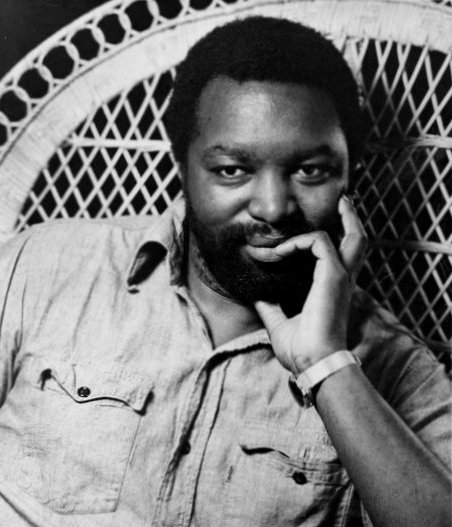
The folk-funk song “River” is by the American singer-songwriter and music producer Eugene McDaniels (1935–2011). He first recorded it with his band Universal Jones on a self-titled album (the group’s only output) in 1972, and he recorded it again, with a synth, on his solo album Natural Juices in 1975.

McDaniels grew up in Omaha, Nebraska, singing gospel music in church. He gained fame in the early 1960s as a clean-cut soul singer—he went by “Gene” at the time—and then surprised everyone in 1970 and 1971 with Outlaw and Headless Heroes of the Apocalypse, containing antiwar, antiestablishment songs performed in a much more experimental style. Universal Jones (1972) is innocuous by comparison, though it still embraces the counterculture. The genres of folk, rock, jazz, gospel, soul, funk, and even proto-rap—often creatively mixed—are all represented in McDaniels’s oeuvre.

Universal Jones cover
From left to right: Eugene McDaniels, Sister Charlotte, Leon Pendarvis, Maurice McKinley, Bob Woos

In the Bible, water connotes blessing, refreshment, life, hope, and abundance. “Flowing streams,” writes the Rev. J. Stafford Wright, “are parables of the flowing life of God.” Wright was referring in particular to one of Ezekiel’s visions, where an unnamed guide leads the prophet through a river that issues forth from the temple in Jerusalem (Ezek. 47:1–12). The guide says,

This water flows toward the eastern region and goes down into the Arabah, and when it enters the sea, the sea of stagnant waters, the water will become fresh. Wherever the river goes, every living creature that swarms will live, and there will be very many fish once these waters reach there. It will become fresh, and everything will live where the river goes.

He then goes on to describe the verdant trees on either side of the riverbank:

Their leaves will not wither nor their fruit fail, but they will bear fresh fruit every month, because the water for them flows from the sanctuary. Their fruit will be for food and their leaves for healing.

Sounds a lot like John’s eschatological vision in Revelation 22, where a river flows down from God’s throne, watering the tree of life, which is for the healing of nations. There are also similar passages in the Minor Prophets: “A fountain shall flow from the house of the LORD” (Joel 3:18); “And in that day it shall be that living waters shall flow from Jerusalem” (Zech. 14:8). God is understood as the source of these waters, which signify an invisible, spiritual reality.

(Related posts: https://artandtheology.org/2022/04/02/lent-28/; https://artandtheology.org/2022/12/11/advent-day-15-great-joy-river/)

When Jesus comes onto the scene, he talks about “rivers of living water” flowing out of the hearts of believers (John 7:38–39), “spring[s] of water welling up to eternal life” (John 4:13–14). God dwells in humanity, and thus the life God gives springs up from within us and vitalizes the wider world.

I don’t know whether McDaniels had any of these biblical texts in mind when he wrote “River.” But a river, a star, a voice, a song of love—these signal to me the Divine moving, shining, speaking, singing into the lives of humanity. Through the ups and downs of history, the ancient will has worked and is continuing to work, revealing itself to those who look, listen, and follow. Ecclesiastes 3:11 says that God has “set eternity in the human heart.” We possess a moral consciousness and spiritual yearning.

To me, “River” is about recognizing the blessing poured out on the world from the heart of God, about tuning in to the unseen truths embedded in the fabric of the universe. It speaks of God’s all-brightening smile (God’s pleasure in his creation), his whispers of our belovedness, and the river-flow of his goodness.

The song has been covered a handful of times over the years and across the globe, including by:

Further, in 1975 the California bluesman J. C. Burris adapted it both lyrically and musically and recorded it under the title “River of Life” on his album Blues Professor:

Bernice Johnson Reagon, a song leader and civil rights activist, uses Burris’s lyrics in her cover on River of Life: Harmony One (1986), overdubbing her voice singing multiple parts in an a cappella tour de force:

There’s a river somewhere
That flows through the life
Of everyone
And it flows through the mountains
And down through the meadow
Under the sun

There’s a star in the sky
That brightens up the life
Of everyone
They can see the life of happiness
Along with the future
Of the lonely one

Yes, it is

There’s a voice from the valley
That speaks to the mind
Of everyone
And it talks about the future
Along with the joy
Of the sorrowed one

Put a smile on your face
And brighten up the day
For everyone
And live your life of happiness
Along with the sick and lonely
And sorrowed one

Yes, it is

There’s a river somewhere
That flows through the life
Of everyone
And it flows from the mountain
Down through the meadow
Under the sun

There’s a sky full of diamonds
That brightens up the life
Of everyone
Then they can see the life of happiness
Along with the future
Of the lonely one

Yes, it is

The main revision by Burris comes at the end of each verse, where he mentions the lonely, the sick, and the sorrowful. They have a special place of belonging in God’s heart and plans. Jesus’s ministry was to such as these. Blessed are the poor and those who mourn, he said, for theirs is the kingdom of heaven.

Burris encourages us to come alongside those who are hurting with love and inclusion, and to look with them into God’s promised future, where the oppressed are liberated, the sick are healed, the silenced go out singing, and mourning is turned to dancing. Contra the cynicism of “the Preacher” who penned Ecclesiastes, there is something new under the sun! For those with eyes to see it, God is in the process of making all things new (Rev. 21:5).

Roundup: West African praise medley, reading poetry and fiction, and more

SPOTIFY PLAYLIST: August 2022 by Victoria Emily Jones: Most months I compile thirty songs and other musical selections into a nonthematic playlist as a way to share good music, mostly from the Christian tradition but otherwise Christian-adjacent. This month’s list includes a traditional Black gospel song performed by Chris Rodrigues and professional spoon player Abby Roach (featured here); a Zulu song from South Africa about holding on to Jesus (bambelela = “hold on”); a song in the voice of Christ Our Mother by Irish singer-songwriter Sinéad O’Connor, from her album Gospel Oak; a portion of Barbados-born Judy Bailey’s Caribbean-style setting of the Anglican liturgy; a brass arrangement of a Golden Gate Quartet classic; Palestrina’s beautiful multivoiced setting of a Latin hymn by Bernard of Clairvaux; a future-looking song of celebration by country artist Naomi Judd, who passed away in April; a condensation of “In Christ Alone” by Texas soul artist Micah Edwards; and more.

The two videos below are from the list: a medley of the Twi praise chorus “Ayeyi Wura” (King of Our Praise) from Ghana and “Most High God” from Nigeria, led by Eric Lige at the 2018 Urbana missions conference, and a new arrangement by Marcus & Marketo of “I’ve Got a River of Life,” a song that I have fond memories of singing in children’s church as a kid (with hand motions!) (you can hear a more standard rendition here). The first line is derived from Jesus’s saying in John 7:38 (“Out of the believer’s heart shall flow rivers of living water”), and the refrain “Spring up, O well!” comes from Numbers 21:17, where the Israelites praise God for providing them water in the desert.

+++

Reading books is a key way that I grow intellectually and spiritually, and books are often where I find content to highlight on the blog, be it poems, visual art, people, or ideas. Because I’m not affiliated with an academic institution, I don’t have easy access to a lot of the books I need for my research, and I rely heavily on my personal library (as well as the Marina interlibrary loan system). If you’d like to support the work of Art & Theology, buying me a book from my wish list is a great way to do that! I’ll consider it a birthday gift, as my birthday is Saturday. 😊

+++

ESSAYS:

>> “Poetry’s Mad Instead” by Abram Van Engen, Reformed Journal: “I believe that poetry has a particular place in the church. I think it responds directly to the call and the invitation of God to ‘sing a new song,’” says Abram Van Engen, chair and professor of English at Washington University in St. Louis and cohost of the podcast Poetry for All. “And in the singing of poetry, the faithful can begin to understand and experience and engage God’s world afresh.” He adds, “Poets often invite us to practice thinking and noticing at a different pace. It is only at a slower speed of processing that we can begin to observe what we have too often missed or ignored.”

In this essay, Van Engen walks readers through the sonnet “Praise in Summer” by Richard Wilbur, which is what he begins with whenever he teaches poetry at church. He teaches you some of the poet’s tools so that you can feel more confident in approaching poems on your own.

>> “In Defense of Fiction: Christian Love for Great Literature” by Leland Ryken: An excellent article, by a professor emeritus of English at Wheaton College and author of The Christian Imagination: The Practice of Faith in Literature and Writing, A Complete Handbook of Literary Forms in the Bible, and more. “With so many valuable nonfiction books available to Christians, many wonder if reading fiction is worth the time. Others view fiction as a form of escapism, a flight from reality and the world of responsibility. But rightly understood, reading fiction clarifies rather than obscures reality. The subject of literature is life, and the best writers offer a portrait of human experience that awakens us to the real world. Fiction tells the truth in ways nonfiction never could, even as it delights our aesthetic sensibilities in the process. Reading fiction may be a form of recreation, but it is the kind that expands the soul and prepares us to reenter reality.”

+++

VISUAL MEDITATION: On Christ and the Samaritan Woman by Jacek Malczewski, by William Collen: William Collen introduced me to this unusual painting on the subject of Christ’s meeting with the woman at the well from John 4—a subject the artist painted several times (e.g., here, here, and here). Whereas Christ is traditionally shown pontificating to the woman with an air of formality, here there is an appealing casualness to their interaction, and the woman dominates the composition.

Malczewski, Jacek_Christ and the Samaritan Woman
Jacek Malczewski (Polish, 1854–1929), Christ and the Samaritan Woman, 1912. Oil on plywood, 92 × 72.5 cm. Borys Voznytskyi Lviv National Art Gallery, Ukraine.

Collen is an art writer and researcher from Omaha, Nebraska, who is a Christian and who blogs at Ruins. I’ve enjoyed following his posts, which include “The proper response to an art of sorrow”; “Dikla Laor’s photographs of the women of the Bible”; how household chores are approached differently by Koons, Picasso, Degas, and Vermeer; “Good art / bad art / non-art”; and “Artists and agency: assumptions and limits.” He writes in a conversational manner that’s really refreshing.