“To Calvary he bore his cross,” aka “My Fearful Dream”: An Early Tudor Passion Carol from the Fayrfax Manuscript

The English Crucifixion lyric “My Fearful Dream” (also known by the beginning of its first line, “To Calvary he bore his cross”) was written anonymously in the fifteenth century. It is preserved, with music by Gilbert Banastir (sometimes spelled Banaster or Banester) (ca. 1445–1487), on folios 77v–82r of the famous Tudor songbook BL Add. MS. 5465, intended for use at the court of King Henry VII. Compiled around the year 1500, this manuscript is commonly referred to as the Fayrfax Manuscript after Robert Fayrfax, the Tudor composer who was organist of St. Albans and a Gentleman of the Chapel Royal—that is, an adult male singer in the monarch’s household choir. It contains twelve sacred songs and thirty-seven secular songs, all in English—with, “beyond question, the finest music written to vernacular words which survives from pre-Reformation England,” writes John Stevens in Early Tudor Songs and Carols (xvi). It is unknown whether the text or the music was written first.

In 1982 “My Fearful Dream” was performed by Pro Cantione Antiqua under the direction of Mark Brown at the Church of St. John-at-Hackney in London. The recording of this performance was originally released in 1985 in vinyl format on A Gentill Jhesu: Music from the Fayrfax Ms. and Henry VIII’s Book (Hyperion A66152) and was later reissued by Regis Records in 2006 on the CD Tears & Lamentations: English Renaissance Polyphony (RRC 1259). Unfortunately, the CD is out of print, the choral group is inactive, and I can find no performances online. I thus provide the recording of “My Fearful Dream” (or “My Fearfull Dreme,” as the track list spells it) directly below for educational purposes. It is a song for three voices: alto, tenor, bass.

Below is the original text as transcribed by Richard Leighton Greene from the Fayrfax Manuscript in The Early English Carols (Oxford: Clarendon Press, 1935), page 124, followed by a version with modernized spellings and updates of a few antiquated words. The text also appears in John Stevens, Music and Poetry in the Early Tudor Court (London: Methuen, 1961), no. 56, and the music in John Stevens, ed., Early Tudor Songs and Carols (Musica Britannica 36) (London: Stainer and Bell, 1975), page 476.

Pro Cantione Antiqua does not sing the third stanza.

van der Weyden, Rogier_Crucifixion (Philadelphia)
Rogier van der Weyden (Netherlandish, 1399/1400–1464), The Crucifixion, with the Virgin and Saint John the Evangelist Mourning, ca. 1460. Oil on panel, overall 71 × 73 in. (180.3 × 185 cm). Philadelphia Museum of Art.

Most people today use the word “carol” as synonymous with a cheerful Christmas song. But up until about 1550, the term was used for lyrics of a certain form rather than a certain subject or spirit. Greene defines the medieval or Renaissance carol as “a song on any subject, composed of uniform stanzas and provided with a burden . . . [that is,] an invariable line or group of lines which is to be sung before the first stanza and after all stanzas” (Early English Carols, xxxii–xxxiii). He distinguishes a burden from a refrain: “The refrain, as defined in this essay, is a repeated element which forms part of a stanza, in the carols usually the last line. The burden, on the other hand, is a repeated element which does not form any part of a stanza, but stands wholly outside the individual stanza-pattern” (clx).

That’s why “My Fearful Dream” can properly be called a carol. The two lines beginning “My fearful dream” open the song and repeat after each stanza.


My Feerfull Dreme

My feerfull dreme nevyr forgete can I:
Methought a maydynys childe causless shulde dye.


To Calvery he bare his cross with doulfull payne,
And theruppon straynyd he was in every vayne;
A crowne of thorne as nedill sharpe shyfft in his brayne;
His modir dere tendirly wept and cowde not refrayne.
Myn hart can yerne and mylt
When I sawe hym so spilt,
Alas, for all my gilt,
Tho I wept and sore did complayne
To se the sharpe swerde of sorow smert,
Hough it thirlyd her thoroughoute the hart,
So ripe and endles was her payne.

My feerfull dreme . . .

His grevous deth and her morenyng grevid me sore;
With pale visage tremlyng she strode her child before,
Beholdyng ther his lymmys all to-rent and tore,
That with dispaire for feer and dred I was nere forlore.
For myne offence, she said,
Her Son was so betraide,
With wondis sore araid,
Me unto grace for to restore:
‘Yet thou are unkynd, which sleith myn hert,’
Wherewith she fell downe with paynys so smert;
Unneth on worde cowde she speke more.

My feerfull dreme . . .

Saynt Jhon than said, ‘Feere not, Mary; his paynys all
He willfully doth suffir for love speciall
He hath to man, to make hym fre that now is thrall.’
‘O frend,’ she said, ‘I am sure he is inmortall.’
‘Why than so depe morne ye?’
‘Of moderly pete
I must nedis wofull be,
As a woman terrestriall
Is by nature constraynyd to smert,
And yet verely I know in myn hart
From deth to lyff he aryse shall.’

My feerfull dreme . . .

Unto the cross, handes and feete, nailid he was;
Full boistusly in the mortess he was downe cast;
His vaynys all and synowis to-raff and brast;
The erth quakyd, the son was dark, whos lyght was past,
When he lamentable
Cried, ‘Hely, hely, hely!’
His moder rufully
Wepyng and wrang her handes fast.
Uppon her he cast his dedly loke,
Wherwith soddenly anon I awoke,
And of my dreme was sore agast.

My feerfull dreme . . .

My Fearful Dream (modernized)

My fearful dream never forget can I:
Methought a maiden’s child causeless should die.


To Calvary he bore his cross with doleful pain,
And thereupon strained he was in every vein;
A crown of thorns, sharp as needles, shoved in his brain.
His mother dear tenderly wept and could not refrain.
My heart did yearn and melt
When I saw him so spilt,
Alas, for all my guilt,
And I wept and did sore complain
To see the sharp sword of sorrow smart,
How it pierced her straight through the heart,
So ripe and endless was her pain.

My fearful dream never forget can I:
Methought a maiden’s child causeless should die.


His grievous death and her mourning grieved me sore;
With pale visage, trembling, she strode before her child,
Beholding his limbs all rent and torn,
That with despair for fear and dread I was near forlorn.
For my offense, she said,
Her Son was so betrayed,
With wounds sore arrayed,
Me unto grace for to restore:
“Yet thou art unkind, which slayeth my heart,”
Wherewith she fell down with pains so smart;
Hardly one word could she speak more.

My fearful dream never forget can I:
Methought a maiden’s child causeless should die.


Saint John then said, “Fear not, Mary; all his pains
He willfully suffers for the special love
He has to man, to make him free that’s now in thrall.”
“O friend,” she said, “I am sure he is immortal.”
“Why, then, do you mourn so deeply?”
“Of motherly pity
I needs must woeful be,
As a terrestrial woman
Is by nature constrained to smart,
And yet verily I know in my heart
From death to life he shall arise.”

My fearful dream never forget can I:
Methought a maiden’s child causeless should die.


Unto the cross, hands and feet, he was nailed;
Violently into the mortise he was cast down;
His veins and sinews were all riven apart and burst;
The earth quaked, the sun was dark, whose light was past,
When he, lamenting,
Cried, “Eli, Eli, Eli!”
His mother was ruefully
Weeping and wrung her hands fast.
Upon her he cast his deathly look,
Wherewith suddenly anon I awoke,
And of my dream was sore aghast.

My fearful dream never forget can I:
Methought a maiden’s child causeless should die.

The speaker of this carol has a dream—a nightmare—of Calvary, where he beholds the ignominious death of Jesus and the agonizing grief of Jesus’s mother and realizes that such suffering was undertaken for his sake, to save him from sin and its fatal consequences. The accusation that Mary hurls at the speaker in her hour of torment is biting: “You slay my heart!” My son is dead because of you. It’s such a humanizing passage, this expression of a mother’s anger at a death that didn’t have to be.

This is the Mater Dolorosa (Latin for “Sorrowful Mother”) of Christian tradition, who is sometimes depicted with a sword (or seven!) in her chest, literalizing Simeon’s prophecy to her as a teen and evoking the piercing sensation of losing a child. In Rogier van der Weyden’s Crucifixion diptych that I’ve reproduced here, created in roughly the same period as “My Fearful Dream” but in the Low Countries, there’s no sword, but Mary’s sorrow is evident in her tear-stained face, the wringing of her hands, and her literally collapsing under the unbearable weight of what she’s been asked to endure.

van der Weyden, Rogier_Crucifixion (detail)

(Related post: https://artandtheology.org/2023/09/15/her-stations-of-the-cross-by-marjorie-maddox/)

In the carol, the apostle John, present with Mary at the foot of the cross, catches her in her swoon and offers consolation, reassuring her that Jesus suffers willingly out of love. She responds that she knows it in her heart, and that she knows too that he will ultimately rise from death, but that that doesn’t diminish the sharpness of the pain she feels, deep in her body, watching her son shamed and wounded so.

The final image in the dream is of Jesus looking on his mother with a deathly pallor. With that, the speaker is jolted awake and sits with the horror.

On this side of the resurrection, it can be easy to breeze past Good Friday (“He didn’t stay dead!”) or to meditate on the Crucifixion only in a spiritual or theological sense. But this poem, this carol, sticks us in medias res, before the resurrection, into a physical human drama full of emotional intensity, so that we can feel what it might have been like to be present at the execution of the Son of God. Maybe you feel that the graphic details are gratuitous (the thorns shoved in his brain[!], his sinews riven apart, etc.), that sensory engagement with the scene is an exercise that fails to honor the bigger picture, and that it’s fruitless to generate pity for Christ or his mother, as the event is passed and what’s done is done. But centuries of faithful Christians have found otherwise: that meditating on Christ’s pain and that of his mother can help us better appreciate the real-life as opposed to merely mythic dimensions of the story and can cultivate in us a proper horror of sin and a deeper gratitude for Christ’s sacrifice.

The word “causeless” in the burden of the carol—the speaker sees a woman’s child dying without cause—does not imply that Jesus’s death served no purpose, but rather that he was put to death on wrongful charges. The Jewish tribunal charged him with blasphemy for calling himself the Son of God, and the Roman courts charged him with sedition, with inciting insurrection against the empire. But he was telling the truth about his identity and did so in ultimate reverence for God, not lack of it, and while the path he called his followers to would in some ways challenge the values of Rome and reorient ultimate loyalties, he never took up arms or encouraged his followers to do so (quite the contrary), and he never sought political power or overthrow.

Listen once more to Pro Cantione Antiqua’s performance of this carol as it would have been performed for the first Tudor monarch, Henry VII, presumably in private religious services for him and his family. May the depths to which God went to save God’s beloved world be something you never can forget.

van der Weyden, Rogier_Crucifixion (right panel)

Epiphany: Die Könige

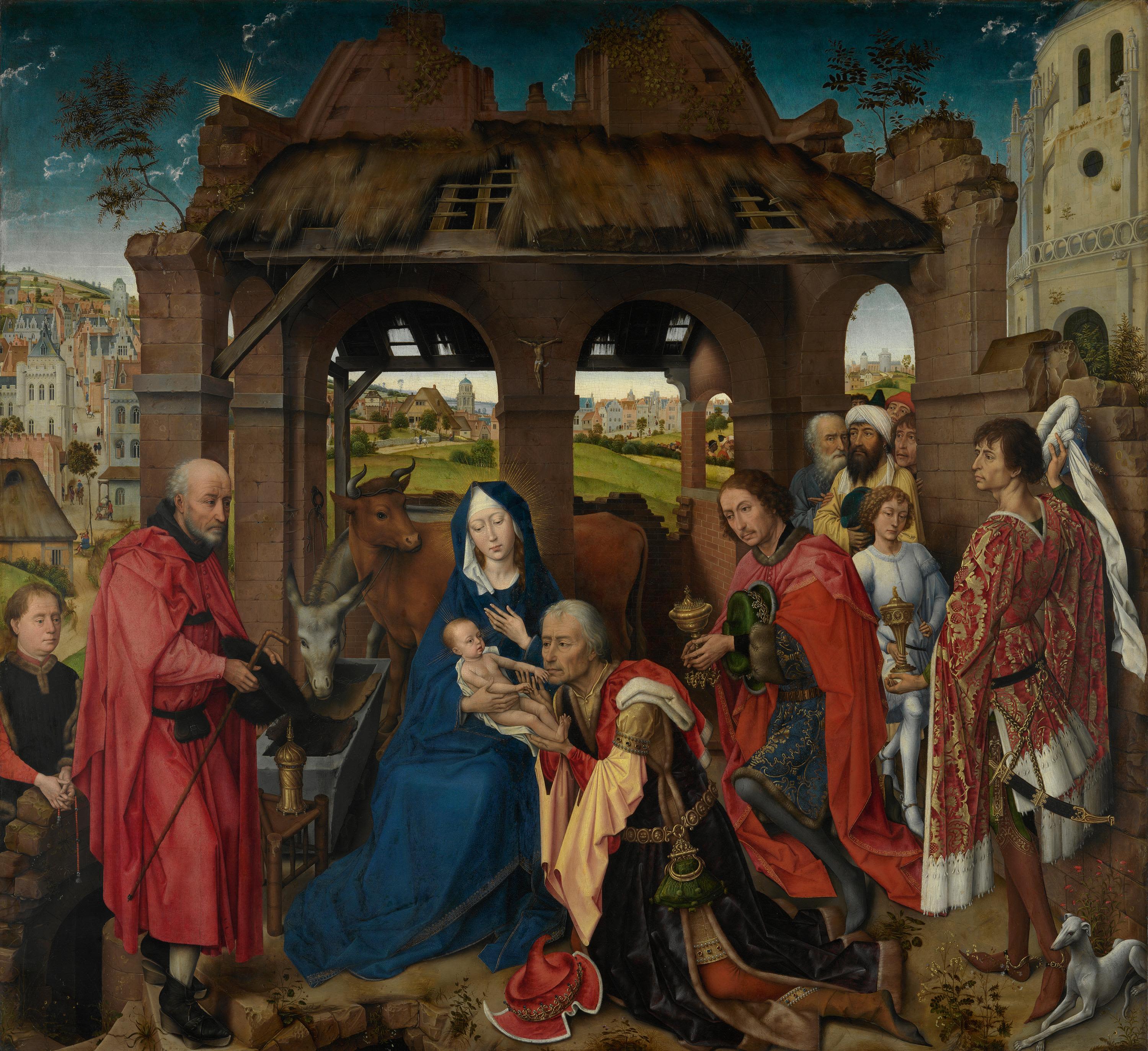
LOOK: Adoration of the Magi by Rogier van der Weyden

van der Weyden, Rogier_Adoration of the Magi
Rogier van der Weyden (Netherlandish, 1399–1464), Adoration of the Magi, ca. 1455. Painting on oak wood, 139.5 × 152.9 cm. Alte Pinakothek, Munich, Germany.

This remarkable painting by the early Northern Renaissance master Rogier van der Weyden shows three kings arriving from afar to worship the Christ child. All the splendor of foreign courts comes to the dilapidated stable of Jesus’s birth, which is relocated to the Low Countries of the fifteenth century. (Notice the contemporary cityscape in the background.)

The most senior king greets the child first, humbly removing his hat and crown and kneeling on the ground, his fur-lined velvet robe rubbing the dirt. He supports the child’s feet with one hand and with the other gently lifts the child’s hand to kiss. Two fellow sovereigns stand behind him, followed by their entourage and various locals.

Standing on the left, in red, is Joseph, hat and staff in hand. He looks reflectively on the visitors, taking it all in. Leaning against the stone wall behind Joseph, a rosary between his fingers, is the painting’s donor. While it’s true that sometimes the practice of painting donors into biblical scenes was done for flattery or, if a condition of the commission, out of arrogance, more often the motivation or purpose was to imaginatively place yourself into the sacred scene as a witness, making yourself present to an event that was in time and yet that also transcends time, in that its impact is ongoing. Seeing oneself as a participant in Christ’s story, a devotee alongside those who walked with him in the flesh, can aid in spiritual contemplation.

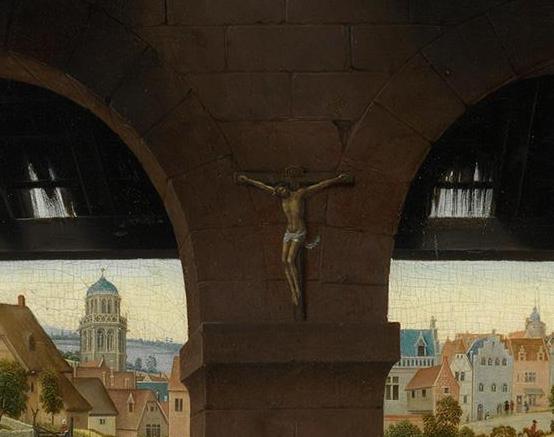
Another anachronism—or rather, a collapsing of chronos and kairos—is the crucifix hung on the central pillar of the stable! This of course alludes to the cruel death Christ would face some thirty years later.

van der Weyden, Rogier_Adoration of the Magi (crucifix detail)

This painting is the centerpiece of a triptych originally made for St. Mary’s Chapel in the church of St. Columba in Cologne. The wings depict the Annunciation and the Presentation of Christ in the Temple.

van der Weyden, Rogier_Columba Altarpiece
Rogier van der Weyden (Netherlandish, 1399–1464), Saint Columba Altarpiece, ca. 1455. Painting on oak wood, 139.5 × 152.9 cm (central), 139.5 × 72.9 cm (each wing). Alte Pinakothek, Munich, Germany.

LISTEN: “Die Könige” (The Kings) from Weihnachtslieder (Christmas Songs), Op. 8, by Peter Cornelius, 1870 | Arranged for a cappella choir by Ivor Atkins, 1957 | Performed by VOCES8, the VOCES8 Scholars, the VOCES8 Foundation Choir, and Apollo5, dir. Barnaby Smith, feat. Jonathan Pacey, 2023

Drei Könige wandern aus Morgenland;
Ein Sternlein führt sie zum Jordanstrand.
In Juda fragen und forschen die drei,
Wo der neugeborene König sei?
Sie wollen Weihrauch, Myrrhen und Gold
Dem Kinde spenden zum Opfersold.

Und hell erglänzet des Sternes Schein:
Zum Stalle gehen die Kön’ge ein;
Das Knäblein schaun sie wonniglich,
Anbetend neigen die Könige sich;
Sie bringen Weihrauch, Myrrhen und Gold
Zum Opfer dar dem Knäblein hold.

O Menschenkind! halte treulich Schritt!
Die Kön’ge wandern, o wandre mit!
Der Stern der Liebe, der Gnade Stern
Erhelle dein Ziel, so du suchst den Herrn,
Und fehlen Weihrauch, Myrrhen und Gold,
Schenke dein Herz dem Knäblein hold!

English translation:

Three kings journey from the East;
A little star leads them to Jordan’s banks.
In Judaea the three of them seek and inquire
Where the newborn king might be.
They wish to make offerings to the child:
Gold, frankincense, and myrrh.

And brightly shines the light of the star.
The three kings enter the stable;
They gaze in rapture at the child,
Bowing low in adoration.
Gold, frankincense, and myrrh
They bring to the child as offering.

O child of man! Follow them faithfully.
The kings are journeying; oh, journey too!
Let the star of love, the star of grace,
Light your way as you seek the Lord,
And if you lack gold, frankincense, and myrrh,
Give your heart to that sweet child.

The German composer and poet Peter Cornelius (1824–1874) was a friend of Franz Liszt’s and Richard Wagner’s. “Die Könige” (The Kings) is the third, and most popular, song in a Christmas cycle he wrote for voice and piano, the others being “Christbaum” (Christmas Tree), “Die Hirten” (The Shepherds), “Simeon,” “Christus der Kinderfreund” (Christ the Friend of Children), and “Christkind” (Christ Child). Cornelius began writing his Weihnachtslieder cycle—both text and music—in 1856, and it underwent several rounds of revision, incorporating input from others, before being published in 1870.

From VOCES8’s Live From London Christmas 2022 broadcast, the performance of “Die Könige” above features as the baritone soloist Jonathan Pacey, who sang bass for VOCES8 from 2015 to 2022. He chose this song as the encore in his final concert. Pacey’s voice is absolutely gorgeous!


This post concludes our journey through the cycle of light, Advent-Christmas-Epiphany. Thanks for walking the road with me! I encourage you to keep journeying, keep following the light, throughout the rest of the church year. May love and grace, as “Die Könige” says, light your way as you seek the Lord.

If you’d like to leave a donation to help offset the costs of running Art & Theology, which I’d really appreciate, you may do so through PayPal or this secure Stripe form. You can expect many more new posts in 2024! Just not at a daily frequency.

Roundup: The Crucifixion in modern art, “Lift Every Voice” ballet solo, and more

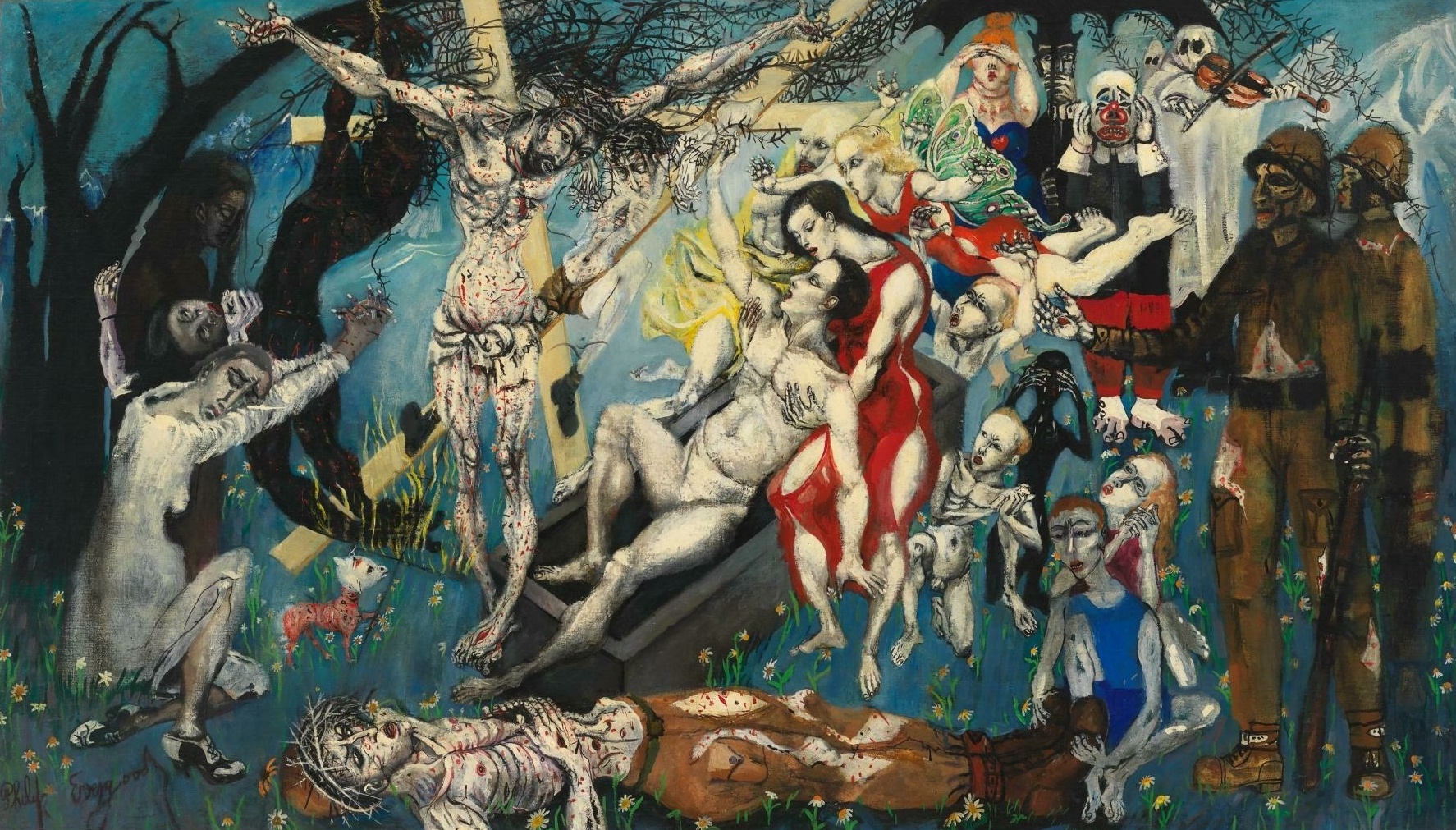
VISUAL MEDITATION: “Waking Up from Apathy,” on Philip Evergood’s The New Lazarus: My latest visual meditation for ArtWay has just been published. It’s on a crowded, noisy, garish painting that, honestly, is distressing to look at. And it’s supposed to be. Because it exposes what Martin Luther King Jr. called the triple evils of society: racism, militarism (war), and economic exploitation (aka extreme materialism, a systematic cause of poverty). Though Philip Evergood was not a Christian, he draws on Christian narrative and iconography, with the figures of Lazarus and Christ, to protest the cycles of violence that we need to rise out of before we self-destruct.

Evergood, Philip_The New Lazarus
Philip Evergood (American, 1901–1973), The New Lazarus, 1927–54. Oil and enamel on canvas mounted on wood, 148 × 237.2 cm. Whitney Museum of American Art, New York.

The see-nothing, hear-nothing, say-nothing figures in the background remind me of people today who insist that racism does not exist and therefore tune out the cries of Black Lives Matter, for instance. I’m implicated too by these symbols of willful ignorance, because I admit that I do not often care to question where my food, clothes, coffee, chocolate, and other conveniences come from, or how the businesses I regularly support with my dollars treat their employees.

Evergood was politically engaged in both his art and his life, espousing egalitarian ideals. He participated in strikes and demonstrations for workers’ rights and was jailed more than once and beaten by police. He was greatly influenced by Mexican muralism, and he embraced the label of “propaganda” for his art, acknowledging that he was trying persuade the public to join the cause of social justice. “He was a figurative painter when much of the art world placed greater value on abstraction,” writes the University of Kentucky Art Museum, “and he was a moralist when moralizing was not considered an option for serious painters.” Nevertheless, he had a successful career, and his work is in many major museum collections, including the Tate Gallery, the Los Angeles County Museum of Art, the Art Institute of Chicago, the Hirshhorn Museum, the Museum of Modern Art, and the Whitney Museum of American Art.

+++

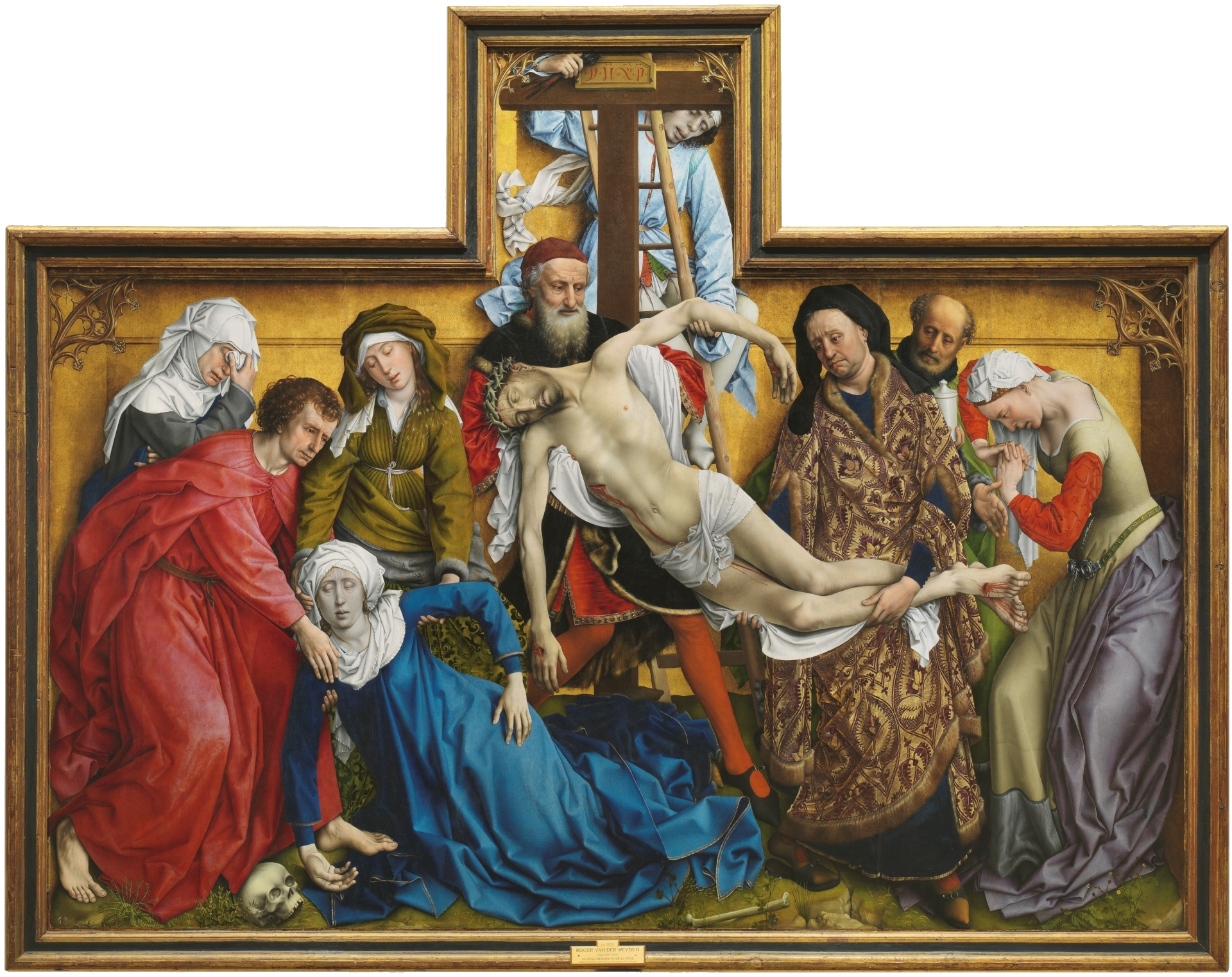
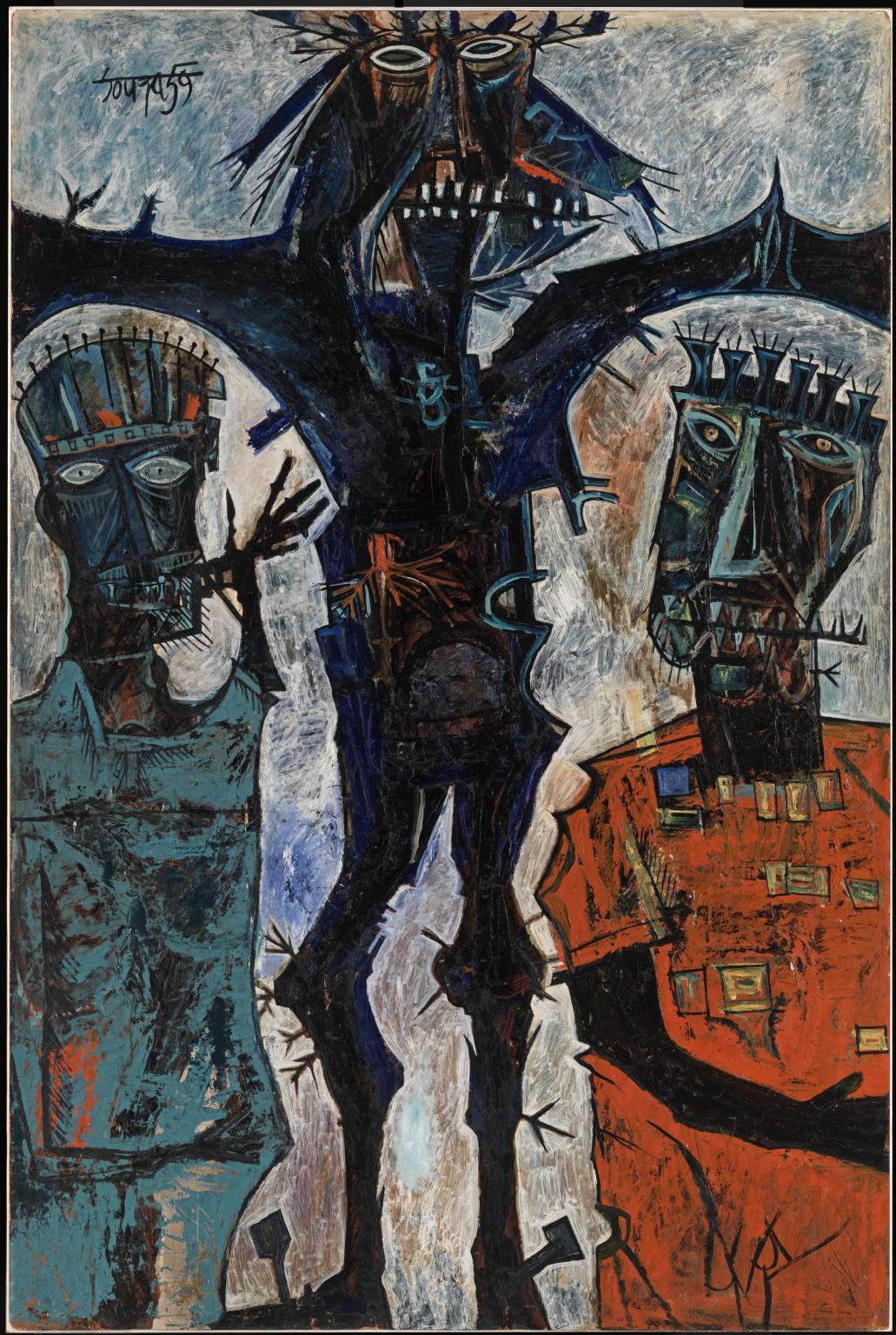
PODCAST EPISODE: “How a ‘biblically illiterate’ generation can discover Christian art,” Holy Smoke, July 28, 2020: I love hearing Ben Quash [previously] discuss specific artworks in detail! He brings such reverence, inquiry, wonder, curiosity, and openness to his looking and interpreting. For this interview with Carmel Thompson he has selected six Christ images spanning the early Renaissance through contemporary eras: the side-by-side Byzantine-inspired Healing of the Man Born Blind and Transfiguration panels of the Maestà Altarpiece by Duccio, the classically beautiful Descent from the Cross by Rogier van der Weyden at the Prado (“probably the painting that put realistic tears on the map of Western art”), Albrecht Dürer’s daring self-portrait as Christ, a homely Christ in the Wilderness: Consider the Lilies by Stanley Spencer, a grotesque Crucifixion by F. N. Souza (with reference to crucifixions by Grünewald, Picasso, Sutherland, and Bacon), and Michael Landy’s kinetic sculpture Doubting Thomas.

In addition to providing individual commentaries, Quash also talks about reading art theologically instead of just aesthetically, art as developing physical sight toward spiritual insight (external and internal seeing), the persistence of Christian iconography in the art of today, and the ways in which art can implicate the viewer.

Weyden, Rogier van der_Descent from the Cross
Rogier van der Weyden (Netherlandish, 1399–1464), Descent from the Cross, before 1443. Oil on panel, 204.5 × 261.5 cm. Museo Nacional del Prado, Madrid.

Crucifixion by F. N. Souza
F. N. Souza (Indian, 1924–2002), Crucifixion, 1959. Oil on board, 183.1 × 122 cm. Tate Modern, London.

There’s so much that’s quotable in the conversation, but because it applies to the ArtWay meditation I linked to above, I’ll just highlight part of his discussion of nonreligious artists’ attraction to Crucifixion imagery in the twentieth century. The Isenheim Altarpiece (1515), he says, a visual reference point for many modern artists,

shows an agonized Christ whose tongue is swollen and protruding from his mouth, whose body is covered in sores, whose skin is tinged green, whose fingers are curled up in agony. There’s no idealization here of what a death like that might have been. Instead there’s a strong assertion that the extremes of human pain and suffering are not alien to the Christian message. And yet it’s a religious image—this is a Christian image painted for a Christian context.

When that work comes into contact with the new traumas of the twentieth century—we talked about [Stanley] Spencer and the Second World War, here [Francis Newton] Souza experiencing colonialism in India—when that painting comes into contact with those sorts of extremes of human experience, it activates, it speaks to them, and calls forth new artistic responses, because it feels as though Christianity can still speak, even in those extremes. And I think Souza, like [Graham] Sutherland and [Francis] Bacon, while they may not have felt comfortable with traditional Christianity, saw the power of that Christian tradition to in some way help them articulate the traumas and the horrors of their own time.

So that’s a very interesting work, and typical of several examples of the extraordinary way in which we might think we’re in a secular age, but Christian iconography is probably as lively as ever—although it’s doing new things—in the work of modern and contemporary artists.

+++

SONGS . . .

from the GOOD SHEPHERD COLLECTIVE: Spearheaded by David Gungor and Tyler Chester, the Good Shepherd Collective [previously] “creates liturgical art to inspire the Christian imagination, that we may embody the love of Christ for the good of our neighbors.” They’ve just released an album of ten hymns. One of them is “Joyful, Joyful, We Adore Thee,” queued up in the liturgical service video below, and though it didn’t make the final album cut, I also really like their version of “His Eye Is on the Sparrow.”

from Family Company: Charles Jones, the lead singer on both of the above videos, is also a part of Family Company, an LA-based music collective celebrating the traditions of soul, blues, and R&B. You might enjoy these seventies covers of theirs: “Heaven Help Us All” (popularized by Stevie Wonder), featuring Charles Jones, and “Let Us Love” by Bill Withers, featuring Teddy Grossman. See more on their YouTube channel.

+++

BALLET SOLO: “Lift Every Voice and Sing”: Premiering at the Lincoln Center in 2019, Ounce of Faith is a contemporary ballet choreographed by Darrell Grand Moultrie, the score a mix of jazz standards, original music, and spoken word. This excerpt is performed by Khalia Campbell of the Alvin Ailey American Dance Theater, with movements suggestive of both struggle and pride.

Known as the Black National Anthem, “Lift Every Voice and Sing” was written in 1899 by writer and activist James Weldon Johnson and set to music by his brother, John Rosamond Johnson. The hymn is sung here, just the first of its three verses, by Aisha Jackson, with Dante Hawkins on piano. It’s a song of historical remembrance and lament but also of hope, a rallying cry to move forward together, in unity, out of our “dark past,” into the truth of God, continuing to fight injustice wherever we find it so that everyone can live free. It acknowledges that God is the one who leads his people in love and who wills liberty, and it supplicates: “Keep us forever in the path [of Your light], we pray.” Learn more about the hymn in this NPR feature. See also this UMC Discipleship article, especially the part where Dr. James Abbington, a choir director and a scholar of African American sacred music, answers the question, “Is this a hymn just for African Americans or is it for all people?”

+++

LITERARY ESSAY: “To Sit with an Onion” by Elizabeth Harwell: God “is tethered to this world in delight” and does not weary of it as we do, writes Elizabeth Harwell after having sat with a mussel shell for one hour, upon the advice of Robert Farrar Capon. (An exercise in wonder! Any inanimate object will do.) Harwell marvels at how the shell—blueberry-blue and milk-white, cold, curvaceous, smooth—was “an entire world to the mussel who called [it] home,” and now, since she picked it up off a Maine beach, it sits in a silver dish in her dining room, a reminder of the Creator’s quiet mirth. And there’s much more where that came from. “That shell represented one of thousands (millions?) of pearly homes that will never lay bare in front of human eyes—miles of ocean floor, covered in secret delights, that began as thoughts in my Father’s mind. We humans can be so self-important that we’ve never considered that God is enjoying parts of creation that none of us will ever see.” Read the whole essay at The Rabbit Room.

(Quash’s discussion of Stanley Spencer’s Wilderness series in the abovementioned podcast, in which Christ gets down on the ground like a curious child to observe wildflowers, scorpion, hen, dovetails nicely with this essay!)