
This month I traveled to parts of Germany and Belgium to experience some of the art of those countries, with a focus on medieval religious art. In Brussels, besides exploring the famous Oldmasters Museum (part of the Royal Museums of Fine Arts of Belgium), I visited the lesser-known Art and History Museum, whose collection includes not just western European art from prehistoric times through the nineteenth century, but also art from Asia (China, Korea, India, Pakistan, Afghanistan, Sri Lanka, Tibet, Nepal, Turkey, Iran, Cambodia, Thailand, Burma), Oceania, the pre-Columbian Americas, and ancient Egypt, Greece, and Rome.

I spent the most time with the medieval European art on the ground floor—wooden statuettes, ivory and alabaster carvings, stained glass, paintings, metalworks, and tapestries. With the Google Translate app open, I hovered my phone over the Dutch and French descriptive labels to read them in English.
My favorite tapestry I saw, from fifteenth-century Tournai, portrays three scenes from the passion of Christ: Christ Carrying the Cross, the Crucifixion, and the Resurrection. The museum gallery it’s displayed in also houses a large medieval loom, which is what’s protruding at the bottom right corner of the following photo.

Tapestries made in the Flemish city of Tournai were among the most sought after in the fifteenth century. These large-scale wall hangings were bought by royalty, nobles, and high-ranking clergy to decorate their palaces. This one, nearly thirty feet long, is the second of a two-part hanging whose first part (portraying Christ’s Entry into Jerusalem, the Last Supper, and the Arrest of Christ) is in the collection of the Vatican.
Below are some detail shots.
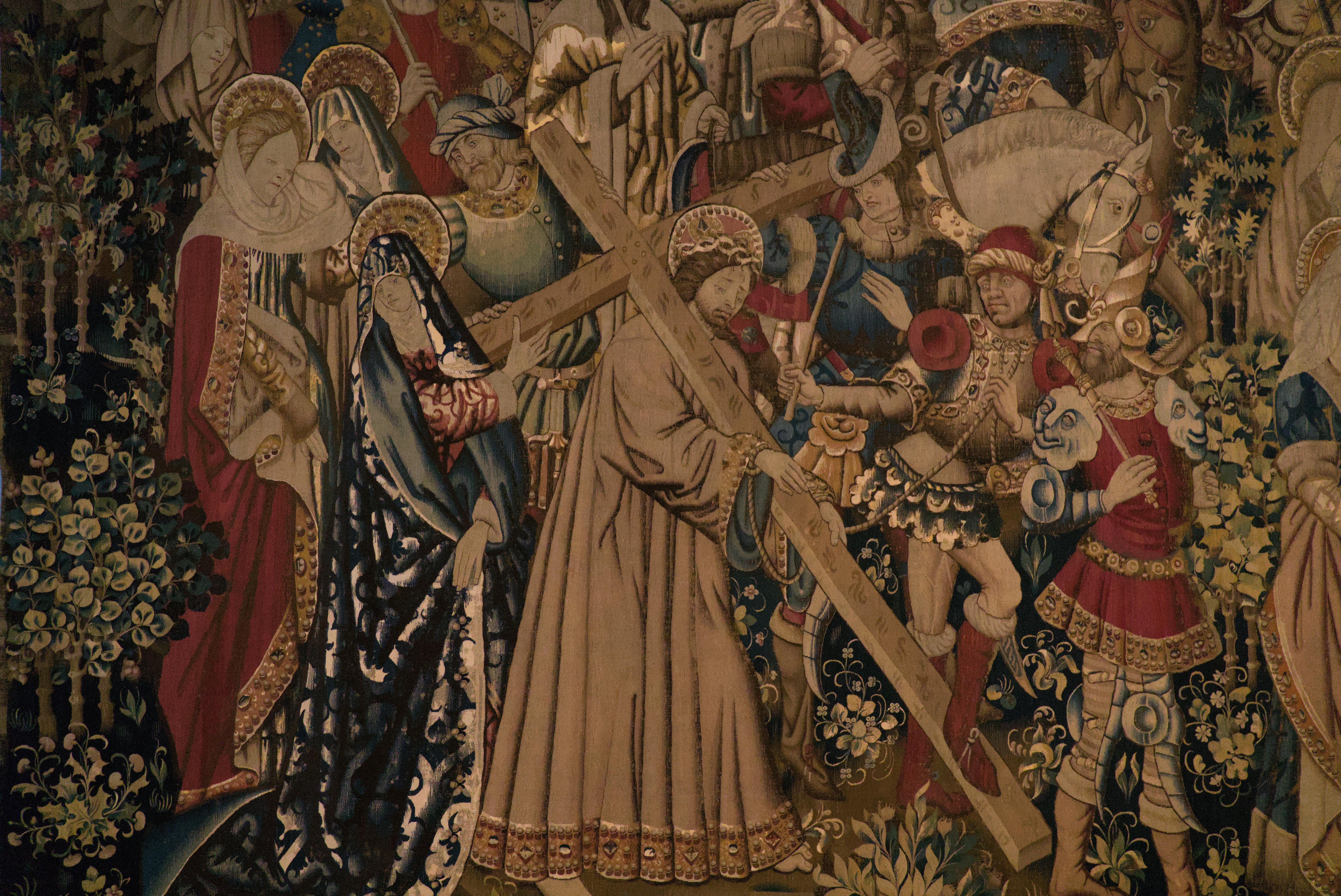
First, Christ carries his cross. A soldier pulls him forward by a rope tied to his wrists, while tauntingly standing on the vertical wood beam and hitting him with a baton. On a less serious note, those are some spiffy face-shaped shoulder scales on the right.
Christ crucified:

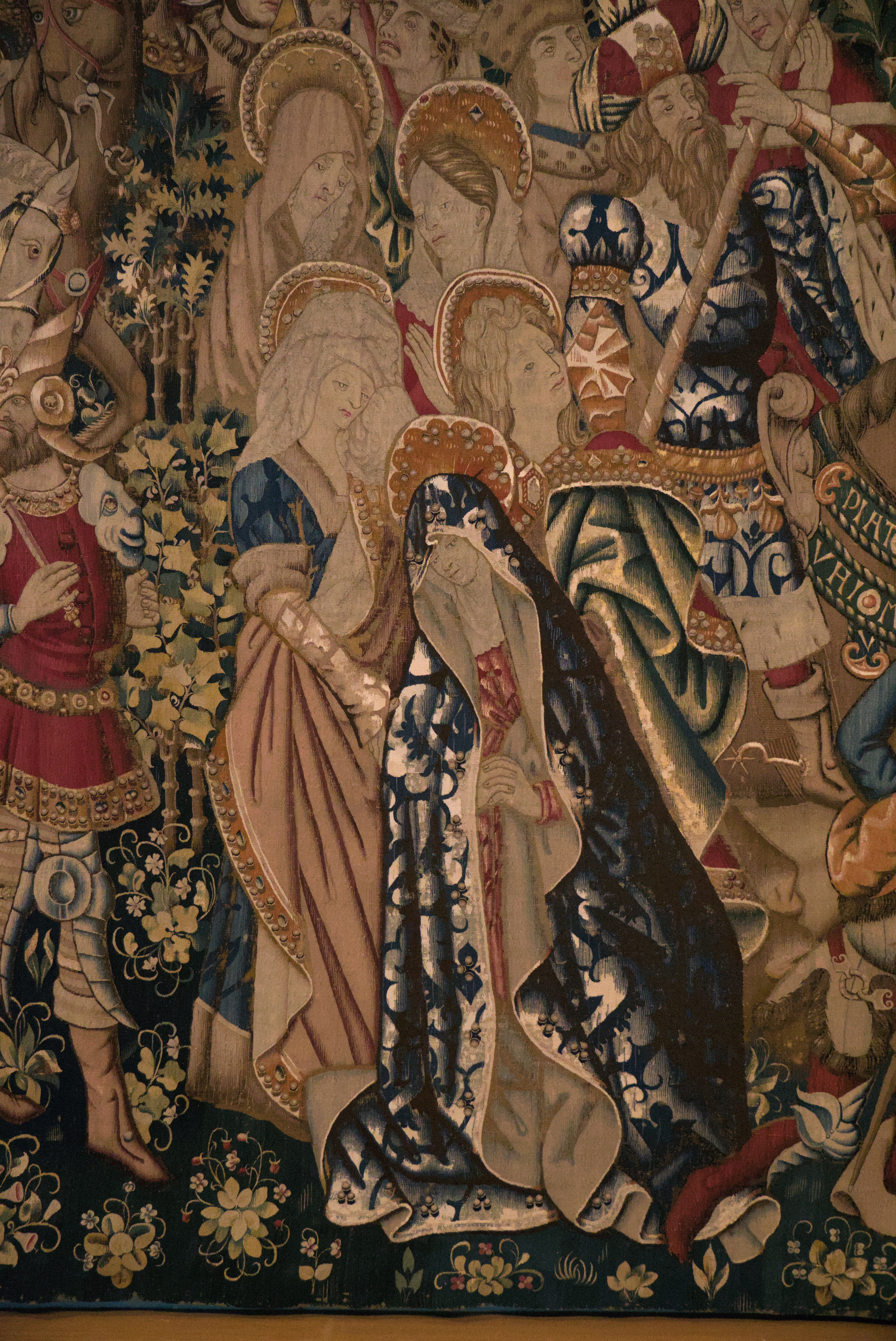
A group of four women mourn—the Virgin Mary up front in the blue mantle, backed by three other Marys—alongside a curly-haired apostle John in green.
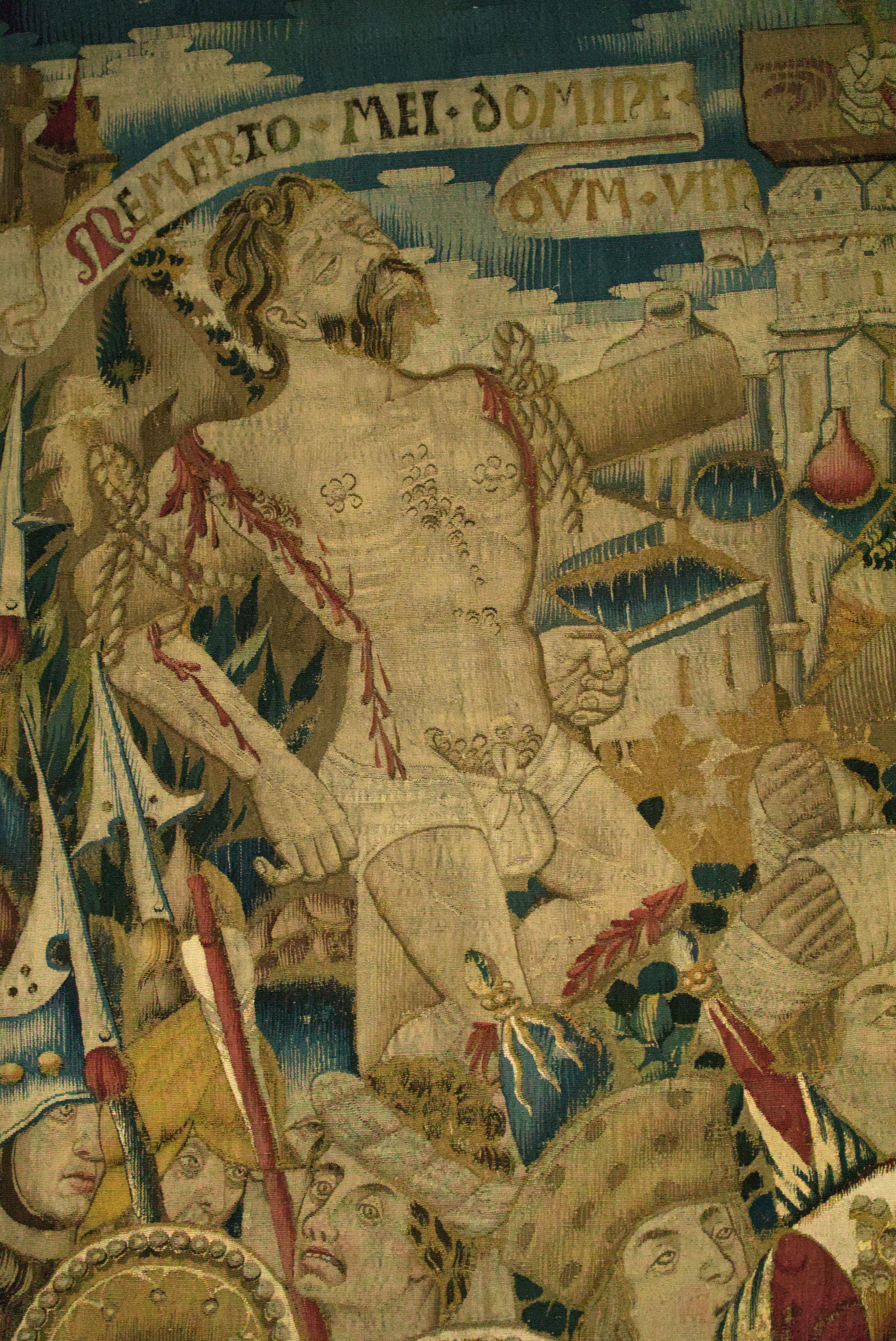
On Christ’s right (the viewer’s left), the penitent thief, with his last breaths, says, Memento mei, Domine, dum ven[eris in regnum tuum] (Remember me, Lord, when you come into your kingdom) (Luke 23:42).
The pointing man below the cross to Christ’s left, our right, is the Roman centurion (officer in command of one hundred soldiers) who, when Jesus died, proclaimed, Vere filius Dei erat iste (Truly this man was the Son of God!) (Matt. 27:54; Mark 15:39; cf. Luke 23:47).

On the other side of the cross, a Roman spearman, to whom tradition gives the name Longinus, points to his eyes. That’s because according to a medieval legend, Longinus was blind, but when he pierced Jesus’s side to verify his death, some of the blood from the open wound fell into Longinus’s eyes and restored his sight, after which he confessed allegiance to Christ.

Despite these three stories—two biblical, one apocryphal—of Christian conversion at the cross, Christ’s death did not move all the hearts of those present. At the base of the cross, two men fight with knives over Christ’s garment, their greed and aggression a foil to Christ’s selflessness and gentleness, and an example of the sin he came to redeem us from.

And again, pacifist though I am, I can’t help but remark on the fine-looking armor in the crowd:

The right-most third of the tapestry portrays vignettes of the Resurrection.
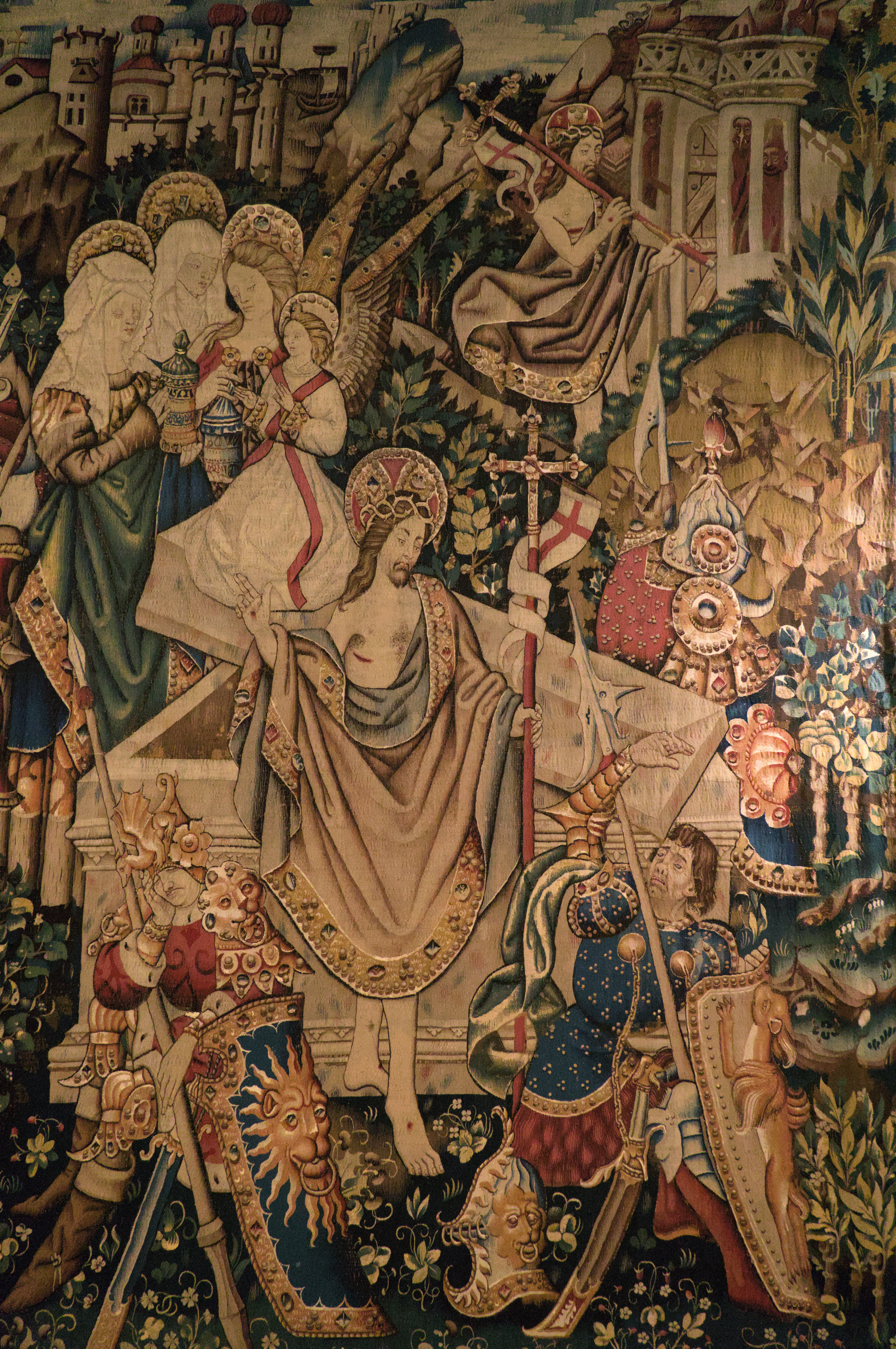
At the bottom, Christ emerges triumphant from his tomb, holding a banner in one hand and bestowing blessing with the other.

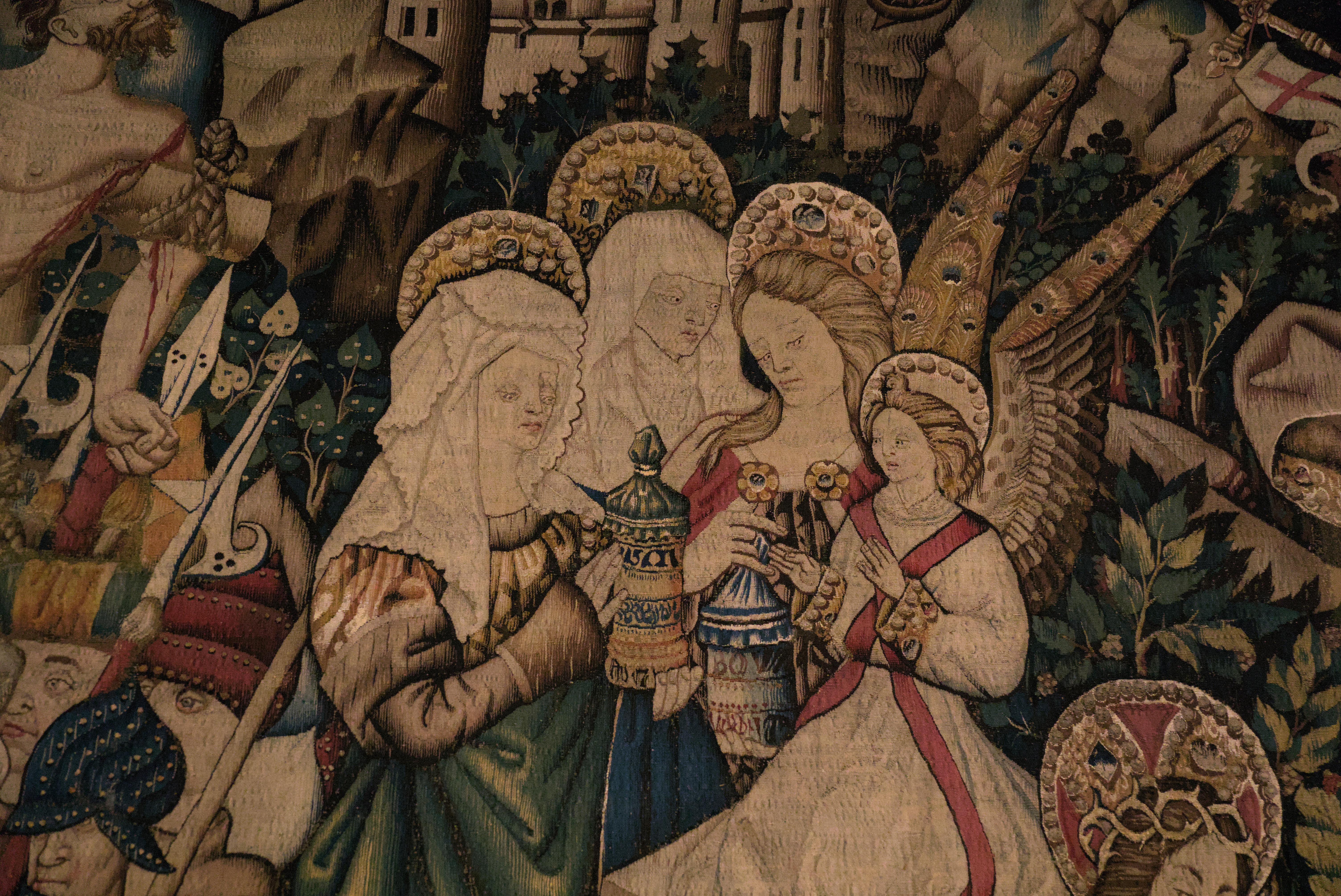
In the middle ground, the three Marys arrive at the empty tomb, ointments in hand, where they meet an angel who informs them that Christ has risen from the dead. Mary Magdalene is the one with her hair uncovered.
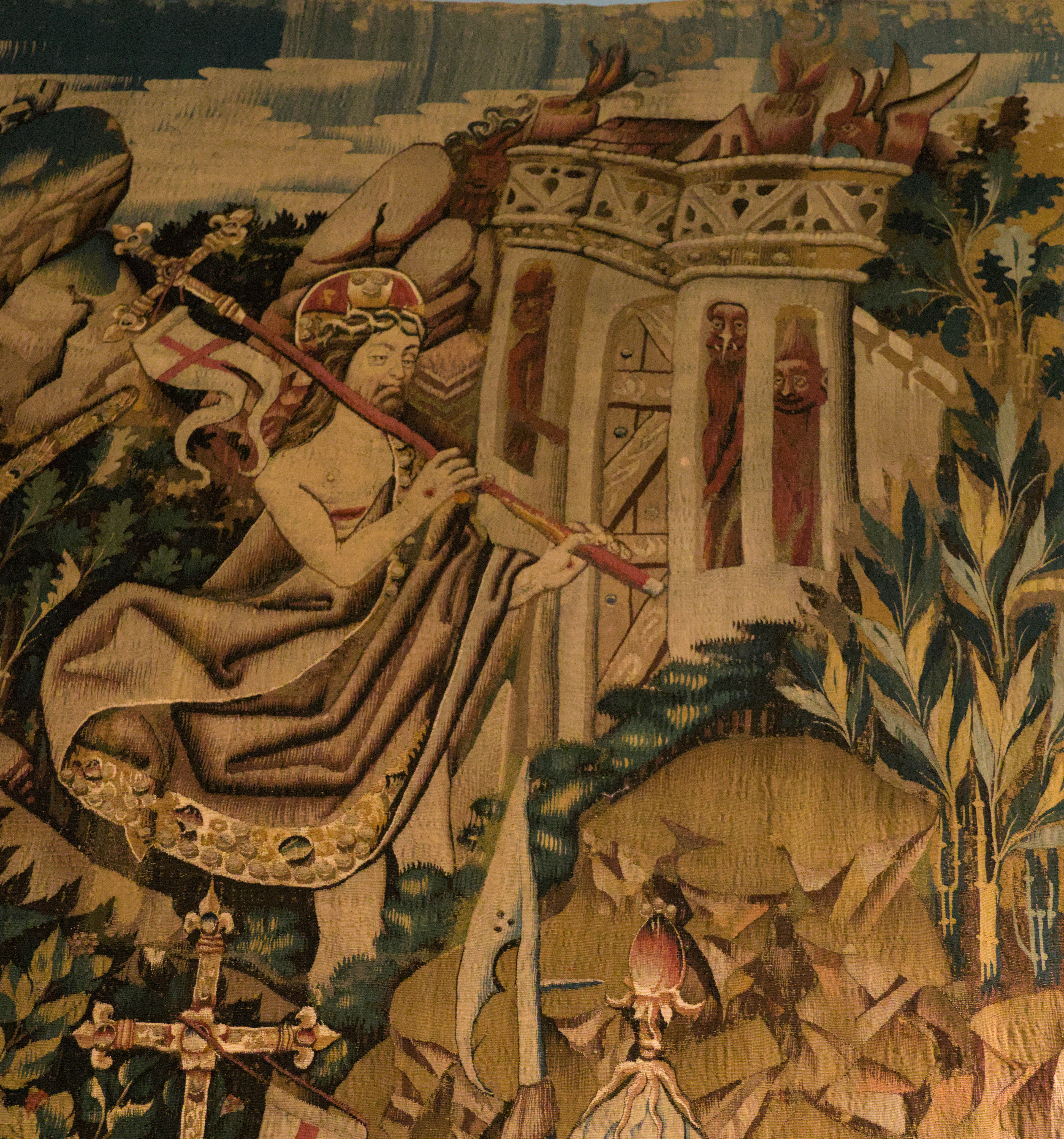
The risen Christ appears again at the top right, harrowing hell, a realm that is represented as a turreted fortress from whose windows fiery red demons glower and smirk. Christ has come to break down the doors and release the Old Testament saints being held captive—that is, those who died trusting in Yahweh and who were awaiting Christ’s redemption in the netherworld.
Let’s zoom in closer, shall we?

This is just one of the many artistic treasures, woven and otherwise, at Brussels’ Art and History Museum. I highly recommend a visit! I easily spent several hours there.
 Art & Theology