
From “On Pentecost” by Romanos the Melodist (poem)

Pentecost (Ottonian)
The Descent of the Holy Spirit, from a benedictional made in Regensburg, Germany, ca. 1030–40. Tempera colors, gold leaf, and ink on parchment, 9 1/8 × 6 5/16 in. (23.2 × 16 cm). J. Paul Getty Museum, Los Angeles, Ms. Ludwig VII 1 (83.MI.90), fol. 47v. As is traditional in artistic depictions of this subject, the apostle Paul (with brown beard) is seated in a prominent position opposite Peter, receiving the Spirit like the other eleven apostles. Paul was not present at the event, but he was later mystically joined to it.

. . .

Peter, speaking like this to the apostles, roused them to prayer,
And standing in their midst, he spoke as follows:
“On bended knee let us beg and pray
That we shall make this chamber a church, for so it is and has become.
Let us be eager to cry unto God,
‘Send us thy good spirit
So that it may lead all of us to correct knowledge
Which thou hast prepared for those who worship and praise
The All-Holy Spirit.’”

When they heard this, those who had been called with him gathered together
As lambs in the presence of the shepherd, charmed by his speech;
And silently they specified what they desired,
And they held up to the Pantokrator the prayers which pressed for these things:
“To the Lord of angels and the King,
To the Ruler of humankind and the Maker of the world,
To the One who holds sway with his nod over those in heaven and earth,
Thy friends and servants cry to thee: ‘Quickly send us
The All-Holy Spirit.’”

Immediately after completing their prayers, they wrote their names under them,
And sealing them in faith, they sent them on high—
Prayers which the Master recognized and he said:
“Comforter, descend as thou dost wish, of thy own initiative, and without being summoned;
The disciples expect thee; they are the ones
Whom I gather together for thee and the Father,
The ones whom I educated when I said: ‘Teach the nations,
Extolling the Father, and worshiping the Son, and praising
The All-Holy Spirit.’”

God heard their wants, and his Comforter
Descended on those who were praying.
The Ineffable One was not removed from one place to the other,
Nor was there alteration, nor accommodation, nor did he endure diminution,
For he was above, and below, and everywhere;
For the divine nature is ineffable and not to be touched;
It is not seen by the eyes, but it is apprehended through faith;
It is not grasped in the hands; but it is felt in hearts of faith—
The All-Holy Spirit.

When the divine Pentecost was complete, the eleven chosen ones set up a din.
As they persevered in their prayers,
And as the passage read from Acts says,
When the sound of the powerful wind of the spirit suddenly came resounding from heaven,
The whole chamber was filled with fire.
Indeed, it amazed the beloved disciples rather too much.
When they saw the dwelling tossed like a boat, they cried:
“O Master, check the storm and send
The All-Holy Spirit.”

When the disciples recognized that the whole upper room was shaken as by an earthquake from the wind,
They all lowered their eyes in fear;
And lo! Another trembling still more to be shuddered at,
And one upon another marvel brought a second trembling in addition to the first fear,
For fiery tongues touched them anew
And began to appear on the heads of the chosen group.
Indeed, the fiery tongues did not burn their hair but lighted up their hearts
And sent them forth cleansed and purified—
The All-Holy Spirit.

Peter, seeing all the things which were happening, cried out: “Brothers,
Let us hold in reverence what we see, and let us not examine it.
Does anyone say what it is that has been done?
For what has been accomplished transcends belief and defies thought.
Spirit and fire are united—a true miracle;
Air and flame are joined together—awesome sight!
Along with winds, torches; along with dew, sparks of fire.
Who has seen, who has heard of this? Who is able to speak of what is produced by
The All-Holy Spirit?

“Do you, then, dearly beloved, stand and simply observe the fire
Which the One who is in heaven has sent from on high;
Do not fear, for the coals do not burn;
Do not be amazed that the fire does not burn, but as prudent men remember
How long ago the fire received kindly the three children,
How their bodies were not burned, nor their hair,
How the furnace revealed the three as four,
For it gave back those whom it received with interest, since it feared
The All-Holy Spirit.

“Then, brothers, let the One descended upon us cast out fear from our minds,
And make a show of love to the Ascended One.
Since he loved those whom he called,
Since all the things which he prophesied, he has fulfilled, and since he has done as he said,
Why, then, should we be afraid of a flame which does not burn?
Let us consider the fire as roses, which indeed it is.
It has been placed upon our heads like flowers,
And on our heads it has formed a crown, an ornament, and illumined us,
This All-Holy Spirit.”

. . .

This passage constitutes strophes 4–12 of a sixth-century Pentecost kontakion (poetic homily) by Romanos the Melodist, translated by Marjorie Carpenter in Kontakia of Romanos, Byzantine Melodist; I: The Person of Christ (Columbia: University of Missouri Press, 1970). For the original Greek, see #33 in the critical edition edited by Paul Maas and Constantine Athanasius Trypanis, Sancti Romani Melodi Cantica Genuina (Oxford: Clarendon Press, 1963).

Three details stand out to me: the prayers of the apostles for the Spirit being sent up like signed, sealed letters to the heavens, eliciting God’s affirmative response; the paradoxical mingling of dew and fire (two seemingly incompatible elements) in the Spirit’s descent, both refreshing and enflaming; and the image of the Pentecostal flames as roses that crown the apostles’ heads!

Romanos is known for his kontakia, a form of hymn in the Byzantine liturgical tradition that Romanos is believed to have introduced. The kontakion is basically a poetic sermon that was sung, containing highly dramatic features, including dialogue, but it was not staged. At its inception in the early sixth century and through the seventh, a kontakion consisted of a prologue (the prooimoion or koukoulion) followed by eighteen to thirty metrically identical strophes (oikoi or ikoi, i.e., stanzas; sing. oikos or ikos) linked by a refrain. (In the example above, the refrain is “The All-Holy Spirit.”) The first letter of each of the strophes often forms an acrostic.

Kontakia were written to be sung at the Daily Office, not Mass, on feast days. Unfortunately, none of the music Romanos wrote for his survives.

By the eighth century, the kontakion had become shortened, and it lost its homiletic character and its dialogue.


Romanos the Melodist (fl. 536–556 CE) was a preeminent Byzantine hymnographer and composer who is said to have written, in Greek, nearly a thousand kontakia, of which fifty-nine (text only) survive, his best known being on the Nativity of Christ. He was born in the late fifth century to a Jewish family in Emesa (modern-day Homs), Syria, but was baptized into Christianity as a young boy. He later moved to Berytus (Beirut) and was ordained a deacon of the Church of the Resurrection there. During the reign of Emperor Anastasius I (r. 491–518) Romanos moved to Constantinople and served as sacristan at Hagia Sophia, residing in that capital city until his death. He was sainted by the Greek Orthodox Church, which celebrates his feast on October 1. The famous Akathist Hymn to the Theotokos is attributed to him.

Christmas, Day 9: “Today the Virgin cometh unto a cave . . .”

LOOK: Nativity icon from St. Catherine’s Monastery

Coptic Nativity icon (St Catherine's)
The Nativity of Christ, Egypt, 7th century(?). Encaustic on wood. Holy Monastery of St. Catherine, Sinai, Egypt. Photo courtesy of the Michigan-Princeton-Alexandria Expeditions to Mount Sinai.

This Coptic icon of the Nativity bears all the traditional elements of Nativity icons. It shows Mary reclining in a cave next to her newborn son, Jesus, who lies in a manger, being affectionately licked by an ox and ass. Why those two animals? Because the church fathers read Isaiah 1:3 into the scene, which says, “The ox knows its owner and the donkey its master’s crib.”

The starry semicircle at the top represents the heavens. A thick beam of light descends from it onto Christ, confirming his divine paternity. On either side, from behind the grassy hills, angels rejoice, bringing glad tidings of the birth.

From the right, three magi approach with their gifts (unusually, their horses are placed apart from them in the bottom left), and in the center, a shepherd plays a pipe while his flock frolics on the grass.

In the bottom left, Joseph sits dejectedly with his head in his hands. He is being assailed once again by doubt as to Jesus’s true paternity. Could Mary’s outrageous story really be true? Or was she sexually unfaithful? In some Nativity icons Satan appears to Joseph in the guise of an old man to tempt him to distrust Mary and to doubt Jesus’s divinity. Anyone would be a fool to believe it, he taunts. It’s possible that the man with the pointed red cap at the far right of this icon is meant to be the devil on his way to Joseph, but if so, it would be an odd compositional choice. Anyway, in Nativity icons, Joseph stands for all skeptics, for those who struggle to accept that which is beyond reason, especially the incarnation of God.

Next to Joseph, two midwives bathe Jesus in a basin. (Jesus appears twice in the composition. He’s identified by the cross-shape in his halo.)

Art historian Matthew J. Milliner, who specializes in the Byzantine era, describes the Orthodox iconography of the Nativity in a 2021 podcast episode of For the Life of the World [shared previously]:

There’s just something wonderful about the classic Nativity icon. When you look at this, you’ve got Joseph in the corner. . . . And then you have this dome that is overarching the scene. That is, speaking in Charles Taylor’s terms, that’s the “immanent frame”—that’s the cosmos as we know it. And it’s shattered! By what? By the light that comes from outside. In other words, the Kantian universe has been pierced and God has revealed himself and said, “This is how I choose to come into the world.”

And there you have the Virgin Mary, and she almost looks seed-like when you look at these icons. She’s on her side because, thank you very much, she just gave birth. And there’s Christ. And the donkey and the ox are there, symbolizing both Jew and Gentile. In other words, the book of Romans in one shot. Boom. Right there.

Then you’ve got the magi sometimes off in the distance, to symbolize all corners of the earth, to symbolize most in particular the Assyrian Church of the East, the expansion of Christianity all the way to the Pacific Ocean by like the fifth century, folks. Gotta remember that! These are the Christians whom we have lost contact with. The global reality of Christianity is communicated by these icons.

And then, of course, you’ve got the shepherds to symbolize, we might even say, all classes incorporated into this faith—not just across the globe, but across socioeconomic status. All of it is communicated just by meditating upon it.

And then you have this cavern—not some sweet little stable, but a cavern, a cave. And folks, it’s the cave of your own psyche as well. It’s a depth-psychology dimension of the Christian tradition. A Nativity icon is what God wants to do in your soul. This is intended to be a spiritual experience.

The dating of the particular icon pictured above has been debated. It is circulating in many places online with an attribution of “seventh century,” perhaps in part because of its use of encaustic (a common medium for earlier icons). But Father Akakios at St. Catherine’s Monastery at Mount Sinai, the institution that owns and houses the icon, told me that’s probably too early, that it’s more likely a later icon that incorporates earlier elements.

From the Sinai Digital Archive, it appears that Kurt Weitzmann, an art historian from Princeton University who had the icon photographed on one of his four research expeditions to Sinai in the late 1950s and early ’60s, proposes the sixteenth or seventeenth century as its likely time of creation. Cathy Pense Garcia, head of Visual Resources Collections at the University of Michigan (which manages the Sinai Digital Archive jointly with Princeton), was unable to confirm an approximate date and said that more scholarly research is needed.

It’s such a wonderful icon! I hope to see some academic writing about it in the future, as my research turned up next to nothing.

LISTEN: “Kontakion of the Nativity of Christ” by Romanos the Melodist, 6th century | Chanted by Fr. Apostolos Hill, 2016

Today the Virgin cometh unto a cave to give birth to the Word who was born before all ages, begotten in a manner that defies description. Rejoice, therefore, O universe, if thou should hear and glorify with the angels and the shepherds. Glorify him who by his own will has become a newborn babe and who is our God before all ages.

(Η Παρθένος σήμερον, τον προαιώνιον Λόγον, εν σπηλαίω έρχεται, αποτεκείν απορρήτως. Χόρευε, η οικουμένη ακουτισθείσα, δόξασον, μετά Αγγέλων και των ποιμένων, βουληθέντα εποφθήναι, Παιδίον νέον, τον προ αιώνων Θεόν.)

This is the prooimoion (prologue) to Romanos the Melodist’s kontakion on the Nativity of Christ; the other twenty-four stanzas can be read in a translation by Ephrem Lash in St. Romano, On the Life of Christ: Kontakia—Chanted Sermons by the Great Sixth-Century Poet and Singer (HarperCollins, 1995).


This post is part of a daily Christmas series that goes through January 6. View all the posts here, and the accompanying Spotify playlist here.

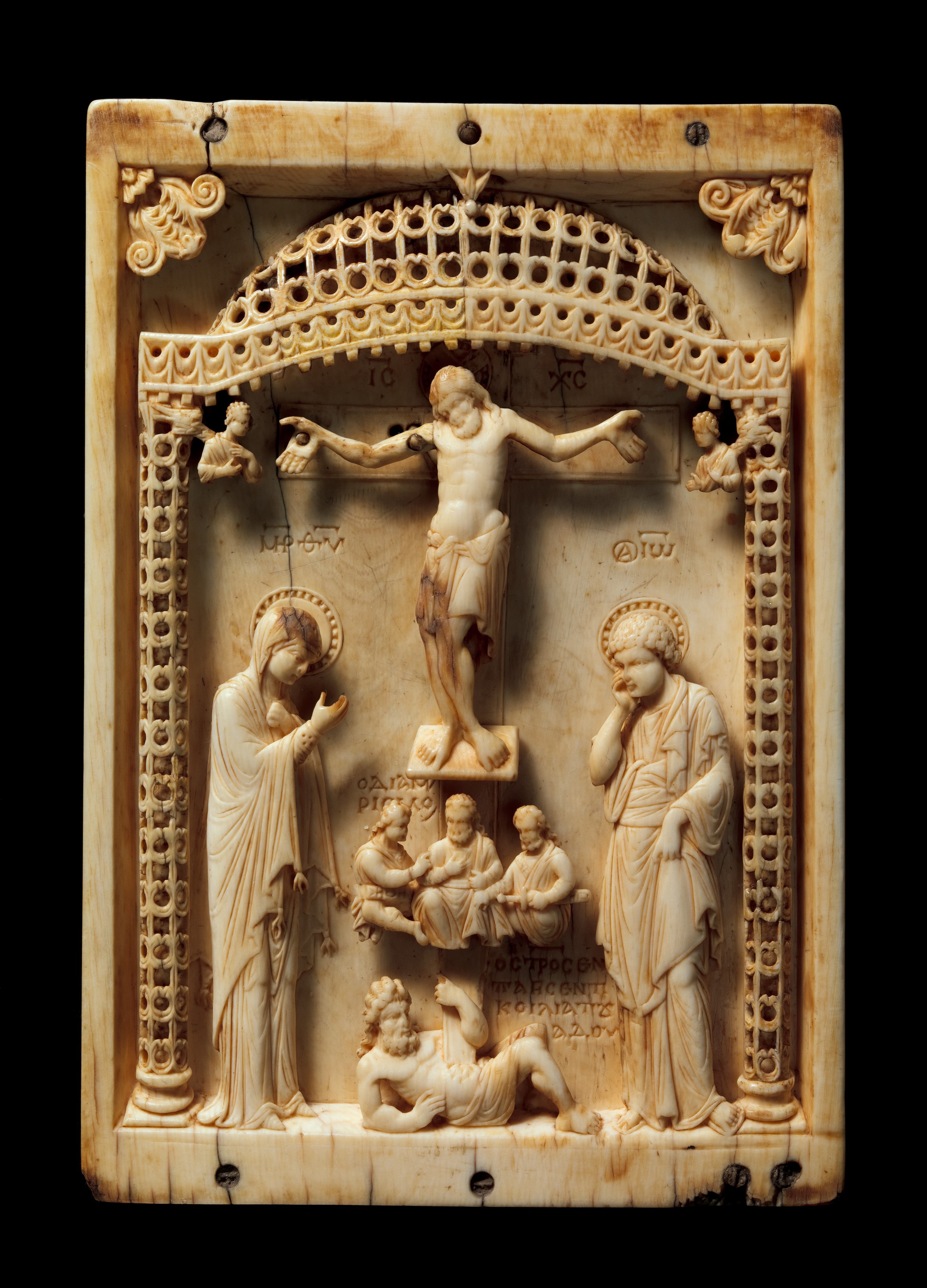
Rare iconography of Hades impaled on Golgotha

The Metropolitan Museum of Art in New York has in its collection a Byzantine Crucifixion ivory from Constantinople with an unusual figure at the bottom: a burly, bearded man in a reclining position, being stabbed through his belly by the cross. The Greek inscription clues us in to his identity: “The Cross Implanted in the Stomach of Hades.” This is the ruler of the underworld being subdued by Christus Victor, the conquering Christ!

Crucifixion with Hades stabbed
Icon with the Crucifixion, made in Constantinople, mid-10th century. Ivory, 5 15/16 × 3 1/2 in. (15.1 × 8.9 cm). Metropolitan Museum of Art, New York.

Hades is associated with death. The New Testament writers use the word, roughly equivalent to the Hebrew Sheol, to refer to the unseen realm of the dead, where people’s souls reside between death and the general resurrection, or sometimes to the grave, the place of bodily decay.

The iconography of Hades being stabbed is unique among surviving Byzantine representations of the Crucifixion, though it is present in some depictions of the Anastasis (Resurrection), known in English as the Harrowing of Hell.

There is also an ancient literary tradition of Hades experiencing gastric troubles in response to Christ’s redemptive work—either being speared through his midsection with Jesus’s cross, or his stomach churning in nervous anticipation of Jesus’s approach. Byzantine art curator Margaret English Frazer cites several such examples in her essay “Hades Stabbed by the Cross of Christ”:

  • “With this precious weapon [the cross] Christ tore apart the voracious stomach of Hades and blocked the treacherous fully opened jaws of Satan. Seeing this, Death quaked and was terrified, and released all whom he held beginning with the first man.”—Ephrem the Syrian, “Sermo in pretiosam et vivicam crucem” (Sermon on the Precious and Life-Giving Cross)
  • In the Gospel of Nicodemus, Hades frets to Satan about Jesus’s coming to the underworld after his crucifixion: “I not long ago swallowed down one dead, Lazarus by name; and not long after, one of the living by a single word dragged him up by force out of my bowels: and I think that it was he of whom thou speakest. If, therefore, we receive him here, I am afraid lest perchance we be in danger even about the rest. For, lo, all those that I have swallowed from eternity I perceive to be in commotion, and I am pained in my belly.”
  • In the Gospel of Bartholomew, upon hearing footsteps descending the stairs to his abode, Hades says, “My belly is rent, and mine inward parts are pained: it cannot be but that God cometh hither.”
  • In a sermon among the spuria of John Chrysostom of the fifth to seventh century, the infernal serpent laments that a nail is implanted in his heart and a wooden lance pierces him, tearing him apart. (“In adorationem venerandae crucis,” Patrologia Graeca 62, col. 748)
  • Hades, to the snake: “Let us both bitterly lament,
    Since in His descent He has attacked my stomach,
    So that I vomit forth those whom I formerly devoured.
    But now lament with me, for we are despoiled of our common glory.”
    —Romanos the Melodist, Fourth Hymn of the Resurrection, trans. Marjorie Carpenter in Kontakia of Romanos, Byzantine Melodist
  • Again, Hades, crying out: “I am pierced in the stomach;
    I do not digest the One whom I devoured;
    Just so, on the third day, the whale disgorged Jonas.
    Now I disgorge Christ and all of those who are Christ’s;
    Because of the race of Adam I am being chastised.”
    —Romanos the Melodist, Fifth Hymn of the Resurrection, trans. Marjorie Carpenter in Kontakia of Romanos, Byzantine Melodist

But again, the context of all these passages is Christ’s descent into Hades, part of the resurrection narrative celebrated on Easter. Is there any precedent for Hades being stabbed at the moment of Christ’s death?

Frazer identifies the most likely literary inspiration for our anonymous ivory carver as Romanos the Melodist’s hymn “On the Triumph of the Cross” from the sixth century, which was sung on Good Friday in the Byzantine church. Here’s an excerpt, translated from the Greek by Marjorie Carpenter:

Pilate fixed three crosses on Golgotha,
Two for the robbers, and one for the Giver of life.
When Hades saw Him, he said to those below:
“O my priests and forces, who has fixed the nail in my heart?
A wooden spear has pierced me suddenly and I am torn apart.
I am in pain—internal pain; I have a bellyache;
My senses make my spirit quiver,
And I am forced to vomit forth
Adam and those descended from Adam, given to me by a tree.
The tree leads them back
Again into Paradise.”

Satan tries to calm Hades, but he is inconsolable in his defeat, replying,

“Run and uncover your eyes, and see
The root of the tree within my spirit;
It has gone down into my vitals,
So that like iron it will draw up Adam.”

As is common in the New Testament and early patristic writings, Romanos interprets the Crucifixion as Christ’s victory over death. Through Christ’s self-sacrifice, death is disemboweled, no longer posing a threat. The gates of eternal life with God are now opened.

As I study this tenth-century ivory, I wonder who first owned it and how it supported their faith, and I marvel that after more than a thousand years, this precious object still beckons and speaks. It is the central panel of a small triptych whose two wings are now lost. Its diminutive size—no bigger than a hand—means it was likely a personal devotional object.

The artist places the scene under a baldachin. Jesus’s arms are extended over the crossbeam and his feet rest on a suppedaneum, below which three seated soldiers cast lots for his cloak. The Virgin Mary and Saint John stand on either side in an attitude of mourning. But their tears will soon give way to rejoicing, because the cross’s wooden stake plunges decisively into the stomach of Hades, doing him in; see the blood welling up at the wound. The cross is portrayed as the weapon with which Christ wins humanity’s salvation.

This is a symbolic image, one that manifests physically the metaphysical drama playing out beneath the surface of things. Hades embodies death, the opposite of life, so his impalement represents an end to his reign of terror. Symbolism is a common tool of the religious artist for signposting the viewer toward an invisible spiritual truth, and here the artist uses it to show how Christ has, surprisingly, vanquished death by death.


FURTHER READING

Margaret English Frazer, “Hades Stabbed by the Cross of Christ,” Metropolitan Museum Journal 9 (1974): 153–61