
Advent, Day 10: Bridegroom of the Soul

LOOK: Jesus as Bridegroom of the Soul from the Rothschild Canticles
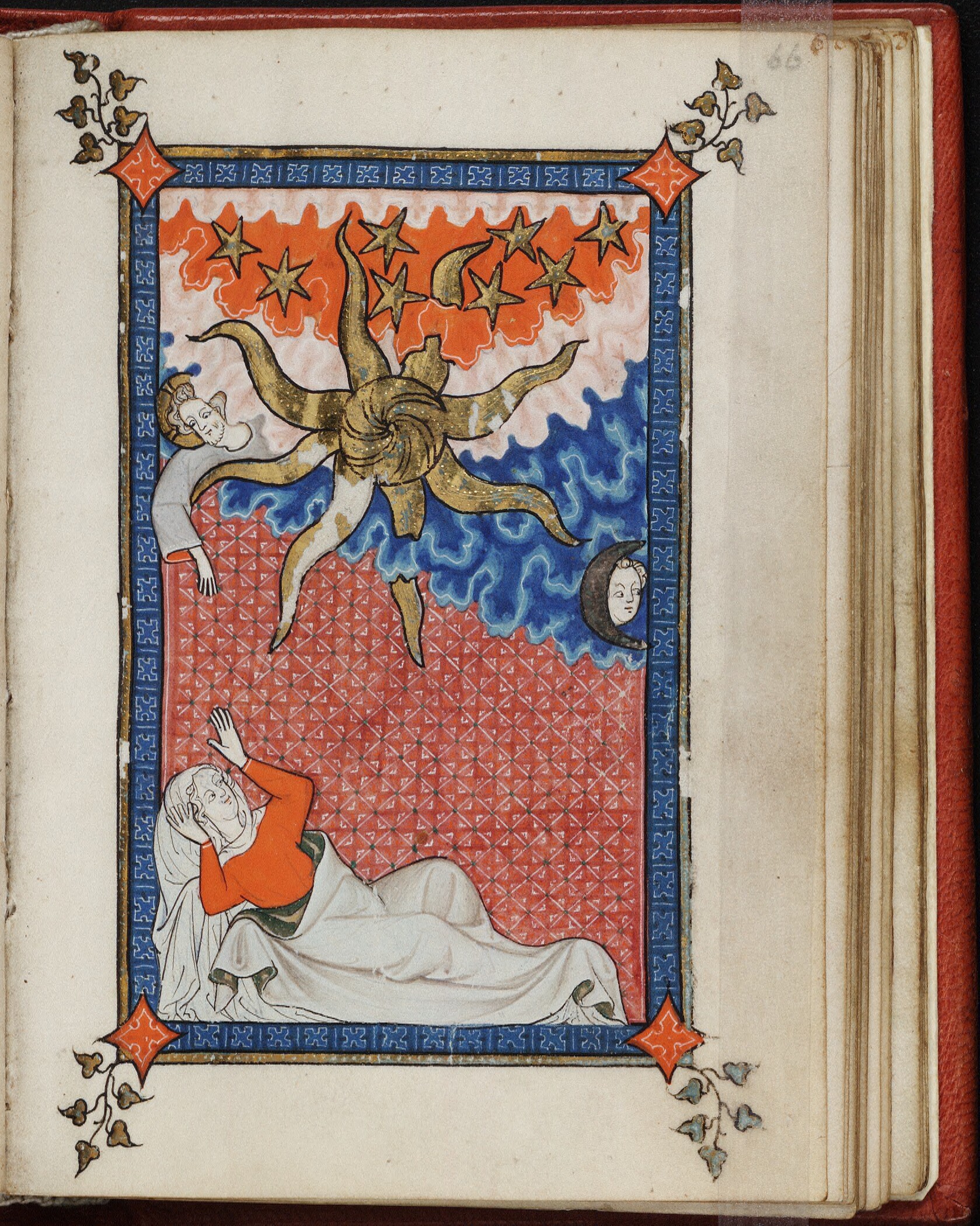
Jesus as Bridegroom of the Soul (Rothschild Canticles)
Jesus as Bridegroom of the Soul, from the Rothschild Canticles, Flanders or Rhineland, ca. 1300. Beinecke Library, Yale University, MS 404, fol. 66r.

The Rothschild Canticles from early fourteenth-century Flanders or the Rhineland (whose innovative Trinity miniatures I wrote about in 2021) is a cento of biblical, liturgical, and patristic citations accompanying an extraordinary program of images. Much of the content reflects the bridal mysticism that was popular at the time, emphasizing spiritual oneness with Christ. The compiler, artist(s), scribe(s), and original recipient of the manuscript are not known, but it was very likely made by a male monastic for a nun or canoness to use in her private devotions.

The miniature on folio 66r is the first in a five-miniature sequence (of which four survive) on the theme of mystical union. It shows the human soul, represented as a woman, about to receive her Bridegroom, Christ, in the marriage bed. Art historian Jeffrey Hamburger writes that in this image, “Christ emerges from the heavens with the energy of a cosmic explosion[,] . . . as a dramatic sunburst dissolving the mists. . . . Christ is the sun, its brightness, the light of the visio Dei. Just as sunlight generates heat, so Christ provokes desire.” [1] The artist uses that whirling sun with its tentacle-like rays as an attribute of Christ throughout the manuscript.

At her lover’s luminous descent, the Bride awakes from her sleep and raises her arms in ecstasy.

The face peeking out from behind the crescent moon on the right may be an angel, whose gaze directs us forward to the next scene, which shows the Bride reclining outdoors amid sprouting vines, “languish[ing] with love” (Song 2:5), and then being led into a wine cellar by the Bridegroom, to be inebriated by his sweet goodness (Song 2:4) .

The corresponding text on the facing page of this image, set inside a bedchamber, incorporates the following excerpts:

  • “I call you into my soul, which you are preparing for your reception, through the longing which you have inspired in it.”—Augustine, Confessions X.1
  • “God comes from Lebanon, the Holy One from the shady and thickly covered mountain.”—Habakkuk 3:3, used in medieval Advent liturgies
  • “I passed by you again and looked on you; you were at the age for love.”—Ezekiel 16:8
  • Plus miscellaneous adaptations of lines from the Song of Songs

In the Middle Ages it was common for Christian mystics, such as Mechthild of Magdeburg and Gertrude of Helfta, to describe and picture spiritual union in terms of physical union, as they “realized that bodily language better conveys the power, intensity, and personality of desire than overly spiritualized language does,” writes medievalist Grace Hamman. [2] And not only was the church, a corporate body, perceived as the bride of Christ, but so was the individual soul. The consummation of the marriage between Christ and his beloved was seen as eschatological, yes—coming at the end of time—but such intimate closeness and pleasure was also seen as something that could be enjoyed now on some level, as devotees commune with Christ through prayer, scripture reading, and the celebration of the Eucharist.

For the nun who used this book, it must have aided her in cultivating a deep love for Christ and strengthened her longing for that full and final coming together, when Christ will return to be with his bride.

To browse the other images in this remarkable manuscript, visit https://collections.library.yale.edu/catalog/2002755.

Notes:

  1. Jeffrey F. Hamburger, The Rothschild Canticles: Art and Mysticism in Flanders and the Rhineland circa 1300 (New Haven: Yale University Press, 1990), 106.
  2. Grace Hamman, Jesus through Medieval Eyes: Beholding Christ with the Artists, Mystics, and Theologians of the Middle Ages (Grand Rapids, MI: Zondervan Reflective, 2023), 49. “The topos of the mystical marriage as an act of physical communion is commonplace. . . . Physical love is used as a metaphor for the consummation of spiritual love.” Hamburger, Rothschild Canticles, 109.

LISTEN: Wachet auf, ruft uns die Stimme, BWV 140 by Johann Sebastian Bach, 1731 | Words by Philipp Nicolai, 1599 (movements 1, 4, 7), and an anonymous other | Melody of movements 1, 4, and 7 by Philipp Nicolai, 1599

Here are two listening options—the first from an album, and the second a live performance that you can hear as well as watch.

>> Performed by the Monteverdi Choir and the English Baroque Soloists, dir. John Eliot Gardiner, on Bach: Cantatas BWV 140 and 147 (1992)

>> Performed by the Choir and Orchestra of the J. S. Bach Foundation, dir. Rudolf Lutz (soloists: Nuria Rial, Bernhard Berchtold, Markus Volpert), Evangelisch-Reformierte Kirche Trogen, Switzerland, 2008 (**The copyright owner has disallowed video embeds, but you can watch the video directly on YouTube by clicking the link below.)

In the libretto that follows, the capital letters in parentheses indicate which voice parts are singing that movement: soprano, alto, tenor, or bass.

1. Choral (SATB)
Wachet auf, ruft uns die Stimme,
der Wächter sehr hoch auf der Zinne,
wach auf, du Stadt Jerusalem.
Mitternacht heißt diese Stunde,
sie rufen uns mit hellem Munde,
wo seid ihr klugen Jungfrauen?
Wohlauf, der Bräut’gam kömmt,
steht auf, die Lampen nehmt,
Alleluia!
Macht euch bereit
zu der Hochzeit,
ihr müsset ihm entgegen gehn.

2. Rezitativ (T)
Er kommt, er kommt,
der Bräut’gam kommt,
ihr Töchter Zions, kommt heraus,
Sein Ausgang eilet aus der Höhe
in euer Mutter Haus.
Der Bräut’gam kommt, der einen Rehe
und jungen Hirschen gleich
auf denen Hügeln springt
und euch das Mahl der Hochzeit bringt.
Wacht auf, ermuntert euch,
den Bräut’gam zu empfangen;
dort, sehet, kommt er hergegangen.

3. Duett (SB) (Dialog - Seele, Jesus)
Wenn kömmst du, mein Heil?
– Ich komme, dein Teil. –
Ich warte mit brennenden Öle.
Eröffne den Saal
– Ich öffne den Saal –
zum himmlischen Mahl.
Komm, Jesu.
– Ich komme, komm, liebliche Seele. –

4. Choral (T)
Zion hört die Wächter singen,
das Herz tut ihr vor Freuden springen,
sie wachet und steht eilend auf.
Ihr Freund kommt von Himmel prächtig,
von Gnaden stark, von Wahrheit mächtig,
ihr Licht wird hell, ihr Stern geht auf.
Nun komm, du werte Kron’,
Herr Jesu, Gottes Sohn,
Hosianna!
Wir folgen all
zum Freudensaal
und halten mit das Abendmahl.

5. Rezitativ (B)
So geh herein zu mir,
du mir erwählte Braut!
Ich habe mich mit dir
von Ewigkeit vertraut.
Dich will ich auf mein Herz,
auf meinen Arm gleich wie ein Sigel setzen,
und dein betrübtes Aug’ ergötzen.
Vergiß, o Seele, nun
die Angst, den Schmerz,
den du erdulden müssen;
auf meiner Linken sollst du ruhn,
und meine Rechte soll dich küssen.

6. Duett (SB) (Dialog - Seele, Jesus)
Mein Freund ist mein,
– und ich bin dein, –
die Liebe soll nichts scheiden.
Ich will mit dir
– du sollst mit mir –
im Himmels Rosen weiden,
da Freude die Fülle, da Wonne wird sein.

7. Choral (SATB)
Gloria sei dir gesungen,
mit Menschen- und englischen Zungen,
mit Harfen und mit Zimbeln schon.
Von zwölf Perlen sind die Pforten,
an deiner Stadt sind wir Konsorten
der Engel hoch um deine Thron.
Kein Aug’ hat je gespürt,
kein Ohr hat je gehört
solche Freude,
des sind wir froh,
io, io,
ewig in dulci jubilo.
1. Chorus (SATB)
Awake, calls the voice to us
of the watchmen high up in the tower;
awake, you city of Jerusalem.
Midnight the hour is named;
they call to us with bright voices;
where are you, wise virgins?
Indeed, the Bridegroom comes;
rise up and take your lamps,
Alleluia!
Make yourselves ready
for the wedding,
you must go to meet him.

2. Recitative (T)
He comes, he comes,
the Bridegroom comes!
O daughters of Zion, come out;
his course runs from the heights
into your mother’s house.
The Bridegroom comes, who like a roe
and young stag
leaps upon the hills;
to you he brings the wedding feast.
Rise up, take heart,
to embrace the Bridegroom;
there, look, he comes this way.

3. Duet (SB) (Dialogue - Soul, Jesus)
When will you come, my Savior?
– I come, as your portion. –
I wait with burning oil.
Now open the hall
– I open the hall –
for the heavenly meal.
Come, Jesus!
– I come, come, beloved soul! –

4. Chorale (T)
Zion hears the watchmen sing,
her heart leaps for joy within her,
she wakens and hastily arises.
Her glorious beloved comes from heaven,
strong in mercy, powerful in truth;
her light becomes bright, her star rises.
Now come, precious crown,
Lord Jesus, the Son of God!
Hosanna!
We all follow
to the hall of joy
and hold the evening meal together.

5. Recitative (B)
So come in to me,
you my chosen bride!
I have to you
eternally betrothed myself.
I will set you upon my heart,
upon my arm as a seal,
and delight your troubled eye.
Forget, O soul, now
the fear, the pain
which you have had to suffer;
upon my left hand you shall rest,
and my right hand shall kiss you.

6. Duet (SB) (Dialogue - Soul, Jesus)
My friend is mine,
– and I am yours, –
love will never part us.
I will with you
– you will with me –
graze among heaven’s roses,
where complete pleasure and delight will be.

7. Chorale (SATB)
Let Gloria be sung to you
with mortal and angelic tongues,
with harps and even with cymbals.
Of twelve pearls the portals are made;
in your city we are companions
of the angels high around your throne.
No eye has ever perceived,
no ear has ever heard
such joy
as our happiness,
io, io,
eternally in dulci jubilo! [in sweet rejoicing]

English translation © Pamela Dellal, courtesy of Emmanuel Music Inc. Used with permission.

Bach wrote this cantata during his time as cantor (music director) at St. Thomas Church in Leipzig, Germany, a post he served from 1723 until his death in 1750. (Imagine having Bach write and lead music for your church. During his first few years at St. Thomas, he composed a new cantata nearly every week for Sunday worship! His productivity is uncanny.) It premiered the twenty-seventh Sunday after Trinity Sunday, the final week of the liturgical year, on November 25, 1731, to correspond to the day’s assigned Gospel reading.

Bach scored the work for three vocal soloists—soprano (playing the Soul), tenor (the Watchman), and bass (Jesus)—a four-part choir, and an instrumental ensemble consisting of a horn, two oboes, taille, violino piccolo, strings, and basso continuo, including bassoon. Musicologist William G. Whittaker calls it “a cantata without weaknesses, without a dull bar; technically, emotionally and spiritually of the highest order. Its sheer perfection and its boundless imagination rouse one’s wonder time and time again.”

Conductor Rudolf Lutz of the J. S. Bach Foundation gave an excellent lecture with theologian Karl Graf prior to the above performance, which is freely available online; together the two break down the cantata’s musical and theological elements. The lecture is in German with English subtitles.

The first time I ever heard Bach’s Cantata 140 was in the Western music history course I took my first year of college. Our professor played a recording of the opening movement in class, then told us to go home and listen to the other six for homework—we would discuss them the next day. Sitting before my laptop at my dorm room desk, ensconced in my headphones, I was transported.

Bach’s Wachet auf, ruft uns die Stimme (Awake, calls the voice to us) is based on a chorale (congregational hymn) of the same name by the German Lutheran pastor, poet, and composer Philipp Nicolai, which conflates the parable of the ten virgins in Matthew 25 with the bridal theology of the Prophets and Revelation. The hymn appears in some English-language hymnals under the title “Wake, Awake, for Night Is Flying” (Catherine Winkworth) or “Sleepers, Wake! A Voice Astounds Us” (Carl P. Daw). Bach used the hymn’s three stanzas, both text and tune, for movements 1, 4, and 7.

The words of movements 2, 3, 5, and 6 are possibly by Picander (the pseudonym of Christian Friedrich Henrici), a frequent literary collaborator of Bach’s. Tender and rapturous, they draw on the imagery of the Song of Songs to describe the marriage of Christ and the human soul.

It’s a remarkable work. I encourage you to listen to it in one sitting—it’s twenty-eight minutes long—while you follow along with the lyrics. Revel in the love of Christ for you, his bride. Get excited for the sweet union to come.

As a bonus, here’s a gorgeous performance of the Nicolai hymn that forms the core of Bach’s cantata. It was arranged by F. Melius Christiansen in 1925 and performed in 2018 by the St. Olaf Massed Choirs under the direction of Anton Armstrong, using William Cook’s 1871 English translation:

Wake, awake, for night is flying,
the watchmen on the heights are crying.
Awake, Jerusalem, arise!
Midnight’s solemn hour is tolling,
his chariot wheels are nearer rolling;
he comes; prepare, ye virgins wise.
Rise up, with willing feet,
go forth, the Bridegroom meet. Hallelujah!
Bear through the night
your well-trimmed light,
speed forth to join the marriage rite.

Hear thy praise, O Lord, ascending
from tongues of men and angels blending
with harps and lute and psaltery.
By thy pearly gates in wonder
we stand, and swell the voice of thunder
in bursts of choral melody. Hallelujah!
No vision ever brought,
no ear hath ever caught,
such bliss and joy.
We raise the song, we swell the throng,
to praise thee ages all along.
Trinity Sunday Roundup

Today, June 4, is Trinity Sunday! Here’s a handful of art and music items on the topic.

VISUAL MEDITATION: “The Wheeling Playfulness of the Trinity” by Victoria Emily Jones: The Rothschild Canticles [previously] from ca. 1300 Flanders contains some of the most inventive and delightful artistic renderings of the Trinity that I’ve ever seen. I key in on four of them in today’s visual meditation for ArtWay

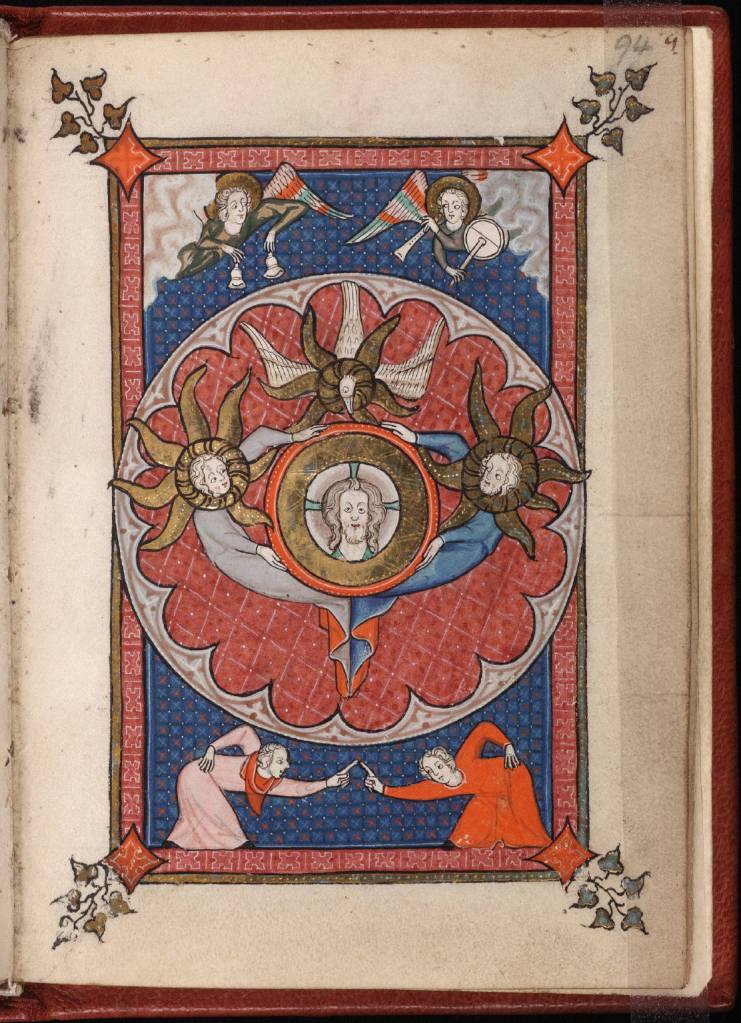
Beinecke MS 404, fol. 94r

+++

MUSICAL COMMENTARY: “Theology in Sound and Motion: Perichoresis, for Brass Quintet” by Delvyn Case: Delvyn Case provides musical and theological commentary on his brass quintet composition “Perichoresis” (2006), inspired by the divine dance of the Trinity. “Its overall mood is joyous, an ecstatic whirling-about in which all three members become lost in the ecstasy of divine fellowship,” he writes. “At the exact moment of the dance when one member moves, the other fills in the spot left vacant.” “Perichoresis” premiered by Boston’s Triton Brass and appears on Case’s 2018 album Strange Energy. About this piece, Bible scholar and theologian Walter Brueggemann said, “I . . . have pondered ‘perichoresis’ for a long time. This is the finest exposition of that thick idea that I have encountered.”

+++

SONGS:

>> “Trinity Song” by Paul Zach: Performed in 2021 by Solomon Dorsey with Liz Vice and Madison Cunningham, this song by Paul Zach evolved into “God of Grace and Mystery” for The Porter’s Gate’s 2022 album Climate Vigil Songs. This earlier iteration has a Trinitarian focus that’s just lovely. “God of all eternity / Father, Spirit, and the Son / Ever-loving Three-in-One / O divine community / . . . / Calling us to join your dance . . .”

>> “One-Two-Three” by the Chosen Gospel Singers: This song was recorded in Los Angeles for Specialty Records and released as a single in 1952, with singers J. B. Randall (bass), E. J. Brumfield (tenor), George Butler (tenor), Fred Sims (tenor), and Oscar Cook (baritone). It opens with a repetition of the lines “One, two, three / One-in-Three and the Trinity.” The refrain is:

One for the Father
Two for the Son
Three for the Holy Ghost
All made of one

The song is largely eschatological. The first verse is about John the Revelator’s vision of the New Jerusalem descending, among other wonders; it ascribes a vision of the Trinity to John, even though that is not explicit as such in either John’s Gospel or the Apocalypse (but see “The Trinity in the Book of Revelation” by Edwin Reynolds). The second verse anticipates our singing and praising the Triune God in heaven, dressed in our brand-new robes. It also mentions David and Goliath, and I’m honestly not sure how that relates. But with gospel songs, floating lyrics are common, taken from one song and spliced into another, some more coherent than others in their new context.

+++

ESSAY: “The Hospitality of Abraham in the Work of Julia Stankova, Painter of Bulgarian Icons” by François Bœspflug: The first half of this peer-reviewed article introduces readers to the Bulgarian artist Julia Stankova, rehearsing her biography and examining her relationship to the icons tradition. The second half explores twelve of her paintings on the subject of the three angelic visitors to Abraham and Sarah in Genesis 18, whom the narrator suggests are a manifestation of God (“The LORD appeared to Abraham at the oaks of Mamre . . .”); because of the number of visitors, many Christians interpret this passage as revealing something of God’s triune nature, and for this reason traditional icons of the story are often titled The Trinity.

Stankova, Julia_The Hospitality of Abraham
Julia Stankova (Bulgarian, 1954–), The Hospitality of Abraham, 2004. Tempera on primed wooden panel and lacquer technique, 46 × 41 cm.

Since the publication of this article in 2019, Stankova has made at least three more paintings on the subject, all of which foreground Sarah and are titled Sarah’s Smile. She has just heard the angels announce that she will conceive a son in her old age.

+++

POEM: “After Rublev’s Trinity by Carrie Purcell Kahler: Published in Image no. 99 (Winter 2018), p. 21, this ekphrastic poem by Carrie Purcell Kahler interprets the famous fifteenth-century Trinity icon by Andrei Rublev. Sometimes referred to as “the hospitality of Abraham,” this biblical episode, as the iconographers interpret it, is really about the hospitality of God, who extends a hand to humanity, ever inviting us to sit at his table.

Rublev, Andrei_Trinity
Andrei Rublev (Russian, 1360–ca. 1430), The Trinity, ca. 1411. Tempera on wood, 141.5 × 114 cm. Tretyakov Gallery, Moscow.

A new choral setting of this poem by Garrett John Law is premiering today at Holy Trinity Episcopal Church in Covina, California, where Law serves as music director and organist. I believe it can be heard on the 10:30 a.m. PT worship service livestream on the church’s YouTube channel, but I’m not sure whether the performance will be archived online for later viewing. (Update, 6/12/23: Here it is! Sung by Holy Trinity’s seven-person choir.)

Innovative Trinity paintings from the Rothschild Canticles

The Rothschild Canticles is the name of a lavishly illuminated manuscript of Franco-Flemish origin, produced at the turn of the fourteenth century. “A potpourri of biblical verses, liturgical praise, dogmatic formulas, exegesis, and theological aphorisms, . . . the manuscript leads its user step by step through meditations on paradise, the Song of Songs, and the Virgin Mary to mystical union and, finally, contemplation of the Trinity,” describes Barbara Newman in her excellent essay “Contemplating the Trinity: Text, Image, and the Origins of the Rothschild Canticles.” It’s a diminutive little book, with a trim size of just four and a half inches by about three and a quarter.

Rothschild Canticles

The manuscript lacks any provenance before 1856, but Newman proposes that it was made at the Benedictine abbey of Bergues-Saint-Winnoc in Flanders, located at what is today the northern tip of France. The compiler of its texts, she suggests, was probably the same person who designed its remarkable images—most likely a monk of Saint-Winnoc, who probably employed a professional lay artist from Saint-Omer to execute the designs. The book’s patron was probably a canoness at the nearby abbey of Saint-Victor. It is now preserved at the Beinecke Rare Book and Manuscript Library at Yale University in New Haven, Connecticut. All photographs in this post are courtesy of the Beinecke. Click here to page through the fully digitized manuscript.

The most extraordinary section of the book is a florilegium (collection of literary extracts) on the Trinity, which comprises folios 39v–44r and 74v–106r and draws especially on Augustine’s De Trinitate. Within these pages are nineteen full-page miniatures that exhibit “the most stunning iconographic creativity, . . . bearing witness to a distinctive Trinitarian theology.”

The representation of the Holy Trinity poses one of the most difficult iconographic problems in Christian art. How is one to portray three distinct, divine persons who share one essence? Historical attempts have included the following:

  • Three identical Christomorphic men (this one is relatively rare)
  • Three mystically conjoined faces, or three separate heads sharing one body (nicknamed the “monstrous Trinity” and condemned by the Roman Catholic Church)
  • The Gnadenstuhl (Throne of Mercy, or Throne of Grace), in which the Father is shown holding a crucifix or, in a later variation known as the Mystic Pietà, his slumped Son, while the Holy Spirit in the form of a dove hovers between them
  • Triangles, trefoils, triquetras, or other abstract geometric designs that suggest Three-in-Oneness
  • In the Eastern Orthodox Church, the Holy Trinity is represented by three angels seated at a table. These are the three mysterious visitors of Abraham in Genesis 18, believed to be a theophany (visible manifestation of God).

The artist of the Rothschild Canticles relies on none of these conventions, inventing instead an almost wholly original visual language to express the rich yet daunting doctrine. In contrast to other depictions of the Trinity, in the Rothschild Canticles we find, says Newman,

a playful, intimate approach to the triune God, marked by spontaneity rather than solemnity, dynamism rather than hieratic stasis, wit rather than awe. There is no hint of narrative, but something more like an eternal dance. . . . The divine persons are caught up in an everlasting game of hide-and-seek with humans while they enact among themselves, in ever-changing ways, that mutual coinherence that the Greek fathers called perichoresis—literally “dancing around one another.” (135)

Jongleurs (itinerant medieval entertainers proficient in juggling, acrobatics, music, and recitation), angels, and various pointing figures play the role of implied viewers and manifest a joyous attitude. For example,

on fol. 79r a celestial percussionist attacks a row of bells with mallets; on fol. 84r, angels in the upper left and right play a game of ring toss; on fol. 88r, musicians . . . strum whimsically shaped zithers embellished with animal heads. . . . In the lower right corner of fol. 96r, an elfin figure bends over backward to play an instrument whose pinwheel shape mimics the great solar wheel behind which divine Wisdom hides. Four characters in the corners of fol. 98r stretch their arms as if to join hands in a cosmic dance, while on fol. 100r, three spectators raise their hands in wonder beneath a divine apparition, imitating the stunned postures of Peter, James, and John at the Transfiguration. . . . Collectively, they seem to proclaim that the reader need not be ashamed or afraid, even though all human attempts to comprehend the Trinity are comically inept. Nonetheless, she can merrily follow the Lord of the Dance. (135–36)

The quirkiness is so endearing!

Newman continues,

In the Rothschild Canticles, coinherence is the dimension of Trinitarian theology to which the artist seems most profoundly committed. The complex relationality of the three persons is conveyed through the delicate interplay of touch, gesture, and changing positions. Sometimes the Father and Son join hands; on fol. 104r they touch feet behind the wheel they hold. Sometimes they grasp the sides, wings, or talons of the dove, and sometimes they unite around a fourth figure representing the Divine Essence. (143–44)

Moreover,

the artist invented some simple devices to keep the paradox of triunity before the mind’s eye at all times. For example, a prime signifier of divinity—the golden sun with its waving, tentacle-like rays—is sometimes single (fols. 44r, 81r, 88r, 90r), sometimes triple (fols. 40r, 83r, 94r). Elsewhere the artist complicated this formula. On fol. 79r, three small suns for each person are superimposed on one large sun; fols. 92r and 100r insert a smaller sun inside a bigger one; and on fol. 96r, two suns interlock to form a double wheel with spokes radiating both inward and outward. (141)

I particularly like fol. 94r, where the three persons of the Godhead wear the sun like a collar. And fol. 100r, where we see just three feet and three hands, each belonging to a different person, peeping out from behind a giant sun disc!

Another recurring and versatile motif in the Trinity cycle is the veil, which signifies both God’s presence and God’s hiddenness. Sometimes it forms a hammock in which the Trinity rests, partially covered (fols. 75r, 88r); or is braided in an enclosing circle, dangling down for humans to touch (fol. 81r); or is looped about the Father, Son, and Spirit, nestling them snugly (fol. 84r); or is knotted and clutched (fol. 92r); or is draped over bands of cloud (fol. 106r). In this artistic program, veils both conceal and reveal, communicating the paradoxical nature of God who is ensconced in mystery—incomprehensible—and yet accessible, wanting to be known.

Notably, the profusion of Trinitarian imagery is supplemented in the manuscript with textual reminders of the limitations of images. In De Trinitate 8.4.7, for example, Augustine says that all manmade images of God are false, and yet, he says, they are useful insofar as they help the mind cling to the invisible reality to which they point.

Below is a complete compilation of Trinity miniatures from the Rothschild Canticles, reproduced in the order they appear in the manuscript. I have prefaced most with one or more of the quotations that appear on its facing page (thanks to Newman’s identifications) so that you can see how intricately text and image relate. If you wish to reproduce any of these images singly, I suggest the following credit:

Trinity miniature from the Rothschild Canticles (MS 404, fol. _), made in Flanders, ca. 1300. Beinecke Rare Book and Manuscript Library, Yale University, New Haven, Connecticut.

“Dominus in orisunte eternitatis et supra tempus” (The Lord is on the horizon of eternity and beyond time):

Rothschild Canticles 40r
Fol. 40r

Rothschild Canticles 42r
Fol. 42r

“Tu es vere Deus absconditus” (Truly you are a hidden God) (Isa. 45:15):

Rothschild Canticles 44r
Fol. 44r

“Bene ergo ipsa difficultas loquendi cor nostrum ad intelligentiam trahit, et per infirmitatem nostram coelestis doctrina nos adjuvat: ut quia in Deitate Patris, et Filii, et Spiritus sancti nec singularitas est, nec diversitas cogitanda, vera unitas et vera Trinitas possit quidem simul mente aliquatenus sentiri, sed non possit simul ore proferri.”—Pope Leo I, Sermo 76.2

(“This difficulty in expressing clearly by speech draws our hearts to the power of discerning, and, through our weakness, the heavenly doctrine helps us, that, because of the divinity of Father, Son, and Holy Spirit, neither singularity nor diversity is to be considered. The true unity and true Trinity can be apprehended ‘at the same time’ by the mind, but cannot be produced at the same time by the lips.” Trans. Jane Patricia Freeland, CSJB, and Agnes Josephine Conway, SSJ)

Rothschild Canticles 75r
Fol. 75r

“Pater complacet sibi in Filio et Filius in Patre, et Spiritus sanctus ab utroque” (The Father is well pleased in the Son, and the Son in the Father, and the Holy Spirit is from both):

Rothschild Canticles 77r
Fol. 77r

Rothschild Canticles 79r
Fol. 79r

“Dicebat enim intra se si tetigero tantum vestimentum eius salva ero” (She said within herself, if I touch the hem of his garment, I will be healed) (Matt. 9:21):

Rothschild Canticles 81r
81r

(Also illustrated on fol. 81r is the Holy Spirit as the person “qui facit ex utroque unum” [who makes both one; cf. Eph. 2:14], as cited on the facing page. Notice the shared halo.)

“Trinus personaliter et unus essentialiter” (Three in persons and one in essence):

Rothschild Canticles 83r
Fol. 83r

Rothschild Canticles 84r
Fol. 84r

“Dominus Deus noster Deus unus est” (The Lord our God is one God) (Mark 12:29):

Rothschild Canticles 88r
Fol. 88r

“Ita et singula sung in singulis, et omnia in singulis, et singula in omnibus, et omnia in omnibus, et unum omnia. Qui videt hec vel ex parte, vel per speculum et in enigmate, gaudeat cognoscens Deum.”—Augustine, De Trinitate 6.12

(“They are each in each and all in each, and each in all and all in all, and all are one. Whoever sees this even in part, or in a puzzling manner in a mirror [1 Cor. 13:12], should rejoice at knowing God.” Trans. M. Mellet, OP, and Th. Camelot)

Rothschild Canticles 90r
Fol. 90r

“Sapientia sua, que pertendit a fine usque ad finem fortiter et disponit omnia suaviter” (His wisdom, which reaches from end to end mightily and orders all things sweetly) (Wis. 8:1):

Rothschild Canticles 92r
Fol. 92r

“Tres vidit et unum adoravit” (He saw three and worshipped one), a liturgical verse referring to the Trinitarian epiphany in Genesis 18:1–3, in which Abraham saw three men, fell down in worship, and then addressed his divine visitors in the singular:

Rothschild Canticles 94r
Fol. 94r

“Gyrum caeli circuivi sola et in profundum abyssi penetravi et in fluctibus maris ambulavi” (I [Wisdom] have circled the vault of heaven alone) (Ecclus. 24:8):

Rothschild Canticles 96r
Fol. 96r

Rothschild Canticles 98r
Fol. 98r

“Abscondes eos in abdito faciei tuae” (Thou hidest them [the saints] in the covert of thy presence) (Psa. 30:21):

Rothschild Canticles 100r
Fol. 100r

“Optime et pulcrius loquitur qui de Deo tacet” (He speaks best and most beautifully who is silent about God):

Rothschild Canticles 102r
Fol. 102r

“Centrum meum ubique locorum, cirumferentia autem nusquam” (My center is in all places, my circumference nowhere). Also, “Quod Deus est, scimus. Quid sit, si scire velimus, / Contra nos imus. Qui cum sit summus et imus, / Ultimus et primus, satis est; plus scire nequimus.” (We know that God is; if we wish to know what he is, / We go against ourselves. That he is the highest and the lowest, / The last and the first, is enough; we can know no more.) And another: “Deus fuit semper et erit sine fine; ubi semper fuit, ibi nunc est. / Et ubi nunc est ibi fuit tunc.” (God always was and shall be without end; where he always was, there he is now. And where he is now, there he was then.)

Rothschild Canticles 104r
Fol. 104r

(I love this detail of the Father and Son touching feet behind the wheel to brace themselves up! And the implosion of the sun.)

And lastly, the final text page in the Trinity cycle, which faces a nonfigural miniature of concentric rings of fire and cloud, contains this unidentified apophatic dialogue:

—Domine, duc me in desertum tue deitatis et tenebrositatem tui luminis, et duc me ubi tu non es.
—Mea nox obscurum non habet, sed lux glorie mee omnia inlucessit.
—Bernardus oravit: Domine duc me ubi es.
—Dixit ei: Barnarde, non facio, quoniam si ducerem te ubi sum, annichilareris michi et tibi.

(—Lord, lead me into the desert of your divinity and the darkness of your light; and lead me where you are not.
—My night has no darkness, but the light of my glory illumines all things.
—Bernard prayed, Lord, lead me where you are.
—He said to him, Bernard, I will not, for if I led you where I am, you would be annihilated both to me and to yourself.)

Rothschild Canticles 106r
Fol. 106r

My hope is that pastors, theologians, seminarians, and Christians in general spend time studying, meditating on, and delighting in these artworks, which present profound theological content in a compact and sensory format. Visual theology at its best.

Though our efforts to visualize the Trinity will always be clumsy and imperfect, I do think the Rothschild Canticles artist has been more successful than anyone before or since. His miniatures convey, with whimsy and warmth, the eternal relationship of love at the heart of the universe.

+++

WORKS CITED

Newman, Barbara. “Contemplating the Trinity: Text, Image, and the Origins of the Rothschild Canticles.” Gesta 52, no. 2 (Sept. 2013): 133–59.