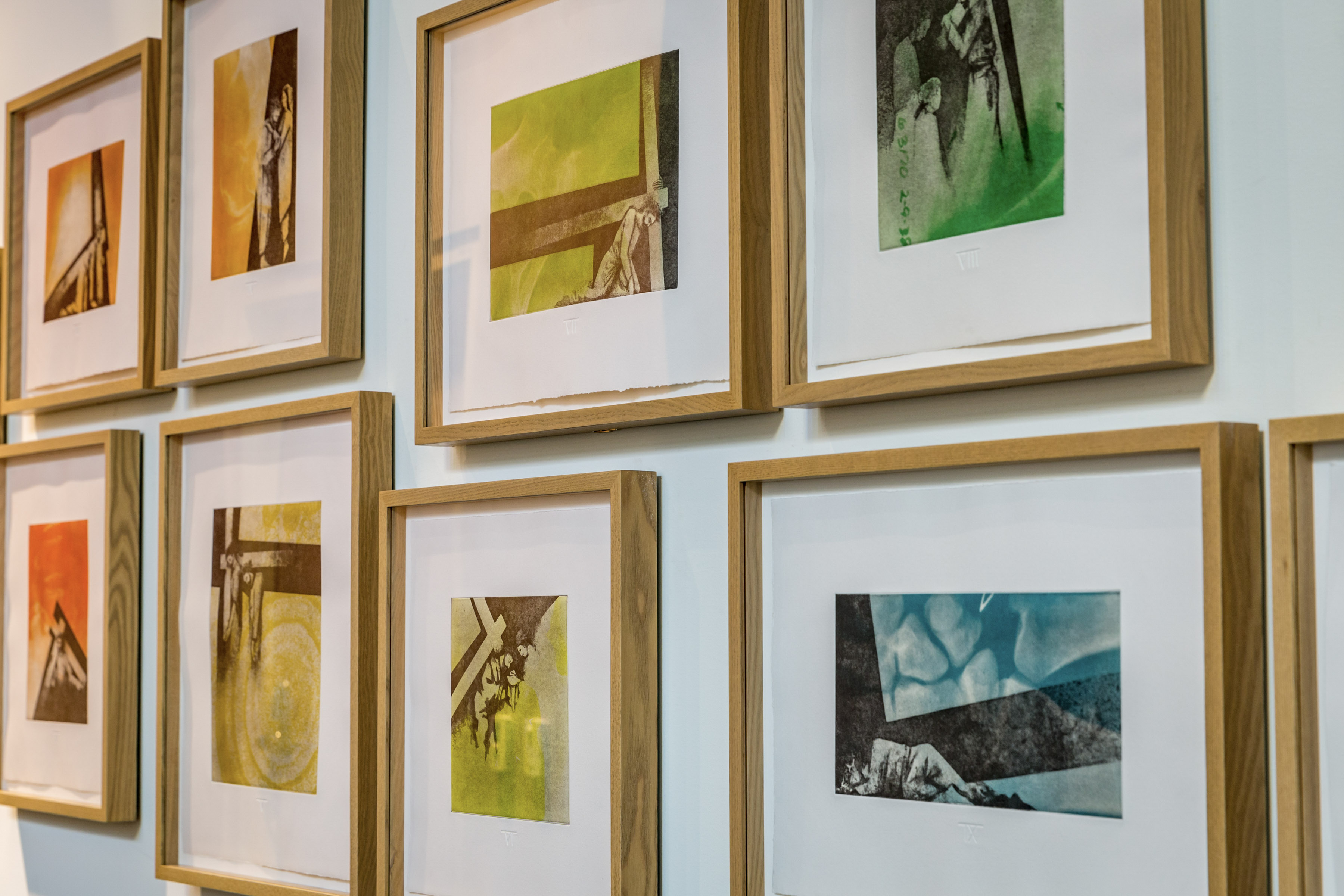
PRINT SUITE: Via Dolorosa by William Frank: Commissioned by SSM Saint Louis University Hospital for their chapel, this set of Stations of the Cross prints by William Frank combines depictions of Christ’s passion with diagnostic X-ray imaging of patients from the hospital’s archives. “The human body, and the community, act as the landscape,” he told me. A bullet in the spine, a kidney stone, a wrist fracture, a tumor, tuberculosis of the bones—Jesus’s suffering unfolds against the backdrop of these specific, tangible forms of suffering. But the rainbow color scheme transforms the stark black-and-white medical images into something a little less scary, suggesting hope and promise—maybe healing, maybe not, but at the very least, divine accompaniment along the path of sorrow.
William Frank (American, 1984–), Via Dolorosa (installation detail), 2020. Etching, archival inkjet, chin collé, with embossment, suite of fourteen prints, overall 4 × 16 ft. SSM Saint Louis University Hospital Chapel, St. Louis, Missouri. Photo: Lisa Johnston, courtesy of the artist.
This year, the Catholic Health Association of the United States created a set of video reflections around Frank’s Stations, one for each piece, which you can find at https://www.chausa.org/prayers/lent-reflections. They also shot a video conversation with the artist:
NEW SONG: “Spooling” by Rev. Matt Simpkins: Diagnosed with stage 4 skin cancer, the Rev. Matt Simpkins [previously] of Lexden in Colchester, an Anglican vicar and a rock musician, said the only way he could calm his nerves enough to get through his next MRI scan was by writing a song from inside the machine. He composed some words and harmonies in his head to the “groovy,” sonorous beeps of the scanner, recording the song afterward using sampling, thus turning a typically threatening, antiseptic medical sound into a party vibe. He was interviewed on the BBC about it last month:
And here’s the bizarre music video, with special effects!
“I’m in a difficult situation with stage 4 cancer, but again, you’ve got a choice, and this song is a good example of that—how you can take something up into song and live,” he says. He hopes the song will minister to those who are undergoing cancer treatment or facing a possible diagnosis—that it is a small oasis, a source of silly laughter, comfort, and strength, for those in dire health.
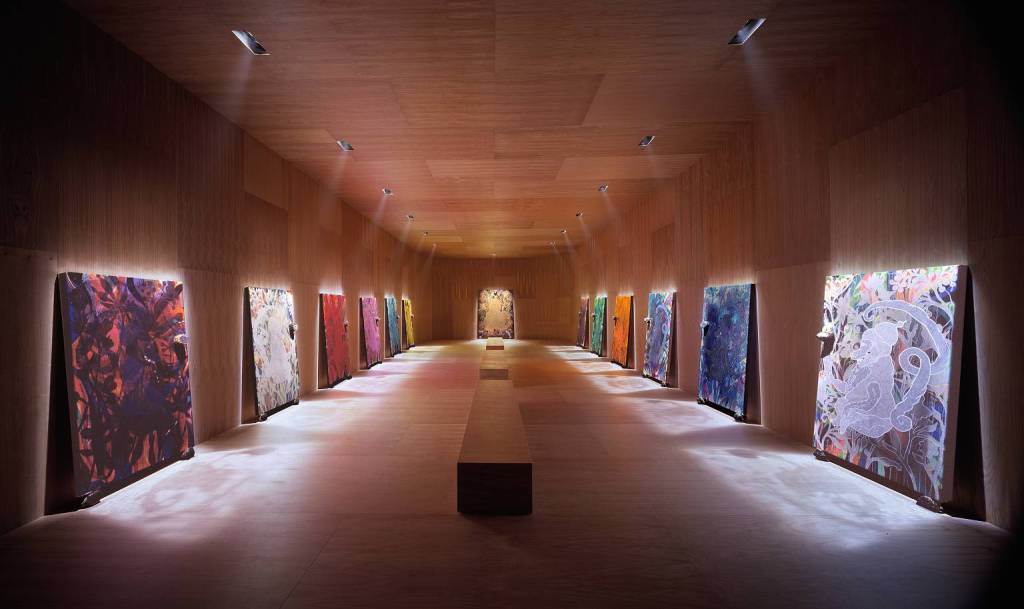
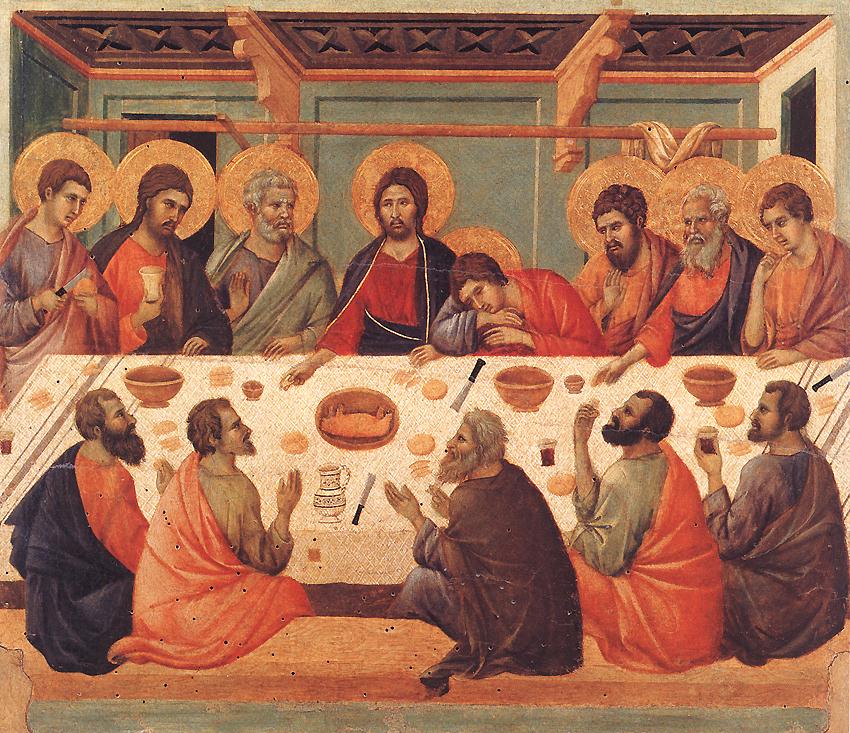
ART COMMENTARY: The Apostle Judas by Adrienne Dengerink Chaplin: As part of the Visual Commentary on Scripture project, Dr. Adrienne Dengerink Chaplin has selected three artworks that in some way interpret Matthew 26:20–25 (and parallel passages), when at the Last Supper Jesus announces that someone there will betray him. Rather than featuring the more common portrayals of Judas as malevolent, halo-less, and/or segregated from the group at the far end of the table, Dengerink Chaplin has chosen works that show him integrated and indistinct, one of twelve betrayers, whose treachery, she boldly proposes, we might construe as “a happy fault.”
Chris Ofili (British, 1968–), The Upper Room, 1999–2002. Oil paint, acrylic paint, glitter, graphite, pen, elephant dung, polyester resin, and map pins on 13 canvases, each 183.2 × 122.8 cm, except head canvas, 244.2 × 183 cm. Installation at Victoria Miro Gallery, London. Collection of Tate, London.
Duccio di Buoninsegna (Italian, d. 1318), The Last Supper, from the Maestà Altarpiece, 1308–11. Tempera and gold on panel, 50 × 53 cm. Museo dell’Opera del Duomo, Siena, Italy.
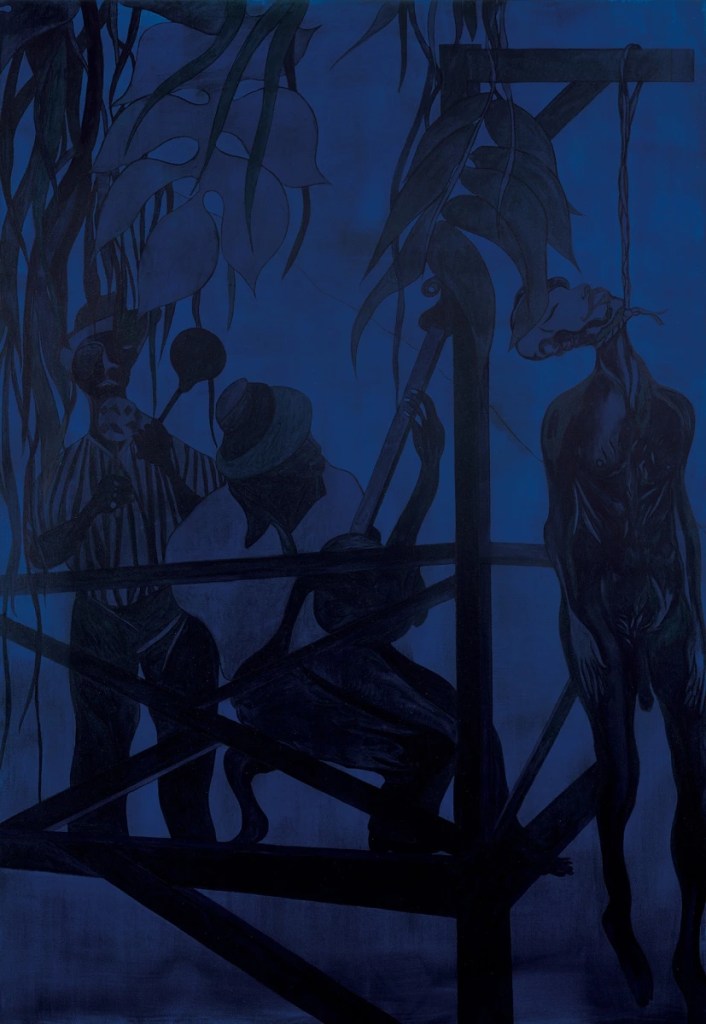
Chris Ofili (British, 1968–), Iscariot Blues, 2006. Oil and charcoal on linen, 281 × 194.9 cm. Photo courtesy of Victoria Miro and David Zwirner.
With the Duccio panel, she points out something I’ve often contemplated as well: that Jesus feeds Judas with the element he calls his body, keeps communion with him, and is there not a preemptive forgiveness implicit in that act?
+++
SONG: “In the Night” by Andrew Peterson: At a Laity Lodge retreat in 2015, Andrew Peterson of Nashville performed one of the songs from his album Counting Stars (2010) with fellow musicians Buddy Greene, Jeff Taylor, and Andy Gullahorn. “In the Night” rehearses “dark night” stories from scripture: Israel wrestles with God, is enslaved by Egypt, is pressed in by Syria; a prodigal son must resort to eating pig slop; the Son of Man is beaten and killed. But in each of these stories, deliverance comes. Hence the refrain: “In the night, my hope lives on.”
+++
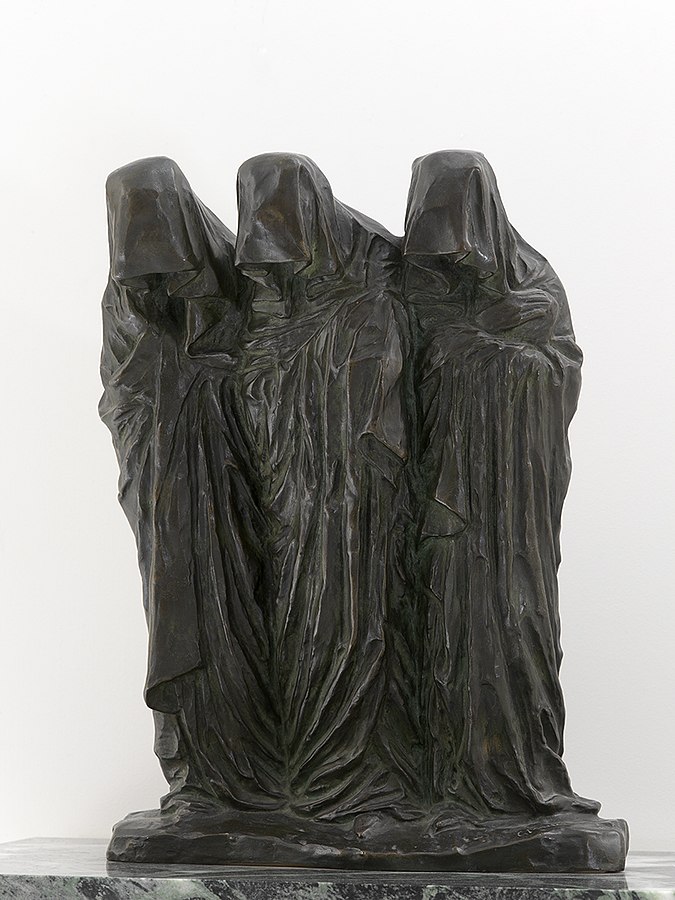
VISUAL MEDITATION: On TheHoly Women at the Tomb by George Minne, commentary by Marleen Hengelaar-Rookmaaker: Marleen Hengelaar-Rookmaaker, the creator of ArtWay, writes about a nineteenth-century bronze sculpture by the Belgian artist George Minne, which shows the three women who went to Jesus’s tomb on Easter morning in an attitude of grief—bent backs, bowed heads—drawing on the gothic pleurants, or weepers, of late medieval tombs. The women are “totally enwrapped in mourning their beloved,” Hengelaar-Rookmaaker writes. “This is in fact the very last moment of the passion, the last moment of suffering past the Pietà and the burial of Christ. It will only be a minute before their hoods will come off and the news of the resurrection will enter their numbed minds.”
George Minne (Belgian, 1866–1941), Les saintes femmes au tombeau (The Holy Women at the Tomb), 1896. Bronze, 44.5 × 62 × 20.5 cm. Groeningemuseum, Bruges, Belgium.
This composition by Minne also exists in granite, wood, and plaster versions.
+++
NEW PLAYLIST: April 2023 (Art & Theology): Includes an excerpt from the psychedelic rock–style Mass in F Minor by the Electric Prunes, “The Outlaw” by Jesus Movement icon Larry Norman, a chuckle-inducing bluegrass song first recorded in 1926 by Gid Tanner and Faith Norris and covered here by the Local Honeys, a choral setting of Psalm 128 (“Happy is everyone who fears the Lord, who walks in his ways . . .”) by the Italian Jewish Renaissance composer Salomone Rossi, Whitney Houston’s rendition of “His Eye Is on the Sparrow,” and a short Kiowa Apache church song that translates to “Son of our Father will set up a cedar tree / Now he is calling to us / He’s going to heal our minds / That’s why he is calling to us.”
Holy Week begins Sunday. I will be publishing short daily devotional posts during that time and through the first eight days of Easter. Also: don’t forget about the Art & TheologyHoly Week Playlist and Eastertide Playlist! I’ve made some new song additions since last year, mixed in to preserve the narrative flow.
+++
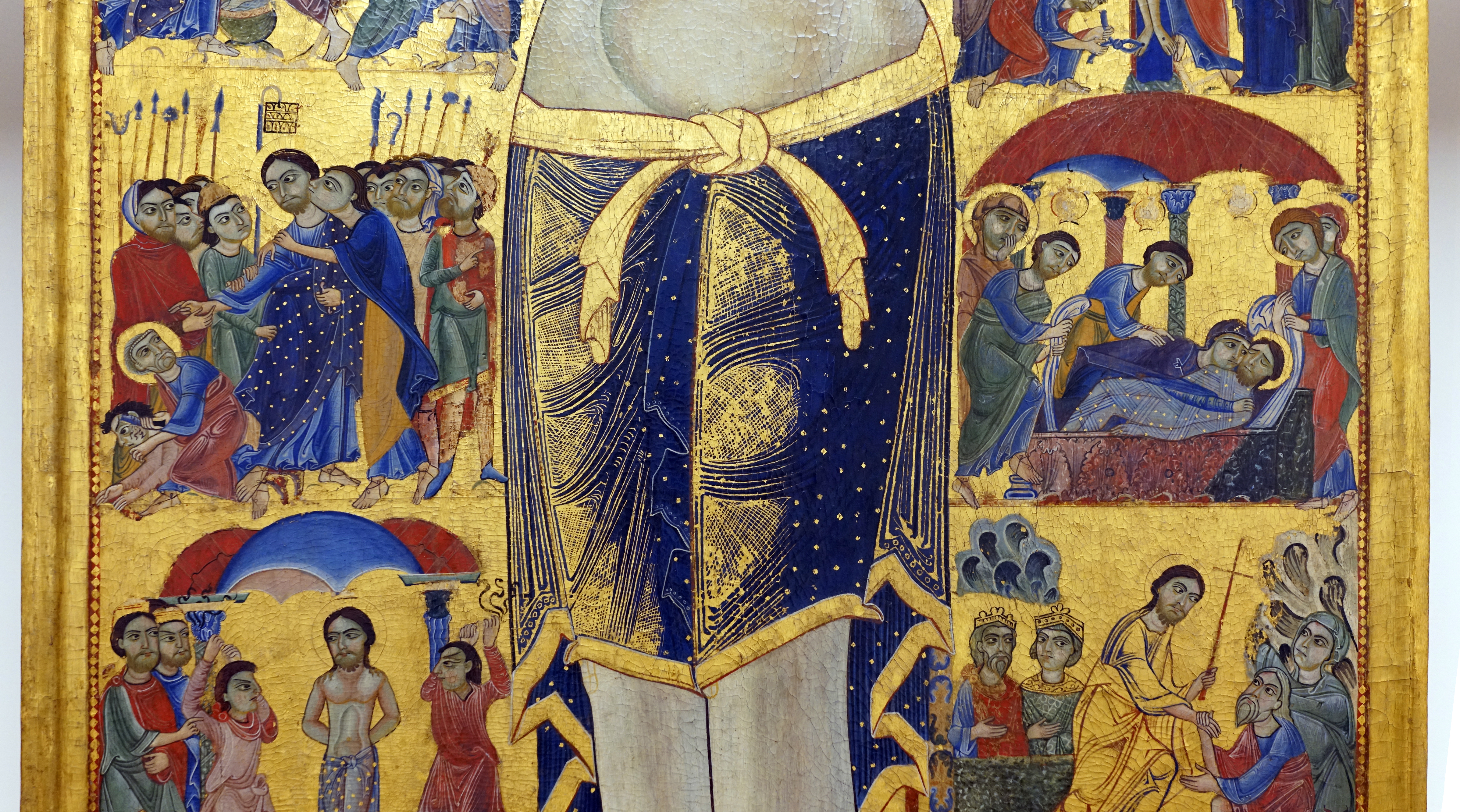
ART VIDEO: “The Crucifixion, c. 1200 (from Christus triumphans to Christus patiens)”: When I was a student in Florence for a semester, my first paper for my Italian history, art, and culture class traced the evolution of the painted wood-panel crucifix in late medieval Italy, from the Christus Triumphans (Triumphant Christ) type to Christus Patiens (Suffering Christ). I lived less than a five-minute walk from the Uffizi, which has in its collection a beautiful example of each—explored by Drs. Steven Zucker and Beth Harris in this short Smarthistory video. Longtime readers of the blog may recognize the latter, which I posted back in 2018.
Painted cross (detail), Pisa, ca. 1180–1200. Tempera and gold leaf on wood, 277 × 231 cm. Galleria degli Uffizi, Florence, Inv. 432. [object record]
Zucker provides wonderful photos of both in high resolution on his Flickr page (start here and scroll right)—the full crosses and details of each apron scene—available for free noncommercial use under a Creative Commons license. And there are many other art historical images there as well!
+++
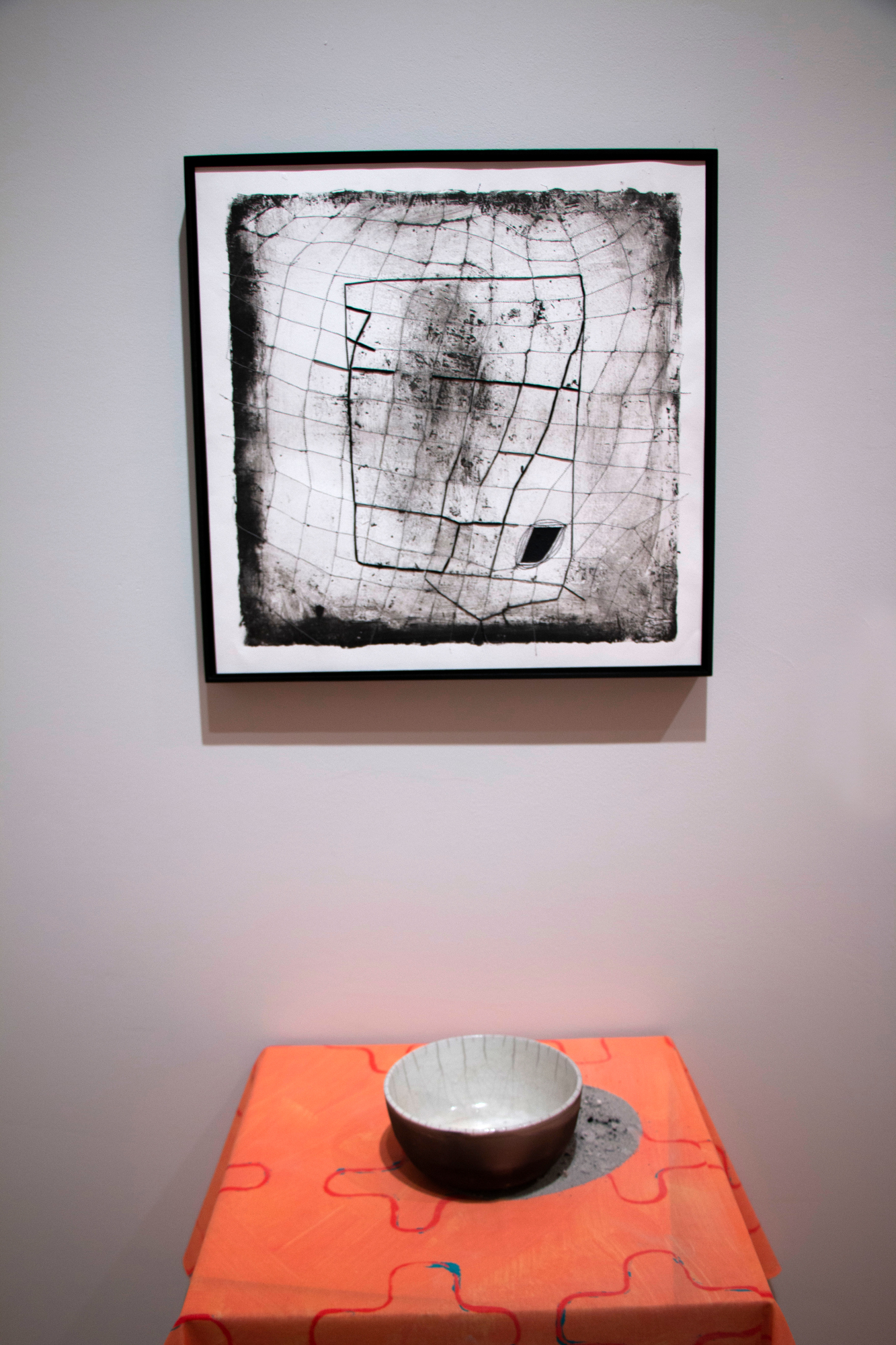
ONLINE EXPERIENCE: “Anamnesis: Journey through the Stations of the Cross”: This year visual artist Daniel Callis and the music and liturgy collective The Many collaborated on a self-guided set of online Stations of the Cross. There are fifteen total, which are being released one at a time every morning and evening from March 30 through April 5. Each station consists of an artwork, a prayer, a song, and a written meditation that help us enter into lament.
Daniel Callis (American, 1955–), Grief Station #1, Prognosis, 2022. Ink, oil, palm ash, fiber, clay, ash, fabric, 60 × 24 × 24 in. (total work). Photo courtesy of the artist.
The artworks are by Callis, and they’re from his Stations: Resurgam series, a body of work that was just exhibited this month at Green Art Gallery at Biola University in La Mirada, California. He began the series in January 2021 in response to the death of his son, Jeremy David Callis (1980–2020). It consists of fifteen mixed-media works on paper (his process involves printing, “wounding,” stitching, etc.) and fifteen raku-fired offering bowls that incorporate, from the cooling process, copies of letters, hospital documents, and drawings from Jeremy. “They are about pain and the absurd insistent pursuit of hope,” Callis says of the series. Resurgam is Latin for “I shall rise again.”
The songs are by The Many.
+++
BOOK EXCERPT from The Unvarnished Jesus: A Lenten Journey by Brian Zahnd: In this post from his blog, Pastor Brian Zahnd excerpts a passage from his book The Unvarnished Jesus (2019). “To interpret the meaning of the cross is more than a life’s work—in fact, it has and will remain the work of the church for millennia,” he writes. “The cross is the ever-unfolding revelation of who God is, and it cannot be summed up in a simple formula. This is the bane of tidy atonement theories that seek to reduce the cross to a single meaning. The cross is many things: It’s the pinnacle of God’s self-disclosure. It’s divine solidarity with all human suffering. It’s the shaming of the principalities and powers. It’s the point from which the satan is driven out of the world. It’s the death by which Christ conquers Death. It’s the abolition of war and violence. It’s the supreme demonstration of the love of God. It’s the re-founding of the world around an axis of love. It’s the enduring model of co-suffering love we are to follow. It’s the eternal moment in which the sin of the world is forgiven . . .” Read more.
+++
SONGS:
>> “The Leaves of Life”: “The Leaves of Life,” alternatively titled “The Seven Virgins,” is a traditional English ballad carol of Christ’s passion, first set down in the nineteenth century. It is narrated by (the apostle?) Thomas, who on a fateful Friday runs into the Virgin Mary and six of her companions, who are looking for Jesus. He directs them to the hill where Jesus is being crucified (“And sit in the gallery” may be a corruption of “The city of Calvary”). The women tearfully fly to the site, and Jesus tries to console his mother from the cross before breathing his last. The song ends with Thomas imbibing a strong scent of rose and fennel as he meditates on Christ’s love. [HT: Global Christian Worship]
Here the song is performed in the chapter house of Wells Cathedral in Somerset by William Parsons, founder of the British Pilgrimage Trust and author of Singing for Our Supper: Walking an English Songline from Kent to Cornwall, a book about the seven months he spent as a wandering minstrel. Parsons refers to it as a gypsy carol because Ralph Vaughan Williams collected one version of it from the Roma singer Esther Smith during his 1908–13 collecting trips that resulted in the publication, with Ella May Leather, of Twelve Traditional Carols from Herefordshire (1920).
>> “Were You There”: This African American spiritual is performed here by Pegasis, a vocal trio of sisters—Marvelis, Rissel, and Yaina Peguero Almonte—originally from the Dominican Republic but now living in Green Bay, Wisconsin. It’s as if they’re the three Marys singing their testimony! The song is on their 2016 album Peace Through Praise, which they released under the name The Peguero Sisters. Their harmonies are gorgeous.
+++
PODCAST EPISODE: “Malcolm Guite: Poems on the Passion”: In this special passion- and resurrection-themed Nomad devotional episode from 2018, Malcolm Guite reads and reflects on three of his poems, and David Benjamin Blower performs an original three-part song that he wrote in response and that has not been released elsewhere (see 4:30, 16:04, and 27:18).
Guite’s “Jesus dies on the cross,” part of his Stations of the Cross sonnet cycle, was inspired by a line from George Herbert’s poem “Prayer”: “God’s breath in man returning to his birth.” And his “Easter Dawn” [previously] is based in part on a sermon by the seventeenth-century Anglican bishop Lancelot Andrewes. Paraphrasing Andrewes, Guite says, “Jesus is the gardener of Mary [Magdalene]’s heart—her heart is all rent and brown and wintery, and with one word, he makes all green again.” Beautiful! For more on the theme of Jesus as gardener, see my 2016 blog post “She mistook him for the gardener.”
VIDEO: “Waiting with Christ: An Artful Meditation for Holy Week”: A collaboration between Duke Initiatives in Theology and the Arts in Durham, North Carolina, and City Church in Cleveland, Ohio, this half-hour video from 2021 presents a small collection of scripture readings, poems, visual art, and music for Holy Week, interspersed with reflections by theologian Jeremy Begbie. The artistic selections are a spoken word performance by Paul Turner, Malcolm Guite’s sonnet “Jesus Meets His Mother,” the Adagio movement of Schubert’s String Quintet in C Major, the painting Riven Tree by Bruce Herman, and Bifrost Arts’ “Our Song in the Night,” performed by Salina Turner, Allison Negus, and Joel Negus [previously].
+++
ARTICLE: “6 Musical ‘Passions’ Beyond Bach” by Josh Rodriguez: Composer, professor, and Deus Ex Musica cofounder Josh Rodriguez is an excellent classical music curator and guide. In this article he introduces us to six modern large-scale musical works about Jesus’s final week: The Passion of Yeshua by Richard Danielpour, La Pasión Según San Marcos by Osvaldo Golijov, The Passion of the Christ Symphony by John Debney, Johannes-Passion by Sofia Gubaidulina, Simeron by Ivan Moody, and the St. John Passion by James MacMillan. He interweaves composer biography, musical analysis, and meaning in concise ways, with nods to music history. Stylistic influences for these diverse selections range from Byzantine chant to salsa! Audio/video excerpts are provided, such as the cued-up “¿Por qué?” from Golijov’s Pasión (see below), a movement centering on the woman who anointed Jesus’s feet with perfume (Mark 14:3–9).
+++
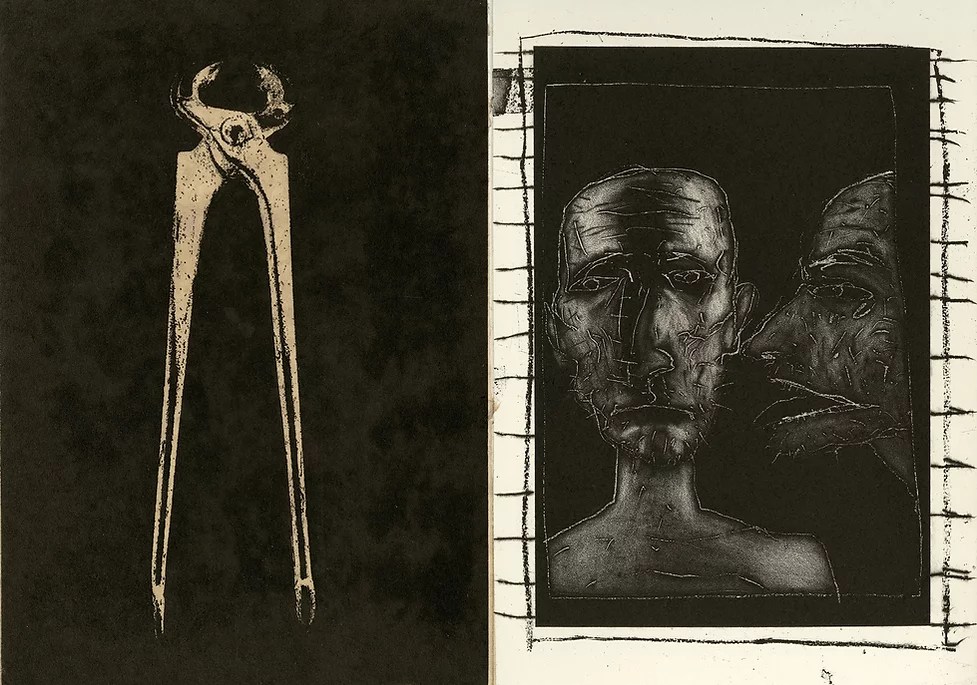
PRINT SERIES: The Passion and Its Objects (after Dürer) by Marcus Rees Roberts: “The Passion and Its Objects (after Dürer) is a series of etchings and monotypes by Marcus Rees Roberts. The images derive from fragments from Albrecht Dürer’s series of woodcuts The Small Passion (1511). Images of the Passion – and of the crucifixion in particular – are so embedded in Western consciousness that we forget that it is a depiction of betrayal, prejudice, and torture. In this version of the Passion by Dürer, one of several he made, small, everyday objects lie scattered within the images – a jug, pliers, a hammer, a coil of rope. Even five hundred years later, we recognise these objects as our own; we can identify with them. But in so doing, we enter the depicted space, and we become complicit in the cruelty. This is one reason why Dürer’s Small Passion is both so powerful and so uncomfortable.”
Marcus Rees Roberts (British, 1951–), The Passion and Its Objects (after Dürer) I, 2019. Diptych etching and aquatint with chine collé printed on Somerset Satin soft white 300gsm, each plate 29.5 × 21 cm (overall 29.5 × 42 cm). Edition of 15.
+++
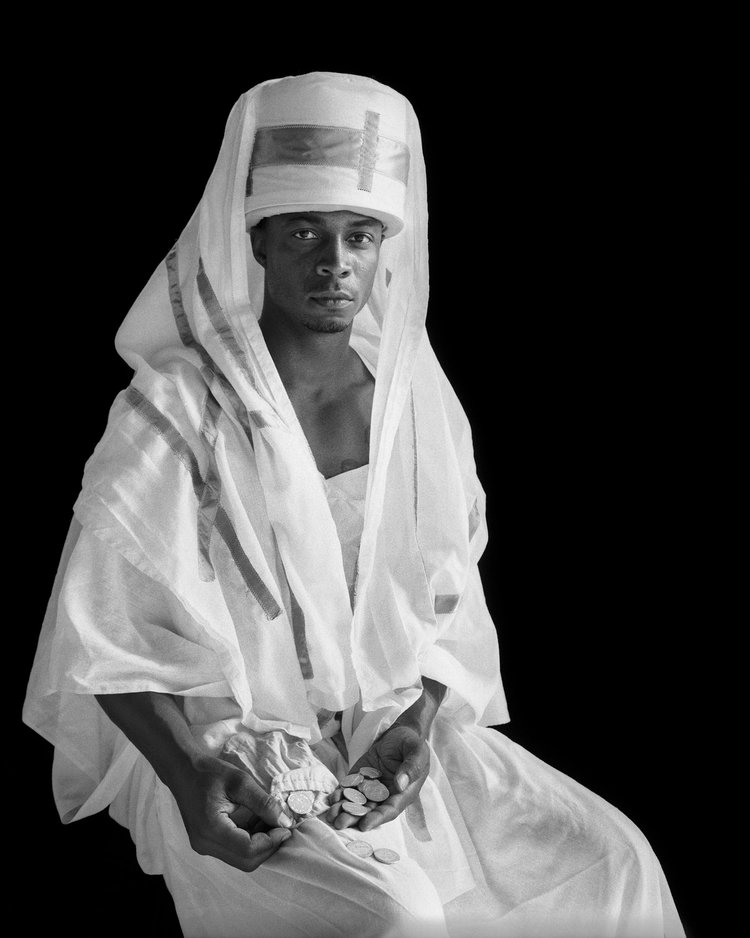
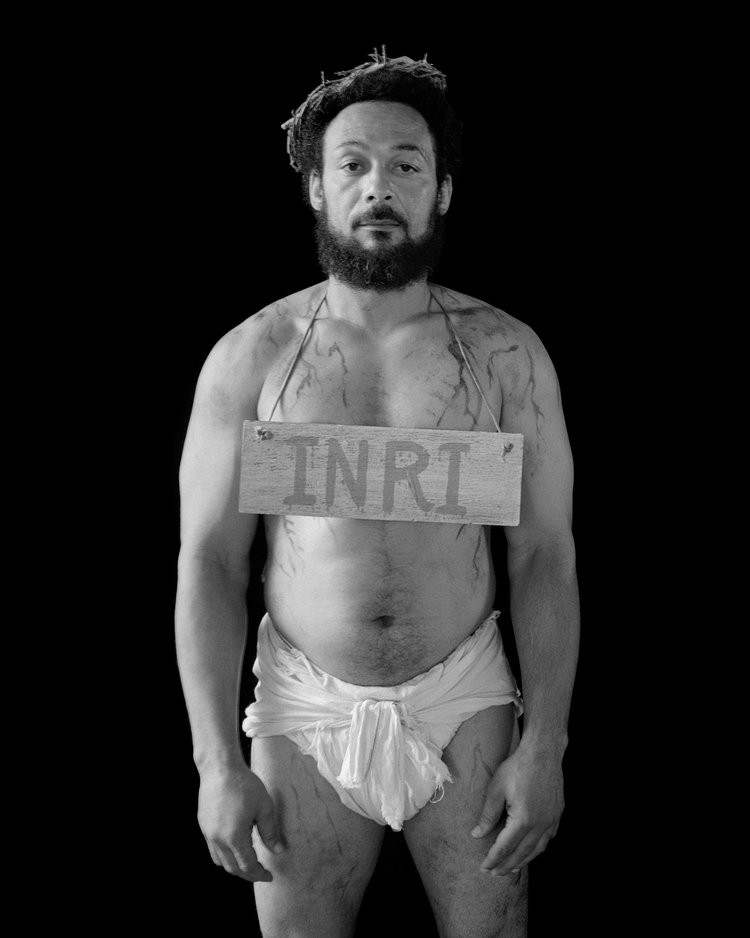
PHOTOGRAPHY SERIES: Passion Play by Deborah Luster: “There are more than 5,300 inmates at the Louisiana State Penitentiary at Angola. Nearly 4,000 of them are serving life without parole. In 2012 and 2013 the Angola Prison Drama Club staged a play unlike any other in the prison’s experience. The Life of Jesus Christ featured 70 inmates, men and women acting together for the first time—in costume, with a real camel, performing for the general public. For the untrained actors, this production held special meaning as they saw pieces of their own lives revealed in the characters they played.”
Layla “Roach” Roberts (Inquisitor), sentenced to LIFE, Angola Prison, Louisiana. Photograph by Deborah Luster, from the Passion Play series, 2013.Bobby Wallace (Jesus), Angola Prison, Louisiana. Photograph by Deborah Luster, from the Passion Play series, 2013.
+++
SONGS:
>>“May I Go with You” by January Lim: This Maundy Thursday song was written in 2020 in the voice of Jesus in Gethsemane, speaking to God the Father. In the first stanza, it seems to me that Jesus is asking to be taken up to heaven, like Elijah—just whisked away back to glory, and spared tomorrow’s cruelties and pain. But in the second stanza that same request seems to shift in meaning as Jesus expresses a desire to go with God’s plan and asks for the strength to follow through. The song was released on the EP Gathered Sighs (2021), put out by Evergreen Baptist Church of Los Angeles, where Lim serves as worship arts pastor. [HT: Global Christian Worship]
NEW ALBUM: Lent Hymns by Paul Zach: Released this month, Lent Hymns by Paul Zach comprises twelve songs, a mix of originals and classics, with contributions by IAMSON, Jessica Fox, Sara Groves, Jon Guerra, and Kate Bluett. The LP is available wherever music is streamed or sold. Here’s an Instagram video that excerpts “Draw Me In”:
KICKSTARTER: New Porter’s Gate album: This summer The Porter’s Gate, an interdenominational Christian music collective, is gathering songwriters to write and record musical settings of passages from The Message, a translation of the Bible by the late Eugene Peterson [previously] that uses contemporary idioms and phrases. The project is in partnership with the Eugene Peterson Center for Christian Imagination at Western Theological Seminary in Holland, Michigan. I’m so looking forward to this!
+++
SONGS:
>> “Вечірня молитва” (Vechirnya molytva) (Evening Prayer): A choral setting of a text from the Divine Service of the Eastern Orthodox Church, by contemporary Ukrainian composer Iryna Aleksiychuk. Performed in 2012 by the Female Choir of Kiev Glier Institute of Music, conducted by G. Gorbatenko. [HT: Global Christian Worship]
English translation:
Heavenly King, Comforter, Spirit of Truth, Who art everywhere present and fillest all things, Treasury of good things, and Giver of life: Come and abide in us, and cleanse us from every sin, And save our souls, O Good One! Holy God, holy Mighty, holy Immortal, Have mercy on us.
>> “Bare and Bones” by Candace Coker: Trinidad-born, Vancouver-based singer-songwriter Candace Coker sings the title track from her new album, Bare and Bones, with her boyfriend, Josiah Charleau. The video is shot at Bamboo Cathedral, a thousand-foot stretch of roadway in Tucker Valley in Chaguaramas, Trinidad and Tobago, where bamboo stalks bend toward each other across the road, creating a canopy.
>> “HigherHoly” by IAMSON:IAMSON is the artist name of singer-songwriter and music producer Orlando Palmer, based in Richmond, Virginia. He released this song as a single in 2020. The rap is performed by guest artist Marv (Marvin Hudgins II) of Chattanooga, Tennessee, and the animation in the video is by Kenya Foster.
>> “I Could Sing of Your Love Forever” (cover) by Mary Yang and Ger Vang: Mary Yang and Ger Vang are Hmong Christian musicians living in Milwaukee, Wisconsin. (The Hmong are an Indigenous people group from East and Southeast Asia.) Here they perform their bossa nova arrangement of this modern worship classic by Martin Smith of the English band Delirious?. Yang and Vang are part of the Fishermen’s Project, a band that releases mainly classic hymns translated into the Hmong language. [HT: Global Christian Worship]
I’ve received a few requests from followers to resume my monthly thirty-song playlists. I had previously thought I’d stick to publishing these during Ordinary Time, since I have longer, thematic playlists for the seasons of Advent, Christmas, Lent (our current place in the calendar), and Easter—which you can find on my Spotify profile. But I’m happy to oblige! Here’s a new playlist for March:
+++
ESSAY: “Victor Hugo’s Masterpiece of Impossibility” by Caitrin Keiper, Plough: A wonderful essay on how competing vows in the novel and musical Les Misérables reveal the paradox of grace. I’ve been captivated by this story of mercy, forgiveness, and transformation set in revolutionary France ever since I saw the 1998 film adaptation starring Liam Neeson in middle school. The faith-inspired actions of Bishop Myriel at the beginning set the life of the protagonist Jean Valjean, an escaped convict, on a trajectory that is beautiful to watch unfold, and the downfall of the law-obsessed Inspector Javert, who cannot bring himself to accept the grace offered him, is most tragic.
+++
PODCAST EPISODES:
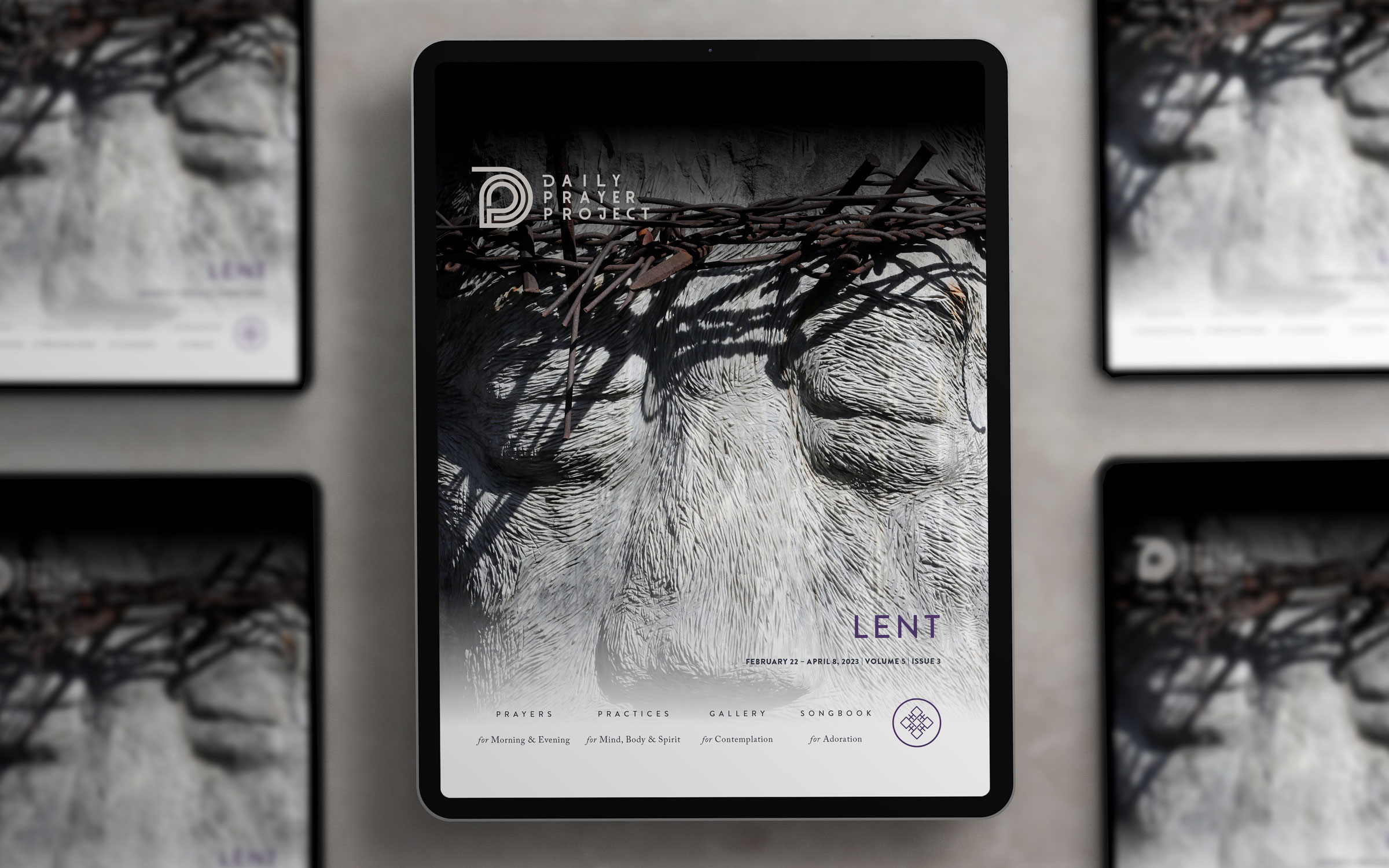
>> Season 2, episode 2, of Gather Round, on the DPP’s Lent 2023 Living Prayer Periodical: On the in-house podcast of Grace Mosaic in Washington, DC, three of my four Daily Prayer Project colleagues and I walk listeners through the latest edition of our prayer periodical, which covers the six weeks of Lent. The conversation starts at 3:46. Rev. Joel Littlepage, curator of the liturgies and songs, highlights a litany to the Servant-Christ from Andhra Theological College in Hyderabad, India, and a song by Pastor Antonio Rivera González of Mexico (see below). Ashley Williams, who commissions or secures reproduction rights for the practice-based essays and curates the photographs throughout, shares some teasers for “Calling Out to God in Lament” by Nina Barnes and “Intractable Sin, Preemptory Prayer” by Alicia Akins.
The Daily Prayer Project’s Lent 2023 booklet, featuring scripture, prayers, practical essays, art, and music from diverse contributors, is available in print and digital formats.
As curator of the art on the cover and in the Gallery section, I discuss the marble sculpture Condemned to Death by Chang Dong Ho (장동호) (see more by the artist), the mixed-media piece Gathering Fragments 1 by C. F. John, the photograph Untitled #10, Flushing, NY from the Stranger Fruit series by Jon Henry, and the painted woodcarving Qwi:qwelstom (Halkomelem, a Coast Salish language, for “Balance and Harmony”) by Don Froese.
At 32:44–35:06, our theological editor, Rev. Russ Whitfield, discusses a theological method that has informed our work at the DPP called triperspectivalism (or multiperspectivalism), which says that we can enrich our perspective, limited on its own, by looking at things from different angles, especially those revealed to us by other people and cultures. For a snippet of the Herman Bavinck quote, see here. What Russ says is SO GOOD! I believe our prayerbooks stand out from other similar projects in that they are deliberately cross-cultural—not because it’s trendy, but because there is so much beauty and wisdom we are missing by not availing ourselves of the many resources of the global church. Our content is also cross-historical.
There are subscription options for individuals (you receive a print edition and a digital download link) and groups (digital access, with bulk-printing options). You can also buy a single copy, but it’s cheaper to purchase a monthly subscription and then cancel after you receive your edition if you don’t wish to continue. We publish six editions a year, each following the same format but filled with new content for the given season.
>> “Lent: Season of Repentance, Renewal . . . and Rebellion” with Esau McCaulley, For the Life of the World: Here Rev. Dr. Esau McCaulley—associate professor of New Testament at Wheaton College, contributing opinion writer for the New York Times, and award-winning author of Reading While Black—talks about the Christian practice of Lent as a collective wisdom passed down through generations of Jesus followers, as well as a spiritual rebellion against mainstream American culture, which has its own established rhythms that shape how we spend our money, when we feast, and what we celebrate.
McCaulley spent the first twenty-one years of his life in the Black Baptist church and the past twenty in a high-liturgical tradition, both of which have been formative for him. One thing he appreciates about liturgy (both the yearly calendar and the elements within a worship service), he says, is how it helps him more fully inhabit the story of Christ. He construes Lent as a season of repentance and grace; he points out the justice practices of Lent; he walks through a Christian understanding of death, and the beautiful practice of stripping the altars on Maundy Thursday; and he’s emphatic about how Lent is a guided season of pursuing the grace to find, or perhaps return to, yourself as God has called you to be. These ideas are expanded upon in his new book, Lent: The Season of Repentance and Renewal, from IVP’s Fullness of Time series.
+++
SONGS:
>> “Divino compañero del camino” (O Lord, Divine Companion): Written in 1964 by Antonio Rivera of Mexico, this popular Spanish-language song is performed here by Karina Moreno and Joseph Espinoza. It’s based on Luke 24:28–32, from the postresurrection story of the walk to and supper at Emmaus, but its pilgrimage aspect—the idea of Jesus as a companion on our life journey—makes it appropriate for Lent. [HT: The Daily Prayer Project]
>> “Yeshu Ji Mere Paap Kshama Kar Do” (Lord Jesus, Forgive My Sins): A Hindi song of confession with words by the late Shri Jalal Masih and music by his granddaughter, Mercy Sharon Masih. Mercy sings it here with her father, Hanook Masih. For an English translation, click the “CC” button. [HT: Global Christian Worship]
+++
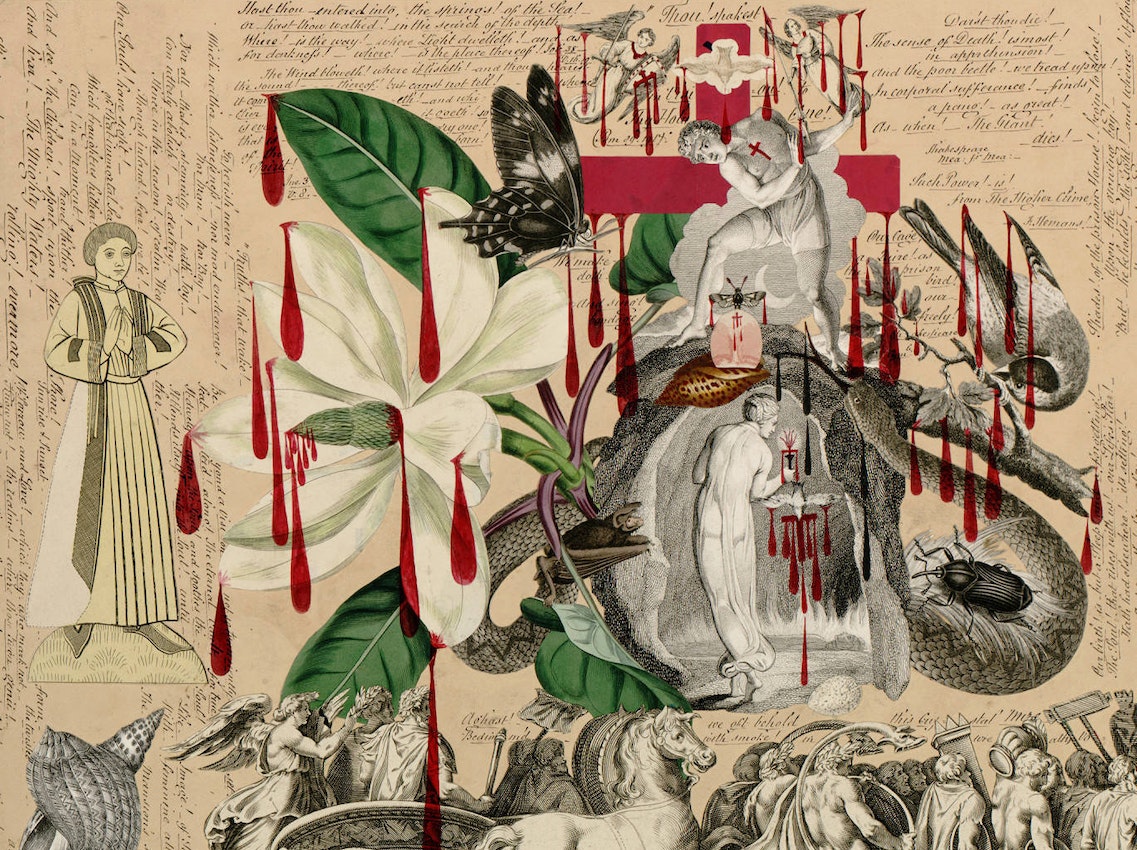
ARTICLE: “The Blood Collages of John Bingley Garland (ca. 1850–60),”Public Domain Review: Peruse the so-called Victorian Blood Book, an eccentricity made by the British politician and fishmonger John Bingley Garland as a wedding gift for his daughter Amy in 1854. It consists of forty-one collages whose sources are engravings by William Blake and various other religious artists, botanical and zoological illustrations, photographs of medieval tombs, and other images from nineteenth-century books, but with one distinguishing decorative addition by Garland’s hand: drops of blood in red India ink, presumably signifying the blood of Christ. The pages also bear extensive handwritten religious commentary.
Detail from a page of John Bingley Garland’s “Blood Book” (ca. 1850–60), featuring a cut-out from a reproduction of William Blake’s engraving The Soul exploring the recesses of the Grave.
The Blood Book transferred from the collection of novelist Evelyn Waugh to the Harry Ransom Center at the University of Texas at Austin upon Waugh’s death, and they identify it as “the single most curious object in the entire library.” Though modern eyes may see the collages as surreal or even grotesque, Garland’s descendants regarded them as nothing other than “a precious reminder of the love of family and Our Lord,” as they have written. The Harry Ransom Center has digitized the full book.
ONLINE EVENT: “Theodicy of Beauty” by Sarah Clarkson, March 6, 2:30 p.m. ET: “The question of suffering is one of the central, aching questions of faith. Too often, we meet suffering with an argument for God’s goodness, rather than an invitation to find and discover his goodness anew. Join me for an exploration of what it means to encounter and trust the beauty of God in our times of darkness, suffering, and pain. Drawing on my own story of mental illness and depression, I’ll explore what it means to engage with God’s goodness in a radically healing way, one that restores our capacity to imagine, hope, and create. We’ll use literature, art, and poetry to discern the ways that God arrives in our darkness to heal us, and also to restore us as agents of his loveliness in the midst of a broken world.”
This Crowdcast talk by Sarah Clarkson is based on her book This Beautiful Truth: How God’s Goodness Breaks into Our Darkness. Registration is $7 and includes a complimentary downloadable copy of “Encountering Beauty,” an arts-based reader’s guide to Clarkson’s book. I have appreciated her From the Vicarage: Books, Beauty, Theology newsletter and her wise, gentle reflections on spirituality, literature, and motherhood on Instagram @sarahwanders, so I’m looking forward to hearing from her on this topic!
+++
LECTURES (available on podcast platforms):
>> “The Loving Look” by Dr. Elissa Yukiko Weichbrodt: In this keynote address for the 2018 Beautiful Orthodoxy conference, art historian Elissa Yukiko Weichbrodt [previously], author of Redeeming Vision: A Christian Guide to Looking at and Learning from Art, discusses how contemporary art—which can sometimes be confounding or otherwise challenging—can drive us to confession, empathy, and love. Sharing her encounters with three contemporary artworks, she talks about art as a place where we can experience sanctification and common grace; how the Incarnation further vested our material world with significance; art as an invitation to embodied knowledge; art as part of how we order and understand our physical world; artworks as mirrors and shapers of culture; and how viewers, not just artists, are called to faithfulness.
She cites Esther Lightcap Meek’s Loving to Know: Covenant Epistemology, in which Meek says that all acts of coming to know are integrative; they become part of us. Knowledge is an act of covenantal care, Meek says. We don’t know in order to love; we love in order to know. Weichbrodt says, “For me, contemporary art—particularly art made by artists grappling with histories and experiences that have remained largely unseen, unknown, and unloved by the dominant culture—has served as a catalyst for faithful knowing.”
>> “The Arts as a Means to Love” by Dr. Mary McCampbell: In this lecture given for English L’Abri, Mary McCampbell [previously], an associate professor of humanities at Lee University, discusses some of the ideas from her book Imagining Our Neighbors as Ourselves: How Art Shapes Empathy. I appreciate how her writing and teaching embraces the arts of film and television alongside literature, such that not only are works like The Power and the Glory by Graham Greene, “A Good Man Is Hard to Find” by Flannery O’Connor, and Beloved by Toni Morrison explored, but so are, for example, the comedy-drama Lars and the Real Girl and the drama series Better Call Saul. Discrediting the recent odd assertion from a prominent evangelical corner that empathy is a sin, McCampbell affirms that empathy is, on the contrary, an essential Christian virtue, and one that the narrative arts are adept at forming in us, exposing us to people and stories outside our realms of experience and helping us recognize the image of God in unlikely places.
+++
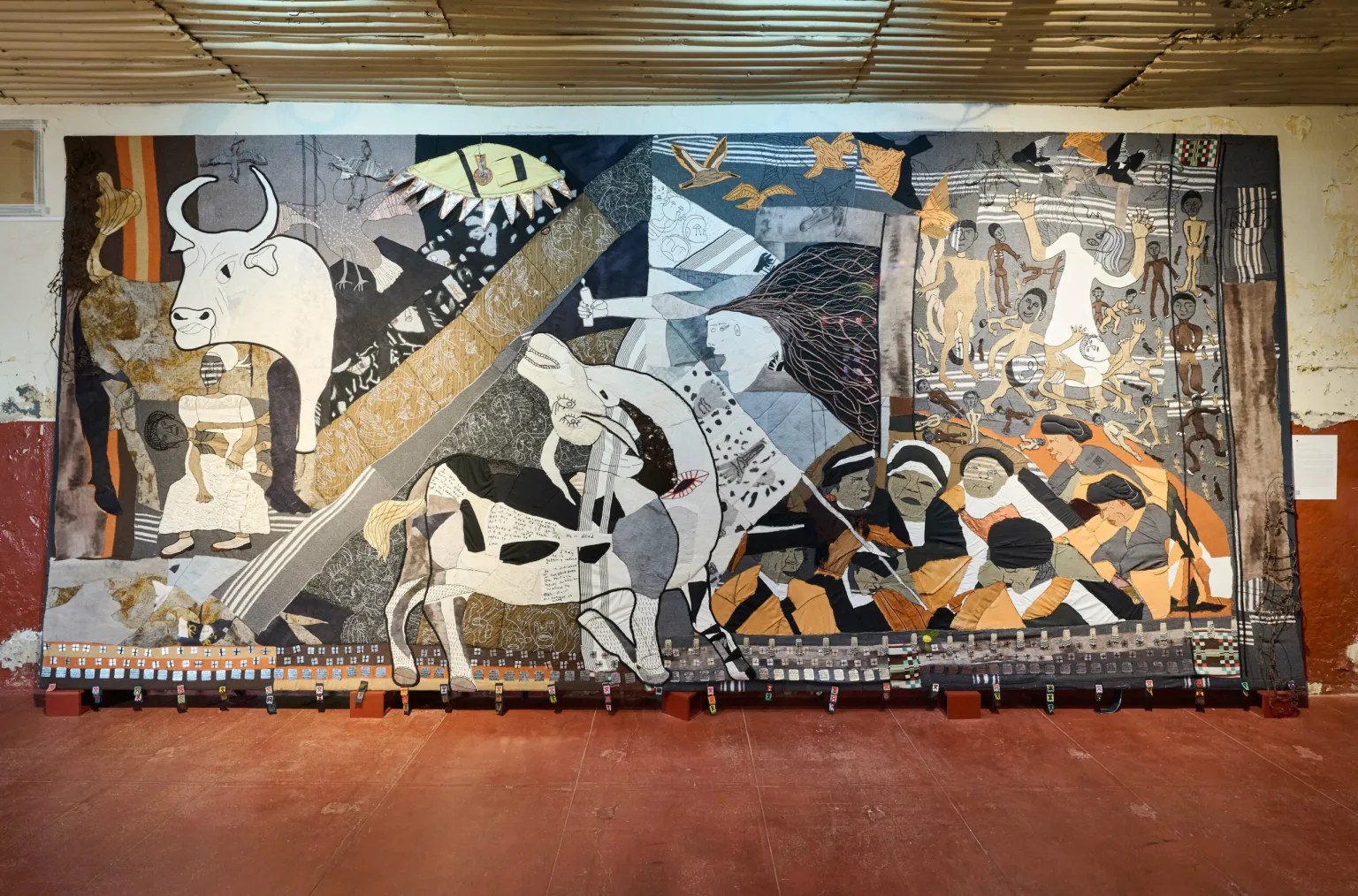
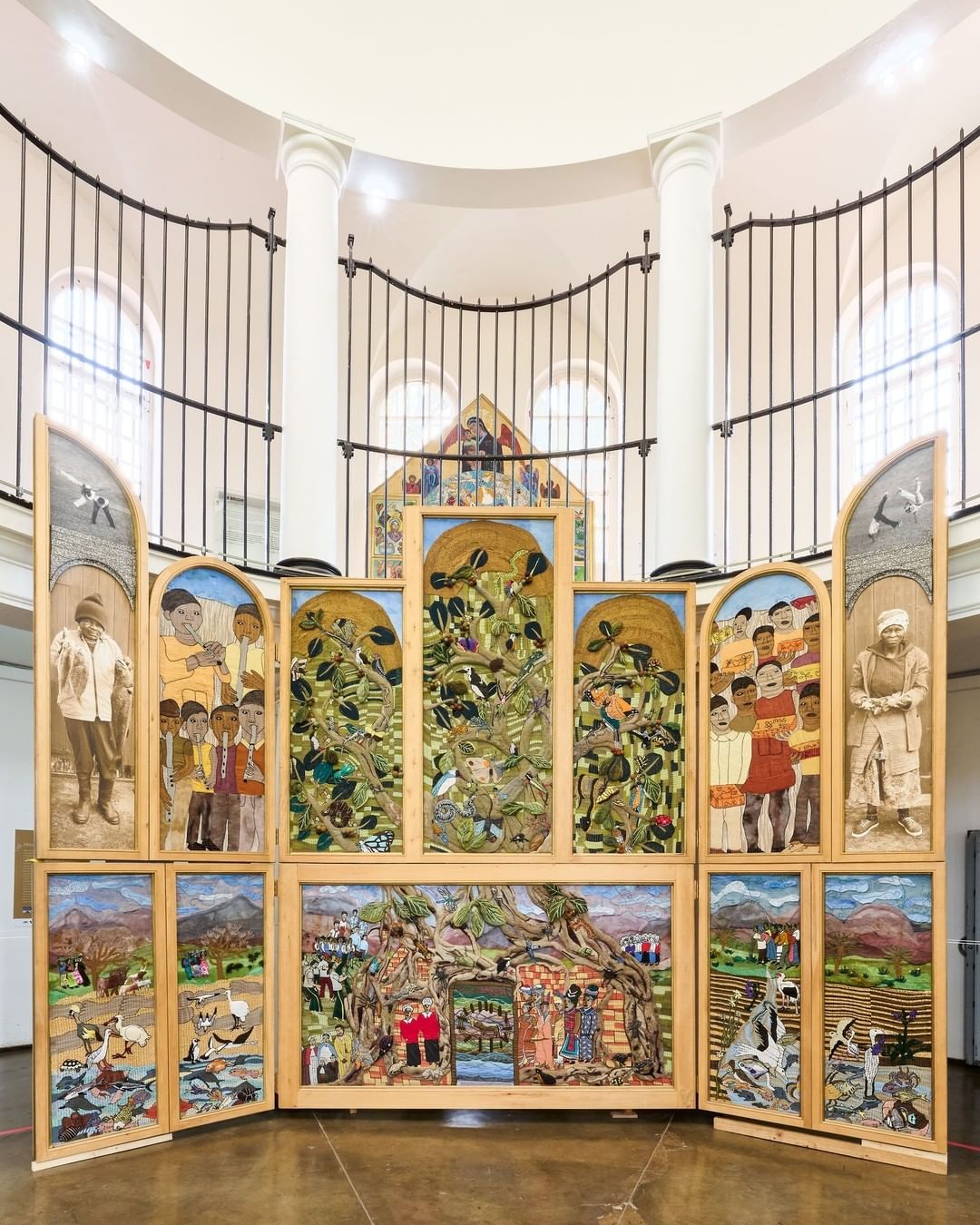
EXHIBITION REVIEW: “Mourning and Perseverance Stitched into South African Tapestries” by Alexandra M. Thomas: Through March 24 at Constitution Hill in Johannesburg, you can see Umaf’evuka, nje ngenyanga, dying and rising, as the moon does, a major retrospective of the work of the Keiskamma Art Project. Founded in 2000, the project archives the collective memory and oral histories of the rural Eastern Cape of South Africa through textile artworks, mainly by Xhosa women. Monumental and small-scale works tell stories of trauma, grief, hope, faith, resilience, and celebration. One of my favorite art research projects has been the one I did on the Isenheim-inspired Keiskamma Altarpiece in 2015, which resulted in the article “Sewing seeds of hope in South Africa”; this altarpiece is one of the many works on display. Let me call out just two others. The photos are from the current exhibition.
Keiskamma Guernica, 2010. Mixed media, including appliqué, felt, embroidery, rusted wire, metal tags, beaded AIDS ribbons, used blankets, and old clothes, 3.5 × 7.8 m. Collection of Javett Art Centre at the University of Pretoria, Tshwane, South Africa. Photo: Anthea Pokroy / Keiskamma Trust.Creation Altarpiece, 2007. Mixed media, including felt, embroidery, photographs, beadwork, wirework, and appliqué, 3.8 × 5.2 m (open). Collection of Unisa Art Gallery, Tshwane, South Africa.
Keiskamma Guernica, after Picasso’s famous antiwar painting, laments the limited access to HIV treatment in rural South Africa in the 2000s and the negligence of government hospitals, which resulted in many HIV/AIDS deaths. The piece repurposes the blankets and clothes of the deceased and serves as an expression of outrage as well as a form of commemoration. Creation Altarpiece, modeled loosely after the Ghent Altarpiece, exults in the region’s abundant wildlife and natural resources and in life-giving initiatives like Hamburg’s music education program, its capoeira group (a dance-like martial art), and the memory boxes made by orphaned children to remember their parents. The three top central panels depict a fig tree eating up an old hotel built by colonialists (a real-life scene observed in the nearby village of Bell!), and the bottom three show villagers of all kinds gathering around Christ, represented as a bull (whereas lambs were commonly sacrificed in ancient Israelite religion, traditional Xhosa religion calls for bull sacrifices).
SONG: “Kyrie” by Ngwa Roland:Ngwa Roland is a composer and the director of De Angelis Capella [previously], a Catholic choir from Yaoundé, Cameroon. Here is his choral setting of the Kyrie eleison (Greek for “Lord, have mercy”), an important Christian prayer used in liturgies around the world.
+++
ARTICLES:
>> “To One Kneeling Down No Word Came” by Jonathan Chan, Yale Logos:Jonathan Chan is a Singapore-based poet and essayist who graduated with a master’s degree in East Asian Studies from Yale in 2022. In this personal essay he reflects on the poetry of R. S. Thomas, a twentieth-century Anglican priest from Wales, particularly as it relates to the toil of prayer—prayer as a discipline requiring persistence and solitude. Thomas’s poems often express a sense of alienation from God, which is not what we might expect from a pastor, but, as Chan remarks, “God’s absence cultivates a desire for God’s presence.”
>> “Stabat Mater: How a 13th Century Lament Resonates Today” by Josh Rodriguez, Forefront: Back in July 2020, composer Josh Rodriguez [previously here and here] published this article on four modern settings of one of the most celebrated Latin hymns of all time, the twenty-stanza Stabat Mater Dolorosa (lit. “The sorrowful mother was standing”), about Mary mourning the death of her son Jesus. Written in the Middle Ages, it continues to inspire composers today, and it remains “a powerful vehicle for ‘grieving with those who grieve,’” Rodriguez writes. He spotlights the settings by James Macmillan, Julia Perry, Hawar Tawfiq, and Paul Mealor, analyzing some of the musical elements of each and quoting the composers in regards to the piece’s meaning to them.
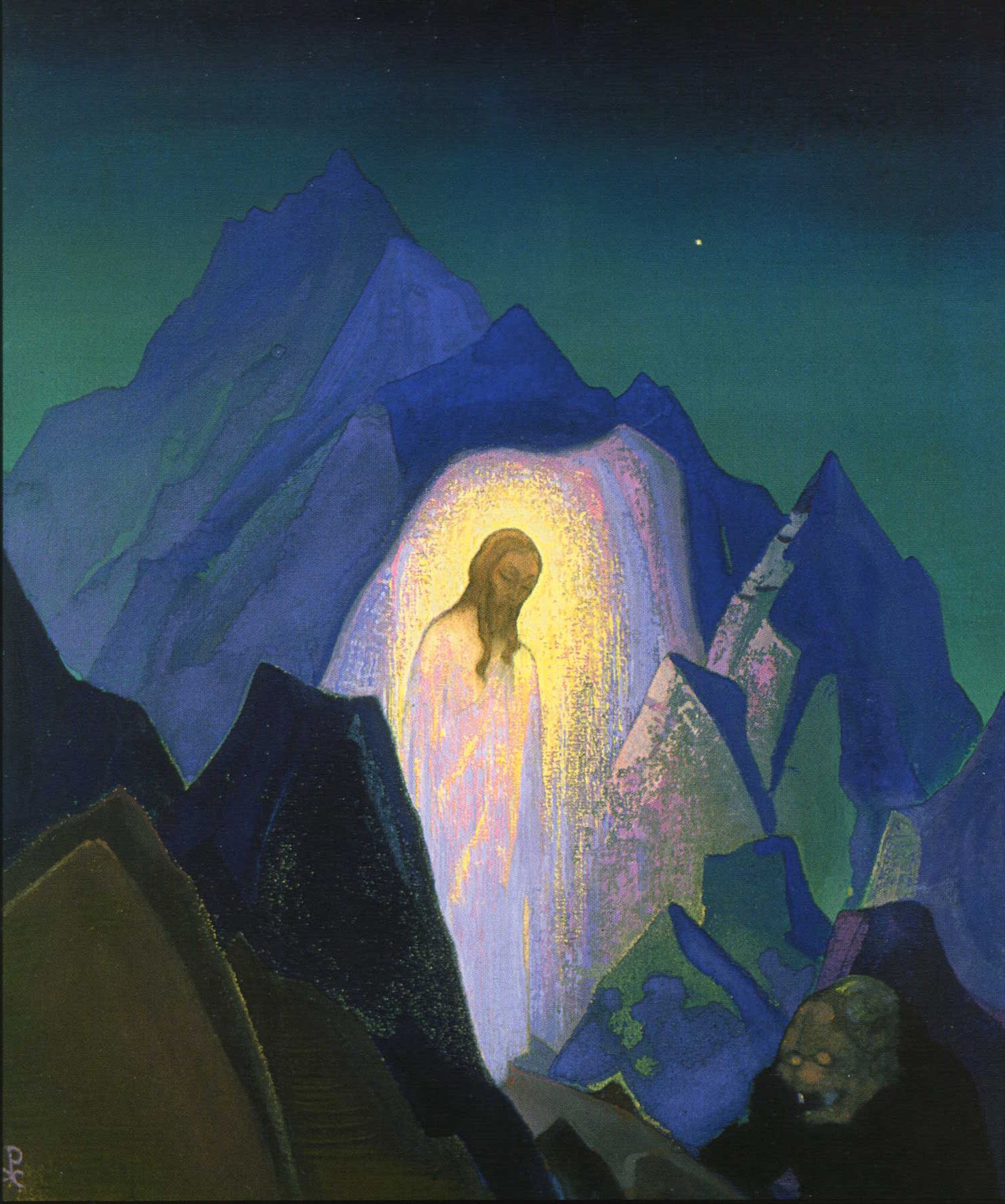
Nicholas Roerich (Russian, 1874–1947), Christ in the Desert, 1933. Tempera on canvas, 60 × 50.9 cm. Nicholas Roerich Museum, Moscow.
QUOTE:
The tradition of Lent means many different things to many different people. I honour the traditions and wisdom of the ages—and I’m interested in discerning what these practices mean [today].
At [my church], Lent is about learning from Jesus, particularly Jesus’ path through the real-life wilderness experiences we all face. We are interested in emulating and discovering a Jesus-shaped life in the hard things, the growing things, and the uncomfortable things. We believe not in an idealized plane of existence no one can quite attain; instead we believe in knowing and living out a Jesus way in the grey areas, the dirt and dust of our earthly lives here and now. . . .
Together and for you, this is our prayer (by Ann Siddall): “May this Lenten journey, with its stories about the hard places of Jesus’ experience, give strength and courage to all whose journey is far from easy. And may it inspire us to risk Christ’s Way of love as we share the journey with other travelers. We make this prayer in his name. Amen.”
>> “Ash Wednesday and the Practice of Truth-Telling” by Christine Valters Paintner: In this introduction to the season of Lent, spiritual writer and retreat leader Christine Valters Paintner discusses lament as a Lenten practice—lament as truth-telling, resistance, solidarity, and the release of God’s power. We need to touch those places of grief that we carry, and open ourselves in compassion to the grief of others. Paintner also unpacks the word “repentance,” visiting its Hebrew and Greek root words to further illuminate its meaning.
>> “Forty for 40: A Literary Reader for Lent” by Nick Ripatrazone:Nick Ripatrazone, the culture editor for Image journal and columnist at The Millions, offers suggestions and blurbs for forty stories, poems, essays, and books appropriate for Lent. Some pieces are inspired by feast days and Gospel readings, while others capture the discernment of the season. From Flaubert’s The Temptation of Saint Anthony and Hemingway’s one-act play Today Is Friday to Love & Salt: A Spiritual Friendship Shared in Letters and Karr’s “Disgraceland,” the selections are varied and intriguing. The dates are off because this was published in 2017, but the list is still valid, and many of the poems can be read online.
+++
LIVING ROOMEVENT: “Poetry of Lent”: On March 4, under the aegis of the local arts nonprofit the Eliot Society, I’m moderating an evening of crowdsourced Lenten poetry at a friend’s home in Crownsville, Maryland. If you’re in the Baltimore-Washington metro area, I’d love to see you there! The themes of this season are so expansive, and I’m looking forward to hearing what people share. Of course, I will have many poems in my back pocket as well. Some words I’ve been thinking of in preparation: pilgrimage; hunger; emptying; grace; greening; solitude; beloved; blood.
+++
SONGS:
>> “Circles” by Tow’rs: Tow’rs, an indie-folk band out of Flagstaff, Arizona, is made up of Gretta and Kyle Miller, drummer Dan Bagle, guitarist Kyle Keller, and cellist Emma Riebe. This song of theirs is about how God lovingly pursues us and clothes our shame.
>> “Parce Domini” by Jacob Obrecht:The Gesualdo Six perform a motet by the Flemish composer Jacob Obrecht (1457/58–1505), which sets a traditional Latin liturgical text based on Joel 2:17, 13.
Parce Domine, parce populo tuo quia pius es et misericors. Exaudi nos in aeternum, Domine.
Spare, O Lord, spare thy people, for Thou art gracious and merciful. Hear us for ever, O Lord.
+++
VISUAL COMMENTARY: “Handling Our Fragility, Seeking a Wise Heart” by Rachel Muers: As part of the Visual Commentary on Scripture project, theologian Rachel Muers has selected and comments on three artworks that resonate with Psalm 90 [previously], a song that combines communal lament with a meditation on wisdom. The psalm ends with the cry “Prosper for us the work of our hands—O prosper the work of our hands!”—which guided Muer in her curation. She gives us nine-thousand-year-old handprints on an Argentinian cave wall, a hospital drawing by Barbara Hepworth, and a cat’s-cradle sculpture by Mitzi Cunliffe. This mini-exhibition is a great way to enter into and engage with this typically Lenten psalm.
Cueva de las Manos (Cave of Hands), began ca. 7,000 BCE. Mural, UNESCO World Heritage Site, Santa Cruz, Argentina.
On a related note: For this Lent, the VCS is dipping into its archives to bring you “Lent Stations: Repentance and Forgiveness,” fourteen artworks with commentary (two per week) that relate to the stated theme. Follow the link to sign up.
PHOTO COMPILATION: “Chester Higgins’s Life in Pictures”: Chester Higgins Jr. (b. 1946) is an American photographer whose work focuses on everyday Black life; “it is inside simple moments where I look for windows into larger meaning,” he says. He was a staff photographer for the New York Times for more than four decades, and his work is in the permanent collection of the Museum of Modern Art. This heavily illustrated New Yorker article is a good introduction to his oeuvre, in which religious belief and practice feature prominently. I found out about him through the photography compilation book Standing in the Need of Prayer: A Celebration of Black Prayer.
Chester Higgins (American, 1946–), Sunrise Prayer on Osu Beach, Accra, Ghana, 1973Chester Higgins (American, 1946–), Father Swinging Son, Brooklyn, 1972
+++
SONGS:
>> “El Shaddai” by Victory: On January 27 singer-songwriter Victory Boyd, who goes professionally by the mononym Victory, released her latest single, “El Shaddai.” El Shaddai is an ancient Hebrew name for God whose original meaning is unclear but which is often translated into English as “God Almighty”—although “God of the Mountains,” “the Full-Breasted God” (referring to God’s nourishment of God’s children), or “the All-Sufficient One” have also been posited. Its first appearance in the Bible is in Genesis 17:1, where God tells Abram, “’I am El Shaddai; walk before me, and be blameless.”
Read the lyrics in the YouTube video description.
>> “Come Unto Me” by Take 6: A friend recently introduced me to the American a cappella gospel sextet Take 6. Formed in 1980 on the campus of Oakwood College in Huntsville, Alabama, and still active, they incorporate sophisticated jazz harmonies into the tradition of Black gospel “quartet” singing. They are featured on Spike Lee’s Do the Right Thing soundtrack and have won ten Grammys.
This 1988 performance for a Heritage USA TV spot features the group’s six original vocalists: Claude V. McKnight III, Mark Kibble, Mervyn Warren, David Thomas, Cedric Dent, and Alvin Chea.
>> “He’s Got the Whole World in His Hands” by Peter Collins: I love what Peter Collins does with this African American spiritual! This video was his submission to Tyler Perry’s #HesGotTheWholeWorldChallenge from 2020 (which I featured here). It didn’t make the final cut, but I’m so glad it’s out there.
+++
LITERARY EXCERPT from The Color Purple by Alice Walker: This short passage from Alice Walker’s 1982 Pulitzer Prize–winning novel is taken from a conversation between the protagonist, Celie, and her friend Shug, about pleasure, gratitude, and grace. Shug refers to God as “it” (“God ain’t a he or a she”), and her statement about the necessity of enjoying God’s good creation and being open to surprise provides the source of the title.
I’m embarrassed to say that although I saw and really liked the 1985 Steven Spielberg film adaptation of The Color Purple, I’ve never read the book! I plan to rectify that before December, when another film adaptation—of the 2005 stage musical based on Walker’s novel—is coming out, directed by Blitz Bazawule. It stars Fantasia, H.E.R., Colman Domingo (Euphoria), Taraji P. Henson (Hidden Figures), Danielle Brooks (Orange Is the New Black), Jon Batiste, and more.
+++
VIDEO: “Ethiopian Gospel Book”: In this six-minute instructional video, Dr. Beth Harris, executive director of Smarthistory, and Kelin Michael, a graduate curatorial intern of manuscripts at the Getty Museum, explore an early sixteenth-century Gospel book from Ethiopia. They discuss the book’s historical context and the formal qualities of its paintings, including the flatness of the figures and the colorful interlacing. They focus on a full-page illumination at the front of the Virgin and Child enthroned between two archangels, but they also touch on the book’s canon tables and its portrait of Saint John the Evangelist.
The Virgin and Child with the Archangels Michael and Gabriel, Ethiopia, ca. 1504–5. Tempera on parchment, 13 9/16 × 10 7/16 in. (34.5 × 26.5 cm). J. Paul Getty Museum, Los Angeles, Ms. 102, fol. 19v.
This roundup is a bit longer than usual, but I’ve found that these six items I’ve gathered over the last month complement each other well, so I’m sharing them all at once. The Art in America and Hyperallergic articles raise interesting points about sacred art—what it is, how it functions, what its relevance is to contemporary life—and this is a topic I discuss in a podcast episode that was released earlier this month. Tammy Nguyen and Wes Campbell are two artists whose work I am glad to have just learned about and plan to explore more of. And there’s always something going on in London’s art scene to remark on as relates to theology or Christian history—this time a National Gallery–sponsored virtual exhibition on the fruits of the spirit, and the latest winning entry for the Fourth Plinth competition, which honors a Baptist pastor and freedom fighter from Malawi.
ARTICLE: “Seeing and Believing: Christian Imagery in Painting Now,” a roundtable conversation with four artists moderated by Emily Watlington: Religion is the theme of the December 2022 issue of the influential contemporary art magazine Art in America, and its cover story is a conversation with painters Frieda Toranzo Jaeger, Tammy Nguyen, Alina Perez, and Jannis Marwitz on their “bold reinventions of traditional Christian iconography.” They discuss the generativity of Christian imagery, the power of sacred images, their favorite Christian paintings, the function of metal leaf in illuminated manuscripts, Jesus as recognizable not by his specific likeness but by body language and symbol, “revisiting and repurposing history” as “a core practice of decolonization,” and the role of storytelling and transcendence in art.
I especially appreciated being introduced to Nguyen’s work and hearing her thoughtful and nuanced perspectives. She mentions her Stations of the Cross series, inspired by her visit to the island of Pulau Galang in Indonesia to connect with her Vietnamese parents’ history as refugees on nearby Kuku Island following the Vietnam War. In the decommissioned Galang Refugee Camp, now a tourist site, fourteen golden Stations of the Cross statues are preserved in the forest, which served as devotional aids for the many Vietnamese Catholic refugees—but they are now overgrown by nature. Nguyen was struck by this tropical takeover, and her resultant body of work setting Christ’s passion in the jungle explores not only environmental agency but also legacies of colonialism and the important role of faith in circumstances of trauma and grief. Hear her discuss the series in this five-minute video that the gallery Lehmann Maupin put out:
Tammy Nguyen (American, 1984–), Man of Sorrow, 2022. Watercolor, pastel, vinyl paint, and metal leaf on paper stretched over wood panel, 84 × 60 in. (213.4 × 152.4 cm).
I regret that besides Nguyen’s, all the other featured contemporary paintings in the Art in America article have only a very tenuous, sometimes indiscernible, connection to Christianity. Toranzo Jaeger’s End of Capitalism, the Future, a “queer utopia,” is based on Lucas Cranach’s Fountain of Youth—but Cranach’s subject (elderly women entering a pool to become young again) is not Christian, it’s mythological. And Marwitz’s The Raid supposedly references Caravaggio’s Madonna of Loreto, but I don’t see it at all, compositionally or otherwise. Perez mentions growing up Catholic in Miami, but that influence isn’t apparent in It Never Heals, unless we’re meant to read it in the painting’s flair for violence and drama. So the article’s subtitle, “Christian Imagery in Painting Now,” is a bit of a misnomer.
With the criteria of currently active painters consciously engaging with Christian imagery in ways that are not merely illustrative, I might have chosen to interview, for example, Jyoti Sahi (India), Daozi (China), Emmanuel Garibay (Philippines), Wisnu Sasongko (Indonesia), Marc Padeu (Cameroon), Harmonia Rosales (US), Stephen Towns (US), Rodríguez Calero (US), Trung Pham (US), Laura Lasworth (US), Patty Wickman (US), James B. Janknegt (US), Mark Doox (US), Sergii Radkevych (Ukraine), Ivanka Demchuk (Ukraine), Natalya Rusetska (Ukraine), Paul Martin (England), Filippo Rossi (Italy), Michael Triegel (Germany), Janpeter Muilwijk (Netherlands), Arne Haugen Sørensen (Denmark), Brett a’Court (Australia), or Julie Dowling (Australia).
I’m also disappointed that, from what I can tell from the interview, none of the four artists approaches their subjects from a place of Christian belief. I absolutely welcome non-Christians to engage with Christian stories and symbols—to play with them, reinterpret them, question them, or even use them as tools of critique or subversion. I just wish that in a conversation about ways that Christian imagery is being used today, the editors had thought to invite a Christian to the table, who could have provided a different viewpoint. But, kudos to Art in America for at least broaching the topic of religion in contemporary art!
+++
NEW STATUE: Antelope by Samson Kambalu: The fourth plinth in London’s Trafalgar Square is the prestigious site of rotating contemporary art installations, and from September 2022 to September 2024, it is home to Antelope by Malawian-born artist Samson Kambalu. This two-man bronze sculpture group reimagines a photograph of the pastor, educator, and revolutionary John Chilembwe (1871–1915) of Nyasaland (now Malawi) standing next to his friend John Chorley, a British missionary. Posing at the entrance of his newly built church, Chilembwe proudly wears a brimmed hat, flouting the law that Africans were not allowed to wear hats in the presence of their then colonial rulers. (Read more from Inno Chanza on Facebook, and from Harvard Magazine.) Kambalu’s sculpture shows the men facing away from each other instead of side-by-side, and he’s made Chilembwe almost twice as large as Chorley, elevating an underrepresented figure in the history of the British Empire in Africa.
Samson Kambalu (Malawian, 1975–), Antelope, 2022. Bronze, resin, 18 ft. high. Photo: Future Publishing / Getty Images.Pastor John Chilembwe and John Chorley at the dedication of Chilembwe’s New Jerusalem Baptist Church in Mbombwe village in what is today southern Malawi, January 24, 1914. The British colonial government demolished the church the next year and imprisoned or executed most of its leaders following an unsuccessful uprising against forced labor, racial discrimination, and conscription led by Chilembwe.
After years of agitating peacefully against British colonial rule to no avail, Chilembwe led an uprising in 1915, which resulted in his death but which laid the seeds for Malawian independence. John Chilembwe Day is observed annually on January 15 in Malawi.
+++
VIRTUAL EXHIBITION: Fruits of the Spirit: Art from the Heart: Curated by the Rev. Dr. Ayla Lepine as part of the National Gallery’s Art and Religion research strand, this new virtual exhibition was inspired by a passage from the apostle Paul’s letter to the Galatians, where he writes, “The fruit of the Spirit is love, joy, peace, patience, kindness, generosity, faithfulness, gentleness, and self-control. There is no law against such things” (5:22–23). The exhibition pairs nine artworks from the National Gallery’s collection with nine from UK partner institutions that represent these spiritual fruits, these virtues, which are held in common across faith traditions. The Renaissance through contemporary eras are represented. [HT: Jonathan Evens]
Screen capture from the online exhibition experience Fruits of the Spirit. This fictitious space consists of seven side galleries and two central displays, which can be navigated with your keyboard.
Accompanying the exhibition is a web-based catalog (with contributions by theologians, activists, novelists, artists), an audio guide, and a series of in-person and online events from November 2022 through April 2023. Next up is a free online talk by the curator on January 30 at 1 p.m. GMT (8 a.m. EST).
+++
ARTICLE: “The Church of Secular Art” by David Carrier: “Bill Viola’s installation at a Naples church misses the spiritual mark,” reads the deck to this Hyperallergic article, a critic’s response to the Ritorno alla Vita (Return to Life) exhibition that ran from September 2, 2022, to January 8, 2023, at the Church of Carminiello in Toledo. The exhibition was organized by Vanitas Club, a Milan-based organization that throws artistic and cultural events in underutilized historic spaces, in collaboration with Bill Viola Studio.
Bill Viola, left: Fire Martyr (2014); right, Water Martyr (2014). Photo courtesy of Vanitas Club.
I didn’t see the exhibition, but I’m familiar with Viola’s work [previously], and I don’t agree with Carrier’s assertions, if my understanding of them is correct. It sounds to me like he’s saying that when a sacred artwork—say, a medieval altarpiece—is transplanted to a museum, the work becomes secular, and that when a secular artwork is shown in a sacred space, rather than the space sacralizing the work, the work secularizes and thus undermines the space. It seems that he’s saying that art made in a contemporary idiom, like Viola’s video art, does not belong in churches, because it does not and cannot function as religious art. Art museums and churches have fundamentally different goals that are irreconcilable.
“The paintings and sculptures in Neapolitan churches are meant to support and strengthen the spiritual lives of believers; representations of St. Gennaro and other saints are intended to reinforce faith. The videos in Ritorno alla Vita call for a fundamentally different response. The exhibition website notes that these videos ‘exemplify the human capacity to transform and to bear extreme suffering and even death in order to come back to life through action, fortitude, perseverance, endurance, and sacrifice.’ These are important ideals, but they can apply equally to secular and nonsecular contexts.” The description Carrier quotes does seem to water down the art’s Christian content/messaging in an attempt to make the art more widely accessible. I’ve noticed that fault with some other displays of contemporary art in churches—where the curator, seeing their role primarily as one of hospitality to the wider (unchurched) community, underinterprets the art’s Christian angle. Though it can be difficult, there is a way to honor a work’s particularity and universality in the exhibition text.
I think we need to let art function differently for different viewers. Cannot a contemporary artwork, regardless of the artist’s intentions or where the art is placed, cultivate my affection for Christ as much as a traditional artwork? How I as a Christian read and experience Viola will differ from how an atheist does, and that’s OK. The same is true for a religious painting hanging in a national gallery—it may elicit prayer in me, boredom or contempt in another, emotional identification in another, purely aesthetic contemplation in another, and historical curiosity in yet another. I don’t think an image loses or gains its sacredness by its location, though I don’t underestimate the power of the staged environment to enable that sacredness to best shine through. I think that if the viewer receives a work as sacred, then it is.
That Viola does not depict specific historical saints in his Martyr panels—originally commissioned as a quadriptych by St. Paul’s Cathedral in London—does widen their interpretive horizon, but it doesn’t make them less “Christian.” I see the work as a memorial to all the unknown martyrs. I think of all the contemporary Christian martyrs around the world whose names I do not know, who have died with Christ’s name on their lips and his Spirit within them, and am prompted to intercede immediately for believers suffering religious persecution in their countries, who worship Jesus under threat of imprisonment or execution.
+++
ARTICLE: “Openness to the world: Wes Campbell and his disturbing illusions of peace” by Jason Goroncy: In December 2022 theology professor Jason Goroncy spoke at the opening of a retrospective of the paintings of the Rev. Dr. Wes Campbell, hosted by Habitat Uniting Church in Melbourne. That talk is adapted here on the Australian Broadcasting Corporation’s Religion and Ethics web portal. Campbell is a retired Minister of the Word in the Uniting Church of Australia with experience in parish ministry, university chaplaincy, UCA synod and assembly roles, and a sustained commitment to peace, justice, and social responsibility. His roughly three decades of art making was integrally connected to these roles, as through his paintings he expounds a faith-fueled poetics of hope, “bearing witness to the trauma of creaturely existence alongside a refusal to abandon the world to its violence, nihilism, and despair.”
Wes Campbell (Australian, 1948–), Transfiguration of Christ, n.d. Acrylic on canvas, 59 × 23 5/8 in. (150 × 60 cm).
“Wes’s art . . . does not shy away from the risky boundaries where hope is threatened, sustained, lost, and birthed,” Goroncy says. “It, therefore, embraces the tragic and the ugly, as well as joy and beauty. Whether his subject matter is the human condition, or explicitly religious stories (such as the nativity or the transfiguration), or the Earth itself, Wes’s work is replete with this kind of fidelity to the contradictions that mark our lived experience. . . . It embodies the conviction that the arts can unmoor us, disrupt the worlds we assume, facilitate our lament, and open up possibilities for futures we hardly dare imagine.”
+++
PODCAST EPISODE: “Victoria Emily Jones: Art & Theology”: In early December I spoke with Luminous podcast host Peter Bouteneff, a systematic theology professor and the founding director of the Institute of Sacred Arts at St. Vladimir’s Orthodox Theological Seminary, about my work at Art & Theology. We discuss how I got into this cross-disciplinary field, definitions of “sacred art,” and more.
Bouteneff earned his DPhil in theology from Oxford University under the supervision of Metropolitan Kallistos Ware. Besides theology, he also has an academic background in music, having studied jazz and ethnomusicology at the New England Conservatory. He has written two books on the music of Estonian composer Arvo Pärt.
I’ve been following the podcast since its inception in 2021. My favorite episodes are the ones with poet Scott Cairns; artist Bruce Herman; art historian Lisa DeBoer, author of Visual Arts in the Worshiping Church; curator Gary Vikan, a specialist in Byzantine art and the director of the Walters Art Museum from 1994 to 2013; and historian Christina Maranci, an expert on the development of Armenian art and architecture. Browse all the episodes here.
PHOTO COMPILATION: “Alternative Advent 2022” by Kezia M’Clelland: Kezia M’Clelland [previously] is the children in emergencies specialist and people care director for Viva and a child protection consultant for MERATH, the Lebanese Society for Educational and Social Development’s community development and relief arm. She is a British citizen, but her work brings her around the world, seeking to safeguard the rights and well-being of children globally.
Every December M’Clelland compiles photos from that year’s news, showing people affected by natural disasters, violence, and injustice, and overlays them with Advent promises. There’s sometimes a disjunction between image and text that’s grievous and challenging, a reminder that our long-looked-for deliverance is not yet fully here, even though we receive foretastes. The twenty-eight photos M’Clelland gathered from 2022 include throngs of people making their way to Aichi cemetery in Saqqez, Iran, to attend a memorial for twenty-two-year-old Mahsa Amini, allegedly beaten to death by the country’s religious morality police for not wearing her hijab properly; a police officer helping a child flee artillery on the outskirts of Kyiv, and a baby being born in a bomb shelter; women carrying pans of granite up the side of a mine in Ouagadougou, Burkina Faso, for meager wages; a woman comforting a neighbor who lost her home to flooding in Tejerias, Venezuela; children playing in a sandstorm at the Sahlah al-Banat camp for displaced people in the countryside of Raqa in northern Syria; children clearing trash from a river in Tonlé Sap, Cambodia; and more.
March 9, 2022: An injured pregnant woman is rescued from a maternity hospital in Mariupol, Ukraine, that was bombed by Russian forces. The following week it was reported that she and her child, delivered in an emergency C-section, did not survive. Photo: Evgeniy Maloletka/AP. Scripture: Isaiah 7:14.January 26, 2022: A young woman looks on from her house destroyed by tropical storm Ana in the village of Kanjedza in Malawi. Photo: Eldson Chagara/Reuters. Scripture: Isaiah 58:12.June 7, 2022: A man and child, part of a migrant caravan consisting mostly of Central Americans, are blocked by members of the Mexican National Guard on a Huixtla road in Chiapas state, Mexico. They seek transit visas from the National Migration Institute so that they can continue their thousand-plus-mile journey north to the US. Photo: Marco Ugarte/AP. Scripture: Isaiah 35:9 MSG.
The sequence of images is a visual prayer of lament and intercession. I appreciate how M’Clelland—via the work of photojournalists, and her sensitive curation—raises awareness about these places of suffering, putting faces to the headlines, but also spotlights moments of empowerment and joy amid that suffering. We are encouraged to seek God’s coming into these situations of distress and to see the subtle ways he does come—for example, through the consoling embrace of a friend, the nurturance of an elder sibling, the protective aid of an officer, a jug of clean water, a child’s glee, or acts of protest.
For photo credits and descriptions, see the Instagram page @alternative_advent. (Start here and scroll left if you’re on your computer, or up if you’re on your phone.) Follow the page to receive new posts in your feed starting next Advent.
+++
SONGS by Rev Simpkins, an Anglican priest and singer-songwriter from Essex previously featured here:
>> “Hallelu! (Love the Outcast)”: This song was originally released on The Antigen Christmas Album (2014) with the byline “Ordinand Simpkins & Brother De’Ath”; it was reissued in 2016 on Rev Simpkins’s album Love Unknown, “a cornucopia of non-LP tracks, studio experiments, ingenious live re-workings, radio sessions, off-the-wall demos, obscure b-sides, & pissings about.” The music video was recorded on an iPhone 4 in the Edward King Chapel at Ripon College Cuddesdon in Oxford. [Listen on Bandcamp]
>> “Poor Jesus” (Traditional): Here the Rev. Matt Simpkins performs the African American spiritual “Oh, Po’ Little Jesus” with a soft banjo accompaniment. Harmonizing vocals are supplied by his daughter, Martha Simpkins. It’s the opening track of his EP Poor Child for Thee: 4 Songs for Christmastide(all four songs are wonderful!), released December 11, 2020, to support St Leonard’s Church, Lexden, where he serves as priest-in-charge. [Listen on Bandcamp]
+++
NEW PAINTING: Tent City Nativity by Kelly Latimore:Kelly Latimore is an Episcopalian artist from St. Louis, Missouri, who “rewonders” traditional iconography, especially with an eye to social justice. This Christmas he painted an icon called Tent City Nativity, which shows the Christ child being born in a homeless encampment. A streetlight shines directly over the Holy Family’s tent, like the star of Bethlehem, and neighbors bring gifts for warmth and sustenance: coffees, a blanket, a cup of chili. View close-ups on Instagram, and read the artist’s statement on his website. Proceeds from print and digital sales of the icon will support organizations serving the unhoused in St. Louis.
Kelly Latimore (American, 1986–), Tent City Nativity, 2022. Acrylic, Flashe, and golf leaf on birch board, 27 × 32 in.
SONG MEDLEY: YouTube user African Beats spliced together excerpts from three songs performed at a church in Germany at Christmastime by South African singer Siyabonga Cele and an unnamed woman, including “Akekho ofana no Jesu” (There’s No One like Jesus) and “He’s Got the Whole World in His Hands.” I couldn’t find the name of the last song, and attempts to contact the singer for information were unsuccessful, but it’s in Zulu, as is the first one. Lyrics to the first song, sourced from here, are below.
Akekho ofana no Jesu (There’s no one like Jesus) Akekho ofana naye (There’s no one like him) Akekho ofana no Jesu (There’s no one like Jesus) Akekho ofana naye (There’s no one like him)
Sahamba, hamba, lutho, lutho (I’m walking, walking, nothing, nothing) Safuna, funa, lutho, lutho (I’m searching, searching, nothing, nothing) Sajika, jika, lutho, lutho (I’m turning, turning, nothing, nothing) Akekho afana naye (There is no one like him)