Wondering why I’m still posting Christmas content? Because Christmas is a twelve-day feast that began December 25 and extends through January 5. While the stores and most media have moved on, the church continues to celebrate. So I encourage you to keep your Christmas decorations up, keep singing and playing carols, and keep partying!
Here’s a link to my Christmastide playlist, comprising over twenty-seven hours of hand-picked sacred Christmas music. Also check out my Epiphany playlist for January 6.
+++
SONGS:
>> “Mary’s Boy Child / Oh My Lord” by Boney M.: The calypso carol “Mary’s Boy Child” was written in 1956 by Jester Hairston and popularized by Harry Belafonte, who recorded it that year. The most famous cover, though, is by Boney M., a reggae, funk, and disco band founded in 1975 in West Germany by the record producer Frank Farian. Its four original members were Liz Mitchell and Marcia Barrett from Jamaica, Maizie Williams from Montserrat, and Bobby Farrell from Aruba. Boney M. released their disco-lite version of “Mary’s Boy Child,” in medley with the new song “Oh My Lord” (by Frank Farian and Fred Jay), as a single in 1978 and then on their full-length Christmas album in 1981. It’s one of the best-selling singles of all time in the UK.
The song makes me smile so much—it’s bright and catchy—especially when I watch the music video, which shows the band singing and dancing in a white room wearing furry white coats. It’s one of two music videos they made for the song, the other cut together with kids enacting the Nativity.
>> “O Ho, Masih Aaya, Zameen Par” (Oh, Christ Has Come! There Is Joy on Earth!) by Akshay Mathews: This contemporary carol from India opens, “Oh, Christ has come! There is joy on earth, there is joy throughout the heavens. Oh, Christ has come!” Then it describes the Annunciation to the Shepherds. Read the Hindi lyrics here. In the video, singer-songwriter Akshay Mathews [previously], who lives in Delhi, triplicates himself using a clone effect so that he is shown playing all three accompanying instruments: guitar, keyboard, and hand drum.
>> “There’s a Fire in Bethlehem,” arr. Conrad Susa: I learned of this traditional Spanish villancico, “En Belén tocan a fuego,” from Calvin University’s 2022 Lessons and Carols Service, For God So Loved the Cosmos. As part of that program, the song was performed in English by the university’s Women’s Chorale, as arranged by Conrad Susa. It opens with imagery of the fire of God’s love flaring out from a stable, and develops into a scene of fish, rivers, and birds rejoicing in the birth of their Redeemer. There was a recording error that puts the lips out of sync with the sound, but the music otherwise comes across just fine.
I love the playful chorus, where the tempo picks up and the pianist shifts to staccato technique (detached and bouncy): “Fish in the river are glistening and dancing, dancing and leaping to celebrate his birthday.” In the sixteenth-note piano run that signals the transition between chorus and verse, I can picture the cavorting, splashing, and darting of our gill-bearing brothers. Although several animal characters make an appearance in Christmas songs, fish usually aren’t one of them. I like how the anonymous writer of this song includes them among the ones who celebrate Christ’s birth. Reminds me a bit of the animated Christmas short from Russia that I shared back in 2017.
To hear a professional recording by the Balthasar-Neumann-Chor, click here.
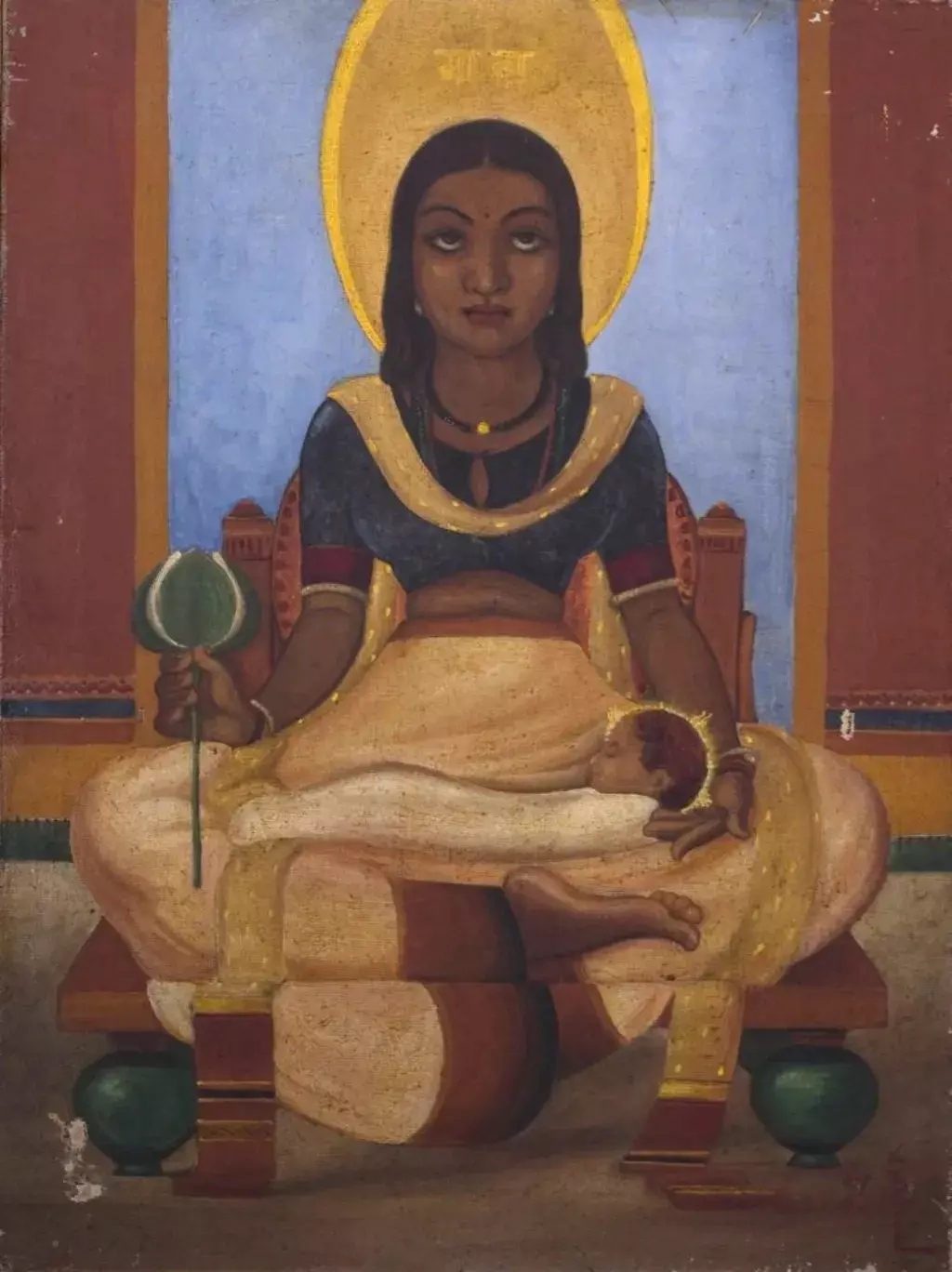
Angelo da Fonseca (Indian, 1902–1967), Mother and Child, 1952. Watercolor on paper. Photo courtesy of the Xavier Centre of Historical Research, Goa.
>> “A Resolution for People Who Are Already Doing Their Best” by Kate Bowler, Everything Happens (Substack): “Every January, we perform this ritual together. We shake off the indulgence of the holidays and brace ourselves for improvement. We tell ourselves that this will be the year we get it together . . . that any mess was temporary . . . that with the right plan, the right habits, the right mindset, we can finally become the person we were always supposed to be. This is not a small thing. In the United States and Canada (bless us all), New Year’s resolutions have become a kind of secular sacrament—an annual recommitment to the belief that limits are a problem to be solved. But what if they aren’t?”
Kate Bowler [previously], an award-winning author, podcaster, and historian of American self-help, breaks the illusion of unlimited agency and shares the question she’s asking herself for the new year instead of “What should I fix?”
SUBSTACK POST: “Advent and Love” by Micha Boyett, The Slow Way: “There was a mother and man who loved her. There was a baby. The baby was the story God was telling, and that story became a seven-pound human and wailed. His mother cleaned his body with cloth and water, and fed him at her breast. She hoped he would latch on. It took a while. She bled and napped. He napped and cried again. He was God’s story and human. This is how he made a home with us. His making a home with us was love, and that love created a way for peace, hope, and joy.” Micha Boyett is an excellent spiritual writer, and I’m thrilled to learn that she has an Advent book coming out next year!
+++
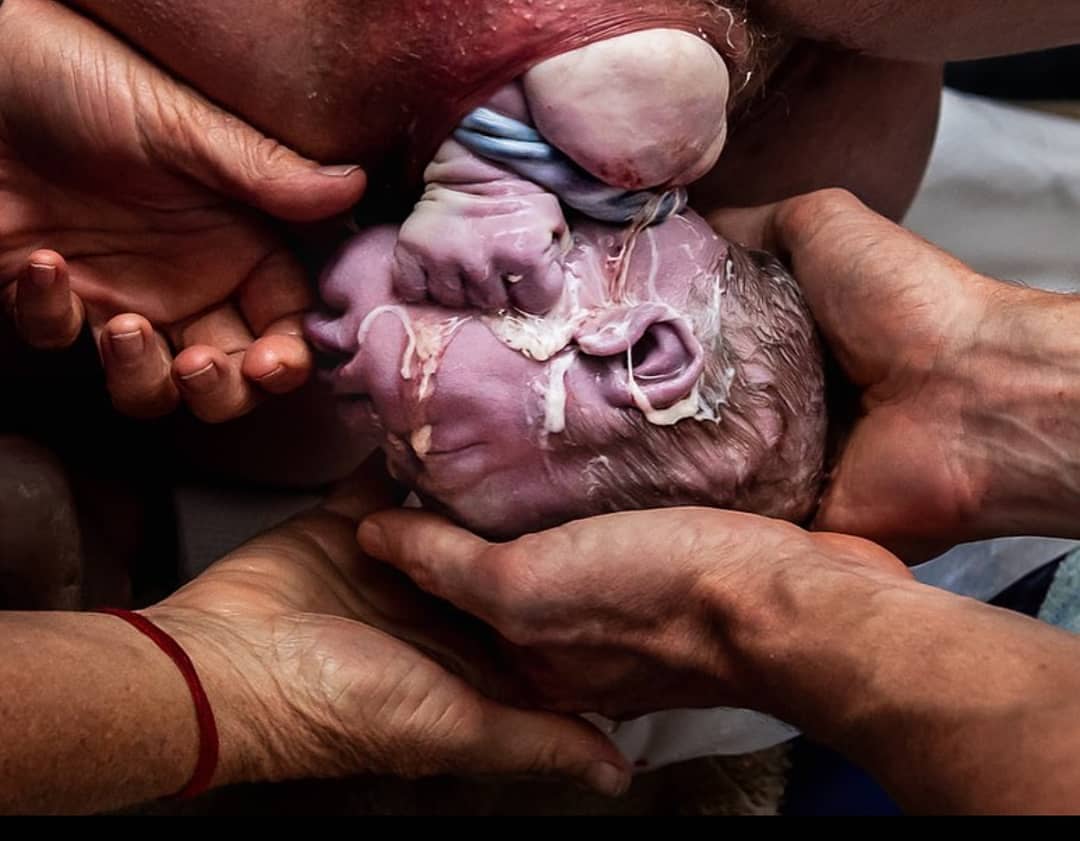
CHILDBIRTH PHOTOGRAPHY: “2019 Birth Becomes Her Image Contest Winners” and “2020 IAPBP Competition Winners”: I’ve never birthed a baby or witnessed a live birth, but whenever I see photographs of the process and its outcome, it makes me emotional with joy. Seriously, I tear up as I smile. I don’t know these people, and yet I’m awed and overwhelmed.
Photograph by Belle Verdiglione, 2019
Since Christmas is about the BIRTH of Jesus, I find it meaningful to spend some time with childbirth photographs to remind myself how God chose to come to us—through a woman’s birth canal. It’s a wonder that never ceases to amaze me. Althoughthereareafewexceptions, it’s a picture of birth that artists interpreting the Nativity typically don’t want to touch (in part because women’s bodies are still largely taboo, in part because the Catholic Church teaches the birth was quick, painless, and bloodless), and so in the artistic canon, we get mostly clean, calm images of postpartum bliss, not the laborious and messy before. But isn’t that, too, part of the miracle and the glory of Christmas?
>> “Love Came Down” by Joanna Forbes L’Estrange: For her 2024 album Winter Light, the British choral composer Joanna Forbes L’Estrange wrote a new setting of this beloved Christmas poem by Christina Rossetti.
>> “Yeshu Thungea Ningla” (On the Day Jesus Was Born) by James Lhomi: Released by Lareso Music, this song was written by James Lhomi, a significant Lhomi Christian musician in Nepal. The Lhomi are a Tibetan people living in India, China, and Nepal. Lhomi is also the name of their language. The song opens, “Let us a sing a sweet song on the day of Christ’s birth, let us rejoice with a joyful heart, for Emmanuel has been born unto us.” [HT: Global Christian Worship]
>> “What a Day It Is” by Evan Thomas Way: Singer-songwriter Evan Thomas Way, cofounder (with Josh White) of the Deeper Well record label, released this song on his 2014 debut album, Only Light. At the time, he was the worship pastor at Door of Hope Church in Portland, Oregon; now he’s an executive pastor there.
>> “Talj, Talj” (Snow, Snow) by Fairuz: The Lebanese singer Fairuz (فيروز,) is one of the most celebrated singers in the Arab world. Born to Christian Maronite and Syriac Orthodox parents, she is now a member of the Greek Orthodox Church. She popularized the Arabic Christmas carol “Talj, Talj” on her 1977 album Christmas Hymns, which you can watch her perform on a television special in the video below (I can’t find the year or name of the show or broadcaster). The lyrics paint a wintry scene of snow falling and hearts flowering, for “there is a baby awake in the cave, and his sweet eyes are full of love.” [HT: Global Christian Worship]
POEM SERIES: “Twelve Days of Advent” by Kate Bluett: This year on her blog, writer Kate Bluett [previously] is publishing a series of original metrical verses based loosely on the cumulative song “The Twelve Days of Christmas.” She calls it the Twelve Days of Advent and through it explores the theology of Christ’s coming. I love this creative, sacred spin on the popular seasonal ditty! Here’s where the series currently stands (my favorite poems are in boldface):
“A Partridge in a Pear Tree”: Bluett imagines, in the tree of the knowledge of good and evil, a bird singing (representing, as I take it, God’s word), but Adam and Eve heed not his song, and, taking the tree’s forbidden fruit, find themselves exiled. The bird weeps for the alienation of his two friends, and wings his way east of Eden, into the home of a young maiden, a daughter of Eve, who receives him, shelters him, an act that leads to restoration. Bluett uses some of the language of late medieval English folksong, such as “with a low, low, my love, my love” and “welaway.”
“Four Calling Birds”: This poem is brilliant. In it the four matriarchs in Jesus’s genealogy speak to Mary, tenderly calling her “Child” and rejoicing in her “bringing forth our life’s tomorrow.” Tamar, Rahab, Ruth, Bathsheba—they’ve long awaited redemption, and now they’re at its threshold. Mary’s yes to God’s call “set[s] [their] dry bones stirring, thrumming / with a hope [they’d] hardly dared.” They inform her that her vocation will involve great suffering (as we know, she’ll experience the brutal death of her son)—but her willingness to give up her son to the cross, to endure that rupture, will mean new life for the world.
“Six Geese a-Laying”: Picking up the Isaianic language of the wilderness being made glad, the poetic speaker sings an eschatological vision of flocks coming home to “the orchard of the rood” (rood = cross) to lay and hatch eggs in nests once empty, now brimming with life.
SUBSTACK SERIES: “Art + Advent 2025” by Elissa Yukiko Weichbrodt: The art historian Elissa Yukiko Weichbrodt [previously], author of Redeeming Vision and the Loving Look Substack, is one of my favorite writers. This Advent she is writing a weekly series of art reflections centered on the themes of hope, peace, joy, and love.
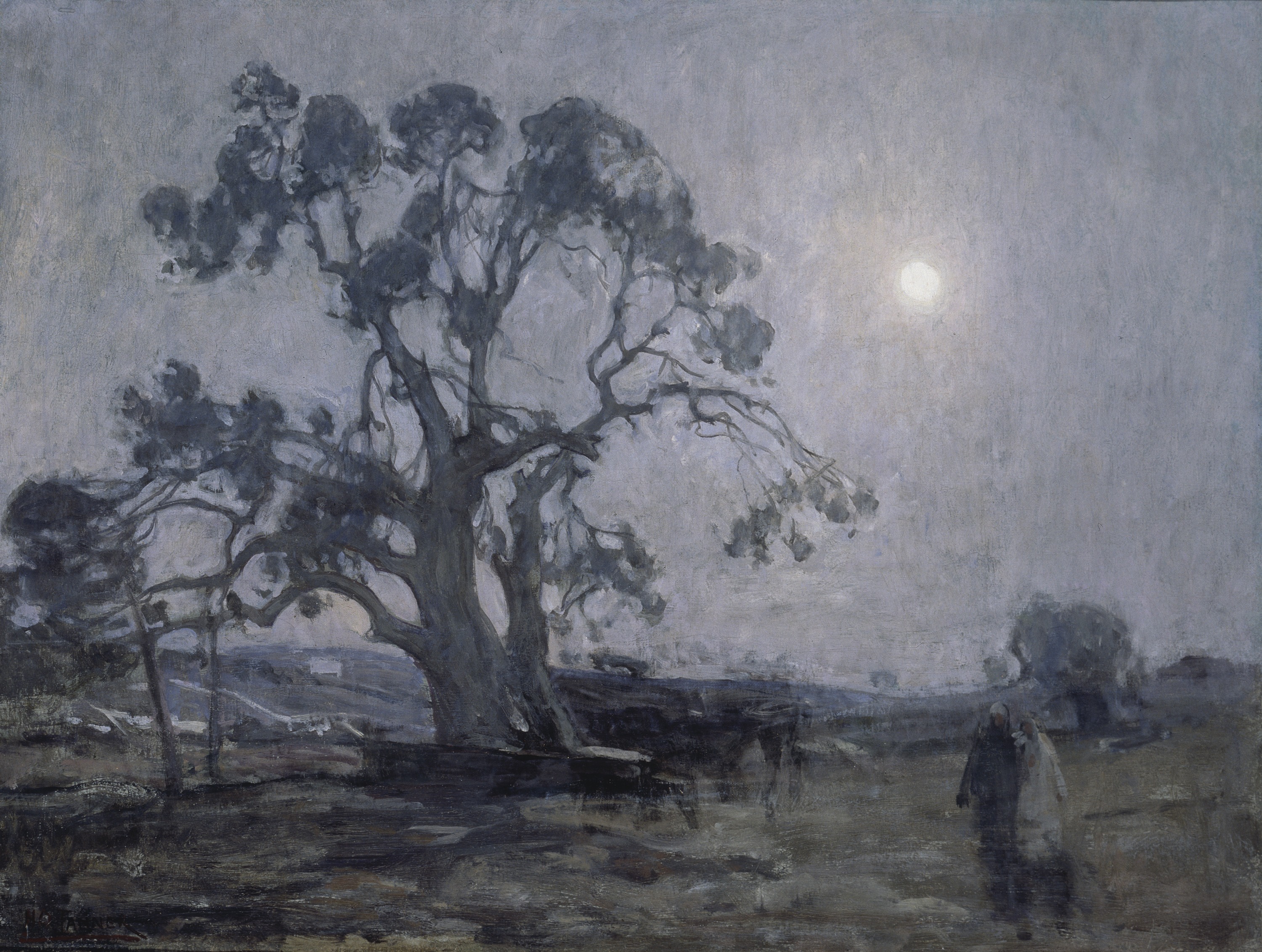
>> “Week 1 // Hope: Abraham’s Oak and Sarah’s Laughter”: Looking at Henry Ossawa Tanner’s painting Abraham’s Oak, Weichbrodt writes about shadowy promise. She also considers, with reference to an early Byzantine mosaic of the Hospitality of Abraham, how to hope again after being wounded, as Sarah did, is a vulnerable thing. “As Advent begins, I find myself peering into a Tanner-like mist, seeing the dim outline of longed-for goodness taking shape in the distance. Sometimes I’m full of hope, but I’m also, like Sarah, sometimes full of armored laughter.”
Henry Ossawa Tanner (American, 1859–1937), Abraham’s Oak, 1905. Oil on canvas, 21 3/8 × 28 5/8 in. (54.4 × 72.8 cm). Smithsonian American Art Museum, Washington, DC.
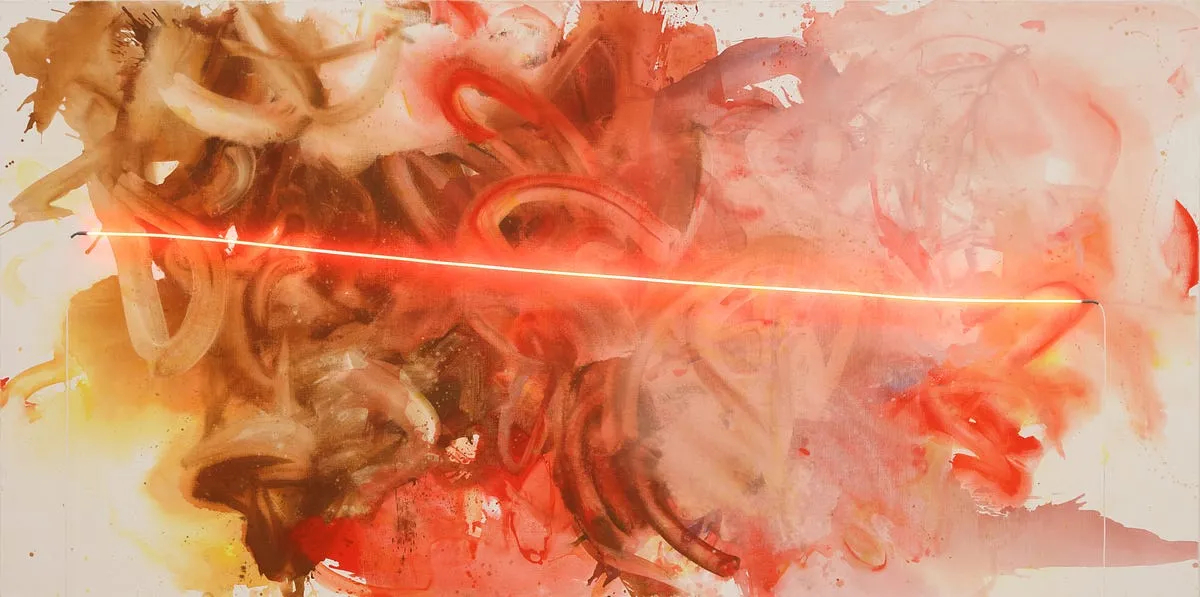
>> “Week 2 // Peace: A Stitch Pulling Tight”: “How do we do repair work in a fraying world with our own, fraying selves? What thread can stitch together all these gaping wounds?” Weichbrodt asks. She looks at Mary Weatherford’s monumental painting Gloria (new to me!), finding in the hot coral neon light blazing across the canvas resonance with Renaissance paintings of the Annunciation, which portray the Light of the World as the stitch that mends the tear between God and humanity.
Mary Weatherford (American, 1963–), Gloria, 2018. Flashe paint and neon on linen, 117 × 234 in. (297.2 × 594.4 cm). High Museum of Art, Atlanta.
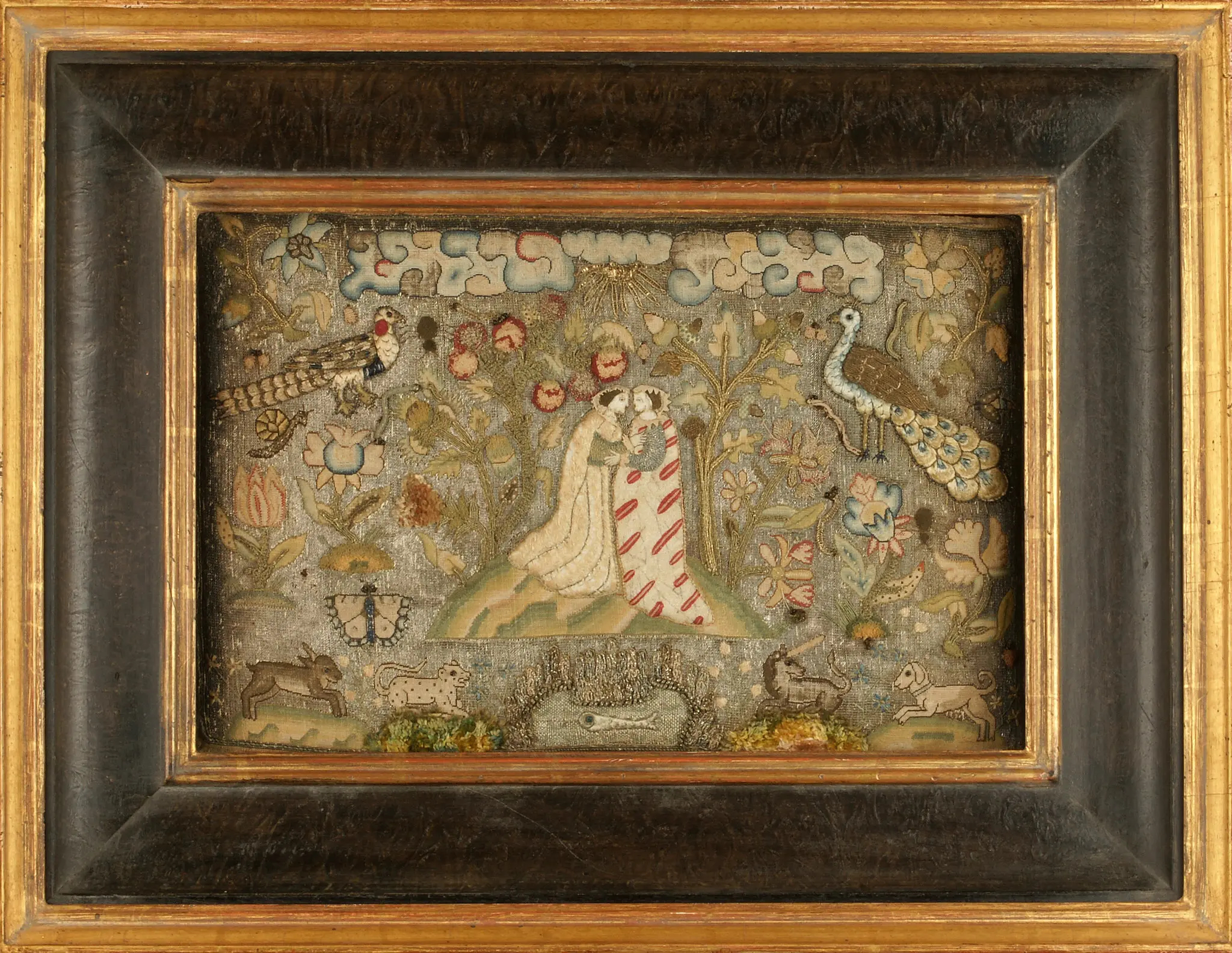
>> “Week 3 // Joy: Far as the Curse Is Found”: In this post, Weichbrodt explores nine Visitation paintings and one extraordinary embroidery. “Every time I see [a Visitation artwork],” Weichbrodt writes, “I encounter joy. It’s not that Mary and Elizabeth are always smiling. Often, their expressions are quite serious. But joy—deep, sustained, sustaining joy—circulates between them like an electrical current.” Justice, threshold, and fecundity are among the supplementary themes touched on.
The Visitation, England, first half of 17th century. Embroidery, 44.1 × 57 cm (framed). Ashmolean Museum, University of Oxford.
Weichbrodt’s final Advent 2025 post, on love, will be published this Saturday. Weichbrodt’s final Advent 2025 post, on love, will be published this Saturday. (Update, 12/20/25: Week 4’s post, “Love In Between,” is now published. It centers on Vincent van Gogh’s painting Almond Blossoms, a gift for his newborn nephew, but also spends time with a Nativity mosaic by Pietro Cavallini and a Nativity painting by Gerard David.)
+++
SONGS:
Here are four newly released Christmas songs of note: two originals, one lyrical adaptation of a classic, and a new arrangement.
>> “War on Christmas” by Seryn:Seryn’s new album is titled War on Christmas. Here’s the title track:
The refrain is:
There is a war on Christmas But it’s not the one you think It’s in the news, it’s out of mind It happens overseas Cause as we sing the hymns and songs With families by our sides There is a war on Christmas Someone’s fighting to survive
“War on Christmas” is a phrase some Christian conservatives in the US use to express their feeling of having their faith traditions attacked by the sinister forces of pluralism when people or signage greet them with a generic “Happy Holidays” instead of “Merry Christmas.” I roll my eyes big-time when I hear people complain about this, because it’s ridiculous for any American to assert that they are impeded from or ostracized for celebrating Christmas in this country, or to take offense that a stranger does not automatically assume their particular religious affiliation.
Seryn’s song affirms that yes, there is a war on Christmas—only it’s a war not against personal religious freedoms in America but against peace, love, and the other values Christ came to teach and embody. When humans wage literal wars with literal weapons, killing and maiming each other and inducing mass terror—that’s an assault against Christ’s mass, with its message of welcome and reconciliation. So, too, when we perpetuate hate, whether on personal, national, or global scales. As another Christmas song puts it, “Hate is strong and mocks the song of ‘Peace on earth, goodwill to men.’”
>> “O New Commingling! O Strange Conjunction!” by the Anachronists: The lyrics to this new song by the Anachronists [previously]—Corey Janz, Andrés Pérez González, and Jonathan Lipps—are a paraphrase from the sermon “On the Theophany, or Birthday of Christ” by Gregory of Nazianzus (ca. 329–390), one of the most influential and poetic theologians of the early church. Gregory delivered the sermon, labeled “Oration 38” in the Nicene and Post-Nicene Fathers series, at Christmastime in 380 in Constantinople, where he served as bishop. In section 13, the Anachronists’ source for the song, he expresses awe at the beautiful mystery of the Incarnation. Below is an excerpt from the public-domain NPNF translation.
The Word of God Himself—Who is before all worlds, the Invisible, the Incomprehensible, the Bodiless, Beginning of Beginning, the Light of Light, the Source of Life and Immortality, the Image of the Archetypal Beauty, the immovable Seal, the unchangeable Image, the Father’s Definition and Word—came to His own Image, and took on Him flesh for the sake of our flesh, and mingled Himself with an intelligent soul for my soul’s sake, purifying like by like; and in all points except sin was made man. . . . O new commingling; O strange conjunction; the Self-Existent comes into being, the Uncreate is created, That which cannot be contained is contained. . . . He Who gives riches becomes poor, for He assumes the poverty of my flesh, that I may assume the richness of His Godhead. He that is full empties Himself, for He empties Himself of His glory for a short while, that I may have a share in His fullness. What is the riches of His goodness? What is this mystery that is around me? I had a share in the image; I did not keep it; He partakes of my flesh that He may both save the image and make the flesh immortal. He communicates a second Communion far more marvelous than the first.
>> “Away in a Manger (Then to Calvary)” by Sarah Sparks: Singer-songwriter Sarah Sparks [previously] released a new EP, Christmas Hymns, last month, comprising five classic carols, including one with revised lyrics that further draw out the significance of the Incarnation. I’m a big fan of Sparks’s voice and her no-frills acoustic style.
Away in the manger No crib for a bed The great King of Heaven Does lay down his head The stars he created Look down where he lay The little Lord Jesus Asleep on the hay
And there in the manger The Maker of earth In riches and glory? No, born in the dirt With oxen and cattle With shepherds and sheep No stranger to weakness He loves even me
And there in the manger Is our Servant-King He sits with the lowly He washes their feet Away in the manger Then to Calvary His birth, life, and death And his raising for me
And there in the manger Is my greatest friend His mercy, his patience His grace know no end Be near me, Lord Jesus For all of my days In life and in death Till we meet face to face
>> “Angels We Have Heard on High” by the Petersens: Last Friday the Petersens [previously] released a music video—shot at Wonderland Tree Farm in Pea Ridge, Arkansas—debuting their new bluegrass arrangement of one of my favorite Christmas carols. Banjo, mandolin, fiddle, acoustic guitar, dobro, upright bass—I love the instrumentation of the bluegrass genre and what it adds here, and the Petersens are consummate performers.
Mary’s response to this announcement [of Jesus’s forthcoming birth]—her Magnificat—is even more overtly revolutionary. Her song in Luke’s Gospel is not a lullaby; it is a manifesto. She declares that the mighty will be cast down from their thrones, the lowly lifted, the hungry filled with good things, and the rich sent away empty. This is the language of redistribution, the language of a world reordered by justice rather than domination. It is no surprise that tyrants have feared this text; throughout modern history, the Magnificat has been prohibited and/or discouraged in public worship in places like Guatemala, Argentina, and India because oppressed communities used it as a rallying cry for liberation. Mary’s theology is insurgent.
What I love about Hannah and Mary is they step into God’s eternal streams of justice and of righteousness and of what it means to live as a faithful follower of Yahweh. They step into this expansive world of what God is going to do and has promised to do in the world, instead of the smaller space of their own need—which again, is OK and understandable. But they take us to places where, if we’re honest, most of our prayers don’t regularly go.
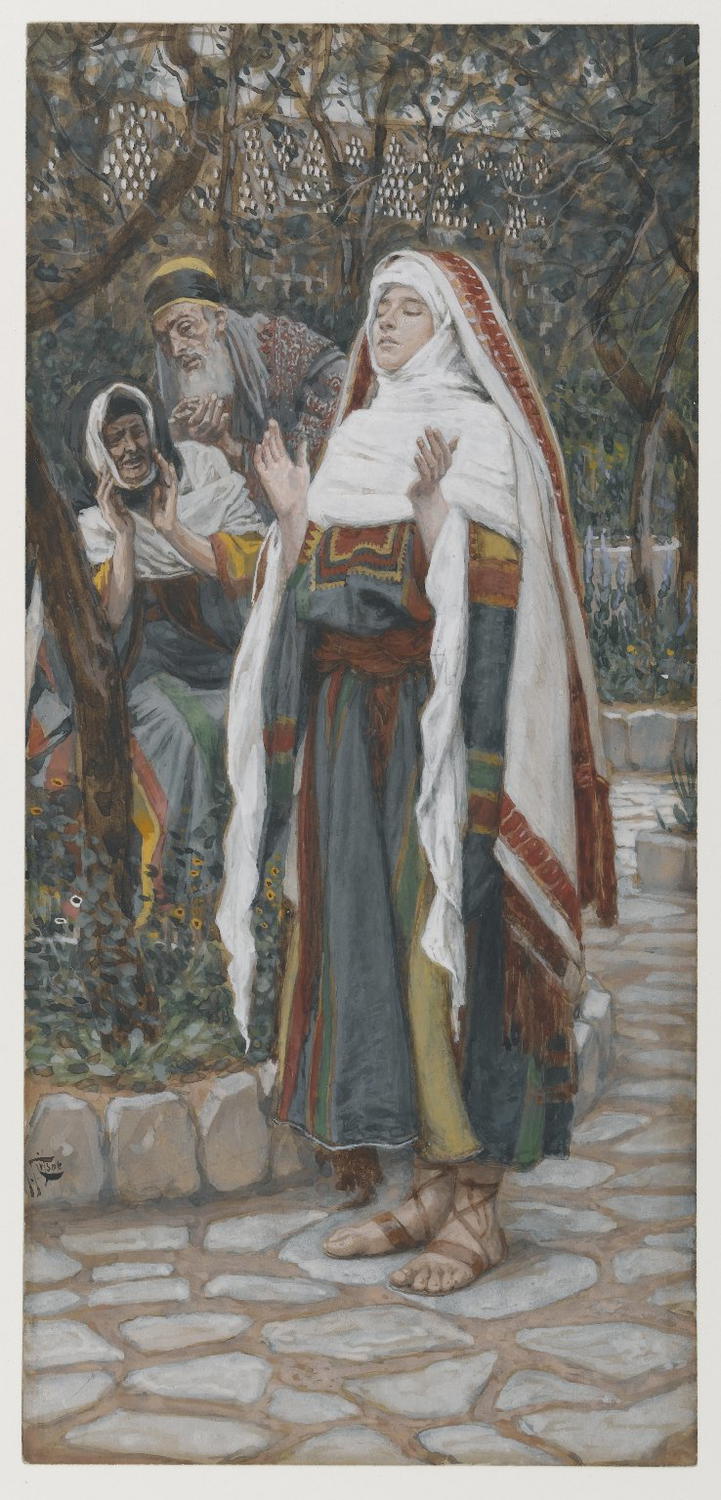
VIDEO DEVOTION:“Beholding the Magnificat with Mary Gardner”: In this “Space for God” video devotion from Coracle, Rev. Mary Amendolia Gardner, an Anglican priest with a bachelor’s degree in art history and a master’s in Christian spirituality, guides us in lectio divina (sacred reading) with Luke 1:46–55 and visio divina (sacred seeing) with James Tissot’s Magnificat.
James Tissot (French, 1836–1902), The Magnificat, 1886–94. Opaque watercolor over graphite on gray wove paper, 9 15/16 × 4 5/8 in. (25.2 × 11.7 cm). Brooklyn Museum, New York.
I typically don’t care for Tissot’s biblical watercolors, because of their illustrative quality—they remind me of pictures from the Sunday school curriculum I followed as a child. But I do like this one, which shows Mary in a position of wisdom and authority, absorbed in prayer, preparing to preach and prophesy. Elizabeth and Zechariah stand in attentive awe on the sidelines, their eyes directed toward the divine child she carries in her body while they await her words. The priest’s tongue had been tied, but Mary’s has been loosed. The Cuban American theologian Kat Armas, in the post quoted above, calls Mary “the first theologian of the Gospel,” as she boldly proclaims the messianic deliverance God has set in motion.
+++
SONGS:
>> “For Ages Women Hoped and Prayed” by Jane Parker Huber: “We join the song that Mary sings, an earthly, heavenly theme.” Performed at Wheaton Bible Church in Illinois.
>> “Mary, Did You Know”with alternative lyrics by Jennifer Henry: The original lyrics of this Gaither Vocal Band song were written by Mark Lowry in 1985, and they were set to music by Buddy Greene in 1991; the song became a popular hit. However, some Christians take issue with the rhetorical device that implies Mary did not know her son was God, that he would deliver Israel, and that he would reign forever, when that’s precisely what Gabriel told her from the beginning and what she alludes to in her Magnificat. (Defenders say these questions are most likely voiced by people in Mary’s life who didn’t know all that God had conveyed to her; or that it’s legitimate to wonder whether Mary knew the specifics that would unfold, and to suppose that even if she knew theoretically who Jesus was, she may have struggled to grasp the full scope and significance of his messiahship.)
In 2017, the Canadian theologian and activist Jennifer Henry rewrote the lyrics to center on the Magnificat and its mobilizing influence on justice movements across the globe. That song is sung here by Eric Lige, who is accompanied by Vahagn Stepanyan on piano.
>> “Magnificat” by Simon de Voil, feat. Alexa Sunshine Rose: This adaptation of the Magnificat is by Simon de Voil, a sacred musician, “interspiritual minister,” and retreat leader originally from Scotland now living in Vermont. The imagery in the video is not what I would have expected: It’s footage of bears in the woods. Perhaps it alludes to how all of creation will be redeemed in “the world that is to come”? The bears here, though, seem at peace, so maybe it’s a picture of blessedness, or of creation’s praise alongside Mary’s.
+++
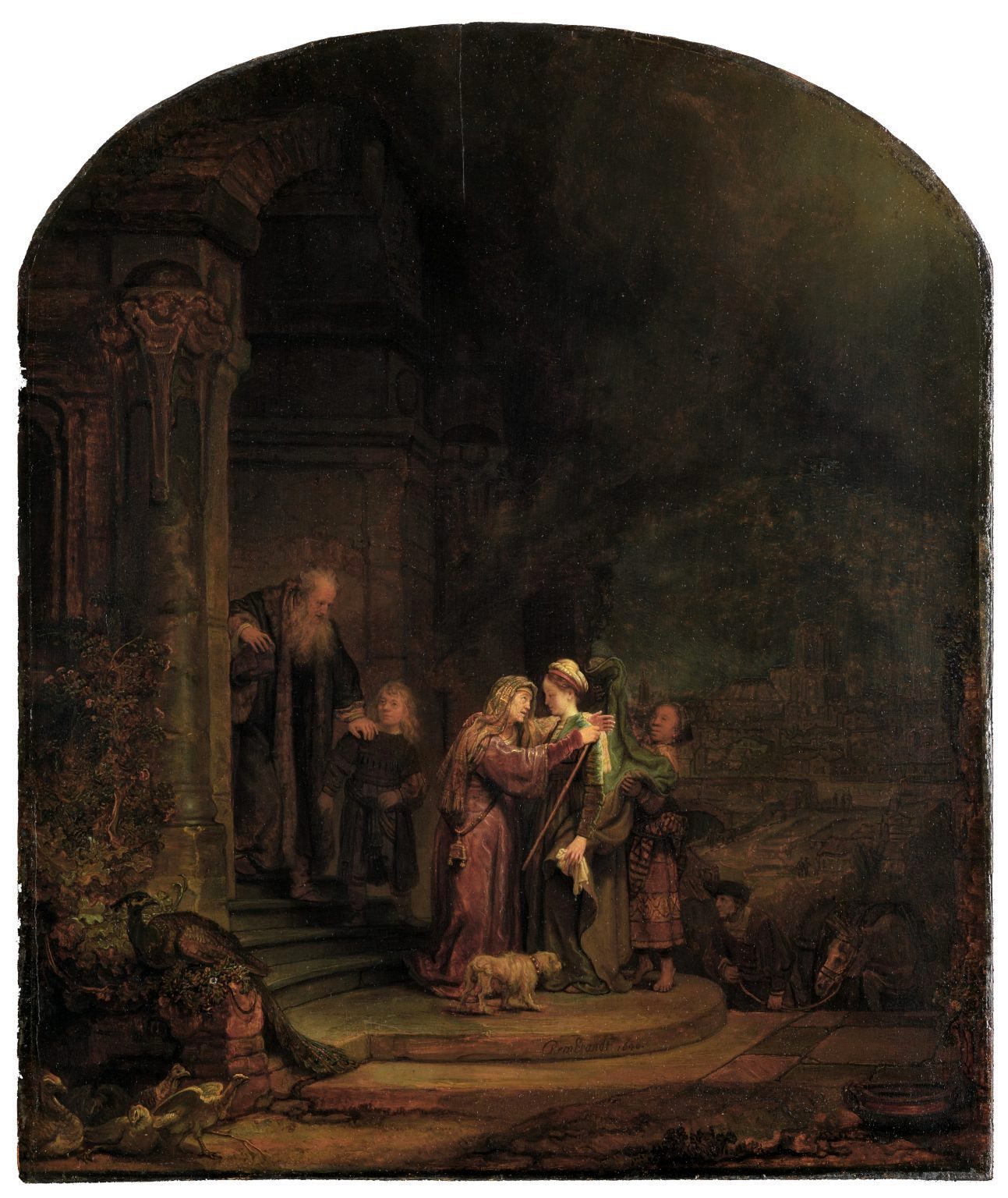
SERMON:“Liberated to See by the God Who Sees” by Wes Vander Lugt, Trinity Forest Church, Concord, North Carolina, December 7, 2025: I’m always pleased when preachers, as part of their biblical exegesis, skillfully integrate art into their sermons—not as mere illustration or decoration but as itself interpreting scripture and/or doing theological work. In the sermon he gave for the Second Sunday of Advent this year, Rev. Dr. Wes Vander Lugt [previously], an ordained Presbyterian minister and director of the Leighton Ford Initiative in Theology, the Arts, and Gospel Witness at Gordon-Conwell Theological Seminary, preached on Luke 1:5–25, 39–45, about how God sees us and liberates us to see him and others. He discusses Rembrandt’s Visitation painting, especially the artist’s use of light and shadow—Mary and Elizabeth step out of the shadows, out of a place of feeling unseen, into the light of God’s grace, says Vander Lugt, where they are known and knowing.
Rembrandt Harmensz van Rijn (Dutch, 1606–1669), The Visitation, 1640. Oil on cedar panel, 22 1/4 × 18 7/8 in. (56.5 × 47.9 cm). Detroit Institute of Arts, Michigan. [object record]
He also touches on, very briefly, James B. Janknegt’s 2008 Visitation, which shows how John the Baptist has been liberated to see Jesus, even as the two are still in utero. See 17:49–20:05.
+++
FROM THE ARCHIVE: The Magnificat is a topic I’ve covered on the blog several times over the past ten years. Here are some examples:
ONLINE DISCUSSION: “Poems of Advent, Christmas, and Epiphany” led by Brian Volck,December 13, 2025, 12–1:30 p.m. ET: Poet Brian Volck (whose work I’ve shared here and here) is leading a free online discussion on Advent, Christmas, and Epiphany poetry next Saturday. Sponsored by the Ekklesia Project, it will bring together diverse poetic styles and voices. “Each poem is read by a volunteer and then the group discusses what stood out, what struck them, and what questions the poem raises,” Volck says. “My goal is to encourage a diversity of responses rather than impose mine. No preparation is required.” Register here to receive the Zoom link and the poems in advance.
+++
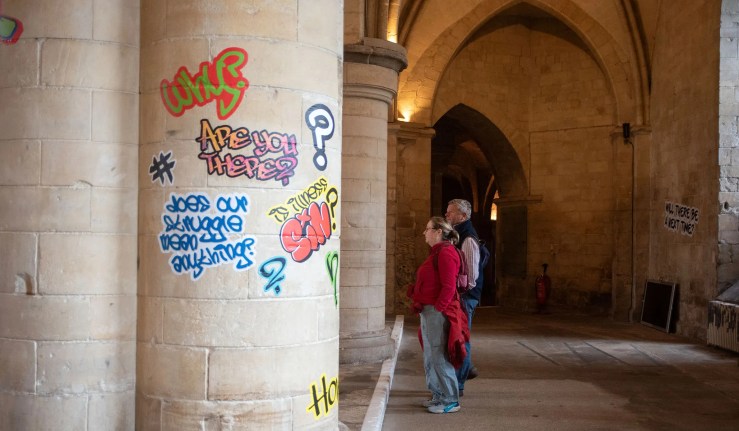
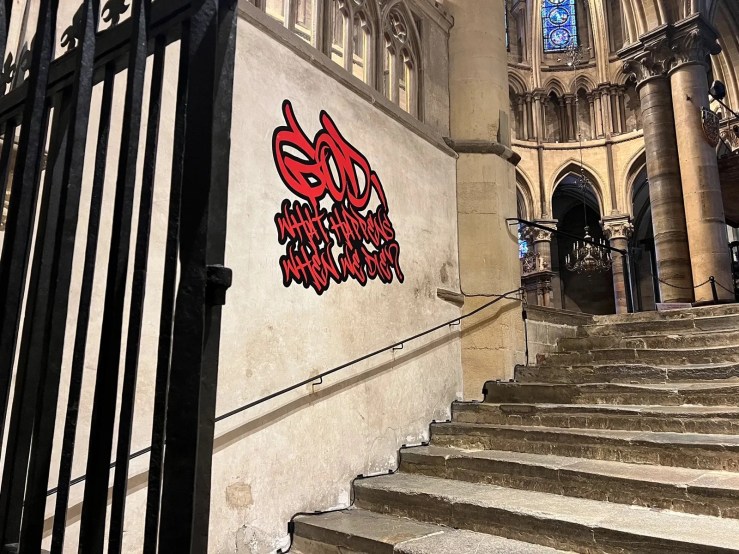
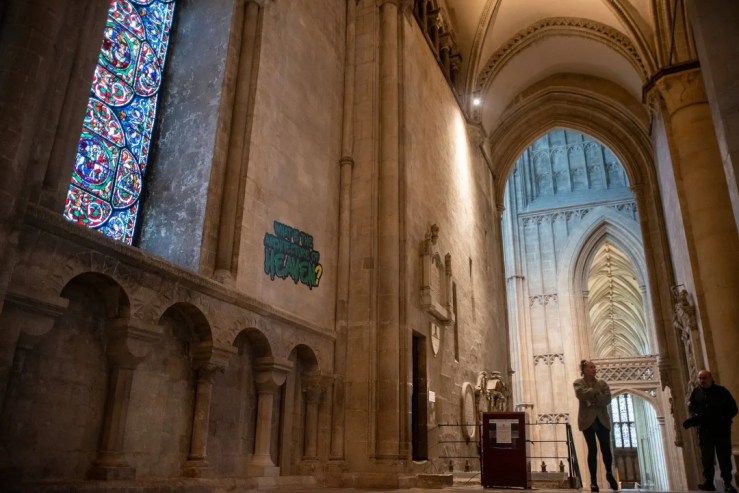
INSTALLATION: Hear Us, Canterbury Cathedral, October 17, 2025–January 18, 2026: Graffiti-style stickers are affixed to the medieval walls, floors, and pillars of England’s Canterbury Cathedral in the temporary installation Hear Us, voicing questions to God collected from local marginalized individuals, such as:
Why is there so much pain and destruction?
Is this all there is?
Are you there?
Does everything have a soul?
Do you ever regret your creations?
How do I break the cycle?
Does our struggle mean anything?
How is my dog Bear doing?
God, do you know me?
Photo: Krisztian Elek
Photo courtesy of Canterbury Cathedral
Photo: Krisztian Elek
Curator Jacquiline Creswell [previously], collaborating with poet Alex Vellis, organized a series of workshops led by artists Sven Stears, Henry Madd, Jasbir Dhillon, Adam Littlefield, Alice Gretton, and Callum Farley, which invited people who felt the cathedral was not for them to gather together and delve into discussions about their lives, experiences, and aspirations. Among the participants were members of the Black and Brown diasporas, LGBTQIA+ people, neurodivergent people, people in addiction recovery, and people with mental health disorders. They were asked to respond to the prompt “If you could ask God a question, what would it be?”
Many of the responses were then translated into big, colorful word graphics that cannot be overlooked. “All of the questions are prayers. All of the questions are already sacred,” Vellis says. “So by putting the questions into an already existent sacred space, we are saying you are valid, your words are valid, your prayers are in a place in which they can be heard and they can be seen and they can be supported.”
I learned about this installation from the Exhibiting Faith podcast’s interview with Creswell and Vellis—an episode I heartily commend. They explain how the exhibition was developed, how they persuaded the cathedral to agree to it, and how they have dealt with the storm of criticism it has generated. Many have called it an act of vandalism (even though the stickers were authorized by the dean and will leave no trace when they’re removed next month) and irreverence, desecration. US Vice President JD Vance said the exhibition “mak[es] a beautiful historical building really ugly,” and Elon Musk called it a “suiciding” of Western culture.
I have not seen the exhibition in person, and I am neither British nor Anglican, so I don’t possess the same sense of my identity or heritage being threatened that many Church of Englanders have expressed. But I personally like the confrontational clash of aesthetics: traditional juxtaposed with modern; majestic Gothic architecture, staid limestone, garishly “spray-painted” in a street style, bringing contemporary spiritual and theological questions into a nearly millennium-old church building. I also like the concept of amplifying rather than diminishing the voices of those who feel marginalized by the church but who still want to engage, who are curious—bringing their questions into the space where we gather as a community of Christ followers and using them as a portal into further faith conversations, as Creswell put it in a media interview.
+++
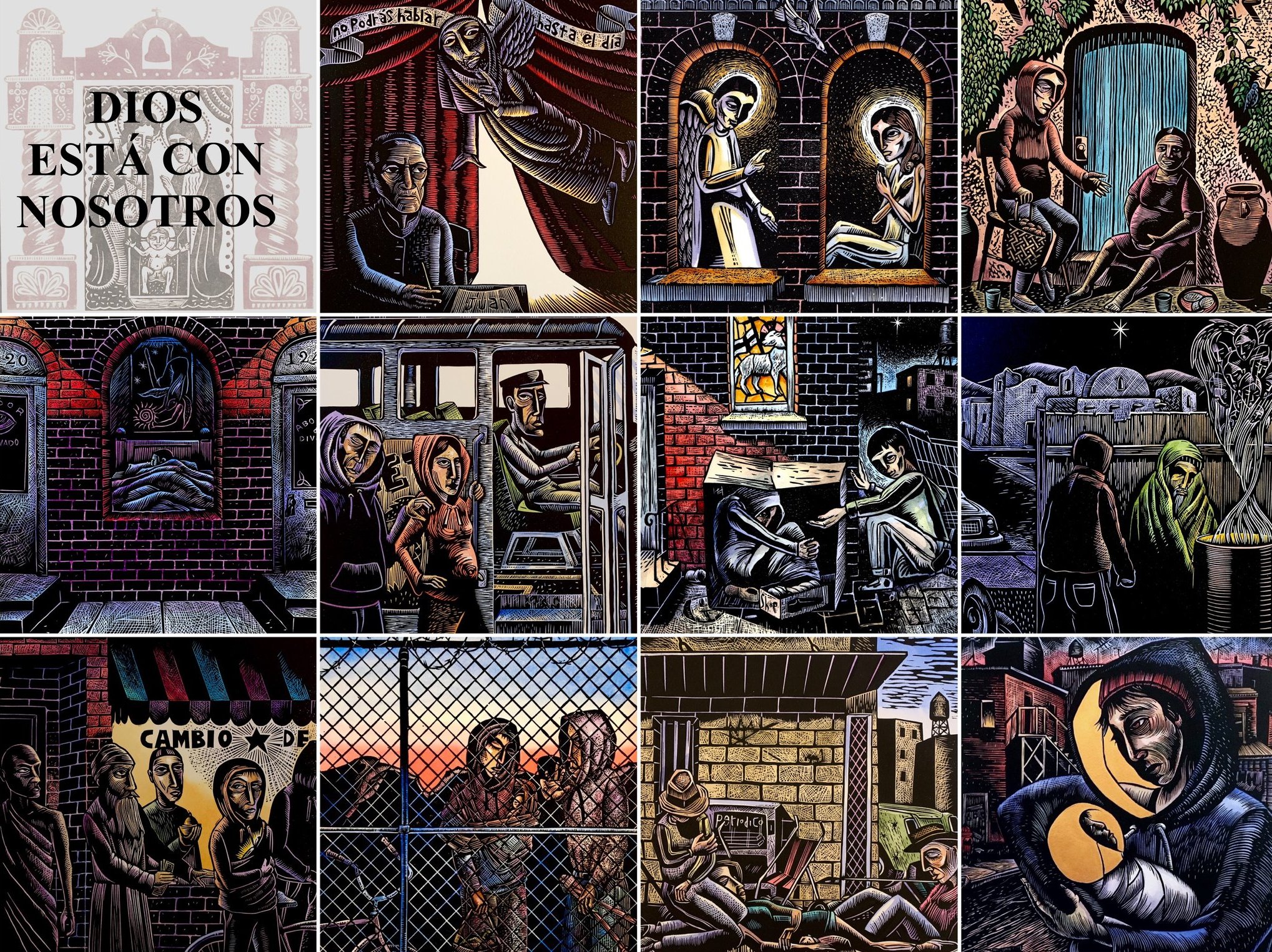
BLOCKPRINT SERIES: Dios con Nosotros (God with Us) by Kreg Yingst:Kreg Yingst [previously] is my favorite contemporary printmaker working on religious themes. Last December he shared a series of hand-colored linocut prints that he started in 2019 and that is ongoing, collectively titled Dios con Nosotros (God with Us)—“a modern-day American Christmas story which takes place somewhere south of the U.S. border,” he writes.
>> “Un Cuento de Navidad” (A Song of Christmas): This original song by Adrian Roberto and Melissa Romero is about a town that had lost its wonder—until a child discovered a Bible, and his reading aloud its story of a Savior sparked revival.
>> “What Child Is This / Child of the Poor”: The Hound + The Fox are Reilly and McKenzie Zamber, a husband-wife musical duo from Oregon. This song of theirs interleaves the classic Christmas carol “What Child Is This” by William Chatterton Dix with a 2008 song by Scott Soper that emphasizes Christ’s solidarity with the poor.
Here are the lyrics to Soper’s “Child of the Poor”:
Helpless and hungry, lowly, afraid, Wrapped in the chill of midwinter; Comes now, among us, born into poverty’s embrace, New life for the world.
Who is this who lives with the lowly, Sharing their sorrows, Knowing their hunger? This is Christ revealed to the world In the eyes of a child, a child of the poor.
Who is the stranger here in our midst, Looking for shelter among us? Who is the outcast? Who do we see amidst the poor, The children of God?
So bring all the thirsty, all who seek peace; Bring those with nothing to offer. Strengthen the feeble; Say to the frightened heart, “Fear not: here is your God!”
>> “Everybody Ought to Treat a Stranger Right”: Arranged and expanded by Dan Damon [previously], this traditional blues song is performed here by the Dan Damon Quartet, featuring guest vocalist Sheilani Alix, at a concert at Community Church of Mill Valley in California on December 10, 2023. “Blind Willie Johnson recorded this song in 1930 with two Christmas verses mixed in. I separated them out, added two verses to tell a fuller Christmas story, and recorded the Christmas version with my band on the album No Obvious Angels,” Damon explains. “According to the writer of Hebrews, some have entertained angels unawares.”
ADVENT SERIES: Restful Advent by Tamara Hill Murphy:Tamara Hill Murphy [previously] is one of my favorite spiritual writers, her thoughtful words and curation of resources having served as a well of inspiration for me over the years. Each year, similar to Art & Theology but with the sensibilities and expertise of an Anglican spiritual director, she publishes a new daily Advent and Christmastide guide through her Substack, Restful, running this year from November 30 to January 5. Each post in the series includes lectionary readings, art, music, a prayer, and a simple practice to help us notice God’s presence during these waiting days. This time around, the Daybook will feature excerpts from Claude Atcho’s new book Rhythms of Faith along with ideas from The Liturgical Home by Ashley Tumlin Wallace and some of my own formerly published art commentaries.
“The Daybook is a way to pay attention to Christ’s three arrivals—then, now, and still to come—and to walk through December with a quieter heart and a stronger hope,” Murphy writes.
Murphy is offering Art & Theology readers a 50% discount to Restful using this link, which brings the subscription cost down to $4/month (let it run for two months if you want to receive the full Christmastide Daybook) or $32/year, which will give you access to her year-round content. The offer expires January 5, 2026.
+++
BLOG POST: “The Sacred Journey of Advent” by Ashley Tumlin Wallace, The Liturgical Home: “Advent,” writes Wallace, “is a season of preparation, for the coming of Christ at Christmas, and also for His return in glory at the end of time.” This is a great introduction to the season that kicks off the new church year.
+++
SONGS:
One of the scripture texts of Advent is Isaiah 40:3–5:
A voice cries out: “In the wilderness prepare the way of the LORD; make straight in the desert a highway for our God. Every valley shall be lifted up, and every mountain and hill be made low; the uneven ground shall become level, and the rough places a plain. Then the glory of the LORD shall be revealed, and all flesh shall see it together, for the mouth of the LORD has spoken.”
The Gospel-writers Matthew (3:3), Mark (1:3), and Luke (3:4) all see this exclamatory figure as John the Baptist, who told people to prepare for God’s coming by repenting of sin, since holding on tightly to ways of unlove erects barriers to God’s entry into one’s life. Here are two songs based on this Advent passage.
>> “Prepare the Way” by Maverick City Music and Tribl, feat. Chandler Moore and Siri Worku, on Tribl I (2021): This song repeats, again and again, the Advent mantra “Prepare the way,” embedding John the Baptist’s invitation deeply into hearts and minds. Its tag beseeches Christ to come with the fire of purging, the rain of refreshment, and the oil of blessing. To welcome this coming, this transformation and growth, we need to decenter ourselves, ceding to God the place of primacy, from which he works our good and his glory.
>> “Prepare the Way” by Christopher Walker, on Rise Up and Sing, 3rd ed., vol. 3 (2009): This 1991 song is by Christopher Walker, a church music composer, lecturer, and choral conductor originally from the UK but now living in Santa Monica, California. Published by OCP (Oregon Catholic Press), it would make a great song for a children’s Advent choir.
+++
2018 SERIES: Advent Caravan: Walking with the Holy Family by Sarah Quezada: I learned about Sarah Quezada’s work at the intersection of faith, justice, and culture through Tamara Hill Murphy (see first roundup item) in 2018, when Quezada published a five-part series reflecting on the likelihood that Mary and Joseph traveled to Bethlehem for the census not alone but in a caravan. Interweaving personal story, biblical interpretation, and current events, Quezada considers how the holy couple’s experience in the final months of Mary’s pregnancy connects to the reality of people on the move seeking hope, peace, joy, and love today.
While the series is not hosted online, I received permission from Quezada to reproduce it here.
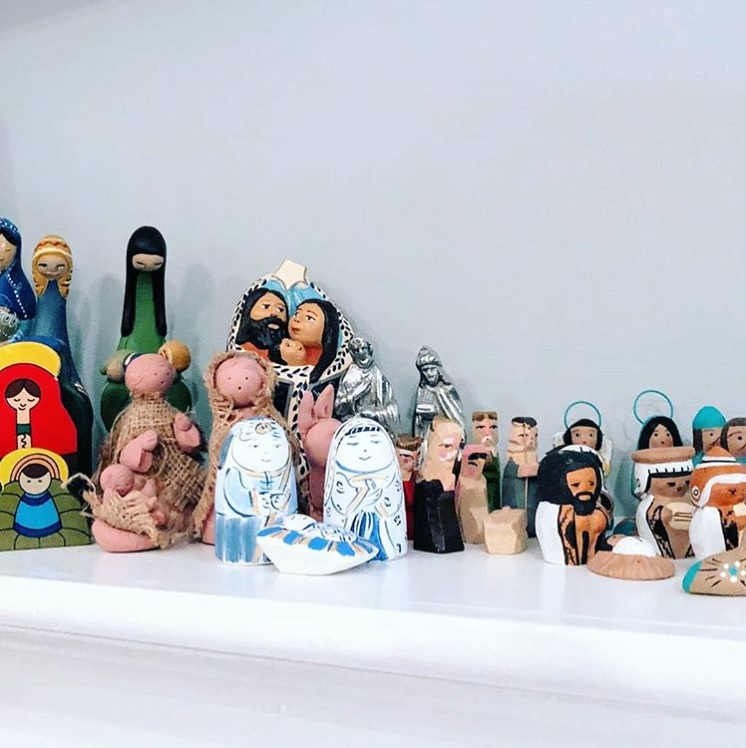
On Instagram, Quezada also shared a photo of her friend’s Advent mantel, where she combined figurines from her various nativity sets to form a “caravan” of travelers.
Photo via @sarahquezada
+++
YOUTUBE PLAYLIST: Jouluradion Hoosianna: Jouluradio is a Finnish radio station that broadcasts annually from November 1 to January 6, playing all Advent and Christmas music. Since 2012, every year they premiere a new arrangement and video performance of the popular Scandinavian Advent hymn “Hoosianna” (Hosanna, an Aramaic expression meaning “Save now!”), which Lutheran and Catholic churches in Finland sing on the first Sunday of the season. Based on Matthew 21:9, its lyrics greet the approaching Christ, affirming his identity and craving the deliverance only he can bring:
Hoosianna, Daavidin Poika,
kiitetty olkoon hän!
Kiitetty Daavidin Poika,
joka tulee Herran nimeen.
Hoosianna, hoosianna,
hoosianna, hoosianna!
Kiitetty Daavidin Poika,
joka tulee Herran nimeen.
Hosanna, Son of David,
Most blessed Holy One,
Hosanna, Son of David,
Who comes in the name of the Lord!
Hosanna, hosanna, hosanna
In the highest!
Hosanna, Son of David,
Who comes in the name of the Lord!
This hymn was written by the German composer, educator, and piano and organ virtuoso Georg Joseph Vogler in 1795 while working in Sweden as court conductor as well as tutor to the crown prince Gustav IV Adolf.
The Jouluradio commissions, which the station has compiled in a YouTube playlist, encompass a range of genres, including jazz, hip-hop, choral, pop, and electronic. Below is a list of previous years’, of which I’ve embedded the two asterisked ones on this page. Jouluradio typically releases their annual “Hoosianna” the day before Advent, so 2025’s will likely be posted this Saturday. [HT: Gracia Grindal]
*2015: Sointi Jazz Orchestra, arr. Jukka Perko (I don’t really understand the narrative in the video. I think the man is remembering a time in his childhood when he got lost in the woods, and then was found by his mother?)
BLOG SERIES: Three excellent, brief musings on the season of Advent by W. David O. Taylor, published last year on his blog:
“Advent is for singing not-Christmas songs”: “This is, of course, easier said than done. Hymnals fail to supply a decent list of options and congregants often clamor for the ‘traditional’ carols, the songs of triumphant appearance and glorious coming. Yet this insistence fights against the dominant concern of the Gospels. Luke especially spends the bulk of his story anticipating Christ’s birth rather than narrating his arrival. The dramatic tension lies in what’s to come—not in what’s happened already . . .”
“Advent is about the goodness of divine interruptions”: “The entire story of Advent is a story of interruptions. . . . May we, like the actors in God’s divine nativity drama, have eyes to see and hearts to welcome his interrupting work in our lives. May we trust that he wills our deepest good in these interruptions. May we be blessed in our trust in him.”
+++
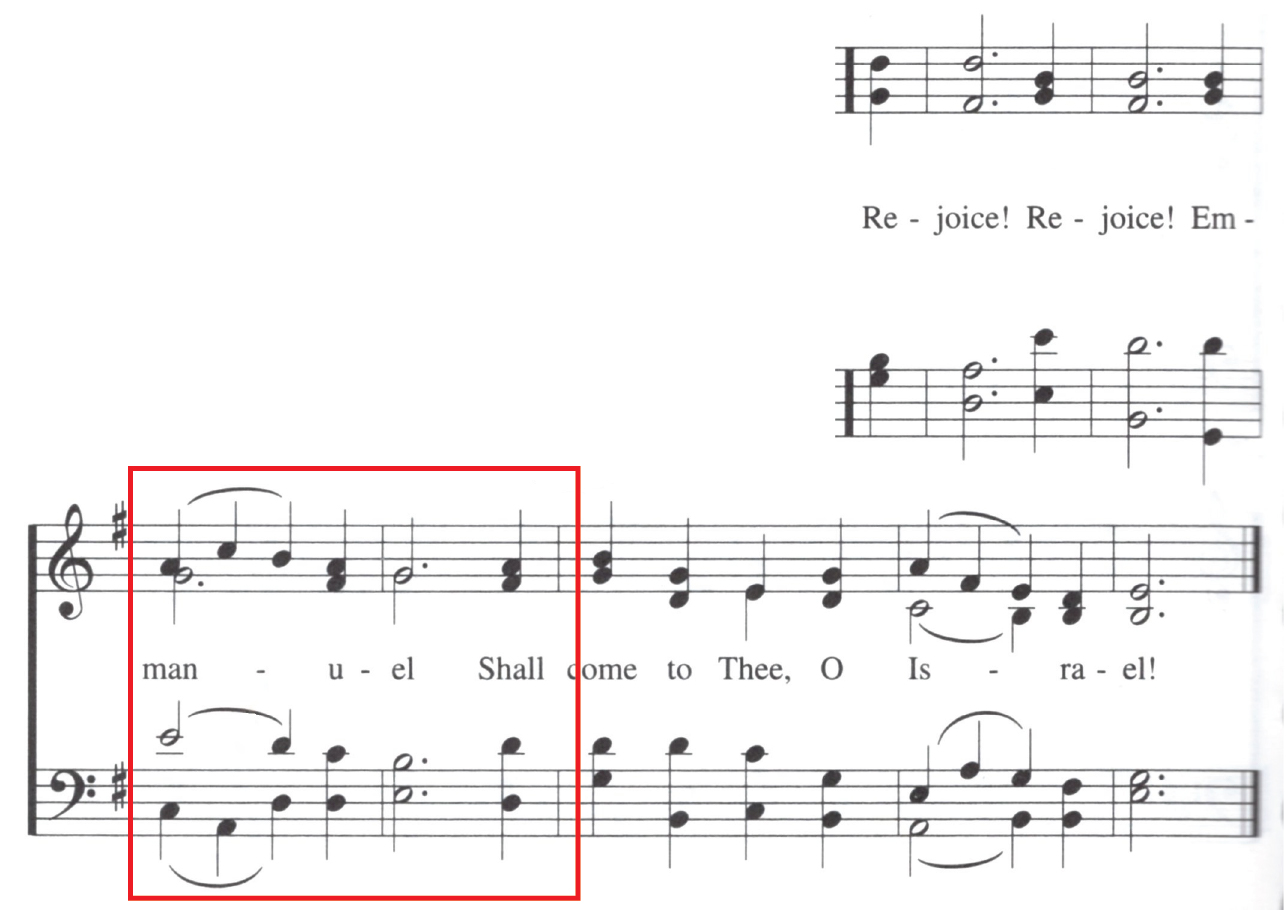
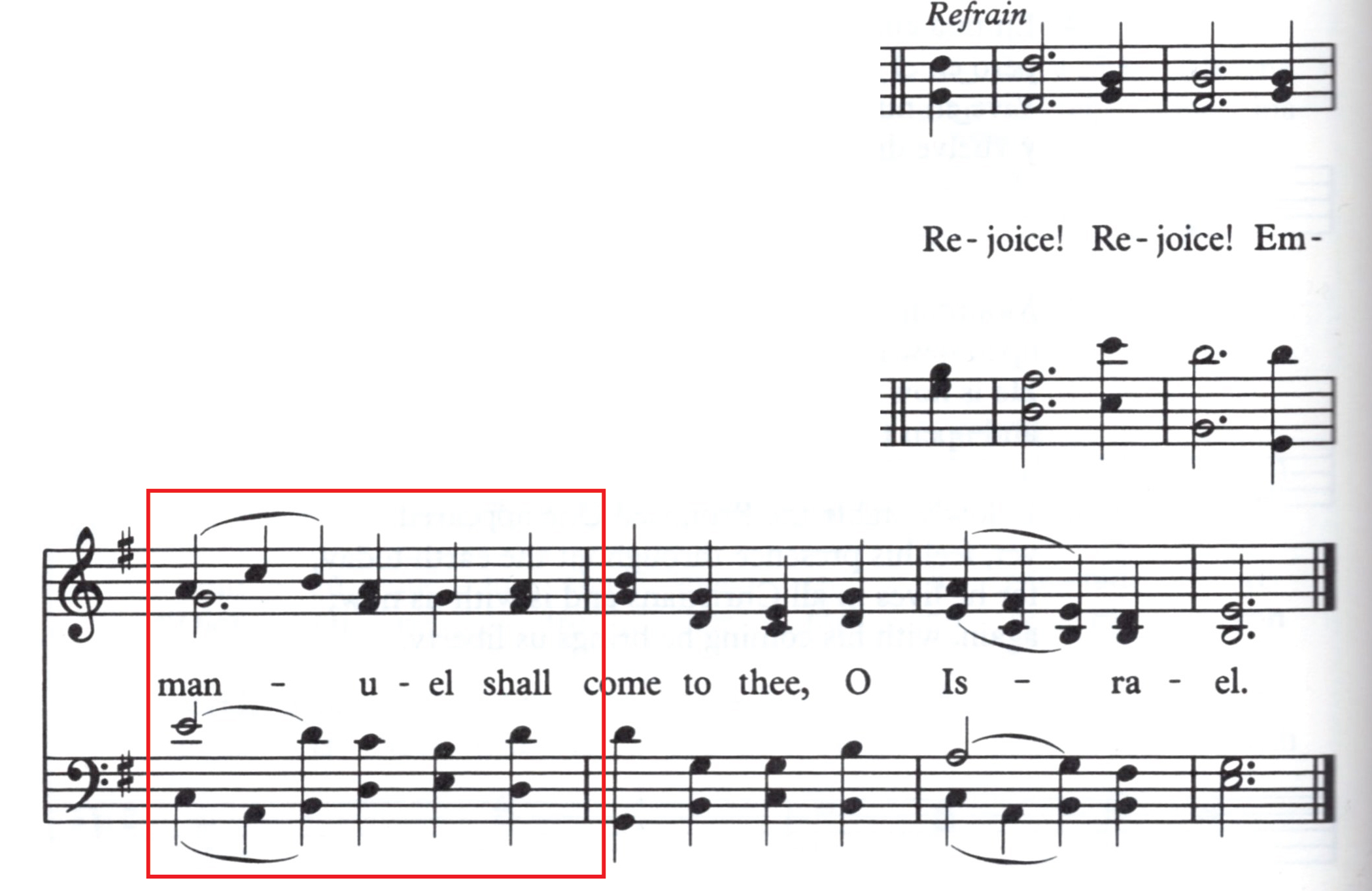
ESSAY: “O Come, O Come, Emmanuel: Dark Good News” by Linda Gregerson, Image: Poet Linda Gregerson reflects, in prose, on the quintessential Advent hymn, which dates back to the Middle Ages. She grew up singing it in her Methodist church every December. “It’s ironic, really—it quite betrays me—to realize that I must have loved this hymn for its whiff of the monastery: chalice and incense smuggled in by way of the minor chord. There’s a moment, a breathtaking moment, when the meter defies expectation. Everything has been steady-as-you-go, four-four time, all quarter notes and dotted halves. But during that remarkable refrain, just when you expect to dwell on the last syllable of the holy name for a count of three, as every verse before this has prepared you to do, the hymn leaps forward and anticipates itself by half a measure. No breath, no stately pause: Emmanuel / Shall come to thee, as though rushing to arrival. Those missed beats never fail to stop my heart.”
I didn’t know what Gregerson was talking about until I looked up the notation in TheUnited Methodist Hymnal no. 211, and sure enough, in measure 15 there are two extra beats. In all the other hymnals I have (and all the recordings of the song I’ve heard), that measure is divided into two and the regular meter sustained, with “el” held out for three beats. Interesting! It does feel unnatural to me to sing it the way she suggests, but she offers a compelling theological reason for why the arranger made that decision.
This is the standard way (as far as I’m concerned) of singing “O Come, O Come, Emmanuel.” Sheet music excerpt from Majesty Hymns, the hymnal of my youth.Sheet music excerpt from The United Methodist Hymnal, showing the unusual (but significant, Gregerson claims) shift from 4/4 meter to 6/4 in one of the measures of the refrain
Here’s an example of a congregation (First United Methodist Houston) singing the refrain the way Gregerson so fondly remembers:
+++
NEW BOOKS:
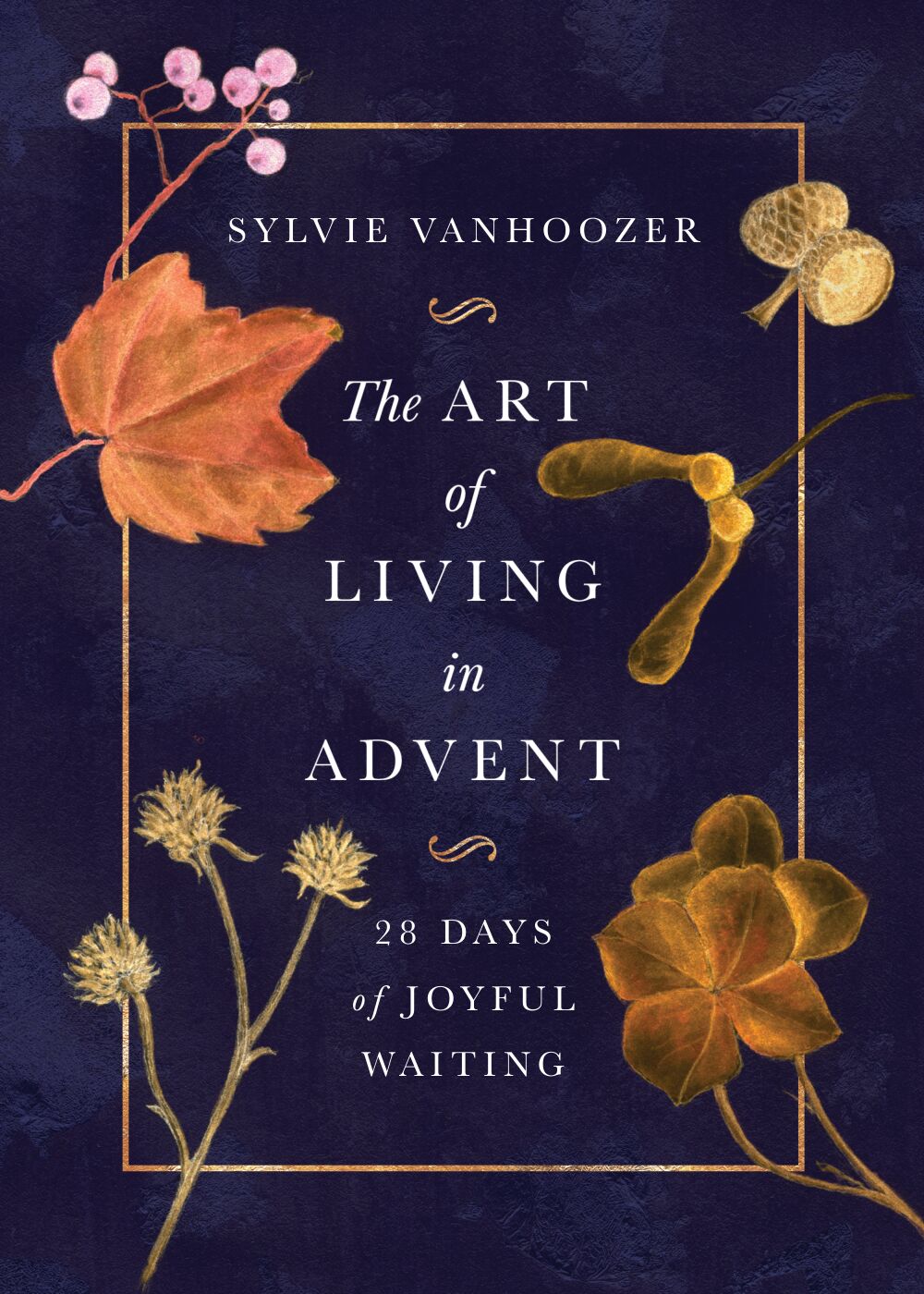
>> The Art of Living in Advent: 28 Days of Joyful Waiting by Sylvie Vanhoozer: A retired French teacher and a botanical artist, Sylvie Vanhoozer was born and grew up in Provence and now lives in Illinois with her husband, the theologian Kevin Vanhoozer. In this little illustrated book, she introduces readers to the tradition of Provençal crèches, localized nativity scenes populated by santons (“little saints”). Made from the land’s clay, the santons resemble nineteenth-century villagers, who offer up gifts from their vocations—olives, bread, wine, wood, sheep, hurdy-gurdy music, herbal remedies. (Reminds me of the presepe from southern Italy that I encountered some years ago!) The crèches are also traditionally decorated with native vegetation, such as thyme, juniper, lavender, and rosemary, freshly harvested on the first weekend of Advent. This is one of the ways in which Provençals embrace Christ’s presence in their own time and place.
“I am not inviting readers to leave their place and go to some distant land in a distant past,” Vanhoozer writes. “The invitation is rather to transpose this Provençal scene into one’s own place, to live the same story in a different context. . . . The question is not ‘Did Jesus really come to Provence?’ but rather ‘Could Jesus really come here, to me?’ Could my home, my neighborhood, my church, become a crèche scene, with Christ right here beside me, in me?”
I think this book would have worked better as a literary essay, as it feels padded out to make its ninety-page count, with redundancies and somewhat arbitrary divisions. But I love how Vanhoozer draws us into this cherished and still-living tradition from her childhood and calls us to see and participate in the story of God’s coming where we live, in all its particularities.
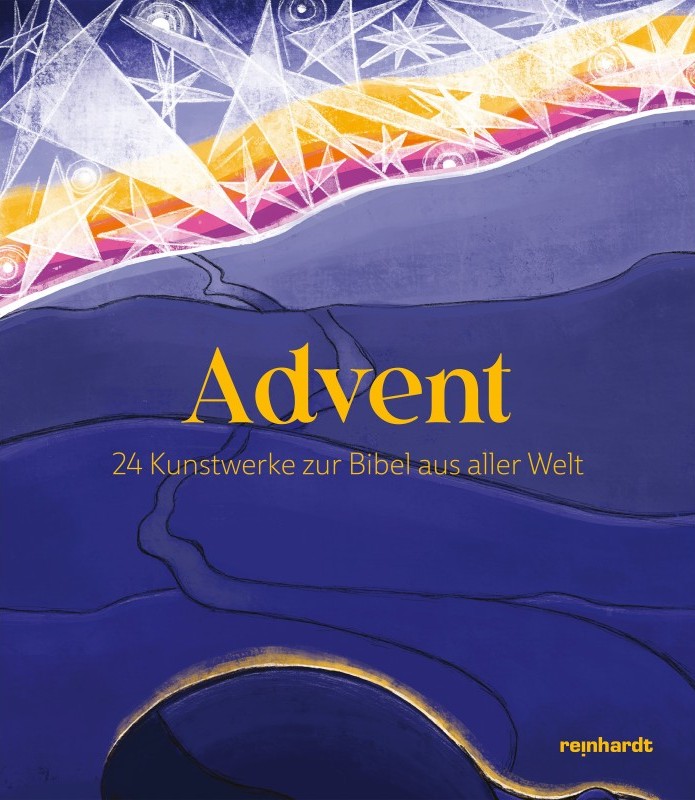
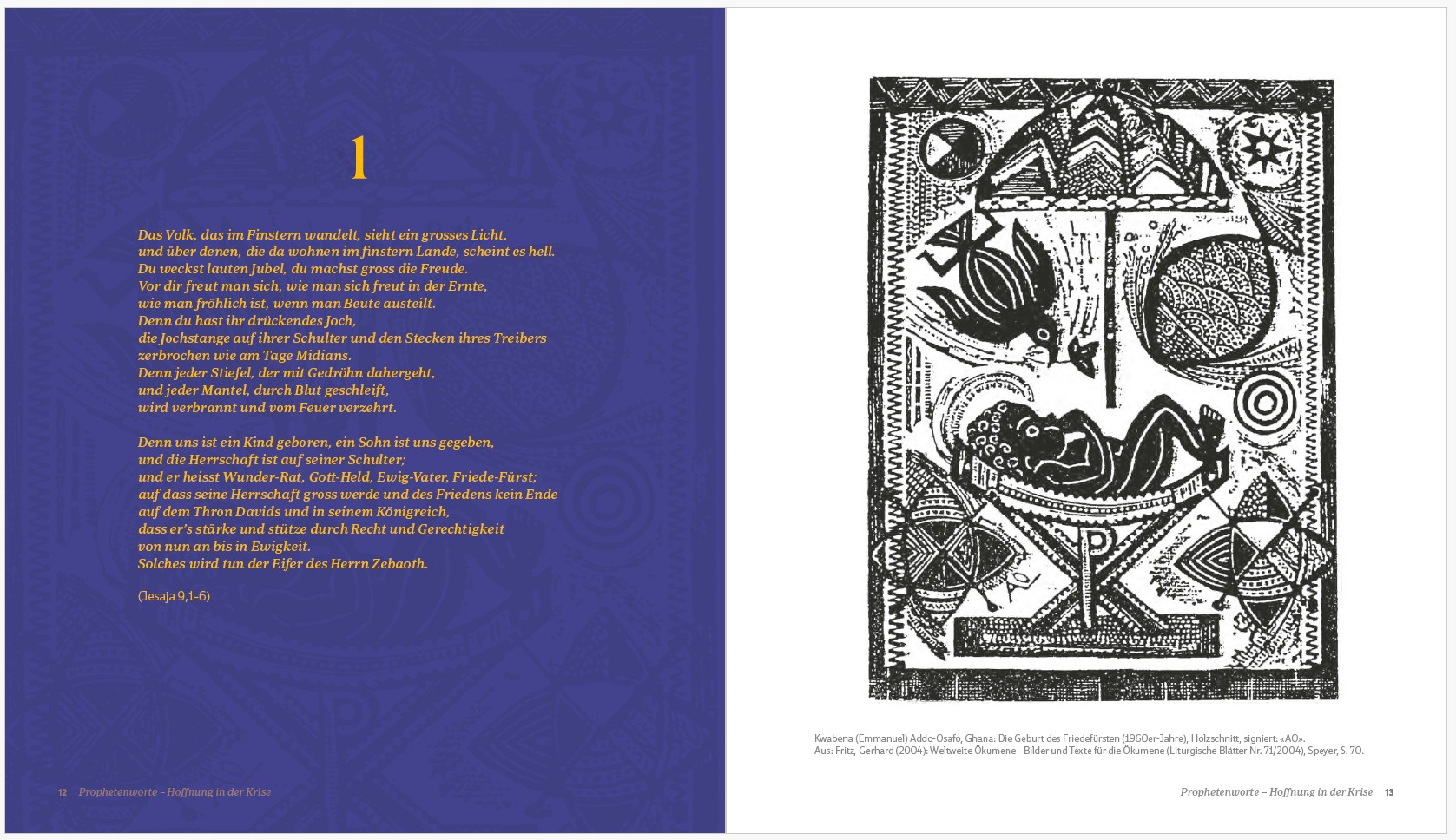
>> Advent: 24 Kunstwerke zur Bibel aus aller Welt by Christian Weber: Rev. Dr. Christian Weber [previously] is the director of studies for Mission 21, an international mission agency of the Protestant Reformed Churches in Switzerland. His work brings him into contact with religious art from diverse parts of the globe. I’m delighted by this new (German-language) book of his, whose title translates to Advent: 24 Bible-Inspired Artworks from Around the World. Organized into four parts (“Words of Prophecy,” “Parables of Jesus,” “John the Baptist,” and “Mary”) and printed in full color, the book features twenty-four primary artworks (plus some supplementary) from twenty-two countries, providing background on and interpretations of each, as well as information about the artists and a bibliography.
Sample page spread from Advent: 24 Kunstwerke zur Bibel aus aller Welt, showing a woodcut by the Ghanaian artist Kwabena (Emmanuel) Addo-Osafo
A church mural from Zimbabwe, a kalamkari from South India, a gourd carving from Peru, a manuscript illumination from Armenia—these are among the artworks Weber highlights. Some of the works are of higher quality than others, but the emphasis is on how the scripture texts of the Advent season have prompted artistic responses in a variety of places outside Europe, which is the continent that has most shaped the popular imagination when it comes to the biblical story. Weber’s Advent encourages us to widen those imaginations. Despite my fifteen or so years spent researching global Christian art, Weber is always bringing new artists to my attention! You can view sample pages from the book on the publisher’s website.
The cover image is a detail of For Those in Darkness by the American artist Lauren Wright Pittman.
Weber is looking for a North American publisher to release an English-language edition of the book.
+++
ARTICLE/VIDEO: “Five Films to Help You Observe Advent” by Abby Olcese, Think Christian: Abby Olcese, author of Films for All Seasons: Experiencing the Church Year at the Movies, provides five movie suggestions for Advent, corresponding to the themes of Hope, Faith, Joy, Peace, and Christ. (Other churches and families, like mine, substitute “Faith” with “Love” on their Advent wreaths; Olcese’s fifth pick, for Christmas Eve, would fit the “Love” theme perfectly, but see also my suggestion below.) You can read the content as an article or watch it in video format, which includes a few film clips:
ALSO: Allow me to add one of my own suggestions: American Symphony, a 2023 documentary about musical artist Jon Batiste, whose meteoric rise to fame coincided with the return of his partner Suleika Jaouad’s leukemia. Directed by Matthew Heineman, the film follows a year in the life of the married couple, as Batiste prepared for the premiere of his boundary-breaking American Symphony composition at Carnegie Hall in September 2022 while Jaouad endured chemotherapy. It has a very Advent-y feel, by which I mean its calling on God in the darkness (Batiste is a devout Christian) and its orientation around faith, hope, and love. It’s a beautiful, intimate portrait of a marriage, of creativity, courage, and care.
+++
ART: Advent Wreath by Beach4Art: Beach4Art is a family of four who create beach art inspired by beautiful nature in Devon, UK. (Follow them on Facebook, Instagram, or TikTok, and see their Etsy shop.) Below are some photos of the Advent wreath they made out of twigs, stones, and shellson Sandymere beach for the first Sunday of Advent in 2023.
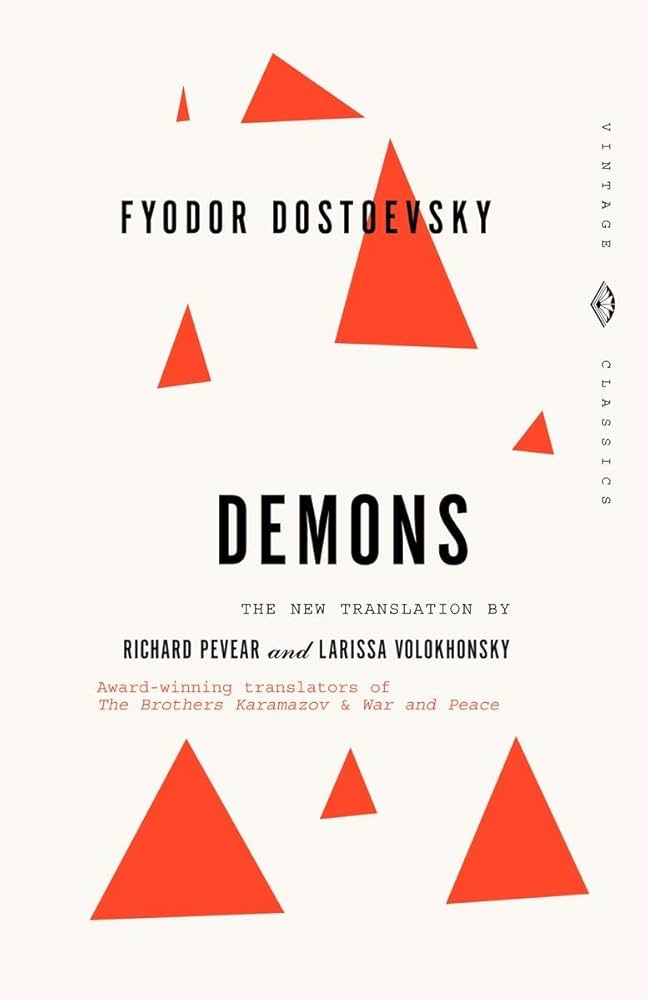
ONLINE COURSE: Studying the novel Demons by Fyodor Dostoevsky with Brian Zahnd, January 3–March 9, 2026: This ten-week online course led by Pastor Brian Zahnd (a Christian writer and preacher I admire) will explore Dostoevsky’s “darkest and most prophetic novel”: Demons (aka The Possessed or The Devils), a social and political satire, psychological drama, and large-scale tragedy inspired by the true story of a 1869 political murder in Russia. The course sounds intriguing to me, and I’m contemplating whether I can invest the time in a seven-hundred-page book—but I did buy a copy just in case! It’s the only one of the literary master’s four novels I haven’t read.
“Dostoevsky’s Demons changed me,” Zahnd writes on Substack. “From it I learned the danger of giving oneself to an ism instead of to Christ. Isms are idols and they often become demonic. Admittedly Demons is a difficult novel, but it’s also prophetic and timely. . . . As you read Demons, expect to be horrified, but also expect to laugh—you are meant to. During the course we will be horrified and warned, but we will also laugh and learn together.”
The live Q&As will take place the first ten Mondays of 2026 at 5 p.m. CT (6 p.m. ET).
+++
SEMINAR (VIDEO):“How to Watch a Movie (as a Christian)” with Chris Retts and Morgan Jefferson: On his FootnotesSubstack, historian Jemar Tisby recently hosted a teach-in with two team members from the Los Angeles Film Studies Center, a nonprofit educational program designed to give undergraduate students at Christian colleges and universities meaningful experience in the film industry during a semester “abroad” in Los Angeles. Chris Retts is the director of the center, and Morgan Jefferson is an instructor.
Before discussing how to watch a movie, they discuss why Christians should watch movies in the first place, beyond the obvious (enjoyment):
Because general revelation can happen anywhere, even at the movies (Rom. 1:20).
Because movies generate empathy, which is central to the greatest commandment (Matt. 22:37–40).
Because every movie has a theology, and media literacy makes it conscious and discernable (1 John 4:1).
They also discuss the four modes of meaning that filmmakers work with; cinematic language; and four steps for exegeting (“drawing out”) a film.
How does film relate to Dr. Tisby’s work at the intersection of faith, history, and justice? He has written for years about the dangers of white Christian nationalism. He says adherents of that ideology, or any, are not evaluating a list of propositions but are buying into a narrative; and “you can’t meet a narrative with logical reasoning,” he says. “You have to invite them into a counter-narrative—a more beautiful story.” Story is why he’s interested in film, as film is an engaging, and probably the most popular (in the US), storytelling medium. “Stories shape our sense of what’s true, what’s possible, and who belongs. That’s as true for political movements as it is for movies.”
DOCUMENTARY SHORT: The Quilters (2024), dir. Jenifer McShane: This thirty-minute documentary on Netflix follows a group of men in a maximum-security prison in Missouri who design and sew custom quilts for children in foster care using donated fabrics and old machines. They care deeply about the quality of their work—they’re proud of what they make—and are emotional about the recipients, some of whom send thank-you cards. The film is about creating beauty and meaning within strict confines, not letting destructive choices from your past stymie you from making constructive ones in the present.
+++
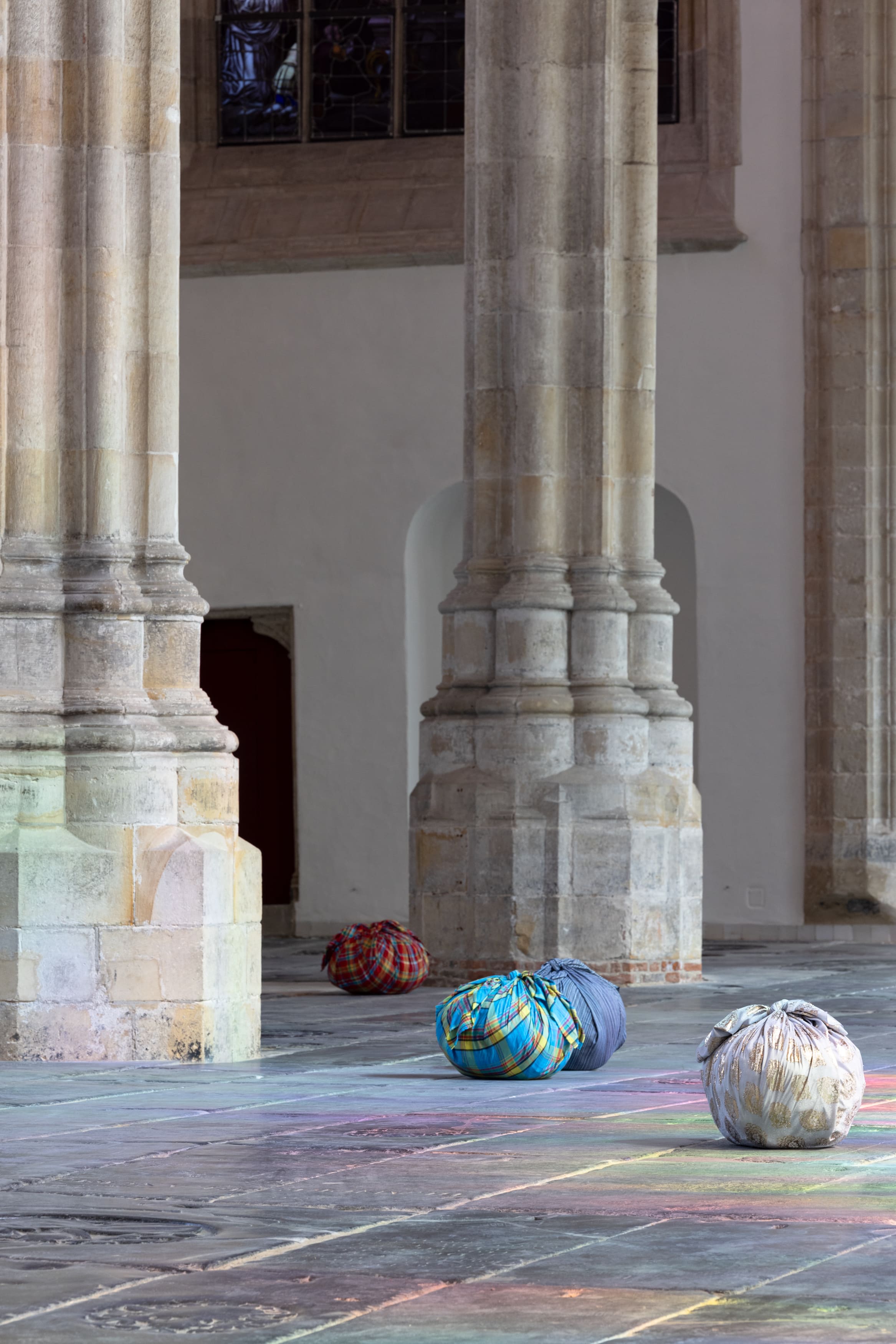
TEMPORARY INSTALLATION: To Breathe—Mokum by Kimsooja, Oude Kerk (Old Church), Amsterdam, May 23–November 9, 2025: Sorry I didn’t get this out while the installation was still up (it wrapped on Sunday), but please do explore the photographic documentation. Kimsooja’s To Breathe—Mokum explores themes of migration, belonging, and the transient nature of home; the Yiddish word in its subtitle means “safe haven.” “At the work’s heart are Kimsooja’s iconic bottari—colorful textile bundles inspired by traditional Korean wrapping cloths,” designboom writes. “Spread across the [medieval] stone floor of the church, these bundles are filled with clothing donated by members of Amsterdam’s diverse communities. Each piece of clothing represents the lives and stories of the people who contribute to the city’s rich multicultural fabric. These textile bundles serve as symbols of both personal and collective journeys, embodying the arrival and departure of individuals who have shaped the identity of the city” over its 750 years.
Kimsooja (Korean, 1957–), To Breathe—Mokum (partial view), 2025. Site-specific installation at Oude Kerk, Amsterdam. Photo: Natascha Libbert.
+++
POEMS:
>> “On the Staten Island Ferry” by A. E. Stallings, Plough, July 1, 2025: Liberty is an American ideal—but for many in this country, an illusory one. Riding in New York Harbor with a boatload of commuters and tourists, Stallings lets settle what a young girl, pointing to the Statue of Liberty, exclaims.
>> “The Pillar of Cloud and Fire”by Anna A. Friedrich, Monafolkspeak (Substack), October 29, 2025: The poet reflects on her confusion as a child about this manifestation of God from the Old Testament, which leads her to surprising insights.
Among this month’s thirty spiritual songs of note are three by Indigenous artists of Turtle Island (North America):
>> “Ambe Anishinaabeg” from Cree composer Andrew Balfour’s Nagamo project, which explores the intersections of Indigenous song and Anglican choral music. The Ojibway text of “Ambe Anishinaabeg” was gifted to Balfour by Cory Campbell: “Ambe Anishinaabeg / Biindigeg Anishinaabeg / Mino-bimaadiziwin omaa” (Come in, two-legged beings / Come in, all people / There is good life here). On the album (and the playlist), the text is set to the “Gloria in excelsis Deo” by the late English Renaissance composer Thomas Weelkes; but in another iteration, captured in the following video, Balfour pairs the text with the music of William Byrd’s “Sing Joyfully” (itself a setting of Psalm 81:1–4). (Balfour has also written original music for Campbell’s text.) See the third roundup item for more about Nagamo.
>> “Jesus I Always Want to Be Near to You,” a solo by Doc Tate Nevaquaya (1932–1996) on Native American flute. Nevaquaya, who was Comanche, played an important role in the revival of the Native American flute in the 1970s, expanding the repertoire and playing techniques. This instrumental is one of twelve from the album Comanche Flute Music, originally released in 1979 by Folkway Records, which also includes Nevaquaya’s adaptations of non-Comanche flute melodies, his own compositions, and one piece by his son Edmund. As he states in his introduction to this track, “Jesus I Always Want to Be Near You” is an original Christian hymn written by the Comanche people. I couldn’t find the lyrics, but to listen to some more Comanche hymns, with words, see this video by Comanche Nation tribal members Anthony Nauni and Chad Tahchawwickah, and this recorded gathering at Lawton Indian Baptist Church in Oklahoma.
>> “naká·yè·ʔr sihskę̀·nęʔ (may it be that you have peace)” by Tuscarora singer Jennifer Kreisburg, a song of blessing from the new Yo-Yo Ma EP Our Common Nature. According to Sony Classical, the song expresses “hope for a future where humanity and nature coexist in harmony.” I just started listening to the album’s wonderful companion podcast, for which four of the seven episodes have been released.
+++
Also for November: See my Thanksgiving Playlist [introduction], comprising a hundred-plus songs of gratitude, with a few recent additions at the bottom; and my Christ the King Playlist [introduction], which I made for the final feast of the church year, celebrated Sunday, November 23, this year.
+++
ALBUM: Nagamo by Andrew Balfour: In May and June 2022, the Vancouver-based vocal ensemble musica intima teamed up with composer Andrew Balfour to create Nagamo (Cree for “sings”), a concert and CD recording that reimagines the Anglican choral tradition through an Indigenous lens. A child of the Sixties Scoop, Balfour was born in 1967 in the Fisher River Cree Nation near Winnipeg but at six weeks old was forcibly removed from his birth family by child welfare authorities of Manitoba and adopted by white parents. He says his childhood was happy, and that he was fortunate to have been put in a men and boy’s choir from a young age, where he received a musical education and international travel opportunities; but of course, the sudden rupture from his culture of origin left wounds.
With Nagamo, Balfour seeks to bring together his identities as Cree and as the son of Anglicans of Scottish descent, who raised him in the church (his father was a minister); his love of Renaissance choral music, much of which voices polyphonic praises to the God of Abraham, Isaac, and Jacob, and an Indigenous spiritual sensibility. The album comprises two original compositions (including one in Scots Gaelic), five Renaissance songs retexted (not translated) in Cree or Ojibway, and five unaltered works by William Byrd and Alfonso Ferrabosco. “The concept mines the fantastical question of what might have happened musically should Indigenous and European musics and cultural expressions come together in a manner collaborative and respectful, rather than divisive,” writes music journalist Andrew Scott for The WholeNote.
Examples of the adaptations include “Four Directions,” a recitation in Ojibway of the four cardinal directions—Ningaabiianong (West), Giiwedinong (North), Wabanong (East), Zhaawanong (South)—set to Thomas Tallis’s “Te lucis ante terminum” [previously], a prayer for protection through the night. And “Ispiciwin” (Journey), whose musical basis is Orlando Gibbons’s “Drop, drop, slow tears,” a Christian hymn of contrition, but whose Cree lyrics make reference instead to a smudging ceremony, a sacred cleansing ritual practiced by many Indigenous peoples. Here’s a mini-documentary about the Nagamo project:
Balfour “re-imagines how settler and Indigenous spiritualities can interact with one another. In essence, Balfour imagines a new system of power relations where both spiritualities can co-exist and engage in dialogue without the power imbalances of colonization,” Lukas Sawatsky writes in his master’s thesis Converging Paths: Settler Colonialism and the Canadian Choral Tradition, the final chapter of which explores Nagamo as a case study of “the reclaiming of settler-originated aesthetic models and genres by Indigenous people for their own storytelling purposes.” Sawatsky continues, “Through the lens of the Anglican choral tradition, Balfour synthesises his Indigenous cultural identity into music that proudly celebrates both parts, without resolving their differences. Through this, Balfour looks towards a world where the settlers and Indigenous people can exist without settler colonialism.”
+++
EVENT RECORDING:“A Timbered Choir: The Witness of Creation,”Wheaton College, Illinois, October 28, 2025: Last week the Marion E. Wade Center and the Conservatory of Music at Wheaton College presented “A Timbered Choir: The Witness of Creation,” an evening of music and poetry inspired by J. R. R. Tolkien’s and Wendell Berry’s love of creation and visions of stewardship. Readings and reflections by Wheaton professors from across the disciplines of biology, literature, and art culminated in the world premiere of a new Wade Center commission, a fifteen-minute choral cycle by Josh Rodriguez called A Timbered Choir, which sets to music three poems by Berry. “It was my aim to create a work which captures a sense of awe: at the trees which play such an important role in our fragile ecosystem, at the beauty and life-giving pleasure they provide for us, and at our urgent responsibility to care for them,” Rodriguez explains. “In this three-part tale on the life of trees, the audience is invited to witness an opening lullaby about the birth of the forest, followed by a desperate lament on the destruction of nature’s life-giving biodiversity, and a concluding celebration of nature’s resilience.”
The Wade Center is dedicated to promoting the study of seven British Christian writers: Owen Barfield, G. K. Chesterton, C. S. Lewis, George MacDonald, Dorothy L. Sayers, J. R. R. Tolkien, and Charles Williams. Wendell Berry—an American poet, novelist, and farmer especially known for his “Sabbath poems,” an expansive series he wrote over decades during his Sunday walks in the woods—is not part of their archive. But Wade Center Director Jim Beitler says they built this recent event around Berry because they want to encourage learners not just to look at the seven authors but to look with them, at the things they cared about. The center identified particular resonance between Berry and Tolkien.
Here are the time stamps from the video recording. The songs are performed by the Wheaton College Concert Choir under the direction of John William Trotter:
Opening remarks by Jim Beitler, director of the Wade Center
Also, the Armerding Center for Music and the Arts, where the event was held, is hosting tree-related art in the lobby: Cross of the Feast by Sung Hwan Kim (a crucifix in wood and mixed media made for a past KOSTA [Korean Students All Nations] Conference at Wheaton), permanently installed; and a set of graphite drawings by David Hooker, on display through Christmas break.
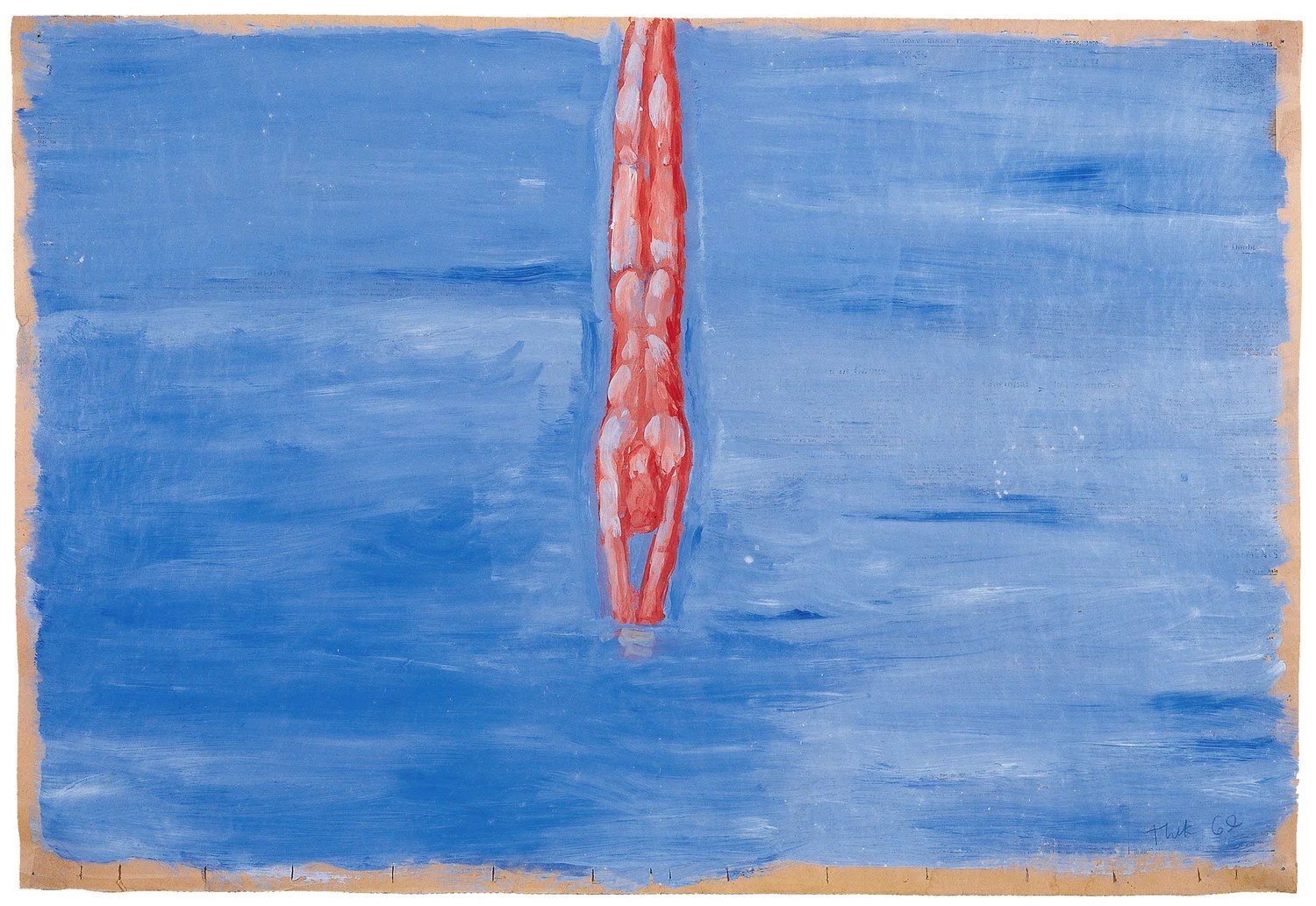
ARTICLE: “Regarding the Face of God: On the Paintings, Drawings, and Notebooks of Paul Thek” by Wallace Ludel, Triangle House Review:Last month I wrote about a chalk drawing by Paul Thek that the Archdiocese of Cologne curated for its latest exhibition at Kolumba museum. In preparation for writing, I did some basic research about the artist, who’s best known for his “Meat Pieces,” and was led to this fascinating article that focuses instead on his paintings, drawings, and notebooks, especially the religiosity and contradictions they are charged with.
Writer Wallace Ludel describes Thek’s “Diver” paintings of 1969–70, speculated to have been inspired by an ancient fresco inside the Tomb of the Diver in Paestum, Italy, as “at once ebullient and lonesome, womb-like and deathly.”
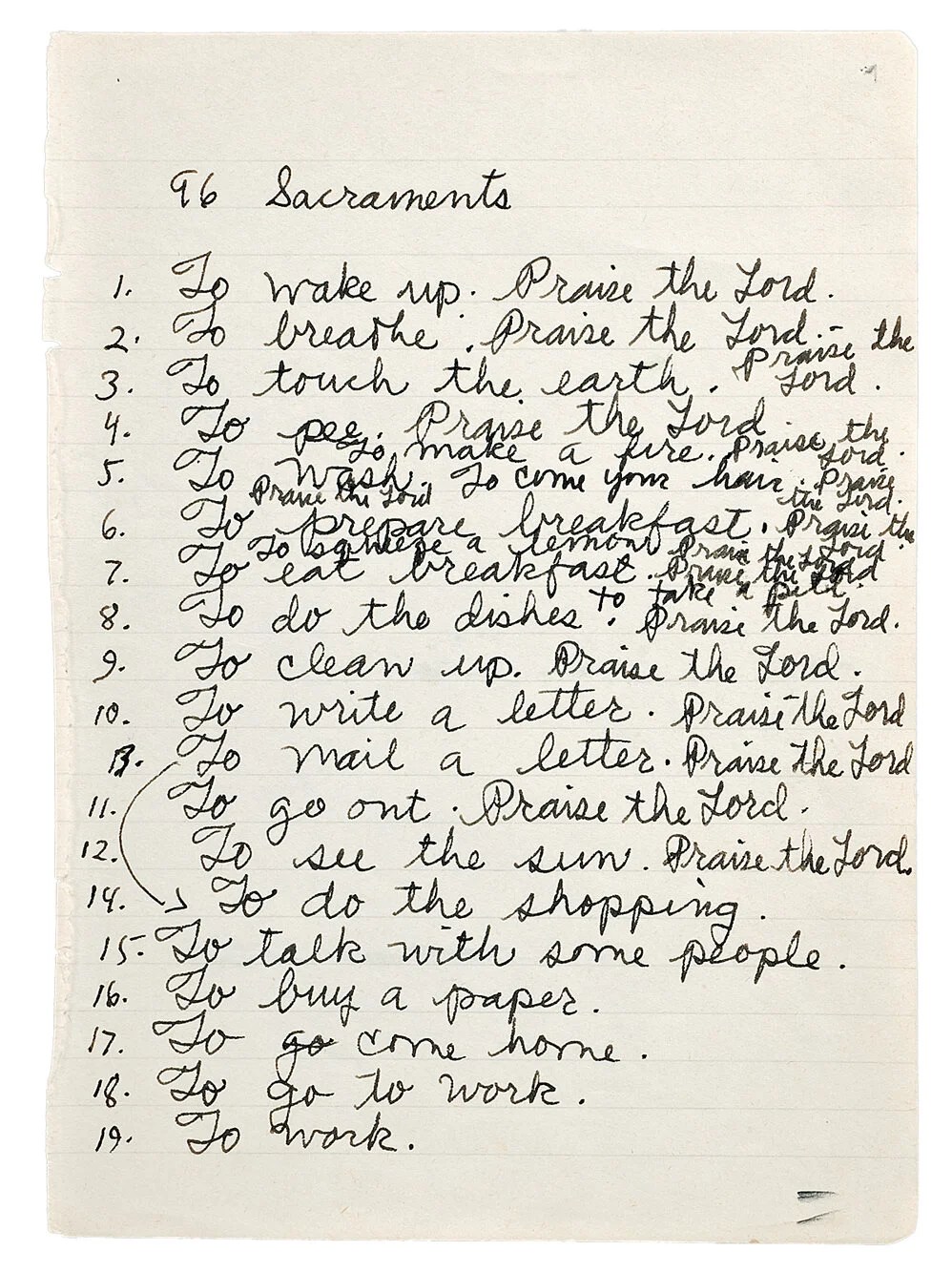
Thek identified as a “predominately gay” Catholic man and was even accepted as a novice by a Carthusian monastery in Vermont shortly before he died of AIDS in 1988. From 1970 onward, he kept notebooks where he copied long passages from spiritual texts and wrote his own devotional musings, as well as made drawings and watercolors and recorded various diaristic thoughts and mantras. One set of the pages, for example, titled “96 Sacraments,” enumerates ninety-six activities—“to breathe . . . to pee . . . to do the dishes . . . to forget bad things . . .”—each followed by the refrain “Praise the Lord.” This list evinces the spiritual influence of Brother Lawrence, who talked about “practicing the presence of God” in all things, which Thek remarked on in a 1984 letter to the Carthusians.
Thek is an artist I had never heard of prior to seeing his work exhibited at Kolumba. Visiting art museums, taking note of the works that intrigue you, and following up afterward with online searches to see and learn more is a great way to develop knowledge of the art that’s out there and to start to identify some of your own personal favorites—which is one of the primary questions I get asked. (“Where do you find all this art?”)
This November near where I live in Maryland there are at least two concerts by Christian artists I’d like to invite you to:
>> Matthew Clark, November 1, 2025, Crownsville, MD: The Eliot Society, an organization I volunteer with, is hosting Matthew Clark, a singer-songwriter from Mississippi, for an evening of music and stories this Saturday. Tickets are $10; wine, coffee, and refreshments will be served. Here’s Clark’s song “Ordinary Artists”:
>> Ordinary Time, November 22, 2025, St. Moses Church, Baltimore: Longtime friends Peter La Grand (Vancouver), Jill McFadden (Baltimore), and Ben Keyes (Southborough, Massachusetts) make up the acoustic folk trio Ordinary Time. They’re performing a free concert at McFadden’s church in a few weeks, which will be followed by Q&A around the role of music in the communal life of the church. Here’s their song “I Will Trust (Isaiah 12)”:
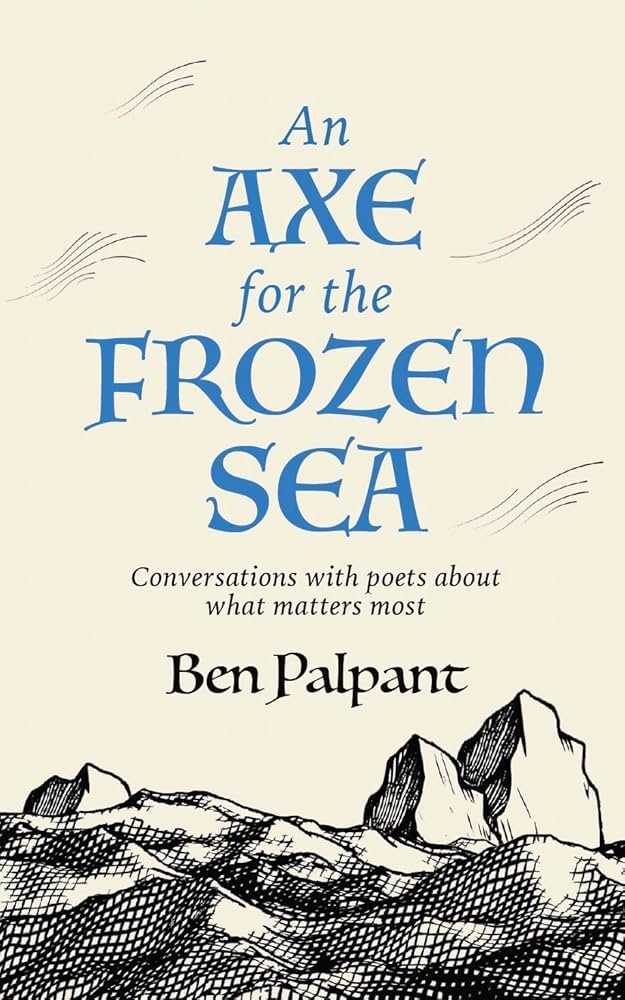
FREE AUDIOBOOK: An Axe for the Frozen Sea: Conversations with Poets about What Matters Most by Bel Palpant: “A book must be the axe for the frozen sea within us,” Franz Kafka wrote in a letter to his friend Oskar Pollak in 1904. That quote is the source of the title of Ben Palpant’s new book, one of my favorites of this year. An Axe for the Frozen Sea is a collection of one-on-one interviews Palpant conducted with seventeen acclaimed poets of faith, exploring the human experience, especially everyday joys and struggles, and the writing life. Featured poets include Scott Cairns, Marilyn Nelson, Robert Cording, Li-Young Lee, and Jeanne Murray Walker. I was really compelled by the conversations.
An Axe for the Frozen Sea is available for purchase in print, but it also kicked off the new podcast Rabbit Room Press Presents, serialized audiobooks of select titles from the publisher. All the book’s content, read by the author, can be listened to for free in this format. Highly recommended!
+++
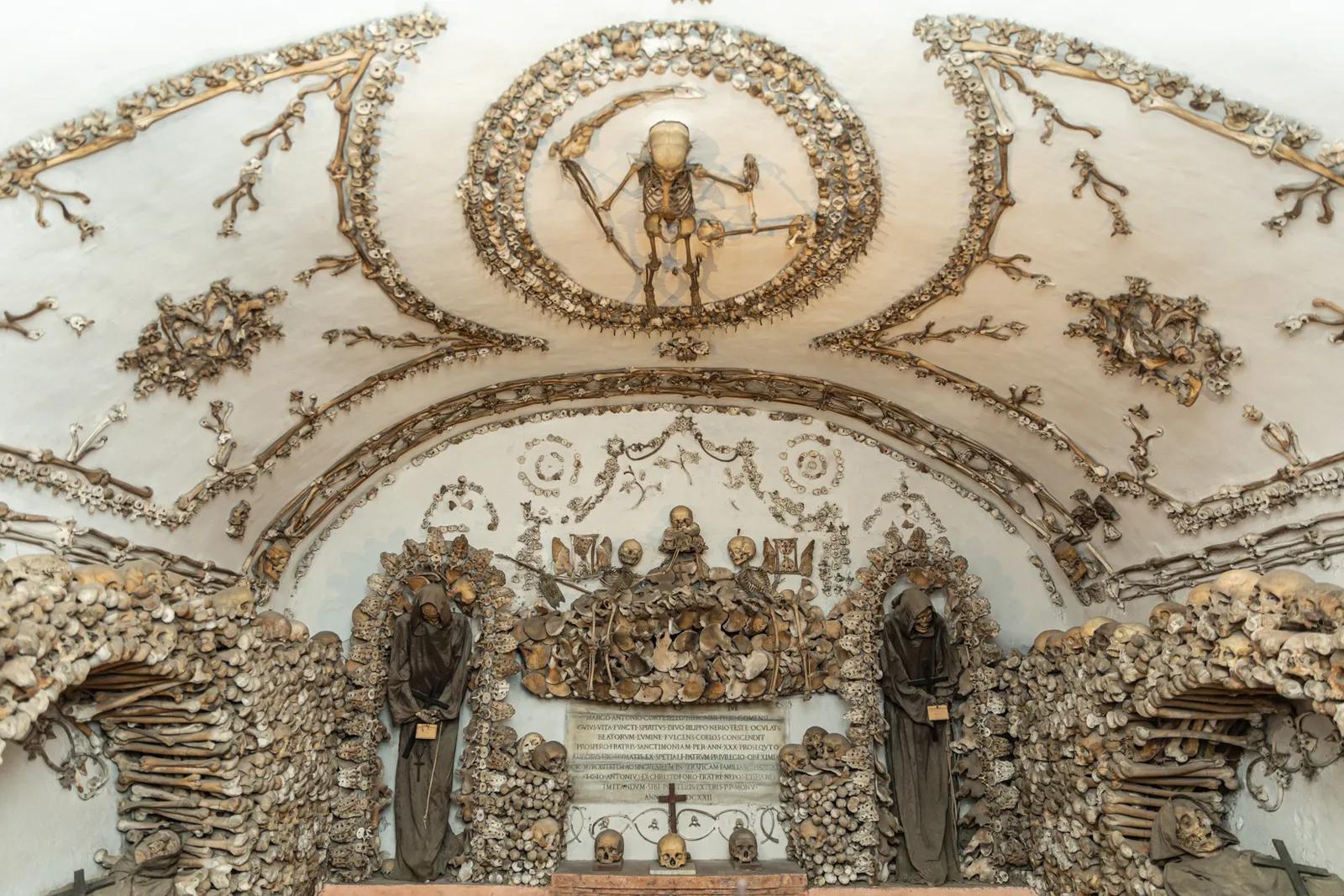
ARTICLE: “Bone chapels and their strange art” by Lanta Davis, Christian Century: If my last blog post piqued your interest in Christian bone chapels, you’ll want to read this article Lanta Davis wrote last November about her visit to the crypt of Santa Maria della Concezione dei Cappuccini in Rome. With a scythe-wielding skeleton overhead and arches, garlands, chandeliers, and mock clocks made of human bones, you’d be forgiven for thinking you mistakenly wandered into a haunted house. But in fact this is a sacred space, its unusual decoration the devotional labor of a seventeenth-century friar. Davis reflects on how the bone installations transform the ugliness of death into something beautiful, rearranging death into surprising forms—such as a skull with butterfly wings made from shoulder blades—that culminate in the Crypt of the Resurrection.
SONG: “Bones” by Mark Shiiba: The title track of Mark Shiiba’s debut album from last year references the placard that greets visitors to Rome’s Crypt of the Three Skeletons (see previous roundup item): “What you are now we used to be; what we are you will be.” This saying was a common memento mori, which I first learned when studying Renaissance art in Florence as a junior in college: Io fu già quel che voi siete, e quel chi son voi ancor sarete, reads the inscription above the fictive cadaver tomb that Masaccio painted inside Santa Maria Novella.
Shiiba’s song is jaunty in tone, and when he shared an excerpt on Instagram, he set it to the similarly sprightly animated short The Skeleton Dance (1929) by Walt Disney, which is based on medieval “danse macabre” imagery. Perhaps that seems to you unbefitting of such a serious subject as death—but since its inception, the church has proclaimed Christ’s ultimate defeat of death. “Where, O death, is your victory?” the apostle Paul taunts. “Where, O death, is your sting?” Death is lamentable, but it’s not the end of the story. The playfully arranged “bones at the bottom of a church in Rome” anticipate the resurrection of our bodies on the last day.

 Art & Theology
