Advent Materials

Advent begins December 2, and Christian resource providers have already started releasing content for the season so that you can start adapting and programming it into your church services or family devotional practices, if desired. Here are three sets plus a Kickstarter campaign that caught my eye.

from SALT PROJECT

SALT Project Advent
Photo by SALT Project

SALT Project is a faith-based media company dedicated to creating beautiful visual content, especially video, for churches and other clients. Below are three of the five videos they’ve put together for Advent, which can be purchased and customized for church use. The videos feature a few products, like illustrated Advent calendar notecards (with daily tasks like “Deliver sweets to a neighbor” or “Write a thank-you letter to God”) and coloring pages and posters inspired by Mary’s Magnificat, available for download from SALT’s online shop.

I love their aesthetic! (These videos make me really excited for Advent.) I also appreciate how the devotional activities can be done either as an individual, a family, or a congregation. Click here to see a roundup of all five videos, and be sure to also check out Advent in Full Color, a devotional booklet that features poetry by Mary Oliver and Howard Thurman, daily practices, scripture texts, meditations on the season’s key theological themes, and coloring pages.

To subscribe to SALT’s weekly e-newsletter (which I highly recommend!), scroll to the bottom of this webpage; you can also follow them on Facebook @SALTyProject.

+++

from REFORMED WORSHIP

The cover story of the September 2018 issue of Reformed Worship magazine is “Advent in Narnia: An Invitation to Biblical Explorations Beyond the Wardrobe” by Cindy de Jong, which chronicles how seven different churches, including the author’s, used The Chronicles of Narnia last year to draw out some of the themes of Advent. In most cases this involved a six-week sermon series, or a service of lessons and carols, that integrated references to C. S. Lewis’s classic tale. At first I was skeptical of keying sermon series to a work of fiction, allegorical though it may be, but it turns out the worship service plans (reproduced in the article) were intelligently done, letting scripture drive and Narnia serve as a supplement to amplify God’s truth. One contributor even mentioned the need to be careful to not let Narnia be the focus; it can provide structural support but should not constitute the core of the sermon nor the worship service.

Reformed Worship cover

“The whole of Advent is this,” de Jong writes: “awaiting the birth of the Christ child in the same way we wait for the return of Christ’s kingdom. The whole of The Lion, the Witch, and the Wardrobe covers the same: waiting for Aslan and waiting for the triumph of Narnia.” Service plans, including songs, sermon titles and notes, Narnia references, and confessions, are included in the article with varying specificity. Though all drawing on the same text, there is a surprising diversity of approaches. Also included are ideas for how to decorate the sanctuary, how to engage children, and how to introduce the book and the sermon series to the congregation. Two additional books that are recommended are Advent in Narnia: Reflections for the Season by Heidi Haverkamp and The Lion’s World: A Journey into the Heart of Narnia by Rowan Williams.

Besides this eleven-page article, this month’s issue also includes an Advent reading for three voices by Joyce Borger, titled “What If . . . ?,” that reflects on the Flight to Egypt in light of today’s immigration debates, as well as an Advent worship service series that includes calls to worship, Advent readings, scripture texts, sermon themes and outlines, and song suggestions for five weeks’ worth of Sundays.

+++

from ADAM FARBIARZ via KICKSTARTER

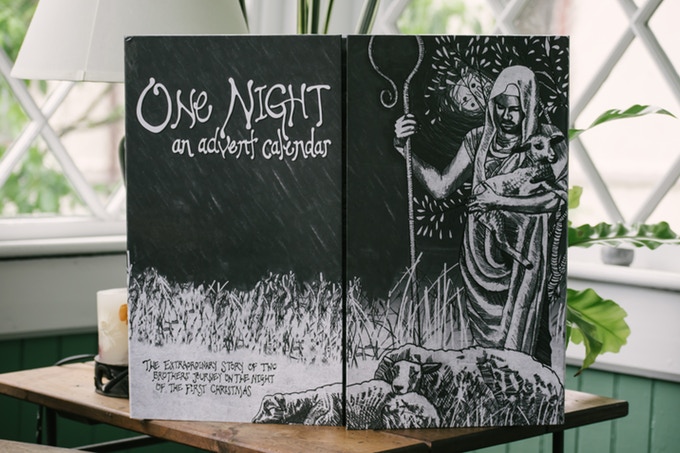
Designed for daily use during December, One Night: An Advent Calendar is a large foldout storybook that reimagines Luke’s nativity narrative through the eyes of a shepherd. Printed on heavyweight paper wrapped around millboard, the product takes the form of a freestanding triptych with twenty-four numbered doors that open to reveal snippets of story. I’ve seen the mock-up, and it looks like a really quality endeavor, something for the whole family to enjoy (it’s pitched to adults but accessible to children). Help the creative team fund printing costs by contributing to their Kickstarter campaign in exchange for your own calendar in the mail by the end of November. Text and direction by Adam Farbiarz, illustrations by Rachael Clarke Hendel, hand lettering by Rachel Farbiarz, and design by Lizzie Stone.

One Night Advent calendar

One Night Advent calendar

+++

from THE HOMELY HOURS

These resources were published over the last few years, but I just found out about them this summer. Run by churchwomen from Christ the King Anglican Church in Dayton, Ohio, The Homely Hours is a website created out of a desire to encourage a deeper integration of the life of the church into the life of the home. It’s treated not so much as a blog (it’s not continually updated) as it is a repository, so search through the tabs and archives for creative ideas to celebrate the liturgical seasons in the domestic sphere.

Advent plans include Advent-wreath prayers, Jesus-tree ornaments, St. Nicholas Day treat bags, Advent Saints and Life of Mary coloring pages, a printable St. Lucy’s crown, poems, and more—all free. As a reminder that the observance of Advent with one’s family does not necessitate perfect planning or novelty or “lots of” (quite the contrary), see “If I handcraft artisan shoes for St. Nicholas Day but have not love . . .”

St. Nicholas treat bag
St. Nicholas Day treat bag by Bley Hack/The Homely Hours
Life of Mary coloring page
Life of Mary coloring page (detail) by Michelle Abernathy/The Homely Hours

Roundup: Aretha Franklin, Berenice Rarig, and more

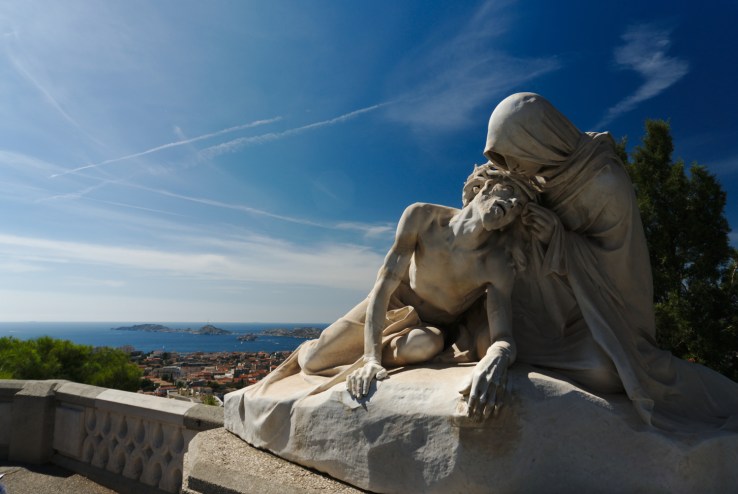
Last week I returned from a two-week trip to western Europe, where my husband and I spent time in Spain (Madrid, Barcelona, and Porto Cristo), southern France (Aix-en-Provence and Marseilles), and Italy (Florence, Rome, Pompeii, and Amalfi). We had only a little time in each city, but wow, what beauty! I’ll be going through our photos soon and sharing some on the blog. In the meantime, here’s one Eric took outside Notre-Dame de la Garde in Marseilles, a basilica built atop a 489-foot-high limestone outcropping that overlooks the Old Port.

Veronica and Christ (Marseilles)
Veronica and Christ, Notre-Dame de la Garde, Marseilles, France. Photo: Eric James Jones.

The stone sculpture, from the twentieth century, shows Veronica (an apocryphal saint) wiping Christ’s brow on his way to Calvary. Her gesture of compassion is meant to symbolize the action of missionaries, to whom the sculpture is dedicated.

+++

While I was gone, Aretha Franklin, the Queen of Soul, passed away. Like many soul singers, she got her start singing gospel, and her 1972 album Amazing Grace, recorded live from New Temple Missionary Baptist Church in Los Angeles, is the highest-selling live gospel music album of all time. Below you can watch her perform the title track, a hymn classic, in 2014.

Many famous singers and musicians paid tribute to Franklin at her eight-hour-long funeral on August 31. One of my favorite performances was Stevie Wonder’s rendition of “The Lord’s Prayer” on harmonica.

+++

NEW ON ARTWAY: ArtWay is a web publication I contribute to that seeks to connect Christians to the rich history and contemporary practice of visual art. Last Sunday I wrote a visual meditation for the site on Bill Viola’s video piece Emergence, which references a Man of Sorrows painting by Masolino.

Emergence by Bill Viola
Bill Viola (American, 1951–), Emergence (still frame), 2002, from The Passions series. High-definition video master tape. J. Paul Getty Museum, Los Angeles, California.

Along with the other editors, I also curate items for ArtWay’s Poetry section. Most recently I selected a poem by Abigail Carroll titled “Dear Wounded Saint,” based on a Caravaggio painting of St. Francis of Assisi. Carroll is a brilliant poet, and I heartily recommend her two collections, Habitation of Wonder (2018) and A Gathering of Larks (2017).

Saint Francis of Assisi in Ecstasy by Caravaggio
Caravaggio (Italian, 1571–1610), Saint Francis of Assisi in Ecstasy, ca. 1595. Oil on canvas, 92.5 × 127.8 cm (36.4 × 50.3 in.). Wadsworth Atheneum, Hartford, Connecticut.

+++

ARTIST INTRO: A chain of connections brought me into contact with Berenice Rarig, an Australian artist whose work comprises installation, performance, sculpture, and photography. In addition, she is the founder of MAKE Collective, an initiative of the Presbyterian Church in America’s missionary arm that helps creatives become part of international church-planting movements through cultural engagement, creative thinking, and artistic excellence. As she was visiting the Baltimore area last week, we got lunch together and shared our visions for our respective ministries.

I loved learning about Berenice’s unique approach to art as mission. “My role as an artist is to point to what’s already pointing,” she says. “I join St. Augustine who said, ‘Everything in creation points to the Creator.’”

> Read an interview with Berenice Rarig from 2006, published in The Creative Spirit: A Journal of Faith and the Arts.

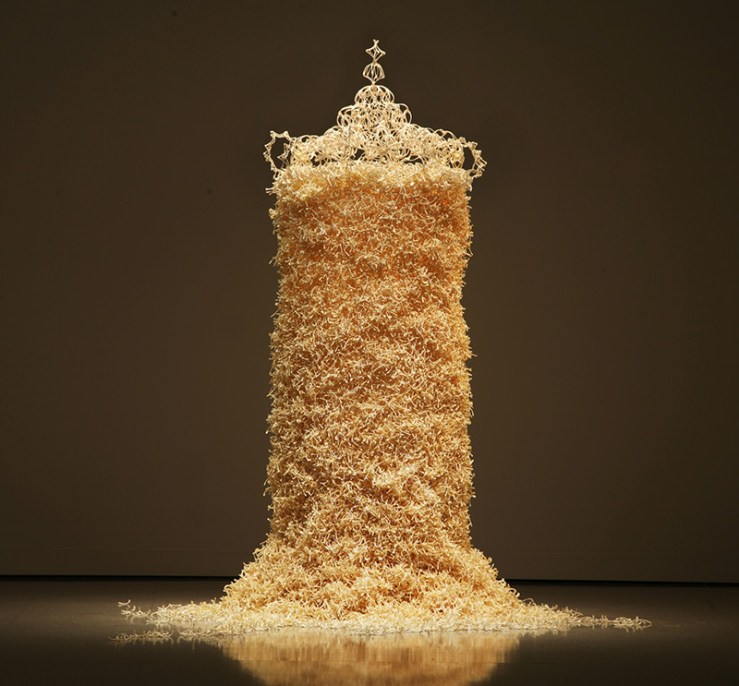
Here is a video-recorded lecture she gave at the Mumbai Arts Conference in 2015; it’s titled “Imaging Grace.” In it she explains the three works of hers pictured below, and others. Wishbones, quail eggs, and coffee filters—that gives you a sense of the kinds of materials she likes to work with. She had a load of donated clock parts in her trunk when I was riding with her, which she is excited to tinker with for her next art project.

Cathedral de St. Icarus the Wishful by Berenice Rarig
Berenice Rarig (Australian, 1959–), Cathedral de St. Icarus the Wishful, 2012. 50,000+ wishbones, wire frame, and lights, 9 ft. high.
A Tiny Hum by Berenice Rarig
Berenice Rarig (Australian, 1959–), A Tiny Hum (Humanity) 3, 2012. Quail eggs and wire.
Whispered Prayers by Berenice Rarig
Berenice Rarig (Australian, 1959–), Whispered Prayers, 2001. Folded coffee filters.

+++

PATRONAGE OPP: Monthly worship services by Liturgy Fellowship: I just became a patron of Liturgy Fellowship and am excited to see what they turn out! “We are starting a new project. Every month we are going to invite a guest liturgical artist to write a worship service for us. The themes will vary from biblical themes, to the church calendar, to under-served topics. If things go well we will also try to invite others to write original songs and create art to go along with the service theme. This will (hopefully) grow into a fantastic resource for the church!”

Roundup: Jewish mosaics; New Psalm Contest; revising hymns; tree-inspired chapel; and more

I will be going on vacation soon and will be mostly unplugged, so you will notice less frequent blog posts for a few weeks. I’ll cue up some Artful Devotions to be published automatically each Tuesday I’m gone but won’t be posting the links to the blog’s Twitter and Facebook pages as I usually do—so be sure to check the site instead! (Or subscribe by email by clicking the “Follow” link, located in the sidebar if viewing from your computer or at the bottom if viewing from your phone.) My regular publishing schedule will resume in September.

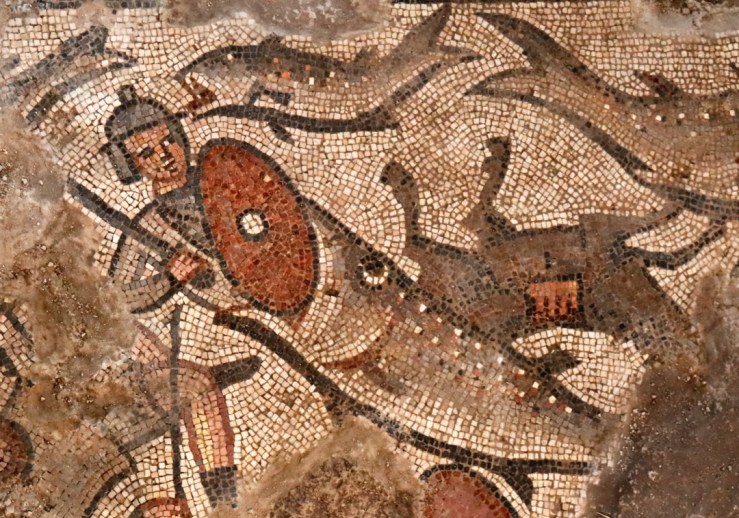
ARCHAEOLOGICAL FIND: “Discovery of Jewish Mosaics in Israel Bring Color to Biblical Accounts” by Sarah E. Bond: “At the ancient site of Huqoq, near the Sea of Galilee in modern Israel, a number of stunning mosaics depicting biblical, astrological, and historical narratives have been uncovered in a Jewish village that flourished during the late Roman empire. The colorful and large number of mosaics found in a synagogue challenge traditional views about Jewish art of the period as symbolic rather than representational of biblical texts, bland, and in decline during the period.”

Fish swallowing Pharoah's soldier
A giant Red Sea fish swallows one of Pharaoh’s soldiers in this mosaic detail from the late Roman (ca. 5th century) synagogue at Huqoq, Israel. Photo: Jim Haberman, via UNC-Chapel Hill.

+++

SONGWRITING CONTEST: “In an effort to encourage Psalm-singing, Church of the Servant [in Grand Rapids, Michigan] invites congregational songwriters to submit a Psalm-based song to its 2018 COS New Psalm Contest. The winner will receive a $500 award. There is no entry fee and the contest is open to all. Submissions must be emailed or postmarked by October 1, 2018. The song will be premiered in worship on January 27, 2019. Church of the Servant is a Christian Reformed Church with a rich history of encouraging the arts in worship. Its worship is Reformed, liturgical, participatory, eclectic, and open to creative new worship expressions.”   Continue reading “Roundup: Jewish mosaics; New Psalm Contest; revising hymns; tree-inspired chapel; and more”

Roundup: New acquisitions; prison psalms; “Sacred Noise”; the spiritual in contemporary art

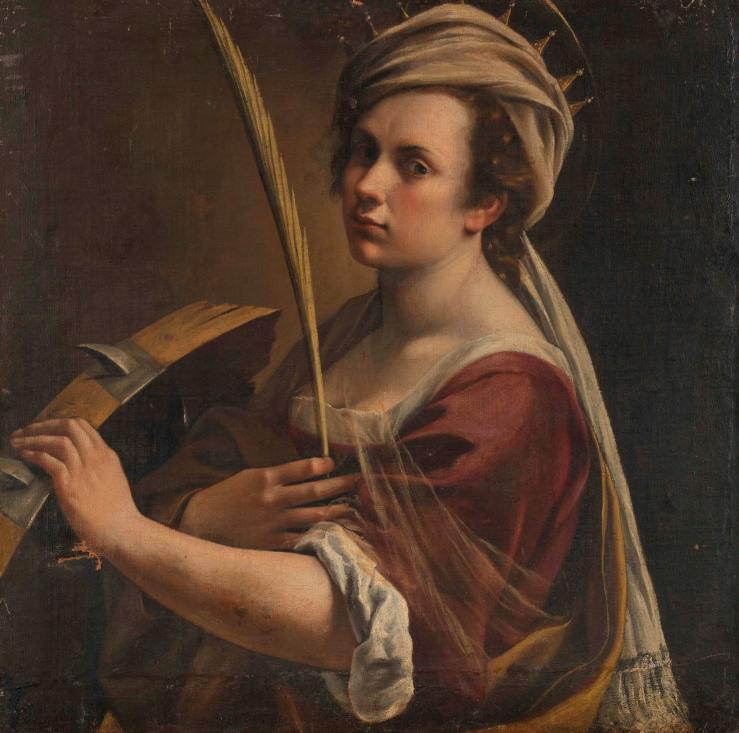
ACQUISITION: Self-Portrait as Saint Catherine of Alexandria by Artemisia Gentileschi, National Gallery, London: This month the National Gallery in London announced its acquisition of a self-portrait by Baroque artist Artemisia Gentileschi posed as the fourth-century Christian martyr Catherine of Alexandria. For centuries it has been in the private collection of a French family, hidden from public view; now it is undergoing restoration and framing before being permanently hung in 2019 alongside other Baroque masters like Caravaggio.

Self-Portrait as Saint Catherine of Alexandria by Artemisia Gentileschi
Artemisia Gentileschi (Italian, 1593–1653), Self-Portrait as Saint Catherine of Alexandria, ca. 1615–17. Oil on canvas, 71.1 × 71.1 cm (28 × 28 in.). National Gallery, London.

Gentileschi is best known for her dramatic paintings of strong female heroines, biblical and extrabiblical, and this painting is no exception. In her left hand she holds a spiked wheel, a torture device used on St. Catherine, and in the right she holds a palm branch, symbol of victory through martyrdom. The painting has biographical resonance, as just a few years earlier, when she was eighteen, Gentileschi was raped by one of her father’s artist colleagues, Agostino Tassi. During the highly publicized trial in 1612, she was subjected to a thumbscrew-like torture called the sibille to test the veracity of her testimony. Although Tassi was convicted, his sentence of five years of exile from Rome was not enforced, and he continued painting frescoes for Pope Paul V. To learn more about the challenges and successes Gentileschi faced as a female artist in the seventeenth century, see Jonathan Jones’s recent Guardian article.

+++

ACQUISITION: Rothschild Pentateuch, J. Paul Getty Museum, Los Angeles: “This is the most spectacular medieval Hebrew manuscript that’s come to market in over a century,” says Getty Museum Director Timothy Potts of the Rothschild Pentateuch, a thirteenth-century illuminated manuscript that the museum acquired last month—its first Jewish manuscript, consisting of the books of Genesis, Exodus, Leviticus, Numbers, and Deuteronomy. The extent and vibrancy of the illuminations, which feature fantastical beasts, humanoid figures, temple accoutrements, and foliate designs, set the manuscript apart from other Jewish Bibles, which are typically image-lite. Starting next month, the Rothschild Pentateuch will be featured in a small Getty exhibition, “Art of Three Faiths: A Torah, a Bible, and a Qur’an,” on view from August 7 through February 3, 2019.

Menorah of the Tabernacle
Menorah of the Tabernacle (Book of Leviticus) from the Rothschild Pentateuch, France and/or Germany, 1296. Leaf: 27.5 × 21 cm (10 7/8 × 8 1/4 in.). Ms. 116 (2018.43), fol. 226v. J. Paul Getty Museum, Los Angeles.

+++

BLOG SERIES: “Monasticism in Lockdown America” by Chris Hoke, Good Letters: In this nine-part series, prison chaplain Chris Hoke, author of Wanted: A Spiritual Pursuit through Jail, Among Outlaws, and Across Borders (HarperOne, 2015), shares conversations and encounters he’s had with men whose lives are marked by gangs, addiction, violence, and mental illness. He encourages the newly sentenced to use prison as a spiritual retreat center, a monastery, reminding them that “some men choose to live out their days in all-male places wearing the same clothing, eating plain food, growing out their beards, leaving the ‘normal’ world behind, and spending much of their time in rooms called cells, walking deeper into the mystery of God’s heart.” And Hoke walks with them. I am impressed by his ability to reveal the depths of Christian theology in contextually appropriate ways, and to stoke enthusiasm for spiritual practice—praying, reading, fasting. Some of the teachings that have resonated with prisoners are on the darkened mind and the image of God. Revelations abound for both parties.

Christ the Prisoner by Nikolai Tsai
Icon by Nikolai Tsai

My favorite installments are the last two, on the Psalms, a book that Hoke describes as “the mess of our shared condition, in all its forms, being welcomed into God.” Like many contemporary rap lyrics, the Psalms express uncensored emotion, not, necessarily, good, clean theology. And yet they are part of the church’s sacred tradition. “What’s in you? What’s your psalm?” Hoke asks. One of the responses, by a juvenile detainee, made me cry.

Part 1: Cloister
Part 2: Prostration
Part 3: Exercises
Part 4: Asceticism
Part 5: Holy Elders
Part 6: Icons
Part 7: Holy Fool
Part 8: Psalms in the Beginning
Part 9: Psalms, in the End

+++

EXHIBITION: “Sacred Noise,” June 25–July 21, 2018, Christie’s London (8 King St., St. James’s): Curated by Cristian Albu, “Sacred Noise” aims to show the impact of the European legacy of Christian painting on postwar and contemporary artists. Each room is anchored by an Old Master painting. For example, a Crucifixion by Francisco de Zurbarán is displayed alongside Marlene Dumas’s Magdalena (one of the biblical characters in the Crucifixion scene) and Gerhard Richter’s Candle (picturing what would have been the Crucifixion’s original illumination source). I love this staged conversation between works and periods! A beautifully designed, 183-page catalog is available for free viewing and download.

I will say that “Modern Art and the Death of God,” the subtitle of the catalog’s main essay and of the trailer, is misleading in that it seems to promote a one-sided narrative of modern art history. It appears that the exhibition does try to subvert the notion that God is absent from modern art (and this is just a case of poor titling), but I can’t say for sure, since I haven’t seen it; I have only the catalog and trailer to go on. Religious traditions were indeed “offset” in many ways by twentieth-century artists, some of whom were atheist but others of whom were devoutly Christian. One can still challenge tradition from a place of faith, and of course people of no faith can “open new interpretive horizons” that we would do well to consider. Jonathan Evens, who did see the show, says in some places it lacks nuanced readings of artists and their work; he also reminds us that a different selection of canonical artists would tell a different story, one of how Christianity can weather quite well (and has) the storms of the modern era.

+++

NEW BOOK + LECTURE: “Encountering the Spiritual in Contemporary Art” by Leesa Fanning: Dr. Leesa Fanning is Curator of Contemporary Art at the Nelson-Atkins Museum of Art in Kansas City, Missouri, and this week a new major book she edited, Encountering the Spiritual Contemporary Art, was released by Yale University Press. While books have been published before on the topic, this one

significantly broadens the scope of previous studies to include new media and non-Western and Indigenous art (in addition to that of the West), presents art from diverse cultures with equal status, promotes cultural specificity, and moves beyond notions of “center and periphery,” celebrating the plurality and global nature of contemporary art today.

On June 7 Fanning gave a fifty-minute talk introducing some of the themes and artworks covered in the book. I’m sometimes turned off by discourse about vague, amorphous “spirituality,” but I found myself grabbed the whole way through. Though doctrinal specificity is avoided, Judaism, Christianity, Islam, Hinduism, Buddhism, and various indigenous belief systems are represented, and as with the book, the reach is unprecedentedly global. Beneath the video is a breakdown of the artworks Fanning discusses.

I. SOURCES OF INSPIRATION
Johanna Bresnick and Michael Cloud Hirschfeld, From Mouth to Mouth
Bill Viola, Ascension
Anselm Kiefer, Maria
Thomas Struth, San Zaccaria
Y. Z. Kami, Daya’s Hands; White Dome IV; Konya
Monir Shahroudy Farmanfarmaian, Ordibebesht (Convertible Series)
Yelimane Fall, Ocean of Generosity
Jim Chuchu, Pagans XII
Mariko Mori, Tom Na H-iu
Abie Loy Kemarre, Bush Hen Dreaming A12933
Maringka Baker, Ngura Kamanti
Kathleen Petyarr, Mountain Devil Lizard Dreaming—Winter Storm
David Ruben Piqtoukun, Bear in shamanic transformation
Monty Claw, We Pray for Rain
Christi Belcourt, Water Song
Calvin Hunt, Thunderbird Mask and Regalia
Marianne Nicolson, The House of Ghosts
Aaron Taylor Kuffner, Gamelatron Empat Bunga (4 Flowers)

II. ARTIST’S BODY AS SIGNIFIER OF SPIRITUAL CONTENT
Kimsooja, A Needle Woman—Kitakyushu
Anselm Kiefer, Falling Stars
Ana Mendieta, Corazón de Roca con Sangre (Rock Heart with Blood)
Marina Abramović, The Artist Is Present
James Lee Byars, Autobiography alla veneziana; The Holy Ghost

III. MATERIALS/FORM/COLOR
James Lee Byars, Is; The Chair for the Philosophy of Question; The Rose Table of Perfect
Mierle Ukeles and Stephen Handel, I’m Talking to You: A Scent Garden
Sonam Dolma, My Father’s Death
Natvar Bhavsar, KETAK
Anish Kapoor, Shelter
Martin Puryear, A Distant Place
Anish Kapoor, Ascension

IV. ART MAKING AS SPIRITUAL PROCESS
Spinifex Women’s Collective, Minyma Tjuta
Meghann O’Brien, Sky Blanket
Lonnie Vigil, Jar
Shirazeh Houshiary, Echo
Wolfgang Laib, Pollen from Hazelnut; Milkstone; Ziggurat

Religious art roundup: Ekphrastic poem; artist interview; Biola chapel renovations; public Jesus sculpture; bestiaries

Here are some recently published articles on religious art that I enjoyed, and I hope you do too:

“Shouldering the ‘Yoke of Love’: The Shared Passion of Simon and Jesus in Stone and Verse” by Victoria Emily Jones, Literary Life: Like Jonathan Stockland, I remember visiting Nicholas Mynheer’s home and seeing his Simon and Jesus sculpture and being moved by it. Stockland wrote a poem in response to his encounter, one that fits nicely within the tradition of ekphrastic poetry (poems about a visual work of art). Jump on over to LiteraryLife.org to read my reflection on it, from Sunday. As I was writing this essay, lines like “borders of despair” and “tents of desperation” rang out especially loudly, reminding me of the cross being borne by Latin American immigrants seeking entry into the United States, many of them fleeing violence in their home countries.

Simon and Jesus by Nicholas Mynheer
Nicholas Mynheer (British, 1958–), Simon and Jesus, 2010. Limestone, 36 cm tall.

+++

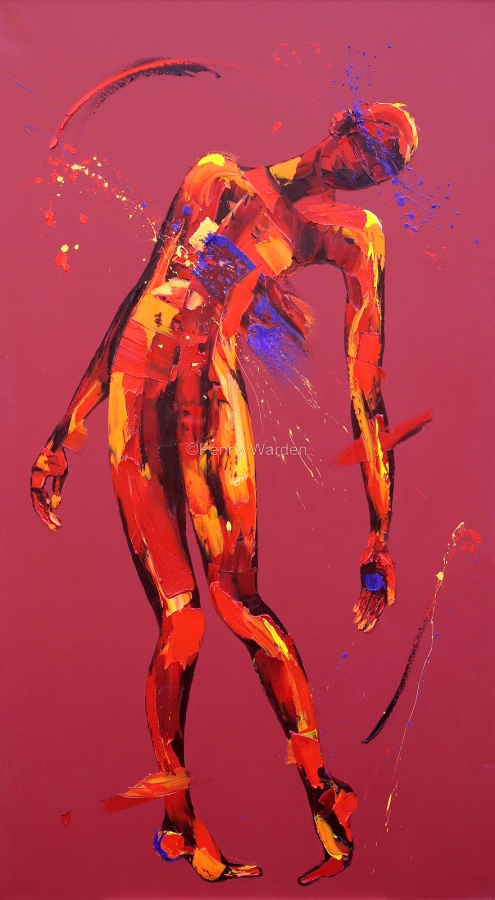
“Theology, Arts, and Culture Series: An Interview with Penny Warden” (+ Part 2), Transpositions: The British artist Penny Warden is best known for her fifteen Stations of the Cross paintings at Blackburn Cathedral. In this excellent two-part interview, she answers questions such as: What does “Christian art” mean in today’s culture? Is there a place for the didactic in religious art? What contemporary artists are making compelling art of theological relevance? Warden also discusses the challenges and advantages of making permanent art for a worship space, how theology informs her practice, the role of tradition versus innovation, and more.

Station 9 by Penny Warden
Penny Warden (British, 1956–), Station 9: Jesus Falls for the Third Time, 2005. Oil on canvas, 6 × 3 ft. Blackburn Cathedral, Lancashire, England.

For more on Warden’s Stations set in particular, see http://www.artway.eu/artway.php?id=896&action=show&lang=en.

+++

“Creating Sacred Space through Art and Light: The Vision of the Calvary Chapel Sacred Art Renovation”: Aesthetic renovations are underway at Biola University’s chapel in Southern California. Not only are significant changes in flooring, walls, seating, and lighting being made, but new permanent art installations have been commissioned by Danish artists Maja Lisa Engelhardt and Peter Brandes: Engelhardt is making an abstract, gilded Resurrection altarpiece for the west wall and a gilded bronze cross for the wooden entry doors, while Brandes is creating thirty-two hand-blown stained glass windows depicting biblical narratives. This is the first time the husband and wife have collaborated this closely on an art project.

Calvary Chapel (Biola University) renovations

The impetus for this revitalization was a concern that the sacred function and experience of the chapel and its interior architectural space had gradually become disassociated as a result of the increased multipurpose demands put upon the space. “The new artwork and proposed renovations seek to restore the chapel’s sacredness through creating a greater architectural and artistic balance between the interior space and the worship experience,” the Biola news article states. Click on the link to learn more or to contribute to the renovation fund.

+++

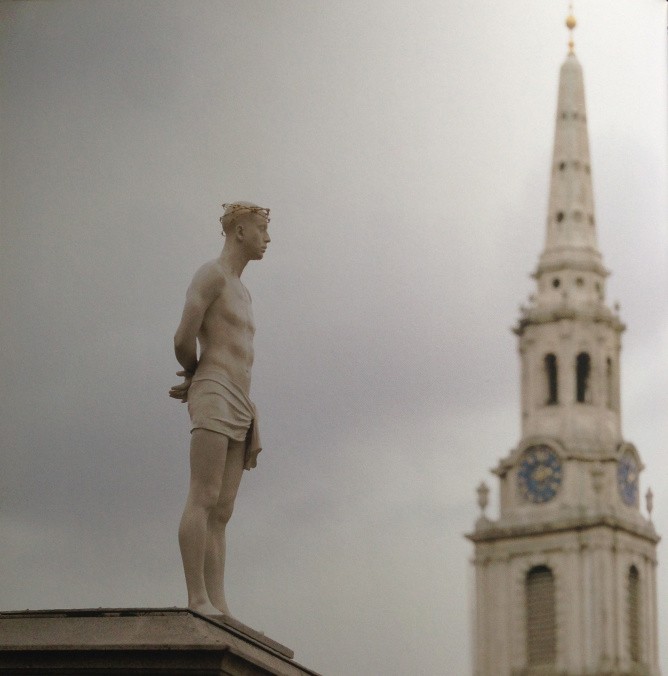
“A Model for All Humanity: Mark Wallinger’s Ecce Homo by Nigel Halliday, ArtWay: The marbleized plastic sculpture Ecce Homo by Mark Wallinger is one of my favorite works of contemporary religious art, and Halliday introduces it beautifully. The artist created it in 1999 to top the empty Fourth Plinth in London’s Trafalgar Square—where the plinths in the three other corners display sculptures of British royals and military commanders. Though the sculpture has since been removed (and shown elsewhere) to allow for the rotation of other new public artworks, Halliday shows how its original location is key to interpreting its meaning, which has to do with worldly power and glory versus spiritual power and glory.

Ecce Homo by Mark Wallinger
Mark Wallinger (British, 1959–), Ecce Homo, 1999. Polyester resin, life-size. Temporary installation, Trafalgar Square, London.

+++

Meet the animals of the medieval bestiary, a Christian compendium of real and imagined beasts, The Iris: The blog of the J. Paul Getty Trust recently ran a series of features interpreting the symbolism of various animals from medieval bestiaries. (“A bestiary is a collection of stories about animals—including land creatures, fish, birds, and serpents [some real, some fantastical]—whose properties and behaviors were interpreted as symbols for God’s divine order.”) The phoenix, for example, is a mythical bird who sets himself on fire but on the third day rises again from the ashes of his pyre—a symbol of Christ. Another common symbol of Christ cemented by bestiaries and found in much medieval Crucifixion art is the pelican, who was said to peck at her breast until it bleeds, and then the blood feeds (or, in another variation, revives from the dead) her young. To learn more about this medieval literature genre, visit http://bestiary.ca.

Pelican Feeding Her Young
A Pelican Feeding Her Young, from a Franco-Flemish bestiary (Ms. Ludwig XV 4, fol. 75), 13th century. Tempera, pen and ink, and gold leaf on parchment, 23.3 × 16.4 cm (9 3/16 × 6 7/16 in.) (full leaf). J. Paul Getty Museum, Los Angeles.
Crucifixion by Masolino
Masolino da Panicale (Italian, ca. 1383–ca. 1447), Crucifixion, ca. 1424. Tempera on wood. Pinacoteca Vaticana, Rome. The pinnacle of this altarpiece shows a “pelican in her piety,” a symbol of Christ’s self-sacrifice.

Roundup: Joseph and Child icon; Clarence Fountain; “First Reformed”; novels for pastors; and more

I had every intention of completing an essay for publication yesterday on the fatherhood of Joseph as expressed in the visual arts, but as I got into the thick of research, the field of discovery proved much vaster than I had anticipated. So that I can do the topic justice (and so that I can continue trying to track down artist, dating, and location info for particular paintings), I will be postponing the essay until a later date. In the meantime, here’s a charming little neo-Coptic icon I found of Joseph holding the Christ child; the narrative scenes in the corners are the Nativity, the Presentation in the Temple, Joseph’s Dream, and the Flight to Egypt. For more on Coptic (Egyptian) iconography, read an interview with the artist from Orthodox Arts Journal.

Joseph of the House of David by Stephane Rene
Stéphane René, Saint Joseph of the House of David. St. Joseph’s Catholic Church, Bunhill Row, London.

+++

OBITUARY: RIP Clarence Fountain, founder and lead singer of the Blind Boys of Alabama: Clarence Fountain of the five-time Grammy Award–winning gospel group the Blind Boys of Alabama died June 3 at age eighty-eight. Fountain formed the group in the mid-1940s along with five friends from the Alabama School for the Negro Blind in Talladega, and the group, though it has gone through iterations in membership, has been touring continuously ever since. (Fountain retired from touring in 2007.) Ray Allen, a folklorist and music historian, said that over the years the Blind Boys’ sound evolved from the more staid style known as jubilee gospel into one that is distinguished by “a prominent lead singer shouting and preaching and backed by a rhythm-and-blues band.” Below you can hear Fountain sing “Look Where He Brought Me From” and the group’s signature song, “Amazing Grace” (to the tune of “House of the Rising Sun”):

+++

ART EXHIBITION: “The Morality Theatre Project: The Art of Barry Krammes,” Green Art Gallery, Biola University, La Mirada, California, April 25–June 29, 2018: Only two weeks left! For this exhibition, the culmination of seventeen years of studio work, Barry Krammes has assembled nineteen open-ended narrative scenes—reminiscent of miniature theater sets—using objects and figures gathered from flea markets and dumpsters, estate sales and antique shops. Although the exhibition title references a genre of medieval drama intended to inspire Christian virtue, the artworks do not preach or provide straightforward moral lessons; rather, they stand as little worlds of mystery that invite association and contemplation. If you’re not able to see the exhibition in person, stay tuned for the forthcoming catalog: I’ve been informed that one is in the works, to be published later this year.

Krammes, Barry_Of Mystery (alt photo)
Barry Krammes (American, 1950–), Of Mystery, 2018. Mixed media assemblage. From “The Morality Theatre Project,” Green Art Gallery, Biola University, La Mirada, California. Photo: Johnny Choura.
Of Lamentations by Barry Krammes
Barry Krammes (American, 1950–), Of Lamentations (detail), 2018. Mixed media assemblage. From “The Morality Theatre Project.” Photo courtesy of the Green Art Gallery at Biola University, La Mirada, California.

The occasion of the exhibition is Krammes’s retirement in May after serving for thirty-five years as an art professor at Biola University (he now bears the title Professor Emeritus). He has been instrumental in making Biola’s art department one of the top ten among Christian colleges and universities, and moreover, he helped to foster art appreciation campus-wide, designing and directing “Arts in Worship” chapels and organizing a yearly Arts Emphasis Week, which developed into the Biola Arts Symposium. He has also been active beyond the walls of Biola, especially as a founding member of the national organization Christians in the Visual Arts (CIVA). To learn more about his art, see “Interceding in the Theatre of Struggle: A reflection on the assemblage work of Barry Krammes” by Betty Spackman, published Sunday at ArtWay, and, from about ten years ago, the Image journal essay “Barry Krammes: Shepherd of the Wasteland” by Christina Valentine.

+++

VIDEO ART INSTALLATION: Three Women (2008) by Bill Viola, St. Cuthbert’s Parish Church, Edinburgh, May 1–September 20, 2018: Bill Viola, a pioneer of new media art, has said that his works “function both as aesthetic objects of contemporary art and as practical objects of traditional contemplation and devotion”—which is one reason they are so well suited to display in churches. In Three Women, a work from his Transfiguration series on temporary view at a Victorian church in Scotland, a mother and her two daughters pass from black and white through a threshold of water, entering a realm of color and light. The work speaks to me of the experience of illumination, of being drawn into a new and glorious understanding of divine truth. Watch an excerpt of the video at the New York Times.

Three Women by Bill Viola
Bill Viola (American, 1951–), Still from Three Women, 2008.

(Update: Sign up for the free HeartEdge church and culture seminar “Bill Viola and the Art of Contemplation,” September 20, 2–5:30 p.m. Various individuals will speak on Viola’s church-located installations, approaches to curating exhibitions in churches, and art as contemplative practice.)

+++

NEW IN THEATERS: First Reformed, written and directed by Paul Schrader: I’ve been hearing great things about this movie, which follows Ernst Toller (Ethan Hawke), the pastor of a small Dutch Reformed congregation in upstate New York, as he grapples with mounting despair. Schrader is the writer who brought us Taxi Driver and Raging Bull, and the folks from Fuller Studio recently sat down with him to discuss his Christian upbringing and how the unique language of film—especially the transcendental style—helps him explore religious questions.

+++

FICTION RECOMMENDATIONS: “Ten Novels Every Pastor Should Read” (+ part 2): Kolby Kerr of LeaderWorks is an exceptional literary guide, whose “ten poets” list I commended in a previous roundup. Here he switches gears to novels. But first he opens by addressing the utilitarian inclination of pastors to nonfiction, which they believe will give them a bigger return on their investment. When it comes to novels, Kerr says, instead of asking What will these books do for me?, we should be asking, What will these books do to me? We should read not only to be informed but to be formed. And once again, what a great list! It’s divided into the categories “saints who sin,” “lost and found” “the dark side,” and “let’s get (meta)physical,” and it concludes with practical advice on how to form and maintain good reading habits.

Book of Revelation roundup

Over the past year or so, it seems I keep running into artistic responses to the book of Revelation. There was the “Apokalipsa” icons exhibition held in Nowica, Poland, in fall 2016, to which thirty-six artists contributed (see photos, plus this Artful Devotion); then last September there was the release of the book Picturing the Apocalypse: The Book of Revelation in the Arts over Two Millennia, which I mentioned in an earlier roundup. What’s more, this April, Pillar Church in Holland, Michigan, was awarded a Vital Worship Grant by the Calvin Institute of Christian Worship “to enrich worship by collaboratively creating artistic liturgical resources inspired by the book of Revelation in order to promote a rich engagement with Scripture.” I’ll be interested to see what they come up with!

The Angel Locks Satan in the Abyss by Joanna Zabaglo
Joanna Zabagło (Polish), The Angel Locks Satan in the Abyss [Rev. 20:1–3], 2016. Tempera on board, 18 × 10 cm.
Now I see that the Association of Scholars of Christianity in the History of Art (ASCHA) is calling for papers on the topic of “Waiting for the End of the World: Eschatology and Art 1850–2000,” for a symposium to be held February 11–12, 2019. Proposals due by September 4.

After 1850, religious subjects became increasingly suspect among modernist artists determined to paint only what the eye can see. Gustave Courbet’s pronouncement, “show me an angel, and I’ll paint one,” exemplified a new, more skeptical orientation. Nevertheless, historical forces and personal motivations compelled many artists, working across a spectrum of materials and visual methods, to directly employ or obliquely reference themes of the Last Judgment and the Apocalypse. Over a century that saw two world wars, economic booms and devastating depressions, the rise and fall of ideologies of left and right, the collapse of colonial empires and the chaos of failed states, the threats of nuclear annihilation and ecological degradation, artists frequently turned to eschatological imagery to visualize the experience of modern life.

The Last Judgment described in the sacred texts of the Abrahamic religions threatens damnation and promises redemption for both the individual and society. This symposium will explore the way that apocalyptic beliefs and imagery—Jewish, Christian, and Islamic—have informed the work of avant-garde artists from all regions of the globe. We invite proposals for 20-minute papers of original research that explore questions such as, but not limited to: What different visual languages have artists used to address the idea of the end of the world? What meanings have they found in the eschatological narrative? How are cultural differences and similarities manifested in their work? To what extent is the teleological narrative of modern art a disguised, secular version of a theological narrative?

Another recent release, from December 2017, is the poetry collection What Will Soon Take Place by Tania Runyan, “an imaginative journey through the book of Revelation” that “offers a poet’s view of the prophetic, not in the sense of seeking out clues to the ‘end times,’ but a means of taking this strange, fantastic book of scripture and letting it read its way into personal lives.” I love Runyan’s poetry (all the poets published by Paraclete are great), so this volume is near the top of my to-read list. Check out “The Angel Over Patmos” and “The Great Throne,” and see the promo video below, with an excerpt from “Vision of the Son of Man.”

Also from 2017, a collage by Nicora Gangi inspired by medieval Last Judgment triptychs. Commissioned by Spark and Echo Arts, Kiss the Son calls on us to love Christ with sincere affection, adorning his feet with kisses like the woman in Luke 7. The left panel shows a heap of humanity’s various “golden calves,” those things we worship that only lead to death. This is contrasted on the right with the New Jerusalem, where the Lion and the Lamb sit atop a cascade of glory. At the bottom of the central panel is the city of destruction, the destination of those who give Christ the betrayer’s kiss; the snake-like forms recall the Evil One who deceived Adam and Eve and plummeted humanity into alienation from God. Above, though, the Son shines brightly, inviting all the reconciled into his loving presence.

Kiss the Son by Nicora Gangi
Nicora Gangi (American, 1952–), Kiss the Son, 2017. Collage, 21 × 33 in.

Lastly, though it was released in 2013, I just recently discovered The Lamb Wins by the Lesser Light Collective, an album of thirty-plus original songs by fifteen-plus artists based on John’s Apocalypse. My favorite song is “The River and the Tree of Life.”

Oh yes, and because I just finished reading the massive Collected Poems of Thomas Merton, here’s a short, thematically relevant excerpt, from “Figures for an Apocalypse: VIII. The Heavenly City” (page 148):

Shine with your lamb-light, shine upon the world:
You are the new creation’s sun.
And standing on their twelve foundations,
Lo, the twelve gates that are One Christ are wide as canticles:
And Oh! Begin to hear the thunder of the songs within the crystal Towers,
While all the saints rise from their earth with feet like light
And fly to tread the quick-gold of those streets . . .

Update: On June 28 and 29, 2018, the Centre for the Critical Study of Apocalyptic and Millenarian Movements (CenSAMM) in the UK hosted the conference “Apocalypse in Art: The Creative Unveiling.” All the talks, given by various scholars, have been added to the organization’s media archive. They address the theme in Hans Memling, Albrecht Dürer, William Blake, James Hampton, Keith Haring, Michael Takeo Magruder, David Best, Bob Dylan, and more.

Whore of Babylon by William Blake
William Blake (British, 1757–1827), Whore of Babylon, 1809. Pen and watercolor over pencil, 26.6 × 22.3 cm. British Museum, London.
De/coding the Apocalypse by Michael Takeo Magruder
Michael Takeo Magruder (British, 1974–), The Horse as Technology, modular installation (in view: SLS 3D print). Part of “De/coding the Apocalypse” v1.0 solo exhibition, 2014, Inigo Rooms, Somerset House, London. Photo: Jana Chiellino.

Roundup: Poetry releases; Heaven, help us; interfaith art exhibitions; 3 free albums

POETRY BOOKS: I just learned about some recently released poetry collections in the Christian Century’s Book Reviews section: Joy: 100 Poems, compiled by Christian Wiman (the review responds to the comment Adrianna Smith made in her otherwise positive review for the Atlantic, that the book’s one fault is its “slant toward a theological comprehension of joy, specifically, an over-representation of a Christian one”); Wade in the Water: Poems by Pulitzer Prize winner Tracy K. Smith; and Meister Eckhart’s Book of the Heart: Meditations for the Restless Soul, a collection of verse-style renderings of the thirteenth-century German Christian mystic by Jon M. Sweeney and Mark S. Burrows, like this one:

“You Are Not an Answer”

There is no Why in You
and so I must learn to trust

that You are not an answer
to my questions but rather

the source that is true before
every question I ever had

and the love beyond every
answer I will ever know.

+++

SONG: “Heaven Help Us All”: This a cappella Stevie Wonder cover is by the vocal group Accent, featuring guest singer Vanessa Haynes. Comprising six male vocalists from five different countries, Accent creates music through Internet collaboration. This song is an intercession to God on behalf of the desperate poor, the homeless, the abused, the lonely, and the depressed. [HT: Global Christian Worship]

+++

ART EXHIBITIONS:

“Pathways to Paradise: Medieval India and Europe,” Getty Museum, Los Angeles, May 1–August 5, 2018: “The pages of medieval manuscripts reveal a dynamically interconnected world filled with real and imagined ideas about foreign peoples and places. Buddhists, Muslims, and Christians living across Europe and Asia conceived paradise as a place of perfect harmony, but the path for locating such a site or achieving this state of mind varied between these religions. By exploring the terrestrial and celestial realms, this exhibition highlights the spiritual motivations for creating and owning portable and devotional artworks.”

“Shared Sacred Sites,” Manhattan, March 27–June 30, 2018: Spread across three Manhattan cultural institutions, the multidisciplinary exhibition “Shared Sacred Sites” aims to raise awareness of the potential for cooperation among the three Abrahamic faiths. The tour begins at the New York Public Library with illuminated manuscripts and documents that highlight holy figures shared in common, like Abraham, Moses, Elijah, and (between Christianity and Islam) Mary and Jesus. The Muslim miniature below shows the Miracle of the Table recounted in the Qur’an (5:111–114), in which ’Isa (Jesus) causes a table set with food to descend from heaven, corroborating his status as a true prophet. This miracle story echoes the Miracle of the Loaves and Fishes in the Gospels.

Jesus receives food from heaven (Persian)
“‘Îsâ (Jesus) receives food from heaven and is able to feed his followers,” from Qisas al-Anbiya (Tales of the Prophets), Iran, ca. 1580. Spencer Collection (Pers. ms. 46, fol. 152v), New York Public Library.

Then it moves to the Morgan Library and Museum, where the celebrated Morgan Picture Bible, produced in thirteenth-century Paris, is on display. This masterpiece of Gothic art offers exquisite visualizations of some three hundred Old Testament scenes (one of which I featured on the last “Artful Devotion”), and it’s also a testament to intercultural exchange: as the book circulated across civilizations, explanatory captions in Latin, Persian, Arabic, Judeo-Persian, and Hebrew were added in the margins.

Lastly, the James Gallery at the CUNY Graduate Center presents artifacts, videos, contemporary art, and photographs that showcase examples of peaceful coexistence of people from different faiths throughout the Eastern Mediterranean as a counternarrative to the stories of conflict that saturate the news media. Several of the photos are of shared worship spaces, like the mosque-synagogue in the cave of Machpelah in Hebron, West Bank, or Ghriba synagogue in Djerba, Tunisia, where Muslims can often be found praying alongside Jewish friends and neighbors or attending pilgrimage ceremonies. (For more on Djerba’s beautiful culture of religious tolerance, see “Jews and Muslims Celebrate Unusual Coexistence in Tunisia’s Djerba.”)

Jewish and Muslim Women Praying
Jewish and Muslim women pray side by side in the Ghriba synagogue in Tunisia, 2014. They stand before the building’s eastern wall, behind which the scrolls of the Torah are preserved. Photo © Manoël Pénicaud.

+++

FREE ALBUM DOWNLOADS:

Weep + Rejoice by Trenton Durham: This four-track EP was released in March as a series of soft-rock meditations on Christ’s death and resurrection.

Top of the Stairs by Scott Mulvahill: Mulvahill is a singer-songwriter and upright bass player from Nashville who toured for five years with Ricky Skaggs’s bluegrass band, Kentucky Thunder. “The Lord Is Coming,” which Mulvahill wrote with Alanna Boudreau and Gabi Wilson, is one of eight songs on his latest EP. See below for a live performance from 2017 with two backing vocalists, or click here for a more recent solo performance from the Tokens Show, uploaded yesterday.

Volume 2 by Deeper Well Records: Five Deeper Well artists have contributed two songs each to this compilation of acoustic hymns, a mix of classics, like “Turn Your Eyes Upon Jesus” and “This Is My Father’s World,” and originals. I can’t speak highly enough of this label—the quality of music they release is superb. You can stream all the full songs on Bandcamp.

Roundup: Anglo-Saxon Ascension poem; underwater dance; Andy Squyres album; contemporary icons; Catholicism meets high fashion

ANGLO-SAXON ASCENSION POEM: Excerpts from “Christ II” by Cynewulf, probably ninth century, translated from Old English by Eleanor Parker: Dr. Eleanor Parker lectures on medieval literature at Oxford University and runs the excellent blog A Clerk at Oxford, where she often shares her translations of Anglo-Saxon poetry, with commentary. The poem she shares here reflects on Christ’s ascension—the disciples’ grief, the angels’ joy. To me the most remarkable section is the one that, indirectly referencing a sermon of Gregory the Great, describes Christ “leaping” up to heaven, taking an active bound toward his homeland, a movement read in light of Song of Solomon 2:8: “Behold, he comes, leaping over the mountains, bounding over the hills.” This leap is one of six he took: from heaven (1) into Mary’s womb, (2) into a manger, (3) onto the cross, (4) into the tomb, (5) into hell, and finally, (6) back into heaven. “Prince’s play”! Parker pairs the poem with an exquisite, near-contemporary manuscript illumination, also from England; there’s also a lot of resonance between the poem and the Ascension image I published Tuesday by Bagong Kussudiardja, which shows a more balletic ascent.

Ascension (10th c)
The Ascension, from the Benedictional of St. Æthelwold (BL Additional MS. 49598), f. 64v, England, 963–984 CE. British Library, London.

+++

UNDERWATER DANCE: “AMA,” a short film by Julie Gautier: This wonderfully expressive silent film shows French free diver and underwater artist Julie Gautier dancing in a single breath for several minutes inside the world’s deepest swimming pool, Y-40 Deep Joy in Montegrotto Terme, Padua, Italy, to a minimalist piano piece. The final shot shows Gautier slowly rising to the water’s surface while releasing a giant air bubble, her pose evocative of the crucified Christ (and her upward movement an Ascension of sorts!). Titled “Ama” (Japanese for “sea woman,” the name given to Japan’s pearl divers), the film is “dedicated to all the women of the world,” Gautier says. The choreography is by Ophélie Longuet.

Gautier and her husband, Guillaume Néry, a free-diving champion, own the underwater filmmaking company Les Films Engloutis. Their most well-known project has been a music video featuring Beyoncé, codirected by Gautier and starring Néry.

+++

KICKSTARTER CAMPAIGN: Help Andy Squyres finance his next album: Andy Squyres is a super-talented singer-songwriter whose lyrics don’t stay in the shallows but, rather, dive into the depths of the faith experience. They are also supremely hope-filled. Below is a video of Squyres performing “Labor in Vain” at a house concert; the song is from his last album, Cherry Blossoms, which I reviewed here. Click on the boldface link above to hear Squyres discuss his new album project and to donate toward it.

+++

ICON PAINTING COMPETITION: The Interparliamentary Assembly of Orthodoxy (IAO) is hosting an international icon painting competition on the subject of Christ’s Resurrection. “Our purpose is to explore and bring to the foreground the numerous stylistic trends in existence today, enabling the visualization of a creative dialogue with tradition and, at the same time, the personal artistic expressions of artists who reframe tradition without, however, digressing from the doctrinal framework of Christian icon painting set by the 7th Ecumenical Council.” The submission window is closed—there are sixty-three great entries!—and now it’s time to cast your vote. Five winners will be selected to receive cash prizes, the topmost being €3,000, and other honors. Popular votes will be taken into account by the twelve jury members, among whom are esteemed iconographers George Kordis from Greece and Todor Mitrovic from Serbia.

Resurrection by Dimosthenis Avramidis
Dimosthenis Avramidis (Greek, 1965–), Christ’s Descent into Hades, 2017. Egg tempera on wood, 91.5 × 61.5 cm.

+++

ESSAY: “On the Border of East and West: Searching for Icons in Lviv” by John A. Kohan: The latest issue of Image journal features a wonderful essay on the Lviv school of iconography (represented in entries #4, #10, and #20 of the above contest), a movement by young Ukrainian Greek Catholic artists to contemporize the Byzantine visual tradition. Written by John A. Kohan, an avid religious art collector and former Time bureau chief in Moscow (1988–1996), it discusses the political history of the city; the role of Metropolitan Andrey Sheptytsky (r. 1901–1944) in preserving and supporting art for future generations; the opening of the Iconart gallery in 2010 to nurture and promote the new style; the broad training these icon makers receive at the Lviv National Academy of Arts; and the uneven reception by others in the denomination (especially official church bodies), who tend to prefer their sacred art in the Radruzh School style or as contemporary Catholic kitsch. Kohan writes from his firsthand experiences meeting the artists and visiting their studios, churches, and exhibition spaces. The essay is available to subscribers only; click here to subscribe.

Crucifixion by Natalya Rusetska
Natalya Rusetska (Ukrainian, 1984–), Crucifixion, 2017. Egg tempera on gessoed wood, 11 3/4 × 8 1/4 in.
Pilate Condemns Jesus to Death by Ivanka Demchuk
Ivanka Demchuk (Ukrainian, 1990–), Christ before Pilate, 2017. Mixed media on gessoed wood, 19 3/4 × 15 3/4 in.

I’m enthralled by the contemporary icons being produced in Lviv—I saw a bunch from Kohan’s collection last summer, and I featured some in a Baptism of Christ roundup earlier this year. The best way to keep abreast of the output from the Lviv school is to follow Iconart on Facebook, and for an even wider breadth of innovative eastern European icons, follow Międzynarodowe Warsztaty Ikonopisów w Nowicy (International Iconography Workshop in Nowica, Poland).

+++

MET GALA + EXHIBITION: “Heavenly Bodies: Fashion and the Catholic Imagination,” May 10–October 8, 2018, Metropolitan Museum of Art, New York City: The largest exhibition ever mounted by the Met’s Costume Institute, “Heavenly Bodies” features both religious vestments from the Vatican and runway fashions by famous designers inspired by Catholicism. A Fashionista reviewer who attended a preview reports on the integrated displays:

A reliquary arm of Saint Valentine is displayed alongside a breastplate and crown of thorns from Alexander McQueen’s Givenchy days; sacred music serves as the auditory backdrop for a Rodarte collection that features a dress inspired by Bernini’s famous sculpture Ecstasy of Saint Teresa. Rows of mannequins wearing Dolce & Gabbana, Moschino and Raf Simons show the ways that the silhouettes of the cassock and nun’s habit have been explored on the runway time and again. There are even vestments by the likes of Yves Saint Laurent and Riccardo Tisci that were expressly designed to dress statues of the Virgin Mary in chapels in Italy and France.

Each year since 1948, the opening of the Costume Institute’s spring exhibition has been celebrated with a huge fundraising gala attended by celebrities who dress to the theme; this year’s took place May 7. There were lots of crosses and haloes, but also some more particularized outfits. Ariana Grande’s gown was inspired by Michelangelo’s Last Judgment; Gigi Hadid’s, by stained glass. Selena Gomez carried a Coach handbag embroidered with Proverbs 31:30b: “A woman who fears the Lord is a woman who shall be praised.” The most brazenly dressed was Rihanna, who wore a gem-encrusted bishop’s miter (not a papal tiara, as has been commonly reported). Another standout headpiece was Sarah Jessica Parker’s, which featured a Neapolitan Nativity scene set inside a mini baldachin. (The making of elaborate presepi, or Christmas crèches, is a longstanding tradition in Naples, reaching its height during the eighteenth century.)

Rihanna as pope
The white Margiela minidress, cape, and headpiece Rihanna wore to Monday’s Met gala were inspired by Catholic pontifical vestments. Photo: John Shearer/Getty.
Sarah Jessica Parker
Sarah Jessica Parker wore a regal gold, long-trained Dolce & Gabbana gown, but the pièce de résistance of her ensemble was the Nativity headpiece.

Lana Del Rey went as Our Lady of Sorrows, wearing an immaculate-heart chest plate pierced through with seven daggers; it was comical to hear religiously illiterate reporters trying to interpret the symbolism, saying things like the daggers are a “reminder to repent your sins or suffer damnation!” (Wrong. The swords symbolize the Virgin’s seven sorrows, beginning with Simeon’s prophecy.)

Roundup: Rock Hall inductions; James Cone; lynching memorial; “Christ in Alabama”

NEW ROCK AND ROLL HALL OF FAMERS:

Last month Sister Rosetta Tharpe (1915–1973), one of the few female guitar evangelists of the ’30s and ’40s and the first gospel superstar, was inducted into the Rock and Roll Hall of Fame. She was named an “Early Influence” for her electric sound and original guitar picking, which influenced the likes of Chuck Berry, Jerry Lee Lewis, Elvis, and Johnny Cash, among many others. (“Tharpe’s unique guitar style blended melody-driven urban blues with traditional folk arrangements and incorporated a pulsating swing sound that is one of the first clear precursors of rock and roll.”) Performing (controversially) both sacred and secular music, in churches and nightclubs, Tharpe collaborated with heavy-hitting artists of the time, including Duke Ellington, Cab Calloway, and the Dixie Hummingbirds, and she even hired a white group, the Jordanaires, to sing backup during one of her tours.

Sister Rosetta Tharpe
Photo: Chris Ware/Getty Images

Two of Tharpe’s best-known songs are her versions of the Negro spirituals “Up Above My Head” and “Strange Things Happening Everyday,” but probably my two favorites of hers are “Use Me” and “Two Loaves of Fishes and Five Loaves of Bread”:

In 2011 BBC Four premiered Sister Rosetta Tharpe: The Godmother of Rock and Roll, a documentary written and directed by UK filmmaker Mick Csaky. Its US television premiere was in 2013, part of PBS’s American Masters series. Watch the trailer below, or watch the full documentary online.

If you’re not familiar with Tharpe, you need to be! My husband and I cycle through dozens of her songs regularly on our customized Spotify gospel playlist. If you enjoy the documentary and want to learn more, check out the biography Shout, Sister, Shout!: The Untold Story of Rock-and-Roll Trailblazer Sister Rosetta Tharpe by Gayle Wald.

Another April Rock and Roll Hall of Fame inductee, who’s more of a household name, is Nina Simone (1933–2003). One of her most famous songs (certainly her most sampled) is “Sinnerman,” a Negro spiritual inspired by Revelation 6:12–17:

When he opened the sixth seal, I looked, and behold, there was a great earthquake, and the sun became black as sackcloth, the full moon became like blood, and the stars of the sky fell to the earth as the fig tree sheds its winter fruit when shaken by a gale. The sky vanished like a scroll that is being rolled up, and every mountain and island was removed from its place. Then the kings of the earth and the great ones and the generals and the rich and the powerful, and everyone, slave and free, hid themselves in the caves and among the rocks of the mountains, calling to the mountains and rocks, “Fall on us and hide us from the face of him who is seated on the throne, and from the wrath of the Lamb, for the great day of their wrath has come, and who can stand?”

When Simone (then Eunice Waymon) was a young girl, her mother, a Methodist minister, had her play the song on the piano at revival and prayer meetings as a means of compelling sinners to the altar. (Before pursuing her career as a singer and recording artist, she wanted to be a classical concert pianist. She plays the piano on “Sinnerman” and many other tracks.) Because she recorded her version of “Sinnerman” at the height of her civil rights activism, in 1965, some have speculated that the song is a veiled condemnation of the sins of white America.   Continue reading “Roundup: Rock Hall inductions; James Cone; lynching memorial; “Christ in Alabama””