Roundup: Visual Theology CFP; E. E. Cummings song cycle; Babette’s Feast; art-lending libraries; exhibitions of lament

UPCOMING CONFERENCE / CALL FOR PAPERS: “Visual Theology I: Transformative Looking Between the Visual Arts and Christian Doctrine (1850–Now),” October 19–20, 2018, The Palace, Chichester, Sussex, England: The inaugural conference of the Visual Theology Symposium will take place this fall, and paper proposals are now being accepted (deadline June 15). “The divide between confessional and critical positions has long impoverished and polarised the academic analysis of the arts,” and this conference seeks to help bridge that divide. Click on the link to learn more, including eight possible paper approaches. Not only are scholars of art history, visual culture, and theology encouraged to submit but also clergy and artists. Jonathan A. Anderson and Ayla Lepine are among the several confirmed speakers so far.

+++

ALBUM: the rain is a handsome animal by Tin Hat (2012): I’ve really been enjoying these seventeen “classical gypsy jazz” settings of the poetry of E. E. Cummings. They’re so dreamsome. Tin Hat consists of violinist and vocalist Carla Kihlstedt, guitarist Mark Orton, clarinetist Ben Goldberg, and accordionist and pianist Rob Reich, and all four are involved in composing. Below is Kihlstedt’s “sweet spring.” For a PDF of the album lyrics, click here. To further engage with Cummings, check out my analysis of his poem “i thank You God for most this amazing,” which also features a musical setting and happens to be the most visited post on this blog.

+++

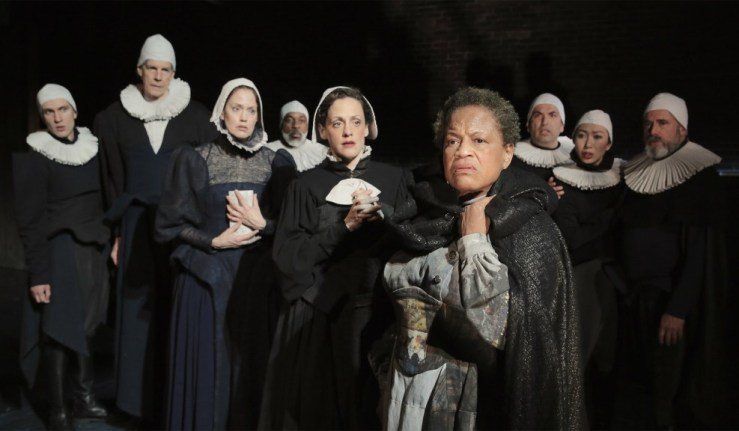
PLAY: Babette’s Feast, Theatre at St. Clement’s, New York City: I’ve heard Babette’s Feast cited many times in Christian literature and addresses, and now it’s been adapted into a stage play, currently running off-Broadway and starring Michelle Hurst (Orange Is the New Black) in the titular role. “Based on Isak Dinesen’s short story made famous by the 1987 Academy Award-winning [Danish] film, this new stage adaptation of Babette’s Feast premiered in January 2018 in Portland, Maine to rave reviews. The play tells the story of Babette, a French refugee, who finds asylum in a pious Norwegian village. With boundless generosity, she throws a lavish feast that becomes an agent of transformative grace, healing a fractured community.” (Update 5/1: Just after I published this post, Image journal published a great interview with director Karin Coonrod.)

Babette's Feast (play)
Photo: Carol Rosegg/National Review

+++

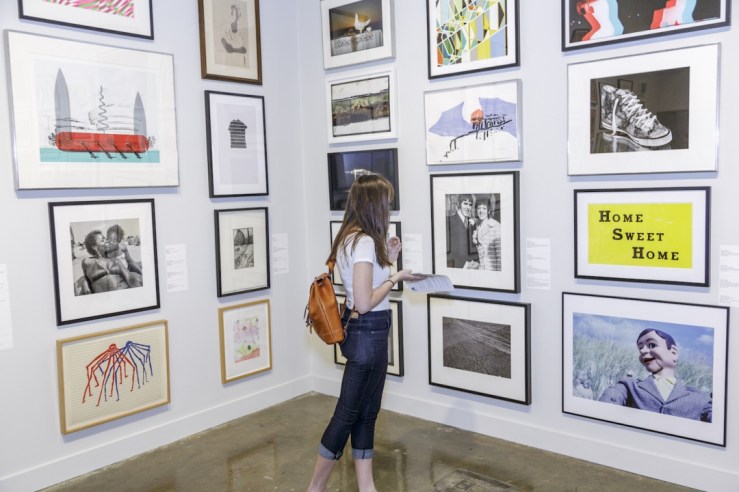
ARTICLE: “Can Art Lending Libraries Empower a New Generation of Collectors?” by Kealey Boyd: “For centuries, those who lacked the space or resources to collect artworks really only had one option—experiencing whatever fine art they could find in public spaces like museums. But in many cities, it’s now possible to borrow art for free. All you need is a local ‘art lending library’—an innovation in art sharing that could, just maybe, help democratize an activity that was once considered inaccessible.”

MIT art lending library
An MIT student peruses some of the 600 works available for free borrowing through the school’s Student Loan Art Program, established in 1969 and including pieces by Louise Bourgeois, Cindy Sherman, and others. Photo: John Kennard, courtesy MIT List Visual Arts Center.

+++

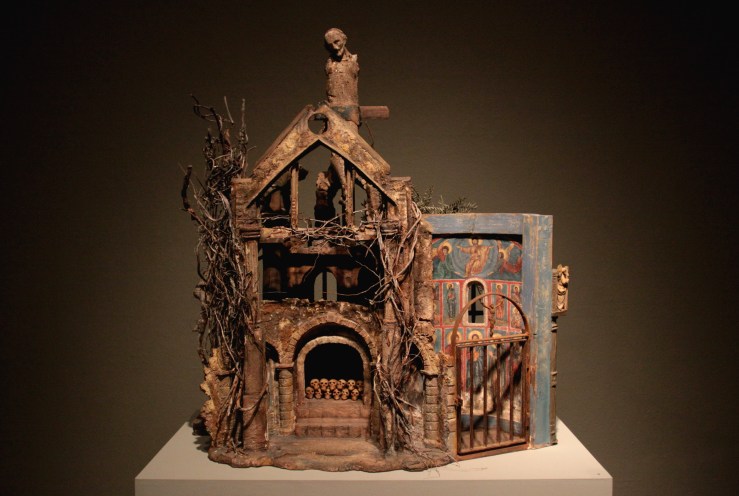
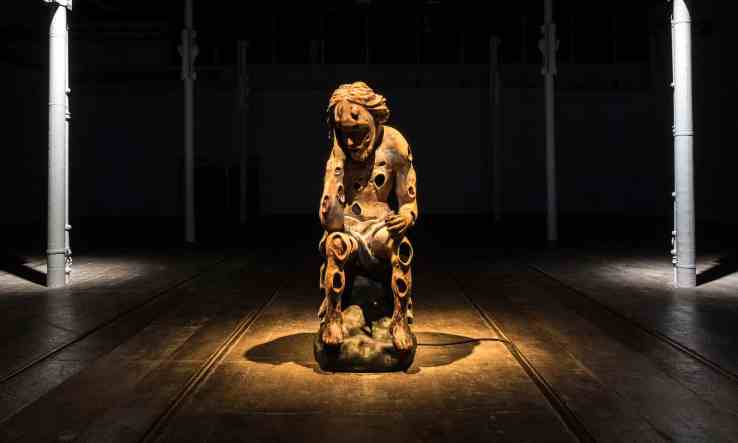
INSTALLATION: “Nobodaddy” by Mark Leckey, Tramway, Glasgow, Scotland, April 20–July 1, 2018: The wounds of Job speak in this solo exhibition by Turner Prize-winning artist Mark Leckey, part of the Glasgow International contemporary art festival. “Nobodaddy”—the title a reference to a William Blake poem about God’s seeming absence—features a spotlit, oversize Job figure that’s based on an eighteenth-century wooden statuette from Germany; he is covered in boils and excrescences and sitting in melancholy contemplation. The open wounds of the figure are embedded with speakers, and they broadcast a monologue of grief, voiced by Leckey and accompanied by horrible gurglings and rumblings. A video screen opposite Job projects a CGI apparition of the same figure and images of his hollowed-out insides. [HT: Jonathan Evens]

Nobodaddy by Mark Leckey
Mark Leckey (British, 1964–), Nobodaddy, 2018. Installation view at Tramway in Glasgow. Photo: Keith Hunter.

+++

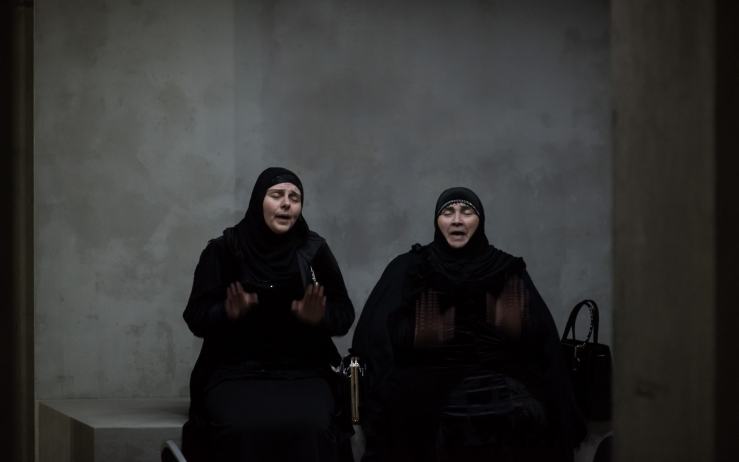
PERFORMANCE ART: An Occupation of Loss by Taryn Simon, Corner of Islington Green, Essex Road, London, April 17–28, 2018, co-commissioned by Park Avenue Armory and Artangel: I’m late on this one, unfortunately. For this work, reprised from its 2016 premiere in New York City, artist Taryn Simon brought together professional mourners from around the world (Albania, Armenia, Azerbaijan, Bhutan, Burkina Faso, Cambodia, China, Ecuador, Ghana, Greece, India, Kyrgyzstan, Romania, Russia, and Venezuela) to simultaneously enact their rituals of grief over the course of a half hour. The result is a cacophony of culturally diverse lamentations that reach a sustained climax and then fall away to a single voice and, eventually, a deep silence. Performed inside an underground concrete auditorium in Central London, balconied and three levels deep, the work is concerned not with the mourning of any one event or person in particular but with the phenomenon of loss itself.

An Occupation of Loss (Azerbaistan)
Haji Rahila Jafarova and Lala Ismayilova are professional Yezidi mourners from Azerbaijan. Photo: Hugo Glendinning, courtesy Artangel and Taryn Simon Projects.

In a New York Times review, William L. Hamilton explains that

traditionally, professional mourners are hired by families of the deceased to mark the occasion and to guide the dead to the place where they will lead their afterlife. Mourners are [also] called upon to mark larger losses within their communities, like displacement or exile, in a cultural role that is part witness, part historian and part poet. . . . Their laments, wails and cries are also testament to their own bereavements. They can be political testimony, too.

Simon describes the purpose of professional mourners this way: “The bereaved solicit the authority of professional mourners to occupy, negotiate, and shape their loss. The mourners control a psychological experience by directing and embodying the emotion of others.” An Occupation of Loss is the culmination of her seven years of research into professional mourning, which relied heavily on interviews with anthropologists, historians, linguists, musicologists, and other experts. Finding these performers, and then securing visas for them, was itself a herculean task. Listen to the artist discuss the project at more length in this Channel 4 news segment. [HT: Jonathan Evens]

An Occupation of Loss (Ecuador)
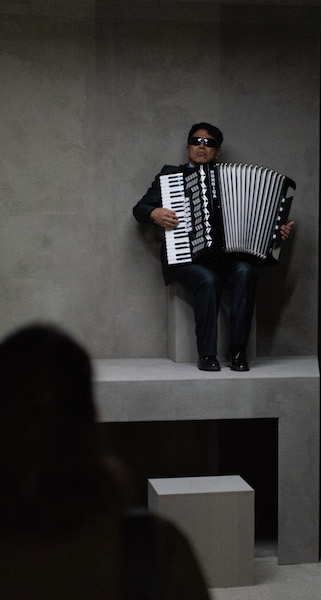
Hugo Aníbal González Jiménez is an Ecuadorian mourner who sings accordion-accompanied laments known as yaravíes and who is blind.

Roundup: Easter flash mob; Good Thief; Resurrection photo; Sistine Chapel frescoes in 3-D; etc.

FLASH MOB: On Easter 2011 at City Mall in Beirut, Lebanon, a flash mob broke out singing the Paschal troparion in Arabic: Christ is risen from the dead, trampling down death by death, and on those in the tombs bestowing life! [HT: Global Christian Worship]

+++

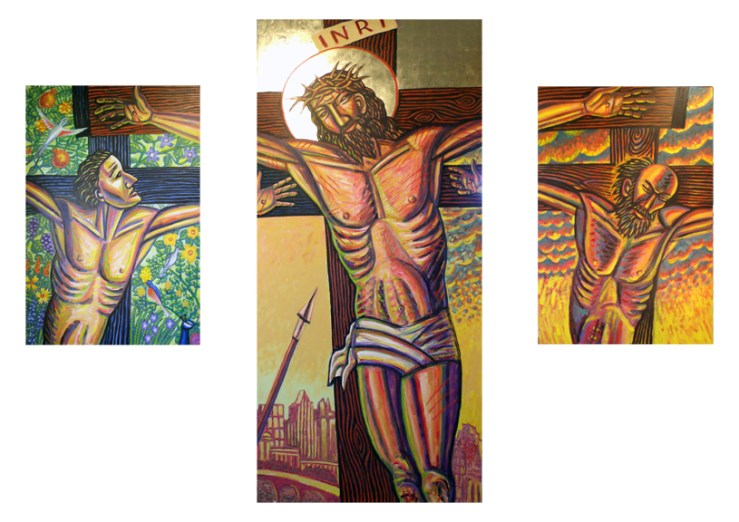
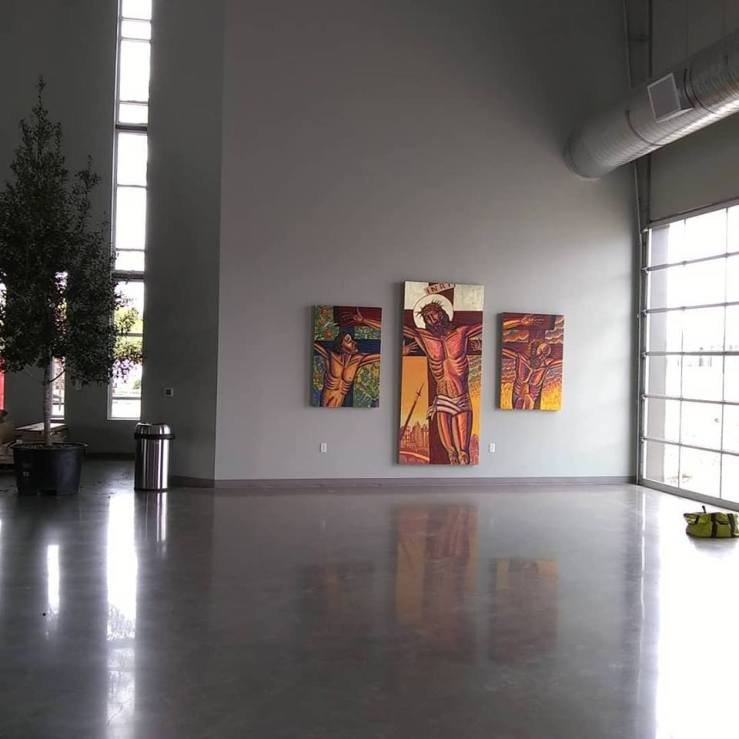
NEW PAINTING INSTALLED: James B. Janknegt is a Christian artist from Texas who is known for transposing biblical stories into contemporary American settings. He recently completed a large triptych for the new Unity Hall at Community First! Village in Austin, a planned community, developed by Mobile Loaves & Fishes, that provides affordable, permanent housing for the chronically homeless. (See the development and learn more about it in this short video, presented by MLF founder Alan Graham.) The painting shows Jesus in conversation with the “good thief” who, as he dies, acknowledges his crime and asks Jesus to “remember me when you come into your kingdom” (Luke 23:42). Behind him paradise flowers forth, indicating not only his new home but his inward regeneration. The other thief, by contrast, turns his head away in stubbornness. This episode demonstrates that repentance is always met by Christ with love, affirmation, and seeds of new life.

Good Thief by James B. Janknegt
James B. Janknegt (American, 1953–), Good Thief, 2018. Oil on three panels, 8 × 12 ft. Unity Hall, Community First! Village, Austin, Texas.

Good Thief by James B. Janknegt

+++

SHORT FILM: “Dance Dance” by French film director Thomas Blanchard evokes each of the four seasons through different elements acting on flowers, captured in either time lapse or slow motion. For fall, a rose is set on fire; for winter, foliage afloat in water becomes frozen in ice; for spring, lilies bloom; and for summer, colored inks hit the flowers and billow up in dusty clouds. Stunning images!

+++

CHAIYA ART AWARD FINALIST: The inaugural Chaiya Art Award competition ended last month, with the winner taking home £10,000 and being exhibited, along with forty-one other juried selections, at London’s gallery@oxo March 29–April 9. The theme was “Where Is God in Our Twenty-First-Century World?”

One entry I really love is finalist Sheona Beaumont’s Natal, a photographic work that shows a nude pregnant woman standing against a dark wall in profile, her hair blown wildly by a gust of wind, opposite a corpse. These are two different spaces set in juxtaposition—two photos stitched together. The black-and-white photo of the dead body, on the left, is Fred Holland Day’s The Entombment from 1898, in which he himself posed as Christ, laid out on a bier before a doorway, his crown of thorns and titulus crucis on the ground beside him. Beaumont rotated this horizontal image 90 degrees clockwise so that the Christ figure is propped upright. She then posed her female model to form a sort of mirror image, but one full of vitality; the woman’s belly, the site of new life about to be born, is brightly lit. This combination photograph makes a powerful Holy Saturday image, one that hints toward resurrection as the stillness gives way to stirrings. The photo is also an allusion to the new life believers have in Christ, and in fact it forms the first in a new series titled Born Again. Visit Beaumont’s website to view the artwork and to read a bit about her process and the meaning the work holds for her.

+++

EXHIBITION: “Zurbarán’s Jacob and His Twelve Sons: Paintings from Auckland Castle”: Last fall, Spanish Golden Age artist Francisco de Zurbarán’s Jacob and His Twelve Sons made its North American debut at the Meadows Museum in Dallas, traveling for the first time in centuries, and now the exhibition is at the Frick Collection in New York City—but only through the end of this week! Twelve of the thirteen paintings in the set are from Auckland Castle in County Durham, England, the residence of the eighteenth-century Anglican bishop Richard Trevor, who acquired them in 1756 and had them displayed in his dining room, where they have remained ever since. Trevor was outbid on the painting of Benjamin, however, which is on loan from Grimsthorpe Castle in Lincolnshire, reuniting the set for the first time since the paintings’ 1756 sale.

Judah and Dan by Francisco de Zurbarán
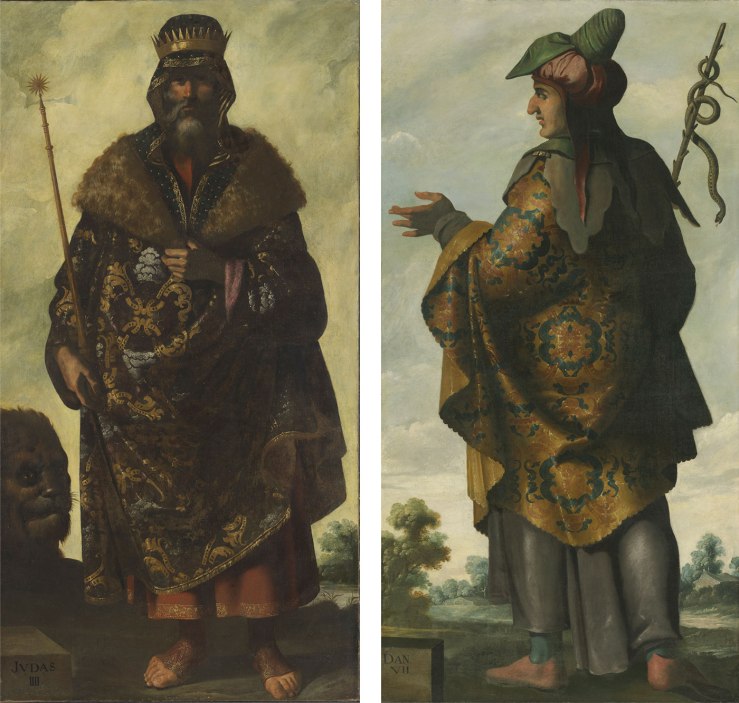
Francisco de Zurbarán (Spanish, 1598–1664), Judah; Dan, 1640–44. Oil on canvas, 79 1/4 × 40 3/4 in. each. Photos: Robert LaPrelle.

The iconography of the paintings is derived from the prophecies Jacob utters over each of his sons on his deathbed, as described in Genesis 49. For example, Judah, from whom “the scepter shall not depart,” holds said scepter and is regally draped in a gold brocade robe and fur that hint at his descendants kings David and Solomon (Zurbarán was the son of a haberdasher, and gave great care to the depiction of textiles); Dan, on the other hand, holds up a serpent on a stick, alluding to his craftiness. To view all the paintings, click here.

+++

3-D SHOW: As of last month and through the end of July, Artainment Worldwide Shows, in cooperation with the Vatican Museums, presents “Giudizio universale: Michelangelo and the Secrets of the Sistine Chapel” by Marco Balich, an immersive 3-D show that brings to life Michelangelo’s Sistine Chapel frescoes inside the Rome Conciliation Auditorium. Half the room is covered, from the walls to the ceiling, with a 270-degree screen that projects extremely high-res photos of the paintings, dramatized through movement, music, lighting, sound effects, narration, live actors, and dance. Lasting sixty minutes, the show concludes with the thirteenth-century Latin hymn Dies irae (“Day of Wrath”), set to new music by Sting and arranged for chamber orchestra and choir by Rob Mathieson. Watch the trailer below, or click here to see some of the 3-D animation of the Last Judgment.

Roundup: Merton on art; psalms of ascent; Oscar-nominated “Loving Vincent”; and more

BOOK EXCERPT: “Reality, Art, and Prayer” by Thomas Merton: In this excerpt from No Man Is an Island (1955), Merton talks about “aesthetic formation,” about how “music and art and poetry attune the soul to God”—art that doesn’t perform that function, he says, isn’t worthy of the name! Some might think that the spiritual solution to overstimulated senses (so many images, so much noise) is to close our eyes and ears. But that’s not necessarily so, as Merton explains: “The first step in the interior life, nowadays, is not, as some might imagine, learning not to see and taste and hear and feel things. On the contrary, what we must do is begin by unlearning our wrong ways of seeing, tasting, feeling, and so forth, and acquire a few of the right ones.” Yes! This is what I was trying to get at in my essay “Disciplining our eyes with holy images.”

+++

KICKSTARTER CAMPAIGN: Songs for the Sojourn by Bellwether Arts: The same liturgical arts initiative that brought you this Advent/Christmas package is now poised to release  a set of songs, visual art, and prose devotions inspired by the Bible’s “psalms of ascent,” which were likely sung by Jewish pilgrims as they ascended the road to Jerusalem for their three major annual festivals. At the head of the project is Bruce Benedict, founder of Cardiphonia, who in 2010 received a grant from the Calvin Institute of Christian Worship to commission songwriters and visual artists to help his congregation explore, through their respective disciplines, these fifteen psalms (read his application here). The project was so enriching to those involved that he recently decided to expand it to include even more songwriters, painters, and writers—the fruits of which are being made available to the public as a double-disc album, songbook, and art-filled devotional book.

While the songs have been recorded, Bellwether needs your help to finance the mixing, mastering, and disc pressing and the printing of the other two products, as well as to pay the new artists involved. Pledging money in exchange for a reward (essentially, placing a preorder) is a tangible way to support the project. Visit their Kickstarter page for more information or to make a pledge. Campaign ends March 23.

Help Higher Than the Hills by Aaron Collier
Help Higher Than the Hills (Psalm 123) by Aaron Collier. Photo courtesy Bellwether Arts/Cardiphonia.
Psalm 133 by Kyle Ragsdale
Psalm 133 by Kyle Ragsdale. Photo courtesy Bellwether Arts/Cardiphonia.

(For other artistic responses to Psalm 133, see this artful devotion featuring the Psalter Project and a William Walker mural, and the poem “Aaron’s Beard” by Eugene Peterson.)

+++

SONG: “Refuse the Bait” by Liturgical Folk: Fr. Nelson Koscheski, Ryan Flanigan, and David Moffitt wrote this song last year about Christ overcoming Satan’s temptations in the wilderness. I’m always blessed by these men’s collaborations. To stay apprised of their latest, follow Liturgical Folk on Facebook, and see also https://liturgicalfolk.bandcamp.com/.

+++

POEM CYCLE: “A Small Psalter” by Pádraig J. Daly: I really love this contribution in the current issue of Image journal—twenty-two modern-day psalms by Irish poet-priest Pádraig J. Daly. Like the biblical psalms, these poems express a range of emotions and postures before God, from sorrow and frustration to joy and awe. Here’s #12:

We are numbed, Lord, by number;
But you, being Other, know
Each single form that kneels at night,
Each heart enchanted by a meadow;
And hear our joys and heed our sighs.
And all we have and are, as we come naked here—
The very self of us!—
Comes from no thing in us
But from you, who make in us an emptiness
That you alone suffice.

+++

FILM: Loving Vincent, dir. Dorota Kobiela and Hugh Welchman: The Oscars are the only occasion of the year that I watch live TV, and I’m really looking forward to the show this Sunday. One of the nominations for Best Animated Feature is the world’s first fully oil-painted feature film, Loving Vincent, a biographical drama about the mysterious Vincent van Gogh. While most reviewers say the narrative content is forgettable, they hail the film’s innovative production methods and visual achievement as nothing short of amazing. Funded by Kickstarter, a team of 125 classically trained artists from various countries painted 65,000 frames in the style of the Dutch master (many of the final canvas paintings were exhibited at the Noordbrabants Museum last year), and actors were cast who had a physical resemblance to van Gogh’s portrait subjects (e.g., Chris O’Dowd as Postman Roulin!). To view the paintings and learn more about the filmmaking process, visit LovingVincent.com, and see the trailer below.

+++

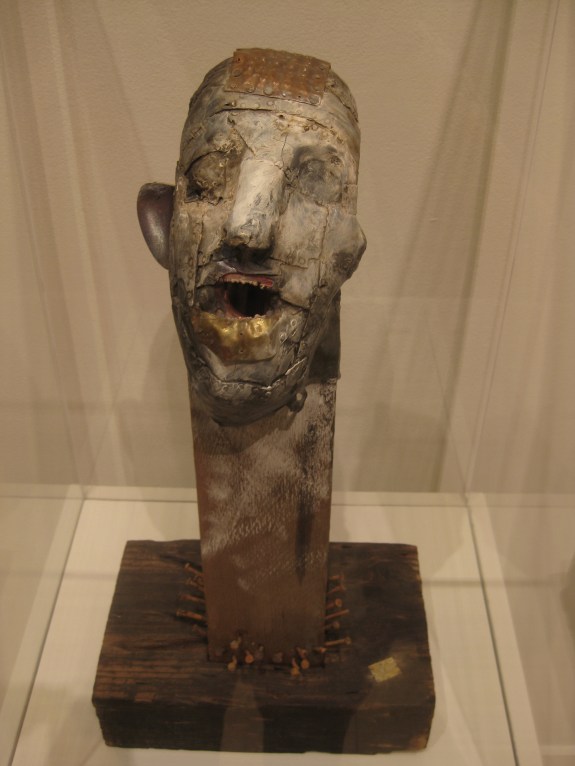
VISUAL MEDITATION: “Behold the Broken, the Bruised” by Victoria Emily Jones: Speaking of van Gogh . . . Last week I wrote a reflection for ArtWay on the mixed-media sculpture After Van Gogh by Mad River Wiyot artist Rick Bartow (1946–2016). The primal wail of the figure expresses the artist’s psychological wounds, as a person with PTSD, and the communal wounds of his people, as well as invokes the famously troubled postimpressionist of its title. To me it also evokes Jesus’s cry of dereliction on the cross: “My God, my God, why hast thou forsaken me?”

After Van Gogh by Rick Bartow
Rick Bartow (Wiyot, 1946–2016), After Van Gogh, 1992. Lead, wood, nails, crab claw, copper, and acrylic, 23 × 12 × 7 in. Private collection. Photo: Victoria Emily Jones.

Also, I’ve been writing Lenten art reflections for GiftofLent.org, one for each Monday of the season (through March 25). This week’s is on Kris Martin’s Altar, a steel replica of the Ghent Altarpiece framework, installed on a Belgian beach. Click on the link to read more.

Altar by Kris Martin
Kris Martin (Belgian, 1972–), Altar, 2014. Steel, 17′4″ × 17′3″ × 6′7″. Temporary installation in Ostend, Belgium.

Roundup: RIP Edwin Hawkins; why Christians should read poetry (and who to read); new Reconciliation Window; global song in white churches

Grammy-winning gospel pioneer Edwin Hawkins dies at 74: African American gospel musician, pianist, choir master, composer, and arranger Edwin Hawkins passed away on January 15. He’s best known for his 1967 R&B arrangement of the eighteenth-century hymn “Oh Happy Day,” which became an unexpected international hit and Grammy winner and is now a gospel standard. [HT: Global Christian Worship]

“Oh Happy Day” was one of eight arrangements Hawkins put together for his Northern California State Youth Choir, made up of forty-six singers ages 17 to 25, to record, planning to sell the album to finance a trip to a church youth conference in Washington, DC. They recorded the songs live at Hawkins’s church, the Ephesian Church of God in Christ in Berkeley, California, on a primitive two-track recorder. After hearing the self-published record, Buddah Records signed the group, helping to launch “Oh Happy Day” to the top of the pop charts in the US, UK, France, Germany, and the Netherlands and bringing attention to lead vocalist Dorothy Combs Morrison, 22. At the time, denomination officials did not approve of Christian singers crossing over into secular markets, and they refused to let Hawkins use the name of the choir on the Buddah reissue—hence the “Edwin Hawkins Singers” were born.

Check out the Christianity Today article “How ‘Oh Happy Day’ Gave Gospel a New Beat,” and this clip of the show-stopping performance of the song in the movie Sister Act 2, featuring a young Ryan Toby.

+++

“Ten poets every pastor should know” by Kolby Kerr (+ Part 2): “Preachers need poetry if for no other reason than to be reminded of the palpable weight of language,” writes Kolby Kerr for LeaderWorks, whose vision is “to provide the tools, training, and support to strengthen the church and its leaders to fulfill their God-given mission.” I love this ten-poet “mixtape” Kerr has put together as an entry point for those who have told him they want to “get into poetry.” An ordained minister with a BA in English and an MFA in creative writing, he offers a wise disclaimer: “I point you toward these poets so that you would read them, not strip mine their work for a quick sermon illustration. Before any of this shows up in your preaching, heed Thomas Cranmer: read, mark, learn, and inwardly digest.” [HT: David Taylor]

I recently wrote about one of Kerr’s recommendations, Richard Wilbur, here.

+++

“The Splash of Words: Believing in Poetry” by Mark Oakley: “Poetry is what we reach for when we are falling in love, when we are grieving and when we search the great mysteries. It’s easy to think the language of faith is in creeds, sermons and certainties, but Mark Oakley says that it is poetry that is the person of faith’s native language. In this talk he will invite us on an adventure into poetry’s power to startle, challenge and reframe our vision: like throwing a pebble into water, the words of a poem cause a splash whose ripples can, if we let them, transform the way we see the world, ourselves, and God.”

I mentioned Mark Oakley in a previous roundup. This lecture, given at St. Paul’s Cathedral in London in November 2016, is based on Oakley’s latest book The Splash of Words, which he says he wrote as a way of celebrating the truth that God is in this world. The first half of the video comprises his talk; the second half, Q&A. I was so enthralled by what he had to say that I immediately bought a copy of the book. It contains a twenty-two-page introduction on the value of poetry, but its bulk consists of twenty-nine poems, carefully selected, with commentary. Love it!

+++

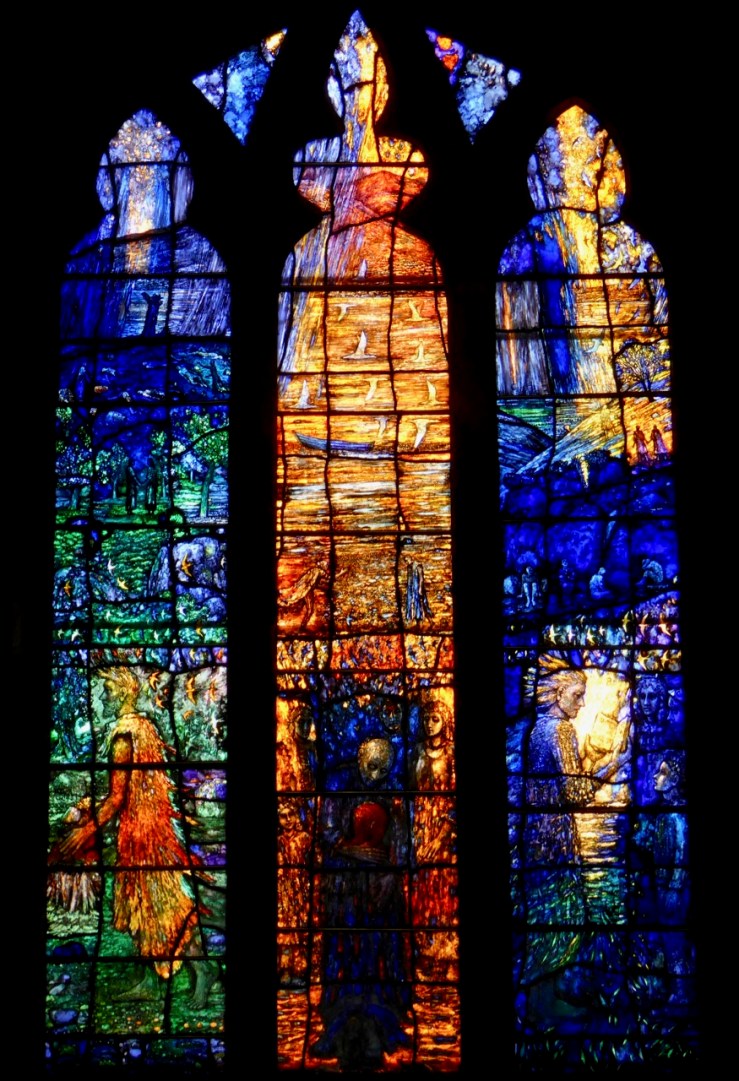
New stained-glass window by Thomas Denny: My friend Paul Neeley tipped me off to this new Reconciliation Window by contemporary stained-glass artist Tom Denny, whose distinctive style, characterized by blazing color, is achieved by acid etching and silver staining. Installed at St. John’s Church in Tralee, County Kerry, Ireland, in October 2017, the window depicts, in its central light, the Return of the Prodigal Son. The right panel shows Jesus reading from the book of Isaiah, and the left panel shows John the Baptist, the church’s patron saint. Throughout are names and vignettes from Traelee’s history and landscape. Bloggers Finola Finlay and Robert Harris have just visited St. John’s and have taken many beautiful detail shots of the window; have a look! For more on Denny, see the recently published book Glory, Azure and Gold: The Stained-Glass Windows of Thomas Denny or the article “Walking Man: The Art of Thomas Denny” from issue 86 of Image journal.

Reconciliation Window by Thomas Denny
Thomas Denny (British, 1956–), Reconciliation Window, 2017. Stained glass, 5 × 3 m. St. John’s Church, Tralee, County Kerry, Ireland.

+++

“Appropriation or Activism? Reflections on ‘Global Song’” by Marissa Glynias Moore: This article was posted this week in the Multicultural Worship Leaders Network Facebook group I’m a part of, addressing a question I’ve pondered a lot. A doctoral candidate in ethnomusicology at Yale University, Moore is wrapping up her dissertation on the use of “global songs” in the worship services of white, North American mainline Protestant congregations. She recounts her initial skepticism:

Within my first weeks at Battell [the University Church in Yale], I began to notice a shift in congregational repertoire compared to that of my college church. We rarely sang the hymns that had become dear to me; instead, we were more likely to be singing an Alleluia from Peru or a South African anti-apartheid “freedom song.” While I was curious about this unfamiliar genre of congregational music, the practice itself made me decidedly uncomfortable as I looked around the space: why were we, a bunch of predominantly white American college and graduate students, singing world music? Did we have the right to sing this music? Hadn’t my training as an ethnomusicologist prepared me to vehemently critique such a practice as a manifestation of appropriation?

But as her research developed she has been led to see that singing global song can actually be a gesture of hospitality and solidarity. (Update, 9/4/18: Listen to Moore on episode 24 of Sarah Bereza’s Music and the Church podcast, “Global Song and the Universal Church.”)

Roundup: Modern Bible illumination; hula; First Nations baptism design; father-daughter waltz; Tamayo and Parker

ESV Illuminated Bible spread

NEW BOOK: ESV Illuminated Bible (2017): In October Crossway released a new Bible illuminated by Seattle-based designer and lettering artist Dana Tanamachi. Printed in two-color (the illuminations are in gold ink), this volume contains one full-page illustration, custom icon, and illuminated drop cap for each book of the Bible, plus hundreds of hand-lettered Bible verses throughout the margins. There are no human figures in any of the illuminations; most consist of flora and fauna—olives, figs, pomegranates, peacocks, lions, lilies, deer, cedar, and so on—derived from the given book. Be sure to check out the book-opener illustration index, and the short video below, in which Tanamachi introduces herself, talks through her process, and explains some of her artistic choices:

“God loves beauty, so we wanted to honor him through this project with something that was beautiful,” says Josh Dennis, Crossway’s senior vice president of creative. “For this edition we really want people to engage with it, so there’s a lot of negative space and wide margins for people to write in it and to do their own Bible journaling.”

This publication comes six years after the release of Makoto Fujimura’s Four Holy Gospels, another illumination project. Fujimura’s is an oversize book with a $150 price point, containing original abstract paintings reproduced in full color alongside the first four books of the New Testament. By contrast, the ESV Illuminated Bible is more wieldy—it has a 6½ × 9 trim size—and less costly ($45), and it contains all sixty-six books. The aesthetic is also much different, as Tanamachi’s influences include art nouveau, the arts and crafts movement, and designers like William Morris and Koloman Moser. [HT: David Taylor]

+++

CHRISTIAN HULA: “‘O ‘Oe ‘Io” (You Are God): Though reduced to tourist entertainment in some places, Hawaiian hula dancing, in its traditional context, is a form of teaching and worship. Because of its associations with polytheism, early missionaries denounced it as sinful. Over the last half century or so, however, most missionaries have changed their stance toward this and other traditional forms of artistic expression—not only in Hawaii, but in whatever their host culture—seeing how such forms can offer more authentic ways for the people to connect to and worship the Christian God.

In the video below, Moani Sitch and ‘Anela Gueco perform a hula noho (“seated hula”) at the 2006 Urbana student missions conference sponsored by InterVarsity Christian Fellowship. It’s to the Christian hymn “‘O ‘Oe ‘Io” (You Are God), originally written in Maori by Luke Kaa Morgan but translated into Hawaiian by Moses Kaho‘okele Crabbe. The sacred name for Creator God—‘Io—is the same in both languages. The lyrics are below. [HT: Global Christian Worship]

‘O ‘oe ‘Io, e makuna lani (You are God, Heavenly Father)
‘O ‘oe ‘Io, ka waiola (You are God, the Living Water)
‘O ‘oe ‘Io, e kumu ola (You are God, the Source of Life)
Ka mea hana i na mea apau (The one who has made all things)
E ku‘u Haku (My Lord)
Ka mauna ki‘eki‘e (Who is the Highest Mountain)
‘O ‘oe ‘Io (You are God)

For a fantastic religious history of Hawaii, see this PDF booklet published by Aloha Ke Akua (“God Is Love”) Ministries. Among the many things I learned is that Hawaiians regard the arrival of Christian missionaries as the fulfillment of their elders’ prophecies that the one true God would one day return to the islands.

+++

FROM THE ARCHIVES: “Jesus as Chief: ‘Baptism Mural’ by Tony Hunt”: First Nations artist Tony Hunt Sr. died last month, just two months after his son Tony Hunt Jr., also a renowned carver. Read about Hunt Sr.’s inculturated serigraph of Christ’s baptism at my old blog, The Jesus Question—part of a seven-part series I did on Christian art of the Pacific Northwest Coast. Based on a carved and painted design he made for the Canadian Conference of Catholic Bishops, it shows John the Baptist as a Kwakwaka’wakw shaman in Native dress and with ceremonial rattle, installing Jesus as chief. The Father is manifest as Sun and the Spirit as Thunderbird.   Continue reading “Roundup: Modern Bible illumination; hula; First Nations baptism design; father-daughter waltz; Tamayo and Parker”

Roundup: Book list, Piano Guys, Mongolian Jingle Bells, call for papers, sacred landscapes, art installation in cave

ANNOTATED BIBLIOGRAPHY: “Art and theology” books published in 2017: I had fun compiling this book list for ArtWay, which spans the disciplines of art history, theological aesthetics, visual theology, philosophy, museum studies, liturgical studies, and Christian ministry. Let me know if I’m missing any titles. (For books published on art and theology between 2014 and 2016, click here.)

Art and theology books 2017

Among those geared toward popular audiences are In the Beauty of Holiness, a lavishly illustrated hardcover survey of eighteen hundred years of Christian fine art; Imaging the Story, structured as a small-group study with a “make” component; and a how-to manual for church leaders written by the director of Sojourn Arts, a flourishing church ministry in Louisville, Kentucky. There are books centered on biblical art from non-Western countries, like New Zealand, Tonga, and Australia, and on art by racial minorities, as in Beholding Christ and Christianity in African American Art, as well as books that focus on a single biblical symbol (e.g., the cross) or group of narratives (such as those unique to John’s Gospel).

But there are also books that focus on the contemporary art world, encouraging Christians to engage works beyond just those with explicitly Christian content or just those made by Christians.

Several books published this year engage with the ideas of leading early Protestant theologians, like Luther, Calvin, and (later) Kuyper, as they relate to visual art, and one even examines Reformational influences on Michelangelo’s late work. A smorgasbord indeed!

+++

SONGS:

Today is the seventh day of Christmas—the celebration continues! Here are two fun songs for your listening pleasure.

^^ “Angels We Have Heard on High,” arranged and performed by the Piano Guys: In this unique piano arrangement for eight hands, Jon Schmidt, Al van der Beek, Steven Sharp Nelson, and Paul Anderson strike, pluck, bow, and percuss the instrument, creating a more complex texture than you would expect. All the sounds you hear (except for the voices) are produced by the piano.

^^ “Mongolian Jingle Bells” by Altai Kai: This video shows a Mongolian musical ensemble performing their own rendition of “Jingle Bells” using local instruments—including a yatga (plucked zither), shanz (plucked lute), and morin khuur (bowed horsehead fiddle)—and overtone singing. [HT: Global Christian Worship]

+++

CALL FOR PAPERS: “Art as a Voice for the Church,” Princeton Theological Review: I regret not finding out about this opportunity earlier, as the due date is just a week away, but I’m posting it so that you can be sure to look out for this art and theology–themed issue in the spring!

Graduate students and early-career scholars are invited to submit papers to the spring 2018 edition of the Princeton Theological Review. We welcome papers from various disciplinary perspectives (theology, philosophy, church history, biblical studies, social sciences, etc.) as they relate to the theme of art and the church. How does theology manifest in all different forms of art (painting, poetry, photography, sculpture, music, theater, film, literature, dance, or any other creative endeavors)? How does artistic expression give voice to piety, critique, worship, or spiritual struggle? How has art influenced and been influenced by biblical interpretations, theological movements, historical context, or cultural conditions? Why is art such a powerful medium for Christian expression? All submissions are due January 8, 2018.

The current issue of PTR, released this fall, is on the same topic and is available for free download. Subtitled “A Festschrift for Gordon Graham,” it includes reflections by three leading thinkers on Professor Graham’s latest book, Philosophy, Art, and Religion: Understanding Faith and Creativity, as well as three essays: “Visual Images and Reformed Anxieties: Some Scottish Reflections” by David Ferguson; “The Scandal of the Evangelical Eye” by Matthew J. Milliner; and “God, One and Three—Artistic Struggles with the Trinity” by Gesa E. Thiessen. [HT: millinerd.com]

+++

COMPANION EXHIBITIONS
October 10, 2017–January 14, 2018
J. Paul Getty Museum, Los Angeles

“Sacred Landscapes: Nature in Renaissance Manuscripts”: “In Renaissance Europe, many people looked to nature for spiritual inspiration and to guide their contemplation of the divine. In manuscripts created for personal or communal devotion, elements of nature—such as rocks, trees, flowers, waterways, mountains, and even the atmosphere—add layers of meaning to the illuminations, which were painted with careful observation of every minute detail. These landscapes remind readers to appreciate, and respect, the wonder of creation.” Read more at The Iris, the blog maintained by Getty curators, educators, conservators, and other staff.

“Giovanni Bellini: Landscapes of Faith in Renaissance Venice”: “Giovanni Bellini’s evocative landscapes are as much the protagonists of his paintings as are the religious subjects that dominated 15th-century Italian art. One of the most influential painters of the Renaissance, he worked in and around Venice, and while his landscapes are highly metaphorical, they also accurately reflect the region’s topography and natural light. Created for sophisticated patrons, Bellini’s works present characters and symbols from familiar sacred stories, set in a dimension of reality and lived experience to a degree unprecedented in the history of Italian painting.”

Crucifixion (detail) by Giovanni Bellini
Giovanni Bellini (Italian, ca. 1430–1516), Crucifixion with the Virgin and Saint John the Evangelist (detail), ca. 1459. Oil and tempera on wood panel. Museo Correr, Venice.

+++

TEMPORARY INSTALLATION: Yesterday was the last day to see “Nativity Scenes of the World” by Ejti Štih, an installation of thirty culturally diverse, life-size cut-out figures inside the concert hall of Slovenia’s famous Postojna Cave. What a location! Click here for a quick video tour of all the figures.

Nativity by Ejti Stih

Nativity by Ejti Stih

+++

I’m excited to dig into the new books I got for Christmas! Thanks, family—you’re the best. (And no, Mom, the book-length bibliography of ekphrastic poetry was not a mistake on my wishlist. Yes, really.)

Christmas books

Roundup: Animated Nativity short; Bethlehem speaks; “Glory in the Darkest Place”; Norwegian jazz; gilding goldfinch

SHORT FILMS:

>> Rozhdestvo (The Nativity) (1996), written and directed by Mikhail Aldashin: I am blown away by this wordless animated short from Russia. Using a naive art style washed in sepia tones and set to a soundtrack of Bach and Beethoven, it tells the story of how angels, humans, and animals came together on the first Christmas to worship the newborn Christ. It opens with Gabriel peeking out from behind a tree at Mary hanging laundry, then chasing her down a footpath to tell her what God is up to. For every person and critter he encounters, Gabriel flashes open the book of God’s word, pointing them to the shalom it prophesies and inviting them to enter in. By the end, shepherds, fishermen, kings, rabbits, lambs, and lion are participating in a round dance outside the stable, while an angel orchestra (which includes violins and timpani!) plays from the rooftop.

An emphasis on the sweet humanity of the holy couple—scared, tired, joyful, loving—makes this film especially endearing, and the roles given to animals reminds us that under Christ, all creation will be redeemed. I’m adding this to my annual Christmas watchlist! [HT: ArtWay]

>> O Little Town of Bethlehem (2012), dir. Tim Parsons: Commissioned by St. Paul’s Arts and Media (SPAM) in Auckland, New Zealand, this film tells the story of Christ’s Nativity through the voices of those who currently live in and around his birthplace of Bethlehem. A Palestinian shepherd, taxi driver, street vendor, midwife, peace activist, and antiquities dealer are among those interviewed, each reflecting on the significance of Christ’s story and providing a window into Middle Eastern culture. Some are Christian, others are Muslim (the Koran has its own account of the virginal conception and birth of Jesus—or Isa, as he is known in that tradition).

Though filmed five years ago, the living conditions captured in this video still exist. The West Bank’s 440-mile wall, built by Israel on seized land, plows through front yards, farms, and university campuses and restricts the movement of Palestinians—to water, work, prayer, and hospitals. Since the establishment of the modern State of Israel in 1948, many Palestinians have been displaced from their homes and live in refugee camps. The director said he didn’t want to make the film political but that he couldn’t avoid filming these realities. The hopes and prayers expressed by the film’s subjects we should adopt as our own this Christmas as we reflect on the birth of Hope, Peace, Joy, and Love two thousand years ago in this little Palestinian town.

+++

SONGS:

>> “Glory in the Darkest Place” by Brittany Hope: Last December Brittany Hope Kauflin (whose professional name drops the “Kauflin”) wrote “a song for those in darkness this Christmas season,” video-recording it at home with her sister McKenzie and her dad Bob. The outpouring of appreciation she received made her recognize the demand for soft and somber Christmas songs that probe for the light—as for many people, the holidays are characterized more by sadness than by celebration. Now the song is available, along with seven others in the same vein, on the album Glory in the Darkest Place. To read an introduction to the song by Bob Kauflin and/or to download the chord chart, piano score, and lyrics, click here. [HT: Bruce Benedict]

>> “Hellige Natt” (O Holy Night), arr. Eirik Hegdal, feat. Kirsti Huke: This innovative Norwegian jazz arrangement of the Christmas classic “O Holy Night” is performed inside the medieval Nidaros Cathedral in Trondheim by the Norwegian University of Science and Technology (NTNU) Jazz Ensemble and the NTNU Chamber Orchestra. An impressive space whose grandeur is matched by this rich, expressive performance. [HT: Global Christian Worship]

+++

ILLUMINATED POEM: “Goldfinch” by Robert Macfarlane, illuminated by Jackie Morris: Nature writer Robert Macfarlane’s critically acclaimed book The Lost Words: A Spell Book, illustrated by Jackie Morris and published this October, is a joyful celebration of the nature words that were dropped from the 2008 edition of the Oxford Junior Dictionary. Aiming to “enchant nearby nature again” for both kids and adults, it comprises a series of acrostic poems whose main letters are gilded in gold leaf.

Goldfinch poem
Poem by Robert Macfarlane. Art by Jackie Morris.

I’m pleased to see that Macfarlane’s collaboration with Morris has continued with his latest “Goldfinch”—a “‘charm’ about hope, harm, gift & darkness.” Handwritten over a painting by Morris, the poem begins

God knows the world needs all the good it can get right now—and
out in the gardens, the woods, goldfinches are gilding the land for free,
leaving little gifts of light . . .

The piece is reproduced in the latest issue of Elementum Journal, and the original has sold. Hear Morris read the poem in the SoundCloud player above.

Click here to read an interview with Macfarlane and Morris on the making of The Lost Words, and here to read Macfarlane’s response to a 2002 study that found that four- to eleven-year-old Brits are better at identifying Pokémon characters than native species of plants and animals, like oak tree and badger. Also, check out his other books, like Landscape, The Old Ways: A Journey on Foot, The Wild Places, and Mountains of the Mind.


Many of the artworks and resources I share on these roundup posts I discover through the individuals, organizations, or publications I follow on social media or via RSS. If I’m not introduced to the content directly by its maker, I will try to indicate an “HT” credit, shorthand for “hat tip,” meaning thank you, X, for bringing this to my attention! All descriptions and commentary, however, are my own, unless set in quote marks.

Roundup: “O Children, Come”; the Christmas story through news photos; Messiaen and the Incarnation; art from Bethlehem; nativity musical soundtrack

SONG: “O Children, Come” by Keith and Kristyn Getty: The Gettys are an Irish married couple who are major contributors to the modern Christian hymn-writing movement. I really enjoyed singing this song of theirs at church last week (CCLI 7036340); it was my first time hearing it. The acoustic performance below is from the Gettys’ 2015 Christmas concert. They’ve also recorded it with Ladysmith Black Mambazo.

+++

PHOTO ESSAY: “Alternative Nativity”: Kezia M’Clelland works with children affected by conflict in the Middle East and raises public awareness through her blog, Kezia Here and There. In 2015 she compiled news photos that document the refugee crisis and set them to excerpts from St. Matthew’s account of Christ’s birth and the prologue to St. John’s Gospel—a very powerful pairing that gives impetus to our Advent cry, “Come, Lord Jesus!” This is not a generic mashup; each photo was carefully selected to amplify a corresponding scripture text.

Alternative nativity1
“About that time Caesar Augustus ordered a census to be taken throughout the Empire. This was the first census when Quirinius was governor of Syria. Everyone had to travel to his own ancestral hometown to be accounted for.” (Photo via Reuters. Displaced Yazidis escape across the Syrian border by foot, fleeing violence from the Islamic State militants who have taken over their home town of Sinjar.)
Alternative nativity2
“So Joseph went to Bethlehem. He took with him Mary, his fiancée, who was obviously pregnant by this time.” (Photo via Al Jazeera. A refugee father with his pregnant wife and daughter asks for permission to enter into Hungary near Roszke as the border fence with Serbia is closed by Hungarian police.)

For each subsequent Advent, M’Clelland has released something in a similar vein: the video “Hope Is on the Way” in 2016, and this year, “Light in the Darkness,” with verses of scripture, mainly from the Old Testament prophets, emblazoned across photos from today’s Middle East. “This year again these Advent pictures and words will speak of a hope that is now and not yet,” she writes. “I am grateful that Advent gives us the freedom to weep and to hope, to rejoice and to grieve, to wait for and to recognise the Christ who is already here among us.”

Marrying the Christmas story with contemporary photojournalism can teach us to “pray with the Bible in one hand and a newspaper in the other,” as the popular adage goes. As we see the world’s brokenness, it should intensify our fervor for Christ’s shalom and impel us to action.

+++

UPCOMING MUSIC & ART EVENT: “Messiaen and the Incarnation,” December 20, 8 p.m., St. Mary’s Addington, London: Next Wednesday evening, Dr. Edward Forman will be performing three movements each from the French avant-garde composer Olivier Messiaen’s organ suite La Nativité du Seigneur (The Nativity of the Lord) and piano suite Vingt regards sur l’Enfant-Jésus (Twenty Contemplations on the Infant Jesus). Messiaen was a committed Christian who sought to express theological truths in a fresh, modern idiom. Like much of his output, these two works reject the Western conventions of forward motion, development, and diatonic harmonic resolution, so they can be difficult for first-time hearers. But this complexity, this sense of the unexpected, is appropriate for the mystical content they seek to convey.

Inspired by the unique palette of sounds, textures, and rhythms of Nativité, British artist Sophie Hacker translated these into visual form. After deeply studying the music, in 2007 she created nine mixed-media panels in response—one for each movement—using slats of wood, nails, lead, wire, tree bark, and other found objects; you can see some of her process in the video below. These premiered at Winchester Cathedral in 2008. Then again in 2015 Hacker participated in another Messiaen-inspired artistic collaboration, under the direction of pianist Cordelia Williams, with poets Michael Symmons Roberts and Rowan Williams. This project is called “Between Heaven and the Clouds: Messiaen 2015.”

La Nativité du Seigneur by Sophie Hacker
Sophie Hacker (British), La Nativité du Seigneur (The Nativity of the Lord), 2007. Mixed media on nine canvases, 60 × 60 cm each. Photo: Mike J. Davis.

To guide us through the listening experience, St. Mary’s will be projecting Hacker’s artworks onto a screen during the playing, and interspersing it with poetic reflections on the theological themes—from the Bible, Messiaen, Roland Riem (Icons of the Incarnation), and other sources. “We think it is equally pointless to try to explain Messiaen’s music in words as to attempt a sensible account of what it means for God to become human,” writes Forman in the booklet that will be provided to attendees. “We hope that the visual effects, words and music will enhance each other in ways that are inspiring and provoking.”

Messiaen’s compositions are definitely more challenging than the standard Christmas music fare, so I am grateful that St. Mary’s has the boldness, vision, and talent to offer them to the public, and in the meaningful context (which you likely won’t get in the concert hall) of meditation on the mystery of the Incarnation.

+++

ARTIST PROFILE: Zaki Baboun: Zaki Baboun is a Palestinian Christian artist living in Beit Jala, a suburb of Bethlehem. He paints religious scenes in oils on olive wood, which you can browse and purchase here—either the originals or reproductions on Christmas cards.

The first video below contains a short, two-minute interview with Zaki and shows him painting The Journey of the Magi; the second shows him painting The Good Shepherd.

+++

ALBUM: The Unusual Tale of Mary and Joseph’s Baby by Waterdeep: I saw the world premiere of this nativity musical last summer in New York (read my review here), and it really helped shepherd my imagination into a deeper understanding of Mary and Joseph’s social and emotional realities. Now the album is out! The songs express the many ups and downs the Holy Couple likely underwent in their faith journeys to bring the Messiah into the world, with the theme of deliverance standing in highest relief. (Mary’s opening song, “I Want to Be Delivered,” is what spurs, much to her shock, the Annunciation, and the finale, “Walk Through the Sea on Dry Land,” draws everyone into a joyful reminiscence of God’s mighty hand in ages past, manifest in the present through the birth of the Christ child.) Comedy is provided through invented characters like Joseph’s friend Benjamin, the innkeeper and his wife, and a shepherd named Naphtali.

The Unusual Tale of Mary and Joseph's Baby album cover

The most poignant scene, for me—and hence probably my favorite song—is the “Magnificat.” The biblical account doesn’t tell us much about Mary’s state of mind at this point, so the writers imagine her coming to Elizabeth filled with fear, and Elizabeth building her up, preaching truth to her (and sharing her own story of shame), helping her move from doubt to confidence. Elizabeth’s song is what emboldens Mary to sing. Their “Magnificat” is later reprised by the full cast immediately following Christ’s birth, concluding part 1.

The new album is not an original cast recording; instead the songs were recorded by their writer, Don Chaffer, and his wife, Lori, and released under the Waterdeep moniker. Stream on Spotify; sample and purchase at Amazon or iTunes.

Roundup: Cracked lanterns; Incarnation songs; Christmas gallery talks; pregnancy poem

COMMUNITY ART PROJECT + INSTALLATION: Light the Well by Anna Sikorska: Last month artist Anna Sikorska led the congregation of St. Martin-in-the-Fields in creating a constellation of cracked, translucent porcelain globes, lit from within like lanterns and linked together—a visualization of Paul’s words in 2 Corinthians 4:6–12, about our hearts being clay jars whose fragility and brokenness enable the light of Christ to shine through all the more. Light the Well was installed at St. Martin’s on November 11, and since November 19 the individual lanterns have been selling for £10 a piece to benefit New Art Studio and Art Refuge UK, charities working with art therapy in the context of migration and displacement. Associate vicar Jonathan Evens delivered a beautiful reflection on this artwork and the scripture that inspired it, as well as a prayer and benediction, which you can read in full here.

Light the Well installation

I love it when churches use art not merely to decorate or prettify the building but to further the congregation’s engagement with scripture and to foster shared doing and seeing.

+++

SONGS:

“City of David” by the Gray Havens: The Gray Havens, a “narrative pop folk duo” from Nashville made up of married couple David and Licia Radford, released a new Christmas single on November 17—recorded on an iPhone! Listen to the song and watch some of their “making of” process in the video below. God the Father often gets overlooked during this season, so I like that the refrain reminds us that “the Father sent him [the Son] down.” [Purchase here]

“Human for Me” by Katy Kinard: Released last year on the album God of Fireflies, this song praises God for assuming full humanity—for not circumventing any frustrating or painful aspect of it. [Purchase here]

+++

GALLERY TALKS:

“The Christmas Story in Art” at the National Gallery, Washington, DC: Gallery lecturer David Gariff will lead a 75-minute discussion about paintings in the collection that depict the birth of Jesus, including one of my favorites, Duccio’s Nativity with the Prophets Isaiah and Ezekiel. (Click on the link to see a full list of works.) The event is free and geared to an adult audience. To participate, meet in the West Building Rotunda at 1 p.m. on December 9 or 10, or 2 p.m. on December 14, 18, 20, 21, or 22.

Nativity with Isaiah and Ezekiel by Duccio
Duccio (Italian, ca. 1255–60–ca. 1318/19), The Nativity with the Prophets Isaiah and Ezekiel, 1308/1311. Tempera on single poplar panel, 48 × 86.8 × 7.9 cm (18 7/8 × 34 3/16 × 3 1/8 in.). National Gallery of Art, Washington, DC.

“Adoration of the Kings” Facebook Live tour at the National Gallery, London: Friday, December 15 at 9 a.m. GMT, director Gabriele Finaldi will be exploring Jan Gossaert and Pieter Bruegel the Elder’s paintings of the Adoration of the Magi. This “tour,” offered exclusively online, will be broadcast live on the Gallery’s Facebook page, and a replay version will be available on the channel afterward.

Adoration of the Kings by Jan Gossaert
Jan Gossaert (Flemish, d. 1532), The Adoration of the Kings, 1510–15. Oil on oak, 179.8 × 163.2 cm. National Gallery, London.
Adoration of the Kings by Pieter Bruegel
Pieter Bruegel the Elder (Flemish, d. 1569), The Adoration of the Kings, 1564. Oil on oak, 112.1 × 83.9 cm. National Gallery, London.

+++

POEM: “Scale” by Chelsea Wagenaar: Chelsea and I went to the same small North Carolina church as kids, back when she was a Henderson and I a Hartz, so we share a heritage of learning Bible lessons from Butch the Dragon and competing annually in the Bean Bag Relay at the AWANA Olympics. Now she is an award-winning poet, a Lilly Fellow, a lecturer in Valparaiso University’s English department, and a mom!

Inspired by her pregnancy, the poem “Scale” is full of metaphors that revel in the wonders of prenatal life—the womb is a “winterplum sky,” the cluster of baby cells “untufted cotton,” the belly a “Lenten moon.” The central theme, which Chelsea cleverly plays around, is Psalm 139:16, a praise verse by King David: “Your eyes saw my unformed substance; in your book were written, every one of them, the days that were formed for me, when as yet there was none of them.”

Chelsea’s poem is especially appropriate for Advent, a season of pregnancy in which we position ourselves retrospectively with Mary, letting our hearts expand as we wait expectantly for that marvelous deliverance, the coming of the Christ child.

Roundup: Record-smashing painting; Sutherland Springs memorial; jazz Thanksgiving; Advent candle liturgy; Every Moment Holy

Leonardo da Vinci painting breaks all-time sales record: A painting of Christ by the Renaissance master sold for $450.3 million at Christie’s on Wednesday to an anonymous bidder, making it the most expensive painting ever acquired, either at auction or (it’s believed) through private sales. (It displaced by a long shot Picasso’s Women of Algiers, which sold for $179.4 million at auction in 2015, and the reported $300 million paid privately for Gauguin’s Nafea Faa Ipoipo?, also in 2015.) A common iconographic subject in the sixteenth century, “Salvator Mundi” translates as “Savior of the World”; Leonardo’s shows Christ in Renaissance dress, holding a crystal orb in his left hand (representative of Earth) and raising his right hand in benediction. He painted it around 1500 for King Louis XII of France, but it was presumed lost until 2005—“the biggest [artistic?] discovery of the 21st century,” said Christie’s. It’s one of only twenty known paintings attributed to Leonardo.

Salvator Mundi attributed to Leonardo da Vinci
Leonardo da Vinci (Italian, 1452–1519), Salvator Mundi (Savior of the World), ca. 1500. Oil on walnut, 45.4 × 65.6 cm (25.8 × 19.2 in.).

+++

White-chair memorial inside Sutherland Springs church opens to public before demolition: First Baptist Church in Sutherland Springs, Texas, reopened to the public on Sunday evening for the first time since a mass shooting on November 5 killed twenty-six people attending worship. In the week between, volunteers came in and repaired all the bullet holes, ripped up the carpet and tore out the pews, and applied fresh coats of white paint to the walls and concrete floor. A temporary memorial has been erected, consisting of white folding chairs that bear the names of the victims in gold paint as well as roses with chiffon ribbons. The one pink rose among twenty-five red ones is for the unborn child who died with his or her eight-months-pregnant mother.

First Baptist Church, Sutherland Springs
Temporary memorial, November 12, 2017, First Baptist Church, Sutherland Springs, Texas. Photo: Drew Anthony Smith for the New York Times
First Baptist Church, Sutherland Springs
Baby Holcombe’s pink rose sits between roses for his or her mom Crystal and brother Greg. Nine of the twenty-six shooting victims were from the Holcombe family.

Although the congregation has not yet officially voted on it, it’s likely that the church will be demolished and a new one built in its place; the pastor said many congregants do not want to go back in there because of the trauma. (The Sunday after the shooting, they worshipped in a large outdoor tent nearby.) Preemptively, a San Antonio contractor teamed up with other local business owners to form a nonprofit, Rebuilding Sutherland Springs Inc., to raise money for a new church building and park. Through GoFundMe, they have already raised $1.1 million of their $2.5 million goal. Click here to donate.

+++

Thanksgiving-themed black gospel jazz service: This video recording is from a Jazz Vespers service held on November 10, 2015, in Goodson Chapel at Duke. Chapel Dean Luke Powery and others offer prayers and readings, while the John Brown Big Band, a professional jazz ensemble, leads music. The songs are as follows: “Glory, Glory, Hallelujah” (opening); Walter Hawkins’s “Thank You (Lord, for All You’ve Done for Me)” (5:15); “Thank You, Lord” (11:44, reprised 52:26); “Every Day Is a Day of Thanksgiving” (25:05); “Perfect Love Song” (56:25); “Amazing Grace” (1:03:24); and “When the Saints Go Marching In” (1:09:04).

+++

Advent candle-lighting liturgy: Advent season is just around the corner. Here are five dramatic readings for the lighting of the Advent candles, based on traditional liturgies. They were written by Kathy Larson, director of Christian education and creative arts at Good Shepherd Presbyterian Church in Charlotte, North Carolina. They sound very compelling!

+++

NEW BOOK: Every Moment Holy by Douglas Kaine McKelvey: On November 3 Rabbit Room Press released a collection of one hundred-plus new liturgies for daily life bound together in a beautiful hardcover volume with linocut illustrations by Ned Bustard. Some of the prayers are intended for routine acts, while others are for special, memorable, difficult, or even tragic occasions. Included are liturgies for laundering, for home repair, for the watching of storms, for the first hearthfire of the season, before beginning a book, for setting up a Christmas tree, for the welcoming of a new pet, for the morning of a medical procedure, for the death of a dream, upon tasting pleasurable food, and for the sound of sirens. The aim is to encourage mindfulness of the constant presence of God. Five free liturgies are available for download at https://www.everymomentholy.com/liturgies. The book is for sale exclusively at the online Rabbit Room Store. Read an interview with the illustrator here.


Communing with the Lord during one’s daily tasks is what the seventeenth-century monk Brother Lawrence calls “practicing the presence of God”; poet George Herbert calls it “drudgery made divine.” The Anglican priest Jonathan Evens led a short meditation a few months ago at St. Stephen Walbrook that draws on the wisdom of these two near contemporaries, titled “Doing Our Common Business for the Love of God”—very much in the same spirit as McKelvey’s book.

Every Moment Holy
Every Moment Holy by Douglas Kaine McKelvey (Rabbit Room Press, 2017). Right: Part opener illustration by Ned Bustard for “Liturgies of Labor and Vocation.”

+++

QUOTE OF THE WEEK: The following church-sign photo from the Canadian Memorial United Church and Centre for Peace in Vancouver has been making the rounds on Twitter via Banksy:

Build a longer table

“If you are more fortunate than others, build a longer table, not a taller fence.”