Roundup: Purpose of Advent, light installation, book list, interview, TheoArtistry

WHY CELEBRATE ADVENT? Some of my evangelical friends don’t understand why I observe Advent. Cheryl Bridges Johns’s recent Seedbed article “Advent and the Winter of Our Disenchantment” answers the question so well, opening like this: “Advent is the time to open the first pages of the Church’s story of salvation. It is an enchanted portal into a world of darkness, deep mystery and the Spirit’s hidden brooding. Advent asks us to sit a while in the darkness, waiting for the light of God.” It’s a counterweight to “the unbearable lightness of Christmas,” a space to groan alongside our spiritual forebears. See also the Desiring God articles “Christmas Is Too Big for One Day” and “Seven Reasons to Celebrate Advent.” Christmas didn’t occur in a vacuum! Advent makes us mindful of the larger story of God’s promise to his people.

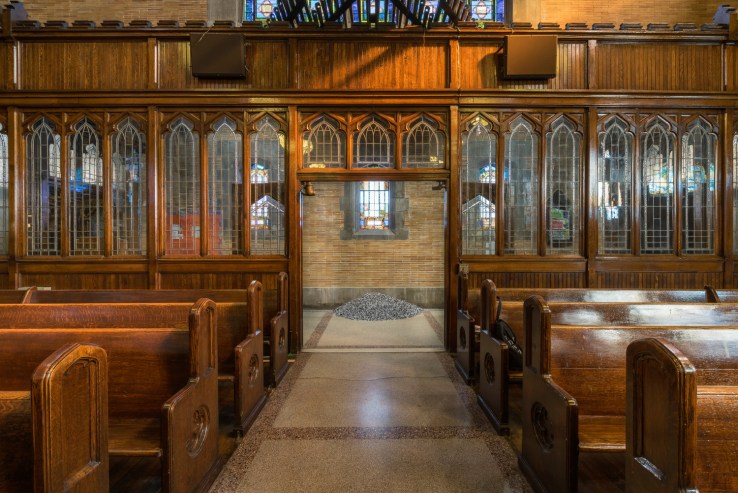
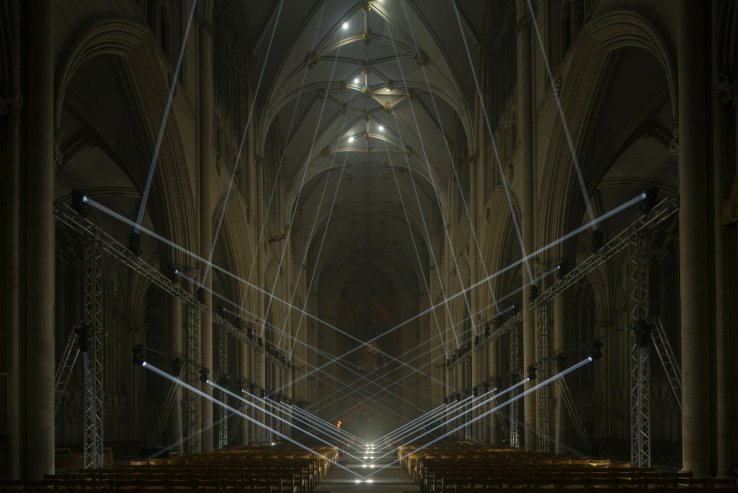
LIGHT MASONRY: Michael Wright tipped me off to this stunning light installation by Jason Bruges Studio in the main nave of York Minster. It was one of six works commissioned for Illuminating York, an annual nighttime festival supported by Arts Council England that encourages visitors to explore and discover the historic city through the imagination of artists who use the medium of light in all its forms. Designed to highlight the cathedral’s Gothic architecture, Light Masonry was constructed using a bespoke system of forty-eight computer-controlled, icon-beam moving-head luminaires (see the “making of” video) and was complemented by the live performance of Arvo Pärt’s Pari intervallo on organ. It ran October 26–29, 2016. The video below captures some of its magnificence.

Light Masonry by Jason Bruges
Light Masonry installation by Jason Bruges Studio, York Minster, York, England, October 26–29, 2016.

BOOK LIST: I recently compiled an annotated bibliography of books published in English between 2014 and 2016 on the subject of Christianity and art: http://www.artway.eu/content.php?id=2204&action=show&lang=en. The thirty-seven entries, from a variety of authors and publishers, cover topics such as iconographic exegesis of the Hebrew Bible, the religious art of Pablo Picasso, contemporary church art commissions, visual culture in the Christian kingdom of Kongo, black public religious art in Chicago, a theology of human creativity, how to launch and manage a church gallery, and building a curriculum for the fine arts in Christian education. Let me know if I’m missing any!

INTERVIEW: Earlier this month I was interviewed by Joan Huyser-Honig for the Calvin Institute of Christian Worship about my vocation as a Christian arts blogger, the two Advent art resources I developed, and my participation in the “Bodies of Christ” seminar at Calvin College this summer. (Read the interview: “Victoria Emily Jones on Gazing as a Spiritual Practice.”) Joan had some good questions, including

  • When you post to your Art & Theology blog, who do you hope will see it and what do you hope they’ll do with it?
  • Your blog’s tagline is “Revitalizing the Christian imagination through painting, poetry, music, and more.” What might or does happen in Christians and congregations who are open to revitalizing imagination?
  • Picture a worship planner without your deep knowledge of art and theology. How might he or she start using resources from your blog in planning public worship?

THEOARTISTRY: TheoArtistry is a new initiative of the Institute for Theology, Imagination and the Arts at the University of St. Andrews in Scotland. “Through new projects and research, TheoArtistry celebrates the practice, making, performance, curatorship, and reception of Christian art. It also seeks to inform the scholarly and public perception of the role of the arts in theology and church practice.” The first project they’ve launched is a collaboration between internationally selected composers and PhD candidates in the St. Andrews Divinity School to set to music “annunciation” texts from the Hebrew Bible. (Two of the participants talk process in the recent Transpositions article “Setting Fire to Music.”) TheoArtistry will also be launching a new database that links artists interested in working with Christian themes, theologians interested in creative collaborations with artists, and commissioners of Christian art. I am SO stoked about all this! For more information, see http://theoartistry.org.

Roundup of religious art exhibitions

Religion is heavily present in every medieval and Renaissance art museum collection, and curators are constantly organizing exhibitions that highlight this fact. To a smaller extent, religion is also present in contemporary art, and my appreciation goes out to those institutions that have picked up on this and have chosen to mount shows with religion up front and center. Here’s a list of just some such exhibitions currently running that have crossed my radar. (Follow the links to view more images.)

+++

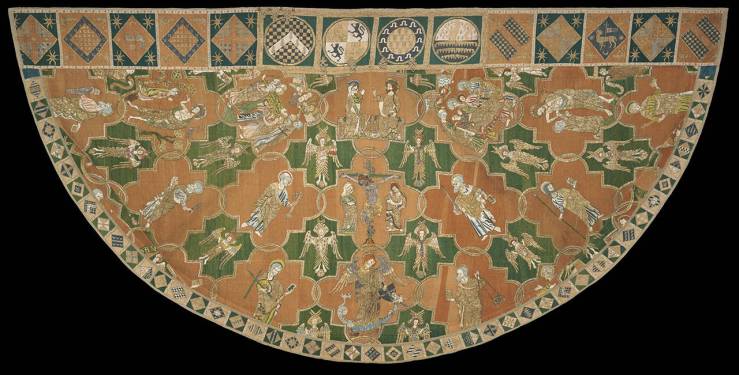
“Opus Anglicanum: Masterpieces of English Embroidery,” Victoria and Albert Museum, London, October 1, 2016–February 5, 2017: In medieval Europe, embroidered textiles were indispensable symbols of wealth and power. Owing to their quality, complexity, and magnificence, English embroideries (referred to as opus Anglicanum, “English work”) enjoyed international demand among kings, queens, popes, and cardinals, and here one hundred of them are brought together. Treasures include the Butler-Bowdon Cope, the Syon Cope, and the Tree of Jesse Cope—ceremonial cloaks made for use in church services and processions, featuring images from the lives of Christ, the Virgin, and the saints. (I love the interactive zoom function on these! To help you navigate the densely packed imagery, details of interest are tagged and can be clicked on to magnify and to reveal a textbox of information.) Hear contemporary embroiderer James Merry discuss some of the aspects of their technique and design that blow him away:

Syon Cope
The Syon Cope, 1310–20, England. Collection of the Victoria and Albert Museum, London.

+++

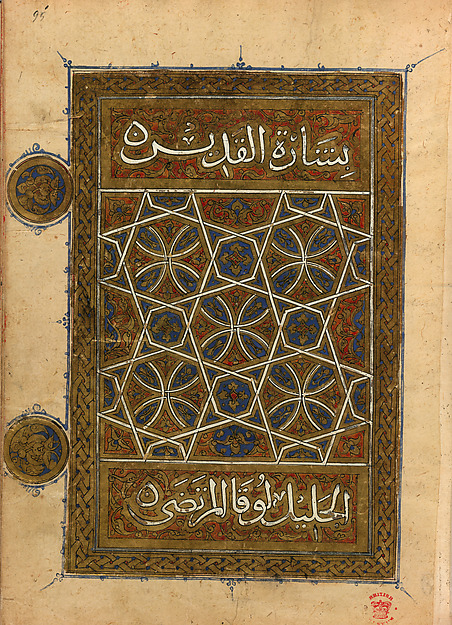
“Jerusalem 1000–1400: Every People Under Heaven,” Metropolitan Museum of Art, New York City, September 26, 2016–January 8, 2017: “This landmark exhibition demonstrates the key role that the Holy City played in shaping the art of the period from 1000 to 1400. In these centuries, Jerusalem was home to more cultures, religions, and languages than ever before. Through times of peace as well as war, Jerusalem remained a constant source of inspiration that resulted in art of great beauty and fascinating complexity. This exhibition is the first to unravel the various cultural traditions and aesthetic strands that enriched and enlivened the medieval city. It features some 200 works of art from 60 lenders worldwide.” I especially love the four Gospels in Arabic borrowed from the British Library, whose geometric illuminations bear an obvious Islamic influence.

Arabic Gospels
Folio from an Arabic Gospel-book, 1335, Jerusalem. Opaque watercolor, gold, and ink on paper, 10 5/8 × 7 7/8 in. (27 × 20 cm). Collection of the British Library (Add. MS 11856).

+++

“The Shimmer of Gold: Giovanni di Paolo in Renaissance Siena,” Getty Center, Los Angeles, October 11, 2016–January 8, 2017: “Manuscript illuminator and panel painter Giovanni di Paolo was one of the most distinctive and imaginative artists working in Siena, Italy, during the Renaissance. This exhibition reunites several panels from one of his most important commissions—an altarpiece for the Branchini family chapel in the church of San Domenico in Siena—for the first time since its dispersal, and presents illuminated manuscripts and paintings by Giovanni and his close collaborators and contemporaries. Through recent technical findings, the exhibition reveals his creative use of gold and paint to achieve remarkable luminous effects in both media.”

Adoration of the Magi by Giovanni di Paolo
Giovanni di Paolo (Italian, ca. 1403–1482), The Adoration of the Magi, 1427. Tempera and gold leaf on panel. Kröller-Müller Museum, Otterlo, the Netherlands.

+++

“The Key” (organized by Caravan), Riverside Church, New York City, September 21–November 6, 2016: Founded by US Episcopal priest Paul-Gordon Chandler, Caravan develops initiatives that use art as a bridge for intercultural and interreligious dialogue. The organization’s 2016 exhibition is in the last leg of its Cairo-London-New York journey. It showcases the work of forty Middle Eastern and Western artists from different monotheistic faith backgrounds, each of whom was given a four-foot-tall fiberglass ankh to develop into a work of art. Known as the “Key of Life,” the ankh is an ancient hieroglyph originating in Egypt but spreading throughout Asia Minor; today it is used as a symbol of pluralism, tolerance, and harmony. I especially like the ones by Sergio Gomez, Arabella Dorman, Fatma Abdel Rahman, and Isaac Daniel.

The Key exhibition (Caravan)

+++

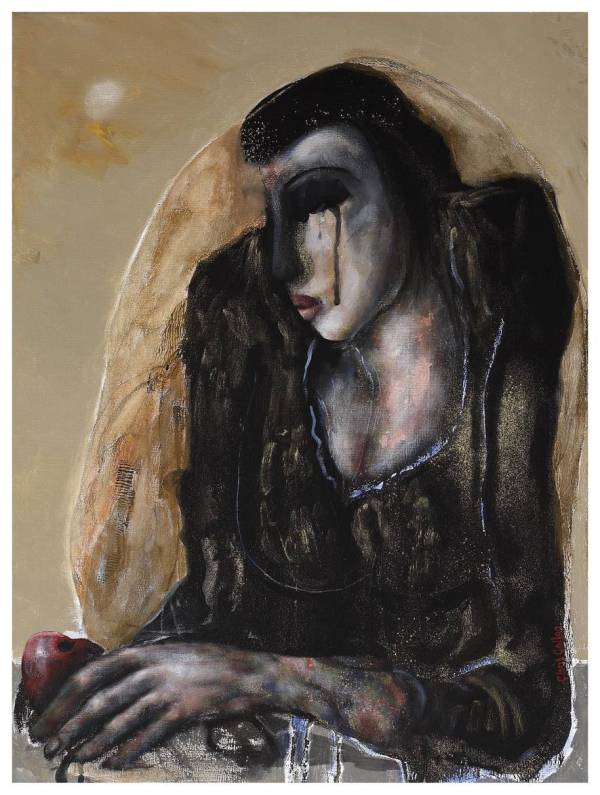
“Incarnation, Mary & Women from the Bible,” Romsey Abbey, Hampshire, England, October 12–November 6, 2016: Having already stopped at Guildford, Norwich, Chichester, Durham, and Hereford Cathedrals, Chris Gollon’s latest series of paintings on women of the Bible is now at Romsey Abbey. It includes the standards, like Eve, Rachel, Hannah, Delilah, Bathsheba, the two Marys (the Virgin, and Magdalene), and Salome, as well as some unnamed and even implied women, like Judas’s wife. It also includes some extrabiblical female saints, like Lucy, Cecilia, Julian of Norwich, and Ethelflaeda. I’m really attracted to the sad quality of many of Gollon’s women, and to the emphasis on hands (much like Eduardo Kingman!).

Contemplation of Eve by Chris Gollon
Chris Gollon (British, 1953–), The Contemplation of Eve, 2011. Acrylic on canvas, 24 × 18 in. (61 × 46 cm).

+++

“Medium: Religion,” Gallery of Art and Design, University of Central Missouri, Warrensburg, Missouri, September 22–October 28, 2016: This exhibition—“meant to inspire, contemplate, and strengthen faith”—features seven contemporary artists whose work engages religion: Tobi Kahn, who creates Jewish ceremonial art like etrog containers, shalom bat chairs, and omer counters; Chris Clack, whose work explores the relationship between Christianity and science; Kysa Johnson, whose Immaculate Conception series links images of the Virgin with asexually reproducing yeast and bacteria; Justine Kuran, known for her quilled hamsas (palm-shaped amulets); Scott Freeman, whose The Wall Remaining laments the long-suffered disunity between Jews and Christians; Tashi Norbu, trained in the art of traditional Tibetan Buddhist thangka painting; and Raudel Arteaga, who deconstructs famous religious paintings into their geometric basics.

medium-religion-exhibition

+++

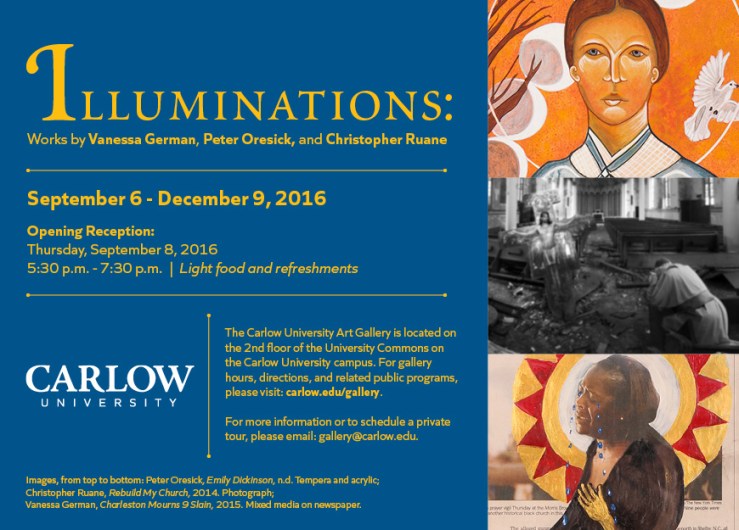
“Illuminations: Works by Vanessa German, Peter Oresick, and Christopher Ruane,” Carlow University Art Gallery, Pittsburgh, Pennsylvania, September 8–December 9, 2016: “‘Illuminations’ features the work of three local artists who evoke the traditions of icon painting or biblical parables to bring out focus on the overlooked and to cast light into the shadows of our present day,” says gallery director Sylvia Rhor. Works include responses to last year’s Charleston church shootings, literary figures painted in the style of Russian icons, and sacred stories updated through the use of photography and digital technology.

illuminations-exhibition-poster

Roundup: Bad-news blessing, the transfiguration of Marilyn Monroe, Christian speculative fiction anthology, European sacred art tour

BLESSING: “Blessing for Getting the News” by Jan L. Richardson: August brought two devastating pieces of news to me; I wasn’t in the line of direct impact, but I hurt for the two families who were. A blessing by artist-author Jan L. Richardson came at just the right time. Here’s an excerpt:

. . . when
the news comes,
may it be attended
by every grace,
including the ones
you will not be able
to see now.

When the news comes,
may there be hands
to enfold and bless,
even when
you cannot receive
their blessing now.

When the news comes,
may the humming
in your head
give way to song,
even if it will be
long and long
before you can
hear it,

before you can
comprehend the love
that latched onto you
in the rending—
the love that bound itself to you
even as it began its leaving
and has never
let you go.

Read more, and view original accompanying artwork, at http://paintedprayerbook.com.

ESSAY: “Transfiguring Gold: Andy Warhol’s Gold Marilyn Monroe” by James Romaine: In his latest visual meditation for ArtWay, art historian James Romaine writes on external versus essential beauty, and the Orthodox aesthetic, in one of Warhol’s most famous paintings. “A revelation of uncreated and transfiguring light” in the icon tradition, the use of gold, Romaine posits, was a theological choice on Warhol’s part, one influenced by his Byzantine Catholic faith. Warhol drew on celebrity imagery to encourage a transformation in viewers from material sight to metaphysical vision. This essay is adapted from a more extensive one titled “The Transfiguration of the Soup Can,” published in Beauty and the Beautiful in Eastern Christian Culture and linked to here with the author’s permission.

Gold Marilyn Monroe by Andy Warhol
Andy Warhol (American, 1928–1987), Gold Marilyn Monroe, 1962. Silkscreen ink on synthetic polymer paint on canvas, 211.4 × 144.7 cm. Museum of Modern Art, New York.

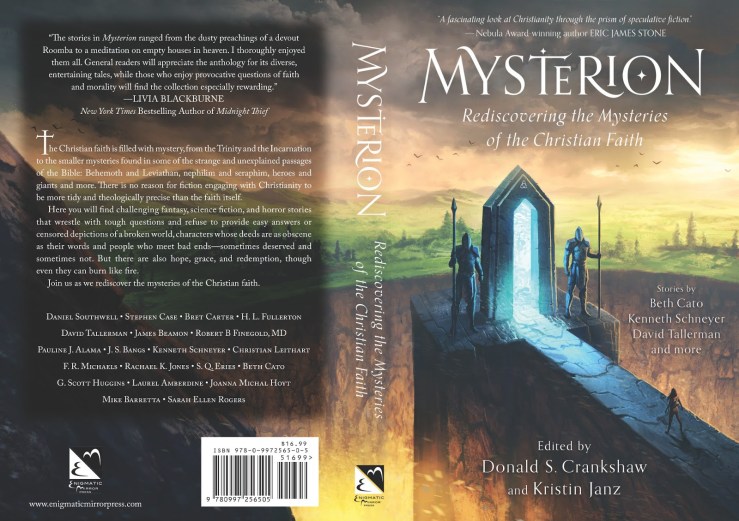
BOOK: Mysterion: Rediscovering the Mysteries of the Christian Faith, edited by Donald Crankshaw and Kristin Janz: Last week the husband and wife team of Donald Crankshaw and Kristin Janz published an anthology of science fiction, fantasy, and horror stories that engage with Christianity. It features twenty of the 450-plus submissions they received, all but four of which are published here for the first time. Describing their criteria for selection, Crankshaw writes in the introduction, “We wanted stories that were as untidy and as theologically imprecise as the Bible itself.” The result is a collection of diverse voices and approaches, exploring such topics as sin, forgiveness, the afterlife, the soul, mission, miracles, and supernatural agents. To read excerpts from the book, visit www.mysterionanthology.com.

Mysterion cover

TOUR: “Reformanda 2017: Sacred Arts Today, Catholic and Protestant”: The Mount Tabor Ecumenical Centre for Art and Spirituality, founded by the Community of Jesus in Massachusetts, has organized a four-leg European tour for next May 10–30 that will explore the face of sacred art from the last five hundred years since the Reformation. With stops in France, Germany, Switzerland, and Italy, the itinerary includes visits to churches and contemporary art exhibitions, symposium lectures and discussions led by Msgr. Timothy Verdon, and Gloriae Dei Cantores choral concerts. Registration is now open.

Reformanda Tour Map

Roundup: Free Bifrost Arts songs, civil religion hymn revised, Bono and Eugene Peterson talk Psalms, Crystal Cathedral transformation, mercy-themed movies

Entire Bifrost Arts catalog available for free download: For a limited time, the Christian music collective Bifrost Arts is offering all forty-eight of their songs for free download from NoiseTrade. Donations are welcome—100 percent of them will go to the Salt and Light Artist fund, which funds residencies for Christian artists in Arab countries, providing a platform for interaction with the local arts community.

Alternative song lyrics for “America, the Beautiful”: In 1993 Sister Miriam Therese Winter adapted the lyrics to “America, the Beautiful” to make the song more appropriate for a Christian worship service (i.e., less nationalistic). Her adaptation is #594 in the United Church of Christ’s New Century Hymnal.

Interview with Bono and Eugene Peterson on the Psalms: This short film, released in April, documents the friendship between Bono (of the band U2) and Eugene Peterson (author of contemporary-language Bible translation The Message) revolving around their common interest in the Psalms. Inspired by their conversation, interviewer David Taylor compiled a list of resources for exploring the Psalms.

Transforming a Protestant worship space into a Catholic one: The largest glass building in the world, the Crystal Cathedral in Orange County, California, has been undergoing renovations since having been sold in 2013 by the Reformed Church in America to the Roman Catholic Diocese of Orange. “Our charge is to convert an open, all-glass Evangelical church into a great Catholic cathedral to serve its centuries-old sacraments and ritual processions, and to reinforce the centrality of the Eucharist,” write architects Scott Johnson and Frank Clementi. This article published in Faith and Form describes some of the symbolic, aesthetic, environmental, and technical challenges of this project and includes renderings of the new space, which is scheduled to reopen next year.

Crystal Cathedral renovations

Top 25 films on mercy: I’ve been enjoying these top 25 film lists put together by the Arts & Faith online community—especially how they reach beyond the obvious choices, dipping into the silent era as well as non-American cinema. Here’s their latest, a list of films that “show us visions of a world so often lacking in mercy, as well as worlds in which one merciful act alters the landscape of human experience forever.” Click here to view their other lists: road films, horror films, divine comedies, films on marriage, and films on memory.

Roundup: Mavis Staples documentary, baptizing the imagination, how medieval manuscripts were made, Nubian Christian art, and Twain’s war prayer

Mavis!: The HBO documentary Mavis! profiles gospel and soul music legend Mavis Staples, from her rise to stardom as part of the Staples Singers, whose Uncloudy Day was the first gospel album to sell one million copies, and her involvement in the civil rights movement, to her still active career as a solo artist. “I’ll stop singin’ when I have nothin’ left to say,” she says. “And that ain’t gonna happen!” Watch the trailer below.

Luci Shaw on art and Christian spirituality: In this 1998 article from Direction journal, the oh-so-quotable poet Luci Shaw writes about imagination, mystery, receptivity, sacramentality, the similarities between art and faith, and her muse, the Holy Spirit. Concludes with her poem “Ghostly,” which explores the Spirit’s different manifestations.

Making medieval manuscripts: Through narrated demonstrations, this video by the Getty Museum shows how paper, pens, ink, paint, book covers, and bindings were made during the Middle Ages—laborious processes! It also shows how the illuminators (visual artists) worked with the scribes (calligrapher-copyists), jobs typically filled by two separate people.

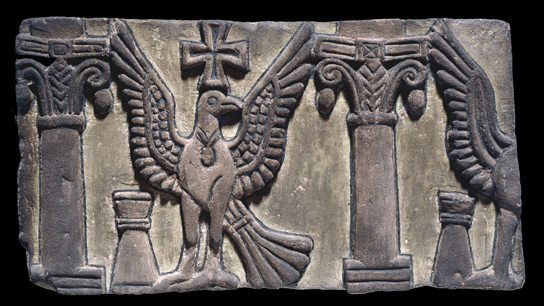
Christianity on the Middle Nile: The two largest Christian kingdoms in the medieval world were actually in modern-day Sudan, writes curator Julie Anderson in a British Museum blog post from 2014: the Makuria and the Alwa kingdoms. Many wall paintings and other objects have been excavated from Faras Cathedral and its adjoining tombs, such as the pottery lamp (with the inscription “Great is the name of God”) and sandstone frieze fragment in the British Museum’s collection. (The paintings are divided between the Sudan National Museum and the National Museum of Warsaw, as it was a Polish team that rescued them from flooding by Lake Nasser.)

Faras Cathedral frieze fragment
Seventh-century sandstone frieze fragment from the former Faras Cathedral in Nubia. Collection of the British Museum.
Fiery Furnace fresco from Faras Cathedral
Fresco from the former Faras Cathedral in Nubia depicting the three youths in the fiery furnace. Collection of the National Museum of Sudan.

“The War Prayer” by Mark Twain: In his day Twain was radically opposed to American military intervention in Cuba and the Philippines and frustrated by the so-called patriotism that made his fellow countrymen so uncritically supportive of it. The stranger’s speech in Twain’s short story “The War Prayer,” set during a church service, exposes the ridiculousness of some of the prayers that go up during wartime even today.

Roundup: Art & Theology on Twitter, Van Gogh earthwork, flowers overhead, God in pop culture, Raised documentary

After years of hesitance, I’ve finally decided to try out this whole Twitter thing. My handle is @artandtheology. I will be sharing posts from the blog as well as retweeting others in the field. Feel free to engage with me there.

+++

Van Gogh’s Olive Trees reinterpreted as earthscape for aerial viewing: Last year the Minneapolis Institute of Art commissioned earthworks artist Stan Herd to recreate Vincent Van Gogh’s Olive Trees, an important painting in its collection, on a 1.2-acre plot of land so that people flying into the Minneapolis–Saint Paul Airport could look down from their windows and be welcomed to the city (and invited to the museum!). Watch Herd at work on the project in the video below.

+++

Deconstructed flower garden suspended in air: To herald the start of spring, London-based installation artist Rebecca Louise Law has suspended 30,000 live flowers from copper wire in the atrium of the concept shopping mall Bikini Berlin in Germany, giving shoppers a perhaps unexpected taste of natural beauty. Natural materials, especially flora, are Law’s specialty. Visit her website to view more of her stunning works (The Yellow Flower from Sasebo, Japan, is probably my favorite), or stop by Bikini Berlin anytime through May 1 to experience Garten.

Garten by Rebecca Louise Law

Garten by Rebecca Louise Law

+++

10 best representations of God in culture: My friend Paul Neeley alerted me to this recent list published in The Guardian. Culled from film, theatre, and visual art, several of these are new to me!

+++

Book and documentary collaboration on the Resurrection: In 2014 Zondervan published Raised? Finding Jesus by Doubting the Resurrection by Jonathan K. Dodson and Brad Watson to demonstrate why the bodily resurrection of Jesus is believable and the possibilities it offers for a life of hope. As a tie-in to the book, Moving Works created a four-part documentary in which Benjamin and Jessica Roberts tell the story of how Christ’s resurrection has personally impacted them. Watch the documentary below, and click here to access related materials for small group study.

Roundup: The art of celebration, cross-cultural exchanges in illuminated manuscripts, the history of color, and insect-wing blooms

The Art of Celebration (album): Rend Collective is a folksy worship band from the small coastal town of Bangor in Northern Ireland that is internationally known for its high-spirited, experimental songs of joy. The Art of Celebration is their fourth of five albums, the story of which is told in the video below. “This record is an attempt to reflect something of the irrepressible laughter in the heart of God,” says bandleader Gareth Gilkeson. “It’s a call to the cynical to once again choose celebration over condemnation and a reminder to the broken that ‘the joy of the Lord is our strength.’” You can preview songs from the album here and purchase it here, or catch the band on tour (they’re currently in the US). I’ve embedded one of my favorite songs from the album below: “My Lighthouse.”

+++

“Traversing the Globe through Illuminated Manuscripts” (exhibition): Through June 26, the J. Paul Getty Museum in Los Angeles is running an exhibition of illuminated manuscripts and painted book arts from the ninth through seventeenth centuries. From the website: “These highly prized objects allow us to glimpse, admire, and study a world gone by, as well as its peoples, different belief systems, and an interconnected global history of human thought and ideas about art.” Check out the Q&A with curator Bryan Keene—so fascinating. Also click the link above to find out about related events. Next up is a lecture on April 19 titled “A Medieval Picture Book and Its Judeo-Persian Lives: The Shah Abbas Bible in 17th-Century Safavid Iran.”

Virgin and Child (Ethiopian)
The Virgin and Child with the Archangels Michael and Gabriel, from a Gospel book, ca. 1480-1520, Gunda Gunde Monastery, Ethiopia. J. Paul Getty Museum, Los Angeles.
Northumberland Bestiary
Pen-and-ink wash-tinted drawing of a dragon riding an elephant, England, ca. 1250–1260. Northumberland Bestiary (Ms. 100), fol. 54, J. Paul Getty Museum, Los Angeles.

+++

The Brilliant History of Color in Art (book): Victoria Finlay’s latest book from Getty Publications, full of fun facts about the origins and science of color. The trailer below tells how Prussian blue, Indian yellow, lead white, and Tyrian purple came to be. Lapham’s Quarterly has a nifty infographic on the same topic.

+++

Mimesis (photomontage series): From 2012 to 2014 Paris-based artist Seb Janiak executed a series of twenty-two photographs that show insect wings pieced together in flower-like forms. Janiak says he believes that a spiritual reality undergirds the physical. “Using art to reveal what is behind the veil of matter is fascinating and full of discoveries,” he writes. See more Mimesis photos at the link above.

Mimesis by Seb Janiak
Seb Janiak (French, 1966–), Mimesis—Lacus Luxuriae, 2013. Chromogenic print, 180 × 180 cm.

Roundup: Church engagement with the arts

“Inspired to Follow: Art and the Bible Story,” St.-Martin-in-the-Fields, London: This program comprises a series of weekly noontime gatherings that use famous local paintings as a springboard into discussion of the biblical narrative and its implications for us today. I’ve enjoyed reading the few presentations given by associate vicar Jonathan Evens, posted on his blog: first, on J. M. W. Turner’s two paintings of Noah’s flood, and more recently, on El Greco’s Christ Driving the Money Changers from the Temple.

El Greco_Christ Driving the Money Changers from the Temple
El Greco (Greek, active Spain, 1541–1614), Christ Driving the Money Changers from the Temple, 1600. Oil on canvas, 106 × 130 cm (42 × 51 in.). National Gallery, London.

+++

VIBRANT music and arts festival, Cahaba Park Church, Birmingham, Alabama: On November 1, 2015, Cahaba Park Church held a Psalms-inspired music and arts festival. Eight visual artists from the church were selected to display their paintings, which were auctioned off to raise money for four nonprofits. The Corner Room performed songs from their new album, Psalm Songs, Volume 1; “Psalm 23” (music by Adam Wright) is the soundtrack for the recap video above. This next VIBRANT festival will be held on July 22.

+++

“Art and Spirit” exhibition, First Congregational Church, Los Angeles: Through April 24, the works of over fifty artists will be on display in the Neo-Gothic Shatto Chapel of the First Congregational Church of Los Angeles. Most of the works are by emerging LA artists from Art Division, an organization that provides art training to young adults who lack the resources to attend university but who want to pursue a career in the visual arts; they were asked to respond to the theme “art and spirit.” A few of the works in the exhibition are by well-known artists such as Rembrandt, Albrecht Dürer, Corita Kent, and Ed Ruscha.

+++

Portraits of Resurrection, 2015 Easter initiative, Saddleback Church, Lake Forest, California: Ex Creatis, the arts ministry at Saddleback, is always coming up with unique ways to incorporate art into the life of its church. Last Easter twenty-three volunteer artists sketched portraits of church attendees onto one of three floral prints (of the sitter’s choosing) made by three different artists in the church. These personalized works of art were meant to remind those who took them home of the new life they have in Christ.

Roundup: Fiction for Lent, art as commodity, major Bosch retrospective, Easter art retreat

Sarah Arthur is the editor of the just-published Between Midnight and Dawn: A Literary Guide to Prayer for Lent, Holy Week, and Eastertide. She has written an article for Christianity Today, “The Best Books to Read for Lent (That You Won’t Find in a Christian Bookstore).”

+++

Writing for the New Yorker, Ken Kalfus reviews the new novel Laurus by Russian medievalist Eugene Vodolazkin: “Medieval Russia was a land trembling with religious fervor. Mystics, pilgrims, prophets, and holy fools wandered the countryside. . . . [Laurus] recreates this fervent landscape and suggests why the era, its holy men, and the forests and fields of Muscovy retain such a grip on the Russian imagination.”

+++

In “Art as a Commodity: Does Time Equal Value in Art?” artist Scott Laumann discusses one of the most annoying questions he is asked at gallery shows: “How long did that take you?”

+++

Garden of Earthly Delights
Hieronymus Bosch (Dutch, ca. 1450–1516), The Garden of Earthly Delights. Oil on oak panels, 220 × 389 cm. Museo del Prado, Madrid.

This year marks the five hundredth anniversary of the death of Dutch artist Hieronymus Bosch, known for his grotesque depictions of human depravity. To commemorate his life and work, the Noordbrabants Museum in ’s-Hertogenbosch, the city of Bosch’s birth, has brought together his panels and drawings from all over the world in what is the largest Bosch exhibition of all time. Bosch invented an entirely new religious iconography: landscapes filled with bizarre, nightmarish creatures doing freakish things to or with humans—meant not as a prediction of what will one day happen to the damned but as a lament for what is already happening. Jonathan Jones, reviewer for The Guardian, gives the retrospective five stars.

+++

Lumen Christi: In the Light of the Risen Christ—Easter Encounters with Art”: The monastic ecumenical Community of Jesus on Cape Cod will be hosting a five-day art retreat from April 5 to 9, led by art historian Timothy Verdon and artist Gabriele Wilpers. Focused on the theme of resurrection, the retreat will feature lectures and discussion, group workshops, studio mentoring, and daily worship services. For more information, follow the link above.