Roundup: “What to Do After Voting,” Apsáalooke praise song, chapel service led by Terry Wildman (Ojibwe, Yaqui), and more

PRESS RELEASE: “The Creative Arts Collective for Christian Life and Faith Announces Launch of Its First Competitive Request for Proposals (RFP)”: The Creative Arts Collective for Christian Life and Faith [previously], an endowed initiative run by Belmont University in Nashville, has just opened its online Letter of Inquiry form for the 2025 Spring Grant Program. Form submission deadline: December 6, 2024.

The RFP is open to interested individual artists, artist collaboratives, church leaders, scholars/theologians, arts-affiliated organizations, faith-based nonprofit organizations, or institutions who reside or operate in the United States. Eligible applicants may submit proposals with requests ranging from $50,000 to $250,000 that may be used over one year. Chosen applications will then be requested to submit a full grant proposal for the competitive 2025 Spring Grant Program.

The 2025 grant-seeking theme is “Performing Shalom.” Applicants are invited to reflect the theme in their project or program, but it is not a requirement when applying for a grant. Please click here for more information.

+++

SUBSTACK POST: “On Artists, Kings, and Mending the Multiverse” by Houston Coley: A wise and rousing reflection after the US presidential election. Houston Coley is an Atlanta-based documentary filmmaker, video essayist (YouTube @houston-coley), podcaster, and writer on TV and film, who “cultivat[es] spiritual imagination around art and pop culture,” as one person put it.

+++

POEM: “What to Do After Voting” by James A. Pearson: The poet James Pearson shared this poem from his collection The Wilderness That Bears Your Name (Goat Tail Press, 2024) on Instagram on Election Day last Tuesday. He writes, “What’s driving [all our voting] are two things: Our common needs for love, safety, and belonging. And our often conflicting attempts to meet them. Rumi wrote: ‘Out beyond ideas of wrongdoing and rightdoing, there is a field. I’ll meet you there.’ History is offering us a fork in the road. Let’s turn towards what we can do—vote. Then let’s find each other in that field and do the long, slow work of building a world where everyone has access to the love, safety, and belonging they need.” [HT: Amy Peterson]

He writes further on his website, “This poem doesn’t pretend to be a full prescription for what our country needs. It’s just my way of acknowledging that all electoral choices are imperfect. Because even more important is what happens between elections—the long, slow work of building a culture of love and justice for our politicians to live up to. And the better we do that work, the better our options will be next time elections come around.”

+++

SONG: “Apsáalooke Praise Song,” sung by Sarah Redwolf (née Bullchief): Sarah Redwolf is a member of Crow Nation in Montana and a follower of the Jesus Way whose Apsáalooke name is Baawaalatbaaxpesh (Holy Word). Here she sings a praise song by her grandmother Xáxxeáakinnee (Rides the Painted Horse). The Apsáalooke lyrics are below; I couldn’t find an English translation, and the artist has not yet returned a message I sent ten days ago, but I believe the song was written with Christian intent, as Christianity has been in Sarah’s family for generations. Her father, Duane Bull Chief, is a traveling Pentecostal preacher and the leader, with his wife, Anita, of Bull Chief Ministries, and Sarah has often led worship for church services and other Christian gatherings. What a beautiful voice!

Akbaatatdíakaata Dáakbachee
Huúlaa-k awúaleel akósh
Sáawe dée kush
Ahóohkaáshi, ahóohkaáshi, áaaaweelee-éeh

Akbaatatdíakaata
Baléelechiisaa awúaleel akósh
Ahóohkaáshi, ahóohkaáshi, áaaaweelee-éeh [source]

+++

LECTURE: “The Sign of Jonah” by Matthew Milliner, Marion E. Wade Center, Wheaton College, Illinois, October 3, 2019: This is the first lecture in a three-part series by art historian Matthew Milliner called The Turtle Renaissance that he developed into the book The Everlasting People: G. K. Chesterton and the First Nations (InterVarsity Press, 2021). (Here’s a well-written book review that I concur with; you can read an excerpt from the book here.) In the video, the talk starts at 8:49, followed by a response by Capt. David Iglesias, JD, of Kuna nation at 1:03:31, and then a Q&A starting at 1:25:27.

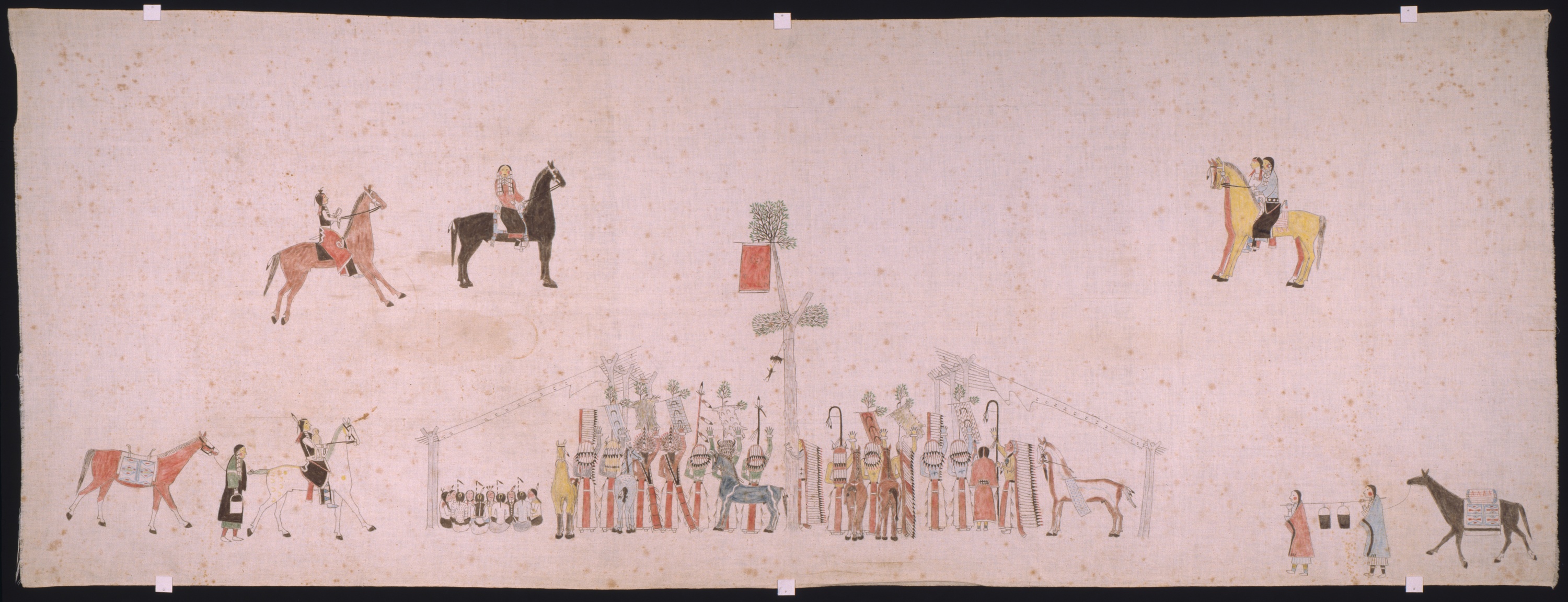
In conversation with Chesterton’s The Everlasting Man, Milliner explores contact points between Christianity and Indigenous North American art, symbol, ritual, and history. The discussion touches on pre-contact petroglyphs carved into Teaching Rocks near Peterborough, Ontario (one of them, a sun figure, quite possibly representing Gitchie Manitou, the Great Spirit—Christ incarnate?), the Sun Dance (which many Native Christians interpret as a prophecy of the Crucifixion), the Ghost Dance (about resurrection and renewal), the Mishipeshu (an underwater panther often representing death, which some Native Americans used to characterize white settlers), the Thunderbird, Black Elk’s vision of a mysterious figure with holes in the palms of his hands, and the cross as an axial tree conjoining the above and below worlds. Just as ancient Hebrew culture contained pointers to Christ, so too, Milliner argues, do the Indigenous cultures of North America. Artists, preachers, and visionaries from among the Ojibwe, Kiowa, Lakota, and other peoples are “our North American Virgils,” he says—Virgil being a Latin poet whose Fourth Eclogue, written around 40 BCE, prophesied the birth of a divine savior who would usher in a golden age.

Sun Dance Scene
Sun Dance Scene, Teton Lakota, Central Plains or Northern Plains, Wyoming, ca. 1885. Muslin cloth with watercolor paint, 36 × 91 1/2 in. (91.5 × 232.5 cm). Art Institute of Chicago. See 32:55 of Milliner’s lecture.

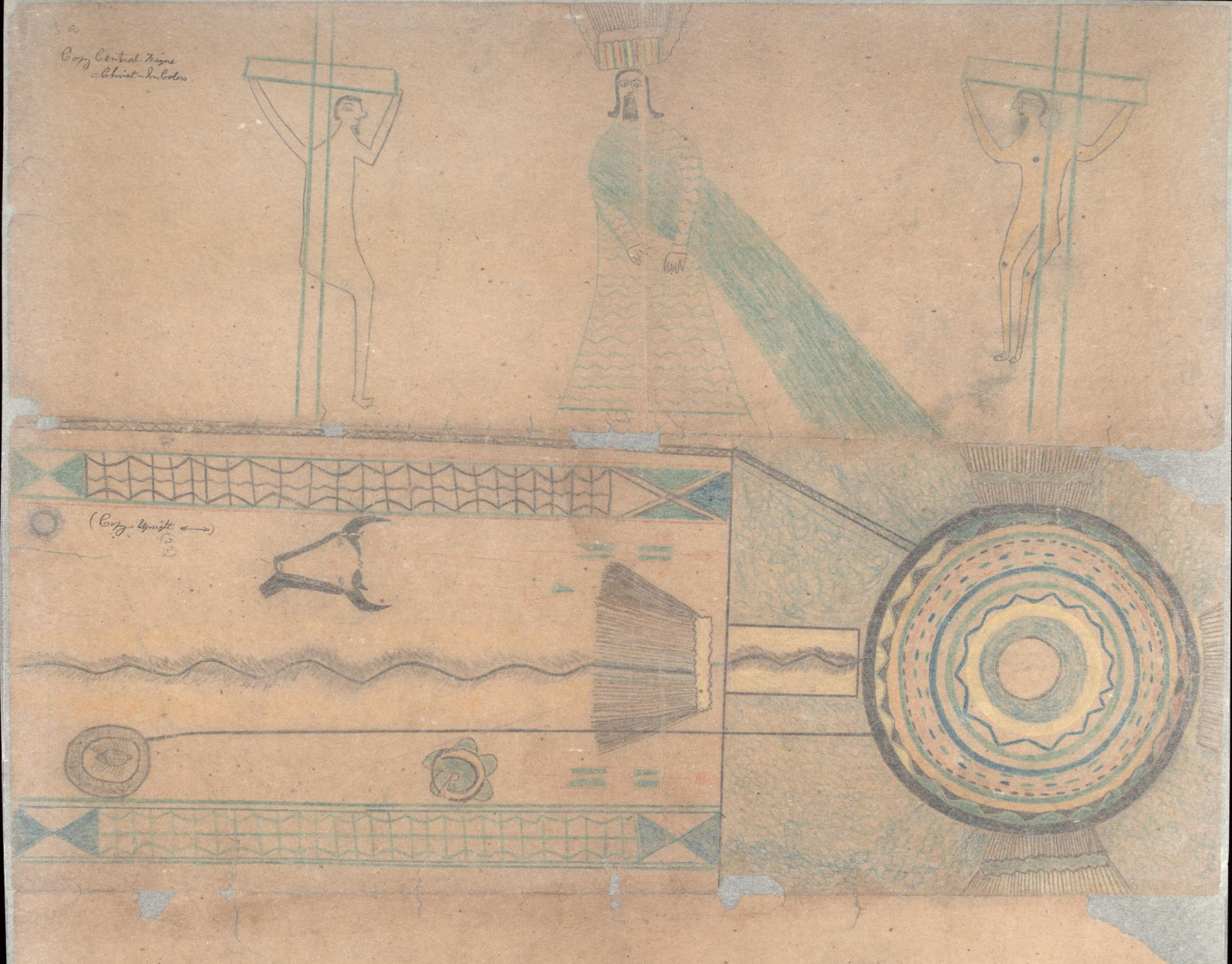
Vision of Jesus (Kiowa Ghost Dance)
Vision of a Kiowa man named Fiqi (Eater), received during the revived Ghost Dance, of Christ blessing the ceremony, collected by ethnologist James Mooney, ca. 1890. Pencil and crayon drawing from MS 2538, National Anthropological Archives, Smithsonian Institution, Washington, DC. See 38:49 of Milliner’s lecture and pages 11–12, 130, 142–44 of his book The Everlasting People.

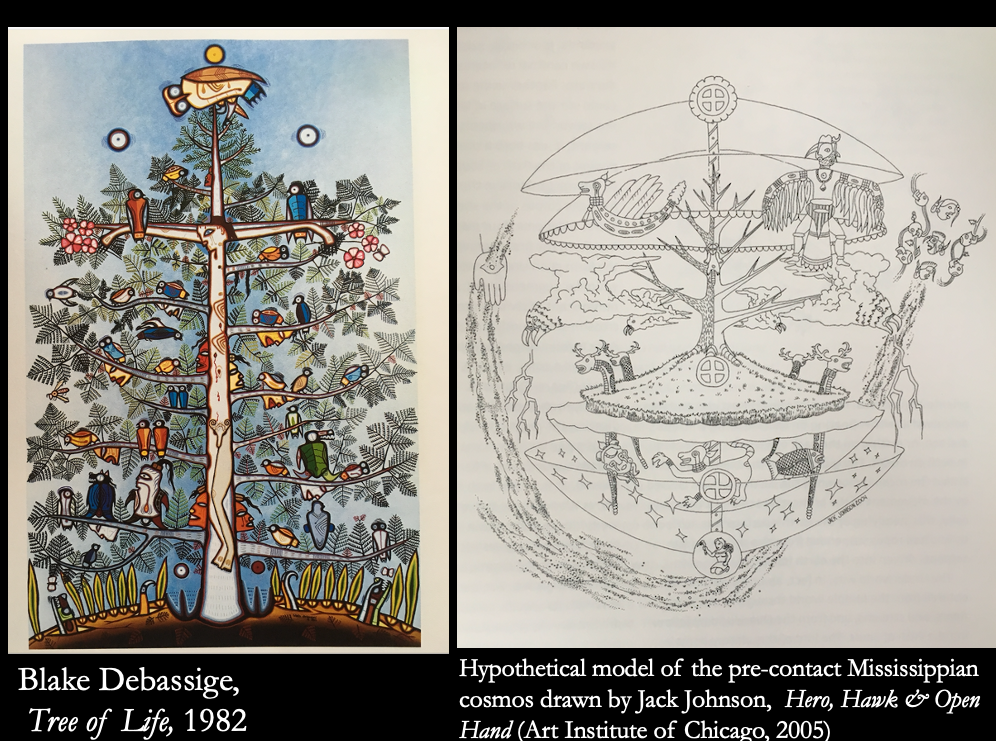
Debassige, Blake_Tree of Life
See 59:24 of Milliner’s lecture and page 8 of his book The Everlasting People

There’s much more I could say, as there’s certainly more nuance and complexity to this, but instead let me simply refer you to Milliner’s lecture and finely footnoted book. There’s also a great audio interview with Milliner about The Everlasting People from November 2021, conducted by Jason Micheli for the Crackers and Grape Juice podcast.

+++

VIDEO: Chapel service led by Terry Wildman, November 6, 2023, Azusa Pacific University, California: Earlier this year I got to have dinner with Terry Wildman [previously] and his wife, Darlene, who form the Nammy Award–winning musical duo RainSong. It was exciting to hear all about their work with Native InterVarsity and other projects. They live in Maricopa, Arizona, on the traditional lands of the Pima and Tohono O’odham peoples. Wildman, who has both Ojibwe and Yaqui ancestry, was the lead translator, general editor, and project manager of the First Nations Version: An Indigenous Bible Translation of the New Testament. (The nativity narrative from the FNV translation of the Gospel of Luke, you may be interested to know, was adapted into an illustrated book titled Birth of the Chosen One: A First Nations Retelling of the Christmas Story, which just released this fall.)

Last November Wildman led a worship service for Azusa Pacific University students. Here are the key elements:

  • The opening three minutes are an animated video of the gospel story, narrated by Terry Wildman to a flute accompaniment by Darlene Wildman
  • 8:12: Blessing of the Gabrielino-Tongva people
  • 9:38: The Lord’s Prayer (FNV)
  • 10:57: Sermon: “Worship in Spirit and in Truth” (John 4:1–42)
  • 21:17: Reading of Psalm 8 (FNV)
  • 23:48: Song: “Lift Up Your Heads” by Terry and Darlene Wildman, based on Psalm 24
  • 28:40: Song: “Hoop of Life” by Terry Wildman – Native American powwows often feature hoop dancers, who dance a prayer that Creator will bring harmony and goodwill to all the gathered people. Wildman says, “I look at Jesus and I call him the Great Hooper Dancer. Because he’s the one who ever lives to pray for us, to make intercession for us, and when he dances his prayer, he is bringing harmony and balance to the whole world, to the whole universe. And if we follow him, if we give our hearts to him, he will produce that harmony and balance in us and with each other.”
  • 35:56: Song: “Nia:wen” (Mohawk for “Thank You”) by Jonathan Maracle of Broken Walls
  • 45:29: Closing prayer

Roundup: Songs of thanksgiving, NYC art exhibitions, and more

SPOTIFY PLAYLIST: November 2024 (Art & Theology)

+++

SONGS:

In addition to the new, nonthematic playlist above, I also have a Thanksgiving Playlist that I published in 2021 and have been adding to sporadically. Here are three new songs, among others, that you can hear on it:

>> “I Just Want to Thank You, Lord” by Lynda Randle: Singer-songwriter Lynda Randle has been performing on the Gaither Homecoming videos and tours since 1993. Here she sings one of her original gospel songs with Gayle Mayes and Angela Primm.

>> “Thanks a Lot” by Raffi: Raffi Cavoukian, who goes by his first name only, is an Armenian Canadian children’s singer-songwriter and book author, best known for his song “Baby Beluga.” “Thanks a Lot” expresses gratitude—presumably to God, though God is not named—for the sun, clouds, wind, birds, stars, “the wondering me,” and so on. This live recording is on the 1984 release A Young Children’s Concert with Raffi. I’m guessing he told the kids in the audience to close their eyes, to help cultivate a prayerful state.

>> “Herraa Hyvää Kiittäkää” (Thank the Good Lord) by Herännäisnuorten kuoro: This hymn was originally written in Swedish by Jesper Swedberg in 1694 and was translated into Finnish six years later. It uses an older (1640) tune—nice and hearty! and in a minor key—by the German composer Heinrich Albert. You can follow along with the Finnish lyrics here.

+++

VIDEO: Jazz Vespers Worship Service, Duke Chapel, November 19, 2019: Duke University in Durham, North Carolina, has hosted a Jazz Vespers worship service nearly every March and November since 2014, a collaboration between Duke Chapel and the Duke Jazz Program. In this recorded service from the fall 2019 semester, Rev. Dr. Luke Powery (the chapel dean) leads the liturgy and Rev. Joshua Lawrence Lazard (the chapel’s minister for student engagement) delivers the sermon, which is from 1 Thessalonians 5:16–18: “Rejoice always, pray without ceasing, give thanks in all circumstances, for this is the will of God in Christ Jesus for you.” The music is led by Duke music professor John Brown, a Grammy-nominated jazz bassist and composer, and his Little Big Band. I can’t find the names of the two vocalists.

List of songs:

  • “Every Day Is a Day of Thanksgiving” by Shelby Wills
  • “Glory, Glory (Since I Laid My Burden Down)”
  • “Because of Who You Are” by Vicki Yohe
  • “I Feel Like Praising Him” by Shirley Caesar
  • “Amazing Grace” by John Newton
  • “Perfect Love Song” by Anita Wilson
  • “You Can’t Beat God Giving” by Billy Preston
  • “Thank You, Lord, for All You’ve Done for Me” by Walter Hawkins

Duke’s next Jazz Vespers service is Thursday, November 14, 2024, at 7 p.m. at Duke Chapel.

+++

LITANY: “Celebrating the Gifts of Immigrants” by Rev. Maren C. Tirabassi: “A prayer for the United States which has come to a time of conflict, when the discussion of immigration seems to be limited to a choice of two – fears of burden or pity for the vulnerable – ignoring the third truth – deep gratefulness.”

+++

VIRTUAL WORKSHOP: “Evocations: Advent Responsive Writing” with Marilyn McEntyre, Nov 26, Dec 3, Dec 10, Dec 17, 2024: Each Tuesday over the course of a month, from 7:00 to 8:30 p.m. ET, Marilyn McEntyre will be leading an online gathering of writers in reflecting on and working with words and images gleaned from centuries of song, poetry, and paintings that celebrate Advent, the season of waiting. Participants will engage in lectio divina and visio divina as a foundation for writing personal reflections, memoir, and poetry. Hosted by Image journal. Registration cost: $195.

+++

ART EXHIBITIONS:

I don’t know that I’ll be able to make it up to New York City before these two exhibitions close in January, but I will try! They both look excellent.

>> Siena: The Rise of Painting, 1300–1350, Metropolitan Museum of Art, October 13, 2024–January 26, 2025: Siena: The Rise of Painting, 1300–1350 examines an exceptional moment at the dawn of the Italian Renaissance and the pivotal role of Sienese artists—including Duccio, Pietro and Ambrogio Lorenzetti, and Simone Martini—in defining Western painting. In the decades leading up to the catastrophic onset of the plague around 1350, Siena was the site of phenomenal artistic innovation and activity. While Florence is often positioned as the center of the Renaissance, this presentation offers a fresh perspective on the importance of Siena, from Duccio’s profound influence on a new generation of painters to the development of narrative altarpieces and the dissemination of artistic styles beyond Italy.”

The New York Times published a glowing review of the exhibition, calling it “revelatory . . . the art show of the season.” Here’s a video tour:

>> Anything but Simple: Gift Drawings and the Shaker Aesthetic, American Folk Art Museum, September 13, 2024–January 26, 2025: “The Shakers, often celebrated for their minimalist approach to design, will be showcased in a new light with the exhibition Anything but Simple: Gift Drawings and the Shaker Aesthetic. Made by women in the mid-19th century and believed to represent divine messages, the ‘gift’ drawings on display represent a departure from the simplicity typically associated with Shaker material culture.

“Opening during the 250th year of Shakerism in the United States, the exhibition features drawings widely considered to be among the finest surviving examples of this rare type. These symbols of love and nature were often given as ‘tokens’ to other Shakers during meetings. Brightly colored and replete with intricate ornamentation, they represent a stunning world of celestial imagery. Compared to examples of Shaker clothing and furniture that will also be included in the exhibition, the vibrancy of the drawings will mark a distinct contrast with the clean lines typically associated with Shaker design.”

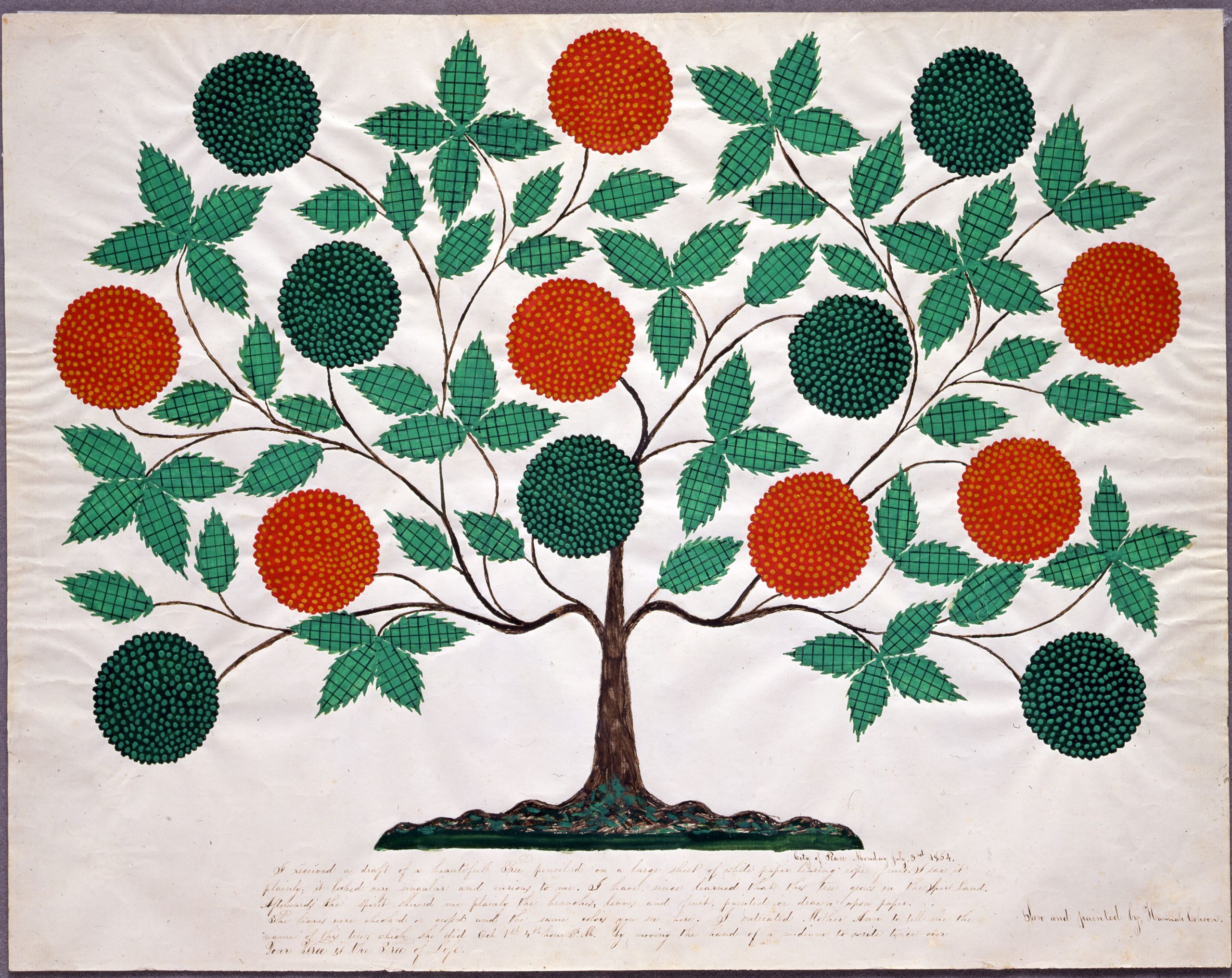
Cohoon, Hannah_The Tree of Life
Hannah Cohoon (American, 1788–1864), The Tree of Life, 1854. Ink and watercolor on paper, 18 1/8 × 23 5/16 in. Collection of the Hancock Shaker Village, Pittsfield, Massachusetts.

Medieval roundup: Julian of Norwich, stained glass at York Minster, Jewish hymn from Andalusia, and more

PODCAST EPISODES:

>> “Jack’s Bookshelf: Julian of Norwich” with Dr. Grace Hamman, Pints with Jack: The “Jack’s Bookshelf” podcast series explores the authors and books that influenced the life and writings of C. S. Lewis. Hosted by David Bates, this episode covers Julian of Norwich (ca. 1343–after 1416), an English anchorite and mystic who authored what editors call Revelations of Divine Love or The Showings, the first English-language book by a woman. The most famous quote from this work is “Sin is behoovely, but all shall be well, and all shall be well, and all manner of thing shall be well.” Medieval scholar Grace Hamman [previously] unpacks the quote and discusses other key passages and themes from Julian, as well as what little we know of her biography. An excellent introduction!

>> “Ben Myers—The Divine Comedy,” Life with God: One of the many gifts my parents have given me over the years was a four-month study-abroad stay in Florence during my junior year of college, where one of my courses was devoted to reading and studying—in its original Italian and in the author Dante Alighieri’s hometown!—the masterful trilogy of narrative poems known as La Divina Commedia, or The Divine Comedy in English. Moving through hell, purgatory, and heaven, it is an allegory of the soul’s journey toward God. I enjoyed hearing Dr. Benjamin Myers [previously], director of the Great Books Honors Program at Oklahoma Baptist University, discuss this deeply influential work from the early fourteenth century, and sharing one of his own poems, “Listening to Reggae at the Nashville Airport.”

+++

VIRTUAL TOURS OF CATHEDRALS:

Cathedrals are, among other things, repositories of sacred art. I’m so appreciative of digitization initiatives that seek to make some of those treasures available to global publics online. Here are two admirable examples.

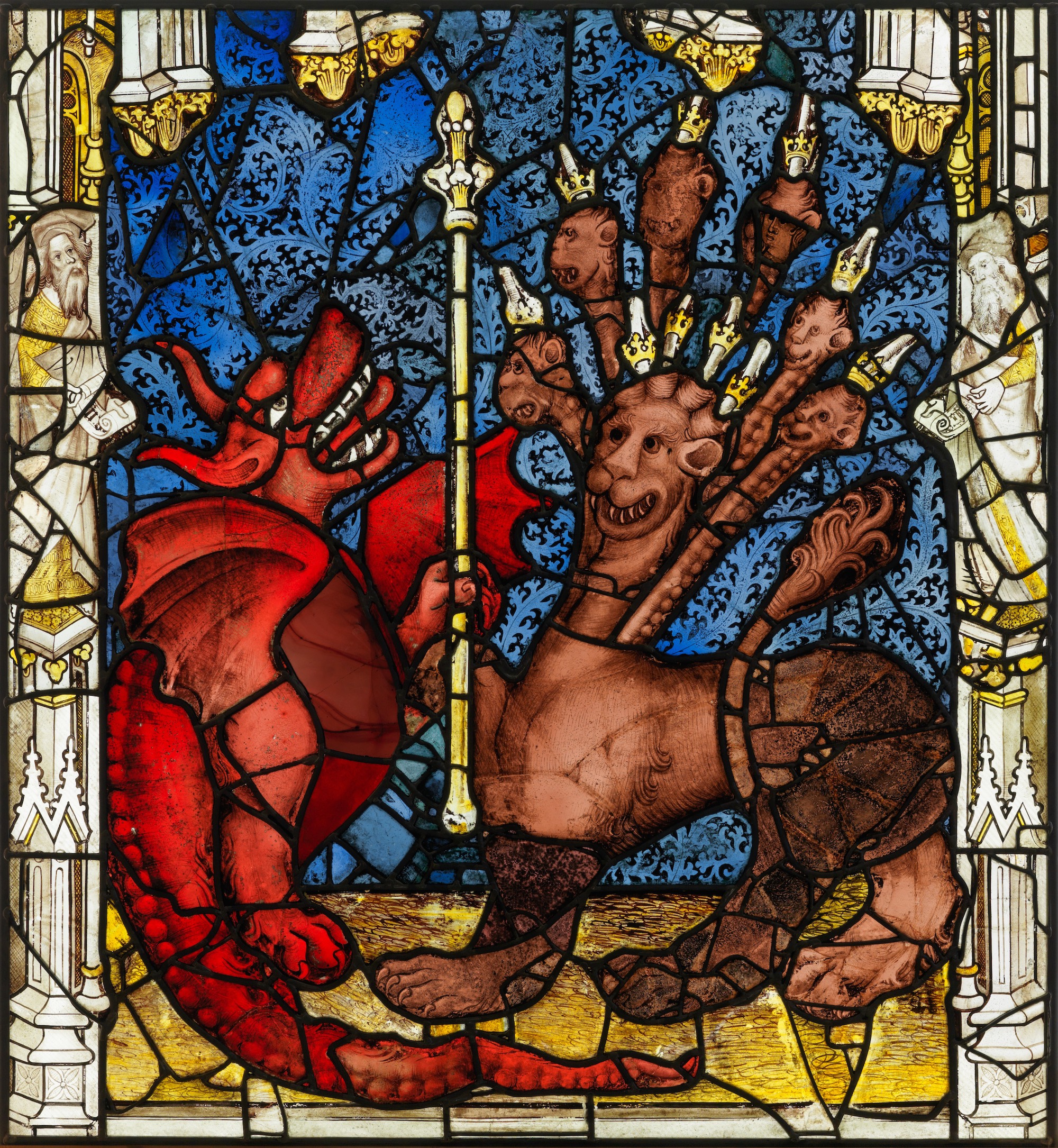
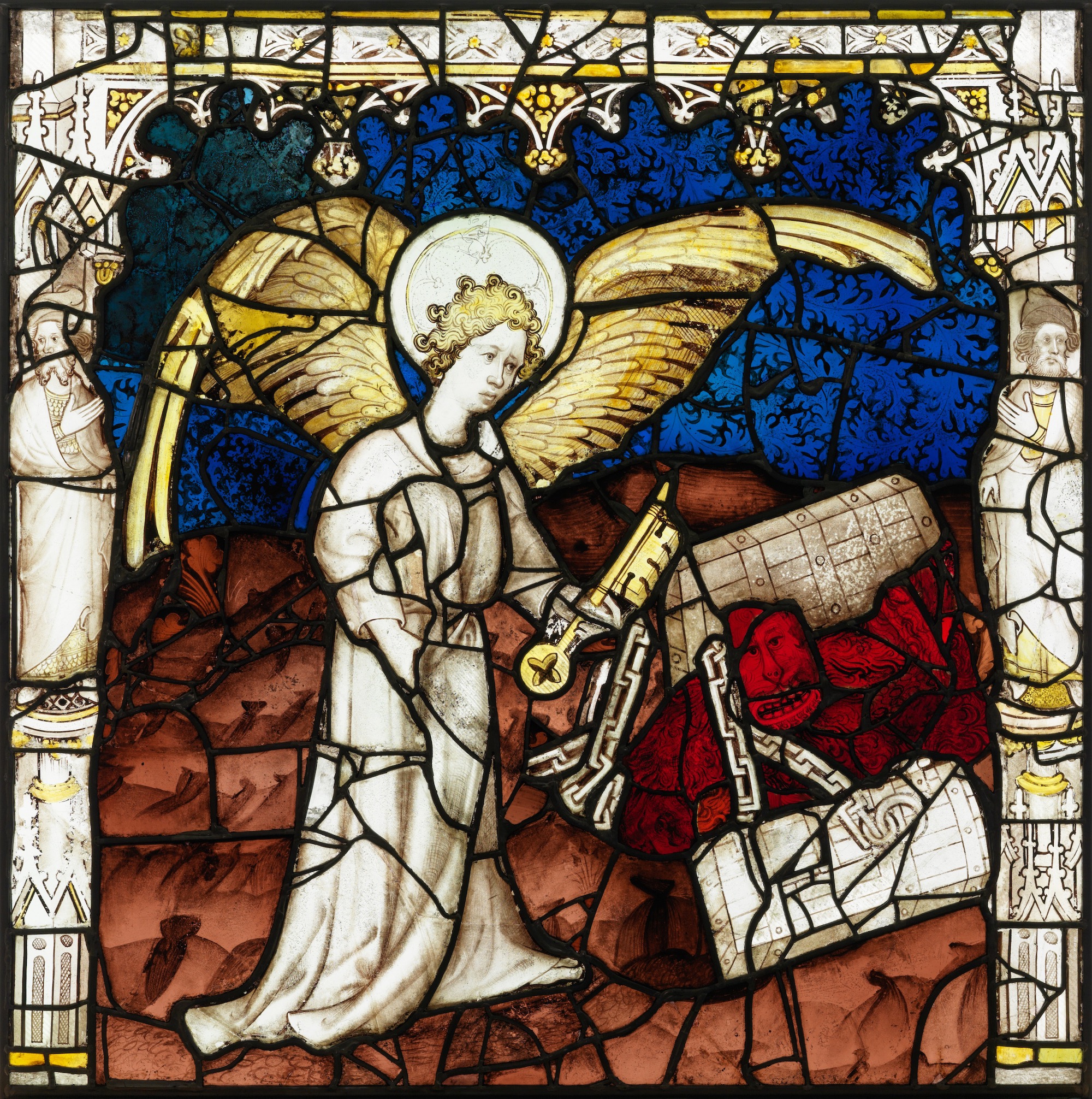
>> The York Minster Stained Glass Navigator: York Minster in northeastern England has the largest collection of medieval stained glass in the UK, with the earliest pieces dating from the late twelfth century. On behalf of the Chapter of York, the York Glaziers Trust is undertaking to photograph it all. These photos are available for viewing online through the cathedral’s “Stained Glass Navigator,” which enables you to hover over panels to identify the scenes, zoom in for higher resolution, and see where each panel in situated in the context of the window’s larger narrative.

I especially recommend exploring the extraordinary Great East Window, which depicts the beginning and the end of all things. The top section opens with the seven days of creation, followed by other select scenes from the Old Testament, but the bulk of the window—and my favorite sequence—consists of scenes from the book of Revelation. The bottom row depicts historical and legendary figures associated with the history of York Minster.

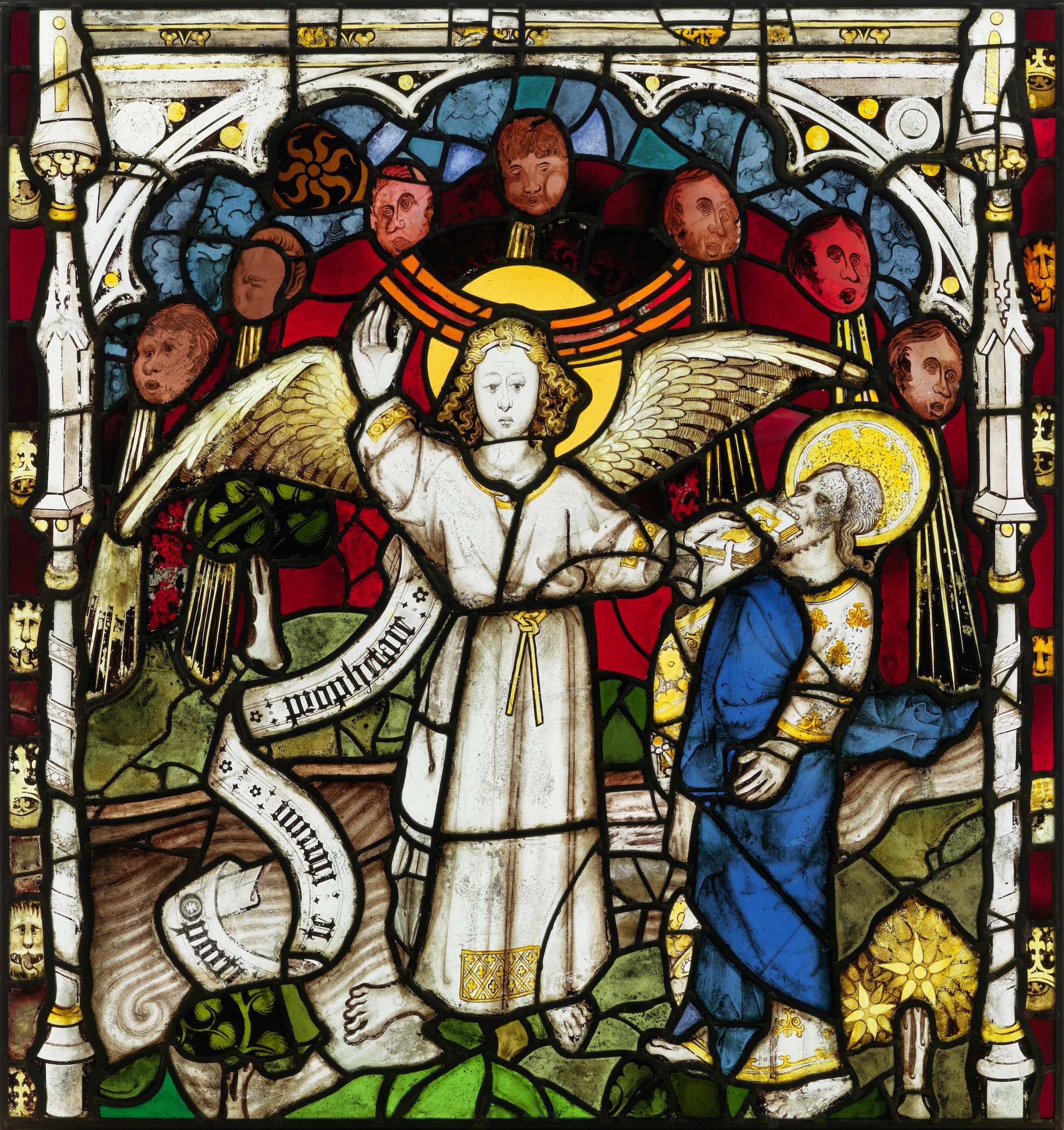
St. John takes the book from the angel (York)
John Thornton of Coventry (British, fl. 1405–1433), St. John Takes the Book from the Angel (Rev. 10:8–11), 1405–8. Stained glass panel from the Great East Window, York Minster, York, England. Photo courtesy of the York Glaziers Trust.

The Dragon gives power to the beast (York)
John Thornton of Coventry (British, fl. 1405–1433), The Dragon Gives Power to the Beast (Rev. 13:1–3), 1405–8. Stained glass panel from the Great East Window, York Minster, York, England. Photo courtesy of the York Glaziers Trust.

Satan chained in the bottomless pit (York)
John Thornton of Coventry (British, fl. 1405–1433), Satan Chained in the Bottomless Pit (Rev. 20:1–3), 1405–8. Stained glass panel from the Great East Window, York Minster, York, England. Photo courtesy of the York Glaziers Trust.

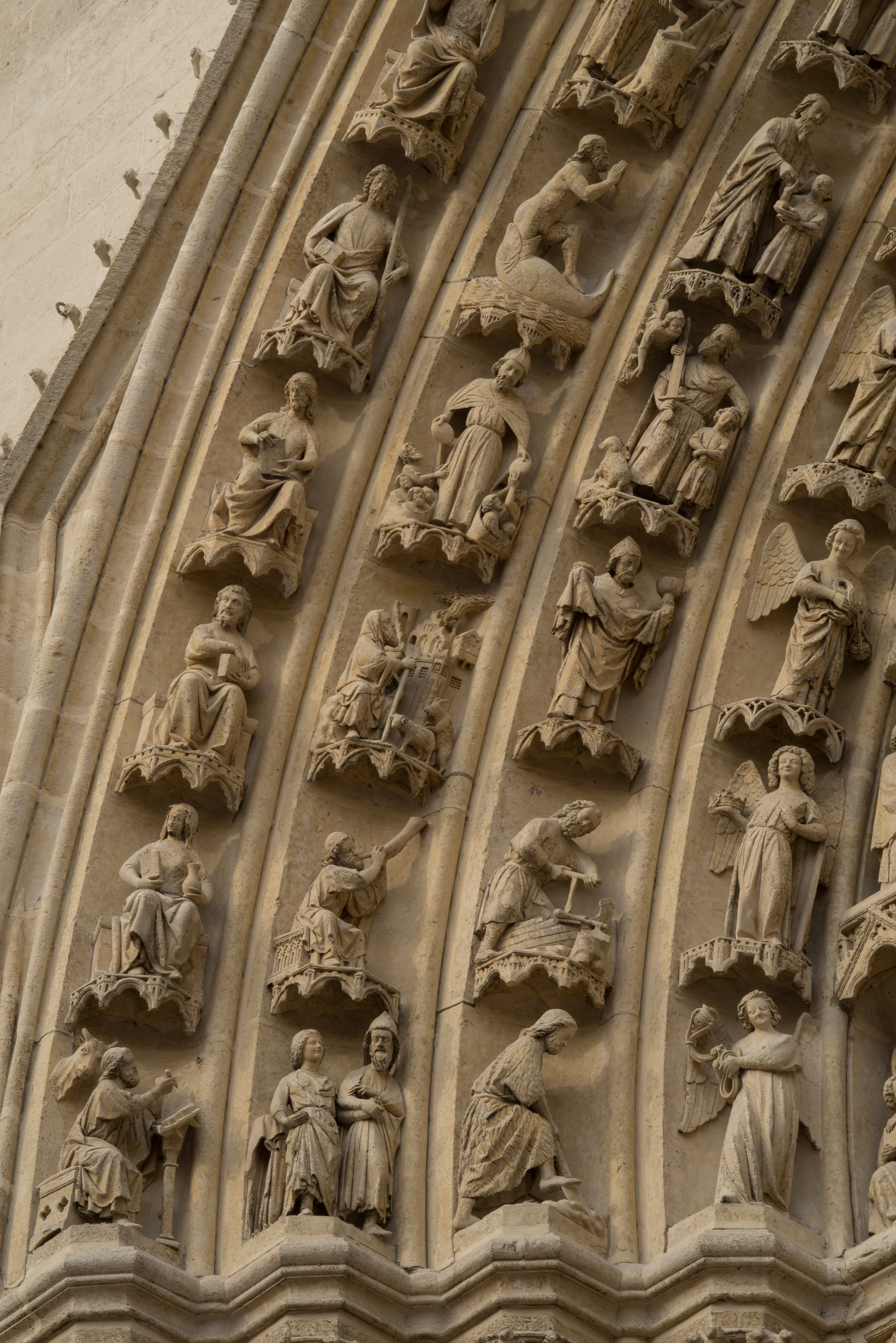
>> Life of a Cathedral: Notre-Dame of Amiens: Located in the heart of Picardy in northern France, Amiens Cathedral is one of the largest Gothic churches of the thirteenth century, renowned for the beauty of its three-tier interior elevation, its prodigious sculpted decoration, and its stained glass. This website put together by Columbia University’s Media Center for Art History offers a detailed virtual tour of the cathedral, drawing attention to its architectural features and artworks, from the many stone relief sculptures over its four portals (my favorite) to the octagonal labyrinth that adorns the marble floor in the nave to the early sixteenth-century misericords in the choir stall.

Voussoir close-up, Amiens Cathedral
Detail of voussoirs from the south transept portal of St. Honoré at Amiens Cathedral, ca. 1240, featuring Adam working the ground, Noah building the ark, Jonah being disgorged from the fish, Hosea marrying Gomer, and other biblical figures and vignettes

+++

SONG: “Adon Olam,” performed by the Maqamat Masters, feat. Nissim Lugas: The well-loved text of this traditional Hebrew prayer in five stanzas probably originated in medieval Spain, having been first found in a thirteenth-century siddur (Jewish prayer book) from Andalusia. Drawn from the language of the Psalms, it praises God for both his transcendence and his immanence. He is incomparably great, the ruler over all, and yet he’s also a personal God, a refuge for those who call on him. The prayer’s title and opening phrase translates to “Master of the Universe” or “Eternal Lord.”

Various tunes have been used for the singing of this prayer over the centuries. The Maqamat Masters perform it here with a melody based on the traditional Armenian folk tune NUBAR NUBAR, arranged by Elad Levi and Ariel Berli. They also add to the prayer a few lines from the ghazals of the Persian Sufi poet Saadi (1210–ca. 1292), about the burning fire of God’s love; Lugas sings this Farsi passage from 3:06 to 4:08.

“Maqamat Masters is a unique group of musicians that coalesced around their work together teaching at the Maqamat School of Eastern Music in Safed, Israel,” 12 Tribes Music writes. “Each of the musicians is a master in a different traditional musical genre from the Middle East, and they bring their personal voices and decades of explorations together, to create a magical, new and innovative sound.”

+++

VIRTUAL EXHIBITION: The Faras Gallery: Treasures from the Flooded Desert: In 1960, Faras, a small town in Sudan near the Egyptian border, was one of the archaeological sites designated for flooding by the waters of the Nile to create Lake Nasser. Responding to an international call by UNESCO to preserve the area’s cultural heritage before it would be buried beneath the new reservoir, a Polish team led by Professor Kazimierz Michałowski proceeded with salvage excavations in 1961–64. Their efforts uncovered the wonderfully preserved ruins of a medieval cathedral, active from the eighth to fourteenth centuries (it was built on the remains of an early seventh-century church) and containing over 150 religious paintings, a trove of Nubian Christian art. By agreement with Sudan, half of the findings went to Poland’s National Museum in Warsaw, while the other half are kept in Sudan’s National Museum in Khartoum.

Nubian Madonna and Child
Wall Painting with Bishop Marianos under the protection of Christ and the Mother of God, early 11th century, excavated from Faras Cathedral in modern-day Sudan. Secco tempera on plaster, 247 × 155.5 cm. National Museum, Warsaw.

Excavation of Faras Cathedral

Curated by Paweł Dąbrowski and Magdalena Majchrzak and hosted by Google Arts & Culture, this virtual exhibition spotlights the wall paintings and artifacts from Faras that are housed in Warsaw. It discusses the importance of the discovery of the cathedral and the technical challenges of detaching the paintings (tempera on dry mud plaster) from the walls. It also includes digital reconstructions of the cathedral’s interior and exterior in 3D stereoscopy, as well as video elements. Here is one of the four videos from the exhibition:

Roundup: New book for All Saints’ Day, Bruce Onobrakpeya exhibition in DC, and more

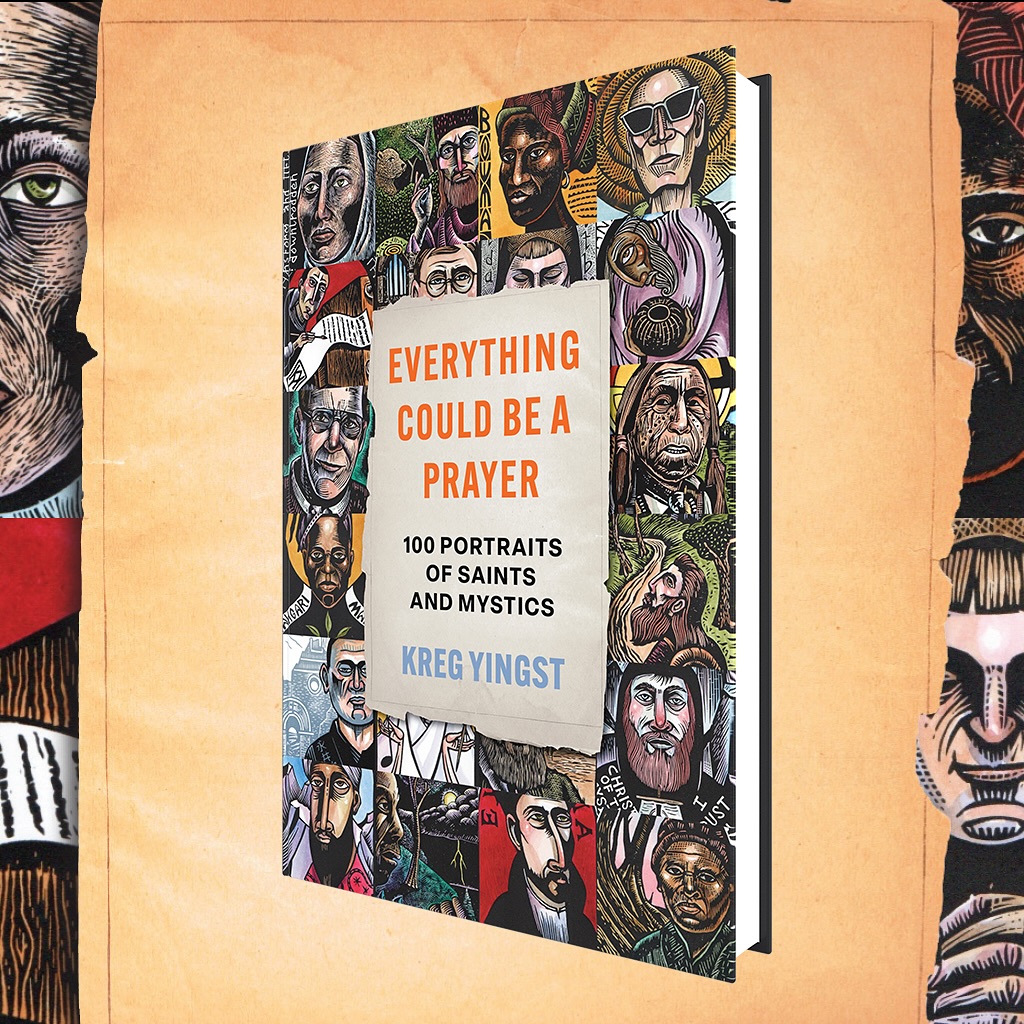
NEW BOOK: Everything Could Be a Prayer: One Hundred Portraits of Saints and Mystics by Kreg Yingst: Released on October 15, this book features one hundred color block-print portraits by Kreg Yingst of folks in the family of God across time and place, along with one-page biographies. Get to know a wide range of Christian civil rights activists, scientists, environmentalists, social service workers, hymn-writers, artists, poets, evangelists, and monastics and the gospel impact they’ve made. The lineup is a mix of familiar and less familiar names, canonized saints and noncanonized. Examples include Brigid of Kildaire, Ignatius of Loyola, Satoko Kitahara, Dietrich Bonhoeffer, Mamie Till, Pandita Ramabai Dongre-Medhavi, and Black Elk. Click here to look inside.

Kreg Yingst book

The title of the book is taken from a quote by Martin de Porres (1579–1639), a Dominican friar from Peru and the first Black saint of the Americas: “Everything, even sweeping, scraping vegetables, weeding a garden, and waiting on the sick, could be a prayer if it were offered to God.”

Related events:

  • October 10–November 16, 2024: Art exhibition featuring the block prints from the book at The Gallery of Art, 36 W. Beach Dr., Panama City, Florida
  • October 26, 2024, 1:00–3:00 p.m.: Book signing at Barnes & Noble, 1200 Airport Blvd., Pensacola, Florida

Through November 1, Yingst is offering 25% off all original woodcuts and linocuts that were used as illustrations for the book; view the discounted pieces in the “Mystics, Saints & Poets” section of his Etsy shop. These are not inkjet-printed photographs of original artworks (which is what some artists misleadingly call “prints”) but are themselves original limited-edition relief prints hand-pulled on an antique proof press from carved blocks; they are made with black oil-based ink and watercolor. If you want original art in your home or to gift a friend or family member for Christmas, Yingst’s work is a great and affordable option!

+++

SONGS:

November 1 is All Saints’ Day, a feast for commemorating the lives and witness of our siblings in the faith who have gone before us. Here are two songs for the occasion.

>> “I Sing a Song of the Saints of God,” performed by Wendell Kimbrough: This charming little children’s hymn was written by Lesbia Scott and was first published in her native England in Everyday Hymns for Little Children (1929). In the United States the song first appeared in the Episcopal Hymnal 1940 with a tune that John Henry Hopkins, a member of the hymnal committee, composed for it, capturing the childlike cadences of the text.

>> “When the Saints” by Sara Groves: This song from Groves’s album Tell Me What You Know (2007) draws encouragement from the faithfulness of God-followers throughout history, from Moses, Paul, and Silas to Harriet Tubman and Mother Teresa to the martyr Nate Saint and his sister Rachel Saint to rescuers of sex-trafficking victims. It is a call to hearers today to pick up their cross and follow Christ into places of hurt and injustice, pursuing liberation of body and soul for all. The refrain quotes the traditional Black gospel song “When the Saints Go Marching In.”

+++

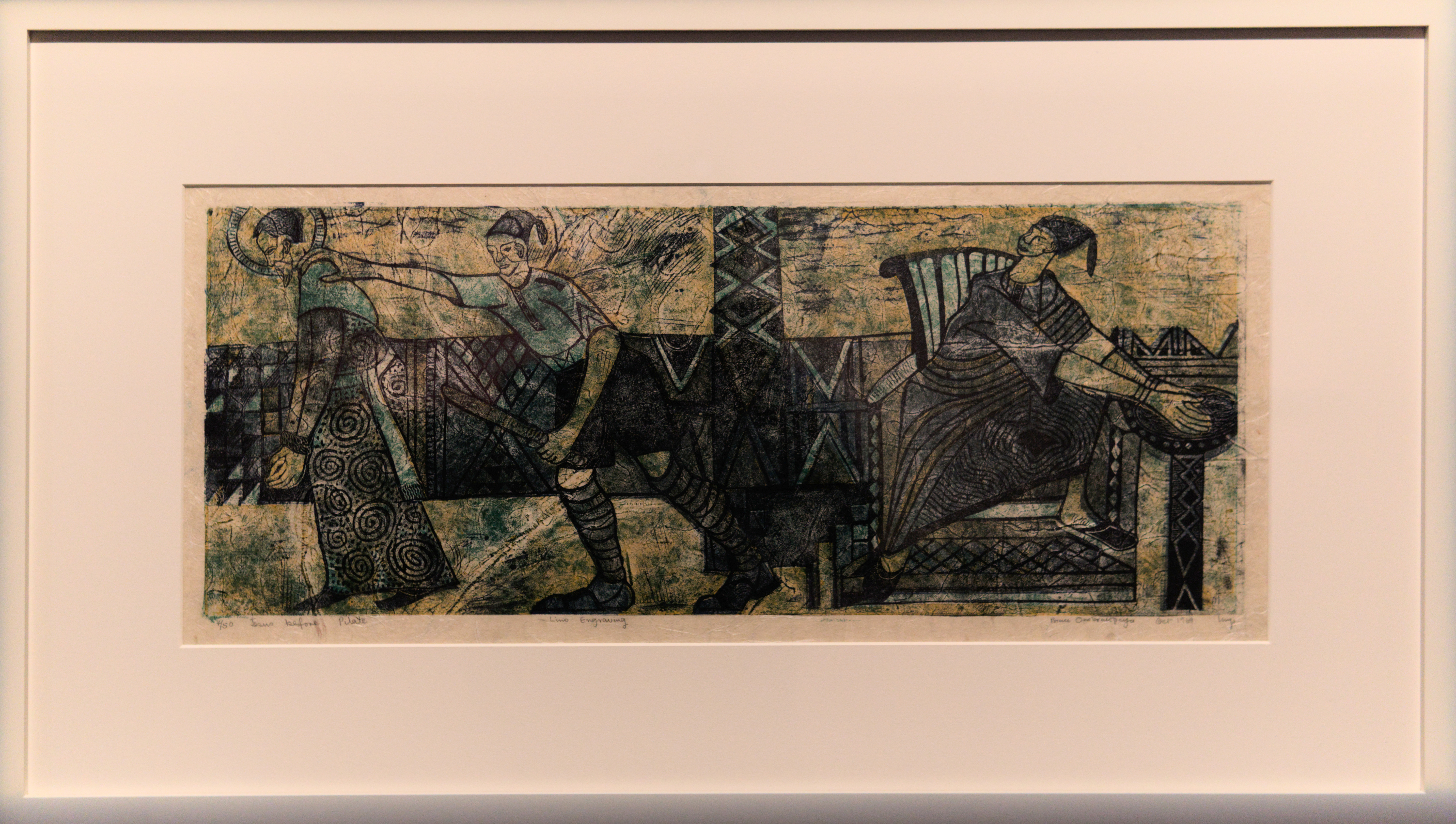
ART EXHIBITION: Bruce Onobrakpeya: The Mask and the Cross, National Museum of African Art, Washington, DC, June 21, 2024–January 21, 2025: A father of African modernism, Bruce Onobrakpeya (b. 1932) [previously] is one of Nigeria’s most celebrated artists, and I was thrilled this month to visit his first solo show in the US, which, as it turns out, is centered on his Christian-themed linocut prints! (The artist is Anglican.) Onobrakpeya’s career spans over six decades, and this Smithsonian exhibition is not meant to be representative of the breadth of his oeuvre, which also includes painting and sculpture and various subject matters; rather, it presents two foundational bodies of work from the late sixties, both commissioned by the Catholic Church, that helped launch the artist’s long and esteemed career.

The exhibition displays rare artist’s proofs of the biblical illustrations Onobrakpeya made for Ki Ijoba Re De (May Your Kingdom Come) (1968), a Yoruba-language textbook for students in their fifth and sixth years of Catholic primary school (it was part of the Nigerian National Catechism), as well as a complete narrative series of prints titled Fourteen Stations of the Cross, produced in 1969. I blogged about the artist’s Stations cycle back in 2014, when I saw a different edition at the SMA African Art Museum in Tenafly, New Jersey; you can view better photos on the High’s website. For more on the work of Fr. Kevin Carroll, the Catholic missionary who commissioned Onobrakpeya to paint a church mural of the Stations that became the basis of these linocuts and who helped facilitate the May Your Kingdom Come publication, see here.

Curated by Lauren Tate Baeza, Bruce Onobrakpeya: The Mask and the Cross first opened last year at the High Museum of Art in Atlanta. This is Baeza’s first exhibition as curator of African art at the High, and I’m so pleased that when she dug through the High’s extensive archives, it was a set of Christian prints by a leading Nigerian artist that most compelled her, that she could imagine building a unique exhibition around and that she felt must be pulled out of storage for more people to see. Hear Baeza discuss the exhibition from 23:28 to 35:58 of the video “African Modernisms: A Legacy of Connection.”

Onobrakpeya, Bruce_Station 1
Bruce Onobrakpeya (Nigerian, 1932–), Station I: Pilate condemns Jesus to death, 1969. Linoleum block print on rice paper, 24 × 34 in. (61 × 86.4 cm). High Museum of Art, Atlanta, Georgia. Photo: Victoria Emily Jones.

For his Stations of the Cross, Onobrakpeya “incorporat[ed] the rich patterns of Yoruba gelede and epa masks and stylized geometric patterns found in northern Nigerian architecture. Then he added generous adire motifs and his signature elongated figures and distortions of scale,” reads one of the gallery wall texts. He also embedded a critique of British colonial rule, portraying the Roman soldiers of Christ’s passion as British officers. (Nigeria had just attained independence from Great Britain earlier that decade, in 1960.) Pilate, though, is shown as a local Nigerian magistrate doing the bidding of the British government, highlighting a deeply felt tension in Nigeria’s then-recent political history.

I really appreciate the video components of the exhibition. One screen plays a compilation of clips from interviews Baeza conducted with the artist, and another displays a two-dimensional animation commissioned from Sadiki Souza specially for this exhibition, which brings to life Onobrakpeya’s fourteen Stations. Neither is available online, at least not that I can find.

+++

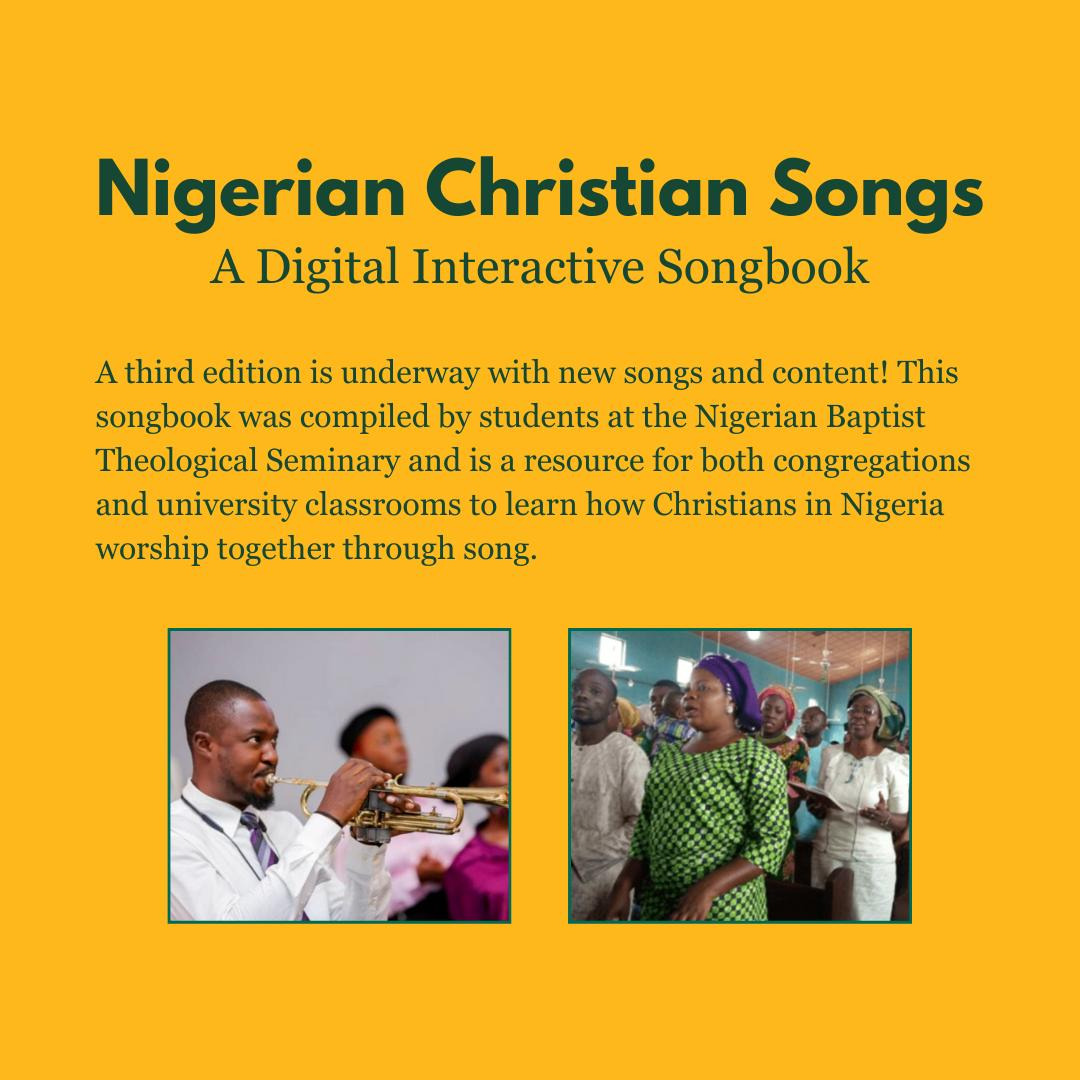
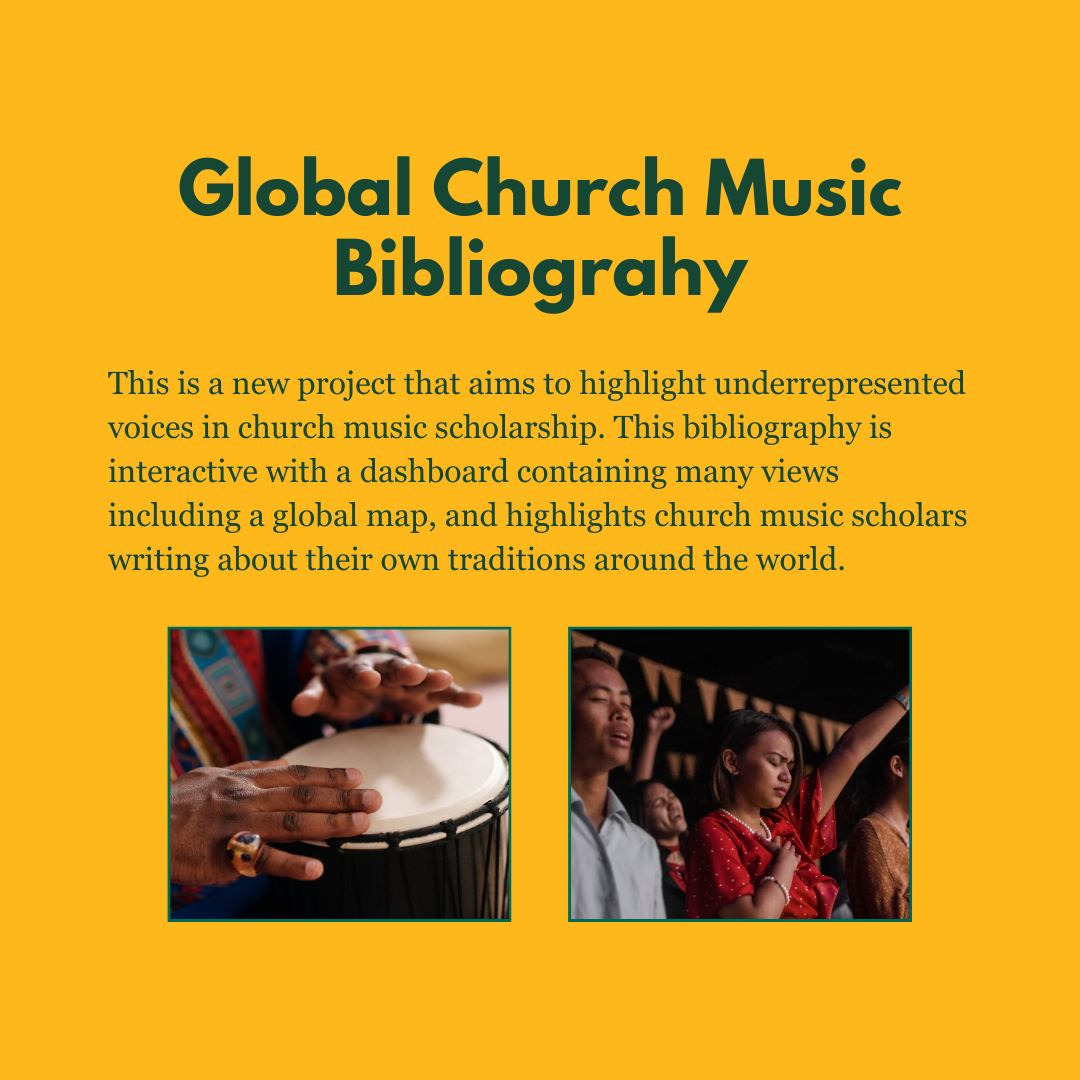
ZOOM EVENT: “Celebration of New Global Church Music Resources,” November 14, 9:00 a.m. CDT (12:00 p.m. ET): From Baylor University’s Dunn Center for Christian Music Studies: “We are excited to announce the launch of two website projects on November 14th! In collaboration with the Nigerian Baptist Theological Seminary, the third edition of the Nigerian Christian Songbook will be updated with new songs and content. In addition, a new project, the Global Church Music Bibliography, highlights underrepresented voices in church music scholarship. This is an interactive dashboard and map that features church music scholars writing about their own traditions outside of North America.” At the Zoom event on launch day, you will hear from various project participants. [HT: Global Christian Worship]

Nigerian Christian Songs
Global Church Music Bibliography

Roundup: Latin American classical music, Pedro Linares sculpture, Pope Francis on literature, and more

UPCOMING LECTURES:

I’m one of the artistic directors of the Eliot Society, a faith-based arts nonprofit in Annapolis. I’m really looking forward to our next two events this fall! If you’re in the area, I’d love for you to come out to these talks by a musician and a medievalist. They’re both free and include a time of Q&A and a small dessert reception afterward.

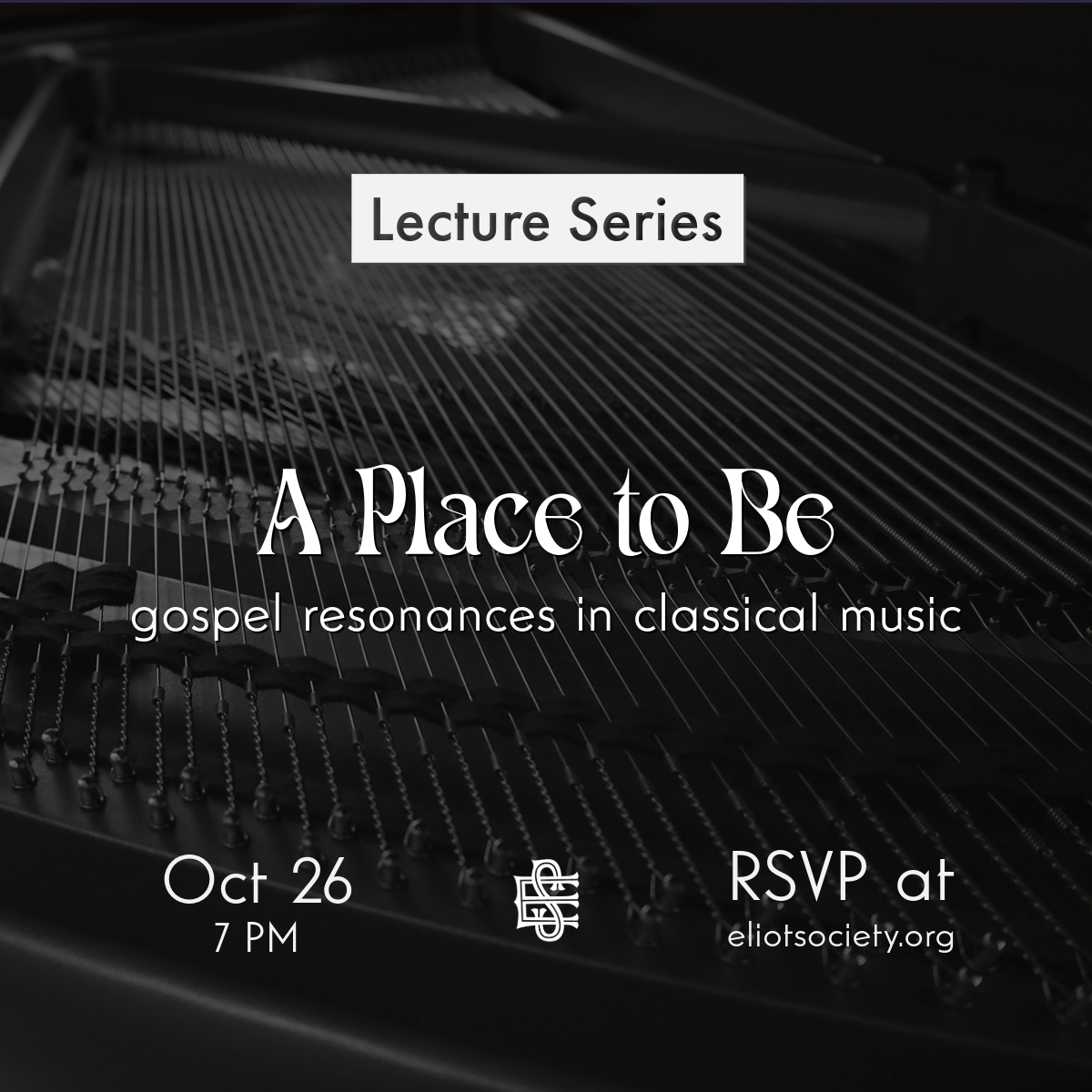
>> “A Place to Be: Gospel Resonances in Classical Music” by Roger Lowther, October 26, 2024, Redeemer Anglican Church, Annapolis, MD: “At its most basic, music is a collection of sounds. How those sounds are organized varies by country and culture and reflects their values, history, and heart-longings. Join Tokyo-based American musician Roger W. Lowther on a journey through the landscapes of Western and Japanese classical music and explore their unique and fascinating differences. Roger will lead from the piano as he demonstrates the musical languages of each tradition and show how they contain hidden pointers to gospel hope in a world full of suffering and pain.”

Roger Lowther lecture

I’ve heard Roger speak before, and he’s very Jeremy Begbie-esque in that he does theology through instrumental music. As a bicultural person, a New Englander having lived in Japan for almost twenty years (ministering to and through artists of all disciplines), he brings a unique perspective. In addition to discussing the defining features of the Western versus Japanese classical traditions, he’ll be performing a few piano pieces from each.

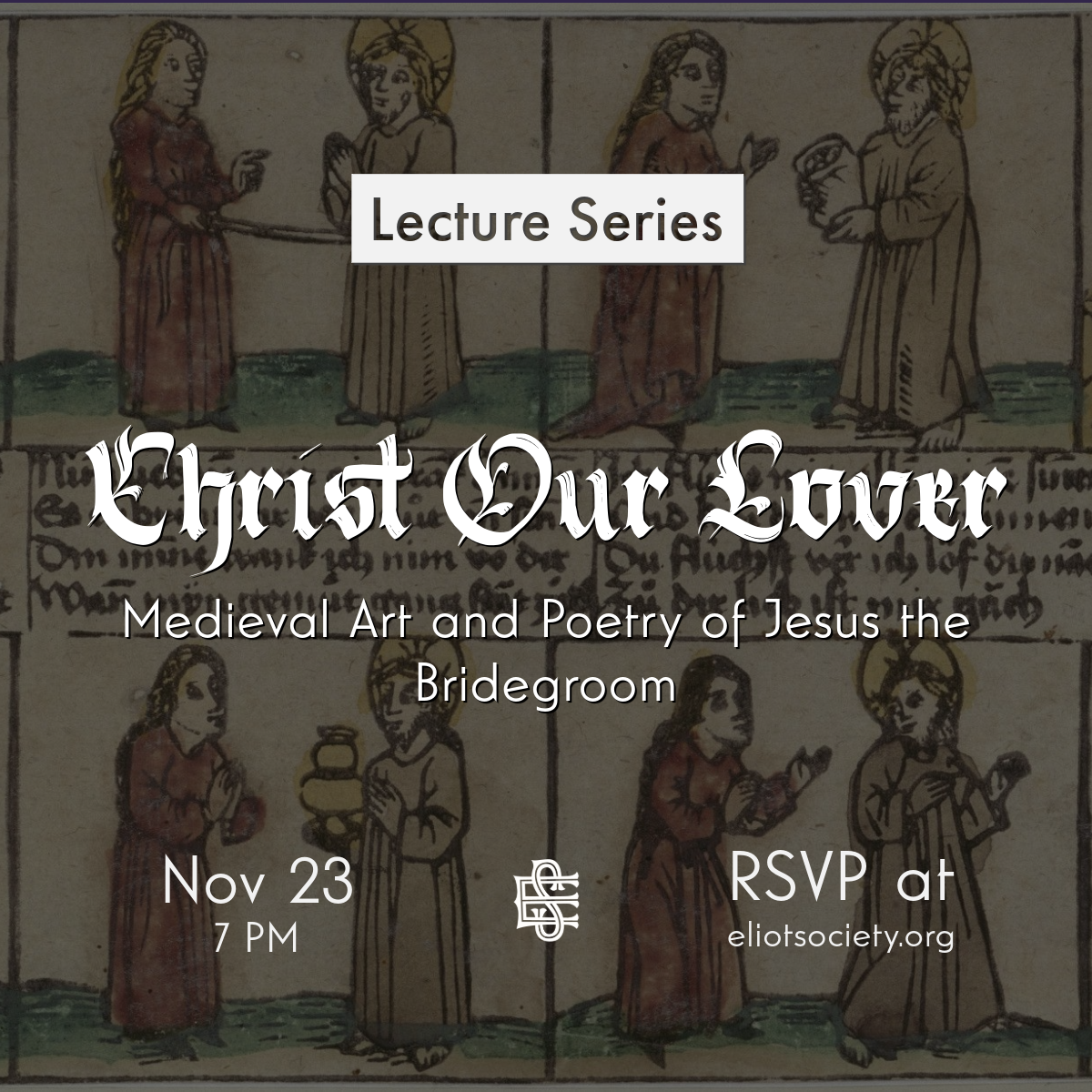
>> “Christ Our Lover: Medieval Art and Poetry of Jesus the Bridegroom” by Dr. Grace Hamman, November 23, 2024, St. Paul’s Anglican Church, Crownsville, MD: “If there was a ‘bestseller’ book of the Bible in the European Middle Ages, it would be the Song of Songs. When read allegorically, in the manner of medieval theologians like St. Bernard of Clairvaux, the book tells the story of the romance between Christ and the soul that culminates in Christ’s love shown on the cross. This is a story of mutual pursuit, the pain of desire and sacrifice, sensual delight, and true union. The idea of Jesus as a longing lover of each individual soul appeared everywhere by the later medieval period, in art, poetry, sermons, and the devotional writings of men and women alike.

“These themes and images can strike us as strange, even uncomfortable. An illustrated poem for nuns depicted the Song of Songs like a cartoon strip. Prayer books of wealthy nobles portrayed Christ’s wounds intimately. Poets wrote Christ in the role of a chivalric, wounded knight weeping and waiting for his lady. And yet, examining this ancient imagery of Jesus our Lover together can challenge us to greater vulnerability with our Savior, to refreshed understandings of God’s hospitality, and, in the words of Pope Gregory the Great, can set our hearts ‘on fire with a holy love.’”

Grace Hamman lecture

Grace is a fabulous teacher of medieval poetry and devotional writing, one whom I’ve mentioned many times on the blog before. Her Jesus through Medieval Eyes was my favorite book of 2023; read my review here. She has encouraged me to move in toward the strange and imaginative in medieval theology and biblical interpretation, because there’s often beauty and wisdom to be found there if we give it a chance. She has a keen awareness of the body of Christ across time and an appreciation for the gifts they’ve bequeathed the church of today, be they words, art, or whatever else.

+++

VIDEO: “Poet and Pastor: Christian Wiman and Eugene Peterson”: In this four-minute video from Laity Lodge, poet and essayist Christian Wiman and pastor and spiritual writer Eugene Peterson (best known for his Bible translation The Message) talk about prayer and spirituality. They each share a poem they’ve written: Wiman’s “Every Riven Thing” and Peterson’s “Prayer Time.” “People who pray need to learn poetry,” Peterson says. “It’s a way of noticing, attending.”

+++

ARTICLE: “Stop and read: Pope praises spiritual value of literature and poetry” by Cindy Wooden, National Catholic Reporter: On August 4 the Vatican published a letter by Pope Francis, a former high school lit teacher, on the important role of literature in formation. Read some highlights at the article link above, or the full letter here.

+++

SONG: “Teach Me How to Pray” by Dee Wilson: This jazz adaptation of the Lord’s Prayer premiered at Good Shepherd New York’s September 8 digital worship service. It is written and sung by Dee Wilson of Chicago.

+++

ARTICLE + PLAYLIST: “Latin American Fiesta!” by Mark Meynell: I always appreciate the selections and knowledge Mark Meynell [previously] brings to his 5&1 blog series for the Rabbit Room, each post exploring five short pieces and one long piece of classical music. This Latin American installment features Kyries from Peru and Argentina, a candombe air, a four-part Christmas anthem in Spanish creole from Mexico (I found an English translation!), an Argentine tango, and a dance chôro (Portuguese for “weeping” or “cry”) from Brazil. What diverse riches!

“Classical music, as conventionally understood, is not often associated with Latin America,” Meynell writes, “though, as we will see, this is a situation that needs rectifying. Some extraordinary soundworlds were being created long before the Conquistadores arrived from European shores, and together with the cultural impact of the transatlantic slave trade from Africa, the musical mix that resulted is unique. To put it at its most simplistic, we could say that the two key musical influences were the Catholic Church and the complex rhythms of percussion and dance; and often, it’s hard to tell where one ends and the other begins.”

View more from the 5&1 series here. In addition to “Latin American Fiesta!,” among the thirty-three posts thus far are “Autumnal Mists and Mellow Fruitfulness,” “Musical Thin Places: At Eternity’s Edge,” “Music in Times of Crisis,” “The Calls of the Birds,” and “It’s All About That Bass.”

+++

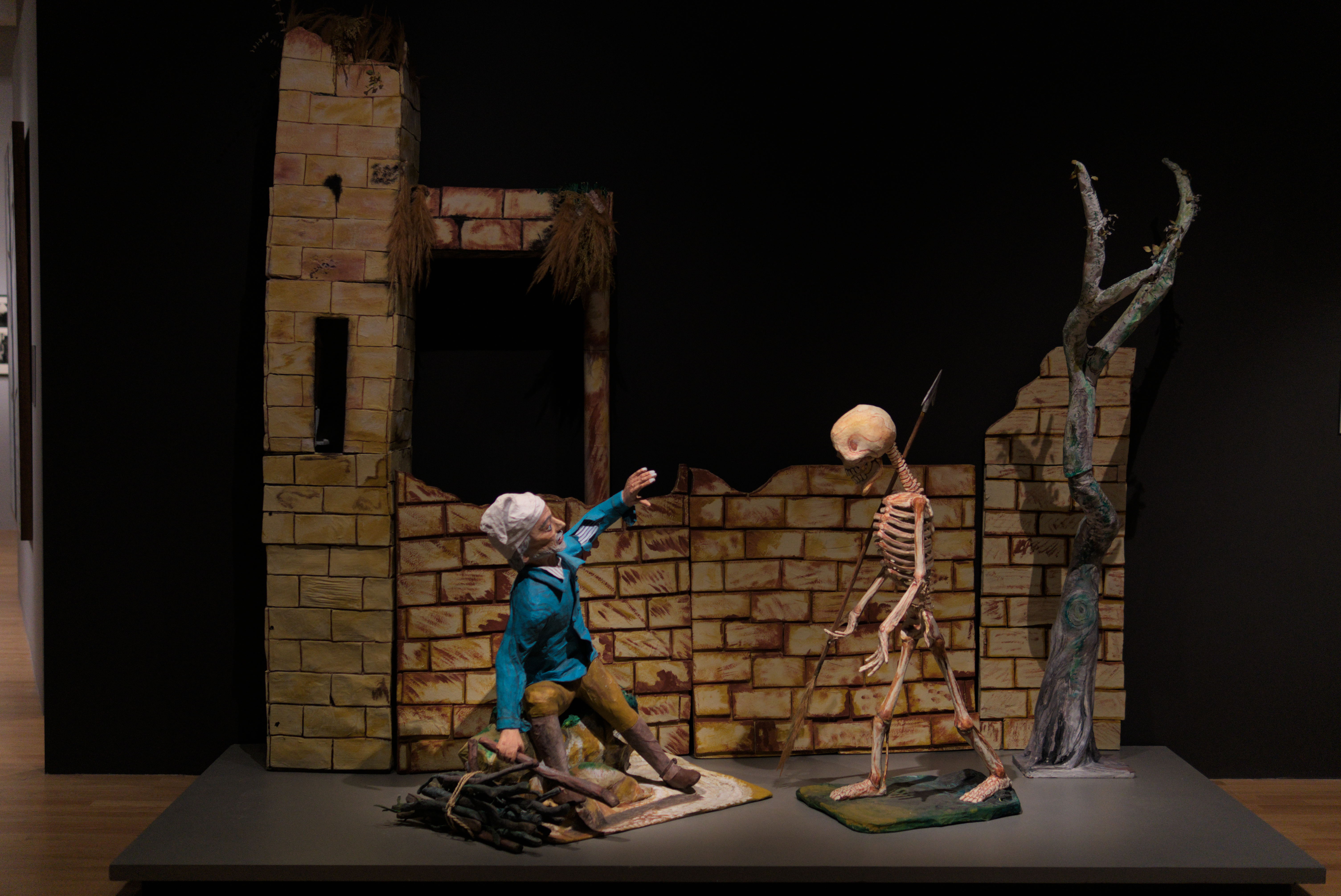
ARTWORK: The Old Man and Death by Pedro Linares: Last month I visited the Wadsworth Atheneum Museum of Art in Hartford, Connecticut, for the first time and was delighted to stumble upon an exhibition that had just been put up, Entre Mundos: Art of Abiayala. On view through December 15, it highlights collection works made by artists with personal or ancestral ties to Mexico, the Caribbean, and Central and South America. The title translates to “Between Worlds,” and “Abiayala,” I learned, is a Guna (Kuna) word that means “land in its full maturity” or “land of vital blood”; it’s used by the Guna and some other Indigenous peoples to refer to the Americas.

Linares, Pedro_The Old Man and Death
Pedro Linares (Mexican, 1906–1992), El viejo y la muerte (The Old Man and Death), 1986. Papier-mâché and mixed media. Wadsworth Atheneum Museum of Art, Hartford, Connecticut. Photo: Victoria Emily Jones.

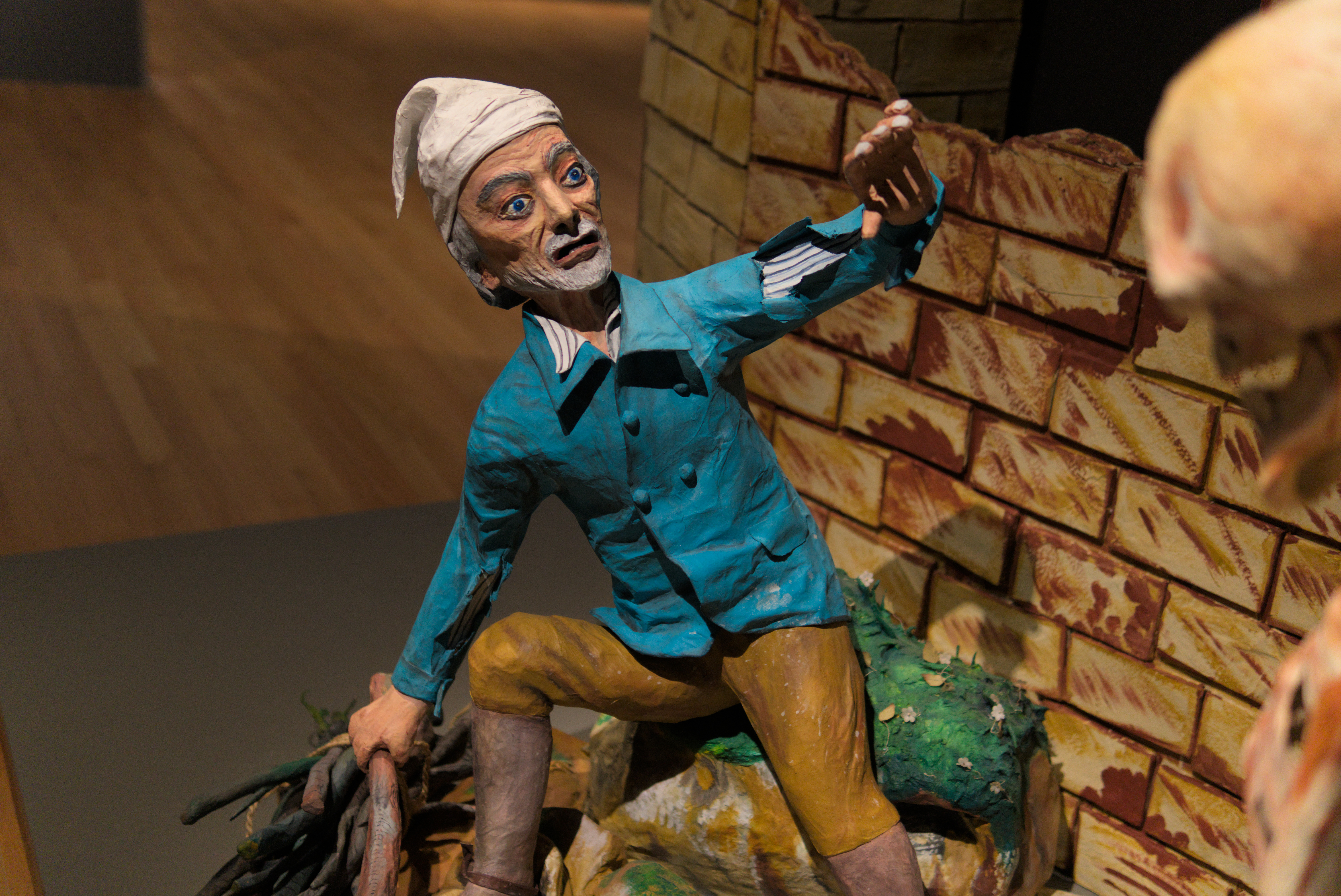
Linares, Pedro_The Old Man and Death (detail)

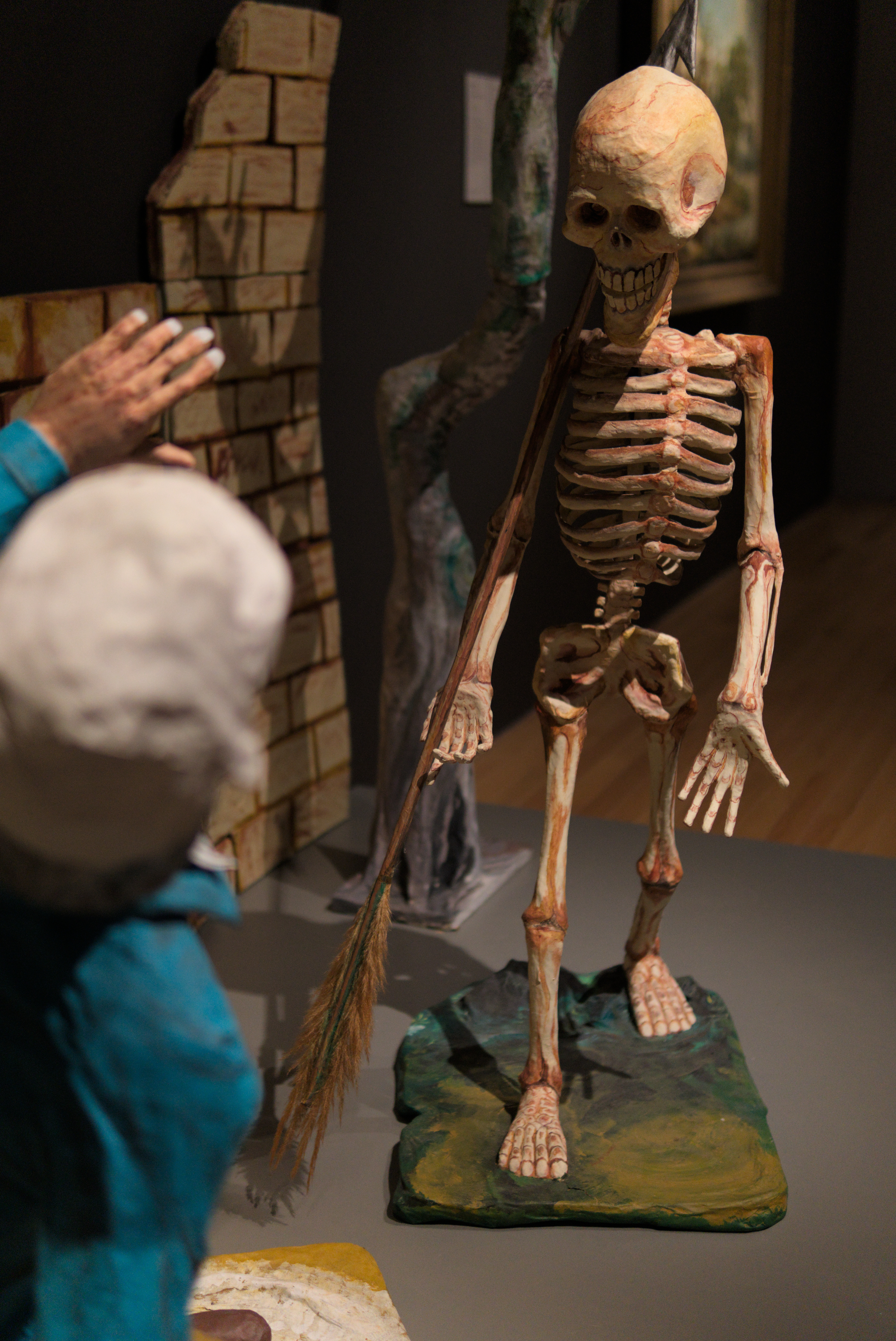
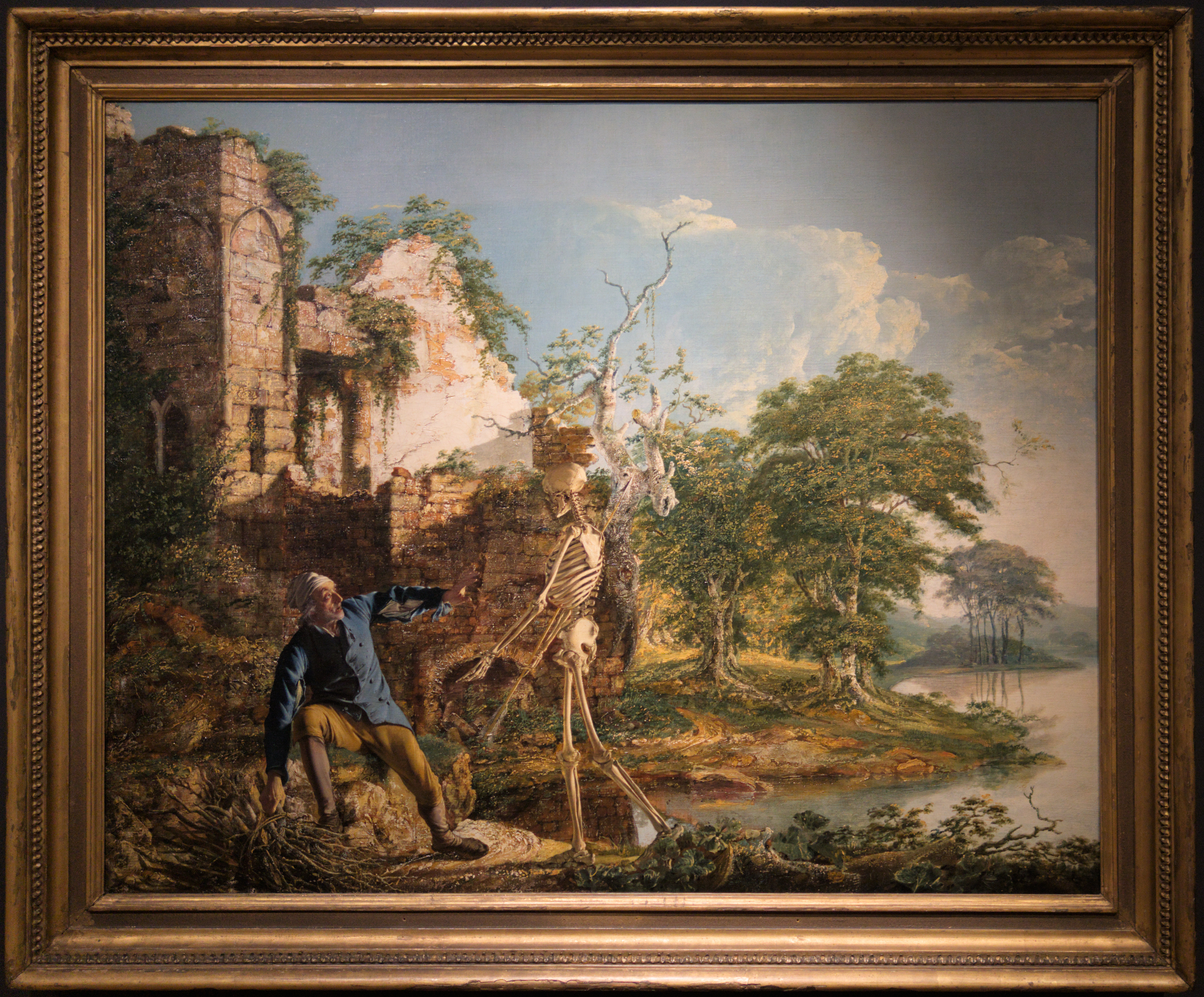
For me the standout piece from the exhibition is The Old Man and Death by Pedro Linares, a dramatic tableau in the medium of cartonería (papier-mâché sculpture), a traditional handcraft of Mexico. Commissioned by the Wadsworth in 1986 for the artist’s MATRIX exhibition, it reinterprets Joseph Wright of Derby’s 1773 painting of the same name, one of the most popular works in the museum’s collection.

Wright, Joseph_The Old Man and Death
Joseph Wright of Derby (English, 1734–1797), The Old Man and Death, 1773. Oil on canvas, 40 × 50 1/16 in. (101 × 127 cm). Wadsworth Atheneum Museum of Art, Hartford, Connecticut. Photo: Victoria Emily Jones.

Regarding the Wright painting, Cynthia Roman writes that it

masterfully combines Wright’s ability to depict a literary narrative with his skill in rendering a natural setting with accuracy and keenly observed detail. The subject of this painting is based on one of Aesop’s Fables or possibly a later retelling by Jean de la Fontaine. . . . According to the tale, an old man, weary of the cares of life, lays down his bundle of sticks and seats himself in exhaustion on a bank and calls on Death to release him from his toil. Appearing in response to this invocation, Death arrives. Personified here as a skeleton, Death carries an arrow, the instrument of death. Illustrating the moral of the tale that it is “better to suffer than to die,” the startled old man recoils in horror and instinctively waves him off, reaching for the bundle as he clings to life.

The Linares piece and its inspiration are placed side-by-side in the gallery, which also displays an alebrije by the same artist, papel picado, painted skulls, an ofrenda, and Diego Rivera’s Young Girl with a Mask.

Roundup: Animal church service, “Life/Blood” installation, and more

Have you been delighted or inspired by the Art & Theology blog this year or its Instagram offshoot, @art_and_theology? If so, please consider donating to the work through a secure online form or PayPal, or by buying me a book from my Amazon wish list (my address is privately stored). Thank you to my five regular monthly supporters, and others who have blessed me with one-off donations of funds and books. These gifts not only provide important material assistance but also serve as an emotional boost, a validation that my work has value and is worth continuing.

My blog-related expenses this year have included a replacement of my old laptop, a conference registration and travel fees, a trip to New York, museum admissions, books, licensing fees for two images (I occasionally pay for images when good photos are not available online), and the yearly WordPress Premium fee to keep this site ad-free and mapped to a custom domain. Donations will go toward covering these, and if there is any left over, toward a new camera lens that will enable me to take wider shots, great for cathedrals and for larger artworks in tight quarters.


SPOTIFY PLAYLIST: October 2024 (Art & Theology): Every month I create a digital mixtape of Christian and Christian-adjacent music that deserves attention, consisting of old and brand-new recordings alike. Two hours of beautiful, soulful expressions of praise, prayer, and lament for your ears and heart.

+++

VIDEO: Animal Service at Ely Cathedral: On September 22, Ely Cathedral in England held its annual animal service, attended by some 450 animal lovers and their pets and service animals, mainly dogs. “Our annual Animal Service is an opportunity to give thanks for the animal companions with whom we share our lives and our planet, to bring them into our Cathedral, to ponder how best to care for animals and to ask God to bless them.” Marley the donkey, from the Donkey Sanctuary, led a procession up the nave. The liturgy was led by Canon James Garrard, and, in addition to several congregational hymns, including “All Creatures of Our God and King,” the cathedral’s children’s choir, the Ely Imps, sang “The Barnyard Song” by Rhonda Gowler Greene and “Look at the World” by John Rutter.

In addition to a special prayer of confession, act of commitment, and benediction, the service included this litany from the Book of Common Prayer:

God said, “Let the waters bring forth living creatures, and let birds fly across the sky.”

We thank you for the teeming life of the seas,
And the flight of the birds.
Help us to protect the environment
So that all life may flourish.
God of life: Hear our prayer.

God said, “Let the earth bring forth living creatures of every kind.”

We rejoice in the variety of animal life.
Grant us grace to treat all animals with respect and care;
To protect endangered species,
To preserve the variety of habitats,
And to honor the delicate balance of nature.
God of life: Hear our prayer.

Heavenly Father, you have filled the world with beauty.
Open our eyes to behold your gracious hand in all your works,
That, rejoicing in your whole creation,
We may learn to serve you with gladness,
For the sake of him through whom all things were made,
Jesus Christ our Lord.
God of life: Hear our prayer.

Two volunteer representatives from the charity Medical Detection Dogs were invited to share about the work of dogs who are trained to detect the odor of human disease.

Several churches worldwide hold animal services around this time of the year, the Feast of St. Francis (known for his love and care of animals) being on October 4. These are usually in addition to the regular Sunday morning worship service and are not eucharistic. UMC’s Discipleship Ministries provides a sample liturgy for “A Service for the Blessing of Animals.” Many such services are held outdoors, such as the one organized annually by Washington National Cathedral, which is taking place this Sunday, October 6, at 2 p.m.

+++

ART INSTALLATION VIDEOS + PHOTOS: In July I mentioned the Vessel art trail organized by Art + Christianity, which places contemporary artworks in rural churches along the Welsh-English border (see here). On commission from A+C, Mud and Thunder has taken some wonderful photos and video of the seven sites on the trail, including interview footage with the artists. What follows are videos for Life/Blood by Lou Baker, Grace Vessel by Jane Sheppard, and Centre by Steinunn Thórainsdóttir. (The remaining videos are on pieces by Lucy Glendinning, Andrew Bick, Barbara Beyer, and Robert George.)

The art trail continues through October 31. Visit https://artandchristianity.org/vessel to view in situ photographs, and see the following links for information on free creative workshops led by the participating artists: on making sculptures of found natural materials, working with clay as a meditative practice, social knitwork, and drawing.

+++

POEMS:

>> “There’s a Special Providence” by Seth Wieck, Texas Poetry Assignment: Seth Wieck [previously] is a writer from Amarillo, Texas. Published the week of the last US presidential inauguration, this poem muses on the impermanence of earthly empires, contrasting such with the steady, indifferent labor of birds, which continues on through administration changes and the passing of generations. The title and opening line are a clever rhyming twist on a line from the final act of Shakespeare’s Hamlet, “There’s a special providence in the fall of a sparrow.” For the poetic speaker, there’s a sense of comfort in God’s sovereignty and an orientation toward Christ’s lordship that puts election poll results, though not negligible, in proper perspective.

In a Substack post from February 2021, Wieck wrote, “I am no politician’s acolyte; they’re public servants, not saviors. I catch some heat in private conversation when I say that I couldn’t care less about national politics. That’s not a true statement, but the tense conversations in which I claim my ambivalence usually leave me no room for nuance. Those conversations demand my total wide-eyed attention to the firehouse of information being created by national elections. But as Mary Oliver said, ‘The beginning of devotion is attention.’ Forgive me if I am unwilling to develop devotion for those people whose only interest in my community is the exploitation of our devotion and resources.”

>> “Jesus Heals a Paralytic” by Ryan Keating, Reformed Journal: Ryan Keating is a pastor on the Mediterranean island of Cyprus (he preaches in Turkish and English), an academic writer and poet, and the owner of Exile Coffee and Wine. This poem retells the miracle from Mark 2:1–12 in the voice of the paralyzed man whom Jesus heals. Whereas many artists depict the episode with ropes used as a lowering mechanism, Keating says it’s much more likely, given the typically low ceilings of Middle Eastern homes, that the man would have been received by “a net of hands” raised up by the people in the room.

The poem repeats the word “temple” three times, remarking how the man was “suspended / in a temple by a temple / and landed on holy ground / as a temple . . .” The temple is the place where the crowd is gathered because Jesus is in it, and the four faith-filled friends who bring the paralyzed man there themselves constitute a temple, and the man too becomes a temple, a dwelling-place of God, after being made whole by Jesus. Drawing on Old Testament imagery of the garden of Eden and the exodus, the final stanza is one of restoration. The sea of people parts as the man steps outside into a garden, his friends buoyed by amazement.

+++

ARTWORK: Intra-Venus by Marina Vargas: October is Breast Cancer Awareness Month, so I wanted to share an artwork I encountered on the subject this summer at the New Worlds: Women to Watch 2024 exhibition at the National Museum of Women in the Arts. Intra-Venus is a nude self-portrait in marble by Spanish artist and breast cancer survivor Marina Vargas, frankly depicting her body after a mastectomy, chemotherapy, and radiation. Owning her scars and her baldness, she uses the language of classical sculpture to monumentalize a common female experience. (The chance of a woman in the US getting breast cancer in her lifetime is 1 in 8, and more than 100,000 US women undergo some form of mastectomy each year; global statistics are harder to come by.) Vargas lost the use of her left arm for a time during treatment, but here she shows herself with her left arm raised in triumph. The sculpture highlights the heroism of women who endure breast cancer and the dignity of their changed form.

Vargas, Marina_Intra-Venus
Marina Vargas (Spanish, 1980–), Intra-Venus, 2019–21. Carrara marble, 77 1/2 × 26 3/4 × 26 in. Photo: Victoria Emily Jones.

Vargas, Marina_Intra-Venus

Roundup: “By Babylon’s River,” Jack Baumgartner, Ordinary Saints, and more

NEW ALBUM: By Babylon’s River by the Pharaoh Sisters: A folk band from the foothills of North Carolina, the Pharaoh Sisters [previously] are Austin Pfeiffer, Jared Meyer, Kevin Beck, and John Daniel Ray. On September 13 they released their second album, By Babylon’s River, unveiling a new genre they call “saloon Christian.” The title track is a western waltz adaptation of Psalm 137. Also included on the album are a version of Psalm 81 (“Sing, Oh Sing”); bluegrass arrangements of the gospel standards “Leave It There” and “Hold to God’s Unchanging Hand”; retunes of the hymns “All Things Bright and Beautiful” by Cecil Frances Alexander and “’Tis Finished” by Charles Wesley; a cheeky take on the story of Samson, and more.

Here’s the press release.

+++

TRAILER: A Man Called Hurt: The Life and Music of Mississippi John Hurt: Made by directors Jamison Stalsworth and Alex Oliver of Draft creative agency in conjunction with the Mississippi John Hurt Foundation, this documentary about the titular Delta bluesman premiered May 1 at the San Francisco Documentary Festival and has been continuing on the festival circuit; most imminently, it will be screening at the Nashville Film Festival on September 19–25. I’m eager to see it once it hits on-demand streaming or comes to a screen near me! Follow updates at https://www.facebook.com/HurtTheFilm/.

I was introduced to Hurt over a decade ago through his recording of the African American spiritual “I Shall Not Be Moved,” based on Psalm 1. The songs he sang were a mix of sacred and secular.

+++

ARTISTS’ PROFILE: “Sunny Taylor / Jack Baumgartner,” Artful, season 3, episode 6: The BYUtv docuseries Artful, which is available to watch freely online, profiles a variety of artists of faith—many of them Latter-day Saints, but some (non-LDS) Christian or Jewish.

The first half of episode 6, season 3, highlights the work of Sunny Taylor, who lives in Wilton, Maine, and engages with painting’s geometric tradition. She values process over product and wants viewers to observe the surface and textures of her paintings, built up through meticulous layering techniques that involve scraping and grinding. She sees beauty in imperfection, and sorrow and joy as bound up together. Follow her on Instagram @sunnytaylorart.

Taylor, Sunny_Connections
Sunny Taylor (American, 1979–) Connections, 2024. Acrylic on panel, 24 × 12 in. [for sale] [artist’s statement]

Beginning at the 13:38 time stamp, the second half is on multidisciplinary artist Jack Baumgartner of Kansas. Baumgartner, who has a Presbyterian background, is a printmaker, painter, farmer, woodworker, puppeteer, and musician. He raises sheep, goats, and chickens, builds furniture, plays the banjo, and cohosts the podcast The Color of Dust with two poet friends, “exploring the seen and unseen in the soil of art and agriculture.” He is also a husband and a father of five. I first learned about Baumgartner through an Image journal profile; and Plough published an article about him in 2018. I really enjoyed this twelve-minute video segment that shows him at work and at play in and around his home—especially his puppet theater performance of The Two Deaths of John Beartrist Laceroot! Follow him on Instagram @baumwerkj.

Baumgartner, Jack_Go On, Adam, Breathe
Jack Baumgartner (American, 1976–), Go On, Adam, Breathe, 2023. Linocut, 14 × 18 in. [for sale]

+++

PODCAST EPISODE: “Grief and Poetry, with guest Kim Langley,” Faith and Imagination, October 4, 2021: Kim Langley is a certified spiritual director and retreat leader from Ohio; she is also the founder of WordSPA (acronym for “Spirituality Poetry Appreciation”) and author of Send My Roots Rain: A Companion on the Grief Journey (Paraclete, 2019), a compilation of sixty poems interwoven with narrative and commentary, in preparation for which she interviewed some three dozen chaplains, pastors, grief counselors, hospice workers, funeral directors, and bereaved people. She wrote the book after the death of her parents. “I found such comfort in the poems,” she writes, “written by a host of people just like us, picking up their pain, juggling it awkwardly in their arms at first—or maybe for a long time—then gradually finding the resilience to carry it, to know when and how to put it down, when to pick it up, and how to develop strong muscles for the long haul. They helped me carry my pain, and I think they will help you to survive, and maybe even thrive a little.” In this podcast episode, she and the host read and discuss four poems from the book: “Let Evening Come” and “Otherwise” by Jane Kenyon, “Those Winter Sundays” by Robert Hayden, and “Stillbirth” by Laure-Anne Bosselaar.

Send My Roots Rain

Launched in 2020, Faith and Imagination [previously] is the podcast of the BYU Humanities Center, hosted by founding director Matthew Wickman. It features interviews with a range of writers, scholars, clergy, and others. View the full archive at https://humanitiescenter.byu.edu/podcast/. And in addition to the Langley episode, let me turn your attention to an excellent recent release with an author I’ve mentioned before: “On Deepening Our Religious Experience: An Invitation to Poetry for the Church, with Abram Van Engen.” You may have heard Van Engen discuss his new book elsewhere, but this interview brings some great insights to the fore.

+++

CREATIVE COLLABORATION: Ordinary Saints, a project by artist Bruce Herman, poet Malcolm Guite, and composer J.A.C. Redford: When Bruce Herman’s parents died unexpectedly in 2009, three months apart, painting their portraits was a key way in which he moved through his grief. Poet Malcolm Guite saw Herman’s portrait of his father exhibited at a Christians in the Visual Arts conference in 2011 and, struck by its sheer sense of presence, wrote a sonnet about it. This act of ekphrasis then developed into a three-way collaboration when their mutual friend J.A.C. Redford, a composer, responded by setting Guite’s poem to music.

Herman, Bruce_Portrait of the Artist's Father
Bruce Herman (American, 1953–), Portrait of the Artist’s Father: William C. Herman, 2010. Oil and alkyd on wood, 30 5/8 × 51 in. Collection of the artist.

The basis of Ordinary Saints is a series of portraits Herman painted of family and friends throughout the 2010s, which spawned a series of poems by Guite, which in turn spawned a suite of instrumental music and a song cycle by Redford. The first public presentation of the multidisciplinary project was at a Laity Lodge retreat in the Texas Hill Country on October 26–28, 2018, and it has since traveled to Nashville and Oxford.

The project attempts “to render . . . a glimpse of the glory of our mortal faces when turned toward God . . . faces that point toward the one Face we all must seek,” Herman says. Or, as Guite puts it: “to explore what it means to be truly face to face with one another, how we might discern the image of God in our fellow human beings, and how that discernment might ready us for the time when, as we are promised, we will no longer see ‘through a glass darkly’ but really see God and one another face to face in the all-revealing, and all-healing light of Heaven.”

Here is the title poem, followed by Redford’s title composition for voice, piano, cello, and clarinet:

Ordinary Saints

by Malcolm Guite

The ordinary saints, the ones we know,
Our too-familiar family and friends,
When shall we see them? Who can truly show
Whilst still rough-hewn, the God who shapes our ends?
Who will unveil the presence, glimpse the gold
That is and always was our common ground,
Stretch out a finger, feel, along the fold
To find the flaw, to touch and search that wound
From which the light we never noticed fell
Into our lives? Remember how we turned
To look at them, and they looked back? That full-
Eyed love unselved us, and we turned around,
Unready for the wrench and reach of grace.
But one day we will see them face to face.

Explore more, including readings of all the poems and recordings of the music, at https://ordinary-saints.com/.

+++

POEMS:

>> “Ordinary Sugar” by Amanda Gunn: Pádraig Ó Tuama reads and comments on this food poem in the July 10, 2023, episode of Poetry Unbound. “How can russet potatoes be made to taste of sugar and caramel? By dedication, love, and craft. Amanda Gunn places her poetry in conversation with the farming and culinary skills of her forebears: women who cultivated land, survival, strength, and family bonds.”

>> “Given” by Anna A. Friedrich: This poem by Anna A. Friedrich is a beautiful tribute to her grandmother, Juanita Powell Alphin, who died this June. Friedrich imagines all the gifts her memama ever gave—jump ropes, stuffed animals, homemade fudge, thrift-store doodads, five-dollar bills, a kitten, a plane ticket, etc.—tumbling out onto the golden streets of heaven, a testimony to her generous, loving spirit.

Roundup: Apache Christ icon, the Bible in photography, deer in church, and more

SPOTIFY PLAYLIST: September 2024 (Art & Theology)

+++

NEW ALBUMS:

>> Live On by the Good Shepherd Collective: The fourteen songs on this seventh full-length album by the Good Shepherd Collective are a mix of gospel, pop, and indie covers (Natalie Bergman, Harry Connick Jr., Aaron Frazer, Joni Mitchell, the Alabama Shakes, Celine Dion, Valerie June, Toulouse, Wilder Adkins) and two originals. Here’s “Look Who I Found” by Harry Connick Jr., sung by Charles Jones, followed by “Peace in the Middle” by Dee Wilson, Asaph Alexander Ward, and David Gungor, sung by Wilson, Gungor, and Rebecca McCartney. For more video recordings of songs from the album, see the Good Shepherd New York YouTube channel, which also features weekly digital worship services. Released July 12.

>> Facing Eden by Hope Newman Kemp: I heard Kemp perform at last year’s Square Halo conference and was compelled by her style, spirit, and songwriting. So I’m excited to see that several of the songs she shared live have now been recorded and released on her brand-new album! Produced by Jeremy Casella and tracked with a session band at the storied Watershed Studio in Nashville, Facing Eden leans toward café jazz but also bears influences from the Jesus Folk music of the 1960s that she was immersed in growing up. “Encompassing expansive sonic territory, the record isn’t afraid to wander into blue cocktail hours (‘My Inflatable Heart’), gospel riversides (‘Mercy,’ ‘Come Home,’ ‘Let It Rise’), ballad-style acoustic hymnody (‘Maria’s Song’), and even the free rubato motion of a musical theatre sound (‘Take Them Home’).” Released August 30.

+++

ARTICLE: “Apache Christ icon controversy sparks debate over Indigenous Catholic faith practices” by Deepa Barath, Associated Press: In 1989, a new icon by the Franciscan artist-friar Robert Lentz was installed behind the altar of St. Joseph Apache Mission church in Mescalero, New Mexico. According to the artist’s statement, the painting shows Christ as a Mescalero holy man, standing on the sacred Sierra Blanca (White Mountains). A sun symbol is painted on his left palm, and in his right hand he holds a deer hoof rattle. A basket at his feet holds an eagle feather, a grass brush, and bags of tobacco and cattail pollen, items used in Native rituals. Behind him flies an eagle, the guide who led the nomadic hunter-gatherer Apaches to their “promised land” of the Tularosa Basin in southern New Mexico some seven hundred years ago. The inscription at the bottom reads, “Bik’egu’inda’n,” Apache for “Giver of Life.” The Greek letters in the upper corners are an abbreviation for “Jesus Christ.”

Lentz, Robert_Apache Christ
Br. Robert Lentz (American, 1946–), OFM, Apache Christ, 1989. Egg tempera and gold leaf on gessoed panel, 8 × 4 ft. St. Joseph Apache Mission Church, Mescalero, New Mexico. Photo: Colin Archibald.

Fr. Dave Mercer, a former priest at St. Joseph’s, describes the image and its significance:

When Franciscan Br. Robert Lentz painted his Apache Christ icon, he did so with great care for Apache traditions and sacred customs and with dialogue with tribal spiritual leaders, the medicine men and women. With their approval, he painted Jesus as a medicine man, including symbols and sacred items for which our Apache friends needed no explanation. They understood the message that our Lord Jesus had been with them all along and that he is one of them as he is one with the people of every land.

But on June 26, the church’s then-priest, Father Peter Chudy Sixtus Simeon-Aguinam, who had been installed in December 2023, removed the icon and a smaller painting depicting a sacred Indigenous dancer. Also taken were ceramic chalices and baskets given by the Pueblo community for use during the Eucharist. Neither Father Chudy nor the Diocese of Las Cruces, which oversees the mission, have provided a statement, but in July Father Chudy departed and, due to the demands of the congregation, the icon and other objects were returned. Presumably the removal was due to a fear of syncretism.

I’m not able to address that complicated charge in this roundup format, but I wanted to put this news item out there to show how art so often shapes religious communities—in this case affirming the Apache Christian identity (contrary to the claims of some, the two are not mutually exclusive) and conveying a sense of God-with-us and God-for-us. Click here to watch a five-minute video interview with the artist from 2016, who says the icon of the Apache Christ is an effort to heal the wounds that Christian missionaries inflicted on Native people in the past.

+++

NEW BOOK: The Bible in Photography: Index, Icon, Tableau, Vision by Sheona Beaumont: Artist and scholar Sheona Beaumont [previously] is a visiting research fellow at King’s College London and cofounder of Visual Theology. In this book published by T&T Clark, she discusses, with critical depth, a range of “photographs that depict or refer to biblical subject matter, asking how the reception of the Bible by photographers and their audiences reveals their imaginative interpretation,” she writes. “I hope to show that, far from being an outdated, idiosyncratic or dead referent, the Bible’s many afterlives in photographs are uniquely qualified to show up the workings of a modern religious imagination” (1).

The Bible in Photography

In preparation for this project, Beaumont comprehensively scoped the representations of biblical characters, scenes, and texts through the whole of photographic history, from Fred Holland Day and Julia Margaret Cameron to Gilbert & George and Bettina Rheims. For the book she chose fifty-five such images and interviewed twenty living photographers. In addition to fine-art photography, she covers documentary photography, advertising photography, propaganda, diableries, and spirit photography.

The Bible in Photography is highly academic; nonscholars will probably find part 1, where the author establishes the conceptional and methodological footing for her inquiry, too dense (it’s in dialogue with Hans-Georg Gadamer, Marshall McLuhan, Walter Benjamin, and Anthony Thiselton). For me, the highlight of the book is the selection of images and the grappling with the literal and the spiritual—the difficulties of representing historically real persons using contemporary models, and of conveying a “something more” beyond the surface, an element of transcendence. Some of the photographic pieces I’ve never encountered before, such as Corita Kent’s arrangement of journalistic photographs as Stations of the Cross from the Spring 1966 issue of Living Light. There’s much to savor here!

My research interests center on the figure of Christ, a figure that, Beaumont notes, still has cultural currency in fine-art photography. “Even if our predominantly secular culture has largely abandoned its inheritance of a (Christian) hermeneutic tradition, the heritage-infused currents of visual culture in combination with the return of religion in global terms, demands its voice” (225). She encourages us to consider where and how and why Jesus is showing up in the medium of photography.

Tenement Madonna
Left: Lewis Hine (American, 1874–1940), A Madonna of the Tenements, 1904. Gelatin silver print, diameter 10 in. Right: Raphael (Italian, 1483–1520), Madonna of the Chair, 1513–14. Oil on panel, diameter 28 in. Palazzo Pitti, Florence.

Nes, Adi_Ruth and Naomi
Adi Nes (Israeli, 1966–), Untitled (Ruth and Naomi), 2006. C-print, 140 × 177 cm.

Mach, David_The Money Lenders
David Mach (Scottish, 1956–), The Money Lenders – Barcelona, 2011. Press print collage, 10 × 18 ft.

+++

VIDEO: Deer in a Church: This short clip is one of the test scenes filmed on July 23, 2014, at the Église Saint-Eustache (Church of Saint Eustace) in Paris in preparation for a site-specific video installation commissioned for the church from Leonora Hamill, a photographic artist born in Paris and based in London and New York. The church is named after a Roman general who converted from paganism to Christianity during a hunt, after the stag he was pursuing turned to him and a cross appeared between its antlers, and he heard God speak, commanding him to be baptized. Eustace was martyred for his faith by Emperor Trajan in AD 118. His feast day is celebrated on September 20 in the Catholic Church and November 2 in the Orthodox Church.

The magnificent red deer (Cervus elaphus) in the video, a trained stag, is named Chambord. The installation he was filmed for, which was on view from December 4, 2014, to January 18, 2015, is titled Furtherance; a “making of” video can be seen here, and Hamill has posted another test scene on Instagram. Her director of photography for the project was Ghasem Ebrahimian.

From the artist’s website: “Shot on 35mm, the work weaves together traces of everyday activities within the church, unusual architectural points of view and a live stag . . . wandering through the space. Hamill transcribes the collective energy specific to this place of worship by retracing the steps of the church’s various occupants: priests, parishioners, tourists, soup-kitchen volunteers (on duty at the West Entrance every evening during winter) and their ‘guests’. These crossing paths constitute the social essence of the site. Their minimalist and precise choreography merges the human and spiritual sap of St Eustache.”

The footage of the majestic deer inside the majestic seventeenth-century sacred space—looking curiously around the high altar, the soaring candles reminiscent of trees in a forest—is breathtaking! Reminds me of Josh Tiessen’s Streams in the Wastelands painting series. Even nonhuman creatures praise the Creator.

Hamill, Leonora_Furtherance (installation)
Leonora Hamill (French, 1978–), Furtherance, installation view, St. Eustache Church, Paris, 2014. Two-channel HD projection, color. 35 mm transferred to 2K. Duration: 8 mins, 26 secs. Commissioned by the Rubis Mécénat cultural fund. Photo: Liz Eve.

Hamill, Leonora_Furtherance
Production still from Furtherance by Leonora Hill

Roundup: US-Zimbabwe sacred music collaboration, tour of Welsh folk hymns, peace song from Palestine, and more

CONCERT RECORDING: “Found in Translation: Cross-Cultural Musical Explorations of the Bible” with John Pfumojena and Delvyn Case: “In this unique concert, acclaimed Zimbabwean musician John Pfumojena and award-winning American pianist Delvyn Case reinterpret traditional sacred music by drawing upon traditions from Africa, Western Europe, and the Americas. Featuring one-of-a-kind arrangements for voice, mbira, and piano of gospel songs, African American spirituals, and hymns, the concert celebrates the unique power of sacred music to foster Christian unity—while simultaneously challenging us to consider the ways the church has fallen short of its ideals. Presented in June 2024 in historic Exeter College chapel at the University of Oxford.”

The program includes, among other selections, a medley of the nineteenth-century hymn “Abide with Me” from the UK and the nineties Zimbabwean song “Iwe Nesu” (Lord God, Be with Your Children) by Chiwoniso Maraire and Chirikure Chirikure; a powerful performative reading of Psalm 22 in English and Ndebele; and perhaps my favorite, the closer, the gospel song “Precious Lord, Take My Hand” with a verse in Shona.

To inquire about bringing this concert to your church, school, or organization in the UK, contact Deus Ex Musica.

+++

CONCERT TOUR: Tafod Arian (Silver Tongue), a.k.a. the Lost Welsh Folk Hymns, a project by Lleuwen Steffan: This year the progressive Welsh folk artist Lleuwen Steffan has been traveling to chapels and other venues across the UK to present a trove of little-known Welsh folk hymns that she uncovered from the sound archive of St Fagans National Museum of History. (The field recordings were made by folklore and oral history expert Robin Gwyndaf in 1964.) Mostly dating from the eighteenth century, these hymns were passed down orally and never made it into church hymnals.

“They’re conversational and the lyrics feel so current,” Steffan says. “There were committees who would choose what hymns would go into the hymn books. These were the unchosen ones, the ‘canceled’ ones, if you like. Many of them are about addiction, mental illness, the dark side of the psyche. You have one that talks of drunkenness and alcoholism that is transformed into drinking the wine from God’s cellar.”

In addition to showcasing her own contemporary arrangements of the hymns, Steffan is also performing electronic renditions of nineteenth-century “hwyl” (spirit) sermons. Here’s an April 17, 2024, performance of hers at Drygate Brewing in Glasgow, part of the Celtic Connections festival:

What a strange and interesting soundscape! I’m eager to hear more of these hymns, and I’d love to see at least some of them translated into English.

+++

DOCUMENTARY: “The Canaan Hymns,” part 4 of The Cross: Jesus in China, dir. Yuan Zhiming (2003): Lu Xiaomin (吕小敏) (b. 1970) is China’s most prolific and beloved Christian hymn-writer, having written over 1,800 hymns since 1990, published in Canaan Hymns (迦南诗选). She didn’t finish junior high school, and she’s had no musical education (at least not at the time the documentary was filmed two decades ago, a full decade into her hymn-writing endeavors), but despite her inability to read music or notate it, she has had a tremendous impact on the development of indigenized Christian worship in her home country. To set down the hymns she composes, she’ll sing them, either in person or into a recorder, and someone else transcribes them.

This documentary tells Lu’s story and features many of her beautiful hymns. It’s the final (fifty-minute) segment of the four-part documentary The Cross: Jesus in China (2003), made by the China Soul for Christ Foundation, and it’s been translated into fifteen languages: English, Arabic, Tamil, French, German, Polish, Dutch, Finnish, Norwegian, Swedish, Russian, Japanese, Korean, and Spanish. See https://www.chinasoul.org/en_US/the-cross.

+++

HYMNS:

I’m always finding new-to-me hymns from YouTube’s recommendations algorithm. Here are two that popped up in that sidebar recently that I particularly enjoyed.

>> “The Rock That Is Higher Than I,” performed by Hannah Fridenmaker: Written in 1871 by Erastus Johnson (words) and William Fischer (music), this hymn is based on Psalm 61:2b–3a: “Lead me to the rock that is higher than I, for you have been my refuge . . .” The video is from the Folks and Hymns YouTube channel of Hannah Fridenmaker, whose tagline is “Creating simple, singable versions of hymns and folk songs for family worship and connection, and for the joy of singing together.”

Follow Folks and Hymns on Instagram, Facebook, and Patreon.

>> “I’m Not Ashamed to Own My Lord,” performed by Nathan Clark George and family: This 1707 hymn by the great Isaac Watts is set to the early American melody PISGAH from Kentucky Harmony (1817). (I love a good shape-note tune!) The phrase “to own God” in the opening line sounds odd to modern ears, as we typically equate that word with possession or mastery over, but here it’s used in the sense of to profess, to claim, to acknowledge to be true or valid. The hymn is an elaboration of Romans 1:16 (“For I am not ashamed of the gospel; it is the power of God for salvation to everyone who has faith, to the Jew first and also to the Greek”) and Matthew 10:32 (“Everyone, therefore, who acknowledges me before others, I also will acknowledge before my Father in heaven”).

Check out the other songs on George’s YouTube channel, and on Spotify!

+++

ALBUM: Cross Culture: Songs of Faith from Near and Far (2003): Consisting of Mary Preus, Donna Peña, ValLimar Jansen, Tom Witt, and José Antonio Machado, Cross Culture was an ecumenical group originally formed to lead music and worship for Lutheran Global Mission events around the US. “While at these events and listening to the many stories and testimonies that were coming from the various countries that this music was born in,” they write in the liner notes, “we could not help but bond with the song, the stories, the spirit, and the heart of those who live in these realities, be they joyous or be they of struggle. We found ourselves forming a deep love and commitment to carry on their truths to you, the musicians and the listeners, so you too may develop a love and understanding that goes way beyond our parish doors.”

This album of theirs brings together nineteen songs from South Africa, Mozambique, Cameroon, Tanzania, Pakistan, Palestine, Taiwan, Sweden, Argentina, Nicaragua, Arapaho Nation, Cherokee Nation, and the US. You can listen to full album on YouTube or Spotify, or buy a digital download from GIA Music; or, like me, you can buy a used physical copy from Amazon. I wanted to have the liner notes. Unfortunately they don’t include most of the original lyrics, but they do provide English translations or paraphrases as well as info about the source and performance of each song.

Let me share just three. The medley “Nzamuranza / African Processional” opens with a traditional Xitswa song from Mozambique, arranged by Patrick Matsikenyiri, who roughly translates it to “Be joyful! We are made in the image of God,” or alternatively, “I worship Jesus. There is no one like him!” (Those meanings are quite different, so it’s possible those are two different verses; it’s not clear from the liner notes which words are sung.) At 2:16, “African Processional” enters; this song was adapted from “Praise, Praise, Praise the Lord,” written by a group of women from Cameroon and collected by Elaine Hanson. Mary Preus is the caller:

The CD also includes a beautiful arrangement of “Amazing Grace” with bombo and Native American flute and rain stick, sung in Cherokee by Donna Peña, who is of Mexican and Cherokee descent:

One of the two featured songs from Palestine is “Yarabba Ssalami,” a traditional chant in Arabic that’s well known by Christians there and in Lebanon, and that’s led on the album by Jim Rolland. The liner notes provide the translation “God of peace, rain peace upon us. Fill our hearts with peace. God of peace, rain peace upon us. Give our land peace.” But let me instead share this “virtual choir” rendition of the song made earlier this year for the World Day of Prayer, amid Israel’s still-ongoing war on Gaza, which in addition to an English translation of the Arabic also features sung Spanish, French, German, Taiwanese, and Mandarin translations:

Yarabba ssalami amter alayna ssalam,
Yarabba ssalami im la’ qulubana ssalam.

Lord of peace, come among us, rain down your peace on the world.
Make a path for your goodness, fill every heart with your peace.

Roundup: “Beauty Is Oxygen,” SparkShorts, and more

SPOTIFY PLAYLIST: August 2024 (Art & Theology): An assortment of psalms, hymns, and spiritual songs, old and new.

+++

OBITUARIES:

>> Jürgen Moltmann (1926–2024): Jürgen Moltmann, one of the leading Christian theologians of the twentieth century, died June 3 at age ninety-eight. His conversion to Christianity began while he was a German soldier in a POW camp in Belgium during World War II, and he afterward spent most of his career as a theology professor at the University of Tübingen, confronting the theological implications of Auschwitz, among other topics. The pastors of the first church I joined as an adult were deeply influenced by Moltmann (and his protégé Miroslav Volf), so I have been shaped by his theology, especially in the areas of theodicy (which he binds inextricably to Christology) and eschatology.

Moltmann challenged the classical doctrine of divine impassibility, which says God does not feel pain or have emotions, in his seminal book The Crucified God (1974), articulating how God the Father, not just God the Son, is a being who feels and is moved and who also suffered on Good Friday; understanding this, he says, is key to understanding how God relates to the suffering of the world. In Theology of Hope (1964), Moltmann tackled eschatology, which he defines not as the theology of last things but as the theology of hope; not of the end of time but of the fullness of time toward which God is moving all creation, even now. The gospel, he says, must be taken as good news not just of a past event (the birth, life, death, and resurrection of Jesus Christ) but also of a promised future, with vast implications for the present.

>> Bernice Johnson Reagon (1942–2024): Bernice Johnson Reagon [previously], a civil rights activist who cofounded The Freedom Singers and later started the African American vocal ensemble Sweet Honey in the Rock, died July 16 at age eighty-one. I’m so inspired by her Christian witness through nonviolent resistance and music—her songs are on regular rotation in my house.

+++

PODCAST EPISODES:

>> “Beauty Is Oxygen with Wesley Vander Lugt,” Maybe I’m Amazed, June 21, 2024: Dr. James Howell speaks with Dr. Wes Vander Lugt—a pastor, theologian, writer, educator, Kinship Plot cofounder, and director of the Leighton Ford Center for Theology, the Arts, and Gospel Witness at Gordon-Conwell Theological Seminary in Charlotte—about his new book, Beauty Is Oxygen: Finding a Faith That Breathes.

Beauty isn’t necessarily pretty, pleasant, soothing, Vander Lugt says. Beauty is whatever makes our being gasp a little—whether in delight, or in terrified awe. Beauty demands attention. It also dislodges us from the center of the story, Vander Lugt continues—it unselfs us, in a way, curving us outward. It can be present in what’s torn. (“God goes belonging to every riven thing,” as the poet Christian Wiman puts it.)

I was struck by a remark that Howell, the host, who is a pastor, made near the beginning of the conversation: he said preachers should be less like an instructor imparting moral lessons and more like a docent at an art museum who points out the beauty of the paintings, drawing people’s eyes to its various aspects. What a compelling way to frame the ministry of preaching!

>> Malcolm Guite on Poetry and the Imagination, The Habit: Conversations with Writers about Writing (Rabbit Room), May 7, 2020: In the eleventh poem of his “Station Island” cycle, Seamus Heaney writes about “the need and chance // To salvage everything, to re-envisage / The zenith and glimpsed jewels of any gift / Mistakenly abased.” In this podcast episode, poet-priest Malcolm Guite [previously] talks with host Jonathan Rogers about the “salvaging of the mistakenly abased gift of imagination.” Imagination, Guite says, is as much a truth-bearing faculty as reason; in order to know things well, wemust engage the imagination. It’s not about a private, subjective world or inward fantasies devised to compensate for the cruelty of the world; it’s about truly seeing.


One of the gifts mistakenly abased by our culture for about the last two or three hundred years is the gift of the imagination. We’ve sidelined it so it’s only about the subjective, [whereas] out there is the objective world of dry, rational facts. And we’ve abased that gift of intuitively knowing the truth and value of things and expressing that in warm and poetic imagery, rather than simply reducing everything to a set of tiny particles or mathematical formulae.

—Malcolm Guite


The Romantic poets, for example, Guite says, “aimed at awakening the mind’s attention, removing the film of familiarity and restoring to us that vision of the freshness and depth of nature for which we have eyes that see not, ears that hear not, and hearts that neither feel nor understand. So they weren’t trying to make stuff up. They were trying to take away this film which [Samuel Taylor Coleridge] says our selfishness and solicitousness have cast over the world, and unveil a deeper but equally real truth about nature which is more than just the surfaces we see.”

Also in this conversation, Guite reveals the poet who made him want to be a poet, the poem that prompted his reconversion to Christianity, what we lost when poetry changed from oral to written, and why he writes poetry in meter.

+++

SHORT FILM SERIES: SparkShorts, produced by Pixar, streaming on Disney+: Did you know Pixar Animation Studios launched an experimental shorts initiative in 2017, giving employees the opportunity, through funding and resourcing, to flex their creative muscles with a great measure of freedom? “The SparkShorts program is designed to discover new storytellers, explore new storytelling techniques, and experiment with new production workflows,” says Pixar President Jim Morris. “These films are unlike anything we’ve ever done at Pixar, providing an opportunity to unlock the potential of individual artists and their inventive filmmaking approaches on a smaller scale than our normal fare.”

Eleven SparkShorts have been released since 2019, all streaming on Disney+. Here are my favorites:

>> Self, dir. Searit Kahsay Huluf: Released February 2, 2024, this stop-motion–CGI hybrid is about a woman who self-sabotages to belong. Writer-director Searit Kahsay Huluf says it was inspired by her family story: her mother immigrated to the US from Ethiopia to escape a civil war and had to learn how to assimilate without losing herself, and as a second-generation African immigrant growing up in Los Angeles, she herself wrestled with identity issues. The way in which Huluf tells the story is beautiful, clever, and kind of dark! Notice the differentiation of textures and sound between the wood of the main character (portrayed by a puppet) and the metal of the “Goldies.”

Self SparkShort

>> Float, dir. Bobby Rubio: A father discovers his infant son has a unique characteristic that differentiates him from others and then tries to hide him to avoid judgment—but when doing so visibly deflates his son’s spirit, he vulnerably releases him out into the world to be who he is. Writer-director Bobby Rubio created Float for his son, Alex, who is on the autism spectrum. As a dad, Rubio initially struggled with the diagnosis, and this is his story of learning to embrace the beauty of it. It’s one of the few portrayals of a Filipino American family on film, and a warmhearted celebration of neurodivergence—or any other type of divergence.

Float SparkShort

>> Nona, dir. Louis Gonzales: Nona is looking forward to a day to herself to just chill in front of the TV, watching her favorite show, E.W.W. Smashdown Wrestling. But when her five-year-old granddaughter is unexpectedly dropped off, she has to adapt her plans—begrudgingly at first. Writer-director Louis Gonzales says Nona is based on his own grandma, with whom he shared a love of wrestling. I appreciate how the film addresses dealing with disruptions to a cherished routine; it’s honest about the frustration (even if the disrupter is someone you love dearly!) while also showing how a gracious, go-with-the-flow attitude can unlock surprising new joys. What a fitting watch for the current season of Ordinary Time!

Nona SparkShort