
LOOK: Ustyug Annunciation icon
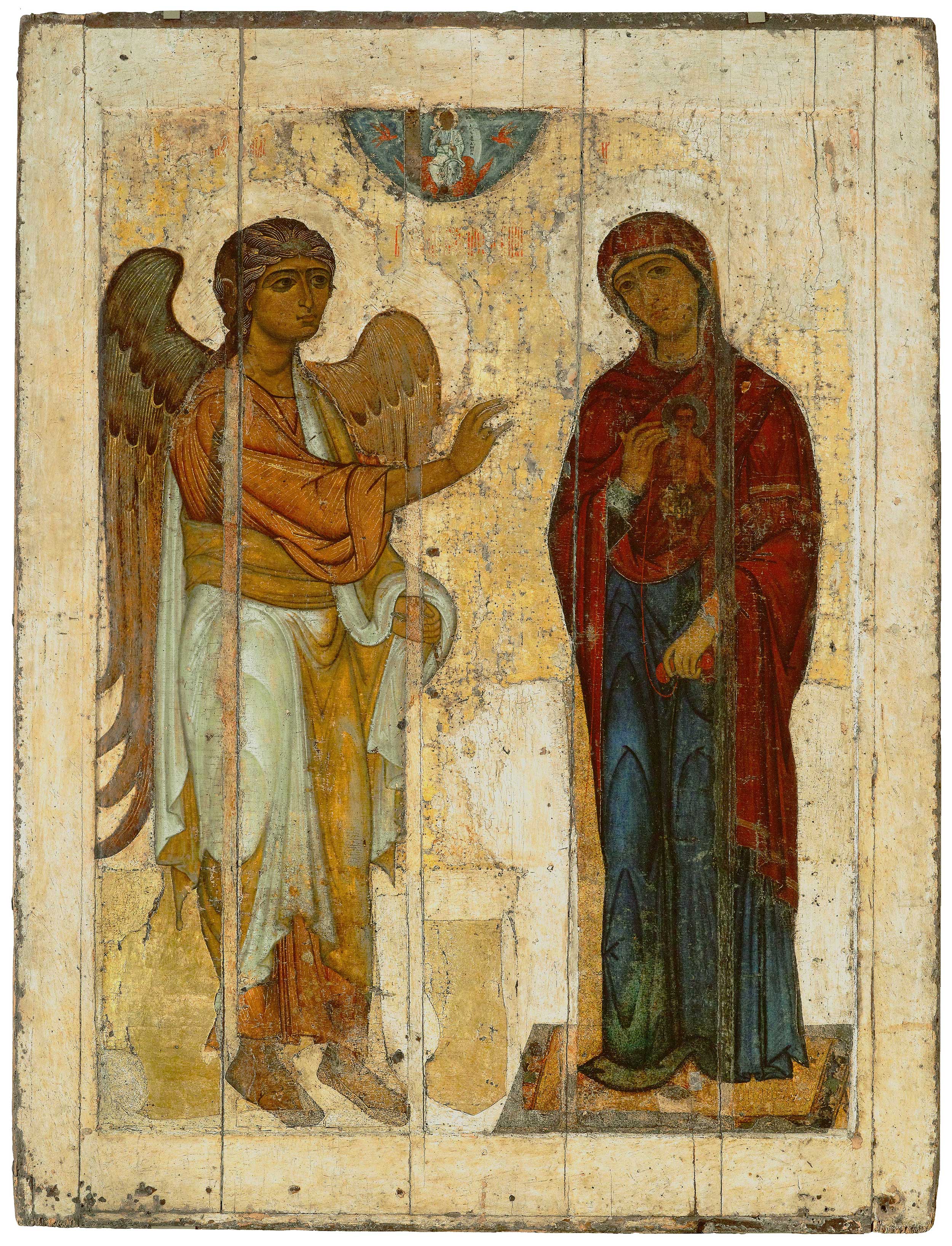
This icon is among the oldest extant Russian icons, being one of the few to have survived the Mongol invasion of Russia in the thirteenth century. Even though it was produced in the Novgorod region, it is called “Ustyug” because of its association with that village in local histories and hagiographies.
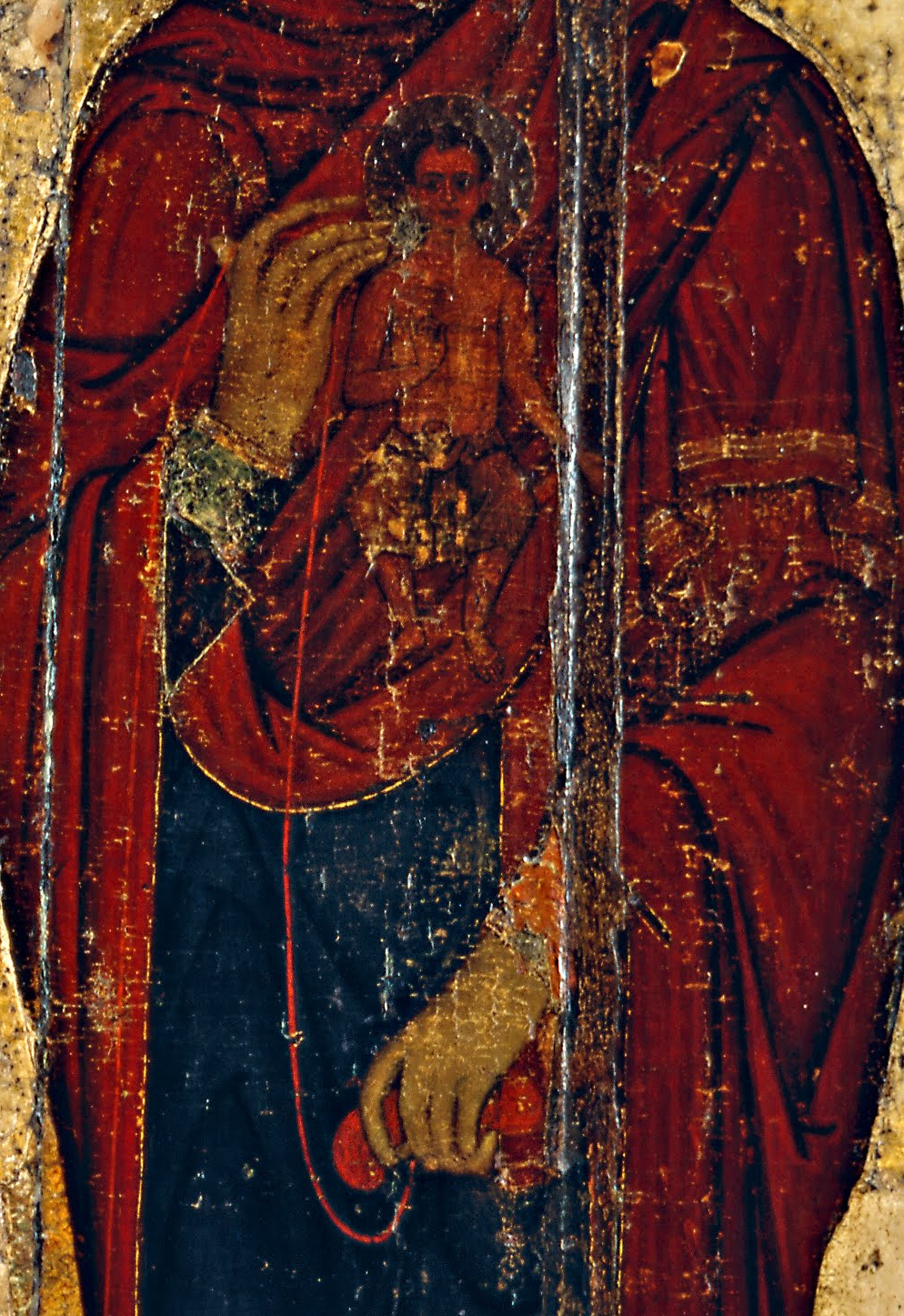
The icon shows the angel Gabriel approaching Mary with the news that she has been chosen to bear the Son of God into the world. In Mary’s left hand she holds a skein of scarlet thread, as tradition says she was one of the women responsible for weaving the veil of the temple in Jerusalem. Following the thread upward to her right hand, we see a remarkable detail in her midsection: a shadowy figure of Christ Emmanuel, fully formed within her and gesturing blessing. The iconographer has compressed together the moments of announcement and conception, suggesting that Mary’s miraculous pregnancy has already been effected.
At the top center, in a blue semicircle representing the heavens, sits the Ancient of Days, a symbolic depiction of God the Father. Fiery red cherubim and seraphim surround his throne. He holds a scroll in his right hand, while his left is raised in benediction. Earlier descriptions of the icon mention a ray of light emanating from God’s throne to Mary, traveled by the Holy Spirit in the form of a dove, but time has worn away this detail.
LISTEN: “Annunciation” piano quintet by Philip Glass, based on the Greek Orthodox communion hymn for the Feast of the Annunciation, 2018
>> Performed by Paul Barnes, Laurie Hamilton, Maria Newman, Scott Hosfeld, and David Geber at Symphony Space, New York, 2019:
>> Performed by Paul Barnes and Brooklyn Rider for Philip Glass: Annunciation, 2019:
Sharing a love of ancient chant traditions, pianist and Greek Orthodox chanter Paul Barnes [previously] and composer Philip Glass have engaged in collaborative projects ever since they first met on an airplane in March 1995. Most recently, Barnes facilitated the commission of a piano quintet by Glass—his first—based on the melody of the Greek Orthodox communion hymn for the Feast of the Annunciation, whose text is Psalm 132:13: “The Lord has chosen Zion, he has desired her for his dwelling place.” (Hear Barnes chant the hymn here.)
A piano quintet is a work of chamber music written for piano and four other instruments, usually a string quartet (two violins, one viola, one cello).
Glass’s “Annunciation” piano quintet premiered April 17, 2018, at the Lied Center for Performing Arts in Lincoln, Nebraska, with the Chiara String Quartet and Barnes on piano.
In the program notes for the piece, Barnes writes:
The work is in two parts. Part One opens with a meditative chromatic chord progression which eventually leads to the first entrance of the chant first stated in the piano. Glass develops this beautiful theme as it is shared by the various members of the quintet, culminating in an opulent neo-romantic closing section recapping the introductory chromatic chord progression. A partial restatement of the theme ends the movement with a brooding D minor coda.
Part Two is a poignant musical meditation on Part One revealing Glass’s innate ability to connect the transcendental ethos of the original chant with his own spacious approach to musical time. A particularly expressive section features the piano in soaring sparse octave melody over undulating eighth notes in the violin and cello. The work ends with an increasingly energetic and ecstatic 7/8 coda based on the opening chant transformed into scale passages that ascend and dissipate into a pianissimo chromatic flourish evocative of incense rising.
I studied Philip Glass’s experimental opera Einstein on the Beach in my Western music history survey course in college—Glass is one of the twentieth century’s most influential composers—and I was delighted to encounter this newer, religiously inspired work of his that Barnes planted the seeds for and is active in promoting and performing.
This post is part of a daily Advent series from December 2 to 24, 2023 (with Christmas to follow through January 6, 2024). View all the posts here, and the accompanying Spotify playlist here.


 Art & Theology