
Roundup: Korean-English worship, “God Breathed” by Ruth Naomi Floyd, John Witvliet on liturgical sincerity, and more

WORSHIP SERVICES:

In February I shared a few of the Vespers services offered at this year’s Calvin Symposium on Worship at Calvin University in Grand Rapids, Michigan, which I was privileged to attend. Here are two of the full-fledged services that give you a sense of what the larger corporate gatherings are like. (The theme was Ezekiel.) I love the cross-cultural sharing that goes on, learning new songs alongside others, getting refreshed by prayer and formed by liturgy, sitting under the teaching of wise ministers of God from various backgrounds, and taking Communion with friends new and old.

>> “God’s Glory Departs from Israel,” February 8, 2024 (with bilingual Korean-English music and liturgy): This worship service was led in Korean and English by the Woodlawn Christian Reformed Church Choir, directed by Chan Gyu Jang; the Living Water Church Worship Team, directed by Yohan Lee; and members of the Calvin University and Calvin Theological Seminary Korean communities. Rev. Dr. Anne Zaki from Evangelical Presbyterian Seminary in Cairo, Egypt, preached on Ezekiel 10–11.

This is an example of bilingual worship done really well! (I’ve seen it done poorly: with lack of communication of intention, one-sided involvement in the design or execution, inadequate pronunciation coaching for non-native speakers at the mic, unclear instructions that create confusion as to who is supposed to say or sing what, unintelligibility, etc.) I’m so grateful for all the creativity and thoughtfulness that went into creating this service—with a special shout-out to the bulletin designers and livestream technicians.

The bulletin provides this note on bilingual worship:

Two languages are intertwined together in this bilingual service. At times, words are spoken in one language, and their translation—unspoken—is provided on the righthand column; at times, the leaders demonstrate to the congregation how to sing or speak the words through transliteration; and at other times, the leaders and congregation converse in both languages, providing meaning to each other, so that no word sung or spoken is left unintelligible. We seek understanding and order in the sharing of our gifts.

In our pursuit, however, we practice patience and hospitality. In this service, we are called not only to speak and sing, but also to listen, to take turns. By listening, we create a room—a shelter—for travelers and strangers in this land, since language and music have power to transport one’s soul homeward. By taking turns, we practice the pace and posture of dialogue, even monolingual dialogue.

Beautiful! Here are three songs I’ll call out for special attention:

  • 9:14: “Joo-yeo, Come, O Lord” by Sunlac Noh: This song, which is particularly well suited for Advent, originated in the Anglican Church of Korea and was translated into English last year by Martin Tel (see podcast interview below). The version we sang at the symposium preserves two of the Korean titles for Jesus.
  • 23:36: 우리에게 향하신 (Woo-ri-e-ge Hyang-ha-shin) (Never-Ending Is God’s Love) by Jin-ho Kim, based on Psalm 117:2: Sung entirely in Korean, this was used as a refrain during the Assurance of Pardon and the Prayers of the People. A simple, repeated line, either sung or spoken, is a good way to involve non-native speakers of a given language.
  • 1:14:37: 주님 다시 오실 때까지 / Rise, My Soul, Till Jesus Comes Again” by Hyeong-won Koh: The closing song is a charge to continue in the way of Jesus, all the way Home. The vocalists on stage sang the song themselves in its original Korean the first time through, and then we all joined in in English for the second time.

All the song credits are provided in full in the YouTube video description.

>> “The Valley of Dry Bones,” February 8, 2024: Rev. Dr. Brianna K. Parker from Dallas, founder of Black Millennial Café, preached on the famous Ezekiel 37 passage, and the Calvin University Gospel Choir, directed by Nate Glasper, led music, along with guest artist Ruth Naomi Floyd.

I want to especially draw your attention to 23:31, where Floyd premieres an extraordinary new song of hers, “God Breathed.” It opens and closes with a flute, and in between are her powerful jazz vocals, singing an original poetic text based on Ezekiel 37, accompanied by James Weidman on piano. (Update: Here’s a standalone video of the song.)

+++

PODCAST EPISODE: “Fighting Back Against the Storms of Life with Martin Tel,” Psalms for the Spirit: Host Kiran Young Wimberly interviews Martin Tel, director of music at Princeton Theological Seminary and senior editor of Psalms for All Seasons: A Complete Psalter for Worship (2012), about the Psalms—the importance of psalm singing in his Dutch Reformed upbringing; the Psalms as a form of resistance and protest; the Psalms as a means of praying our own prayers and those of others; our need to overhear some psalms as being prayed against us (that is, have you considered that you might be someone else’s oppressor?); and ideas for framing a psalm with a refrain, such as these:

  • Combine the Charles Albert Tindley gospel song “The Storm Is Passing Over” with Psalm 57 (“In the shadow of your wings I will take refuge, until the destroying storms pass by . . .”). Sing into the storm.
  • Choose a Gospel passage of someone in deep lament (e.g., the ten lepers in Luke 17:11–19), surround it with Psalm 88, and have the congregation sing “Kum Ba Yah” (Gullah for “Come by Here”) in minor mode as a refrain (“Someone’s crying, Lord . . .”). A choir can hum the spiritual while the reader(s) read the scriptures.
  • Intersperse the verses of Psalm 14 (“Fools say in their heart, ‘There is no God.’ . . . They have all gone astray . . .”) with the refrain “Prone to wander, Lord, I feel it . . .” to help the congregation members see their own foolishness instead of assuming it’s someone else who’s the fool.

+++

ARTICLE: “The Mysteries of Liturgical Sincerity” by John Witvliet, Worship (reprinted Pray Tell), May 2018: Some Protestants accuse the more liturgically inclined Christians, like me, of not valuing sincerity in worship because we value prewritten prayers and other set forms. But just because something is scripted or done habitually does not make it “rote” or “empty.”

“Among my mostly Protestant students, no theme is more contested, misunderstood, or cherished” than sincerity, writes John D. Witvliet, director of the Calvin Institute of Christian Worship and professor of worship, theology, and congregational and ministry studies at Calvin University and Calvin Theological Seminary. In this article he explores several different definitions of sincerity, which vary widely across cultures, centuries, philosophical frameworks, and Christian traditions, and then offers six “corrective lenses” to common astigmatisms in the free-church Protestant way of viewing the world: outside-in sincerity, vicarious sincerity, trait sincerity, symbiotic sincerity, sincerity as gift, and aspirational sincerity.

This article is SO GOOD. I have been greatly influenced over the years by Dr. Witvliet’s teachings on liturgical formation, and I strongly encourage you all to read this piece.

+++

EKPHRASTIC POEMS:

An ekphrastic poem is a poem written in response to a work of visual art. Here are two examples I like from the past two years:

>> “Christ Preaching” by Keene Carter, Image: “I forgive the absent boy,” begins this poem based on a Rembrandt etching, directing our attention to the young child in the foreground who has turned away, disinterested, from Jesus’s sermon, drawing on the ground instead. Jesus gives grace to those in the crowd with averted gazes or who are distracted, simply continuing to preach on on the virtue of empathy—of seeing yourself in others—and on true life.
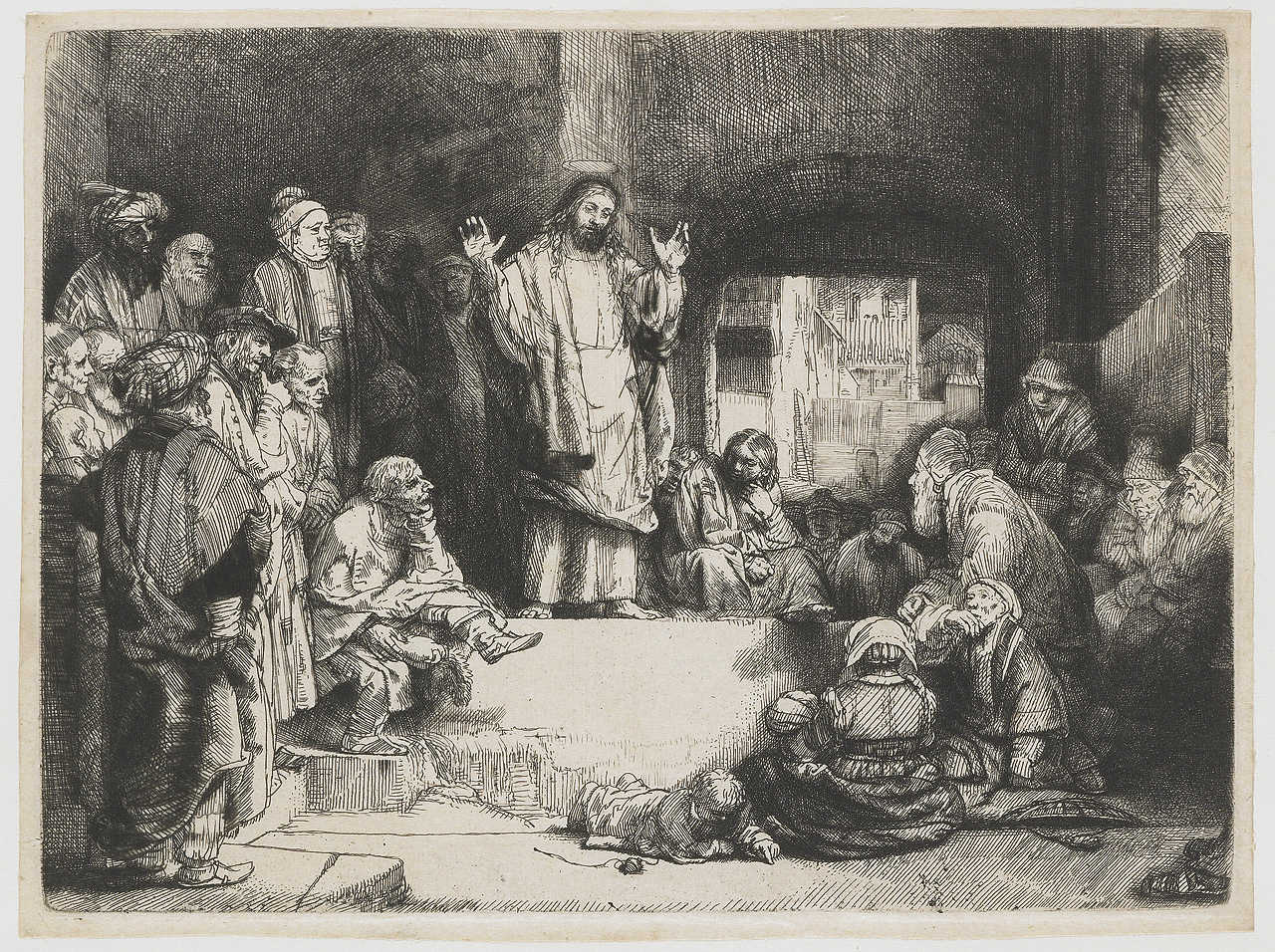
Rembrandt_Christ Preaching (1652)
Rembrandt van Rijn (Dutch, 1606–1669), Christ Preaching (La Petite Tombe), ca. 1652. Etching, engraving, and drypoint on paper, 6 1/4 x 8 5/16 in. (15.9 × 21.1 cm). National Gallery of Art, Washington, DC.

>> “L’Angélus” by Seth Wieck, Grand Little Things: The Angelus is a traditional Christian prayer whose name comes from its opening words in Latin, “Angelus Domini” (The angel of the Lord). For centuries it was prayed by the faithful three times a day—at 6 a.m., noon, and 6 p.m.—the times announced by the ringing of bells from church towers. In the nineteenth century Millet famously painted two peasant farmers at dusk pausing from their labor in the fields to bow their heads and pray the Angelus. Seth Wieck interprets the painting through poetry, homing in on the part of the prayer that says, “Let it be done to me according to thy word,” expressing an attitude of surrender to God’s will. Wieck imagines the hard life of the man and woman shown pulling up potatoes from the earth—the same earth in which, shortly hence, they’ll bury a child, lost to sickness. The poem becomes a meditation on death, harvest, and acceptance.

Millet, Jean-Francois_The Angelus
Jean-Franҫois Millet (French, 1814–1875), The Angelus, 1857–59. Oil on canvas, 55.5 × 66 cm. Musée d’Orsay, Paris.


DONATE

I am committed to keeping all Art & Theology posts freely available to all; no paywalls here. To help me make a part-time living developing content for the site, would you consider donating to the work, or supporting my research by buying me a book from my Amazon wish list? I appreciate it!

Roundup: Jazz Vespers with Ruth Naomi Floyd, Psalm 90 set to Celtic tune, and more

ARTWORK:

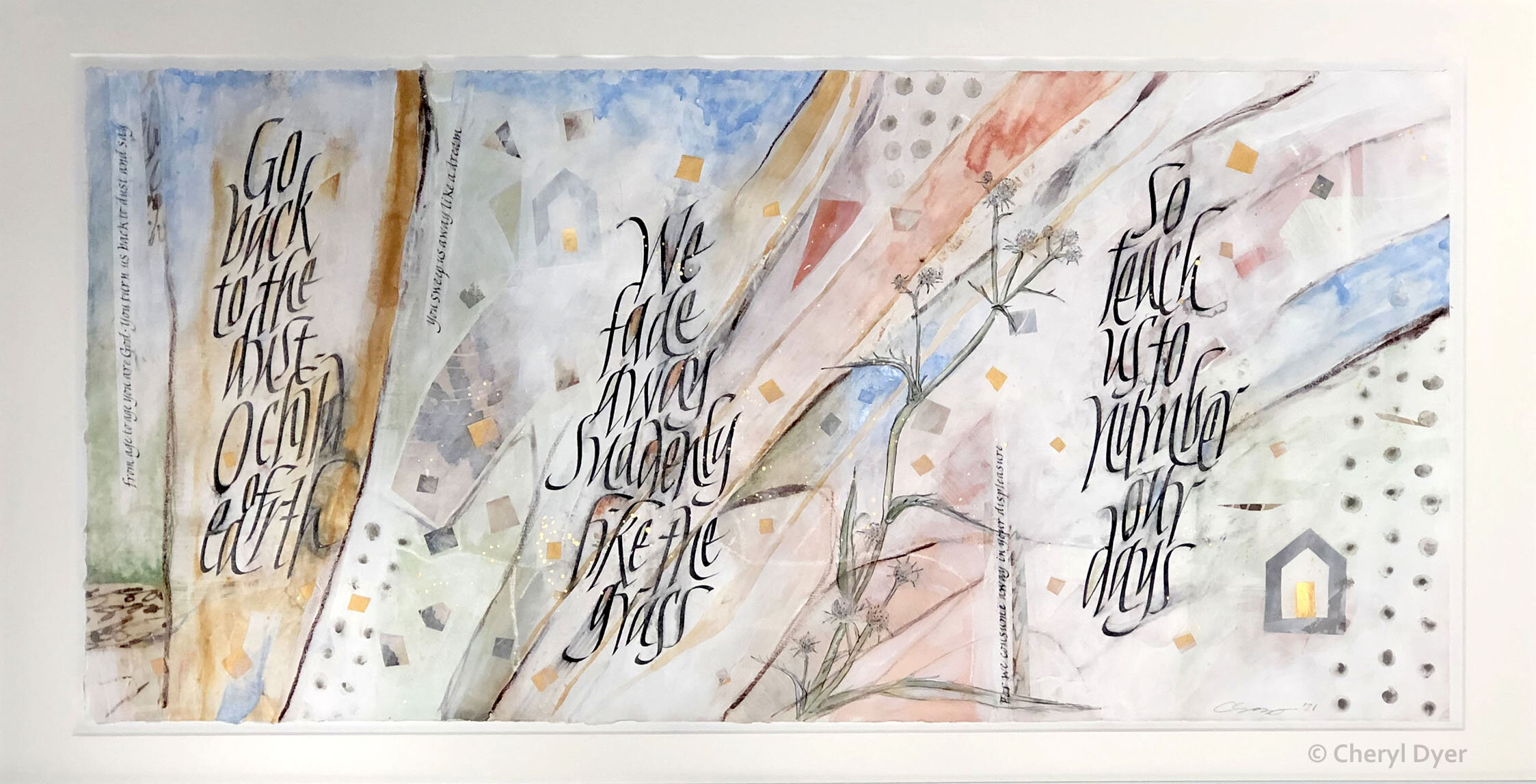
Dyer, Cheryl_Rattlesnake Master
Cheryl Dyer, Rattlesnake Master, 2021. Collage / mixed media, 34 × 18 in.

In this piece, lettering artist and calligrapher Cheryl Dyer of Omaha takes Psalm 90 (traditionally read on Ash Wednesday) as her subject, embellishing excerpts with watercolor and other media. Rattlesnake master is a perennial herb of the parsley family native to the tallgrass prairies of central and eastern North America.

+++

ARTICLE: “The Vindication and Blessing of Lent” by Rev. Dr. Michael Farley, Modern Reformation: I also sometimes receive pushback from others in my Reformed Christian circles for my observance of Lent. I appreciate Farley’s response to such concerns, explaining why he finds Lent—and the liturgical calendar as a whole—biblically, theologically, and practically compelling.

Note: If you’d like a new devotional booklet to work through this Lent that is broadly Reformed and that combines scripture readings, prayers, songs, art, and other elements, I recommend the Daily Prayer Project’s Living Prayer Periodical, which, full disclosure, I had a hand in producing. New for this year’s Lent edition, we’ve added a special page spread for each day of the Triduum: Maundy Thursday, Good Friday, and Holy Saturday. The cover image is of a thirteenth-century Armenian khachkar from the Monastery of Gosh and is one of eight featured artworks inside (three accompanied by written reflections, three by visio divina prompts). If you want to receive a copy by the start of Lent on Wednesday, order the digital version; otherwise, expect a few business days for shipping.

Lent LPP

+++

SERMON: “Seasons of the Heart: Preparing for Lent” by James K. A. Smith: Last February, Jamie Smith preached on Ecclesiastes 3:1–8 and John 16:12–15 at his home church, Sherman Street Christian Reformed Church in Grand Rapids, Michigan. He talks about seasonality—how we creatures experience time in seasons, both personally and collectively—and encourages us to ask, “When am I?” Along the way he references Gustavo Gutiérrez, Rita Felski, and Bruce Springsteen. Below is a transcription of 23:42 onward, which I find so resonant. To receive the full force of this conclusion, listen to the whole sermon.

God has more to say to us in his word that we haven’t yet got. There is something in us, for us, in the word that we hear over and over and over again, and the way that we will get to the place of receiving it is precisely by giving ourselves over to the seasons in our lives and letting God do the work in us so that we get new ears, because we have new hearts. This is one of the reasons why . . . repetition is at the heart of the spiritual life. It’s exactly why we keep repeating the liturgical seasons over and over again. Why? Because every single one of us is a different person every time Advent arrives. Every single one of us has undergone something every single time Lent rolls around again.

And so as we’re preparing for Lent—this season of repentance, this season of encountering our mortality—again, I want to encourage us to ask: When am I? When are we? What am I going through? What season am I in? And then from that place, come to Lent with expectation. What does God want to say to me in the now that I find myself? What are you newly ready for because of what you’ve come through? What can Jesus say to you this year that he couldn’t tell you last year?

So many of you are mourning. And the journey of Lent is really a journey of yearning for resurrection. But it passes through the valley of the shadow of death. Unapologetically. And the psalmists’ cries that you’re going to hear in Lent, maybe this year they’re going to give voice to a cry of your own that you didn’t have before. The experience of being bereft on Holy Saturday is going to hit some of you in a way it never has before this year. But maybe that also means that Easter dawns for you in a way it never has before.

Friends, maybe some of you feel, to go back to Ecclesiastes, that it’s a time to build and plant. Because you’ve come through the season of tearing down and uprooting. Maybe this Lent you feel like you’re finally in a place where you can be vulnerable to a God that you finally learned is compassionate, who loves you all the way down. This is a season to build, to plant.

Friends, maybe some of you feel like it’s the time of giving up and throwing away. There is a time for everything, the Teacher tells us. There’s a time to give up, there’s a time to throw away. But maybe it’s precisely what you need to let go of that has been blocking your ability to experience God’s incessant, steadfast, always love.

Whenever you are, whatever season you find yourself in, God has good news to share with you. That’s what we can rely on. No matter what season you’re in, the God who is eternal—the same yesterday, today, and forever—has always a word of good news, because he is always the God with us. He is always Emmanuel. And so this Lent and Eastertide, maybe this is the year you finally get God’s song. You finally hear the song of new life. And friends, I hope you hear that God is singing to you.

+++

VESPERS SERVICES AT CALVIN UNIVERSITY:

I’ve just returned from another inspiring Calvin Symposium on Worship, so grateful for all the gifts and wisdom that were shared. There’s much I could say, but one thing I discovered was how much I loved participating in Vespers, a short evening worship service consisting of scripture readings, prayers, and song (vesper in Latin simply means “evening”). It’s not something that’s regularly offered in my (Presbyterian) tradition, at least not near me. Here are three of the Vespers services that took place this week at Calvin, the latter two at which I was present:

>> Celtic Vespers: “Psalms of Healing and Hope for a Troubled World,” led by Kiran Young Wimberly and The McGraths: This service of psalms set to Celtic melodies was led by Kiran Young Wimberly and The McGraths (a Northern Ireland–based group that performs and records together), Mary Beth Mardis-LeCroy (violin), and Brian Hehn (piano). Since Ash Wednesday is this coming week, I’ll draw your attention especially to “From Dust We Came (Psalm 90)” (see timestamp 15:28), which uses the eighteenth-century Irish tune CASADH AN T’SÚGÁIN. Plus, another highlight for me: “Love and Mercy (Psalm 85),” set to the eighteenth-century Scottish tune LOVELY MOLLY (39:55)—I’ve added this to my Advent Playlist! For more info about the musicians and their work, see https://www.celticpsalms.com/.

>> Jazz Vespers: “Lament as Worship,” led by Ruth Naomi Floyd and her jazz quartet: Ruth Naomi Floyd is a phenomenal jazz vocalist, composer, and fine-art photographer. This liturgy that she crafted and presented is so moving. In her thoughtful selection of readings, Floyd brings a James Baldwin poem into conversation with Psalm 42:7–11 and even includes an amusing proverb from Chinua Achebe’s novel Arrow of God. She also adds a visual element: black-and-white photographic portraits she shot, which were displayed on slides during each segment (not all of them are featured in the video recording).

The musical performance, I hardly have words for. All I can say is, it was utterly engrossing. The expressiveness of Floyd’s voice is unmatched, carrying such pathos. I couldn’t pick a favorite song, but the opening spiritual, “Trouble So Hard” (11:37), hit me forcefully. The first verse talks about a mountaintop experience of spiritual ecstasy (“getting happy” refers to being filled with the Spirit), and that’s contrasted in the second verse with a descent into the valley of deep suffering and grief. The refrain asserts to God, seeking divine consolation, “Oh Lord, trouble so hard,” and then testifies that only God truly knows our troubles. Also take note of the concluding song, “Press On” (34:31), an original Floyd composition whose text is taken from the writings of Frederick Douglass, part of a larger body of work that has been recorded and will most likely be released by the end of this year, Floyd told me; see https://frederickdouglassjazzworks.com/.

The amazing instrumentalists are James Weidman (piano), Keith Loftis (saxophone), Matthew Parrish (bass), and Mark Prince (drums).

>> Choral Vespers: “Christ, Holy Vine, Christ, Living Tree,” led by David M. Cherwien and The Choral Scholars: Led by the West Michigan chamber ensemble The Choral Scholars and organist/pianist David Cherwien, this service centers on botanical imagery of Christ and his people—such a generative idea! I enjoyed singing Gerald Cartford’s responsorial setting of Psalm 141:1–4a and 8 (see timestamp 12:48); the refrain is “Let my prayer rise before you as incense; and the lifting of my hands as the evening sacrifice” (the plant connection is that incense is derived from fragrant gum resins, i.e., tree sap). Also, this was my first time hearing Elizabeth Poston’s “Jesus Christ, the Apple Tree” performed live (20:48), and the first time its words truly registered with me.

+++

PRAYER-POEM: “Marked by Ashes” by Walter Brueggemann: “. . . On this Wednesday, we submit our ashen way to you—you Easter parade of newness. Before the sun sets, take our Wednesday and Easter us, Easter us to joy and energy and courage and freedom . . .” This prayer by the Old Testament scholar and theologian Walter Brueggemann, from his book Prayers for a Privileged People (2008), is ostensibly for any ol’ Wednesday in the church year, but it could be used, with one small elision, for Ash Wednesday itself. I love how it reads Easter backward into Lent, recognizing that the fruits of Christ’s resurrection are borne all year round.

P.S. This year, Ash Wednesday falls on February 14, Valentine’s Day. It did too in 2018; read the poem by Luci Shaw that I published for that occasion.

Pentecost Playlist

Celebrated fifty days after Easter, Pentecost is one of the great feasts of the Christian year. It commemorates the descent of the Holy Spirit on Jesus’s apostles when they were gathered in Jerusalem for the Feast of Weeks ten days after Jesus ascended to heaven, marking the birth of the church. Acts 2 describes the Spirit’s coming as accompanied by a “rushing mighty wind” and “tongues of fire”—quite the dramatic entry! The Spirit filled the apostles with the miraculous ability to preach in speech that was comprehensible to all the many Jewish pilgrims, from various language groups, who were gathered in the city, resulting in the conversion that day of three thousand to the Jesus Way.

I’ve compiled a Spotify playlist of one hundred-plus Pentecost songs that celebrate God’s Spirit poured out over the face of the earth, bringing life and power. The indie folk genre is heavily represented, but there’s also an Appalachian fiddle tune, a Renaissance motet, a Native American dance song, a Russian Orthodox kontakion, Sacred Harp hymns, modern classical, Pentecostal gospel, blues, jazz, pop, lo-fi, and more. I hope to capture something of the Spirit’s dynamism with these selections.

The Holy Spirit ministers in a handful of ways. He renews, purifies, transforms. He gifts and empowers. He guides and illumines and comforts. He dwells within, a constant friendly presence. He intercedes for us with wordless groans. He unites believers across lines of difference, making us one. He enables us to bear fruit—love, joy, peace, etc.—for God’s glory and the world’s good.

So many songs centered on the Holy Spirit have an individualistic focus and a gentle, subdued tone. The Spirit does of course minister to the individual, and can be gentle and soothing (Jesus refers to him as the Comforter, after all!), and we often invoke him in our weariness. But the Spirit is also wild and uncontainable. And the life he brings is not merely of an inward spiritual kind; his impact manifests itself in tangible deeds out in the community, as those whom he fills go forth to serve their neighbors after the example of Christ.

Urban Doxology’s “Spirit, Send Your Fire” is a good example of a Holy Spirit song with an outward, communal focus, and it’s full of anticipatory excitement:

In terms of energy, consider the vigor with which Bach ornaments the final line of the Gloria, “Cum Sancto Spiritu in gloria Dei Patris” ([You, Jesus Christ, alone are the Most High] with the Holy Ghost in the glory of God the Father), in his B minor Mass. And for wildness: the loud clashing of the piano chords in Daniel Glover’s “The Descent of the Holy Spirit” from Misteria, evoking a sense of the disorientation that must have been felt on that historic day when the Spirit came suddenly sweeping in and the apostles started speaking multiple languages at once. (Some observers thought they were drunk!)

“Let the Waters” is another high-octane Pentecost song—this one in a rock style—which Michael Gungor wrote in 2014 when he was part of the Liturgists. In 2020 he revisited it with the Good Shepherd Collective, adding as a tag the African American spiritual “Wade in the Water” [previously]. In this context the spiritual references both the Spirit’s tendency to disrupt and the ancient Jewish folk belief that an angel would periodically come down to stir the waters of a certain pool in Bethesda, activating its healing properties (see John 5:4). The GSC released this new arrangement later in 2020 under the title “Pentecost,” featuring on vocals Gungor, Liz Vice, and Charles Jones.

Let the waters cool ya
Let the Spirit move ya
Feel the fire on your lips and sing your hallelujah
Sing your hallelujah

O my soul, sing hallelujah

Wade in the water
Wade in the water, children
Wade in the water
God’s gonna trouble the water

Led by Betty Pamptopee of Isabella Reservation, Michigan, “Methodist Hymn” is the first verse of “O for a Thousand Tongues to Sing” in Ojibwe (but to the tune of “Alas, and Did My Savior Bleed”). Even though “tongues” in the song’s titular first line is probably referring not to languages but to the individual’s desire to maximize God’s praise—as in “Oh, that I had more tongues to praise you with!”—I love the implications for Pentecost, when the gospel went out in many tongues, the beginning of the “proclaim[ing] and spread[ing] through all the earth abroad / the honors of [Jesus’s] name.” I think there’s massive potential for a multilingual choral arrangement of this hymn. (I’m thinking, for example, of Laurel MacDonald’s “Qui habitat,” featured here.)

Several of the songs on the playlist highlight the Spirit’s creativity, such as verse 1 of “Come, Holy Spirit” (alt title: “Holy Spirit, Groaning”) by David Benjamin Blower. Genesis 1 says that in the beginning, the Spirit hovered over the waters of chaos—implying that he was active in creation. And he is still a creative force, bringing forth new life.

Hildegard of Bingen [previously], a twelfth-century nun and polymath from Germany, wrote several beautiful Latin antiphons to the Holy Spirit, both words and music, which together convey a sense of mystery and awe. One of them is “Spiritus sanctus vivificans,” from her Symphony of the Harmony of Celestial Revelations, sung here by soprano Anna Sandström:

Here are two English translations; I can’t decide which I like best, so I proffer them both:

Holy Spirit, 
giving life to all life,
moving all creatures,
root of all things,
washing them clean,
wiping out their mistakes,
healing their wounds,
you are our true life,
luminous, wonderful, 
awakening the heart
from its ancient sleep.

Trans. Stephen Mitchell
The Spirit of God
is a life that bestows life,
root of the world-tree
and wind in its boughs.

Scrubbing out sins,
she rubs oil into wounds.

She is glistening life
alluring all praise,
all-awakening,
all-resurrecting.

Trans. Barbara Newman

Most songs take the form of calling on the Spirit to descend once more with the breath or fire of revival, such as many of the old hymns: by Ambrose (retuned by Bradford Loomis and Beth Whitney), Rabanus Maurus, Bianco da Siena (retuned by Seth Thomas Crissman, and another version by Luke Brodine), Martin Luther (retuned by Paula Best and Tara Ward), Heinrich Held (retuned by Joshua Bennetch), Isaac Watts (retuned by Jon Green), Joseph Hart (retuned by Stephen Gordon), Charles Wesley (retuned by Jered McKenna), Benjamin Beddome, and Samuel Longfellow (retuned by Seth Thomas Crissman, and another version by Greg Yoder, both of The Soil and The Seed Project).

For example, we might ask the Spirit to increase our love for God and others. In Watts’s “Come, Holy Spirit, heav’nly dove,” we beseech him to come “with all Thy quick’ning pow’rs; come, shed abroad a Savior’s love, and that shall kindle ours.” Or elsewhere, similarly, to “light up our mortal frame” with love, “till others catch the living flame” (Ambrose). The Spirit also kindles belief and trust. “Revive our drooping faith,” prays Hart.

(Related post: “Pentecost roundup”)

Further, the Spirit knits together diverse peoples into a brand-new family whose head is Christ. Fr. Peter Raymond Scholtes, a Catholic priest living on the south side of Chicago, penned the post–Vatican II hymn “One in the Spirit” (aka “They’ll Know We Are Christians by Our Love”) against the backdrop of the civil rights movement. It proclaims that Christians are united by their share in, as the apostle Paul puts it, “one body and one Spirit . . . one hope . . . one Lord, one faith, one baptism, one God and Father of all . . .” (Eph. 4:2–5), and prays “that all unity [across all humankind] will one day be restored.” It also emphasizes the importance of the church’s public witness through acts of love. As Jesus says in John 13:35, “By this everyone will know that you are my disciples, if you have love for one another.” Love is the primary fruit of the Spirit that Paul lists in Galatians 5:22–23. Here’s a jazz arrangement of the hymn performed by Ruth Naomi Floyd:

Unity is also the theme of one of four featured hymns from the Orthodox liturgy for Pentecost, the text of which translates to: “When the Most High descended and confused tongues [at the Tower of Babel], he scattered the people; but when he distributed the tongues of fire, he called all to unity. Therefore, with one voice, let us praise the most Holy Spirit.” Pentecost is often referred to as a reverse Babel.

There are several musical settings of scripture on the playlist, including:

  • “Psalm 104: Lord, Send Out Your Spirit” by Roderick Bell and Rawn Harbor, a setting of Psalm 104:1, 24, 29–30, 31, 34, with an adapted verse 30 serving as the refrain: “When you send forth your spirit, they are created, and you renew the face of the ground.”
  • “O Children of Zion” by Seth Thomas Crissman (The Soil and The Seed Project), a setting of Joel 2:23a, 28: “O children of Zion, be glad and rejoice in the LORD your God. . . . I will pour out my spirit on all flesh; your sons and your daughters shall prophesy, your old men shall dream dreams, and your young men shall see visions.”
  • “If Ye Love Me” by Thomas Tallis, a setting of John 14:15–17: Jesus says, “If you love me, you will keep my commandments. And I will ask the Father, and he will give you another Advocate [/Helper/Comforter; Gr. parakletos, Paraclete], to be with you forever. This is the Spirit of truth, whom the world cannot receive because it neither sees him nor knows him. You know him because he abides with you, and he will be in you.”
  • “The Spirit of Life” by Cody Curtis (Psallos), a setting of Romans 8:1–17, about living not according to the flesh but according to the Spirit, who is “life and peace” and who abides in us, enabling us to resist sin and bearing witness that we are children of God and therefore join heirs with Christ
  • “God Is Love” by Ri-An, a setting of 1 John 4:7–21, about how we abide in God, and God in us, through the Spirit, who is love

There are also a few songs that reference the story of Ezekiel in the valley of dry bones [previously], in which God brings his prophet to a desolate landscape littered with human bones. But then: “Thus says the Lord GOD to these bones: I will cause breath to enter you, and you shall live. . . . Come from the four winds, O breath, and breathe upon these slain, that they may live” (Ezek. 37:5, 9). And the bones reassembled, took on flesh, and became animated once again—a picture of the regenerative power of God’s Spirit. (The Hebrew word for “spirit” is ruach, which can also be translated “breath”; same with the Greek pneuma.) Here’s Caroline Cobb’s “Dry Bones”:

Several of the playlist songs I’ve featured before on the blog: “Wind” by Joseph, “Abbeville” (Come, Holy Spirit, Come), “The Elements: Fire” by Hiromi and Edmar Castaneda, “Untitled” by Seryn, “If Ye Love Me” by Thomas Tallis, “The Earth Shall Know” by the Porter’s Gate, “Blessed Be the Tie That Binds,” “Make of Our Hearts” by Hiram Ring, “Your Peace Will Make Us One” by Audrey Assad, and “This Little Light of Mine.”

I hope the Art & Theology Pentecost Playlist helps you to more fully exult in the myriad workings of the Spirit, who came in a blaze some two thousand years ago and burns still, all over the globe, where Christ’s kingdom has taken root.