
Marian roundup: Contemporized statuettes, Mary as an icon of literacy, and more

Since the Middle Ages, the Roman Catholic Church has celebrated May, a time of new growth, as “Mary’s month.” The calendrical placement of this celebration probably has to do in part with the fact that the ancient Greeks celebrated a festival to Artemis, the goddess of fecundity, in May; the ancient Romans, Flora, the goddess of flowers and spring. Because Mary, by the power of the Holy Spirit, conceived in her womb and brought to birth the life of the world, Jesus Christ, Christians see her as standing at the threshold of an eternal springtime.

[Related posts: “‘May is Mary’s month’: Hopkins poem meets Glasgow style”; “Bursting with God-News (Artful Devotion)”]

POLL QUESTION: Before moving on to the six roundup items below, if you are a regular reader of this blog or other media like it, would you please help me out by answering the following poll question? (I’m trying out this WordPress feature for the first time!) Over the years I’ve gathered a lot of compelling poems and artworks on the Annunciation, encompassing a variety of eras, styles, and perspectives, and I’d like to pursue the idea of turning one or the other, or both, into a book. Which kind of Annunciation-themed book would you be most inclined to buy? Keep in mind that a book with art would cost significantly more because it would be in full color and probably a larger hardcover. Also note that a book that combines art and poetry would obviously have fewer selections of each than a book dedicated fully to one or the other.

+++

UPCYCLED MARY STATUETTES: Soasig Chamaillard is a French artist who, since 2006, has been acquiring small, damaged statues of the Virgin Mary—either from garage sales or received donations—and restoring and transforming them, often with reference to children’s toy lines and media franchises, comic book heroes, or other pop-culture icons. Some are silly or irreverent; others, merely quirky. Here are two I like, which both modernize Mary, by her dress or her reading material. Click on the images to view detail photos of the final product, and see here and here for blog posts that document the transformation process.

Jeans Mary (before-after)
Before/After. Right: Soasig Chamaillard (French, 1976–), Jeans-Marie (Jeans Mary), 2015. Plaster, acrylic paint, resin, metal frame, height 48 cm.

Chamaillard, Soasig_New Bible (before-after)
Before/After. Right: Soasig Chamaillard (French, 1976–), Nouvelle Bible (New Bible), 2008. Plaster, acrylic paint, resin, digital print, height 40 cm.

The first shows Mary in high-waisted jeans and red Converse high-tops with rosettes on the tongues. The second one, a Madonna del Parto, shows her pregnant and reading the book J’élève mon enfant (Raising My Child) by Laurence Pernoud, picking up tips on being a new mom.

+++

ESSAY: “Mary: Evolution of a Bookworm” by Joel J. Miller: “It’s unlikely the historical Mary could read at all, but medieval Christians transformed her into an icon of literacy,” often showing her with a book in hand, whether as a child learning to read from her mother, Saint Anne; at the Annunciation, with the book of Isaiah, the Psalter, or a book of hours splayed open on her lap; or teaching her own child, Jesus, how to read. Drawing on the research of Laura Saetveit Miles, author of The Virgin Mary’s Book at the Annunciation: Reading, Interpretation, and Devotion in Medieval England [previously], Joel J. Miller discusses how images of Mary reading “rode a wave of rising female literacy and simultaneously encouraged its expansion.”

Annunciation (Brunswick Casket)
Ivory plate of the Annunciation from the Brunswick Casket, made in Metz, France, ca. 860–70. Herzog Anton Ulrich Museum, Braunschweig, Lower Saxony, Germany. This is the earliest known representation of the Virgin Mary with a book at the Annunciation.

Costa, Lorenzo_Annunciation
Lorenzo Costa (Italian, 1460–1535), Annunciation (Mary Reading), first third of 16th century. Oil on panel, 62 × 60.5 cm. Gemäldegalerie Alte Meister (Old Masters Picture Gallery), Dresden, Germany.

+++

CONVERSATION: “Sacra Conversazione” with Walter Hansen and Bruce Herman: In this written conversation from Image no. 62, artist Bruce Herman [previously] and patron Walter Hansen discuss the two large altarpieces Herman produced comprising six paintings on the life of the Virgin Mary: Miriam, Virgin Mother and Second Adam. The article is about the creative process and Herman’s collaboration with Hansen and with student apprentices in Orvieto, Italy, but it’s also about attempting to recover Mary’s image from a heap of the saccharine or overly exalted on the one hand, and ironic detachment on the other. Herman says,

I had vivid memories of Boston art critics and museum people back in the 1980s telling me that [religious] subject matter could only be approached ironically, but I had a persistent feeling that they were wrong. I’ve sensed for many years that the tradition of biblical imagery in art is far from exhausted—maybe simply stalled out due to loss of nerve or imagination. To me, much of the recent religious imagery we’ve inherited is fairly shallow. I know this might sound odd, given more than a thousand years of tradition, but I honestly believe that new insights are arrived at in every generation. Why can’t a contemporary artist paint the Virgin Mary without irony—and maybe even specifically attack the problematic nature of much Marian imagery? Why can’t a century of experimentation in painting yield something relevant to that tradition?

It’s an excellent conversation! You may have to subscribe to Image journal to access it, but it’s well worth it for all the wonderful content they put out quarterly and access to their archives.

Herman, Bruce_Miriam, Virgin Mother
Bruce Herman (American, 1953–), Miriam, Virgin Mother, 2007. Oil on wood with silver and gold leaf, 95 × 154 in. (241.3 × 391.2 cm).

Read more about the two altarpieces and view more photos at www.bruceherman.com/magnificat, and in the beautifully produced catalog magnificat, with a foreword by Hansen and essays by Rachel Hostetter Smith and John Skillen. The book also features four paintings from Herman’s related Woman series.

+++

ART VIDEOS:

What follows are my two favorite videos from the Visual Commentary on Scripture’s twelve-episode series “Unlocking Christian Art: The Virgin Mary,” in which theologian Ben Quash and art historian Jennifer Sliwka discuss religious artworks from museums in Berlin.

>> “Holy Kinship”: The subject of this video is a late medieval German limewood carving by Hans Thoman depicting Jesus’s extended family on his mother’s side. He and his mom, grandma, grandpa, step-grandpas, aunts, and cousins pose for this matriarchal family portrait that reflects a medieval legend (rejected by the Council of Trent) that Saint Anne was grandmother not just to Jesus but also, through two subsequent marriages, to five of the twelve apostles: James the Greater, Simon, Jude, James the Less, and John the Evangelist. Also included in this sculpture group are Elizabeth and Zechariah with their son, John the Baptist, and Emelia with her son Servatius of Tongeren, a fourth-century saint whom legends name a distant relative of Jesus. [view object record]

>> “Leave-Taking”: From the same period and general region as the above sculpture comes a painting by Bernhard Strigel (1460–1528) that shows Jesus taking leave of his mother just before his entry into Jerusalem the week of his death, a popular subject in northern Europe in the sixteenth century. The episode derives from a versified Marienleben (Life of Mary) from the early fourteenth century written by the Carthusian monk Philipp von Seitz, aka Bruder Philipp, from Middle Franconia. [view object record]

View more videos like this on the VCS YouTube channel.

+++

SONG: “Mary” by Patty Griffin: “Mary, you’re covered in roses, you’re covered in ashes, you’re covered in rain . . .” From the 1998 album Flaming Red by the country-folk artist Patty Griffin, the song “Mary” is a tribute to the woman who mothered Jesus and mothers us all. A compassionate presence who lives on in heaven at her son’s right hand, she feels the pain of other mothers who’ve lost their children. Griffin sings of Mary’s beautiful, big, humble, suffering, nurturing, pondering heart.

+++

POEM: “Christ’s Mother Reflects: His Childhood” by Micha Boyett: This is the last in a series of five Advent poems written from the perspective of Mary for John Knox Presbyterian Church in Seattle in 2010, the other four being on the subjects of the Annunciation, the boy who is snatched away by a dragon in Revelation 12, the Visitation, and the Nativity. Here, after Jesus’s death, Mary reflects back on his life—an early heartbreak of his, his contemplative nature, a question he once asked, his delight in scripture study, the hard choices he made, her own unfulfilled hope for normalcy on his behalf, the tearing of his flesh that mends us.
Advent, Day 6: That Holy Thing

LOOK: Holy Family at Night (Rembrandt’s workshop)

Rembrandt (workshop)_Holy Family at Night
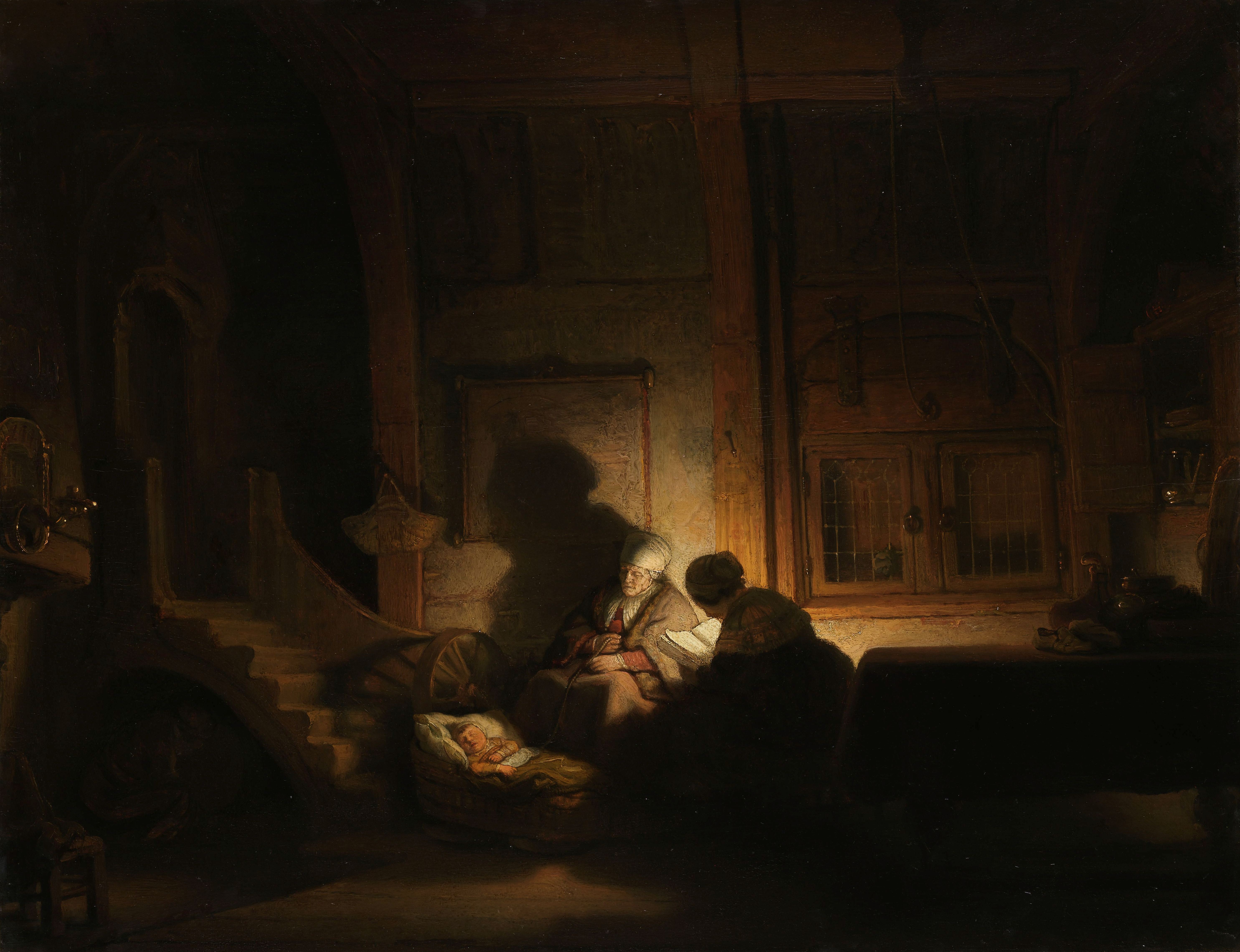
Workshop of Rembrandt van Rijn, Holy Family at Night, ca. 1642–48. Oil on panel, 66.5 × 78 cm. Rijksmuseum, Amsterdam.

During the Dutch Golden Age, the master artist Rembrandt van Rijn (1606–1669) ran a flourishing workshop in Amsterdam, overseeing the production of students’ paintings that continued the deep chiaroscuro and distinctive application of paint seen in his own work.

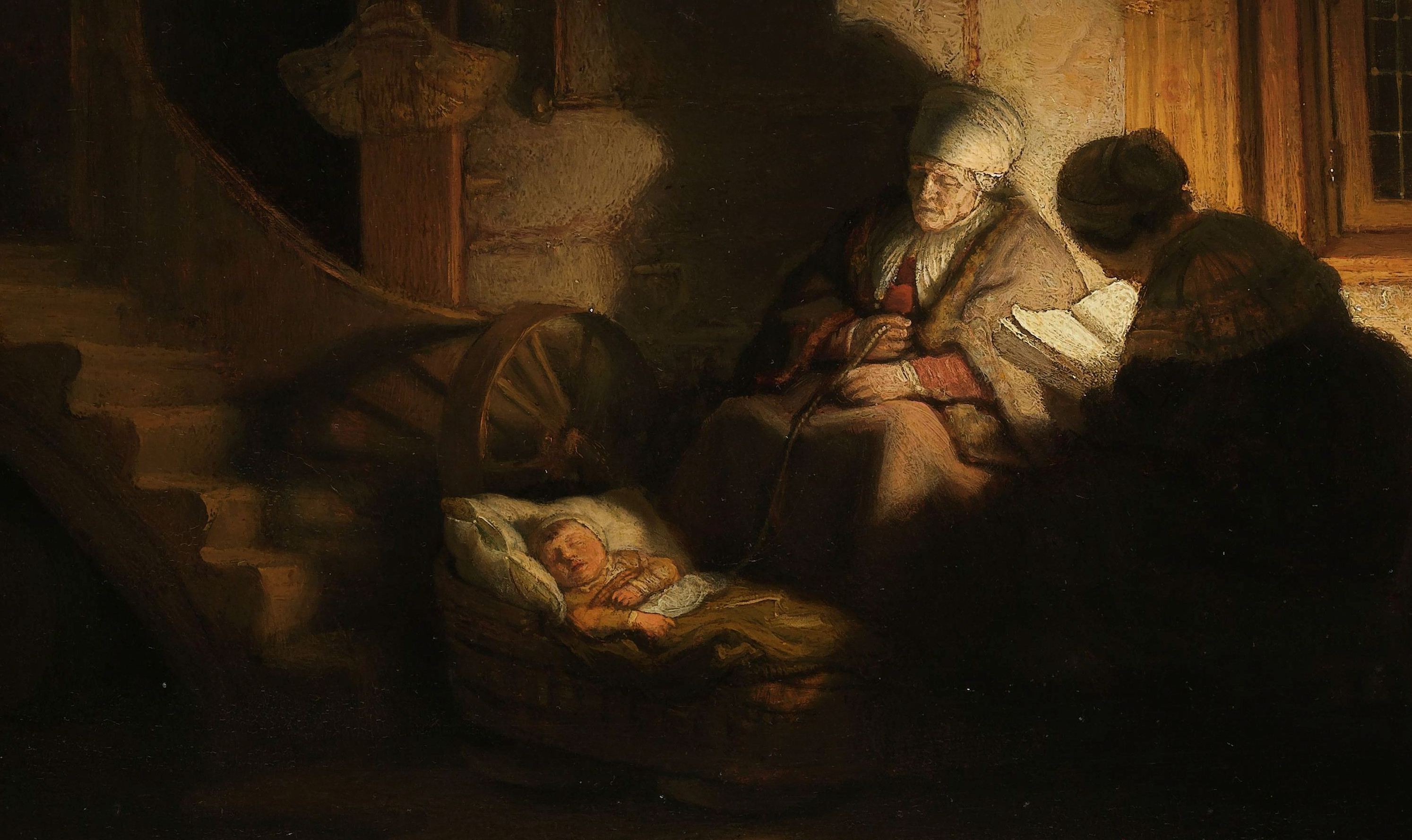
This painting from his workshop shows the Holy Family in a sparsely lit domestic interior at night. The Christ child lies asleep in a wicker cradle at the foot of a half staircase, his grandma Anne likewise nodding off as she rocks him gently with the cradle rope. Relieved by the quiet, Jesus’s mom, Mary, catches up on some reading, and Joseph taps liquid from a barrel on the left under the stairs (he’s very difficult to make out through the shadows).

This lived-in room is full of everyday objects from seventeenth-century Holland. Over the hearth on the left a copper candlestick holder is affixed to the wall. Behind Anne is a map, and beside her a spinning wheel, and a wicker basket hangs from the nail of a curved wooden beam. On the table to the right are a pair of old shoes, a flask attached to a leather belt, and a mortar and pestle, and a Jan Steen jug and other kitchenware are stored in the cupboard above. The shutters are drawn closed over the window. How utterly ordinary!

Although scholarly opinion since 1900 has identified the figures as biblical ones (the title is not the artist’s, as artists did not title their paintings at the time), for much of the painting’s history viewers interpreted it as simply a genre scene—that is, a scene showing regular people going about their daily lives. It lacks the “distinction, nobility, and loftiness” owed to biblical subject matter, it was believed, especially the Holy Family. There are no angels, no haloes. The only hint of sacredness is the pouring of light from a mysterious unknown source.

Rembrandt (workshop)_Holy Family at Night (detail)

But the ordinariness of the scene depicted is precisely what makes it so glorious. Jesus was born into a working-class family. For most of his life he labored as a carpenter, adopting Joseph’s trade. He wasn’t surrounded by lavish things. His upbringing looked much like that of all the other Jewish boys in Nazareth. That he was God incarnate would be revealed in time, to those who had eyes to see. But in the meantime, he cooed and pooed and cried and slept and fed and spit up like any other baby! And his mom was exhausted like any other mom, forced to sneak in some time for herself (including private devotional time, as she’s probably reading her Bible here) wherever she could, between childcare, chores, and other obligations.

That God chose to come to us as an ordinary human being born to an ordinary family (albeit conceived in an extraordinary way!) surprised everyone. The song that follows extends the surprise of the Incarnation into God’s other interventions in our lives, on a more personal scale. Just as he defied expectations in his first coming, so he often continues to surprise us in the ways he comes to us now—that is, not according to our own prescriptions, but down his “own secret stair,” when and where we’re least expecting it.

LISTEN: “That Holy Thing” | Words by George MacDonald, 1877 | Music by Katy Wehr, on In Others’ Words, 2008

They all were looking for a king,
To slay their foes, and lift them high:
Thou cam’st a little baby thing
That made a woman cry.

O Son of Man, to right my lot
Naught but thy presence can avail;
Yet on the road thy wheels are not,
Nor on the sea thy sail.

My how or when thou wilt not heed,
But come down thine own secret stair,
That thou mayst answer all my need,
Yea, every bygone prayer.

This song is a setting of a poem written by George MacDonald (1824–1905) in December 1877 and sent by letter to a handful of friends.* When it was first published in 1893 in the two-volume Poetical Works of George MacDonald, it was with this revised final stanza:

My fancied ways why shouldst thou heed?
Thou com’st down thine own secret stair;
Com’st down to answer all my need,
Yea, every bygone prayer!

The poem appears in the highly influential Oxford Book of English Verse (1900), compiled and edited by Arthur Quiller-Couch, but in its original form.

“That holy thing” is a translation of the Greek word hagios, which appears in Gabriel’s speech to Mary in Luke 1:35: “that holy thing which shall be born of thee shall be called the Son of God.” Educator Missy Andrews unpacks the poem:

In “That Holy Thing,” MacDonald meditates on man’s expectations and God’s will. In the first line of the poem, the poet remembers the first-century Jews who suffered under Roman occupation, waiting for the Messiah who would restore the throne of David to Israel. He acknowledges their plight and their expectation, contrasting it with what they in fact received. The baby Christ represented both a gracious answer to their need, and an immediate disappointment. He satisfied the deepest intentions of their prayer and Yahweh’s ancient prophecies, but frustrated their earthy expectations for geographic kingdoms and vindication. Not only that, but the baby King “made a woman cry.” This references not only the immediate suffering and travail of the Christ Child’s mother, Mary, but ultimately the suffering that would rend her heart when He himself was lifted high upon the cross in answer to their desperate prayer for triumph over their foes.

The poet notes that his own travails and petitions, his own desperate need of God’s intervening help, is denied in its immediacy as well. For, although the Son of Man’s own presence alone can help to “right the lot” of the poet, his coming is not visible by road or sea. In this way, MacDonald acknowledges that his own expectations, like those of his spiritual forebears, eclipse his ability to see the Lord’s coming in his own circumstances. He acknowledges the differences between God’s ways and man’s, in faith acknowledging that the Lord answers man in his own ways and times, keeping secret His approach, but stealthily accomplishing man’s every need, answering his every prayer through the mystery of incarnation. This incarnate Child, the Son of Man, replete with humanity and no stranger to suffering, suggests a remedy for all who wait and suffer.

Andrews is a founding director of CenterForLit, whose goal is “to bring readers face to face with the world’s best books so they can know themselves more fully as God’s creatures.” The center has a special emphasis on equipping parents to teach the classics to their kids.

The commentary above is excerpted, with Andrews’s permission, from the first post of twenty-five published in Advent 2015 for the CenterForLit’s “Literary Advent” blog series (which is excellent!). Andrews provides interpretations of poems by John Donne, Madeleine L’Engle, Gerard Manley Hopkins, T. S. Eliot, W. H. Auden, and more, combining literary analysis and theological reflection. You can enjoy Andrews’s series in print form with the book Wild Bells: A Literary Advent.

Kathryn Wehr, PhD, is a singer-songwriter whose most recent album, which leans folk rock in style, is And All the Marys: Women Encountering Christ in the Gospels (2018).

Besides being a musical artist, Wehr is also a scholar whose interests include theology and the arts, spiritual formation, and church history. Her specialization is the religious drama of Dorothy L. Sayers, and as such, she is the editor of the forthcoming book The Man Born to be King, Wade Annotated Edition (IVP Academic, 2023). In addition, she is the managing editor of Logos: A Journal of Catholic Thought and Culture at the Center for Catholic Studies at the University of St. Thomas in Saint Paul, Minnesota. 

* Thank you to the Special Collections & University Archives at Taylor University, through whose British Author Collections I discovered this earlier composition date for the poem, as well as an authoritative version of stanza 3 from MacDonald’s own hand. They provided me with a scan of one of MacDonald’s handwritten copies of “That Holy Thing” (Ref. ID 482), which contains the headnote “Written for my friends—Christmas, 1877.”