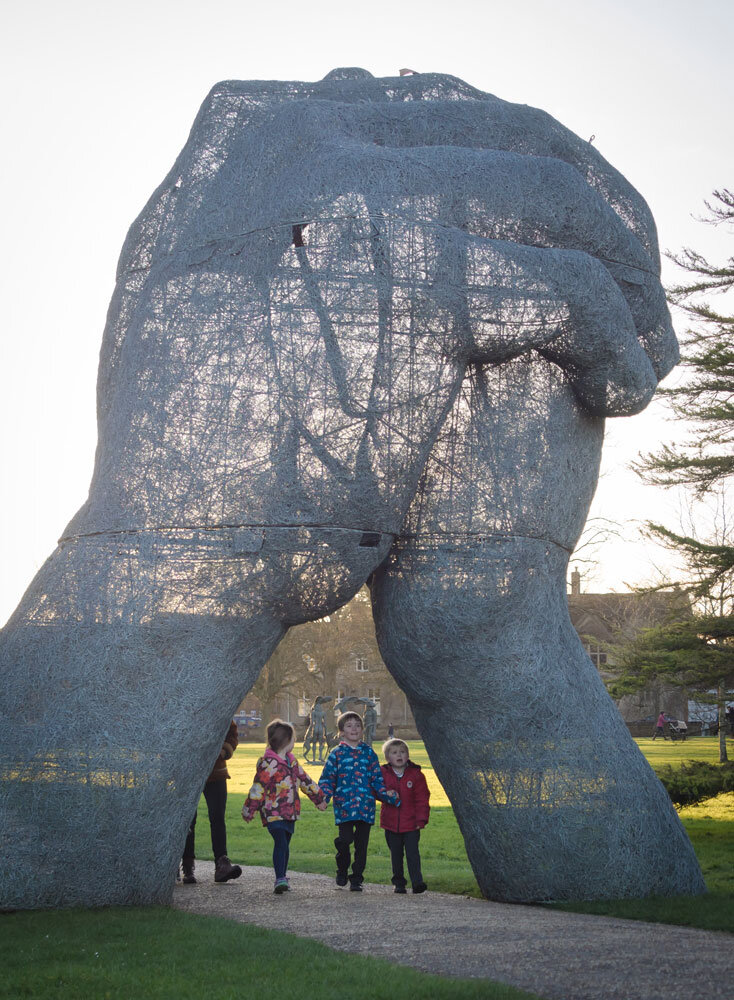
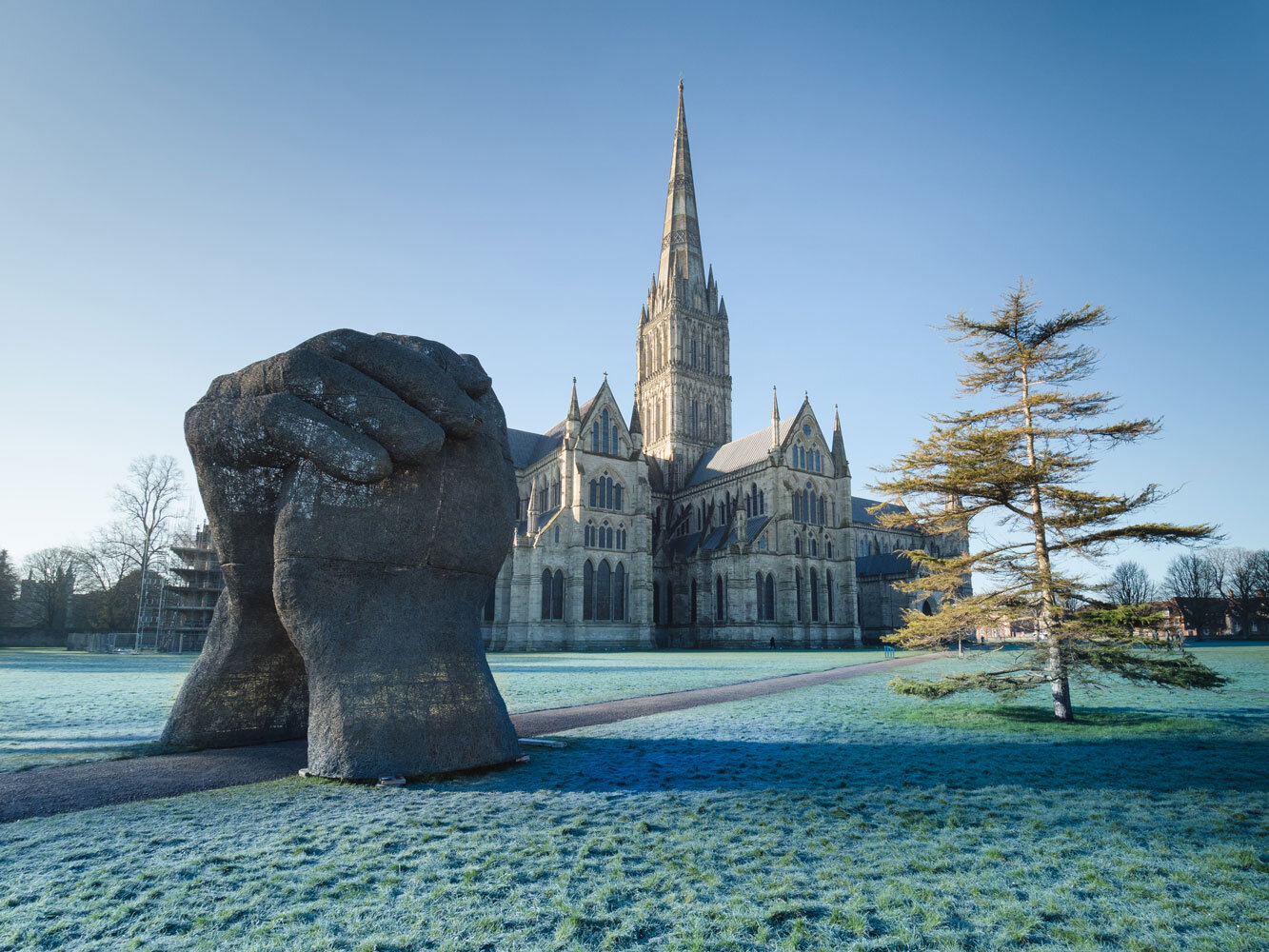
Sophie Ryder (British, 1963–), The Kiss, 2016. Galvanized steel wire, 579 × 590 × 380 cm. From the 2016 exhibition Sophie Ryder: Relationships at Salisbury Cathedral, England. Photo: Ash Mills.
A monumental wire sculpture of two hands “clasped in love, friendship or prayer,” The Kiss by Sophie Ryder was one of over twenty sculptures by the artist on display from February 12 to July 3, 2016, in the close and cloister of Salisbury Cathedral. It straddled the path from the High Street Gate to the West Door for the first week but was then moved to the North Lawn after too many oblivious texters bumped their heads on it (despite the six feet, four inches of clearance in the center).
Sophie Ryder: Relationships was curated by Jacquiline Creswell, who specializes in siting contemporary art in sacred spaces.
>> Traditional Welsh tune (AR HYD Y NOS) | Performed by Crystal Muro, Brenna Boncosky, and Ian Murrell with organist Phillip Kloeckner, First United Methodist Church at Chicago Temple, 2020
>> Music by Benjamin Brody, 2009 | Performed by musicians of First Congregational Church of Houston, 2020
View the present through the promise, Christ will come again. Trust despite the deepening darkness, Christ will come again. Lift the world above its grieving through your watching and believing in the hope past hope’s conceiving: Christ will come again.
Probe the present with the promise, Christ will come again. Let your daily actions witness, Christ will come again. Let your loving and your giving and your justice and forgiving be a sign to all the living: Christ will come again.
Match the present to the promise, Christ will come again. Make this hope your guiding premise, Christ will come again. Pattern all your calculating and the world you are creating to the advent you are waiting: Christ will come again.
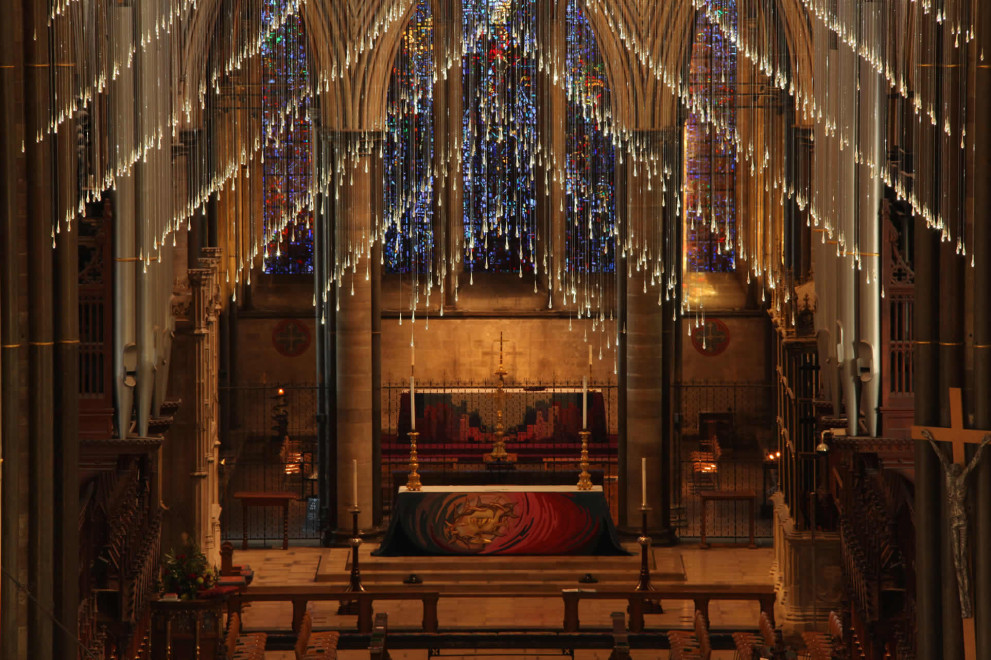
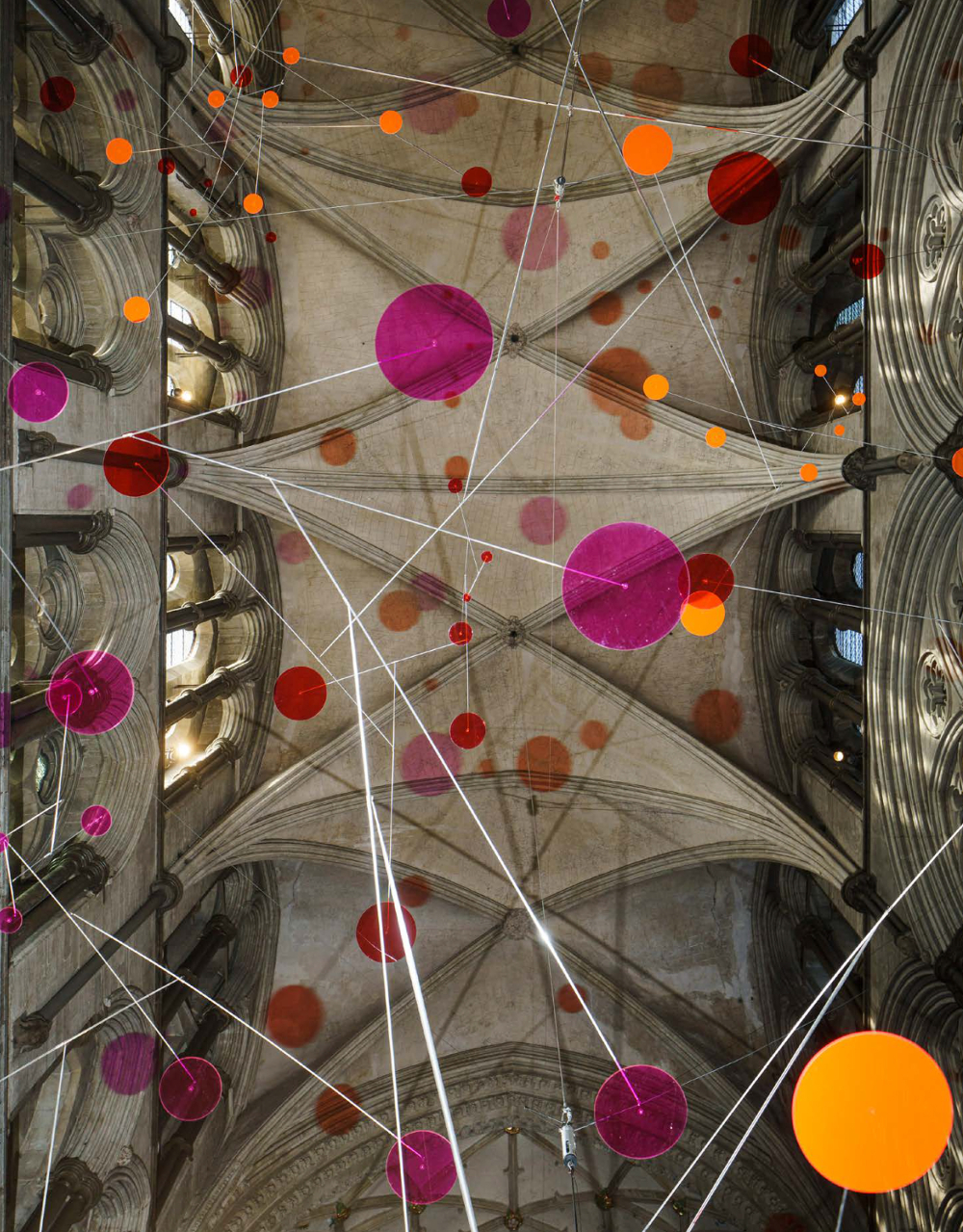
Bruce Munro (British, 1959–), Light Shower, 2010. Temporary installation at Salisbury Cathedral, England.
For Christmas 2010, Salisbury Cathedral commissioned a site-specific light installation from multimedia artist Bruce Munro. Called Light Shower, the piece consists of an invisible wire matrix suspended from the ceiling above the transept, from which dangle hundreds of optical fibers lit with tiny LEDs. As the title implies, they look like drops of light descending like rain.
There is a light Bright star shining In the dark night Old tales come true
All of our fears Hopes and prayers He has heard And answered us
The light came down Cast the darkness away He appeared A helpless child The light of God came down
There is a light A new day dawning Old things pass All things made new
Prophets have spoken All he would accomplish When the light of God Would dwell with men
The light came down Cast the darkness away He appeared A helpless child The light of God came to save us To the world that he made us O Lord and Savior Alleluia
This is the final post in the 2023 Advent series (daily Christmas posts will follow through January 6). View all the posts here, and the accompanying Spotify playlist here.
WEBSITE LAUNCH: The Foundation for Spirituality and the Arts: From a September 20 press release: “The Foundation for Spirituality and the Arts is pleased to announce the debut of our new website, fsa.art. Complementing in-person programming in Charleston and New York City, fsa.art functions as FSA’s online curatorial wing. It hosts both commissioned and curated content as well as a selection of features spotlighting significant artists, scholars, exhibitions, and publications from recent decades. We hope this site will be a valuable and inspiring resource that fosters dialogue, community, and innovation in the field of spirituality and the arts.”
FSA is “devoted to nurturing connections between spirituality and contemporary art. . . . By encouraging a mutual flow of creativity and faith from both artists and scholars, we hope to initiate fresh channels of spiritual enrichment from new depths of artistic expression. Nurturing innovative and experimental collaborations between a wide range of communities, we aspire to integrate estranged voices together in a spirit of harmony, openness, and inquisitiveness.”
At the heart of their programming is their annual series of residencies, open to visual artists, performers, composers, choreographers, curators, writers, and theologians. Visit their website to find out more, and follow them on Instagram @foundation.spirituality.arts. Below are four artworks I’ve encountered through their social media postings.
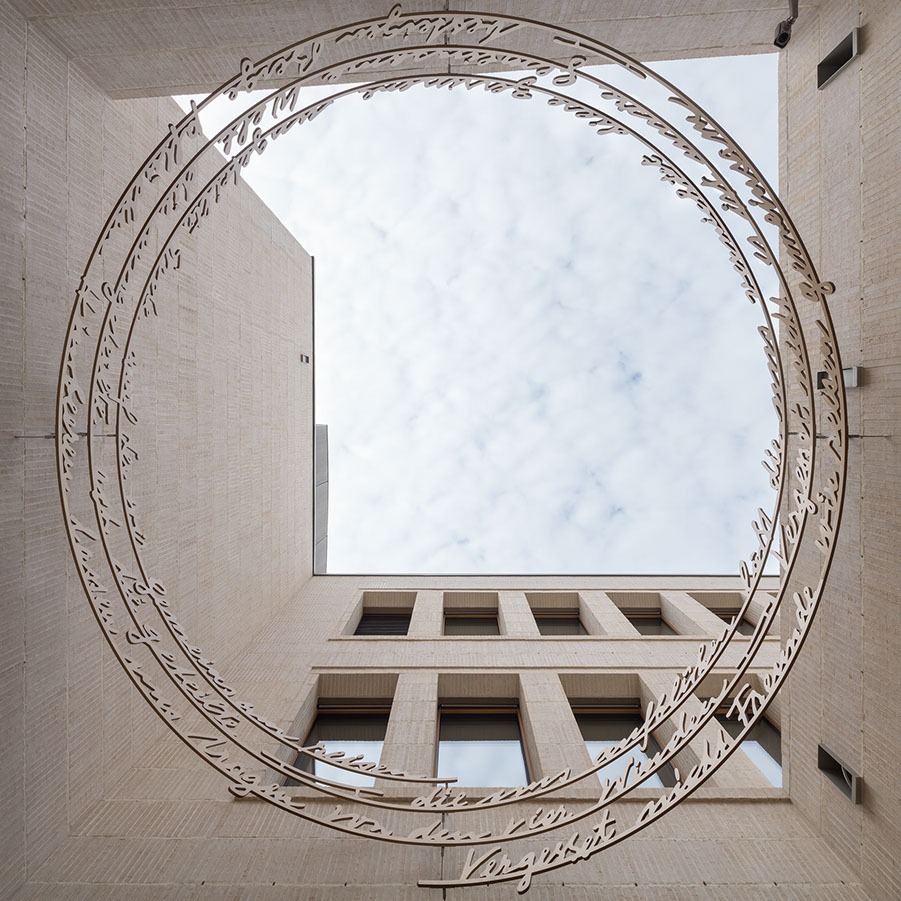
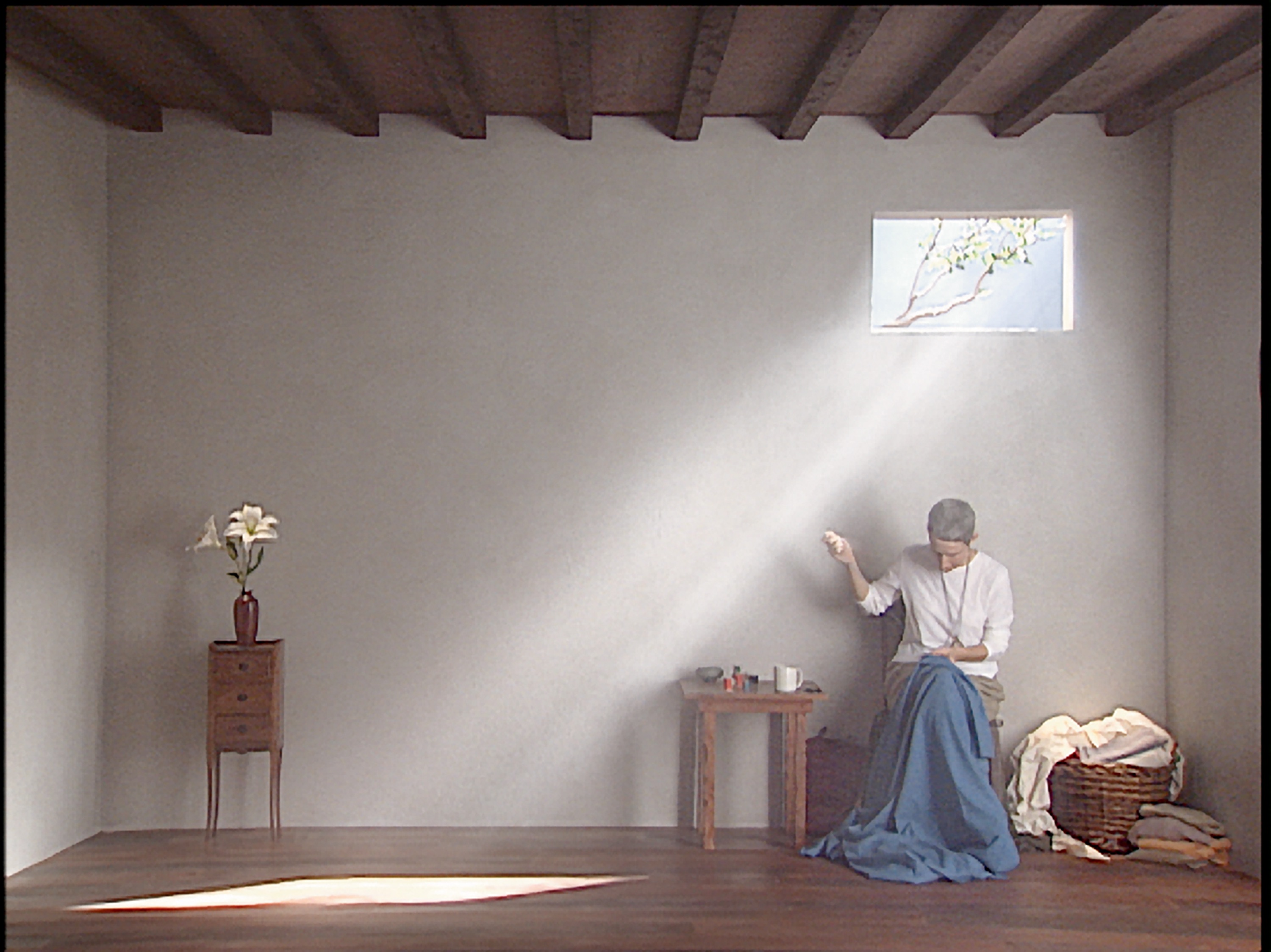
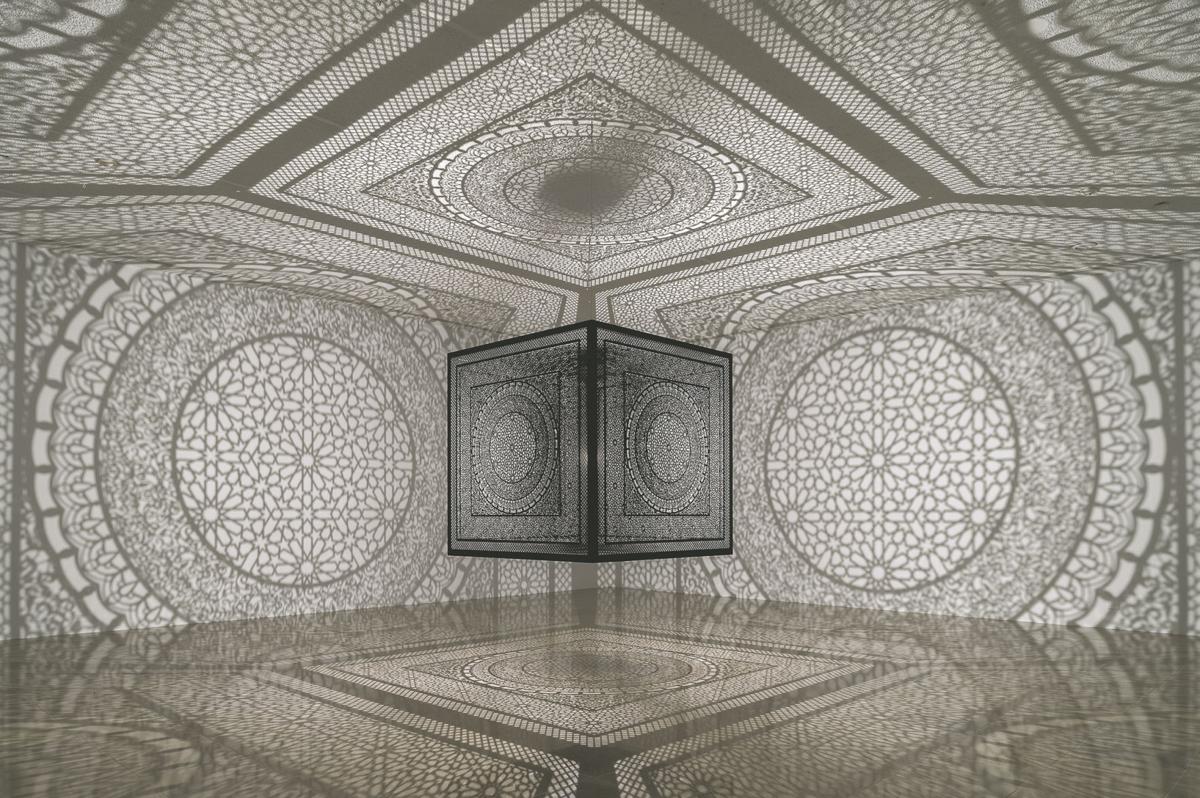
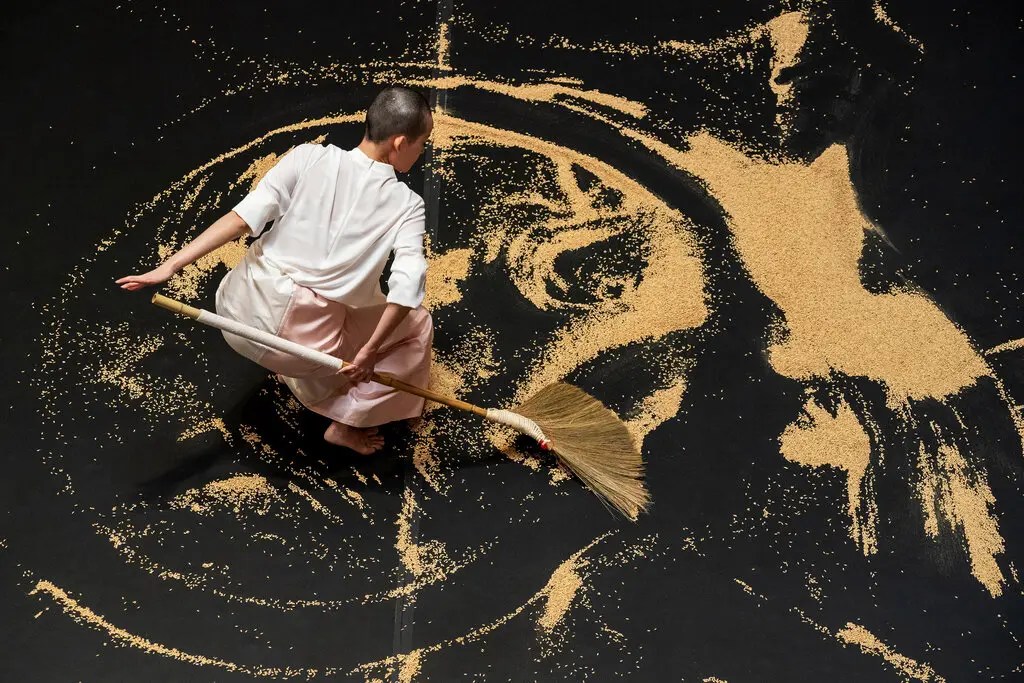
Tom Kristen (German, 1968–), Gemeinsam (Together), 2019. Jewish Synagogue and Community Center, Regensburg, Bavaria. Photo: Marcus Eben. Floating above the center’s atrium, this gilded bronze spiral text is taken from Rose Ausländer’s poem “Gemeinsam”: “Vergesst nicht, Freunde, wir reisen gemeinsam. . . . Es ist unsre gemeinsame Welt.” (“Don’t forget, friends: we travel together. . . . It is our common world.”)Bill Viola (American, 1951–), Still from Catherine’s Room, 2001. Color video polyptych on five flat panel displays, 18:39 minutes, performer: Weba Garretson. Photo: Kira Perov, courtesy Bill Viola Studio.Anila Quayyum Agha (Pakistani American, 1965–), Intersections, 2013. Lacquered wood and halogen bulb, 78 × 78 × 78 in. (cast shadows: 43.5 × 43.5 × 16 ft.). Installation view at Rice Gallery, Houston, Texas, 2015.Lee Mingwei (Taiwanese American, 1964–), Our Labyrinth, 2015–present. Photo: Stephanie Berger. In this performance work, single dancers, dressed in floor-length sarongs and wearing ankle bells, take turns sweeping a mound of rice in patterns on the floor in a designated gallery space. This iteration from 2020 at the Metropolitan Museum of Art was a collaboration with choreographer Bill T. Jones, and the performer in the photo is I-Ling Liu. [Watch on YouTube]
+++
LECTURE: “The New Visibility of Religion in Contemporary Art” by Jonathan A. Anderson: Religion is becoming more visible in contemporary art and more discussable, says artist, art critic, and theologian Jonathan Anderson in his September 17 talk sponsored by Bridge Projects in Los Angeles. Danh Vo, Kris Martin, Andrea Büttner, Deana Lawson, Arthur Jafa, Genesis Tramaine, Hossein Valamanesh, Theaster Gates, Zarah Hussain, Francis Alÿs, Louise Bourgeois, Sol LeWitt, Sean Kelly, Gerhard Richter, James Turrell—these are just some of the many contemporary artists who have engaged substantively with religion in their work, either through form or content or through the ways in which they frame the work’s central questions. Curators and art historians are recognizing this more and more, and it’s being reflected in exhibitions and scholarship. Anderson highlights several such instances from the past two decades, celebrating religion’s increased visibility but also pointing out where there’s room for improvement. The talk starts at 6:36:
At 28:58, Anderson outlines four interpretive horizons, or fundamental hermeneutics, within which religion is becoming visible, intelligible, and meaningful in contemporary art: anthropological (31:00), political (37:43), spiritual (42:51), and theological (48:42). He discusses the problems and possibilities of each—ways in which it has been productive or insightful, and ways in which it’s limiting. The fourth horizon, the theological, is the least developed in the art world and the most contested, he says.
He concludes,
A more concentrated and well-developed mode of theological inquiry has much to contribute to the history, theory, and criticism of contemporary art without being reductive, but instead opening much of what’s going on in contemporary art. And so going forward, I do envision a mode of study that keeps all these horizons in view, and a mode of discourse that keeps all these horizons in view, while especially developing the potential for the modes of critical writing capable of addressing theological conceptualities, genealogies, and implications that are in play in so much of the art being made today. And that involves thinking better from both directions, developing concepts and capacities—skills, really—where art criticism might operate with a more agile, historically sensitive understanding of religion and theology (a richer theological intelligence), and theology might operate with a more agile, historically sensitive understanding of art and criticism (a richer art historical intelligence, or visual intelligence).
The last half hour is Q&A. What he says at 1:03:59 is fascinating! If you enjoyed this talk, check out, too, the one he gave ten years ago, “The (In)visibility of Theology in Contemporary Art Criticism,” which I published detailed notes on and which became a chapter in the book Christian Scholarship in the Twenty-First Century: Prospects and Perils, edited by Thomas M. Crisp, Steve L. Porter, and Gregg A. Ten Elshof.
As a side note, Anderson teaches two courses at Duke Divinity School, where he is a postdoctoral associate in the DITA program: “Contemporary Art and Theology” and “Visual Art as Theology.” The latter looks at the history of primarily Christian art as a domain of primary theological reasoning and biblical commentary, done in visual-spatial terms rather than in verbal-written terms. His hope is that divinity students—future biblical scholars, theologians, pastors, etc.—will become more literate in the visual-spatial forms of theology. I mention this because it’s what I’m about too!
+++
PODCAST EPISODE: “Jacquiline Creswell: Curating in Sacred Spaces,”Exhibiting Faith: Hosted by critic and art historian David Trigg, this is the first episode of a brand-new podcast about the intersection of art and faith, featuring a range of guests for whom those two elements have played a significant role. First up is Jacquiline Creswell, a visual arts adviser and curator who has, since 2009, organized more than forty-five exhibitions in sacred spaces. She has been central to the development of the visual arts programs at Salisbury, Ely, and Chichester Cathedrals. She discusses some of the projects she has worked on and how they’ve been received by the congregation and the wider public, how the setting of an artwork can alter its meaning and the way people engage with it, the logistical challenges of placing art in historic churches, and more.
I was interested to learn that she is from a Jewish background, even though most of her jobs have been with Christian institutions. Check out the eight objectives she lists on her website, which have guided her curatorial work and which I find exciting; the first is “To present artwork which is engaging, that encourages a spiritual response and may at times challenge conventional perceptions.”
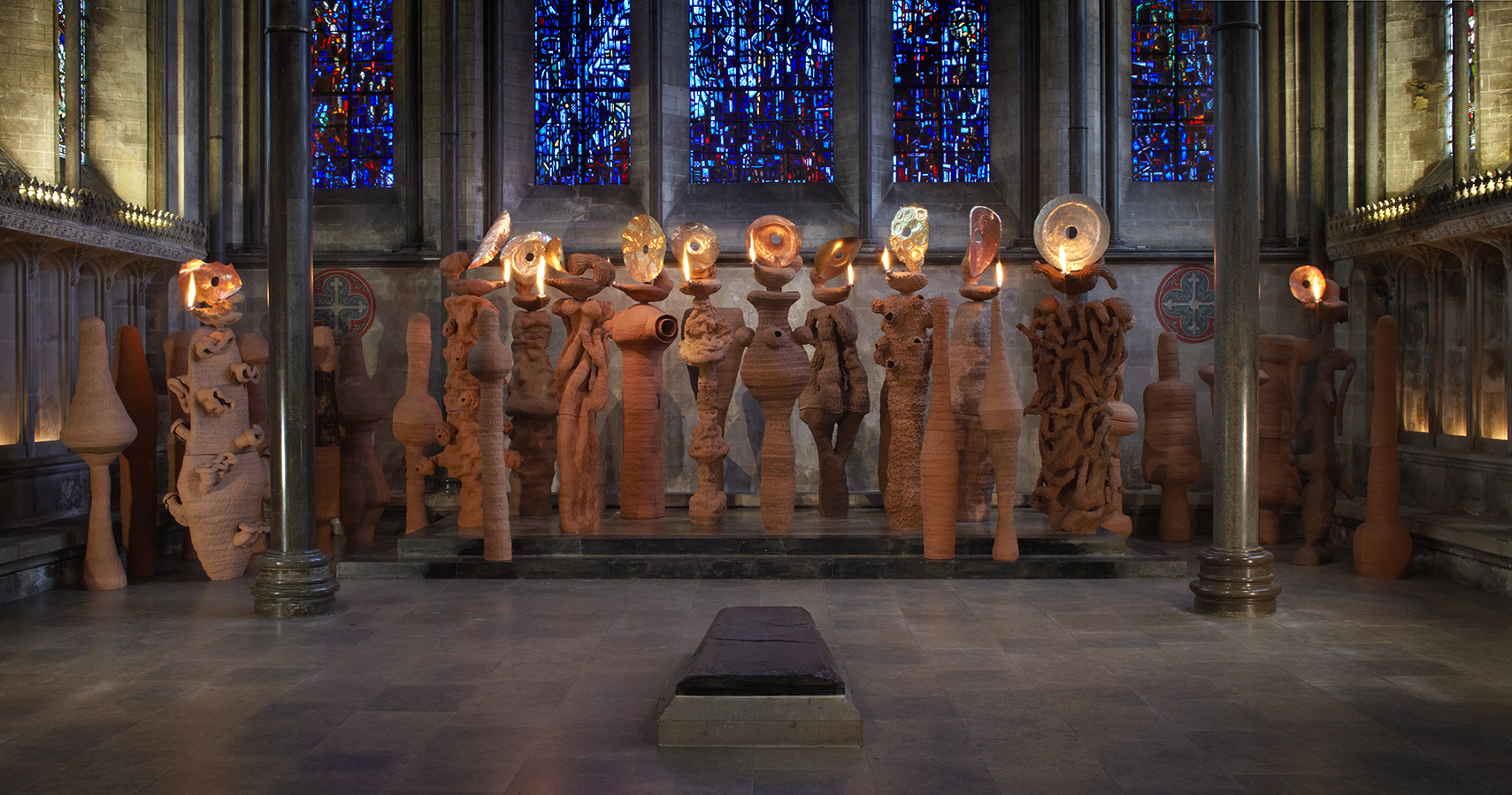
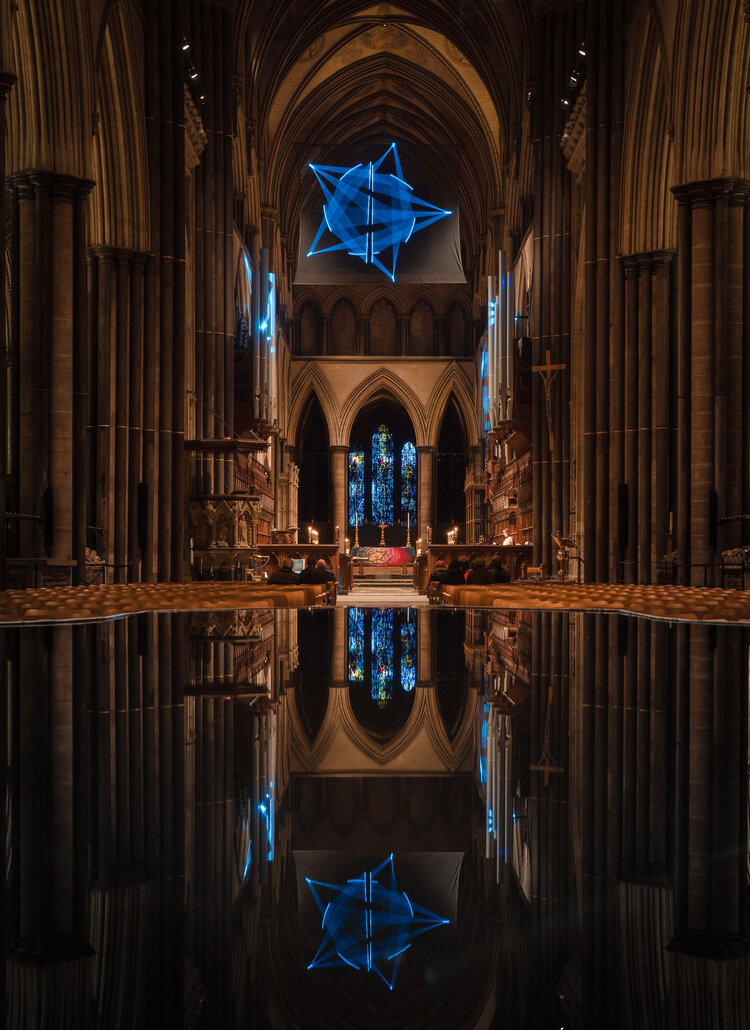
Nicholas Pope (British, 1949–), The Apostles Speaking in Tongues Lit By Their Own Lamps, 1996, installed 2014. Thirty-three figures in terracotta, metal, wick, paraffin, and flame. Trinity Chapel, Salisbury Cathedral. Photo: FXP, London.Jayson Haebich (born in Australia, living in Hong Kong and London), Star of Bethlehem, 2016. Interactive laser installation at Salisbury Cathedral, England.
New episodes of Exhibiting Faith are released once a month. The second (and latest) episode is an interview with Dubai-born, Birmingham-based textile artist Farwa Moledina, whose Women of Paradise (2022) scrutinizes the portrayal of Muslim women in the canon of Western art. Moledina also discusses her experience of Ramadan during lockdown and how it resulted in By Your Coming We Are Healed (2020), two sufras (floor mats for communal dining) made up of photographs of plated dishes submitted to her by participants in the virtual iftars she hosted, arranged according to Islamic design principles of symmetry, abstraction, and recurrence.
+++
SHORT FILM SERIES: At the Threshold: Theology on Film, dir. Sean Dimond:At the Threshold is the latest project from UNTAMED, a documentary film studio in Seattle that “pursue[s] stories of spiritual and narrative depth, with a bias for hope, risk, and redemption.” Filmed in Belgium, Germany, and the UK, it profiles six Christian theologians from Europe, each one humble, open-hearted, and reflective.
“The Open Narrative of Love” with Lieven Boeve, Leuven, Belgium: Boeve reflects on how God interrupts people’s self-enclosed stories. Christianity, he says, is itself an open narrative, not a closed one, and it leads us not away from the world but right into it. One of the filming locations in this short is a rural landscape in Borgloon where Pieterjan Gijs and Arnout van Vaerenbergh built Reading between the Lines, an open-air chapel created to imagine a church inseparable from the world around it.
“The Greater Part” with David Brown, St Andrews, Scotland: Brown talks about prayer, the Bible as part of a living tradition, the church’s call to be creatively other, and the only time he ever saw his father cry. He also cites some of the poets, novelists, and composers/singer-songwriters he admires.
“The Radiance” with Perry Schmidt-Leukel, Muenster, Germany: “The fractcal structure of religious diversity” is of deep interest to Schmidt-Leukel, a Christian who draws insights from Buddhism and who was criticized by Cardinal Joseph Ratzinger for doing so.
“Danseuse” with Ann Loades, Durham, England: A feminist theologian, Loades is one of only two people ever to be awarded a CBE for services to theology. The Christian tradition is responsible for the devaluation of women, she says, but that tradition also contains resources for its own transformation. She also discusses dance as prefiguring the resurrection body.
“To Imagine That” with Garrick Allen, Glasgow, Scotland: Allen sees the book of Revelation as being about how to live in a system that is unjust. “This is John’s response to an oppressive system, and it gives us space to rethink what a just system would look like in our world—to begin to imagine that.”
“Begin with the End” with Judith Wolfe, St Andrews, Scotland: “We have to take seriously the claim that we do not yet live in the world as it will be, and as we will be, and that we have to live towards an eschaton, a presence of God in the world, which is not only not yet apparent, but is not even comprehensible to us. So how do we live authentically in this life?”
From the studio: “Theology offers a home for the vast and the intimate. No question is foreclosed. Visually immersive, poetic, and global in scale, these narrative and theological short films invite viewers into a conversation about life and its limits which is as vibrant as it is challenging. This series isn’t about promoting theological ideas we necessarily agree with, but rather we are exploring the connections between vulnerable life, big questions, and the diversity of theological work being done today. It’s not that we are on the threshold of discovering God, but that perhaps God is already on the threshold of our lives, knocking to enter through our wounds, deepest desires, and questions.”
VIDEO TALK: “The Breath of Life: Why Art Matters in a Pandemic” by James K.A. Smith: In this half-hour Zoom talk released June 2, Image journal editor in chief Jamie Smith [previously] discusses the ability of the arts to stimulate our cultural imagination in much-needed ways. “The arts matter in a pandemic,” he says, “because they shape us for the work of reshaping and rebuilding society. In other words, we all need artists to continue creating for us so the rest of us can cultivate the imagination we need to re-create our common life, our social bonds.” And again: “The arts train our imagination so that we relearn to see what we need to see. . . . It’s art as imagination therapy, it’s art as an ophthalmology of the soul that we need in order to build and sustain and restore the institutions of a healthy, flourishing society. . . . If we’re going to imagine the world otherwise, we need imaginations that are trained in subtlety, that have been humbled by mystery, and that are infused with infinity.”
At 14:44 Smith introduces three ways in which art matters during and after a pandemic: art helps us (1) attend, (2) transcend, and (3) mend. That is, art helps us attend more carefully to the world and our neighbors, calling sometimes for gratitude, sometimes for grief, often both; art helps us transcend despair, attesting to the “something more” we long for (“the arts enable us to transcend the tragic when they invite us into a joy that forgets nothing”); and art helps us mend our tattered social fabric by helping us to better understand one another and to imagine possibilities. For each of these functions he provides a few concrete examples, including the current Home Alone Together exhibition.
Photo by Yola Monakhov Stockton, May 17, 2020, for the “Home Alone Together” exhibition
+++
Along these same lines . . . at the end of the Makers & Mystics podcast episode “Art as Healing,” recorded live last year at The Farm House in Charlottesville, Virginia, and released June 5, 2020, host Stephen Roach reads an excerpt from a book he’s writing:
In our present day, it can be easy to conclude from the various crises taking place around the world, all the injustice and political unrest, the rampant poverty and environmental threats, persecution and killings, diseases and displacements, that art and beauty are mere luxury. It could even make some feel that to focus on art and beauty is insensitive or shortsighted. However, I want to suggest that it’s precisely because of these desperate situations that the artist is called upon to beautify the world with art and engage these issues from a vantage point of hope.
The desperate situation in our world calls for the artist to emerge as a prophetic voice for change and to offer heaven’s alternatives. I’m reminded of the example of Iraqi cellist Karim Wasfi, who countered the tragedy of war by playing music at the sites of car-bomb explosions, with smoldering buildings in the background of his concertos. Wasfi said, “The other side chose to turn every element, every aspect of life in Iraq into a battle and into a war zone. I chose to turn every corner of Iraq into a spot for civility, beauty, and compassion.”
This is the call of the artist in collaboration with God: we are called to be the architects of hope and to counter the destruction of life with the opposite spirit in beauty and creativity.
Here’s a video of Wasfi playing an original cello composition in the destroyed buildings of Al Shifa Hospital in Mosul, Iraq, in September 2018, where some two thousand explosive hazards were removed by UNMAS (United Nations Mine Action Service):
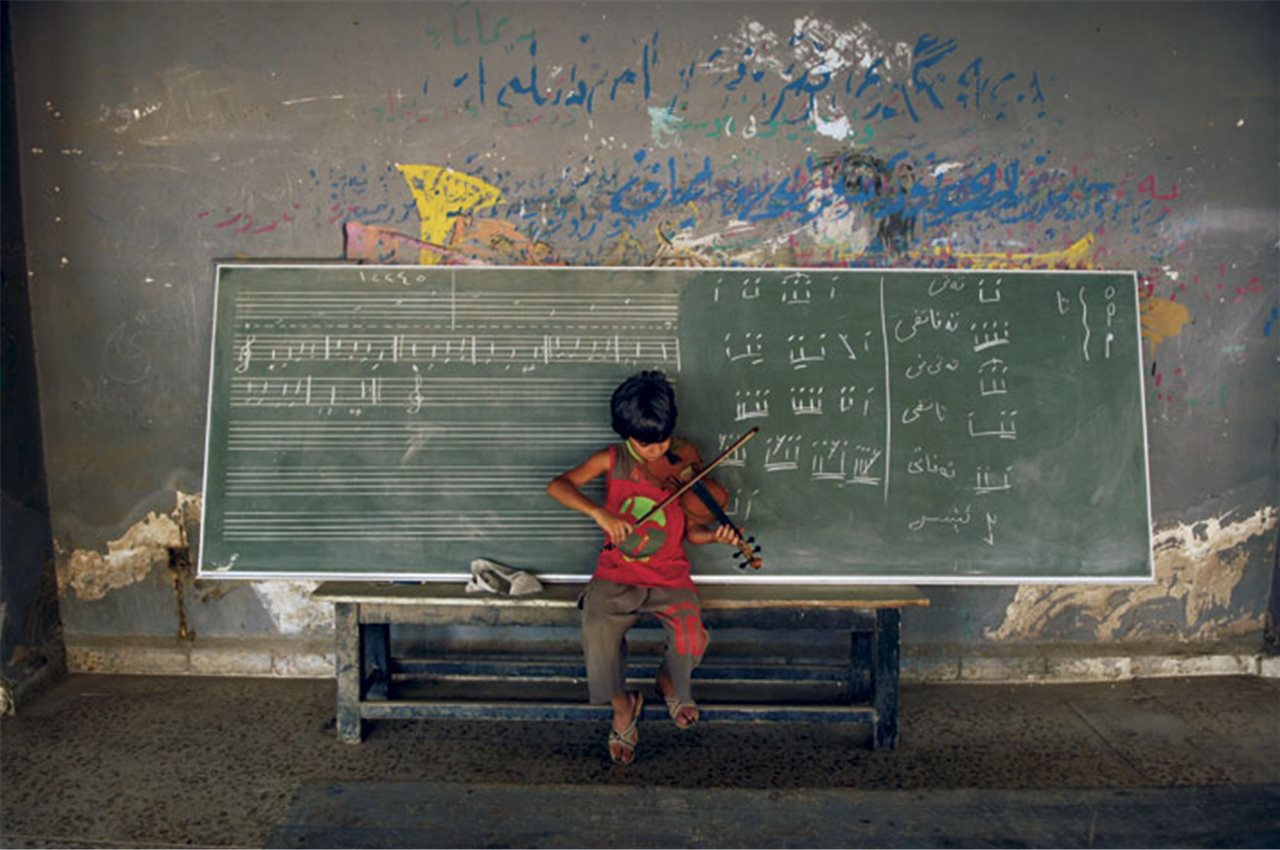
It reminds me of a photograph by Julie Adnan that I saw in National Geographic a decade ago and that, of all the extraordinary photos published in that magazine, has stuck with me the most. Its caption reads, “Some 160 miles northeast of Baghdad, in a Sulaymaniyah music hall ravaged by war, looting, and neglect, a violin-playing boy sounds a note of hope. His teacher, Azad Maaruf, lives there, instructing scores of students.”
Photo by Julie Adnan, taken in Sulaymaniyah, Iraq, published in the February 2010 issue of National Geographic
The expression “fiddling while Rome burns,” which legend says the emperor Nero did in 64 CE, is used deprecatingly to refer to the doing of something trivial and irresponsible during a crisis. But beauty is not trivial, and its pursuit during times of crisis does not indicate apathy. I love that this little boy wants to play music while bombs sound out around him. Making art can be a daring act of resistance, an assertion of and call to common humanity, a better way. It’s life-affirming. As artist Laura Bon says: “Artists need to create on the same scale that society has the capacity to destroy.”
+++
NEW SONG: “The Medicine” by Dee Wilson: Dee Wilson of Common Hymnal premiered this song on his YouTube channel on May 27, and then Good Shepherd New York and friends put together a beautiful arrangement for the church’s June 7 virtual worship service. It’s a prayer that God would save us from the virus of racism, which harms and divides. The chorus goes: “We don’t know what to do, so we turn our eyes to you. We’ve run out of words to say. But if you come and have your way, you can save us from ourselves before our wounds hurt someone else. We need you now.” The video features Wilson on lead vocals, Liz Vice on background vocals, Orlando Palmer and Charles Jones on keyboard, Franklin Rankin on guitar, Michael Decena on bass, and Terence F. Clark on drums.
Every Sunday since March 15, Good Shepherd New York (“an interdenominational church helping New Yorkers embody the love of Christ for the good of our neighbors”) has been releasing a worship service video with liturgy, prayer, sermon, open communion—and phenomenal music led by associate pastor David Gungor, which engages current events. The whole services are worth watching/participating in, but here are a few musical highlights I’ve queued up. I especially like the medleys, which blend together excerpts from a range of songs:
May 10: MEDLEY: “My Brother, My Sister” by David Gungor / “Higher Love” by Steve Winwood
March 22: MEDLEY: “All Who Are Thirsty” by Brenton Brown and Glenn Roberts / “Take Me to the River” by Leon Bridges / “Amazing Grace” (with traditional English folk tune RISING SUN)
“Way Maker”– Written by Sinach (Osinachi Kalu) – Performed by Zanbeni and Benny Prasad – This husband-wife duo [previously] brings a fusion of R&B, jazz, and Indian classical music to this 2015 gospel song.
+++
EXHIBITION / VIRTUAL ART TOUR: Celebrating 800 Years of Spirit and Endeavour: To celebrate the eight hundredth anniversary of the laying of its first foundation stone, Salisbury Cathedral organized a major exhibition this year, which was three years in the making. After the art was sited and installed both inside the building and outside on the lawns, COVID-19 hit, and the cathedral was forced to close. But the planning team adapted to the setback, developing a virtual tour that uses panorama technology to enable the viewer to enter the cathedral virtually, watch a video introduction, and navigate around the exhibition space by clicking on thumbnail images of the works and links to the corresponding catalog pages.
Curated by Jacquiline Creswell, who has led the cathedral’s visual arts program for the past eleven years, the exhibition features twenty-nine works of art by significant artists of the modern and contemporary eras, including Henry Moore, Elisabeth Frink, Antony Gormley, Mark Wallinger, Shirazeh Houshiary, and Subodh Gupta. Nine of the works are from the cathedral’s permanent collection, while the other twenty were specially brought in, of which two were newly commissioned: the abstract, solar-powered mobile in the nave by Daniel Chadwick, and the light installation in the north porch by Bruce Munro.
The beautifully photographed, ninety-page exhibition catalog is available for free download from the Spirit and Endeavour page of the cathedral website. Besides providing commentary on all the artworks, it also includes an essay by Sandy Nairne that discusses significant art commissions by British churches in the twentieth and twenty-first centuries and the difference between viewing art in a cathedral versus a museum gallery. Another available resource is a guide for kids with questions and activities. While I do hope the interior portion of the exhibition is able to open to visitors soon, I’m grateful that the online resources enable me to “visit” from my living room in the US.
Daniel Chadwick (British, 1965–), Somewhere in The Universe, 2019–20. Acrylic sheet, stainless steel, solar-powered motor, 1,000 × 1,000 cm. Temporary installation at Salisbury Cathedral. Photo: Ash Mills.
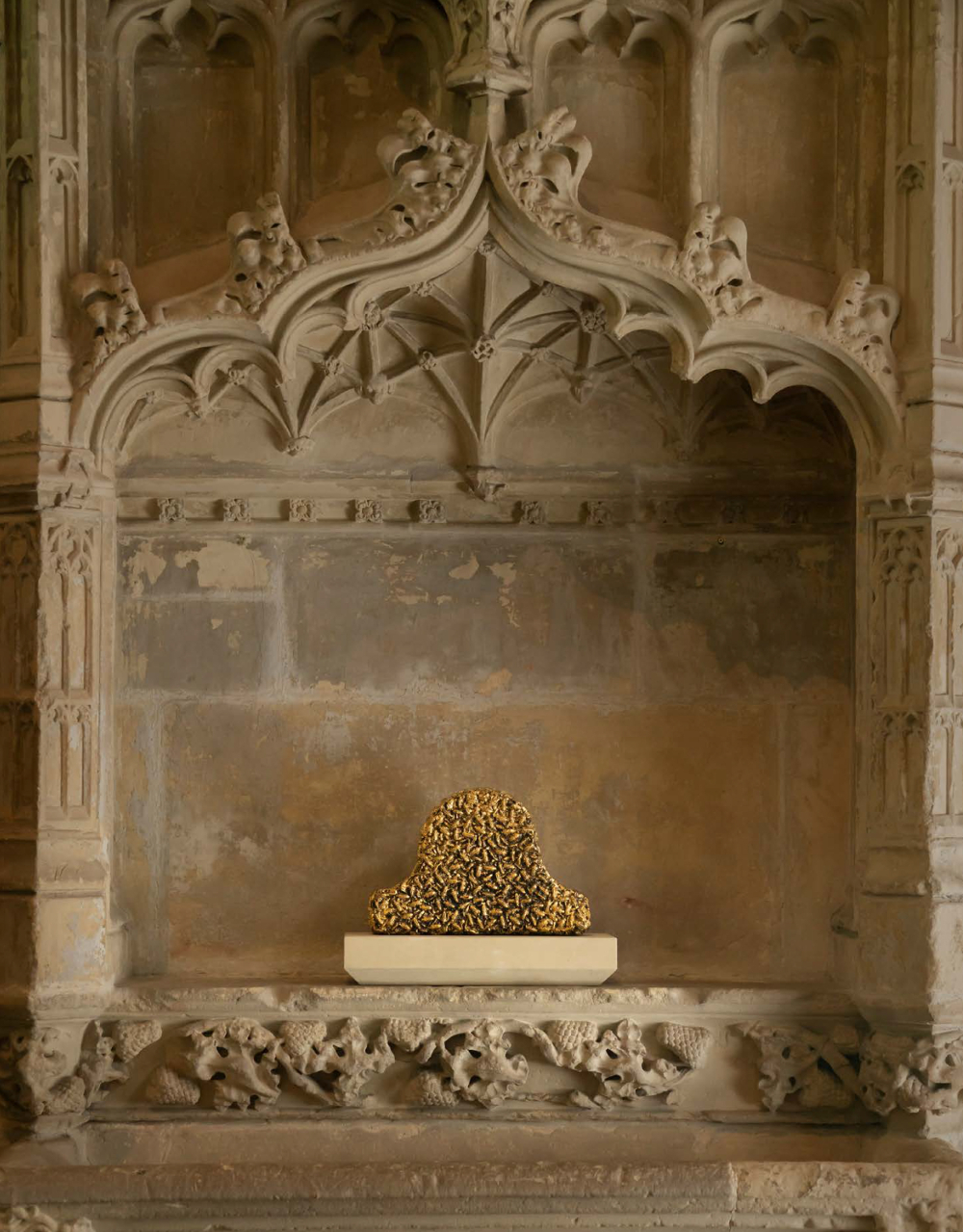
Bill Woodrow (British, 1948–), Clockswarm, 2001. Bronze, 25 × 35 × 11 cm. Photo: Ash Mills.
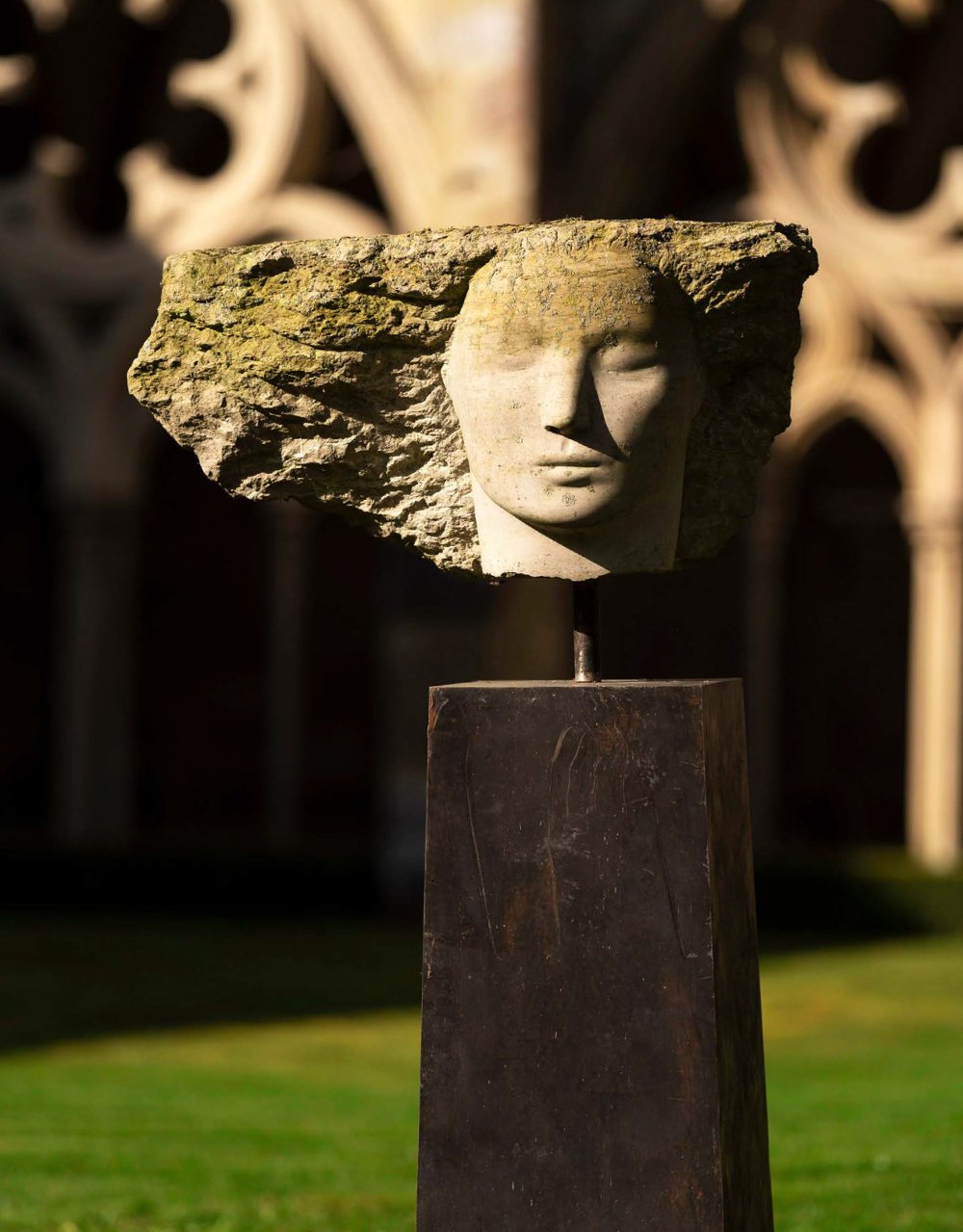
Emily Young (British, 1951–), Angel Gabriel, 2008. Purbeck stone, 90 cm. Collection of Salisbury Cathedral. Photo: Ash Mills.
PSALM 13 SETTINGS FROM INDIA: In November 2015 a group of musicians from Poona Faith Community Church in Pune, India, composed and recorded worship songs in several of the country’s languages. Because Psalm 13 is assigned in today’s lectionary, here are three settings of that lament, in Marathi, Hindi, and Nepali. [HT: Global Christian Worship]
How long, O LORD? Will you forget me forever?
How long will you hide your face from me?
How long must I take counsel in my soul
and have sorrow in my heart all the day?
How long shall my enemy be exalted over me?
Consider and answer me, O LORD my God;
light up my eyes, lest I sleep the sleep of death,
lest my enemy say, “I have prevailed over him,”
lest my foes rejoice because I am shaken.
But I have trusted in your steadfast love;
my heart shall rejoice in your salvation.
I will sing to the LORD,
because he has dealt bountifully with me.
(This psalm has also been impactfully adapted by Isaac Wardell, as “How Long,” on Bifrost Arts’ 2016 Lamentations album.)
The feast day of John the Baptist’s birth is coming up on June 24, and London’s National Gallery has provided a great way to immerse yourself in his story—through art! The museum has produced a ten-video series called Saint John the Baptist: From Birth to Beheading, in which Professor Ben Quash, director of the Centre for Arts and the Sacred at King’s College, joins Dr. Jennifer Sliwka, curator of art and religion at the National Gallery, for a stroll through the museum and some nearby sites to discuss various works of art in which John appears.
investigate how Christian scripture, beliefs and practices have found expression in art over 2,000 years; trace the idea of beauty in Western theological tradition; make use of examples in London. . . . The MA will enable students to work across disciplinary and specialism boundaries, and in particular to explore simultaneously the art-historical and theological dimensions of Christian art – approaches which are generally pursued in isolation from one another.
Their analysis of the paintings in this video series is superaccessible to those with no art background, and familiarity with Christianity isn’t assumed either.
The ten videos—about eight minutes each—are embedded below.


 Art & Theology