
Merry Christmas!
LOOK: Ethiopian Nativity tapestry
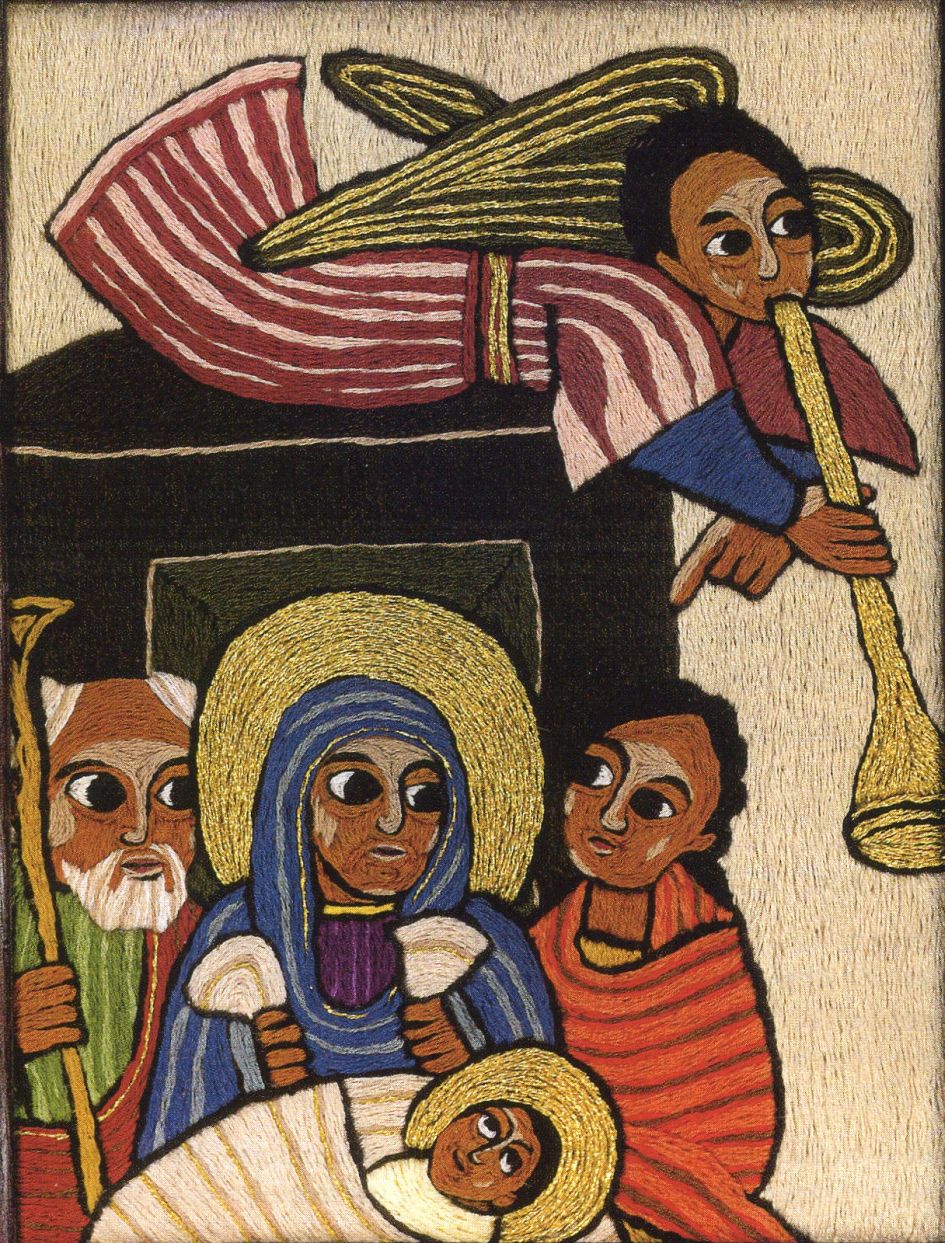
I don’t know the maker or whereabouts of this charming tapestry, but I did find that it is based on a painting made by the Ethiopian artist Tadesse Wolde Aregay, which you can view here, along with three of Aregay’s other Christmas paintings. In it, a trumpeting angel points to the newborn Christ, whose mother, Mary, wraps him warmly in a blanket. Joseph stands on the left with a staff. On the right is Salome, a midwife and disciple of Jesus who appears in the Nagara Maryam (History of Mary), an apocryphal book of Marian legends from Ethiopia, and who is often portrayed in Ethiopian paintings of the Nativity and the Flight to Egypt.
LISTEN: “Christ Is Born Today” | Original German and Latin words attributed to Heinrich Suso (ca. 1295–1366); English translation by John Mason Neale, 1853 | Music: German dance tune, 14th century | Arranged by Elbertina “Twinkie” Clark and performed by the Clark Sisters on New Dimensions of Christmas Carols, 1978
Good Christian men, rejoice
With heart, and soul, and voice;
Give ye heed to what we say:
Good news!
Jesus Christ is born today!
Ox and ass before him bow;
He is in the manger now.
Christ is born today!
Christ is born today!
Christ is born today!(Joy to the world)
Christ is born today!
(He’s in the manger now)
Christ is born today!
(Peace on earth, goodwill to men)
Christ is born today!
(Unto us)And man is blessèd evermore.
Christ is born today!
(Christ is born today)
Christ is born today!
(Peace on earth, goodwill to men)
Christ is born today!
(Unto us a child is given)
Christ is born today!
This Christmas carol has its origins in late medieval Germany. It’s attributed to the Dominican friar Henry Suso—a legend says he had a vision of angels singing and dancing with joy about the birth of Christ, and, caught up in the mystic celebration, he penned the song.
I love the quick-tempoed, 6/8 version I grew up singing in church—but I also love what the Clark Sisters have done with it!
Officially formed in 1973 and active ever since, the Grammy-winning Clark Sisters are Jacky Clark Chisholm, Elbernita “Twinkie” Clark, Dorinda Clark-Cole, and Karen Clark Sheard. They were born in Detroit to gospel musician and choral director Dr. Mattie Moss Clark, who got them started in their singing careers. The group is a pioneer of contemporary gospel music, and last year they were inducted into the Black Music & Entertainment Walk of Fame in Atlanta.
The soloist on “Christ Is Born Today” is Denise “Niecy” Clark-Bradford, who left the group in 1986. In the first verse she mistakenly sings “groan” instead of “bow.”
Note that in hymnals today it is common to replace the first line with “Good Christian friends, rejoice” or “Good Christian folk, rejoice” to avoid the gendered “men,” and likewise in a later verse to change “And man is blessèd evermore” to “And we are blessed forevermore.” I get that “men” is being used in the broad sense of “humankind,” but where small lyrical changes for gender inclusivity are nondisruptive, as they are here, I am in favor of them.
The carol is written in the voice of the angels who excitedly proclaimed Christ’s birth to the shepherds, and their proclamation is taken up by Christians around the globe who sing this song, spurring one another to rejoice in the good news.
This post is part of a daily Christmas series that goes through January 6. View all the posts here, and the accompanying Spotify playlist here.
 Art & Theology