Kolumba and KMSKA: Medieval and contemporary art in conversation (part 2)

This a continuation of yesterday’s article. In part 1 I shared three room highlights from my visit to Kolumba museum in Cologne, Germany, run by the city’s Catholic archdiocese; in this final part I will do the same for KMSKA in Antwerp, Belgium, whose Old Masters galleries received a “contemporary injection” in an exhibition that wrapped this week. All photos are my own.

[Content warning: This article contains female nudity: a controversial Renaissance painting of the Virgin Mary, and three photographs of women who have just given birth.]

KMSKA, Antwerp

The Royal Museum of Fine Arts Antwerp, or KMSKA for short, is a world-famous museum whose collection spans seven centuries, from the Flemish Primitives to the Expressionists.

When I was there last month, the featured exhibition was Collected with Vision: Private Collections in Dialogue with the Old Masters, which ran from April 4 to October 12, 2025. Organized in conjunction with Geukens & De Vil Projects, it interwove postwar and contemporary works by internationally renowned artists from Belgian private collections with the existing museum collection, “expanding the transhistorical approach already in place. The exhibition offers a reflection on the history of art collecting and asks probing questions about social issues such as gender, power and identity. The role of museums and collectors is the focal point. Do the interventions create a harmonious dialogue with 700 years of art history, or do they give rise to challenging contrasts?” Featured artists included Cindy Sherman, Olafur Eliasson, David Claerbout, Francis Alys, Christian Boltanksi, Tracey Emin, Marlene Dumas, Luc Tuymans, and Louise Bourgeois.

The galleries of the exhibition were organized by theme: Holy, Impotence, Horizon, Image, Entertainment, Profusion, Lessons for Life, Fame, The Salon, Heroes, Evil, The Madonna, Suffering, Redemption, Prayer, Heavens, and Power.

I’ll spotlight what I consider the most successful and intriguing pairings.

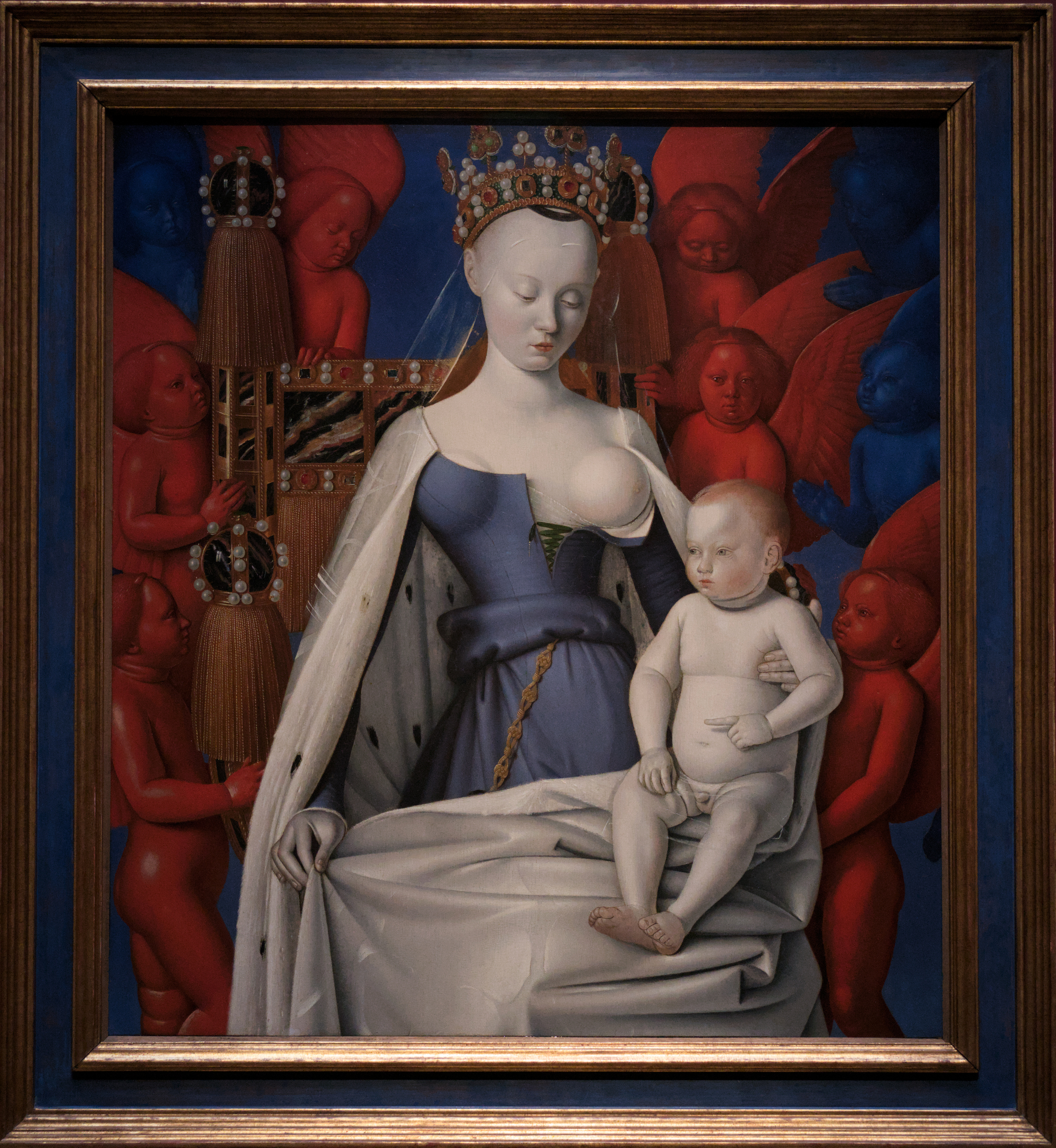
First, the “Madonna” room, anchored by the famous Madonna Surrounded by Seraphim and Cherubim by the late medieval French court painter Jean Fouquet. It’s the right wing of a diptych that originally hung above an altar at the Collegiate Church of Notre-Dame in Melun.
Fouquet, Jean_Madonna Surrounded by Seraphim and Cherubim
Jean Fouquet (French, 1410/30–1477/81), Madonna Surrounded by Seraphim and Cherubim, ca. 1450. Oil on panel, 92 × 83.5 cm. Koninklijk Museum voor Schone Kunsten Antwerpen (KMSKA, Royal Museum of Fine Arts Antwerp).

The painting is historically significant—I first encountered it in a college art history course. Commissioned by Etienne Chevalier, treasurer to King Charles VII of France, it portrays the Virgin Mary as the Queen of Heaven, baring her breast ostensibly to nourish the Christ child with her milk. She was probably modeled after Agnès Sorel, the king’s recently deceased mistress and mother of three of his daughters, considered the ideal of feminine beauty at that time in western Europe: pale-skinned, with a high forehead, and fashionable in her ermine cloak.

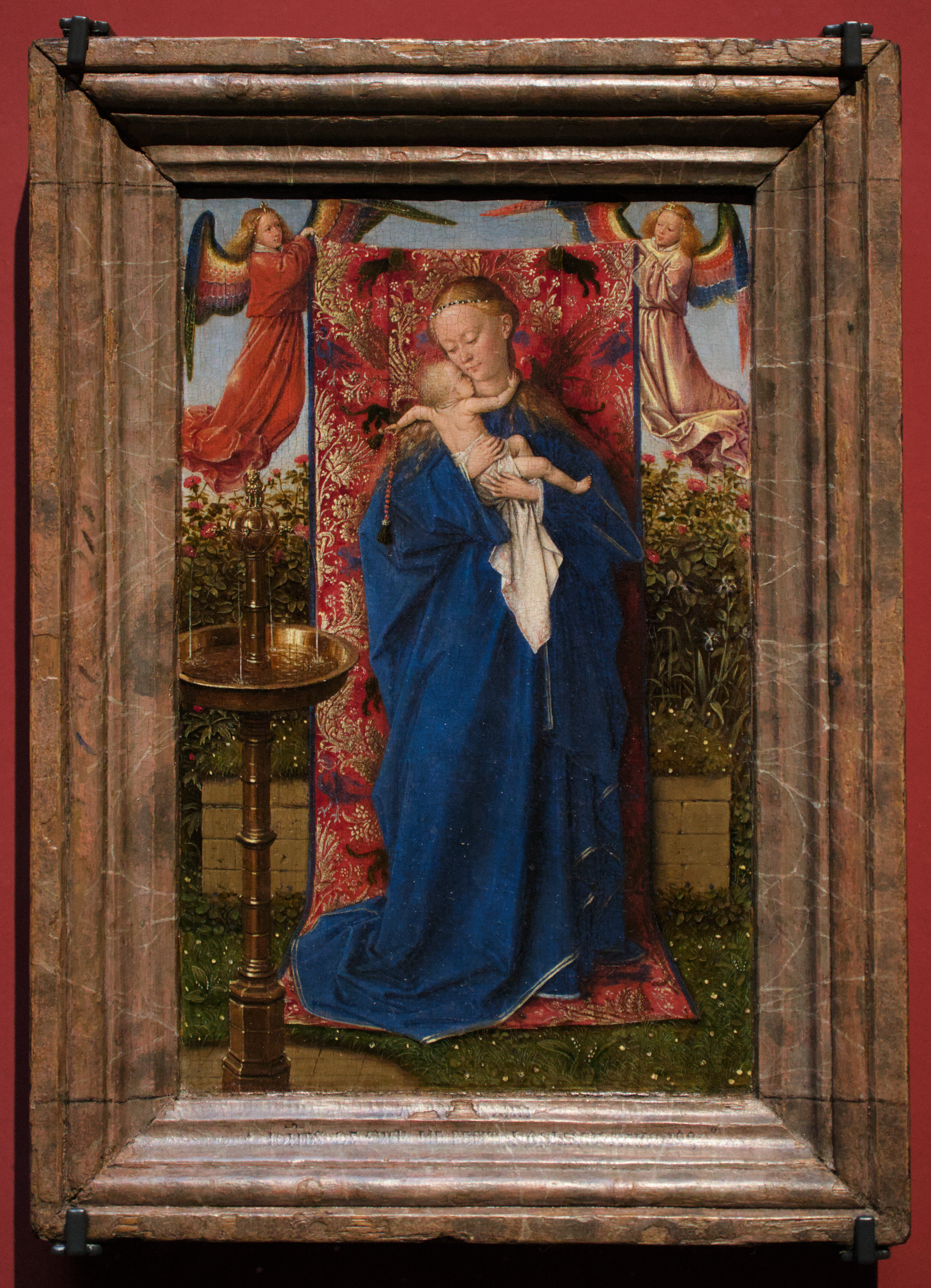
Though I can appreciate the technical excellence of this painting and the intense reds and blues of the angels, I don’t really like it. Mary seems cold, not very maternal. There’s also an eroticization of her body—not because her breast is exposed, which was common in Marian art, but because it seems to be on display for the viewer; her son’s not interested in feeding—that’s wholly inappropriate for the subject. Why you’d want to memorialize your boss’s sex partner in such a way is beyond me. I’m no prude, but I much prefer Jan van Eyck’s Madonna at the Fountain, on display in the same room:
van Eyck, Jan_Madonna at the Fountain
Jan van Eyck (Flemish, 1390/99–1441), Madonna at the Fountain, 1439. Oil on panel, 19 × 12 cm. Koninklijk Museum voor Schone Kunsten Antwerpen (KMSKA, Royal Museum of Fine Arts Antwerp).

This small painting originally hung not in a church but in someone’s house. Though there’s still an air of formality, it has all the tenderness and connection that the other one lacks. Mother and son embrace in a garden of roses, irises, and lilies of the valley, he reaching round her neck and holding a string of prayer beads, she gazing adoringly at him. They stand beside a fountain, recalling Jesus’s discussion in John 4 about the “living water” he gives to those who thirst. The original wood frame bears the artist’s motto: “As well as I can.”

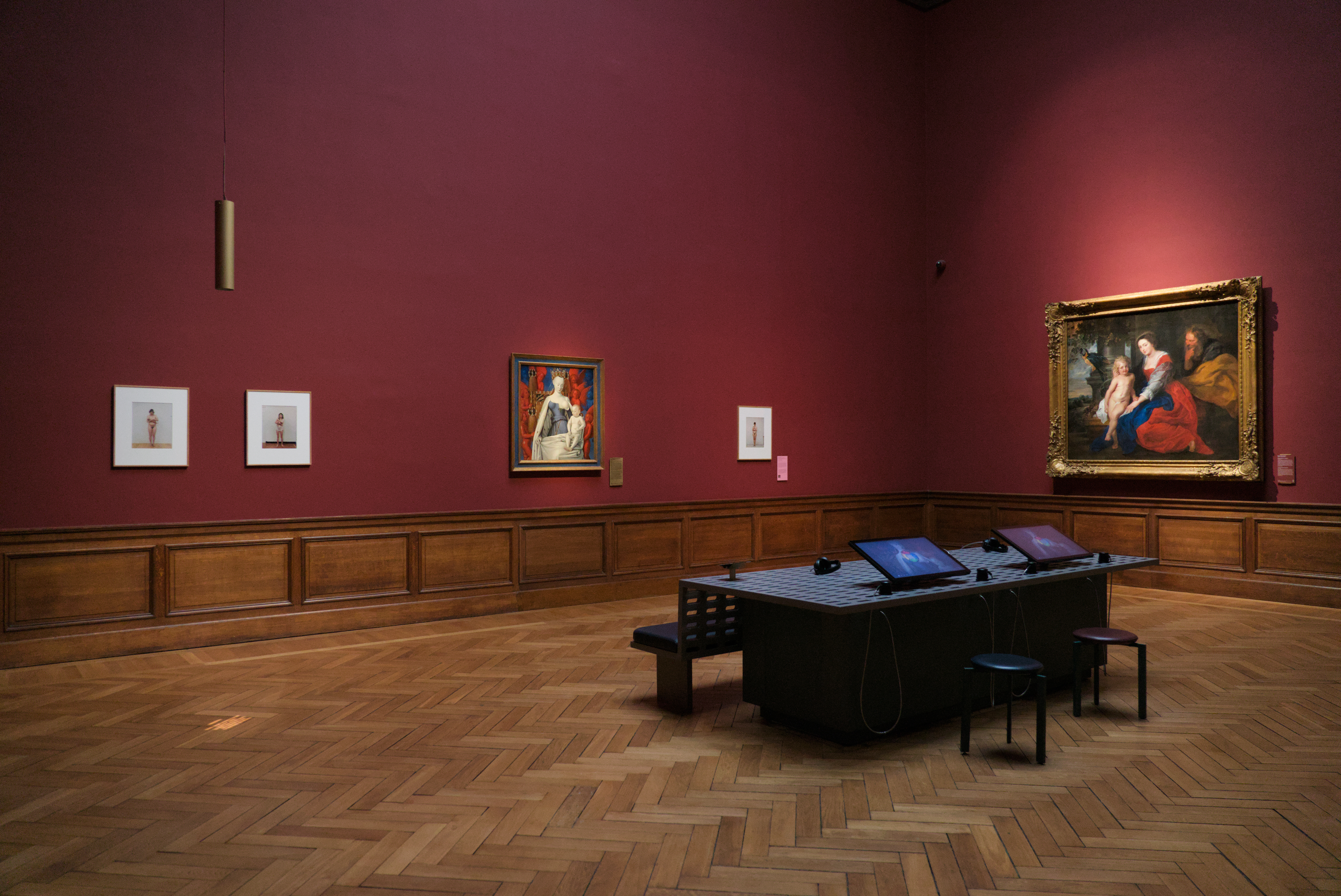
The deeply engrained portrait of motherhood embodied by the Virgin Mary is juxtaposed most potently with a series of three black-and-white portraits of new mothers by the Dutch photographer Rineke Dijkstra.
"Madonna" gallery
Gallery 2.17 (“The Madonna”) from the KMSKA exhibition Collected with Vision: Private Collections in Dialogue with the Old Masters

The accompanying text read:

Jean Fouquet portrays motherhood as something sacred. Mary as a symbol of purity and devotion is richly dressed in cool colours. Rineke Dijkstra homes in on the vulnerable reality. Her mothers are scantily clad and marked by childbirth. Both works are innovative: Fouquet may have painted his Mary for the first time from a real person, and in its day the painting was regarded as ‘modern’. Dijkstra shows motherhood in all its rawness, a taboo usually withheld from view.
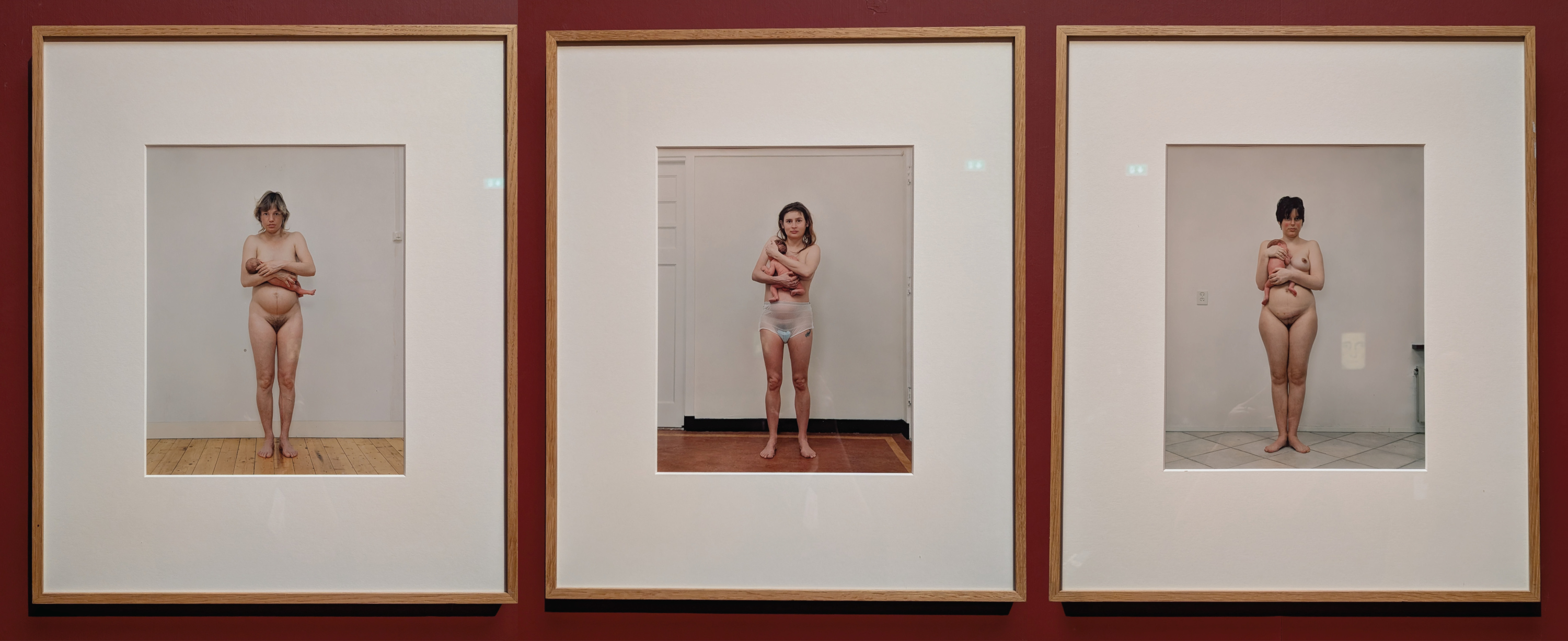
Dijkstra, Rineke_New Mothers
Rineke Dijkstra (Dutch, 1959–), Tecla (Amsterdam, The Netherlands), Julie (Den Haag, The Netherlands), and Saskia (Harderwijk, The Netherlands), 1994. Digital prints. Private collection. [Composite photo by author]

Julie wears hospital pads and mesh underwear, which women often do for several weeks after giving birth to manage postpartum bleeding and urinary incontinence. As for Tecla, blood is running down her leg. And Saskia bears a scar from her cesarean section. A linea nigra (dark line) zips down the abdomen of all three, a temporary pigmentation increase caused by increased hormone levels. I love this triptych that shows motherhood’s glorious, messy, alterative impact on the body—the real physicality of the vocation of bearing children into the world.

I wish there were more imagery of Mary like this, as it would, I think, deepen the wonder of the Incarnation and enhance women’s ability to identify with Mary and thus further enliven her story.

Also in the Madonna gallery was a unique “light poetry” installation by Nick Mattan and Angelo Tijssens—one of seventeen spread throughout the second floor, collectively titled Licht dat naar ons tast (Light that reaches for us). KMSKA had commissioned this couple to bring to life the short verses the museum’s late writer-in-residence Bernard Dewulf had written in response to the galleries’ stated themes.

“Inspired by the museum’s many reading and praying figures, as well as James Ensor’s expressive hand sketches, [Mattan and Tijssens] sought a subtle way to make [Dewulf’s] words tangible,” the museum writes. Their solution was to project them onto the gallery floors from brass cylinders suspended from the ceiling. The words shine like faint specks of light, becoming legible only when a visitor holds their hands, a sweater, or something else up to the light.

Here my husband “holds” a poem written in the voice of Mary:
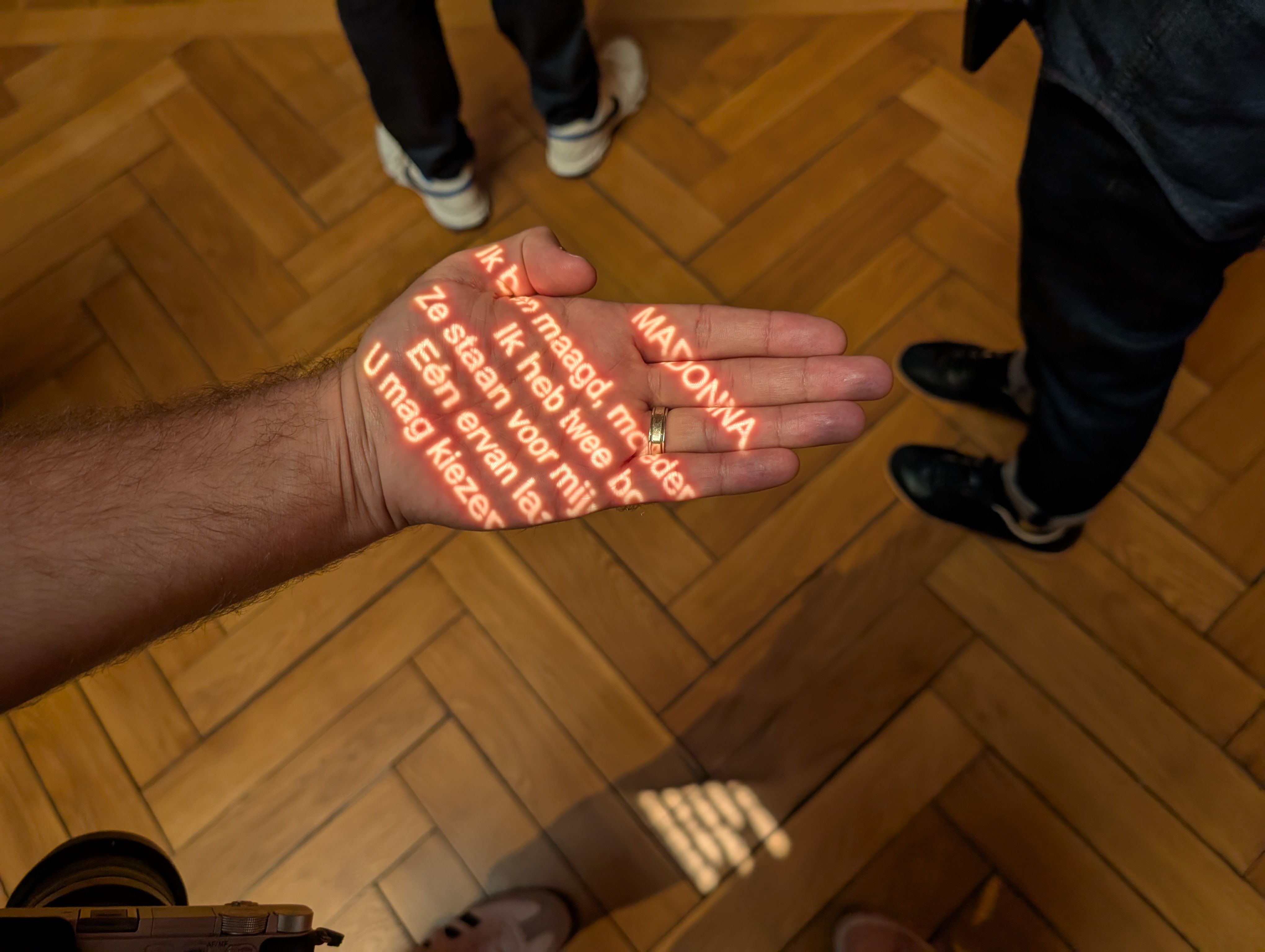
Light that reaches for us
Nick Mattan (Belgian, 1987–) and Angelo Tijssens (Belgian, 1986–), Licht dat naar ons tast (Light that reaches for us), 2023, featuring seventeen poems by Bernard Dewulf. Commissioned by and permanently installed at the Koninklijk Museum voor Schone Kunsten Antwerpen (KMSKA, Royal Museum of Fine Arts Antwerp).

“Madonna” by Bernard Dewulf

Virgin, mother, wife –
I have two breasts
that stand for my three souls.
I show you one of them,
and whose it is is yours to choose.

Translated from the original Dutch by David Colmer

Kind of cheeky! Dewulf speaks of Mary’s three identities and lets us decide if the breast she bares in Fouquet’s painting represents her naked innocence, her nurturing impulse, or her desire to please her husband. (Traditionally in art, it has always stood for the second.)

Though I can’t read Dutch and thus had to consult the KMSKA app for translations of the poems, the thrill of discovery was there in each room. View other visitor engagements with Licht dat naar ons tast on Instagram.

The next gallery I entered was themed “Suffering.”
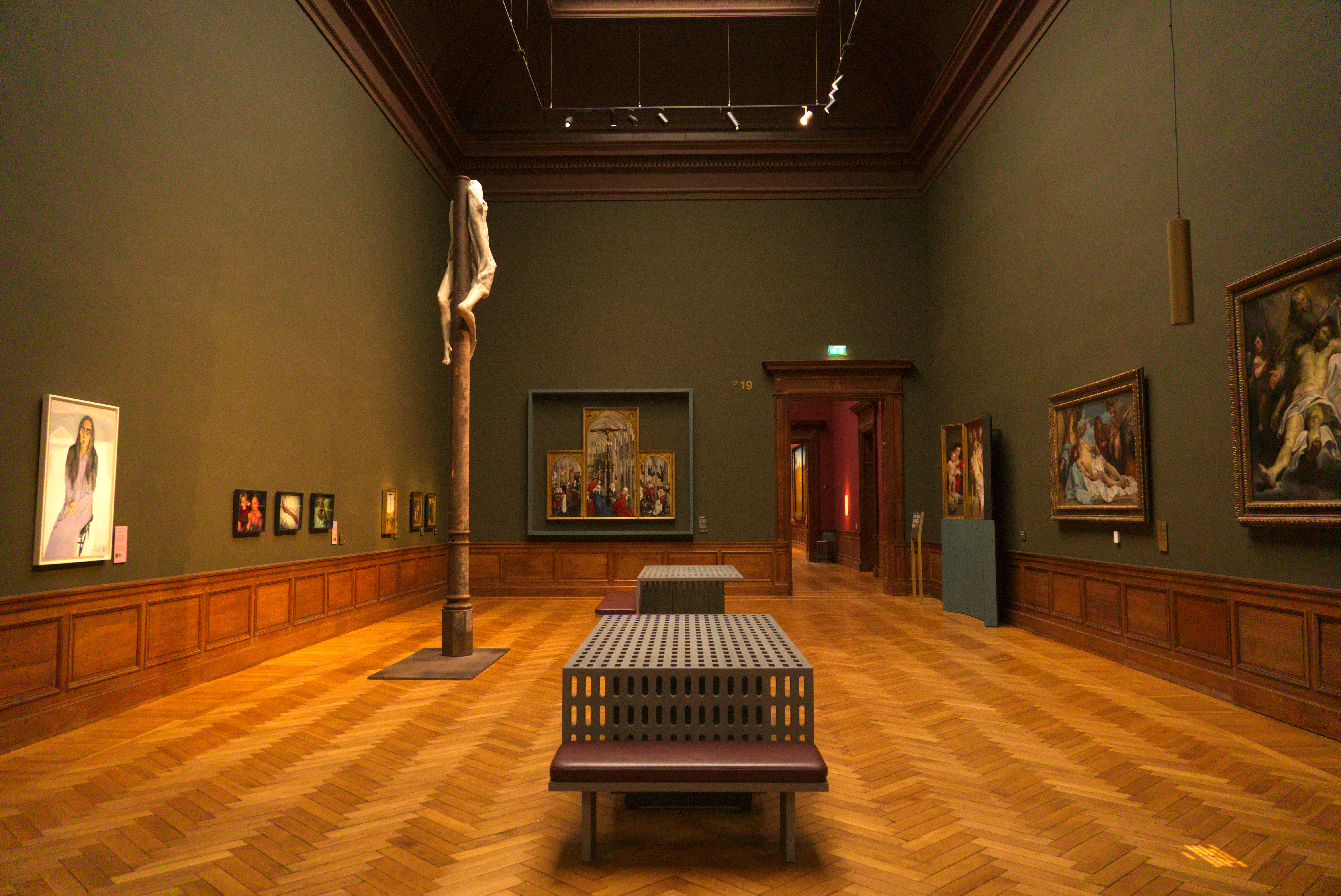
Suffering gallery
Gallery 2.19 (“Suffering”) from the KMSKA exhibition Collected with Vision: Private Collections in Dialogue with the Old Masters

As one would expect, it’s inhabited by several Old Master paintings of Christ’s passion, most notably a triptych by the Flemish Baroque artist Peter Paul Rubens.
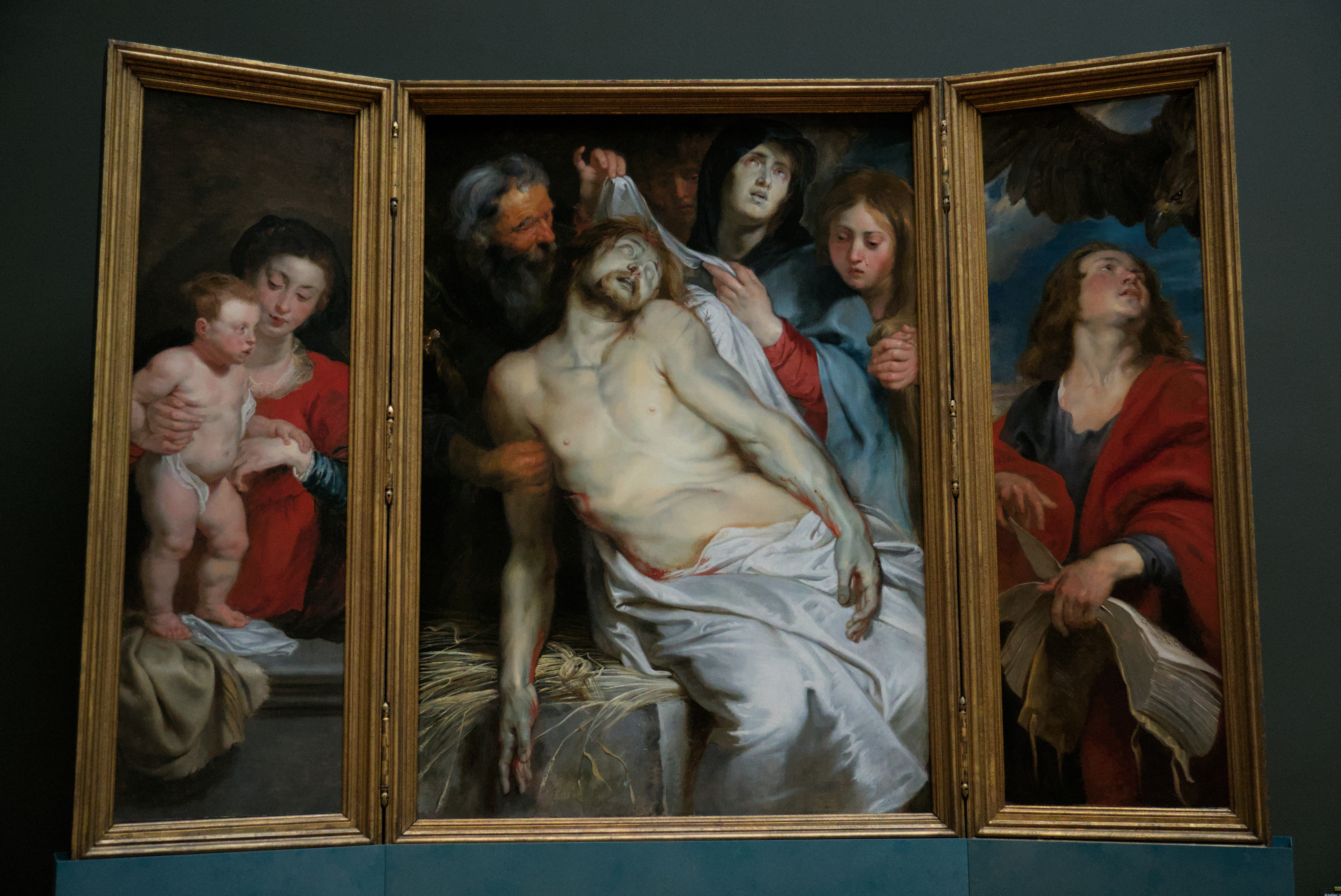
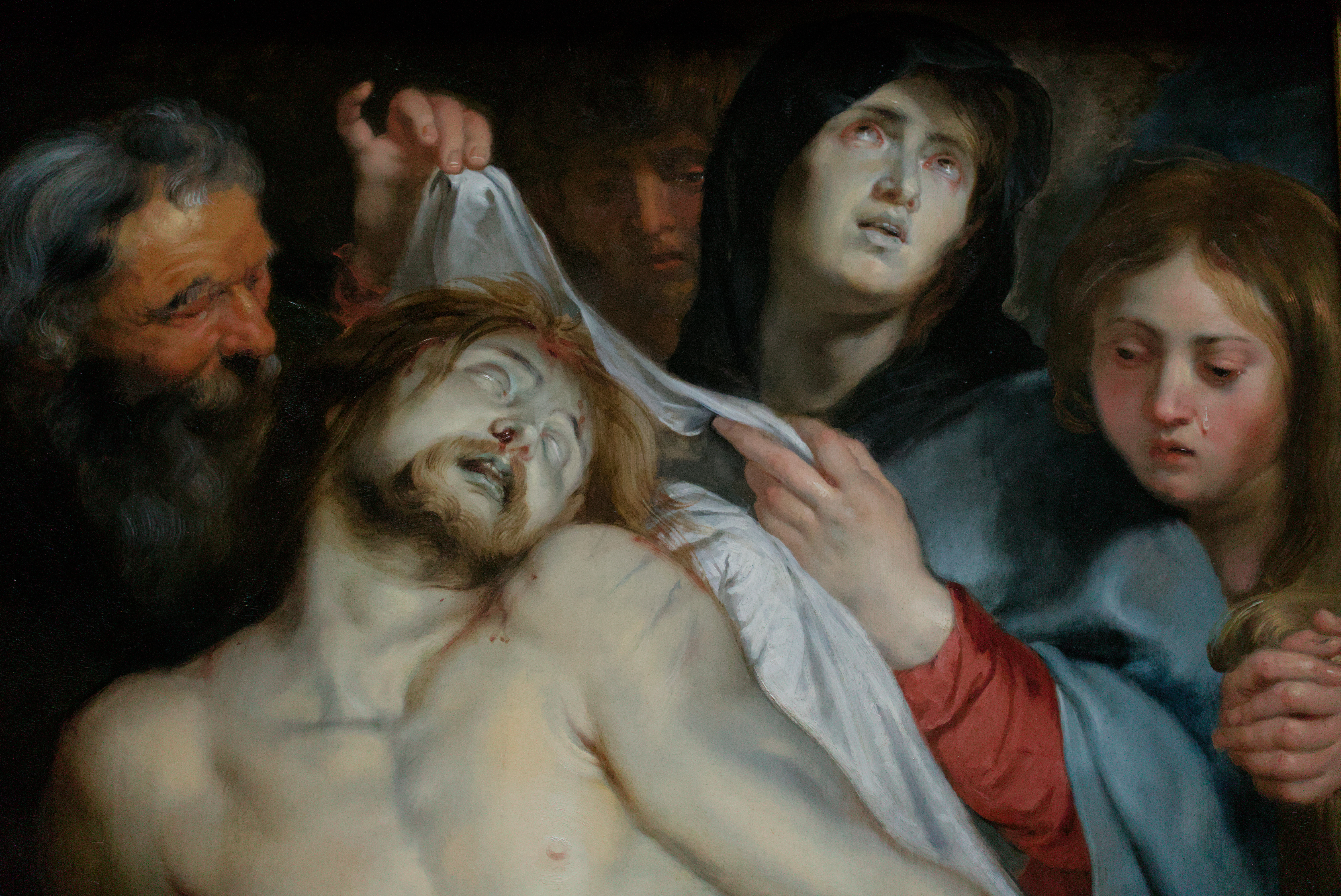
Rubens, Peter Paul_Christ on the Straw
Peter Paul Rubens (Flemish, 1577–1640), Epitaph of Jan Michielsen and His Wife Maria Maes (aka Christ on the Straw, Madonna, and Saint John), 1618. Oil on panel, 138 × 178 cm. Koninklijk Museum voor Schone Kunsten Antwerpen (KMSKA, Royal Museum of Fine Arts Antwerp).

Rubens, Peter Paul_Christ on the straw (detail)

The central panel shows the dead Christ being laid out on a marble slab and wrapped in a shroud by Joseph of Arimathea, while his mother and Mary Magdalene (and the apostle John in the background) mourn him. The left wing shows Mary supporting the pudgy little baby Jesus as he takes some of his first steps, while the right wing shows John, whose symbol is the eagle, writing his Gospel that will place Jesus’s death in the context of the larger story of his life of ministry and his resurrection.

This painting, along with Anthony van Dyck’s Lamentation over the Dead Christ and The Holy Trinity by a follower of Rubens’s (which shows God the Father cradling the dead body of God the Son in an image type sometimes referred to as the Mystic Pietà), are juxtaposed with three photographs by Nan Goldin that show the impact of AIDS on her friend, the Parisian gallery owner Gilles Dusein, and his partner, the artist Gotscho.
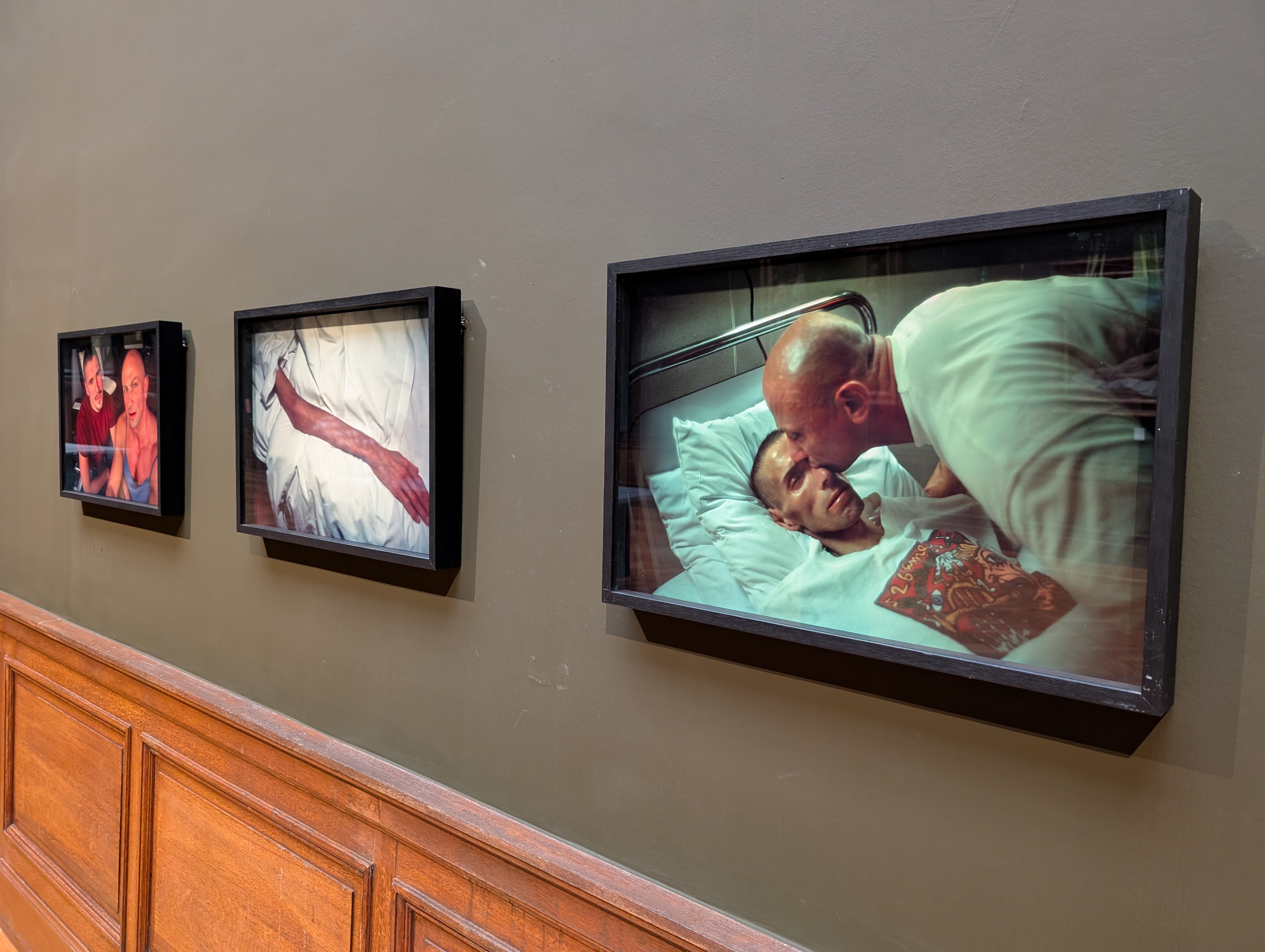
Photos by Nan Goldin
Nan Goldin (American, 1953–), Gilles in Hospital, Gilles’ Arm, and Gotscho Kissing Gilles, 1993. C-prints. Private collection.

Dusein’s emaciated arm, resting weakly on a hospital sheet, recalls the limp arm of Christ in paintings of the Deposition and Entombment; and Gotscho’s kiss, the love and grief of Jesus’s mother and friends as they watched their loved one suffer and succumb to death.

By displaying these disparate artworks from vastly different contexts across from each other, we are encouraged to draw connections between the suffering of Christ and that of the LGBTQ+ community. While Christians in Rubens’s day would sit before images of Jesus in pain or sorrow or having died a torturous and untimely death, and deepen their empathy and love, so too might we do well to sit prayerfully, humbly, empathetically, with contemporary images of suffering, seeking to enter the stories they tell.

Calvary by Antonello da Messina (another version of which is at the National Gallery in London) also hangs in this gallery. While the crucified Christ seems at peace with his death, the other two on their crosses writhe in pain.
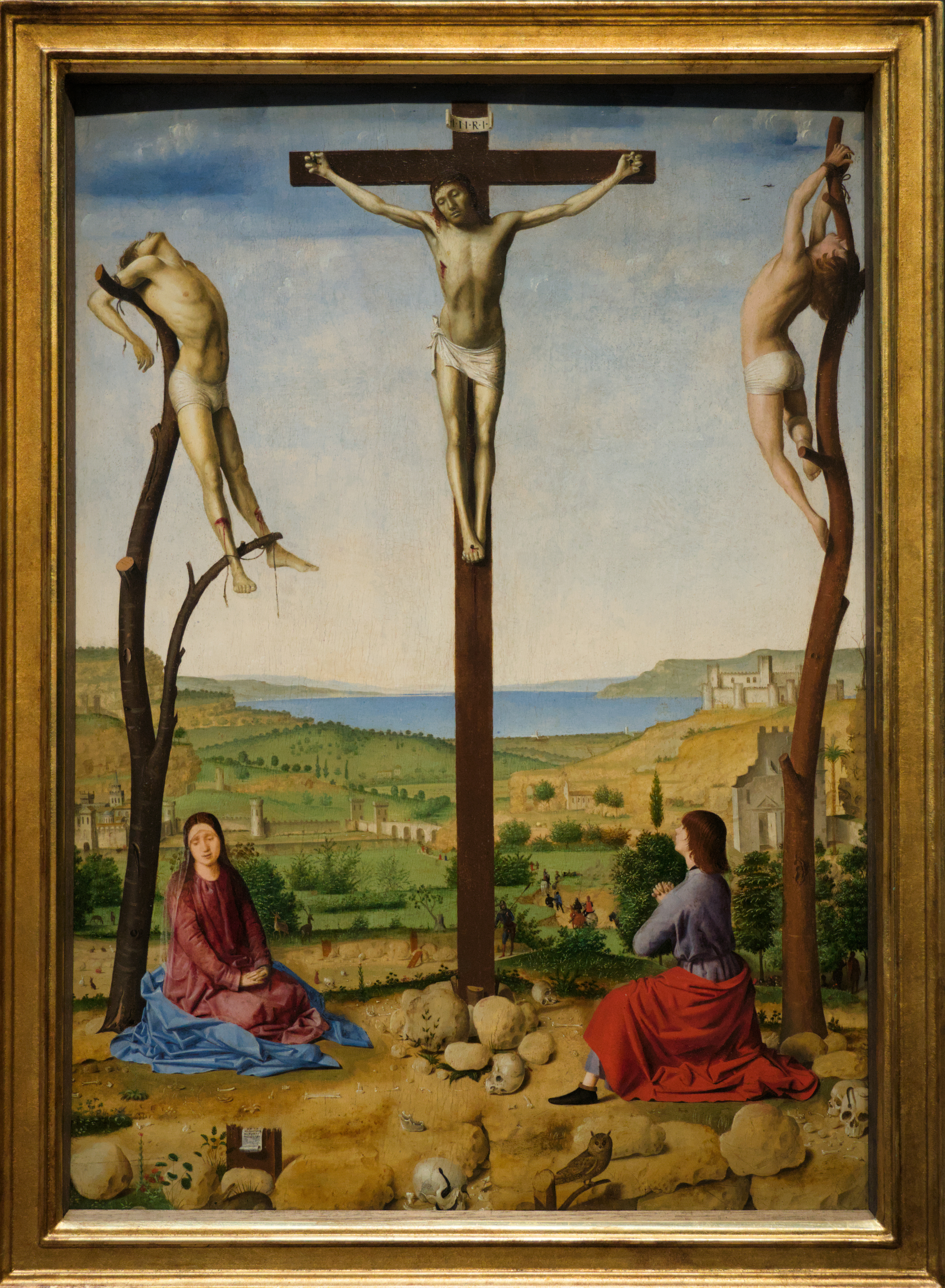
Antonello da Messina_Calvary
Antonello da Messina (Italian, 1430–1479), Calvary, 1475. Oil on panel, 52.5 × 42.5 cm. Koninklijk Museum voor Schone Kunsten Antwerpen (KMSKA, Royal Museum of Fine Arts Antwerp).

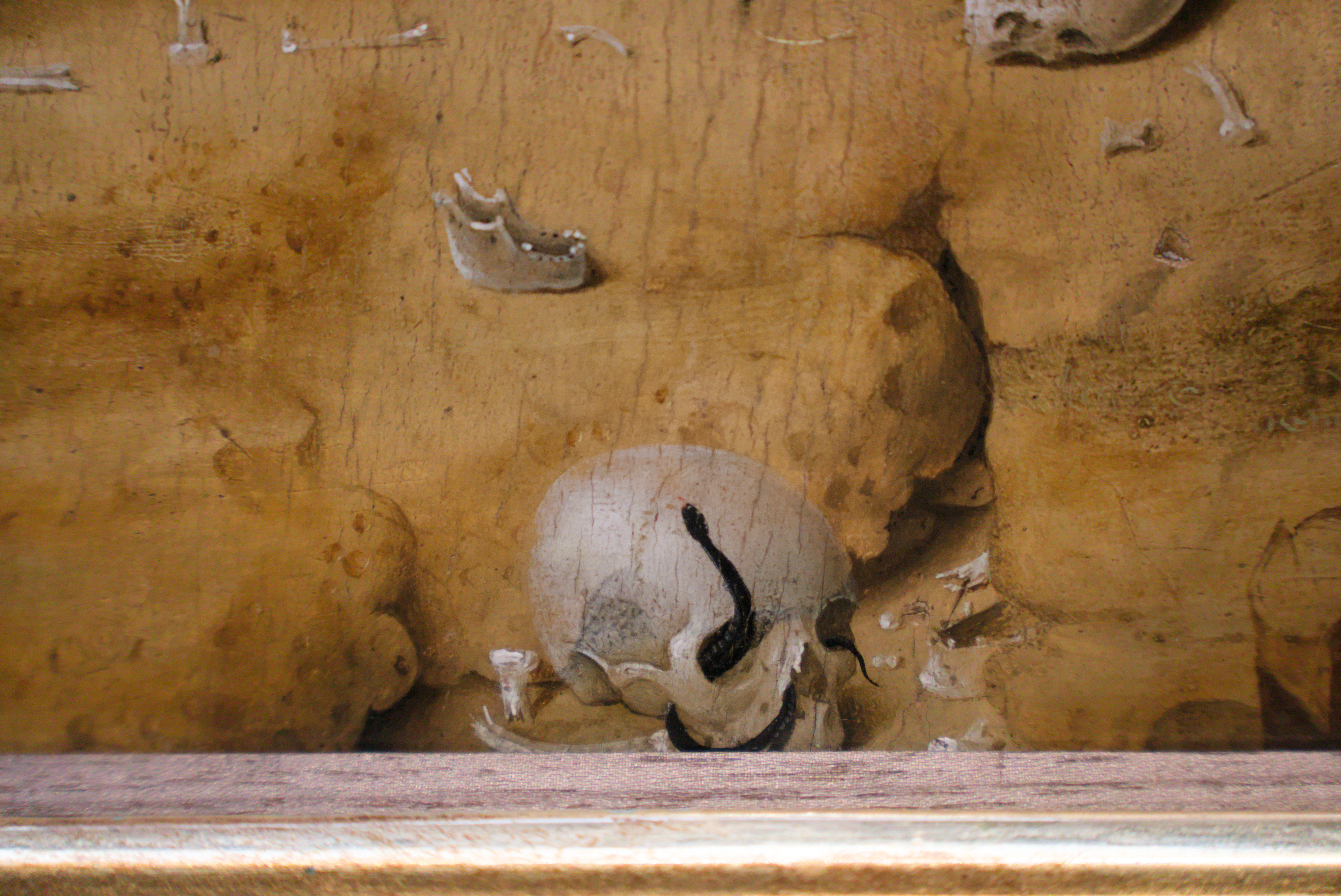
Antonello da Messina_Calvary (detail)

Compare these figures to contemporary Belgian artist Berlinde de Bruyckere’s Schmerzensmann (Man of Sorrows), on loan from the collection of David and Indré Roberts (see wide-view photo above). The piece consists of a wax and resin mold of a contorted human form, its skin stretched and broken, its legs wrapped around a tall rusty pole.

“Man of Sorrows” is also the title of an Early Netherlandish painting by Albrecht Bouts and a modern painting by James Ensor, which KMSKA displays side-by-side.
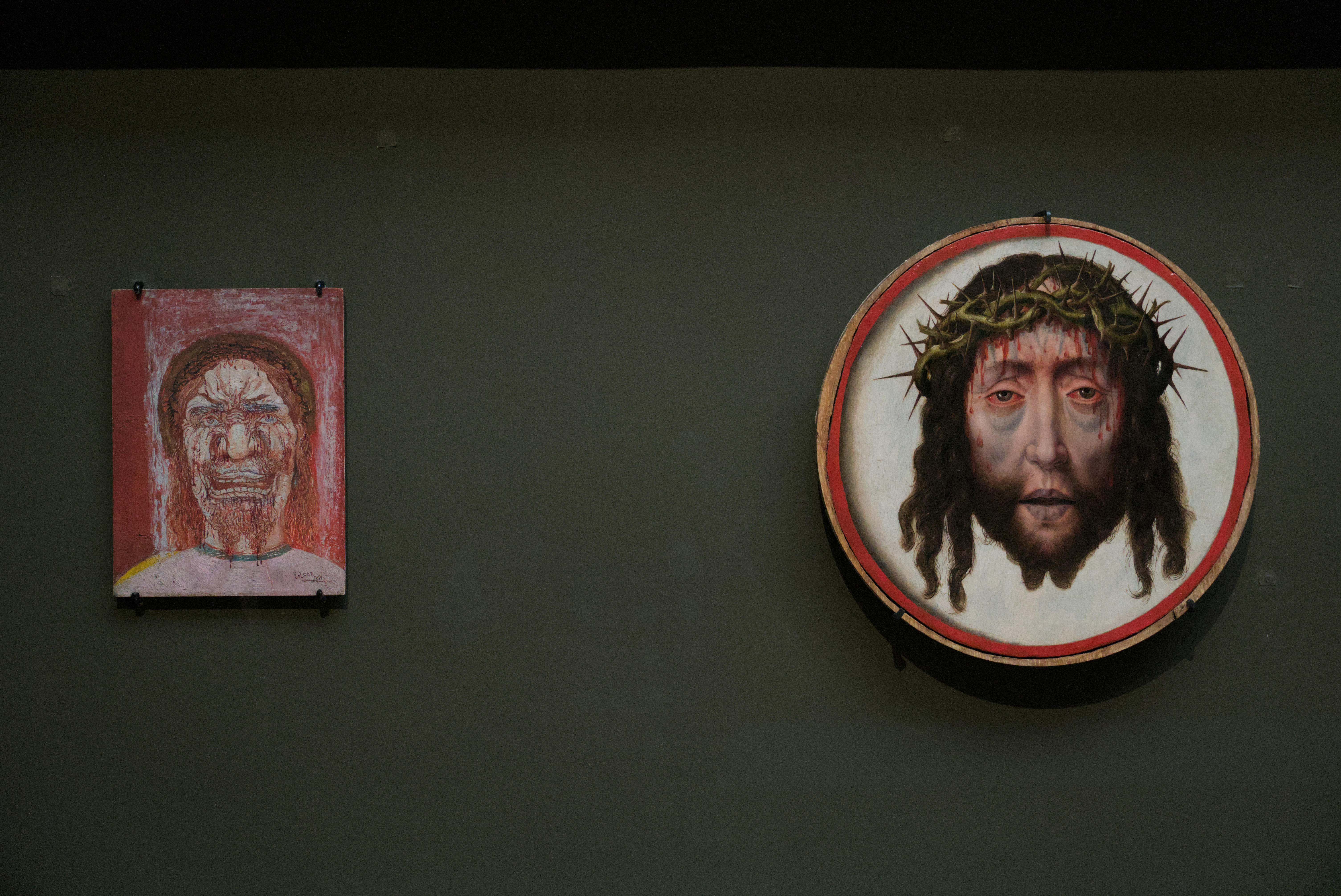
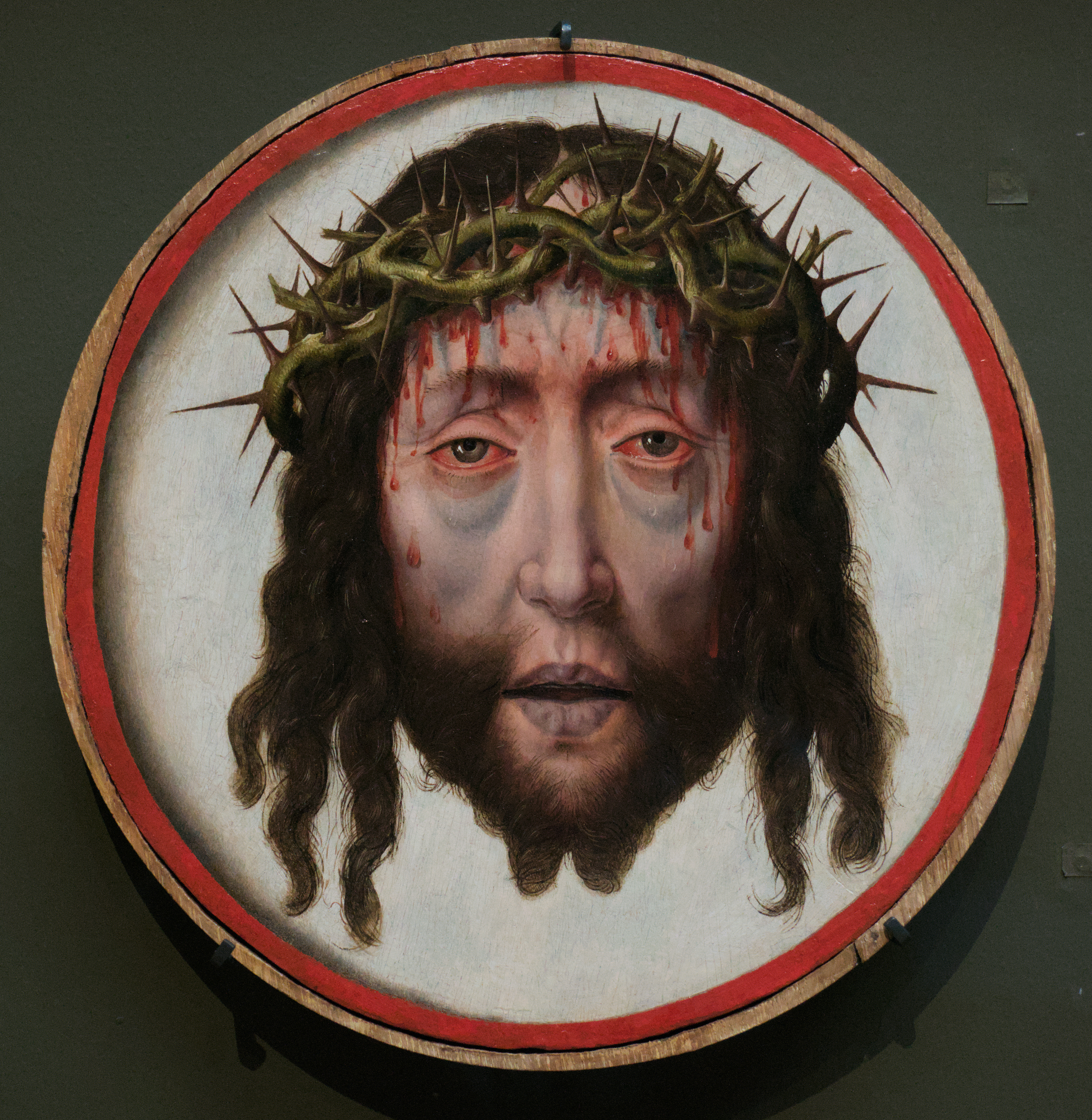
Bouts, Albrecht_Man of Sorrows
Albrecht Bouts (Flemish, 1451/55–1549), Man of Sorrows, 1500–1525. Oil on panel, diameter 29 cm. Koninklijk Museum voor Schone Kunsten Antwerpen (KMSKA, Royal Museum of Fine Arts Antwerp).

The earlier one is an incredibly moving image of pathos. Christ wears a thick, twisted, mock crown whose thorns dig holes into his forehead and draw blood. His eyes are red with tears and sunken in, and his lips are turning blue with the pallor of death. I find it quite beautiful, insofar as an image of suffering can be beautiful. (That’s a topic for another day.)
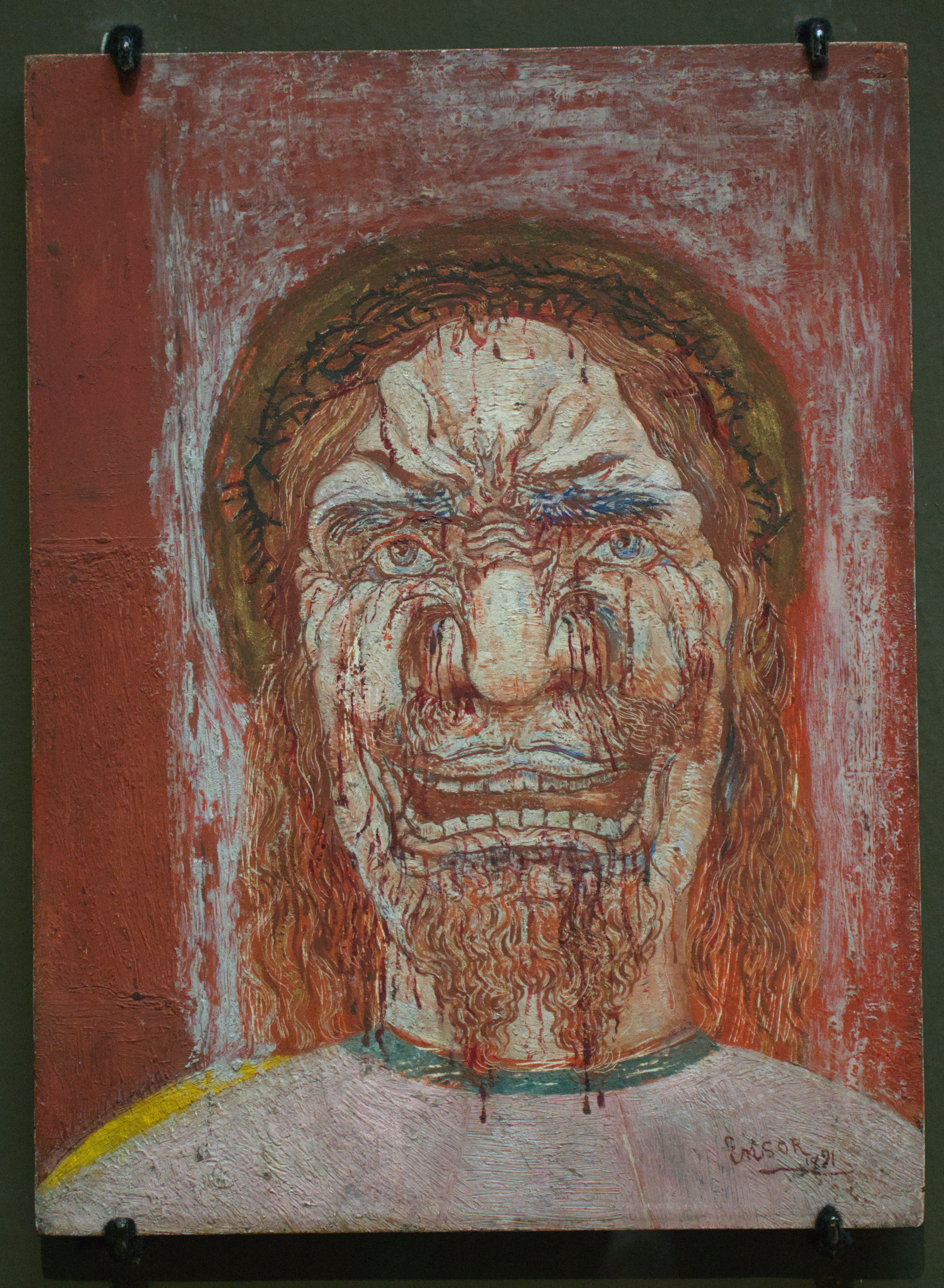
Ensor, James_Man of Sorrows
James Ensor (Belgian, 1860–1949), Man of Sorrows, 1891. Oil on panel, 20 × 15.5 cm. Koninklijk Museum voor Schone Kunsten Antwerpen (KMSKA, Royal Museum of Fine Arts Antwerp).

The Ensor painting, on the other hand, is decidedly not beautiful. In fact, I think it’s the ugliest image of Christ I’ve ever seen, with his crumpled face, scraggly hair, and bared teeth. There’s something very unsettling about his expression, and no wonder, as the curatorial text informs that Ensor drew inspiration from the masks of demon characters in Japanese theater. “His [Ensor’s] Jesus screams with rage about the injustice inflicted on him,” the label says. Is that what that expression is? To me he looks sinister. Like he’s growling at us. And I dislike his dinky crown that he wears like a headband; give me Bouts’s gnarly one instead.

I’m in favor of Christ images that show the rage he must have felt, but I don’t think Ensor is successful if that was his aim. To name a few modern artists who were: Guido Rocha (Tortured Christ, 1975) and David Mach (Die Harder, 2011), both of whom capture Jesus’s cry of dereliction on the cross.

The final themed gallery I’ll call out is “Heavens.”
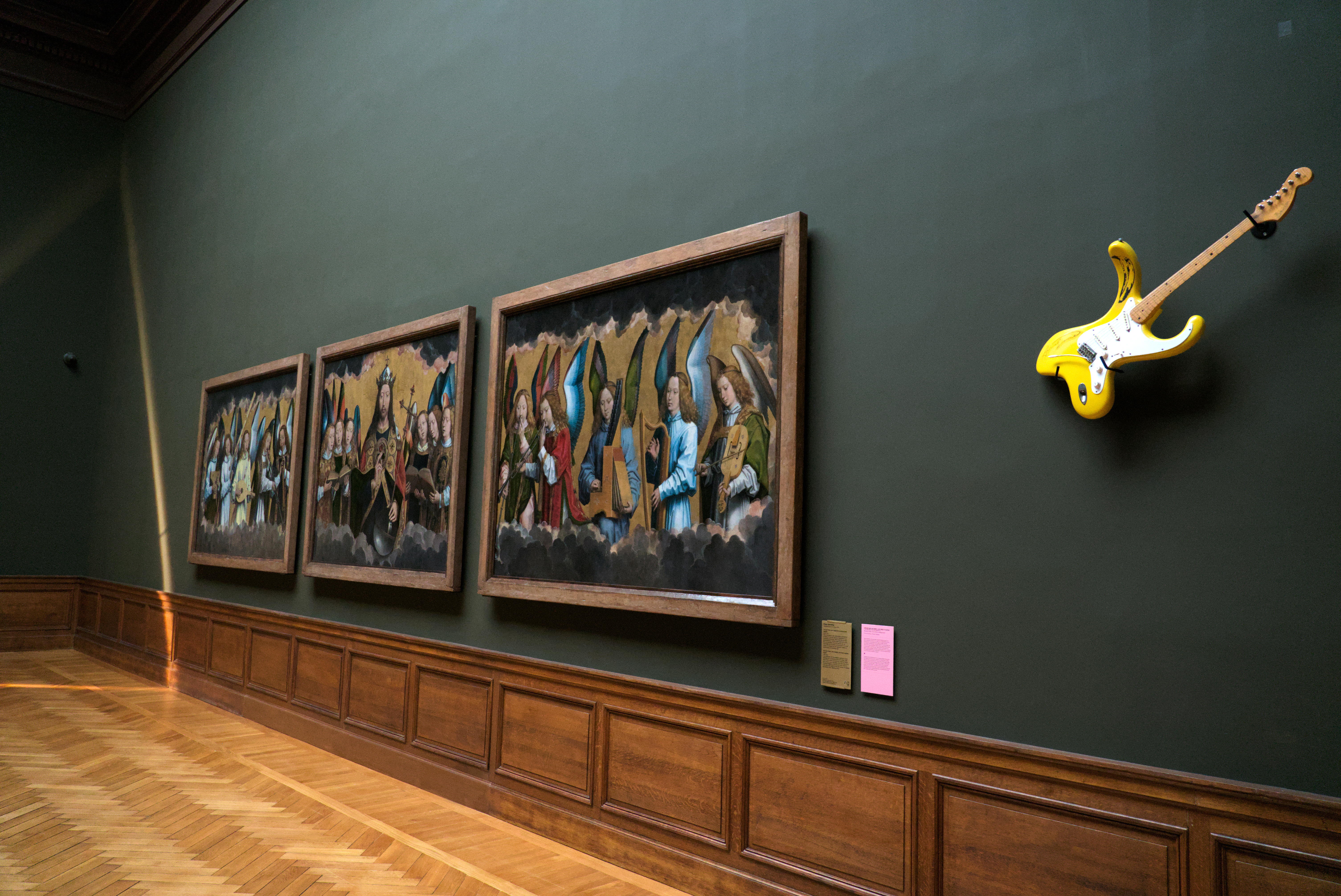
Heavens gallery
Gallery 2.22 (“Heavens”) from the KMSKA exhibition Collected with Vision: Private Collections in Dialogue with the Old Masters

The dominant Old Master work is a set of three panels from the upper tier of a colossal altarpiece that Hans Memling painted for the church at the Benedictine Abbey of Santa Maria la Real in Najera in northern Spain. All the other panels are lost.

The museum titles the central panel God the Father with Singing Angels—but I think the figure is more properly God the Son, Jesus Christ, portrayed as Salvator Mundi (Savior of the World). In his left hand he holds a cross-surmounted crystal globe, signifying his dominion over the earth, and with the other hand he gestures blessing. He wears a tiara and a red cope decorated with gold-thread embroidery, pearls, and precious stones, and his collar bears the words Agyos Otheos (Holy God).
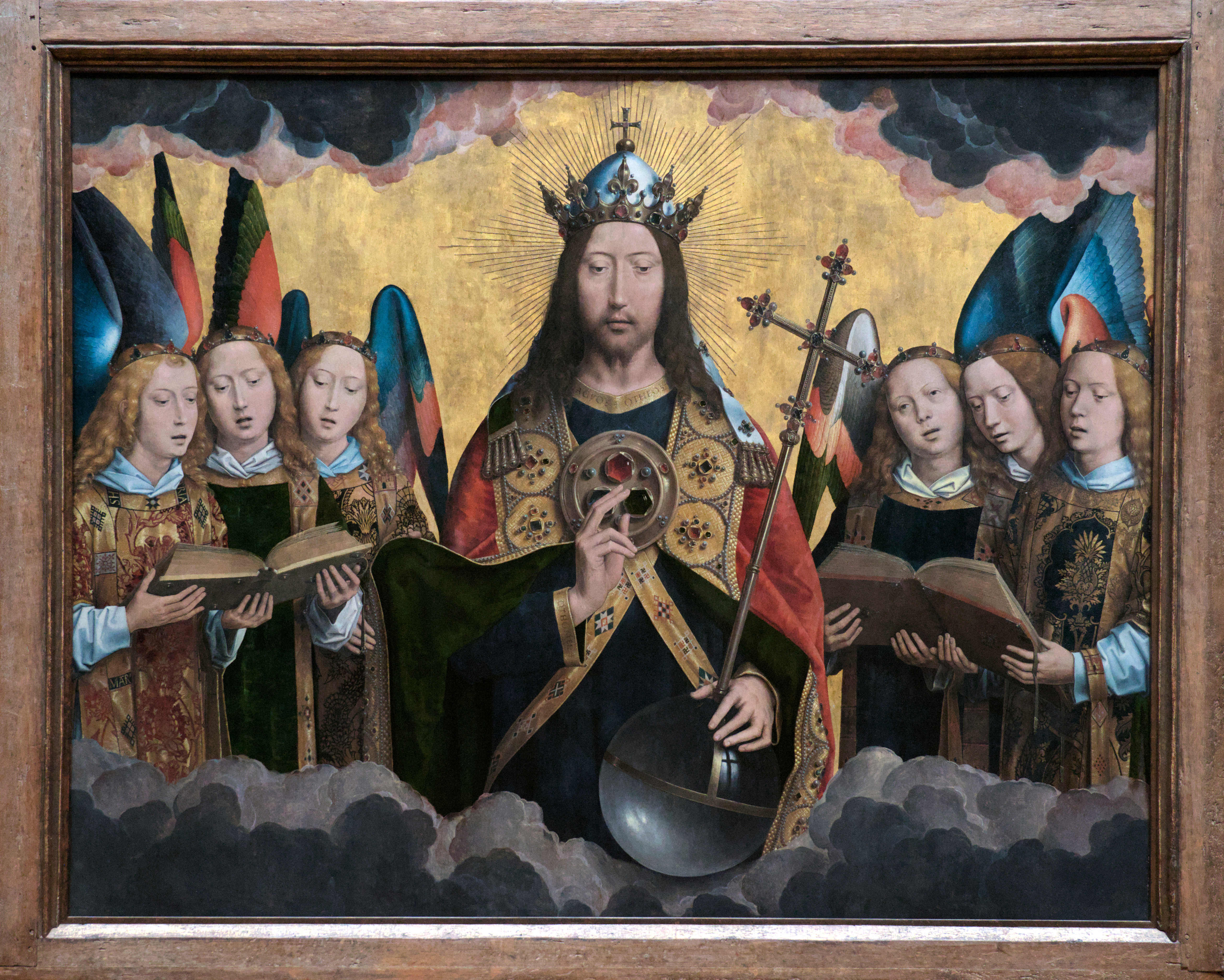
Memling, Hans_God the Father with Singing Angels
Hans Memling (German Flemish, ca. 1430–1494), God the Father with Singing Angels, 1483–94. Oil on panel, 164 × 212 cm. Koninklijk Museum voor Schone Kunsten Antwerpen (KMSKA, Royal Museum of Fine Arts Antwerp).

Surrounding him is a musical band of angels, singing his praises from songbooks and, in the flanking panels, playing a variety of wind and string instruments: (from left to right) a psaltery, a tromba marina, a lute, a trumpet, a shawm, a straight trumpet, a looped trumpet, a portative organ, a harp, and a fiddle.
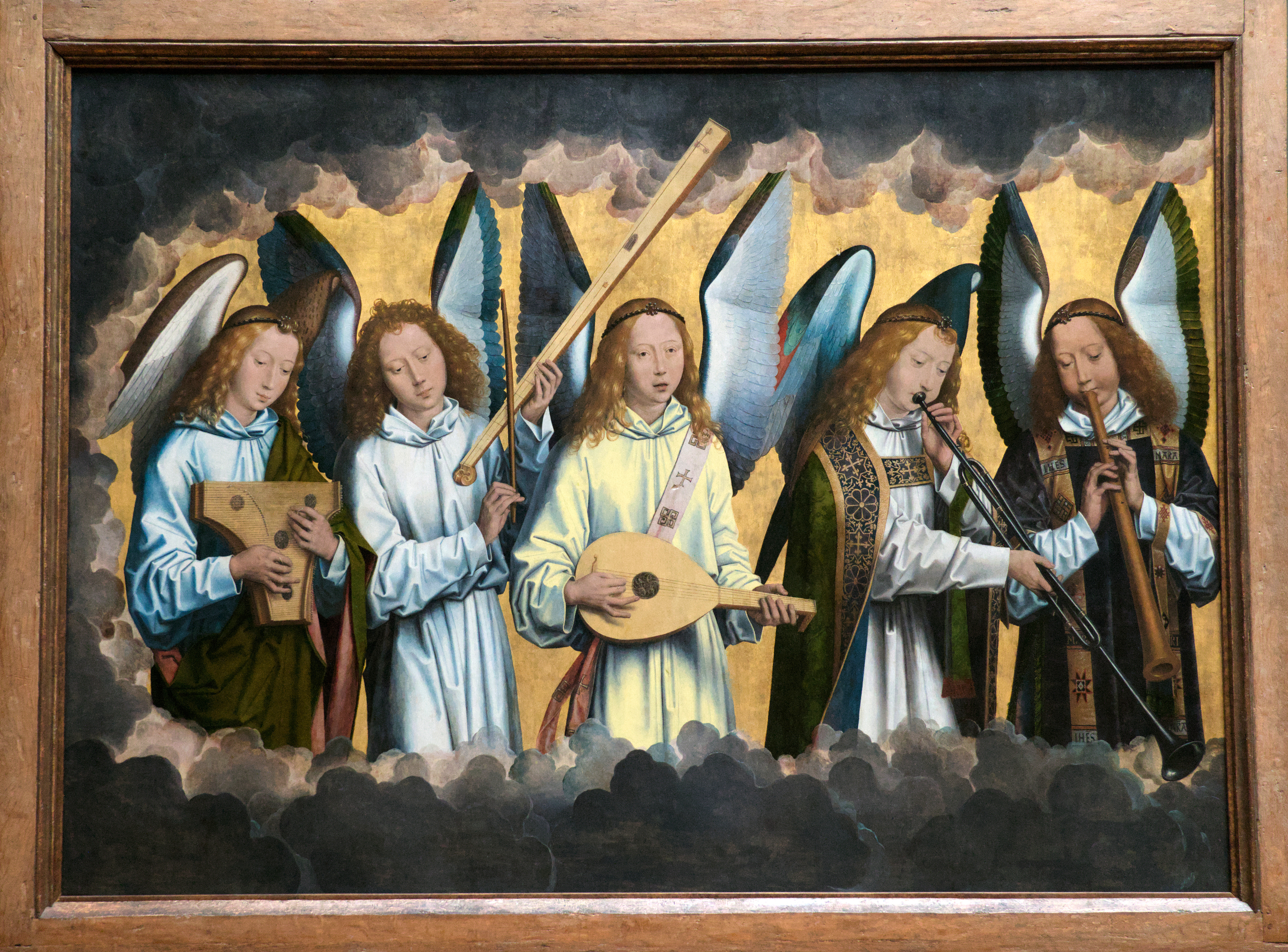
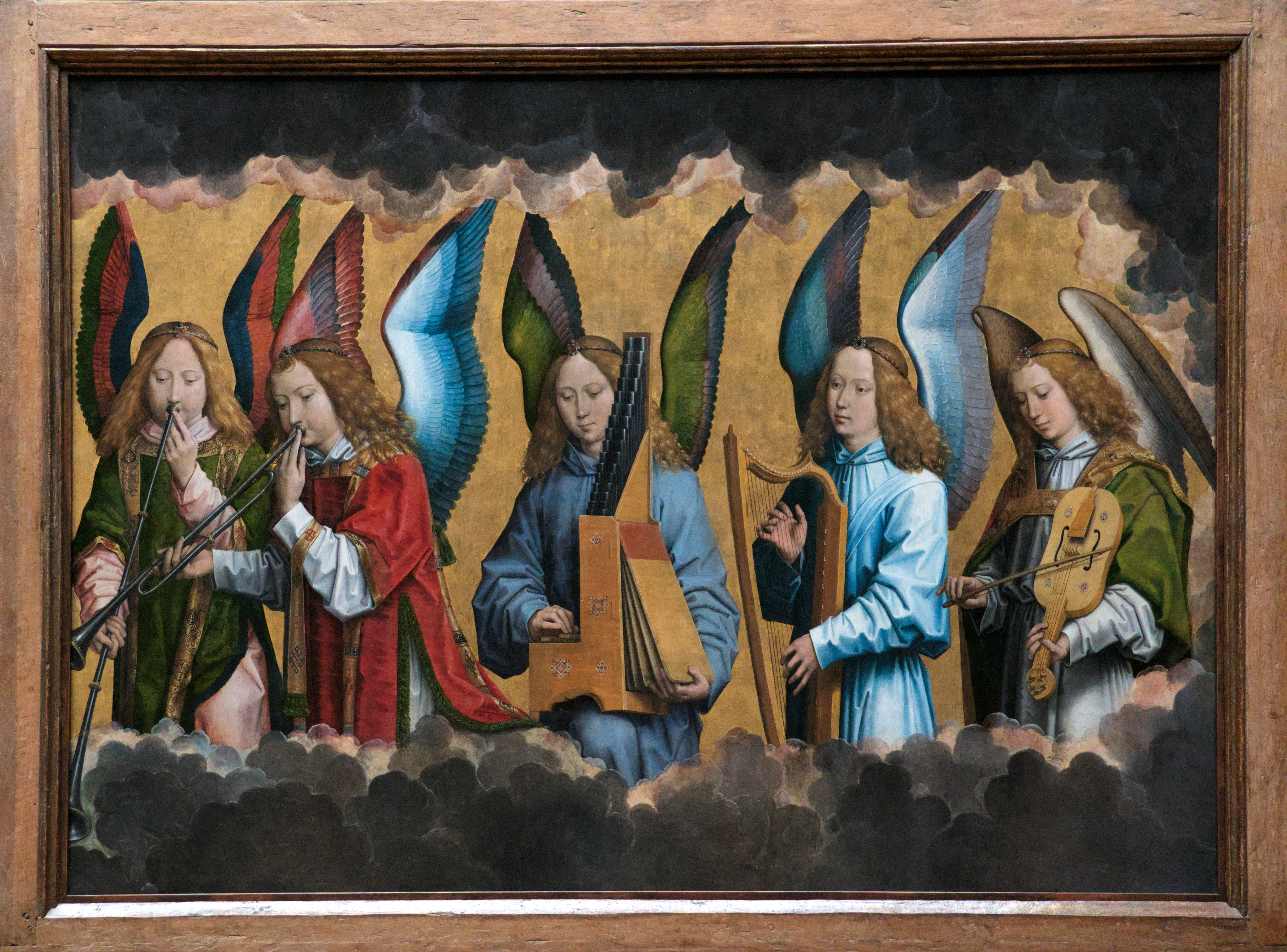
Memling, Hans_Music-Making Angels
Hans Memling (German Flemish, ca. 1430–1494), Music-Making Angels (left), 1483–94. Oil on panel, 165 × 230 cm. Koninklijk Museum voor Schone Kunsten Antwerpen (KMSKA, Royal Museum of Fine Arts Antwerp).

Memling, Hans_Music-Making Angels
Hans Memling (German Flemish, ca. 1430–1494), Music-Making Angels (right), 1483–94. Oil on panel, 165 × 230 cm. Koninklijk Museum voor Schone Kunsten Antwerpen (KMSKA, Royal Museum of Fine Arts Antwerp).

This ensemble probably evokes for you a particular sound—something like Tallis or Palestrina—soaring polyphonic vocals, a gentle yet majestic accompaniment. But instead, a different soundtrack played, audibly, in the room: songs from the 1967 debut album of the American rock band the Velvet Underground, several of which use religious language to describe the experience of doing drugs. “Heroin” opens like this:

I don’t know just where I’m going
But I’m gonna try for the kingdom, if I can
’Cause it makes me feel like I’m a man
When I put a spike into my vein

And I’ll tell you things aren’t quite the same
When I’m rushing on my run
And I feel just like Jesus’ son

This aural element was complemented, on the gallery wall, by the guitar of Lou Reed, the band’s lead singer and songwriter. It’s signed by Andy Warhol, who produced and championed the Velvet Underground & Nico album and made its banana cover art, replicated on the instrument.
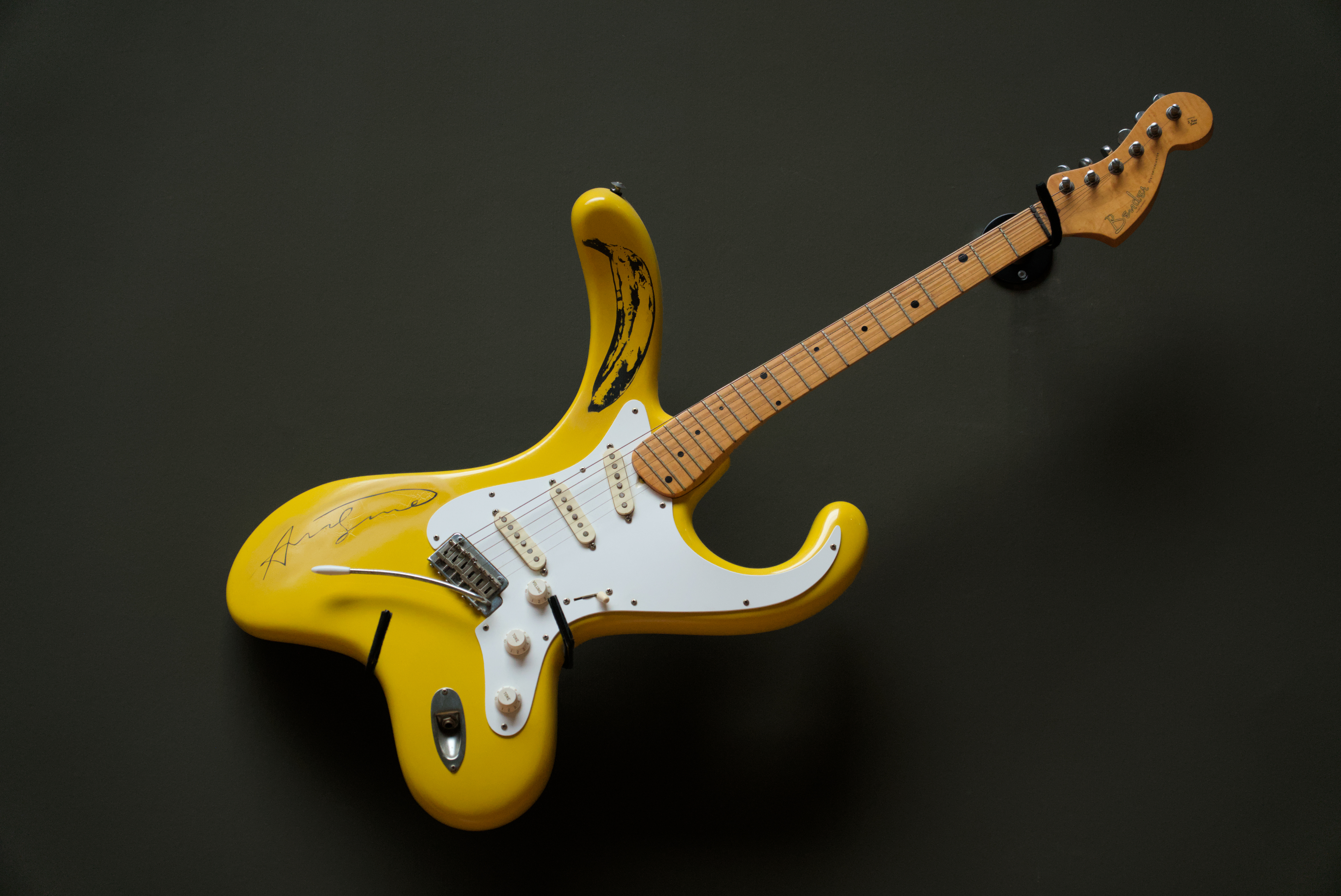
Lou Reed's guitar
Lou Reed’s “Banana Guitar,” from a private collection

Adding to the mix, in the corner of the room was an installation by the Copenhagen-born and -based artist Olafur Eliasson, called Lighthouse Lamp. “Affixed to a tripod, a lamp situated within a Fresnel lens—a compact lens which was developed for lighthouses—emits a band of white light in 360 degrees,” the artist’s website explains. In this space, the beam takes on a triangular shape.
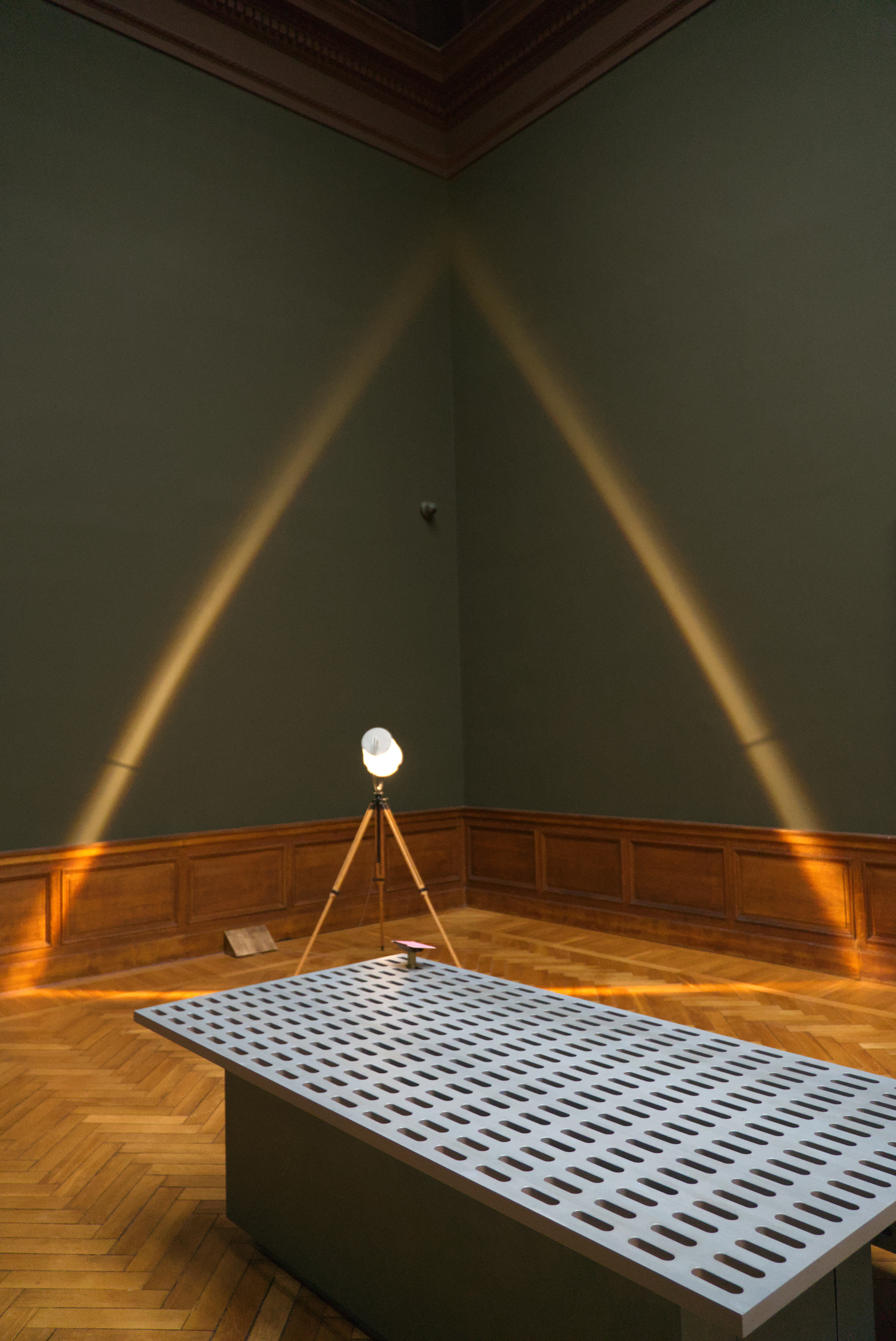
Eliasson, Olafur_Lighthouse Lamp
Olafur Eliasson (Icelandic Danish, 1967–), Lighthouse Lamp, 2004. Mixed media. Collection of Filiep and Mimi Libeert.

There was also an altarpiece of The Last Judgment and the Seven Acts of Mercy by Bernard van Orley, which references Jesus’s teaching in Matthew 25 about one’s entry into heaven being contingent on whether, in this life, you feed the hungry, give shelter to the homeless, visit the prisoner, and so on.

The “Heavens” gallery begs the question: How does one define “heaven”? Is it a physical place? A state of mind? An encounter? I think of related words like bliss, beatitude, communion, the sublime.

The celestial scene painted by Memling—and remember, it’s only partial, as the rest is missing—is beautifully rendered, but it also encapsulates what has become the popular cliché of heaven: angels on clouds, strumming harps, and a regal God swaying his scepter. Music-making, angelic beings, and the reign of God are all certainly a part of how the Bible describes heaven. But it’s also so much more. It’s a garden and a city. It’s healing and restoration. It’s the righting of wrongs. It’s all things made new. It’s jubilee. It’s a wedding—deep and lasting union between God and humanity. It’s an eternal interlocking of God’s space and ours (earth). It’s a global, transhistorical community of faith, gathered together around Christ their head, worshipping him in diverse languages, musical styles, dances, and other cultural expressions. It’s the culmination of the greatest story ever told.

Today, Memling’s vision of heaven probably fails to captivate most people, even Christians. So it’s an interesting experiment to compare it to how others conceive of the concept.

Eliasson’s Lighthouse Lamp wasn’t a commission on or explicit treatment of the theme, but the curator saw fit to place it beside Memling, because heaven is often conceived of as a light-filled space, and light can evoke the divine. For this reason, Memling painted his background gold. What’s more, the three-sidedness of Eliasson’s light beam may, for some, evoke the Trinity, the classical Christian doctrine of Father, Son, and Holy Ghost that Memling alludes to with the three precious stones on the fibula of Christ’s mantle.

Still, other folks experience what could be termed “heavenly” transcendence through the use of mind-altering substances, as did the members of the Velvet Underground, whose drug trips gave birth to their experimental music—which, in turn, has taken others to a transcendent place.


Whether in special exhibitions or displays of their permanent collections, I want to see more of this in museums: bringing old and new artworks into conversation with one another around universal themes, in the same room. (In some museums, the labels sometimes cross-reference works in other galleries, but that’s not the same.) Although there are benefits to the traditional approach of laying out art chronologically to give you discrete pictures of different historical eras and allow you to progress by time period, a thematic approach that compiles works from across time also has its benefits.

I’ve found cross-temporal art displays to be especially vitalizing, because instead of trying to tell history, they more naturally invite personal reflection and tend to be less academic in tone. Such an approach makes the art accessible to a larger number of people, especially those who don’t frequent museums. It helps us see the relevance of the Old Masters (or whatever the museum’s collection focus) for today—how the subjects they depicted often address topics or questions we still ask or wonder about or that reflect aspects of the common human experience, such as joy, suffering, family, death, betrayal, or festivity. Creating relationships between works made centuries apart, highlighting similarities and differences, can give us a broader perspective.

And for this museumgoer (pointing at myself) who is attracted to medieval and early Renaissance art and sometimes bypasses the contemporary galleries, the integrative approach is more engaging. Giving contemporary works a point of connection with the works I’m already inclined to like helps me enter into them more easily and fruitfully, and I’m more likely to spend time with them than if they were segregated.

New and old don’t have to be equally represented—Kolumba skews heavily contemporary, whereas KMSKA lets its strengths shine with the Old Masters, and yet the occasional unexpected intervention from years past or future always caused me to pause and be curious. Over the last several years I’ve been noticing other museums engaging in similar playful exchange—plopping a contemporary work into the medieval section, or vice versa, in a way that provides some kind of illumination.

This was my first and only visit to KMSKA, and as I understand, there’s not the same degree of intermixing of old and new year-round; this was a special exhibition that brought in contemporary works from outside, as the institution itself owns very few. But they did do something similar last year with the exhibition What’s the Story?, and the dangling light poems by Bernard Dewulf are a permanent fixture in the Old Masters galleries.

Have you been to a museum where works from different time periods were displayed side-by-side to create a discourse, and if so, did that choice enhance your engagement, insight, or appreciation? I’d love to hear what other museums are doing this!


This article took me some forty hours to write and to select and edit photos for. If you appreciate learning about my museum experiences and having access to high-resolution, downloadable art images, would you please consider adding to my “tip jar” (PayPal), or sponsoring a book from my Amazon wish list? Thank you!

Advent, Day 4: “The baby in the manger upholds the universe”

In these last days [God] has spoken to us by a Son, whom he appointed heir of all things, through whom he also created the worlds. He is the reflection of God’s glory and the exact imprint of God’s very being, and he sustains all things by his powerful word.

—Hebrews 1:2–3

“The Spirit of the Lord is upon me,
    because he has anointed me
        to bring good news to the poor.
He has sent me to proclaim release to the captives
    and recovery of sight to the blind,
        to set free those who are oppressed,
to proclaim the year of the Lord’s favor.”

Today this scripture has been fulfilled in your hearing.

—Jesus’s first public teaching in Nazareth (see Luke 4:16–21), quoting from Isaiah 61

LOOK: Niño Jesus santo

Niño Jesus
Niño Jesus, Puerto Rico, 18th century. Carved and painted wood and metal, 13 3/8 × 5 1/2 × 4 3/8 in. (34 × 14 × 11.2 cm). Smithsonian American Art Museum, Washington, DC.

“Devotional figures of the infant Jesus became popular in Puerto Rico during the seventeenth and eighteenth centuries,” writes Yvonne Marie Lange in her 1975 PhD dissertation, Santos: The Household Wooden Saints of Puerto Rico. “An unknown craftsman carved this small figure in the act of benediction, or blessing, with an orb in his left hand to symbolize God’s dominion over the earth.” (He’s got the whole world in his hands!) This is a baby Salvator Mundi, “savior of the world.” He is naked to emphasize his full humanity. The three flame-like shapes around his head create a cross and represent the light of God emanating from him.

LISTEN: “The Spirit of the Lord” by Katie Ribera, 2019 [chord chart]

Just as Isaiah
The prophet has foretold
A sprout from Jesse’s root
Into a tree shall grow
This sprout shall bloom
Into a mighty tree of life
Its fruit will feed us
And its source will be our light

The Spirit of the Lord
Will come to dwell with us
A righteous judge
A mighty counselor
And by the word
Of his everlasting power
The baby in the manger
Upholds the universe
The baby in the manger
Upholds the universe

For in him all the fullness
Of God was pleased to dwell
And through him
To reconcile all things to himself
Have you ever seen
A wolf and a lamb lie down together?
Can there ever be peace like this
Between enemies?
Can there ever be peace like this
Between enemies?
Would God dare to descend
To come live with his enemies?

The Spirit of the Lord
Will come to dwell with us
Put on flesh
Make peace for us with God
And by the word
Of his everlasting power
The baby in the manger
Upholds the universe
The baby in the manger
Upholds the universe

Then I saw heaven open
And behold
A white horse with its rider
Righteousness his clothes
With eyes that burn like fire
And a crown atop his head
Robes dipped in blood
That he himself willingly shed
Yet I had no doubt
I still recognized his face
Son of God, Son of Man
Glorious grace

King of kings and Lord of lords
Messiah, Christ, the Word of God
King of kings and Lord of lords
Messiah, Christ, the Word of God
King of kings and Lord of lords
Messiah, Christ, the Word of God
King of Kings and Lord of lords
Messiah, Christ, the Word of God

The Spirit of the Lord
Has come to dwell with us
Behold, the Lamb of God
Makes all things new
And by the word
Of his everlasting power
The baby in the manger
Upholds the universe
The baby in the manger
Upholds the universe
And he shall reign
Forever and ever

Katie Ribera is involved in the music ministry of Trinity Church Seattle, which is led by Luke Morton, pastor of worship arts. Ribera wrote this song for her congregation, and it was recorded live from one of their worship services, released under the artist name Trinity Songworks. Listen to more from Trinity Songworks on the church’s website and their SoundCloud page, or on the albums Live Archive 2018–2021 and Let the Little Children Come.


This post is part of a daily Advent series from December 2 to 24, 2023 (with Christmas to follow through January 6, 2024). View all the posts here, and the accompanying Spotify playlist here.

Roundup: Advent photo essay, carol in a silo, multicultural Christmas, and more

PHOTO ESSAY: “Advent 2020: Comfort My People”: Community development and relief worker Kezia M’Clelland, a child protection in emergencies specialist, works in areas of disaster and conflict. Every December she compiles a set of news photographs published in The Guardian that year, pairing each with an Advent scripture. (I introduced her in a 2017 Advent roundup.) Text and image amplify each other and prompt deeper reflection on the themes of the season as well as an awakening to global crises and/or injustices. The photos in this year’s compilation include a schoolteacher bringing plastic-wrapped hugs to her quarantined students in Rio de Janeiro, flooded roadways in Honduras following Hurricane Eta, a Syrian family from Ariha breaking their Ramadan fast amid the rubble of their home, a Palestinian boy from the Khan Younis refugee camp standing on a pile of scrapped car parts, the aftermath of the Beirut port explosion in August (caused by improperly stored ammonium nitrate), a protester outside Dallas City Hall in the US insisting that all citizens’ presidential election votes be counted, and others.

Comfort, comfort my people
Photo: Pilar Olivares / Reuters [via], set to Isaiah 40:1 by Kezia M’Clelland

The rough ground shall become level
Photo: Aaref Watad / AFP [via], set to Isaiah 40:4 by Kezia M’Clelland

M’Clelland adds one new photo for each day of Advent and then releases them all in video slideshow form on December 24. Here are her photo compilations from 2019 (“Good News of Great Joy”) and 2018 (“Peace on Earth”):

She also made a photo compilation for Holy Week 2020.

+++

SONG: “He Who Made the Starry Skies”: For optimal acoustics, three Bruderhof women from the Fox Hill Community in Walden, New York, trek on over to a silo to sing a fifteenth-century processional carol written by the nuns of St. Mary’s, Chester, in England, a medieval nunnery of which nothing now survives. Both the words and music have been preserved in a ca. 1425 manuscript known as The Chester Mysteries. The original is in Latin (and is titled “Qui creavit coelum”), but singers Alina McPherson, Melinda Goodwin, and Coretta Marchant opt for an English translation. I am providing the sheet music here, courtesy of the Bruderhof Historical Archives. [HT: Tamara Hill Murphy]

He who made the starry skies (Lully, lully, lu)
Sleeping in a manger lies (Lully, lully, lu)
Ruler of all centuries (Lully, lully, lu)

Joseph brings the swaddling clothes (Lully, lully, lu)
Mary wraps the babe so mild (Lully, lully, lu)
In the manger puts the child (Lully, lully, lu)

Humbly clad, the King of kings (Lully, lully, lu)
Joy of heav’n to earth now brings (Lully, lully, lu)
Sweet above all earthly things (Lully, lully, lu)

Mary, ask thy little son (Lully, lully, lu)
That he give us of his joy (Lully, lully, lu)
Now and through eternity (Lully, lully, lu)

The Bruderhof is an Anabaptist Christian movement of more than three thousand people committed to peacemaking, common ownership, and proclamation of the gospel. They have twenty-eight settlements on four continents, made up of families and singles. Perhaps you know them through their publishing house, Plough. Their website reads, “Love your neighbor. Take care of each other. Share everything. Especially in these challenging times, we at the Bruderhof believe that another way of life is possible. We’re not perfect people, but we’re willing to venture everything to build a life where there are no rich or poor. Where everyone is cared for, everyone belongs, and everyone can contribute. We’re pooling all our income, talents, and energy to take care of one another and to reach out to others. We believe that God wants to transform our world, here and now. This takes a life of discipleship, sacrifice and commitment; but when you truly love your neighbor as yourself, peace and justice become a reality. Isn’t that what Jesus came to bring for everyone?”

+++

UPCOMING (ONLINE) CHRISTMAS CONCERTS:

“A Family Holiday Singalong with Dan and Claudia Zanes,” Tuesday, December 15, 6 p.m. EST: Presented by the Lebanon Opera House in New Hampshire, this multicultural concert will feature Christmas, Hanukkah, or New Year’s songs from France, Wales, Germany, America, Puerto Rico, Korea, Tunisia, and Haiti. You can download the set list, which includes lyrics and chords, at the registration link I’ve posted. Dan and Claudia Zanes are a musical couple from Baltimore (my neck of the woods!), and I’ve really enjoyed the daily song videos they’ve been releasing on YouTube since COVID started. Here they are in 2018 with Pauline Jean, singing “Ocho Kandelikas,” a Hanukkah song written by Flory Jagoda in the 1980s in the Judeo-Spanish language known as Ladino. (Update: Concert video available here.)

“Gospel Christmas: O Holy Night,” Friday, December 18, 6 p.m. EST: Presented by Washington National Cathedral, this program will feature gospel, jazz, and blues music interspersed with scripture readings. (Update: Concert video available here.)

“Lowana Wallace Christmas Concert,” Sunday, December 20, 9 p.m. EST: Canadian singer-songwriter Lowana Wallace [previously] incorporates subtle jazz styles into her arrangements of worship songs and her own compositions. Listen to a sampler from her wonderful Hymns & Carols album, and tune in this weekend! (Update: Concert video available here.)

+++

ARTICLE: “Making Space for a Multicultural Christmas” by Michelle Reyes: “How can each of us celebrate Christmas at the intersection of our faith and our culture, while welcoming differing cultural perspectives on Christ’s birth?” asks Dr. Michelle Reyes, VP of the Asian American Christian Collaborative and editorial director of Pax, in this Gospel Coalition article. She briefly discusses four different cultural traditions that highlight unique aspects of Jesus’s birth narrative: posadas in Central America, Kiahk in Egypt, parols (star-shaped lanterns) in the Philippines, and Día de los Reyes [previously] in Puerto Rico, Mexico, and other Hispanic countries.

(Related posts from my old blog: “Nativity Paintings from around the World”; “More Nativity Paintings from around the World”)

+++

PODCAST EPISODE: “God’s Global Family,” BibleProject: BibleProject, a nonprofit ed-tech organization and animation studio, produces one of my favorite podcasts, hosted by biblical scholar Tim Mackie and Jon Collins. (I found episodes 6–11 of their recently wrapped “Character of God” series, on the wrath of God, particularly illuminating.) “Family of God” is the name of the series they’re in now. In this first episode they discuss how Christianity is the most multiethnic religious movement in history, and how our humanity cannot be fully realized without understanding, appreciating, and being connected to the identity of every other culture. I link to it here because it dovetails nicely with the Reyes article and because I want to introduce you to the podcast, if you’re not already familiar with it, but also because Mackie spends time talking about the Basilica of the Annunciation in Nazareth, with its many culturally specific portrayals of Mary and Jesus from around the world.

Widayanto, Fransiskus_Mother Mary
Fransiskus Widayanto (Indonesian, 1953–), Bunda Maria (Mother Mary), 2006. Ceramic mosaic and relief sculpture. Basilica of the Annunciation, Nazareth, Israel. Photo © BibleWalks.com. Mary is depicted in a traditional Javanese kebaya.

Madonna and Child mosaic (Thailand)
Thai Madonna and Child, mosaic, Basilica of the Annunciation, Nazareth, Israel. Photo © BibleWalks.com.

Mveng, Engelbert_Our Lady of Africa
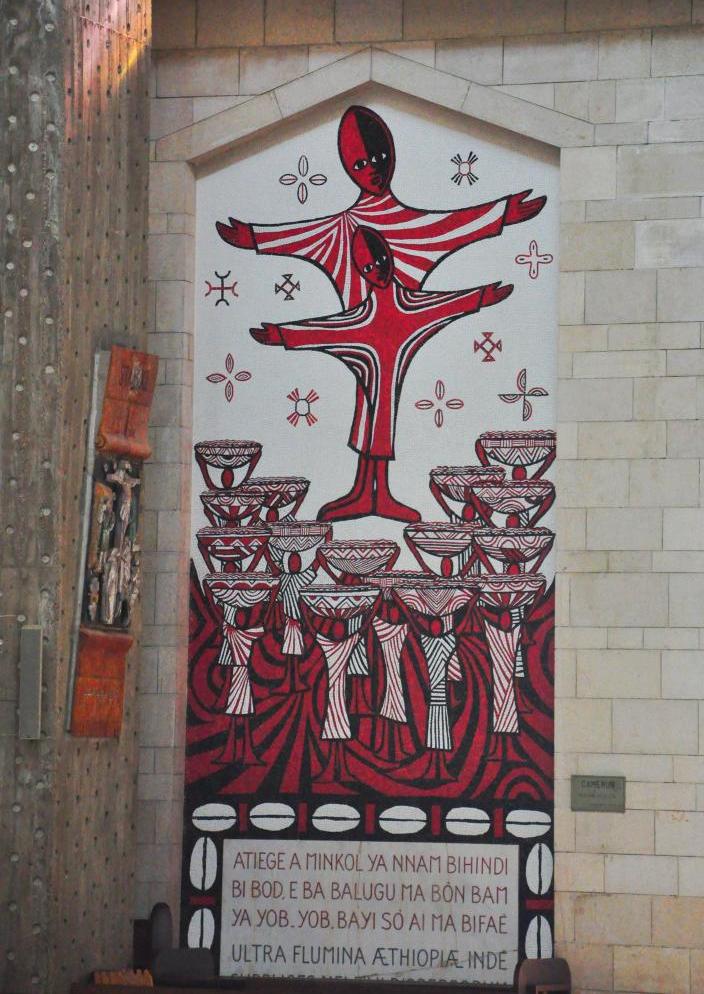
Fr. Engelbert Mveng, SJ (Cameroonian, 1930–1995), Our Lady of Africa, mosaic, Basilica of the Annunciation, Nazareth, Israel. Photo © BibleWalks.com. The inscription is from Zephaniah 3:10: “From beyond the rivers of Cush / my worshipers, the daughter of my dispersed ones, / shall bring my offering.”

As you know, diversity in biblical imagery, especially images of Jesus, is important to me, so I was delighted to hear this popular podcast tip their hat to this pilgrimage site in Israel that features a range of visual interpretations of the incarnation. You can view a compilation of the church’s national mosaics at BibleWalks.com. Most of them are not of high artistic quality, but I appreciate the initiative of inviting the nations to contribute their own localized representations. Above, I posted three that I particularly like.

Roundup: Record-smashing painting; Sutherland Springs memorial; jazz Thanksgiving; Advent candle liturgy; Every Moment Holy

Leonardo da Vinci painting breaks all-time sales record: A painting of Christ by the Renaissance master sold for $450.3 million at Christie’s on Wednesday to an anonymous bidder, making it the most expensive painting ever acquired, either at auction or (it’s believed) through private sales. (It displaced by a long shot Picasso’s Women of Algiers, which sold for $179.4 million at auction in 2015, and the reported $300 million paid privately for Gauguin’s Nafea Faa Ipoipo?, also in 2015.) A common iconographic subject in the sixteenth century, “Salvator Mundi” translates as “Savior of the World”; Leonardo’s shows Christ in Renaissance dress, holding a crystal orb in his left hand (representative of Earth) and raising his right hand in benediction. He painted it around 1500 for King Louis XII of France, but it was presumed lost until 2005—“the biggest [artistic?] discovery of the 21st century,” said Christie’s. It’s one of only twenty known paintings attributed to Leonardo.

Salvator Mundi attributed to Leonardo da Vinci
Leonardo da Vinci (Italian, 1452–1519), Salvator Mundi (Savior of the World), ca. 1500. Oil on walnut, 45.4 × 65.6 cm (25.8 × 19.2 in.).

+++

White-chair memorial inside Sutherland Springs church opens to public before demolition: First Baptist Church in Sutherland Springs, Texas, reopened to the public on Sunday evening for the first time since a mass shooting on November 5 killed twenty-six people attending worship. In the week between, volunteers came in and repaired all the bullet holes, ripped up the carpet and tore out the pews, and applied fresh coats of white paint to the walls and concrete floor. A temporary memorial has been erected, consisting of white folding chairs that bear the names of the victims in gold paint as well as roses with chiffon ribbons. The one pink rose among twenty-five red ones is for the unborn child who died with his or her eight-months-pregnant mother.

First Baptist Church, Sutherland Springs
Temporary memorial, November 12, 2017, First Baptist Church, Sutherland Springs, Texas. Photo: Drew Anthony Smith for the New York Times

First Baptist Church, Sutherland Springs
Baby Holcombe’s pink rose sits between roses for his or her mom Crystal and brother Greg. Nine of the twenty-six shooting victims were from the Holcombe family.

Although the congregation has not yet officially voted on it, it’s likely that the church will be demolished and a new one built in its place; the pastor said many congregants do not want to go back in there because of the trauma. (The Sunday after the shooting, they worshipped in a large outdoor tent nearby.) Preemptively, a San Antonio contractor teamed up with other local business owners to form a nonprofit, Rebuilding Sutherland Springs Inc., to raise money for a new church building and park. Through GoFundMe, they have already raised $1.1 million of their $2.5 million goal. Click here to donate.

+++

Thanksgiving-themed black gospel jazz service: This video recording is from a Jazz Vespers service held on November 10, 2015, in Goodson Chapel at Duke. Chapel Dean Luke Powery and others offer prayers and readings, while the John Brown Big Band, a professional jazz ensemble, leads music. The songs are as follows: “Glory, Glory, Hallelujah” (opening); Walter Hawkins’s “Thank You (Lord, for All You’ve Done for Me)” (5:15); “Thank You, Lord” (11:44, reprised 52:26); “Every Day Is a Day of Thanksgiving” (25:05); “Perfect Love Song” (56:25); “Amazing Grace” (1:03:24); and “When the Saints Go Marching In” (1:09:04).

+++

Advent candle-lighting liturgy: Advent season is just around the corner. Here are five dramatic readings for the lighting of the Advent candles, based on traditional liturgies. They were written by Kathy Larson, director of Christian education and creative arts at Good Shepherd Presbyterian Church in Charlotte, North Carolina. They sound very compelling!

+++

NEW BOOK: Every Moment Holy by Douglas Kaine McKelvey: On November 3 Rabbit Room Press released a collection of one hundred-plus new liturgies for daily life bound together in a beautiful hardcover volume with linocut illustrations by Ned Bustard. Some of the prayers are intended for routine acts, while others are for special, memorable, difficult, or even tragic occasions. Included are liturgies for laundering, for home repair, for the watching of storms, for the first hearthfire of the season, before beginning a book, for setting up a Christmas tree, for the welcoming of a new pet, for the morning of a medical procedure, for the death of a dream, upon tasting pleasurable food, and for the sound of sirens. The aim is to encourage mindfulness of the constant presence of God. Five free liturgies are available for download at https://www.everymomentholy.com/liturgies. The book is for sale exclusively at the online Rabbit Room Store. Read an interview with the illustrator here.


Communing with the Lord during one’s daily tasks is what the seventeenth-century monk Brother Lawrence calls “practicing the presence of God”; poet George Herbert calls it “drudgery made divine.” The Anglican priest Jonathan Evens led a short meditation a few months ago at St. Stephen Walbrook that draws on the wisdom of these two near contemporaries, titled “Doing Our Common Business for the Love of God”—very much in the same spirit as McKelvey’s book.

Every Moment Holy
Every Moment Holy by Douglas Kaine McKelvey (Rabbit Room Press, 2017). Right: Part opener illustration by Ned Bustard for “Liturgies of Labor and Vocation.”

+++

QUOTE OF THE WEEK: The following church-sign photo from the Canadian Memorial United Church and Centre for Peace in Vancouver has been making the rounds on Twitter via Banksy:

Build a longer table

“If you are more fortunate than others, build a longer table, not a taller fence.”