
Easter, Day 4: Weeping Mary

LOOK: Mary Magdalene Stood Crying by Kateryna Kuziv
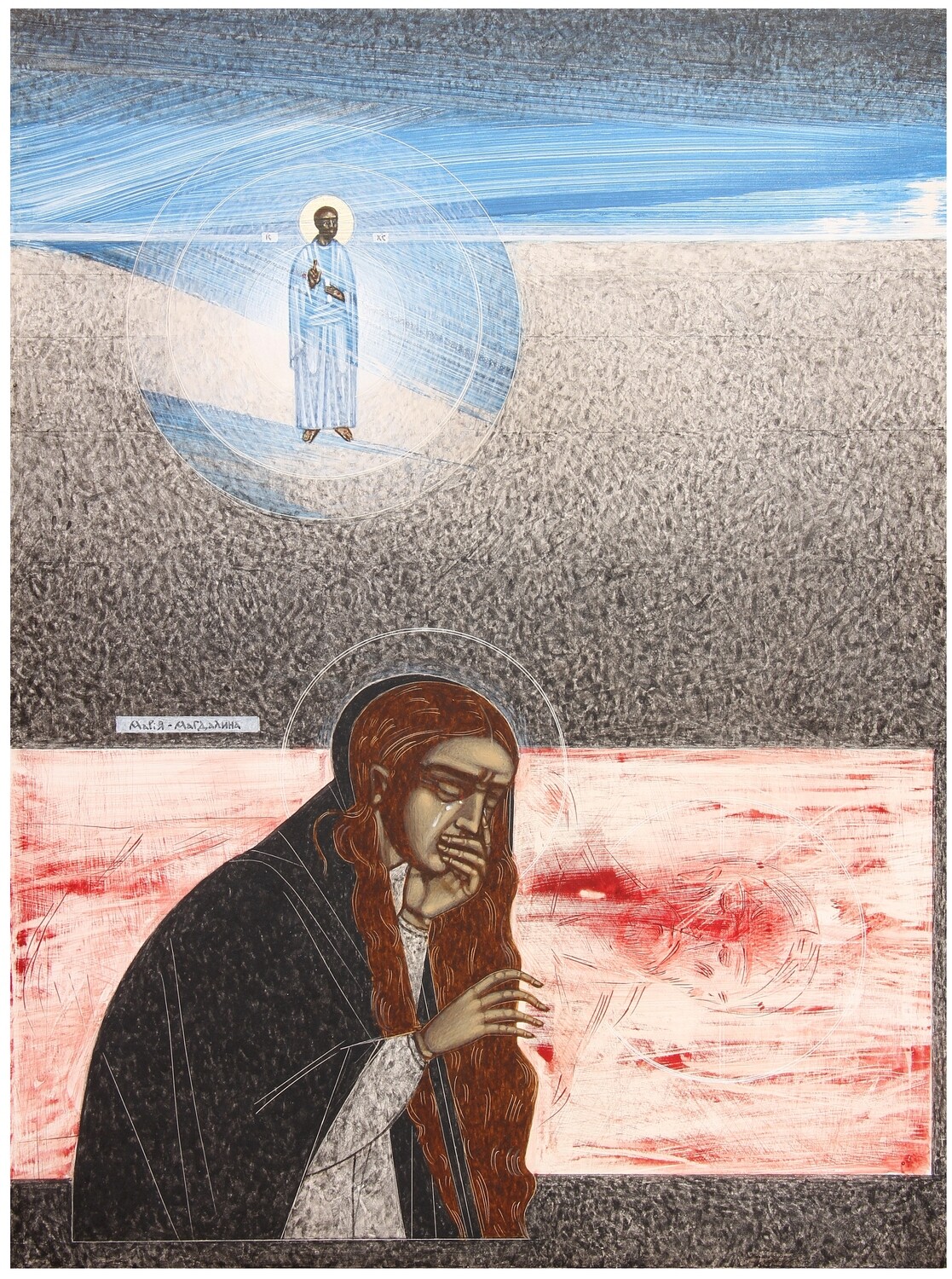
Kuziv, Kateryna_Mary Magdalene stood crying
Kateryna Kuziv (Ukrainian, 1993–), Mary Magdalene Stood Crying, 2021. Egg tempera and gilding on gessoed wood, 40 × 30 cm.

LISTEN: “Weeping Mary” | Traditional American, 19th century | Arranged by Dan Damon and performed by the Dan Damon Quartet, feat. Sheilani Alix, on Beautiful Darkness, 2022

Is there anybody here like Mary a-weeping?
Call to my Jesus and he’ll draw nigh.
Is there anybody here like Mary a-weeping?
Call to my Jesus and he’ll draw nigh.

Refrain:
Glory, glory
Glory, glory
Glory be to my God on high
Glory, glory
Glory, glory
Glory be to my God on high

Is there anybody here like Peter a-sinking? . . .

Is there anybody here like jailers a-trembling? . . .

This early American spiritual was transmitted orally before first being recorded in The Social Harp (Philadelphia, 1855), a shape-note hymnal compiled by John Gordon McCurry (1821–1886). McCurry was a farmer, tailor, and singing teacher who lived most of his life in Hart County in northeastern Georgia. The Social Harp credits the music for “Weeping Mary” to him and gives it the year 1852, but I think that indicates not composition but notation and harmonization; in other words, McCurry is the arranger.

In the description of their 1973 facsimile reprinting of The Social Harp, the University of Georgia Press writes, “In the time between the [American] Revolution and the Civil War, the singing of folk spirituals was as common among rural whites as among blacks. This was the music of the Methodist camp meeting and the Baptist revival, and white spirituals in fact are known chiefly because homebred composers sometimes wrote them down, gave them harmonic settings, and published them in songbooks.”

I regard “Weeping Mary” as an Easter song, since the primary verse refers to Mary Magdalene standing outside the empty tomb weeping because she doesn’t know what happened to the body of her Lord (John 20). Then a man she supposes to be the gardener engages her in conversation—and turns out to be the one she’s been seeking, only he’s alive!

The jailer in the third verse refers to the Philippian jailer from Acts 16, tasked with guarding the prisoners Paul and Silas, who were falsely charged with disturbing the peace. One night an earthquake strikes, releasing the chains from the walls and breaking open the cell doors. The jailer raises his sword to kill himself to avoid the shame of having let his wards escape. But Paul alerts him that they’re still there, after which the jailer “fell down trembling” and asked the two what he must do to be saved. “Believe in the Lord Jesus,” they reply. After which he and his whole household convert to the new faith.

“Call to my Jesus and he’ll draw nigh,” the song promises.

Another “Weeping Mary” verse not in The Social Harp but that I’ve heard added in some renditions is “Is there anybody here like Thomas a-doubting?”

More subdued than the typical Easter fare, “Weeping Mary” testifies to the nearness of God in our sorrows, fears, doubts, and weaknesses. It embraces those who are anxious, grieving, or struggling, offering a gentle word.

I first learned this song from a recording by the American folk musician Sam Amidon, which I also really like:

In Brattleboro, Vermont, where he grew up in the 1980s and ’90s, he told NPR, shape-note singing was a social tradition, something that happened once a month, with singers moving to different people’s houses, including his own. His parents are the well-known folk musicians Peter and Mary Alice Amidon.

In his rendition he uses the grammatically incorrect but historically faithful verb that appears in original songbook, “Are there anybody . . .”

For a more vigorous jazz arrangement, which includes scat singing and a trumpet solo, see June April’s 2007 album What Am I?. She uses just the first verse.

And here’s a traditional performance in four-part a cappella by the Dordt College Concert Choir, directed by Benjamin Kornelis:

From the Mire (Artful Devotion)

Lo, Beth_Formed
“Formed” by Beth Lo (American, 1949–)

I waited patiently for the LORD;
he inclined to me and heard my cry.
He drew me up from the pit of destruction,
out of the miry bog,
and set my feet upon a rock,
making my steps secure.
He put a new song in my mouth,
a song of praise to our God.
Many will see and fear,
and put their trust in the LORD.

—Psalm 40:1–3

+++

SONG: “Oh, He’s Taken My Feet” | Early American folk hymn, performed by Lucy Simpson, with Rock Creek (Bill Destler, Wally Macnow, Tom McHenry), Mary Alice Amidon, Peter Amidon, and Caroline Paton, on Sharon Mountain Harmony: A Golden Ring of Gospel (1982, 2002)

https://open.spotify.com/embed/track/6ptUvZJNH1KZnaFQNrqzp4

Lucy Picco Simpson (1940–2006) was a prodigious collector of old hymns, amassing four hundred hymnals, mostly from the nineteenth and twentieth centuries, over her lifetime. From their pages she would dig out old gems and help revive them—such as “Oh, He’s Taken My Feet.” After recording the song for Folk-Legacy Records in 1982, it was picked up by folk singers Jean Redpath and Lisa Neustadt in 1986, and thenceforth by others.

I’m not sure precisely where Simpson sourced the song from, but I do know both the text and tune were compiled, along with 249 others, by George Pullen Jackson in the book Spiritual Folk Songs of Early America (New York: J.J. Augustin, 1937), which you can download for free from Project Gutenberg.

Sharon Mountain Harmony, where Simpson’s simple rendition appears, is one of my favorite albums. In his 1983 review for the Washington Post, Richard Harrington wrote,

On “Sharon Mountain Harmony” the inspiration is the particularly rich motherlode of gospel song, both black and white traditions. Rock Creek [the vocal trio comprising Wally Macnow, Tom McHenry, and Bill Destler] shares the album with Lucy Simpson of Brooklyn, and Mary Alice and Peter Amidon of Vermont. Simpson and Rock Creek alternate leads while providing a constant, thick backing of informal and earthy harmonies with heavenly aspirations. The singing is comfortable, unhurried. No matter which voice leads – Simpson’s ethereal and soft soprano, Bill Destler’s gentle tenor or Wally McHenry’s persuasive baritone – it’s the richness of the ensemble, the entrancing vocal weaves, that make this album a quiet gem. Another plus is the choice of material. All 16 songs are deeply rooted in prayer meetings, crusty hymnals and songbooks, revival tents, amen corners, rural radio programs; they come from the land and they’ve been well-used. There’s the clipped bluegrass harmony of “Glory Bound,” the shape-note urgency of “There Are Angels Hovering Round,” the exuberant Baptist release of “Oh, He’s Taken My Feet” and “Trouble So Hard,” the spiritual grace of “Blessed Quietness” and “Time Has Made a Change in Me,” the calming reassurance of “I Will Arise.” These are all wonderful songs, beautifully displayed. They reflect intensely personal convictions and a tremendous respect for the grace of unadorned voices singing from the heart.

Folk artist Sam Amidon, one of the sons of Peter and Mary Alice Amidon (who sing on Sharon Mountain Harmony), learned “Oh, He’s Taken My Feet” from Lucy Simpson, a family friend. Music critic Ryan Foley calls Amidon a “clever re-inventor, overly ambitious re-animator, whiz-bang music folklorist, fusty archivist . . . disassembling and then reconstructing antiquated sacred songs, secular ballads, and folk tunes.”

https://open.spotify.com/track/0Qf1Tz7IFMh7g5mh2y71WS?si=1f8dpJZuRlym5kT3da4V1A

That’s what he does with this song on his 2013 album Bright Sunny South. “Brimming with unexpected shifts and subtleties,” Amidon’s arrangement of “He’s Taken My Feet” “begin[s] with a spare guitar and voice, [then is] slowly joined by hints of trumpet, understated fretless bass, and other elements until the song, very gradually, grows to a burning climax of dissonant guitars, synths, and explosive drums” (Fred Thomas). The sonic chaos at the end lasts almost a full two minutes and represents “the mire and the clay”—all that pulls us down, gets us stuck.

The melancholic tone that culminates in clashing is not what you’d expect from a psalm of testimony about the rock-solid stability God provides. But when the song is taken in context of the whole biblical psalm on which it is based, which vacillates between praise and lament, it makes perfect sense. Psalm 40 opens by celebrating the deliverance God has wrought in the past, but then it moves into the miry present, where the psalmist is in need of another deliverance:

For evils have encompassed me
beyond number;
my iniquities have overtaken me,
and I cannot see;
they are more than the hairs of my head;
my heart fails me.

Be pleased, O LORD, to deliver me!
O LORD, make haste to help me!
. . .
You are my help and my deliverer;
do not delay, O my God! (vv. 12–13, 17b)

Amidon’s arrangement of “He’s Taken My Feet” captures the believer’s struggle through adverse circumstances to find firm footing once again on the “Rock of Ages.” From within the fray the speaker remembers God’s faithfulness, sings God’s faithfulness, and that weary song creates anticipation for yet another act of divine rescue.


This post belongs to the weekly series Artful Devotion. If you can’t view the music player in your email or RSS reader, try opening the post in your browser.

To view all the Revised Common Lectionary scripture readings for the Second Sunday after Epiphany, cycle A, click here.