Roundup: New book for All Saints’ Day, Bruce Onobrakpeya exhibition in DC, and more

NEW BOOK: Everything Could Be a Prayer: One Hundred Portraits of Saints and Mystics by Kreg Yingst: Released on October 15, this book features one hundred color block-print portraits by Kreg Yingst of folks in the family of God across time and place, along with one-page biographies. Get to know a wide range of Christian civil rights activists, scientists, environmentalists, social service workers, hymn-writers, artists, poets, evangelists, and monastics and the gospel impact they’ve made. The lineup is a mix of familiar and less familiar names, canonized saints and noncanonized. Examples include Brigid of Kildaire, Ignatius of Loyola, Satoko Kitahara, Dietrich Bonhoeffer, Mamie Till, Pandita Ramabai Dongre-Medhavi, and Black Elk. Click here to look inside.
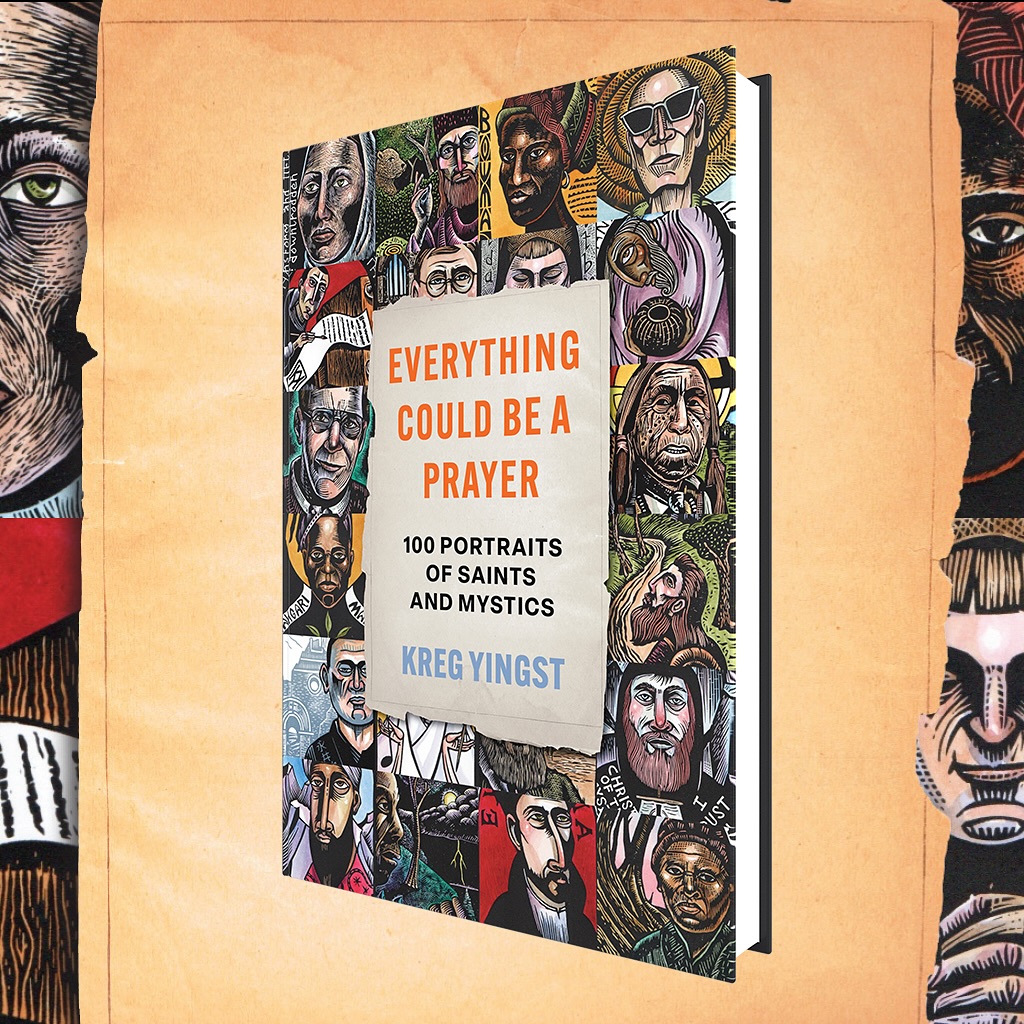
Kreg Yingst book

The title of the book is taken from a quote by Martin de Porres (1579–1639), a Dominican friar from Peru and the first Black saint of the Americas: “Everything, even sweeping, scraping vegetables, weeding a garden, and waiting on the sick, could be a prayer if it were offered to God.”

Related events:

  • October 10–November 16, 2024: Art exhibition featuring the block prints from the book at The Gallery of Art, 36 W. Beach Dr., Panama City, Florida
  • October 26, 2024, 1:00–3:00 p.m.: Book signing at Barnes & Noble, 1200 Airport Blvd., Pensacola, Florida

Through November 1, Yingst is offering 25% off all original woodcuts and linocuts that were used as illustrations for the book; view the discounted pieces in the “Mystics, Saints & Poets” section of his Etsy shop. These are not inkjet-printed photographs of original artworks (which is what some artists misleadingly call “prints”) but are themselves original limited-edition relief prints hand-pulled on an antique proof press from carved blocks; they are made with black oil-based ink and watercolor. If you want original art in your home or to gift a friend or family member for Christmas, Yingst’s work is a great and affordable option!

+++

SONGS:

November 1 is All Saints’ Day, a feast for commemorating the lives and witness of our siblings in the faith who have gone before us. Here are two songs for the occasion.

>> “I Sing a Song of the Saints of God,” performed by Wendell Kimbrough: This charming little children’s hymn was written by Lesbia Scott and was first published in her native England in Everyday Hymns for Little Children (1929). In the United States the song first appeared in the Episcopal Hymnal 1940 with a tune that John Henry Hopkins, a member of the hymnal committee, composed for it, capturing the childlike cadences of the text.

>> “When the Saints” by Sara Groves: This song from Groves’s album Tell Me What You Know (2007) draws encouragement from the faithfulness of God-followers throughout history, from Moses, Paul, and Silas to Harriet Tubman and Mother Teresa to the martyr Nate Saint and his sister Rachel Saint to rescuers of sex-trafficking victims. It is a call to hearers today to pick up their cross and follow Christ into places of hurt and injustice, pursuing liberation of body and soul for all. The refrain quotes the traditional Black gospel song “When the Saints Go Marching In.”

+++

ART EXHIBITION: Bruce Onobrakpeya: The Mask and the Cross, National Museum of African Art, Washington, DC, June 21, 2024–January 21, 2025: A father of African modernism, Bruce Onobrakpeya (b. 1932) [previously] is one of Nigeria’s most celebrated artists, and I was thrilled this month to visit his first solo show in the US, which, as it turns out, is centered on his Christian-themed linocut prints! (The artist is Anglican.) Onobrakpeya’s career spans over six decades, and this Smithsonian exhibition is not meant to be representative of the breadth of his oeuvre, which also includes painting and sculpture and various subject matters; rather, it presents two foundational bodies of work from the late sixties, both commissioned by the Catholic Church, that helped launch the artist’s long and esteemed career.

The exhibition displays rare artist’s proofs of the biblical illustrations Onobrakpeya made for Ki Ijoba Re De (May Your Kingdom Come) (1968), a Yoruba-language textbook for students in their fifth and sixth years of Catholic primary school (it was part of the Nigerian National Catechism), as well as a complete narrative series of prints titled Fourteen Stations of the Cross, produced in 1969. I blogged about the artist’s Stations cycle back in 2014, when I saw a different edition at the SMA African Art Museum in Tenafly, New Jersey; you can view better photos on the High’s website. For more on the work of Fr. Kevin Carroll, the Catholic missionary who commissioned Onobrakpeya to paint a church mural of the Stations that became the basis of these linocuts and who helped facilitate the May Your Kingdom Come publication, see here.

Curated by Lauren Tate Baeza, Bruce Onobrakpeya: The Mask and the Cross first opened last year at the High Museum of Art in Atlanta. This is Baeza’s first exhibition as curator of African art at the High, and I’m so pleased that when she dug through the High’s extensive archives, it was a set of Christian prints by a leading Nigerian artist that most compelled her, that she could imagine building a unique exhibition around and that she felt must be pulled out of storage for more people to see. Hear Baeza discuss the exhibition from 23:28 to 35:58 of the video “African Modernisms: A Legacy of Connection.”
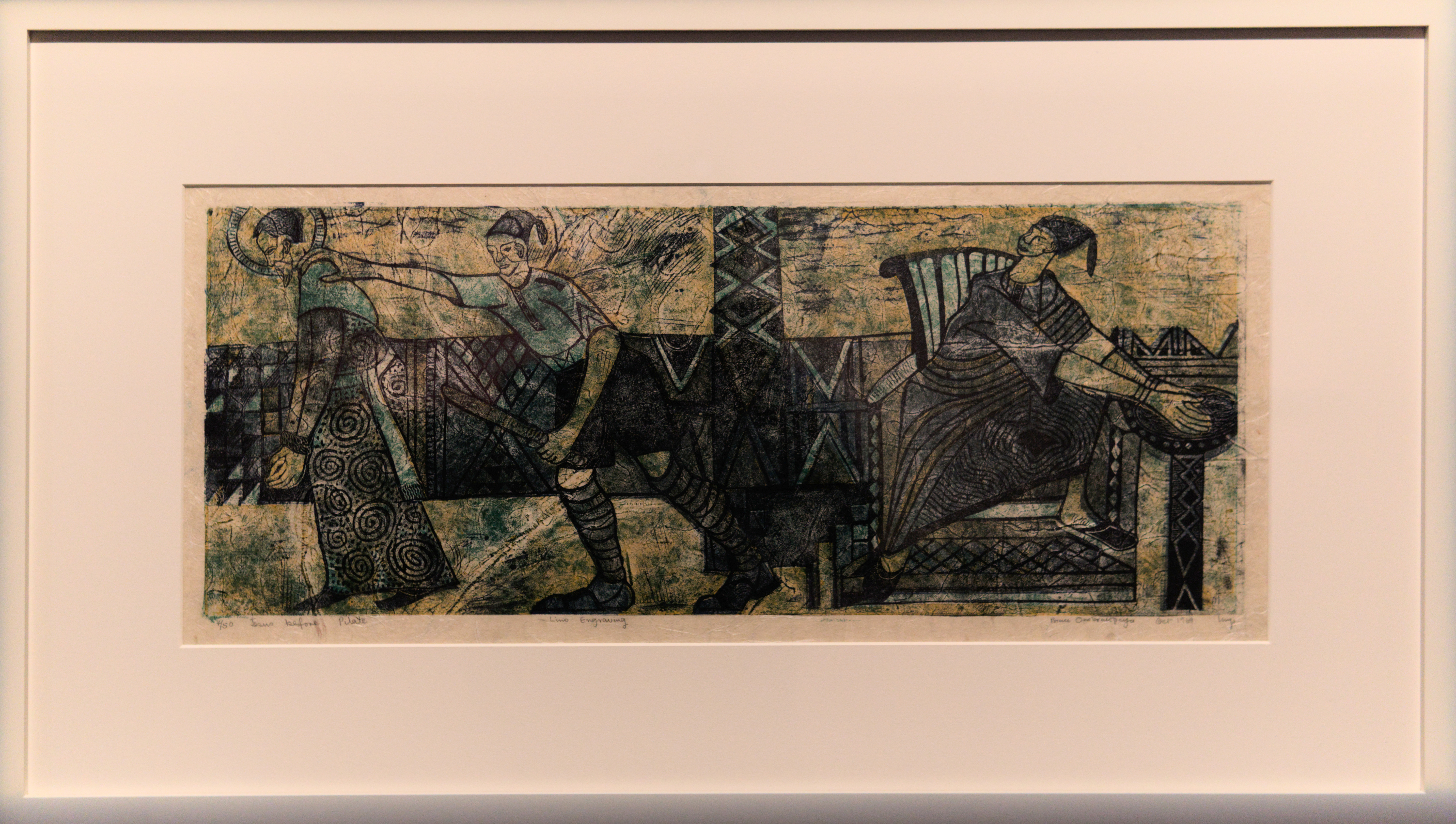
Onobrakpeya, Bruce_Station 1
Bruce Onobrakpeya (Nigerian, 1932–), Station I: Pilate condemns Jesus to death, 1969. Linoleum block print on rice paper, 24 × 34 in. (61 × 86.4 cm). High Museum of Art, Atlanta, Georgia. Photo: Victoria Emily Jones.

For his Stations of the Cross, Onobrakpeya “incorporat[ed] the rich patterns of Yoruba gelede and epa masks and stylized geometric patterns found in northern Nigerian architecture. Then he added generous adire motifs and his signature elongated figures and distortions of scale,” reads one of the gallery wall texts. He also embedded a critique of British colonial rule, portraying the Roman soldiers of Christ’s passion as British officers. (Nigeria had just attained independence from Great Britain earlier that decade, in 1960.) Pilate, though, is shown as a local Nigerian magistrate doing the bidding of the British government, highlighting a deeply felt tension in Nigeria’s then-recent political history.

I really appreciate the video components of the exhibition. One screen plays a compilation of clips from interviews Baeza conducted with the artist, and another displays a two-dimensional animation commissioned from Sadiki Souza specially for this exhibition, which brings to life Onobrakpeya’s fourteen Stations. Neither is available online, at least not that I can find.

+++

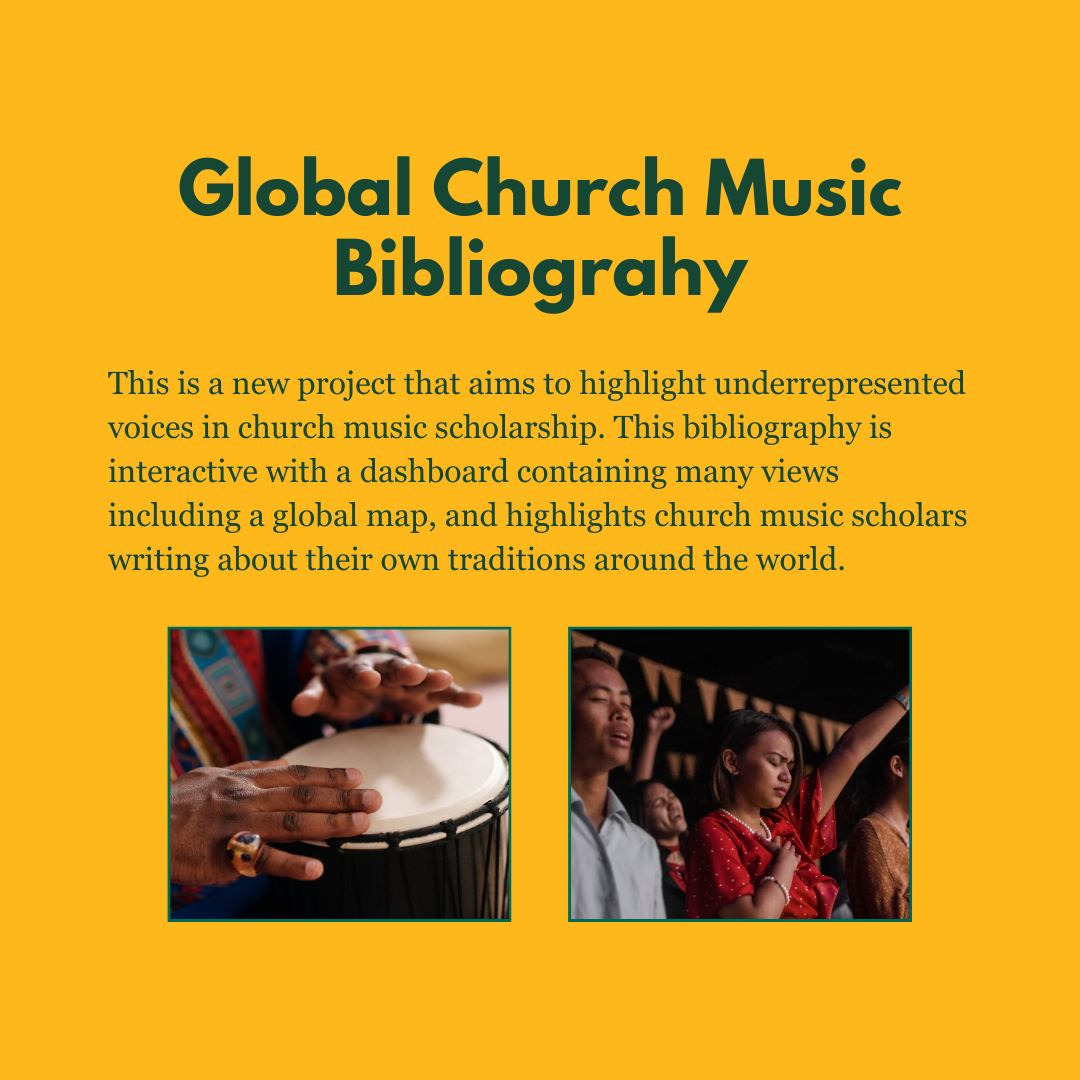
ZOOM EVENT: “Celebration of New Global Church Music Resources,” November 14, 9:00 a.m. CDT (12:00 p.m. ET): From Baylor University’s Dunn Center for Christian Music Studies: “We are excited to announce the launch of two website projects on November 14th! In collaboration with the Nigerian Baptist Theological Seminary, the third edition of the Nigerian Christian Songbook will be updated with new songs and content. In addition, a new project, the Global Church Music Bibliography, highlights underrepresented voices in church music scholarship. This is an interactive dashboard and map that features church music scholars writing about their own traditions outside of North America.” At the Zoom event on launch day, you will hear from various project participants. [HT: Global Christian Worship]
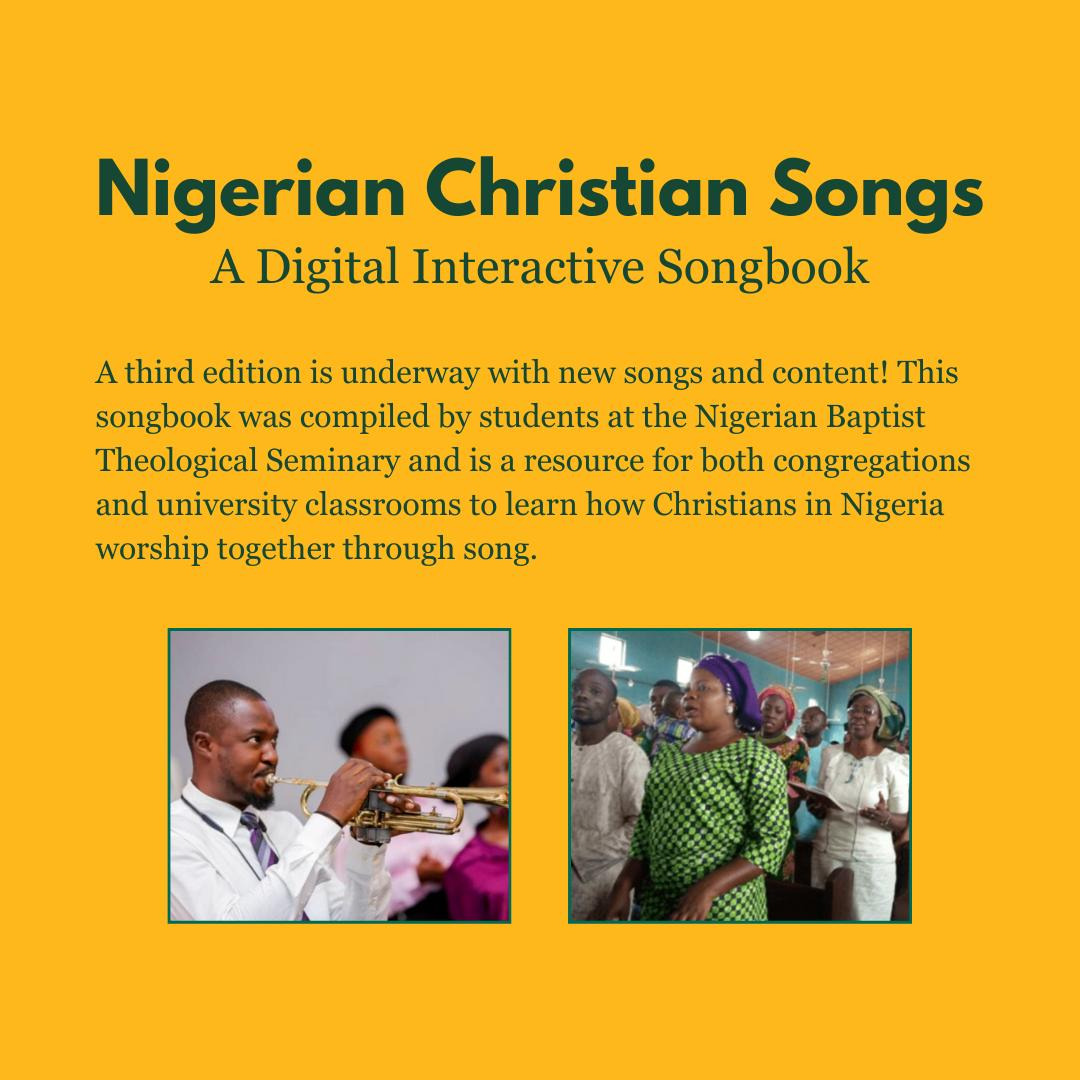
Nigerian Christian Songs
Global Church Music Bibliography

Advent Prelude: Guide Us

LOOK: Milky Way by Frida Hansen

Hansen, Frida_Milky Way
Frida Hansen (Norwegian, 1844–1931), Melkeveien (Milky Way), 1898. Tapestry, 260 × 345 cm. Museum für Kunst und Gewerbe (Museum of Arts and Crafts), Hamburg, Germany.

This art nouveau tapestry by Norwegian artist Frida Hansen received a gold medal at the world’s fair in Paris in 1900. It shows angelic figures unfolding a starry veil over the night sky. They glide forward above a band of Hebrew script that references the creation of the stars in Genesis 1.

The God who brought light in darkness in the beginning is bringing light again as we enter a new liturgical year.

Comprising the first five weeks of that new year, Advent-Christmas-Epiphany is a time of starlight, promise, and revelation. The first of the triad, Advent, is particularly concerned with themes of longing, waiting, lament, and future-oriented hope. We make ready our hearts to receive Christ—he who came to us first as a babe in a manger, in a vulnerable body like ours, to teach and suffer and redeem, and who is coming back one day in unveiled power and majesty to bring the fullness of God’s heavenly kingdom to earth.

Two millennia ago, God hung a special star in the sky for the magi to follow, guiding them on their way to the Christ child. May God similarly illumine our way to Christ as we seek him this season, giving us eyes to see and ears to hear the gospel of God-with-us and cultivating in us an eager readiness for Christ’s return.

I think of Hansen’s crowned young ladies as ushering us into the deep, dark blue of Advent to behold the signs that sparkle in scripture, foretelling a wondrous future.

For an excellent illustrated article about Hansen’s life and work, see “Frida Hansen: A leading star in European textile art” by Anne Sommerin Simonnæs.

LISTEN: “Star of Wonder” by Sara Groves, on O Holy Night, 2008; adapted and arranged from the refrain of “We Three Kings” by John Henry Hopkins, 1857

Star of wonder, star of light
Star of royal beauty bright
Guide us
O guide us
Won’t you guide us


Want to follow along with the music on Spotify? Most of the songs in this Advent blog series, and many more besides, can be found on the Art & Theology Advent Playlist.

Roundup: Visual lament, shalom chant, song for the displaced, unfinished art, and “Roma”

The Arts of Lament (lecture)

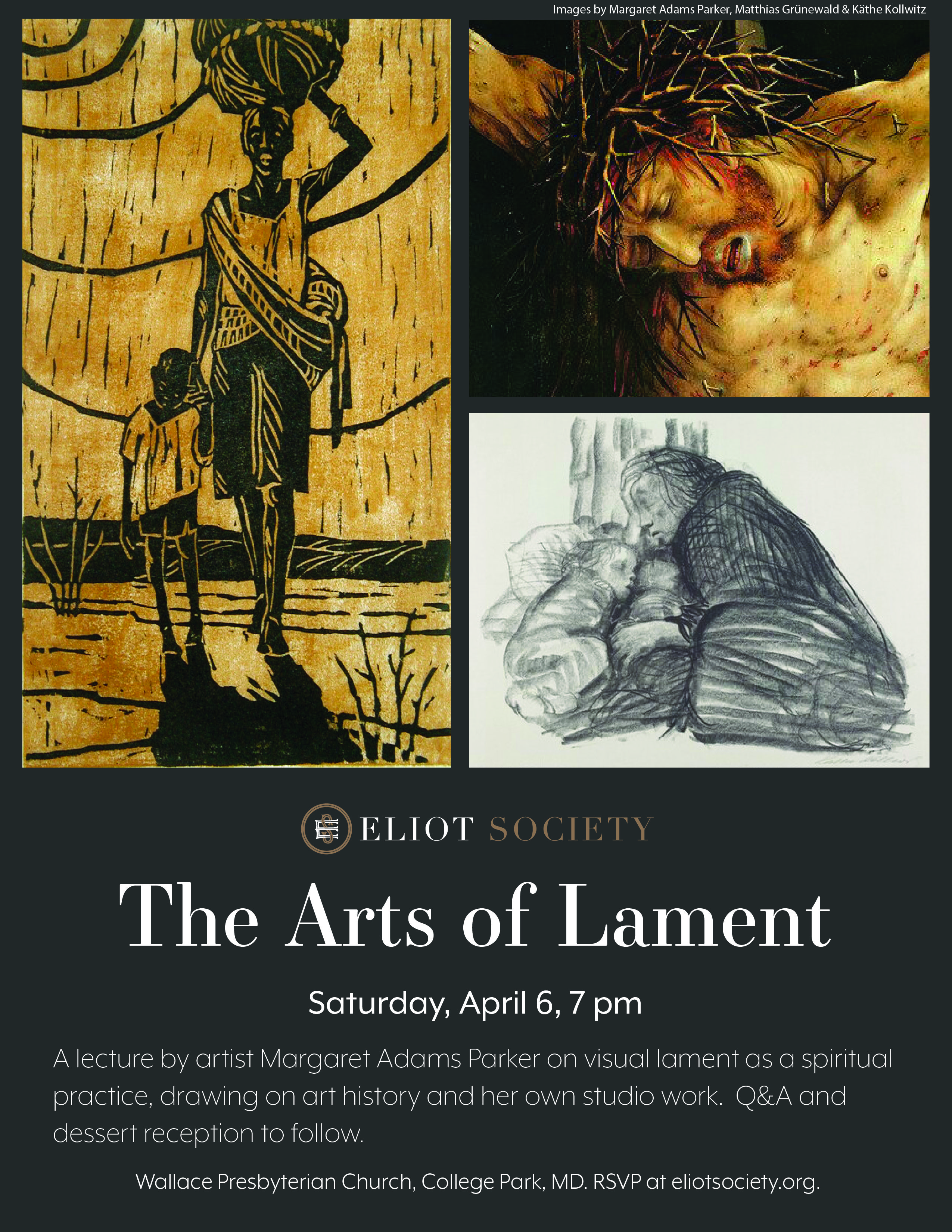
UPCOMING LECTURE: “The Arts of Lament” by Margaret Adams Parker: I’m one of the artistic directors of the Eliot Society, a DC-based nonprofit that promotes spiritual formation through the arts. Our next event is a lecture on April 6, 2019, by printmaker and sculptor Margaret (Peggy) Adams Parker (previously), which I’m really looking forward to.

Most especially during Lent, we recall the prominence of lament in Scripture: the psalms of lament; David’s lament for Jonathan; the Lamentations of Jeremiah; Christ’s lament over Jerusalem. These laments bear witness to outrage, sorrow, suffering, fear, desolation. And through these passionate cries, the biblical authors allow us to experience and express—in God’s holy presence—our own stories of brokenness and loss.

The visual arts make these laments visible. In this program Parker will present images by Grünewald, Rembrandt, Goya, Käthe Kollwitz, Jacob Lawrence, and others, as well as some of her own work. We will ask, How might these depictions of the horrors of war, displacement, oppression, sickness, and death enlarge our appreciation of the scriptural laments and in turn illuminate our understanding of suffering? Further, we will explore the spiritual significance of the practice: how lament might ultimately serve to console and strengthen, helping to lead us out of dark places into the light.

+++

SHALOM CHANT: At the 2019 Brehm Conference, “Worship, Theology, and the Arts in a Divided World,” liturgist Julie Tai led attendees in a group chant of the word shalom, an exercise she picked up from the author, speaker, psychotherapist, songwriter, and Episcopal priest Ian Morgan Cron. I streamed in from afar, and even from this distance, I found it really moving. “Really think about the places and spaces that need shalom—shalom meaning not our flat language of just ‘peace,’” Tai said by way of preface. “It’s an embodied word, a disruptive word. And we don’t get to see the completeness of shalom until all of us are at the table.” She instructs that after chanting shalom in unison three times, everyone is to find a note, any note, and sing it. Dissonance is welcome. The thick texture and distinctive timbre that result are possible only because each and every person is contributing their unique selves. The exercise is about listening to your neighbor, seeing your neighbor, and praying for and committing to pursuing shalom, wholeness, in this world. It expresses, in community, a shared hope and intention.

Chanting is a practice found in almost all spiritual traditions. Through rhythmical repetition, a word or short phrase washes over you and settles into the mind. When done in a group, everyone’s biorhythms become synchronized; individual breaths and sound vibrations unite, a physical manifestation of a spiritual communion.

“Julie Tai is the director of chapel at Fuller Theological Seminary. She received a BA in Asian American Studies and studied vocal jazz at UCLA before earning an MA in Intercultural Studies from Fuller. She is a songwriter, worship leader, and liturgist who loves to explore creative and integrative ways to engage diverse people in worship. A proud second-generation Korean American, Julie has led worship experiences at Urbana, the Calvin Worship Symposium, and SIM’s Global Assembly. She passionately trains worship leaders, seminarians, and pastors to see liturgy as a unifying and artistic act of justice . . . the reordering of glory, honor, and praise to the One seated on the throne.” [source]

+++

NEW SONG: “Jesus, See the Traveler” by Sara Groves: “I wanted a way for Ruby [my daughter] and me to remember the number of people who are on the road, displaced and wandering on any given night,” said Sara Groves about this new song she wrote. “Due to war and violence, there are more displaced people right now than any other time in history, and I want to be in the number who are responding in love—both in person in my community, and in my music.” The official music video is below; purchase the single on iTunes or stream on Spotify. [HT: Tamara Hill Murphy, A Sacramental Life]

+++

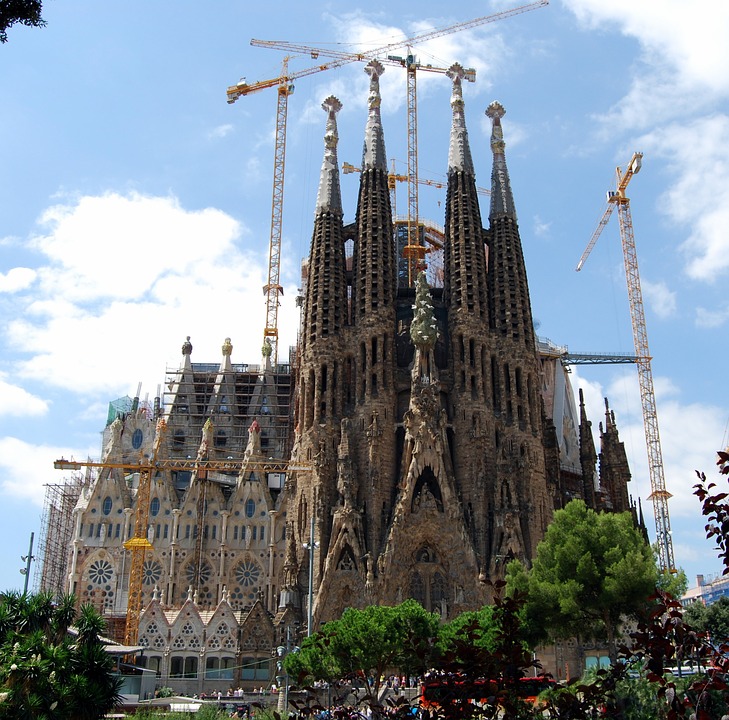
ARTICLE: “Art Interrupted” by Sophie Haigney: Unfinished artworks, like La Sagrada Familia (whose architect was hit by a tram when the cathedral was only a quarter of the way done) or Elizabeth Shoumatoff’s famous FDR portrait (the president slumped over mid-portrait-sitting and died of a brain hemorrhage), are reminders of our mortality. [HT: Michael Wright, Still Life]

La Sagrada Familia
Cranes hover over the spires of La Sagrada Familia in Barcelona, whose construction began in 1882 under architect Antoni Gaudí and is still going on.

 +++

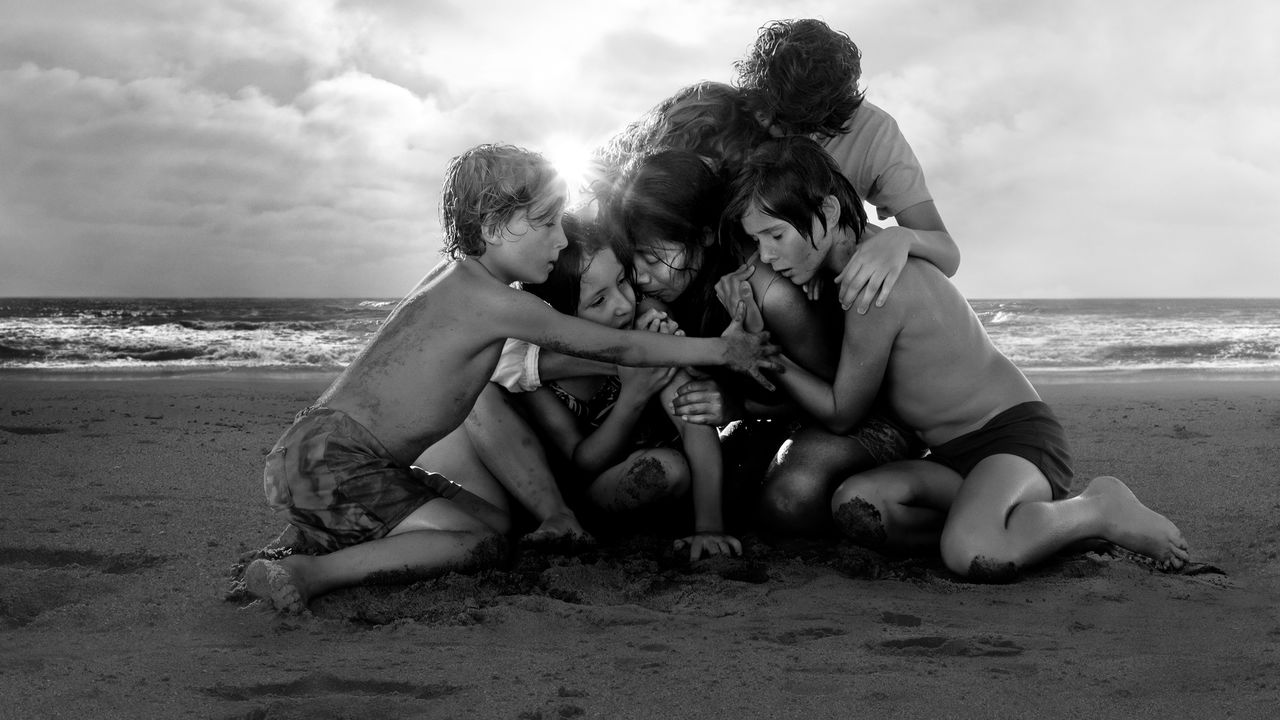
PODCAST EPISODE: “Roma,” Sunday Morning Matinee, January 22, 2019: To help me think more deeply and articulately about movies, I appreciate the work of, among others, Sunday Morning Matinee (formerly Technicolor Jesus), hosted by Matt Gaventa and Adam Hearlson. Back in January they discussed a movie that was one of my favorites of 2018, which is Roma, written, directed, and shot by Alfonso Cuarón. Set in the Colonia Roma neighborhood of Mexico City in the early ’70s, it focuses on Cleo (played by newcomer Yalitza Aparicio), a Mixtec domestic servant for a middle-class family. It was a very personal project for Cuarón, who based the character of Cleo on the real-life nanny who helped raise him, Liboria “Libo” Rodríguez.

Roma film still
This still frame from Roma captures a climactic moment of shared intimacy as Cleo (center), grieving a recent trauma, receives love and support from the family she works for.

“As artists, our job is to look where others don’t,” Cuarón said in his acceptance speech last month for the Academy Award for Best Director. (The movie also won Best Foreign Language Film and Best Achievement in Cinematography.) As an adult, Cuarón looked back and realized that Libo had another life, both internal and external, that he had not been aware of as a child, and this is his way of honoring Libo’s beautiful complexity. This podcast episode discusses the opening and closing shots of the movie, water symbolism, the contrast of the terrestrial and the heavenly, the role of memory, Cleo’s interiority and who gets access to it, the possibilities and limits of employer-employee relationships, and more.

Click here to listen to the podcast episode.