Roundup: Weighed-down sheep, sin and grace, Bermejo’s devil, and more

POEM: “Lost Sheep” by Margaret DeRitter: DeRitter writes about a lost Merino sheep in Australia who, because left unsheared for so long, was carrying over seventy-five pounds of wool on his back. He was found in 2021 and rescued by Edgar’s Mission Farm Sanctuary in Lancefield.

+++

SONGS:

>> “What Have We Become” by the Sweeplings: The Sweeplings are Cami Bradley and Whitney Dean, a singing-songwriting folk pop duo. From their album Rise and Fall (2015), “What Have We Become” laments how sin encroaches on our lives—we may welcome it in at first, but then it takes over, makes of our house a wasteland. This theme is embodied by a shadowy, thorny-veiled dancer in the music video.

>> “It Knows Me” by Avi Kaplan: Living outside Nashville, Tennessee, Avi Kaplan is best known for being the original vocal bass of the a cappella group Pentatonix, from 2011 to 2017. This song of self-probing is from his second solo EP, I’ll Get By (2020). It’s about the freedom that comes from reckoning with one’s inner darkness and accepting grace. The animation in the video is by Mertcan Mertbilek.

Kaplan, who is Jewish, wrote on Facebook,

“It Knows Me” is an extremely personal song to me. I believe that everyone has a darker side of them, and that you can choose to play into that, or you can choose to not. This song is about that battle between those two forces, and having a little grace for yourself when you do falter on your path.

>> “Not the Devil Song” by Marcus & Marketo: Marcus & Marketo (Marcus Clingaman and Marketo Michel) are a worship music duo from South Bend, Indiana, fusing the styles of gospel, classical, country, and soul. “Not the Devil Song,” which they wrote in 2019, is about the power Christians are given to tell Satan to back off! When he dangles temptations in front of you, whispers lies in your ear, sows seeds of doubt or fear or hopelessness, you can confidently retort, “Devil, no, you gotta let go; Jesus died to save my soul.”

+++

WOODCUT SERIES: Das Herz de Menschen (The Heart of Man): “The following illustrations—which, in a wonderful marriage of word and image, plot out the life of the Christian soul—form the central strain in The Heart of Man: Either a Temple of God, or a Habitation of Satan: Represented in Ten Emblematical Figures, Calculated to Awaken and Promote a Christian Disposition (1851), an English edition of a German book published in 1812 in Berlin by the ‘divine’ and philanthropist Johannes Gossner (1773-1858),” which was itself based on an older French text. The illustrations are not credited and are probably copies of ones that originated in France in the late seventeenth or early eighteenth century.
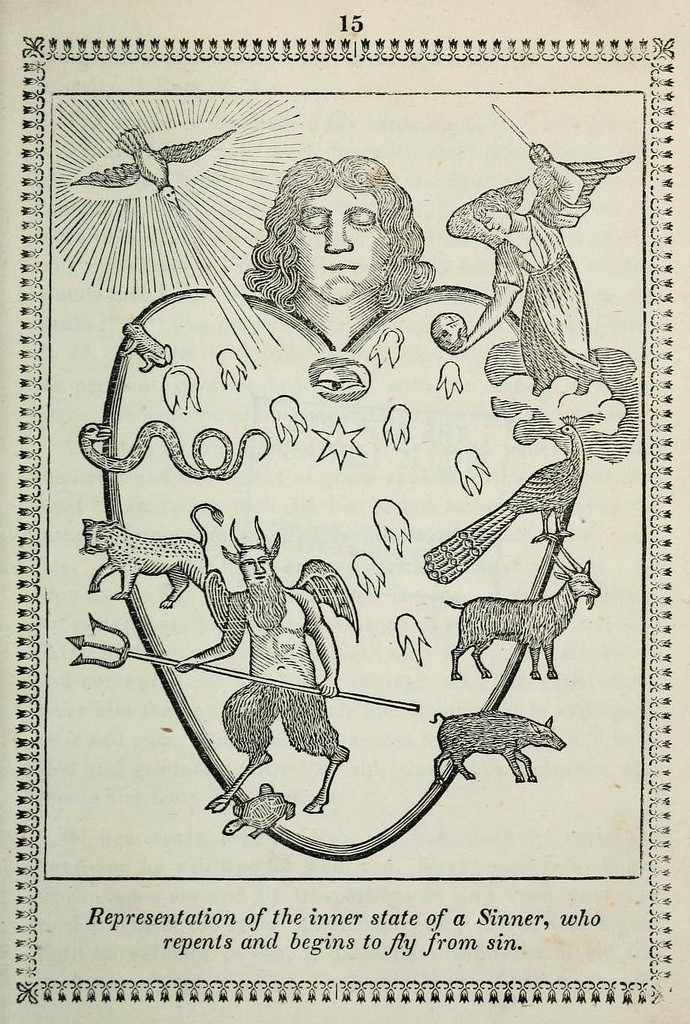
The Heart of Man

In his book The Forge of Vision (2015), visual studies scholar David Morgan contrasts this emblematic series with the related Cor Jesu amanti sacrum by Anton Wierix (which I wrote about here). Whereas the Wierix engravings from Antwerp are marked by sweetness, with the Christ child gently cleaning and setting up house in the human heart, the anonymous illustrations Gossner uses portray more of a psychomachia (battle for the soul), with armed angels seeking to oust Satan and his minions.

+++

VIDEO: “How Bermejo paints good and evil in Saint Michael Triumphs over the Devil: In this nine-minute video, Daniel Sobrino Ralston, associate curator for Spanish paintings at the National Gallery in London, examines a late Gothic painting in the museum’s collection by the Spanish artist Bartolomé Bermejo, showing the archangel Michael slaying Satan. Based on Revelation 12:7–9, this subject gave artists the chance to flex their imaginations in portraying evil incarnate and its vanquishment. Possessing an impressive capacity for fantastical invention, Bermejo gives the devil snakes for arms, eyes for nipples, bird claws, moth-like wings, a spiky tail, and a cactus growing out of its head!
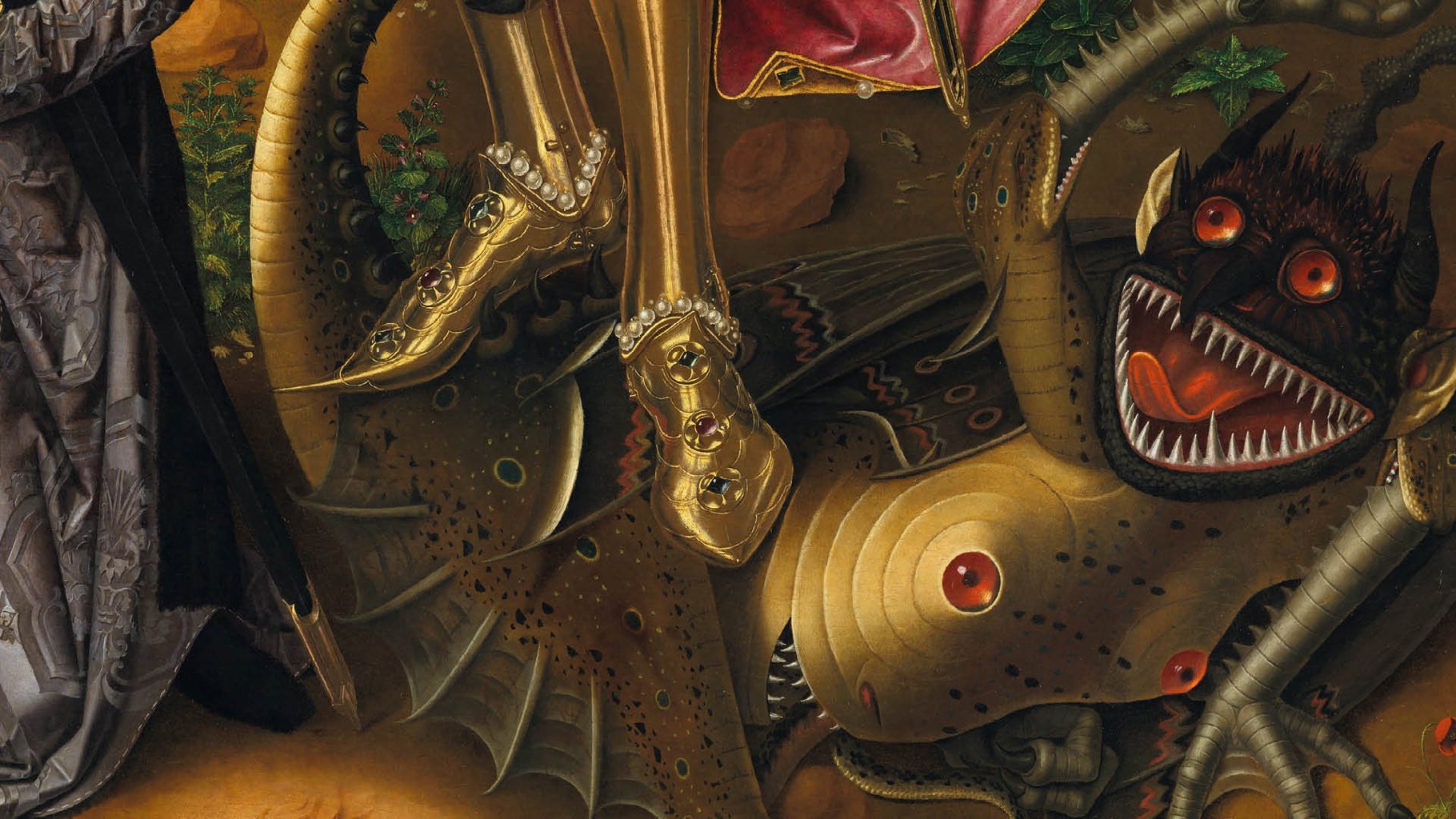
Bermejo, Bartolome_St. Michael (detail)
Bartolomé Bermejo (Spanish, ca. 1440–after 1495), Saint Michael Triumphs over the Devil (detail), 1468. Oil and gold on wood, 179.7 × 81.9 cm. National Gallery, London.

If this visual subject interests you, I recommend the book Angels and Demons in Art by Rosa Giorgi, from the J. Paul Getty Museum’s Guide to Imagery series.
Medieval roundup: Julian of Norwich, stained glass at York Minster, Jewish hymn from Andalusia, and more

PODCAST EPISODES:

>> “Jack’s Bookshelf: Julian of Norwich” with Dr. Grace Hamman, Pints with Jack: The “Jack’s Bookshelf” podcast series explores the authors and books that influenced the life and writings of C. S. Lewis. Hosted by David Bates, this episode covers Julian of Norwich (ca. 1343–after 1416), an English anchorite and mystic who authored what editors call Revelations of Divine Love or The Showings, the first English-language book by a woman. The most famous quote from this work is “Sin is behoovely, but all shall be well, and all shall be well, and all manner of thing shall be well.” Medieval scholar Grace Hamman [previously] unpacks the quote and discusses other key passages and themes from Julian, as well as what little we know of her biography. An excellent introduction!

>> “Ben Myers—The Divine Comedy,” Life with God: One of the many gifts my parents have given me over the years was a four-month study-abroad stay in Florence during my junior year of college, where one of my courses was devoted to reading and studying—in its original Italian and in the author Dante Alighieri’s hometown!—the masterful trilogy of narrative poems known as La Divina Commedia, or The Divine Comedy in English. Moving through hell, purgatory, and heaven, it is an allegory of the soul’s journey toward God. I enjoyed hearing Dr. Benjamin Myers [previously], director of the Great Books Honors Program at Oklahoma Baptist University, discuss this deeply influential work from the early fourteenth century, and sharing one of his own poems, “Listening to Reggae at the Nashville Airport.”

+++

VIRTUAL TOURS OF CATHEDRALS:

Cathedrals are, among other things, repositories of sacred art. I’m so appreciative of digitization initiatives that seek to make some of those treasures available to global publics online. Here are two admirable examples.

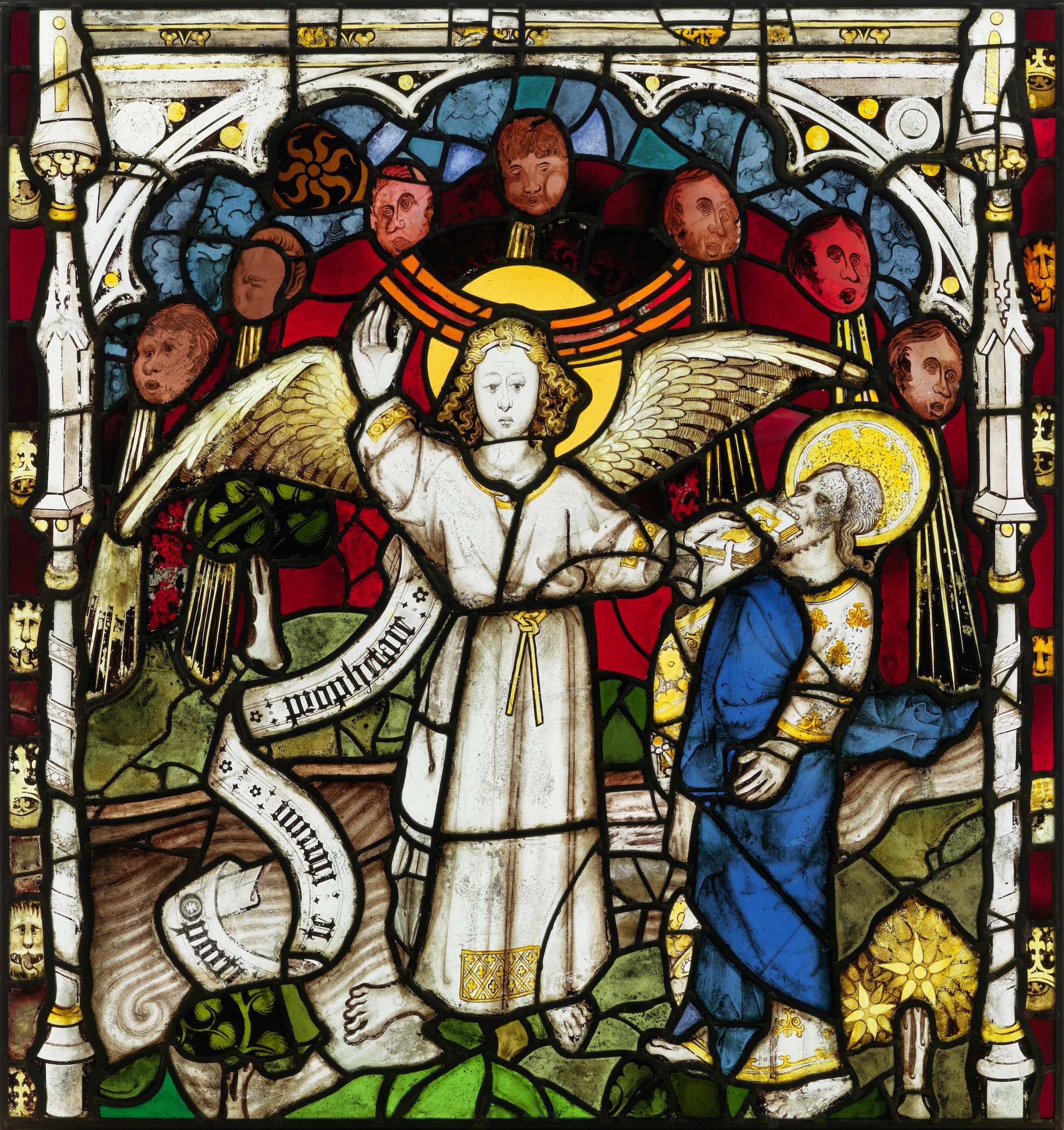
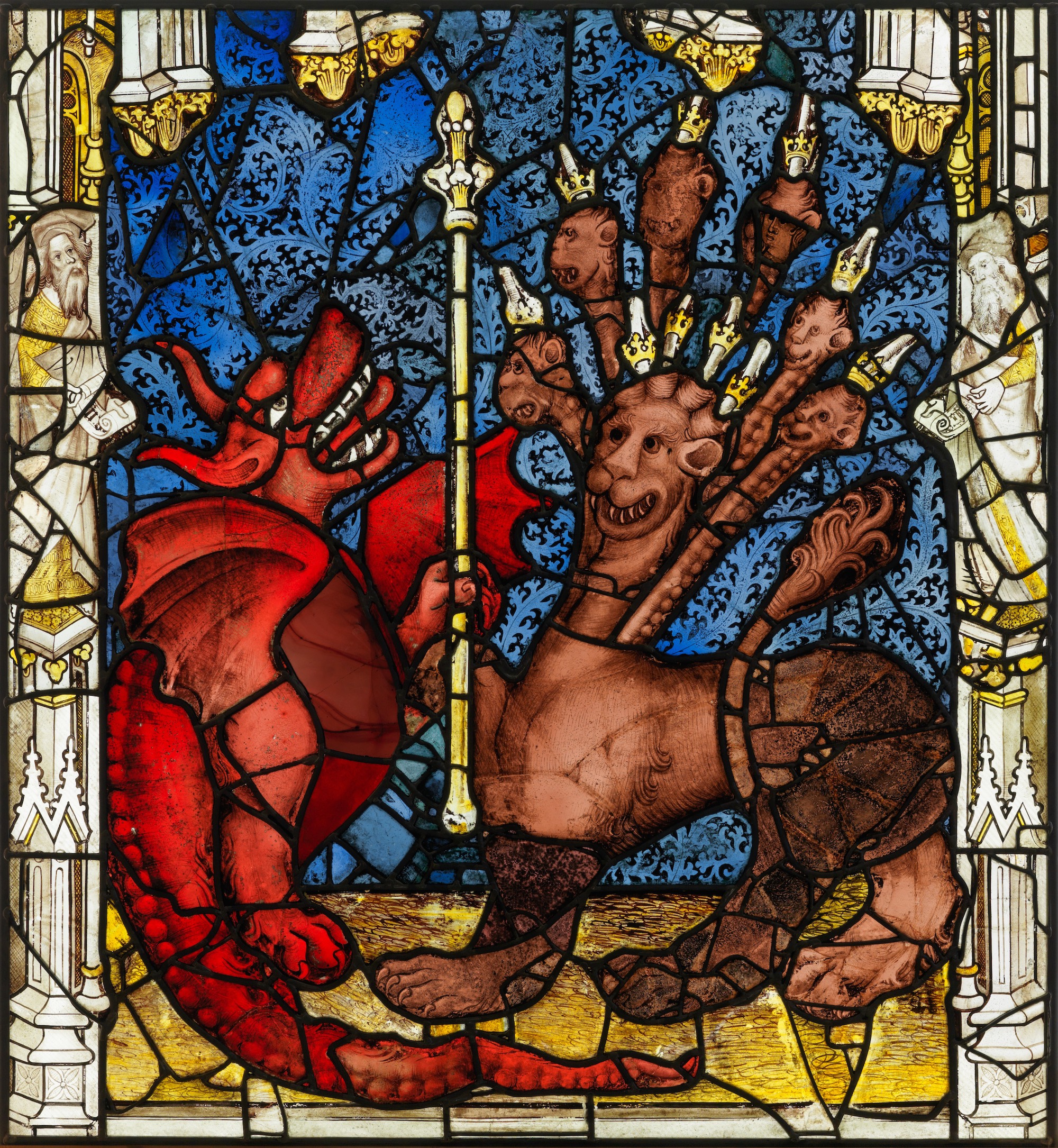
>> The York Minster Stained Glass Navigator: York Minster in northeastern England has the largest collection of medieval stained glass in the UK, with the earliest pieces dating from the late twelfth century. On behalf of the Chapter of York, the York Glaziers Trust is undertaking to photograph it all. These photos are available for viewing online through the cathedral’s “Stained Glass Navigator,” which enables you to hover over panels to identify the scenes, zoom in for higher resolution, and see where each panel in situated in the context of the window’s larger narrative.

I especially recommend exploring the extraordinary Great East Window, which depicts the beginning and the end of all things. The top section opens with the seven days of creation, followed by other select scenes from the Old Testament, but the bulk of the window—and my favorite sequence—consists of scenes from the book of Revelation. The bottom row depicts historical and legendary figures associated with the history of York Minster.

St. John takes the book from the angel (York)
John Thornton of Coventry (British, fl. 1405–1433), St. John Takes the Book from the Angel (Rev. 10:8–11), 1405–8. Stained glass panel from the Great East Window, York Minster, York, England. Photo courtesy of the York Glaziers Trust.

The Dragon gives power to the beast (York)
John Thornton of Coventry (British, fl. 1405–1433), The Dragon Gives Power to the Beast (Rev. 13:1–3), 1405–8. Stained glass panel from the Great East Window, York Minster, York, England. Photo courtesy of the York Glaziers Trust.

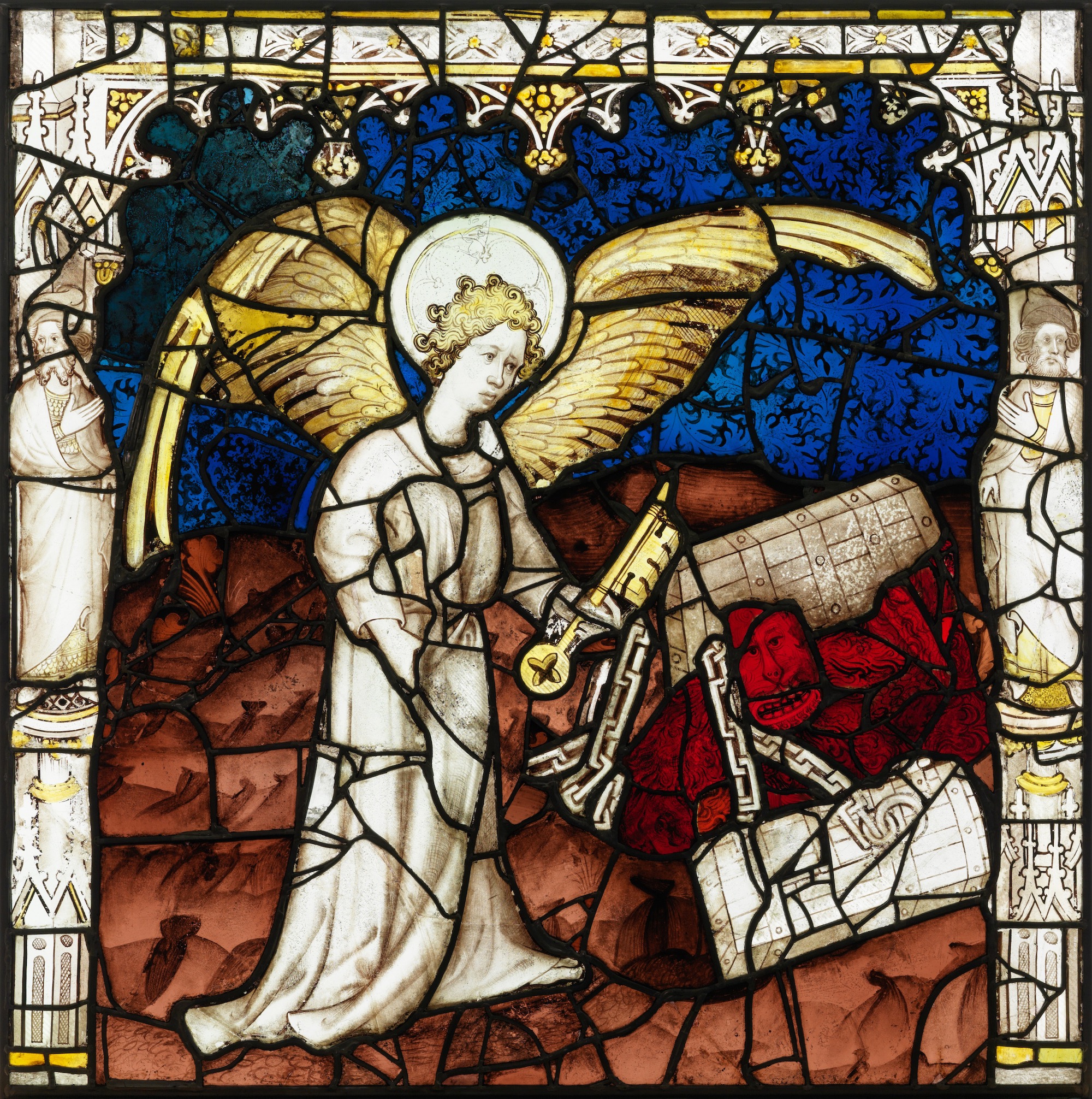
Satan chained in the bottomless pit (York)
John Thornton of Coventry (British, fl. 1405–1433), Satan Chained in the Bottomless Pit (Rev. 20:1–3), 1405–8. Stained glass panel from the Great East Window, York Minster, York, England. Photo courtesy of the York Glaziers Trust.

>> Life of a Cathedral: Notre-Dame of Amiens: Located in the heart of Picardy in northern France, Amiens Cathedral is one of the largest Gothic churches of the thirteenth century, renowned for the beauty of its three-tier interior elevation, its prodigious sculpted decoration, and its stained glass. This website put together by Columbia University’s Media Center for Art History offers a detailed virtual tour of the cathedral, drawing attention to its architectural features and artworks, from the many stone relief sculptures over its four portals (my favorite) to the octagonal labyrinth that adorns the marble floor in the nave to the early sixteenth-century misericords in the choir stall.

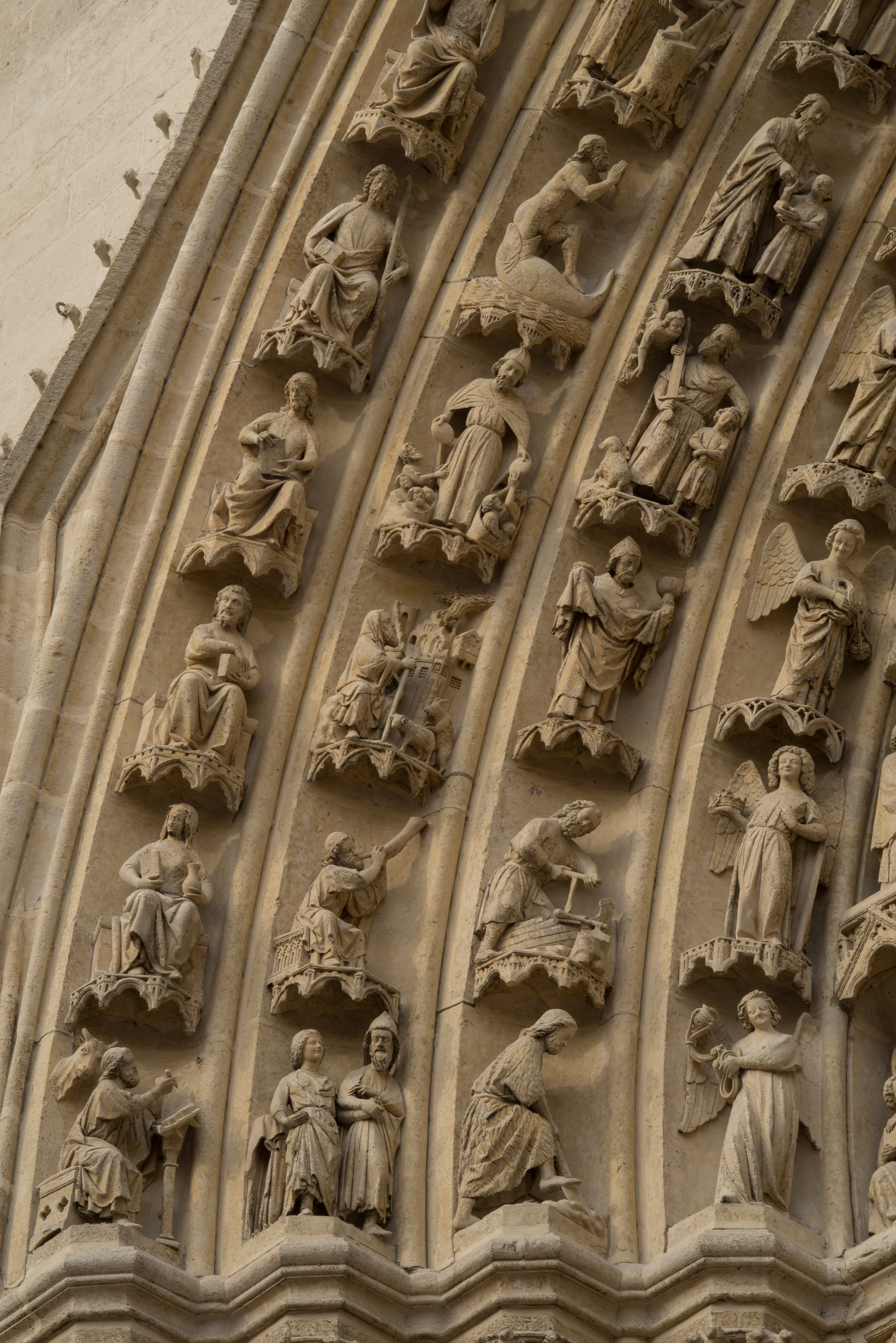
Voussoir close-up, Amiens Cathedral
Detail of voussoirs from the south transept portal of St. Honoré at Amiens Cathedral, ca. 1240, featuring Adam working the ground, Noah building the ark, Jonah being disgorged from the fish, Hosea marrying Gomer, and other biblical figures and vignettes

+++

SONG: “Adon Olam,” performed by the Maqamat Masters, feat. Nissim Lugas: The well-loved text of this traditional Hebrew prayer in five stanzas probably originated in medieval Spain, having been first found in a thirteenth-century siddur (Jewish prayer book) from Andalusia. Drawn from the language of the Psalms, it praises God for both his transcendence and his immanence. He is incomparably great, the ruler over all, and yet he’s also a personal God, a refuge for those who call on him. The prayer’s title and opening phrase translates to “Master of the Universe” or “Eternal Lord.”

Various tunes have been used for the singing of this prayer over the centuries. The Maqamat Masters perform it here with a melody based on the traditional Armenian folk tune NUBAR NUBAR, arranged by Elad Levi and Ariel Berli. They also add to the prayer a few lines from the ghazals of the Persian Sufi poet Saadi (1210–ca. 1292), about the burning fire of God’s love; Lugas sings this Farsi passage from 3:06 to 4:08.

“Maqamat Masters is a unique group of musicians that coalesced around their work together teaching at the Maqamat School of Eastern Music in Safed, Israel,” 12 Tribes Music writes. “Each of the musicians is a master in a different traditional musical genre from the Middle East, and they bring their personal voices and decades of explorations together, to create a magical, new and innovative sound.”

+++

VIRTUAL EXHIBITION: The Faras Gallery: Treasures from the Flooded Desert: In 1960, Faras, a small town in Sudan near the Egyptian border, was one of the archaeological sites designated for flooding by the waters of the Nile to create Lake Nasser. Responding to an international call by UNESCO to preserve the area’s cultural heritage before it would be buried beneath the new reservoir, a Polish team led by Professor Kazimierz Michałowski proceeded with salvage excavations in 1961–64. Their efforts uncovered the wonderfully preserved ruins of a medieval cathedral, active from the eighth to fourteenth centuries (it was built on the remains of an early seventh-century church) and containing over 150 religious paintings, a trove of Nubian Christian art. By agreement with Sudan, half of the findings went to Poland’s National Museum in Warsaw, while the other half are kept in Sudan’s National Museum in Khartoum.

Nubian Madonna and Child
Wall Painting with Bishop Marianos under the protection of Christ and the Mother of God, early 11th century, excavated from Faras Cathedral in modern-day Sudan. Secco tempera on plaster, 247 × 155.5 cm. National Museum, Warsaw.

Excavation of Faras Cathedral

Curated by Paweł Dąbrowski and Magdalena Majchrzak and hosted by Google Arts & Culture, this virtual exhibition spotlights the wall paintings and artifacts from Faras that are housed in Warsaw. It discusses the importance of the discovery of the cathedral and the technical challenges of detaching the paintings (tempera on dry mud plaster) from the walls. It also includes digital reconstructions of the cathedral’s interior and exterior in 3D stereoscopy, as well as video elements. Here is one of the four videos from the exhibition:

Lent, Day 12

LOOK: Mr. & Mrs. Satan Fishing by Leroy Almon

Almon, Leroy_Mr. and Mrs. Satan Fishing
Leroy Almon (American, 1938–1997), Mr. & Mrs. Satan Fishing, 1991. Polychrome bas-relief wood carving, 22 1/2 × 24 in. Gordon Gallery, Nashville.

Leroy Almon (1938–1997) was born in Tallapoosa, Georgia, but grew up in Ohio. While working for Coca-Cola in Columbus, he met the self-taught woodcarver Elijah Pierce [previously] at Gay Tabernacle Baptist Church, where Pierce served as lay preacher, and in 1979 became apprenticed to him. Pierce taught Almon how to make low-relief carvings in wood using pocketknives and hand chisels, and then to paint them. Initially the two collaborated on pieces, until 1982, when Almon returned to Tallapoosa. There he restored his childhood home, converting the basement into an art studio. Like his mentor, he too combined the vocations of art making and evangelical preaching.

Almon is well known for his didactic carvings on the subjects of religion, politics, and African American history. The battle between good and evil is at the forefront of his art. Satan fishing for souls is a theme he developed and returned to many times in variation; see, for example, here, here, here, and here. Such carvings show a caricatured Satan (red, horned, spiky-tailed, and goateed) dangling various vices—gambling, promiscuity, sex, drugs, greed, hypocrisy, etc.—as bait before humans who appear ready to bite. Sometimes he’s joined by his wife, Mrs. Satan!

In the version at the Gordon Gallery in Nashville, cards, cash, a romantic couple (presumably unwed), alcohol, cigarettes, a bomb, hard drugs, and a church building are on the line. The latter symbolizes the false piety of many churchgoers and the corruption inside institutionalized Christianity.

In The New Encyclopedia of Southern Culture, Vol. 23: Folk Art, Jenifer P. Borum praises Almon’s ability to “mix fire-and-brimstone warnings about the world’s evils with a playful sense of humor”; she refers to the “comic moralism” of his work. My first reaction upon seeing Mr. & Mrs. Satan Fishing was to laugh out loud. But then I wondered whether the humor was intentional. Does the artist want us to chuckle? I haven’t been able to find any statements from Almon. The image likely represents very real temptations that afflicted his community and maybe, some of them, him personally. I suppose the humor could be self-conscious, but if so, it’s a dark humor—gravitas masked in levity. Almon knew that “like a roaring lion [our] adversary the devil prowls around, looking for someone to devour” (1 Pet. 5:8).

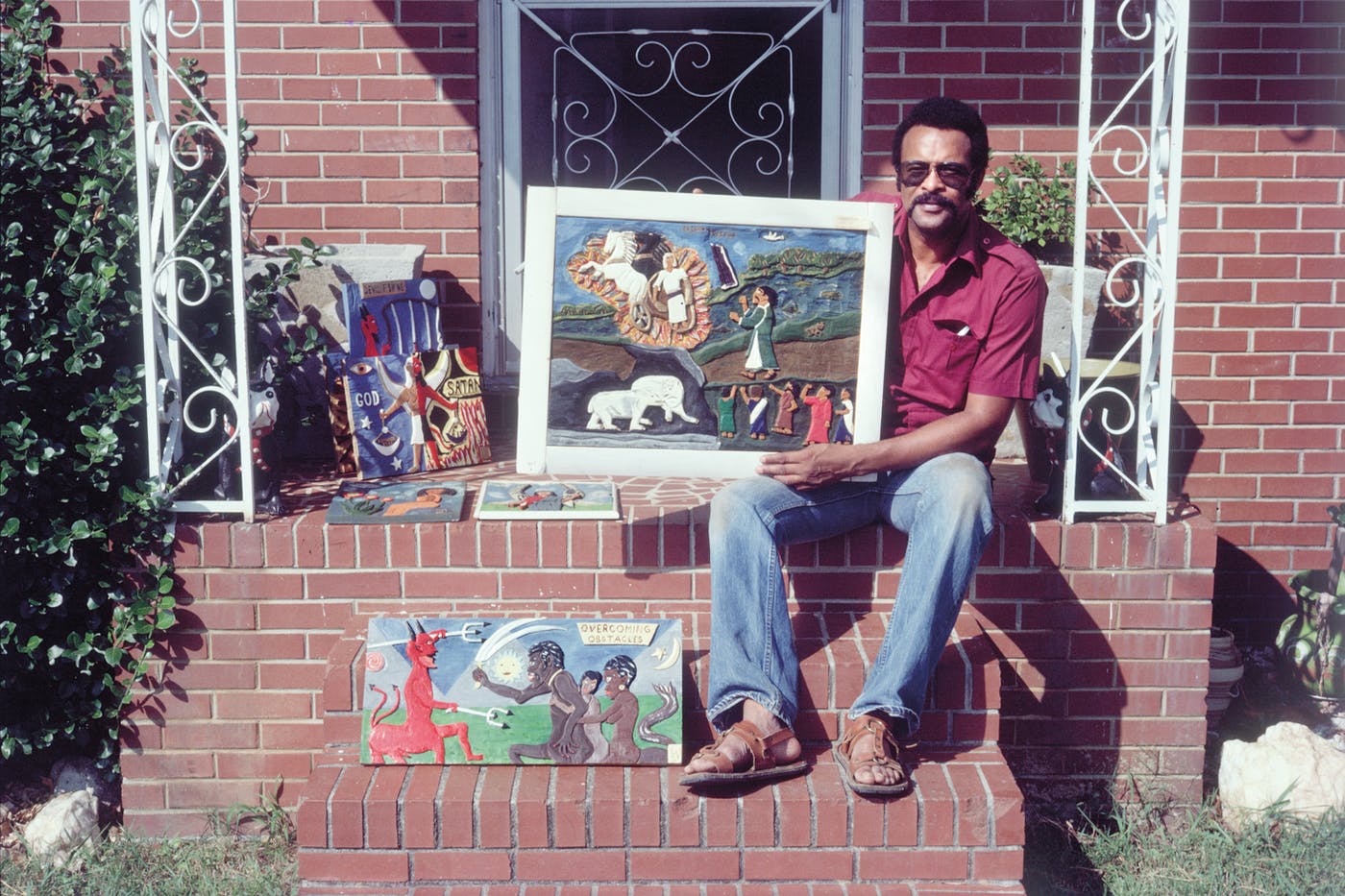
Leroy Almon
Leroy Almon on his front stoop in Tallapoosa, Georgia, 1987. Photo: Roger Manley.

LISTEN: “The Devil Ain’t Lazy” by Fred Rose; originally recorded by Bob Wills & His Texas Playboys, 1947 | Performed by Pokey LaFarge on Pokey LaFarge, 2013

The devil ain’t lazy (No siree)

He roams around with sticks and stones
Passing out his moans and groans
The devil ain’t no lazy bones
He works 24 hours a day

The devil ain’t lazy (No siree)

He likes to see us fight and fuss
Makes us mean enough to cuss
Then he blames it all on us
He works 24 hours a day

He travels like a lightning streak
And he strikes from town to town
Then he gets you when you’re weak
He’ll tear your playhouse down

The devil ain’t lazy (No siree)

He tells us he won’t hurt a fly
Then he makes us steal and lie
Keeps us sinning until we die
He works 24 hours a day

The devil ain’t lazy (No siree)

Gets his pitchfork out each night
Gives the folks an awful fright
I know he does it just for spite
He works 24 hours a day

The devil ain’t lazy (No siree)

Tells us how to find success
I know he’ll wind up in distress
I’ll tell ya why: the devil is an awful mess
He works 24 hours a day

He likes to see things scorch and burn
He don’t make no excuse
If he catches you, he’ll turn you
Every way but loose

The devil ain’t lazy (No siree)

So if you think you’re strong and brave
Smart enough to not behave
You got one foot in the grave
He works 24 hours a day
24 hours a day (Yes, he does!)
He works 24 hours a day

Lent, Day 5

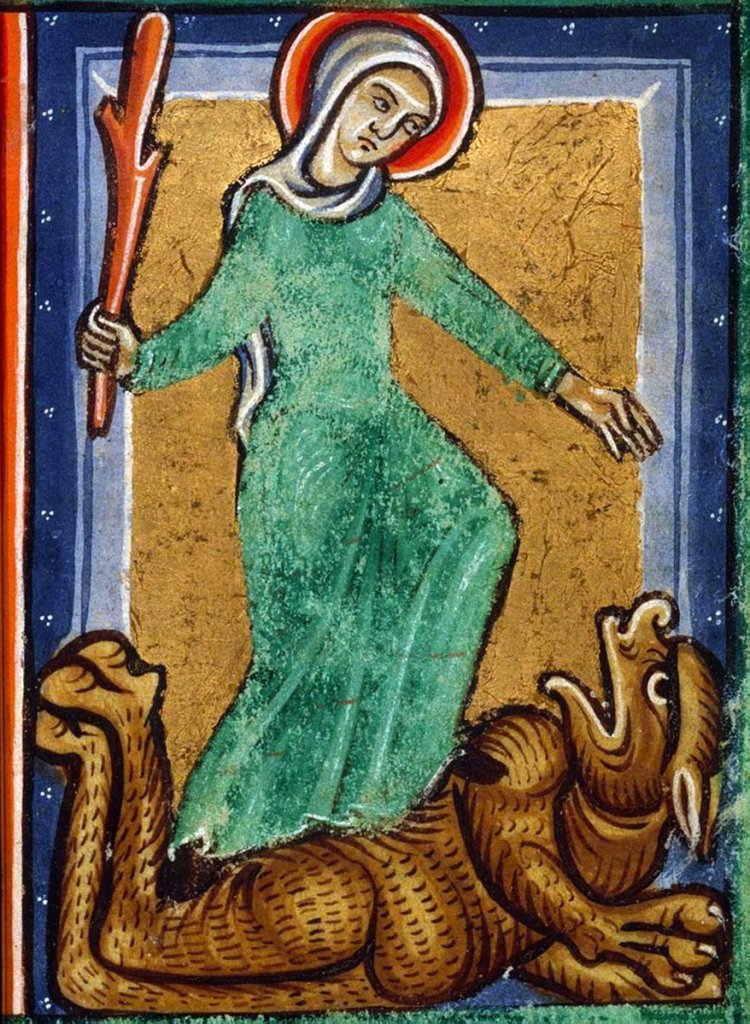
LOOK: (1) “St. Juliana of Nicomedia, the devil at her feet,” from a Picture Bible made at the Abbey of Saint Bertin, Saint-Omer, France, ca. 1190–1200. KB, 76 F 5, fol. 32r. Koninklijke Bibliotheek (Royal Library), The Hague, Netherlands. (2) “St. Juliana of Nicomedia binding the devil,” from the Passionary of Weissenau, made in Germany, 12th century. Codex Bodmer 127, fol. 44v. Fondation Martin Bodmer, Cologny, Switzerland.

St. Juliana of Nicomedia and the devil
St. Juliana binding the devil

Saint Juliana (ca. 286–ca. 304) was a Christian from Nicomedia in present-day Turkey—the eastern capital of the Roman Empire in her day—who suffered martyrdom under the Diocletian persecutions. Legend has it that she engaged in some serious combat with the devil, so in art she is sometimes shown beating him with a club, binding him with a rope or chain, or otherwise incapacitating him. Bam!

[Related post: “Stomp (Artful Devotion)”]

LISTEN: “Satan, Take Your Hands Off Me” by Essie Mae Brooks, on Rain in Your Life (2000)

. . .
Satan, take your hand off me.
I’m in God’s hand.
Jesus, my Jesus,
Has got his arm,
They wrapped all around me,
And the world can’t do me no harm.
. . .

Born in 1930, Essie Mae Brooks is a gospel singer-songwriter from Houston County, Georgia. Rain in Your Life is her debut album, which was followed up by I’ve Been Washed in the Water in 2002.

These two projects were financed by the Music Maker Relief Foundation, a nonprofit dedicated to preserving the musical traditions of the South by directly supporting the musicians who bear those traditions. Cofounder Tim Duffy realized, while studying folklore in college, that preservationists tended to focus on documenting and archiving rather than on taking care of the artists themselves, and he wanted to take a more people-centered approach. So he and his wife Denise launched the foundation in 1994, seeking to empower and sustain folk and blues musicians in and around Winston-Salem, North Carolina, and beyond.

Music Maker provides tour booking, management, and recording services to its artists in addition to grants, but more than that, it offers ongoing support that helps artists pay their bills. The organization focuses on the most vulnerable musicians: those over fifty-five who live on less than $25,000 a year.

To learn more, you can listen to the 2019 NPR segment “Capturing the Undersung Blues People of the Rural South” (or, from 2014, “Preserving American Roots Music Begins with Keeping the Lights On”). And visit the Music Maker website to explore more artists.

“Satan, Take Your Hands Off Me” by Essie Mae Brooks is featured on the Art & Theology Lent Playlist on Spotify.

Resist (Artful Devotion)

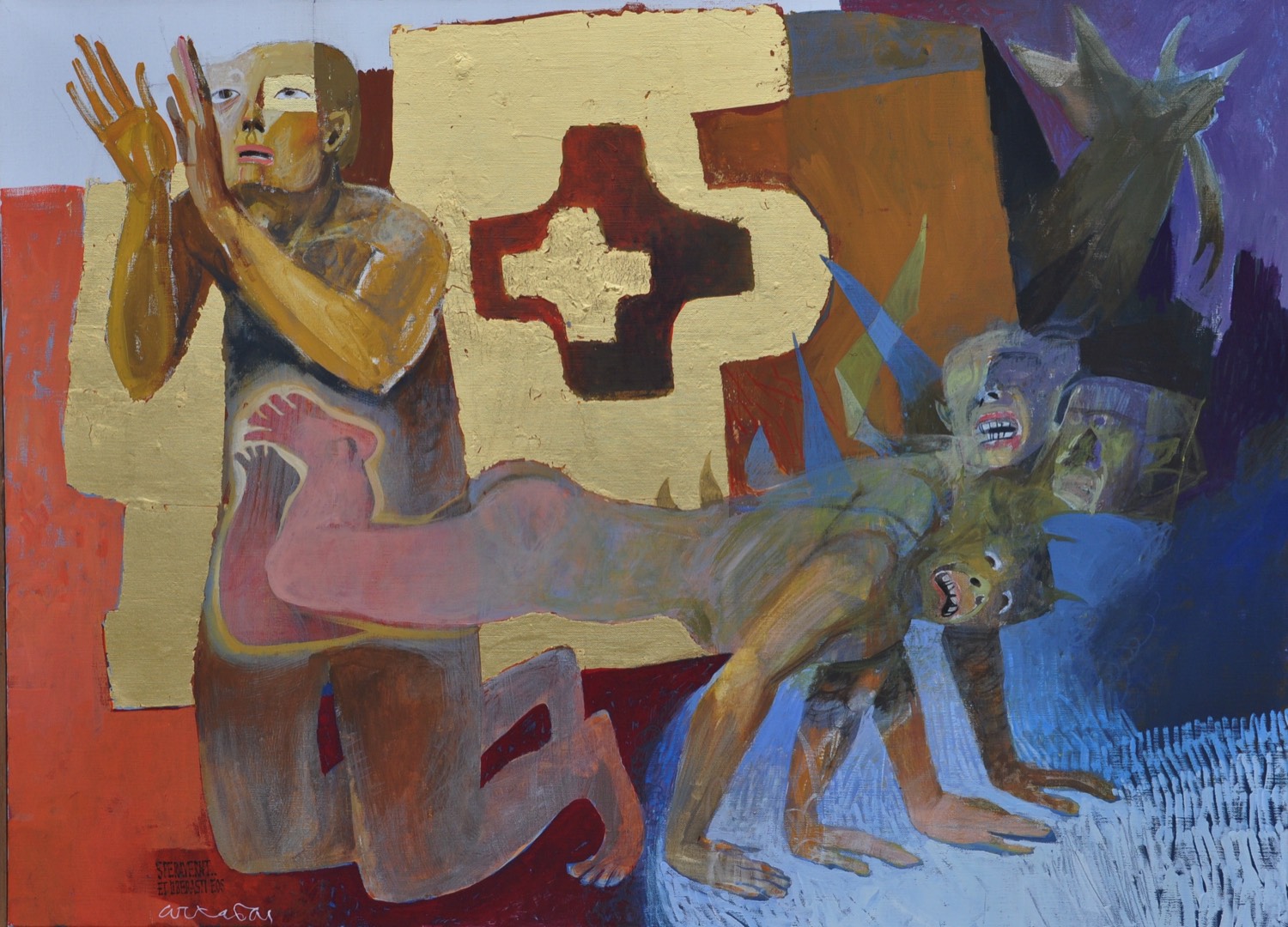
Prayer by Arcabas
Painting by Arcabas (French, 1926–2018)

Submit yourselves therefore to God. Resist the devil, and he will flee from you.

—James 4:7

+++

SONG: “Way Down in the Hole” by Tom Waits, on Franks Wild Years (1987)


This post belongs to the weekly series Artful Devotion. If you can’t view the music player in your email or RSS reader, try opening the post in your browser.

To view all the Revised Common Lectionary scripture readings for Proper 20, cycle B, click here.

Voices in the desert—whose blessing will we heed?

Temptation by G. K. Hajarathbai
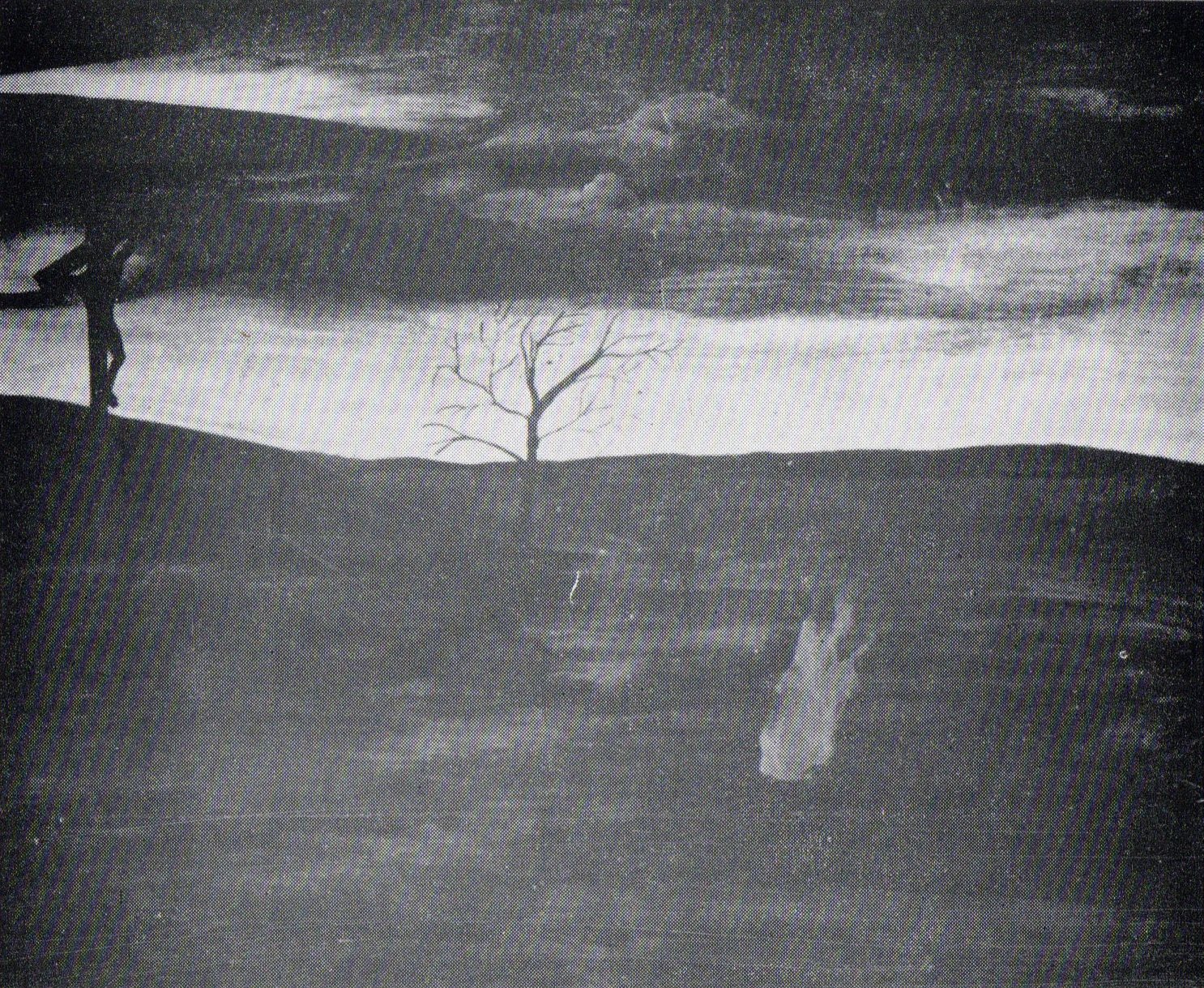
Gulap K. Hajarathbai (Indian), Temptation, 20th century. Oil on canvas, 18 × 20 in. Source: Herbert E. Hoefer, Christian Art in India (Chennai, India: Gurukul Lutheran Theological College and Research Institute, 1982)

“Tempted” by Eugene H. Peterson

Mark 1:12–13

Still wet behind the ears, he’s Spirit-pushed
up Jordan’s banks into the wilderness.
Angels hover praying ’round his head.
Animals couch against his knees and ankles
intuiting a better master. The Man
in the middle—new Adam in old Eden—
is up against it, matched with the ancient
Adversary. For forty days and nights
he tests the baptismal blessing and proves to his dismay
the Man is made of sterner stuff than Adam:
the Man will choose to be the Son God made him.

This poem was originally published in A Widening Light: Poems of the Incarnation, edited by Luci Shaw (Wheaton, IL: Harold Shaw, 1984), and is reprinted here by permission of the editor. www.lucishaw.com

+++

Mark dedicates a spare two verses to this initiatory event in the life of Christ: the forty days of temptation he endured immediately following his baptism: “The Spirit immediately drove him out into the wilderness. And he was in the wilderness forty days, being tempted by Satan. And he was with the wild animals, and the angels were ministering to him” (Mark 1:12–13, ESV; cf. Matthew 4:1–11, Luke 4:1–13).

I’m intrigued by Mark’s use of the word driven (ekballō) to describe the manner in which the Spirit imparts motion to Christ. Whereas Matthew and Luke use the gentler led (anagō), Mark implies something more forceful: ejected, cast forth, hurled. In his idiomatic translation of the Bible, The Message, Eugene H. Peterson uses push: “At once, this same Spirit pushed Jesus out into the wild” (emphasis mine).

So the same Spirit who had just alighted on Jesus in the waters of the Jordan, presiding over God’s pronouncement that “You are my beloved Son; with you I am well pleased” (Mark 1:11), now pushes Jesus into the Judean desert, away from civilization. Why? So that in the quiet, he could get to better know himself and the Father, to better discern the task to which he had been called. This process necessarily involved doing battle with the prospects of other paths, other identities.

“Turn these stones into bread.” “Jump; let’s see if God saves you.” “Worship me; I’ll give you the kingdom of earth.”

Satan tries to draw Jesus from a messiahship of self-sacrifice to a messiahship of power. Performing miracles for his own benefit, to avoid any discomfort or pain in life; performing miracles for show, like a magician, to impress the masses; becoming an earthly king, with political control and dominion—these are all temptations Jesus would face again. Here he has the opportunity to confront them head-on in preparation for his imminent ministry to the Israelites. Over this period of forty days, Jesus solidifies his mission, rejecting the vision of himself and his life that Satan lays out for him. Instead of gratification, pride, and riches, Jesus chooses purity, humility, and poverty.   Continue reading “Voices in the desert—whose blessing will we heed?”