Pentecost roundup: “All Flesh” by Steve Thorngate, animated fabrics, and more

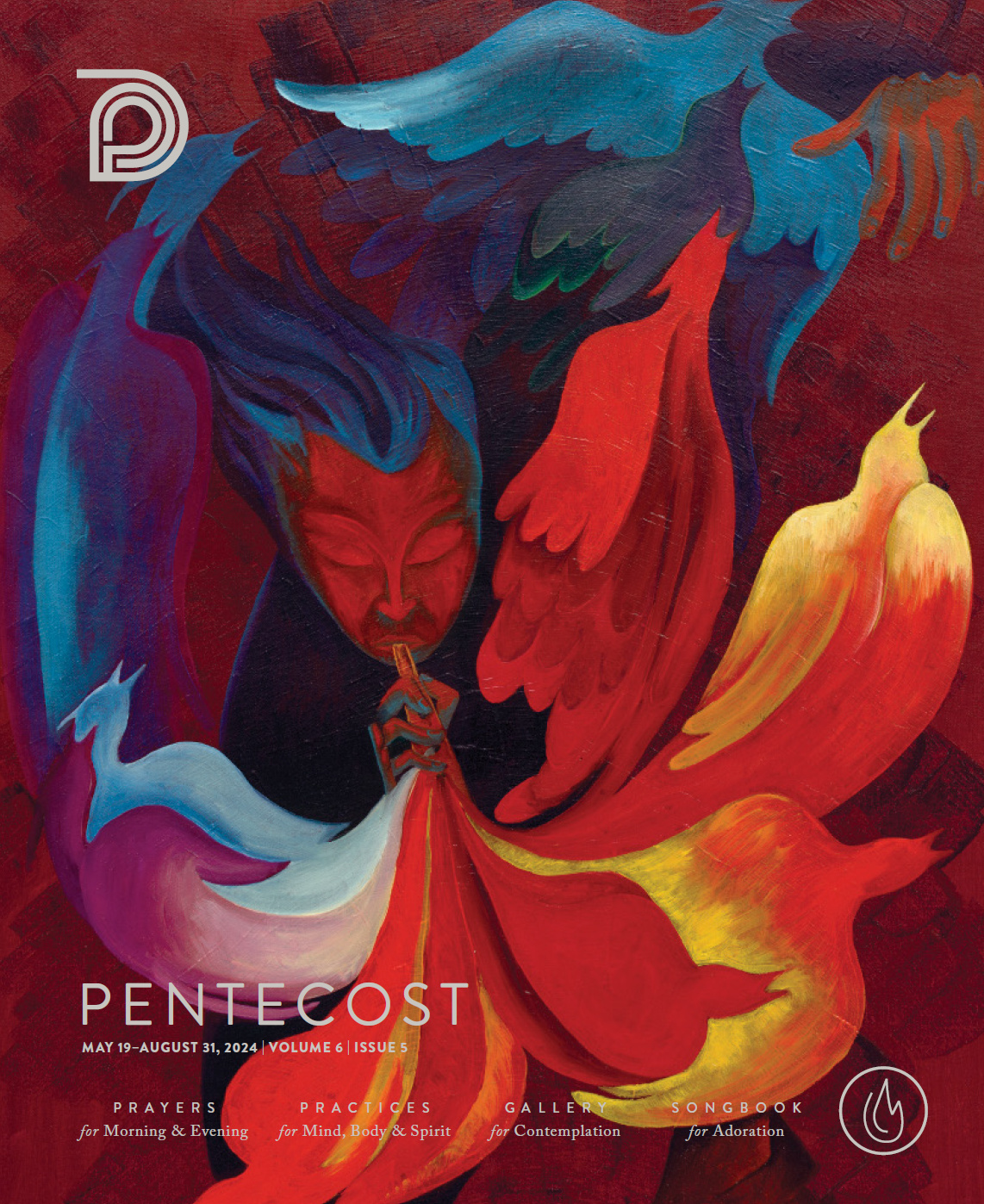
LIVING PRAYER PERIODICAL: Pentecost 2024: The latest edition of the Daily Prayer Project’s Living Prayer Periodical is available for purchase! Pentecost is this Sunday, May 19, so grab your copy soon. The booklet provides a distinct liturgy of scripture and prayer for each day of the week, through August 31, as well as art with accompanying reflections, songs, spiritual practice essays, and, new this issue, a poem! I curate the art and poetry for the DPP. The cover image is cropped from a painting by the Guatemalan artist Juan Francisco Guzmán (it’s reproduced in full in the interior). And the poem we feature, which I wrote a short commentary for to help readers engage it more meaningfully, is “Not Like a Dove” by Mary F.C. Pratt; I’m grateful to the directors for taking a risk with this unusual, even difficult, poem, which rewards those willing to sit with its imagery over time.
Pentecost LPP 2024

+++

SERMON (text only): “When the Spirit Comes” by N. T. Wright: Preached May 23, 2010, at Durham Cathedral, where he was bishop at the time, this Pentecost sermon by the esteemed N. T. Wright is a rousing call to stand, like Jesus, at the place where heaven and earth collide: in the Spirit. Here are two excerpts:

  • “The point about Pentecost is that it’s the point at which two worlds collide and look like they are now going to be together for keeps. The two worlds are of course heaven and earth. . . .
              The whole point of heaven and earth in Jewish thought is that they are meant to meet and merge. And the point of the gospel story as Luke has told it in his first volume is that Jesus had come to bring the life of heaven and earth together. That is the meaning of the ‘kingdom of God’. Thy kingdom come, he taught us to pray, on earth as in heaven. The disciples, we may presume, had been praying that prayer, among others, in the fifty days since Easter. And now the prayer is answered.”
  • “When the Spirit comes, the Spirit will prove the world wrong [in how things are run] . . . which is not a comfortable message, and it’s not meant to be. But if we can at least recognise that discomfort, and see it as the thing you should expect when the two worlds collide, we can put our shoulders back, take a deep breath – in other words, breathe in God’s breath – and get on with the task to which the New Testament commits us but in which . . . we feel a strange reluctance.
              Of course we can get it wrong, and of course we will find it awkward. But how much more wrong would it be not to try! How much more awkward, when God finally brings heaven and earth fully together, will it be to discover that we had continued to live in the split-level world when we were invited, by Ascension and Pentecost together, to dare and to risk the possibility of bringing them together in our own lives and in our own witness! Because of course none of this is in the last analysis ‘about’ us. If we are embarrassed at the heaven-and-earth conjunction, we are forgetting that we are not, after all, the centre of attention in all this. Jesus went on to say that the Spirit would glorify him, not us: he will take what belongs to Jesus and declare it to us and through us to the world.”

+++

MUSIC:

>> “All Flesh” by Steve Thorngate: This playfully serious song is rooted in Joel 2:28–29, which Peter quotes in his sermon at Pentecost: “I will pour out my spirit on all flesh; your sons and your daughters shall prophesy, your old men shall dream dreams, and your young men shall see visions. Even on the male and female slaves, in those days I will pour out my spirit.” Thorngate wrote it several years ago, but this recording, new this year, is the first he’s released, and it’s available only on Bandcamp for now.

>> “Ruach” by Delvyn Case, performed by the Mivos Quartet: Inspired by the story of Pentecost in Acts 2, this sacred concert work for string quartet, writes composer Delvyn Case, “bring[s] to our awareness many different ways ‘breath’ and ‘spirit’ can become sonically and dramatic present. Throughout the piece the performers are asked to make various kinds of breath sounds with their instruments and their own voices, blurring the line between music and sound. Overall, the piece emphasizes idea of the spirit as a powerful force that is surprising, shocking, and fundamentally resistant to control.”

>> “Sweet, Sweet Spirit” by Doris Akers, performed by Ruah Worship: Consisting of siblings Joshua Mine, Julia Mine, Erika Grace Izawa, and Marian Mine, Ruah Worship from Japan performs original worship songs as well as covers. I especially love their a cappella arrangements of Black gospel songs. Here they sing a song by Gospel Music Hall of Famer Doris Akers (1923–1995), about the sweetness of the Holy Spirit, who revives communities and fills them with love.

+++

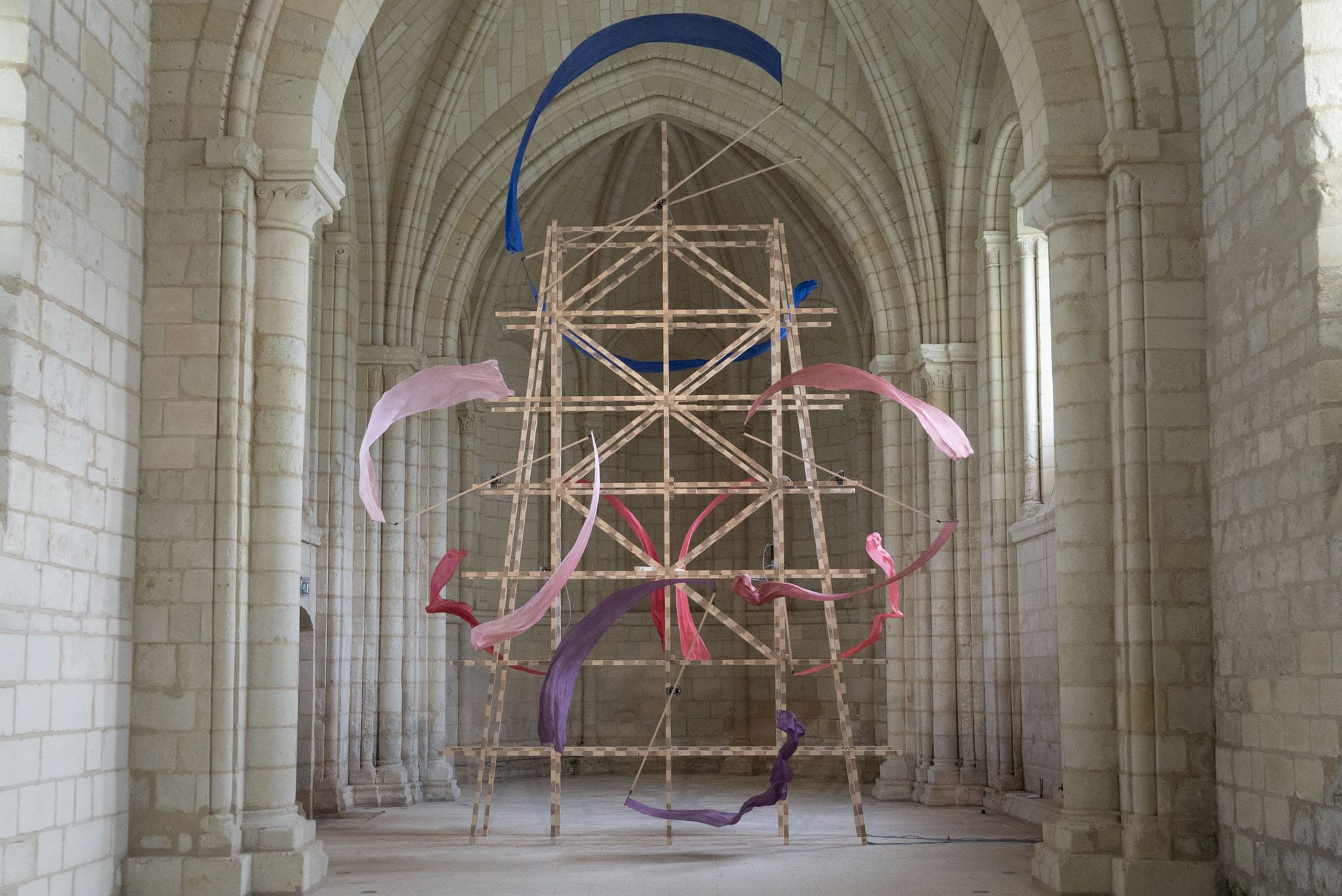
ART INSTALLATION: Fanions et Carillons by Pinaffo & Pluvinage: I learned of this kinetic sculpture by the French artist duo Marion Pinaffo (b. 1987) and Raphaël Pluvinage (b. 1986) in a Colossal article in February and thought of the movement of the Holy Spirit. Fanions et Carillons, French for “Pennants and Chimes,” was commissioned by Fontevraud Abbey and was on display earlier this year in one of the abbey’s twelfth-century chapels. Inspired by the historical striking clocks of churches, the automaton comes to life every half hour, sending fourteen pennants of blue, red, pink, and purple swinging and swirling.
Fanions et Carillons
Marion Pinaffo and Raphaël Pluvinage (aka Pinaffo & Pluvinage), Fanions et Carillons, 2023. Painted wood, motor, silk, electronic, 4 × 2 × 7 m. Temporary installation at the Chapelle St-Benoît, Abbaye Royale de Fontevraud, Anjou, Maine-et-Loire, France.

On their website, Pinaffo & Pluvinage write of the piece, “Although its mechanics are simple and rudimentary, using rotational or pendulum movements, it doesn’t produce the sound of bells, but rather animates fabrics. A set of 14 inert pennants awaken in turn to create ephemeral forms that mutate, respond and compose. Like a harmony of chimes creating a melody, this ensemble creates a choreography lasting a few minutes at regular intervals.” Whereas one might associate a certain rigidness and predictability with clocks, in this piece there’s a freedom, with the pennants moving at different rates and occasionally reversing direction.

+++

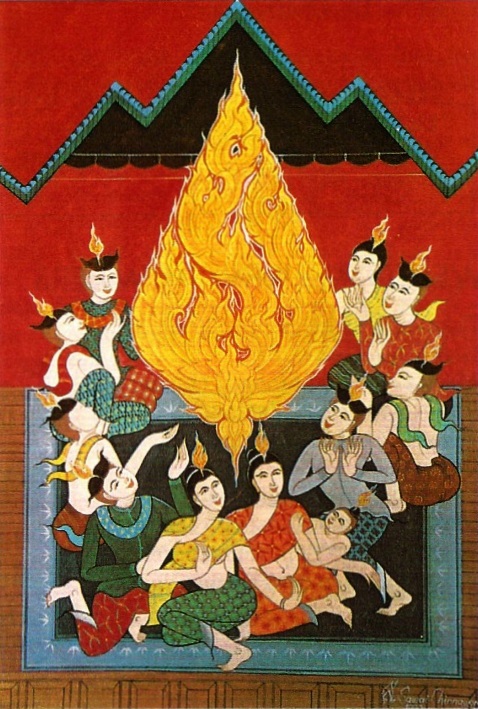
ARTICLE: “Painting Pentecost: Painter Sawai Chinnawong saturates the outpouring of the Spirit with the colors Thai art traditionally associates with the holy” by Amos Yong and Jonathan A. Anderson, Christian Century: Adapted from the book Renewing Christian Theology: Systematics for a Global Christianity (Baylor University Press, 2014), this article explores one of the Pentecost paintings of Thai Christian artist Sawai Chinnawong, who adopts and adapts a Thai Buddhist visual vernacular in terms of color choices, design elements, and the gestures and postures of figures. I’m appreciative of how the painting shows both men and women, and even a child, present at Pentecost and being recipients of the gift of the Spirit, as they surely were.
Chinnawong, Sawai_Pentecost
Sawai Chinnawong (Thai, 1959–), Pentecost, 1997. Acrylic on canvas.

(Related post: “Pentecost art from Asia”)

Some Christians are uncomfortable with art that transposes biblical events into other cultural contexts. But I think it’s a beautiful picture of the global character of the gospel, which has taken root in countries all over the world. As the authors write, in addition to celebrating a historic event, Chinnawong’s Pentecost “prompts us to see this as another event altogether: the outpouring of the Spirit in a room in 21st-century Bangkok rather than first-century Jerusalem. Chinnawong sets the scene here not out of disregard for the historical particularity of the original event but as a means of imagining and visually praying for the Spirit’s presence in his own historical moment. For Chinnawong, the Holy Spirit’s filling is not isolated to a single event, a particular moment, or one place but may be repeated at any time and place and for any people. Thus the circle of believers being filled with the Spirit is repeatedly repopulated and renewed.”
Joyful Lent (Artful Devotion)

Genesis 9:13 by Sawai Chinnawong
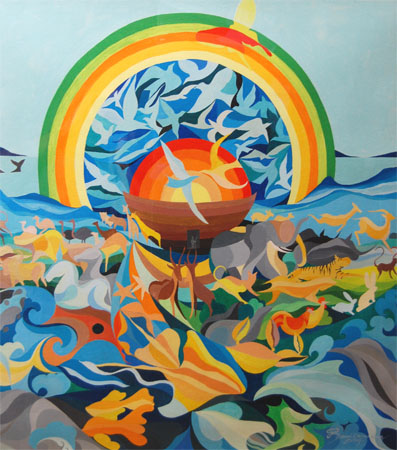
Sawai Chinnawong (Thai, 1959–), Genesis 9:13, 2004. Acrylic on canvas, 27 × 27 in.

Then God said to Noah and to his sons with him, “Behold, I establish my covenant with you and your offspring after you, and with every living creature that is with you, the birds, the livestock, and every beast of the earth with you, as many as came out of the ark; it is for every beast of the earth. I establish my covenant with you, that never again shall all flesh be cut off by the waters of the flood, and never again shall there be a flood to destroy the earth.”

And God said, “This is the sign of the covenant that I make between me and you and every living creature that is with you, for all future generations: I have set my bow in the cloud, and it shall be a sign of the covenant between me and the earth. When I bring clouds over the earth and the bow is seen in the clouds, I will remember my covenant that is between me and you and every living creature of all flesh. And the waters shall never again become a flood to destroy all flesh. When the bow is in the clouds, I will see it and remember the everlasting covenant between God and every living creature of all flesh that is on the earth.”

God said to Noah, “This is the sign of the covenant that I have established between me and all flesh that is on the earth.”

—Genesis 9:8–17

+++

MUSIC: Keyboard Sonata in C Major (K. 159, L. 104) by Domenico Scarlatti | Arranged for banjo by Béla Fleck and for mandolin by Edgar Meyer | Performed by Béla Fleck and Chris Thile on Perpetual Motion (2001)

+++

This art and music may seem inappropriately light and bright for the first Sunday of Lent, a season that’s stereotypically thought of as gloomy and self-deprecating. But the Old Testament reading the Revised Commentary Lectionary assigns to this day is God’s covenant with Noah after the Flood, a passage filled with great hope.

Contrary to popular misconceptions, Lent does not mean forty days of beating yourself up. It literally means “springtime,” and it’s a time of renewal in preparation for Easter. Self-examination is a major component, yes, but so is grabbing hold of the divine promise—of God’s wondrous love and mercy.

In my church’s liturgy (and this is common across denominations), the confession of sin is always followed by words of assurance—a verse of scripture, spoken by the pastor, that reminds us of the pardon we receive through Christ. We are not left in the darkness of our failures; we are brought into the light, and given power to live as children of the light. Repentance is a joyous thing! That’s why the Constitution on the Sacred Liturgy, a Second Vatican Council document, refers to Lent as the “joyful season.” It’s joyful because God’s mercy is amazing.

After forty days on a dark boat, and then some, Noah, his family, and a whole bunch of animals come out to a renewed earth, and to a promise painted across the sky in bright colors that never again will all God’s creation be destroyed. Similarly, during Lent we choose to enter a period of darkness, taking stock of our sin. It may be a rocking journey, but it’s ultimately a period of regeneration, and when we arrive at Easter we receive, as confirmation of the new life that’s possible, the resurrected Christ. He’s there for us all along—we need not wait till Lent’s over to enter his forgiveness and to rise with him. But we also don’t want to skip over the necessary steps of first acknowledging the depth of our sin, and confessing it with a contrite heart.

+++

Excerpt from “The Agreement” by Henry Vaughan, from Silex Scintillans:

But while Time runs, and after it
Eternity, which never ends,
Quite through them both, still infinite,
Thy covenant by Christ extends;
No sins of frailty, nor of youth,
Can foil His merits, and Thy truth.

And this I hourly find, for Thou
Dost still renew, and purge and heal:
Thy care and love, which jointly flow,
New cordials, new cathartics deal.
But were I once cast off by Thee,
I know—my God!—this would not be.

+++

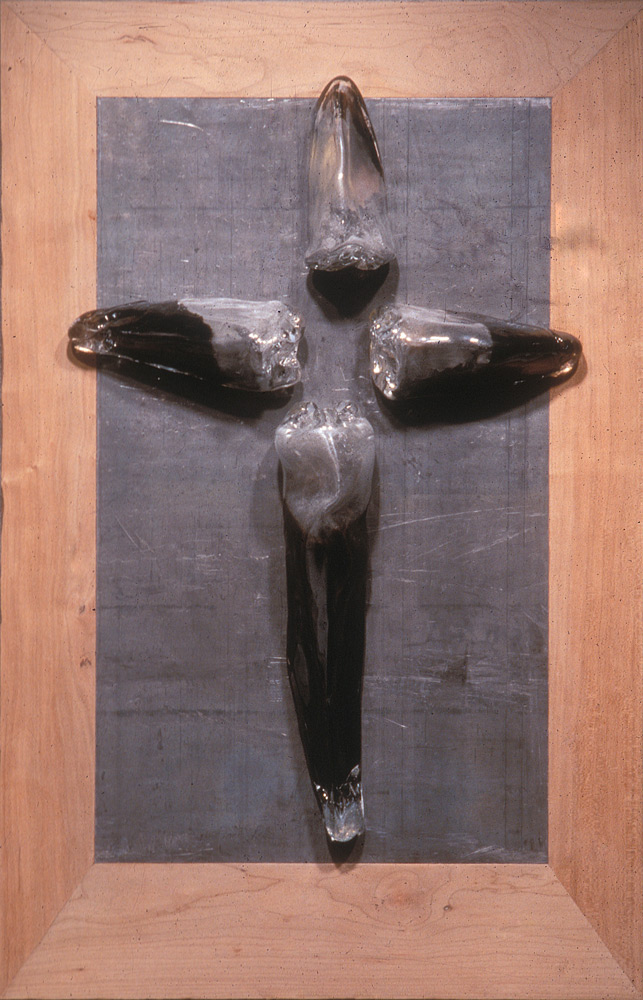
Tomorrow is Ash Wednesday, and I have a poem planned for publication here at Art & Theology. But I also wrote a short visual meditation for the Anglican Church in North America, which you can find at the bottom of their Lent website, https://giftoflent.org/. It’s on Ted Prescott’s mixed-media artwork All My Sins, which incorporates paper ash, the residue left over from the artist’s burning of a list of his personal sins.

All My Sins by Ted Prescott
Theodore Prescott (American, 1944–), All My Sins, 1996. Cherry, lead, hand-blown glass, paper ash, and silicon, 36.5 × 24.5 × 5 in.


This post belongs to the weekly series Artful Devotion. If you can’t view the music player in your email or RSS reader, try opening the post in your browser.

To view all the Revised Common Lectionary scripture readings for the First Sunday of Lent, cycle B, click here.

Life in the Spirit (Artful Devotion)

Holy Spirit by Sawai Chinnawong
Sawai Chinnawong (Thai, 1959–), Holy Spirit, 2003. Ink drawing, 14 × 17 in. Artist’s statement: “God’s all-seeing eye takes in the whole of creation, here represented by slivers of his cosmos. A great mother bird feeds us, her spiritual young. The metamorphosis of all life, part flower, part animal, takes place in my Christian view of Yin and Yang.”

Romans 8:6:

“To set the mind on the flesh is death, but to set the mind on the Spirit is life and peace.” (RSV)

“Obsession with self . . . is a dead end; attention to God leads us out into the open, into a spacious, free life.” (The Message)

+++

MUSIC: “Untitled” by Seryn, on This Is Where We Are (2011)


This post belongs to the weekly series Artful Devotion. If you can’t view the music player in your email or RSS reader, try opening the post in your browser.

To view all the Revised Common Lectionary scripture readings for Proper 10, cycle A, click here.

Pentecost art from Asia

Ten days after Jesus ascended into heaven (and fifty days after his resurrection), his Holy Spirit descended on the apostles, manifesting as “tongues of fire” (Acts 2:3). This miraculous gift enabled the apostles to speak in languages foreign to them but native to the many Jews from abroad who were gathered in Jerusalem for Shavuot (called “Pentecost” by Hellenized Jews), a festival of giving thanks for the harvest and for God’s provision of the Torah. For the first time the gospel of Jesus Christ was proclaimed to a global audience. Three thousand people came to faith that day, and the Christian church was born.

The Spirit is still at work in the dissemination of the good news today, breathing life into cultures all over the world and thereby building up an incredibly diverse body of Christ.

The arts are one expression of this diversity.

In the introduction to his groundbreaking book Each with His Own Brush: Contemporary Christian Art in Asia and Africa (New York: Friendship Press, 1938), Daniel Johnson Fleming writes,

As at Pentecost, Parthians, Medes and Elamites heard the message, “every man in his own tongue wherein he was born,” so we see Chinese and Japanese and Indians expressing Christianity’s universal language, each with his own brush. For when the spirit of God descends upon any people, new forms of beauty appear, new artistic gifts are revealed, adding another testimony to the universality of the Christian faith.

Since the publication of this book almost seventy years ago, Christianity has grown exponentially in Asia, as have indigenous artistic expressions of the faith. In 1975 Japanese theologian and arts advocate Masao Takenaka published the heavily illustrated book Christian Art in Asia, highlighting the robust variety being produced on the continent. Three years later the Asian Christian Art Association was founded to encourage the exchange of ideas between Asian artists and theologians. Their magazine, Image (not to be confused with the Seattle-based quarterly), has showcased local talents even further. Dozens more books have been published in English on individual Asian artists, countries, and the Asian Christian art movement in general. For the latter, see the beautifully designed The Christian Story: Five Asian Artists Today, plus The Bible Through Asian Eyes.

Below is a sampling of Asian art on the theme of Pentecost. Some works were made using traditional art forms or techniques—Chinese papercutting, Japanese flower arranging (ikebana) or stencil printing (kappazuri), Indian cloth dyeing (batik)—while other artists have chosen to work in oils and acrylics, collage, or glass. Some depict native people and settings—for example, Thai dancers wrapped in sabai, or a group sitting under a thatched roof in Indonesia—while others prefer ethnic and geographic ambiguity. There’s no single style that epitomizes the art of any country.

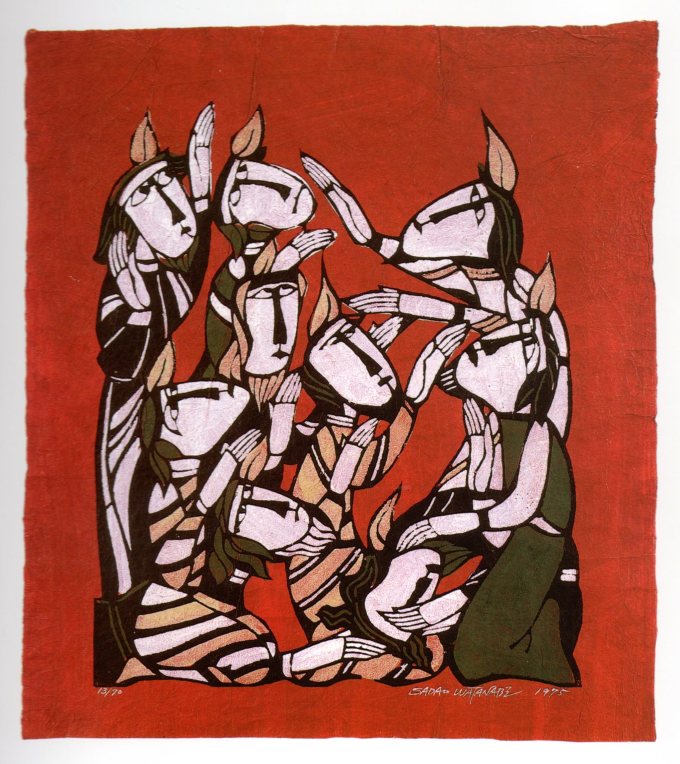
Pentecost by Sadao Watanabe
Sadao Watanabe (Japanese, 1913–1996), Pentecost, 1975. Hand-colored kappazuri-dyed stencil print on washi paper, 25.5 × 22.75 in. Source: Printing the Word: The Art of Watanabe Sadao (Philadelphia: American Bible Society, 2003)

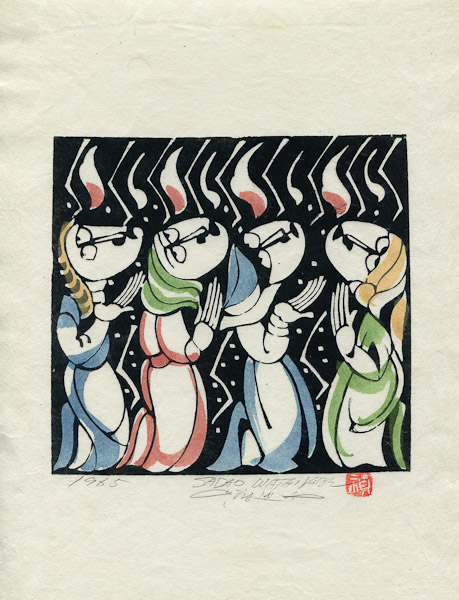
Pentecost by Sadao Watanabe
Sadao Watanabe (Japanese, 1913–1996), Pentecost, 1965. Hand-colored kappazuri-dyed stencil print on washi paper.

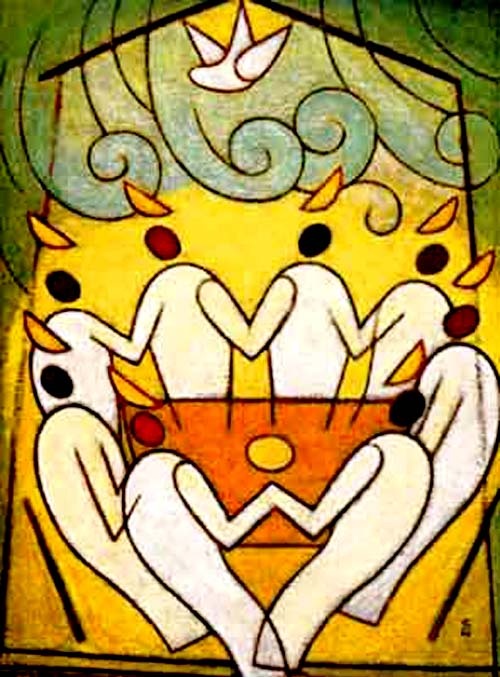
The Coming of the Holy Spirit by Soichi Watanabe
Soichi Watanabe (Japanese, 1949–), The Coming of the Holy Spirit, 1996. Oil on canvas, 18 × 13.25 in. Collection of the Overseas Ministries Study Center.

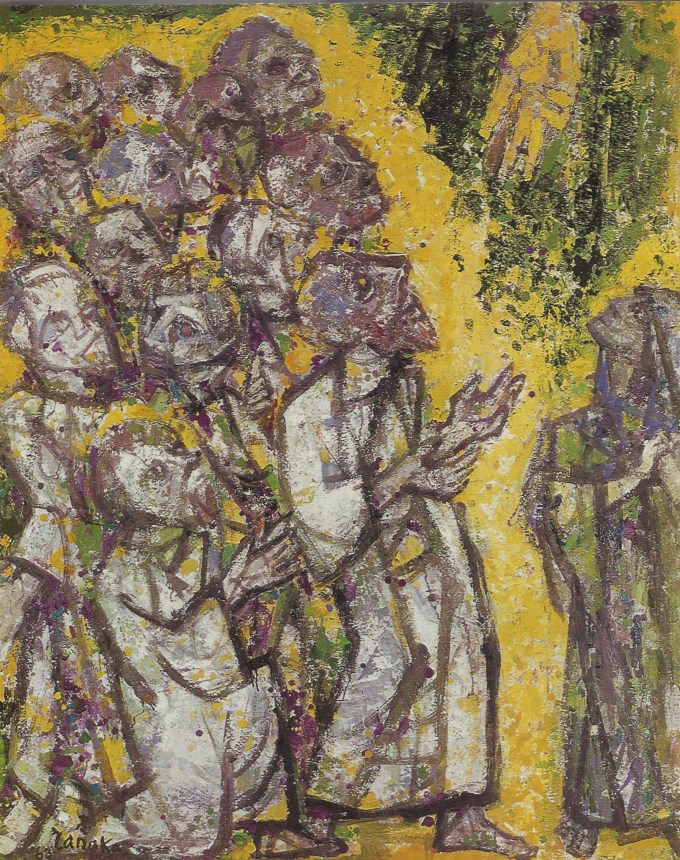
Pentecost by Tadao Tanaka
Tadao Tanaka (Japanese, 1903–1995), Pentecost, 1963. Oil on canvas. Source: Christian Art in Asia by Masao Takenaka (Tokyo: Kyo Bun Kwan, 1975)

Pentecost by Gako Ota
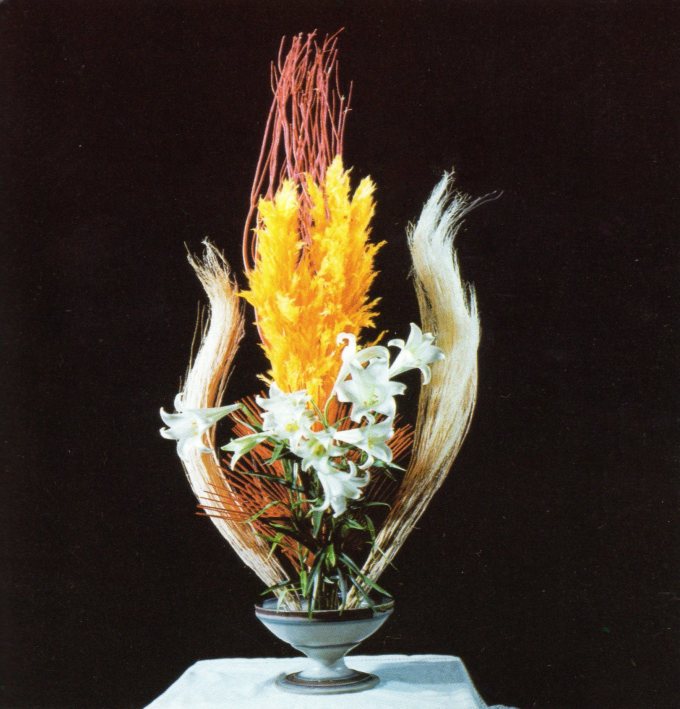
Gako Ota (Japanese, 1904–1972), Pentecost. Belvedere, pampas grass, paper bush, lilies, and rib of fan. Source: Consider the Flowers: Meditations in Ikebana, ed. Masao Takenaka (Tokyo: Kyo Bun Kwan, 1990)

Pentecost by Keiko Miura
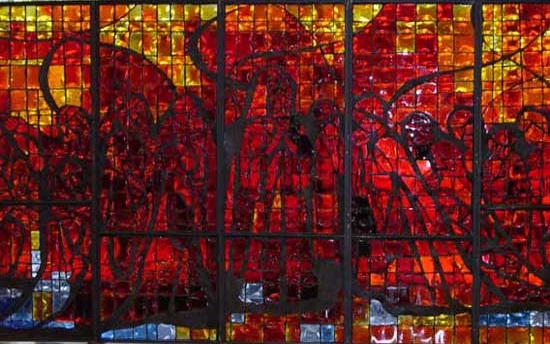
Keiko Miura (Japanese, 1935–), Pentecost, 2004. Stained glass window, All Pilgrims Christian Church, Seattle, Washington, USA.

Holy Spirit Coming by He Qi
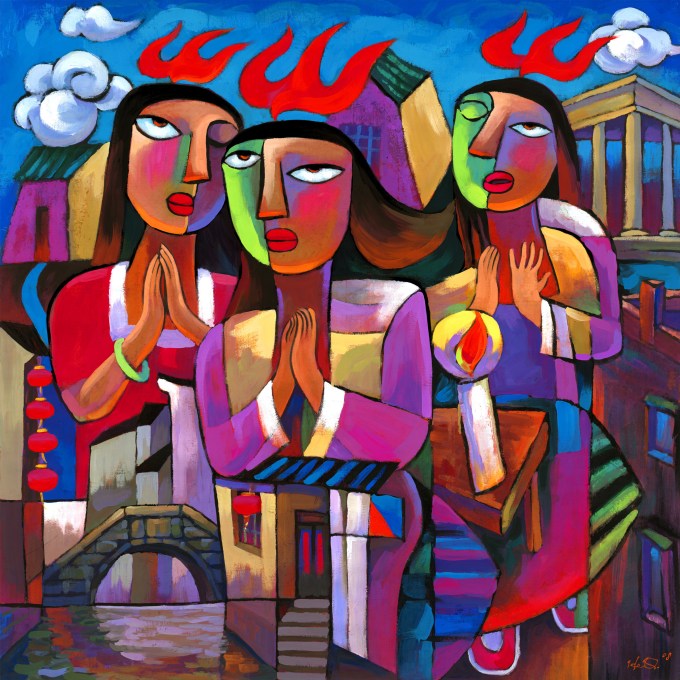
He Qi (Chinese, 1950–), Holy Spirit Coming, 1998. Oil on canvas.

Continue reading “Pentecost art from Asia”