Roundup: “God’s Love” playlist, embracing the ephemeral, and more

LENT SERIES: “Let go of unlove this Lent: Let’s practice love together—a new and improved Lenten reflection series starting March 5th” by Tamara Hill Murphy: I’ve been nurtured for years by Murphy’s gentle spiritual writing and curated beauty and wisdom, and I especially appreciate her annual Advent and Lent Daybook series. This Lent, she’ll be exploring four postures of cruciform love given to us in 1 Corinthians 13, providing daily scripture readings, prayers, and art, along with weekly practices. You can gain access for just $16. (She uses the Substack platform.)
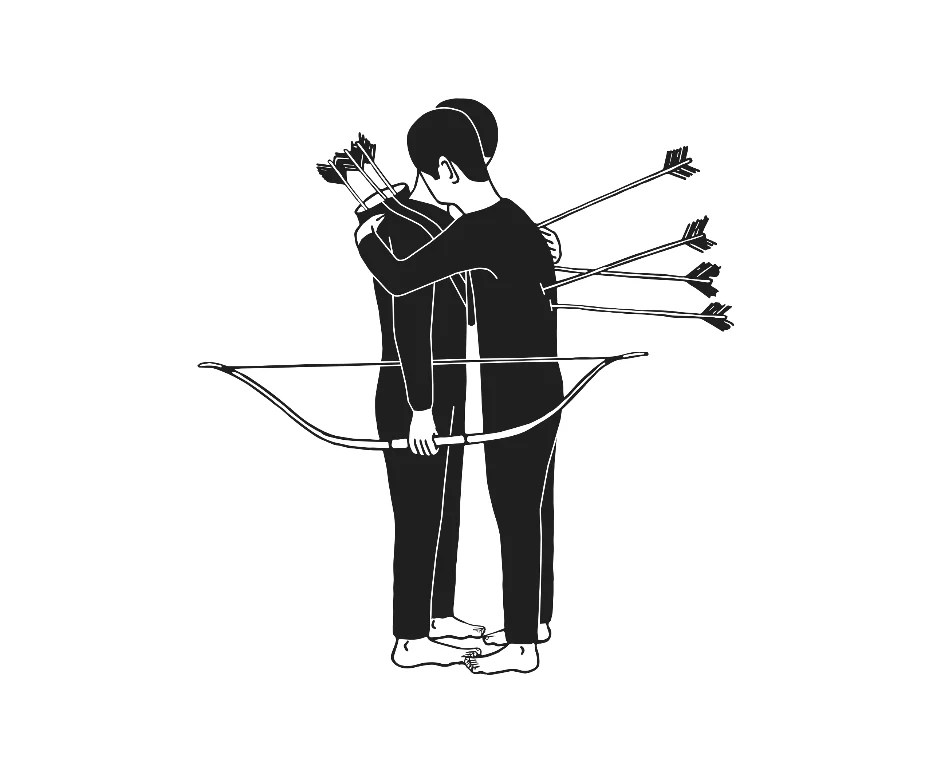
Erickson, Scott_Forgive Thy Other
Forgive Thy Other by Scott Erickson

I like how Murphy frames the season: “Lent is a significant time for us to seek a deeper understanding of God’s heart and recognize the gaps in our experiences of His love. Through its beautiful stories, prayers, and practices, Lent also invites us to reflect on our own expressions of love and unlove. The Book of Common Prayer encourages us to let go of our unloving ways so we can love what (and who) God loves. Let’s joyfully embrace this transformative season together, reflecting God’s love with compassion and understanding.”

+++

NEW PLAYLIST: God’s Love (Art & Theology): Related to Tamara Hill Murphy’s 2025 Lent Daybook theme: here’s a new playlist I put together of songs about the abounding, ever-present love of God the Father, Son, and Holy Spirit, a love that seeks, heals, and transforms.

The cover photo is of an early twentieth-century relief sculpture from the exterior of Holy Trinity Church in the town of St Andrews, Scotland, taken by Joy Marie Clarkson; it shows a pelican pecking her breast to feed her young with her own blood, a medieval symbol of Christ’s self-giving love.

There’s some overlap between this playlist and my dedicated Lent Playlist. I hope it uplifts you in the knowledge of the depths and riches of God’s love for you.

+++

SONGS:

>> “And Am I Born to Die?”: Lent opens with a call to “remember you are dust, and to dust you shall return.” A reflection on human mortality, this somber hymn was written by the great English Methodist hymnist Charles Wesley (1707–1788) and set to music—a shape-note tune—by Ananias Davisson (1780–1857), a Presbyterian elder from Virginia. In this video from January 2023, it’s performed by the Appalachian folk musician Nora Brown, with Stephanie Coleman on fiddle and James Shipp on harmonium.

And am I born to die?
To lay this body down?
And must my trembling spirit fly
Into a world unknown?

Awaked by trumpet sounds,
I from my grave shall rise,
And see the Judge, with glory crowned,
And see the flaming skies.

Soon as from earth I go,
What will become of me?
Eternal happiness or woe
Must then my portion be.

>> “Nunc tempus acceptabile” (Now Is the Accepted Time): Second Corinthians 5:20b–6:10 is traditionally read on Ash Wednesday, a passage that includes the adjuration, “Behold, now is the acceptable time; behold, now is the day of salvation!” (2 Cor. 6:2). There’s a beautiful tenth-century Latin chant hymn for Lent, from the Liber Hymnarius, that opens with this line. In 2013, the Chicago-based composer and conductor Paul M. French set it to music for SSA a cappella choir, its unison opening unfolding into an increasingly expressive three-part harmony. It’s performed here by the Notre Dame Magnificat Choir under the direction of Daniel Bayless.

Nunc tempus acceptabile 
Fulget datum divinitus,
Ut sanet orbem languidum
Medela parsimoniae.

Christi decoro lumine
Dies salutis emicat,
Dum corda culpis saucia
Reformat abstinentia.

Hanc mente nos et corpore,
Deus, tenere perfice,
Ut appetamus prospero
Perenne pascha transitu.

Te rerum universitas,
Clemens, adoret, Trinitas,
Et nos novi per veniam
Novum canamus canticum.

Amen.
Today is the accepted time.
Christ’s healing light, the gift divine,
shines forth to save the penitent,
to wake the world by means of Lent.

The light of Christ will show the way
that leads to God’s salvation day.
The rigor of this fasting mends
the hearts that hateful sinning rends.

Keep all our minds and bodies true
in sacrifice, O God, to you,
that we may join, when Lents have ceased,
the everlasting Paschal feast.

Let all creation join to raise,
most gracious Trinity, your praise.
And when your love has made us new,
may we sing new songs, Lord, to you.

Amen.

Translation © 2006 Kathleen Pluth

+++

LECTURE: “Embracing the Ephemeral: How Art Honors Creaturehood” by James K. A. Smith, Duke Divinity School, February 17, 2022: Mortality means something more than being a creature who will someday die, says philosopher James K. A. Smith; it is a way of being, not defined solely by its terminus. “To be created is to be ephemeral, fugitive, contingent. To be a creature is to be a mortal, subject to the vicissitudes of time.” Part of the Duke Initiatives in Theology and the Arts Distinguished Lecture Series, this talk about developing a Christian temporal awareness is based on chapter 4 of Smith’s then-forthcoming, award-winning book How to Inhabit Time (Brazos, 2022), titled “Embrace the Ephemeral: How to Love What You’ll Lose.”
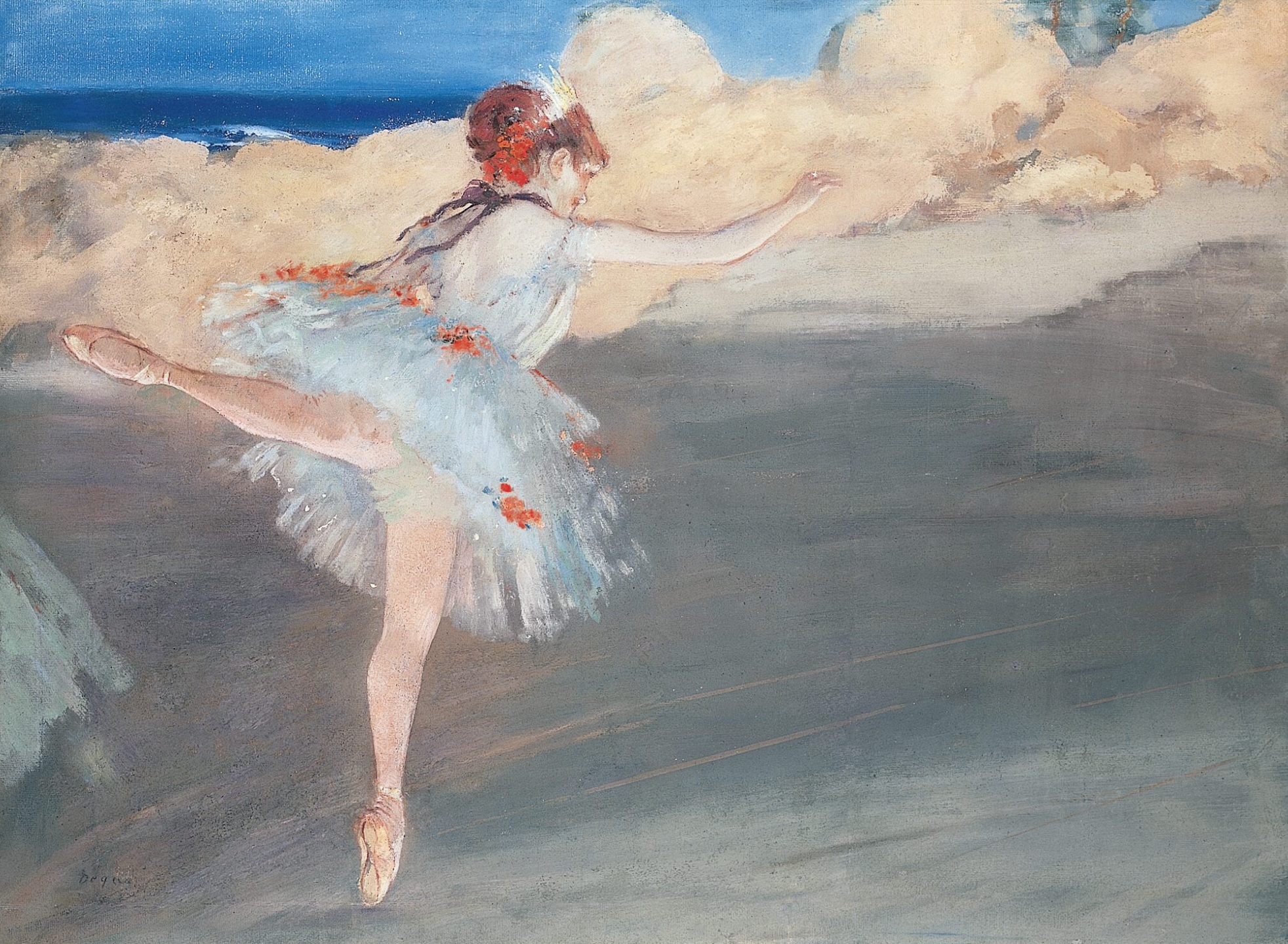
Degas, Edgar_The Star
Edgar Degas (French, 1834–1917), The Star: Dancer on Pointe, ca. 1878–80. Gouache and pastel on paper, mounted on board, 22 1/4 × 29 3/4 in. (56.5 × 75.6 cm). Norton Simon Museum, Pasadena, California.

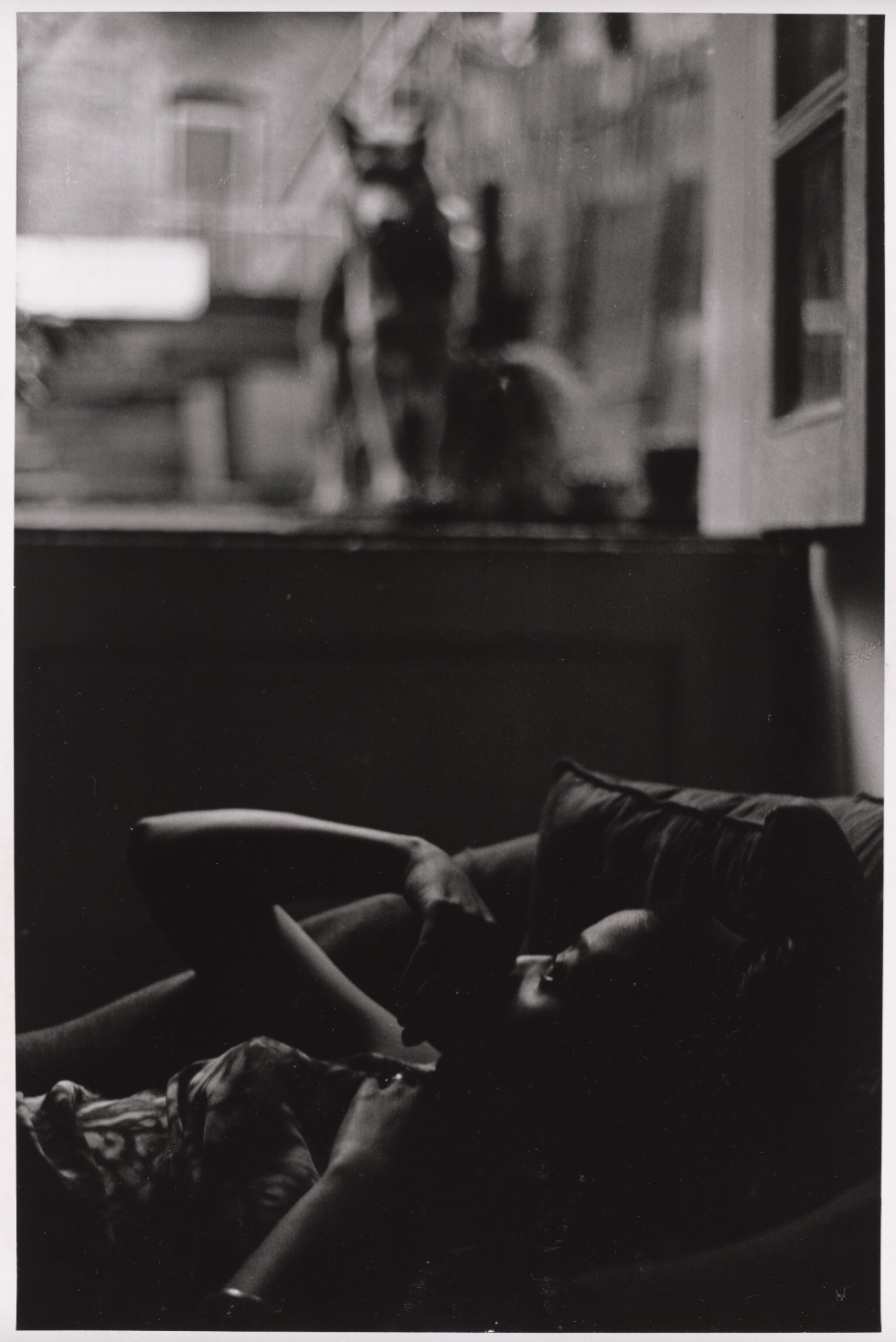
Randall, Herbert_Untitled (Lower East Side, NY)
Herbert Randall (American, 1936–), Untitled (Lower East Side, New York), 1960s. Gelatin silver print, 13 7/16 × 8 7/8 in. (34.2 × 22.5 cm). J. Paul Getty Museum, Los Angeles.

Some notes I took:

  • “We need not only memento mori, but also memento tempore—reminders of our temporality, not just our mortality.”
  • “Imagine embracing the ephemeral as a discipline of not only conceding our mortality as a condition but also receiving our mortality as a gift.”
  • “Our finitude is not a fruit of the fall, even if it is affected by the fall. Contingency is not a curse. . . . Aging is not a curse. Autumn is not a punishment. Not all that is fleeting should be counted as loss. The coming to be and passing away that characterize our mortal life are simply the rhythms of creaturehood.”
  • Resting in our mortality instead of resenting it
  • Theologian Peter Leithart says hebel means not “emptiness,” “vanity,” or “meaninglessness” but, literally, “mist” or “vapor.” The Teacher in Ecclesiastes uses that word repeatedly to describe human life: it’s vaporous, elusive, escapes our efforts to hold on to it, to manage it.
  • “The Fly” by William Oldys
  • Mono no aware, a Japanese aesthetic principle—what the thirteenth-century Japanese Buddhist nun Abutsu-ni referred to as “the ah-ness of things”
  • “It may be artists who help us best appreciate the fragile dynamism of creaturehood.”
  • Exhibition: Working Together: The Photographers of the Kamoinge Workshop. A collective of Black photographers founded in New York City in 1963. Their photographs don’t capture the ephemeral; they hallow it.
  • How to sift tragedy from good creaturely rhythms in which good things fade?
  • “To dwell faithfully mortally is to achieve a way of being in the world for which not all change is loss and not all loss is tragic, while at the same time naming and lamenting those losses that ought not to be. . . . To be faithfully mortal is a feat of receiving and letting go, celebrating and lamenting. Being mortal is the art of living with loss, knowing when to say thank you and knowing when to curse the darkness.”
  • “One Art” by Elizabeth Bishop: “The art of losing isn’t hard to master . . .”

A Q&A takes place from 39:00 onward. The first question, asked by theologian Jeremy Begbie, is the one I had, and it recurs with different phrasing at 58:17.

+++

POEM: “Ash Wednesday” by Anya Krugovoy Silver: I first encountered this poem in the excellent devotional Between Midnight and Dawn: A Literary Guide to Prayer for Lent, Holy Week, and Eastertide, and it has stuck with me ever since. (It was originally published in the equally excellent The Ninety-Third Name of God, Silver’s first poetry collection.)

Mortality is one of the main themes in Silver’s poetry, including the physicalities of being human, as reflected in “Ash Wednesday,” in which she, the speaker, muses on the shared Christian ritual of the imposition of ashes at the beginning of Lent. Silver, who died of breast cancer eight years after writing this poem, was used to practicing memento mori (“remember you must die”): her mastectomy scar and silicone breast prosthesis are constant reminders of the fact, she writes. She wants to touch the body of God, wants to wrap her fingers around some tangible promise of healing, but both remain elusive. Instead she resolves to embrace the finiteness of her present form, taking the burnt remains of those Hosanna palms from last year and wearing them with repentance and praise, knowing that what is sown in perishability will be raised in imperishability (1 Cor. 15:42).

I’m compelled by how Silver both laments her fragility and owns it. There’s a defiant quality to the tone, the ash-and-oil mixture that’s thumbed into her forehead in the shape of a cross evoking a football player applying eye black in front of a locker room mirror before the big game. Wearing the mark of Christ, she’s ready for the face-off between herself and death.

A Blessing for Those Who Hate and Hurt

Pena Defillo, Fernando_The Offering
Fernando Peña Defilló (Dominican, 1928–2016), La ofrenda (The Offering), 1993. Oil and acrylic on canvas, 126 × 166 cm. Private collection. Source: Latin American Art in the Twentieth Century, ed. Edward J. Sullivan (Phaidon, 1996), p. 110.

May those whose hell it is
To hate and hurt
Be turned into lovers
Bringing flowers.

—Shantideva, eighth century

These lines are from chapter 10, stanza 9, of the Bodhicharyavatara (Way of the Bodhisattva), a Mahayana Buddhist text by the eighth-century Indian monk Shantideva. I first encountered this religious classic, originally written in Sanskrit, while working at Shambhala Publications. The excerpt above was adapted by author David Richo from a translation by the Padmakara Translation Group. Here’s 10.9 in full, as translated by PTG:

May the hail of lava, fiery stones, and weapons
Henceforth become a rain of blossom.
May those whose hell it is to fight and wound
Be turned to lovers offering their flowers. [source]

Other translations include those by Stephen Batchelor—

May the rains of lava, blazing stones, and weapons
From now on become a rain of flowers,
And may all battling with weapons
From now on be a playful exchange of flowers. [source]

—and Fedor Stracke:

May the rain of leafs, embers, and weapons
Become forthwith a rain of flowers.
May those cutting each other with knives
Forthwith throw flowers for fun. [source]

I am so struck by this short benediction that prays our hate be transformed into love, our hardness into softness, our cold, sterile weaponry into delicately petaled, fragrant blooms. Shantideva recognized that when we lash out in physical or verbal violence, we create a hell that’s all our own. We may intend to inflict suffering on another, but in doing so, we often wound ourselves—psychologically, spiritually. When we dehumanize others, we become less human.

Instead of hurling rocks, punches, bullets, or insults, what if we were to completely confound our enemies by offering them words or tokens of love? Love is the way of the bodhisattva, the “enlightened being.” It’s the way of Jesus—he who said, “Love your enemies; do good to those who hate you; bless those who curse you; pray for those who mistreat you” (Luke 6:27–28).

Loving people doesn’t mean we can’t be angry at them—but we cannot allow our anger to fester into bitterness and ill will or to explode in harmful outbursts. It should be a productive anger.

How might we use an ethic of love to direct our anger or somebody else’s toward a good end, to defuse a contentious situation? Not taking the easy way out by simply ignoring or retreating from a problem, but confronting our opponent in peaceful, creative, and potentially transformative ways?

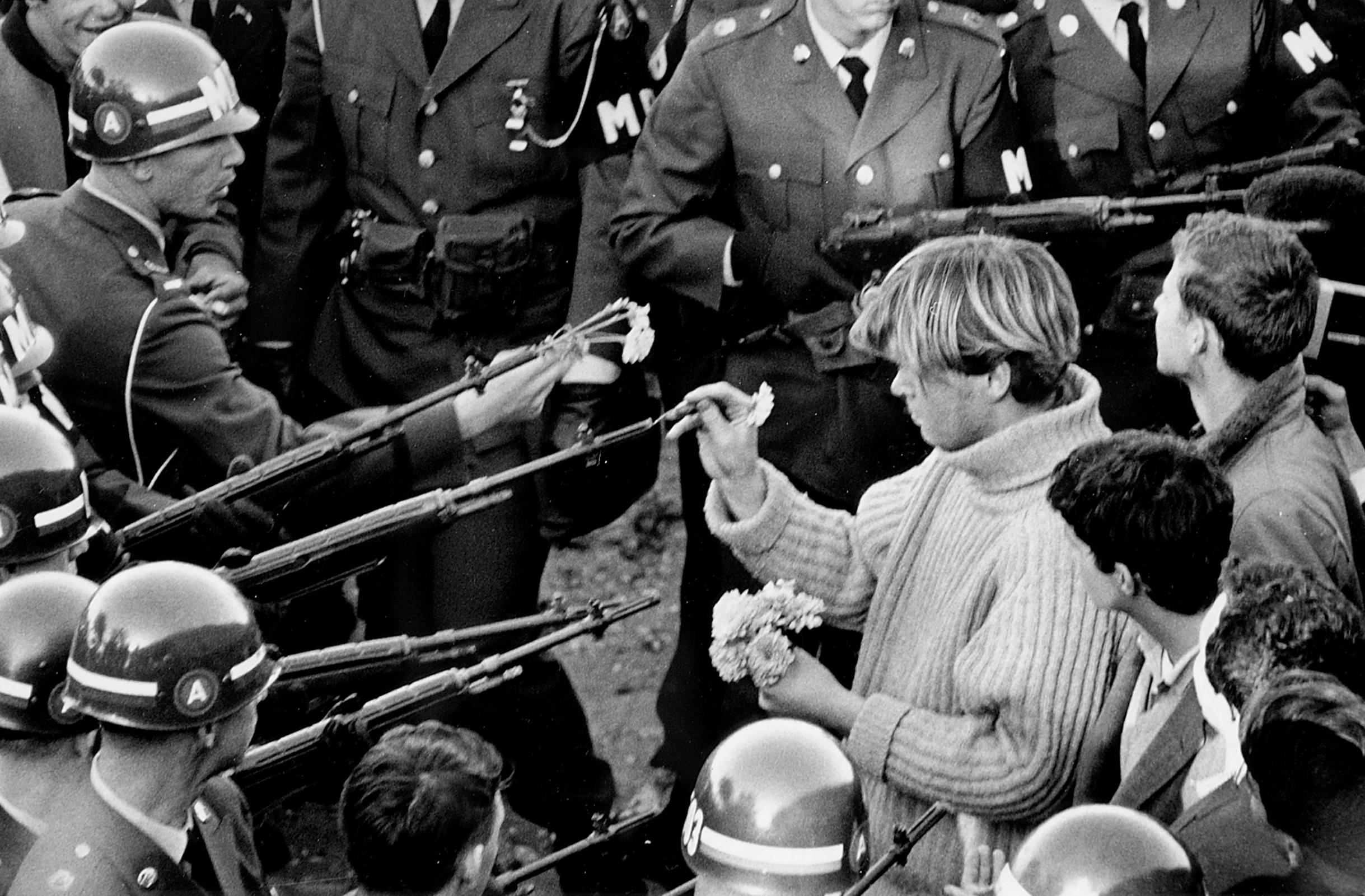
I’m reminded of the historic Pulitzer Prize–nominated photograph Flower Power, taken by Washington Star photojournalist Bernie Boston on October 21, 1967, when he was covering an antiwar march on the Pentagon. As the 503rd Military Police Battalion formed a semicircle around demonstrators to prevent them from climbing the Pentagon steps, Boston captured eighteen-year-old George Edgerly Harris III, aka Hibiscus, placing a carnation into the barrel of an M14 rifle held by one of the soldiers. What a powerful image!

Flower Power
Bernie Boston (American, 1933–2008), Flower Power, Arlington, Virginia, 1967

Two years earlier in his essay “How to Make a March/Spectacle,” Allen Ginsberg was the first to expound on the potency of flowers as a spectacle to simultaneously disarm opponents and influence thought. He said “masses of flowers” should be handed out on the front lines of protests to police, the press, and onlookers as a symbol of nonviolent advocacy. He also suggested candy bars and toys.

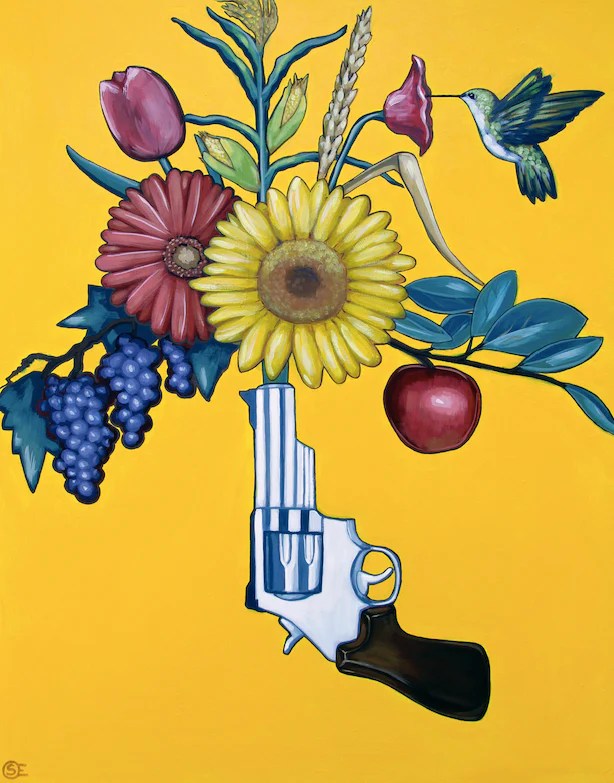
Artist Scott Erickson seems to have drawn on Boston’s Flower Power photograph in his visual interpretation of Isaiah 2:4, Swords into Plowshares, which shows a sprig of foliage growing out of the barrel of a pistol, oriented upward like a vase. Its deadly power mocked and reversed, the gun releases a benign projectile that attracts and nourishes rather than strikes fear.

Erickson, Scott_Swords into Plowshares
Scott Erickson (American, 1977–), Swords into Plowshares, 2016 [purchase a reproduction]

The evocative Bible verse on which this painting is based prophesies a day when all the nations “shall beat their swords into plowshares, and their spears into pruning hooks”—a poetic way of describing the cessation of violence, as tools of destruction are transformed into gardening tools.

Christian activist Shane Claiborne has been instrumental in helping me see the immense beauty of Isaiah’s visions of the eschaton—he has worked with RAWtools to decommission firearms and literally forge them into shovels, spades, and other life-giving implements!—along with the holy foolishness of the gospel and all that implies. Before becoming a leader of the new monasticism movement, Claiborne went to circus school, and he has often put that training to use on the streets of Philadelphia where he lives. In his first book, The Irresistible Revolution: Living as an Ordinary Radical (2006), he writes,

Whenever there is a fight on our block, my first instinct is to run inside and grab our torches and begin juggling them, to upstage the drama of violent conflicts in our neighborhood. Perhaps the kids will lose interest in the noise of a good fight and move toward the other end of the block to watch the circus. I truly believe we can overwhelm the darkness of this world by shining something brighter and more beautiful. (285)

He has also written about Jesus’s “triumphal” entry into Jerusalem as a theatrical parody of power: he rode in on a dinky donkey instead of a warhorse, showing a much different alternative to the military might of empires. (“Imagine the president riding a unicycle in the Fourth of July parade”! Jesus for President, p. 122) And then on the cross, Jesus made a spectacle of human violence. In exchange for taunts and blows, he gave forgiveness, a metaphorical bouquet.

Banksy_Rage, Flower Thrower
Banksy, Rage, Flower Thrower, 2005. Mural, Beit Sahour, Palestinian Territories. Photo: Eddie Gerald / Alamy Stock Photo.

The UK-based street artist Banksy draws on the association of flowers with love and peace and their playful ability to disrupt violence in his mural Rage, Flower Thrower, which debuted on the West Bank wall in Israel-Palestine. Nathan Mladin, a researcher for Theos think tank, wrote about this artwork for the Visual Commentary on Scripture’s Logics of Reversals exhibition:  

With a balaclava drawn over his face, the young protester is shown leaning back, as though braced to hurl a Molotov cocktail. But instead of a weapon, he wields a flower bouquet, the only coloured element in this otherwise monochrome work. We expect an act of aggression—all other elements of the mural suggest imminent violence—but instead we are offered a call to peace. . . . Theologically construed, the mural hints at the eschatological terminus of violence.

The absurd juxtaposition of flowers and violence is employed too by Lithuanian artist Severija Inčirauskaitė-Kriaunevičienė, who embroiders floral patterns onto antique soldiers’ helmets sourced from various countries, and Natalie Baxter of Lexington, Kentucky, whose Warm Gun series comprises over one hundred quilted stuffed guns, “droopy caricatures of assault weapons,” she says, “bringing ‘macho’ objects into a traditionally feminine sphere and questioning their potency.”

Incirauskaite-Kriauneviciene, Severija_Kill(ed) for Peace
Severija Inčirauskaitė-Kriaunevičienė (Lituanian, 1977–), from the series Kill(ed) for Peace, 2016. Antique soldier’s helmet, cotton, cross-stitch embroidery, drilling, and industrial needle punching, 30 × 22 × 21 cm. Private collection, Latvia.

Baxter, Natalie_Rose to the Occasion (Warm Gun)
Natalie Baxter (American, 1985–), Rose to the Occasion, from the Warm Gun series, 2016. Fabric and polyfill, 15 × 42 × 3 in.

Another artistic example of overcoming brutality with gentleness can be found in the climactic battle sequence from Disney’s animated classic Sleeping Beauty (1959). As Prince Phillip escapes from Maleficent’s dungeon with the aid of the three good fairies, Maleficent’s goons shoot arrows at him—but Flora transforms them by magic into flowers, which fall innocuously about his booted feet. (The animation is by Dan McManus.)

Sleeping Beauty arrows

Flora’s other enchantments include turning launched boulders into soap bubbles and a curtain of boiling water, tipped from a cauldron over a doorway, into a rainbow. Each of these deflective maneuvers involves the transformation of something threatening into something whimsical. While they do not ultimately deter the villain from her murderous rampage, and alas, Phillip conquers evil with a sword (albeit the Sword of Truth—there’s metaphor at play here), Flora’s few creative interventions at the outset of the battle assert an attractive counterethic that we would do well to embrace.

I need the dreams of Isaiah and the prayers of Shantideva, I need the ridiculous street theater of Hibiscus and Shane Claiborne and the activist blacksmithing of RAWtools, I need Banksy’s murals in zones of conflict and other subversive art, I need fairy tales from writers and animation studios, to help me relinquish my hate and imagine wholesome new ways of engaging my enemies. Most of all, I need Christ’s vibrant, upending gospel embedded more deeply in my heart, and the Holy Spirit—renewer, transformer—to melt the disdain and loathing I feel for certain figures in the current US political landscape and reshape it into loving regard.

While I do not have an urge to enact physical violence on anyone, I often seethe and think unkindly thoughts toward those I deem morally odious. Sometimes I pray they get what’s coming to them. But then I am convicted by that un-Christlike posture. I crave the eyes and mind of Christ, who sees everyone as redeemable and worthy of love, bearers of the divine image, and who moves toward them with open arms instead of clenched fists.

“May those whose hell it is to hate and hurt be turned into lovers bringing flowers.”

I pray this, sincerely, for others (I have a few particular names in mind), and also for myself.

Amen.

Online events

Organized by Mount Tabor Ecumenical Centre for Art and Spirituality:

>> April 10, 11 a.m.–12:30 p.m. EDT: “The Victory of Life (Easter in Renaissance Art)”: “The most important event of New Testament belief, Christ’s Resurrection, is not described in the Scriptures. That has not prevented artists however from imagining it. As we celebrate Eastertide, we invite you to join Monsignor Timothy Verdon as he reflects on a number of works focused on this theme.”

View more events at https://mounttabor.it/mount-tabor-talks-topics/.

Organized by HeartEdge:

>> April 15, 11:30 a.m.–1 p.m. EDT: “In the Shadow of Your Wings: Musical Bible Study on the Psalms”: Deus Ex Musica presents this interactive event in which participants watch prerecorded live performances of three brand-new vocal settings of Psalm 57, each set to music by a composer representing a different Christian tradition. After viewing the performances, participants will engage in moderated small-group discussions. No musical expertise is required.

Deus Ex Musica is an ecumenical organization of musicians, educators, pastors, and scholars that promotes the use of sacred music as a resource for learning and spiritual growth.

>> April 26, 3–4 p.m. EDT: “Art and the Liturgical Year: Bringing the Church Calendar to Life”: Organized in partnership with the CEEP Network. “This workshop explores ways of engaging artists with churches/congregations using the church calendar. What might inspire artists in engaging with the patterns that underpin the life of many churches, and how might engaging with artists open up understandings of faith in new ways for congregations? Examples of the kind of projects we will explore include initiatives using the visual arts in dialogue with scripture or exhibitions/installations in particular seasons such as Advent or Lent. Fundamentally, though, this workshop seeks explore a range of ideas and approaches and to hear about the benefits both for artists and congregations.”

Panelists:

  • Janet Broderick, Beverly Hills, California: Rector, All Saints Beverly Hills
  • Paul-Gordon Chandler, Casper, Wyoming: Bishop, Diocese of Wyoming; and Founding President of CARAVAN Arts (moderator)
  • Catriona Laing, Brussels: Chaplain, St. Martha & St. Mary’s Anglican Church Leuven; Associate Chaplain, Holy Trinity Brussels
  • Ben Quash, London: Professor, Christianity and the Arts & Director, Center for Arts and the Sacred, King’s College London; Director, Visual Commentary on Scripture Project
  • Aaron Rosen, Washington, DC: Professor, Religion and Visual Culture; Director, Henry Luce III Center for the Arts and Religion, Wesley Theological Seminary; Cofounder, Stations of the Cross Public Art Project

>> June 4, 11, 18, 25, 11:30 a.m.–1 p.m. EDT: “Jesus Is Just Alright: What Pop Songs About Jesus Can Teach Christians Today”: Led by composer, musician, and educator Delvyn Case of Deus Ex Musica. “For over fifty years, pop musicians in all genres have explored the meaning and significance of Jesus in their music. The result is a rich collection of songs that consider important spiritual questions like faith, doubt, and prayer in unique and often provocative ways. Through a combination of listening and discussion, this four-part series invites participants to explore a different spiritual topic each week. Join us to listen to great music that asks tough questions about our faith and our lives as Christians.”

View more events at https://www.heartedge.org/.

Organized by Art + Christianity:

>> April 21, 1–2 p.m. EDT: “Exhibiting Faith in the Museum and Beyond”: World-leading experts Ittai Weinryb, Neil MacGregor, and Jennifer Sliwka will discuss the joys and difficulties of introducing to the general public art that builds on a faith tradition. “They will discuss what has become a major concern for teachers, lecturers and museum curators in many countries. How do you encourage a largely secular audience to step inside a work of art, in such a way that its religious meaning is felt and understood, and the artistic experience can become immersive? . . . Among the topics to be explored are:

  • The opening up of museums and galleries to enhanced audiences during the pandemic.
  • How certain objects are altered by their move from a sacred space into a museum, yet how they also ‘live on’ beyond the museum plinth or computer screen.
  • The need to understand secular inhibitions and the loss of interest in Christianity and to find ways in which works of art can readdress this situation.”

>> April 29, 2–3:30 p.m. EDT: “Coventry Cathedral: Icon and Inspiration”: “Join Alexandra Epps [an Accredited Lecturer for The Arts Society and Guide and Lecturer at Tate Modern, Tate Britain and the Guildhall Art Gallery] for the extraordinary story of the rebuilding of Coventry Cathedral as a symbol of peace and reconciliation and its inspiring commitment to the modern. Experience the artistic journey that is the Cathedral discovering the work of many of the world-class artists associated with its many treasures including Jacob Epstein, Elisabeth Frink, John Piper, Graham Sutherland and more.”

View more events at https://www.artandchristianity.org/upcoming-events.

Organized by Image journal:

>> May 5, 56 p.m. EDT: “The Art of Criticism: The People’s Madonna”: “Filmmaker Lucia Senesi grew up in Arezzo, Italy, within walking distance of several Old Master Madonnas. But it wasn’t until she was older—and viewing films by Andrei Tarkovsky and Valerio Zurlini, who were both captivated by the Madonna del Parto in Monterchi—that she saw these paintings with fresh eyes. Her essay in the spring issue of Image describes the fascinating history of a Madonna commissioned by peasants, executed by a Renaissance master, condemned by popes, and preserved through wars and social upheaval. She’ll talk with culture editor Nick Ripatrazone about film, the populism of sacred art, and the scandal of a woman pregnant with God.”

>> May 26, 56 p.m. EDT: “The Art of Imagery: You Are What You Contemplate”: “Artist Scott Erickson wanted to design a series of Stations of the Cross that people in his Portland neighborhood could encounter without the barrier of having to enter a church building—and he wanted to make them accessible to all. The result is a series of downloadable, printable images that have appeared all over the globe. His most recent book is Honest Advent: Awakening to the Wonder of God-with-Us Then, Here, and Now. He’ll speak with Image editor in chief James K.A. Smith about church, art, and ‘spiritual formation through image contemplation.’”

Roundup: Anger, lament, and racial oppression

INTERVIEW: “Singing the Songs of Injustice” with David M. Bailey and W. David O. Taylor: David Bailey is the director of the reconciliation ministry Arrabon and founder of its music-making and liturgical resource arm, Urban Doxology, and David Taylor is an assistant professor of theology and culture at Fuller Theological Seminary. In this conversation the two men discuss how “biblical, angry, congregational worship can help transform our hearts and churches.” “God has given us the psalms to be an ‘anger school’ for us and I’ve discovered that when we skip class, we aren’t emotionally equipped to deal with difficult stuff we’re experiencing now,” Taylor says. “The extraordinary gift of the psalms is that they show us how to pray angry prayers without being overcome by our anger, how to hate without sinning (to borrow from Saint Paul’s language), or, as Eugene Peterson once put it, how to ‘cuss without cussing.’”

Bailey and Taylor talk about the constant simmer of race relations in America, faithful versus unfaithful expressions of anger, the language of “enemy” in the Psalms, the importance of lament in Sunday gatherings and the need for language that expresses the horizontal aspects of what it means to be a Christian, and leading without moderation during turbulent times.

Anger prayer card
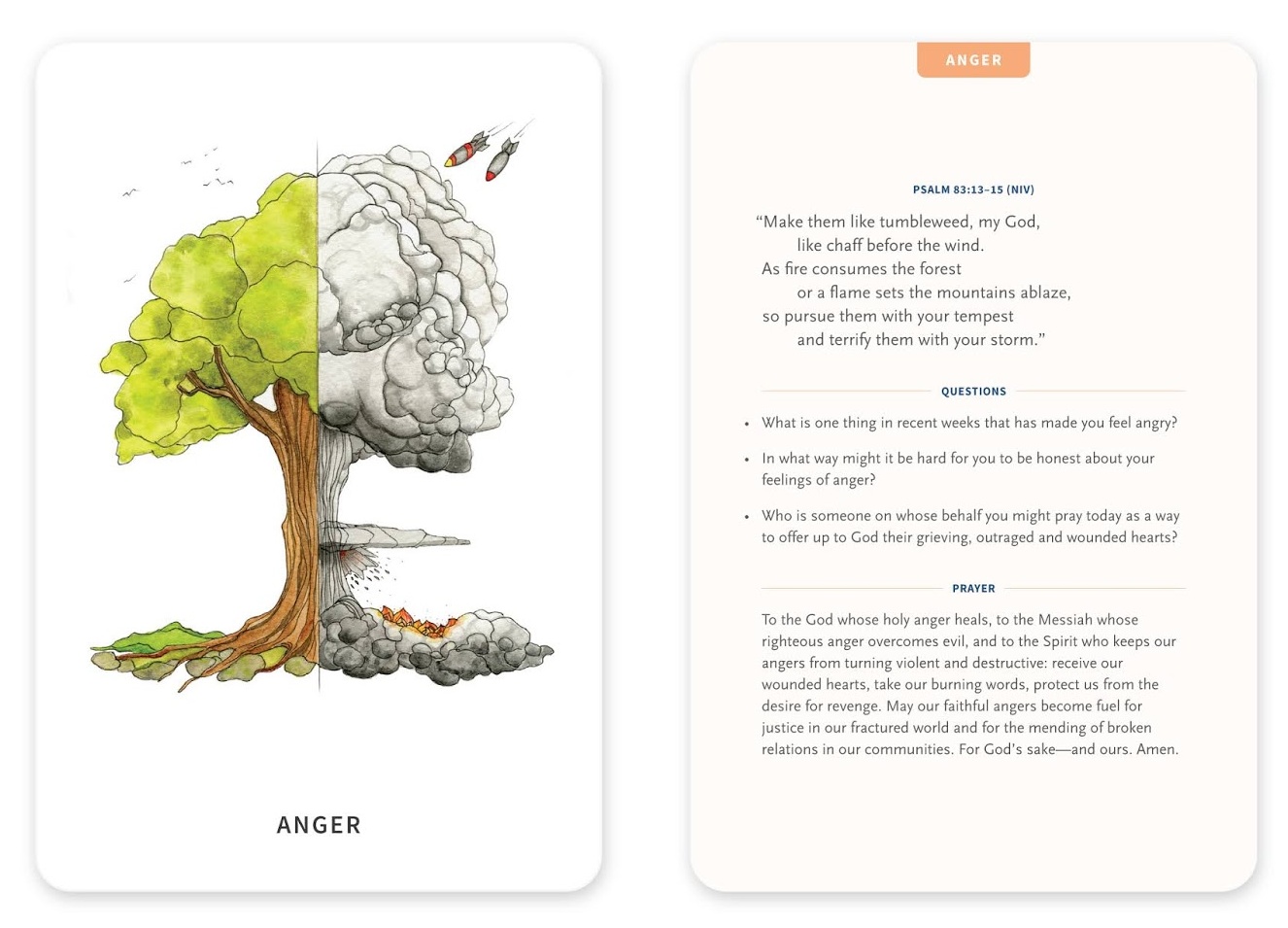
The Psalms of Anger: Prayer Card (illustration by Phaedra Taylor)

Taylor’s latest book, Open and Unafraid: The Psalms as a Guide to Life, contains a chapter on “The Psalms of Anger.” Read an excerpt here, or view this video talk. To coincide with the release in March, he and his wife Phaedra created a set of fifteen prayer cards. His prayer on the “Anger” card reads, “To the God whose holy anger heals, to the Messiah whose righteous anger overcomes evil, and to the Spirit who keeps our angers from turning violent and destructive: receive our wounded hearts, take our burning words, protect us from the desire for revenge. May our faithful angers become fuel for justice in our fractured world and for the mending of broken relations in our communities. For God’s sake—and ours. Amen.”

+++

LITURGIES

+++

LAMENT SONGS

The first two are new.

“I Just Wanna Live” by Johnnetta Bryant, performed by Keedron Bryant: Twelve-year-old gospel singer Keedron Bryant posted a video on Instagram last week of himself singing a song his mom wrote in response to the killing of George Floyd. “God gave me those lyrics” for Keedron, she said in a joint interview on Today. Keedron said he prayed the song, meditated with it, then hit record. It’s a heart-baring, heartbreaking lament, a plea for divine protection in a world that is especially dangerous for young black males.

“It Is Enough!” by R. DeAndre Johnson: R. DeAndre Johnson is the pastor of music and worship life at Christ Church Sugar Land outside Houston. He wrote the lyrics for “It Is Enough!” in July 2016 following the deaths of Alton Sterling and Philando Castile but hadn’t set them to music until now. The nine verses bear the refrain “Kyrie eleison” (Lord, have mercy!), or “Christe eleison” (Christ, have mercy!), a common cry of lament. “There are no words that can contain / The depth of sorrow, grief, and pain / That mothers, sons, and all exclaim: / Kyrie eleison!” Johnson sang the song for his church’s livestreamed service on May 31. A lead sheet is available on his Facebook page. [HT: Global Christian Worship]

“I Want Jesus to Walk with Me”: Sharon Irving is a singer-songwriter, spoken-word artist, and worship leader from Chicago who was also a semifinalist on season 10 of America’s Got Talent. In this video from 2015 she sings a spiritual that expresses deep sorrow—“When my strength is failing,” “When my heart is aching,” “When my life feels like a burden”—but also trust in the companionship of Christ, who walks with us through valleys of death. Having likely originated as an improvisation, the song has several lyrical variations and can be easily adapted to voice a range of feelings: “In my rage,” “In my frustration,” “In my exhaustion,” “In my confusion,” etc.

“O This Night Is Dark” by Tom Wuest: Last Sunday my congregation sang Isaac’s Wardell’s setting of Psalm 126 [previously], whose refrain is “Although we are weeping, Lord, help us keep sowing the seeds of your kingdom . . .” Seeds of love, truth, justice, hope. I just learned that Wardell’s song was inspired by Tom Wuest’s “O This Night Is Dark,” released in 2008 on Rain Down Heaven. In addition to Psalm 126, Wuest’s song also references 1 Corinthians 15, Isaiah 2, Amos 9, and Isaiah 65.


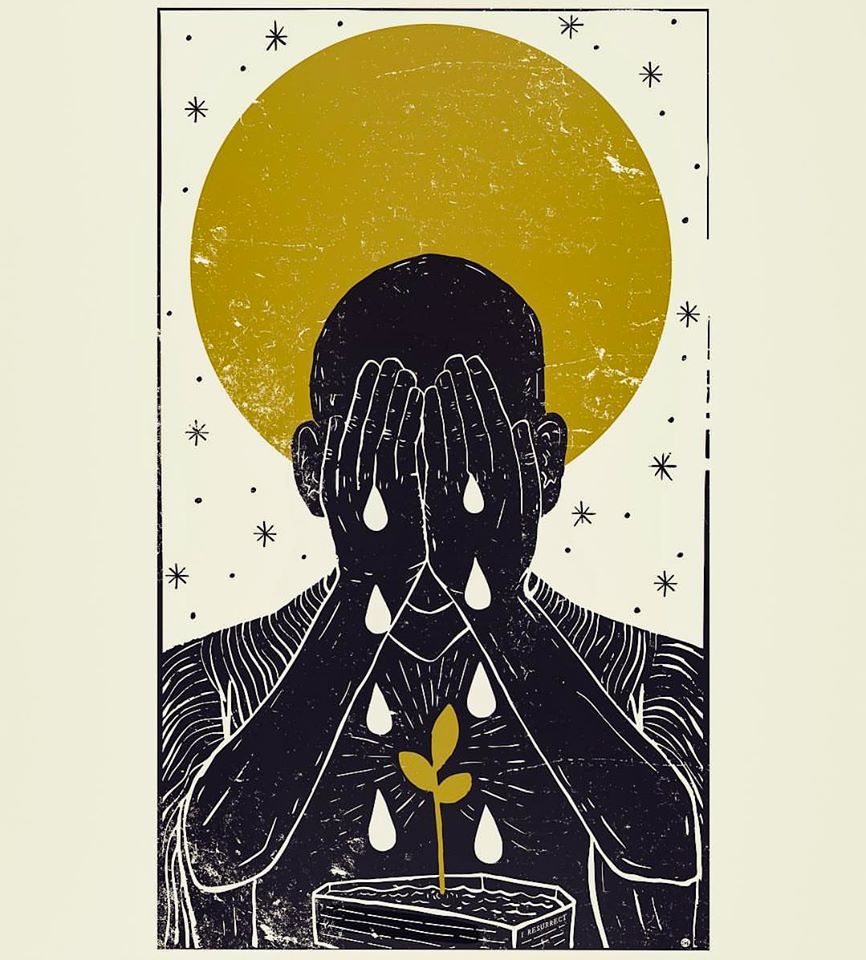
And this week as I was listening to the song, the following image by Scott Erickson showed up on my Instagram feed, with the caption “If one part suffers, all the parts suffer with it” (1 Cor. 12:26).

Erickson, Scott_Sorrowful Saint
Scott Erickson (American, 1977–), The Sorrowful Saint, 2016

Erickson painted the image in July 2016 in response to the fatal shootings of Sterling and Castile. It suggests that tears of grief can be generative, that new life can rise out of death. That’s not at all to say that death is good because it catalyzes a movement of change, but that our mourning the evils of racism and murder, our publicly crying out “Enough!,” is not fruitless, though it often seems so. Growth will come.

+++

VIDEO ART: Weight by André Daughtry:Weight is an attempt to visualize societal projections on the black male body,” writes André Daughtry, a Brooklyn-based interdisciplinary photography and media artist, writer, and performer. The piece is from 2014, and last year PBS’s AllArts station commissioned Daughtry to restage it in New York City as part of a larger video work. [HT: ImageUpdate]

Daughtry has a master’s degree in theology and the arts from Union Theological Seminary and serves as community minister of the arts at Judson Memorial Church, which has a long history of nurturing artists. “We believe that artists have the potential to serve as our modern-day prophets,” the church website reads. “They show us where we’ve been, who we are, and what we can become.”

+++

PODCAST EPISODE: “The SPU Conversation About Spike Lee Films,” North by Pacific Northwest: In this Seattle Pacific University conversation released April 11, 2019, two cinephiles, Jeffrey Overstreet and Josh Hornbeck, discuss some of the films of writer-director Spike Lee, “the boldest and brashest auteur in American film” (Guardian). The first several minutes, though, are spent decrying the then recent Oscar win of Green Book, which popular audiences loved but critics were generally sour on because it perpetuates the simplistic and ultimately false notion that to solve racism, white people just need to realize that “we’re all the same” and find a black friend.

Best known for Do the Right Thing (1989), Lee is one of several filmmakers they cite who deals with race in more complex ways, and while some people dismiss him as an “angry black man,” many celebrate him for forcing audiences to reckon with the problem of racism. “I think there should be rage inside of every conscious human being in the world, because there’s stuff that’s just not right,” he said in a 2000 interview. “Anger can be constructive.” Lee’s films are heavy-handed, in-your-face; they shout and unsettle. Heavy-handedness usually makes for bad art, but Overstreet and Hornbeck show how the approach works for Lee.

Spike Lee Films-01

Starting at 16:44, they focus on the satirical comedy-drama Bamboozled (2000), which joined the prestigious Criterion Collection just this March. (It’s also been the subject of much scholarly study across fields, one instance I’ve come across being an essay by art theorist W. J. T. Mitchell, titled “Living Color: Race, Stereotype, and Animation in Spike Lee’s Bamboozled,” in What Do Pictures Want? The Lives and Loves of Images.) “Under pressure to help revive his network’s low rating, television writer Pierre Delacroix (Damon Wayans) hits on an explosively offensive idea: bringing back blackface with The New Millennium Minstrel Show. The white network executives love it, and so do audiences, forcing Pierre and his collaborators to confront their public’s insatiable appetite for dehumanizing stereotypes.”

From 25:54 onward, Overstreet and Hornbeck discuss more generally their passion for cinema and the importance of revisiting films.

Here are some things they reference:

+++

People have been expressing frustration that The Help, a civil rights era drama that sidelines the perspectives of its black characters, is the number one most-streamed movie on Netflix right now. Film critic Alissa Wilkinson gives a list of fifteen movies to watch instead on racial injustice and being black in America. A mix of dramas and documentaries by such filmmakers as Barry Jenkins, Ava DuVernay, Spike Lee, and others, these are black-centered stories that help illuminate where we’re at right now. All are available for online streaming, and Wilkinson provides links to her reviews.

Roundup: Advent art, songs, poems

So much to share today! Be sure not to miss “Psalm 126” by Drew Miller (a new favorite Advent song) and Matthew Milliner’s excellent presentation on the Virgin Mary in art, which opened an exhibition that’s running in Southern California—both below. (If you only have time to take in a few items from this post, those are the ones I’d recommend.)

PODCAST EPISODE: “A Time for Wanting and Waiting: An Advent Conversation with W. David O. Taylor”: In this recent episode of The Road to Now, hosts Bob Crawford and Chris Breslin interview liturgical theologian David Taylor [previously] about the season of Advent: what it is, its history and how it fits into the wider church year (see especially 43:29ff.), the canon of Advent and Christmas songs, and the gift the Psalms offers us during this season. Referencing his 2015 Washington Post article, Taylor says our picture of Christ’s coming, especially as expressed through our hymnody, tends to be unidimensional and far too sanitized:

We should permit the Nativity stories to remain as strange and bizarre and fantastical and difficult as they in fact are, rather than taming and distilling them down to this one nugget or theme of effusive joy. There is effusive joy in that—it’s simply that that’s not the only thing that characterizes these stories. Unfortunately, most of our canon of Christmas carols or hymns tends to focus on what I would argue is only 50 percent of the Nativity stories. Everything that begins with Elizabeth and Zechariah and goes all the way to, say, Anna and Simeon and the visit of the Magi and the flight to Egypt . . . it really is one whole story that is being told with these subplots.

I would love to see us create . . . new music that either retells portions that we are already telling but not the whole of it, or we need to tell parts that have not yet been told. . . . Let’s ask ourselves how God is at work in all the minor-key or difficult or dissonant parts of the Nativity stories, not absent from—those are not extraneous to God incarnating himself in Jesus Christ. Those are essential parts of it. And so how can our hymns become ways of praying ourselves into these stories so they can sink deeply into the fibers of our hearts and minds and bodies, and for us to say, “Oh, all the weird and difficult and dissonant parts of our lives are part and parcel of God’s good work,” not, again, on the margins of it, or things we should eschew.

To help deepen and expand the church’s repertoire of Christmas music, Taylor founded, along with a few others, the Christmas Songwriters Project. The Psalms are an inspiration in this task, as they express a joy that is at times quiet and at others raucous, as in the Nativity narratives, and that exists as part of a dynamic constellation of emotions and postures that praise can encompass. Most of us don’t recognize the pure, undistilled happiness that is marketed to us throughout December, Taylor says, and we shouldn’t force ourselves to try to feel it but rather should take a cue from the Psalms and also see the same emotional complexity at work at the beginning of the Gospels:

The Psalms, and I think Christian faith at its heart, can make space for joy and sorrow to exist alongside each other in a way that happiness, as we commonly understand it, cannot, or only with great difficulty. . . . What the psalms of praise do . . . is that in one movement, there’s this effusive joy or a shouting joy or a convivial joy, and then it segues to a quieter joy or a contemplative joy or a yearning, painful kind of joy. . . .

So in the season of Advent, when we look at the characters in scripture—you know, Mary and Joseph and Zechariah and Elizabeth and the shepherds and Anna and Simeon—every one of them has this moment, perhaps, of which we could say, “That sounds like joy.” . . . But immediately before or immediately after, it transitions to something else. So does that mean that joy is negated? Is joy squashed? Is joy extinguished? Or is joy able to continue to exist side by side, to subsist, with a continued experience of longing or a sudden moment of sadness?

+++

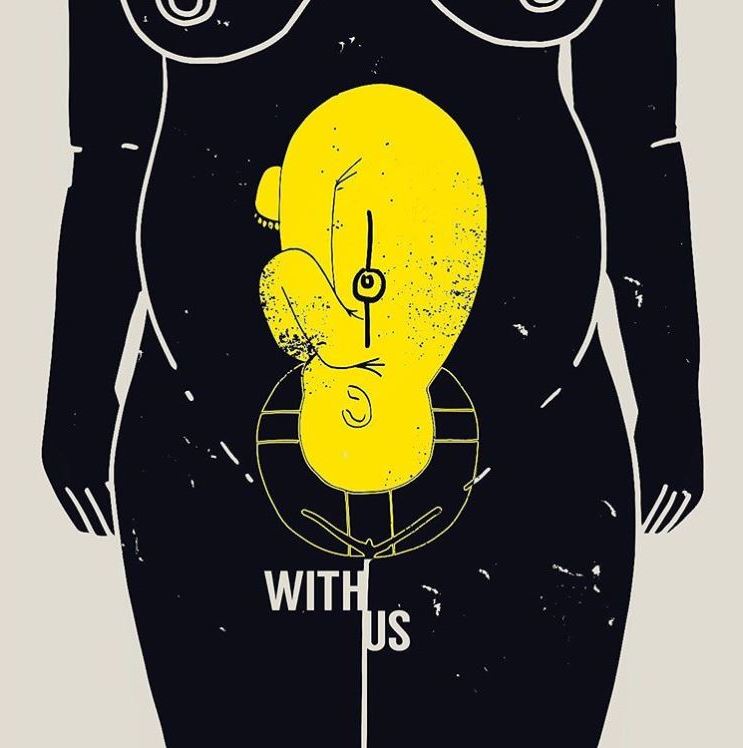
ART BY SCOTT ERICKSON: This month Portland-based artist Scott Erickson has been posting on Instagram Advent-themed images he has made, along with thoughtful meditations. Some emphasize the bodiliness of the Incarnation, which often gets overlooked, presumably out of a sense of propriety. But “grace comes to us floating in embryonic fluid . . . embedded in the uterine wall of a Middle Eastern teenage woman,” Erickson writes about With Us – With Child, to which one Instagrammer responded, “This is trajectory changing. Thank you for this. Nipples, vaginas, and Jesus CAN coexist!” Another mentioned how she had never seen Mary with a belly button and a linea nigra before. The image reminds us that Jesus was indeed “born of woman” (Gal. 4:4).

Erickson, Scott_With Us, With Child
Scott Erickson (American, 1977–), With Us – With Child, 2016 [purchase as poster]
Another imaginative image suggests that Christ came to set the world on fire, so to speak. God, who is of old, gives himself to earth as a Jewish babe (“Love has always been FOR GIVENESS,” Erickson writes), sparking a revolution.

Erickson, Scott_Advent
Art by Scott Erickson

View more art by Scott Erickson @scottthepainter.

+++

LECTIONARY POEMS FOR ADVENT: This year Englewood Review of Books launched a new feature on their website: a weekly post of four to six poems that resonate with the Revised Common Lectionary readings for that week. “We will offer here a broad selection of classic and contemporary poems from diverse poets that stir our imaginations with thoughts of how the biblical text speaks to us in the twenty-first century. We hope that these poems will be fruitful not only for preachers who will be preaching these texts on the coming Sunday, but also for church members in the pews, as a way to prime our minds for encountering the biblical texts.” I’m really enjoying these stellar selections, several of which are new to me.

Continue reading “Roundup: Advent art, songs, poems”

ESSAY: “A Plan of a Peace-Office for the United States” by Benjamin Rush

Blogger’s Note: One of the first three departments created in 1789 in the new executive branch of the United States government was the War Department—now called the Department of Defense. Having witnessed the evils of war firsthand while serving as surgeon general of the Middle Department of the Continental Army, founding father Benjamin Rush published an essay in Banneker’s Almanac in 1793 advocating for the formation of a cabinet-level Department of Peace to promote a counterethic. Among other things, his proposed Secretary of Peace would be responsible for abolishing capital punishment; dissolving state militias, including getting rid of military uniforms and titles; and providing every family with a Bible by which to become educated in Christ’s law.

His plan even provides for the interior decoration of the Peace Office—which must include lamb, dove, and olive branch imagery; biblical inscriptions; and a collection of plowshares and pruning hooks forged from the melted-down metals of swords and spears—as well as its sonic environment: the daily singing of peace hymns. The War Office, by contrast, should display images of death and destruction and bear cautionary inscriptions.

Literary satire, maybe. Then again, maybe not. Rush was an uncompromising champion of many causes throughout his lifetime, including, besides nonviolence, public education, prison and mental health reform, the abolition of slavery, mass distribution of Bibles, and temperance. While his proposal for a U.S. Department of Peace may sound airy-fairy and ridiculous, he very much believed in its practicality, and his confidence has been matched by twentieth- and twenty-first-century politicians: since the publication of Rush’s “Plan of a Peace-Office,” almost a hundred bills have been introduced in Congress proposing the creation of such a department, most recently in 2015.

The following essay is rekeyed in its entirety from Benjamin Rush’s Essays, Literary, Moral, and Philosophical (Philadelphia: Thomas & Samuel F. Bradford, 1798).

Swords into Plowshares by Scott Erickson

“A Plan of a Peace-Office for the United States”

Benjamin Rush

Among the defects which have been pointed out in the Federal Constitution by its antifederal enemies, it is much to be lamented that no person has taken notice of its total silence upon the subject of an office of the utmost importance to the welfare of the United States, that is, an office for promoting and preserving perpetual peace in our country.

It is to be hoped that no objection will be made to the establishment of such an office, while we are engaged in a war with the Indians, for as the War-Office of the United States was established in time of peace, it is equally reasonable that a Peace-Office should be established in the time of war.

The plan of this office is as follows:

I. Let a Secretary of the Peace be appointed to preside in this office, who shall be perfectly free from all the present absurd and vulgar European prejudices upon the subject of government. Let him be a genuine republican and a sincere Christian, for the principles of republicanism and Christianity are no less friendly to universal and perpetual peace than they are to universal and equal liberty.   Continue reading “ESSAY: “A Plan of a Peace-Office for the United States” by Benjamin Rush”