When the beauty comes, the beauty comes When the beauty comes, it all just falls from the sky (Singin’) When the beauty comes, it all just falls from the sky (Singin’) When the beauty comes, it all just falls from the sky
Refrain 2: It makes us sing, makes us sing, makes us sing, makes us sing We’re gonna sing, gonna sing, gonna sing, gonna sing, gonna sing We’re gonna sing, gonna sing, gonna sing, gonna sing, gonna sing
When we forgive someone, forgive someone When we forgive someone, the beauty just falls from the sky Every time we forgive someone, the beauty just falls from the sky Oh, when we forgive someone, the beauty just falls from the sky [Refrain 2]
When we admit we were wrong, admit we were wrong When we admit we’re wrong, beauty just falls from the sky And when we admit we’re wrong, beauty just falls from the sky And when we admit we’re wrong, beauty just falls from the sky [Refrain 2]
When merciful justice comes, merciful justice comes When merciful justice comes, beauty’s gonna fall from the sky When merciful justice comes, beauty’s gonna fall from the sky When merciful justice comes, beauty’s gonna fall from the sky [Refrain 1]
When the good Lord comes, good Lord comes And when the good Lord comes, beauty’s gonna fall from the sky (Singin’) When the good Lord comes, beauty’s gonna fall from the sky (Singin’) When the good Lord comes, beauty’s gonna fall from the sky [Refrain 1]
His face was like the sun shining with full force.
—Revelation 1:16
[. . .] make ready for the Face that speaks like lightning, Uttering the new name of your exultation Deep in the vitals of your soul. Make ready for the Christ, Whose smile, like lightning, Sets free the song of everlasting glory That now sleeps, in your paper flesh, like dynamite.
—Thomas Merton, from “The Victory” (1946)
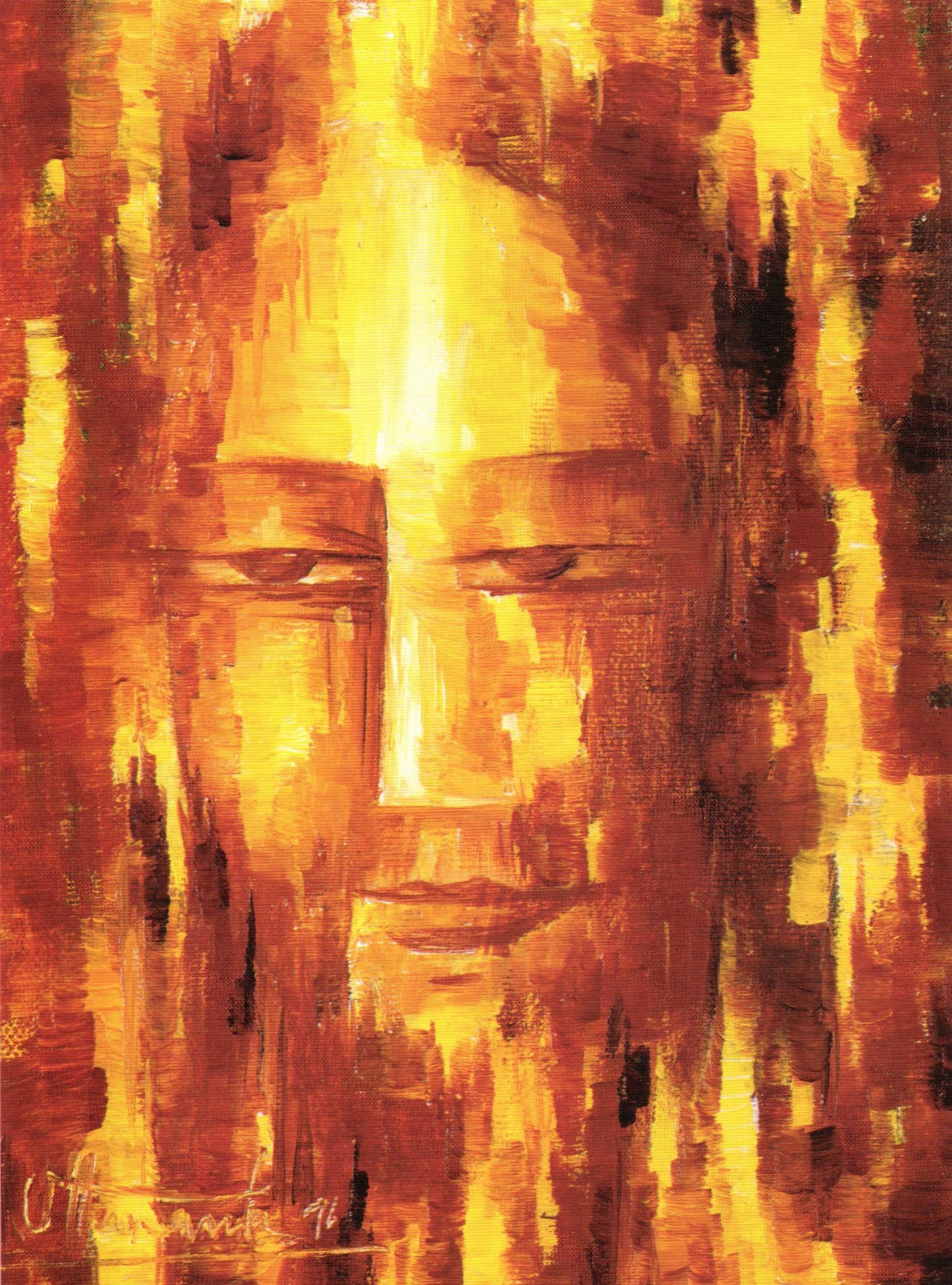
LOOK: Portrait of Jesus by Hatigammana Uttarananda
Hatigammana Uttarananda is a Sri Lankan Buddhist monk, artist, and scholar. His friendship with Fr. Aloysius Pieris, SJ—a Jesuit priest, liberation theologian, and founding director of the Tulana Research Centre for Encounter and Dialogue in Kelaniya—led him to study the Christian Gospels and to portray some of its stories in his paintings.
In his semiabstract Portrait of Jesus, Christ’s face gives off a deep radiance. He is both enlightened and enlightening.
“Bikku Uttarananda portrays Jesus with lowered eyelids, the enlightened one who has found the true meaning of life and is united in compassion with the suffering of all beings,” writes the Christian theologian Wesley Ariarajah in Christ for All People: Celebrating a World of Christian Art. “The rays of the light of life burst through his forehead; the colours are those of the saffron robes of the Buddhist monk and the fire of self-giving.”
LISTEN: “When Jesus Comes,” African American spiritual | Arranged by Alice Parker, 1988, and performed by The Musicians of Melodious Accord on Listen, Lord: A Cantata, Two Suites, and Eight Spirituals, 2010
When Jesus comes, he’ll outshine the sun Outshine the sun Outshine the sun When Jesus comes, he’ll outshine the sun Look away beyond the moon
When Jesus comes, we’ll sing Hosiana! . . .
When Jesus comes, we’ll shout Hallelujah! . . .
If you want to see King Jesus, keep prayin’ on . . .
Alice Parker (1925–2023) was an American composer, arranger, conductor, and teacher whose arrangements of hymns, spirituals, and folk songs of American, French, Spanish, Hebrew, and Ladino origin have become part of the repertoire of choirs around the world. In addition to arrangements, she also wrote original works, including operas, song cycles, cantatas, choral suites, and hymns. In 1985 she founded the professional choir Melodious Accord, with whom she released fourteen albums.
For the African American spiritual “When Jesus Comes,” she cites her source as The Negro Sings a New Heaven, a collection compiled by Mary Allen Grissom (University of North Carolina Press, 1930).
I saw one like a son of man coming with the clouds of heaven. And he came to the Ancient One and was presented before him.
—Daniel 7:13
“Immediately after the suffering of those days
the sun will be darkened, and the moon will not give its light; the stars will fall from heaven, and the powers of heaven will be shaken.
“Then the sign of the Son of Man will appear in heaven, and then all the tribes of the earth will mourn, and they will see ‘the Son of Man coming on the clouds of heaven’ with power and great glory. And he will send out his angels with a loud trumpet call, and they will gather his elect from the four winds, from one end of heaven to the other.”
—Matthew 24:29–31
“. . . you will see the Son of Man seated at the right hand of Power and coming on the clouds of heaven.”
—Matthew 26:64
Look! He is coming with the clouds; every eye will see him, even those who pierced him, and all the tribes of the earth will wail on account of him.
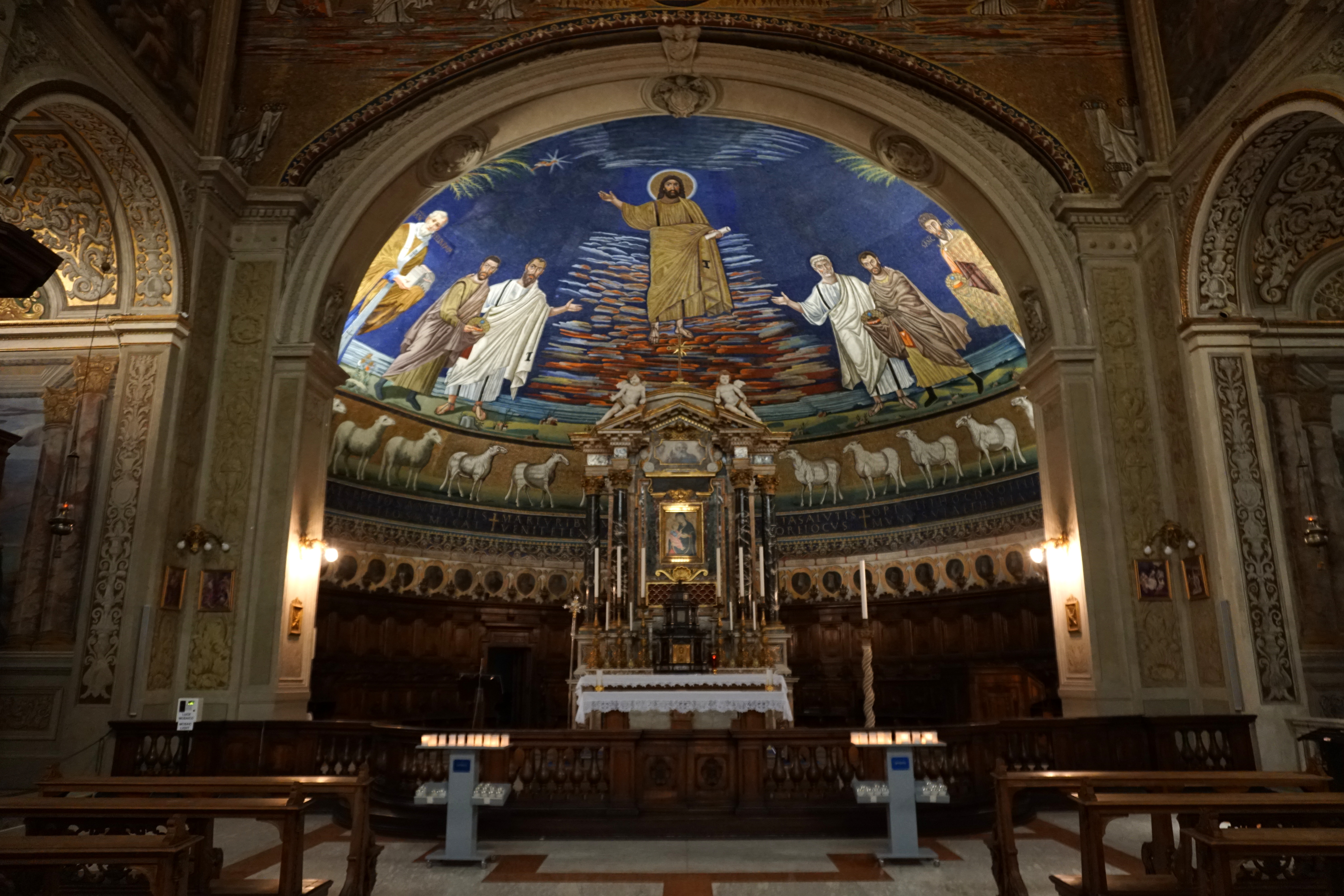
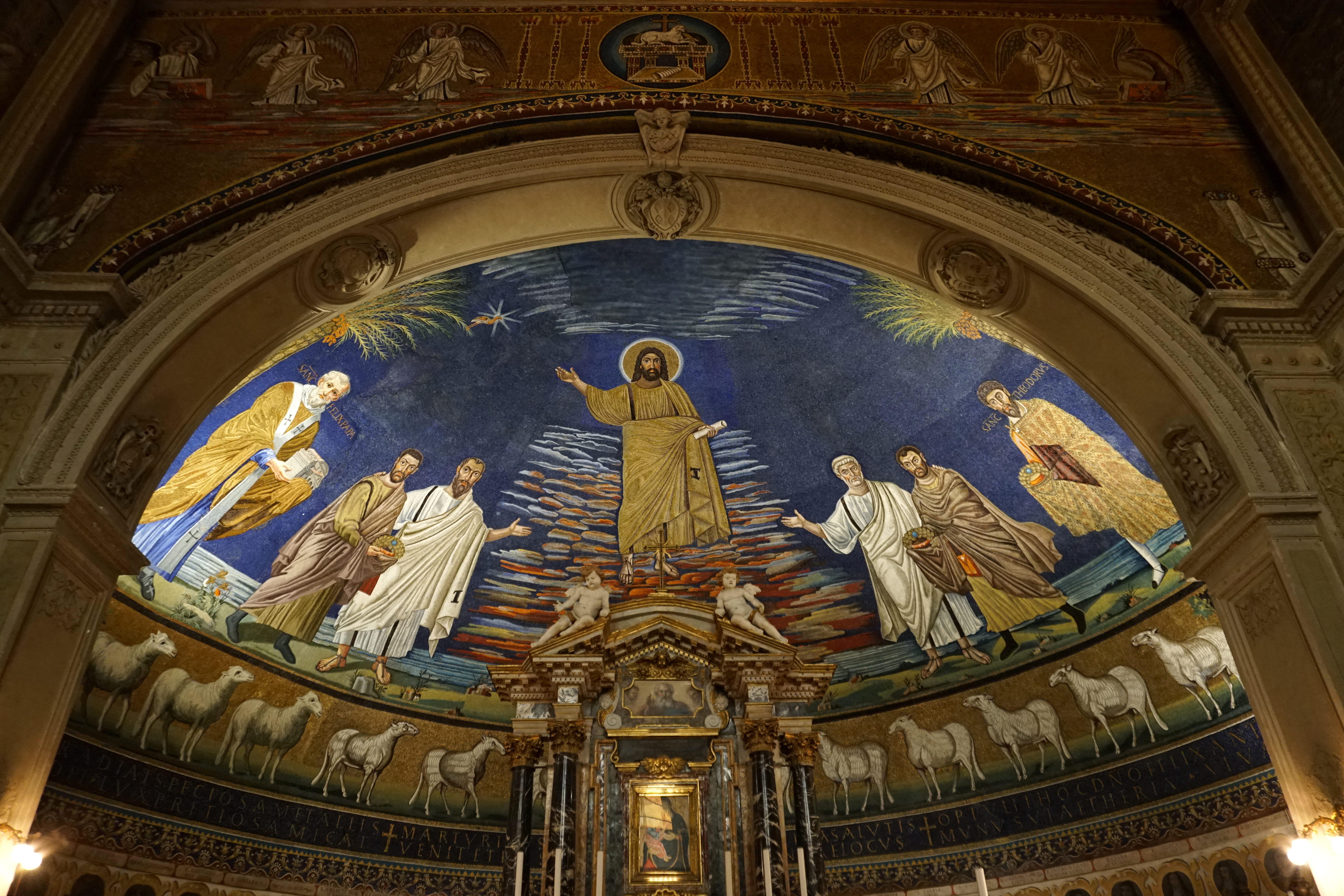
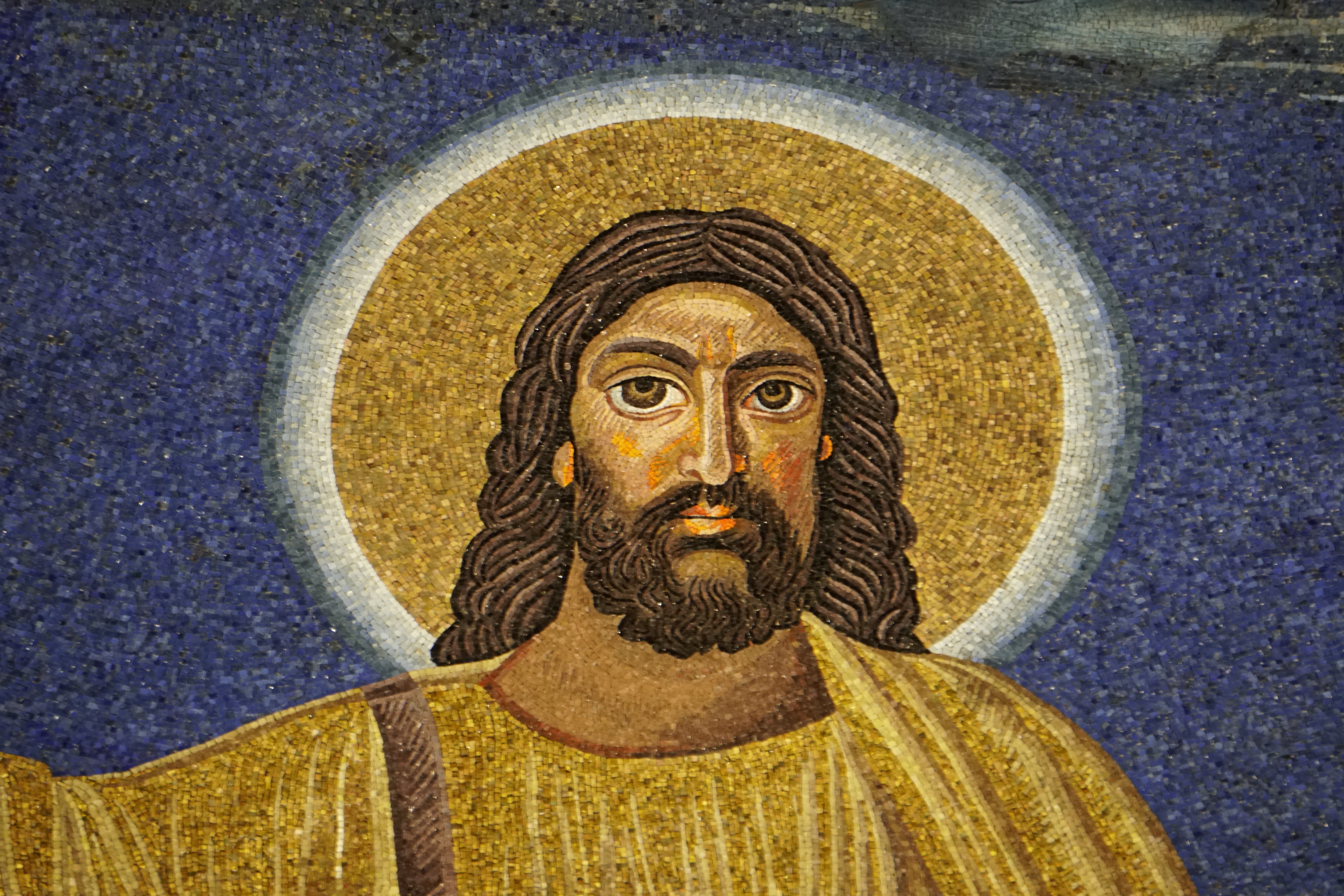
LOOK: Apse mosaic, Basilica of Saints Cosmas and Damian, Rome
The Second Coming of Christ, ca. 526–30. Mosaic, Basilica of Santi Cosma e Damiano (Saints Cosmas and Damian), Rome. All photos by Victoria Emily Jones.
This Roman-Byzantine mosaic decorates the apse (large semicircular recess at the east end of a church) of a basilica in Rome dedicated to the Christian martyr-saints Cosmas and Damian, twin brothers from third-century Arabia. Cosmas and Damian (Cosma and Damiano in Italian) were physicians who, out of love for Christ and humanity, treated their patients free of charge. They were killed in the Diocletian persecution, one of the Roman Empire’s attempts to squelch Christianity.
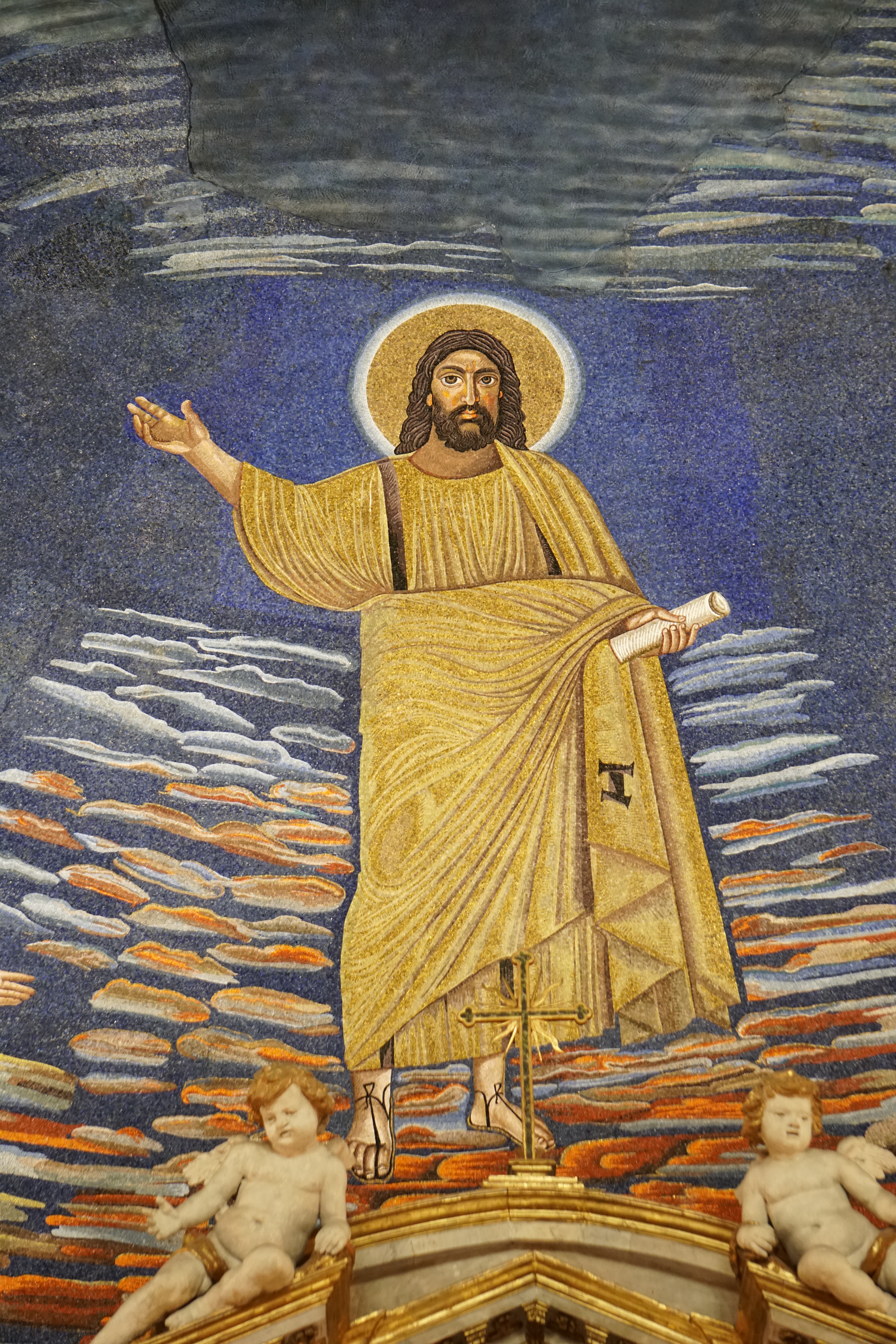
Situated behind the altar—and partially obscured by a hideous Baroque altarpiece with putti that was added in the seventeenth century—the mosaic depicts the parousia, the second coming of Christ. Christ is bearded and notably dark-skinned, and he wears a golden toga edged with purple. In his left hand he holds a rolled-up scroll, and his right hand he raises to indicate a phoenix in a palm tree—a mythological bird that rose from its own ashes, a potent symbol of resurrection that was adopted by the early Christians.
Descending from the heavens on dramatically colored clouds, Christ is portrayed as a triumphant ruler worthy of worship.
He is flanked by Peter and Paul, who present Cosmas and Damian. The figures on the extreme left and right are Pope Felix IV (r. 526–30), who paid to convert a pagan temple into the present church and to have it decorated with mosaics, and Theodore, another martyr under Diocletian. Cosmas, Damian, and Theodore lay down the crowns of their martyrdom before Christ, and Felix does the same with a model of the church he built.
The inscription at the base of the mosaic tells us that “Felix has offered this gift worthy of the lord bishop so that he may live in the highest vault of the airy heavens.” (If you balk at that, I do too; that you can buy your way to heaven, that you can earn favor with God or remit your punishment for sin through expensive gifts, is a false belief that still persists today in some corners of popular culture and even the church. I’m grateful for wealthy donors to the church throughout history, whose funds have enabled, among other things, the creation of beautiful art—but I must reckon with the fact that sometimes their motives were misguided and self-serving.)
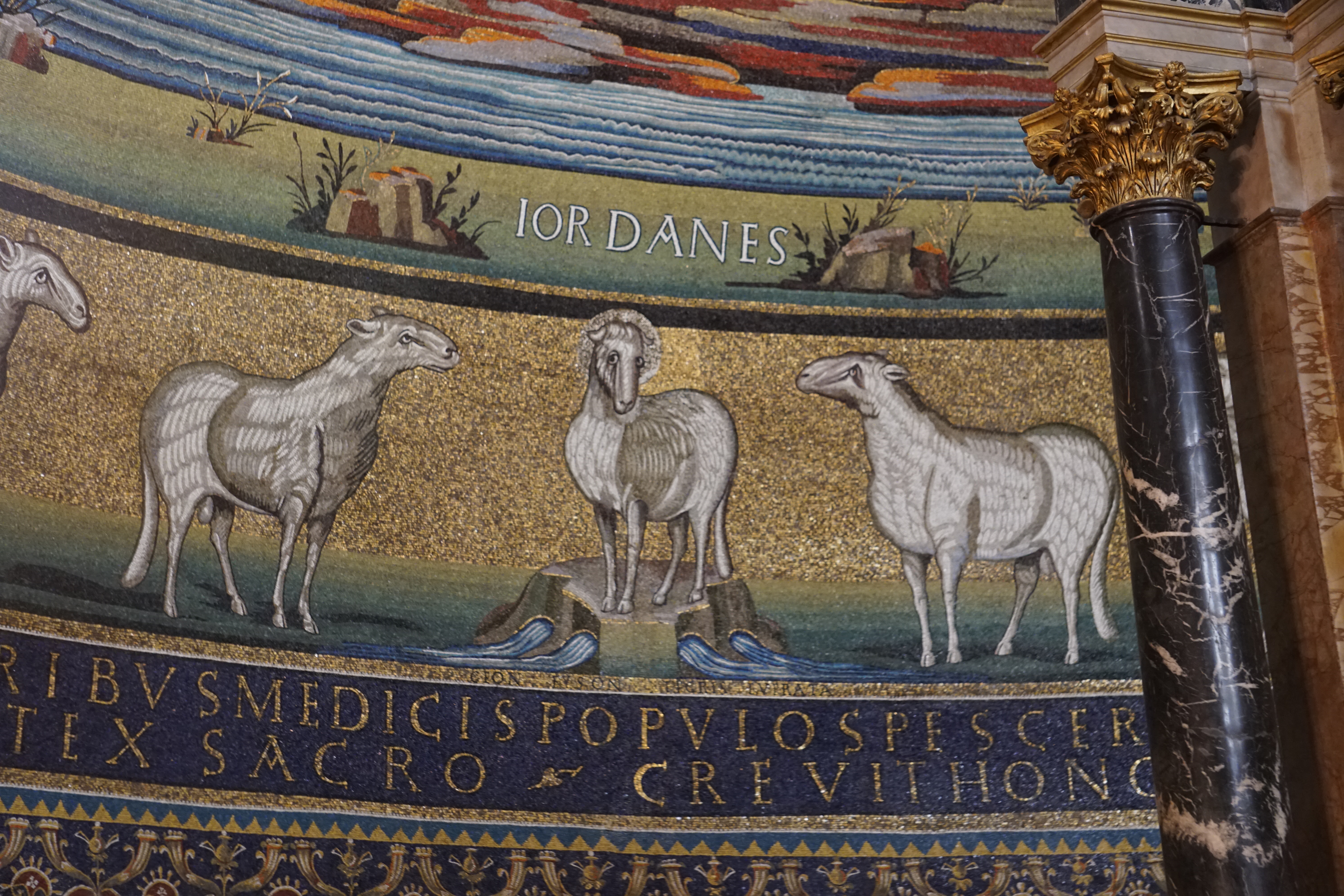
Below the primary scene is a band of twelve sheep, which represent the apostles, or the Christian flock more generally. They process toward the Agnus Dei (Lamb of God), who stands on a rock from which flow the four rivers of paradise.
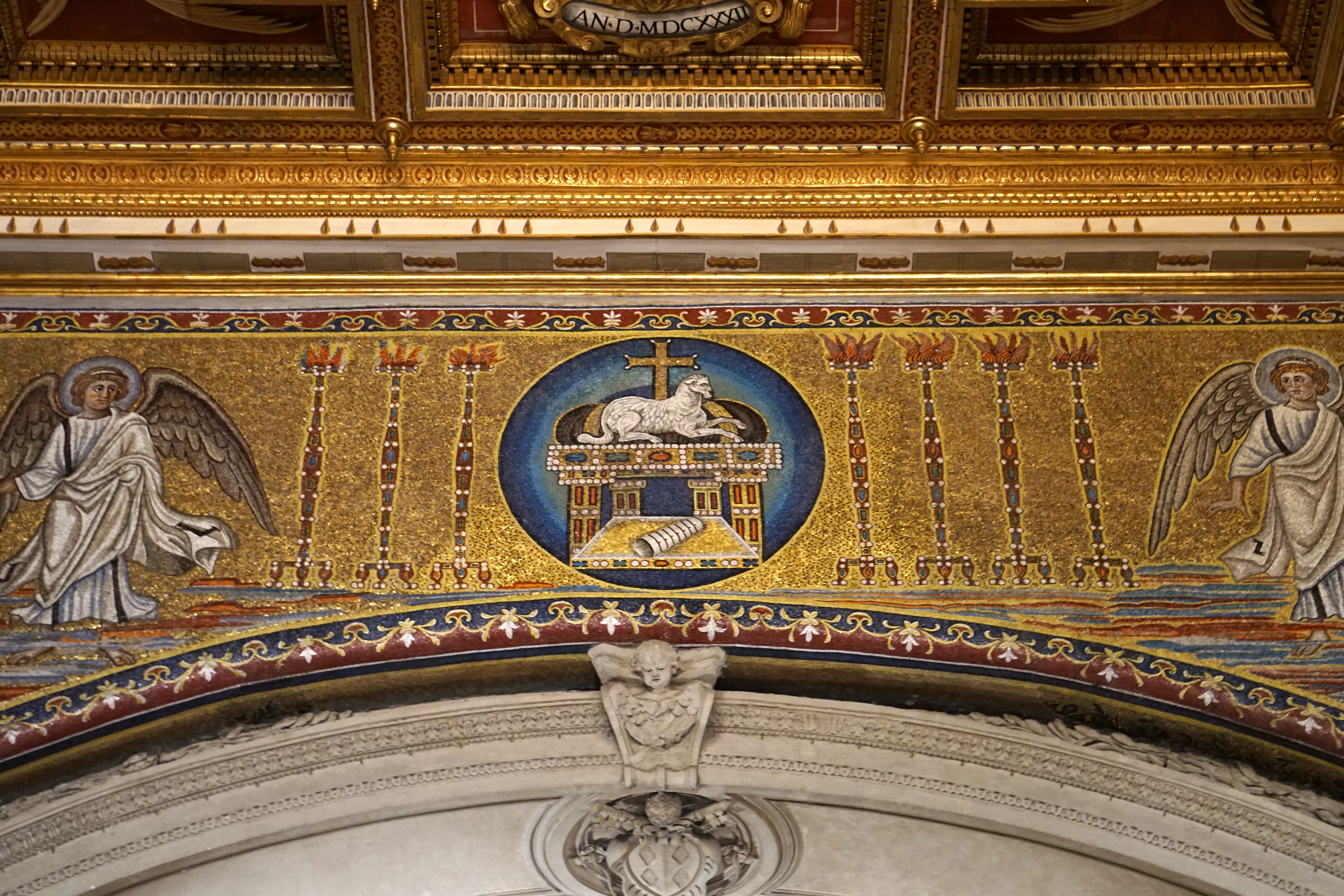
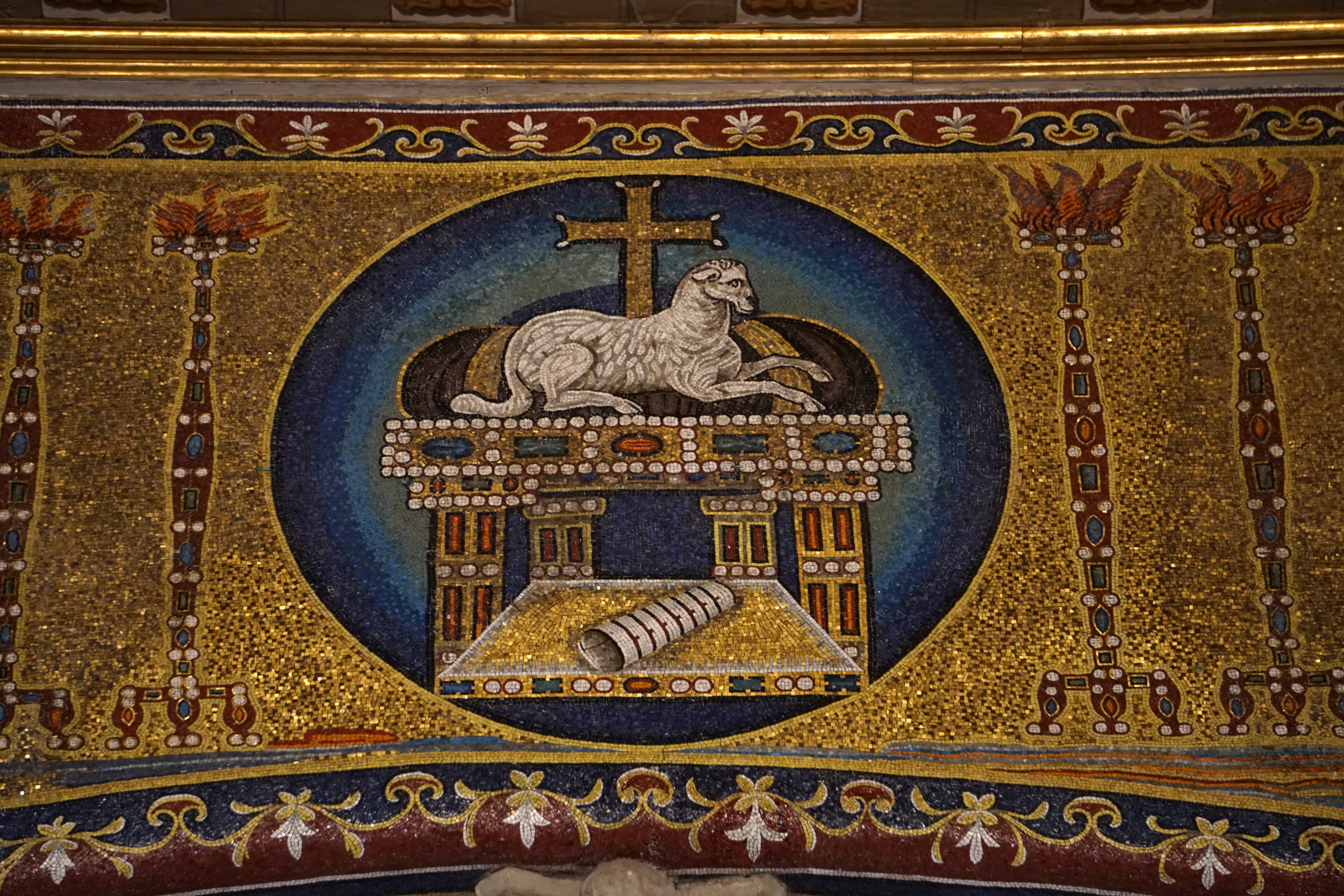
Based on further imagery from the book of Revelation, the arch that frames the apse depicts the Lamb seated upon the throne, a scroll with seven seals laid before him. He is flanked by seven lampstands, angels, and (not pictured) symbols of the Four Evangelists.
Refrain: God is coming on the clouds Yes, he said God is coming on the clouds Yes, he said May be morning, noon, or night Better get all your business right God is coming on the clouds Yes, he said
When the clouds turn dark as night And there ain’t no light in sight When the world begins to tremble Won’t that be an awful night You better get in a hurry My Lord is coming soon Oh, he’s coming on the clouds Yes, he said [Refrain]
Oh Lord, please give me power Stay with me every hour I just been waiting here praying For your Holy Ghost power God, you been my friend I know you freed me from sin Yeah, you coming on the clouds Yes, he said [Refrain]
“One of poetry’s great gifts is to slow us down,” writes Peggy Rosenthal in Praying the Gospels through Poetry. “We’re used to racing ahead as we read, whether it’s a newspaper or an email memo or even an essay: language in these forms propels us forward, urging us to grab up its main points. But poetry doesn’t press ahead so much as hold us still—in the wonder of words crafted to open into another dimension.”
Below are twenty-five poems to “hold us still” this holiday season.
I’ve collected hundreds of Advent and Christmas poems over the past decade, but for this feature one of the selection criteria was that the poem must be freely available online. I chose the number twenty-five because that is standard in most Advent calendars—tools for counting down the days to Christmas. This way, you can choose, if you wish, to bookmark this page and read just one poem a day from December 1 to 25, each one a little treat.
The order progresses, in general, from Advent longing and anticipation to Christmas joy and wonder to post-nativity moments like the presentation in the temple and the visit of the magi.
1. “Advent Madrigal” by Lisa Russ Spaar: I’m not sure I understand this poem, but I like it. A madrigal is a part-song, and this is a song of waiting in simultaneous belief and doubt, of being irresistibly attracted to God’s story while also skeptical of aspects. The speaker compares the moon to a flashlight that a theater usher shines down the aisle to escort folks to their seats. What does it mean that “the treetops sough // & seize with” escape? Escape from what? And that the earth has been purloined? I don’t know, but the final couplet really lands for me—about how in the dark night of our not-knowing, we make our Advent wreaths, decking them with evergreens, their round shape an O of lament and awe before the yet-to-be-seen.
Source: University of Virginia Office of Engagement
2. “Prayer” by John Frederick Nims: The first in a sequence of five poems, “Prayer” expresses a sense of emptiness and desire, beckoning an unnamed one whom I read as Christ to come and fill. “Come to us, conceiver, / You who are all things, held and holder. / . . . / Come, infinite answer to our infinite want.”
3. “how he is coming then” by Lucille Clifton: This poem is part of a sequence on the life of Mary; it appears between “mary’s dream” (on the Annunciation) and “holy night” (on Mary’s ecstatic birthing experience). In answer to the title, Clifton gives three similes.
4. “Advent 2” by Anna A. Friedrich: This poem is the second in a series of Advent villanelles commissioned by the poet’s church in Boston last year to converse with one or more of the lectionary readings for each week of the season. Malachi 3:1–4 is the primary touchstone here, a formidable prophetic passage that compares God in the day of his coming to a blazing fire that refines metal. Stanza 3 references the fiery repentance-preaching of John the Baptist from Luke 3:1–6, and then Friedrich draws in another, unexpected “fire” text: Daniel 3, in which three young Hebrew men are thrown into a furnace by a Babylonian king for their refusal to worship his gods but are preserved from harm when a mysterious fourth person appears with them in the flames. Friedrich connects this story to the promise that the earth and its inhabitants will not be wholly consumed in the fire of God’s judgment—only the impurities, the dross, will be destroyed, so that all may be restored to their truest selves. Hence why, in Friedrich’s words, “We pray for His fire. We trust this flame.”
5.“Desert Blossoming” by Amit Majmudar: A reflection on the messianic promise of Isaiah 35:1–2, this poem celebrates how, through the deserts of Israel, Jesus “scattered his verses on the secretly gravid ground,” causing the wilderness to blossom. Majmudar mentions red, the color of fire (an image he connects to the light of faith), rhyming it with “bled.” Although he uses this final word in the sense of spreading into or through—oases bleeding into one another as dry land becomes water—one can’t help but think of Jesus’s sacrificial death, his blood extraordinarily fertile, producing life.
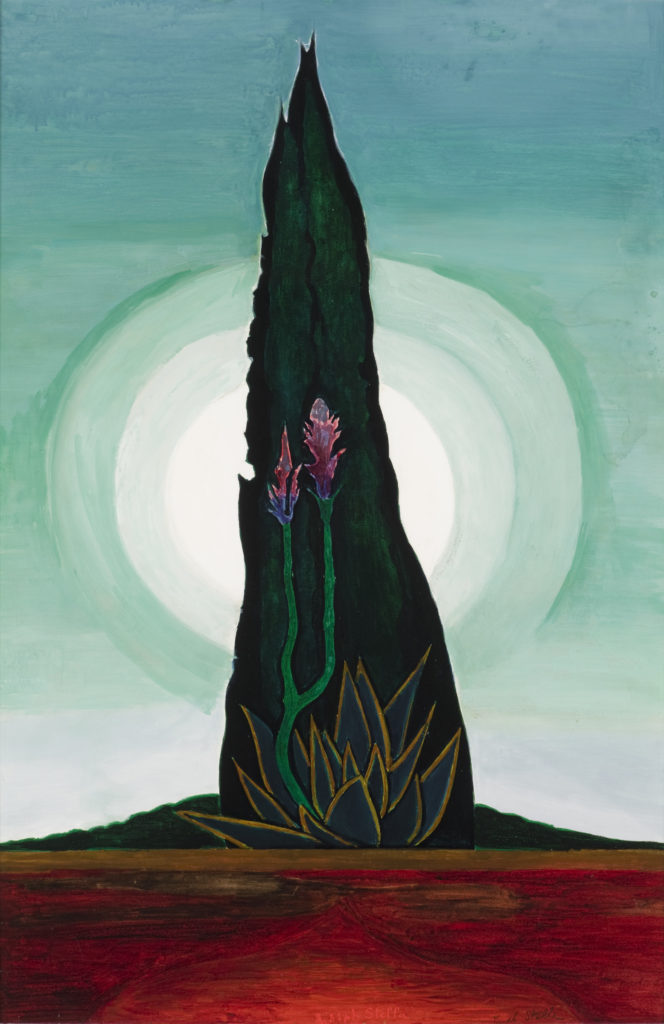
Joseph Stella (American, 1877–1946), Tree, Cactus, Moon, ca. 1928. Gouache on paper, 104.1 × 68.6 cm. Reynolda House Museum of American Art, Winston-Salem, North Carolina.
6.“Name One Thing New”by Seth Wieck: This six-line poem takes the Teacher of Ecclesiastes to task, responding to his cynical claim that “there is nothing new under the sun” (Eccles. 1:9) with a counterexample.
7.“For My Mother at Advent” by Brian Volck: The poet recalls a simple Advent tradition his mother established in his childhood and reflects on her spiritual legacy, her lifetime of Christ-inspired kindnesses that continue to pillow him. How might we soften the hardness of the world for others?
8. “Advent” by Suzanne Underwood Rhodes: This stunning poem makes unlikely intertextual connections, bringing Matthew 19:24 (one of Jesus’s hard sayings regarding wealth) to bear on John 1. Its unique angle on the Incarnation and its evocative imagery have inspired an experimental jazz composition and several paintings.
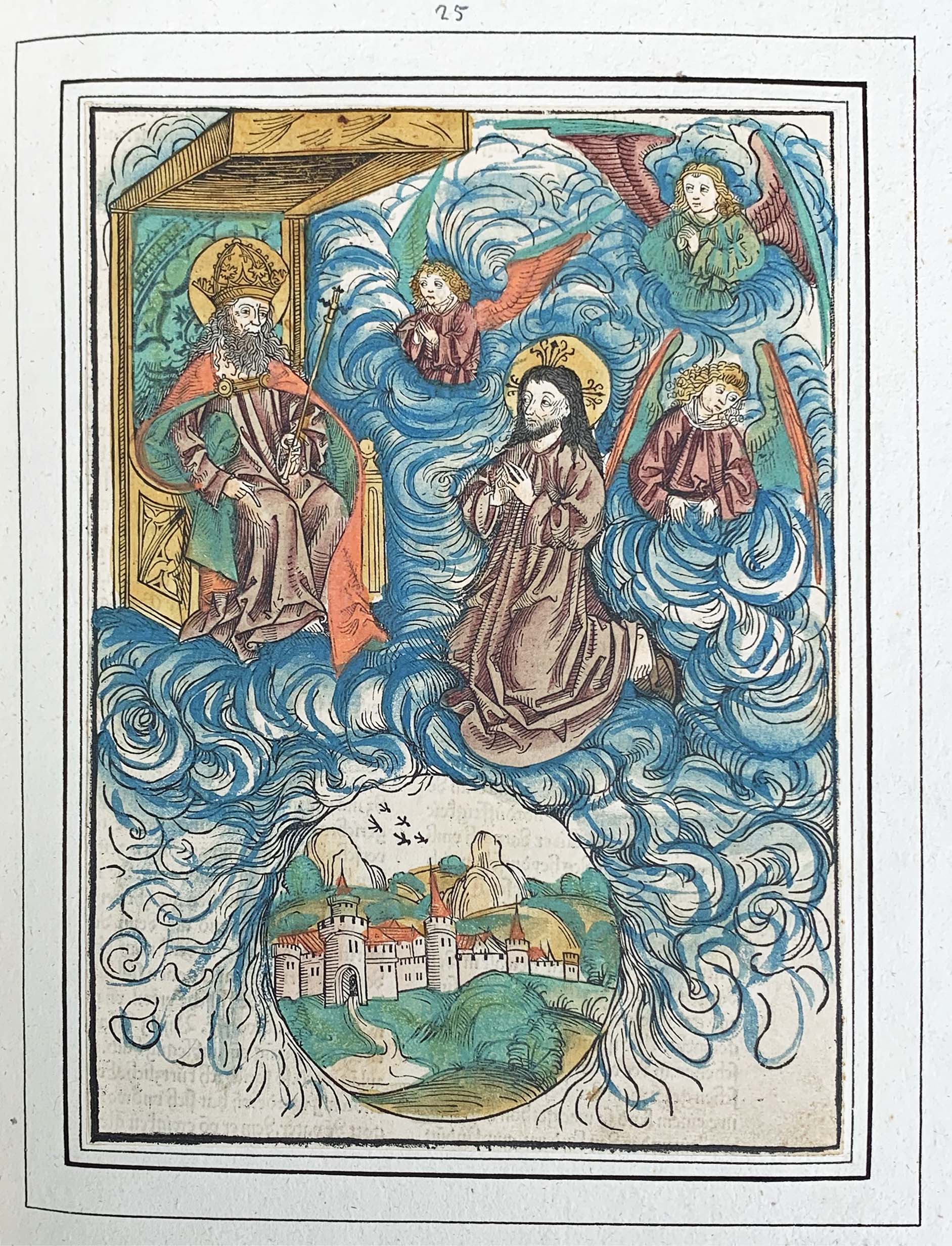
9. “An Hymn to Humanity” by Phillis Wheatley: “Lo! for this dark terrestrial ball / Forsakes his azure-pavèd hall / A prince of heav’nly birth!” So begins this poem on the Incarnation by Phillis Wheatley (ca. 1753–1784), the first African American to publish a book of poetry. In stanzas 2 and 3, God the Father dispatches the Son to establish his throne on earth, “enlarg[ing] the close contracted mind, / And fill[ing] it with thy fire.” The “languid muse” in stanza 5 refers to Wheatley herself, whereas the “celestial nine” are the ancient Greek inspirational goddesses of literature, science, and the arts. The “smiling Graces” is another classical reference.
Michael Wolgemut (German, 1434–1519), The Father sending the Son into the world, 1491. Hand-colored woodcut from the Schatzbehalter (published by Anton Koberger, Nuremberg), 43.7 × 27.5 cm. British Museum, London.
10. “In My Hand” by Sarah Robsdottir: Mary remembers the moment she conceived Jesus, one ordinary day when sitting down to a bowl of lentil stew.
Source: Aleteia, April 9, 2018
11. “The Risk of Birth, Christmas, 1973”by Madeleine L’Engle: Best known for her children’s novel A Wrinkle in Time, Madeleine L’Engle was also a poet. Here she compares our era to the one in which Jesus was born—both are characterized by violence and hate, and yet Jesus, the embodiment of divine love, willingly entered the peril.
12. “On Another’s Sorrow” by William Blake: Through the Incarnation, God lovingly, humanly, entered the world of human woe to experience it firsthand. “He doth give His joy to all,” Blake writes: “He becomes an infant small, / He becomes a man of woe, / He doth feel the sorrow too.” I featured this poem about Emmanuel, God-with-us, in a musical setting by singer-songwriter David Benjamin Blower in 2023 but was surprised that Blower omitted Blake’s final stanza, whose closing couplet I find striking, as it conveys Jesus’s continued identification with and compassion for humanity, how he moans alongside us in our suffering. For a different musical interpretation, also in an acoustic indie folk mode, see the one by Portland-based artist Michael Blake, from his 2021 album Songs of Innocence and Experience:
Source: Songs of Innocence and Experience (London, 1794). Public Domain.
13.“Missing the Goat”by Lorna Goodison: An immigrant from Kingston, Jamaica, to Toronto, Ontario, Goodison writes of the heightened feeling of exile but also of creative adaptations during the holidays as she tries to carry out the food traditions of her native country on a foreign soil where some of the ingredients are in more limited supply. For the sorrel wine, traditionally made with roselle (Hibiscus sabdariffa) petals, tropically grown, she has to make do with redbuds. And the local shops have run out of goat meat—“the host of yardies” (people of Jamaican origin) who’ve moved to the area have already bought it all up—so “we’ll feast then on curried some-other-flesh.” Despite the differences from home, Christmas is still Christmas, and she raises her “hybridized wassail cup” to her new place, her new neighbors (many of them, like her, also recent arrivals from the Caribbean), and the creation of new rituals in multicultural Toronto.
Source: Controlling the Silver (University of Illinois Press, 2010); compiled in Collected Poems (Carcanet, 2017)
14. “Word Made Flesh”by Kathleen Raine: Awarded the CBE (Commander of the Order of the British Empire) for her significant contributions to literature and culture, Raine has been described as a mystical and visionary poet. Here is her revoicing of John 1. What a powerful last two lines!
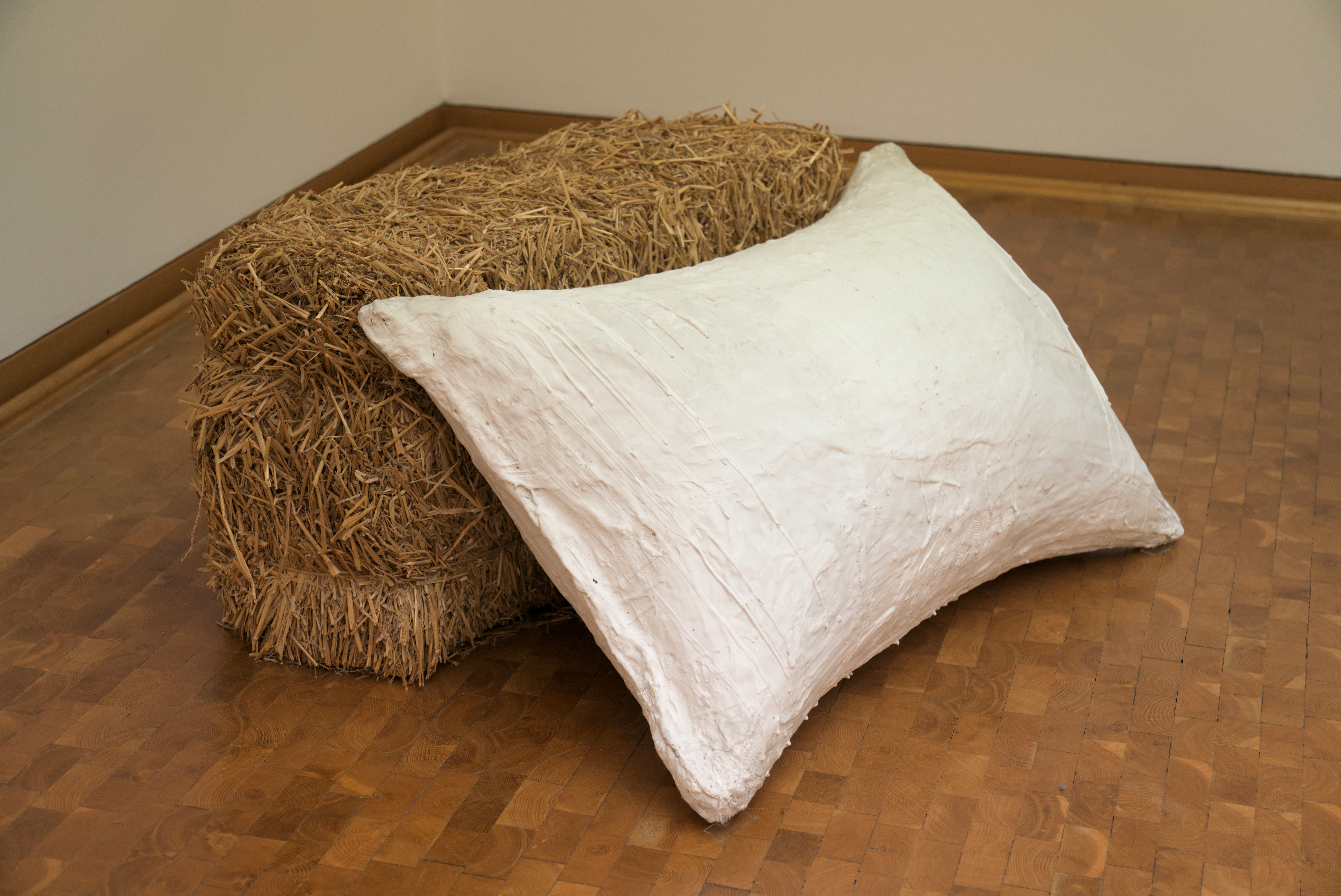
15.“Nativity”by Barbara Crooker: In the heavy dark, in the windy cold, “love is born in the world again” every December when we retell the story of Christ’s birth.
Gary Kuehn (American, 1939–), Straw Pillow, 1963. Straw, plaster. Ludwig Museum, Cologne, Germany, Inv. ML/SK 5185. Photo: Victoria Emily Jones.
16. “First Miracle”by A. E. Stallings: The first miracle Jesus performed, according to the Gospel of John, was turning water into wine. Stallings reflects on an earlier miracle performed by his mother’s body, and all birth-giving mothers’: turning nutrients from her blood into milk.
17.“What Sweeter Music Can We Bring” (or “A Christmas Carol, sung to the King in the Presence at Whitehall”)by Robert Herrick: “The Darling of the world is come”! Originally written as a song for soloists (each number corresponds to a different singer) and chorus, this poem reverses the typical seasonal imagery of Christmas, remarking how, at Jesus’s birth, “chilling Winter’s morn / Smile[s] like a field beset with corn” and “all the patient ground [is turned] to flowers.” The original music by Henry Lawes is lost, but many contemporary composers have written settings of the text, most famously John Rutter.
Source: Hesperides: Or, Works Both Human and Divine (London, 1648). Public Domain.
18.“Sharon’s Christmas Prayer”by John Shea: A five-year-old recounts the Christmas story, and when she reaches the clincher, she can’t hold back her glee.
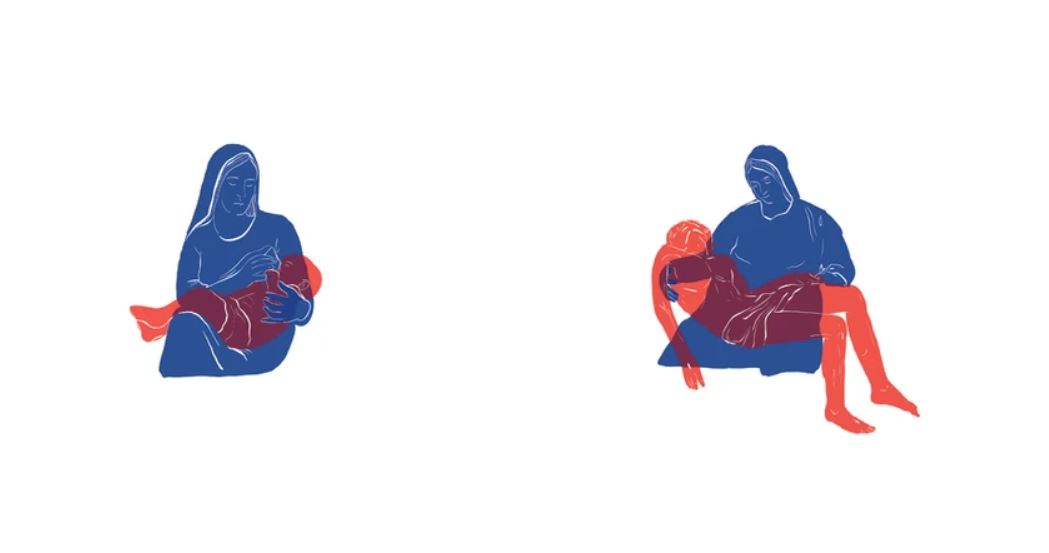
19.“God”by D. A. Cooper: Riffing on Williams Carlos Williams’s “The Red Wheelbarrow,” this spare poem attends to the birth and death of the incarnate God, upon which so much depends.
Source: Reformed Journal, September 3, 2024
Katarzyna Malinowska (Polish, 1989–), Juxtapose (diptych), 2021. Digital painting, 20 × 30 cm.
20. “Lullaby after Christmas”by Vassar Miller: The speaker wishes sweet sleep for the newborn Christ child, wishes to keep him innocent of his fate for as long as possible—for “even God has right to / Peace before His pain.” Consisting of four sestets whose second, fourth, and sixth lines rhyme, the poem has a sing-songy quality that is jarring for the juxtaposition of words like “soft,” “warm,” and “tinkling” with the likes of “blood,” “gore,” and “die.”
21. “Journey of the Magi”by T. S. Eliot: Eliot wrote this poem shortly after his conversion to Christianity in 1927. Opening with a passage from a Christmas sermon by the seventeenth-century Anglican bishop Lancelot Andrewes, it is from the perspective of one of the magi, who made a long, toilsome journey in search of the meaning of a mysterious guiding star. After the magi’s encounter with the Christ child, they would never be the same; their paganism would no longer satisfy. The poem is about the transformative impact Christ has on those with humility enough to see him for who he is (having followed the light of revelation) and to worship him accordingly. And that transformation is in some ways painful, as it involves giving up some of the things one once held dear.
“Were we led all that way for / Birth or Death?” the magus asks. Jesus’s wasn’t the only birth they witnessed; they, too, were (re)born in Bethlehem. But spiritual rebirth is also a sort of death—the magi died to their old selves and false loves and loyalties. Thus, when they returned to Babylon, they felt like strangers in a strange land. They were now citizens of a different kingdom, and filled with a longing for its consummation.
Source: Journey of the Magi (Ariel Poems) (Faber & Gwyer, 1927). Public Domain.
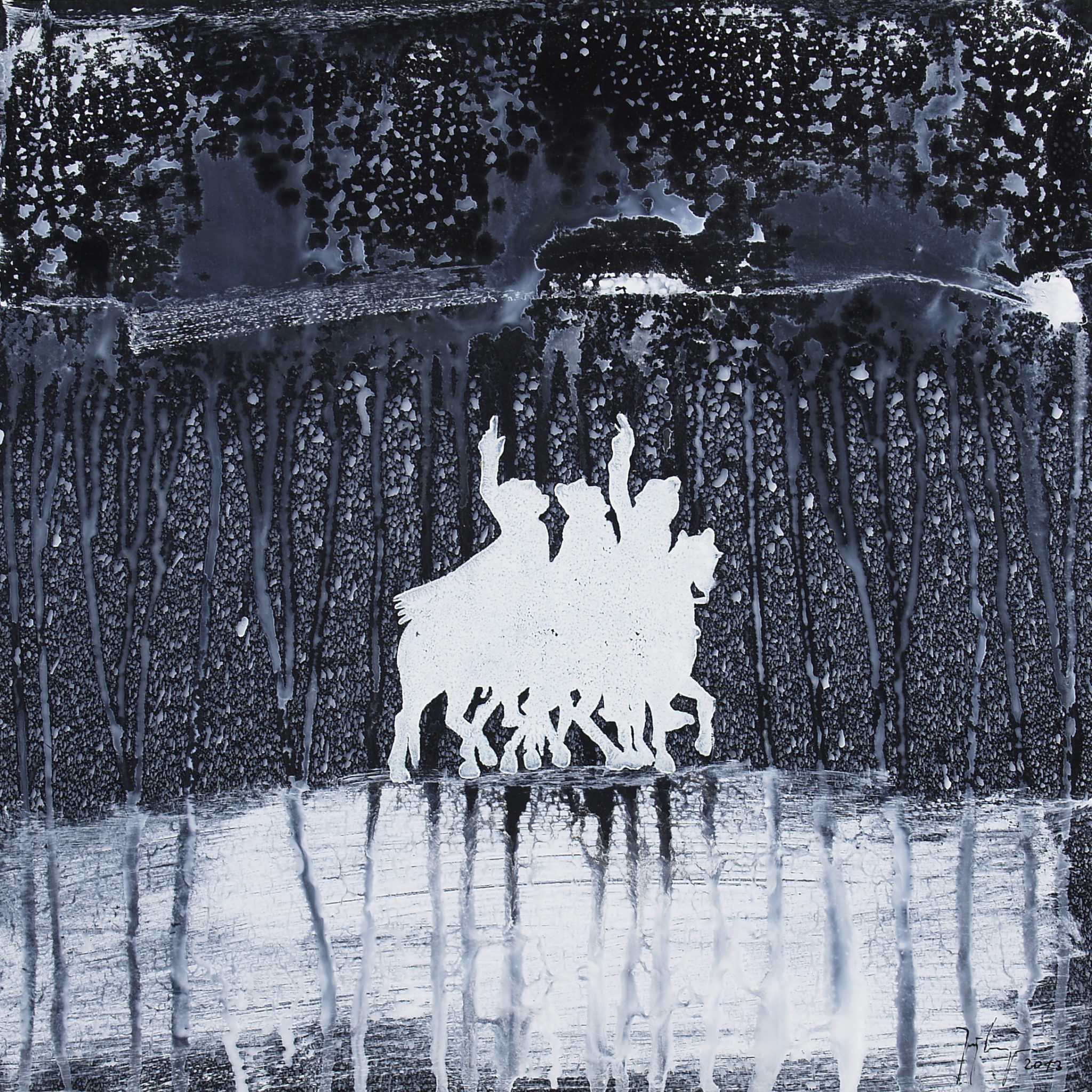
Jörg Länger (German, 1964–), The Three Kings, 2013. Linocut and gesso on aluminum dibond, 38 × 38 cm. The linocut is after a 12th-century illumination from the St Albans Psalter, held at the Dombibliothek, Hildesheim, Germany.
22. “Twelfth Night”by Sally Thomas: (Scroll to second poem.) As the Christmas season draws to a close, holly berries shrivel and drop, the “candles drown themselves in waxen lakes,” “the tree’s a staring corpse,” and a spider has built a web across the mantel nativity. Thomas uses the passing of the season to reflect more broadly on the passing of time and our own dustiness and desiccation—and by contrast, the unchangeability of God.
23. Untitled poemby S. E. Reid: Most reflections on the New Year are full of enthusiastic goal-setting and go-getting, but Reid, gardening in her greenhouse in the crisp cold of January, describes a “fall[ing] backwards,” “dropping into the dark,” “shivering,” herself a seed, latent in the soil, trusting God that growth will come.
24. “Anna the Prophetess” by Tania Runyan: Forty days after Jesus’s birth, Mary and Joseph presented him in the Jerusalem temple. Runyan imagines this event from the perspective of Anna, a woman who was widowed young and thenceforth lived at the temple into old age, devoted to prayer, fasting, praise, and prophecy.
25. “The Work of Christmas”by Howard Thurman: Drawing on Jesus’s mission statement in Luke 4, the great African American theologian and civil rights leader Howard Thurman urges us to continue the work of Christmas—finding, healing, feeding, etc.—throughout the year. Listen to the simple yet vigorous choral setting by Elizabeth Alexander.
. . . each day a misery and a marvel, each person also.
—Rachel E. Hicks, from “Accumulated Lessons in Displacement”
A white American born in the foothills of the Himalayas to international school educators, Rachel E. Hicks is a second-generation third-culture kid (TCK) whose writing reflects decades of living as a global nomad, exploring themes of memory, connection, suffering, exile (both physical and spiritual), hospitality, and hope. She grew up in six countries—India, Pakistan, the United States, Jordan, the Democratic Republic of the Congo, and Hong Kong—and spent seven years as an adult in Chengdu, China, where she worked for the relief and development organization Food for the Hungry.
In 2013, she, her husband, and their two kids repatriated to the US, settling in Baltimore, where they live today. Hicks has lived in Baltimore longer than in any other city. But even with this rootedness, “the soil of each place in which I’ve lived still clings,” she says.
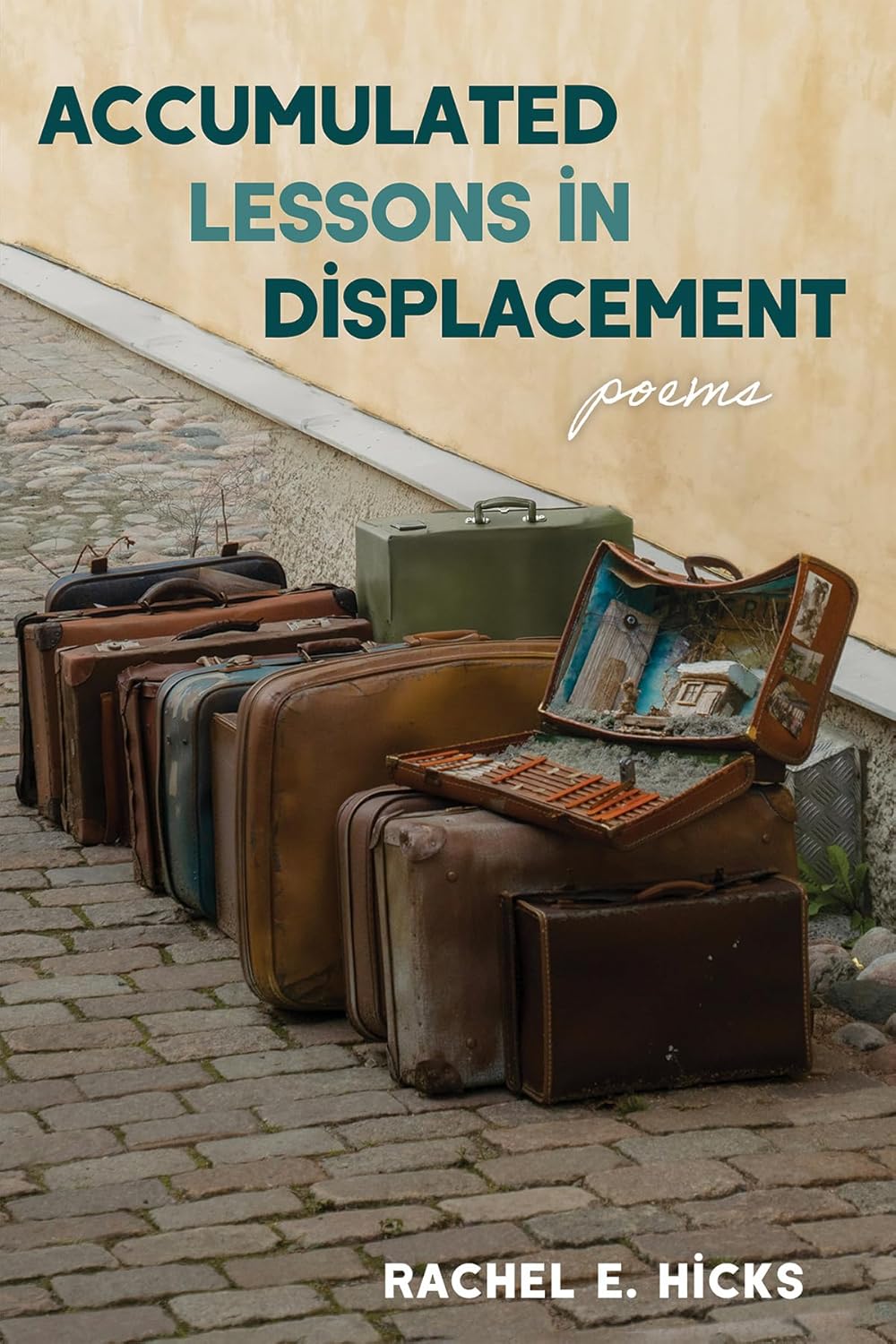
In her debut poetry collection, Accumulated Lessons in Displacement (Wipf & Stock / Resource Publications, 2025), Hicks grapples with the experience of being a “perpetual pilgrim”—on her way to a particular place but also attuned to the significance of each moment along the way. “Pilgrims learn to walk a life of paradox: even though their hearts are set on their final destination, they walk through each day alive to its possibilities, people and lessons,” she wrote in a 2014 blog post.
What is “home”? How can we bear to leave home, whether forced to do so by war, famine, or natural disaster, or we choose to for opportunity or ministry? What do we do with feelings of alienation when we find ourselves in a culture not our own or in which we don’t fit well? How do we live cross-culturally? How do we make a home where we’re at? What are our responsibilities to place? Who is our neighbor?
“I believe that many—all?—of us live our lives with some sense of exile,” Hicks writes on her blog. “We experience it and are aware of it to varying degrees, but it’s there. So many of our quests, our longings, our purpose-seeking, and the stories we create and tell are about trying to find our way home. Home being that place—literal or figurative—in which we feel wholeness and true belonging.”
Accumulated Lessons is divided into two parts: “Bright Sadness, Bitter Joy” and “A Deeper Knowing.” The term “bright sadness”—a translation of the Greek word charmolypê—comes from the Eastern Orthodox tradition, and it describes the paradoxical state of mourning over sin while rejoicing in God’s grace. It can also describe the paradox of living a life of joy amid suffering.
I was trying to learn the word for joy
that settles awkwardly in grief’s nest, an oversized bird. I didn’t want to scare it away.
So says the speaker in the book’s title poem, “Accumulated Lessons in Displacement.” Unfolding over eight sections, this persona poem draws on Hicks’s own experience of abrupt displacement from Kinshasa as a teenager, as well as the experiences of Bosnian refugee friends, and Syrian refugees she had only read about in the news.
It opens with a reflection on “home” in all its ordinariness—the yellow coffee cup, the dusty houseplant, the sunlit window seat—and laments that “no footpath exists leading back to these things,” which, the reader is led to presume, have been destroyed by armed conflict, or its residents blocked from returning by threat of death.
The poem contains several arresting images, like the green threads of a sweater on barbed wire tracing a path across miles. A boy who collects bullet casings to make a necklace for his sister. Charred diary pages dancing around a blown-out living room, “ma[king] a strange poem in my heart.”
Hicks wrestles with the savage violence humans are capable of:
It makes no sense that a soldier can press a button
and somewhere a baby ignites into flame. And he goes home and brushes his teeth.
What we do to each other, to other created souls. Always I carry this burden like a child on my hip.
Another powerful poem in the collection is “Visit to Sarajevo,” where Hicks describes visiting the Bosnian-Herzegovinan capital with her friend Dragan, who was forced to flee it as a young married adult with a child in the 1990s after the city was besieged by Serbian forces. Hicks had met Dragan and his family in 2000 through her husband, Jim, who worked alongside him at a refugee resettlement agency in Phoenix, Arizona, and the families became close. Meeting up years later in Dragan’s hometown, Dragan leads Hicks through the once-familiar streets “in a haze of pride, nostalgia, nightmare,” giving her a tour of sites both historically significant and deeply personal.
Hicks’s passport country too has its national traumas, one of which was precipitated by 9/11, when in 2001, terrorists flew planes into the World Trade Center in New York City, killing almost three thousand people. In “Disaster Chaplaincy Training,” she describes a course she took, taught by a Ground Zero worker, to become further equipped for her work in China, which was focused on disaster preparedness and response. In the course, she learned how to “loiter with intent” in zones of disaster, “acclimat[ing] to [suffering’s] pungency.” Make sure, said the instructor, to “let them see you cupping a small ball / of hope—toss it up, catch it.”
Nationwide crisis struck the US again when on April 12, 2015, a young Black man from Baltimore, Freddie Gray, died of a spinal cord injury while in police custody, allegedly due to police brutality—though none of the six involved officers was ultimately held responsible. Gray’s death led to civil unrest in Baltimore (which Hicks had recently made her home) and throughout the country, as citizens demanded recognition, in word and practice, that “Black lives matter.”
Hicks wrote “The Morning After Freddie Gray’s Funeral” while Baltimore was on lockdown. Fumbling for words, she tries to explain to her children what’s going on as she, too, tries to educate herself more deeply about the history of racism in America and the longstanding grievances of the Black community she lives in. In the poem, she harvests mint from her garden to brew a gallon of black mint tea to share with her neighbor—
as what? An offering, apology?
A way to say I’m trying—learning about all that fuels these fires still smoldering this hushed morning?
The staining of the clear water as the tea steeps becomes a metaphor.
Accumulated Lessons in Displacement addresses global suffering, more localized suffering, as well as personal and family suffering.
One example of the latter has to do with Hicks’s daughter’s diagnosis, following an ankle sprain, with complex regional pain syndrome (CRPS), Ehlers-Danlos syndrome (EDS), and postural orthostatic tachycardia syndrome (POTS), chronic conditions that cause extreme nerve pain. “Bright Sadness” describes a return car ride from a fruitless medical visit, her daughter crying and gasping in agony in the back seat, when offhandedly, Hicks insists, “Turn your cries into opera!” This unexpected and ridiculous suggestion defuses, if for just a moment, the intense situation, resulting in “joy-laughing” amid plaintive contralto tones all the way home.
“Post-Miracle (I)” celebrates her daughter’s miraculous healing, holds the strange, tentative, empty-handed feeling of a fervent prayer request graciously granted. But then comes “Post-Miracle (II),” written when, after two months of her daughter being pain-free, the CRPS returned. Hicks wrestles with gratitude for the brief reprieve and anger at God’s “undoing” the miracle. She wonders about some of the healings Jesus performed in the Gospels, and whether they stuck.
“Post-Miracle (II)” is one of the few poems in the collection with end rhyme, each quatrain following an abba pattern. Perhaps the choice to work with a rhyme scheme for this particular subject represents, consciously or subconsciously, her attempt to make things rhyme again, to harmonize the reality of chronic pain with a good and loving God, to impose structure on the chaos.
Several of Hicks’s poems engage with biblical stories: the Suffering of Job, the Parable of the Prodigal Son, the Massacre of the Innocents, Zacchaeus encountering Jesus, the Walk to Emmaus. She performs poetic midrash, imaginatively interpreting and expanding the texts to connect with them on a deeper level.
Besides the biblical authors, some of her literary conversation partners in this collection are Frederick Buechner, Henri Nouwen, Simone Weil, Czesław Miłosz, Dostoevsky, G. K. Chesterton, Gregory of Nyssa, Paul Kingsnorth, and Karen Blixen.
Although there’s a heaviness to much of the material, it’s not overwhelming, as small graces are woven throughout: complimentary walnuts from a fruit shop owner on a winter Sunday; laughter over language barriers; refreshment from a water hose; the scent of turmeric and cardamom at a Punjab store in Baltimore, reminders of the poet’s birthplace; “the comfort of the priest’s thick thumb / upon my forehead, the signature of / Jesus,” on Ash Wednesday; dandelions and buttercups brushing ankles; a cairn at West Clear Creek; the monks at Great Lavra, Greece, making room for the dispossessed; bundles of sheep ascending limestone slopes at dawn in the Cotswolds; the delightful word cusp; her son’s euphoria upon gliding down a mountain on skis; the slow labor of opening a pomegranate and obtaining its ruby-red seeds for her daughter to eat.
The book is shot through with joy—a joy that coexists with suffering and that is sustained through faith.
“These are poems to live by—to help you stay human, love people, find joy in sorrow, pay attention to the world around you, open yourself to God, welcome mystery, and understand our times at a deeper level,” Hicks wrote in an email announcing the launch of the book. “You’ll journey all around the world and find it—in spite of its sorrow—full of beauty and worth loving.”
One of my favorite poems is “Just Before,” a perfect reading for the upcoming Advent season. It spans four cities of the world—places where people work, play, pray, and rest; places of economic disparity, of spiritual longing as well as mundane concerns—in each imagining the moment just before Jesus returns. In the midst of our threshing corn or lighting a lamp or settling a legal dispute or herding sheep, Jesus will come with a beauty that blossoms all the way out to the horizon, calling all nomads home.
“Just Before” by Rachel E. Hicks
When Jesus comes again in all his glory, somewhere in the Sichuan mountains tires will crackle over corn spread out on the road— easy threshing—while a small child urinates in the gutter, absorbed in watching the car shoot by.
As the first rent opens a fingernail tear in the hazy sky, a woman in the foothills above Rishikesh will lay down her firewood burden and light the clay Diwali lamp in the chilling dusk, circling her cupped hands in blessing.
In the pause before the clamor of heaven’s trumpets, the jurors’ waiting room in Baltimore’s civic court will throb with the quiet turning of pages, a buzzing phone in the hand of a tired man, berating himself for forgetting to bring coffee.
Just before we are aware of him, Jesus will pause to survey the view; two shepherd boys amidst boulders in the Wadi Rum hills south of Amman wipe sleep from their eyes and stand amazed at the blood-red poppies at their feet stretching to the eastern horizon.
Purchase Accumulated Lessons in Displacement here. (Update, 11/14/25: Wipf & Stock is offering a 50% discount through November 30, 2025; use code CONFSHIP at checkout. Media mail shipping is free.)
“Just Before” is reproduced with permission from Wipf and Stock Publishers, www.wipfandstock.com.
DANCE: “I Wanna Be Ready”: The African American spiritual “I Wanna Be Ready” forms the soundtrack to this iconic solo from Alvin Ailey’s contemporary ballet Revelations. The dancer in this first video is Amos Machanic:
In 2018, in honor of the Alvin Ailey American Dance Theater’s sixtieth anniversary, Matthew Rushing, who is currently the company’s interim artistic director, traveled to Ailey’s birthplace of Rogers, Texas, to dance “I Wanna Be Ready” at Mount Olive Baptist Church, one of the few landmarks of Ailey’s childhood that’s still standing in Rogers. He was accompanied live by five local singers. The performance was filmed, edited, and released on YouTube.
I’m so excited that in January, for the first time, I’m going to see AILEY live in New York! The company will be performing three pieces, including the brand-new Sacred Songs, choreographed by Rushing.
+++
SONGS:
>> “Time Is Running Out” by Adoration ’N Prayze: Adoration ’N Prayze was a female gospel quartet from Detroit that was active in the early nineties, consisting of Damita Bass, Marguerita Bass, Pamela Taylor, and Shontae Graham (later replaced by Audra “Dodi” Alexander). This original song is the title track of their first and only album, released in 1991. The live recording is from a concert they gave at Clowes Memorial Hall in Indianapolis in 1992.
>> “Oil in My Vessel,” traditional gospel song performed by Rani Arbo & daisy mayhem: Rani Arbo & daisy mayhem are a New England–based folk quartet made up of Rani Arbo (fiddle, guitar), Andrew Kinsey (bass, banjo, ukulele), Anand Nayak (electric and acoustic guitars), and Scott Kessel (percussion). This song they perform is based on a recording by Joe Thompson (1918–2012), who was raised in a Holiness Church in Alamance County, North Carolina. Thompson said the song was in his church hymnal, and that he learned it from his mom when he was about five years old (in the 1920s). Its refrain is a statement of intent to “be ready when the Bridegroom comes,” and its stanzas are taken from the seventeenth-century hymn “Must Jesus Bear the Cross Alone?” by Thomas Shepherd and, from the eighteenth century, “Amazing Grace” by John Newton.
+++
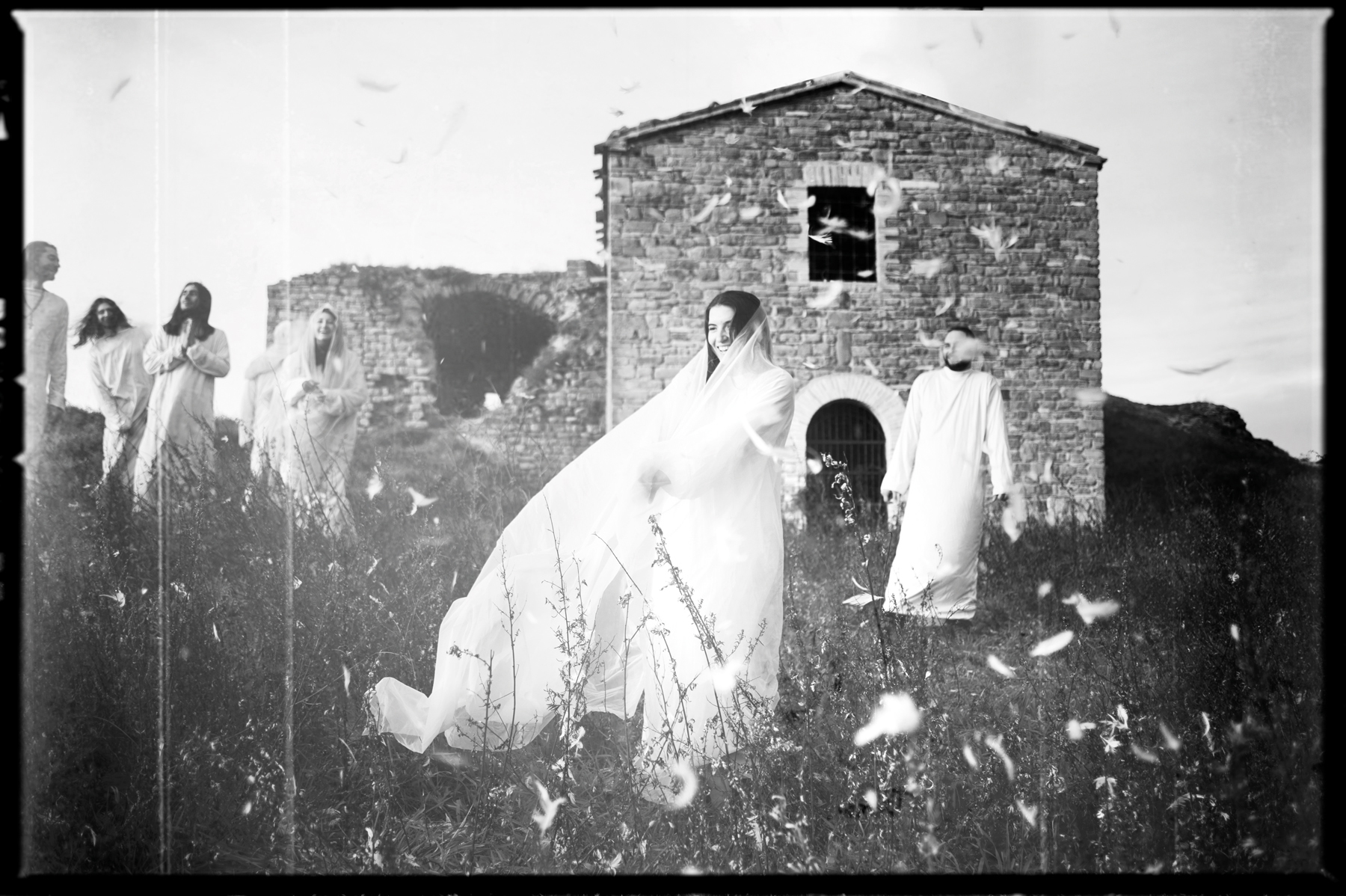
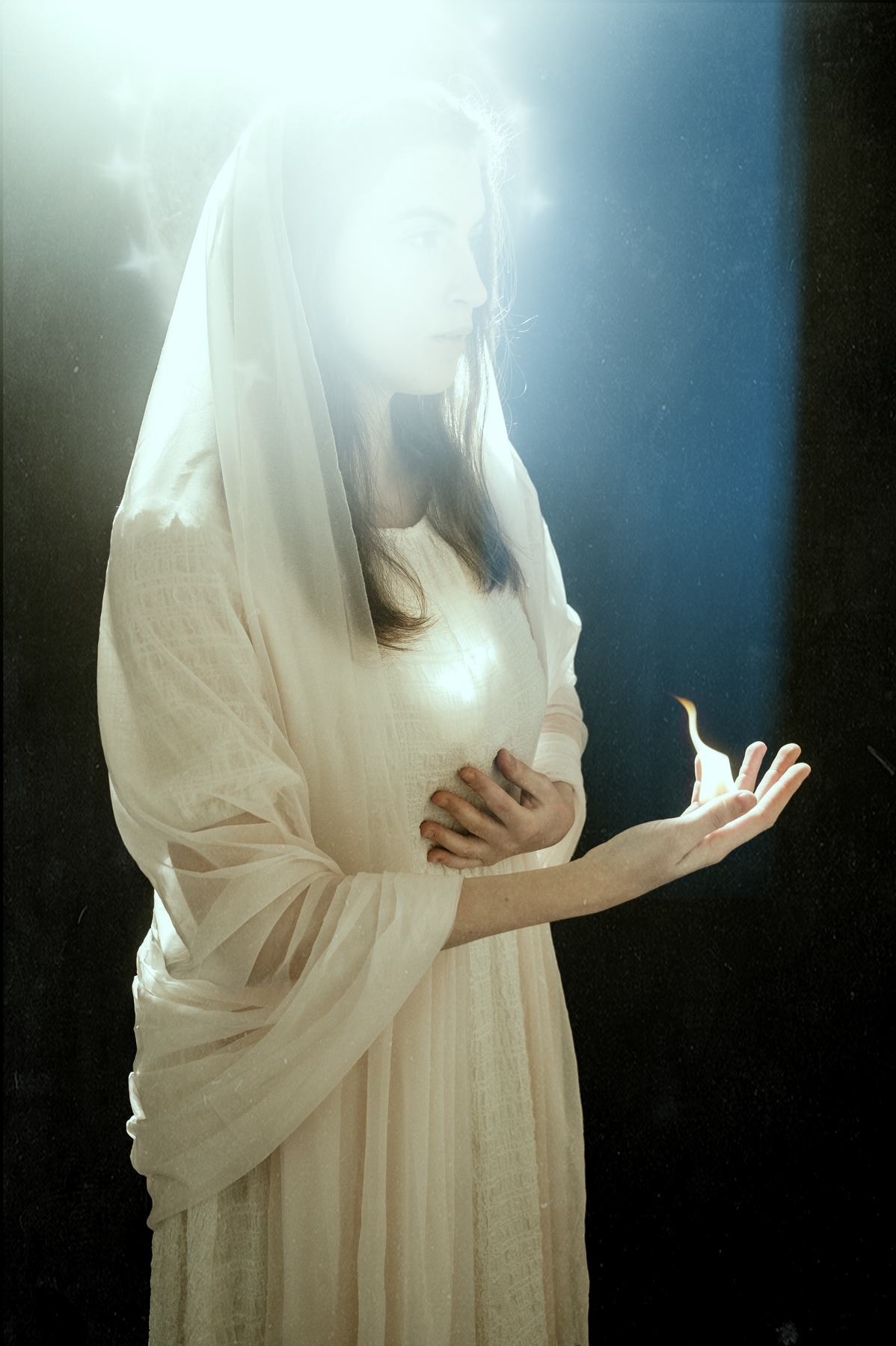
PHOTOGRAPH SERIES: Elogio all’Innocenza (In Praise of Innocence) by Gloria Mancini:Gloria Mancini is an Italian artist working mainly in photography. One of her recent series, divided into three parts, is based on Revelation 3:1–6 (Gli Innocenti, or The Innocents), 12:1 (La Donna Vestita di Sole, or The Woman Clothed with the Sun), and 5:1–7 (L’Agnello, or The Lamb). “Becoming small to become great has been the aim of my exploration of the Book of Revelation,” she writes in her artist’s statement. “Inspired by the visionary and magnetic power of the Kyrios (the Christ, the Lamb), I chose to focus my reflection on innocence as a fundamental and revolutionary value of being, reaffirming its virtue.” She says she is compelled by how in Revelation, it is a meek and vulnerable lamb who defeats evil.
Jesus’s message to the church in Sardis, a wealthy city in west-central Asia Minor, is so seldom (or not at all?) visualized in art history—I’m grateful to Mancini for drawing attention to this passage through her thoughtful work! Jesus tells the church to “wake up,” to “remember . . . what you received and heard; obey it and repent,” following the example of the few there “who have not soiled their clothes.” Those people, he says, “will walk with me, dressed in white, for they are worthy.” He admonishes the Sardis Christians to be watchful and to strengthen and perfect their good works so that they might conquer evil and their names be preserved in the book of life.
Mancini pictures the faithful remnant at Sardis praying, keeping watch, persevering in purity, and gamboling about in the life of the Spirit.
Gloria Mancini (Italian, 1992–), photograph from the Elogio all’Innocenza series, 2023Gloria Mancini (Italian, 1992–), photograph from the Elogio all’Innocenza series, 2023
The Woman Clothed with the Sun from Revelation 12, on the other hand, is widely represented in art, and since the twelfth century has been associated with the Virgin Mary, because the woman gives birth to a son who is pursued by the Dragon. In church tradition Mary is also likened to the burning bush in Exodus, because she bore the fire of divinity—God in Christ—within her but was not consumed. Mancini plays on both associations, showing Mary cautiously holding a flame, bringing it closer to her breast: she accepts the Incarnation and is set alight.
Gloria Mancini (Italian, 1992–), photograph from the Elogio all’Innocenza series, 2023
+++
ART SPOTLIGHT: “Yellow Silence: Miniature from the Silos Apocalypse (ca. 1100),”Public Domain Review: One of the most dramatic pauses in scripture comes about a third of the way through the book of Revelation. John has just described the nations’ loud and jubilant praises around the throne of God, and then he opens the next chapter, “When the Lamb broke the seventh seal, there was silence in heaven for about half an hour” (Rev. 8:1). This is the calm before the next storm of judgment breaks with the blowing of the seven trumpets, through which God purges the earth of evil.
While artists have historically relished the chance to visualize the rain of blood, fire, locusts, and such initiated by the trumpet blasts, the anonymous artist of a twelfth-century copy of an Apocalypse commentary from Spain saw fit to also visualize the sonic absence that preceded these spectacular occurrences. He did so with a rectangular swath of yellow.
Miniature from the Silos Apocalypse, northern Spain, 1091–1109. British Library, Add MS 11695, fol. 125v.
This swath calls readers to somber, speechless awe and reflection. God’s earlier word spoken to and through the prophet Zephaniah is appropriate here: “Be silent before the Sovereign LORD, for the day of the LORD is near” (Zeph. 1:7).
Click here to browse more images from the Silos Apocalypse.
To him who loves us and freed us from our sins by his blood and made us a kingdom, priests serving his God and Father, to him be glory and dominion forever and ever. Amen.
Look! He is coming with the clouds; every eye will see him, even those who pierced him, and all the tribes of the earth will wail on account of him.
So it is to be. Amen.
—Revelation 1:5b–7
LOOK: The Last Judgment by Jan van Eyck
Jan van Eyck (Netherlandish, ca. 1390–1441), The Last Judgment, ca. 1436–38. Oil on canvas, transferred from wood, 22 1/4 × 7 2/3 in. (56.5 × 19.7 cm). Metropolitan Museum of Art, New York.
What is your reaction to this image? Terror? Awe? Gratitude? Disgust? Intrigue? Indifference?
I’m often repulsed by how the Last Judgment was interpreted by medieval and Renaissance artists, with graphic displays of torture intending to compel people to righteous living through fear. To be sure, the subject has made for some truly remarkable paintings, full of fantastical grotesqueries and masterfully executed—like this one—but I worry that the scare tactics such paintings use are not helpful and are even harmful.
Nonetheless, the Last Judgment is an unavoidable topic in scripture. The Bible refers several times to God as judge and describes a final accounting of sin upon Christ’s return, resulting in reward for the righteous and punishment for the unrighteous. It’s also in our creeds: “He [Jesus Christ] will come again to judge the living and the dead” (see 2 Tim. 4:1; 1 Pet. 4:5). Those who seek to be faithful to scripture must reckon with the idea of the Last Judgment. Advent, which is penitential in character, has historically been a period for the church to do that. As the Episcopal priest and author Fleming Rutledge points out in her published collection of Advent sermons, judgment is one of the four traditional themes of the season—the other three being death, heaven, and hell.
The early Northern Renaissance master Jan van Eyck’s Last Judgment from ca. 1436–38 is one of history’s most famous and most gruesome. “The diabolical inventions of Bosch and Brueghel,” writes art historian Bryson Burroughs, “are children’s boggy lands compared to the horrors of the hell [van Eyck] has imagined.”
The midground portrays the resurrection of the dead, who rise up out of their graves on land or at sea to be judged by Christ. One of the inscriptions on the frame is Revelation 20:13: “And the sea gave up the dead which were in it; and death and hell delivered up the dead which were in them: and they were judged every man according to their works.”
In the center Saint Michael the Archangel, dressed in his jewel-studded armor and with sword unsheathed, stands atop the giant batlike wings of Death personified, which are inscribed with the words CHAOS MAGNVM (“great chaos”) and UMBRA MORTIS (“shadow of death”). Death is a skeletal figure who excretes the damned through his bowels into hell’s dark slime, where bestial demons tear at, choke, devour, crush, and impale them. One man’s legs are being ripped apart at the anus.
Even kings and clergymen are part of the tragic death-heap—see the bishop’s miter, the cardinal’s galero, the royal crown. Not all who say, “Lord, Lord,” will enter heaven (Matt. 7:21); even the most outwardly pious will have their sins exposed on the last day, and those who prove to be hypocrites, who have harmed others and shamed God without repentance, will be thrown into the pit.
Shooting down like arrows into this pit is the double inscription ITE VOS MALEDICTI IN IGNEM ETERNAM (“Go, ye cursed, into everlasting fire”), taken from Matthew 25:41. And Deuteronomy 32:23–24, a warning from God via Moses to the people of God in their disobedience, is one of the inscriptions on the frame:
I will heap mischiefs upon them; I will spend mine arrows upon them. They shall be burnt with hunger, and devoured with burning heat, and with bitter destruction: I will also send the teeth of beasts upon them, with the poison of serpents of the dust.
Perhaps your chest is tightening right now, your stomach churning. How does this picture cohere with the God of love and mercy?
Look up.
See Jesus Christ, the Son of Man, coming in glory. See his glowing stigmata, beacons of love and mercy. He is dressed in a long, red, open mantle and is barefoot, revealing all five wounds. All around him, angels bear the instruments of his passion: the cross, the three nails, the crown of thorns, the lance, the sponge-tipped reed. See him flanked by all the ranks of the redeemed, including, on a larger scale, the Virgin Mary and John the Baptist, the first two witnesses of Jesus’s divinity.
VENITE BENEDICTI PATRIS MEI, read the inscriptions fanning out from Christ’s elbows: “Come, ye blessed of my Father” (Matt. 25:34). This good word is taken from Jesus’s parable of the sheep and the goats, in which he teaches that those who feed the hungry, clothe the naked, shelter the immigrant, care for the sick, and visit the imprisoned will be honored by God on the last day.
Another benediction is inscribed on the picture’s frame:
And I heard a loud voice from the throne saying,
“See, the home of God is among mortals. He will dwell with them; they will be his peoples, and God himself will be with them and be their God; he will wipe every tear from their eyes. Death will be no more; mourning and crying and pain will be no more, for the first things have passed away.” (Rev. 21:3–4 NRSV)
Van Eyck’s Last Judgment does not stand alone. For centuries it has been configured as a diptych (two-paneled artwork) with a Crucifixion on the left and is thus intended to be read in light of God’s supreme act of vulnerable love and self-giving:
Jan van Eyck (Netherlandish, ca. 1390–1441), The Crucifixion; The Last Judgment (with recently conserved frame), ca. 1436–38. Oil on canvas, transferred from wood, each panel 22 1/4 × 7 2/3 in. (56.5 × 19.7 cm). Metropolitan Museum of Art, New York.
Originally these two paintings very likely served as the wings of a triptych with a painted or sculpted centerpiece, or as the doors to a tabernacle or reliquary shrine. In 2019 the Metropolitan Museum of Art had the frames restored from their modern brass color to their original red.
So, what are we to make of this image today? Is there value in meditating on it?
I’ve presented it here, so I think it’s definitely worth knowing about. It’s a stunning art object that gives us a glimpse into the religious imagination of late medieval Christians. But I would also advise caution, especially to those who have been traumatized by hell teachings in the past. While Christians are called to cultivate a holy fear of God, a soberness around the weight of our sin and the power of God’s justice, this fear is not supposed to be the kind of fear that induces anxiety or paralyzes. That kind of fear will never lead us to love God.
We are never meant to think on hell apart from the grace Christ extends to us with his pierced and outstretched hands, which plead our case before God. Van Eyck holds both together in this painting, but the more visually immersive bottom half seems to indulge some pretty sick fantasies that could well generate an unhealthy fear of God if one were to stay stuck there, not to mention create the false impression that God is monstrously vindictive.
There is debate within Christianity, and has been since the patristic era, whether Jesus’s justice is merely punitive or ultimately restorative—that is, whether hell is a place of eternal conscious torment or a place where one is purged of evil and that will in the end be emptied. (There is biblical support for both views, which I won’t get into here.) There is also disagreement as to whether the Bible’s language about hell, such as its being a place of “fire” and “brimstone” (sulfur) (e.g., Rev. 21:8), is meant to be taken literally or figuratively.
Whatever the duration, physical nature, and ultimate purpose of hell, I want to emphasize that biblical passages about the Last Judgment ought not drive us to despair; they should drive us into the arms of Christ, who receives into his presence all those who trust in his merits and turn from their wickedness. The wounds that Christ so prominently displays in van Eyck’s painting are tokens of divine forgiveness as well as a model of the kind of selfless love we are to follow, a love vulnerable enough to receive injury but never to inflict it. Those who tumble into the depths of the underworld to be ravaged by externalizations of their own destructive evils have rejected the call to “do justice, love mercy, and walk humbly with [their] God” (Mic. 6:8). Many of them are ones who on earth bore much power but used it to abuse others or were neglectful.
For more on the characterization of Jesus as judge in the art and theology of the Middle Ages (whose influence was felt in the Renaissance and later eras), see chapter 2, “The Judge,” of Jesus through Medieval Eyes by Grace Hamman. “The promise of answering unanswered evil, acknowledging the recognized and unrecognized wrongs of the mortal world—everlasting justice and compassion—is ultimately what Christ the Judge signifies. It’s a promise, a prophecy, and a call for action now,” Hamman writes (28). She discusses how neighborliness and fear of God are twinned: “Am I seeing the immortal being, the image of God, Jesus himself, in every person I encounter?” medieval imagery prompted viewers to ask (37). “Jesus the Judge reminds us of our divine community and invites a fear that guides us to love our neighbor as we love ourselves. . . . Fear of Jesus the Judge becomes a gift for our practice of justice, in the radiant light of his justice. Such a fear softens flinty hearts” (21, 36). In the chapter Hamman does also acknowledge the complications and misuses of fear in the medieval church and its legacy today.
I urge you to consider the van Eyck diptych in light of the retuned hymn below as you meditate on Christ’s return and his role as judge.
LISTEN: “Lo! He Comes with Clouds Descending” | Words by Charles Wesley, 1758 | Music by Thomas Vito Aiuto, 2012 | Performed by the Welcome Wagon on Precious Remedies Against Satan’s Devices, 2012
Lo! he comes with clouds descending, once for favored sinners slain; thousand, thousand saints attending swell the triumph of his train.
Ev’ry eye shall now behold him, robed in dreadful majesty; those who set at naught and sold him, pierced, and nailed him to the tree, deeply wailing, deeply wailing, shall the true Messiah see.
Ev’ry island, sea, and mountain, heav’n and earth, shall flee away; all who hate him must, confounded, hear the trump proclaim the day: Come to judgment, come to judgment! Come to judgment, come away! Alleluia, alleluia! God appears on earth to reign.
The dear tokens of his passion Still his dazzling body bears, Cause of endless exultation To his ransomed worshippers. With what rapture, with what rapture Gaze we on those glorious scars! Alleluia, alleluia! God appears on earth to reign.
Yea, amen! Let all adore thee, high on thine eternal throne; Savior, take the pow’r and glory, claim the kingdom for thine own. O come quickly, O come quickly; everlasting God, come down. O come quickly, O come quickly; everlasting God, come down. O come quickly, O come quickly; everlasting God, come down.
I’m struck by the bright, celebratory, homey tone of the new tune Rev. Vito Aiuto gave this old Wesley hymn about Christ’s second coming. One might expect, with its verses about judgment, to have a dark or foreboding tone. But for those who are in Christ, his return, and even the day of judgment, will be an occasion of rejoicing!
Note that “dreadful” here is used in the archaic sense of inspiring awe or reverence.
This post is part of a daily Advent series from December 2 to 24, 2023 (with Christmas to follow through January 6, 2024). View all the posts here, and the accompanying Spotify playlist here.
Larain Briggs (British, 1960–), Alpha and Omega, 2019. Oil over acrylic underpainting on stretched canvas, 100 × 100 cm.
“Behold, I am coming soon. . . . I am the Alpha and the Omega, the first and the last, the beginning and the end.”
—Revelation 22:12–13
This apocalyptic landscape painting by British artist Larain Briggs was on display at London’s gallery@oxo as part of the 2021 Chaiya Art Awards exhibition “God Is . . .” Briggs’s creative practice is centered on Jungian theory, and in Alpha and Omega she addresses the current “metacrisis,” the complexity of global issues (ecological, cultural, economic, etc.) that interrelate and present an existential threat of unknown magnitude. “The archetypal imagery in the book of Revelation offers the means to understand and process the dark times in which we live,” Briggs told me.
In the exhibition catalog Briggs explains, “Although I perceived the painting to be a vision of the end, it is full of light and hope. The end can equally be viewed as a beginning.”
When I saw this work, I was intrigued. Its title evokes Jesus’s self-declaration in the book of Revelation as the first and the last, and visually, it appears that something significant is in process.
In the center of the composition a faint circular form rests on a heavily textured, curved platform of cloud and smoke (“Behold, he is coming with the clouds . . .” [Rev. 1:7]). At this focal point, turbulence resolves into tranquility and darkness gives way to light. I see the image as the earth being transfigured by the arrival of the King.
The body of water at the bottom may be a reference to the “sea of glass mingled with fire” in Revelation 15:2.
LISTEN: “The King Shall Come” | Words by John Brownlie, based on miscellaneous Greek sources, 1907 | Music: American folk tune from Kentucky Harmony, 1816; arr. Minna Choi, 2020 | Performed by Tiffany Austin, 2020
The King shall come when morning dawns And light triumphant breaks; When beauty gilds the eastern hills And life to joy awakes.
Not as of old, a little child To bear, and fight, and die, But crowned with glory like the sun That lights the morning sky.
O brighter than the rising morn, When He victorious rose, And left the lonesome place of death, Despite the rage of foes;—
O brighter than that glorious morn Shall this fair morning be, When Christ, our King, in beauty comes, And we His face shall see.
The King shall come when morning dawns And earth’s dark night is past;— O haste the rising of that morn, That day that aye shall last.
And let the endless bliss begin, By weary saints foretold, When right shall triumph over wrong, And truth shall be extolled.
The King shall come when morning dawns, And light and beauty brings;— Hail! Christ the Lord; Thy people pray, ‘Come quickly, King of kings.’
“The King Shall Come” expresses hopeful longing for the return of Christ, which will bring about a new and lasting morn and the final passing of “earth’s dark night.” Stanza 2 contrasts Jesus’s first coming in suffering and struggle and sacrifice, his glory mostly veiled, with his second, when his glory will be unmistakable, his rule uncontested. The victory of that day, the hymnist writes, will be even more exhilarating than that of Christ’s resurrection, because it is total.
This hymn was written in the early twentieth century by the Scottish Presbyterian minister John Brownlie (1859–1925), who cites inspiration from the hymns of the Greek Orthodox Church. It was originally published in 1907 in Hymns from the East. In the introduction Brownlie writes, “The hymns are less translations or renderings, and more centos and suggestions. . . . The Greek has been used as a basis, a theme, a motive.” He differentiates this approach from that used in his previous volumes, which contain “truthfully rendered translations from the originals.”
Though the hymn is often attributed to an anonymous ancient Greek writer, most scholars consider it an original text by Brownlie that reflects his wide knowledge of Greek hymnody, as no Greek original has ever been found. It’s possible that the lines are a composite and expansion of fragments found in the Greek, but really, it’s a pastiche that nods to the centrality of light in Orthodox theology.
This wistful arrangement by City Church San Francisco worship arts assistant Minna Choi is performed by guest artist Tiffany Austin, a Bay Area jazz vocalist. The other musicians are Adam Shulman on piano, Jeff Marrs on drums, Jason Muscat on bass, and Wil Blades on organ. Their version omits stanzas 5–6, as do several hymnals.
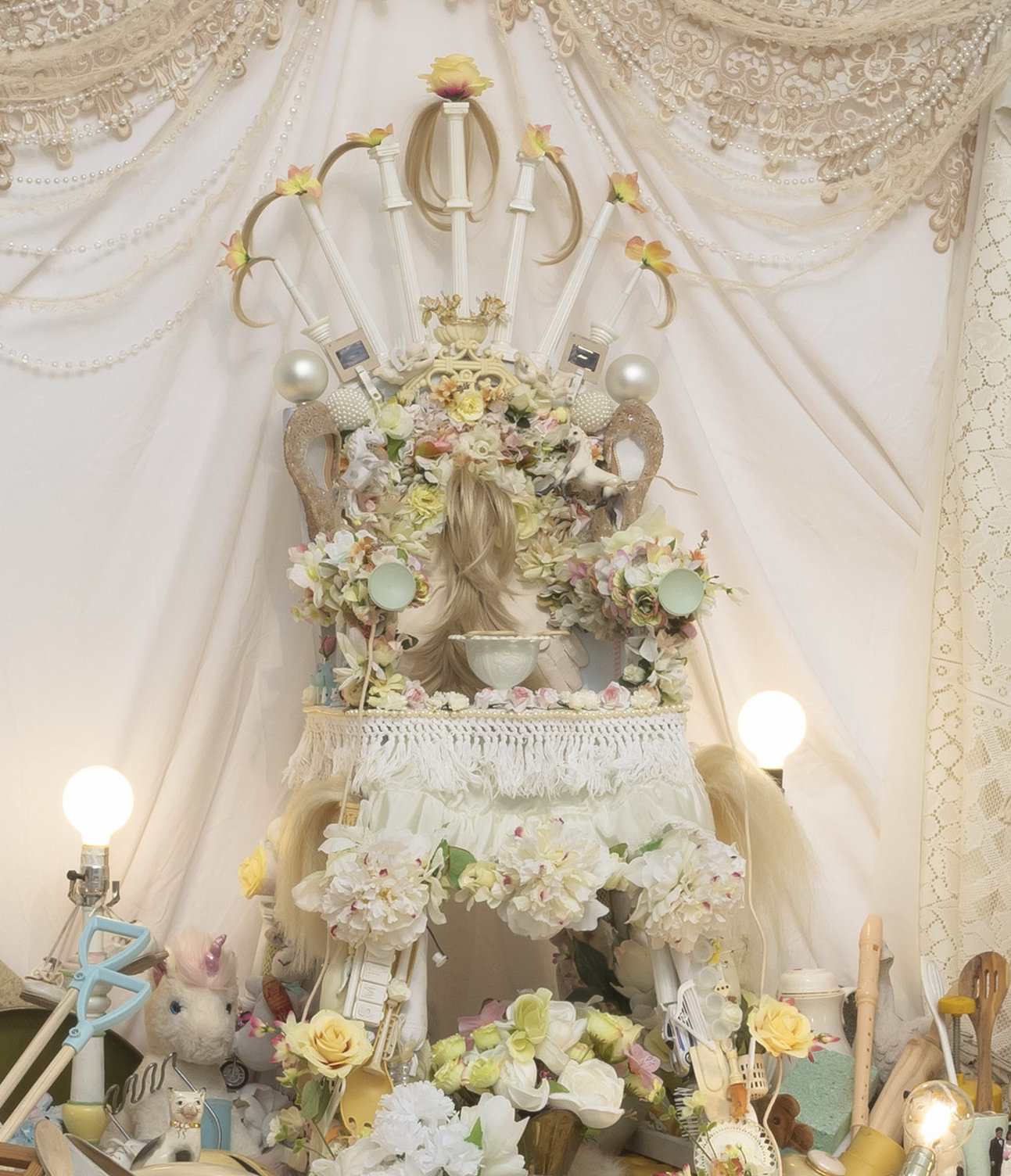
LOOK: Dim Gold (Feast of Brides) by Mandy Cano Villalobos
Mandy Cano Villalobos (American, 1979–), Dim Gold (Feast of Brides), 2022. Miscellaneous found objects, dimensions variable. Installation at Bridge Projects, Los Angeles. Photo courtesy of the artist.
Mandy Cano Villalobos is an interdisciplinary artist whose projects span installation, painting, drawing, performance, sculpture, and video. She lives in Grand Rapids, Michigan.
Drawing on the archetype of the waiting bride, the found-object installation Dim Gold (Feast of Brides) was commissioned by Bridge Projects for Here After, an exhibition exploring humanity’s hope for paradise. The artist writes,
Dim Gold is an allegory of marital covenant, bodily death, and the hope of love’s consummation in afterlife. The throne heap consists of discarded clothing, broken appliances, old lamps, unwanted toys, bruised furniture, fake flowers, stained curtains, human and synthetic hair, scratched glasses, deflated soccer balls, faded photographs, worn shoes, chipped figurines, kitchen utensils, costume jewelry, yellowed wedding decorations, cracked dishes, Christmas ornaments, mildewed books, and bathtub plugs.
From baby bottles and children’s playthings to a cane and a pillbox, the pile contains a life. (In fact, Cano Villalobos said she acquired most of the items from an old woman’s estate sale.) It’s a full life, but one of brokenness and decay. There is no permanence in this world. The otherworld—the new heaven, the new earth (a transfigured thisworld)—is what endures.
The Dim Gold construction is throne-like, all its components leaning in toward a central chair topped by seven white, ribbed shafts that fan out and that are suggestive, with the flame-colored flowers at the terminals, of a menorah. Lace, silk, and draped strings of pearls form the throne’s backing. With its dressed but empty seat that calls forth a presence, the piece evokes the hetoimasia (prepared throne of the second coming) of Eastern Orthodox icons.
The scattered, lit bulbs on shadeless lampstands allude to the burning oil lamps in Jesus’s parable of the ten bridesmaids (Matt. 25:1–13), which signify readiness for the Bridegroom’s return.
Cano Villalobos combines earthly and heavenly imagery in Dim Gold, an Advent ensemble that pictures the church-as-bride’s waiting with lights on, amid the ephemera of this life, for her groom to come take her home, where an eternal feast is spread in bright, delicious glory, and the two of them will become one at last.
LISTEN: “When the Bridegroom Comes”| Words by David Omer Bearden, 1973 | Music by Judee Sill, 1973 | Performed by Judee Sill on Heart Food, 1973
See the bride and the Spirit are one. Then won’t you who are thirsty invite him to come? With your door open wide, Won’t you listen in the dark for the midnight cry? And see, when your light is on, that the Bridegroom comes.
Into cold outer darkness are gone Guests who would not their own wedding garment put on. Though the chosen are few, Won’t you tarry by your lamp till he calls for you? And pray that your love endure till the Bridegroom comes.
When the halt and the lame meet the Son, And he sees for the blind and he speaks for the dumb, Let their poor hearts’ complaint, Like the leper turned around who has kissed the saint, Lift like a trumpet shout, and the Bridegroom come.
See the builders despising the stone, See the pearl of great price and the dry desert bones. By the Pharisees cursed, Be exultant with the rose when the last are first, And see how his mercy shines as the Bridegroom comes.
Hear the bride and the Spirit say, “Come!” Then won’t you who are weary invite in the Son? When your heart’s love is high, Won’t you hasten to the place where the hour is nigh? And see that your light is on, for the Bridegroom comes. See that your light is on, for the Bridegroom comes.
Judee Sill (1944–1979) was an American singer-songwriter whose genre of music Rolling Stone refers to as “mystic Christian folk.” Themes of temptation, rapture, redemption, and the search for higher meaning permeate her work.
Sill survived ongoing physical and verbal abuse in childhood from her mother and stepfather. As a teenager, she committed a series of armed robberies that landed her in reform school, where she learned to play the organ for church and became interested in gospel music. Upon her release, after briefly attending a junior college and working in a piano bar, she got caught up in the California drug culture, developing a crippling heroin addiction and resorting to prostitution and check forgery to fund it.
While she was serving a prison sentence for narcotics and forgery offenses, her only sibling, Dennis, died of an illness, and she was devastated. But this seems to have given her the impetus to pursue a career in songwriting and performing. She gigged in clubs around Los Angeles while living in a Cadillac, and she was eventually signed by the new Asylum Records. Graham Nash (of Crosby, Stills, Nash & Young) produced her first single, “Jesus Was a Cross Maker.” Her two albums, Judee Sill (1971) and Heart Food (1973), received some acclaim but failed to chart. Discouraged, and suffering back pain from a car accident and later a fall, she returned to hard drugs. She died of a cocaine and codeine overdose at age thirty-five.
Why do I rehearse Sill’s turbulent biography? Because songs don’t come out of a vacuum. The longing in “When the Bridegroom Comes”—those piano chords, that voice—is real. Her thirst, her questing, her waiting and hoping. Though she herself didn’t write the lyrics (David Omer Bearden, her romantic partner at the time, did, though she likely gave input), she sings them with fervency, makes them her prayer.
The song melds together the parable of the ten bridesmaids from Matthew 25 with the bridal theology of Revelation. In one, which has more of an individual focus, we are put in the place of the bride’s attendants and warned to be prepared for the imminent wedding celebration, lest we get locked out in the dark; in the other, Christ’s church as a collective is likened to the bride herself, eagerly anticipating the arrival of her groom and the sweet union that will follow.
The song’s primary referent is Revelation 22:17, from the final chapter of the Bible:
The Spirit and the bride say, “Come.” And let everyone who hears say, “Come.” And let everyone who is thirsty come. Let anyone who wishes take the water of life as a gift.
In this verse, the voice of the bride (the church) through whom the Spirit speaks calls out, “Come.” Because of the interchange of speakers and subjects in the broader passage, it’s unclear whether the addressee of this imperative is Christ or the masses. The church could be crying out for Jesus’s return, as they do in verse 20, or they could be inviting people far and wide to the gospel feast, bidding them come and eat. I think the latter, which would make it continuous with the third and fourth lines, but it could really go either way. Because as sure as there’s the final coming of Christ to the world, there’s also the coming of the world to Christ. He comes to us, and we come to him.
Sill’s whole song is full of biblical references—Jesus’s healing ministry, Jesus as the rejected cornerstone (Matt. 21:42), Jesus as the pearl of great price (Matt. 13:45–46), the Spirit breathing life into dry bones (Ezek. 37:1–14), Jesus’s upside-down kingdom in which the last are first and the first are last (Matt. 19:30). It celebrates divine mercy and grace and encourages us to respond in the affirmative to Christ’s wedding invitation, and to persevere in love while he tarries.
“There will be signs in the sun, the moon, and the stars, and on the earth distress among nations confused by the roaring of the sea and the waves. People will faint from fear and foreboding of what is coming upon the world, for the powers of the heavens will be shaken. Then they will see ‘the Son of Man coming in a cloud’ with power and great glory. Now when these things begin to take place, stand up and raise your heads, because your redemption is drawing near.”
Then he told them a parable: “Look at the fig tree and all the trees; as soon as they sprout leaves you can see for yourselves and know that summer is already near. So also, when you see these things taking place, you know that the kingdom of God is near. Truly I tell you, this generation will not pass away until all things have taken place. Heaven and earth will pass away, but my words will not pass away.
“Be on guard so that your hearts are not weighed down with dissipation and drunkenness and the worries of this life, and that day does not catch you unexpectedly, like a trap. For it will come upon all who live on the face of the whole earth. Be alert at all times, praying that you may have the strength to escape all these things that will take place, and to stand before the Son of Man.”
—Luke 21:25–36
LOOK: Country Gospel Music by Robert Gwathmey
Robert Gwathmey (American, 1903–1988), Country Gospel Music, 1971. Oil on canvas, 40 × 50 in. Private collection.
LISTEN: “I Believe in Being Ready” | Appalachian spiritual, 19th century | Performed by Rising Appalachia on Leylines (2019) [see also this performance at the Yuba River in Northern California]
I believe in being ready I believe in being ready I believe in being ready For the time is drawing near
Brothers, sisters, please get ready Brothers, sisters, please get ready Brothers, sisters, please get ready For the time is drawing near
Oh there’ll be signs and wonders Oh there’ll be signs and wonders Oh there’ll be signs and wonders For the time is drawing near
We’ll turn round and just start over We’ll turn round and just start over We’ll turn round and just start over For the time is drawing near
I believe in being ready I believe in being ready I believe in being ready For the time is drawing near
I believe in being ready I believe in being ready I believe in being ready For the time is drawing near
For the time is drawing near For the time is drawing near
Whereas the Great Awakening may have brought about the first American break from established religious musical form, the Second Awakening and the rise of evangelical religious fervor, mostly in the Pennsylvania backcountry and southern mountains, left us with the spiritual folk songs, or folk hymns, that have a lingering legacy in West Virginia. This musical form developed during the period from the 1780s to the 1830s. The camp meeting was an old-world form brought by the Scots-Irish to America. The new spirituals that developed along with this form of worship on the frontier directly contributed to the religious fervor generated through the camp meeting.
“One might well remember, for example, that the camp meetings began and remained in nature surroundings, in the wilderness,” wrote [George Pullen] Jackson. Camp meetings in America (also called bush meetings, field meetings, and, today, brush-arbor revival or tent meetings) spawned a new emotion which materialized in song as the spiritual. At this point the chorus was introduced to the songs and became an identifying mark.
Choruses were repetitive, and verses were simplified for easy memorization by illiterate participants and where songbooks were nonexistent. Often only the introduction of a new person, as in mother, father, sister, and brother, differentiated one verse from another. Additional verses suggest more people such as sinner, preacher, playmates, etc. But it is the music—the old folk tunes clinging to all the sensitive and moving traits that attract many to folk music—that has caught the attention and held the fancy of West Virginians for as long as two centuries. These folk hymns are the predecessors to the “gospel hymns” that began about 1870 in the Protestant churches and continue to be sung today.
The song is more commonly called “When This World Comes to an End” and has been recorded under that title in this millennium by, for example, Tim O’Brien, Ashley Cleveland, and David Powell. We know of it thanks to Maggie Hammons Parker (1899–1987) from Pocahontas County, West Virginia, whose family participated in camp meetings in the early twentieth century. Parker sang the song as she remembers it for Alan Jabbour on a 1970 field recording, with the following lyrics. For more information, see the 1973 American Folklife Center publication The Hammons Family: A Study of a West Virginia Family’s Traditions.
I believe in being ready, I believe in a-being ready, I believe in being ready, When this world comes to an end.
Oh, sinners, do get ready, Oh, sinners, do get ready, Oh, sinners, do get ready, For the times is a-drewing near.
Oh, there’ll be signs and wonders, Yes, there’ll be signs and wonders, Oh, there’ll be signs and wonders, When this world is to an end.
Oh, the sun, she will be darkened, Yes, the sun, she will be darkened, Oh, the sun she will be darkened, When this world is to an end.
Oh, the moon, she will be a-bleeding, Yes, the moon, she will be bleeding, Oh, the moon, she will be bleeding, When this world is to an end.
I believe in a-being ready, I believe in being ready, I believe in being ready, When this world is to an end.
Oh, the stars, they’ll all be a-falling, Yes, the stars will all be falling, Oh, the stars will all be falling, When this world is to an end.
Oh, sisters, do get ready, Oh, sisters, do get ready, Oh, sisters, do get ready, For the times is a-drewing near.
Oh, fathers, do get ready, Yes, fathers, do get ready, Oh, fathers, do get ready, When this world is to an end.
Oh, mothers, do get ready, Yes, mothers, do get ready, Oh, mothers, do get ready, For the times is a-drewing near.
For there’ll be them signs and wonders, Yes, there’ll be them signs and wonders, There will be them signs and wonders, When this world comes to an end.
For their 2019 recording of the song, the band Rising Appalachia adapted the lyrics and retitled the song after its first line. “Drawn to its haunting, modal melody and stark lyrics,” they write, “we put the heavy drum pulse of the bodhran behind it to rattle the ribcage. It is both apocalyptic and soothing to call forth and sing these words.”
Rising Appalachia was founded in 2004 by sisters Leah and Chloe Smith, who grew up in Atlanta, absorbing the city’s emerging hip-hop scene as well as traveling with their family to fiddle camps across the Southeast on weekends. Their music is a blend of folk, world, and urban. “Rising Appalachia has come out of this idea that we can take these traditions of southern music—that we’ve been born and raised with—and we can rise out of them, creating all these different bridges between cultures and stories to make them feel alive,” Leah says. “Our music has its foundation in heritage and tradition, but we’re creating a music that also feels reflective of the times right now. That’s always been our work.”
The Smiths are joined on the album Leylines by longtime band members David Brown (upright bass, baritone guitar) and Biko Casini (world percussion, n’goni) and by two new members: West African musician Arouna Diarra (n’goni, talking drum) and Irish musician Duncan Wickel (fiddle, cello). Special guests on the album include singer-songwriters Ani DiFranco and Trevor Hall and jazz trumpeter Maurice Turner.



.jpg)




 Art & Theology