
Roundup: Kristin Asbjørnsen interprets the spirituals, photos from Skid Row, and more

SPOTIFY PLAYLIST: July 2023 (Art & Theology): This month’s Spotify mix that I put together for you all includes a Shona worship song from Zimbabwe; “Adonai Is for Me,” a song in Hebrew by Shai Sol; a Black gospel rendition of the children’s classic “Jesus Loves Me”; a new setting of the Lord’s Prayer by Jon Guerra; a composition for clarinet and piano by Jessie Montgomery, written in April 2020 to try to make peace with the sadness brought about by the pandemic-prompted quarantine orders; a country-style setting of Psalm 121 by Julie Lee; and a benediction by Bob Dylan that I heard Leslie Odom Jr. sing in concert recently—its refrain, “May you stay forever young,” is not an anti-aging wish but rather a call to childlike faith, wonder, and curiosity in perpetuity.

The playlist also includes the following two songs.

>> “Come Go with Me”: A lesser-known African American spiritual performed by the Norwegian jazz singer-songwriter Kristin Asbjørnsen, from her excellent album Wayfaring Stranger: A Spiritual Songbook. She describes the spirituals as “existential expressions of life: songs of longing, mourning, struggling, loneliness, hopefulness and joyful travelling.” This particular one is about walking that pilgrim path to heaven, a path on which Satan lays stones to obstruct our progress but which Jesus, our “bosom friend,” clears away.

>> “Love, More Love”: A short Shaker hymn that opens with a common Shaker greeting: “More love!” “Our parents above” refers, I believe, to the elders of the faith who have passed on. The hymn uses horticultural imagery to describe the qualities of communal love—something planted and grown, becoming stronger and fuller and more beautiful as it is nurtured.

Love, more love
A spirit of blessing I would be possessing
For this is the call of our parents above

We will plant it and sow it
And every day grow it
And thus we will build up an arbor of love

The Shakers are a Christian sect founded in 1747, but because celibacy is one of their tenets (and thus they cannot rely on procreation for the community’s continuation), there are only two Shakers left: Sister June and Brother Arnold, who live in Dwellinghouse, Maine. But there has long been a historical interest in Shaker religious culture and aesthetics—which is why, for example, the Enfield Shaker Singers was formed, to preserve the hymnody.

+++

INTERVIEW + PHOTOS: “Photographer Shows the Raw, Unflinching Reality of Life on Skid Row”: For the past decade, anonymous street photographer Suitcase Joe has been spending time on Skid Row in downtown Los Angeles, a neighborhood inhabited by the largest unhoused community in America. He slowly developed trust and built relationships with the people in that community, learning more about their stories, and they granted him unprecedented access to their daily lives, allowing him to capture them on camera. Hear him talk about the experience, and about misconceptions people tend to have about those experiencing homelessness, in this interview, which also includes a sampling of photos. Even though the headline hawks “Raw!” and “Unflinching!,” I was more struck by how the photographs show experiences of joy and friendship.  

Photo by Suitcase Joe
Photograph by Suitcase Joe, Skid Row, Los Angeles

To find out ways to help meet the needs of those living on Skid Row, visit https://suitcasejoefoundation.org/.

+++

POEM WITH COMMENTARY: “The Rungs” by Benjamin Gucciardi, commentary by Pádraig Ó Tuama: Each week on the Poetry Unbound podcast, Ó Tuama reads and reflects on a different contemporary poem. In this episode’s featured poem, “a social worker holds a group for teenagers at a school. They only half pay attention to him. Then something happens, and they pay attention to each other.” The poem is from Gucciardi’s latest collection, West Portal.

+++

ARTICLE: Dool-Hoff: A Dutch Maze with New Jerusalem at its Centre (1705)”: The Public Domain Review is always uncovering unique, amusing prints and other artistic and literary curiosities from centuries past. Here they look at an early eighteenth-century religious maze published in Haarlem, Netherlands, whose pathways are filled with didactic verse, some leading to dead ends but others leading to heaven at the center.

Dool-Hoff (Dutch maze)
Dool-hoff (maze), signed by the Dutch Catholic printer Claes Braau, 1705. Photo courtesy of the Rijksmuseum, Amsterdam.

+++

SONG: “Home Inside” by Valerie June, performed by the Good Shepherd Collective: This Valerie June cover is sung so gorgeously by Sowmya Somanath with Kate Gungor, Bea Gungor, Jayne Sugg, Liz Vice, and Diana Gameros, and John Arndt accompanies on piano. It premiered in Good Shepherd New York’s March 12 digital service. The song is a prayer for belonging more fully to ourselves, to God, and to this earth; its speaker asks that she might be sensitive to the divine breath in all living things, and be soothed and refreshed by that great stream of water that flows from God’s heart. (Reminds me a bit of Universal Jones’s “River”!)
Here is the original recording by Valerie June.

Advent, Day 8

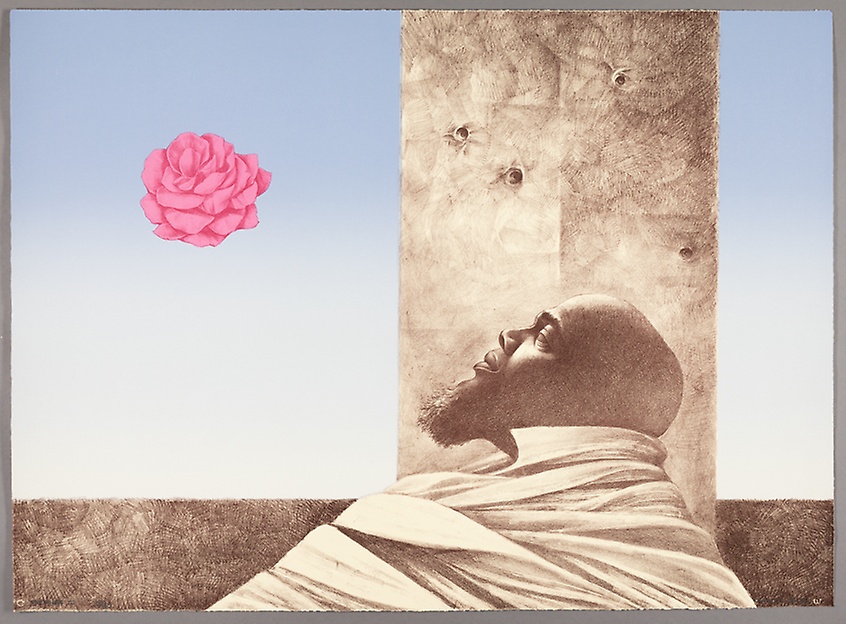
LOOK: Prophet I by Charles White

White, Charles_Prophet I
Charles White (American, 1918–1979), Prophet I, 1975. Color lithograph on white wove paper, 68.7 × 94.2 cm. Art Institute of Chicago.

Isaiah is the definitive Old Testament prophet of Advent, as he anticipates more than any other the coming of the Messiah and the renewal he will usher in. In chapter 35 he foresees deserts flowing with water and vegetative abundance: “the wilderness and the solitary place shall be glad; and the desert shall rejoice, and blossom as the rose” (v. 1).

Perhaps the modern Black artist Charles White had this scripture in mind when he created the lithograph Prophet I. It shows a robed man, who appears to be blind, gazing up at a pink rose suspended in the sky. (The blind prophet with keen inner sight is a common trope in ancient mythology.) On the cross-hatched wall he stands against are four eyes, which White said are there because the prophet sees more than the rest of us.

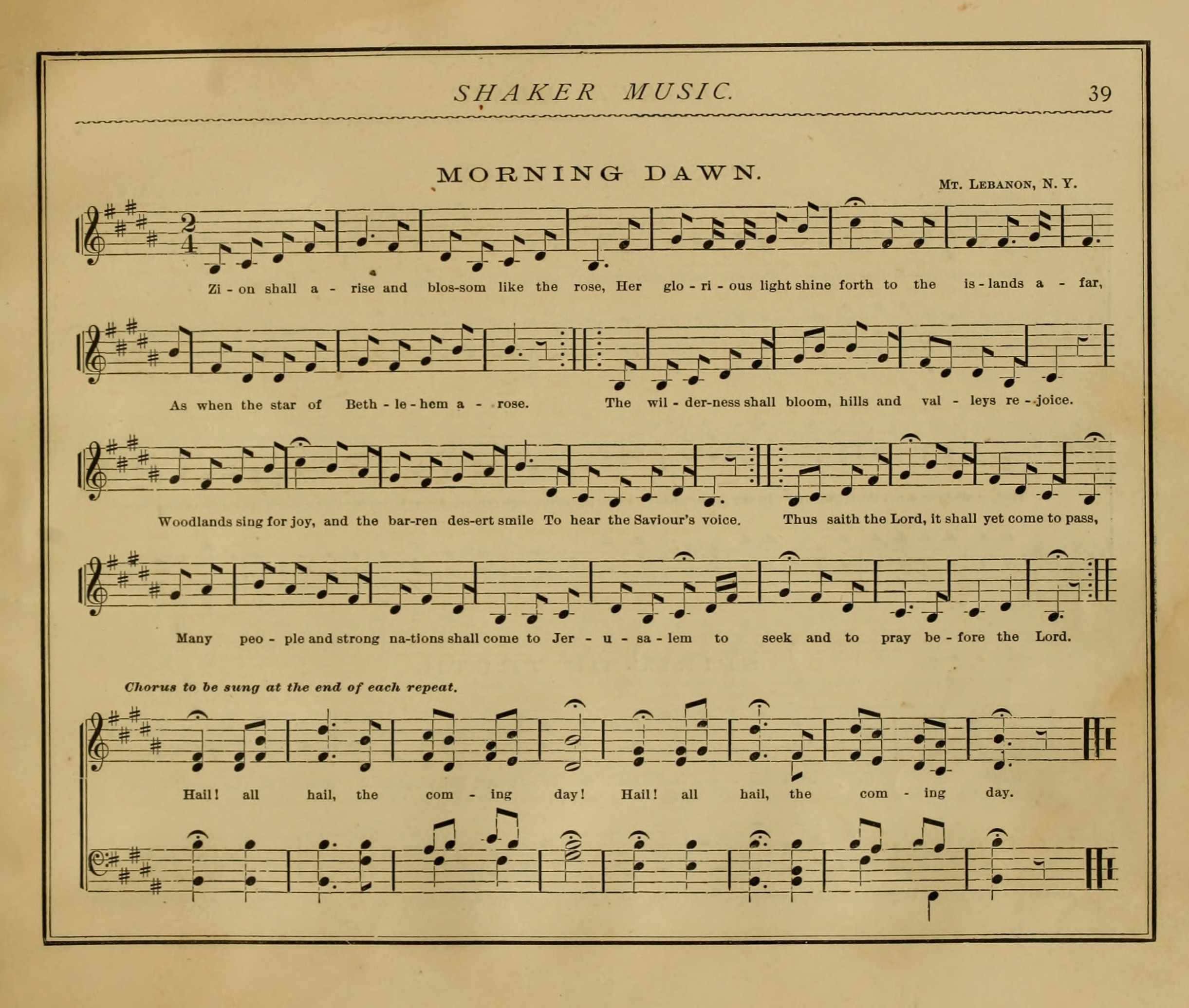
LISTEN: “Morning Dawn,” a Shaker hymn from New Lebanon, New York, 19th century | Performed by The Rose Ensemble on And Glory Shone Around: Early American Carols, Country Dances, Southern Harmony Hymns, and Shaker Spiritual Songs (2014)

Zion shall arise and blossom like the rose
Her glorious light shine forth to the islands afar
As when the Star of Bethlehem arose

Hail, all hail the coming day!

The wilderness shall bloom, hills and valleys rejoice
Woodlands sing for joy, and the barren desert smile
To hear the Savior’s voice

Hail, all hail the coming day!

Thus saith the Lord, it shall yet come to pass
Many people and strong nations shall come to Jerusalem
To seek and to pray before the Lord

Hail, all hail the coming day!

Give Good Gifts (Artful Devotion)

Mary Antoinette Lorania Pike and Sarah Adeline Pike
Joseph H. Davis (American, 1811–1865), Mary Antoinette Lorania Pike and Sarah Adeline Pike, 1835. Watercolor, pencil, and ink on paper, 8 1/2 × 11 in. American Folk Art Museum, New York. Photo: John Bigelow Taylor.

Let love be without hypocrisy. Detest evil; cling to what is good. Love one another deeply as brothers and sisters. Outdo one another in showing honor. Do not lack diligence in zeal; be fervent in the Spirit; serve the Lord. Rejoice in hope; be patient in affliction; be persistent in prayer. Share with the saints in their needs; pursue hospitality.

Bless those who persecute you; bless and do not curse. Rejoice with those who rejoice; weep with those who weep. Live in harmony with one another. Do not be proud; instead, associate with the humble. Do not be wise in your own estimation. Do not repay anyone evil for evil. Give careful thought to do what is honorable in everyone’s eyes. If possible, as far as it depends on you, live at peace with everyone.

—Romans 12:9–18 CEB

+++

SONG: “Give Good Gifts One to Another” by Sister Martha Jane Anderson, 1893 | Performed by The Rose Ensemble, on And Glory Shone Around: Early American Carols, Country Dances, Southern Harmony Hymns, and Shaker Spiritual Songs (2014)

Give good gifts one to another,
Peace, joy, and comfort gladly bestow;
Harbor no ill ’gainst sister or brother,
Smooth life’s journey as you onward go.

Broad as the sunshine, free as the showers,
So shed an influence, blessing to prove;
Give for the noblest of efforts your pow’rs;
Blest and be blest, is the law of love.

+++

Born in Limington, Maine, to a farming family, Joseph H. Davis was an itinerant artist who created small, inexpensive portraits of New England citizens from 1832 to 1837. He wandered from town to town through the border region between Maine and New Hampshire with his watercolors, paper, pencils, and brushes, initially seeking clients among his church connections. (He was a member of the Freewill Baptist Church.) His reputation spread by word of mouth, and over a five-year period he executed at least 150 watercolor portraits, most often posing together in profile a husband and wife or, as in the above painting, siblings, either in parlor settings or outdoors. The family pets are sometimes included too. Along the bottom borders he recorded the sitters’ names and ages.

After Davis’s daughter was born, he gave up painting and became involved in land speculation, manufacturing, and inventing.

Mary Antoinette Lorania Pike and Sarah Adeline Pike was part of the exhibition A Piece of Yourself: Gift Giving in Self-Taught Art, which ran from July 22, 2019, to January 10, 2020, at the American Folk Art Museum in New York City. Other pieces included quilts, handmade valentines and toys, Shaker gift drawings, a tin top hat (a tenth anniversary present), and a delicate, lacelike papercut made in 1830 by an inmate at Walnut Street Prison in Pennsylvania for a prison guard’s daughter.


This post belongs to the weekly series Artful Devotion. If you can’t view the music player in your email or RSS reader, try opening the post in your browser.

To view all the Revised Common Lectionary scripture readings for Proper 17, cycle A, click here.