
Advent, Day 5: When?

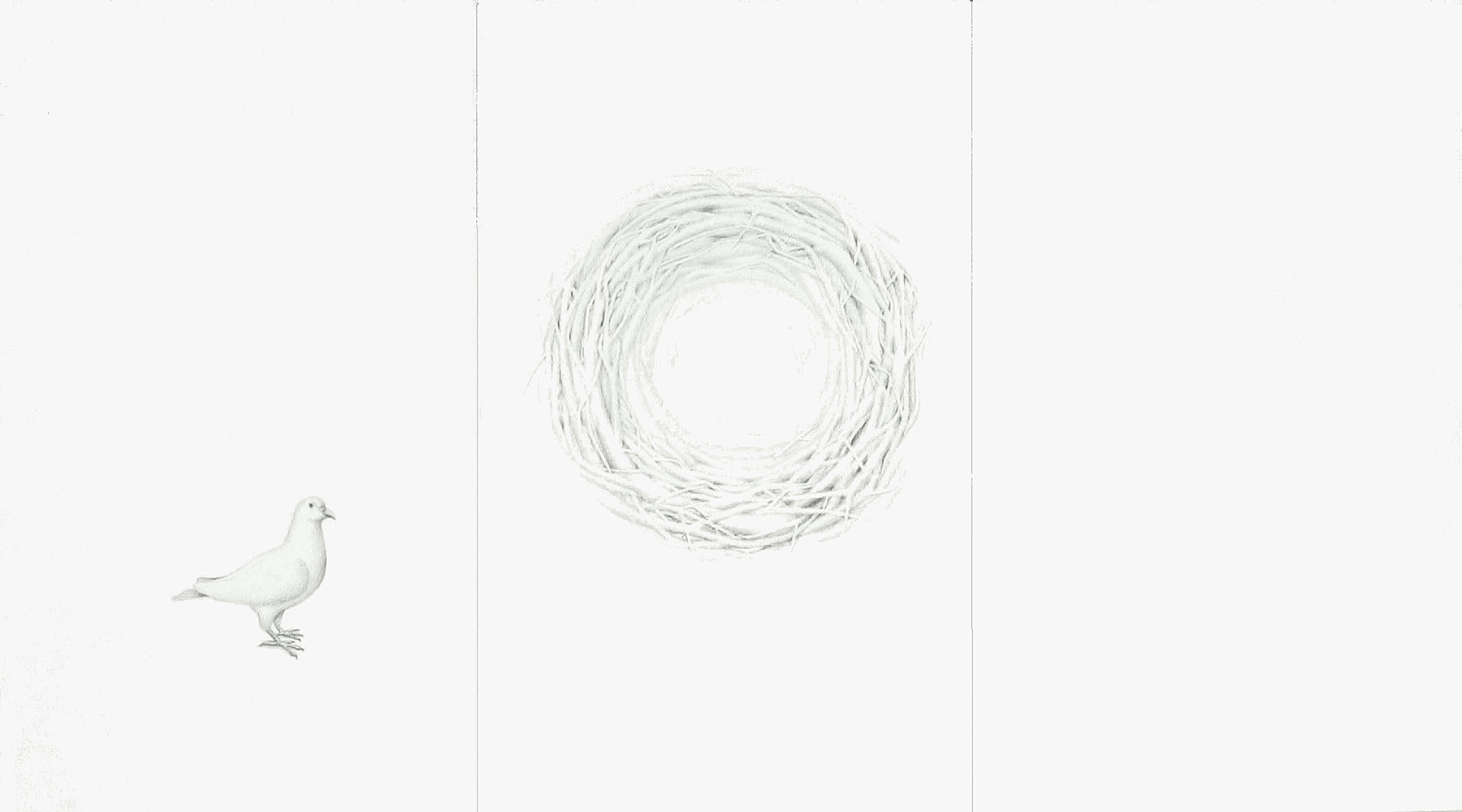
LOOK: Bethlehem by Carola Faller-Barris
Faller-Barris, Carola_Bethlehem
Carola Faller-Barris (German, 1964–), Bethlehem, 2009. Pencil on paper on MDF board, 100 × 180 cm. [HT]

LISTEN: “Peace” | Words by Gerard Manley Hopkins, 1879, and Wilfred Owen, 1917 | Music by Peter Bruun, 2017 | Performed by the Svanholm Singers, dir. Sofia Söderberg, on Exclusive, 2019

When will you ever, Peace, wild wooddove, shy wings shut,
Your round me roaming end, and under be my boughs?
When, when, Peace, will you, Peace? I’ll not play hypocrite
To own my heart: I yield you do come sometimes; but
That piecemeal peace is poor peace. What pure peace allows
Alarms of wars, the daunting wars, the death of it?

Out there, we’ve walked quite friendly up to Death,—
Sat down and eaten with him, cool and bland,—
Pardoned his spilling mess-tins in our hand.
We’ve sniffed the green thick odour of his breath,—
Our eyes wept, but our courage didn’t writhe.
He’s spat at us with bullets and he’s coughed
Shrapnel. We chorussed when he sang aloft,
We whistled while he shaved us with his scythe.

Oh, Death was never enemy of ours!
We laughed at him, we leagued with him, old chum.
No soldier’s paid to kick against His powers.
We laughed,—knowing that better men would come,
And greater wars: when each proud fighter brags
He wars on Death, for lives; not men, for flags.

O surely, reaving Peace, my Lord should leave in lieu
Some good! And so he does leave Patience exquisite,
That plumes to Peace thereafter. And when Peace here does house
He comes with work to do, he does not come to coo,
He comes to brood and sit.

The text of this choral work by the Danish composer Peter Brunn combines two British poems: “Peace” by Gerard Manley Hopkins and “The Next War” by Wilfred Owen. Let’s look at each one separately, and then together.


“Peace” by Gerard Manley Hopkins

When will you ever, Peace, wild wooddove, shy wings shut,
Your round me roaming end, and under be my boughs?
When, when, Peace, will you, Peace? I’ll not play hypocrite
To own my heart: I yield you do come sometimes; but
That piecemeal peace is poor peace. What pure peace allows
Alarms of wars, the daunting wars, the death of it?

O surely, reaving Peace, my Lord should leave in lieu
Some good! And so he does leave Patience exquisite,
That plumes to Peace thereafter. And when Peace here does house
He comes with work to do, he does not come to coo,
He comes to brood and sit.

The Jesuit poet-priest Gerard Manley Hopkins (1844–1889) wrote this curtal sonnet on October 2, 1879, after finding out he was reassigned from his role as curate at St. Aloysius’s church in Oxford to curate at St. Joseph’s in the industrial town of Bedford Leigh, near Manchester. He was apprehensive about this move to a place he described as “very gloomy” and unclean. The following decade, the last of his life, he would be plagued by melancholic dejection, which his later poems reflect. In addition to the internal disquiet he was experiencing in the fall of 1879, there was also an external lack of peace, as Great Britain was at war on three fronts—in southern Africa (against the Zulu kingdom), Afghanistan, and Ireland.

The speaker of the poem addresses Peace, an elusive dove, begging him to come settle down to nest, to incubate his eggs. “Brooding” here, writes J. Nathan Matias, is not a morose act but a generative, warmly creative one, birthing life.

Though the dove appears in scripture as a symbol of God the Spirit, in the last three lines of this poem he could be God the Son, the Prince of Peace. The people waited for generations upon generations for his arrival. And when he came, he was not all talk. He came with serious work to do; he came to hatch a newborn world.

This poem expresses yearning for peace in our hearts and in our lands—a permanent, holistic peace that only Christ can bring.


“The Next War” by Wilfred Owen

“War’s a joke for me and you,
While we know such dreams are true.”
—Siegfried Sassoon

Out there, we’ve walked quite friendly up to Death,—
Sat down and eaten with him, cool and bland,—
Pardoned his spilling mess-tins in our hand.
We’ve sniffed the green thick odour of his breath,—
Our eyes wept, but our courage didn’t writhe.
He’s spat at us with bullets and he’s coughed
Shrapnel. We chorussed when he sang aloft,
We whistled while he shaved us with his scythe.

Oh, Death was never enemy of ours!
We laughed at him, we leagued with him, old chum.
No soldier’s paid to kick against His powers.
We laughed,—knowing that better men would come,
And greater wars: when each proud fighter brags
He wars on Death, for lives; not men, for flags.

One of the premier poets of World War I, Wilfred Owen (1893–1918) was a British soldier whose poems lament the horrors of trench and gas warfare. His cynicism and transparency about war stood in stark contrast to the confidently patriotic verse written by earlier war poets.

Owen wrote “The Next War” while being treated for “shell shock” (PTSD) at Craiglockhart War Hospital in Edinburgh; he sent it in a letter to his mother dated September 25, 1917, writing the following week that he wanted her to show it to his youngest brother, Colin—for him “to read, mark, learn.” Owen was discharged from the hospital two months later and returned to the front lines of France, where he was killed in action on November 4, 1918, a week before the armistice, at age twenty-five.

He opens his ironic-toned sonnet with an epigraph from “A Letter Home” by Siegfried Sassoon, a fellow war poet he met at Craiglockhart, who became a friend and a mentor to him. (Bruun omits the epigraph in his choral work so that there’s a seamless transition between poems.) “Dreams will triumph, though the dark / Scowls above me,” Sassoon writes earlier in his poem, a poem that acknowledges the bleakness of war but, imagining the rebirth of a friend slain in battle, clings to the hope that it will soon be over and we can laugh it off.

Owen undercuts the optimism and solace in these lines with what follows in his own poem. The speaker of “The Next War”—which it’s pretty clear is the poet himself—personifies Death as a comrade whose intimate presence is normal among soldiers. He spits bullets, coughs shrapnel, and breathes stinking odors, and yet they ally themselves with him, sing Death’s song, go with him into battle.

Soldiers only delude themselves if they think they fight against Death, Owen asserts; they fight with him. Their nations’ governments will say they’re heroes, taking up arms to save lives and secure peace, but Owen rejects the idea that there’s anything noble, glorious, or effective about war. Soldiers kill men “for flags”—merely serving national interests—and their doing so never puts an end to war but only leads to another.


By bringing together these two texts, sandwiching Owen between Hopkins, Bruun gives a more hopeful framing to Owen’s disillusioned reflections on war, ending with the final image of a brooding dove. I like how the two poems play off one another. For example, Hopkins’s rhetorical question of “What pure peace allows / . . . the death of [peace]?” stands in starker relief when read in conjunction with Owen’s criticism of the ostensible rationale for war.

Bruun still honors Owen’s experience of being made far too familiar with death, his endurance of mortar blasts and mustard gas and all-around carnage, to no apparent end. Owen’s text starts at 2:11 of the video, where a menacing, march-like cadence enters. We feel the anxiety and the darkness of battle. The specificity of the poem resists us metaphorizing war—that is, applying the poem to a situation of inner turmoil (battling inner demons) only. This is physical combat between nations, which, of course, has severe psychological repercussions on the participants.

But at 5:33 the hushed tones of Hopkins return. Bruun had been attracted to Hopkins’s poem “Peace” for some time. In 2010 he wrote a setting of it for solo voice and flute, clarinet, horn, percussion, glockenspiel, violin, violoncello, and contrabass, and in 2016 he published a new setting, with Owens now inserted, as the second in a five-song cycle called Wind Walks for mixed choir and accompaniment, all five texts taken from Hopkins. He then adapted the song for the male-voice chamber choir the Svanholm Singers from Sweden, which is what I feature here.

The pointed and repeated “When” at the opening of Bruun’s piece, a word that Hopkins repeats three times in his poem, is powerful, an echo of the familiar biblical refrain, “How long, O Lord?” If we read Peace as Christ, then the poem is a prayer, asking Christ to come home to us, to our world—to spread his wings over it and nurture it back to life.

In Hebrew thought, shalom, “peace,” is not a passive thing, merely the absence of war. It’s the active presence of God and an all-encompassing state of completeness, soundness, health, safety, and prosperity.

Shalom is what we long for, especially during Advent. It’s what scripture promises will come someday—but now, its lack is keenly felt. It may occasionally flit and hover nearby, but then it flies off again.

As the church, may we embrace “Patience exquisite, / That plumes to Peace thereafter,” as we await Christ’s return, in the meantime preparing his way through acts of righteousness and reconciliation.

Advent, Day 19: Behold

“They will hunger no more and thirst no more;
    the sun will not strike them,
    nor any scorching heat,
for the Lamb at the center of the throne will be their shepherd,
    and he will guide them to springs of the water of life,
and God will wipe away every tear from their eyes.”

—Revelation 7:16–17

Then the angel showed me the river of the water of life, bright as crystal, flowing from the throne of God and of the Lamb through the middle of the street of the city. On either side of the river is the tree of life with its twelve kinds of fruit, producing its fruit each month, and the leaves of the tree are for the healing of the nations. Nothing accursed will be found there any more. But the throne of God and of the Lamb will be in it, and his servants will worship him; they will see his face, and his name will be on their foreheads. And there will be no more night; they need no light of lamp or sun, for the Lord God will be their light, and they will reign forever and ever.

And he said to me, “These words are trustworthy and true, for the Lord, the God of the spirits of the prophets, has sent his angel to show his servants what must soon take place.”

 “See, I am coming soon! Blessed is the one who keeps the words of the prophecy of this book.”

—Revelation 22:1–7

LOOK: The Supper of the Lamb by Wayne Forte

Forte, Wayne_The Supper of the Lamb
Wayne Forte (Filipino American, 1950–), The Supper of the Lamb, 2004. Oil on canvas, 60 × 48 in.

In this eschatological painting by Wayne Forte, the slain and risen Lamb reopens Eden, welcoming us all to the feast. He holds a palm branch, symbol of the martyr’s victory, and stands atop a table set with bread, wine, and the fruits of the tree of life. A river issues forth, further underscoring that this is a place of refreshment.

In the foreground, the iron grillwork of the gate depicts key events from salvation history: the Fall and Expulsion, Noah’s Ark, the Sacrifice of Isaac, the Exodus, the Nativity, the Crucifixion, and the Resurrection. Originating in the early Christian era, the IHS monogram at the top denotes the first three letters of the Greek name of Jesus, ΙΗΣΟΥΣ: iota, eta, sigma. Later it came to be mistakenly (but appropriately!) interpreted as an acronym for the Latin Jesus Hominum Salvator, “Jesus, Savior of Humanity.”

LISTEN: “Behold, Behold” by Caroline Cobb, performed with Sean Carter on A Home and a Hunger: Songs of Kingdom Hope (2017)

I see a city coming down
Like a bride in whitest gown
Purely dressed
I see the pilgrims coming home
All creation finds shalom
The promised rest
The Lamb of God will be her light
The sun will have no need to shine

Refrain:
Behold, behold
God makes his home with us
He’ll take his throne, forever glorious
Behold, behold
God makes his home with us
He’ll take his throne, forever glorious
The curse will be undone
O come, Lord Jesus, come

The Lord will banish every sin
All that’s broken he will mend
And make new
And we will see him face to face
As he wipes our tears away
And death is through
And all the ransomed and redeemed
From every tongue and tribe will sing

[Refrain]

At last the darkness will surrender to the light
But we, unveiled in glory, will forever shine
At last the powers of hell will drown in lakes of fire
But we will freely drink the crystal streams of life

Come, thirsty, taste and see
Come, hungry, to the feast
Come, weary, find your peace
The Bride and Spirit sing
Come!
Come!

[Refrain]

Based on Revelation 21–22, “Behold, Behold” is the last song on Caroline Cobb’s album A Home and a Hunger, which traces kingdom hope from Genesis to Revelation, each song focusing on a different biblical book.


This post is part of a daily Advent series from December 2 to 24, 2023 (with Christmas to follow through January 6, 2024). View all the posts here, and the accompanying Spotify playlist here.

“Compassionate and Wise” (interfaith song in response to 9/11)

The song “Compassionate and Wise,” which appears on an album of the same name recorded by Father Cyprian Consiglio in 2006, represents a cross-pollination of Hinduism, Buddhism, and Christianity.

An earlier version, simply called “Dedication of Merit,” was first sung at a Buddhist-Christian conference at a Benedictine convent in Indiana the week after the September 11 terrorist attacks on the World Trade Center in New York City. The Rev. Dr. Heng Sure, an American Chan Buddhist monk, was asked to offer a dedication of merit (similar to what Christians would call an intercessory prayer, though it’s phrased more like a benediction). For this he and a colleague translated a passage from the Mettā Sutta, the Buddha’s discourse on developing and sustaining loving-kindness. Their translation reads:

May every living being,
Our minds as one and radiant with light,
Share the fruits of peace
With hearts of goodness, luminous and bright.

If people hear and see
How hands and hearts can find in giving, unity,
May their minds awake,
To Great Compassion, wisdom, and to joy.

May kindness find reward;
May all who sorrow leave their grief and pain;
May this boundless light
Break the darkness of their endless night.

Because our hearts are one,
This world of pain turns into paradise.
May all become compassionate and wise,
May all become compassionate and wise.

In reciting the dedication, Sure spontaneously matched it with a melody by Canadian singer-songwriter Loreena McKennitt, which she had written in 1994 for the song “Dark Night of the Soul,” a setting of verse by the sixteenth-century Spanish Catholic mystic Saint John of the Cross. Conference attendees, their hearts full of grief over the falling of the Twin Towers, joined in singing, lifting up their collective longing for light to break through the darkness.

A few years later at a different Buddhist-Christian gathering, Sure met Father Cyprian Consiglio, a Camaldolese Benedictine monk, author, and musician from California. He shared the song with him, struck by its similarity to some of the prayers Consiglio had offered that week.

With the blessing of Sure and McKennitt, Consiglio and his regular collaborator John Pennington, a percussionist, recorded a new arrangement of the song in 2006 under the title “Compassionate and Wise.” Here they are performing it with friends on June 28, 2018, at the “Arise, My Love” concert in Santa Cruz to raise money for New Camaldoli Hermitage in Big Sur, California, where Consiglio has been the prior since 2013:

(The song starts at 2:43, following Consiglio’s spoken introduction.)

Their version has slight lyrical alterations and opens with two Sanskrit chants that Consiglio learned from the monks and nuns at Saccidananda Ashram (nicknamed Shantivanam, “Forest of Peace”), a Camaldolese Benedictine monastery in Tannirpalli, South India. The first chant, which is from the Rig Veda but also appears in the Yajur Veda, is known as the Mahamrityunjaya Mantra (Great Mantra for Conquering Death). The second is a svasti pāṭhaḥ, an invocation for the welfare of all.

The following Sanskrit and its English translation were provided to me by Consiglio:

OM tryambakam yajâmahe
Sugandhim pushtivardhanam
Urvâr ukamiva bandhanât
Mrityor mukshiyam amritat

OM sarvesâm svastir bhavatu
Sarvesâm shantir bhavatu
Sarvesâm pûrnam bhavatu
Sarvesâm mangalam bhavatu
Sarve bhavtu sukhinâh
Sarve shântu nirâmayâh
Sarve bhadrâni pashyantu
Mâ kashchid dukha bhagbhavet
OM shânti shânti shânti

We worship the true God who is the Supreme Being
Who is fragrant and nourishes all beings
May he liberate us from death for the sake of immortality
Like a cucumber is severed from its bondage to the creeper

May all be happy
May all be free from disease
May all realize what is good
May none be in misery
May the nonvirtuous be virtuous
May the virtuous attain tranquility
May the tranquil be freed from the bonds of death
May the freed make others free
Peace, peace, peace

And here is the sung English that follows:

May every living being,
Our minds as one and radiant with light,
Share the fruits of peace,
Our hearts of goodness luminous and bright.

If people hear and see,
Our hands and hearts can find, in giving, unity.
May their minds awake
To Great Compassion, wisdom, and to joy.

May goodness find reward;
May all who sorrow leave their grief and pain;
May this boundless light
Dispel the darkness of their endless night.

Because our hearts are one,
This world of pain turns into paradise.
May all become compassionate and wise,
May all become compassionate and wise.

This song is full of interfaith exchanges. A melody written to set the text of a Carmelite Christian friar was adapted to fit a Buddhist dedication of merit and is introduced by a Benedictine Christian monk with a passage from the Hindu scriptures! For more information on the song’s history, see urbandharma.org.

Explaining the significance of a dedication of merit (and metta practice) to his Christian readers, Consiglio writes on the hermitage blog, “We can dedicate whatever closeness to God we have to the good of someone else.” I myself wouldn’t use the phrase “dedication of merit” or its derivatives to describe what I’m doing when I intercede to God for others, but I see what Consiglio means, and I think it’s this: “The prayer of the righteous is powerful and effective” (James 5:16). Through Christ, God hears our prayers, and it is our duty in prayer to think more widely than just our own needs or the needs of those in our immediate circles—though that can be a good starting point. As the apostle Paul says, “I urge that supplications, prayers, intercessions, and thanksgivings be made for everyone” (1 Tim. 2:1, emphasis mine).

What if our prayers extended to enfold all living beings? I was always taught to avoid genericisms in prayer, and while there is value in direct naming, there is also a beauty to those kinds of broad prayers often heard on the lips of children—for “the whole world,” for “peace everywhere.”

Perhaps you are uncomfortable by the lack of doctrinal specificity in “Compassionate and Wise,” or by what you might call “syncretism” (the mixing of belief systems). But as Consiglio says, there is nothing in the song that contradicts Christianity. The song arose out of an interreligious context, so it’s meant to invite the participation of people of various faith backgrounds.

“Because our hearts are one” refers to a unity of intention or desire. The singers may not be united in theological particulars, nor even around the deity they’re addressing, but they are one in their wish for universal well-being, for liberation from the bonds of death and a walking together in friendship across boundaries of difference.

Lent, Day 6

LOOK: Breathe by Billie Bond

Bond, Billie_Kintsugi Heads
Billie Bond (British, 1965–), Breathe (diptych), 2018. Black stoneware, resin, gold, 15.8 × 13 × 7.9 in. each. [available for sale]

This pair of ceramic busts by British sculptor Billie Bond is inspired by the Japanese art of kintsugi, or “golden seams,” by which a broken pottery vessel is repaired using gold lacquer. With this technique the cracks are purposefully accentuated rather than hidden, and the mended object is even more beautiful than the original.

Japanese American author, speaker, and artist Makoto Fujimura has spoken extensively about kintsugi as a metaphor for human brokenness and mending in Christ. We come to Christ in fragments; he lovingly puts us back together. The scars remain, but like his, they shine.

For Bond, the kintsugi heads represent human fragility and resilience—particularly healing after grief or psychological trauma, and enlightenment gained through experience. View more of Bond’s kintsugi sculptures here.

Bond, Billie_Smashed ceramic head
Smashed ceramic head by Billie Bond, before being reassembled and repaired with gold

LISTEN: “Come Healing” by Leonard Cohen and Patrick Leonard, 2012 | Performed by Elayna Boynton at Crosswalk Church, Redlands, California, 2012; and on The Farewell (Original Motion Picture Soundtrack), 2019

O gather up the brokenness
And bring it to me now
The fragrance of those promises
You never dared to vow
The splinters that you carry
The cross you left behind
Come healing of the body
Come healing of the mind

And let the heavens hear it
The penitential hymn
Come healing of the spirit
Come healing of the limb

Behold the gates of mercy
In arbitrary space
And none of us deserving
The cruelty or the grace
O solitude of longing
Where love has been confined
Come healing of the body
Come healing of the mind

O see the darkness yielding
That tore the light apart
Come healing of the reason
Come healing of the heart

O troubledness concealing
An undivided love
The Heart* beneath is teaching
To the broken Heart above
O let the heavens falter
Let the earth proclaim:
Come healing of the Altar
Come healing of the Name

O longing of the branches
To lift the little bud
O longing of the arteries
To purify the blood
And let the heavens hear it
The penitential hymn
Come healing of the spirit
Come healing of the limb

O let the heavens hear it
The penitential hymn
Come healing of the spirit
Come healing of the limb

* The official website of Leonard Cohen, maintained by Sony Music Entertainment, capitalizes “Heart” in this stanza; same with “Altar” and “Name.”

Known as “the poet of brokenness,” Leonard Cohen (1934–2016) is widely considered one of the greatest songwriters of all time. Spiritual yearning characterizes quite a few of his songs, the most famous of which is “Hallelujah.” He was Jewish, with a respect for other spiritual traditions and a fondness for Jesus Christ as a universal figure.

“Come Healing” is from Cohen’s 2012 album Old Ideas. Elayna Boynton, perhaps discovered through this YouTube video from a worship service at her Southern California church, was asked to record the song for the 2019 film The Farewell (an excellent watch!). Cohen’s deep growl of a voice, though it has its admirers, is not attractive to me, so Boynton’s cover really helped me hear the tremendous beauty of this song.

Elliot R. Wolfson describes “Come Healing” as “a poem that is prayer in its purest distillation, a prayer clothed in quintessential nakedness, an anthem that celebrates and laments the wholehearted fragmentariness of the human condition.”

The speaker prays for healing of body and spirit, head and heart. We bring our failures and our lack, our guilt and regrets and all manner of pain to the altar, to the “gates of mercy.” We long to bloom, to be purified. In the mystical unity of love that ties our hearts to God, our hurt hurts him. His heart breaks over seeing us suffer, whether as a result of our own sin (which is what Cohen’s “penitential hymn” seems to focus on) or due to things outside our control.

When we bring our cracked or shattered selves to God, acknowledging our inability to fix the damage, he will restore us to wholeness.

While spiritual salvation is granted instantly (at least in the understanding of my tradition) to the one who turns to God, through Christ, in faith and repentance, what about other types of brokenness that we come to him with? Why won’t he heal us of that chronic physical condition? Or that debilitating mental illness? Or the effects of trauma? Why won’t he heal that broken relationship between us and our parent, despite our efforts at reconciliation?

I don’t have an answer for that—why, though none of us is free of pain and hardship in this life, some suffer much more than others; or why some receive healing and others do not. But eventual wholeness, shalom, is promised to those who are in Christ. In the new heavens and the new earth, salvation will be holistic, infusing spirits as well as bodies, minds, relationships, systems, and the whole created world.

And sometimes we do receive glimpses of that wholeness here and now! Sometimes the cancer goes away. Sometimes the depression is effectively treated, and fulfillment made possible again. Sometimes the sobriety sticks.

Often God is piecing us back together slowly, such that the progress may be imperceptible until years later, we look back and can see it.

The song suggests that although we don’t always deserve the slings and arrows that come our way, neither do we deserve the lavish graces God bestows. Sometimes we’re so focused on the one that we fail to see the other.

Even though complete wholeness is not possible in this life, God still invites us to reach out to him with the shards of our life, to seek his healing in specific areas—with faith that he can heal whatever it is that’s broken! He will tend to the shards with loving tenderness. And maybe put them back together in a way we didn’t expect.