Claudia Fontes (Argentine, 1964–), sculptures from the Foreigners series, 2013–15. Flaxseed paper porcelain, height 25 cm. Photo: Bernard G. Mills.
Oh! how my mind
          Is gravel’d!
                    Not a thought
That I can find,
          But’s ravel’d
                    All to nought.
Short ends of threads,
          And narrow shreds
                    Of lists,
Knots, snarled ruffs,
          Loose broken tufts
                    Of twists,
Are my torn meditation’s ragged clothing;
Which, wound and woven, shape a suit for nothing.
One while I think, and then I am in pain
To think how to unthink that thought again.

How can my soul
          But famish
                    With this food?
Pleasure’s full bowl
          Tastes rammish,
                    Taints the blood:
Profit picks bones,
          And chews on stones
                    That choke.
Honor climbs hills;
          Fats not, but fills
                    With smoke.
And whilst my thoughts are greedy upon these,
They pass by pearls, and stoop to pick up peas.
Such wash and draff is fit for none but swine;
And such I am not, Lord, if I am thine.
          Clothe me anew, and feed me then afresh;
          Else my soul dies famish’d and starv’d with flesh.
I first encountered this poem in Before the Door of God: An Anthology of Devotional Poetry, edited by Jay Hopler and Kimberly Johnson. I had never heard of Christopher Harvey (1597–1663), an English clergyman and minor poet who was a contemporary of John Donne, George Herbert, Henry Vaughan, and Richard Crashaw, the so-called Metaphysical poets. Apparently out of a sense of humility, Harvey published his poetry anonymously during his lifetime. This poem is from a slim 1640 volume of his titled The Synagogue, or, The Shadow of The Temple, but his name didn’t start appearing on the title page until the nineteenth century. Read about the mysterious publication history of The Synagoguehere.
“Confusion” uses an unusual stanza form that befits the subject, with uneven line lengths that produce a raggedy appearance on the page. The rhyme scheme is abc abc dde ffe gghh, with an additional rhyming couplet at the end of the second stanza.
The speaker says his mind is all jumbled, unsettled. “Oh! how my mind is graveled!” he laments. “Not a thought that I can find, but’s raveled all to nought.” (“Graveled” is an archaic word meaning disarrayed, and “raveled” means entangled.) Launching into sartorial imagery, he compares his fragmented thoughts to old, partial, mismatched pieces of dress that fail to make up a coherent attire.
He doesn’t yet specify the nature of his thoughts, whether sinful (e.g., prideful, hateful, lustful) or simply trivial and unfocused on God or dominated by worry. Either way, he is suffering from intrusive and distracting thoughts that undo him.
In stanza 2 he shifts to the metaphor of food, and reveals that it is avarice he is struggling with—an insatiable need to acquire more and to be perceived as successful and important. In part to maintain an image, he indulges in the pleasures typical of rich men, which appear juicy and delicious, he says, but they actually taste quite rank (“rammish”) and make him sick. He cautions that wealth, social status, and human praise, if that’s what we feed on, not only fail to nourish (fatten) our souls; they can ultimately choke us or starve us to death.
Feasting on sensual gratification, expensive toys, and accolades instead of on Christ is like passing up pearls for peas, the speaker remarks. Such foods are the dregs, the refuse (“draff”), fit only for pigs, not for God’s children.
The closing couplet pulls together both stanzas, as the speaker asks God to clothe him in a whole new garment and to feed him afresh so that he is not “starved with flesh.” This final phrase, an oxymoron, suggests how the dishes served up by this world seem meaty but ultimately do not satisfy; when it comes to filling us, they’re as good as nothing, only leaving us empty.
Instead of being content to go about in tatters, eating slop, we must “clothe ourselves with the new self . . . in true righteousness and holiness” (Eph. 4:24) and feed on Jesus, “the bread of life . . . come down from heaven” (John 6:35, 33).
POEM: “Lost Sheep” by Margaret DeRitter: DeRitter writes about a lost Merino sheep in Australia who, because left unsheared for so long, was carrying over seventy-five pounds of wool on his back. He was found in 2021 and rescued by Edgar’s Mission Farm Sanctuary in Lancefield.
+++
SONGS:
>> “What Have We Become” by the Sweeplings:The Sweeplings are Cami Bradley and Whitney Dean, a singing-songwriting folk pop duo. From their album Rise and Fall (2015), “What Have We Become” laments how sin encroaches on our lives—we may welcome it in at first, but then it takes over, makes of our house a wasteland. This theme is embodied by a shadowy, thorny-veiled dancer in the music video.
>> “It Knows Me” by Avi Kaplan: Living outside Nashville, Tennessee, Avi Kaplan is best known for being the original vocal bass of the a cappella group Pentatonix, from 2011 to 2017. This song of self-probing is from his second solo EP, I’ll Get By (2020). It’s about the freedom that comes from reckoning with one’s inner darkness and accepting grace. The animation in the video is by Mertcan Mertbilek.
“It Knows Me” is an extremely personal song to me. I believe that everyone has a darker side of them, and that you can choose to play into that, or you can choose to not. This song is about that battle between those two forces, and having a little grace for yourself when you do falter on your path.
>> “Not the Devil Song” by Marcus & Marketo:Marcus & Marketo (Marcus Clingaman and Marketo Michel) are a worship music duo from South Bend, Indiana, fusing the styles of gospel, classical, country, and soul. “Not the Devil Song,” which they wrote in 2019, is about the power Christians are given to tell Satan to back off! When he dangles temptations in front of you, whispers lies in your ear, sows seeds of doubt or fear or hopelessness, you can confidently retort, “Devil, no, you gotta let go; Jesus died to save my soul.”
In his book The Forge of Vision (2015), visual studies scholar David Morgan contrasts this emblematic series with the related Cor Jesu amanti sacrum by Anton Wierix (which I wrote about here). Whereas the Wierix engravings from Antwerp are marked by sweetness, with the Christ child gently cleaning and setting up house in the human heart, the anonymous illustrations Gossner uses portray more of a psychomachia (battle for the soul), with armed angels seeking to oust Satan and his minions.
+++
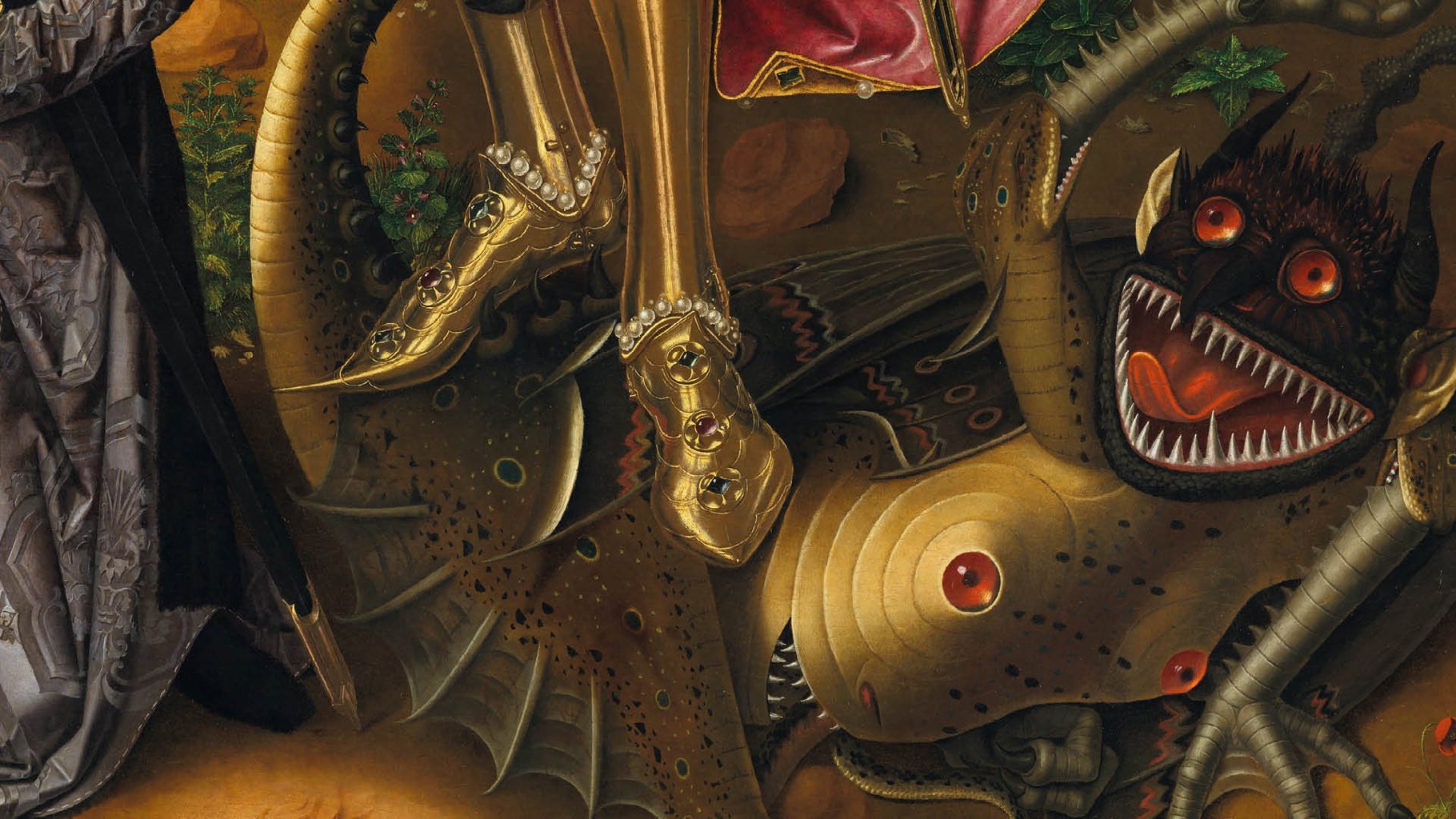
VIDEO: “How Bermejo paints good and evil in Saint Michael Triumphs over the Devil”: In this nine-minute video, Daniel Sobrino Ralston, associate curator for Spanish paintings at the National Gallery in London, examines a late Gothic painting in the museum’s collection by the Spanish artist Bartolomé Bermejo, showing the archangel Michael slaying Satan. Based on Revelation 12:7–9, this subject gave artists the chance to flex their imaginations in portraying evil incarnate and its vanquishment. Possessing an impressive capacity for fantastical invention, Bermejo gives the devil snakes for arms, eyes for nipples, bird claws, moth-like wings, a spiky tail, and a cactus growing out of its head!
Bartolomé Bermejo (Spanish, ca. 1440–after 1495), Saint Michael Triumphs over the Devil (detail), 1468. Oil and gold on wood, 179.7 × 81.9 cm. National Gallery, London.
If this visual subject interests you, I recommend the book Angels and Demons in Art by Rosa Giorgi, from the J. Paul Getty Museum’s Guide to Imagery series.
In Antwerp sometime around 1600, the Flemish printmaker Anton Wierix II (whose name is alternatively rendered as Antonie, Anthony, Antoine, or Antonius) engraved a series of seventeen* cardiomorphic emblems called the Cor Jesu amanti sacrum (The Heart Consecrated to the Loving Jesus), which portray the human heart as the dwelling-place, schoolroom, and throne of Christ. Commissioned by the Jesuit order, the series shows the Christ child cutting through the net that has ensnared the heart, knocking at the heart’s door, shining a light inside, sweeping out the monsters and vices, purging it with his blood, establishing his reign therein, teaching it, adorning it, making music in it, defending it from hostile invasion, piercing it with the arrows of love, and setting it aflame with desire.
These prints circulated as loose sheets and inside books, and various artists copied Wierix’s designs throughout the seventeenth century. The most famous book that uses the Cor Jesus images is Le coeur dévot, throsne royal de Iesus, Pacifique Salomon (The Devout Heart, Royal Throne of Jesus, Pacific Salomon) by Etienne Luzvic, SJ, originally written for a religious community, perhaps one devoted to the Sacred Heart. The book’s initial publication—in Paris in 1626—was without illustrations, but an enlarged edition was reissued in Douai and Antwerp the following year, containing twenty Cor Jesu engravings adapted by Martin Baes from Wierix’s originals, as well as additional meditations called “Incentives” by Fr. Etienne Binet, SJ.
Also in 1627, Le coeur dévot was translated into Latin, which became the basis for a number of vernacular translations throughout Europe, including an English version translated by Henry Hawkins in 1634, titled The Devout Hart, or Royal Throne of the Pacifical Salomon. This English edition includes a hymn by Hawkins for each emblem.
The odd-sounding subtitle of the book is a reference to King Solomon of the Old Testament, whom Luzvic apparently read a type of Christ in his majesty. “Pacifical” is an archaic word meaning conciliatory, peaceable.
Below I reproduce Wierix’s seventeen emblems, a loose-leaf edition held by the Wellcome Collection in London; you can click on the image to be taken to its object page.
Each engraving contains at the bottom a rhyming Latin verse in two stanzas of three lines each, interpreting the picture. The English translations provided below are sourced from the Wellcome Collection website, unless otherwise noted.
The engravings are not numbered, and their order was not fixed; they show up in variable sequences in different books. I’ve ordered them as they appear in Hawkins’s The Devout Hart. Scholars and editors have given them different descriptive titles over the years. I use Hawkins’s titles, only I’ve modernized the spellings. I’ve also provided a few quotes from Hawkins’s translation of Luzvic’s meditational texts that accompany the images in The Devout Hart, with page numbers provided in parentheses.
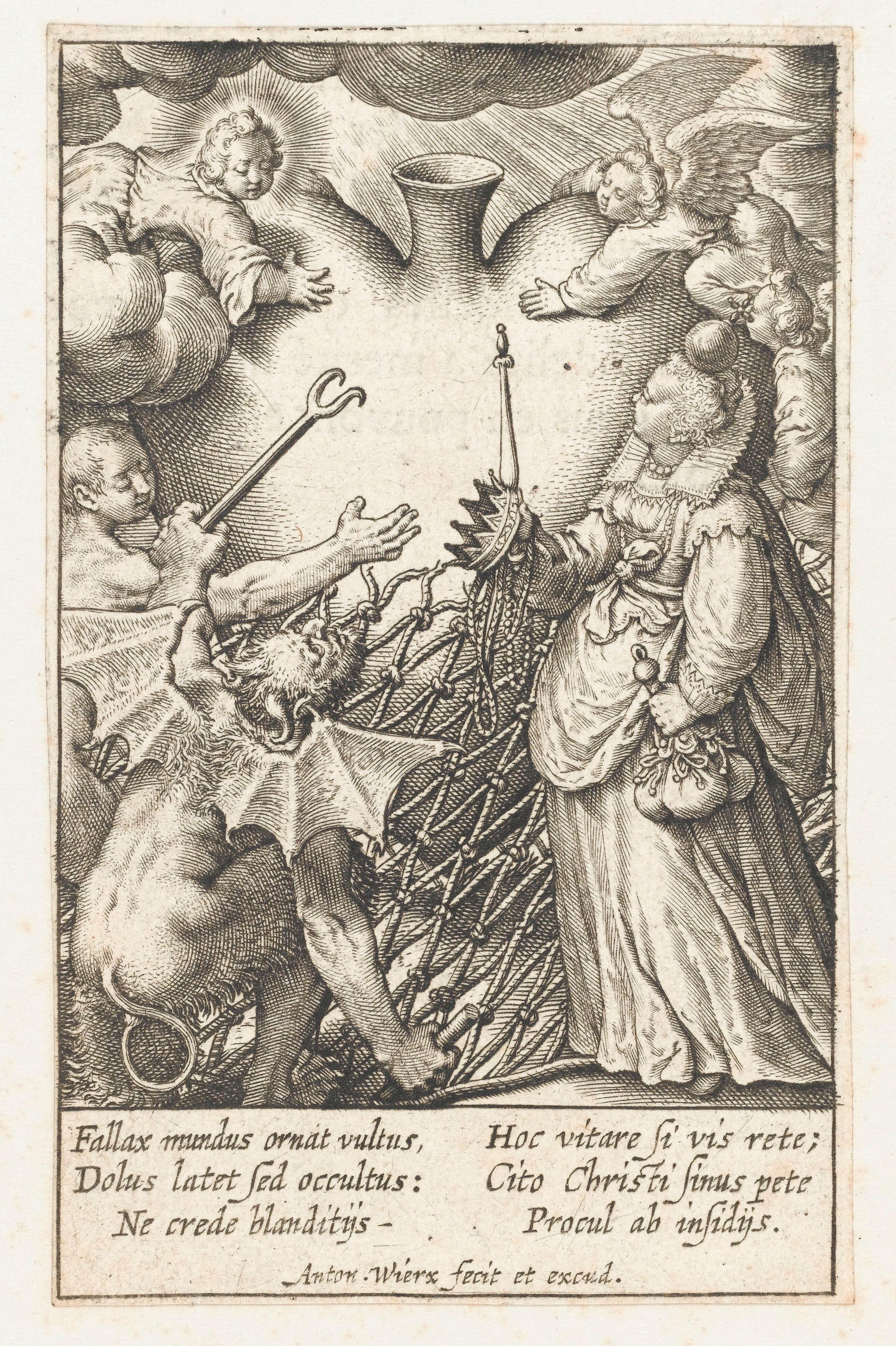
1. The world, the flesh, and the devil assail the heart, but Jesus saves it for himself
Anton Wierix II (Flemish, ca. 1555–1604), The world, the flesh, and the devil assail the heart, but Jesus saves it for himself, ca. 1600. Engraving, with etching, image 7.7 × 5.6 cm.
Fallax mundus ornat vultus, dolus latet sed occultus: ne crede blanditiis.
Hoc vitare si vis rete; cito Christi sinus pete procul ab insidiis.
(The deceptive world makes up its face, yet trickery lurks concealed. Do not trust in blandishments if you want to avoid this net! Quickly seek the breast of Christ, far from ambushes.)
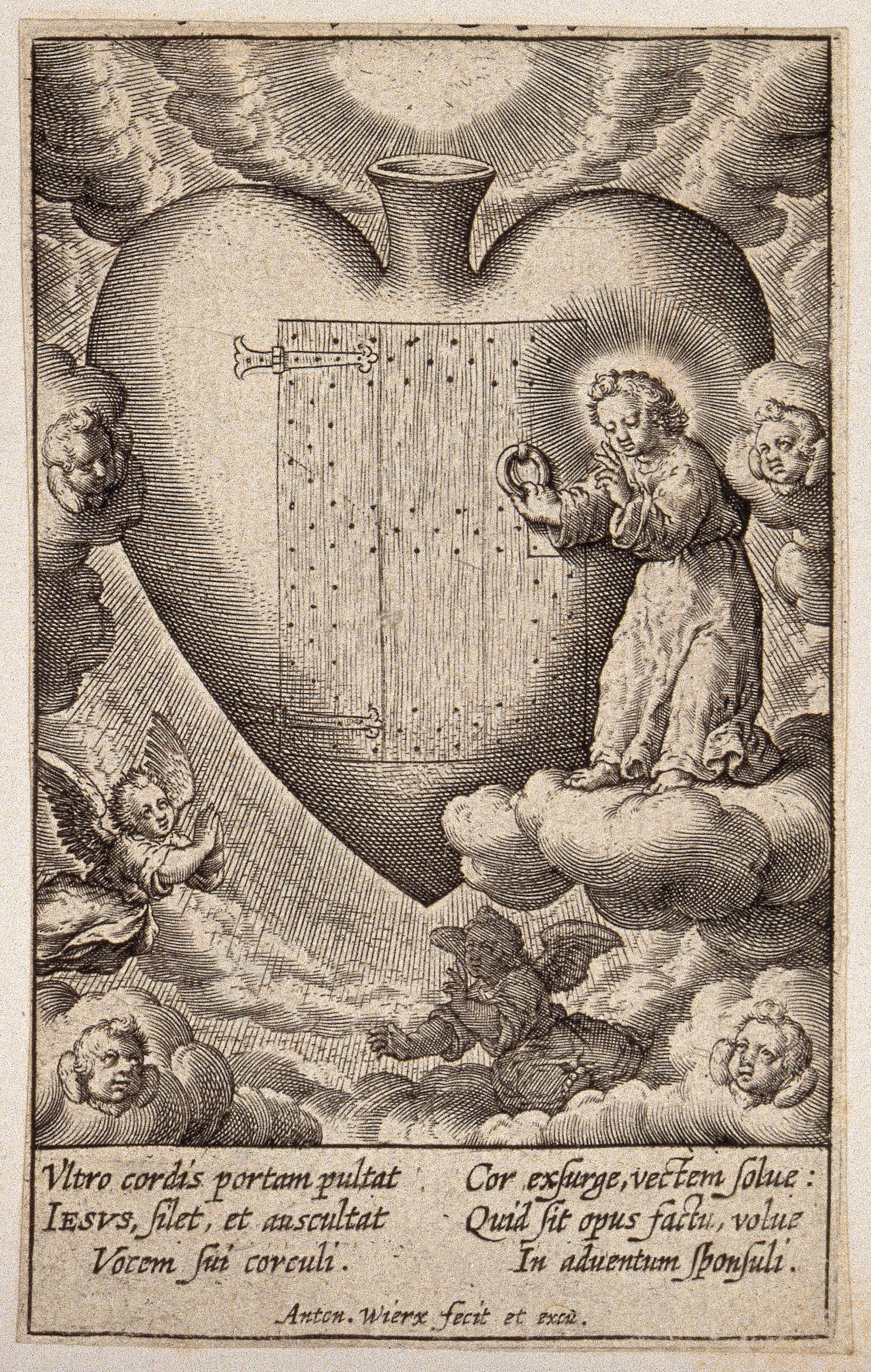
2. The most amorous Jesus knocks at the door of the heart
Anton Wierix II (Flemish, ca. 1555–1604), The most amorous Jesus knocks at the door of the heart, ca. 1600. Engraving, image 7.8 × 5.5 cm.
Ultro cordis portam pultat Iesus, silet et auscultate vocem sui corculi.
Cor exsurge, vectem solve: Quid sit opus factu, volve in adventum sponsuli.
(Outside the door of the heart Jesus knocks, is silent, and listens for the voice of his little heart. Heart, rise up! throw back the bolt! think what needs to be done at the arrival of the little betrothed one!)
This image is rooted in Revelation 3:20: “Behold, I stand at the door, and knock: if any man hear my voice, and open the door, I will come in to him . . .” (KJV).
If you cannot hear the knocking, Etienne Luzvic encourages you to consider,
Is it the noise perhaps of the guests thou hast admitted in already, which so tacked up, and stupefies thine ears, as thou canst not hear thy beloved’s voice? Oh guests, or haunting ghosts, I may call you, rather! Oh sinister affections! Oh inordinate appetites! What a tumult have you made here? (49)
He further exhorts:
Hasten, therefore, O fairest of all beauties; what? Sleepest thou yet? Shake off this sluggishness. Is there a mutiny at home, then quiet the tumults, command silence, bid the door be set open. And if thy spouse now wearied with thy demurs should chance to divert from thee, and go his ways, follow him at the heels with cries, and prayers, and tiring him outright, urge him hard, that he would deign to return again to his sanctuary. (50)
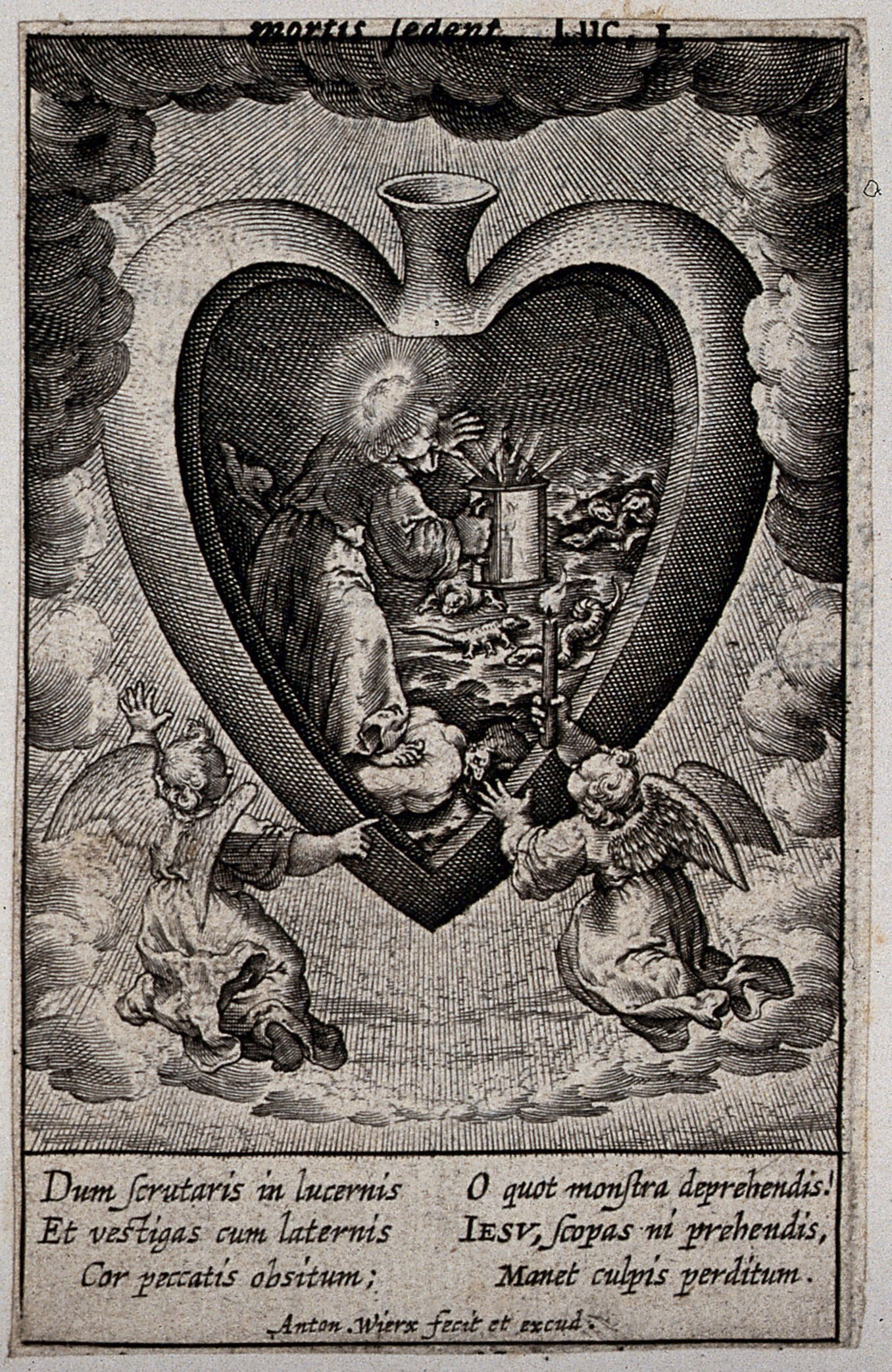
3. Jesus searcheth out the monsters lurking in the dark corners of the heart
Anton Wierix II (Flemish, ca. 1555–1604), Jesus searcheth out the monsters lurking in the dark corners of the heart, ca. 1600. Engraving, image 7.8 × 5.7 cm.
Dum scrutaris in lucernis et vestigas cum laternis cor peccatis obsitum;
o quot monstra deprehendis! Iesus, scopas ni prehendis, manet culpis perditum.
(While you search among the lights and track the heart besieged by sins, oh how many monsters do you find! Jesus, if you do not find a broom, [the heart] remains lost in wrongs.)
From Luzvic:
So long as Jesus is absent from my heart. Ah me! what monsters? what sordidies? what Gorgons? what wicked fiends? what hells are centered there?
When Jesus enters into the heart, and therein pours his light, good God? what foul, what horrible prodigies of vices the mind discovers there which the eyes had never yet detected? I say while Jesus puts forth his rays, what bestial manners? what perfidiousness? what blots of an ungrateful mind? what heinous crimes are represented in this detestable heart?
At these portents the very angels tremble. Yet go thou on, my most sweet Jesus: illuminate the darksome corners of the soul; cleanse this foul, infamous stable. Amid this Cimmerian darkness, with glimpse of thy light bewray [reveal] me to myself that . . . at length [I] may fly to thee, love nothing else but thee. Oh the only Darling of my soul! O only love of my heart, my little Jesus! (60–61)
Oh how I tremble at it, to see how many snakes there are! What spiders, what scorpions, and other such like plagues . . . (65)
Consider, then, how powerfully Jesus, as soon as admitted to enter into the heart, expels and banisheth all sins from the secretes nooks thereof. (68)
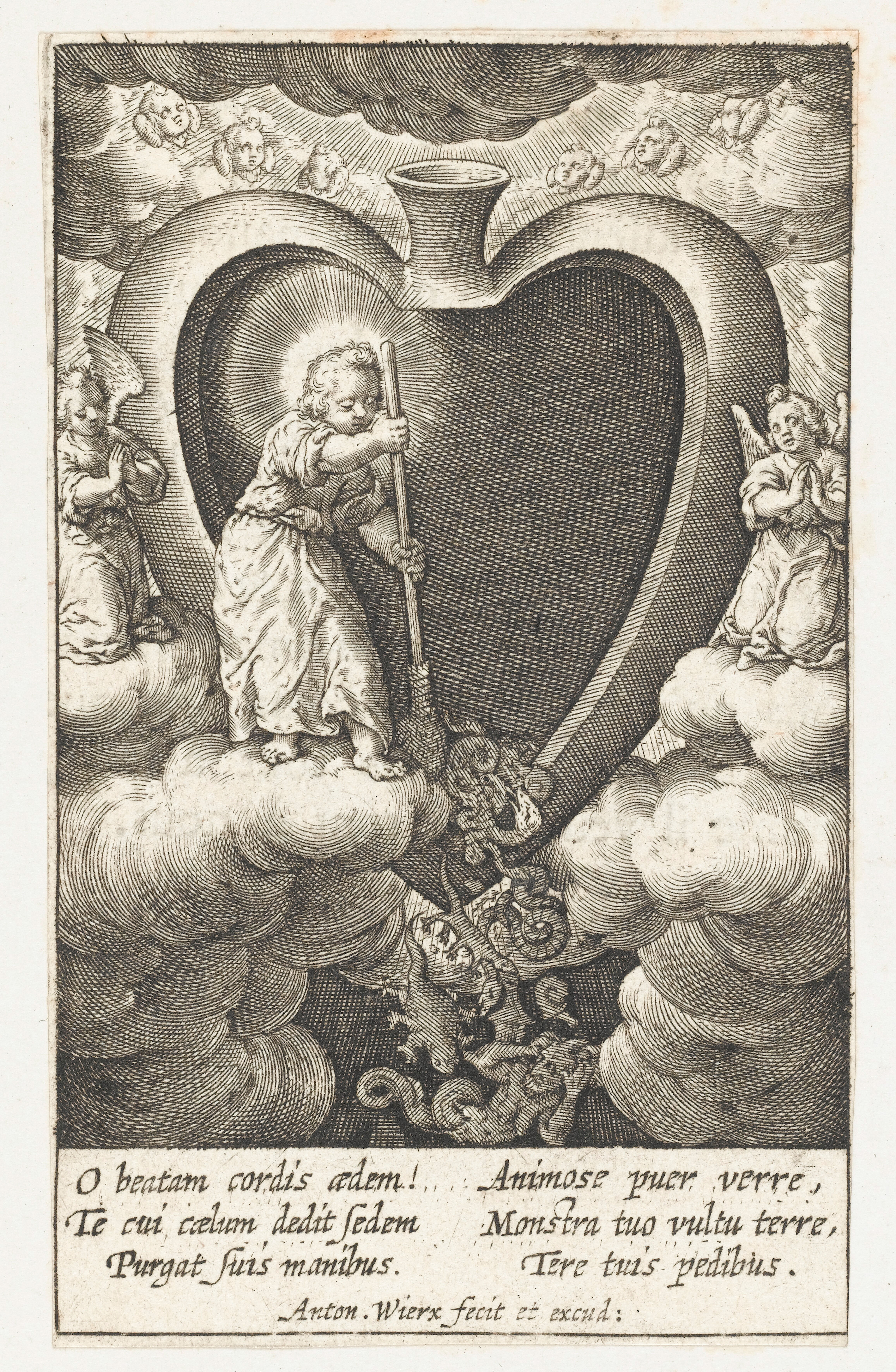
4. Jesus sweeps the dust of sins from the heart
Anton Wierix II (Flemish, ca. 1555–1604), Jesus sweeps the dust of sins from the heart, ca. 1600. Engraving, 7.8 × 5.6 cm.
O beatam cordis aedem! Te cui caelum dedit sedem purgat suis manibus.
Animose puer verre, monstra tuo vultu terre, tere tuis pedibus.
(O blessed temple of the heart! Let him to whom heaven has given his abode clean you with his own hands. Spirited boy, sweep away! Frighten the monsters with your look! Crush them under your feet!)
Once Jesus locates the toads, snakes, and other slimy creatures (symbols of sin) hiding in the heart’s cave, he sweeps them out. Luzvic welcomes this purging:
Go on, my little Jesus, and oh! expel, tread, crush under thy holy feet this poisonous virulence of serpents, which with their venom intoxicate and kill my soul. Destroy them quite, and so frame me a heart wholly according to thy heart. (73–74)
He asks Jesus that, once he banishes the monsters, he keep them out for good:
Thou, most Blessed Darling of my heart, fortify and prevent all the ways and passages of the enemy, and place strong guards at the entrance and gates thereof, lest happily they steal or rush in anywhere . . . (77)
But he also owns his own responsibility in keeping them out:
Oh what dullness of mind is this, what stupidity of heart, that we should so long suffer these monsters to rest and abide with us, as if they were some friends and familiars of ours! Oh truly admirable goodness of God! who hath attended and expected us so long to return to the duty and office of good men; and now at last most powerfully hath brought us into liberty, wherefore we will steadfastly purpose, and determine hereafter, to die rather than once to afford any place in our heart to sins. (82)
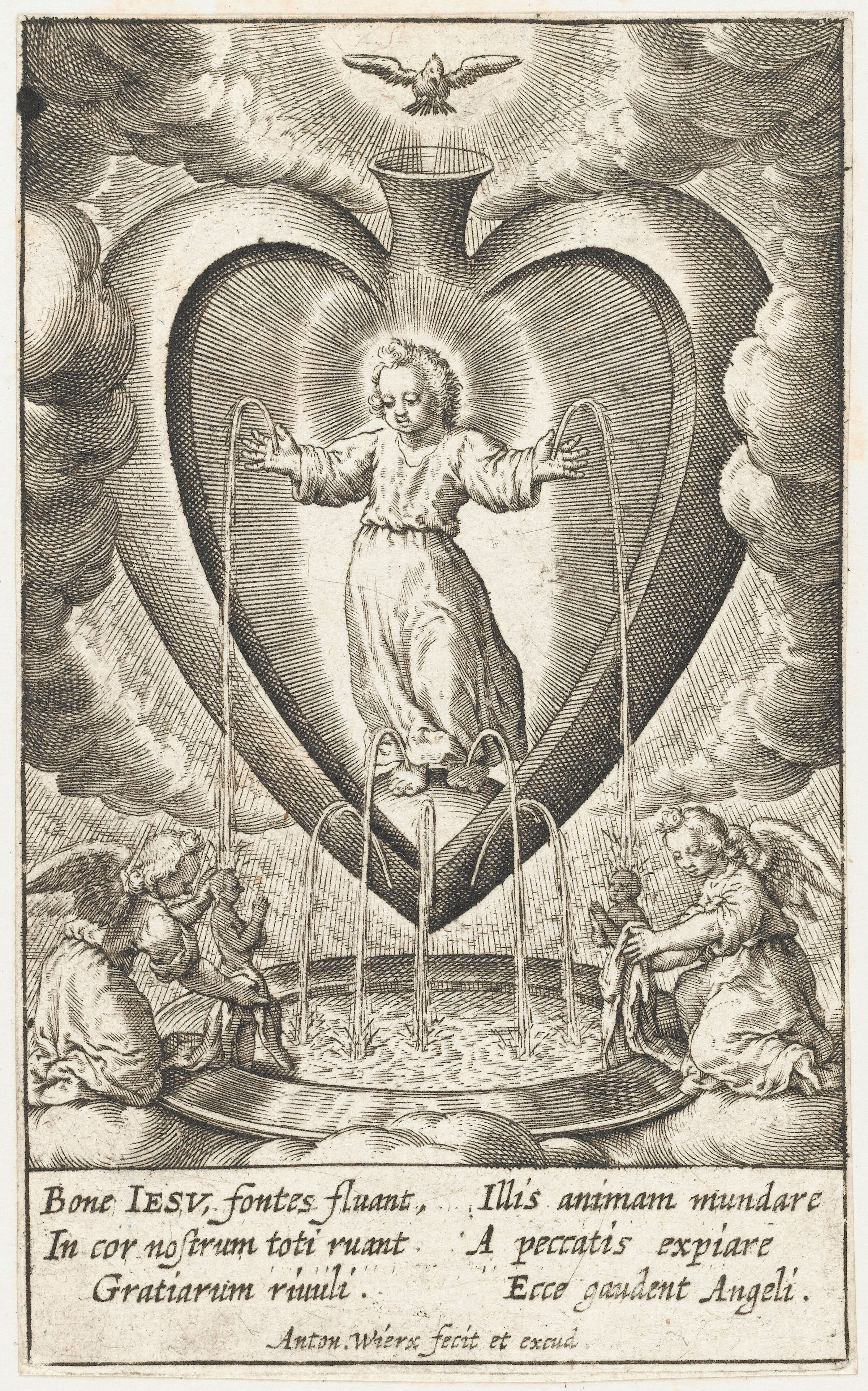
5. Jesus the Living Fountain in the heart
Anton Wierix II (Flemish, ca. 1555–1604), Jesus the Living Fountain in the heart, ca. 1600. Engraving, with etching, image 7.9 × 5.6 cm.
Bone Iesu fontes fluant, in cor nostrum toti ruant, gratiarum rivuli.
Illis animam mundare, a peccatis expiare, Ecce gaudent angeli.
(Good Jesus, into the heart let fountains flow, let all the streams of graces [flow]. With them to clean the soul and expiate [it] from sin, behold angels rejoice.)
In this image, blood flows out of the nail wounds in Christ’s hands and feet—a cleansing, refreshing fount.
Luzvic rhapsodizes,
If Jesus be absent, I am arid, dry, and without juice, so as neither I feel God, nor anything of God. Oh cruel aridity! O fatal drought!
If Jesus be present, he sheds divine dews of graces; he opens springs of incredible sweetness; the heart floats only and swims and sinks in these torrents of celestial delights. Oh grateful dews! O blessed springs! O ineffable delights!
Angelical hands laid hither those waters of life; sprinkle therewith my heart and soul, cleanse, and water them with endless springs of paradise. (85)
He asks God’s angels to “plunge this my dry and thirsty heart, drown it in the ocean of love” (91).
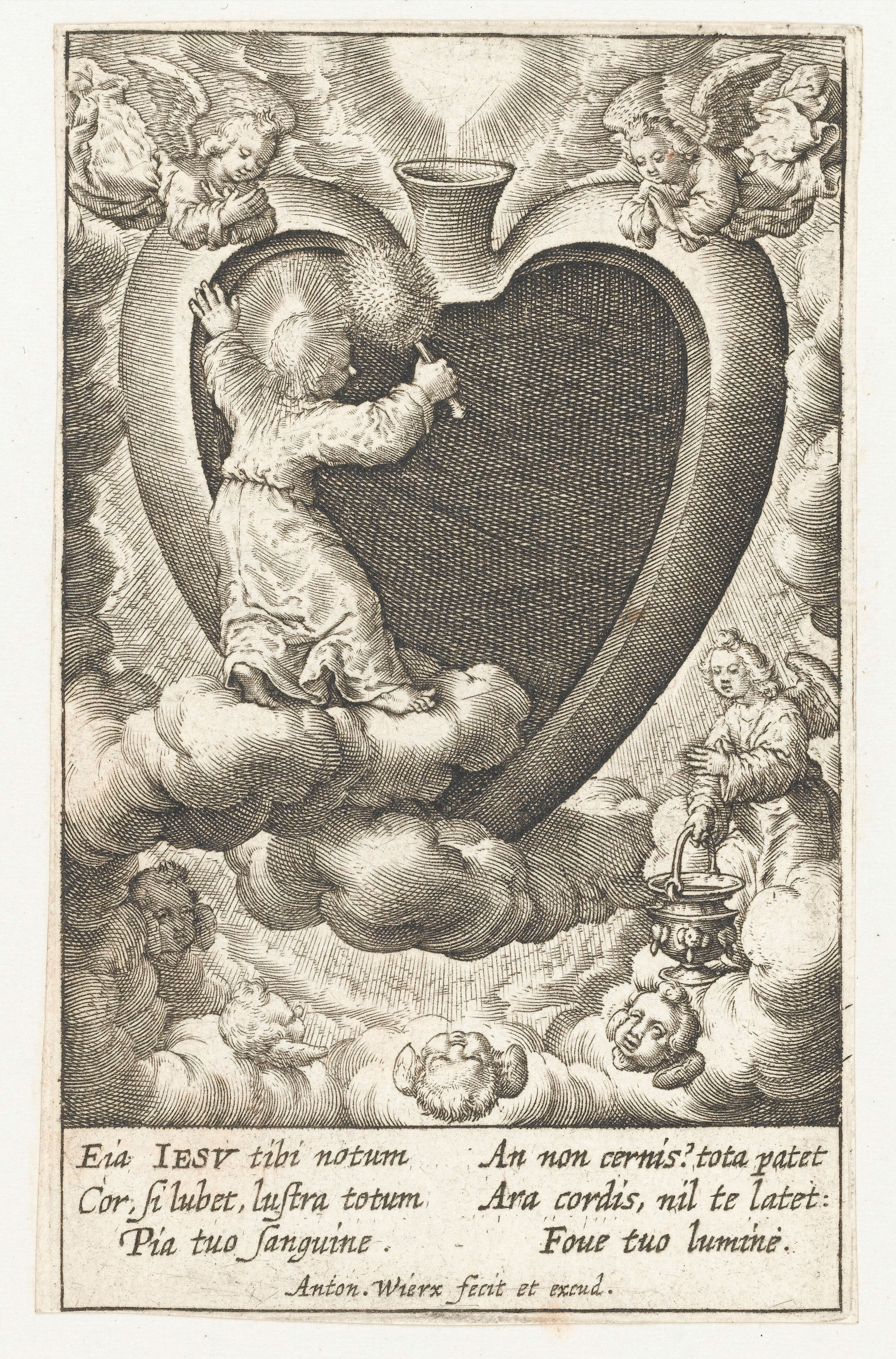
6. Jesus purgeth the heart with expiatory blood
Anton Wierix II (Flemish, ca. 1555–1604), Jesus purgeth the heart with expiatory blood, ca. 1600. Engraving, with etching, image 7.8 × 5.6 cm.
Eia Iesu tibi notum cor, si lubet, lustra totum, pia tuo sanguine.
An non cernis? tota patet ara cordis, nil te latet: Fove tuo lumine.
(Ahh, Jesus, the heart which you know, clean it all, if you like, purify it with your blood! Or do you not see? The whole altar of the heart lies open, nothing is hidden from you. Sustain it with your light.)
“Purge me with hyssop,” prays David the psalmist (Ps. 51:7). In this image Jesus uses an aspergillum to sprinkle his blood on the believer’s heart, much like Moses did with the blood of oxen (Exod. 24:1–8)—sprinkling it on the altar and on God’s covenant people—and like the Levitical priests did with the blood of bulls and goats before the mercy seat (Lev. 16).
Binet writes of the immediate effect: “Lo, the heart came presently to itself again, as soon as it felt but one little drop of thy divine love to be sprinkled on it” (98). I love that phrase: “the heart came presently to itself again.” Jesus reconciles us not only to God but also to ourselves, taking away our guilt so that we can live in the freedom we were always meant to have. He brings us home to our truest selves.
There’s power in the blood! Luzvic beseeches Jesus for just a few drops:
Take, therefore, O Jesus, love of my soul, from this infinite bath of thine some few little drops, at least, and sprinkle thy sanctuary therewith, I say—the ample field of my heart, whose sure possession thou hast taken to thyself long since. (99–100)
7. Jesus rules and reigns in the loving and devout heart
Anton Wierix II (Flemish, ca. 1555–1604), Jesus rules and reigns in the loving and devout heart, ca. 1600. Engraving, with etching, image 7.8 × 5.7 cm.
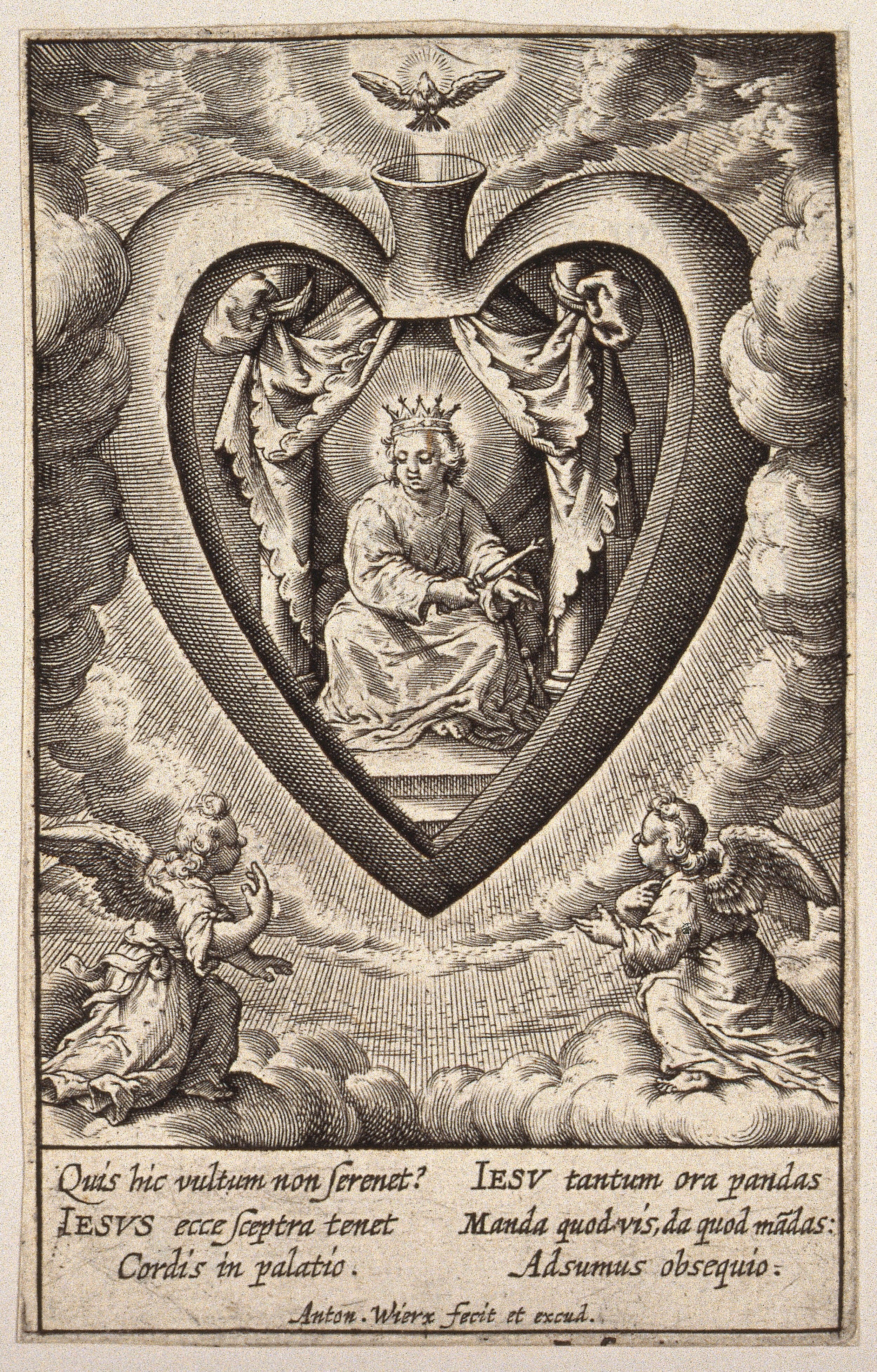
Quis hic vultum non serenet? Iesus ecce sceptra tenet cordis in palatio.
Iesu tantum ora pandas, manda quod vis, da quod mandas; adsumus obsequio.
(Who would not here have a serene expression? Behold, Jesus holds the scepter in the palace of the heart. Jesus, just open your mouth, order what you want, give what you order: we are present to obey.)
Here’s a beautiful prayer by Luzvic. Its last line is a quotation from Song of Solomon 6:3, a book that Christians have read, on one level, as an allegory of the love between Christ and the human soul:
The heart . . . is hungry and thirsty, nor lives contented with any owner, unless thou fix the seat of thy kingdom in its precincts. If thou beest present with, it desires no more; if absent, come in all created things at once and woo it never so much, there will yet be place enough for more. If thou gettest from thence, all felicity departs with thee: if thou abides, all beatitude comes suddenly thither. Reign, therefore, and eternally reign in my heart, O love of my heart. Quiet the motion of perturbations, nor ever suffer the unhappy heart to thrust the king out of his seat, then which cannot happen a greater disaster to it. Nor suffer, I say, O darling and delight of my heart, that one heart should be shared into many parts. For thou sufferest no rival. Oh suffer it not ever to be enticed with the allurements of worldly pleasure, which gate being once set open, I see how easily the enemy will rush in. Be thou to it a brazen, yea, a wall of fire, which may so roundly girt the tower, as that no passage may be found unto it. But that only the Holy Ghost may come down from heaven, whereto the heart lies open, and enter therein with a full gale, and occupy the whole heart, that so I may truly profess and glory, My beloved to me and I to him. (116–18)
8. Jesus teacheth the devout heart
Anton Wierix II (Flemish, ca. 1555–1604), Jesus teacheth the devout heart, ca. 1600. Engraving, with etching, image 7.7 × 5.5 cm.
Sunt auscultent qui Platoni, aut facundo Ciceroni, aut mundi stultitiae.
Tu ne verba vitae sperne: Audi patris aeviterne dicta sapientiae.
(Some listen to Plato or to eloquent Cicero, or to the stupidity of the world. [But] you, do not scorn the words of life! Listen to the Father’s sayings of everlasting wisdom!)
In this image Christ is portrayed as the heart’s instructor. He sits with an open book that reads, “Erunt omnes docibiles Dei” (All shall be the pupils of God).
Luzvic imagines one of the directives he gives:
Hear, my child (for so Jesus advises from the pulpit of the heart): Do thou give thyself to me. Let me be thy possession, thy nurse, thy food, for nothing can satiate thine appetite without me. My child, throw away those leeks and garlic of Egypt, turn thy face from the stinking waters of [vain] pleasure, and put thy mouth rather to my side, the wine-cellar of graces, whence at ease thou mayest draw and derive to thyself most sovereign and incomparable joys. (128–29)
9. Jesus paints the images of the last things in the table of the heart
Anton Wierix II (Flemish, ca. 1555–1604), Jesus paints the images of the last things in the table of the heart, ca. 1600. Engraving, with etching, image 7.8 × 5.7 cm.
Sume Iesu penicilla, corque totum conscribilla piis imaginibus:
sic nec Venus prophanabit, nec Voluptas inquinabit vanis phantasmatibus.
(Take, Jesus, your paintbrushes and daub over the whole heart with holy images. Thus neither shall Venus profane it nor shall pleasure pollute it with empty fantasies.)
The four last things, clockwise from bottom left inside the heart, are death, judgment, heaven, and hell. The image asks Jesus to make these future realities vivid in our minds so that we would live blamelessly until then.
10. Jesus brings the cross into the heart, and easily imprints it in the lover
Anton Wierix II (Flemish, ca. 1555–1604), Jesus brings the cross into the heart, and easily imprints it in the lover, ca. 1600. Engraving, with etching, image 7.8 × 5.6 cm.
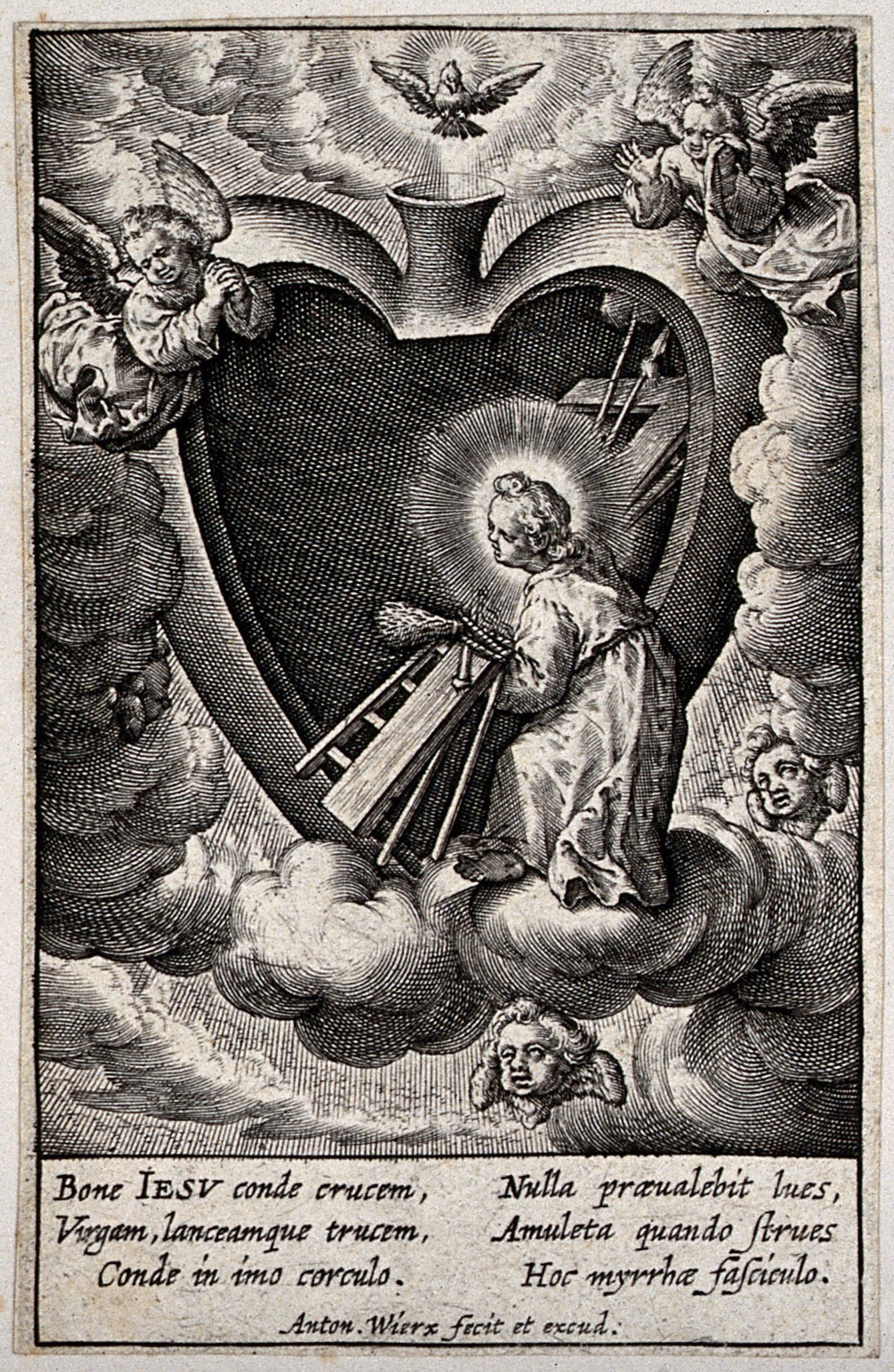
Bone Iesu conde crucem, virgam, Ianceamque trucem, conde in imo corculo.
Nulla praevalebit lues, amuleta quando strues hoc myrrhae fasciculo.
(Good Jesus, stow the cross, the lash, and the cruel lance, stow it at the bottom of the little heart. No sin shall prevail when you pile up this preservative on a gathering of myrrh.)
In this image, Christ deposits the instruments of his passion in the heart of the believer, where they serve as a reminder of the cross-shaped ethic we are to adopt—giving ourselves for others—as well as a call to gratitude for Christ’s sacrifice and a source of strength in times of suffering.
Go in, lovely cross; enter, lance, sponge, nails, scourge; bloody thorns, get you into the closet of the heart. Welcome still, but on this condition that Jesus bring you in himself; for myrrh with Jesus is admirable, and mere sweetness.
Thou sayest thou lovest Jesus; then needs must thou his cross, for if otherwise thou boast to love Jesus, thou deceivest thyself and others.
Most sweet child, what have you and I to do with this lumber here? Scarce art thou come into the world, but thou art oppressed with the weight of punishments. Oh plant thy seat in my heart! and then shall I challenge hell itself: for if Jesus and I hold together, what Hercules can stand against us both? (150–51)
11. The heart consecrated to the love of Jesus is a flourishing garden
Anton Wierix II (Flemish, ca. 1555–1604), The heart consecrated to the love of Jesus is a flourishing garden, ca. 1600. Engraving, with etching, image 7.7 × 5.9 cm.
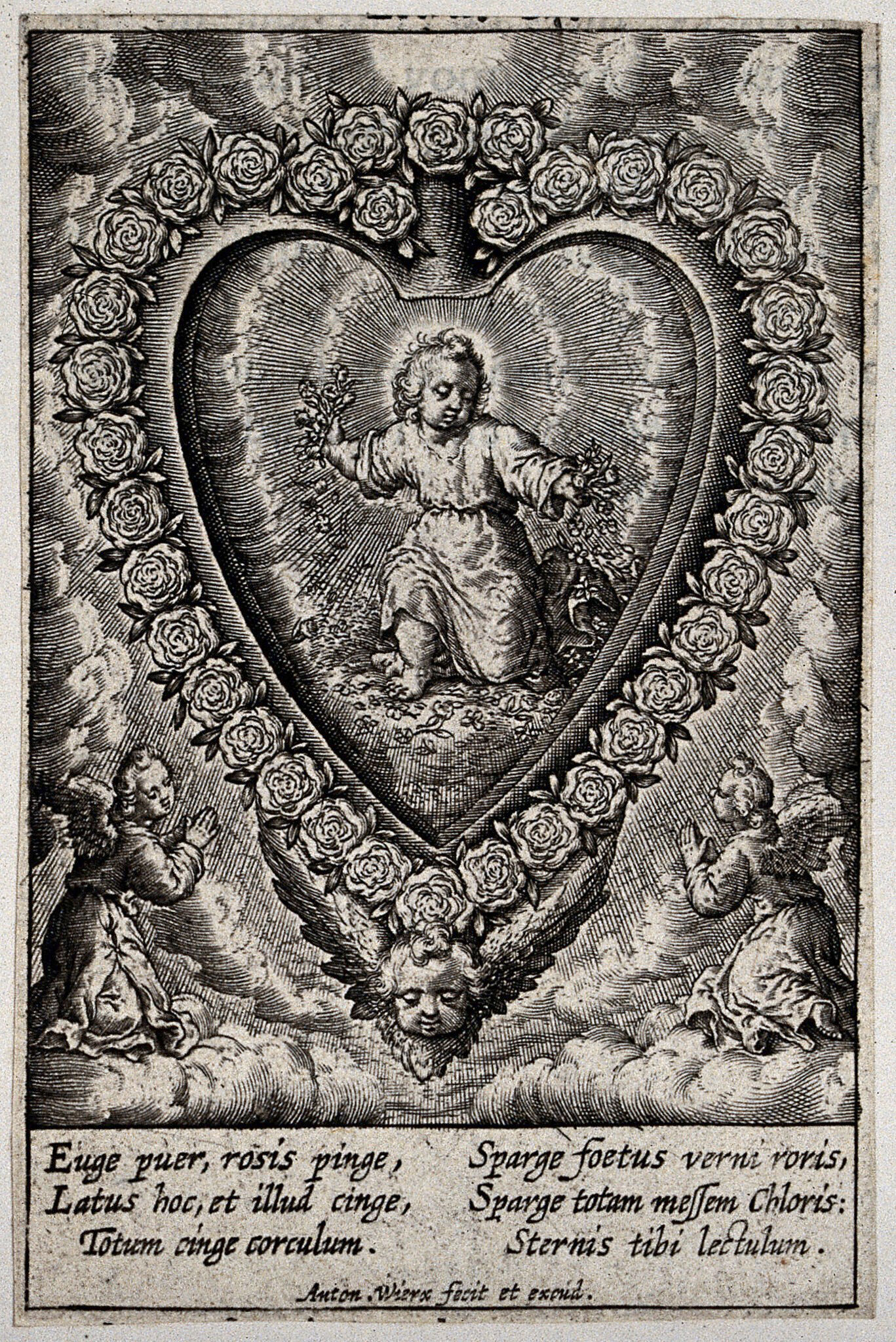
Euge puer, rosis pinge, latus hoc, et illud cinge, totum cinge corculum.
(Bravo, boy! paint this side and that and surround it with roses, surround the entire little heart! Spread the fruit of the spring dew, spread the entire harvest of the realm of flowers: you are [thus] laying a cot for yourself.)
(Alt translation by Walter S. Mellion: Bravo, lad! Embroider with roses now this side, now that, encompass them. Wreath the little heart, all of it. Strew it with the progeny of the springtime dew, with the whole harvest of Chloris: spread for yourself a [flowery] bed.)
Jesus bedecks the heart with roses in this image—makes it beautiful and fragrant. Again, this image evokes the Song of Solomon, with its scenes of lovers in the garden.
12. Jesus sings in the choir of the heart, to the angels playing on musical instruments
Anton Wierix II (Flemish, ca. 1555–1604), Jesus sings in the choir of the heart, to the angels playing on musical instruments, ca. 1600. Engraving, with etching, image 7.8 × 5.5 cm.
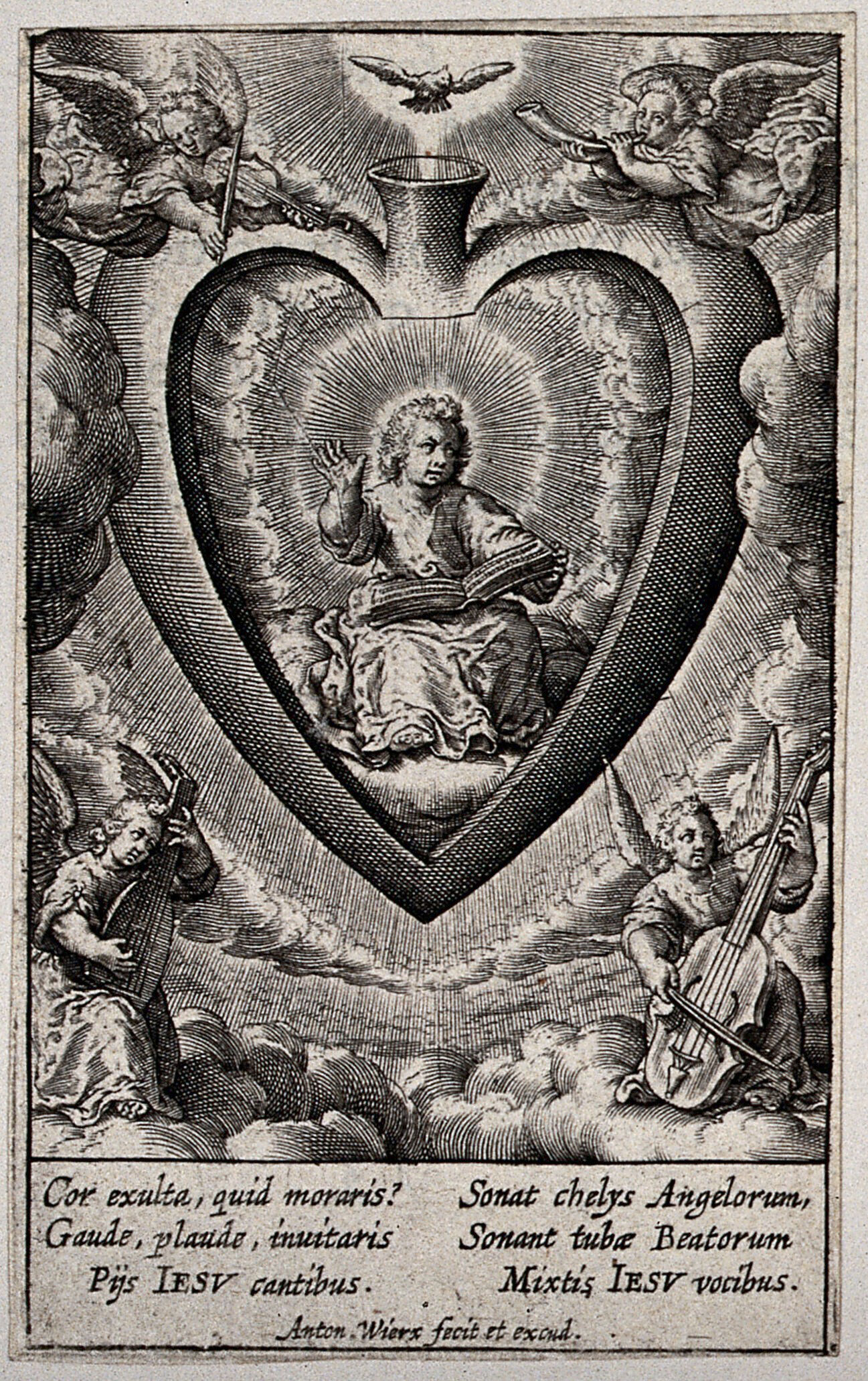
Cor exulta quid moraris? Gaude, plaude, invitaris piis Iesu cantibus.
Sonat chelys angelorum, sonant tubae beatorum mixtis Iesu vocibus.
(Heart, exult! Why do you hesitate? Rejoice! Applaud! Invite Jesus with sacred songs! The [name of] Jesus sounds forth in the lyre of angels, it sounds in the trumpets of the blessed mixed with voices [singing].)
Luzvic fancifully develops the image of Jesus as singer and choir conductor in the sanctum of our hearts, making sweet, melodious music:
I will chant the mercies of the Lord forever. For to this purpose Jesus, the prime Christ, records his ancient loves to the human heart, and now mixing with admirable skill flats with sharps, sharps with flats, the tenor with the bass, and running diversely divisions he touches with a sweet remembrance now with a moderate, now remiss, now slow, and now with a quick voice, the innumerable number of his benefits wherewith heretofore he hath wooed the heart . . . (176)
13. Jesus, the son of David, plays on the harp in the heart, while angels sing
Anton Wierix II (Flemish, ca. 1555–1604), Jesus, the son of David, plays on the harp in the heart, while angels sing, ca. 1600. Engraving, with etching, image 7.5 × 5.7 cm.
Pulsa chordas, sonet chelys, dum nos recreas de caelis Iesu cordis gaudium.
Dulce melos intonabunt, novum nobis excitabunt angeli tripudium.
(Strike the strings! Let the lyre sound forth! While from heaven you renew us, Jesus, joy of the heart. A sweet tune angels shall intone [and they] shall arouse a new dance within us.)
14. Jesus rests in the lover’s heart
Anton Wierix II (Flemish, ca. 1555–1604), Jesus rests in the lover’s heart, ca. 1600. Engraving, with etching, image 7.8 × 5.6 cm.
dum in corde lectum stravit, atque sponsus dormitavit, tuta ridet sponsula.
(In vain the north wind threatens, in vain the thunder runs wild, in vain the sea foams: while in the heart the betrothed has spread his bed and gone to sleep, the bride elect smiles in safety.)
What a moving image—the heart as a place of rest for Jesus. From the four corners the four winds blow, but Jesus is not perturbed, so why should we be? He still has the world in his hands (well, in his lap!).
The image is an allusion to the episode in all three Synoptic Gospels where a storm arises on the Sea of Galilee while Jesus and the disciples are in a boat; the disciples are frantic, and exasperated that Jesus is snoozing, but he tells them not to worry, and then he silences the wind and waves with a command: “Peace, be still!”
The image projects peace and stillness onto our troubled hearts.
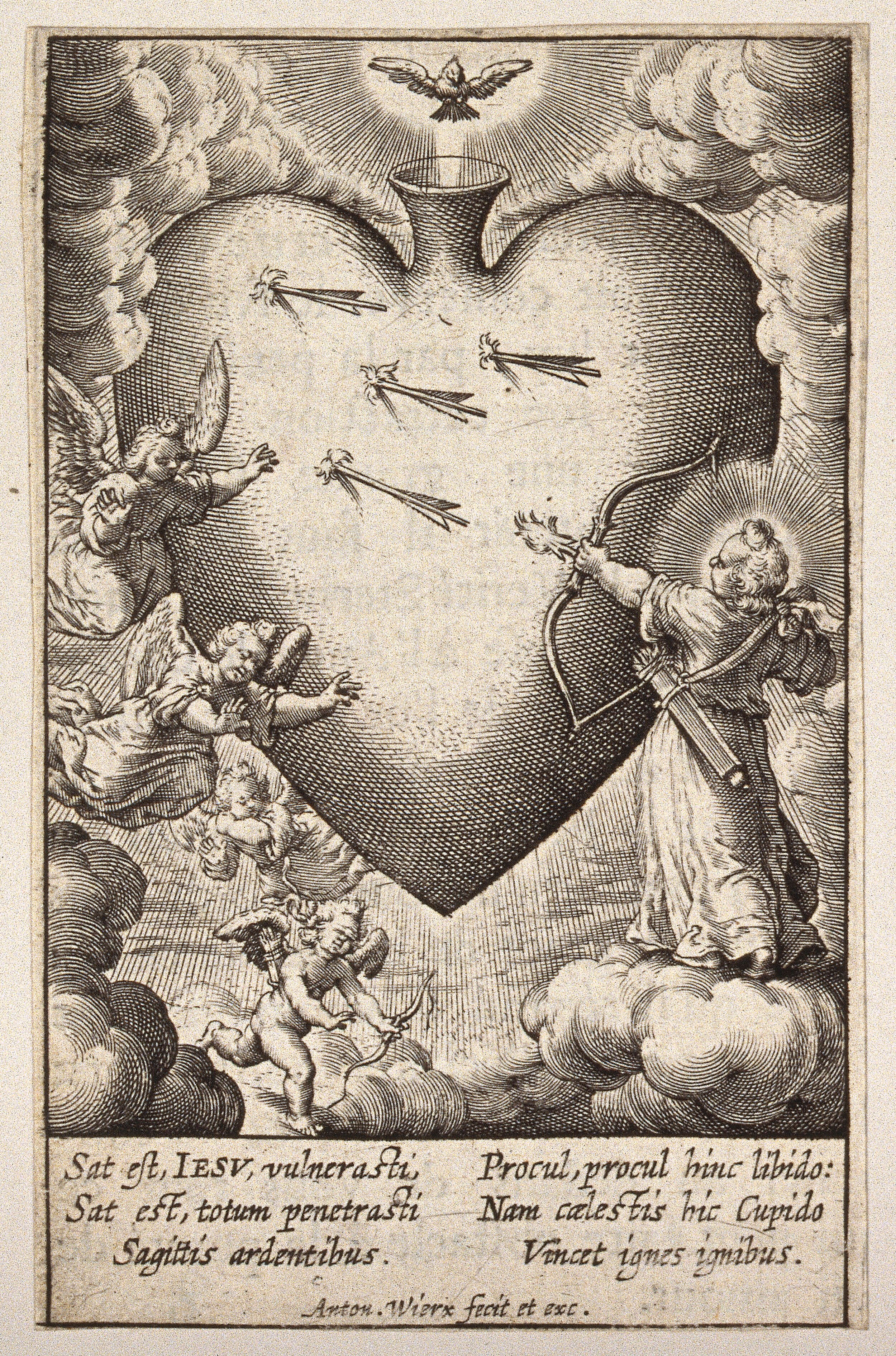
15. Jesus wounds and pierces the heart with the shafts of love
Anton Wierix II (Flemish, ca. 1555–1604), Jesus wounds and pierces the heart with the shafts of love, ca. 1600. Engraving, image 7.8 × 5.7 cm.
Sat est, Iesu, vulnerasti, sat est, totum penetrasti sagittis ardentibus.
Procul, procul hinc libido: nam caelestis hic Cupido vincet ignes ignibus.
(Enough, Jesus, enough! You have shot through the whole heart with flaming arrows. Lust, [be gone] far, far from here! For here is a heavenly Cupid who will conquer fire with fire.)
Luzvic quotes from chapter 2 of Augustine’s Confessions in this section: “Lord, thou hast pierced our hearts with thy charity.”
He elaborates with his own ecstatic words:
My good Archer, shoot, ah, shoot again! shoot through this heart of mine, with a million shafts, this refractory and rebellious heart, to thy divine love: slay and kill all love that is not thine, or is adversary to it. O sweet wounds! O dear to me! O arrows dipped and tipped with honey. . . .
The heart is never in so good a plight as when it is transfixed with a thousand points of sharpest love. (216)
16. The heart enflamed with the love of Jesus shines with light and flames
Anton Wierix II (Flemish, ca. 1555–1604), The heart enflamed with the love of Jesus shines with light and flames, ca. 1600. Engraving, with etching, image 7.8 × 5.7 cm.
En armatas flammis tendit Iesus manus, cor accendit hinc et illinc facibus.
Age, totum comburatur, in favillam redigatur cor amoris ignibus.
(Behold, Jesus holds out his hands armed with flames, and sets alight the heart with torches on this side and that. Come, let it all burn, let the heart be reduced to an ember by the fires of love.)
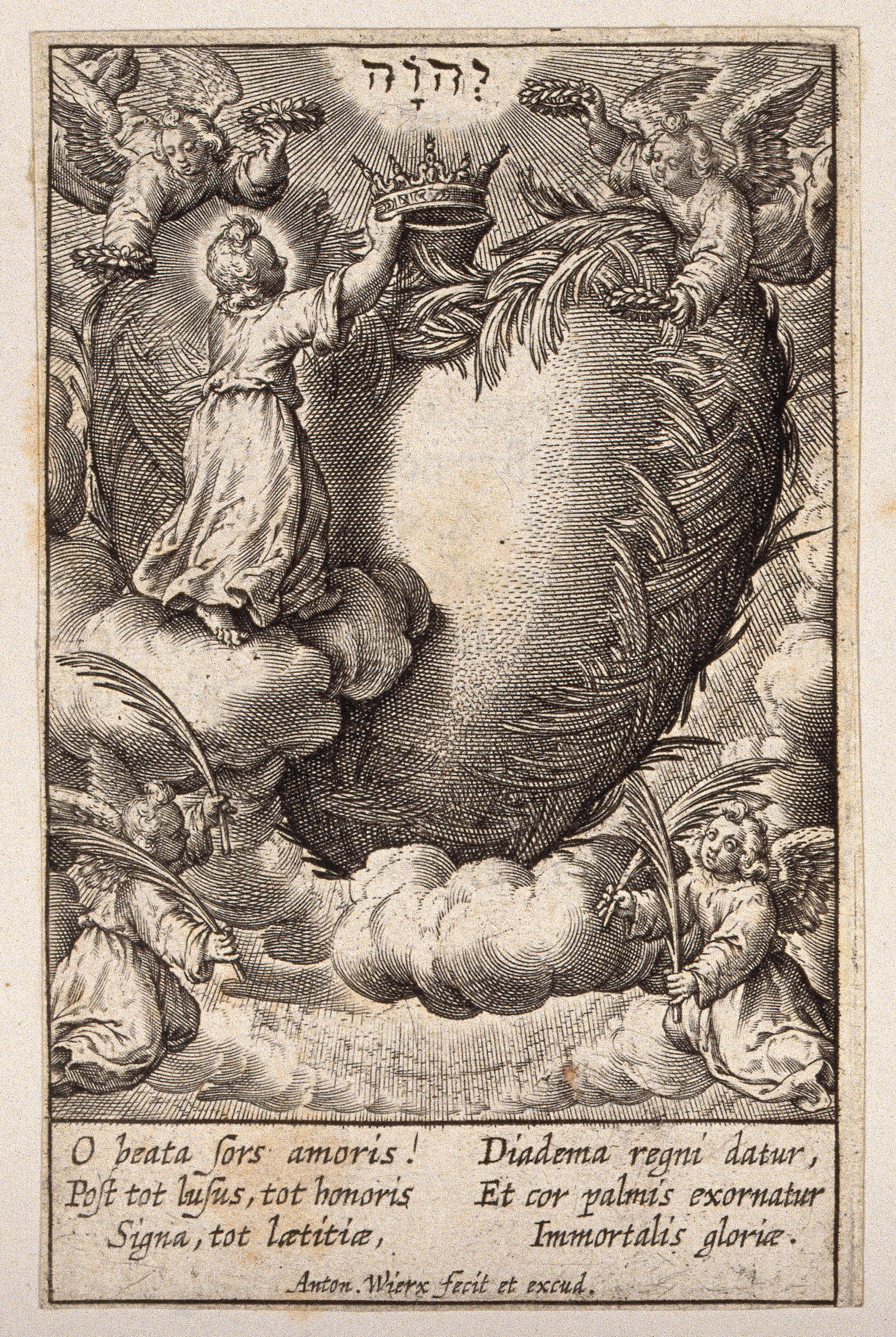
17. Jesus crowns his dear heart with palms and laurels
Anton Wierix II (Flemish, ca. 1555–1604), Jesus crowns his dear heart with palms and laurels, ca. 1600. Engraving, with etching, image 7.8 × 5.5 cm.
O beata sors amoris! Post tot lusus, tot honoris signa, tot laetitiae,
diadema regni datur, et cor palmis exornatur immortalis gloriae.
(O blessed fortune of love! After so many games, so many tokens of honor, so many of joy, the crown of the kingdom is bestowed, and the heart is adorned with the palms of immortal glory.)
* I am excluding the title page engraving from the count, which shows a flaming heart, inscribed with the words Cor Jesu amanti sacrum, held up by a Jesuit and a Franciscan friar; Jesus is not pictured, and there is no corresponding verse. And it appears that the Wellcome Collection does not own (or has not digitized) this print.
FURTHER READING
Daly, Peter M. The Emblem in Early Modern Europe: Contributions to the Theory of the Emblem. Surrey, UK: Ashgate, 2014.
George MacDonald (1824–1905) was a Scottish preacher, poet, essayist, and writer of both realist and fantasy fiction. He was a great influence on J. R. R. Tolkien and C. S. Lewis, the latter of whom published, in 1946, a compilation of MacDonald’s theological writings excerpted from his sermons, novels, and other sources. “I know of hardly any other writer who seems to be closer, or more continually close, to the Spirit of Christ Himself,” Lewis wrote in the preface to George MacDonald: An Anthology.
MacDonald is best known for his fairy tales, such as The Princess and the Goblin (my entrée to the author as a child, via a 1991 animated film adaptation from Wales) and Phantastes. But more recently I have been appreciating his devotional poetry.
George MacDonald, as photographed by his friend and fellow writer Lewis Carroll, 1863
While in his fifties, MacDonald published A Book of Strife in the Form of the Diary of an Old Soul (1880), a collection of 366 short, original, untitled devotional poems, one for each day of the year. (Read it for free online.) Addressed to God, these poems voice discouragement, weariness, restlessness, desire, doubt, and trust. MacDonald asks God for healing and refreshment; for a vulnerable, stripped-down soul, clothed anew in Christ; for salvation from his stubbornness and folly; for guidance through his dark night of the soul; for rightly ordered loves; for Christian growth. He searches for God, confesses his sinful tendencies, praises God for God’s love and faithfulness, and prays for words when words fail him.
Below are my favorite selections—some full poems, some just single lines or excerpts—from MacDonald’s Diary of an Old Soul, which is in the public domain. The headings are my own, to aid in navigating more easily to different topics, and the trifold dividers mark separate entries.
When the book was printed privately in 1880, all the left-hand pages were left blank to encourage thoughtful reader responses; “Let your white page be ground, my print be seed,” MacDonald wrote in the dedication. I’d encourage you, too, to grab a journal and record your own prayers and reflections prompted by any of these verses, or simply to copy out the lines that resonate. And songwriters and composers: I can see potential for musical settings here!
A New Song
Barb thou my words with light, make my song new.
Seeing with the Inner Eye
That thou art nowhere to be found, agree
Wise men, whose eyes are but for surfaces;
Men with eyes opened by the second birth,
To whom the seen, husk of the unseen is,
Descry thee soul of everything on earth.
Who know thy ends, thy means and motions see:
Eyes made for glory soon discover thee.
+++
Lord, in the land of things that swell and seem,
Help me to walk by the other light supreme,
Which shows thy facts behind man’s vaguely hinting dream.
God Transcends All Imagining
What the heart’s dear imagination dares,
Thou dost transcend in measureless majesty
All prayers in one—my God, be unto me
Thy own eternal self, absolutely.
+++
Oh, let me live in thy realities,
Nor substitute my notions for thy facts,
Notion with notion making leagues and pacts;
They are to truth but as dream-deeds to acts,
And questioned, make me doubt of everything.—
“O Lord, my God,” my heart gets up and cries,
“Come thy own self, and with thee my faith bring.”
Be My All
Be thou the well by which I lie and rest;
Be thou my tree of life, my garden ground;
Be thou my home, my fire, my chamber blest,
My book of wisdom, loved of all the best;
Oh, be my friend, each day still newer found,
As the eternal days and nights go round!
Nay, nay—thou art my God, in whom all loves are bound!
In Him and by Him All Things Consist
Thy fishes breathe but where thy waters roll;
Thy birds fly but within thy airy sea;
My soul breathes only in thy infinite soul;
I breathe, I think, I love, I live but thee.
Oh breathe, oh think,—O Love, live into me;
Unworthy is my life till all divine,
Till thou see in me only what is thine.
Practicing the Presence of God at Work
Two things at once, thou know’st I cannot think.
When busy with the work thou givest me,
I cannot consciously think then of thee.
. . . . . . . . . . . . . . . . . . . . . . . . . . . . . . . . . .

Therefore I make provision, ere I begin
To do the thing thou givest me to do,
Praying,—Lord, wake me oftener, lest I sin.
Amidst my work, open thine eyes on me,
That I may wake and laugh, and know and see,
Then with healed heart afresh catch up the clue,
And singing drop into my work anew.
“The life is more than meat, the body more than raiment”
Thy will be done. I yield up everything.
“The life is more than meat”—then more than health;
“The body more than raiment”—then than wealth;
The hairs I made not, thou art numbering.
Thou art my life—I the brook, thou the spring.
Because thine eyes are open, I can see;
Because thou art thyself, ’tis therefore I am me.
On Prayer
Sometimes, hard-trying, it seems I cannot pray—
For doubt, and pain, and anger, and all strife.
Yet some poor half-fledged prayer-bird from the nest
May fall, flit, fly, perch—crouch in the bowery breast
Of the large, nation-healing tree of life;—
Moveless there sit through all the burning day,
And on my heart at night a fresh leaf cooling lay.
+++
In my dead moments, master, stir the prayers.
+++
My prayer-bird was cold—would not away,
Although I set it on the edge of the nest.
Then I bethought me of the story old—
Love-fact or loving fable, thou know’st best—
How, when the children had made sparrows of clay,
Thou mad’st them birds, with wings to flutter and fold:
Take, Lord, my prayer in thy hand, and make it pray.
Prayers in Times of Spiritual Destitution
When I no more can stir my soul to move,
And life is but the ashes of a fire;
When I can but remember that my heart
Once used to live and love, long and aspire,—
Oh, be thou then the first, the one thou art;
Be thou the calling, before all answering love,
And in me wake hope, fear, boundless desire.
+++
There is a misty twilight of the soul,
A sickly eclipse, low brooding o’er a man,
When the poor brain is as an empty bowl,
And the thought-spirit, weariful and wan,
Turning from that which yet it loves the best,
Sinks moveless, with life-poverty opprest:—
Watch then, O Lord, thy feebly glimmering coal.
A Prayer for Joy in All Circumstances
Do thou, my God, my spirit’s weather control;
And as I do not gloom though the day be dun,
Let me not gloom when earth-born vapours roll
Across the infinite zenith of my soul.
Should sudden brain-frost through the heart’s summer run,
Cold, weary, joyless, waste of air and sun,
Thou art my south, my summer-wind, my all, my one.
A Prayer for Victory over Temptation
Haste to me, Lord, when this fool-heart of mine
Begins to gnaw itself with selfish craving;
Or, like a foul thing scarcely worth the saving,
Swoln up with wrath, desireth vengeance fine.
Haste, Lord, to help, when reason favours wrong;
Haste when thy soul, the high-born thing divine,
Is torn by passion’s raving, maniac throng.

Fair freshness of the God-breathed spirit air,
Pass through my soul, and make it strong to love;
Wither with gracious cold what demons dare
Shoot from my hell into my world above;
Let them drop down, like leaves the sun doth sear,
And flutter far into the inane and bare,
Leaving my middle-earth calm, wise, and clear.
A Prayer for Endurance through Trials
Thou wouldst not have thy man crushed back to clay;
It must be, God, thou hast a strength to give
To him that fain would do what thou dost say;
Else how shall any soul repentant live,
Old griefs and new fears hurrying on dismay?
Let pain be what thou wilt, kind and degree,
Only in pain calm thou my heart with thee.
A Prayer for Sanctification
Lord, in my silver is much metal base,
Else should my being by this time have shown
Thee thy own self therein. Therefore do I
Wake in the furnace. I know thou sittest by,
Refining—look, keep looking in to try
Thy silver; master, look and see thy face,
Else here I lie for ever, blank as any stone.

But when in the dim silver thou dost look,
I do behold thy face, though blurred and faint.
Oh joy! no flaw in me thy grace will brook,
But still refine: slow shall the silver pass
From bright to brighter, till, sans spot or taint,
Love, well content, shall see no speck of brass,
And I his perfect face shall hold as in a glass.
A Prayer against Workaholism
Help me to yield my will, in labour even,
Nor toil on toil, greedy of doing, heap.
“My yoke is easy, and my burden is light”
I cannot see, my God, a reason why
From morn to night I go not gladsome, free;
For, if thou art what my soul thinketh thee,
There is no burden but should lightly lie,
No duty but a joy at heart must be:
Love’s perfect will can be nor sore nor small,
For God is light—in him no darkness is at all.
God Our Mother
. . . Weary and worn,
Why not to thee run straight, and be at rest?
Motherward, with toy new, or garment torn,
The child that late forsook her changeless breast,
Runs to home’s heart, the heaven that’s heavenliest . . .
Faith and Doubt
Doubt swells and surges, with swelling doubt behind!
My soul in storm is but a tattered sail,
Streaming its ribbons on the torrent gale;
In calm, ’tis but a limp and flapping thing:
Oh! swell it with thy breath; make it a wing,—
To sweep through thee the ocean, with thee the wind
Nor rest until in thee its haven it shall find.
+++
Ever above my coldness and my doubt
Rises up something, reaching forth a hand:
This thing I know, but cannot understand.
Is it the God in me that rises out
Beyond my self, trailing it up with him,
Towards the spirit-home, the freedom-land,
Beyond my conscious ken, my near horizon’s brim?
New Life
If thou hadst closed my life in seed and husk,
And cast me into soft, warm, damp, dark mould,
All unaware of light come through the dusk,
I yet should feel the split of each shelly fold,
Should feel the growing of my prisoned heart,
And dully dream of being slow unrolled,
And in some other vagueness taking part.

And little as the world I should foreknow
Up into which I was about to rise—
Its rains, its radiance, airs, and warmth, and skies,
How it would greet me, how its wind would blow—
As little, it may be, I do know the good
Which I for years half darkling have pursued—
The second birth for which my nature cries.
+++
“Wake, thou that sleepest; rise up from the dead,
And Christ will give thee light.” I do not know
What sleep is, what is death, or what is light;
But I am waked enough to feel a woe,
To rise and leave death. Stumbling through the night,
To my dim lattice, O calling Christ! I go,
And out into the dark look for thy star-crowned head.
+++
Lord, wake me up; rend swift my coffin-planks;
I pray thee, let me live—alive and free.
Rooted in Christ
Thou in my heart hast planted, gardener divine,
A scion of the tree of life: it grows;
But not in every wind or weather it blows;
The leaves fall sometimes from the baby tree,
And the life-power seems melting into pine;
Yet still the sap keeps struggling to the shine,
And the unseen root clings cramplike unto thee.
Dying to Self
Lord, I have fallen again—a human clod!
Selfish I was, and heedless to offend;
Stood on my rights. Thy own child would not send
Away his shreds of nothing for the whole God!
Wretched, to thee who savest, low I bend:
Give me the power to let my rag-rights go
In the great wind that from thy gulf doth blow.
+++
Lord of essential life, help me to die.
To will to die is one with highest life,
The mightiest act that to Will’s hand doth lie—
Born of God’s essence, and of man’s hard strife:
God, give me strength my evil self to kill,
And die into the heaven of thy pure will.—
Then shall this body’s death be very tolerable.
+++
With every morn my life afresh must break
The crust of self, gathered about me fresh;
That thy wind-spirit may rush in and shake
The darkness out of me, and rend the mesh
The spider-devils spin out of the flesh—
Eager to net the soul before it wake,
That it may slumberous lie, and listen to the snake.
Lost Sheep
Things go not wrong when sudden I fall prone,
But when I snatch my upheld hand from thine,
And, proud or careless, think to walk alone.
Then things go wrong, when I, poor, silly sheep,
To shelves and pits from the good pasture creep;
Not when the shepherd leaves the ninety and nine,
And to the mountains goes, after the foolish one.
“Forgive us our debts, as we forgive our debtors”
Keep me from wrath, let it seem ever so right:
My wrath will never work thy righteousness.
Up, up the hill, to the whiter than snow-shine,
Help me to climb, and dwell in pardon’s light.
I must be pure as thou, or ever less
Than thy design of me—therefore incline
My heart to take men’s wrongs as thou tak’st mine.
Spiritual Riches
Lord, in thy spirit’s hurricane, I pray,
Strip my soul naked—dress it then thy way.
Change for me all my rags to cloth of gold.
Who would not poverty for riches yield?
A hovel sell to buy a treasure-field?
Who would a mess of porridge careful hold
Against the universe’s birthright old?
The Prodigal God
Gloriously wasteful, O my Lord, art thou!
Sunset faints after sunset into the night,
Splendorously dying from thy window-sill—
For ever. Sad our poverty doth bow
Before the riches of thy making might:
Sweep from thy space thy systems at thy will—
In thee the sun sets every sunset still.
God’s Stability
Father of me, thou art my bliss secure.
Make of me, maker, whatsoe’er thou wilt.
Let fancy’s wings hang moulting, hope grow poor,
And doubt steam up from where a joy was spilt—
I lose no time to reason it plain and clear,
But fly to thee, my life’s perfection dear:—
Not what I think, but what thou art, makes sure.
God’s Universality
Where should the unknown treasures of the truth
Lie, but there whence the truth comes out the most—
In the Son of man, folded in love and ruth?
Fair shore we see, fair ocean; but behind
Lie infinite reaches bathing many a coast—
The human thought of the eternal mind,
Pulsed by a living tide, blown by a living wind.
Searching for Pleasure
Ah, me, my God! in thee lies every bliss
Whose shadow men go hunting wearily amiss.
+++
I see a little child whose eager hands
Search the thick stream that drains the crowded street
For possible things hid in its current slow.
Near by, behind him, a great palace stands,
Where kings might welcome nobles to their feet.
Soft sounds, sweet scents, fair sights there only go—
There the child’s father lives, but the child does not know.
Perfect Love
Thou dost demand our love, holy Lord Christ,
And batest nothing of thy modesty;—
Thou know’st no other way to bliss the highest
Than loving thee, the loving, perfectly.
Thou lovest perfectly—that is thy bliss:
We must love like thee, or our being miss—
So, to love perfectly, love perfect Love, love thee.
+++
Lord, with thy breath blow on my being’s fires,
Until, even to the soul with self-love wan,
I yield the primal love, that no return desires.
Surrender
O Christ, my life, possess me utterly.
Take me and make a little Christ of me.
+++
O Master, my desires to work, to know,
To be aware that I do live and grow—
All restless wish for anything not thee
I yield, and on thy altar offer me.
Let me no more from out thy presence go,
But keep me waiting watchful for thy will—
Even while I do it, waiting watchful still.
+++
My Lord, I have no clothes to come to thee;
My shoes are pierced and broken with the road;
I am torn and weathered, wounded with the goad,
And soiled with tugging at my weary load:
The more I need thee! A very prodigal
I stagger into thy presence, Lord of me:
One look, my Christ, and at thy feet I fall!
Freedom
So bound in selfishness am I, so chained,
I know it must be glorious to be free
But know not what, full-fraught, the word doth mean.
By loss on loss I have severely gained
Wisdom enough my slavery to see;
But liberty, pure, absolute, serene,
No freest-visioned slave has ever seen.
+++
So shall abundant entrance me be given
Into the truth, my life’s inheritance.
Lo! as the sun shoots straight from out his tomb,
God-floated, casting round a lordly glance
Into the corners of his endless room,
So, through the rent which thou, O Christ, hast riven,
I enter liberty’s divine expanse.
Receptivity to the Spirit
Faith opens all the windows to God’s wind.
Aging
O Life, why dost thou close me up in death?
O Health, why make me inhabit heaviness?—
I ask, yet know: the sum of this distress,
Pang-haunted body, sore-dismayed mind,
Is but the egg that rounds the winged faith;
When that its path into the air shall find,
My heart will follow, high above cold, rain, and wind.
+++
Thou, healthful Father, art the Ancient of Days,
And Jesus is the eternal youth of thee.
Our old age is the scorching of the bush
By life’s indwelling, incorruptible blaze.
O Life, burn at this feeble shell of me,
Till I the sore singed garment off shall push,
Flap out my Psyche wings, and to thee rush.
+++
My harvest withers. Health, my means to live—
All things seem rushing straight into the dark.
But the dark still is God. I would not give
The smallest silver-piece to turn the rush
Backward or sideways. Am I not a spark
Of him who is the light?—Fair hope doth flush
My east.—Divine success—Oh, hush and hark!
Death
God, thou from death dost lift me. As I rise,
Its Lethe from my garment drips and flows.
Ere long I shall be safe in upper air,
With thee, my life—with thee, my answered prayer,
Where thou art God in every wind that blows,
And self alone, and ever, softly dies,
There shall my being blossom, and I know it fair.
+++
I was like Peter when he began to sink.
To thee a new prayer therefore I have got—
That, when Death comes in earnest to my door,
Thou wouldst thyself go, when the latch doth clink,
And lead him to my room, up to my cot;
Then hold thy child’s hand, hold and leave him not,
Till Death has done with him for evermore.
The Diary of an Old Soul represents only a fraction of the poetry George MacDonald wrote. To explore more, see The Poetical Works of George MacDonald, vols. 1 and 2 (1893). Seeing as next year is the bicentenary of his birth, I expect to be hearing his name a lot more!
Published last month by Brazos Press, the book consists of ten chapters, each one built around a theologically charged word or concept (such as “sin,” “image of God,” or “lament”) and a twentieth-century novel or poem(s) by a Black author that is then engaged through that lens. A potential danger with this approach is that the interpretations in either direction could be forced to fit into a box, but this turned out not to be the case at all. Reading Black Books is a two-way, mutually enriching exchange between theology and literature, one that is expansive rather than limiting and that takes each discipline seriously on its own terms.
Combining literary analysis and theological reflection, Atcho shows how “God’s truth addresses Black experience and how Black experience, as shown in the literature of our great writers, can prod readers from all backgrounds toward sharper theological thinking and more faithful living” (1). We are invited to inhabit the experiences of various characters and poetic voices and to be transformed as a result. As a middle-class white woman living in a Maryland suburb, I acknowledge that I move about the world with a very different set of experiences than those of people of color. With pastoral sensitivity but also directness, Atcho helps me enter into America’s racial narrative—and the narrative of the gospel!—from a different vantage point. This book is for Christians of any race who desire to be enlarged by story and to live more fully into the liberative arc of scripture.
Atcho provides enough context for each book—introducing us to characters, rehearsing relevant plot points, and highlighting specific scenes, often including quoted excerpts—that you don’t have to have read the work previously to benefit from his commentary. The book does contain spoilers, as all serious literary criticism almost inevitably will. But literature is way more than plot, and readers are encouraged to then engage with the primary texts in full on their own, equipped with frames for thinking about them and open to surprises.
I have attempted to come to this book about books as a guide who integrates my affections: my love for these stories, my love for what they say about Black experience in both trials and triumphs, and my love for Jesus and his kingdom.
Claude Atcho, p. 7
Chapter 1 examines the question “What does it mean to live as an image bearer when other image bearers try to limit your existence?” The protagonist of Ralph Ellison’s Invisible Man (not to be confused with H. G. Wells’s sci-fi novel The Invisible Man) is not physically invisible; rather, he is rendered invisible by others’ refusal to see him. Atcho discusses the need for white sight—our warped “inner eyes”—to be redeemed.
Chapter 2 explores how systemic sin exacerbates personal sin through the controversial character of Bigger Thomas in Richard Wright’s Native Son, a Black man from 1930s Chicago who kills two people (the first one accidentally). Is Bigger a victim or a perpetrator? The question is too simplistic. Bigger is both trapped by Sin and an agent of Sin, Atcho says. Atcho’s explication of Sin with a capital S and sin, little s, is sophisticated and illuminates for me broader discussions going on in contemporary culture. Sin is not just personally experienced and personally enacted; it is also a dominating force that’s been set loose in our world and that has become embedded in systems.
The focus of chapter 3 is James Baldwin’s semiautobiographical debut novel Go Tell It on the Mountain, “a critical generational portrait of the toxic Christian practice that emerges from belief in a loveless God” (40). Baldwin gestures toward true religion through negation—by presenting the character of Gabriel, the protagonist’s minister stepfather, as a promiscuous and abusive binge drinker with a lust for power.
Chapter 4 visits “Christ Recrucified” and the nine-hundred-line “The Black Christ” (read the first stanza here) by Harlem Renaissance poet Countee Cullen, unpacking the picture they paint of a Jesus who suffers for, like, and with us. Published in the 1920s, both poems compare the crucified Christ to a lynched Black man.
In chapter 5 Zora Neale Hurston’s Moses, Man of the Mountain, a folkloric retelling of the book of Exodus, opens up a quest into the doctrine of salvation. Atcho discusses salvation from and to, which story and script forms us most (the old empire or the coming kingdom?), the significance of the promised land, and Christian social concern as a biblical imperative.
The deliverance of the exodus elides the false dichotomy of a truncated salvation. Hurston’s Moses points in the same direction—toward imagining a fully orbed salvation, as did our enslaved ancestors: revelation and liberation.
Is it our attention, then, to be fixed on the sin of slavery or our slavery to sin? Personal piety in the power of the Spirit or social change in Jesus’s name? Liberation or revelation? In the exodus, the Lord frees his people so that they might exist in freedom for him. It is liberation through revelation and atonement. God’s revelation (Exod. 9:4, 16, 29; 10:1–2; 11:7; 14:4), the necessity of atonement (13:13, 15), the urgency of liberation (2:23–25), and the subsequent call to holiness (31:13; Lev. 20:8) cannot be isolated. In the exodus, each motif exists in relation, forming the full melody of salvation. The song of salvation is not played in only one key. The contextual pressures of human experience can force us, understandably at times, to prize piety or liberation when truly salvation expands and contains both—and more. (84–85)
Nella Larsen’s Passing—which was adapted into an acclaimed film last year—is the subject of chapter 6, on racism. The novella delves into the psyches of two light-skinned Black women in 1920s Harlem, one of whom passes for white in all settings as a means of survival, and the other of whom does so only when convenient. Atcho talks about the need to combat colorism with affirmation (e.g., “Black is beautiful”), with denial, and through the flesh of Christ.
Chapter 7 spotlights Beloved, a gothic novel by Toni Morrison that combines the historical and the supernatural to tell the story of a devoted mother named Sethe who is seeking freedom from enslavement. At one point she escapes with her children, but when the authorities find them she kills her two-year-old daughter (who is unnamed in the novel and referred to as “Beloved,” the sole word on her tombstone) rather than relinquish her to a life of slavery. Sethe is ultimately able to get away to an Ohio farmhouse, which becomes haunted by Beloved’s ghost.
Atcho discusses the traumas of enslavement that continue to compound and haunt the body, mind, and soul even after one becomes “free”; the need for righteous rage; enfleshment and bodily liturgy; chattel slavery’s theft of the mother-child relationship; memory as a muscle that needs to be exercised transparently, communally, and redemptively; new creation and anticreation; and exorcism, rescue.
One of the most compelling characters in the novel is Sethe’s mother-in-law, Baby Suggs. A shepherdess of bodies and souls, she creates a new space in the woods near the farmhouse where she enacts weekly liturgies of healing. She directs her people, in Atcho’s words, “to move and be in the sacred humanity that they are and that has so viciously been attacked by those who enslaved and debased them” (117). A key passage in Beloved describes this communal gathering:
After situating herself on a huge flat-sided rock, Baby Suggs bowed her head and prayed silently. The company watched her from the trees. They knew she was ready when she put her stick down. Then she shouted, “Let the children come!” and they ran from the trees toward her.
“Let your mothers hear you laugh,” she told them, and the woods rang. The adults looked on and could not help smiling.
Then “Let the grown men come,” she shouted. They stepped out one by one from among the ringing trees.
“Let your wives and your children see you dance,” she told them, and groundlife shuddered under their feet.
Finally she called the women to her. “Cry,” she told them. “For the living and the dead. Just cry.” And without covering their eyes the women let loose.
It started that way: laughing children, dancing men, crying women and then it got mixed up. Women stopped crying and danced; men sat down and cried; children danced, women laughed, children cried until, exhausted and riven, all and each lay about the Clearing damp and gasping for breath. In the silence that followed, Baby Suggs, holy, offered up to them her great big heart. . . .
“Here,” she said, “in this here place, we flesh; flesh that weeps, laughs; flesh that dances on bare feet in grass. Love it. Love it hard. Yonder they do not love your flesh . . .”
Baby Suggs then goes on to list various parts of the body—eyes, skin, hands, mouth, neck, liver, heart—contrasting what “yonder” men do to those parts (gouge, flay, chop, beat, hang, expose and feed to hogs) with each part’s innate belovedness. Atcho’s comments on this passage—a passage that has stuck with me ever since I first read the novel some fifteen years ago—are among the best in the book.
Chapter 8 is on the theme of lament, and it considers that biblical practice in relation to the poem “A Litany of Atlanta” by W. E. B. Du Bois while also looking at the Psalms and the cross. “There is . . . power in lament that names injustice for what it is,” Atcho writes. “By naming it as such and placing it before God as counter to his moral will, lament teaches us to make no peace with injustice or oppression” (137). Bearing true witness against evil, the poem was written in response to the three-day reign of racial terror that white men unleashed on a Black community in Atlanta in September 1906, killing, maiming, and destroying homes and businesses. It opens, “O Silent God, Thou whose voice afar in mist and mystery hath left our ears an-hungered in these fearful days— / Hear us, good Lord!”
Chapter 9 takes a look at another novel by Richard Wright, The Man Who Lived Underground, published for the first time last year, sixty-one years after the author’s death. (Publishers rejected it during Wright’s lifetime.) It follows Fred Daniels, a Black man who, after being picked up by police and relentlessly tortured, confesses to a double murder that he did not commit, then flees into the city’s sewer system. “The underground” confers on him a new knowledge of the world’s foundations of falsehood and injustice. At the end, he meets his demise.
To imagine a more just world, one must reckon with the world that is.
Claude Atcho, p. 145
Even though the novel promotes a worldview that is bleak and fatalistic, reading it can still be constructive, Atcho says; as Christians, we carry our hope to bleak texts. What would it look like to see this senseless world reconfigured into wholeness and justice? Atcho calls us to action, away from discrimination, violence, and power abuse and toward the pursuit of justice for all people on earth as it is in heaven.
It’s fitting that the last chapter centers on hope, particularly as expressed through Margaret Walker’s poem “For My People.” Atcho describes the poem as “a living history, an ode, an exhortation, a lament, a prayer” that “embodies the fiery passion of a communal hope, a bond of persons and destiny” (160, 166). While the majority of the poem addresses Walker’s Black kin, at the end she expands “my people” to embrace all of humanity, “all the adams and eves.”
+++
Throughout Atcho’s book we see the legacies of racial oppression in America—how it manifests today. Though the most recent of the featured literary works is from 1989, they all speak into our current moment. I appreciate how Atcho defines terms that show up a lot in public discourse, such as liberation and justice, comparing cultural definitions with biblical ones. But he leads with story. While in the public square our tendency is often to arm ourselves with arguments to bolster our views and defend against attacks, story has a way of disarming us. Abstract concepts become incarnate in the lives of characters. Literature can teach us the discipline of listening and can develop our empathy and understanding. It may prompt us to assess our own prejudices or complicities and impel us to repentance and real change.
Reading Black Books demonstrates the power of great literature to form us spiritually, regardless of the faith commitments of its author. Atcho presumes no theological agenda on the part of the writers, but rather chooses to read these works theologically—which can unlock more nuanced interpretations or deepened meaning. Applying a theological framework, Atcho draws out themes from the works that cannot be addressed quite as well, I’d say, without theological language. He connects our collective human story to God’s story.
The back matter includes discussion questions for each chapter.
Though I had previously read and studied all four poems Atcho discusses, I’ve read only one of the seven novels—and this despite my having been an English major in college! This book makes me want to read more for sure. I’ve already stocked up my library accordingly. I’m grateful to Atcho for reactivating my interest in fiction and for extending it in the direction of these seminal African American novels.
Leroy Almon (American, 1938–1997), Mr. & Mrs. Satan Fishing, 1991. Polychrome bas-relief wood carving, 22 1/2 × 24 in. Gordon Gallery, Nashville.
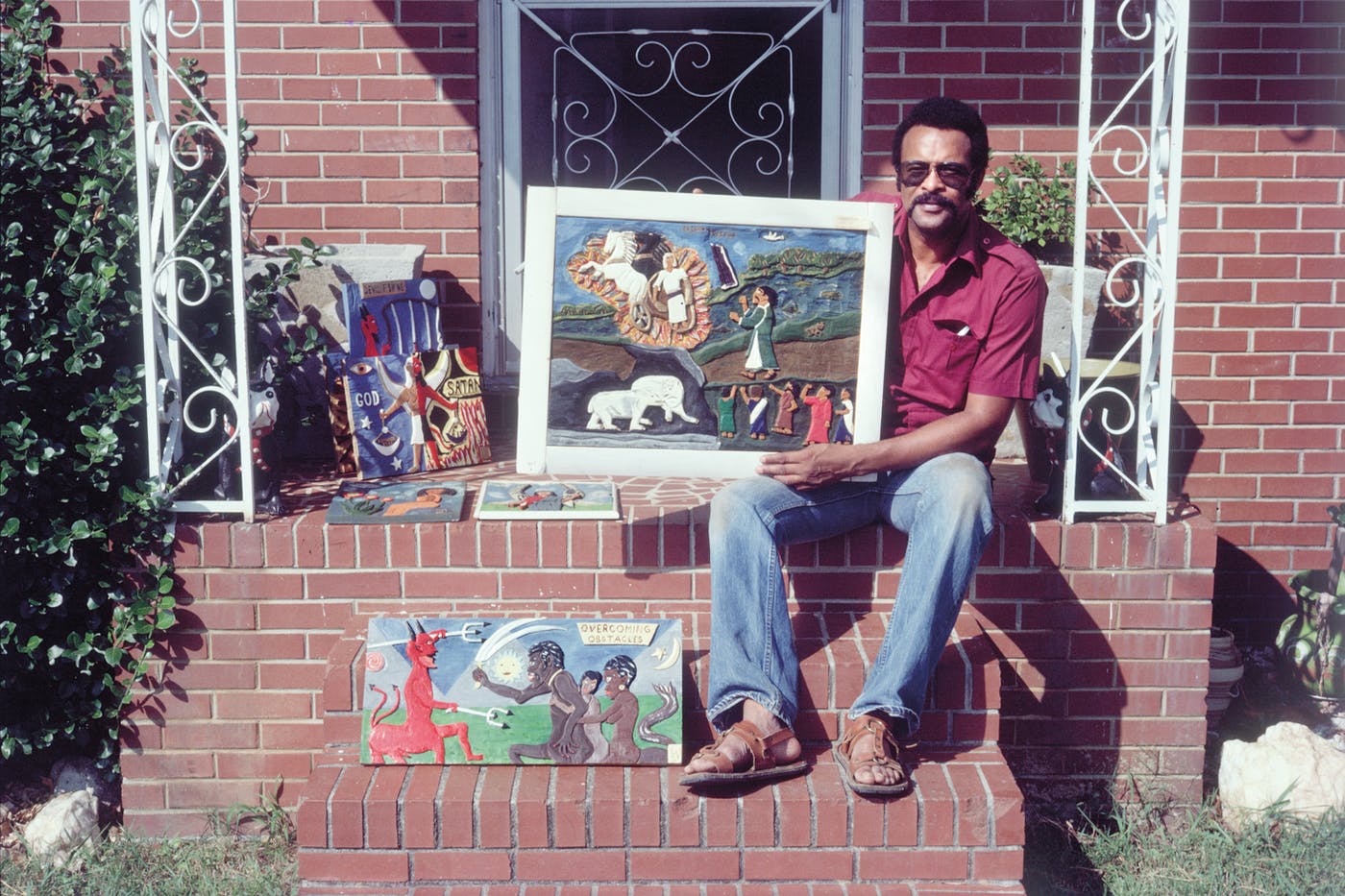
Leroy Almon (1938–1997) was born in Tallapoosa, Georgia, but grew up in Ohio. While working for Coca-Cola in Columbus, he met the self-taught woodcarver Elijah Pierce [previously] at Gay Tabernacle Baptist Church, where Pierce served as lay preacher, and in 1979 became apprenticed to him. Pierce taught Almon how to make low-relief carvings in wood using pocketknives and hand chisels, and then to paint them. Initially the two collaborated on pieces, until 1982, when Almon returned to Tallapoosa. There he restored his childhood home, converting the basement into an art studio. Like his mentor, he too combined the vocations of art making and evangelical preaching.
Almon is well known for his didactic carvings on the subjects of religion, politics, and African American history. The battle between good and evil is at the forefront of his art. Satan fishing for souls is a theme he developed and returned to many times in variation; see, for example, here, here, here, and here. Such carvings show a caricatured Satan (red, horned, spiky-tailed, and goateed) dangling various vices—gambling, promiscuity, sex, drugs, greed, hypocrisy, etc.—as bait before humans who appear ready to bite. Sometimes he’s joined by his wife, Mrs. Satan!
In the version at the Gordon Gallery in Nashville, cards, cash, a romantic couple (presumably unwed), alcohol, cigarettes, a bomb, hard drugs, and a church building are on the line. The latter symbolizes the false piety of many churchgoers and the corruption inside institutionalized Christianity.
In The New Encyclopedia of Southern Culture, Vol. 23: Folk Art, Jenifer P. Borum praises Almon’s ability to “mix fire-and-brimstone warnings about the world’s evils with a playful sense of humor”; she refers to the “comic moralism” of his work. My first reaction upon seeing Mr. & Mrs. Satan Fishing was to laugh out loud. But then I wondered whether the humor was intentional. Does the artist want us to chuckle? I haven’t been able to find any statements from Almon. The image likely represents very real temptations that afflicted his community and maybe, some of them, him personally. I suppose the humor could be self-conscious, but if so, it’s a dark humor—gravitas masked in levity. Almon knew that “like a roaring lion [our] adversary the devil prowls around, looking for someone to devour” (1 Pet. 5:8).
Leroy Almon on his front stoop in Tallapoosa, Georgia, 1987. Photo: Roger Manley.
LISTEN: “The Devil Ain’t Lazy” by Fred Rose; originally recorded by Bob Wills & His Texas Playboys, 1947 | Performed by Pokey LaFarge on Pokey LaFarge, 2013
The devil ain’t lazy (No siree) The devil ain’t lazy (No siree)
He roams around with sticks and stones Passing out his moans and groans The devil ain’t no lazy bones He works 24 hours a day
The devil ain’t lazy (No siree) The devil ain’t lazy (No siree)
He likes to see us fight and fuss Makes us mean enough to cuss Then he blames it all on us He works 24 hours a day
He travels like a lightning streak And he strikes from town to town Then he gets you when you’re weak He’ll tear your playhouse down
The devil ain’t lazy (No siree) The devil ain’t lazy (No siree)
He tells us he won’t hurt a fly Then he makes us steal and lie Keeps us sinning until we die He works 24 hours a day
The devil ain’t lazy (No siree) The devil ain’t lazy (No siree)
Gets his pitchfork out each night Gives the folks an awful fright I know he does it just for spite He works 24 hours a day
The devil ain’t lazy (No siree) The devil ain’t lazy (No siree)
Tells us how to find success I know he’ll wind up in distress I’ll tell ya why: the devil is an awful mess He works 24 hours a day
He likes to see things scorch and burn He don’t make no excuse If he catches you, he’ll turn you Every way but loose
The devil ain’t lazy (No siree) The devil ain’t lazy (No siree)
So if you think you’re strong and brave Smart enough to not behave You got one foot in the grave He works 24 hours a day 24 hours a day (Yes, he does!) He works 24 hours a day He works 24 hours a day
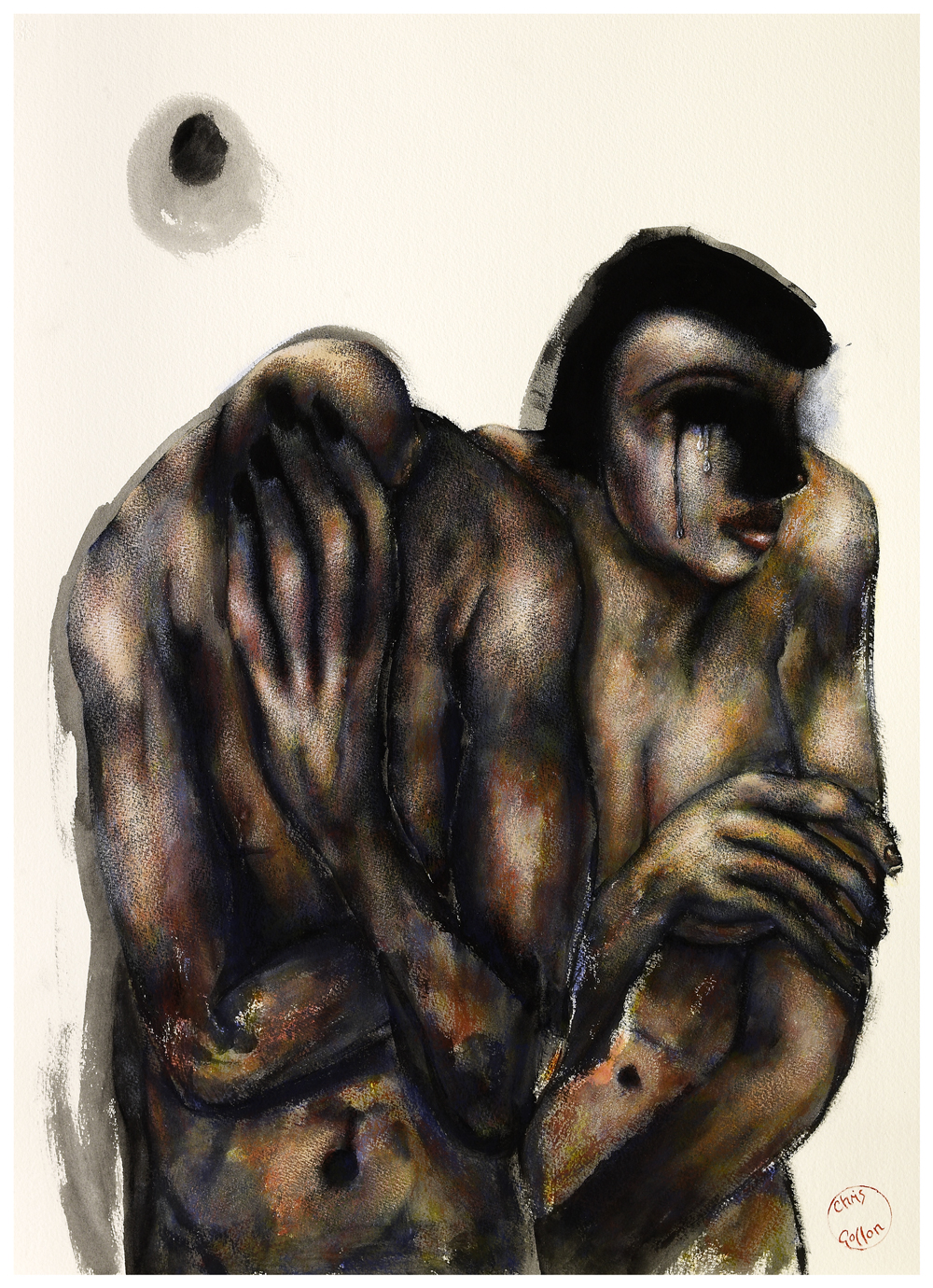
Chris Gollon (British, 1953–2017), Expulsion from Paradise, 2013. Acrylic on paper, 30 × 22 in. (76 × 56 cm).
So when the woman saw that the tree was good for food, and that it was a delight to the eyes, and that the tree was to be desired to make one wise, she took of its fruit and ate, and she also gave some to her husband who was with her, and he ate. Then the eyes of both were opened . . .
The fall, the fall, oh God, the fall of man
The fruit is found in every eye and every hand
Nothing, there is nothing yet, in truest form
We walk like ghosts upon the earth; the ground, it groans
How long, how long will you wait?
How long, how long till you save us all, save us all?
Turn your face to me, turn your face to me
Turn your face to me, turn your face to me
The light, the light, the morning light is gone
And all that’s left is fragile breath and failing lungs
The night, the night, the guiding night has come
Uniting lover with his bride, more precious than the dawn
How long, how long must we wait?
Turn your face to me, turn your face to me
Turn your face to me, turn your face to me
Because of the music behind “Turn your face to me”—soft and smooth, consonant, calm not frantic like the rest—I read this refrain as being spoken by God. The humans lament their fall, asking how long they must wait for salvation, and God gently responds: it’s available now, just turn your face to me.
The idea of “ghosts upon the earth” is inspired by C. S. Lewis’s allegorical novel The Great Divorce, in which a group of travelers from a “grey town” are taken by bus to heaven, a land that proves to be far more solid, more real, than even the travelers’ own bodies. “Sometimes it seems like the most real thing is what we can see and experience with our senses around us—this life, the tangible,” Michael Gungor said. “Ideas like love, like God, these things sometimes feel more disconnected and ethereal, like that’s the ghostly realm. But what if that’s wrong and God and love is actually what is most real, and we are more like ghosts walking upon the earth, hoping to become more real?”
To watch a live performance of Gungor’s “The Fall” from 2012, click here.
This post belongs to the weekly series Artful Devotion. If you can’t view the music player in your email or RSS reader, try opening the post in your browser.
To view all the Revised Common Lectionary scripture readings for the First Sunday of Lent, cycle A, click here.
Who are you? Why do you not let me live
As I please? And how could your caress, so rough,
Be kinder than my smooth alternative?
Your steel-brush strokes are forcing me to slough,
Daily, my fleshy growths of appetite,
But still they come; I cannot have enough.
I would forever scratch my itches, light
At first, then harder at the thickened sore;
But you would give me radical delight,
Gouging my itches till I have no more.
“The Pleasure Principle” is published here with the permission of Southern Humanities Review, where the poem first appeared in Spring 1974.
+++
In this poem, sinful desires are characterized as skin sores whose itchiness is temporarily relieved when scratched—but the scratching also makes the sores become irritated and enlarged and even more vile-looking, and the itch comes back not too long after.
The speaker addresses God, first in a posture of defensiveness. God has presumably penetrated his conscience, illuminating his sin, and he responds with a string of accusatory questions to the effect of, “Who do you think you are, coming into my life, telling me what I can and can’t do? I am happy as I am, thank you very much.” Continue reading ““The Pleasure Principle” by Raymond Oliver”→










 Art & Theology