Roundup: Sister Wendy on the art of Holy Week, Fernando Botero’s “Via Crucis,” and more

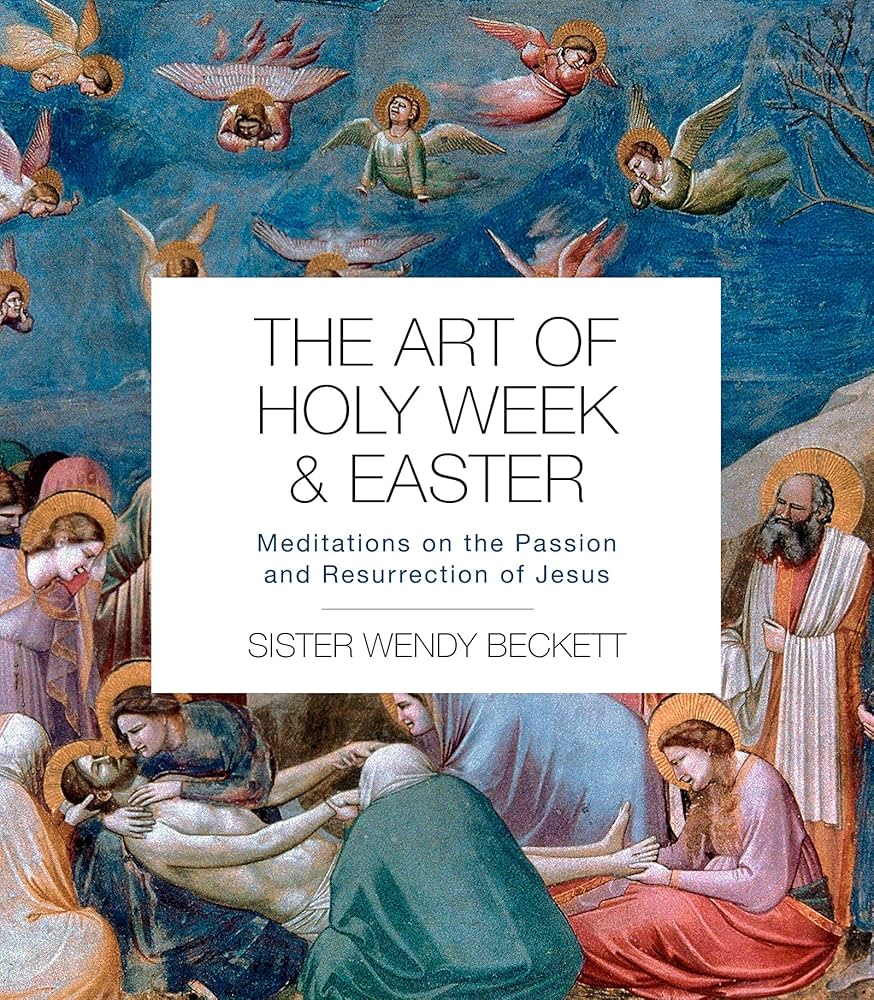
BOOK: The Art of Holy Week and Easter: Meditations on the Passion and Resurrection of Jesus by Sister Wendy Beckett (2021): Sister Wendy Beckett, a British Catholic nun and art enthusiast who died in 2018, is the one who first got me interested in art history. We watched clips from her BBC series Sister Wendy’s Story of Painting in my studio art class in high school, and I was so drawn to the way she looked at art and talked about it. Enthusiastic, warm, inquisitive, spiritually sensitive and theologically astute, and interested not just in the technical qualities of a work but also in its content—though I know I lack the same flair, my own voice and approach when it comes to art are indebted to hers.

So I was delighted to see that SPCK (and IVP in North America) has published two church calendar–based art devotionals by Sister Wendy: one for Lent, and one for Holy Week and Easter. I was disappointed with The Art of Lent: It has an admirable diversity of art selections, but Sister Wendy’s reflections are short and basic, and most don’t shine in the way I’ve come to expect from her; there were only two standouts for me. I also found it thematically confusing (for example, a section on “Confidence”?), unfocused, and redundant (especially in the “Silence” and “Contemplation” sections). I will grant that Lent is a more difficult season to structure for a project like this than Advent is, as I found the one year I published a daily Lent series; it can mean many things to many people.
The Art of Holy Week and Easter

Sister Wendy’s The Art of Holy Week and Easter, on the other hand, I did enjoy and recommend, even though I wish it had the same variety as the Lent book. (There’s only one modern/contemporary painting.) I care for only about half the featured artworks—two favorites are below—but even for the ones I was disinclined toward, her commentary helped me appreciate them.
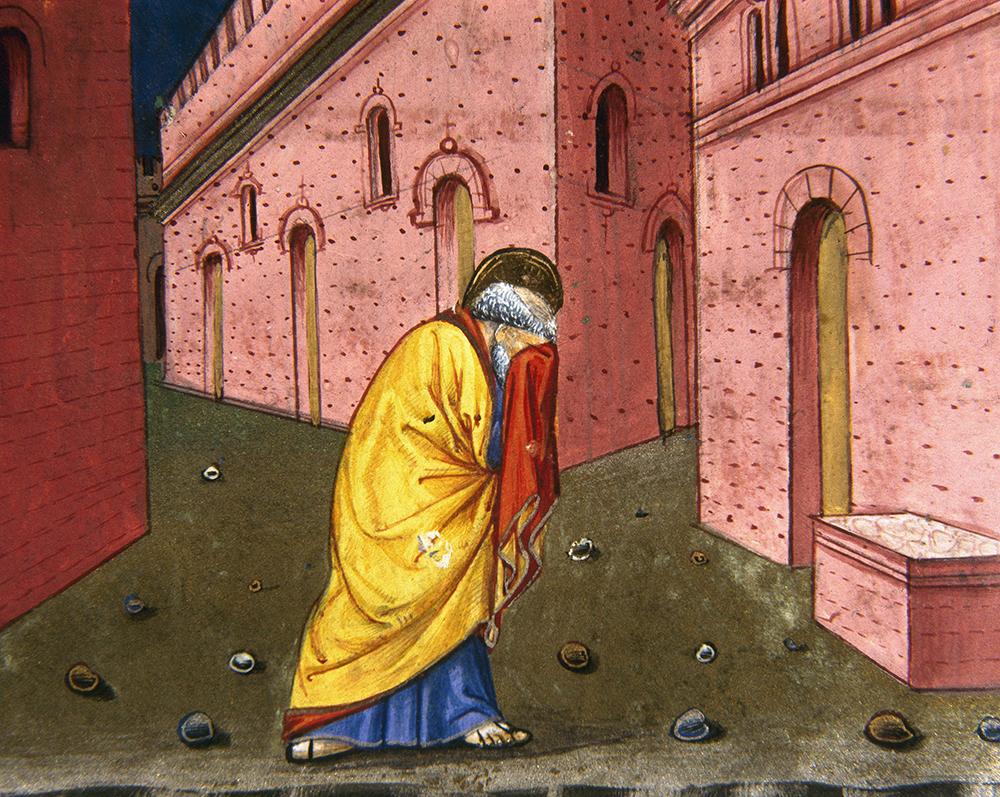
Peter's Repentance
Cristoforo de Predis (Italian, 1440–1486), “Saint Peter realizing he has thrice betrayed Jesus,” from the Leggendario Sforza-Savoia, 1476. Codice Varia 124, Biblioteca Reale (Royal Library), Turin, Italy.

About a medieval manuscript illumination of Peter weeping by Cristoforo de Predis, Sister Wendy writes:

This magical little picture presents an unforgettable image of grief. It is that most painful kind of grief, lamenting of our own folly. Here we see Peter with his shamed face covered, stumbling blindly forward from one closed door to the next. There are ways out behind him, but Peter is too lost in misery to look for them. This claustrophobic despair, this helpless anguish, this incapacitating sense of shame: these are the result of a sudden overturn of our own self-image.

Peter had honestly seen himself as one who loved and followed Jesus, priding himself, moreover, on how true his loyalty was in comparison with that of others. ‘Even if all should betray you, I will never betray you’ – it was a boast, but he had meant it. Now he sees, piercingly, that he is fraudulent. He has been unmasked to himself, he has lost his self-worth.

The crucial question is: What next? Will he hide his face forever, destroyed by self-pity? Will he lose all heart, perhaps even kill himself, as Judas did? But while Judas felt only remorse, Peter feels contrition, a healing sorrow that will lead to repentance and a change of heart. Now that he knows his true weakness, he will cling to Jesus as never before. He will cling in desperate need and not in false strength, and will in the end become truly Peter, the ‘rock’, on which the Church, likewise dependent on Christ, will be built. (26)

El Greco_Christ crucified with Toledo in the Background
El Greco (Greek Spanish, 1541–1614), Christ Crucified with Toledo in the Background, 1604–14. Oil on canvas, 111 × 69 cm. Fundación Banco Santander, Madrid.

About El Greco’s Christ Crucified, she mentions how “Jesus . . . dies looking upwards, his determination set upon his Father’s will and its consummation. . . . His body spirals upwards like a white flame, radiating out as he spreads his arms to share the light with the defeated shadows” (38).

+++

HYMNS:

>> “O Love, How Deep, How Broad, How High”: I’ve enjoyed learning a few new-to-me hymns from the YouTube channel of Josh Bales. Attributed to the fifteenth-century German-Dutch Catholic mystic Thomas à Kempis, this hymn text was translated from Latin into English by Benjamin Webb in 1871. It appears in the Episcopal hymnal with the tune EISENACH by Bartholomäus Gesius, as adapted by Johann Hermann Schein in 1628, which is what Bales sings. It’s rare among hymns for emphasizing that our salvation was won not just by Christ’s death but also by his life—his faithful obedience to the Father.

>> “I Stand Amazed (How Marvelous)”: A favorite from my childhood, this 1905 gospel hymn by Charles H. Gabriel is performed here by the Imani Milele Choir, made up of orphaned and/or vulnerable children and youth from Uganda.

>> “Come Let Me Love”: I recently learned of this shape-note hymn from a book I’m reading by J. R. Watson. Written by the late great Isaac Watts, the text was first published in the 1706 edition of Watts’s Horæ lyricæ with the title “Christ’s Amazing Love and My Amazing Coldness.” I especially love verses 4 and 5, reproduced below. The tune in the following video, LAVY, is actually a new one (from 1993) that sounds old, by John Bayer Jr.

Infinite grace! Almighty charms!
Stand in amaze, ye rolling skies!
Jesus, the God with naked arms,
Hangs on a cross of love and dies.

Did pity ever stoop so low,
Dress’d in divinity and blood?
Was ever rebel courted so,
In groans of an expiring God?

+++

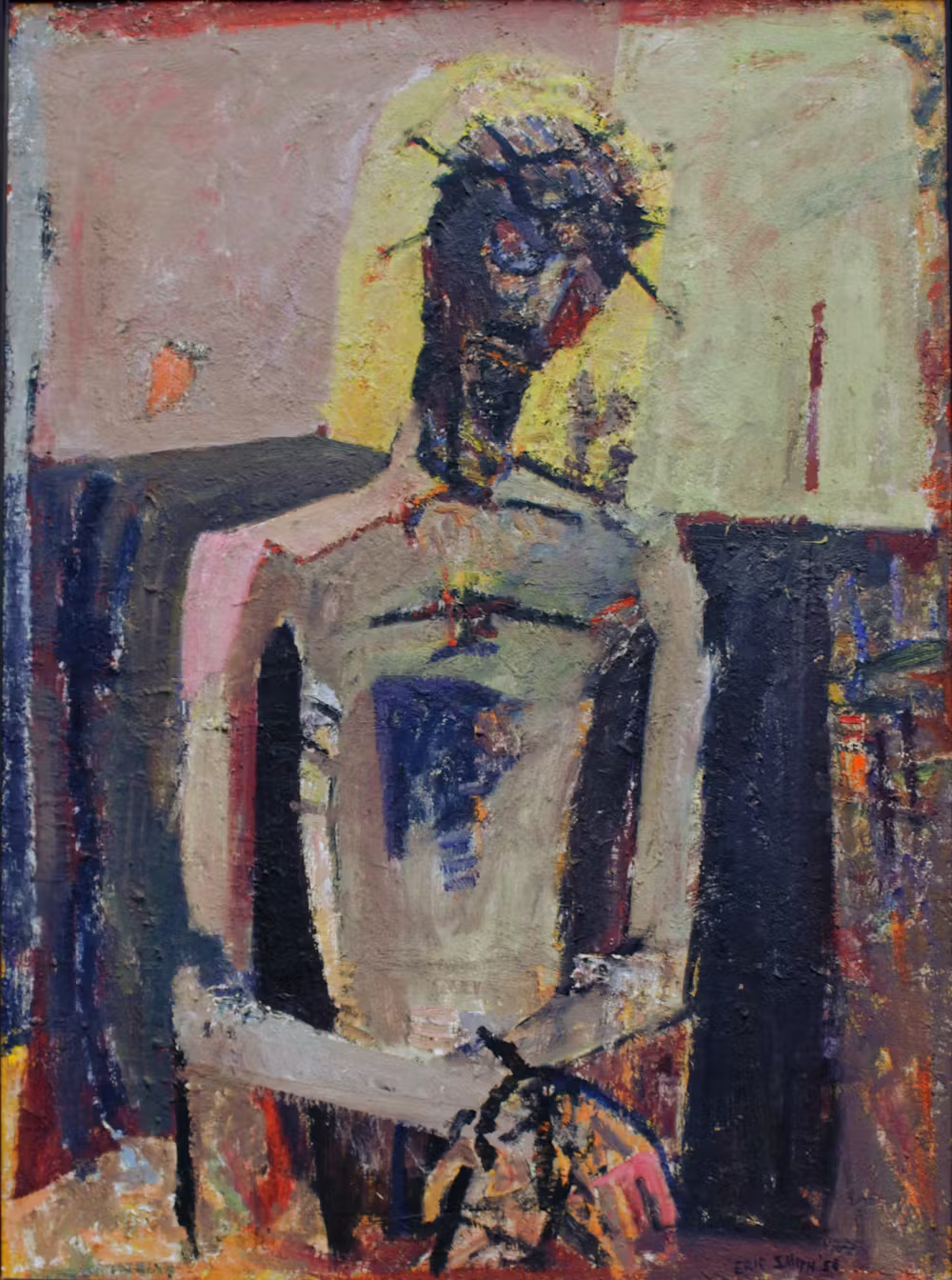
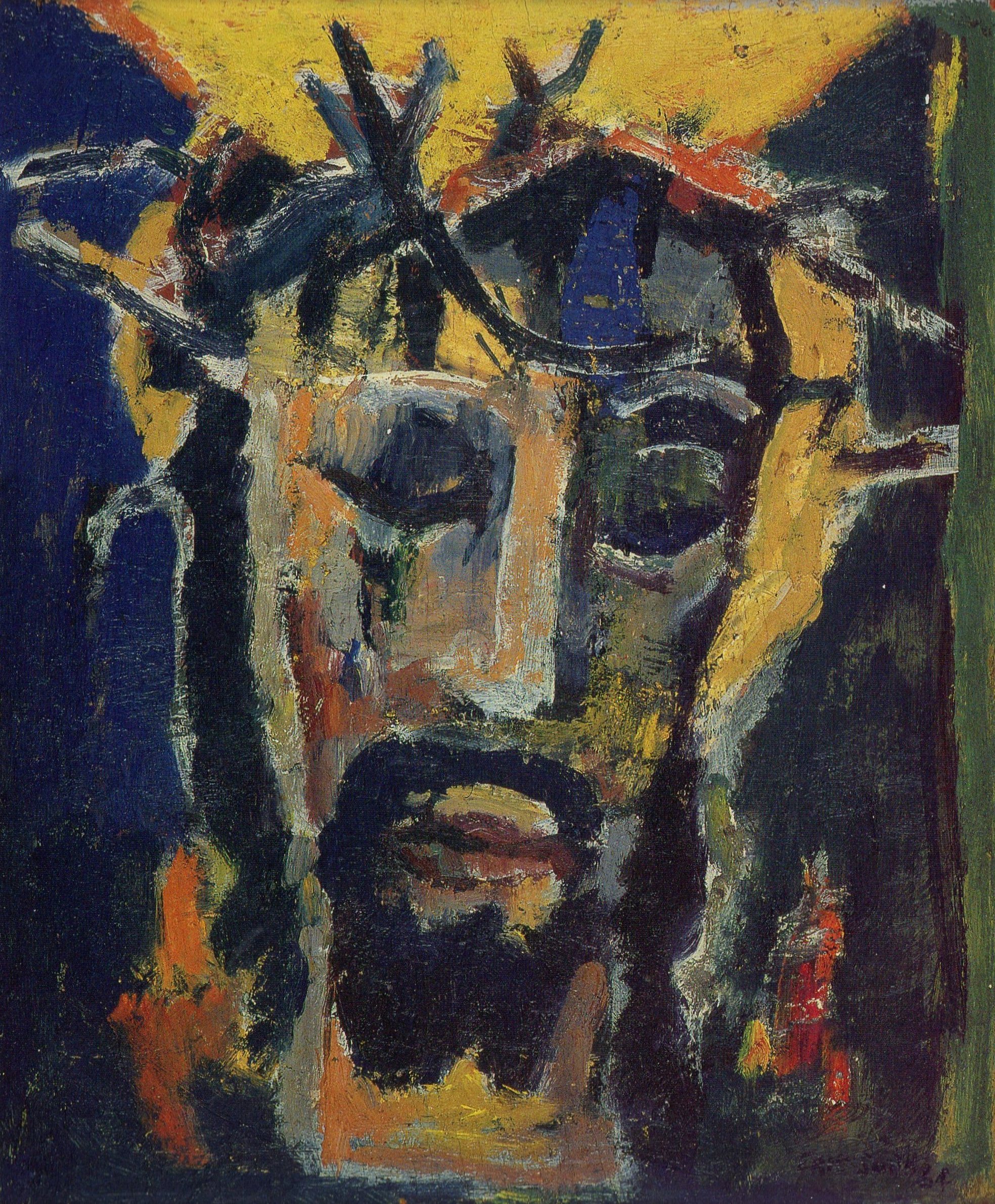
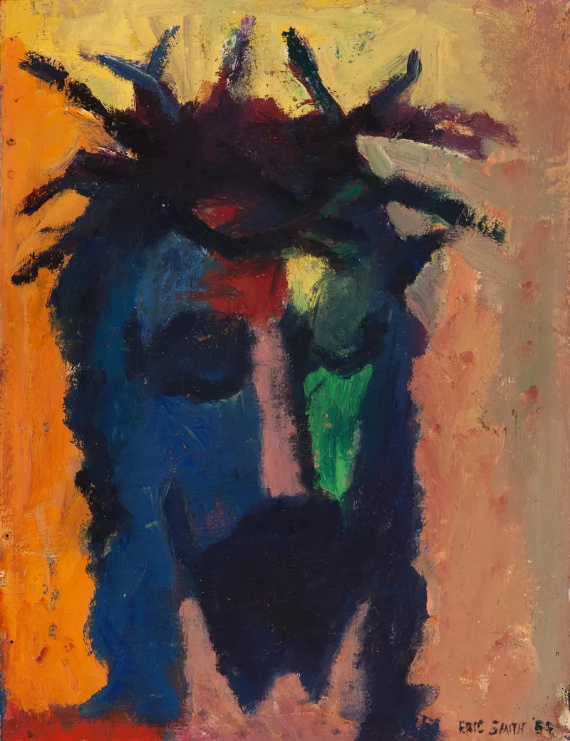
VIDEO: Christ by Eric Smith”: This is the first video in the (Catholic) Archdiocese of Brisbane’s four-part Art Aficionados series from 2022. In it, Archbishop Emeritus Mark Coleridge, theology professor Maeve Heaney, and Rev. Dr. Tom Elich of Liturgy Brisbane discuss the semiabstract Ecce homo painting Christ by the modern Australian artist Eric Smith—its pathos, calm, and double irony. This Christ is crushed yet composed, Coleridge says. Smith won the prestigious Blake Prize for Religious Art six times, including, in 1956, for a painting similar to this one (see second image in slideshow below). I’d love to see more dioceses releasing videos like this!—close looking at art.

The other videos in the Art Aficionados series are on The Stories That Weren’t Told by Lee Paje, The Good Samaritan by Olga Bakhtina, and The Visitation by Jacob Epstein.
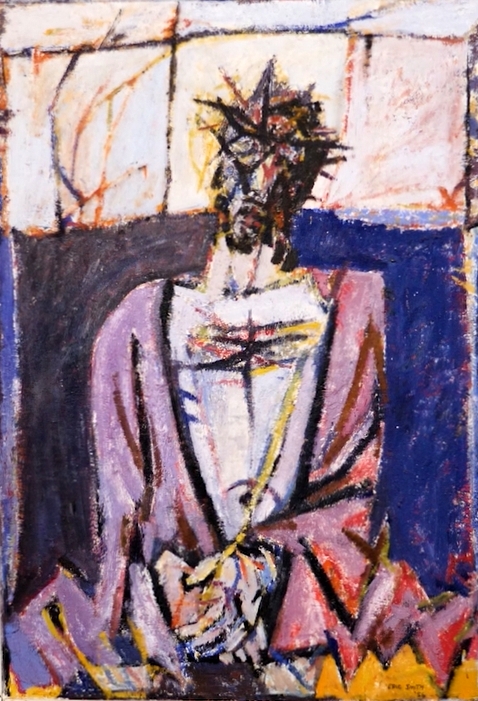
  • Smith, Eric_Christ
  • Smith, Eric_The Scourged Christ
  • Smith, Eric_Head of Christ
  • Smith, Eric_Head of Christ

+++

ART SERIES: Via Crucis: La pasión de Cristo (Way of the Cross: The Passion of Christ) by Fernando Botero: Executed in 2010–11, Via Crucis is a series of twenty-seven oil paintings and thirty-four mixed-media drawings by Colombia’s most famous artist, Fernando Botero (1932–2023) [previously]. Botero said he turned to the subject of Christ’s passion not because he’s religious, but out of admiration for the great works of art on the subject; he approached it with “a spirit of great respect,” aiming to portray God as a tortured man. The artist donated the series to the Museo de Antioquia in Medellín for his eightieth birthday. I can’t find a compilation of the whole series (the museum has digital records of the Boteros in its collection, but not all the images are showing up for me)—but you can view fourteen of the paintings in this article, and here’s a quick little Facebook reel.

Marlborough Gallery in New York offers a catalog of the series for $75, and Artika offers a much more expensive one (a gorgeous product, but $9,500!):

Here’s a news segment, in English, about the series’ exhibition at Lisbon’s Palacio de Ajuda in November 2012 (unfortunately, the video quality is low):
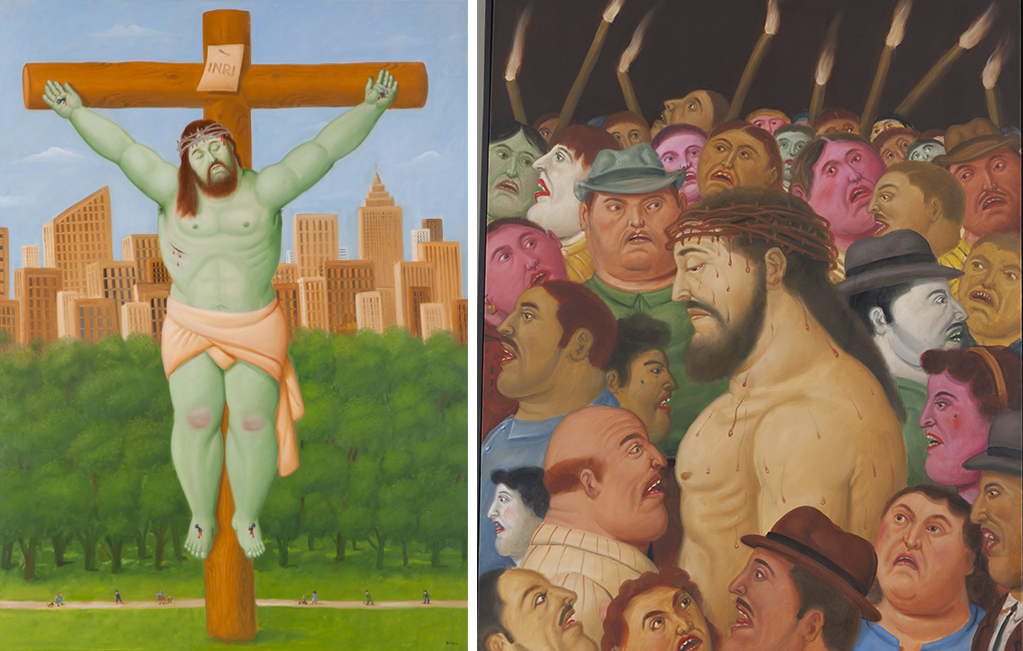
Botero, Fernando_Via Crucis
Fernando Botero (Colombian, 1932–2023), Crucifixión (Crucifixion), 2011, and Jesús y la multitud (Jesus and the Crowd), 2010. Oil on canvas. Museo de Antioquia, Medellín, Colombia.

+++

I have thematic playlists on Spotify for Lent and Holy Week—for the latter, don’t miss “From the Garden to the Tomb” by The Soil and The Seed Project, one of several recent additions.

But, by popular request, I also have a brand-new March 2026 playlist, a somewhat random assortment of songs I’ve been enjoying—some new releases, some not.

Roundup: Sister Wendy, Quaker Skyspace, Bach on the street, and more

OBITUARY: “Sister Wendy Beckett, Nun Who Became a BBC Star, Dies at 88”: A nun since the age of sixteen, Sister Wendy spent most of her life living in silence in a windowless trailer on the grounds of the Carmelite monastery in East Anglia, England. She read voraciously about art but had never set foot in a museum or seen any great paintings in person—until in 1991, a BBC producer persuaded her to do a documentary about the paintings in London’s National Gallery. She agreed, thinking it would be a flash in the pan, but it was very successful, and so throughout the nineties she presented several other documentaries on the history of art, including Sister Wendy’s Odyssey, Sister Wendy’s Grand Tour, and Sister Wendy’s Story of Painting. She quickly became the world’s best-loved art critic, as her unscripted commentaries, so full of wonder and enthusiasm, connected well with the general public, making high art accessible. She also authored some thirty-five books.

Sister Wendy

“One of the ways, for me, of looking at God is by looking at art,” she says in the intro to Odyssey. Not that art is God but that art can lead us to a deeper understanding of who, and Whose, we are.

Sister Wendy was a major influence on my path to becoming a writer on Christianity and the arts. I first encountered her in high school through her Story of Painting series, which a studio art teacher made our class watch excerpts from. This was my entrée into art history, a subject that captivated me then and that inspired me to pursue some such coursework in college, including a semester abroad in Florence, Italy. Without this initial incitement of interest from Sister Wendy, I doubt I would be writing about art today.

What attracts me to her is what attracts most people: her utter joy and rapture as she discusses art. She is the first person who taught me how to look at a painting and read it. I appreciate her charitable stance toward modern and contemporary art (movements that large swaths of Christians reject), and her unabashed delight in the nude body. Over the years, people have tended to be either amused or shocked, or both, by her frankness in talking about sexuality in art, but she was always insistent on the goodness of the human body and of sex. When Bill Moyers asked her back in 2000 whether she’s scandalized by the carnality, the sensuality, of so much art, she really stumps him with her matter-of-fact response! (See 4:15 of the video below.)

+++

INTERVIEW: “Why You Should Read Devotional Poetry in 2019” by Leland Ryken: In this interview with Collin Huber, Ryken cites three reasons why Christians should read devotional poetry, elaborating on each one: (1) devotional poets express our spiritual experiences, (2) it sets our affections “in right tune,” and (3) it will take us to corners of the spiritual life that might otherwise remain unvisited. He also discusses how poetry has shaped him; the obstacles that keep people from enjoying poetry, and how to overcome them; what makes poetry distinctive as a genre; and the prevalence of poetry in the Bible. “Mastering a devotional poem by a famous English or American poet requires nothing beyond what mastering a psalm requires,” he says. “If you can possess Psalm 23, you can possess Milton’s sonnet on his blindness.”

Leland Ryken is an emeritus professor of English at Wheaton College and the author or editor of some fifty books, most recently the anthology The Soul in Paraphrase: A Treasury of Classic Devotional Poems. Other titles of his include How to Read the Bible as Literature, The Christian Imagination: The Practice of Faith in Literature and Writing, The Liberated Imagination: Thinking Christianly about the Arts, and several volumes in the Christian Guides to the Classics series.

+++

STREET PERFORMANCE: Toccata and Fugue in D minor (BWV 565) by J. S. Bach: Bach’s Toccata and Fugue is probably the most famous organ work in existence. But last fall in Cologne, a group of four musicians, whose names I cannot find, performed it on two accordions, a violin, and a tuba! It’s uncanny how closely the collective timbre approximates that of an organ. The tuba grants sonority, and the other instruments contribute to the full-bodied sound.

This performance took place between Hohe Straße and Theo-Burauen-Platz in Cologne, Germany, but a few commenters on the video have reported witnessing near-identical performances in other parts of the country, so either this group travels, or the arrangement is circulating.

+++

SACRED ARCHITECTURE

I frequently encounter articles on or photos of contemporary religious architecture. Here are just two notable buildings I’ve come across recently—the first one, thanks to Michael Wright’s Still Life newsletter (to which you should subscribe!).

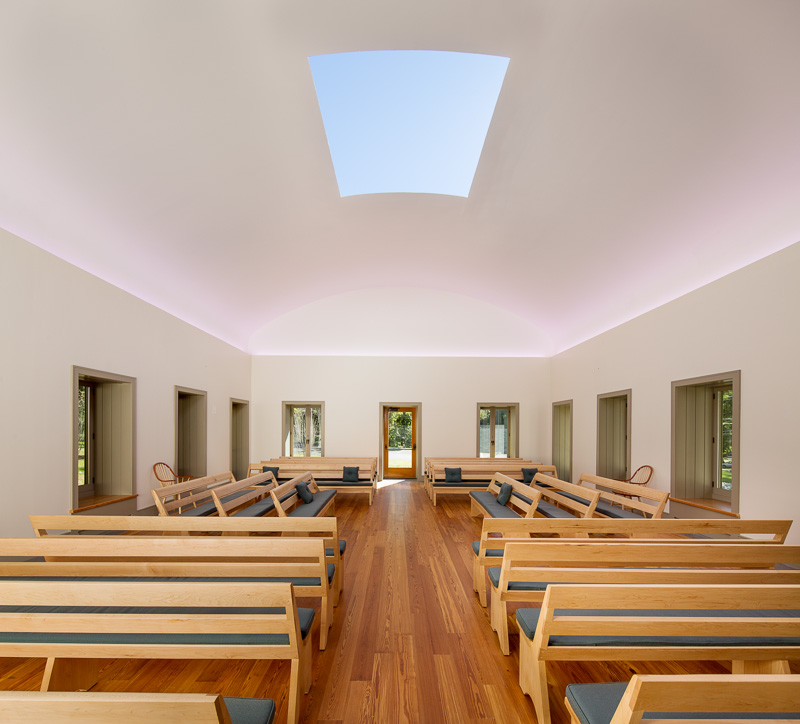
Chestnut Hill Friends Meeting (2013): When the Chestnut Hill Friends Meeting in northwest Philadelphia was building a new meetinghouse, they invited contemporary light artist James Turrell, himself a Quaker, to design one of his famous “Skyspaces” for the meeting room—that is, an aperture in the ceiling that’s open to the sky. From the beginning, Turrell collaborated with architect James Bradberry to achieve this permanent art installation; for example, Turrell wanted the aperture to have no perceptible thickness, so Bradberry and his team developed a sophisticated steel roof structure and “knife’s edge” opening. The achieved effect of paper thinness is impressive: when I first saw photos, I assumed the “sky” on the ceiling was just a painted patch! (Visitors have reported similar surprise.) Turrell calls this Skyspace Greet the Light, a reference not only to the light of the sun but to the Quaker doctrine of the “Inner Light,” God within.

Greet the Light by James Turrell
Chestnut Hill Friends Meeting Room, Philadelphia, Pennsylvania, featuring a permanent Skyspace installation, titled Greet the Light (2013), by James Turrell.

Greet the Light by James Turrell

The meeting room is open to the public, for free, on select days (more info here). Visitors are invited to bring a yoga mat, pillow, and blankets (when the retractable roof is open, the room is unheated) and to lie on their backs on the floor or benches. Silence is requested. Turrell’s installation also makes use of artificial light: over the course of fifty minutes or so, the vaulted ceiling is bathed in turn in four color variations—green, red, blue, and white—which augments the natural light projected by the opening.

View other Skyspaces by James Turrell at http://jamesturrell.com/work/type/skyspace/, and read Bradberry’s perspective on the project at Faith & Form.

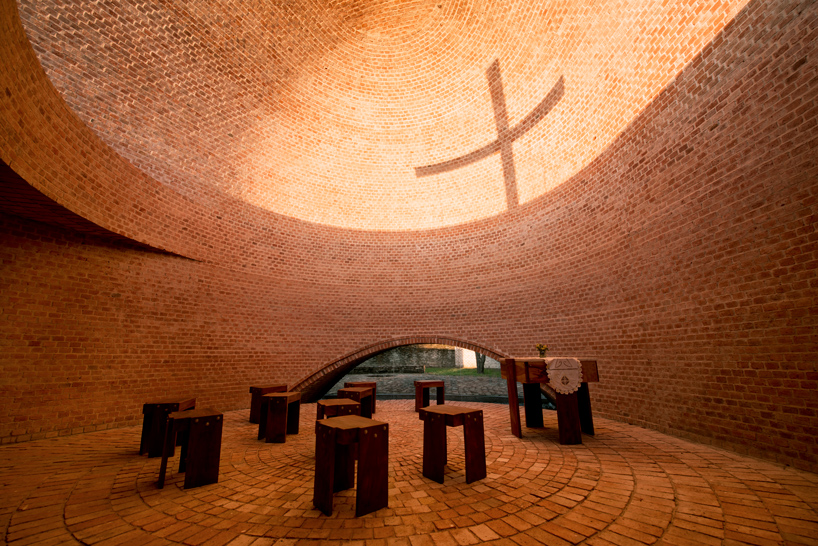
San Bernardo Chapel (2015): Located in a wooded grove in Argentina’s Pampas lowlands, just east of Córdoba, Capilla San Bernardo (St. Bernard Chapel) was designed by Nicolás Campodonico. It was constructed using hundred-year-old bricks that had been dismantled from the rural home and courtyard that previously stood on the site. There is no electricity in the area, so natural light plays a huge role, especially in the chapel’s most unique feature: two perpendicular beams, independently suspended from a large exterior opening, cast shadows onto an interior wall, which glide progressively toward each other throughout the day, ultimately overlapping to form a cross (see time lapse). Campodonico said he had in mind Jesus’s journey to Golgotha with the transverse beam, which, upon arrival at the execution site, was attached to the vertical mount; it’s as if the passion is being reenacted daily through the shadows, he said. See more photos at designboom.

San Bernardo Chapel
Capilla San Bernardo (St. Bernard Chapel), La Playosa, Córdoba Province, Argentina. Photo: Nicolás Campodonico.

San Bernardo Chapel

+++

FREE ALBUM: Into the Light by Joel LeMaire: Fans of Josh Garrels, Iron and Wine, and John Mark Pantana will probably enjoy Joel LeMaire’s 2015 EP, which is about finding hope in the letting go and stepping into the unknown. Download your own copy from NoiseTrade, and read more about the meaning behind the songs on LeMaire’s blog.