
Even to the nameless dog I said farewell.
Madness took him long since,
but I remember his sharp bark,
how he warmed my feet on cool evenings.
I nursed my father in that city,
raised a cup to his lips the night he died.
We laid him near the fig tree,
its twisted trunk his monument.

Now ash marks his place, and Mother’s too,
and all the others whose bread sometimes burnt,
whose clay pots shattered, who wept with me.
They were not good people, and yet . . .
Lot’s back was not enough to see.
I turned. One sign, one glance
for all we left behind.
My faith is strong—
yea, stronger even than salt.
I wait for God to forgive my love.
From To Love Delilah: Claiming the Women of the Bible by Mary Cartledgehayes (San Diego: LuraMedia, 1990). Used by permission of the author.
Lot’s wife, unnamed and unvoiced in scripture, was probably a native of Sodom, the thriving city where Abraham’s nephew had settled. But the people there harbored sin. They were prideful, and did not share their wealth with the poor (Ezek. 16:49–50). To say they lacked hospitality is an understatement: they tried to gang-rape two visitors (Gen. 19:1–11; cf. Jude 1:7). For their persistence in doing evil, God destroyed them.
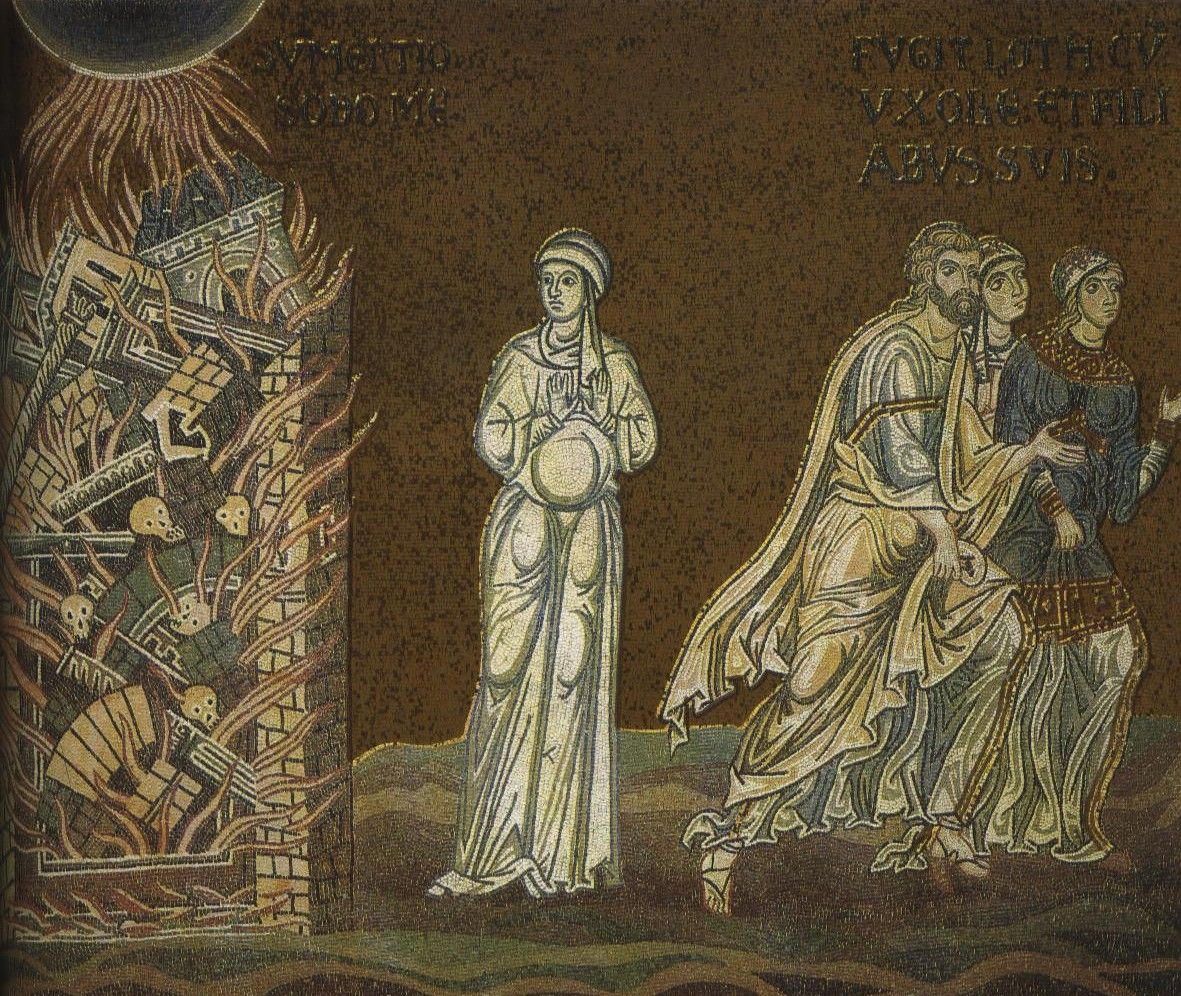
Genesis 19:12–29 records the story of Lot’s family’s escape. Two angels warn them of the coming judgment, tell them to run and not look back. But in their sudden flight, as the fire and brimstone are raining down behind them, wiping out the life they’ve known together, Lot’s wife turns to see. In an instant, she’s transmogrified into a pillar of salt.
This narrative is often preached as a lesson against looking back on one’s old (preconversion) life with longing, or clinging to the things of this world. Typically Lot’s wife’s reason for turning, disregarding the angels’ instruction, is interpreted as unbelief or covetousness.
But in this poem Mary Cartledgehayes cuts through the moralistic framing of the story and taps into its human emotional component. She suggests that the backward look of Lot’s wife was her taking a moment to mourn the loss of the people she loved and the only home she ever knew—could this be wrong? In To Love Delilah Cartledgehayes writes, “I don’t think she was motivated by greed or stupidity but by love: the love she felt for others, the love of a hometown that was a place of relationship, the love of the security in seeing the same faces at the well day after day, of sharing the births and deaths of children, of hearing the same chickens scratching in the dirt and the same dogs barking for a bite of food” (34).
For Cartledgehayes, Lot’s wife was a pillar of faith, strength, and compassion. Anna Akhmatova (“Lot’s Wife”) and Natalie Diaz (“Of Course She Looked Back”) imagine similar qualities in their poems on the subject. I’ve heard at least one commentator suggest that the salt Lot’s wife becomes is metaphoric, representing the salty tears she shed for her city, her being encrusted by grief, a monument of grief.
It’s common for those displaced by disasters to look back on their hometowns, both literally and in remembrance, and grieve the destruction, the loss of life, property, and possessions, and all the memories held there. In the case of Lot’s wife, God explicitly tells her and her family, through two angels, not to look back, so it’s her disobedience that’s punished. There’s no indication in the story that she engaged in the unrighteous behaviors of her Sodomite neighbors and relatives, or that a prior life of indulgence is what she yearns for. And yet because the punishment seems harsh, many of us try to read some kind of nefarious motive into her looking back. Or else we receive this simply as a cautionary tale about the severe consequences of defying God’s word.
Because Lot’s wife is given no backstory or dialogue (external or internal) in Genesis, nor does the narrator explain, we don’t know why she looked behind her as she fled. (The Polish poet Wisława Szymborska provides a whole list of options in “Lot’s Wife”!) I’m thankful to poets, like Cartledgehayes and others, who poke the trope of the “worldly” wife of Lot in an attempt to find the multidimensional woman beneath.
Mary Cartledgehayes is a writer and an ordained minister in the United Methodist Church, living in Louisville, Kentucky. Possessing an MFA in creative nonfiction from Goucher College and an MDiv from Duke University, she has led workshops across the US on writing and spirituality and enjoys mentoring other writers. In addition to numerous essays, poems, and sermons, she is the author of Grace: A Memoir (Crown / Random House, 2003), about love, death, praxis, fury, and entering pastoral ministry as a middle-aged woman.



 Art & Theology