25 Poems for Christmas, vol. 3

This is the third installment of my annual “25 Poems for Christmas” series. Included too, on the front end, are poems for Advent, the four-week season of preparation, hope, and expectation leading up to Christmas.

[Read volume 1] [Read volume 2]

1. “Advent (III)” by W. H. Auden, from For the Time Being: Voiced by the Chorus, who cry out from “a dreadful wood / Of conscious evil,” this is the third section of part 1 of Auden’s book-length Christmas poem in nine parts, For the Time Being—“the only direct treatment of sacred subjects I shall ever attempt,” he said. He wrote the poem in 1941–42. He had originally conceived it as the libretto of an oratorio that Benjamin Britten would write the music for, but the text turned out to be too complex, and Britten abandoned the project. The final two lines of this section set us up for the seemingly impossible feat of divine incarnation: “Nothing can save us that is possible: / We who must die demand a miracle.”

Source: For the Time Being: A Christmas Oratorio (Princeton University Press, 2013)

2. “Advent” by R. A. (Robert Alan) Rife: Ten sensory metaphors for Advent, conveying its mood of anticipation.

Source: https://innerwoven.me/ (author’s website)

3. “O Orient Light” by James Ryman: Loosely influenced by the O Antiphons (a set of short chants used in medieval Advent liturgies), this Middle English lyric is by the fifteenth-century Franciscan friar James Ryman of Canterbury; it’s one of 166 sacred poems he published in a 1492 collection. Each stanza consists of one rhyme repeated six times, and the Latin refrain translates to “O Christ, king of the nations, / O life of the living.” The fourth stanza is a standout, connecting the salvation wrought by Christ to the healing properties of plants: “O Jesse root, most sweet and sote, / In rind and root most full of bote, / To us be bote, bound hand and foot, / O vita viventium.”

Source: Cambridge University Library, MS Ee. 1.12; compiled in The Early English Carols, ed. Richard Leighton Greene, 2nd ed., revised and enlarged (The Clarendon Press, 1977). Public Domain.
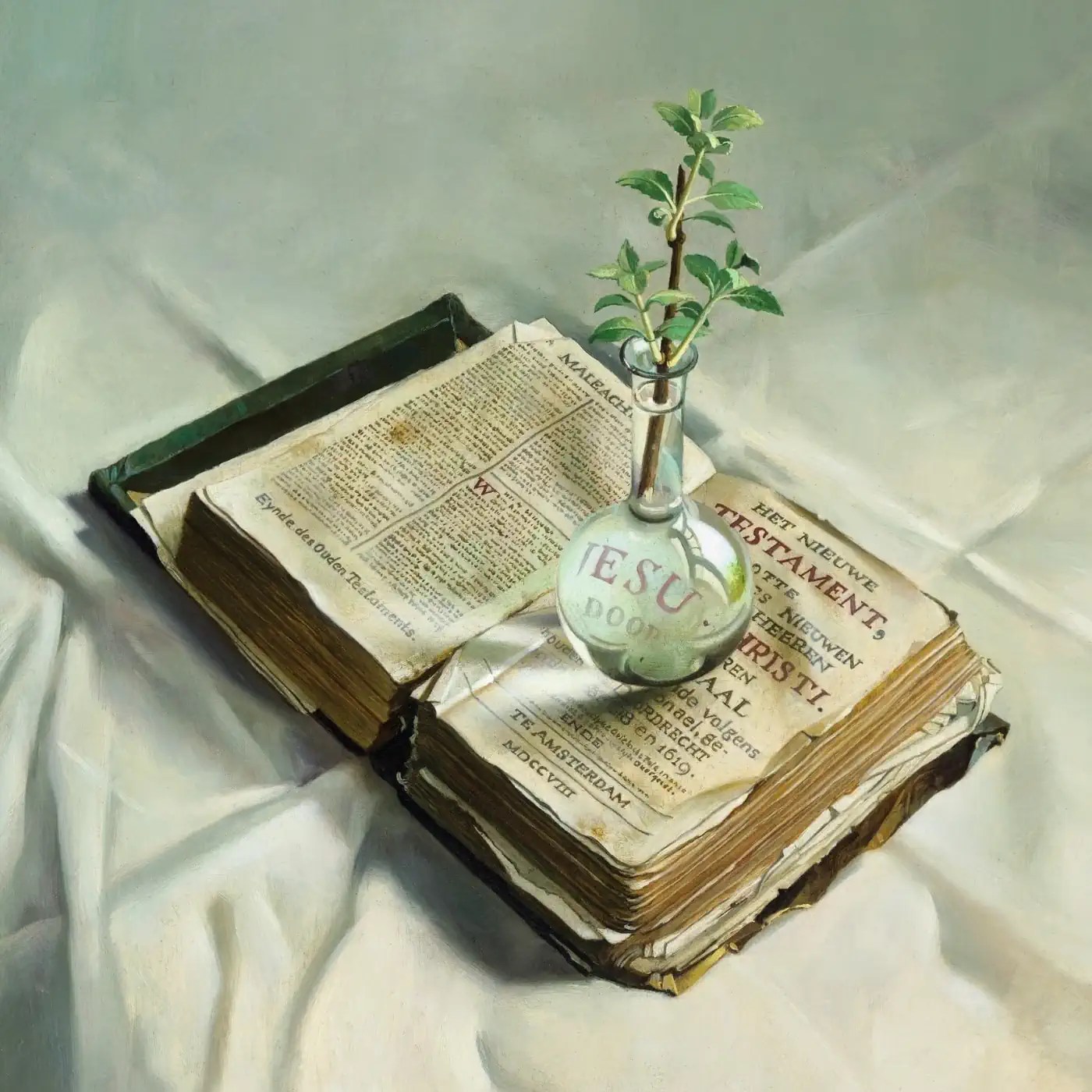
Helmantel, Henk_New Life II
Henk Helmantel (Dutch, 1945–), Nieuw Leven II (New Life II), 1999 (after the 1972 original that was stolen). Oil on canvas, 27 × 24 cm.

4. “Merger Poem” by Judy Chicago: “Merger Poem” is an aspiration that artist Judy Chicago wrote to accompany her 1979 monumental artwork The Dinner Party, a celebration of the richness of women’s heritage, expressed as place settings around a table, that is housed at the Brooklyn Museum. Her vision in the poem is not theistic, at least not explicitly so, but she uses the language of “Eden,” and her descriptions evoke passages from Isaiah about a future harmony, a merging of heaven and earth, in which justice and equity are achieved at last—not to mention the strong eschatological tones that feasting has in Christianity. Each line begins with “And then,” cumulatively generating a longing in the reader for “then” to arrive.

Source: The Dinner Party, exh. cat. (San Francisco Museum of Modern Art, 1979) | https://judychicago.com/

5. “truth” by Gwendolyn Brooks: “And if sun comes / How shall we greet him?” the speaker asks at the opening of this poem. The sun here represents truth, revelation, illumination, which we may seek with weeping and prayer but which can be dreadful when it actually comes. It’s often more comfortable to stay asleep in the dark than to confront the stark brightness of day. But oh, what we miss when we do! Gwendolyn Brooks uses the pronoun “him” for the sun, and it’s easy to read the poem Christologically: you can read it in the sense of any of Christ’s three comings—as a baby in Bethlehem, in personal, inner ways (he reveals himself, and seeks entrance, to human hearts), or as a king and judge at the end of time. Did you catch the reference to Revelation 3:20?

Source: Annie Allen (Harper & Row, 1949); compiled in Blacks (Third World Press, 1987)
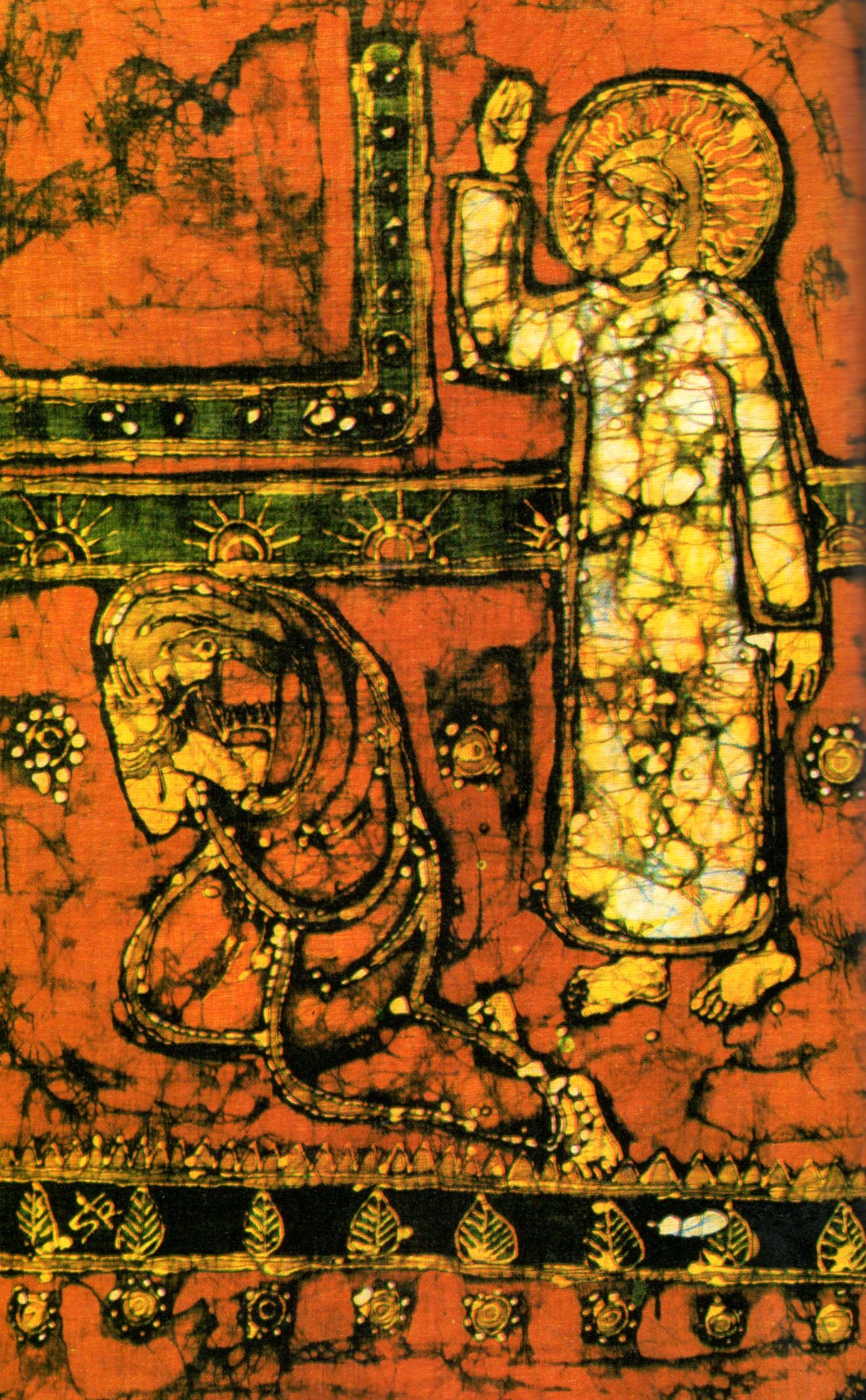
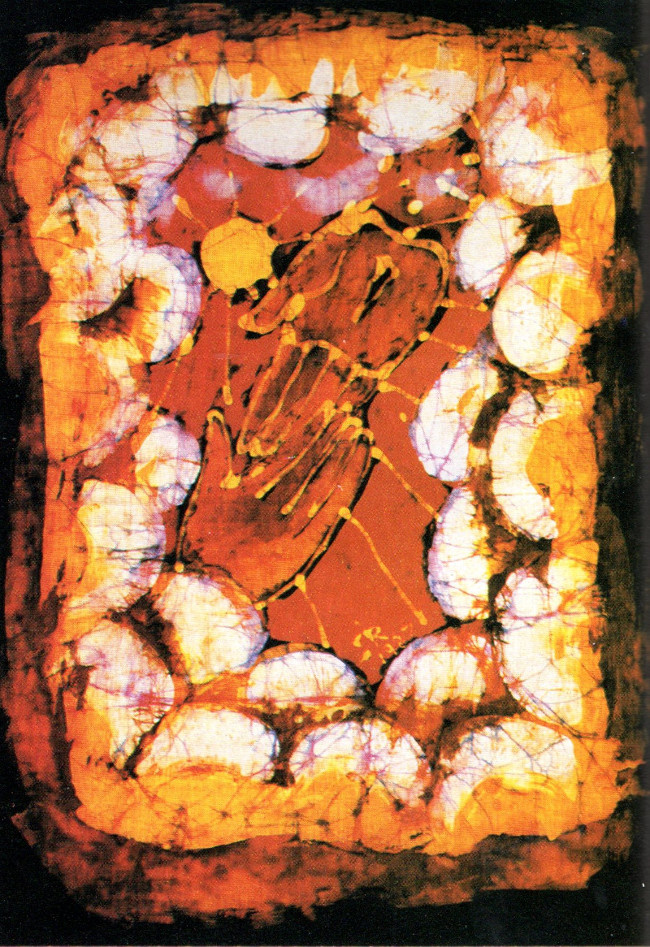
Raj, Solomon_Waiting for My Lord
P. Solomon Raj (Indian, 1921–2019), Waiting for My Lord, batik, published in Living Flame and Springing Fountain (ISPCK, 1993)

6. “Advent” by Mary Jo Salter: In this poem a mother and daughter are building a gingerbread house when a wintry gust tears a shutter on their actual house off its hinges, the shock of the thud causing, inside, a gingerbread wall to split. I think “house,” here, could be a metaphor for a faith structure; a house of belief. Shutters are doing a lot of work in the text: one falls off in a storm, and the daughter’s Advent calendar consists of twenty-five shutters, one opened each day until Christmas to reveal a Bible verse or narrative scene.

I’m not quite sure how to interpret the poem overall, but it seems to be addressing themes of (in)stability, brokenness and repair, the desire to believe versus the impulse to shut out belief, openness (“The house cannot be closed”), (dis)enchantment, the mother-child bond, and safety and danger (the Christmas story, like faith itself, characterized by both). I can’t decide if the “blank” in the final tercet sounds hopeful or bleak: does it connote possibility or lack? And is the mother suggesting in the final line (a repurposing of the final line from stanza 15) that what’s most real to her is not Mary and the baby Jesus but herself and her own child, right there in that moment?—or is she finding a point of kinship with Mother Mary in the love she feels for her offspring?

Source: Open Shutters (Knopf, 2003)

7. “Nativity” by Li-Young Lee: “What is the world?” asks a little boy in the darkness; and again as an adult. A poem of spiritual questing, Li-Young Lee’s “Nativity” deals with existential questions, ending with a tercet that evokes Isaac Watts’s famous carol line “Let every heart prepare him room.” Within us we must make a manger, a “safe place,” to receive the wild God.

Source: Book of My Nights (BOA Editions, 2001)

8. “Nazareth” by Drew Jackson: Ancient Nazareth, where Jesus grew up, was an insignificant village that many believed no good could come out of (see John 1:46). This poem by public theologian Drew Jackson accentuates Jesus’s origins there, his identity as a “southsider” (Nazareth is in southern Galilee). Today some urban neighborhoods on the “South Side” are disparaged, their residents dismissed as poor and lacking education and potential. God chose to incarnate in a rural neighborhood with a similar reputation, not simply dropping in and then leaving but, as the second person of the Trinity, being formed and nurtured in that environment. “Nazareth” is from Jackson’s debut poetry collection, in which he works his way through the first eight chapters of Luke’s Gospel, drawing out the theme of liberation and making contemporary connections.

Source: God Speaks Through Wombs: Poems on God’s Unexpected Coming (InterVarsity, 2021) | https://drewejackson.com/

9. “The Visitation” by Calvin B. LeCompte Jr.: The poet imagines the fields that Mary passes on her way to her cousin Elizabeth’s house joining in the Magnificat, praising the Savior in her womb.

Source: I Sing of a Maiden: The Mary Book of Verse, ed. Sister M. Thérèse (Macmillan, 1947)

10. “My Darling” by Alexandra Barylski: Mary and Joseph are cuddling in bed as she reflects on the divine interventions that brought and kept them together. The poem references the legend, originating in the second-century Protoevangelium of James and repeated in the seventh-century Gospel of Pseudo-Matthew, that Joseph was chosen to wed Mary when from his staff, submitted to the high priest along with those of other single men, there miraculously emerged a dove. Mary expresses appreciation for Joseph’s “visionary love,” patience, and courage in their relationship, his spiritual leadership and support.

Source: Reformed Journal, May 11, 2021
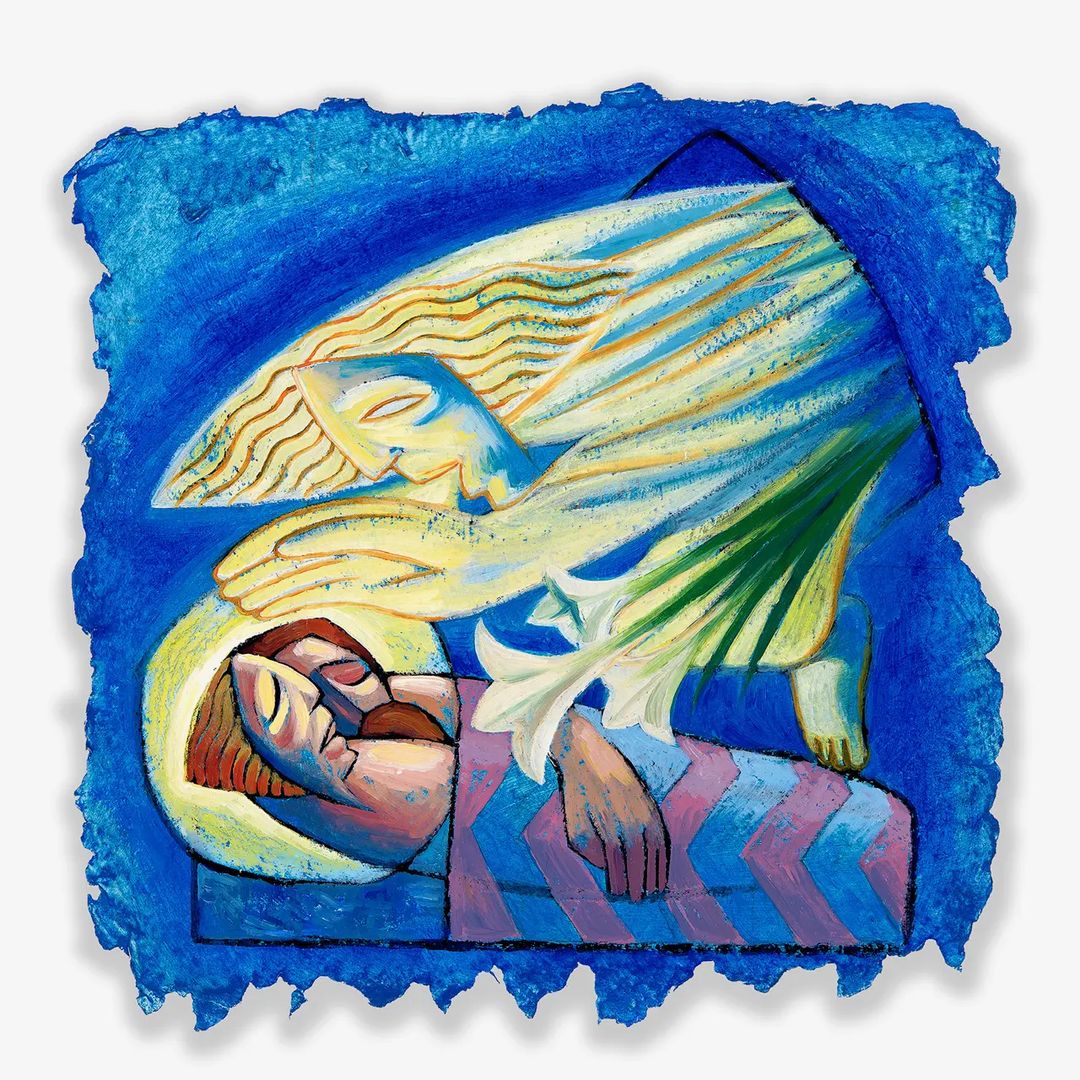
Mynheer, Nicholas_Annunciation
Nicholas Mynheer (British, 1958–), Annunciation, 2017. Oil on handmade paper, 20 × 20 cm.

11. “A Blessing for the New Baby” by Luci Shaw: The speakers of this poem give a lovely benediction over Christ—preincarnate and then embryonic in the first stanza, then out of the womb in the second and third.

Source: Accompanied by Angels: Poems of the Incarnation (Eerdmans, 2006) | https://lucishaw.com/

12. “Love’s Delights” by Meister Eckhart, rendered by Jon M. Sweeney and Mark S. Burrows: The medieval German mystic Meister Eckhart didn’t write poetry, but many of his sermons have a poetic quality to them, so contemporary poet Mark S. Burrows and writer Jon M. Sweeney, working from an English translation of the Middle High German by Frank Tobin, reworked select excerpts into verse. Adapted from a sermon Meister Eckhart preached on Isaiah 60:1, this poem meditates on the downward movement of love that raises up.

Source: Jon M. Sweeney and Mark S. Burrows, Meister Eckhart’s Book of the Heart: Meditations for the Restless Soul (Hampton Roads, 2017)

13. “Word Become Flesh” by Seth Wieck: Pregnancy, childbirth, and nursing take a toll on the body. Voiced by Mary, this poem highlights the bodily realities of Jesus’s first coming—Mary swollen, bruised, cracked, and bleeding. She was wounded for our transgressions, in the sense that she endured kicks to the ribs, postpartum hemorrhoids, etc., in order to bring forth our Savior, and by these wounds, because they gave life to Jesus, our healing was made possible. The last sentence is a zinger. Mary gives (physical) birth to Jesus, and he gives (spiritual) birth to her.

Source: Fathom, December 21, 2017 | https://www.sethwieck.com/

14. “Prince of Peace” by Brian Volck: The poet provides his own introduction to this poem on his website: “Octavian Augustus, first emperor of Rome, was known by many titles, including Divi Filius (Son of God) and Princeps Pacis (Prince of Peace). An inscription in Asia Minor states that Augustus’s birth ‘has been for the whole world the beginning of the gospel (εύαγγέλιον) concerning him.’ How strange, then, to use the same names for a contemporaneous but obscure Palestinian Jew, whose understanding of peace, politics, and power was so radically different. How strange to have so long diluted the scandal of the gospel (good news) with accommodations to an Augustan vision of a peace built on the use or threat of lethal violence. Here’s a Christmas poem calling attention to that contrast in a conscious act against forgetting.”

Source: Flesh Becomes Word (Dos Madres, 2013) | https://brianvolck.com/

15. “The Burning Babe” by Robert Southwell: Consisting of sixteen lines in iambic heptameter, this poem by the Jesuit martyr-saint Robert Southwell [previously] relates a mystical vision of the Christ child, who appears to the narrator on a cold winter’s night, enflamed and hovering in midair. The poem develops the metaphor of the love of Christ as a fiery furnace that both warms and purifies.

Source: St Peter’s Complaint, and Other Poems (London, 1595). Public Domain.
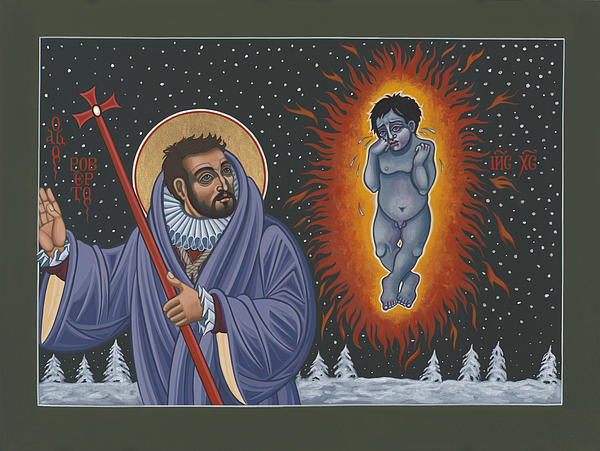
McNichols, William Hart_Robert Southwell and the Burning Babe
William Hart McNichols (American, 1949–), Holy Poet-Martyr St. Robert Southwell and the Burning Babe, 2015. Acrylic on wood. [purchase reproduction]

16. “Advent 1966” by Denise Levertov: This poem is shocking in its horror. Written in 1966, it picks up Southwell’s image of the Burning Babe and transposes it to the napalmed villages of Vietnam, where children were being physically (not symbolically or ethereally, as in Southwell’s poem) set on fire by chemical weapons deployed by the US military. Denise Levertov [previously], who was an antiwar activist as well as a poet, uses repetition to strong effect, conveying a sense of the seemingly relentless carnage (the war produced an estimated two million civilian casualties, more than half the total number). Though addressing a specific historical event, this elegy for the innocent provokes us to consider where similar atrocities are happening today.

Source: To Stay Alive (New Directions, 1971); compiled in Making Peace, ed. Peggy Rosenthal (New Directions, 2006)

17. “Christmas Eve” by Christina Rossetti: The Victorian poet Christina Rossetti [previously] opens this lyric with two paradoxes that characterize Christmas—bright darkness and chilly warmth—referencing the general mood of cheer and comfort that coexists with the bleak English midwinter. Why this mirth? Because “Christmas bringeth Jesus, / Brought for us so low.” Jesus was brought down from heaven in the Incarnation, but he would be brought lower still: his spirits sunken in Gethsemane, his body buried in a grave. The second stanza evokes a wedding: dressed in a bridal gown of gauzy snow, earth receives her heavenly Bridegroom.

Source: Time Flies: A Reading Diary (London, 1885); compiled in The Complete Poems (Penguin, 2001). Public Domain.

18. “Hill Christmas” by R. S. Thomas: In a poor rural Welsh village, parishioners make their way across snowy fields, weather-beaten, on Christmas to feed their bodies and souls with a snow-white bread loaf and crimson wine. In the celebration of the Eucharist, they hear love cry “in their heart’s manger.” Then they return to the day’s chores. I think the last line refers to a wayside crucifix.

Source: Laboratories of the Spirit (Macmillan, 1975); compiled in Collected Poems, 1945–1990 (Dent, 1993)

19. “back in the day” by Carl Winderl: In a practice known as “setting lambs on,” when a baby lamb dies in birth, sheep farmers will often take a live lamb (an orphan, or a twin or triplet from another ewe) and cover it in the skin of the deceased one so that, when the grieving mother smells the familiar scent of her deceased offspring, she accepts the lamb as her own. In Carl Winderl’s poem, Mother Mary reflects on that practice and has a premonition of a dead lamb.

Source: Christian Century, December 27, 2023

20. “Hymn 4 on the Nativity of Christ” by Ephrem the Syrian: St. Ephrem, a church father from the fourth century, wrote his theology in verse and is one of the most significant Early Christian hymnists. His Nativity hymns are my favorite; I’m particularly struck in Hymn IV by his meditation on how the Christ who suckles at Mary’s breast also gives suck to the whole world. “He is the Living Breast of living breath,” as Kathleen E. McVey translates the Syriac.

Source: Ephrem the Syrian: Hymns, trans. Kathleen E. McVey (Classics of Western Spirituality) (Paulist Press, 1989)
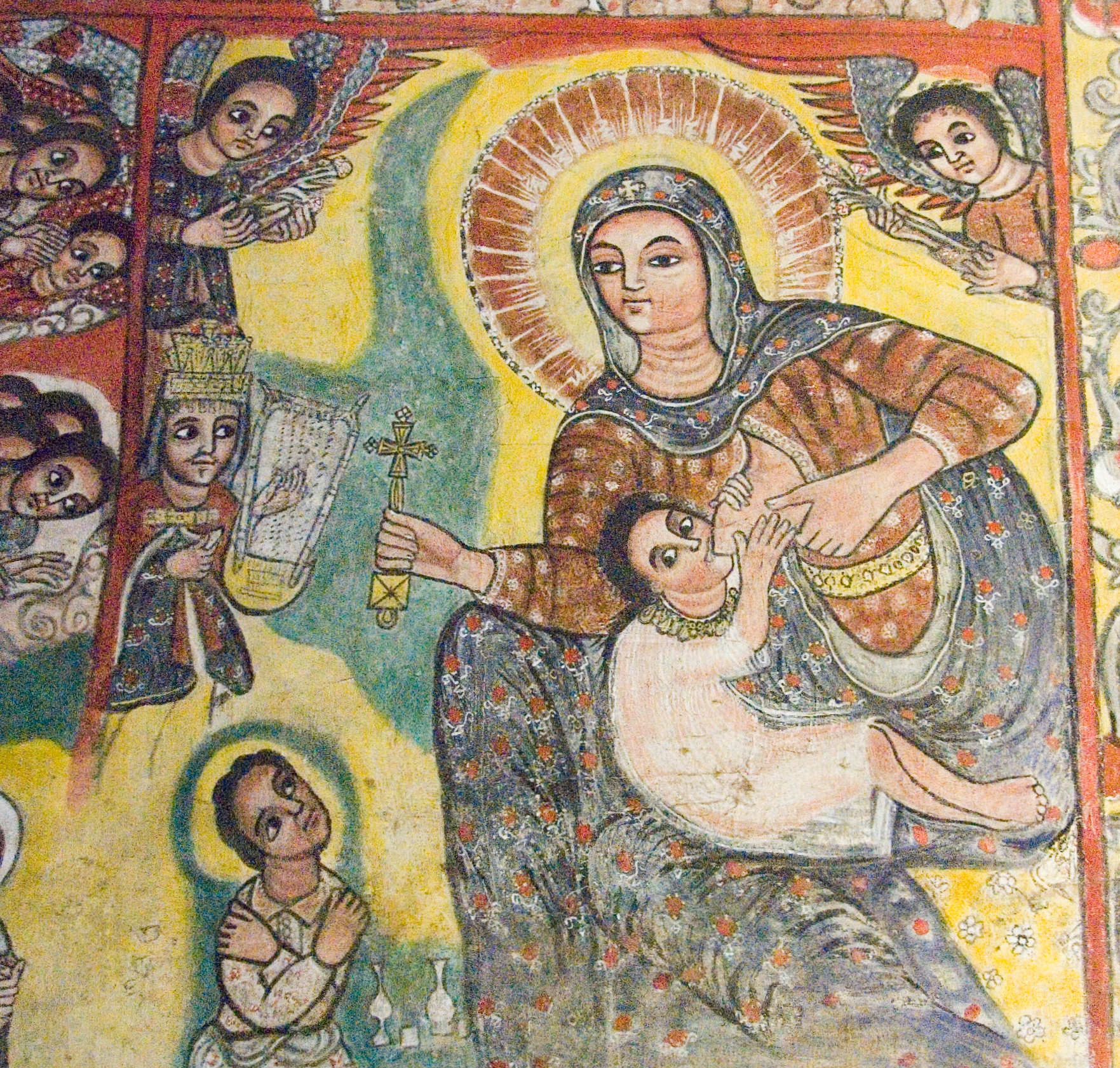
Maria lactans (Ethiopian)
Maria lactans, late 18th century. Fresco, Church of Narga Selassie, Dek Island, Lake Tana, Ethiopia. Photo: Alan Davey.

21. “Nativity” by Scott Cairns: This is the first in a pair of ekphrastic poems called “Two Icons,” in which the poet, who is Greek Orthodox, describes an icon from his home prayer corner. The first three stanzas engage in constructive wordplay: Jesus is wrapped in swaddling bands by his mother, and she is rapt—enraptured, wholly absorbed—by him. She holds him in her gaze and in her hands, and is beholden to him. Icons are about just that: beholding Christ and the sacred mysteries and deepening our affection for the One who holds us in affection. In Nativity icons our gaze is directed to “the core / where all the journeys meet, appalling crux and hallowed cave and womb,” where we are beckoned, like the magi, to bow before the incarnate God.

Source: Compass of Affection: Poems New and Selected (Paraclete, 2006)

22. “Star of the Nativity” by Joseph Brodsky: The Nobel Prize–winning Russian poet Joseph Brodsky was born into a Jewish family, but he was captivated by the story of Jesus’s birth and wrote many poems about it. The final stanza of this one gives us the unique perspective of the Star of Bethlehem, looking down—the Father’s beaming pride.

Source: Nativity Poems (Farrar, Straus and Giroux, 2001)

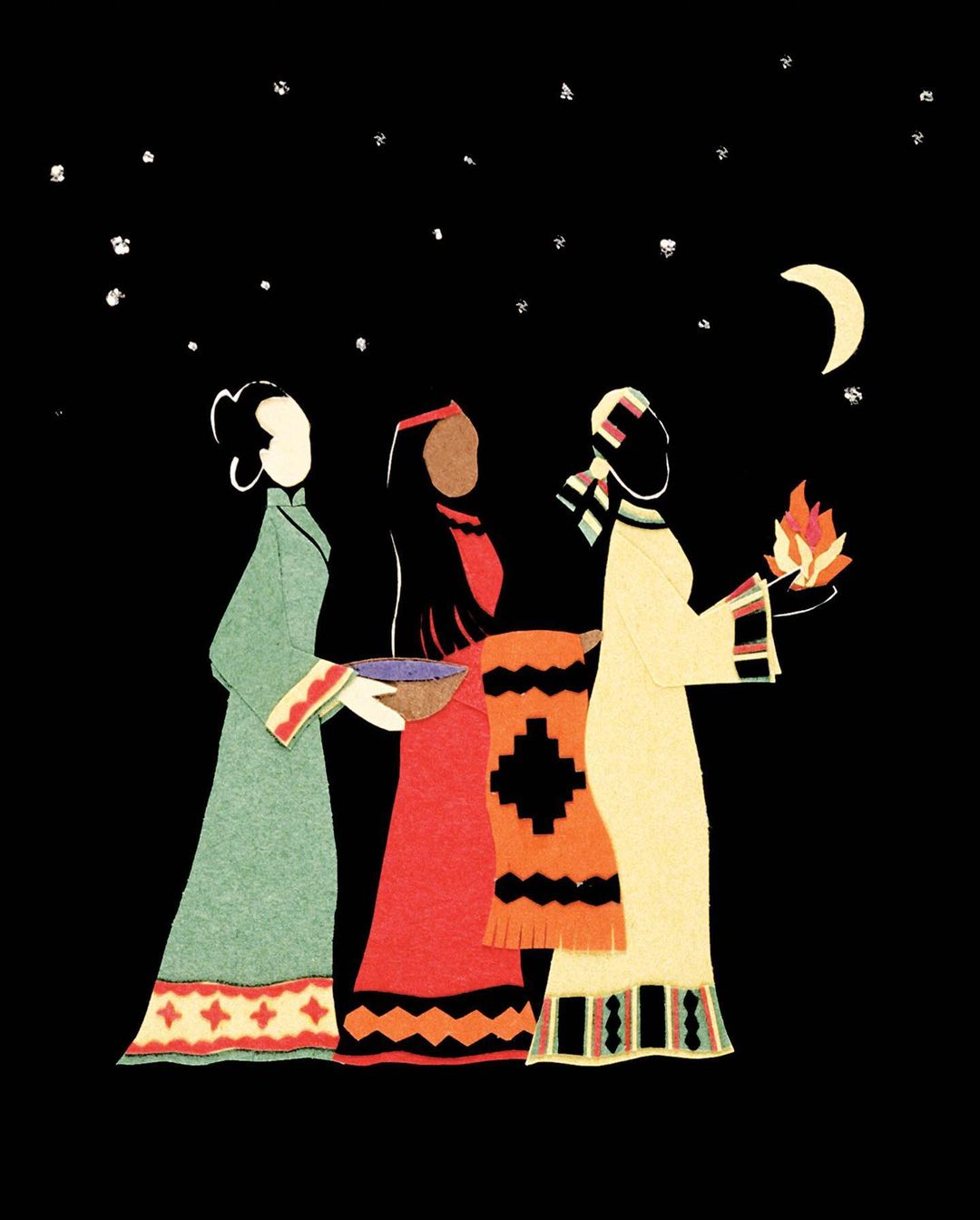
23. “Wise Women Also Came” by Jan Richardson: The Gospel of Matthew tells us that when Jesus was born, wise men came from the east to worship him. But wise women came too, Jan Richardson surmises. They came during Mary’s labor—midwives assisting with the birth. They came with lamps, fresh water, and blankets.

Source: Night Visions (Wanton Gospeller, 2010)
Richardson, Jan_Wise Women Also Came
Jan Richardson (American, 1967–), Wise Women Also Came, 1995. Collage. [purchase reproduction]

24. “Green River Christmas” by John Shea: Theologian and storyteller John Shea reflects on how, after experiencing something scary or unpleasant (like getting a shot or a teeth cleaning), mothers often give their child a treat. Christmas is a kind of supreme treat after the penitential season of Advent, during which we confronted the state of our spiritual health and remedied any shortfalls. Think, too, of the liturgy of (somber) confession and (sweet) pardon every Sunday at church, a prelude to the feast of bread and wine. At the Lord’s Table, we are fed—the gifts of God for the people of God. The Eucharist is the subtext of the final stanza, where Shea describes the presentation of Jesus in the temple forty days after his birth. There he is received by “the long-starved arms / of Simeon and Anna.” They had hungered for salvation, endured a long period of waiting; now they are filled.

Source: Seeing Haloes: Christmas Poems to Open the Heart (Liturgical Press, 2017)

25. “Taking Down the Tree” by Jane Kenyon: “Tick, tick, the desiccated needles drop.” This poem is about the passing of time—the death of another year—and the glumness that often sets in after the holidays are over, but it’s also about the storage of memories. In many households, Christmas ornaments are a multigenerational collection of memories. As with hanging them on the tree, taking them off and packing them away is a ritual that may prompt us to revisit certain past experiences or periods in our life. After we unplug the stringed lights and wrap up the baubles for safekeeping, then what? How will we inhabit the twelve months until next Christmas?

Source: Collected Poems (Graywolf, 2005)

Christmas, Day 8: All the Way

LOOK: Avatharana by Solomon Raj

Raj, Solomon_Avatharana
Solomon Raj (Indian, 1921–2019), Avatharana (Incarnation), late 1980s, batik. Source: Living Flame and Springing Fountain (Indian Society for Promoting Christian Knowledge, 1993).

Avataraṇa (अवतरण), from which we get the word “avatar,” is a Sanskrit word that means stepping down from a higher position. It’s the word used in Hinduism to refer to the incarnation of a deity, to his or her descending to earth. The late Indian Lutheran pastor, artist, and theologian Solomon Raj, from Andhra Pradesh, used the word, with nuance, to refer to the incarnation of Christ.

In this batik—a type of dyed cloth artwork made using a wax-resist method—Raj shows Jesus diving through the ether, surrounded by angels. He hurtles headfirst from heaven to earth to be with humanity. Reproduced in the book Living Flame and Springing Fountain (1993), the image is accompanied by this verse-style reflection by Raj:

When God became man and came to us,
the heavens donned a new robe of light.
When the son of man came to this earth,
the whole creation became renewed.
The universe now is redeemed and kept
for a glory yet greater than the first
because the unknown and the unknowable One
became man to live with mankind.

For more on the concept of Jesus as avatar from Christian perspectives, see:

LISTEN: “All the Way from Heaven Down” by Thomas Whitfield | Performed by the Thomas Whitfield Company, on The Annual Christmas Services (1988)

All the way from heaven down
Just to save me
All the way from heaven down
Just to love me

Roundup: Global Christian music; Christologies from the margins; race, gender, and photography

Today’s roundup brings together a theologian (Anderson Jeremiah), an art historian (Elissa Yukiko Weichbrodt), and a musician (Eric Lige and friends) who I think complement one another really well!

SONGS:

Eric Lige [previously] is “a music-maker who promotes Jesus, Justice, Faith, and Community.” He is the worship director at Ethnos Community Church in San Diego and the co-executive producer of The Ethnos Project, which creates a platform for new and emerging global voices in musical worship to be heard worldwide. Especially since COVID hit in 2019, he has been assembling multinational teams of musicians to produce YouTube videos, many of which are livestreamed as part of Ethnos worship services. Here are three examples (view more on Lige’s YouTube channel):

>> “Ξεδιψασμένος (No Longer Thirsty)” by Kostas Nikolaou: A contemporary Christian worship song in Greek, about how Christ, the living water, quenches our thirst for love and purpose. The lead vocalist is Nefeli Papanagi—and wow, do I love her voice!

>> “Ua Mau (Hosanna)” by Moses W. Kaaneikawahaale Keale (aka Keale Ta Kaula): Reyn and Joy Nishii perform this nineteenth-century Hawaiian hymn by Keale “the Prophet,” who converted to Christianity after calling on God during a hunting accident and finding rescue. The first verse translates to “Perpetual is the righteousness / That comes from the Father above / Let us gather together / In his goodness and grace.”

>> “Love’s in Need of Love Today” by Stevie Wonder: Edward Chen and friends—from Canada, the United States, Armenia, Venezuela, and Mexico—perform the opening track from Stevie Wonder’s Grammy-winning album Songs in the Key of Life. “God gave me this gift, and this particular song was a message I was supposed to deliver,” Wonder has said. “The concept I had in mind was that for love to be effective, it has to be fed.” See the full list of credits in the description on the video page. Eric Lige is the one in the maroon shirt.

+++

LECTURES:

>> “Many Faces of Jesus: Christologies from the Margins” by the Revd. Canon Dr. Anderson H. M. Jeremiah, October 12, 2021: Anderson Jeremiah is a senior lecturer in the politics, philosophy, and religion department at Lancaster University in the UK, whose areas of expertise include Christian theology in Asia, postcolonial approaches to theology, Dalit studies, liberation theology, modern missionary movements, and inculturation and faith. Ordained in the Church of South India (part of the Anglican Communion), he was installed as Canon Theologian of Blackburn Cathedral in September 2021, making him the first Dalit to be appointed to that role in any English cathedral.

In this half-hour online talk given last fall for the Diocese of Manchester, Jeremiah discusses the Incarnation as a continuous event—Christ being born into human cultures—as expressed through a selection of visual artworks from Ghana, Bolivia, China, Japan, and India. These images subvert the predominant Western image of Christ and sometimes provide critique. New to me was the black marble crucifix from the Anglican chapel inside Cape Coast Castle, a former trading post (now a museum) where enslaved Africans were held before being loaded onto ships and sold in the Americas. I’m not sure who commissioned the sculpture or when it was placed at this site, but it definitely looks modern.

The Q&A that followed on the original Zoom event is not included in the video, but here’s one of Jeremiah’s comments from it that I transcribed: “Jesus is not foreign to my own experience; this Jesus is part and parcel of my own existential reality. It [the image] enables people who are seeking peace and emancipation; [they are] emboldened in that process of seeing themselves reflected in the image of Jesus. The normative image the church has been holding on to has not created that space.” When one attendee asked if images of white Jesus are always “wrong” or to be discouraged, Jeremiah replied that there’s nothing wrong with such an image in itself, but the problem is when it is imposed on the entire world as the only way of looking at Jesus. “When we hold up one image as normative, we lose the diverse ways God intends to manifest himself in diverse contexts,” he said. (I couldn’t agree more!)

Bolivian crucifix
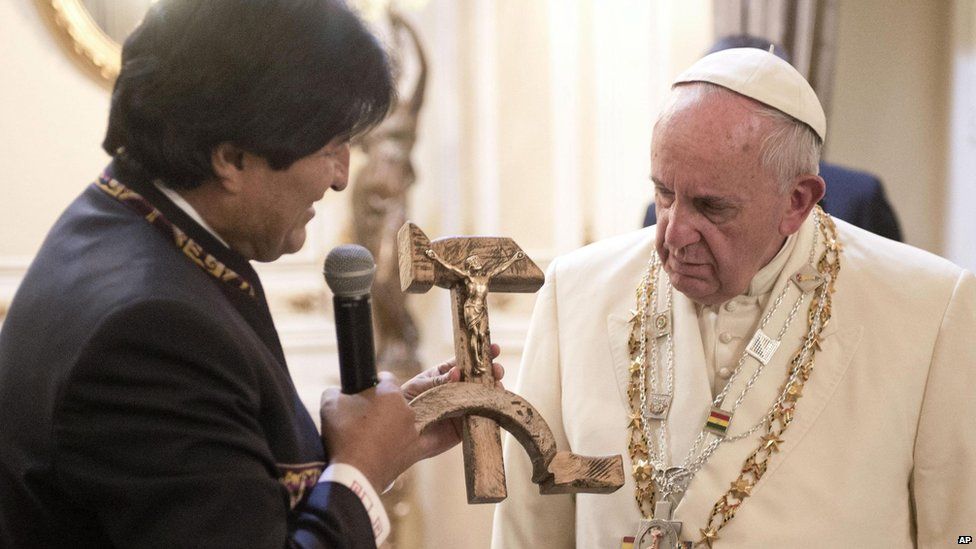
In July 2015 Bolivian president Evo Morales (who is Aymara) presented to Pope Francis a crucifix sculpted in the shape of a hammer and sickle. The crucifix is based on a design by Luís Espinal (1932–1980), a Jesuit priest assassinated in 1980 by right-wing militia. Bolivia’s communications minister, Marianela Paco, told Bolivian radio that “the sickle evokes the peasant, the hammer the carpenter, representing humble workers, God’s people.” Photo: AP.

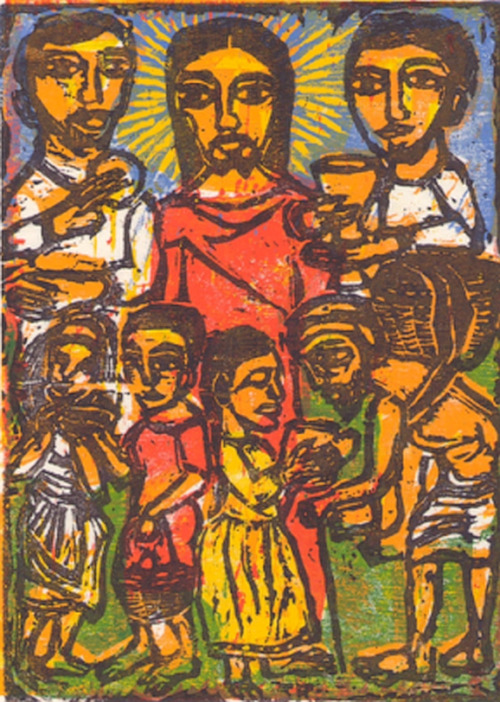
Raj, Solomon_The Lord Remembers the Hungry
Solomon Raj (Indian, 1921–2019), The Lord Remembers the Hungry: Liberation from Hunger, 2006 (based on the 1988 original). Woodcut, from the series “Liberation in Luke’s Gospel.”

To hear more from the Rev. Dr. Anderson Jeremiah, see “Dalit Theology in the Context of World Christianity: Subversion and Transgression,” another excellent online talk that he gave in June 2021 at the invitation of the Oxford Centre for Religion and Culture. And this Grace Podcast episode from October, where he briefly discusses the From Lament to Action report of the Church of England’s Archbishops’ Anti-Racism Taskforce (published April 22, 2021), the contextual nature of all theology (contra the view that white Euro-American theology is somehow universal, whereas theologies that come from Africa, for example, need to be qualified), and cultural appreciation versus appropriation. “I’m trying to capture the experiences of communities through the stories they tell about Jesus,” Jeremiah says. Follow him on Twitter @TheOutsider40.

>> “The Loving Look: Or, How Art History Taught Me About the Difference Between Structure and Direction When Looking at Images of Race and Gender” by Dr. Elissa Yukiko Weichbrodt, October 12, 2017: Art historian Elissa Yukiko Weichbrodt, a professor at Covenant College who researches representations of race and gender in art and visual culture from the nineteenth century to the present, is one of my favorite people to follow on Instagram (@elissabrodt). I love how she helps people understand and use the tools of the discipline of art history. She teaches us how images work and how to interrogate them.

In this undergraduate lecture (starts at 4:06), Weichbrodt discusses how photography has been used to shape racial bias and even construct race, as well as gender, focusing on a famous 1957 photograph of school desegregation in Little Rock, Arkansas. She shows how this single photo is part of a larger web of meaning that contemporary news photos also play into. We’re always interpreting and categorizing images in relationship to things we’ve already seen, Weichbrodt says, creating a mental archive—for example, a file for “blackness,” a file for “womanhood.” And “as Christians called to recognize the dignity of God’s image in all people, we have to do actual work to acknowledge how our own archives may have hampered or distorted our love for our neighbors.” To look more faithfully, we need to look more; we need to build a broader archive.

For related content from Weichbrodt, see her 2018 series of articles for The Witness BCC: “Representing Race: Why Do Images Matter?,” “Representing Race: Lenses for Interpretation,” and “Restorative Looking.” You can also view a longer and more recent version of this lecture, “Looking Justly,” given October 30, 2019, at Christ Community Church in Franklin, Tennessee, which includes a Q&A.

+++

NEW PLAYLIST: February 2021 (Art & Theology): Continuing my initiative to share good music from the Judeo-Christian tradition . . . here’s a new (nonthematic) playlist I put together, which includes a fifteenth-century Jewish hymn (with a contemporary melody by Ugandan rabbi Gershom Sizomu), a country one-hit wonder from the sixties (thanks to my dad, a regular ’60s Gold listener, for introducing me to this one!), a virtuoso guitar composition by Bruce Cockburn inspired by Jesus’s first miracle, an original gospel song by Freedom Singer Bernice Johnson Reagon, the opening theme song of an antebellum television drama, and more.

Roundup: Multiethnic Jesus, egg dancing, new Easter album, and more

ARTICLE: “Searching for a Jesus Who Looks More Like Me” by Eric V. Copage: I was interviewed the other week for this New York Times piece on multiethnic images of Christ. I comment on paintings by Wisnu Sasongko (Indonesian), Greg Weatherby (Aboriginal Australian), Emmanuel Garibay (Filipino), and Solomon Raj (Indian), and helped select a few of the other images.

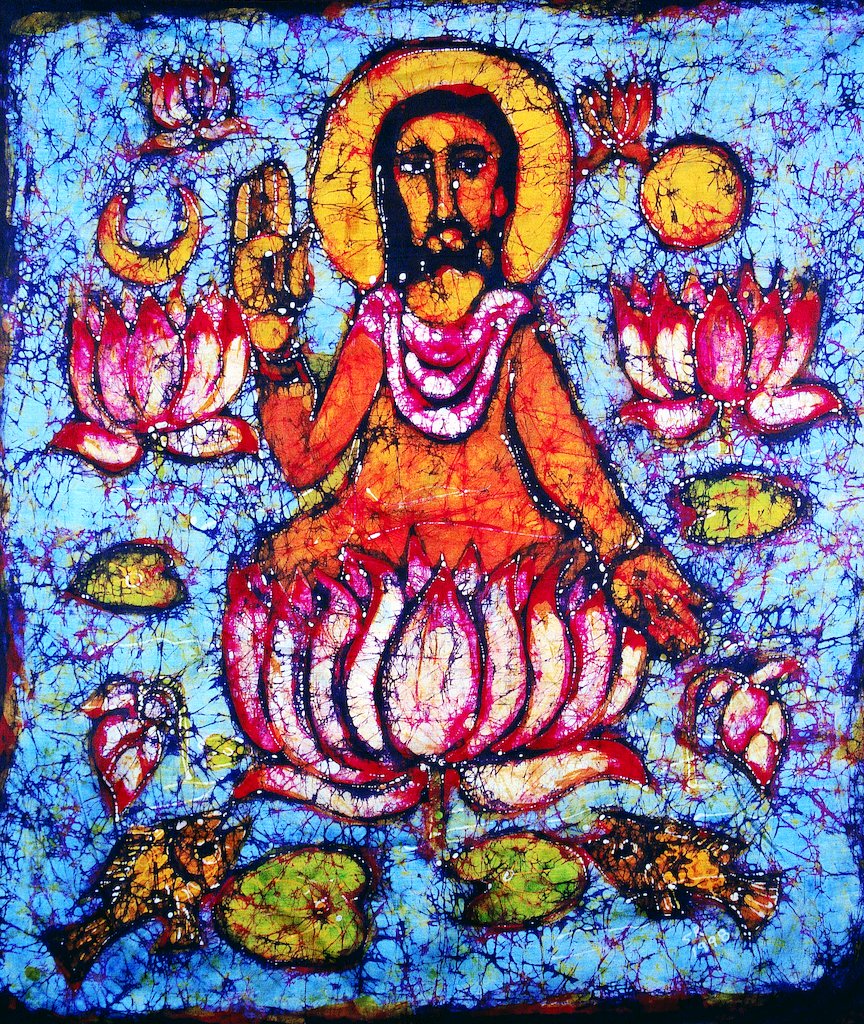
Jesus on a Lotus by Solomon Raj
Solomon Raj (Indian, 1921–2019), Jesus on the Lotus Flower, 1998. Batik. Photo: Gudrun Löwner.

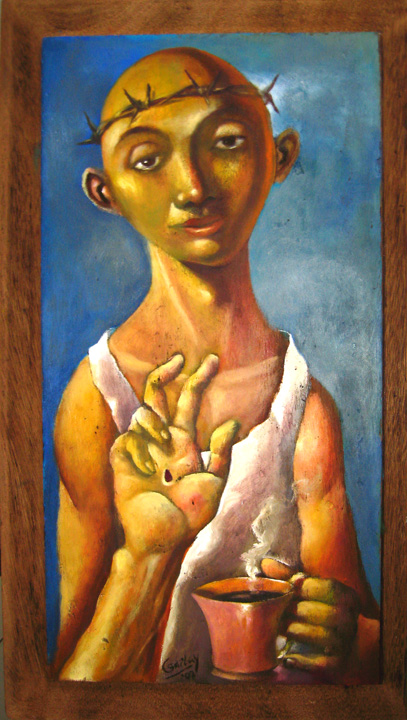
Garibay, Emmanuel_Jesus with coffee
Emmanuel Garibay (Filipino, 1962–), Untitled, 2007. Oil on wood. Photo via the artist.

Of those Christians who even permit images of Jesus, some hold to a strict literalism and object to images that show him as anything other than a first-century Jew from Israel-Palestine—even though these same literalists would rightly insist that no image is literally Jesus. As I hope is clear from my website, I embrace a wide range of Christological imagery, which I feel reflects the universal presence and revelation of God. (“Christ is all, and in all,” as the apostle Paul wrote in Colossians 3:11; he continues to manifest spiritually, and through his ecclesial body, all over the world.) I’m not so proud to assume that my way of picturing Jesus is the most right or authoritative; I need others to help me see Jesus more fully, more truly. Like C. S. Lewis said, “My own eyes are not enough for me, I will see through those of others.” And historical realism is not the only, or even necessarily the best (depends on context), art style to show who Jesus is.

Even though the historical Jesus never wore a full-face moko (tattoo) like the Maori, as Sofia Minson paints him, nor did he sit on a lotus flower when he taught his disciples, nor did he appear to Peter, James, and John transfigured between two Yoruba deities, these images and others like them tell us something about Jesus. At a broad level, they proclaim the Incarnation—God in flesh, dwelling among us, as us, that is, fully human. The historical Jesus existed in a specific time and place, and had ethnic particularities, but his coming was not just for the Jews but for the Gentiles too, and not just for his day, for but all time. Through symbol and metaphor and materiality, artists make this truth real.

+++

UPDATED BLOG POSTS

Occasionally if I’ve covered an art topic in the past and then come across a new image that fits that topic perfectly, I will add it as an addendum to the original post. I’ve done that with two Eastertide posts.

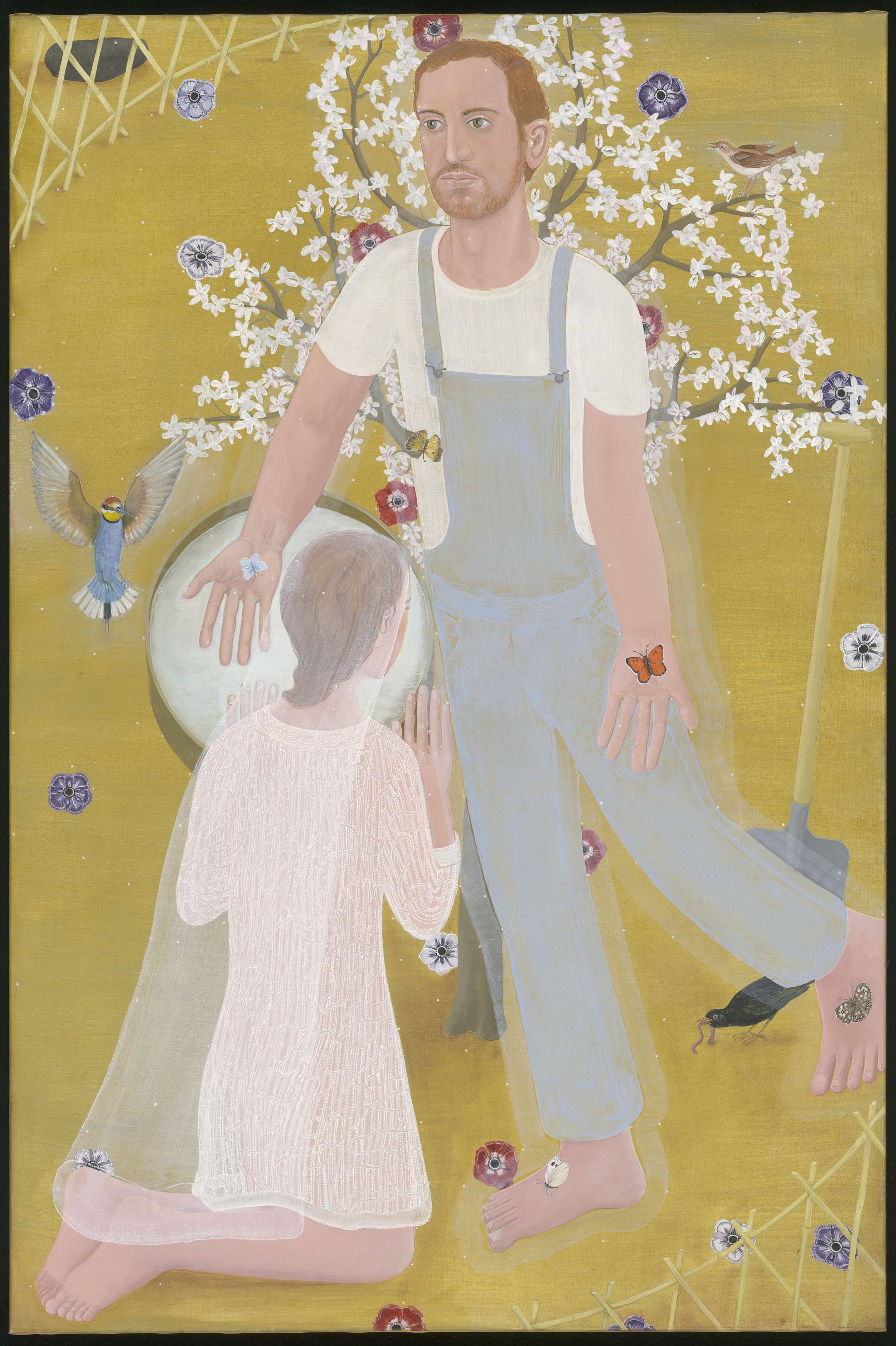
“‘She mistook him for the gardener’”: Humanity was born in a garden and reborn in a garden, as biblical scholars like N. T. Wright are keen to point out, with Easter morning marking the launch of new creation. In art history the resurrected Christ is sometimes amusingly shown carrying gardening tools when he encounters Mary Magdalene outside his tomb—to explain the case of mistaken identity that John records, perhaps, but more likely to establish a metaphor. Two of the paintings I’ve added to this post are by Janpeter Muilwijk, whose New Gardener from 2017 shows the freshly risen Christ in a white T-shirt and overalls, heading with open arms toward Mary, who is dressed like a bride to receive him. (Mary is modeled after the artist’s daughter Mattia, who died.) Butterflies alight on each of Jesus’s five wounds, marking them as sites of transformation, and the flowering branches of a tree crown him with spring glory.

Muilwijk, Janpeter_New Gardener
Janpeter Muilwijk (Dutch, 1960–), New Gardener, 2017. Oil on canvas, 150 × 100 cm. Private collection, Netherlands.

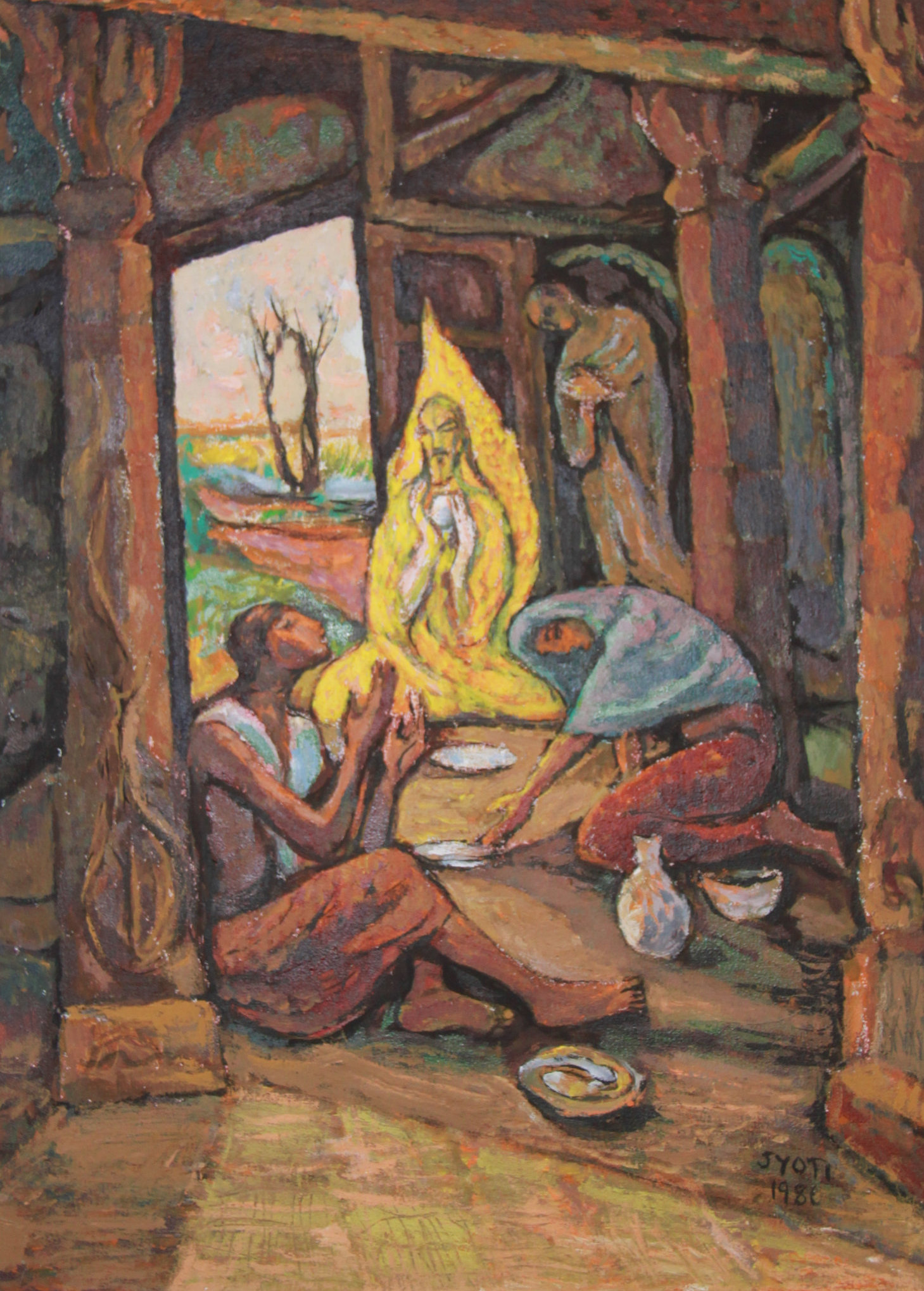
“The Unnamed Emmaus Disciple: Mary, wife of Cleopas?”: Written in 2017, this is one of Art & Theology’s most visited posts. In it I conjecture that the pilgrim who traveled with Cleopas from Jerusalem to Emmaus in the famous Easter story could have been a woman, perhaps Cleopas’s wife. Several artists have conjectured the same, and besides adding to this compilation three Emmaus paintings that the artist Maximino Cerezo Barredo sent me after the initial publication, I’ve also added one by Jyoti Sahi, which shows Jesus sitting with the two disciples—one male, one female—on the floor of a small roadside dwelling, breaking chapati (Indian flatbread) together. He is ablaze with glory, evoking his earlier revelations as I AM in the burning bush before Moses and to Peter, James, and John on Mount Tabor at the Transfiguration.

Sahi, Jyoti_Supper at Emmaus
Jyoti Sahi (Indian, 1944–), The Supper at Emmaus, 1980. Mixed media on canvas. Photo courtesy of the artist.

+++

NEW SONGS

“A Bedtime Song for Anxious Children” by W. David O. Taylor and Paul Zach: David Taylor has written a new children’s song (set to music by Paul Zach), which he sings here with his daughter, Blythe. The lyrics are in the video description on YouTube.

“I’ve heard from so many parents recently that their children are struggling with anxiety, fear, frustration, sadness, anger, and restlessness,” Taylor writes, “and so I thought a little song reassuring them of God’s care at night, when they’re most vulnerable, might help their hearts. Our hope is that the melody might be simple enough for parents and children to be able to sing it when they go to bed.”

“See the Day” by Liz Vice: One of my favorite singers, Liz Vice, released a new single on April 10, called “See the Day.” Cowritten by her, Leslie Jordan, and Jonathan Day, it expresses hope for the coming day of the Lord, when justice will roll down like a mighty river, walls of division will crumble into dust, oppression will cease, and the whole world will be startled awake by love. “Precious Lord, come lead us on” to that reality.

+++

NEW ALBUM: Easter 1 by Mac Meador: Mac Meador, a singer-songwriter from Austin, Texas, released a new EP of six songs for Eastertide this April, a sort of flip side to the Lent 1 EP he released in February. I really enjoyed them both (and the same goes for his Summer of Psalms from 2018). The Easter album strikes just the right note for me right now—of a quiet hope and joy that’s not absent of pain. The songs celebrate Christ the risen king while also expressing longing for the age to come, when the kingdom will be established in full. Lean into that promise!


You can stream and purchase Meador’s music on Bandcamp. (Note: To help musicians affected by COVID-19, Bandcamp is waiving its cut of all sales made on its site on May 1.) You might also want to check out his YouTube channel, where he posts additional songs. For the past four weeks he has been releasing “Quarantine Hymn Sing” lyric videos for his church, Grace + Peace Austin, where he serves as minister of music. (He also sets Bible memory verses to music for kids!)

+++

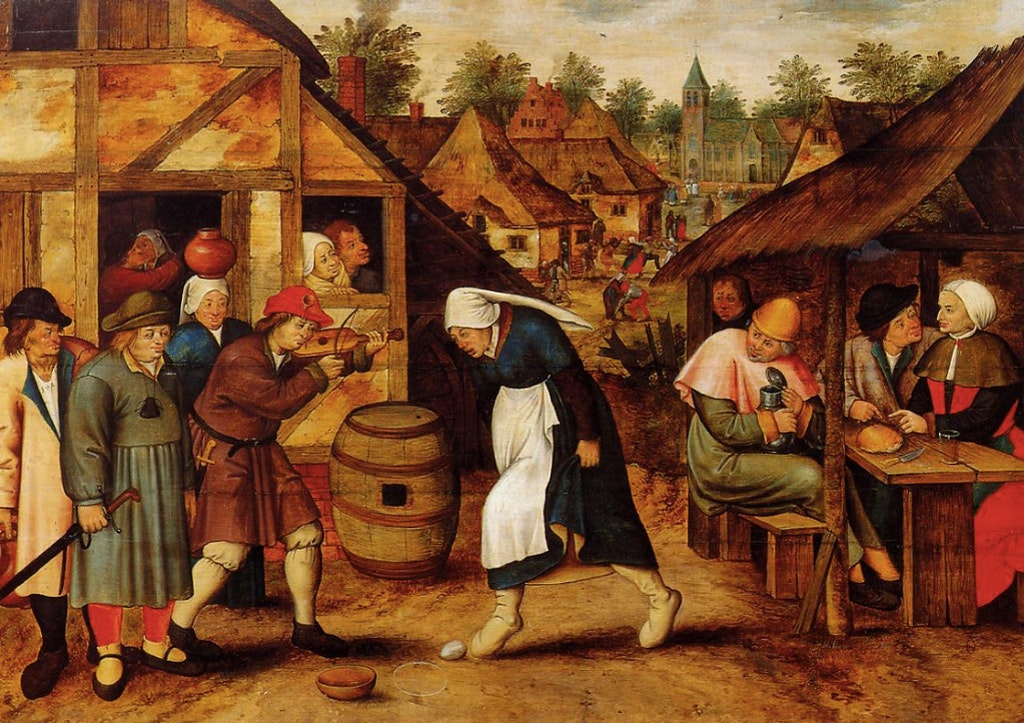
EGG DANCING: “The Egg Dance: From Peasant Village to Political Caricature”: The Public Domain Review has compiled an amusing gallery of historical paintings, drawings, and prints that show the egg dance, a traditional Easter game with several variations, most associated with western European peasantry of the sixteenth and seventeenth centuries.

Brueghel the Younger, Pieter_The Egg Dance
Pieter Brueghel the Younger (Flemish, 1564/65–1637/38), The Egg Dance, ca. 1620. Oil on panel, 26 1/4 × 41 1/4 in. (66.7 × 104.8 cm).

+++

ART VIDEO: “500 Years of the Herrenberg Altarpiece”: I love seeing all the fun, creative resources being produced by art museums to help educate and engage the public in viewing art. Though I speak not a lick of German, this video from the Staatsgalerie Stuttgart about Jörg (Jerg) Ratgeb’s Herrenberg Altarpiece made me laugh and had me hooked for its full five minutes. (I came across it when I was prepping a Holy Week blog post that features a different painting attributed to the same artist.) Released last October for the five hundredth anniversary of the altarpiece, the video, directed by Valentin Hennig and Oleg Kauz, animates some of the birds from the painted panels and has them narrate as the camera zooms in on details (one of them quite jarring and unseemly!). They then fly through the museum hall and over the town some twenty miles southwest to the church where the piece originally stood.

To add autogenerated subtitles, click the “CC” (closed captioning) button on the bottom of the video player, then select your language using the gear icon.

Painted in 1519, this double-winged altarpiece was commissioned by the Brethren of the Common Life, a Catholic pietist community, for the high altar of the collegiate church of Herrenberg in Swabia. Closed, it shows the apostles about to set out on their mission to spread the word of God. The first open view (interior panels closed, exterior wings folded out) reveals scenes from the passion of Christ, each panel with a primary scene in the foreground and a secondary scene in the background: the Last Supper with the Agony in the Garden, the Flagellation and Crowning with Thorns with the Ecce Homo (presentation to the crowd), the Crucifixion with the Carrying of the Cross and the Entombment, and the Resurrection with the Noli me tangere (appearance to Mary Magdalene). Completely opened (its feast-day configuration), the altarpiece shows scenes from the infancy of Christ, with reference also to the life of the Virgin Mary. It used to have a central Marian statue and predella figures, but these were likely destroyed when the Protestant Reformation came to Württemberg in 1534.

The artist had already died by this time—he was executed (drawn and quartered) for treason in 1526 for his role as one of the leaders of the German Peasants’ Rebellion.

By the Mark (Artful Devotion)

You and I by Solomon Raj
P. Solomon Raj (Indian, 1921–), You and I, before 1993. Batik. Source: Living Flame and Springing Fountain (Indian Society for Promoting Christian Knowledge, 1993)

Then [Jesus] said to Thomas, “Put your finger here, and see my hands; and put out your hand, and place it in my side. Do not disbelieve, but believe.”

Thomas answered him, “My Lord and my God!”

—John 20:27–28

+++

SONG: “By the Mark” by Gillian Welch and David Rawlings, on Revival (1996)

(Related post: “Thomas in the dark”)

+++

“St. Thomas the Apostle” by Malcolm Guite, from Sounding the Seasons: Seventy Sonnets for the Christian Year

“We do not know . . . how can we know the way?”
Courageous master of the awkward question,
You spoke the words the others dared not say
And cut through their evasion and abstraction.
O doubting Thomas, father of my faith,
You put your finger on the nub of things:
We cannot love some disembodied wraith,
But flesh and blood must be our king of kings.
Your teaching is to touch, embrace, anoint,
Feel after him and find him in the flesh.
Because he loved your awkward counter-point,
The Word has heard and granted you your wish.
O place my hands with yours, help me divine
The wounded God whose wounds are healing mine.

[Click here to listen to a short sermon Guite preached on St. Thomas back in 2012, which opens with his reading of this poem.]


This post belongs to the weekly series Artful Devotion. If you can’t view the music player in your email or RSS reader, try opening the post in your browser.

To view all the Revised Common Lectionary scripture readings for the Second Sunday of Easter, cycle B, click here.

Pentecost art from Asia

Ten days after Jesus ascended into heaven (and fifty days after his resurrection), his Holy Spirit descended on the apostles, manifesting as “tongues of fire” (Acts 2:3). This miraculous gift enabled the apostles to speak in languages foreign to them but native to the many Jews from abroad who were gathered in Jerusalem for Shavuot (called “Pentecost” by Hellenized Jews), a festival of giving thanks for the harvest and for God’s provision of the Torah. For the first time the gospel of Jesus Christ was proclaimed to a global audience. Three thousand people came to faith that day, and the Christian church was born.

The Spirit is still at work in the dissemination of the good news today, breathing life into cultures all over the world and thereby building up an incredibly diverse body of Christ.

The arts are one expression of this diversity.

In the introduction to his groundbreaking book Each with His Own Brush: Contemporary Christian Art in Asia and Africa (New York: Friendship Press, 1938), Daniel Johnson Fleming writes,

As at Pentecost, Parthians, Medes and Elamites heard the message, “every man in his own tongue wherein he was born,” so we see Chinese and Japanese and Indians expressing Christianity’s universal language, each with his own brush. For when the spirit of God descends upon any people, new forms of beauty appear, new artistic gifts are revealed, adding another testimony to the universality of the Christian faith.

Since the publication of this book almost seventy years ago, Christianity has grown exponentially in Asia, as have indigenous artistic expressions of the faith. In 1975 Japanese theologian and arts advocate Masao Takenaka published the heavily illustrated book Christian Art in Asia, highlighting the robust variety being produced on the continent. Three years later the Asian Christian Art Association was founded to encourage the exchange of ideas between Asian artists and theologians. Their magazine, Image (not to be confused with the Seattle-based quarterly), has showcased local talents even further. Dozens more books have been published in English on individual Asian artists, countries, and the Asian Christian art movement in general. For the latter, see the beautifully designed The Christian Story: Five Asian Artists Today, plus The Bible Through Asian Eyes.

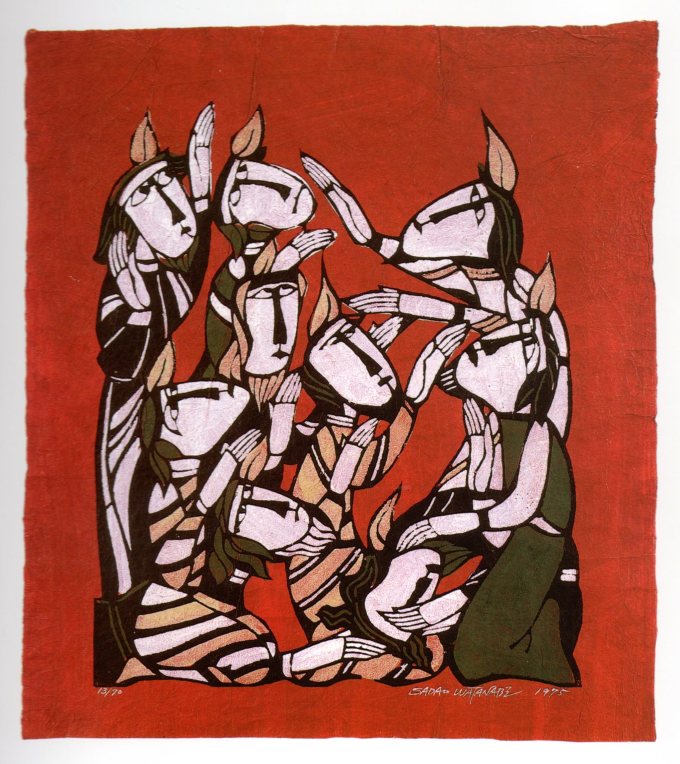
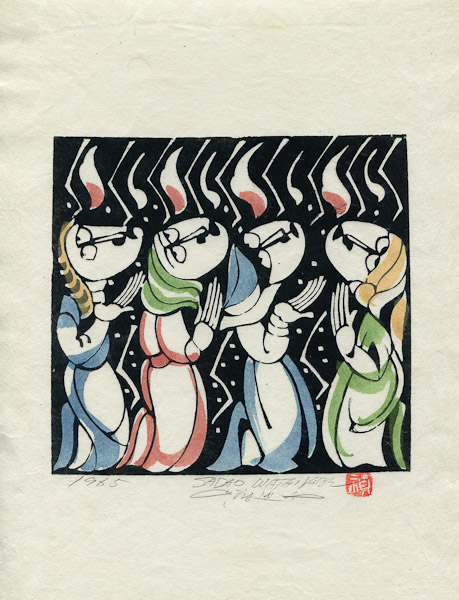
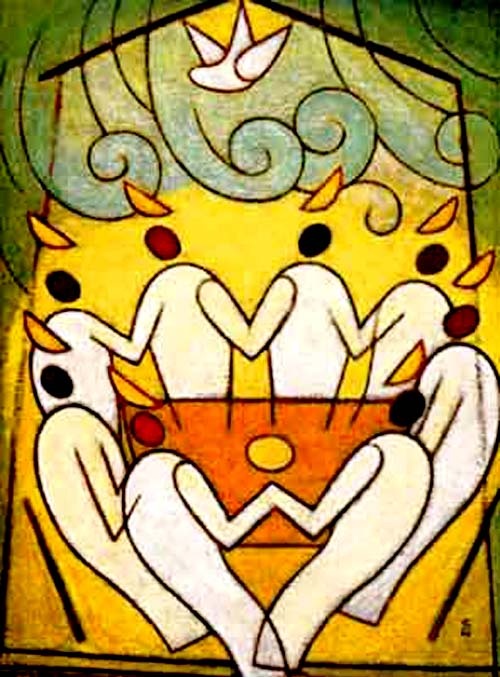
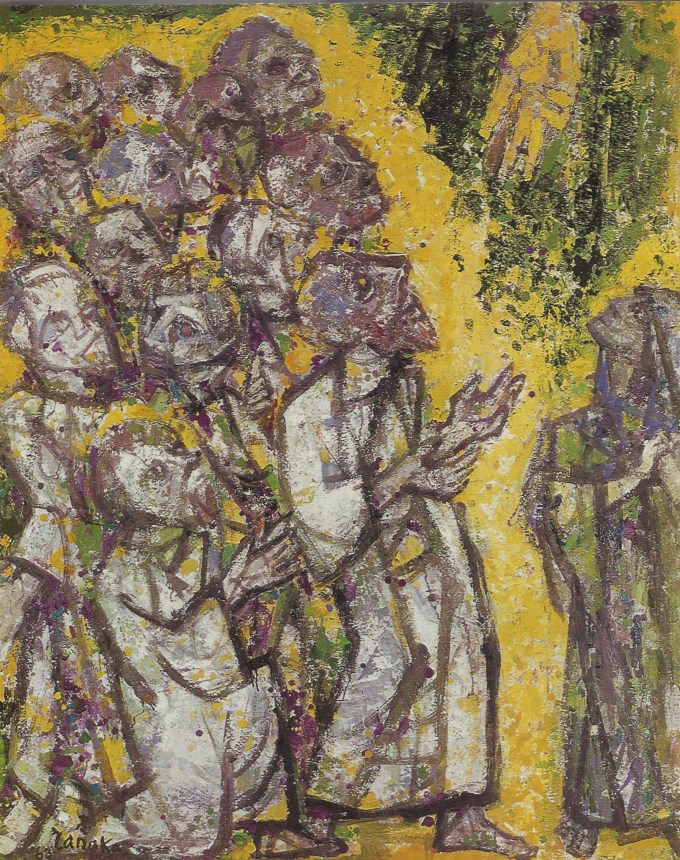
Below is a sampling of Asian art on the theme of Pentecost. Some works were made using traditional art forms or techniques—Chinese papercutting, Japanese flower arranging (ikebana) or stencil printing (kappazuri), Indian cloth dyeing (batik)—while other artists have chosen to work in oils and acrylics, collage, or glass. Some depict native people and settings—for example, Thai dancers wrapped in sabai, or a group sitting under a thatched roof in Indonesia—while others prefer ethnic and geographic ambiguity. There’s no single style that epitomizes the art of any country.

Pentecost by Sadao Watanabe
Sadao Watanabe (Japanese, 1913–1996), Pentecost, 1975. Hand-colored kappazuri-dyed stencil print on washi paper, 25.5 × 22.75 in. Source: Printing the Word: The Art of Watanabe Sadao (Philadelphia: American Bible Society, 2003)

Pentecost by Sadao Watanabe
Sadao Watanabe (Japanese, 1913–1996), Pentecost, 1965. Hand-colored kappazuri-dyed stencil print on washi paper.

The Coming of the Holy Spirit by Soichi Watanabe
Soichi Watanabe (Japanese, 1949–), The Coming of the Holy Spirit, 1996. Oil on canvas, 18 × 13.25 in. Collection of the Overseas Ministries Study Center.

Pentecost by Tadao Tanaka
Tadao Tanaka (Japanese, 1903–1995), Pentecost, 1963. Oil on canvas. Source: Christian Art in Asia by Masao Takenaka (Tokyo: Kyo Bun Kwan, 1975)

Pentecost by Gako Ota
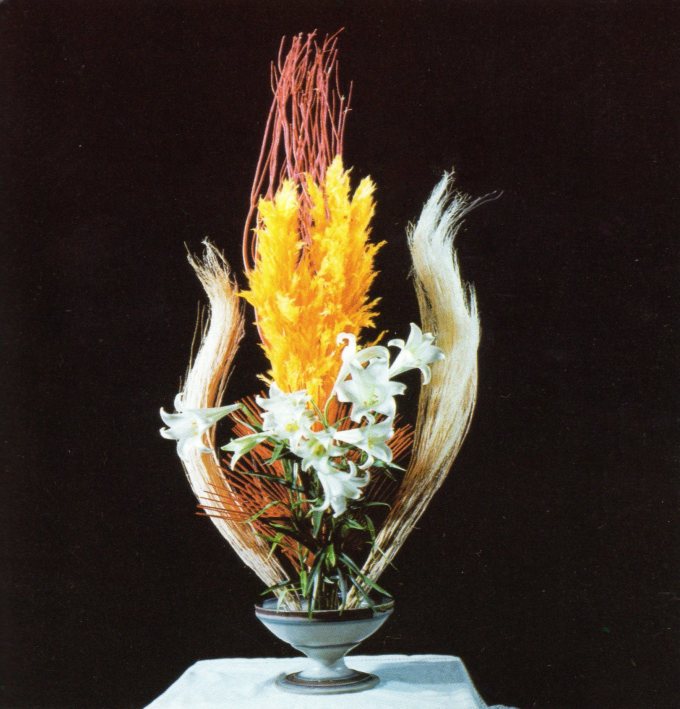
Gako Ota (Japanese, 1904–1972), Pentecost. Belvedere, pampas grass, paper bush, lilies, and rib of fan. Source: Consider the Flowers: Meditations in Ikebana, ed. Masao Takenaka (Tokyo: Kyo Bun Kwan, 1990)

Pentecost by Keiko Miura
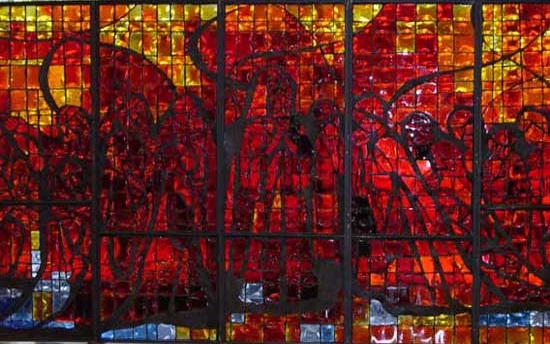
Keiko Miura (Japanese, 1935–), Pentecost, 2004. Stained glass window, All Pilgrims Christian Church, Seattle, Washington, USA.

Holy Spirit Coming by He Qi
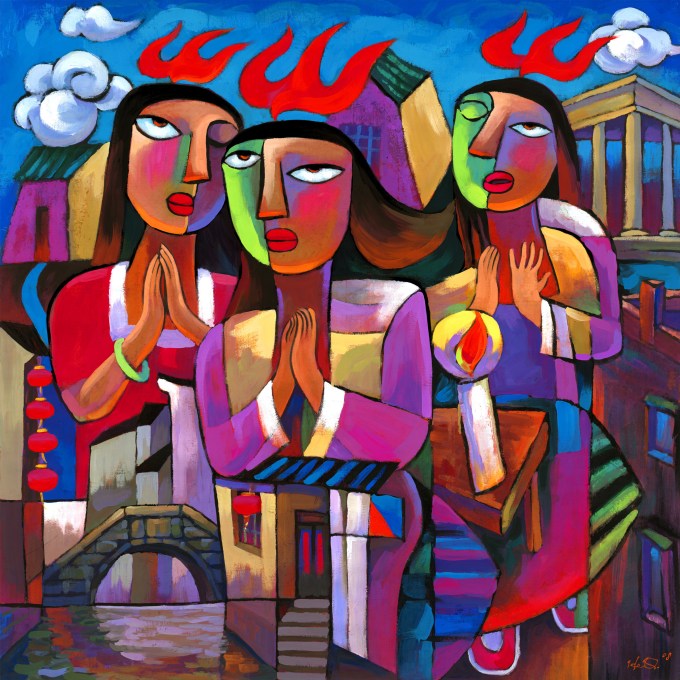
He Qi (Chinese, 1950–), Holy Spirit Coming, 1998. Oil on canvas.

Continue reading “Pentecost art from Asia”