What is that coming up from the wilderness like columns of smoke, perfumed with myrrh and frankincense, with all the fragrant powders of a merchant?
—Song of Solomon 3:6 (KJV)
Arise, shine; for thy light is come, and the glory of the LORD is risen upon thee.
—Isaiah 60:1 (KJV)
Awake, awake; put on thy strength, O Zion; put on thy beautiful garments, O Jerusalem, the holy city. . . . Shake thyself from the dust; arise, and sit down, O Jerusalem: loose thyself from the bands of thy neck, O captive daughter of Zion. For thus saith the LORD, Ye have sold yourselves for nought; and ye shall be redeemed without money.
—Isaiah 52:1–3 (KJV)
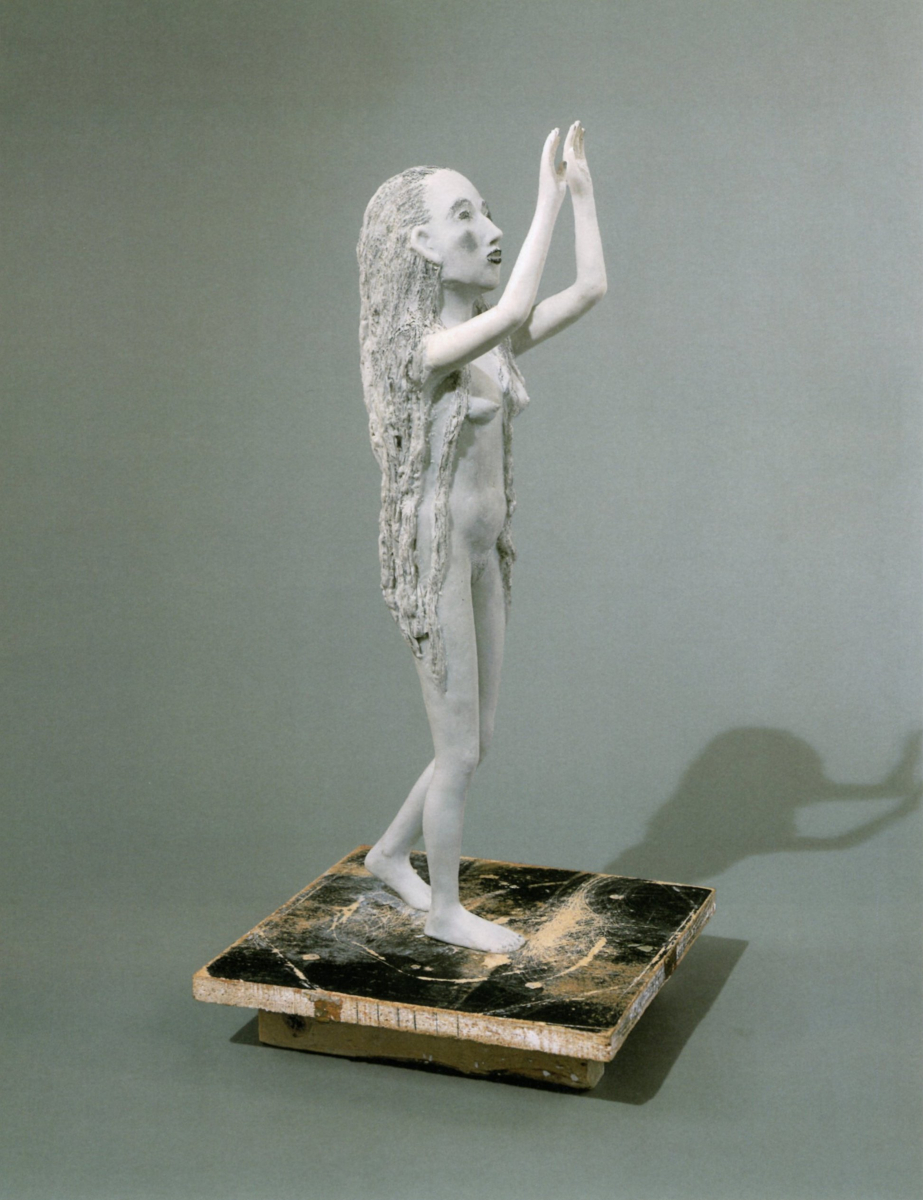
LOOK: Eve by Kiki Smith
Kiki Smith (American, 1954–), Eve, 2001. Manzini (resin and marble dust) and graphite, 20 3/8 × 5 × 6 3/4 in. (51.8 × 12.7 × 17.1 cm). Source: Kiki Smith: A Gathering, 1980–2005, p. 247
Eve, the mother of all living, a representative of humanity. The crown of God’s creation, and yet she distrusted God’s word, transgressed his command, breaking what was intended to be an eternal communion. In this small sculpture, she looks up, raising her hands in front of her face—in a gesture of prayer or praise? Shielding her eyes from brightness? Could it be she sees redemption on the horizon?
LISTEN: “Lecha Dodi” (Come, My Beloved), traditional Jewish hymn | Words by Shlomo ha-Levi Alkabetz, based on verses from the Hebrew Bible, 16th century | Music by Maayan Tzafrir, 2021 | Sung by Maayan Tzafrir, 2021
(Turn on CC on the video to read the Hebrew lyrics alongside the English.)
ENGLISH TRANSLATION (supplied by 12 Tribes Music):
Rouse yourselves! Rouse yourselves! [Isa. 51:17] Your light is coming; rise up and shine. [Isa. 60:1] Awake! Awake! Utter a song. The glory of God is revealed upon you.
Who is this that cometh up out of the wilderness, Perfumed with myrrh and frankincense, With all the fragrant powders of a merchant? [Song of Sol. 3:6]
Shake off the ashes! Rise up from the dust! Put on your garments of splendor, my people. [Isa. 52:1] Through the son of Yishai [Jesse] of Bethlehem, Redemption draws near to my soul.
Awake! Awake! Utter a song, Let me see thy countenance. Awake! Awake! Utter a song, Let me hear thy voice.
When I was a student at UNC–Chapel Hill, I was curious to learn more about the Jewish roots of my Christian faith. I reached out to the Jewish campus organization Hillel, and they invited me to attend their Shabbat dinner, hosted every Friday at sundown at a large house on Cameron Ave.
Most markedly, I remember, before eating, the communal singing of the piyyut (Jewish liturgical poem) “Lecha Dodi” as everyone turned to face the door. I had no idea what the words meant—they were in Hebrew—or what the orientation of bodies was communicating. The song was part of the group’s regular liturgy, familiar to the Jewish students who were gathered, so no introduction or explanation was given, no lyric sheet that I recall. Afterward I asked the rabbi what just happened. “We welcomed in the Shabbat bride,” she said. “The Shekinah.” (The Shekinah is a dwelling or settling of the divine presence. The word is a feminine noun in Hebrew.)
I was puzzled by this statement. It sounded so mystical, challenging my very literalistic sensibilities at the time. The words of the song, by the rabbi and Kabbalist Shlomo ha-Levi Alkabetz (1500–1576), are mostly a composite of scripture texts from the Song of Songs, Isaiah, and elsewhere. Rabbi Shlomo personifies Shabbat (the Sabbath) as a bride, and Israel as her mate. The song anticipates the everlasting Shabbat, ultimate redemption, as the people of Israel ask God to bring about messianic deliverance.
I was taken back to this experience from almost twenty years ago when recently, I came across a version of the “Lecha Dodi” distributed by 12 Tribes Music [previously]. There are hundreds of different tunes for Rabbi Shlomo’s text, from medieval Moorish to northern European folk; but 12 Tribes features a newer setting by the Israeli musician Maayan Tzafrir.
The YouTube video description provides some biographical background:
Maayan Tzafrir is a singer and musician who weaves Balkan and Middle Eastern musical traditions with her Jewish roots. In her music she combines ancient piyutim (chants) with folk melodies. Maayan’s original compositions are inspired by Greek, Bulgarian, Georgian, and Turkish traditions. Maayan is the founder and vocal leader of the Yearot Ensemble, a singer in the Greek band Tavernikos, founder of The Hebrew Balkan Choir, and conductor of various workshops, meetings, and tours focusing on Balkan traditional singing with a Hebrew and feminine spirit.
The lyrics provided for Tzafrir’s version differ slightly from the traditional lyrics. It appears that she uses verses 5 and 4, with complementary material in between.
As a Christian, I can’t help but hear these words in light of Jesus. Several of the Hebrew scripture texts for Jewish Shabbat overlap with the Hebrew scripture texts for the Christian season of Advent, which is itself a dedicated time of looking forward to the arrival of the Messiah, beseeching his coming to dwell.
The phrase “son of Jesse” is a reference to the royal Davidic line from which the Messiah will come—and, in Christian belief, did come, in Jesus of Nazareth, son of Mary, who has since ascended into heaven but has promised to return to bring about the fullness of God’s kingdom.
SUBSTACK POST: “Read something medieval this year” by Grace Hamman: One of the most frequently asked questions that medievalist Grace Hamman receives is: “What books should I read from the past?” She gives recommendations for the following six scenarios (including specific translations/editions!).
I have never read anything medieval before! Where do I start?
I have not read any medieval literature, but I did read Confessions in college. How about something a little later, a little more “medieval”?
I want to read some medieval theology.
I’ve read Bernard. Give me a theology deep cut!
No thanks on the monastic theology. Give me poetry! Give me drama and beauty and weirdness!
I’m a stubborn cuss / good millennial hipster / professional troublemaker. I want to read what no one else is reading casually. Make it super hard and dialectical and confusing (but awesome).
+++
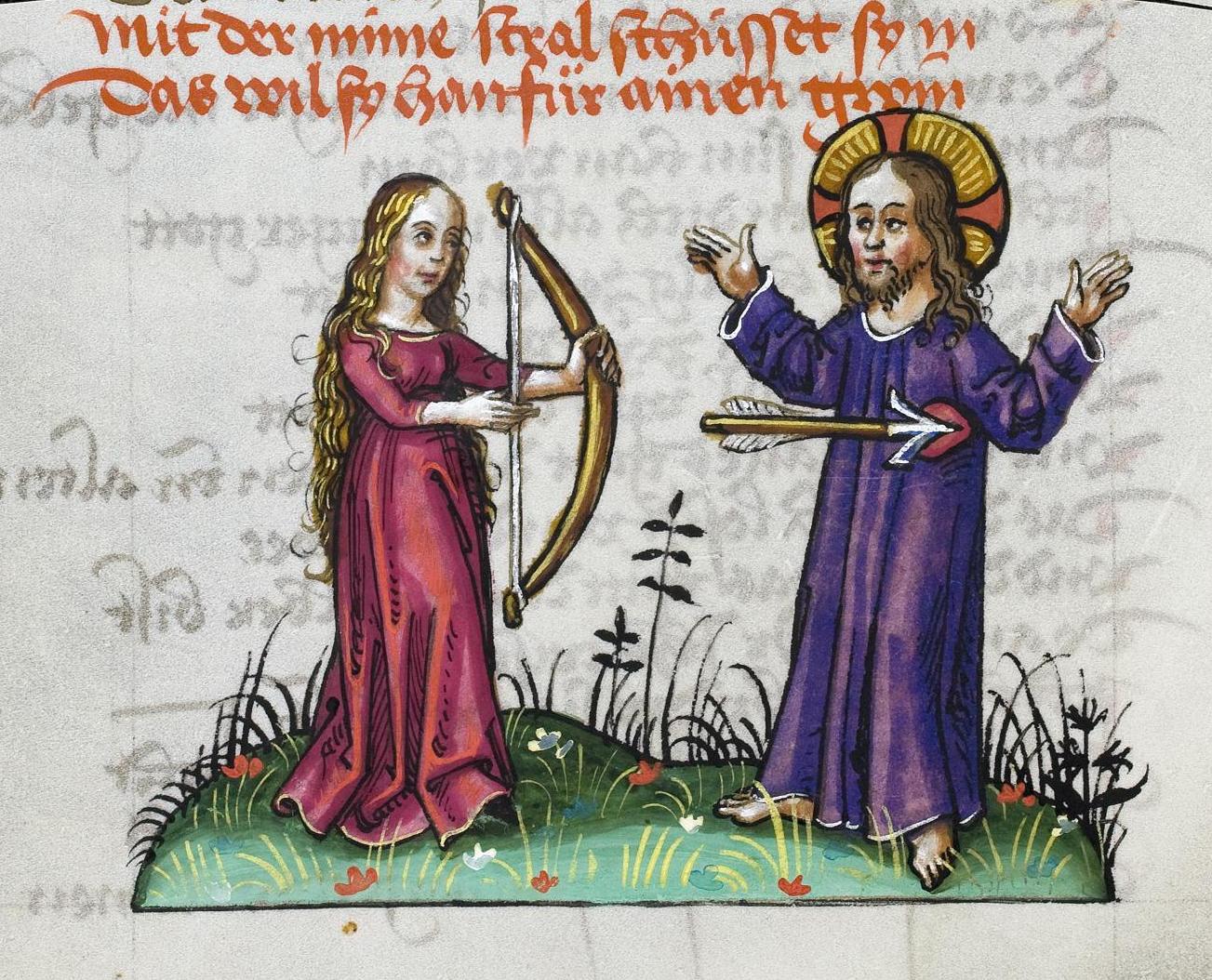
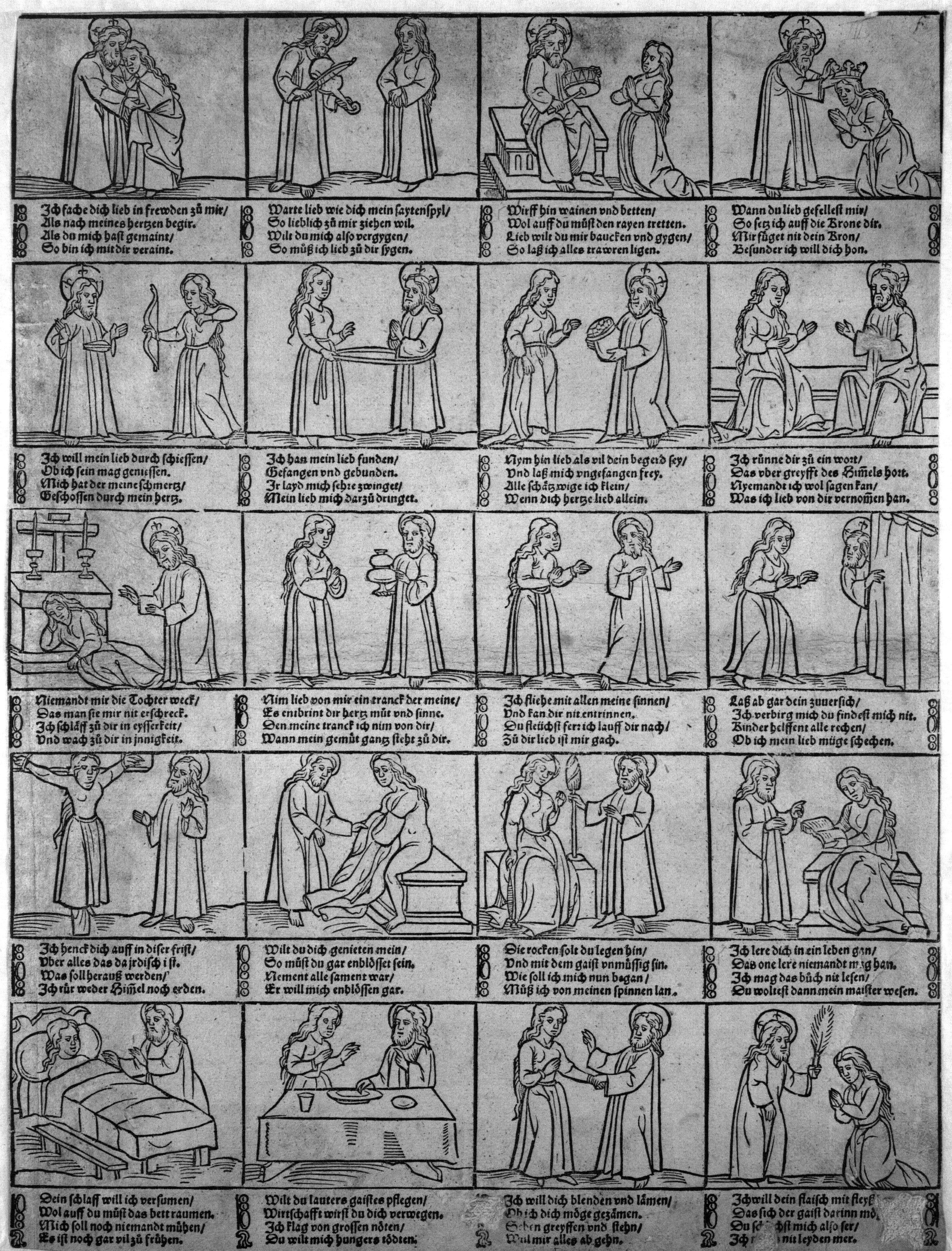
LECTURE: “Christ Our Lover: Medieval Art and Poetry of Jesus the Bridegroom” by Grace Hamman: Last fall I had the pleasure of inviting Dr. Grace Hamman (see previous roundup item) to my neck of the woods to speak for the Eliot Society, a Maryland nonprofit I serve on the board of. She gave this wonderful lecture on one of the popular medieval metaphors for Christ in theology and the arts, which was Jesus as bridegroom, or lover. For medieval people, “the union between God and the human soul was . . . a marriage made in mutual desire, joy, and even mutual submission,” she says. Hamman explores a few different pieces belonging to this tradition, including the fourteenth-century poem “Quia Amore Langueo” (Because I Languish for Love) and the fascinating fifteenth-century verse and image sequence Christus und die minnende Seele (Christ and the Loving Soul).
Illustration by Rudolf Stahel (ca. 1448–1528) from a copy of Christus und die minnende Seele, Constance, Germany, ca. 1495. Karlsruhe, Badische Landesbibliothek, Cod. Donaueschingen 106, fol. 26v. Amber L. Griffioen provides this caption: “The Soul takes up her bow, draws her minne stral (or ‘arrow of love’), and goes on the hunt. She shoots and wounds Christ in the side, capturing him as her prize in order to ‘enjoy him’ forever.”Christus und die minnende Seele, from the printing house of Matthäus Franck in Augsburg, Germany, 1559–68. Woodcut, 35.5 × 27 cm. Munich, Bayerische Staatsbibliothek, Einblatt III, 52f.
+++
SONGS:
Inspired by Hamman’s talk, I’d like to turn your attention to the following two songs: one Jewish, the other Christian.
>> “Et Dodim Kala (Time for Lovers)”: The Hebrew text of this song, drawn from the biblical book the Song of Songs, is traditional Jewish (the video attributes it to Rabbi Haim Ben Sahl of the tenth century), and the music is a traditional gnawa melody (gnawa is a genre of Moroccan religious music marked by repetition). The performance is led by Lala Tamar on vocals and guembri (three-stringed bass plucked lute), and she’s joined by Ella Greenbaum and Imanouelle Harel on background vocals and krakebs (hand cymbals) and Tal Avraham on trumpet.
Tamar is an Israeli musician of Moroccan and Brazilian descent who performs Moroccan Jewish liturgical poems as well as contemporary music in Moroccan Arabic and Ladino.
Turn on closed captioning (CC) in the above video for the lyrics and their English translation, which is basically, “A time for lovers, my bride: / The vine has blossomed, / The pomegranates have budded.” The song is also available on Spotify.
>> “The Heavenly Courtier”: The anonymous words of this hymn were first published in 1694, and the tune is from The Christian Harmony (1805), a shape-note hymnal compiled by Jeremiah Ingalls. The song speaks of “Christ the glorious lover” who comes to earth “to woo himself a bride, resolving for to win her.” At first she’s resistant to his romantic entreaties, preferring instead the company of other lovers. But when she sees him for who he truly is—receives “one glimpse of [his] love and power”—she is overcome with ecstasy and accepts his proposal. The song ends with a wedding feast and mutual embrace. Read the full lyrics here, and listen to the Boston Camerata, directed by Joel Cohen, perform the piece on their album An American Christmas (1993); the vocalist is Joel Frederiksen.
I wouldn’t commend this hymn for a worship service, at least not without adaptation: while I’m on board with most of it, its Christ is in parts coercive, threatening violence, and there’s an overemphasis on the bride’s wretchedness and shame, with Christ the wooer breaking her down by revealing how “filthy” and unworthy she is. The Boston Camerata removes two of the more problematic verses, but I still think further tweaking needs to be done, more nuancing around the doctrines of sin and salvation (literarily, of course, preserving the extended metaphor!), to faithfully communicate the gospel through this song.
Regardless, I find it interesting as an artifact of early American Christian worship (it was sung congregationally in New England) and as an elaboration of the biblical picture of Christ the Bridegroom, not to mention poetically and musically charming. As I gathered from Grace Hamman’s lecture posted above, we can still appreciate creative works from the past and be moved or instructed by aspects of them without embracing them wholesale. It’s important for us Christians to be able to step outside our own cultural, historical, and denominational contexts with humble curiosity.
+++
2025 CALVIN SYMPOSIUM ON WORSHIP:
Calvin University’s annual Symposium on Worship was held last week. I wasn’t able to go this year, but I enjoyed tuning in virtually to the services that were livestreamed, now archived on the “Live” tab of the Calvin Institute of Christian Worship YouTube page. Here are two examples.
>> “Vesper: I Will Lift Mine Eyes,” led by Kate Williams and Tony Alonso: “Inspired by ancient and modern contemplative texts, this Vespers service is an invitation to come into the quiet and discover the eternal beauty of God’s consoling presence.” View the song credits in the YouTube video description.
>> “Worship Service: The Rich Man and Lazarus”: The Calvin University Gospel Choir, under the direction of Nate Glasper and with some songs guest-conducted by Raymond Wise, leads the musical portion of this service, and Rev. Dr. Dennis R. Edwards preaches on Luke 16:19–31, Jesus’s parable of the rich man and Lazarus. I especially enjoyed Wise’s original gospel song “Make a Joyful Noise” at 16:30, based on Psalm 100:1, and, also new to me, “Poor Man Lazarus” at 36:46, a traditional African American spiritual arranged by Jester Hairston. See additional song credits in the YouTube video description.
Laura Lasworth (American, 1954–), Lily Among the Thistles, 2001. Oil on wood panel. From the Love’s Lyric series, based on the Song of Songs.
This still-life painting by Seattle-based artist Laura Lasworth shows a beautiful cut lily sharing a vase with a bouquet of twelve thorny, withered stems. The water in which they sit is red. The work’s title is taken from the Song of Songs 2:1–2: in Latin, “Ego flos campi, et lilium convallium. Sicut lilium inter spinas, sic amica mea inter filias,” or from the New Revised Standard Version:
I am a rose of Sharon, a lily of the valleys.
As a lily among brambles, so is my love among maidens.
While the Song of Songs, written in the wisdom tradition of Solomon, is first and foremost a collection of poems exploring the human experience of love and sexual desire, most Christians also interpret it as an allegory of the love between Christ and his church, or God and the individual soul. In that reading, Christ is the “lily of the valley” who speaks here.
Early Christian writers such as Origen, Hippolytus, Ambrose, Jerome, and Augustine associated the lily of Song of Songs 2:1 with Christ; in the Middle Ages, Venantius Fortunatus (ca. 530–610), Peter Damian (1007–1072), and Bernard of Clairvaux (1090–1153), among others, followed suit. I’m familiar with this floral metaphor for Jesus from a gospel song I grew up singing!
From the fourteenth century onward, in images of the Annunciation, Western artists commonly portrayed either a lily vase on a table, or the angel Gabriel presenting a lily to Mary. The lily became a symbol both Christological and Mariological, signifying the flowering of the Incarnation: God’s pure Son emerging from the virginal stem of Mary.
On December 10, Jonathan A. Anderson, a professor of theology and the arts at Regent College in Vancouver, gave the homily in chapel, using Luke 1:26–38 as his scripture text and exploring Lasworth’s Lily Among the Thistles in relation to it.
Thorns and thistles are an image of cursedness throughout scripture, starting in Genesis 3:17–18, Anderson points out. But in Lasworth’s painting, a lily rises up from the center of that cursedness. “If the thistles visually articulate the groaning of creation and the sorrows of humanity, the lily symbolically inaugurates a newness of life, somehow flowering right in the midst of this,” Anderson says. “The audacious proclamation of Advent is that the Son of God—the Creator and Healer of all things, our tree of life—was born into the brambles of human history and into the bloody heritages that still cry out daily from the ground.”
Anderson considers the polyvalence of Lily Among the Thistles:
In one sense, this is an icon of Christ’s appearance in human history. In another sense, this vase is also an individual heart—my heart, your heart—that has heard the Annunciation for itself amidst its own sorrows and deathliness. . . . Or we might also see this as an icon of creation, simultaneously groaning for the reconciliation of all things and blooming with new creation. And surely, it is an icon of the church, in which we harbor various fertility altars overgrown with thorns and thistles, and yet in which we are a people of the incarnation, people in whom new creation has begun, people through whom the light of the Spirit is already casting the shadows of the redemption of all things.
1. There sprang a Flower from out a thorn, To save mankind that was forlorn, As prophets spake before that morn: Deo Patri sit Gloria!
2. There sprang a well at Maid Mary’s foot, That turned all this world to good, Of her took Jesu flesh and blood: Deo Patri sit Gloria!
. . .
4. From diverse lands three kings were brought, For each one thought a wondrous thought, A King to find and thank they sought: Deo Patri sit Gloria!
5. Richly laden with gifts they fare, Myrrh, frankincense, and gold they bear, As clerks in sequence still declare: Deo Patri sit Gloria!
. . .
9. There shone a star in heaven bright, That the men of earth might read aright That this Child was Jesu, King of Might: Deo Patri sit Gloria!
This song is a choral setting by London-based composer Dominic Veall of a late medieval lyric that begins, “Ther ys a blossum sprong of a thorn”—or, as Jessie L. Weston modernizes it, “There sprang a Flower from out a thorn.” The recording omits stanzas 3, 6, 7, and 8, but you can read the full lyrics here. The Latin refrain translates to “Glory be to God the Father!”
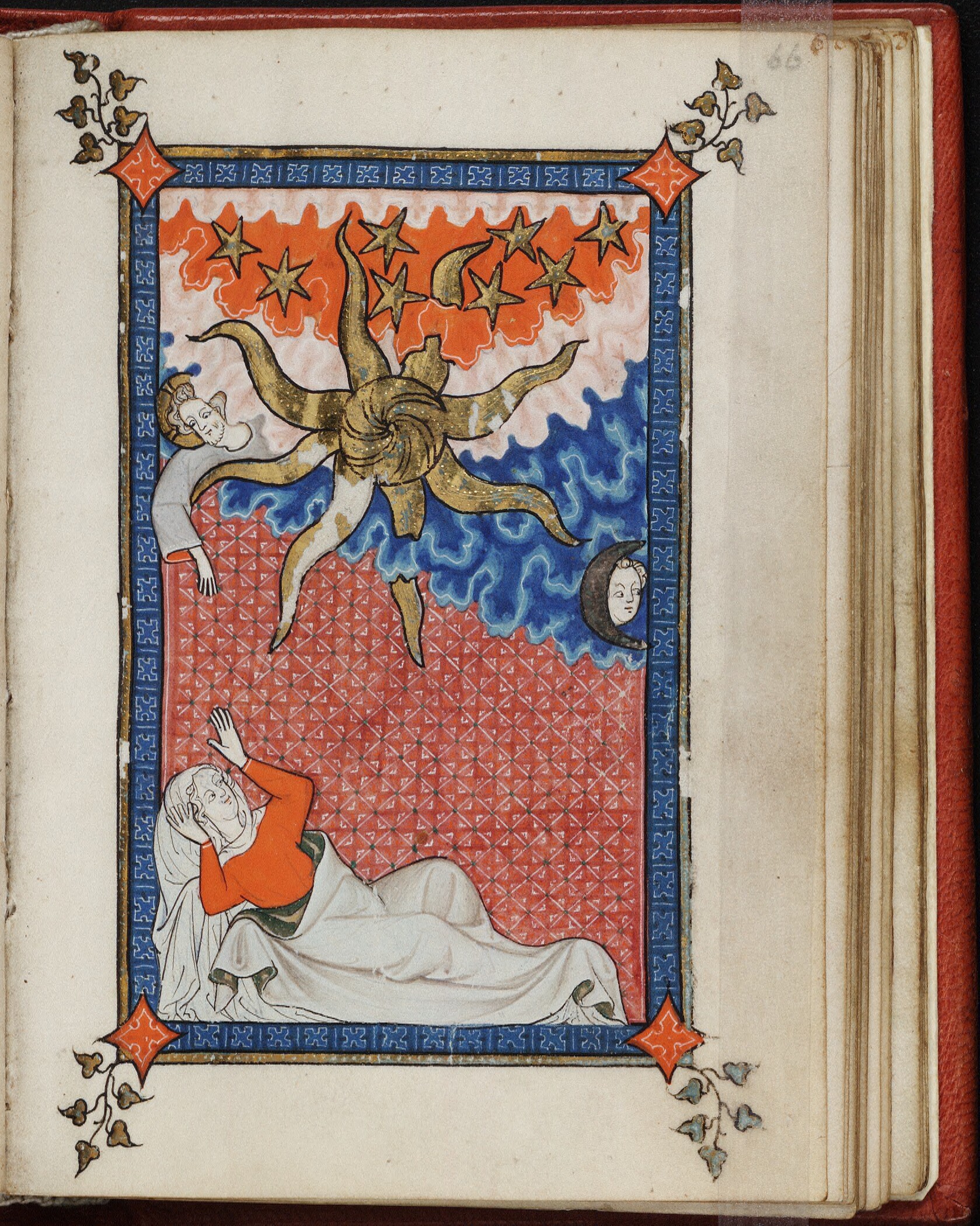
LOOK: Jesus as Bridegroom of the Soul from the Rothschild Canticles
Jesus as Bridegroom of the Soul, from the Rothschild Canticles, Flanders or Rhineland, ca. 1300. Beinecke Library, Yale University, MS 404, fol. 66r.
The Rothschild Canticles from early fourteenth-century Flanders or the Rhineland (whose innovative Trinity miniatures I wrote about in 2021) is a cento of biblical, liturgical, and patristic citations accompanying an extraordinary program of images. Much of the content reflects the bridal mysticism that was popular at the time, emphasizing spiritual oneness with Christ. The compiler, artist(s), scribe(s), and original recipient of the manuscript are not known, but it was very likely made by a male monastic for a nun or canoness to use in her private devotions.
The miniature on folio 66r is the first in a five-miniature sequence (of which four survive) on the theme of mystical union. It shows the human soul, represented as a woman, about to receive her Bridegroom, Christ, in the marriage bed. Art historian Jeffrey Hamburger writes that in this image, “Christ emerges from the heavens with the energy of a cosmic explosion[,] . . . as a dramatic sunburst dissolving the mists. . . . Christ is the sun, its brightness, the light of the visio Dei. Just as sunlight generates heat, so Christ provokes desire.” [1] The artist uses that whirling sun with its tentacle-like rays as an attribute of Christ throughout the manuscript.
At her lover’s luminous descent, the Bride awakes from her sleep and raises her arms in ecstasy.
The face peeking out from behind the crescent moon on the right may be an angel, whose gaze directs us forward to the next scene, which shows the Bride reclining outdoors amid sprouting vines, “languish[ing] with love” (Song 2:5), and then being led into a wine cellar by the Bridegroom, to be inebriated by his sweet goodness (Song 2:4) .
The corresponding text on the facing page of this image, set inside a bedchamber, incorporates the following excerpts:
“I call you into my soul, which you are preparing for your reception, through the longing which you have inspired in it.”—Augustine, Confessions X.1
“God comes from Lebanon, the Holy One from the shady and thickly covered mountain.”—Habakkuk 3:3, used in medieval Advent liturgies
“I passed by you again and looked on you; you were at the age for love.”—Ezekiel 16:8
Plus miscellaneous adaptations of lines from the Song of Songs
In the Middle Ages it was common for Christian mystics, such as Mechthild of Magdeburg and Gertrude of Helfta, to describe and picture spiritual union in terms of physical union, as they “realized that bodily language better conveys the power, intensity, and personality of desire than overly spiritualized language does,” writes medievalist Grace Hamman. [2] And not only was the church, a corporate body, perceived as the bride of Christ, but so was the individual soul. The consummation of the marriage between Christ and his beloved was seen as eschatological, yes—coming at the end of time—but such intimate closeness and pleasure was also seen as something that could be enjoyed now on some level, as devotees commune with Christ through prayer, scripture reading, and the celebration of the Eucharist.
For the nun who used this book, it must have aided her in cultivating a deep love for Christ and strengthened her longing for that full and final coming together, when Christ will return to be with his bride.
LISTEN: Wachet auf, ruft uns die Stimme, BWV 140 by Johann Sebastian Bach, 1731| Words by Philipp Nicolai, 1599 (movements 1, 4, 7), and an anonymous other | Melody of movements 1, 4, and 7 by Philipp Nicolai, 1599
Here are two listening options—the first from an album, and the second a live performance that you can hear as well as watch.
>> Performed by the Monteverdi Choir and the English Baroque Soloists, dir. John Eliot Gardiner, on Bach: Cantatas BWV 140 and 147 (1992)
>> Performed by the Choir and Orchestra of the J. S. Bach Foundation, dir. Rudolf Lutz (soloists: Nuria Rial, Bernhard Berchtold, Markus Volpert), Evangelisch-Reformierte Kirche Trogen, Switzerland, 2008 (**The copyright owner has disallowed video embeds, but you can watch the video directly on YouTube by clicking the link below.)
In the libretto that follows, the capital letters in parentheses indicate which voice parts are singing that movement: soprano, alto, tenor, or bass.
1. Choral (SATB) Wachet auf, ruft uns die Stimme, der Wächter sehr hoch auf der Zinne, wach auf, du Stadt Jerusalem. Mitternacht heißt diese Stunde, sie rufen uns mit hellem Munde, wo seid ihr klugen Jungfrauen? Wohlauf, der Bräut’gam kömmt, steht auf, die Lampen nehmt, Alleluia! Macht euch bereit zu der Hochzeit, ihr müsset ihm entgegen gehn.
2. Rezitativ (T) Er kommt, er kommt, der Bräut’gam kommt, ihr Töchter Zions, kommt heraus, Sein Ausgang eilet aus der Höhe in euer Mutter Haus. Der Bräut’gam kommt, der einen Rehe und jungen Hirschen gleich auf denen Hügeln springt und euch das Mahl der Hochzeit bringt. Wacht auf, ermuntert euch, den Bräut’gam zu empfangen; dort, sehet, kommt er hergegangen.
3. Duett (SB) (Dialog - Seele, Jesus) Wenn kömmst du, mein Heil? – Ich komme, dein Teil. – Ich warte mit brennenden Öle. Eröffne den Saal – Ich öffne den Saal – zum himmlischen Mahl. Komm, Jesu. – Ich komme, komm, liebliche Seele. –
4. Choral (T) Zion hört die Wächter singen, das Herz tut ihr vor Freuden springen, sie wachet und steht eilend auf. Ihr Freund kommt von Himmel prächtig, von Gnaden stark, von Wahrheit mächtig, ihr Licht wird hell, ihr Stern geht auf. Nun komm, du werte Kron’, Herr Jesu, Gottes Sohn, Hosianna! Wir folgen all zum Freudensaal und halten mit das Abendmahl.
5. Rezitativ (B) So geh herein zu mir, du mir erwählte Braut! Ich habe mich mit dir von Ewigkeit vertraut. Dich will ich auf mein Herz, auf meinen Arm gleich wie ein Sigel setzen, und dein betrübtes Aug’ ergötzen. Vergiß, o Seele, nun die Angst, den Schmerz, den du erdulden müssen; auf meiner Linken sollst du ruhn, und meine Rechte soll dich küssen.
6. Duett (SB) (Dialog - Seele, Jesus) Mein Freund ist mein, – und ich bin dein, – die Liebe soll nichts scheiden. Ich will mit dir – du sollst mit mir – im Himmels Rosen weiden, da Freude die Fülle, da Wonne wird sein.
7. Choral (SATB) Gloria sei dir gesungen, mit Menschen- und englischen Zungen, mit Harfen und mit Zimbeln schon. Von zwölf Perlen sind die Pforten, an deiner Stadt sind wir Konsorten der Engel hoch um deine Thron. Kein Aug’ hat je gespürt, kein Ohr hat je gehört solche Freude, des sind wir froh, io, io, ewig in dulci jubilo.
1. Chorus (SATB) Awake, calls the voice to us of the watchmen high up in the tower; awake, you city of Jerusalem. Midnight the hour is named; they call to us with bright voices; where are you, wise virgins? Indeed, the Bridegroom comes; rise up and take your lamps, Alleluia! Make yourselves ready for the wedding, you must go to meet him.
2. Recitative (T) He comes, he comes, the Bridegroom comes! O daughters of Zion, come out; his course runs from the heights into your mother’s house. The Bridegroom comes, who like a roe and young stag leaps upon the hills; to you he brings the wedding feast. Rise up, take heart, to embrace the Bridegroom; there, look, he comes this way.
3. Duet (SB) (Dialogue - Soul, Jesus) When will you come, my Savior? – I come, as your portion. – I wait with burning oil. Now open the hall – I open the hall – for the heavenly meal. Come, Jesus! – I come, come, beloved soul! –
4. Chorale (T) Zion hears the watchmen sing, her heart leaps for joy within her, she wakens and hastily arises. Her glorious beloved comes from heaven, strong in mercy, powerful in truth; her light becomes bright, her star rises. Now come, precious crown, Lord Jesus, the Son of God! Hosanna! We all follow to the hall of joy and hold the evening meal together.
5. Recitative (B) So come in to me, you my chosen bride! I have to you eternally betrothed myself. I will set you upon my heart, upon my arm as a seal, and delight your troubled eye. Forget, O soul, now the fear, the pain which you have had to suffer; upon my left hand you shall rest, and my right hand shall kiss you.
6. Duet (SB) (Dialogue - Soul, Jesus) My friend is mine, – and I am yours, – love will never part us. I will with you – you will with me – graze among heaven’s roses, where complete pleasure and delight will be.
7. Chorale (SATB) Let Gloria be sung to you with mortal and angelic tongues, with harps and even with cymbals. Of twelve pearls the portals are made; in your city we are companions of the angels high around your throne. No eye has ever perceived, no ear has ever heard such joy as our happiness, io, io, eternally in dulci jubilo! [in sweet rejoicing]
Bach wrote this cantata during his time as cantor (music director) at St. Thomas Church in Leipzig, Germany, a post he served from 1723 until his death in 1750. (Imagine having Bach write and lead music for your church. During his first few years at St. Thomas, he composed a new cantata nearly every week for Sunday worship! His productivity is uncanny.) It premiered the twenty-seventh Sunday after Trinity Sunday, the final week of the liturgical year, on November 25, 1731, to correspond to the day’s assigned Gospel reading.
Bach scored the work for three vocal soloists—soprano (playing the Soul), tenor (the Watchman), and bass (Jesus)—a four-part choir, and an instrumental ensemble consisting of a horn, two oboes, taille, violino piccolo, strings, and basso continuo, including bassoon. Musicologist William G. Whittaker calls it “a cantata without weaknesses, without a dull bar; technically, emotionally and spiritually of the highest order. Its sheer perfection and its boundless imagination rouse one’s wonder time and time again.”
The first time I ever heard Bach’s Cantata 140 was in the Western music history course I took my first year of college. Our professor played a recording of the opening movement in class, then told us to go home and listen to the other six for homework—we would discuss them the next day. Sitting before my laptop at my dorm room desk, ensconced in my headphones, I was transported.
Bach’s Wachet auf, ruft uns die Stimme (Awake, calls the voice to us) is based on a chorale (congregational hymn) of the same name by the German Lutheran pastor, poet, and composer Philipp Nicolai, which conflates the parable of the ten virgins in Matthew 25 with the bridal theology of the Prophets and Revelation. The hymn appears in some English-language hymnals under the title “Wake, Awake, for Night Is Flying” (Catherine Winkworth) or “Sleepers, Wake! A Voice Astounds Us” (Carl P. Daw). Bach used the hymn’s three stanzas, both text and tune, for movements 1, 4, and 7.
The words of movements 2, 3, 5, and 6 are possibly by Picander (the pseudonym of Christian Friedrich Henrici), a frequent literary collaborator of Bach’s. Tender and rapturous, they draw on the imagery of the Song of Songs to describe the marriage of Christ and the human soul.
It’s a remarkable work. I encourage you to listen to it in one sitting—it’s twenty-eight minutes long—while you follow along with the lyrics. Revel in the love of Christ for you, his bride. Get excited for the sweet union to come.
As a bonus, here’s a gorgeous performance of the Nicolai hymn that forms the core of Bach’s cantata. It was arranged by F. Melius Christiansen in 1925 and performed in 2018 by the St. Olaf Massed Choirs under the direction of Anton Armstrong, using William Cook’s 1871 English translation:
Wake, awake, for night is flying, the watchmen on the heights are crying. Awake, Jerusalem, arise! Midnight’s solemn hour is tolling, his chariot wheels are nearer rolling; he comes; prepare, ye virgins wise. Rise up, with willing feet, go forth, the Bridegroom meet. Hallelujah! Bear through the night your well-trimmed light, speed forth to join the marriage rite.
Hear thy praise, O Lord, ascending from tongues of men and angels blending with harps and lute and psaltery. By thy pearly gates in wonder we stand, and swell the voice of thunder in bursts of choral melody. Hallelujah! No vision ever brought, no ear hath ever caught, such bliss and joy. We raise the song, we swell the throng, to praise thee ages all along.
O set me as a seal upon thy heart O set me as a seal upon thine arm For love is strong, strong as death, my love And jealousy is cruel as the grave
Its flashes are the living flame of a blazing fire That cannot be drowned out in a flood All earthly gold in exchange for love Would be utterly contemptible and scorned
Come, my love Let me hear your voice My companions and I wait in the garden Make haste, my love, and shine out like the rising sun Like a stag appearing on the mountain
After the crucifixion of Jesus, a small group of his female followers purchased spices and prepared them to bring to the tomb to anoint his body on Sunday morning. (Sabbath restrictions prevented them from doing work on Saturday.) This was an act of love and reverence that served the practical function of counteracting the smell of decomposition.
The singer-songwriter Katy Wehr [previously] imagines the women consoling each other by singing excerpts from the Song of Songs as they crushed the myrrh, mixed it with oil, and bottled it up for transport—maybe also as they headed over to the gravesite. Wehr has set to music four of the verses from the book’s final chapter, a setting she says she hopes conveys a tone that is both mournful and hopeful.
The Song of Songs, or Song of Solomon, is an ancient collection of Hebrew love poems that Christians have long read as allegorical of the love between Christ and his bride, the church.
Wehr’s selections comment on the nature of love: it is permanent, strong, passionate, inextinguishable, and priceless. The female speaker in the poem seeks to stamp herself on her lover’s heart like a seal, claiming him as hers. She professes love’s power, which is as severe and enduring as death. In the context of this passage, the word “jealousy” appears to be used in the positive sense to mean zeal or passion—a resolute devotion.
She goes on to describe love as fiery and intense.
It seems her lover has gone out for the day, or gone on a trip, and she calls him back home. She can’t wait to hear his voice again. She waits outside for him in the garden, wishing for him to come bounding back into her arms.
“Make haste, my love, and shine out like the rising sun.” One can imagine the myrrh-bearing women of the Gospels hoping beyond hope that their beloved Jesus would arise, would speak their names once more, would prove that love is indeed stronger than death.
WORLD PREMIERE: “Yr Oedd Gardd / There Was a Garden” by Alex Mills, March 29, 2024, Saint Deiniol’s Cathedral, Bangor, Wales: On Good Friday this year, a new setting of seven unpublished R. S. Thomas poems, curated from the archives of the R. S. Thomas Research Centre, will be performed for the first time by Saint Deiniol’s Cathedral Choir under the direction of Joe Cooper, accompanied by devotional readings. The choral composition is by Alex Mills [previously], and it was commissioned by Saint Deiniol’s for Holy Week. The title comes from John 19:41–42: “Now there was a garden in the place where he was crucified, and in the garden there was a new tomb in which no one had ever been laid. And so, because it was the Jewish day of Preparation, and the tomb was nearby, they laid Jesus there.”
Thomas was a priest in the Church of Wales and one of the twentieth century’s greatest poets, his works exploring the cross, the presence and absence of God, forgiveness, and redemption.
This is the second commission Mills has fulfilled for the cathedral; last year he wrote “Saith Air y Groes / Seven Last Words from the Cross,” a choral setting of the seven short phrases uttered by Jesus from the cross, according to the Gospel writers, but in Welsh.
+++
CONTEMPORARY HYMNS/GOSPEL SONGS BY WOMEN:
I try to be intentional about featuring the work of women throughout the year, but as March is Women’s History Month, I wanted to call attention to these three sacred songs by Christian women from the generation or two before me.
>> “Christ Jesus Knew a Wilderness” by Jane Parker Huber (1986): Born in China to American Presbyterian missionaries, Jane Parker Huber (1926–2008) is best known as a hymn writer and an advocate for women in the church. This hymn—which can be found in A Singing Faith(1987), among other songbooks—is particularly suitable for Lent. Huber wrote the words, pairing them with an older tune by George J. Elvey. Lucas Gillan, a drummer, educator, church music director, composer, and occasional singer-songwriter from Chicago and founding member of the jazz quartet Many Blessings, arranged the hymn and performs it here with his wife, Anna Gillan, a project commissioned by Saint Matthew Lutheran Church in Walnut Creek, California. What a great violin part!
Christ Jesus knew a wilderness Of noonday heat and nighttime cold Of doubts and hungers new and old Temptation waiting to take hold
Christ Jesus knew uncertainty Would all forsake, deny, betray? Would crowds that followed turn away? Would pow’rs of evil hold their sway?
Christ Jesus knew an upper room An olive grove, a judgment hall A skull-like hill, a drink of gall An airless tomb bereft of all
Christ Jesus in our wilderness You are our bread, our drink, our light Your death and rising set things right Your presence puts our fears to flight
>> “For Those Tears I Died (Come to the Water)” by Marsha Stevens-Pino (1969): I grew up in an independent Baptist church in the southern US, and though the worship music consisted almost entirely of traditional hymns, I have a faint recollection of a woman singing this song as an offertory one Sunday. (Or maybe I heard it on a Gaithers’ television special at my grandma’s house?) It is a very early CCM (contemporary Christian music) song that was popular with the emerging Jesus Movement. Marsha Stevens-Pino (née Carter) (born 1952) of Southern California wrote it in 1969 when she was sixteen and a brand-new Christian, and it was recorded by Children of the Day in 1971.
In the video below, excerpted from the DVD Stories and Songs, vol. 1, it is sung by Callie DeSoto and Maggie Beth Phelps with their father, David Phelps.
>> “The First One Ever” by Linda Wilberger Egan (1980): An alumna of the Union Theological Seminary School of Sacred Music with a background in voice and organ, Linda Wilberger Egan (born 1946) has served Lutheran, United Methodist, and Presbyterian congregations as music director throughout her career. Based on Luke 1:26–38, John 4:7–30, and Luke 24:1–11, her hymn “The First One Ever” honors the gospel witness of biblical women: Mother Mary, who said yes to God’s plan for her life, bearing the Messiah into the world; the unnamed woman of Samaria, who, after Jesus personally revealed his messianic identity to her, evangelized her whole village; and Mary Magdalene, Joanna, and Mary the mother of James, the first people to receive the news of Jesus’s resurrection and to preach it to the apostles.
The hymn is sung in the following video by Lauren Gagnon at St. Mark’s Episcopal Church in Chenango Bridge, New York, accompanied by her husband, Jacob Gagnon, on guitar.
+++
SUBSTACK POST: “St. Gabriel to Mary flies / this is the end of snow & ice” by Kristin Haakenson: Kristin Haakenson, creator of Hearthstone Fables, is an artist, farmer, and mom from the Pacific Northwest who shares art and reflections inspired by the sacred and the seasonal, place and past. In this most recent post of hers, she discusses the yearly intersection of Lent and the Feast of the Annunciation. “In a time when the Annunciation isn’t celebrated as universally within the Church as it once was, it may feel somewhat disjointed to stumble upon this joyful feast – celebrating the conception of Jesus – during the penitential season of Lent,” she writes. “This timing, though, is part of a revelatory harmony within the Christian calendar. When we step back to see it in the context of the rest of the liturgical year – and also in the context of the natural, astronomical seasons – the theology embedded in this system of sacred time begins to absolutely bloom.”
+++
LITURGICAL POEM: “Annunciation 2022” by Kate Bluett:Kate Bluett from Indiana writes metrical verse around the liturgical calendar and is also one of the lyricists of the Porter’s Gate music collective. In this poem (which she said was inspired in part by the timing of this blog post!) she brings the Annunciation into conversation with the Song of Solomon in such resonant ways.
Toros Taronatsi (Armenian, 1276–ca. 1346), The Annunciation to the Virgin Mary, 1323, from a Gospel-book made at Gladzor Monastery, Siunik, Armenia. MS 6289, fol. 143, Matenadaran Collection (Mesrop Mashtots Institute of Ancient Manuscripts), Yerevan.
On Holy Saturday I’m planning to feature a song that connects the Song of Solomon to the women at Jesus’s tomb! If you haven’t read that Old Testament book or it’s been a while, I’d encourage you to do so, as then you’ll be able to more easily identify the references in Bluett’s poem and the upcoming song I’ve scheduled for the Paschal Triduum.
Aelbert Bouts (Netherlandish, ca. 1451/54–1549), Man of Sorrows, mid-1490s. Oil on oak wood, 14 15/16 × 10 7/16 in. (37.9 × 26.5 cm). Harvard Art Museums / Fogg Museum, Cambridge, Massachusetts.
ORIGINAL MIDDLE ENGLISH:
Vndo þi dore, my spuse dere,
Allas! wy stond i loken out here?
fre am i þi make.
Loke mi lokkes & ek myn heued
& al my bodi with blod be-weued
For þi sake.
Allas! allas! heuel haue i sped,
For senne iesu is fro me fled,
Mi trewe fere.
With-outen my gate he stant alone,
Sorfuliche he maket his mone
On his manere.
Lord, for senne i sike sore,
Forʒef & i ne wil no more,
With al my mith senne i forsake,
& opne myn herte þe inne to take.
For þin herte is clouen oure loue to kecchen,
Þi loue is chosen vs alle to fecchen;
Mine herte it þerlede ʒef i wer kende,
Þi suete loue to hauen in mende.
Perce myn herte with þi louengge,
Þat in þe i haue my duellingge.
Amen.
MODERN ENGLISH TRANSLATION:
“Undo thy door, my spouse dear,
Alas! why stand I locked out here?
For I am thy mate.
Look, my locks and also my head
And all my body with blood bedewed,
For thy sake.”
“Alas! alas! evil have I sped,
For sin Jesus is from me fled,
My true companion.
Without my gate he standeth alone,
Sorrowfully he maketh his moan
In his manner.”
Lord, for sin I sigh sore,
Forgive, and I’ll do so no more,
With all my might I forsake my sin,
And open my heart to take thee in.
For thy heart is cleft our love to catch,
Thy love has chosen us all to fetch;
My heart it pierced if I were kind,
Thy sweet love to have in mind.
Pierce my heart with thy loving,
That in thee I may have my dwelling.
Amen.
This poem appears in the 1372 “commonplace book” of the Franciscan friar John of Grimestone, who lived in Norfolk, England. Commonplace books were notebooks used to gather quotations and literary excerpts, with entries typically organized under subject headings. Preachers often kept them for homiletic purposes, gathering potential material for sermons. Grimestone’s is remarkable because it includes, in addition to much Latin material, 239 poems in Middle English. (English friars at the time regularly used vernacular religious verse in their sermons.) It is unknown whether Grimestone composed these verses himself or merely compiled them; likely, it is some combination. The first two stanzas of this particular poem are found, transposed, in another manuscript from almost a century earlier. Grimestone revised them slightly and added the third stanza.
Belonging to the Christ-as-lover tradition, “Undo thy door” is based primarily on Song of Solomon 5:2, cited in Grimestone’s manuscript: “I sleep, but my heart waketh: it is the voice of my beloved that knocketh, saying, Open to me, my sister, my love, my dove, my undefiled: for my head is filled with dew, and my locks with the drops of the night.” In a clever interpretation of the Old Testament source, the poet imagines the dewdrops on the Beloved’s brow as blood, thus identifying him with the thorn-crowned Christ. His bride is the human soul. Revelation 3:20 is provided as a further gloss by Grimestone: Jesus says, “Behold, I stand at the door, and knock: if any man hear my voice, and open the door, I will come in to him, and will sup with him, and he with me.”
So in the poem, the speaker is keeping company with sin and has locked out her true lover, Christ. Christ stands at the gate of her heart and implores her with great ardor to let him in and to send sin packing. Wet with the wounds of sacrifice, tokens of his love, he is persistent in his longing for her.
Christ’s entreaties provide the impetus for the speaker’s repentance, expressed in the final stanza, which changes awkwardly in form and meter. His love has pierced her to the core, undoing her resistance. She resolves to break the sin-lock—to turn away from wrongful deeds—and answer Christ’s call so that they can enjoy sweet union together, dwelling in one another’s love. It was his heart that opened first—it was cleft by the centurion’s spear as he hung on the cross—and she is compelled to respond with similar openness, receiving what he has given, requiting his desire.
SOURCES:
This poem is #6108 in the Digital Index of Middle English Verse. It is preserved in Edinburgh, National Library of Scotland, Adv.MS.18.7.21, fol. 121v. A shorter, earlier version, from the late thirteenth century, appears in London, Lambeth Palace Library 557, fol. 185v.
Modern English translation: David C. Fowler, The Bible in Middle English Literature (Seattle: University of Washington Press, 1984), 85–86
For further reading, see chapters 4–5 of Siegfried Wenzel, Preachers, Poets, and the Early English Lyric (Princeton, NJ: Princeton University Press, 1986), especially pages 140–41; and chapter 7, “The Theme of Christ the Lover-Knight in Medieval English Literature,” in Rosemary Woolf, Art and Doctrine: Essays on Medieval English Literature (London: The Hambledon Press, 1986), especially pages 109–10.
He brought me to the banqueting house, and his banner over me was love.
—Song of Solomon 2:4
I will extol thee, O LORD; for thou hast lifted me up . . .
—Psalm 30:1a
Blessed be the God and Father of our Lord Jesus Christ, who hath blessed us with all spiritual blessings in heavenly places in Christ . . .
—Ephesians 1:3
LOOK: Ethiopian Angels, Debre Birhan Selassie Church
Painted wood ceiling, early 19th century, Debre Birhan Selassie Church, Gondar, Ethiopia. Photo: A. Savin.
Debre Birhan Selassie (Trinity and Mountain of Light) Church in Gondar, the imperial capital of Ethiopia from 1636 to 1855, is famous for the colorful paintings that cover every inch of the interior walls and ceiling. The south wall concentrates on the Life of Christ, while the north wall depicts various saints. The focal point—on the east wall, in front of the holy of holies—is a Crucifixion scene and an icon of the Trinity. But the most celebrated visuals inside the church are the hundred-plus winged heads painted in rows between the wooden beams of the ceiling, representing the cherubim and God’s omnipresence.
The original church, which was round, was consecrated in 1693 by Emperor Iyasu I, but lightning destroyed it in 1707. The rectangular stone church that stands on the site now likely dates to the late eighteenth century, and it is the only one of the forty-four Orthodox Tewahedo churches in Gondar to survive the 1888 sack of the city by Mahdist soldiers from Sudan. (Locals say the marauders were miraculously rerouted by a swarm of bees.)
According to Ethiopia (Bradt Travel Guide) writer Philip Briggs, “The paintings are traditionally held to be the work of the 17th-century artist Haile Meskel, but it is more likely that several artists were involved and that the majority were painted during the rule of Egwala Seyon (1801–17), who is depicted prostrating himself before the Cross on one of the murals.”
The church is part of a larger imperial compound, known as Fasil Ghebbi, that has been a UNESCO World Heritage Site since 1979 and that includes palaces, monasteries, and public and private buildings.
Photo: Alan Davey
LISTEN: “His Banner Over Me Is Love” by B. C. Laurelton (pseudonym of Alfred B. Smith), 1965 | Performed by Christy Nockels on Be Held: Lullabies for the Beloved, 2017 | CCLI #28579
I am my Beloved’s and He is mine— His banner over me is love. I am my Beloved’s and He is mine— His banner over me is love. I am my Beloved’s and He is mine— His banner over me is love, His banner over me is love.
He brought me to His banqueting table— His banner over me is love. He brought me to His banqueting table— His banner over me is love. He brought me to His banqueting table— His banner over me is love, His banner over me is love.
He lifted me up to the heavenly places— His banner over me is love. He lifted me up to the heavenly places— His banner over me is love. He lifted me up to the heavenly places— His banner over me is love, His banner over me is love.
I sang a version of this song in children’s church regularly when I was little (with hand motions!) and have carried it with me all these years, a gentle assurance that I am divinely loved and protected. I’ve quoted the scriptures it’s drawn from above. Its refrain comes from Song of Solomon 2:4: “his banner over me was love.”
The Song of Solomon, aka the Canticle of Canticles, has traditionally been read, at least on one level, as an allegory of the love between God and the human soul—or, more specifically in the Christian tradition, Christ and his church.
From the root “to cover,” the Hebrew word for “banner” in this verse refers to a military standard. It is being used figuratively here to indicate that we enlist ourselves under Love’s banner, which goes forth in triumph and protects those under its billows. We belong to love, commit ourselves to love, overcome through love. The verse is perhaps an allusion to the names of generals being inscribed on the banners of their armies. God’s name is Love (1 John 4:8).
The image is at once vigorous and gentle. The NRSV translates the phrase as “his intention toward me was love.”
The song “His Banner Over Me Is Love” was written by Alfred B. Smith (1916–2001), an itinerant song leader, songwriter, and Christian music publisher. Smith compiled and published his first songbook, Singspiration One: Gospel Songs and Choruses, while he was a student at Wheaton College in 1941, to support the evangelistic meetings he was running with his roommate, Billy Graham (yes, that Billy Graham!). Two years later he founded Singspiration Publishing Company, which published several popular series of songbooks. In 1963 he sold Singspiration to Zondervan, but he ran other publishing ventures (i.e., Better Music Publications and Encore Publications) for the remainder of his ministerial career.
According to Music in the Air: The Golden Age of Gospel Radio by Mark Ward Sr., Smith composed “His Banner Over Me Is Love” in 1965 as an impromptu offertory while serving as a visiting song leader at First Baptist Church–Laurelton in Brick, New Jersey. Afterward he received requests from the congregation for the music. His original notation read “B. C. Laurelton” (for “Baptist Church Laurelton”) to designate where he wrote the song, and it was copied as such as people shared the music with others—so when the song was later published in 1972, Smith decided to adopt “B. C. Laurelton” as a pen name.
Singer-songwriter Christy Nockels [previously] sings “His Banner over Me” on an album of lullabies to a twinkling piano accompaniment.
May this truth—that God’s banner over you is love—soothe you and give you confidence.
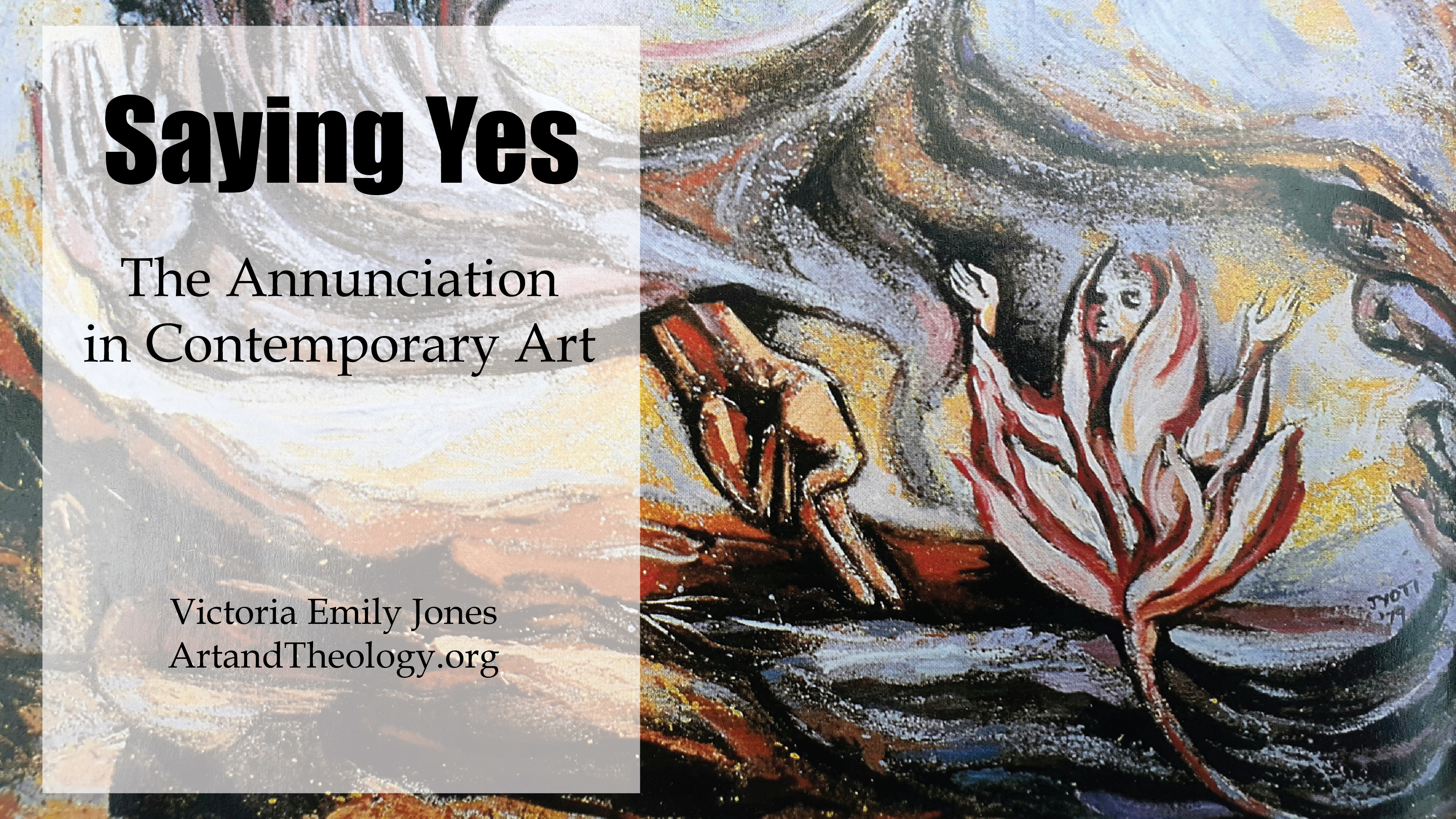
This year’s The Breath and the Clay creative arts gathering, on the theme of “Reenchantment,” is taking place March 17–21, with both in-person (in Winston-Salem, North Carolina) and virtual options. Registration for virtual attendees is pay-what-you-wish. Presenters include theologian Jeremy Begbie, poet Pádraig Ó Tuama, singer-songwriter Joy Ike, contemplative author Christine Valters Paintner, dancer Camille D.C. Sutton, and many more . . . including me! On the evening of March 18 I’ll be giving a twenty-minute talk titled “Saying Yes: The Annunciation in Contemporary Art,” which will be archived online afterward. (The global church celebrates the feast of the Annunciation the following week, on March 25.) (Update: Watch here.) Here’s the description:
The story of Jesus’s miraculous conception in the womb of Mary, a first-century Galilean peasant girl, told in Luke 1 has activated the imaginations of artists since the early Christian era. When an angelic messenger came and told Mary she had been chosen to bear God’s Son, she cycled through a range of emotions before ultimately accepting the call, stepping onto a path that, though scary, would be life-giving not only for her but also for her religious and ethnic community and for the whole world.
God invites us to participate in his work in the world and gives us the grace to do it. When his voice breaks through our safe, predictable routines, calling us to something big, do we respond with brave obedience? In this talk Victoria Emily Jones will share a handful of contemporary artworks that visualize that pivotal moment in salvation history when Mary said yes and set in motion the incarnation. These works show us the wild beauty of God’s plans and can help us tune our ears to the annunciations in our own lives.
(The title slide image is a detail of an Annunciation painting by Jyoti Sahi.)
I’m always impressed by the variety of artists, arts professionals, and art lovers that director Stephen Roach manages to bring together for The Breath and the Clay. Click here to learn more and to register.
+++
ONLINE LENT SERIES:
>> VCS Lent 2021: The Visual Commentary on Scripture is highlighting a different exhibition from its archives for each week of Lent, with new content including a video introduction to the week by Ben Quash and an audio reading of each of the three constituent commentaries.
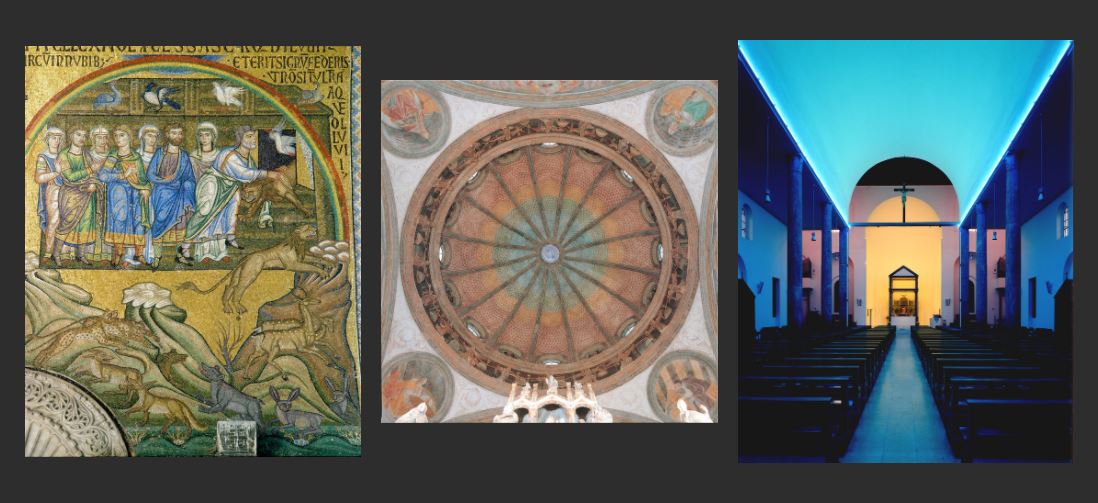
The first week was on the theme of Covenant and covers Genesis 8:20–9:17. Stefania Gerevini curated three artworks from Italy that convey some aspect of the rainbow as divine promise: a thirteenth-century mosaic from the Basilica di San Marco in Venice, a colorful dome fresco (fifteenth century) from the Cappella Portinari in Milan, and a contemporary light installation by Dan Flavin at Santa Maria Annunciata in Chiesa Rossa, also in Milan.
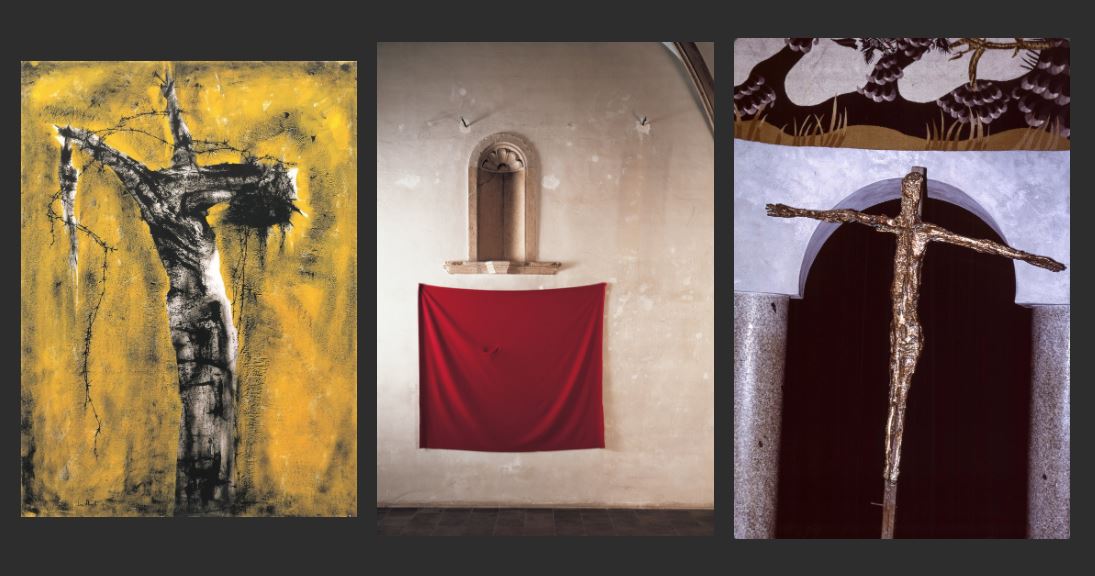
Week 2, on Prophecy, explores the Suffering Servant of Isaiah 53. Jonathan Koestlé-Cate comments on three modern artworks: Crucified Tree Form by Theyre Lee-Elliott, a crucifix by Germaine Richier (which sparked outrage when it was unveiled at Notre-Dame de Toute Grâce, Assy, in 1950), and an installation by postminimalist artist Anish Kapoor at the church of Saint Peter, Cologne.
>> “The Many Faces of Jesus”: I’ve been enjoying this Lenten series (on blog andpodcast) by medievalist Dr. Grace Hamman, who makes medieval lit super accessible.“For Lent, Old Books With Grace will share and explore some medieval representations of Jesus in art and literature—the versions of Jesus that dominate the medieval church’s imagination. These medieval portrayals of Jesus may strike us as odd, threatening, charming, creative, stupid, or inspiring. In attending to these versions of Jesus, I hope for a few end goals: the first is that we may expand our Christian imagination. Perhaps a side of Jesus that has never occurred to you, or been sideswept by our contemporary culture, will suddenly illuminate an aspect of the Jesus of scripture. The second is that we may better identify the ways that we ourselves have culturally contained and portrayed Jesus, in positive and negative ways. Often the strangeness of the past helps us recognize the weird or damaging things we believe in order to make Jesus more palatable, understandable, or like us.”
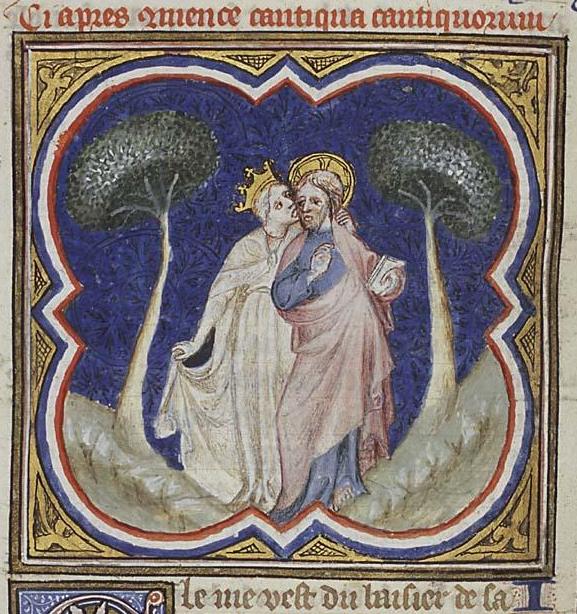
Jean Bondol, “The bride (Ecclesia) and bridegroom (Christ),” from a Bible Historiale made in Paris, 1371–72. The Hague, MMW, 10 B 23, fol. 330v.
>> “Up from My Youth (Psalm 129)” by Advent Birmingham, feat. CashBack and Terence June Gray: This is such a strange and compelling fusion! “An 1806 hymn by Isaac Watts meets hip-hop meets Johnny Cash meets folk meets New Orleans jazz meets industrial steel factory.”
Led by Zac Hicks, Advent Birmingham [previously] is a group of worship musicians from the Cathedral Church of the Advent in downtown Birmingham, Alabama. Hicks wrote this new tune for Isaac Watts’s metrical paraphrase of Psalm 129 and integrated a rap by guest artist Terence June Gray from Memphis. Singing lead (and playing drums) is Leif Bondarenko, the front man of the Johnny Cash tribute band CashBack. The video was filmed at Birmingham’s historic Sloss Furnaces. Available on iTunes, Amazon, and Spotify.
You can read the lyrics here, which include a slight revision of Watts’s verse 6.
POETRY READING:“Phase One” by Dilruba Ahmed, read, with commentary, by Pádraig Ó Tuama, Poetry Unbound: “What do you find hard to forgive in yourself? What might help? In this poem, the poet makes a list of all the things she holds against herself: opening fridge doors, fantasies, wilted seedlings, unkempt plants, lost bags, feeling awkward, treating someone poorly. Dilruba Ahmed repeats the line ‘I forgive you’ over and over, like a litany, in a hope to deepen what it means to be in the world, and be a person of love.”
“An Advent Visio Divina” by John Skillen, CIVA blog: John Skillen, author of Putting Art (Back) in Its Place, discusses four works of Advent-themed art from Italy, where he lives for part of each year leading retreats and seminars through the Studio for Art, Faith & History. He starts in Florence with The Adoration of the Shepherds altarpiece by Renaissance artist Domenico Ghirlandaio, which invites worshippers to follow the shepherds’ (and patrons’) example of adoring the Christ child. Then he moves to Orvieto, spotlighting Karin Coonrod’s directing a medieval mystery play in the city’s streets and churches. (For more on this, read Skillen’s excellent essay in Image no. 96, “Fierce Mercy: The Theater Art of Karin Coonrod.”) Advent is also about the second coming, so Luca Signorelli’s apocalyptic frescoes in the Chapel of San Brizio in Orvieto Cathedral are appropriate. Continuous, in some ways, with these late fifteenth-century paintings are the bronze reliefs on the central doors by Emilio Greco from 1962; they depict the seven works of mercy, the criteria, according to Matthew 25, by which humanity will be judged.
Actor Patrice Johnson portrays Mary, who carries the light of the world, in this contemporary adaptation of The Second Shepherds’ Play directed by Karin Coonrod. Photo: Massimo Achille.Luca Signorelli (Italian, ca. 1441/45–1523), Sermon and Deeds of the Antichrist (detail), 1499–1502. Fresco, Chapel of San Brizio, Orvieto Cathedral, Italy. The Antichrist is shown as a puppet of the Evil One.
“Passion for the Light” by Alexandra Jean Davison, ArtWay: For last Sunday, the first day of Advent, Culture Care RDU Director Alexandra Jean Davison wrote this wonderful meditation on a set of contemporary sculptures by Jaume Plensa at the North Carolina Museum of Art, connecting them to the season we’re in. She begins, “We see three identical nudes filled with light, the face and arms covered with names and Scripture. Each figure sits at rest horizontally on one of the three walls which form a triangle. The closed eyes and mouth are covered with embossed text of the names of the eight gates of the ancient city walls of Jerusalem: New, Herod, Damascus, Golden (two doors: Gate of Repentance and Gate of Mercy), Lions, Jaffa, Zion, and Dung. Tattoo-like passages from the Song of Songs emerge from the heart upon the arms.” Read more at ArtWay.eu.
Jaume Plensa (Spanish, 1955–), Doors of Jerusalem I, 2006. Resin, stainless steel, and light, 47 1/4 × 62 3/16 × 80 11/16 in. (120 × 158 × 205 cm). North Carolina Museum of Art, Raleigh. Photo: Victoria Emily Jones.
+++
VIDEO: “Matthew 1:18-23” by SALT Project: The Emmy Award–winning production company SALT Project released a short video this week setting a reading from Matthew’s Gospel (“This is how the birth of Jesus came about . . .”) against evocative time lapses of blooming flowers. They’re generously offering it for free download and use in worship services, online or in-person. It could be used as an opener, as one of the morning’s scripture readings, or in a number of other ways.
+++
SONGS (the latter two released this week!):
“Christ Child’s Coming”: This simple Advent song is based on the African American spiritual “The Train Is a-Coming” (where “train” is a multivalent metaphor having to do with salvation). While a musician at Christ Church East Bay in Berkeley, California, Keith Watts adapted the lyrics to relate more explicitly to Advent: “Christ child’s coming, oh yeah!,” “Light is coming, oh yeah!,” and “Our king’s coming, oh yeah!” The song is sung here by Trinity Majorins, accompanied by her mom, Sarah [previously], on the piano and her dad, Philip [previously], on guitar.
“Weight/Wait” by Mike McMonagle: “Hope . . . flicker[s] underneath the weight of the wait.” Introducing this new demo, Mike McMonagle, a roots rock musician from Lancaster, Pennsylvania, wrote on Facebook about how the pandemic has created an extended season of waiting in the darkness this year, which has helped him to feel both pain and longing more keenly: “For the past couple of months, I’ve found myself processing all the ups & downs of the current life experience in step with what I’d label the deepest dive into the Advent season that I’ve ever done. All my life, Advent was just a church-y word for rat race otherwise known as The Holidays. There were happy hours, shopping trips, family outings – things that made it hard to focus on the Advent season for more than an hour each Sunday. This year has been different.”
“In Distress” by the Pharaoh Sisters: Written by Austin Pfeiffer and Jared Meyer and based on Psalms 120 and 121, this song blends Latin and Appalachian folk music influences and has lyrics in both English and Spanish. “The song’s creation began in the spiritual angst after the 2016 [US presidential] election,” Pfeiffer writes. “Calling on believers to put their hope in Christ as King, the song has broad themes of Kingdom orientation, raises questions about social divisions, but also leans into Advent ideas, specifically Isaiah 9.” It premiered at the 2017 Presbyterian Church in America (PCA) General Assembly but didn’t end up fitting on the Pharaoh Sisters’ 2020 debut album, Civil Dawn. “Now as our nation plunges deeper into distress and unrest, be it political and/or social, the band is eager to release the song for Advent 2020.”
+++
ONLINE PANEL: “Religious Art,”December 9, 6:00–7:15 p.m. London time (1:00–2:15 p.m. ET): “The relationship between religion and art is ancient and complex, varying across religious traditions and cultures. In this event, Mehreen Chida-Razvi, Ben Quash, and Lieke Wijnia consider how these traditions of religious art differ and what role art plays in religion today. How should we display religious art? Might art be a way of opening interfaith dialogue? And has art itself become a kind of religion?” This free Zoom event is organized by the Forum for Philosophy and the Department of Philosophy, Logic and Scientific Method at the London School of Economics. I’ll be attending! (Note: The promotional image below is David LaChapelle’s Last Supper.) Update, 12/10/20: The panel discussion has been archived and can be viewed here.