Great Spirit of the God who is alive, Whose risen Son I seek before the dawn, Who makes the black and gold sunflower thrive, The earthworm loosen soil beneath the lawn; Great Spirit, grant my great-grandmother’s looks Attend me while I rub her cherry hutch. Great Spirit, grant my late grandfather’s books Preserve his signature I love to touch. Surround and show to me that massive cloud Of witnesses—undauntable or docile. Allow their countenances to enshroud My shoulders, spoken of by Your Apostle. Send generous Nunnehi to my steeple, Returning me, at last, to my dark people.
Note: Nunnehiare spirit people in Cherokee mythology. The Cherokee word has been translated as “The People Who Live Anywhere” or “The People Who Live Forever.”
Jennifer Reeser (born 1968) is a formalist poet of Anglo-Celtic and Native American descent. Her seven poetry collections are Strong Feather (2022), Indigenous (2019), Fleur-de-Lis (2016), The Lalaurie Horror (2013), Sonnets from the Dark Lady and Other Poems (2012), Winterproof (2005), and An Alabaster Flask (2003), and she is anthologized in Christian Poetry in America since 1940 (2022). In addition to writing original poems, she also translates poetry from Russian, French, and Cherokee. A member of the Cherokee Nation, she divides her time between Louisiana, where she was born and raised, and the Cherokee Reservation in Indian Country near Tahlequah, Oklahoma.
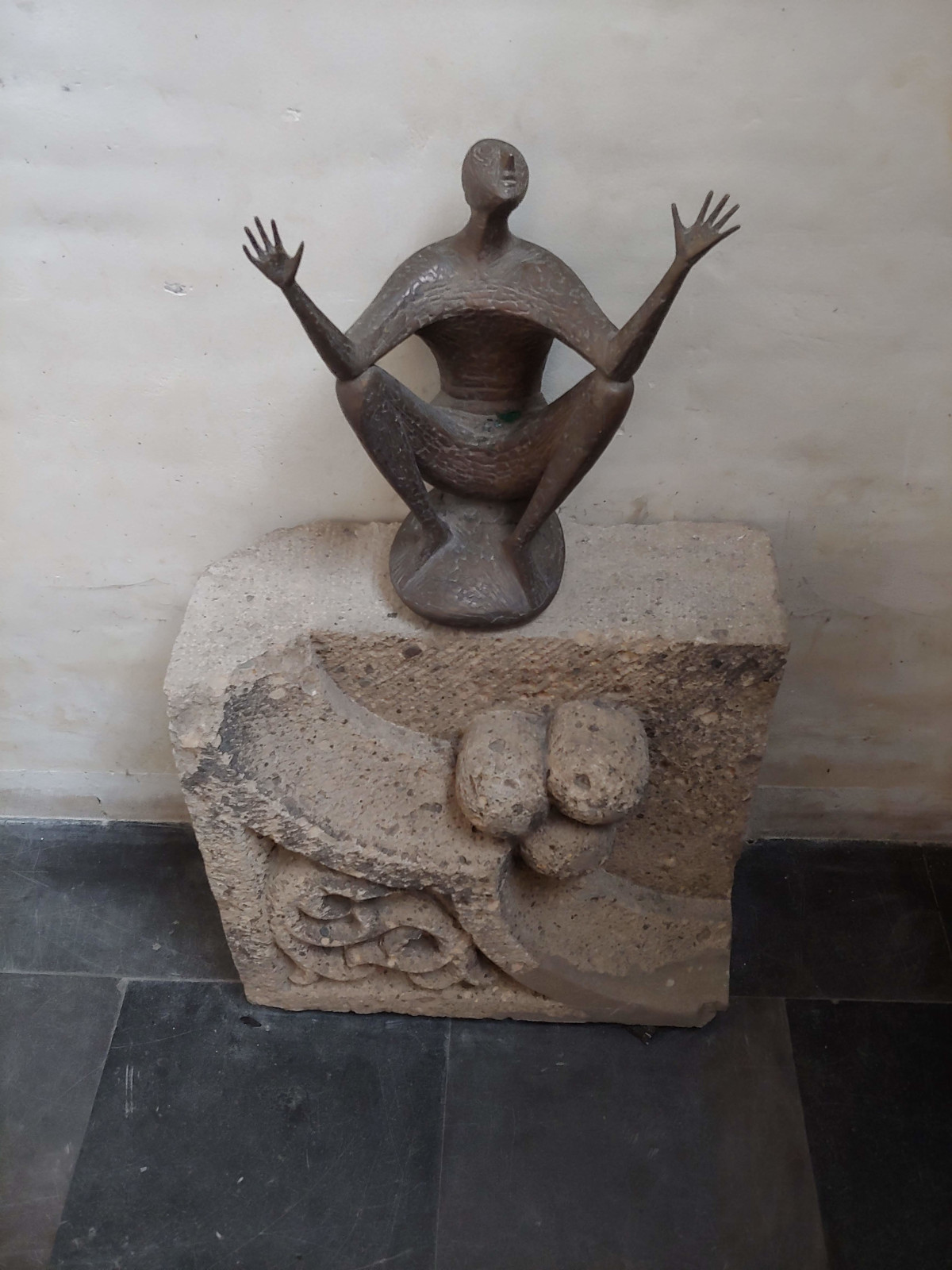
Unidentified sculpture at the Grote of Sint-Laurenskerk (Church of Saint Lawrence), Rotterdam, Netherlands. Photo: Victoria Emily Jones.
Would God I knew there were a God to thank
     When thanks rise in me, certain that my cries
Do not like blind men’s arrows pierce the skies
     Only to fall short of my quarry’s flank.
Why do I thirst, a desperate castaway
     Quaffing salt water, powerless to stop,
Sick lark locked in a cellar far from day,
     Lone climber of a peak that has no top?

To praise God is to bellow down a well
     From which rebounds one’s own dull booming voice,
          Yet the least leaf points to some One to thank.
The whorl embodied in the slightest shell,
     The firefly’s glimmer signify Rejoice!
          Though overhead, clouds cruise a sullen blank.
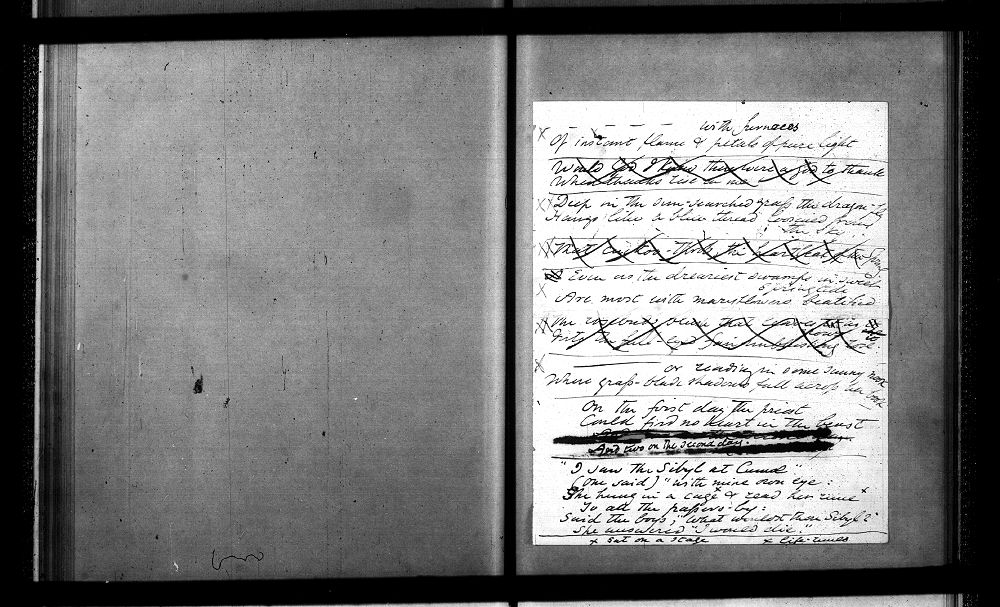
The first line and a half of this sonnet are a crossed-out fragment from one of the notebooks of the British poet and artist Dante Gabriel Rossetti (1828–1882), which he used to work out poetic ideas. This one never went anywhere. But Rossetti’s brother, William Michael Rossetti, saw something in it worthy of preservation; he salvaged it and other select scraps from his brother’s papers, publishing them posthumously in a “Versicles and Fragments” section of Rossetti’s collected works in 1901.
Page 16 of Sonnets and Fragments by Dante Gabriel Rossetti (Princeton/Troxell bound manuscript volume), 1848–81. The first deletion, by Rossetti’s hand, is “Would God I knew there were a god to thank / When thanks rise in me.” [object record]
The modern American poet X. J. Kennedy developed Rossetti’s fragment into a full poem that grapples with the silence of God and, despite such, the impulse to praise. The speaker is confounded by the contradiction that the world seems infused with God’s presence—the natural world points to a Creator—and yet God is unresponsive when the speaker initiates contact. The prayers he launches toward heaven like arrows appear not to reach their target. He’s experiencing spiritual aridity. He feels like a thirsty castaway whose only drink is salt water (why doesn’t God satiate as promised?); a bird trapped in a dark cellar; a mountain climber endlessly climbing, never catching sight of the vista.
The poem tugs back and forth between despondency and awe, between clench-fisted frustration and open-handed surrender. Each glorious tree leaf, the intricate design of conch shells, the whimsy of lightning bugs—these are gifts, but where’s the giver? Gratitude must be directed to someone, but whom does one thank for the wonders and small joys experienced in nature? Who or what is their source? Oh, how I wish I knew there were a God out there to thank, when thanks well up in me. The speaker wants to place his thanks somewhere, but when he places them in God, he receives no confirmation of receipt. There’s a disconnect between what nature testifies and what the speaker has suffered: the “sullen blank” of heaven.
Dante Gabriel Rossetti’s brother, William, wrote in 1895 that, unlike their devout sister Christina [previously], Dante was “a decided sceptic. He was never confirmed, professed no religious faith, and practised no regular religious observances; but he had sufficient sympathy with the abstract ideas and the venerable forms of Christianity to go occasionally to an Anglican church—very occasionally, and only as the inclination ruled him.” Starting in mid-adolescence, he rejected organized religion.
Kennedy, similarly, was raised in a religious household: his father was Catholic, his mother Methodist. And yet in his adulthood he has come to question and reject some of the tenets of orthodox Christianity. But still, he searches for God. “There is a clash in his poems between his skepticism or uneasy agnosticism and his unresolved longing for faith in God,” reads his bio on the Harvard Square Library website. Kennedy’s desire to believe but his inability to do so is expressed recurringly in his work—as in this poem, in which he, taking the baton from Rossetti, is very likely the speaker.
X. J. Kennedy (born 1929) is an American poet, translator, editor, and author of children’s literature and textbooks on English literature and poetry. Born Joseph Charles Kennedy in Dover, New Jersey, he adopted the nom de plume X. J. Kennedy in 1957 to avoid being mistaken for the better-known Joseph Kennedy, then US ambassador to England and father of future president John F. Kennedy. His award-winning poetry collections include Nude Descending a Staircase (1961) and Cross Ties (1985). He lives in Lexington, Massachusetts.
mother emanuel ame church, charleston, sc, 1822: cross-ankle church, palmetto, ga, 1899: green leaf presbyterian church, keeling, tn, 1900: red top church, hopkinsville, ky, 1915: first baptist church, carteret, nj, 1926
Fisk Jubilee Proclamation
(choral)
O sing unto the Lord a new song . . . (Psalm 96)
O, sing . . . undo the world with blued song
born from newly freed throats. Sprung loose from lungs
once bound within bonded skin. Scored from dawn
to dusk with coffle and lash. Every tongue
unfurled as the body’s flag. Every breath
conjured despite loss we’ve had. Bear witness
to the birthing of our hymn from storied depths
of America’s sin. Soul-worn psalms, blessed
in our blood through dark lessons of the past
struggling to be heard. Behold—the bold sound
we’ve found in ourselves that was hidden, cast
out of the garden of freedom. It’s loud
and unbeaten, then soft as a newborn’s face—
each note bursting loose from human bondage.
Fulton Street M.E. Church, Chicago, IL, 1927: Second Baptist Church, Detroit, MI, 1930: Macedonia Baptist Church, Egg Harbor City, NJ, 1935: Mount Methodist Church, Henderson, NC, 1940: Negro Methodist Church, Loganville, GA, 1947
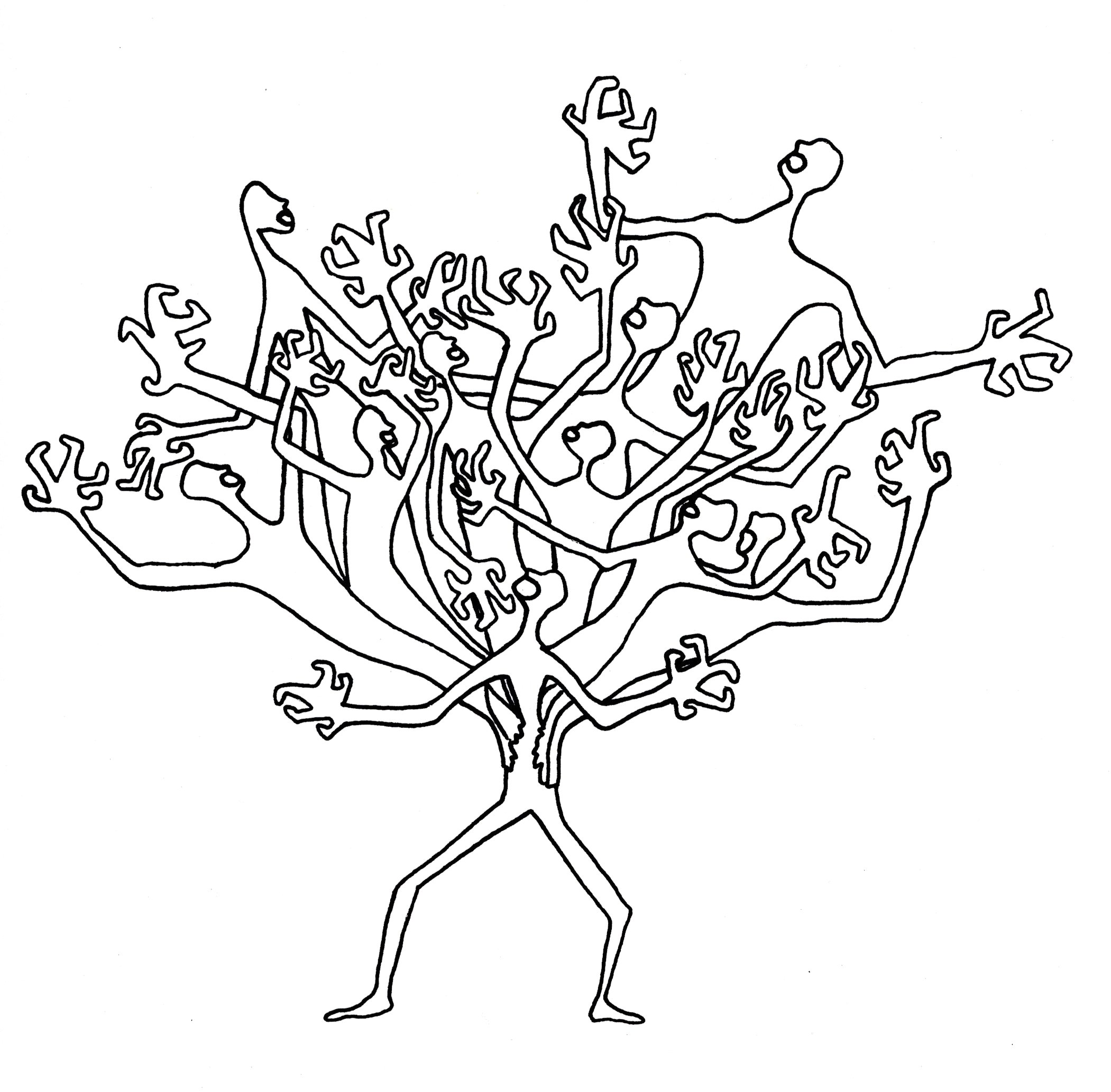
Source: Olio by Tyehimba Jess (Seattle and New York: Wave Books, 2016). Illustration by Jessica Lynne Brown, from Olio, p. 5. Used with permission. View the book page.
Hear Tyehimba Jess introduce and read his poem at the New York State Writers Institute in this video from 2017:
“Fisk Jubilee Proclamation” by Tyehimba Jess is the first in a heroic crown of sonnets from Jess’s second poetry collection, the Pulitzer Prize–winning Olio. A crown of sonnets is a circular sequence in which the last line of the first sonnet becomes the first line of the second sonnet, the last line of the second sonnet becomes the first line of the third sonnet, and so forth, until eventually the last line of the last sonnet becomes the first line of the first sonnet. What makes Jess’s crown “heroic” (part of the form’s technical name) is that it comprises fifteen sonnets, and the final one is made up of all the first or last lines of the preceding fourteen, in order. Quite the feat!
With this heroic crown, Jess honors the Fisk Jubilee Singers from the historically Black Fisk University in Nashville, Tennessee, a choral ensemble established in 1871 and still active today. Fisk was founded after the Civil War to educate freed men and women and other young African Americans. To raise money for the new school, music professor and treasurer George L. White formed a small choir of nine students to tour the United States. Their repertoire was the spirituals they and their parents sang on the plantations, songs that were rarely known at the time among northern white audiences—such as “Go Down, Moses,” “Steal Away to Jesus,” “Ezekiel Saw the Wheel,” “Joshua Fit the Battle of Jericho,” and “Roll, Jordan, Roll,” to name a few. The Fisk Jubilee Singers are credited with spreading and popularizing this uniquely Black American art form over the country and world.
The nine original Jubilee Singers, Fisk University, Nashville, Tennessee, ca. 1871. From left to right: Minnie Tate, Greene Evans, Isaac Dickerson, Jennie Jackson, Maggie Porter, Ella Sheppard, Thomas Rutling, Benjamin Holmes, Eliza Walker.
Their first eighteen-month stint took them to Ohio, Pennsylvania, New York, Connecticut, Rhode Island, New Jersey, Massachusetts, Maryland, and Washington, DC. Then in 1873, they toured Great Britain and continental Europe, performing for Queen Victoria and other prominent figures.
The name of the group comes from Leviticus 25, where God mandates that every fifty years, the enslaved are to be set free: “And you shall hallow the fiftieth year, and you shall proclaim liberty throughout the land to all its inhabitants. It shall be a Jubilee for you: you shall return, every one of you, to your property and every one of you to your family” (v. 10).
The Fisk Jubilee Singers took up God’s call to proclaim liberty far and wide, and they did so through their song. Written in the singers’ collective voice (hence the “choral” headnote), “Fisk Jubilee Proclamation” opens with an epigraph taken from Psalm 96:1: “O sing unto the Lord a new song . . .” (emphasis mine). The first line plays upon this biblical line by substituting three words that rhyme with the ones displaced: “O, sing . . . undo the world with blued song.”
Their song is blued because it was born out of deep suffering. And with it they undo the world—they open up those who were formerly closed off against them. They unravel racist stereotypes, asserting their sacred humanity.
They sing as an act of defiance. Whereas their enslavers had demanded them and their parents to be quiet and would often beat them into submission, now they are unapologetically loud, unbeaten—their words, like them, set free. They own their voices, which embody a range of nuance, from strong, vigorous, and sharp to soft and smooth. Tongue-tied no more, they burst loose from bondage with their new song of freedom. An unfurling of their body’s flag.
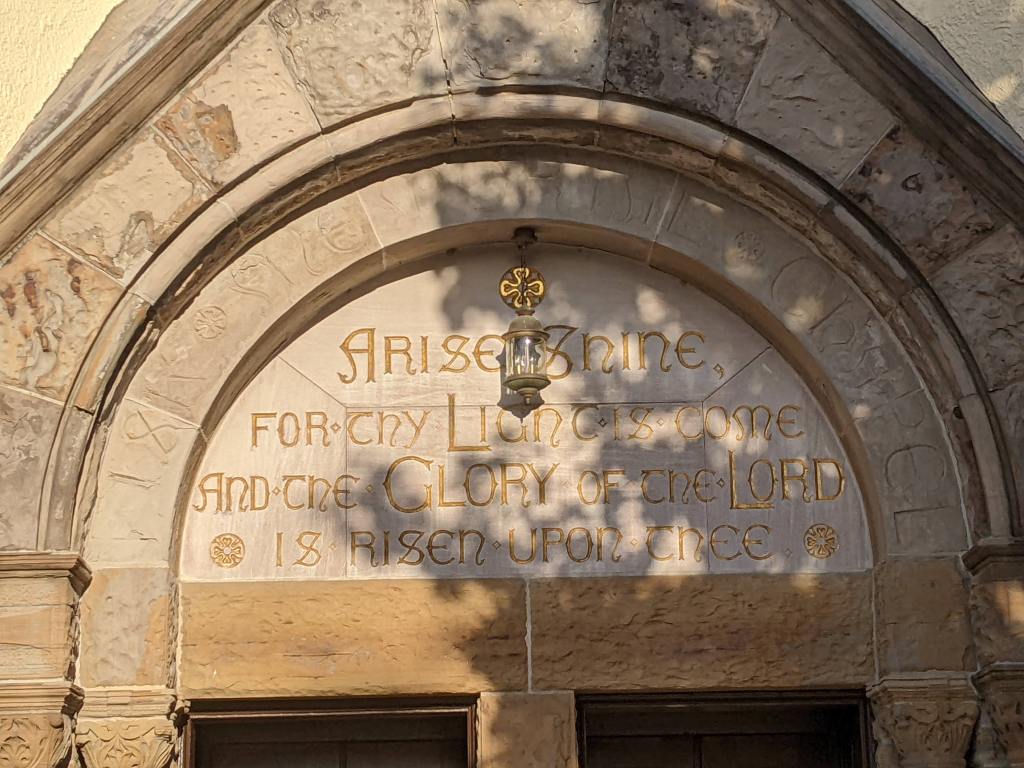
“Arise, shine, for thy light is come, and the glory of the Lord is risen upon thee” (Isa. 60:1). Tympanum, Fisk Memorial Chapel (built 1892), Fisk University, Nashville, Tennessee. Photo: Victoria Emily Jones. This chapel is the home performance site for the Fisk Jubilee Singers.
The poem is full of b alliteration: blued, born, bound, bonded, body’s, breath, bear, birthing, blessed, blood, behold, bold, (un)beaten, bursting, bondage. This letter is what’s known as a plosive consonant, because it makes a small explosive sound as you say it. Such an effect reinforces the idea of eruption.
Jess describes the choir’s singing as an act of childbirth, the hymn that has lain within them finally emerging, through painful labor, for all to hear. That hymn is “scored”—in the sense of its music being written on the page, but also bearing the marks of the slaver’s lash, that trauma, that story of violence and oppression, passed down to new generations. The “worn” in “soul-worn psalms” also has a double meaning, in that the singers wear their souls on the sleeves of their songs (or, the songs are dressed in soul) but also they are soul-weary.
Concurrent with the rise and ongoing performances of the Fisk Jubilee Singers were frequent attacks on Black places of worship. As the singers were spreading beauty and hope through the spirituals, white terrorists were spreading ugliness and hate. To remind readers of this context, Jess provides a litany of church names and dates across the top and bottom of the page of each Fisk Jubilee sonnet, indicating Black churches that were burned down, bombed, or sites of other kinds of racially motivated violence. In the back of the book Jess includes this note “On the Fisk Jubilee Choir testifying through fire . . .”:
The names of our burned and bombed black churches enfold the spirituals sung by our Jubilee choir. Inside each flame burns hum, prayer, and holy book. Each hymn inhabits heat and smolder; each biblical spark is kindled with story. There is no complete record of all such attacks upon the black congregational body, no complete accounting of all the pulpits, pews, and psalm books rendered into fire—these 148 stand in testimony to all the unnamed churches lost to arson and TNT, the slats and nails and sweat that doubled as schoolhouse and underground passageway, the pyres of pine and oak and cedar steeples that sheltered baptisms and home-goings, the silent crucifixions curled into ash. The AMEs and the Graces, the Tabernacles and all the many Firsts; the hand fans, tambourines, mourner’s benches, and collection plates; they rise in smoke like the songs that soaked through them and up to heaven’s blued, eternal door. (221)
The litany traces an unbroken line of violence from 1822 to 2015 and, true to the sonnet corona form, highlights a tragic circularity: Mother Emanuel AME Church in Charleston, South Carolina, is the earliest African American church to suffer arson that Jess found record of in his research, and that same church was the target of a mass shooting on June 17, 2015, which claimed nine victims. (Tomorrow is the eighth anniversary.) This murder occurred while Olio was in production with the publisher, and Jess knew he had to add it to the end of the poem sequence.
Despite such assaults on their dignity and personhood, the Fisk Jubilee Singers have always continued to praise, and that is their glorious legacy. They’ve carried forward the joys, sorrows, and faith of their community in song. The final, extraordinary poem in Jess’s Fisk Jubilee sequence is titled “We’ve sung each free day like it’s salvation.” It ends like this: “We’ve smuggled faith from slave shack to palace, / boiling the air with hallelujah’s balm— / each note bursting loose from bondage / to sing unto the world a new song.”
I wholly commend Olio to you, which is the most inventive volume of poetry I’ve ever read. It took Jess nearly eight years to write, and given its irregular nature, I imagine it also took a while for the designer and production team at Wave Books to work out! An olio is a miscellaneous mixture of heterogenous elements, a hodgepodge, but also, as an early page of the book notes, “the second part of a minstrel show which featured a variety of performance acts and later evolved into vaudeville.”
Part fact, part fiction, the book examines the lives of mostly unrecorded African American performers directly before and after the Civil War up to World War I, in “an effort to understand how they met, resisted, complicated, co-opted, and sometimes defeated attempts to minstrelize them,” as the publisher writes. It includes, for example, transcripts of interviews conducted by the fictitious Julius Monroe Trotter with an array of people who knew the ragtime composer Scott Joplin. It also includes syncopated sonnets (a form of contrapuntal poetry), which can be read up, down, diagonally, or interstitially—listen to Jess read and explain, for example, the sequence he wrote on the conjoined twins Millie and Christine McKoy, where the form stands in for the corpus of the sisters to represent their interconnected but independent narratives. But even for just the fifteen Fisk Jubilee sonnets alone, ten of which are in the voice of each of the original nine singers and their (white) conductor, the book is worth the price.
To learn more about what went into writing the Fisk Jubilee sonnets, read Jess’s blog post for the Poetry Foundation, “Flames of History / Rhythms of Song.” Also check out the interview with Jess published in the Interlochen Review, “Music, Literature, and the Struggle of Consciousness.” One thing that particularly stood out to me from the interview was, when asked about how he intertwines language and music in Olio, he said,
You have to remember in African American literature that we were deprived of the right of reading and writing for most of our history in this country. So, the song and the music became the literature. So, after emancipation, it’s impossible to really completely extract one from the other, because one was so instrumentally carrying so many stories for so long, for so many generations.
Tyehimba Jess (b. 1965) is a major poet whose work bridges slam and academic poetry and is imbued with deep archival research, often fusing music, history, and fiction. His first collection, leadbelly (2005), an exploration of the blues musician Huddie “Lead Belly” Ledbetter’s life, was chosen for the National Poetry Series by Brigit Pegeen Kelly. His second collection, Olio (2016), which celebrates the mostly unrecorded Black musicians, orators, and other performers of the nineteenth and early twentieth centuries, won the 2017 Pulitzer Prize. He teaches English at the College of Staten Island.
Felice Casorati (Italian, 1883–1963), Study for Portrait, 1919. Oil on cardboard. Museo del Novecento, Florence.
God whispered, and a silence fell; the world Poised one expectant moment, like a soul Who sees at heaven’s threshold the unfurled White wings of cherubim, the sea impearled, And pauses, dazed, to comprehend the whole; Only across all space God’s whisper came And burned about her heart like some white flame.
Then suddenly a bird’s note thrilled the peace, And earth again jarred noisily to life With a great murmur as of many seas. But Mary sat with hands clasped on her knees, And lifted eyes with all amazement rife, And in her heart the rapture of the spring Upon its first sweet day of blossoming.
This sonnet by Theodosia Garrison (1874–1944) originally appeared in The Earth Cry: And Other Poems (New York: Mitchell Kennerly, 1910) and is in the public domain.
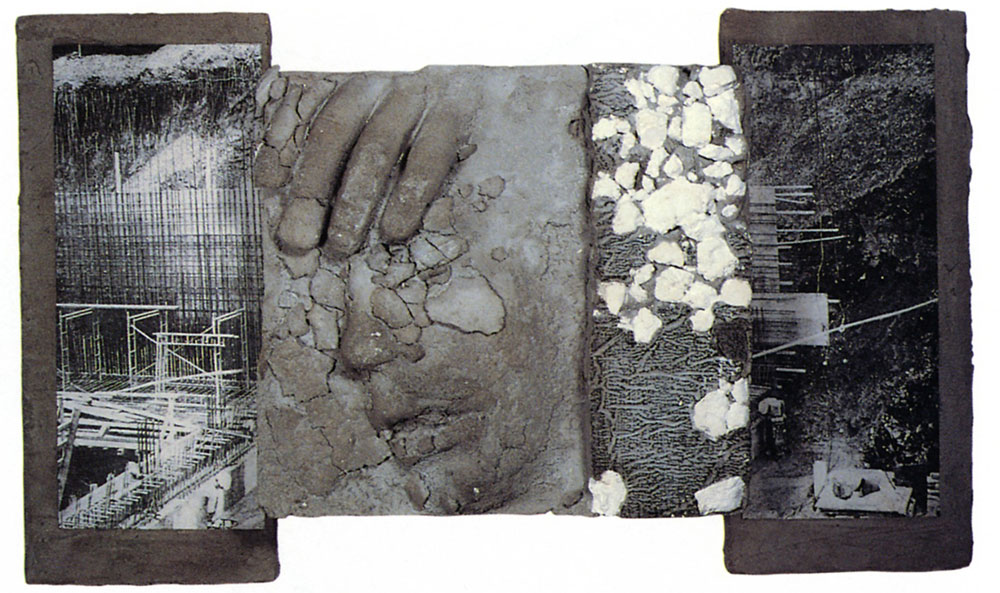
LOOK: Bradford Johnson, Untitled, 1987. Mixed media, 12 × 28 × 3 in. This image is featured in the essay “Wreckage and Rescue: The Art of Bradford Johnson” by Joel Sheesley in Image no. 25 (Spring 2000).
“Child of Dust” is the final song of a four-EP cycle structured on the four basic elements: Fire, Water, Air, and Earth. It’s written as a sonnet in the voice of Earth.
Dear prodigal, you are my son and I Supplied you not your spirit but your shape, All Eden’s wealth arrayed before your eyes. I fathomed not you wanted to escape.
And though I only ever gave you love, Like every child you’ve chosen to rebel, Uprooted flowers and filled the holes with blood. Ask not for whom they toll, the solemn bells.
O child of dust, to Mother now return, For every seed must die before it grows. And though above the world may toil and turn, No prying spades will find you here below.
Now safe beneath their wisdom and their feet, Here I will teach you truly how to sleep.
The earth personified laments how humanity has not reciprocated the care she gives. We’re made of her (Gen. 2:7) and are invited to enjoy her beauty, and yet we abuse and destroy her and each other.
The second stanza alludes to Cain’s murdering Abel. “The voice of your brother’s blood is crying to me from the ground,” God tells Cain in Genesis 3:10. Line 8 is a reference to John Donne’s “Meditation 17” from Devotions upon Emergent Occasions, which uses a metaphor of land erosion to express humanity’s interconnectedness:
No man is an island, entire of itself; every man is a piece of the continent, a part of the main. If a clod be washed away by the sea, Europe is the less, as well as if a promontory were, as well as if a manor of thy friend’s or of thine own were. Any man’s death diminishes me, because I am involved in mankind; and therefore never send to know for whom the bell tolls; it tolls for thee.
In other words, when one person dies, a part of the whole of humanity is severed, and in that sense any time a funeral bell rings, we ought all to mourn the loss of a piece of ourselves.
Line 10, in the third stanza, references Jesus’s parable of the grain of wheat: “Truly, truly, I say to you, unless a grain of wheat falls into the earth and dies, it remains alone; but if it dies, it bears much fruit” (John 12:24). Jesus was talking about his own literal death and resurrection, but the principle applies to our dying to sinful desires, an act that enables new life to spring up in us (see, e.g., Rom. 6; Gal. 2:20, 5:24; Col. 3:2–5; 1 Pet. 2:24).
Kensrue’s lyrics have Mother Earth asking her prodigal children to return to her. As they sing the final couplet, the band puts the microphone in a wooden box (a “coffin”) and shovels dirt on top of it, creating a muffled sound effect. The last sixty seconds of the track are near silence, just the faint clinking of shovels into dirt and rocks. It’s as if we, the listener, are being buried.
Lent is a time when, beneath the world’s incessant noise and toil, we sow ourselves; we reground ourselves in God. The song can be interpreted in several ways, but I see it as calling us to die to self so that we might truly live. Dying and rising is a lesson that Earth, with her seasons and agricultural cycles, can teach us. The seed must be buried before it can experience growth.




 Art & Theology