Roundup: Visitation hymn, word games with George Herbert, The Message set to music, and more

HYMN FOR THE FEAST OF THE VISITATION: “Somewhere I hear the church bells ringing” by Gracia Grindal: There are many church songs on the Magnificat, the canticle Mary sings in Luke 1:46–55 when she greets her cousin Elizabeth at Elizabeth’s home in the hills of Judea, but very few hymns, at least in Protestantism, that narrate the Visitation event that occasions it, including Elizabeth’s glad affirmations. Gracia Grindal’s “Somewhere I hear the church bells ringing” is one example of the latter—a four-stanza hymn she wrote in 2010 for the Feast of the Visitation, celebrated every year on May 31, with Elizabeth as the poetic speaker. The hymn captures the excitement of the Messiah coming into the world, and references an Alfred Lord Tennyson poem along the way.

On her blog Hymn for the Day, Grindal provides the lyrics and a reflection on this hymn, as well as sheet music that uses a melody Daniel Charles Damon wrote specifically for the text, which is also available in Damon’s collection Garden of Joy (Hope Publishing, 2011). For public-domain tune alternatives, Grindal suggests DISTRESS or KEDRON from William Walker’s Southern Harmony (1835), or the Renaissance tune by Thomas Tallis known as TALLIS’ CANON—all three of which are commonly used with Fred Pratt Green’s twentieth-century hymn “O Christ, the Healer, We Have Come.”

A professor emerita at Luther Seminary in St. Paul, Minnesota, Gracia Grindal is a prolific writer and translator with expertise in Scandinavian hymns. She has served on several hymn committees and boards and is the author of A Treasury of Faith, a three-volume series of over seven hundred hymn texts on the lessons of the Revised Common Lectionary (Wayne Leupold Editions, 2006–9); Preaching from Home: The Stories of Seven Lutheran Women Hymn Writers (Eerdmans, 2011); an English translation of Hallgrímur Pétursson’s Icelandic Passíusálmar (Hymns of the Passion) (Hallgrím Church, 2020); and Jesus the Harmony: Gospel Sonnets for 366 Days (Fortress, 2021), among many other books.

+++

SUBSTACK POSTS:

>> “The Slow Way: On Being ‘at Peace and in Place’” by Micha Boyett, The Slow Way: When her third child was born with Down syndrome, Micha Boyett, an emerging writer, knew she needed to release herself from the anxiety of producing and focus on parenting; she decided to slow down in order to be faithful to her son. Drawing on themes in her new book, Blessed Are the Rest of Us: How Limits and Longing Make Us Whole, Boyett reflects in this post on the slow, remarkable, intricate work God does when we “allow all that we are to nourish the place we find ourselves”; when we let go of plans and rest in the goodness of what God has for us at this moment. “Rest is something that nourishes our long-term lives. And rarely, if ever, does rest improve our influence, our finances, or our platforms,” she writes. “Rest is an invisible gift to ourselves that results in invisible growth, invisible peace, invisible relational wholeness.”

>> “Word Games with George Herbert” by Grace Hamman, Medievalish: This Herbert poem was new to me, and what a delight it is! It consists of five tercets, each with an end word that gradually diminishes through loss of a letter with each subsequent line—e.g., CHARM, HARM, ARM. Playing this word game, Herbert develops the conceit of himself as a tree in God’s enclosed garden-orchard.

Peach (Tradescants’ Orchard)
“The Nuingetonn Peeche” from the Tradescants’ Orchard, 1620–29. Oxford, Bodleian Library MS. Ashmole 1461, fol. 105r.

I always enjoy the literary works, which are mostly medieval or early modern, that Dr. Grace Hamman explores through her newsletter and podcast—and the “Prayer from the Past” she curates for each newsletter sign-off, like the one in this edition, by Richard Brathwait (1588–1673).

+++

SONG: “Te Atua” (Dear Lord): I heard this popular New Zealand hīmene (hymn) in the Taika Waititi–directed movie Boy (2010) (such a great movie!). It’s a traditional Māori Christian text, set to the Appalachian folk tune NEW BRITAIN (best known for its pairing with “Amazing Grace”) and performed in 1997 by the St. Joseph’s Māori Girls’ College Choir, featuring soloist Maisey Rika. The arrangement is by the college’s principal, Georgina Kingi. Bearing echoes of Jesus’s parable of the sower, this song is particularly appropriate for the season of Ordinary Time that we’re now in, during which the seeds that were planted in us in the first half of the Christian year germinate, grow, and bear fruit.

E te Atua kua ruia nei 
Ö purapura pai
Hömai e koe he ngákau hou
Kia tupu ake ai

E lhu kaua e tukua
Kia whakangaromia
Me whakatupu ake ia
Kia kitea ai ngá hua

A má te Wairua Tapu rá
Mátou e tiaki
Kei hoki ki te mahi hé
Ö mátou ngákau höu
Dear Lord, you have spread
Your seeds of goodness
Give us new hearts
So that these seeds may grow

Dear Lord, do not allow
These seeds to be lost
But rather let them grow
So that the results may be seen

May the Holy Spirit
Guide us
Lest our hearts should
Return to our evil ways

[source]

+++

NEW ALBUMS:

>> Message Songs by the Porter’s Gate: For this album, the Porter’s Gate Worship Project partnered with the Eugene Peterson Center for Christian Imagination at Western Theological Seminary to set to music excerpts from Peterson’s best-selling translation of the Bible, The Message. Included are adaptations of Psalms 5, 16, 27, and 121, Matthew 11:28–30, Luke 15, and John 1—by a range of songwriters. The album release this month coincided with the publication of The Message Anniversary Edition, available from NavPress.

>> Volume 10 (Ordinary Time) of The Soil and The Seed Project: This double album—which is completely free!—features twenty-four songs by musicians of faith under the direction of Seth Thomas Crissman, a Mennonite pastor, educator, songwriter, and multi-instrumentalist from Harrisonburg, Virginia. Here’s one of the songs, “The Way Your Kingdom Comes” by Lindsey FitzGerald Stine, sung by her and her sister Rachel FitzGerald:

The music is one element of a larger project that also includes liturgies and newly commissioned artworks. Learn about the project’s free summer concert series on their Events page, which will feature contributors to the most recent album and other friends.

Roundup: Biber’s Mystery Sonatas, icons by Maxim Sheshukov, “Mercy at the Movies,” and more

SPOTIFY PLAYLIST: March 2024 (Art & Theology): My new monthly playlist of thirty songs is up a day early and, as usual, includes both recent releases and older favorites. Let me also point you to the longer, thematically distinct playlists I made for Lent, Holy Week, and Eastertide.

+++

CONCERT: Phantasia performs Biber’s Mystery Sonatas, St Hubert’s Church, Corfe Mullen, England, February 17, March 23, and April 13, 2024: The Mysteries of the Rosary are a set of fifteen meditations on episodes in the lives of Jesus and his mother, Mary. They are divided into three groups: the Joyful Mysteries (the Annunciation, the Visitation, the Nativity, the Presentation of the Infant Jesus in the Temple, the Twelve-Year-Old Jesus), the Sorrowful Mysteries (Christ on the Mount of Olives, the Scourging at the Pillar, the Crown of Thorns, Jesus Carries the Cross, and the Crucifixion), and the Glorious Mysteries (the Resurrection, the Ascension, Pentecost, the Assumption of the Virgin, and the Beatification of the Virgin).

Around 1676, the Bohemian Austrian composer Heinrich Ignaz Franz von Biber (1644–1704) wrote fifteen short sonatas for violin and continuo based on these mysteries. In a free three-part event sponsored by Deus Ex Musica, the newly formed period-instrument ensemble Phantasia will be performing Biber’s Mystery Sonatas at St Hubert’s Church, Corfe Mullen, on the south coast of England, accompanied by commentary by musician and educator Dr. Delvyn Case, who will provide thoughts about the ways each sonata reflects its “mystery,” linking specific elements of the musical structure to themes or ideas in the biblical scene. The performance of the first cycle of the work has already passed, but the remaining two are still upcoming: the Sorrowful Mysteries on March 23 (the Saturday just before the start of Holy Week), and the Glorious Mysteries on April 13.

Case tells me that Deus Ex Musica hopes to eventually provide video excerpts from the performances on their YouTube channel. In the meantime, here’s a little teaser, a snippet from the “Presentation in the Temple” movement, performed by Phantasia musicians Emma-Marie Kabanova on Baroque violin and Chris Hirst on German theorbo (long-necked lute).

+++

ARTICLES:

>> “Mercy at the Movies: Ten Films That Flip the Script” by Meaghan Ritchey, Mockingbird: “Spanning almost a century of cinema, this list of films maps a world—real and imagined—devoid of the mercy for which we all have need, as well as a world animated by unexpected and unearned mercies, flipping the script and leaving the plot forever changed.” What a great list! Number 7 is one of my all-time favorite films.

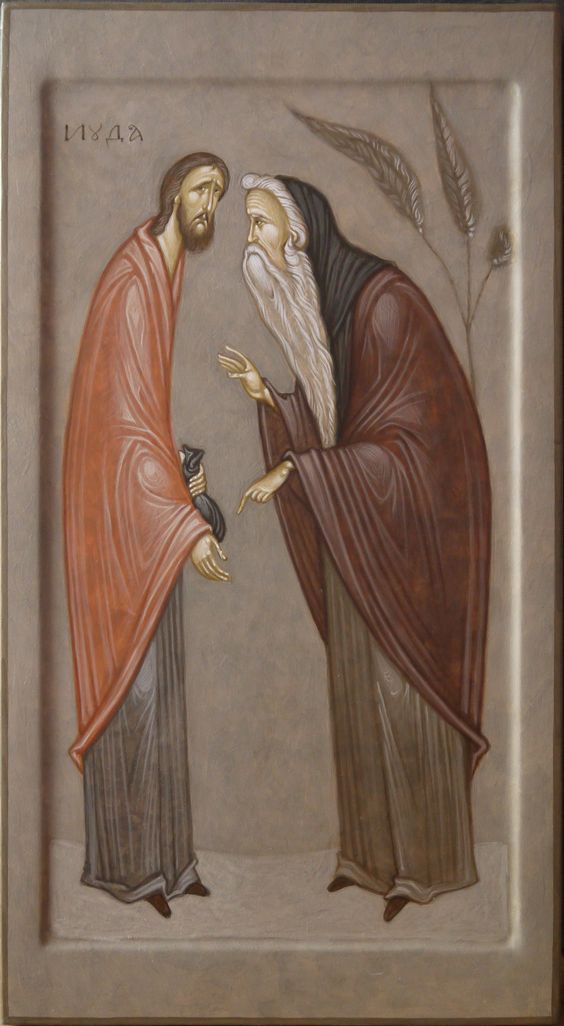
>> “As If Through a Child’s Inner Eye: The Contemporary Icons of Maxim Sheshukov” by Fr. Silouan Justiniano, Orthodox Arts Journal: In this article from 2016, Fr. Silouan Justiniano, a monk at the Monastery of Saint Dionysios the Areopagite on Long Island, explores the work of contemporary iconographer Maxim Sheshukov (Максим Шешуков) of Pskov, Russia, finding it “exemplary of the diversity and flexibility possible within our ever-renewing and living Tradition.”

Sheshukov, Maxim_Zacchaeus
Maxim Sheshukov, Zacchaeus, 2015. Egg tempera on gessoed wood.

Sheshukov, Maxim_Judas
Maxim Sheshukov, Judas, 2020. Egg tempera on gessoed wood.

+++

NEW ALBUMS:

>> Volume 9 (Lent-Easter-Pentecost) of The Soil and The Seed Project: This is the latest release in an ongoing series of music for the church year by musicians of faith from the Shenandoah Valley. Some of my favorite tracks are “I Will Sing to the LORD” (a setting of Psalm 104:33) and “Hosanna, Loud Hosanna” (a newly retuned but old-timey-sounding hymn for Palm Sunday). I also really like “Gentle Shepherd,” a lullaby written for the children of Salford Mennonite Church to sing in worship in 2018 and performed in this music video by the sister folk duo Spectator Bird:

>> Life and Death and Life: Songs for Lent, Holy Week, and Easter by Steve Thorngate: Chicago-based church musician and songwriter Steve Thorngate has followed up his excellent album After the Longest Night: Songs for Advent, Christmas, and Epiphany with an album for the next two seasons of the church year, including the Day of Pentecost! In addition to twelve original songs, it includes two African American spirituals, a Charles Tindley hymn, and, perhaps my favorite, a cover of (new-to-me) Brett Larson’s poetic country song “Rolling Away,” about barriers to sight and wholeness being removed and a fresh new clarity, a freedom, a path opening up:

>> JOY JOY JOY JOY JOY by Paul Zach: The ever prolific Paul Zach of Virginia’s latest release is an effusively joyous ten-track album celebrating God’s love, salvation, and sustenance. He collaborated with other musicians on the project, including Jon Guerra, Tristen Stuart-Davenport, and IAMSON. Here’s a snippet of the opening song, “Nothing,” based on Romans 8 (listen to the full track here):

Roundup: Sing Me High Music Festival, visual LP shot on Mayne Island, and more

SPOTIFY PLAYLIST: August 2023 (Art & Theology): Here’s this month’s!

+++

MUSIC FESTIVAL: “Sing Me High,” August 11–12, 2023: Celebrating music and faith in the Shenandoah Valley. Next Friday evening and all day Saturday at the Brethren & Mennonite Heritage Center in Harrisonburg, Virginia, various folk, bluegrass, and acoustic musicians from the region will be performing: the Walking Roots Band [previously], Chatham Rabbits, Maya de Vitry, Spectator Bird, Honeytown, Juniper Tree, Tide Spring, Good Company, Ebony Nicole, Ears to the Ground Family (read my review of their debut album), Shekinah, Ryan Scarberry, Clymer & Kurtz, and the Rain Pickers. Buy your tickets ahead or at the gate. I’ll be there! (In the audience, that is.)

Below are songs by three different bands/artists who will be playing at the festival: “Praise to God (Whirlwinds),” a new setting by the Walking Roots Band of an eighteenth-century hymn by Anna Barbauld (recorded on The Soil and The Seed Project, vol. 4 and appearing on the Art & Theology Thanksgiving Playlist); “Again, Amen” by Spectator Bird (sisters Rachel and Lindsey FitzGerald); and “Grieve and Rejoice” by Ryan Scarberry, director of music at Incarnation Anglican Church in Williamsburg, Virginia.

+++

ONLINE EVENT: “In Memoriam: An Evening Celebrating Frederick Buechner’s Literary Contributions,” August 15, 2023: “Celebrated as one of the foremost spiritual writers of his generation, Frederick Buechner’s witty, vivid, and rich writing has inspired readers’ minds and stirred hearts through his more than 30 published books for six decades. One year after his passing, Frederick Buechner (July 11, 1926–August 15, 2022) remains an influential voice for writers across genres, from novelists and memoirists to homileticians and theologians alike. For those writers who feel not religious enough for religious readers, or too religious for non-religious readers, Buechner’s voice has been a welcome, guiding light.

“On the one-year-anniversary of Frederick Buechner’s passing, Image is hosting space for community members to gather and share their appreciation for Buechner’s literary contributions. From themes of paying attention to one’s life and stewarding one’s grief, to the unexpected influences on one’s vocation and the ordinary miraculous moments of everyday life, Buechner’s words offer a variety of invitations through which one might come to see the world and one’s place within it more deeply. Image community members are invited to bring a favorite selection of Buechner’s writing to read aloud and to briefly reflect on the difference his words have made for their life.” Register for this free, moderated, open-mic-style time of sharing and reflections at the link above.

+++

DOCUMENTARY: The Sea in Between (2013) by Mason Jar Music: Blayne Johnson and his family, who reside in Mayne Island, British Columbia, are big fans of Portland, Oregon-based indie singer-songwriter Josh Garrels. In 2012 Johnson reached out to Garrels and some of the folks at Mason Jar Music, the Brooklyn-based creative collective Garrels has worked with, to invite them up to his home for a relaxing getaway, and to play for his family and neighbors. Mason Jar specializes in live performance videos, so they sent a small crew and a handful of musicians with the intention of shooting a few of those at various locations around the island—along the bay, on a farm, in a church. Then they decided to extend the footage from the week into a feature-length documentary, directed by Matt Porter, which you can watch for free on YouTube (embedded directly below). The song recordings were released afterward on an album of the same name, along with others that didn’t make the final cut of the film.

The Sea in Between, the film, is about vocation, the creative process, patronage, faith, family, community, and the beauty of place, and it centers on the joy of making and experiencing music together. Besides Garrels, the musicians are Dan Knobler (slide guitar, mandolin), Jay Kirkpatrick (banjo, accordion), Russell Durham (violin), Charlaine Prescott (cello), Jason Burger (drums), Chad Lefkowitz-Brown (clarinet, flute, saxophone), and Gabriel Gall (miscellaneous), who served as music director and wrote the orchestrations. Michelle Garrels and Matt Porter play the aquarion (glass marimba), and everyone contributes vocals. Perhaps my favorite song from the film is “Pilot Me” (not to be confused with the Edward Hopper hymn “Jesus, Savior, Pilot Me”; this is a Garrels original):

+++

SONG: “O nata lux” by Thomas Tallis, performed by VOCES8: “O nata lux de lumine” (O Light Born of Light) is the office hymn at Lauds of the Feast of the Transfiguration, celebrated August 6. Here VOCES8 performs a setting from the English High Renaissance by Thomas Tallis, inside St. Bartholomäus-Kirche in Pegnitz, Germany.

O nata lux de lumine,
Jesu redemptor saeculi,
Dignare clemens supplicum
Laudes precesque sumere.

Qui carne quondam contegi
Dignatus es pro perditis,
Nos membra confer effici
Tui beati corporis.
O Light born of Light,
Jesus, redeemer of the world,
with loving-kindness deign to receive
suppliant praise and prayer.

Thou who once deigned to be clothed in flesh
for the sake of the lost,
grant us to be members
of thy blessed body.