
“Sonnet Beginning with a Line and a Half Abandoned by Dante Gabriel Rossetti” by X. J. Kennedy (poem)

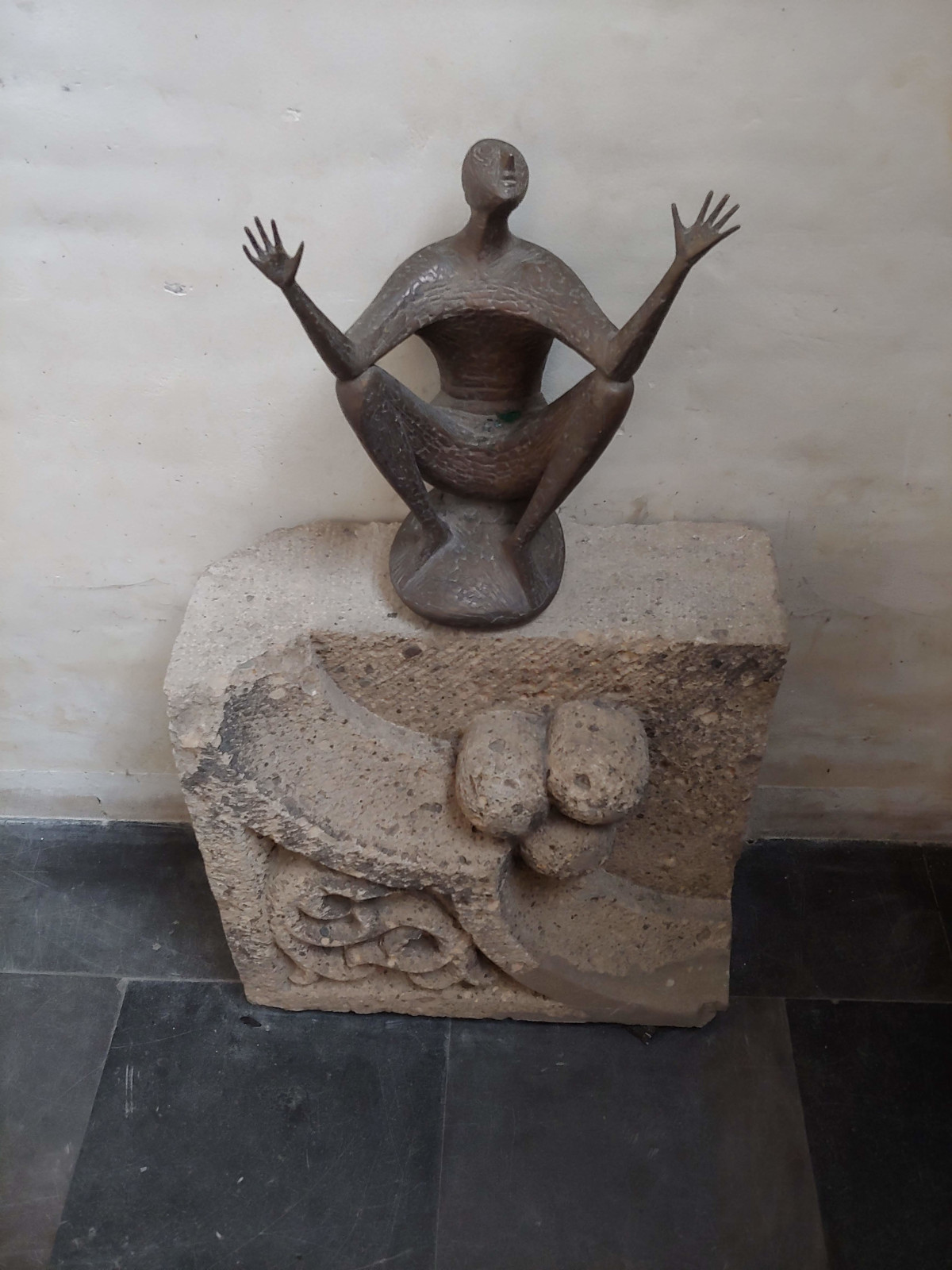
Laurenskerk sculpture
Unidentified sculpture at the Grote of Sint-Laurenskerk (Church of Saint Lawrence), Rotterdam, Netherlands. Photo: Victoria Emily Jones.

Would God I knew there were a God to thank
     When thanks rise in me, certain that my cries
Do not like blind men’s arrows pierce the skies
     Only to fall short of my quarry’s flank.
Why do I thirst, a desperate castaway
     Quaffing salt water, powerless to stop,
Sick lark locked in a cellar far from day,
     Lone climber of a peak that has no top?

To praise God is to bellow down a well
     From which rebounds one’s own dull booming voice,
          Yet the least leaf points to some One to thank.
The whorl embodied in the slightest shell,
     The firefly’s glimmer signify Rejoice!
          Though overhead, clouds cruise a sullen blank. 

This poem was originally published in In a Prominent Bar in Secaucus: New and Selected Poems, 1955–2007 by X. J. Kennedy (Baltimore: Johns Hopkins University Press, 2007). Used by permission of the publisher.


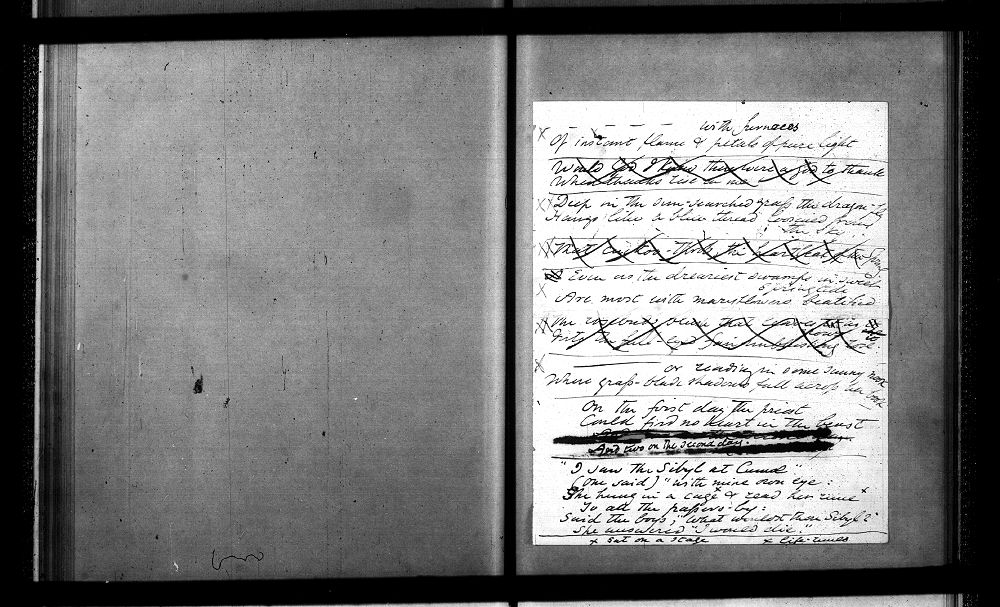
The first line and a half of this sonnet are a crossed-out fragment from one of the notebooks of the British poet and artist Dante Gabriel Rossetti (1828–1882), which he used to work out poetic ideas. This one never went anywhere. But Rossetti’s brother, William Michael Rossetti, saw something in it worthy of preservation; he salvaged it and other select scraps from his brother’s papers, publishing them posthumously in a “Versicles and Fragments” section of Rossetti’s collected works in 1901.
Dante Gabriel Rossetti deleted text
Page 16 of Sonnets and Fragments by Dante Gabriel Rossetti (Princeton/Troxell bound manuscript volume), 1848–81. The first deletion, by Rossetti’s hand, is “Would God I knew there were a god to thank / When thanks rise in me.” [object record]

The modern American poet X. J. Kennedy developed Rossetti’s fragment into a full poem that grapples with the silence of God and, despite such, the impulse to praise. The speaker is confounded by the contradiction that the world seems infused with God’s presence—the natural world points to a Creator—and yet God is unresponsive when the speaker initiates contact. The prayers he launches toward heaven like arrows appear not to reach their target. He’s experiencing spiritual aridity. He feels like a thirsty castaway whose only drink is salt water (why doesn’t God satiate as promised?); a bird trapped in a dark cellar; a mountain climber endlessly climbing, never catching sight of the vista.

The poem tugs back and forth between despondency and awe, between clench-fisted frustration and open-handed surrender. Each glorious tree leaf, the intricate design of conch shells, the whimsy of lightning bugs—these are gifts, but where’s the giver? Gratitude must be directed to someone, but whom does one thank for the wonders and small joys experienced in nature? Who or what is their source? Oh, how I wish I knew there were a God out there to thank, when thanks well up in me. The speaker wants to place his thanks somewhere, but when he places them in God, he receives no confirmation of receipt. There’s a disconnect between what nature testifies and what the speaker has suffered: the “sullen blank” of heaven.

Dante Gabriel Rossetti’s brother, William, wrote in 1895 that, unlike their devout sister Christina [previously], Dante was “a decided sceptic. He was never confirmed, professed no religious faith, and practised no regular religious observances; but he had sufficient sympathy with the abstract ideas and the venerable forms of Christianity to go occasionally to an Anglican church—very occasionally, and only as the inclination ruled him.” Starting in mid-adolescence, he rejected organized religion.

Kennedy, similarly, was raised in a religious household: his father was Catholic, his mother Methodist. And yet in his adulthood he has come to question and reject some of the tenets of orthodox Christianity. But still, he searches for God. “There is a clash in his poems between his skepticism or uneasy agnosticism and his unresolved longing for faith in God,” reads his bio on the Harvard Square Library website. Kennedy’s desire to believe but his inability to do so is expressed recurringly in his work—as in this poem, in which he, taking the baton from Rossetti, is very likely the speaker.


X. J. Kennedy (born 1929) is an American poet, translator, editor, and author of children’s literature and textbooks on English literature and poetry. Born Joseph Charles Kennedy in Dover, New Jersey, he adopted the nom de plume X. J. Kennedy in 1957 to avoid being mistaken for the better-known Joseph Kennedy, then US ambassador to England and father of future president John F. Kennedy. His award-winning poetry collections include Nude Descending a Staircase (1961) and Cross Ties (1985). He lives in Lexington, Massachusetts.
Lent, Day 20

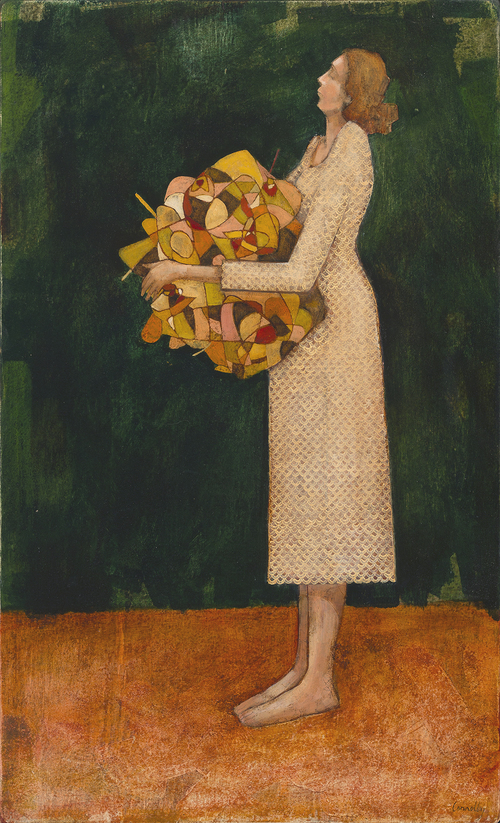
LOOK: Holding a Mystery by Caitlin Connolly

Connolly, Caitlin_Holding a Mystery
Caitlin Connolly (American, 1986–), Holding a Mystery, 2014. Oil on panel, 16 × 6 in.

Caitlin Connolly is an artist from Provo, Utah, whose paintings explore womanhood, sorrow, and faith. Her website, www.caitlinconnolly.com, contains an archive of original images dating back to 2013, many of which she sells as giclée prints from her online shop. She is featured in the first half of this episode of the BYUtv documentary series Artful.

The women in Connolly’s paintings are often shown holding something—the world, “holy things,” a book, a truth, a child, tears—or they might cup or cradle an absence that hurts. Here the figure carries a beautiful, tangled mass, a mystery, which is strangely both heavy and light. She doesn’t try to untangle it but simply hugs it close, resting.

LISTEN: “Lovely (Anselm of Canterbury)” by Nick Chambers, 2020 (to be released on an EP in 2022)

Lord my God, I don’t know how to start,
So I pray today that you would teach my heart
Where and how to find you, God, O where and how to search.
How can I know unless you show me first?

My God and my All, I’ve never seen you.
You created me, and you have made me new
And given me the good things in my hands and in my heart,
But still I don’t know who it is you are.

[Refrain] Let me seek you in all my desire,
Desire you in everything I seek.
Let it be by loving you I find you,
And when I finally find you, let it be lovely.

I come to you confessing gratefully.
It was in your image you created me
So that I may remember you and find the living course
On my way back to the loving source.

But that image is so worn and dim,
Darkened by the fault and by the smoke of sin,
That it can no longer do what you made it to do
Until it is refashioned and renewed.

[Refrain]

I’m not trying to ascend your heights;
My mind’s in no way capable of such a flight.
I do desire to know a little of your truth above
Which my heart already trusts and loves.

I seek to understand not so I can believe,
but I believe so I may understand.
And what is more, I do believe that unless I do believe,
I’ll never understand this mystery.

Originally from the Midwest, the Rev. Nick Chambers lives with his wife Katlyn and two sons in Atlanta, where he serves as the worship and formation pastor at Trinity Anglican Northside. His academic background is in philosophy and theology. “I love writing songs in, with, and for the church, and I’ve been doing it for years but only recently started seeking to share them beyond my local community,” he told me. He has contributed to two Porter’s Gate albums (Advent Songs and the forthcoming Climate Vigil Songs) and will be releasing his first solo EP later this year.

On Chambers’s YouTube channel you will find some of his original settings of psalms, prayers by Ephrem and Augustine and from the Book of Common Prayer, a poem by Pádraig Ó Tuama, and even a reworking of a Swedish hymn that he encountered through a few spoken lines from the Ingmar Bergman film Wild Strawberries!

“Lovely (Anselm of Canterbury)” is adapted from a prayer by the eleventh-century Burgundian-born monk, and later archbishop, named in the title. A doctor of the church, Anselm had a tremendous influence on the development of Christian theology and spirituality. The “combination of theological veracity and personal ardour is what most distinguishes Anselm’s writings from similar prayers, and makes him both traditional and revolutionary,” says Sister Benedicta Ward, a preeminent scholar and English translator of Anselm.

Anselm wrote the Proslogion (Lat. Proslogium, “Discourse”) in the 1070s while he was prior of the abbey of Notre Dame at Bec in Normandy. Chambers’s song is based on the passage that ends chapter 1:

Teach me to seek thee, and reveal thyself to me, when I seek thee, for I cannot seek thee, except thou teach me, nor find thee, except thou reveal thyself. Let me seek thee in longing, let me long for thee in seeking; let me find thee in love, and love thee in finding. Lord, I acknowledge and I thank thee that thou hast created me in this thine image, in order that I may be mindful of thee, may conceive of thee, and love thee; but that image has been so consumed and wasted away by vices, and obscured by the smoke of wrong‑doing, that it cannot achieve that for which it was made, except thou renew it, and create it anew. I do not endeavor, O Lord, to penetrate thy sublimity, for in no wise do I compare my understanding with that; but I long to understand in some degree thy truth, which my heart believes and loves. For I do not seek to understand that I may believe, but I believe in order to understand. For this also I believe—that unless I believed, I should not understand. (translated from the Latin by Sidney Norton Deane, 1903; emphasis mine)

In her 1973 translation of the Proslogion (pp. 243–44), Benedicta Ward sets this prayer in broken lines “in an attempt to convey the rhythm of Anselm’s complex rhymed prose, which is closer to our conception of poetry” and which aids a more meditative reading:

      Teach me to seek you,
   and as I seek you, show yourself to me,
   for I cannot seek you unless you show me how,
      and I will never find you
   unless you show yourself to me.
Let me seek you by desiring you,
   and desire you by seeking you;
   let me find you by loving you,
   and love you in finding you.

   I confess, Lord, with thanksgiving,
   that you have made me in your image,
so that I can remember you, think of you, and love you.
But that image is so worn and blotted out by faults,
   so darkened by the smoke of sin,
   that it cannot do that for which it was made,
   unless you renew and refashion it.
Lord, I am not trying to make my way to your height,
   for my understanding is in no way equal to that,
   but I do desire to understand a little of your truth
   which my heart already believes and loves.
I do not seek to understand so that I may believe,
   but I believe so that I may understand;
      and what is more,
I believe that unless I do believe I shall not understand.

I particularly love lines 8–9: “Let me find you by loving you, and love you in finding you.” Or, as Deane translates it, “Let me find thee in love and love thee in finding.” Chambers highlights these lines by making them, and the two that precede them, the refrain of his song: “Let me seek you in all my desire, / Desire you in everything I seek. / Let it be by loving you I find you, / And when I finally find you, let it be lovely.”

For Anselm, our desire for God must precede our understanding of God. We cannot know God except through love; those who pursue him without loving him will not find him. And it’s not as if our “finding” God ends the pursuit, as there is always more of God to discover. We catch small glimpses, and that’s invigorating. In this life we are never granted a full and complete vision of God but rather are always searching and often finding—and that search, undertaken with loving belief, is a delight.