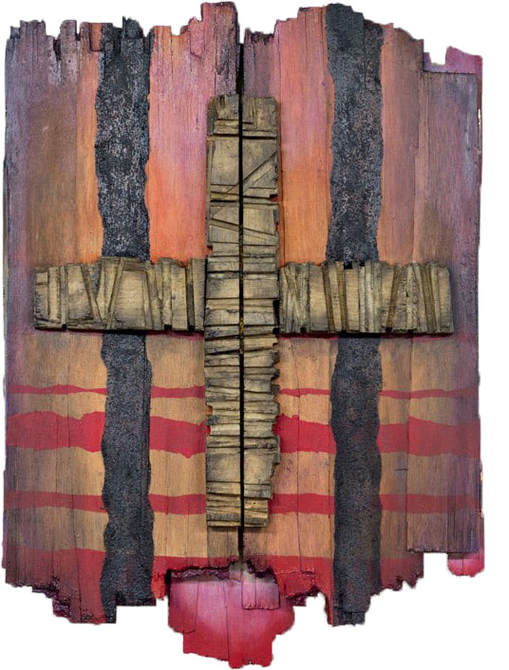
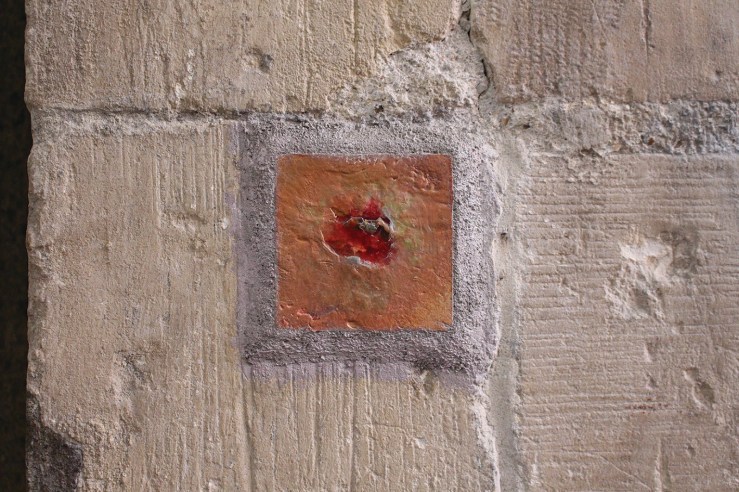
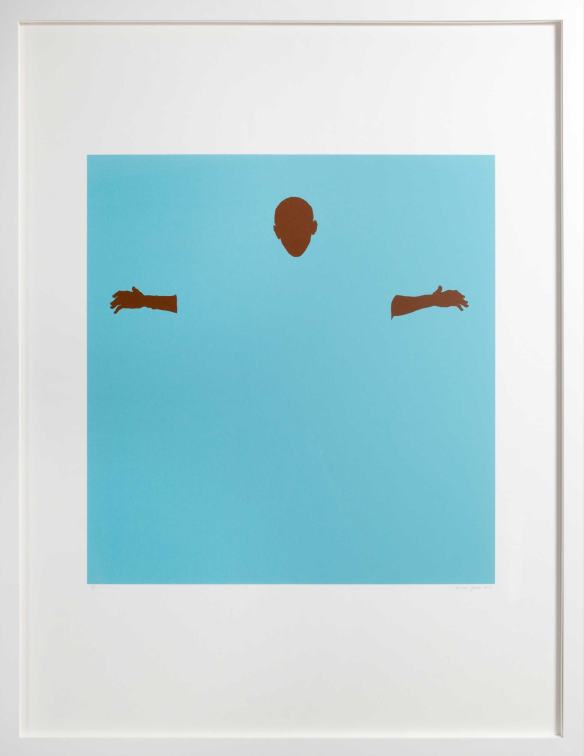
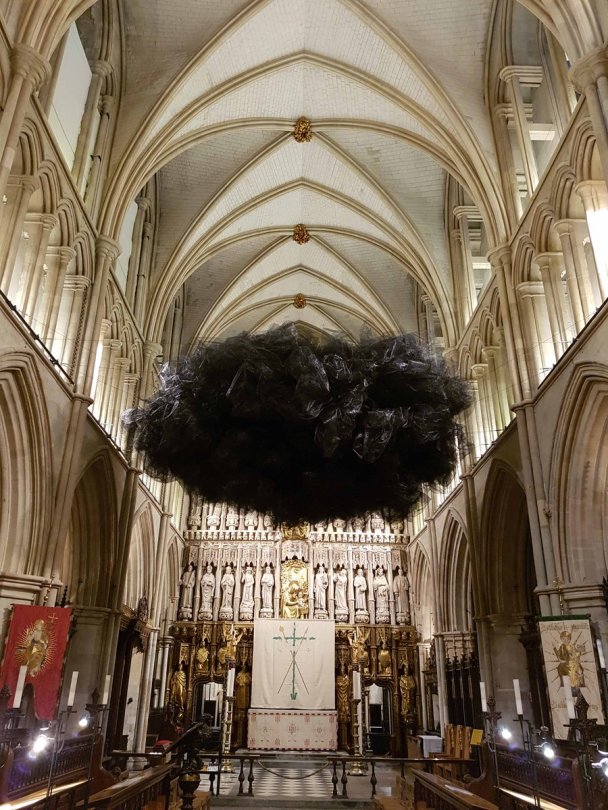
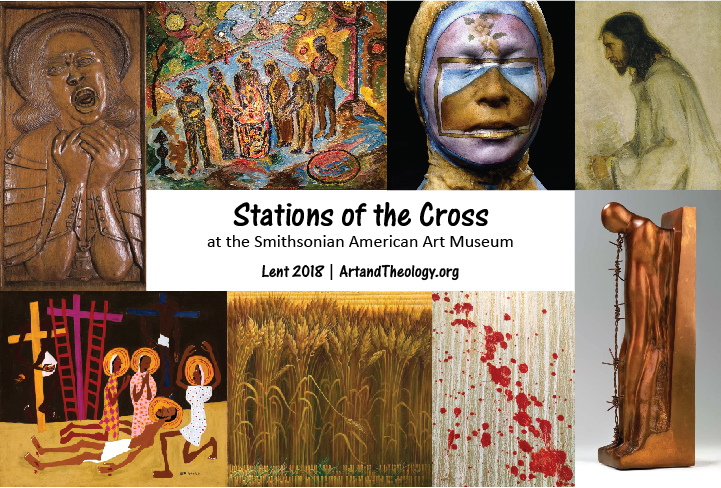
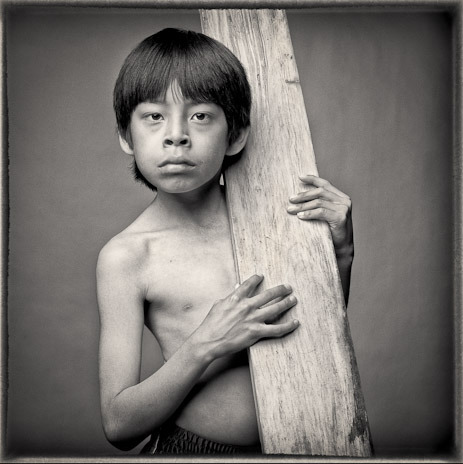
Welcome to the Stations of the Cross audio tour at the Smithsonian American Art Museum (SAAM), developed by Victoria Emily Jones at ArtandTheology.org.
Originating in the thirteenth century, the Stations of the Cross is a Christian devotional practice whereby participants immerse themselves in the story of Jesus Christ’s final sufferings by metaphorically journeying with him from his trial to his entombment. The road between is known as the Via Dolorosa (“Way of Sorrows”) or Via Crucis (“Way of the Cross”).
In this eighteen-stop tour we will walk this road with Jesus, recognizing along the way the many other paths of sorrow that were traveled in America’s history and that are still being traveled today. Migrant workers, soldiers, prisoners, victims of racial discrimination and violence, the poor and the homeless, the grieving, and the mentally ill are among the many people we will meet through these paintings, sculptures, and mixed-media works that bear witness to human suffering.
The American novelist and social critic James Baldwin said of Beauford Delaney, one of the artists on our tour, “The reality of his seeing caused me to begin to see.” That is my hope: that as we encounter these visual narratives of suffering from our nation’s past and present, we will begin to see. This tour obviously doesn’t cover all the oppressed groups in the US, but this is a starting point for further conversation, discovery, intercessory prayer, confession, and action.
My other hope is that we will be led to a deeper engagement with the biblical narrative—with Jesus’s way of sorrows and why he walked it, what it achieved.
Jesus began his public ministry by reading these words from an Isaiah scroll at his local synagogue at Nazareth:
The Spirit of the Lord is upon me,
because he has anointed me
to proclaim good news to the poor.
He has sent me to proclaim liberty to the captives
and recovering of sight to the blind,
to set at liberty those who are oppressed,
to proclaim the year of the Lord’s favor.
Then, as Luke 4:20–21 tells us, “he rolled up the scroll and gave it back to the attendant and sat down. And the eyes of all in the synagogue were fixed on him. And he began to say to them, ‘Today this Scripture has been fulfilled in your hearing.’” This was a very bold move: here, he is claiming to be the messianic servant of the Lord prophesied about in Isaiah 61, who would bring spiritual and, ultimately, material salvation to the world. But the cost of this salvation, the Hebrew prophet tells us, is suffering; the messianic servant must suffer and die. “He was pierced for our transgressions; he was crushed for our iniquities; upon him was the chastisement that brought us peace, and with his wounds we are healed” (Isaiah 53:5).
Below you will find eighteen audio tracks of art commentary available for free streaming or download, as well as transcripts and artwork locations. If you are taking this tour virtually, you can click on any of the featured images to jump to that object’s museum page, where you can zoom in on details.
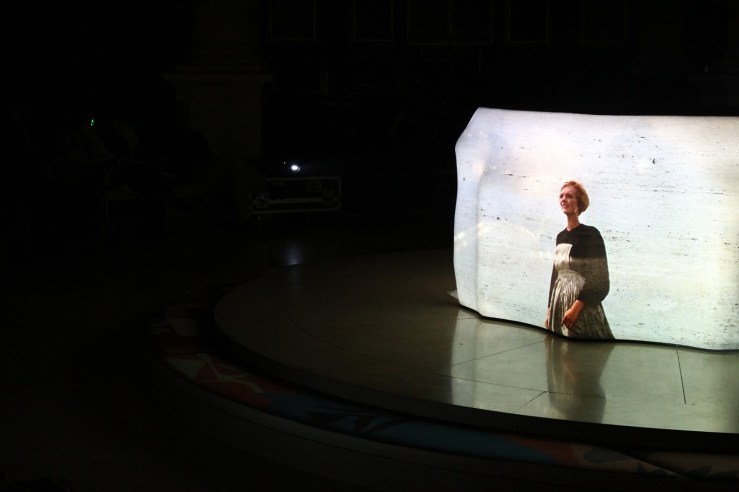
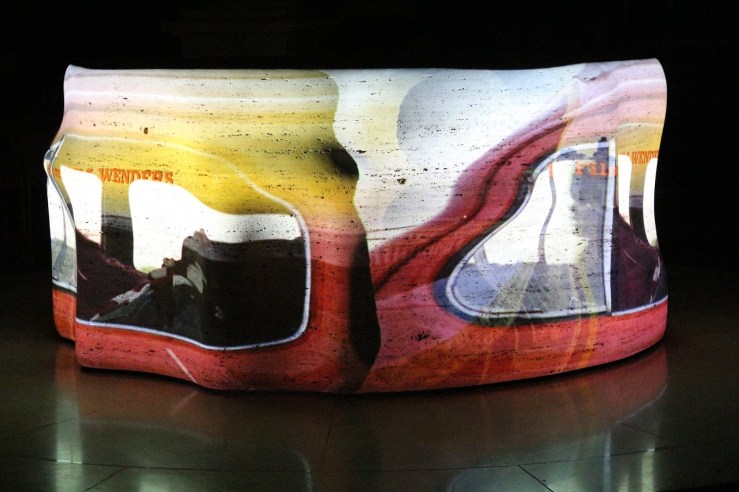
“Mark Dean Projects Stations of the Cross Videos on Henry Moore Altar,” exhibition review and artist interview by Jonathan Evens: On April 15–16 St. Stephen Walbrook in London hosted an all-night Easter Eve vigil that featured a fourteen-video installation by artist-priest Mark Dean. Inspired by the Stations of the Cross, these videos were projected, in sequence and interspersed with readings and periods of silence, onto the church’s round stone altar by the famous modern artist Henry Moore (Dean wanted his work to be presented as an offering). The vigil culminated with a dance performance by Lizzi Kew Ross & Co and a dawn Eucharist. Evens writes,
Mark Dean’s videos are not literal depictions of the Stations of the Cross, the journey Jesus walked on the day of his crucifixion. Instead, Dean appropriated a few frames of iconic film footage together with extracts of popular music and then slowed down, reversed, looped or otherwise altered these so that the images he selected were amplified through their repetition. As an example, in the first Stations of the Cross video, a clip of Julie Andrews as the novice Maria from the opening scenes of The Sound of Music was layered over an extract, from the Alfred Hitchcock film Psycho, of a car arriving at Bates Motel where Marion Crane would be murdered by Norman Bates. The blue of the sky and the innocence suggested by Maria’s religious vocation was in contrast with the footage from Psycho, which was indicative of the violent death to which Jesus was condemned. [Read more of the review, plus an interview with the artist, here.]
Mark Dean, “I. The Royal Road,” from Stations of the Cross cycle. Video projected on Henry Moore altar at St. Stephen Walbrook, London, April 15–16, 2017. Photo: Jonathan EvensMark Dean, “VIII. Daughters of Jerusalem,” from Stations of the Cross cycle. Video projected on Henry Moore altar at St. Stephen Walbrook, London, April 15–16, 2017. Photo: Jonathan EvensMark Dean, “IX. In Freundschaft,” from Stations of the Cross cycle. Video projected on Henry Moore altar at St. Stephen Walbrook, London, April 15–16, 2017. Photo: Jonathan Evens
Sounds like an exemplary integration of art and liturgy! You can read the catalog essay and watch the videos on Dean’s website, tailbiter.com. See also the interview with curator Lucy Newman Cleeve published in Elephant magazine.
+++
“Featured Artist: Nicholas Mynheer” by Victoria Emily Jones: This month I wrote a profile on British artist Nicholas Mynheer for Transpositions, the official blog of the Institute for Theology, Imagination, and the Arts at the University of St. Andrews in Scotland. (There’s a glitch with their publishing tool that is preventing all the artworks from displaying, but all the ones I discuss in the article can be found at www.mynheer-art.co.uk.) A painter, sculptor, and glass designer, Nick works almost exclusively on religious subjects, in a style that blends influences from medieval, primitive, and expressionist art. I met him in 2013 and got to see his studio and his work in situ in various Oxford churches. His love of God and place was obvious from my spending just one afternoon with him. Other articles I’ve written are on Nick’s Wilcote Altarpiece, Islip Screen, and 1991 Crucifixion painting (which I own).
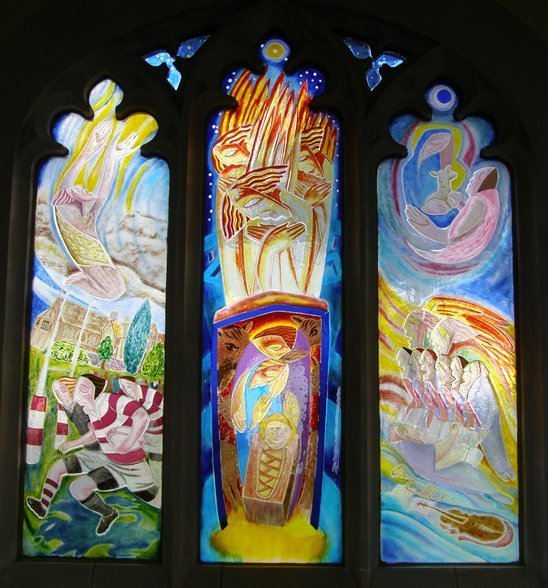
Nicholas Mynheer (British, 1958–), Harvest, 2010. Oil on canvas, 70 × 70 cm.Nicholas Mynheer (British, 1958–), Michaelmas Term Window, 2012. Fused glass. Abingdon School Chapel, Oxfordshire, England.Nicholas Mynheer (British, 1958–), Corpus of Christ, 2010. English limestone, 85 cm tall.
+++
Season 14 of So You Think You Can Dancepremiered last Monday (the only TV show I never miss!). Watching dancers draws me into a deeper awe of God, as I see all the creative potentialities of the human body he designed. Here are my two favorite auditions from episode 1. The first is husband-wife duo Kristina Androsenko and Vasily Anokhin performing ballroom. The second is a modern dance number performed by Russian twins Anastasiia and Viktoriia; they gave no comment on the dance’s motivation or meaning, but it’s clear that it represents trauma of some kind.
+++
“Why we need Mary Oliver’s poems” by Debra Dean Murphy: “Oliver is a mystic of the natural world, not a theologian of the church. . . . Her theological orientation is not that of orthodox Christianity. Nevertheless, Christians have much to gain from reading Oliver . . .” Her poems are “occasions for transfiguring the imagination and a summons to wonder and delight”; they remind us “of what it means to attend to what is before us in any given moment,” teach us to adopt “a posture of receptivity that Christians sometimes speak of as part of our vocation—the calling to live more fully into our humanity as persons bearing the imago dei, to mirror the divine dance of mutual presence, mutual receptivity, mutual love.” Some of my favorite Oliver poems are “Praying,”“I Wake Close to Morning,”“Messenger,”“The Summer Day,” and “How the Grass and the Flowers Came to Exist, a God-Tale.”
+++
NEW SONG: “Weep with Me” by Rend Collective: Written last month in response to the Manchester Arena bombing, “Weep with Me” is a contemporary lament psalm in which the speaker asks God to do what the title says: weep with him. To feel his pain and respond. It’s introduced and performed acoustically by band member Chris Llewellyn in the video below.
Can worship and suffering co-exist? Can pain and praise inhabit the same space? Can we sing that God is good when life is not? When there are more questions than answers? The Bible says a resounding yes: these songs are called laments and they make up a massive portion of the Psalms.
We felt it was fitting to let you hear this lament we’ve written today as we prepare to play tonight in Manchester. We can’t make the pain go away. We refuse to provide cheap, shallow answers. But hopefully this song can give us some vocabulary to bring our raw, open wounds before the wounded healer, who weeps with us in our distress. We pray that we can begin to raise a costly, honest and broken hallelujah. That is what it means to worship in Spirit and in Truth.
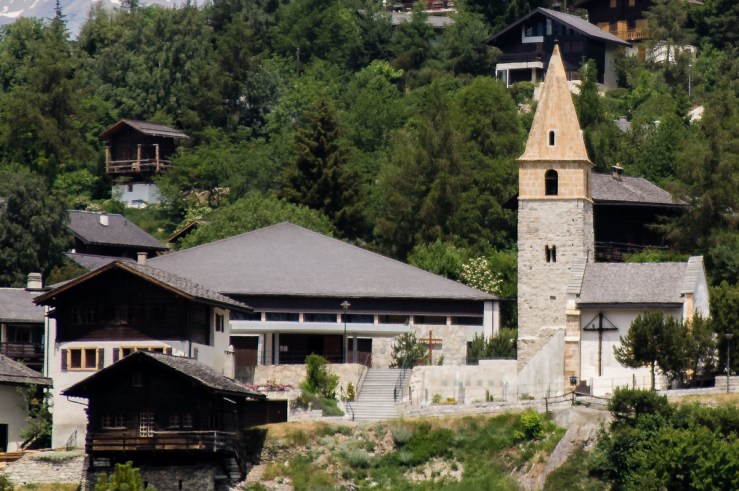
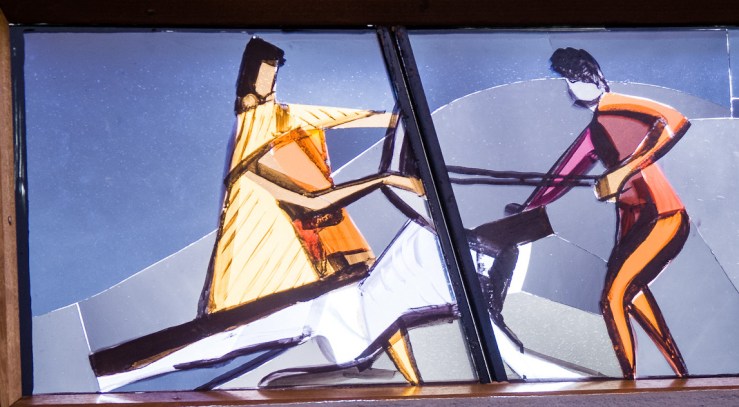
The Swiss artist Albert Chavaz (1907–1990) is best known for his paintings, but he also worked in mosaic, ceramics, engraving, and stained glass. In 1963 the parish of Vercorin, a small village in the Swiss Alps, tore down the nave of its twelfth-century Saint Boniface Church, leaving the bell tower and chancel intact. Beside this site they built a new church, commissioning Chavaz to design and make a set of stained glass windows on the Stations of the Cross.
The “new church” of Vercorin, Switzerland (left; built 1964), beside the “old church” (12th century). Photo: Paul Gellings
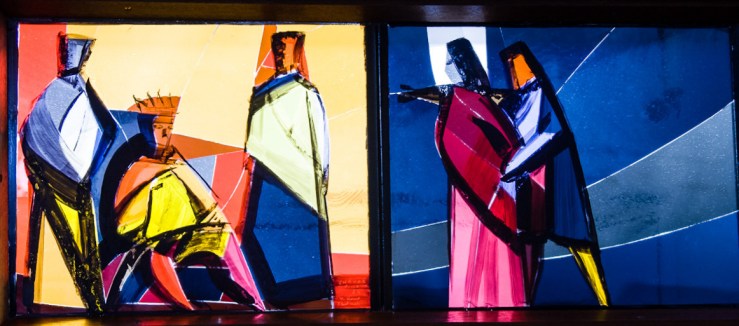
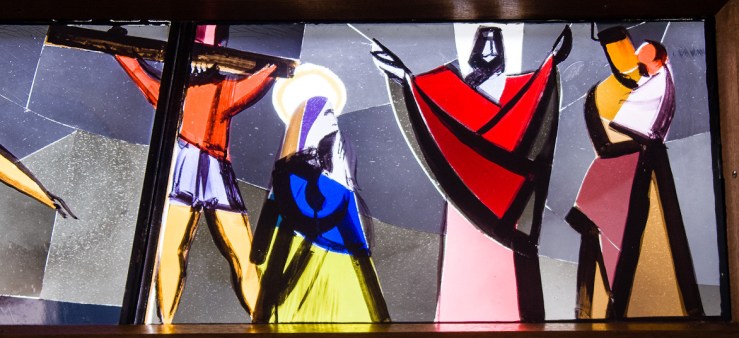
These windows were installed in 1965, a total length of about forty feet, running in a horizontal band above the entryway. They tell the story of Christ’s journey using large swaths of vibrant color to make up the figures, set against a ground of mainly grays and blues. For the last station, Chavaz chose to replace the traditional Burial of Christ with the Resurrection.
Station I: Jesus Is Condemned to DeathStation II: Jesus Accepts the CrossStation III: Jesus Falls for the First TimeStation IV: Jesus Meets His MotherStation V: Simon of Cyrene Carries the CrossStation VI: Veronica Wipes the Face of JesusStation VII: Jesus Falls a Second TimeStation VIII: Jesus Meets the Women of JerusalemStation IX: Jesus Falls a Third TimeStation X: Jesus Is Stripped of His GarmentsStation XI: Jesus Is Nailed to the CrossStation XII: Jesus Dies on the CrossStation XIII: Jesus’s Body Is Taken Down from the CrossStation XIV: Jesus’s Body Is Resurrected after Death
As you may have noticed, I’ve had to ease up lately on my self-imposed one-post-a-week rule to accommodate other projects. For February and March, I’ve been teaching an adult Sunday school course at my church called “Art and the Church: Seeing the Sacred in Global Christian Art”; I have a really great group of people exploring the topic with me, and I’ve enjoyed seeing which images they respond to most. I’ve also been invited by three separate entities to produce content on their platforms this spring: by a missions organization, to curate an online gallery of Passion art; by a divinity school, to write a post for its blog; and by a Christian ministry at Brown University, to deliver a talk to undergraduates. Moreover, I just returned from a trip to California, where I attended a Biola University–sponsored art symposium called “Art in a Postsecular Age”; I got to meet Matthew Milliner and Jonathan Anderson and hear from a panel of other distinguished speakers.
So, while I had every intention of getting this list out last week to coincide with the start of Lent, slide preparations, permissions e-mails, and travels have claimed my focus. I regret that all this revving up has come during a season dedicated to slowing down. Please forgive the slackness, but I’ve decided to practice the “holy pause” for the next forty days (through Easter Sunday). To fast from my obsession with productivity. I will still honor my obligation to those who have commissioned me for specific tasks, but I will be lightening up on the frequency of blog posts. In lieu of Lent-related Art & Theology content, I lift up the following supports for your journey.
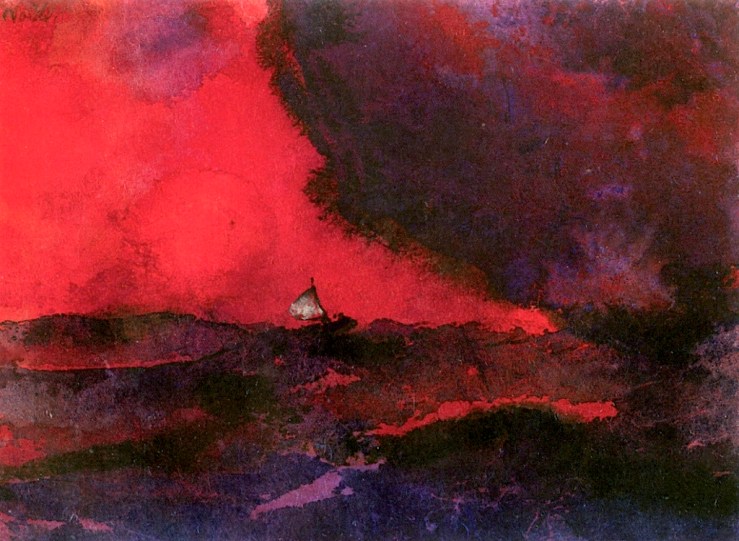
Online devotional with visual art and music: Each Lenten season since 2012, Kevin Greene, an associate pastor at West End Presbyterian Church in Richmond, Virginia, has published an online devotional that comprises for each day an art image, a short scripture reading, a prayer, and a music file. I absolutely love this model, with its spare style: because the entries are light on text, they invite silence, contemplation, seeing, listening. Greene’s image selection is stellar. He doesn’t go for the obvious choices but rather aims at something more atmospheric, more slant. Among the painted subjects, for example, you’ll find a stairway, a storm, a dancer, a reaper; day 1, Ash Wednesday, was a sailboat on troubled waters (pictured below). Fine-art viewing isn’t something that’s typically a part of Protestant devotional practice, so in response to questions he’s received, Greene has described how art operates on the imagination and the spirit. I’ve been greatly blessed moving through the first week of Lent with this companion, and I can’t wait to dive into the backlist entries later on. You can sign up via e-mail in the left sidebar, or simply bookmark the website and visit it each morning.
Emil Nolde (German, 1867–1956), Dark Red Sea, ca. 1938. Watercolor. Nolde Museum, Seebüll, Schleswig-Holstein, Germany.
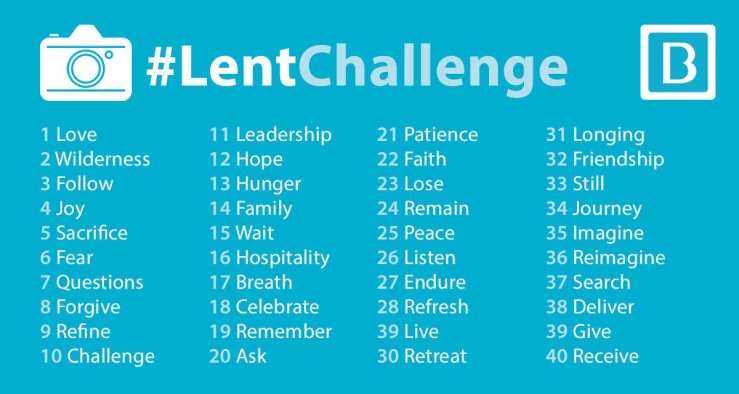
Lent Photo Challenge: The UK-based Bible Society invites people to take one photo per day throughout the season based on rotating themes (e.g., wilderness, hospitality, ask), then share them on social media using the hashtag #LentChallenge. Today is the sixth day of Lent (Sundays are excluded from the traditional forty-day count), and the assigned theme is “fear.”
Essays, short stories, poems, art: Founded in 1989, Image journal seeks “to demonstrate the continued vitality and diversity of contemporary art and literature that engage with the religious traditions of Western culture.” This Lent they’ve curated a selection of literary essays, short stories, poems, and art images from their back issues and their blog, Good Letters, that relate to the season, as well as to Easter. I especially enjoyed “Jeffrey Mongrain: An Iconography of Eloquence.” A few selections might be accessible only to subscribers (you can subscribe here; you won’t be disappointed!). Also available: the book God For Us: Rediscovering the Meaning of Lent and Easter, a full-color devotional with contributions by some of Image’s favorites. Lent is not about becoming lost in our brokenness, the description says, but about cleansing the palate so that we can taste life more fully.
Jeffrey Mongrain (American, 1956–), Blood Pool, 2006. Plexiglas, 47 × 88 in. Saint Peter’s Catholic Church, Columbia, South Carolina.
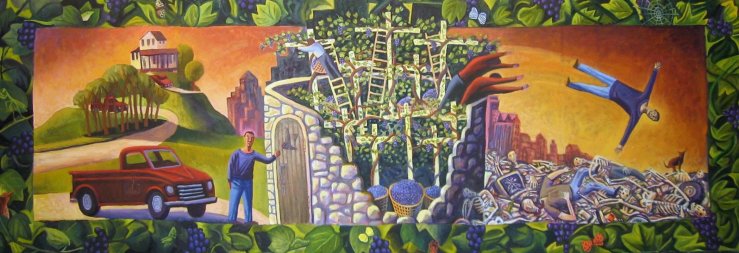
“Lent Is Here to Throw Us Off Again: Finding healing in repetition, community, and art” by W. David O. Taylor: An excellent introduction to Lent, addressing unselfing, dying a good death, opening up vacant space, and praying with the eyes. This Christianity Today article is adapted from the foreword Taylor wrote for artist James B. Janknegt’s new book, Lenten Meditations, which features forty of Janknegt’s paintings on the parables of Jesus, along with written reflections. Artists like Janknegt, Taylor writes, “fix before us an image of a world broken by our own doing, but not abandoned by God. They question our habits of sight. They arrest our attention. See this image. See it for the first time, again. See what has become hidden and distorted. See the neglected things. See the small but good things. It is in this way that artists can rescue us from what the poet Samuel Taylor Coleridge calls the ‘film of familiarity’ and the ‘lethargy of custom.’”
James B. Janknegt (American, 1953–), The Wicked Tenants, 2008. Oil on canvas, 24 × 72 in.
Stations of the Cross in Washington, DC: This Lent, Dr. Aaron Rosen and the Rev. Dr. Catriona Laing of the Church of the Epiphany have organized a combination pilgrimage and art exhibition, featuring works located throughout Washington, DC, in places both sacred and secular. Mostly contemporary, some newly commissioned, the works include George Segal’s Depression Bread Line, the Vietnam Women’s Memorial by Glenna Goodacre, Barnett Newman’s Stations cycle at the National Gallery of Art, a video installation at First Congregational United Church of Christ by Leni Diner Dothan, and more. Participants can follow the stations by downloading the app “Alight: Art and the Sacred,” which offers maps and audio commentary (my friend Peggy Parker is a contributor!). (If you don’t have a smartphone, you can view the maps and listen to the commentary through a browser by following the primary link above.) Also check out the accompanying devotional guide.
Lent by The Brilliance: This 2012 EP by The Brilliance, a duo comprising David Gungor and John Arndt, has seven tracks: “Dust We Are,”“Now and at the Hour of Our Death” (the rerelease on Brother removes the invocation to Mary), “Dayspring of Life,”“Does Your Heart Break?,” “Holy Communion,” “Violent Loving God,” and “Have You Forsaken Me?” Each one is a beautiful prayer, the words organized around a string quartet. Some take the shape of praise, others lament. God is supplicated for peace, mercy, light. The first track well captures the spirit of Lent: “Be still my soul and let it go, just let it go.” Click here to read a 2015 Hallels interview with The Brilliance, or here to listen to a podcast interview by David Santistevan.
While working at a rehabilitation center for torture survivors in Chicago, Greg Halvorsen Schreck was struck by the profound physical and emotional traumas these individuals had experienced. He thought of Christ, who suffers in solidarity with those who suffer. And he thought that as a fine-art photographer, maybe he could tell the story of this via dolorosa (“way of sorrow”) they were traveling, by linking it to the medieval Christian devotional practice of the fourteen stations of the cross.
Greg Halvorsen Schreck (American, 1957–), Station 2: Jesus is given his cross, from the Via Dolorosa project, 2012. Photograph.
The stations of the cross originated in the thirteenth century as a way for Christians to enter more fully into Jesus’s last hours by praying visually, verbally, and bodily with fourteen images that highlight various points along his journey to the cross, from his trial to his entombment. Derived from the scriptural accounts (save for the legendary addition of Veronica’s veil, plus the embellishment of Christ’s three falls), the stations offered a stay-at-home alternative for Christians who couldn’t afford a pilgrimage to Jerusalem: instead of literally walking the road between Antonia fortress and Golgotha, they could walk it metaphorically, in their imaginations, with fourteen way stations to provide particular foci.
The models Schreck used in his Via Dolorosa cycle—which can be viewed in full here, and in the video below—are not themselves torture survivors. (That would have posed a safety risk.) But “the stories and the general ethos of those in our midst wounded by war, political upheaval, and unspoken violence shaped my approach,” he said.
It was important to him to portray a range of ethnicities—which is why his stations include people not only of European descent but of Latin American, Caribbean, Middle Eastern, East Asian, and African descent, including a few of mixed race. The falling Christ is portrayed by a Mexican American veteran of the Iraq War. Simone of Cyrene is portrayed by an Ethiopian woman. Mary Magdalene, with her jar of incense, is portrayed by a woman who is half-Syrian.
Schreck also included his two children, adopted from Guatemala, in the project. His daughter, Magdalena, is cast alongside three of her friends as a daughter of Jerusalem in station 8 (top left). His son, Teo, is featured in stations 2 and 13; in the latter, Schreck himself stands in for Joseph of Arimathea or Nicodemus, a reference to Michelangelo’s self-portrait in his Florence Deposition sculpture, Schreck says.