Roundup: Stained glass by Kerry James Marshall, “Still I Rise” choreography, Black Liturgies, and more

February is Black History Month, and while I endeavor to showcase Black art year-round, today’s post gives it dedicated attention.

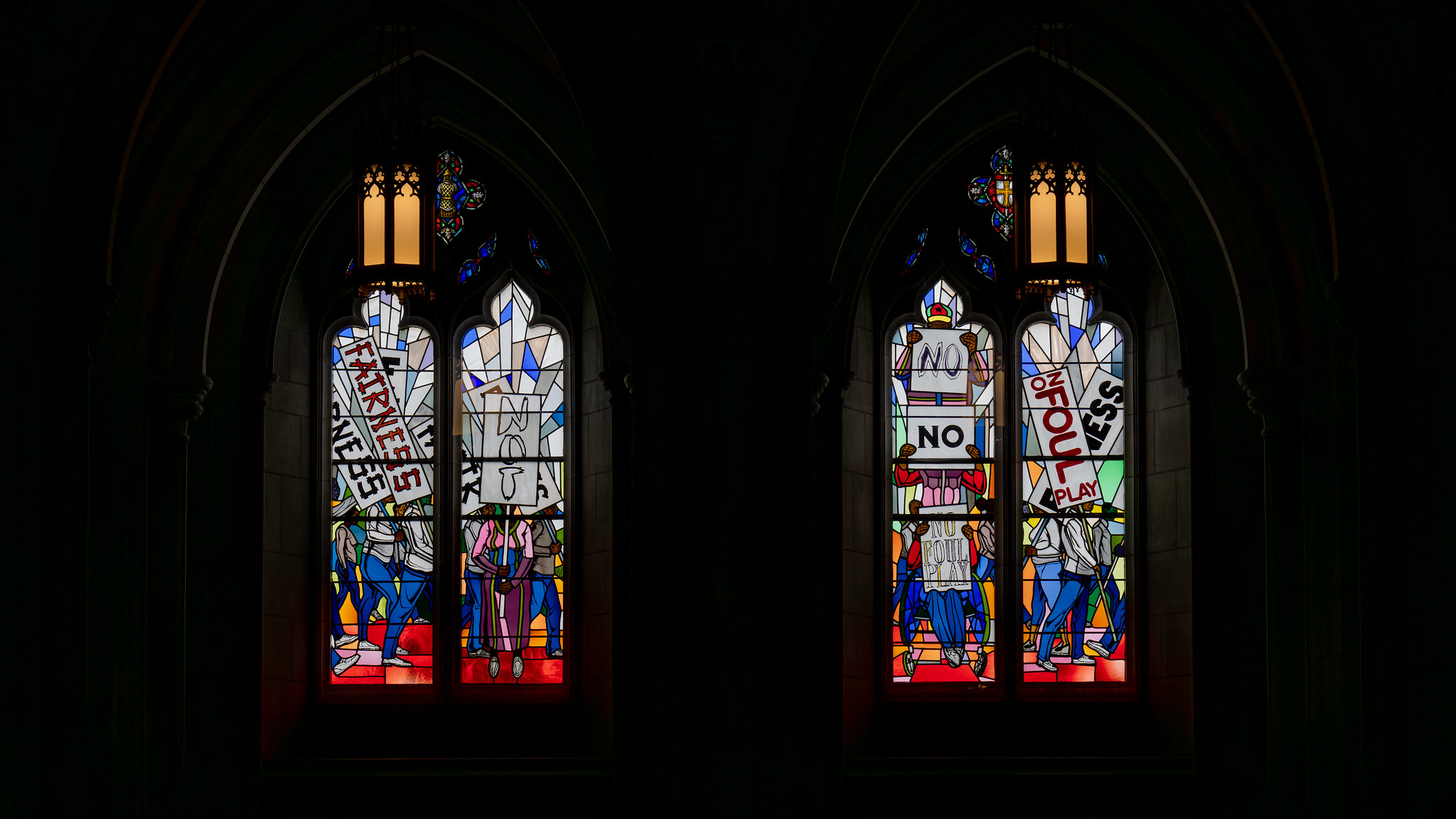
VIDEO: “Kerry James Marshall, Now and Forever; Elizabeth Alexander, ‘American Song,’ Washington National Cathedral,” Smarthistory, January 22, 2024: Art historian Beth Harris and Kevin Eckstrom, former chief public affairs officer of Washington National Cathedral, explore the latest artwork to be permanently installed in the US capital’s “house of prayer for all people”: two Now and Forever stained glass windows by Kerry James Marshall, depicting a march for racial justice. Unveiled on September 23, 2023, these replace windows that memorialized Confederate generals Robert E. Lee and Stonewall Jackson, which had been donated by the United Daughters of the Confederacy and installed in 1953. (For my international readers: The Confederacy was a group of eleven Southern US states that seceded from the Union in 1860 and 1861 to preserve the institution of race-based chattel slavery on which their plantation economies relied; its government was dissolved in 1865 following the end of the Civil War, but its legacy continued.)

In 2015, when a white supremacist, who touted the Confederate flag as symbolic of his ideology, murdered nine Black churchgoers in Charleston, South Carolina, Washington National Cathedral’s dean at the time, the Very Rev. Gary Hall, called for the removal of the Lee-Jackson windows, which initiated a two-year discernment process involving ample community discussions. The cathedral finally took down the windows in 2017 following a white nationalist rally in Charlottesville, Virginia, that claimed yet another life. The Very Rev. Randolph Hollerith, then the dean, said the windows “were a barrier to our mission, and an impediment to worship in this place.” Their removal and the installation of the Now and Forever windows in their place were funded by private foundations.
Marshall, Kerry James_Now and Forever
Kerry James Marshall (American, 1955–), Now and Forever, 2023. Fabricated by Andrew Goldkuhle. Stained glass windows, south outer aisle, bay 7, Washington National Cathedral, Washington, DC. Photo: Steven Zucker.

  • "American Song" by Elizabeth Alexander
  • American Song by Elizabeth Alexander

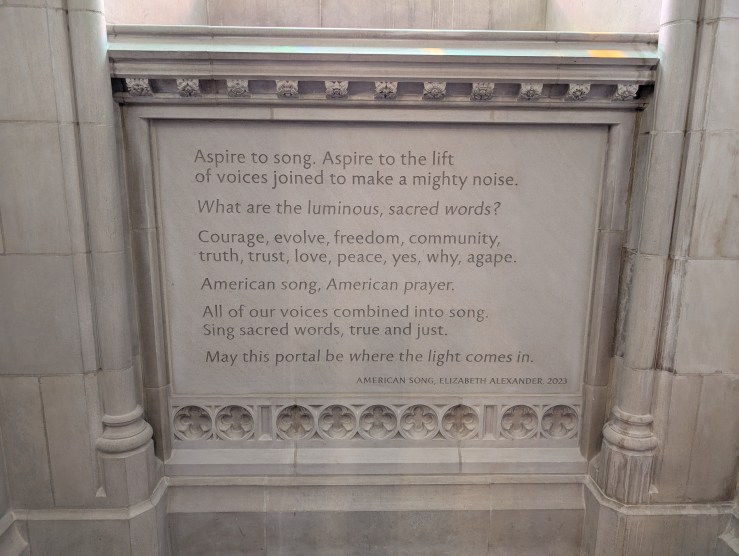
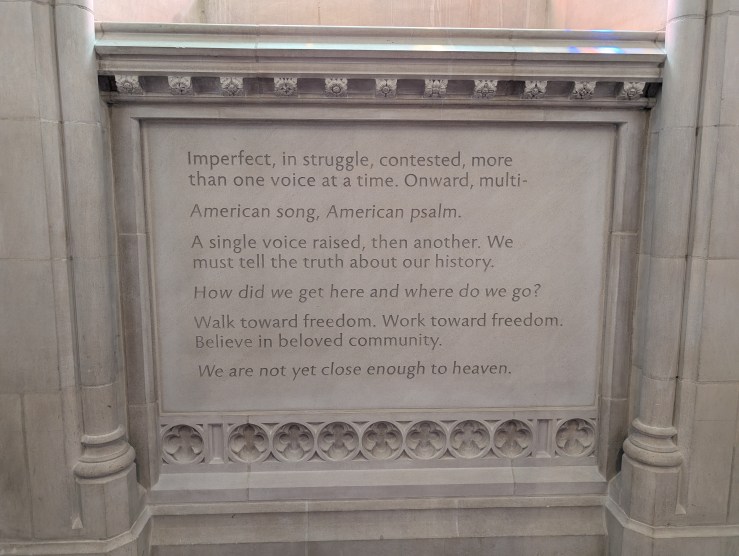
In addition to commissioning Marshall to design new windows, the cathedral commissioned the Pulitzer-nominated poet Elizabeth Alexander, who wrote and read “Praise Song for the Day” for President Barack Obama’s 2009 inauguration, to write a poem for this occasion. Titled “American Song,” it is inscribed on two limestone tablets beneath Marshall’s windows. The Windows Replacement Committee gave both artists this assignment:  

We seek to tell a story of resilience, endurance, and courage that gives meaning and expression to the long and arduous plight of the African American, from slavery to freedom, from alienation to the hope of reconciliation, through physical and spiritual regeneration, as we move from the past to present day. The artist will capture both darkness and light, both the pain of yesterday and the promise of tomorrow, as well as the quiet and exemplary dignity of the African American struggle for justice and equality and the indelible and progressive impact it has had on American society. Each artist should respond in his or her own creative way to these ideals and aspirations, framing both the earthly and the divine, within the sacred space of the Washington National Cathedral.

When I was there last year, I asked the guide why the signs the figures hold don’t bear any of the more familiar slogans of our historical moment, such as “Black Lives Matter.” She said the artist deliberately did not want to tether the protest to a particular time period, in order to emphasize that the struggle for racial equality is ongoing. “Fairness,” “No Foul Play,” “No,” “Not”—these are expressions of demand and defiance that could apply to a number of justice-related issues and that encompass people of all races.

Learn more at https://cathedral.org/college/windows/.

+++

DANCE: “Still I Rise,” choreographed by Sean Cheesman: I really miss the TV show So You Think You Can Dance, which had aspiring dancers train across genres—contemporary, hip-hop, ballroom, jazz, etc.—with renowned choreographers, performing to compete for the title of “America’s favorite dancer.” It was entertaining, impressive (the athleticism!), and often moving. Here’s a contemporary routine choreographed by Sean Cheesman to spoken word artist Alexis Henry’s reading of a classic poem by Maya Angelou about Black strength and defiance. It’s danced by Koine “Koko” Iwasaki, Kiki Nyemchek, Taylor Sieve, and Mark Villaver. It’s from season 14, episode 12, which aired September 4, 2017.

(Another memorable Cheesman-choreographed dance from season 14 is an African jazz duet to Sheila Chandra’s “Speaking in Tongues II,” which unfortunately, I cannot find online.)

+++

ARTICLE: “Stephen Towns’ Quilted Works Emphasize Black Joy as Resistance in ‘Safer Waters’” by Kate Mothes: Through June 14, the Wichita Art Museum in Kansas is hosting the exhibition Safer Waters: Picturing Black Recreation at Midcentury, featuring eleven quilts and six paintings by the Baltimore-based artist Stephen Towns [previously]. Black history has always been an important aspect of Towns’s work, and in this series he was inspired by historic photographs (by Bruce Mozert) of Paradise Park, a segregated attraction in Silver Springs, Florida, that operated from 1949 to 1969 and that was popular among Black vacationers, providing a space for leisure and togetherness away from Jim Crow.
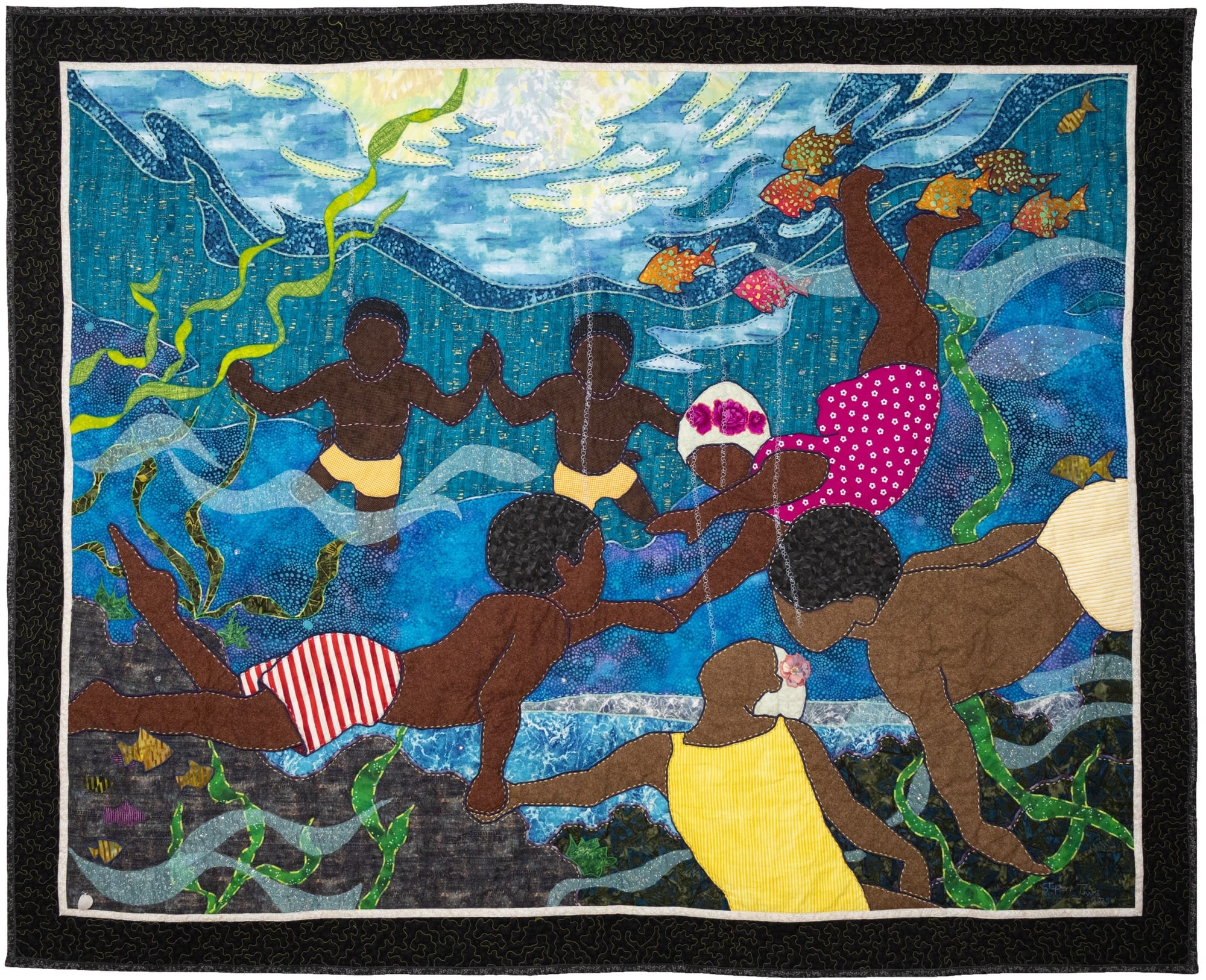
Towns, Stephen_All We Knew Was Joy
Stephen Towns (American, 1980–), All We Knew Was Joy, 2025. Natural and synthetic fabric, polyester and cotton thread, cubic zirconia, glass beads, and shell, 55 × 65 1/2 in.

Towns began his Paradise Park series in 2022 after reading Remembering Paradise Park by Cynthia Wilson-Graham and Lu Vickers, and this show is a continuation of it, for which he made seven new quilts (pictured in Mothes’s article). His art is displayed alongside some of Mozert’s photographs and related objects from Florida archives and collectors. See an exhibition walk-through on the artist’s Instagram page; see also photos from the opening on January 16–17.

Here is a short 2024 interview with Towns about this body of work, as presented at the earlier exhibition Private Paradise: A Figurative Exploration of Black Rest and Recreation at the Rockwell Museum in Corning, New York:

+++

SONGS:

Gospel music is one of the many gifts the Black church has given the world. Here are two songs from that distinctive choral tradition.

>> “Perfect Praise (How Excellent)” by Brenda Joyce Moore, performed by the Sunday Service Choir: Written in 1989 based on Psalm 8, this song gained recognition through its performance on the 1990 album This Is the Day by Walt Whitman and the Soul Children of Chicago, featuring Lecresia Campbell. It has since become a gospel choir standard, though often with the lead vocals eliminated (and that part taken by the full choir). It’s performed in this video by Sunday Service at the Théâtre des Bouffes du Nord in Paris on March 1, 2020.

>> “He’s a Wonder” by Jamel Garner, performed by the Chicago Mass Choir, feat. Cornelius Owens: This song about Jesus’s miracles is from the Chicago Mass Choir’s 2024 album Greater Is Coming.

+++

PODCAST EPISODES:

>> “Artist Archetypes with Jakari Sherman,” Be. Make. Do., January 21, 2025: I really enjoyed this conversation with Jakari Sherman on the soul|makers podcast hosted by Rev. Lisa Cole Smith, where he describes his journey as an artist and a believer. Sherman is a choreographer within the tradition of stepping, a percussive dance practice in which dancers use primarily their hands and feet to create music. Stepping comes from the African American Greek letter organizations and has roots, Sherman explains, in the antebellum South, where enslaved people had their drums taken away and thus had to find ways to express the rhythms they felt using just the floor and their own bodies. (Tap evolved largely for the same reason.)

Sherman is the creative director of [Jk]creativ, a multidisciplinary company developing purpose-driven and truth-seeking cultural works. From 2007 to 2014 he served as the artistic director of Step Afrika! and has continued to develop and direct works for them, such as Drumfolk and The Migration (which I saw in 2024 and was excellent). To establish a foundation for his scholarly research on the history of stepping, he completed a master of arts program in ethnochoreology at the Irish World Academy of Music and Dance in 2015. Below is a trailer for one of Sherman’s latest works, Our Road Home, an interactive rhythmic production that meditates “on what is means to find freedom—and to live it fully in body, soul, and spirit”; it premiered last June as part of a year-long collaboration with the Houston Freedmen’s Town Conservancy.

>> “Cole Arthur Riley – Black Liturgies,” Nomad, February 9, 2024: Tim Nash interviews Cole Arthur Riley, the best-selling author of Black Liturgies: Prayers, Poems, and Meditations for Staying Human (which grew out of her popular Instagram account @blackliturgies) and This Here Flesh: Spirituality, Liberation, and the Stories That Make Us. She is a wise, feeling, richly spiritual and embodied writer and speaker whose work I’ve appreciated. In this conversation she discusses her hang-ups with the Book of Common Prayer; battling chronic illness; balancing the active and contemplative lives; the revival of lament; self-sacrifice versus self-care; her experience of white people engaging with her work (“I like to think that there’s something mysterious that’s healed in us when we encounter each other’s interior worlds; when we hear words written by a Black woman toward God, that that could somehow move someone in some way, and move us closer to each other”); and what hope means to her and where she sees signs of it.
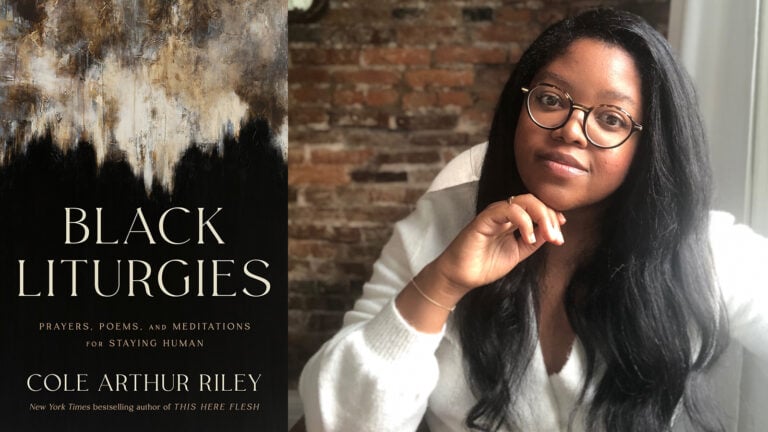
Black Liturgies by Cole Arthur Riley

Even though I, as a white person, am not the intended audience for the book Black Liturgies, in reading it, I found it meaningful to listen to the cries of Riley’s heart. While many of the prayers are particular to the experience of being Black, still many others are general enough that they could be prayed by anyone. Part 1, organized thematically, consists of chapters such as “Dignity,” “Wonder,” “Doubt,” “Lament,” “Rage,” and “Rest,” whereas part 2 contains prayers for dawn, day, and dusk as well as for the liturgical year, secular holidays, and life occasions. I like the names for God with which she opens each prayer—e.g., “God of the shadows,” “God who expands,” “Divine Labyrinth,” “God aware,” “God of locked doors,” “God who reclaims,” “God our home,” “God of delight,” “God of the art that will never be seen,” “God who whispers”; it has prompted me to consider the names and descriptions I use for God and how they influence how I pray.

To give you a flavor of Black Liturgies, here are two prayers from the book (and note that prayers are only one component; also included are letters, quotes, questions for contemplation, confessions and assurances of pardon, and benedictions):

For Marveling at Your Own Face

God of the flesh,
When we consider what is worthy of our wonder, it is easy to forget our own faces, our bodies. The world is relentless in indoctrinating us into self-hatred—into anti-Blackness, into transphobia, into misogyny in all forms. We are slowly and steadily brainwashed to despise our own faces from the time we’re tall enough to stare up at ourselves in the mirror. How can we resist this? Let the tyranny of the mirror be no more. May it instead become a portal—to delight, to pleasure, and to love. These noses, these hips, the way our hair rises and falls. The memories etched into our hands and faces. Remind us of the miracle of flesh that grows back, of blood that pulses warm beneath the skin that holds us. Of bodies, these holy beautiful bodies, that are working a thousand unseen miracles just so that we can read these lines, breathe this air, cry or not cry. As we peer into the face before us, remind us that we are something to behold. We believe; forgive our unbelief. Ase.

For Those Who Doomscroll

Still God,
We confess that we are addicted to pessimism. Although we rarely name it as such, so much of our attention is devoted to negativity. Show us how we use technology to soothe and stir the aches in us. Keep us from turning control over to our anxiety, that it would no longer feed itself with news of tragedy and impending disaster. It is easy to become lost, buried in the quicksand of digital catastrophe. Draw our attention upward. Guide us to look away habitually; and not just away, but up at the sky, the grass, the table. Guide us inward as well. Acquaint us with goodness again. In the world, and in ourselves. Let us follow the children, freed from the grip of seriousness. Renew our playfulness. Lead us into wise rhythms of engagement, retreating to rest and breathe. Remind us that there is much the world needs, including our attention to atrocity—but if we watch the world burn for long enough, the fire will become our only reality. Amen.

Contemporary Black artists at the Baltimore Museum of Art

This week I’ve been editing and captioning a backlog of photos from my camera, and I’ve come to a batch I took last August from Every Day: Selections from the Collection at the Baltimore Museum of Art, a reinstallation of the museum’s contemporary collection centered on the Black artistic imagination. I thought I’d share some of these photos here as a way to introduce you to some of today’s leading Black American artists.

+++

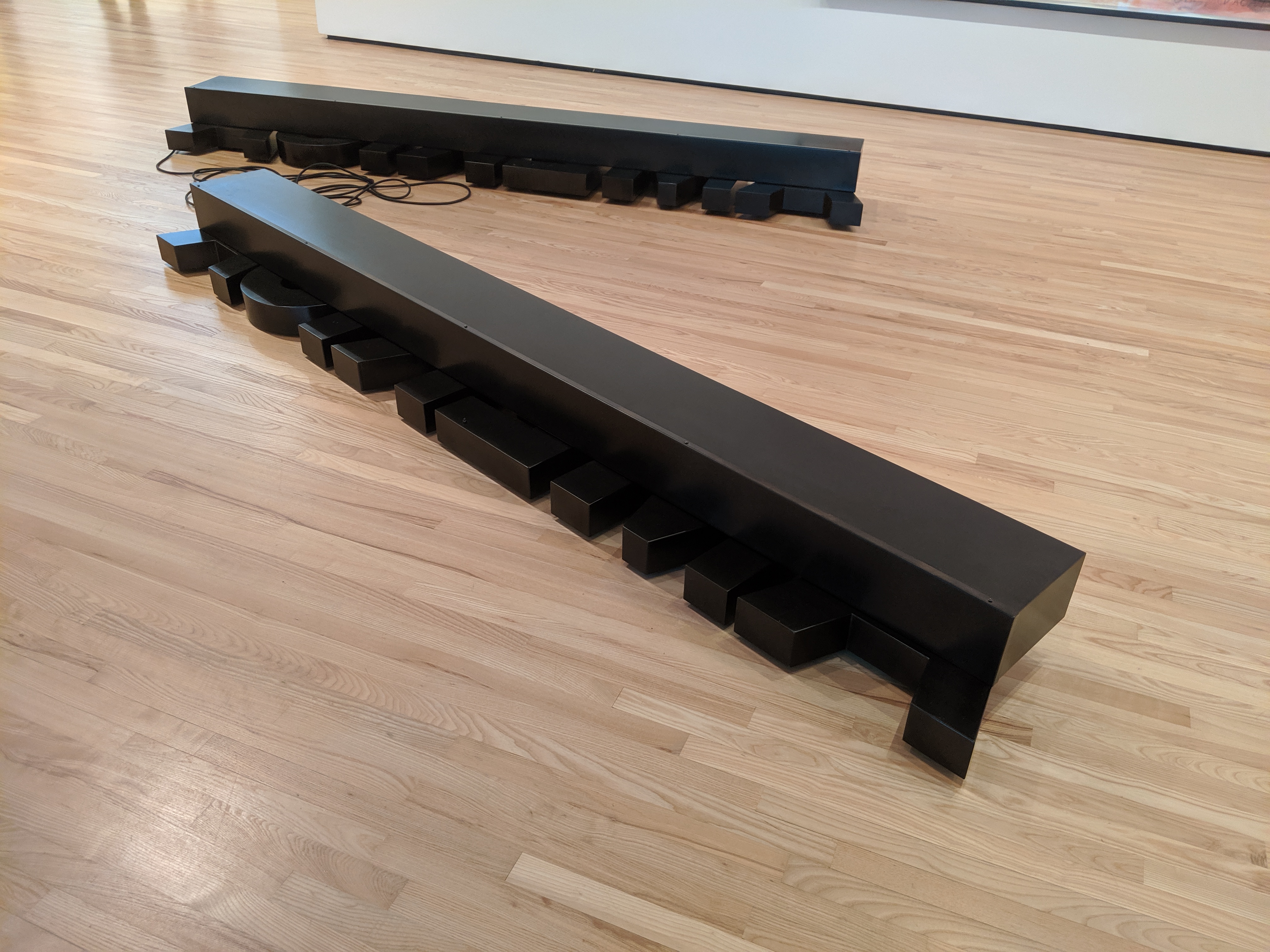
In the first gallery, an untitled neon sculpture by Glenn Ligon confronts the viewer, consisting of two black lightbox letter signs lying face-down on the floor, which each read, with some difficulty, “America.” They emit a flickering white light that pulsates at random. The piece is part of a series of variations on that word—a word, Ligon says, that means different things to different people.

Ligon, Glenn_America America
Foreground: Glenn Ligon (American, 1960–), Untitled (America America), 2015. Neon and blackened steel, 22 × 125 × 10 in. each. Baltimore Museum of Art, Maryland. Photo: Victoria Emily Jones.

He said his “double America” motif was inspired by the opening lines of Charles Dickens’s A Tale of Two Cities: “It was the best of times, it was the worst of times, it was the age of wisdom, it was the age of foolishness . . . it was the spring of hope, it was the winter of despair . . .” The wall text continues: “Dickens used a series of opposing statements to capture a moment in European history [1775–92] in which wealth coexisted with poverty, war with leisure and comfort, and aspirational ideals with harsh realities. Ligon sees similar extremes at work in the twenty-first century: ‘There is this sense that America, for all its dark deeds, is still this shining light.’”

In the age of MAGA I’m reminded of a poem by Langston Hughes published in July 1936, “Let America Be America Again,” in which he laments that as a country, we’ve never been what we’ve aspired to be: a place of liberty and justice for all. He loves America and the ideals on which it was founded but is forced to reckon with its failures, pointing out the hypocrisy of a nation that proclaims in its founding document that “all men are created equal” while segregating, disenfranchising, and brutalizing African Americans. (And the poem goes on to cite inequalities experienced by other groups too.) It’s very much in the spirit of Frederick Douglass’s speech less than a century earlier, “What to the Slave Is the Fourth of July?”

Ligon, Glenn_America America

You can read Hughes’s full poem at Poets.org, but here are the first six stanzas and then one:

Let America be America again.
Let it be the dream it used to be.
Let it be the pioneer on the plain
Seeking a home where he himself is free.

(America never was America to me.)

Let America be the dream the dreamers dreamed—
Let it be that great strong land of love
Where never kings connive nor tyrants scheme
That any man be crushed by one above.

(It never was America to me.)

O, let my land be a land where Liberty
Is crowned with no false patriotic wreath,
But opportunity is real, and life is free,
Equality is in the air we breathe.

(There’s never been equality for me,
Nor freedom in this “homeland of the free.”)

. . .

O, let America be America again—
The land that never has been yet—
And yet must be—the land where every man is free.

. . .

Hear Ligon discuss his art practice in the “A Closer Look” interview from the BMA, below, and zoom in on some of his artworks at Google Arts & Culture.

+++

Behind Ligon’s neon sculpture was a large gouache by Kara Walker titled Terrible Vacation. It was impossible to get a decent photo with the glare on the glass, so here is a professional photo of the painting, unframed, from Sikkema Jenkins & Co.

Walker, Kara_Terrible Vacation
Kara Walker (American, 1969–), Terrible Vacation, 2014. Gouache on paper, 72 1/2 × 159 1/2 in. Baltimore Museum of Art, Maryland.

Best known for her room-size tableaux of cut-paper silhouettes addressing the history of race in America, here she pays homage to J. M. W. Turner’s 1840 Slave Ship, the Romantic painter’s abolitionist response to the Zong massacre of 1781, in which the captain of a British slave ship en route to Jamaica threw 133 sick enslaved people overboard to collect insurance on them as property “lost at sea.” Human and elemental violence converge in Turner’s painting, as a ship sails through a stormy ocean filled with flailing human limbs in chains.

Walker’s painting after Turner brings this mass murder to the attention of a new public, and though it references the past of England in particular, America, as a fellow player in the transatlantic slave trade, is implicated too.

+++

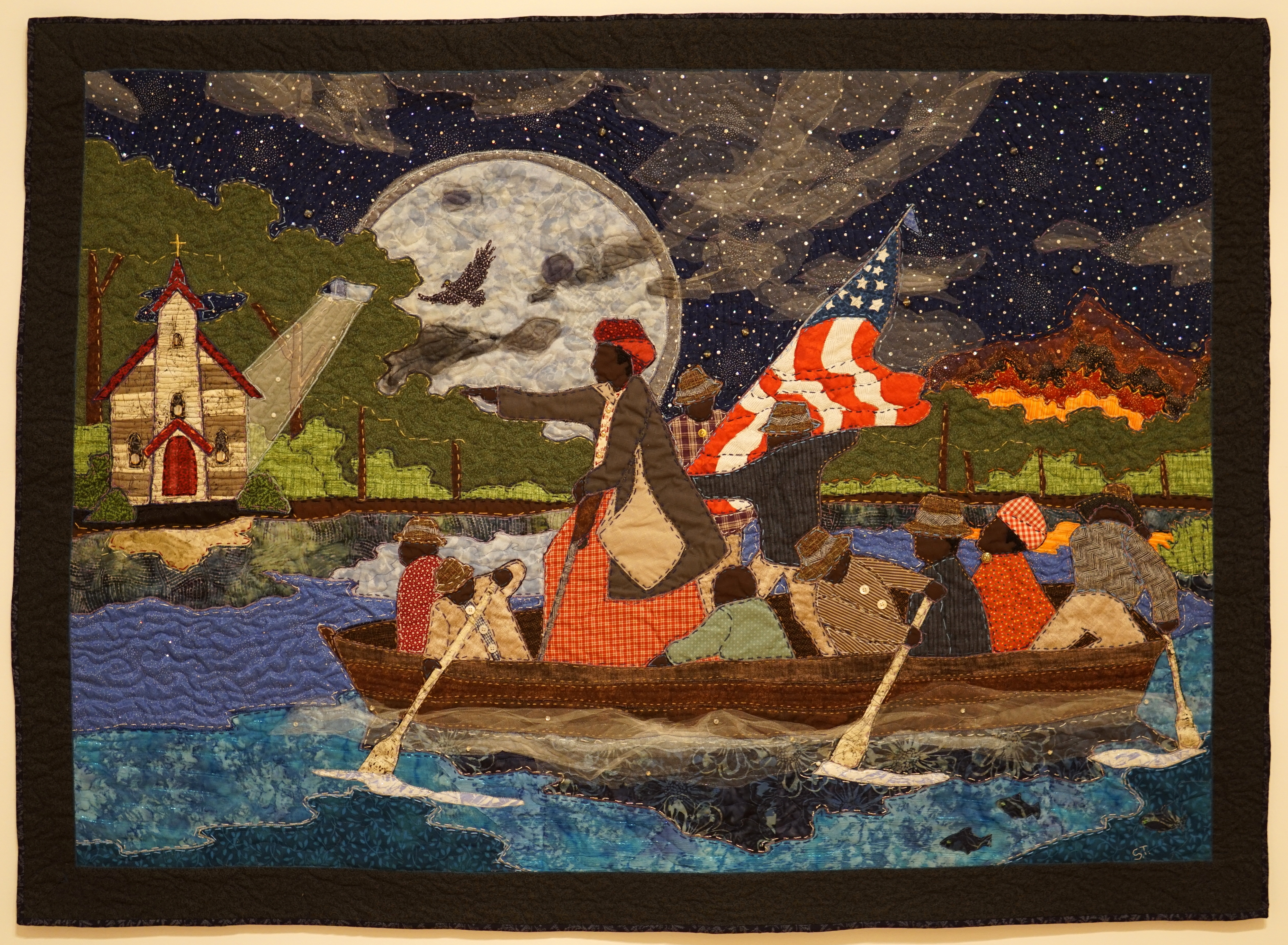
On the left wall was a story quilt by Baltimore artist Stephen Towns [previously], one is a series paying tribute to Harriet Tubman.

Towns, Stephen_We Shall Pass through the Combahee.JPG
Stephen Towns (American, 1980–), We Shall Pass through the Combahee, 2019. Natural and synthetic fabric, nylon tulle, polyester and cotton thread, metallic thread, crystal glass beads, and resin and metal buttons. Baltimore Museum of Art, Maryland. Photo: Victoria Emily Jones.

Titled We Shall Pass through the Combahee, it records the historic military operation, led by Harriet Tubman, known as the Raid on Combahee Ferry, which succeeded in freeing seven hundred-plus slaves. During the Civil War, on June 1–2, 1863, Tubman guided two of Lincoln’s gunboats, peopled with Union Army soldiers, along the Combahee in South Carolina to strategic points near the shore where slaves awaited rescue, avoiding rebel torpedoes along the way.

Towns modeled the scene after Emanuel Leutze’s famous 1851 painting Washington Crossing the Delaware, set during the Revolutionary War, but he recasts Tubman as the American hero, bravely leading her people and her nation to victory. The church in the background likely represents the historic Tabernacle Baptist Church in Beaufort, where the escapees gathered after the raid, further up the river, before being relocated to St. Helena Island. It is illuminated as if by divine light because Tubman always said it was God who gave her direction in making certain critical moves during her many rescue operations—as Underground Railroad conductor and as military leader.

Towns describes the piece, and his complicated relationship to history and patriotism:

To learn about another body of Towns’s work, A Path Between Two Continents, see this video by York College Galleries:

+++

New York–based Afro-Dominican artist Firelei Báez examines through her art the historical narratives of the Afro-Caribbean diaspora, focusing on the politics and cultural ambiguities of place, writes ArtDaily. May 19, 2017, 6:05 p.m. (an idiom playing out its history) at the Baltimore Museum of Art commemorates New Orleans’s removal of its monument to Confederate general Robert E. Lee, erected in 1884, from “Lee Circle.” “It’s a gesture that reacts in time both forward and backwards, almost like a prayer, in solidarity with the people who had to suffer through that space and the resistance moving forward,” Báez said.

Baez, Firelei_May 19, 2017
Firelei Báez (Dominican American, 1981–), May 19, 2017, 6:05 p.m. (an idiom playing out its history), 2018. Oil, oil stick, and graphite on canvas, 92 × 120 in. Baltimore Museum of Art, Maryland. Photo: Victoria Emily Jones.

Katie A. Pfohl, a curator at the New Orleans Museum of Art, writes about the series to which this piece belongs, which focuses on key chapters from New Orleans’s past:

In these new paintings, Báez overlays figures, symbolic imagery, and calligraphic gestures onto architectural surveys from the 1930s-era Historic American Buildings Survey, a project of the Works Progress Administration, of significant sites across New Orleans. Blurring the lines between past, present, and future, Báez paints new imagery upon these archival drawings, and in the process overwrites the often divisive history these older documents represent. Báez carries portraiture into a space where identity is rooted in history, but can likewise become untethered—and liberated—from it.

Another Báez piece in the BMA’s collection is Convex (recalibrating a blind spot), which consists of a diagram of the American Sugar Refinery in New Orleans overpainted with vibrant colors.

+++

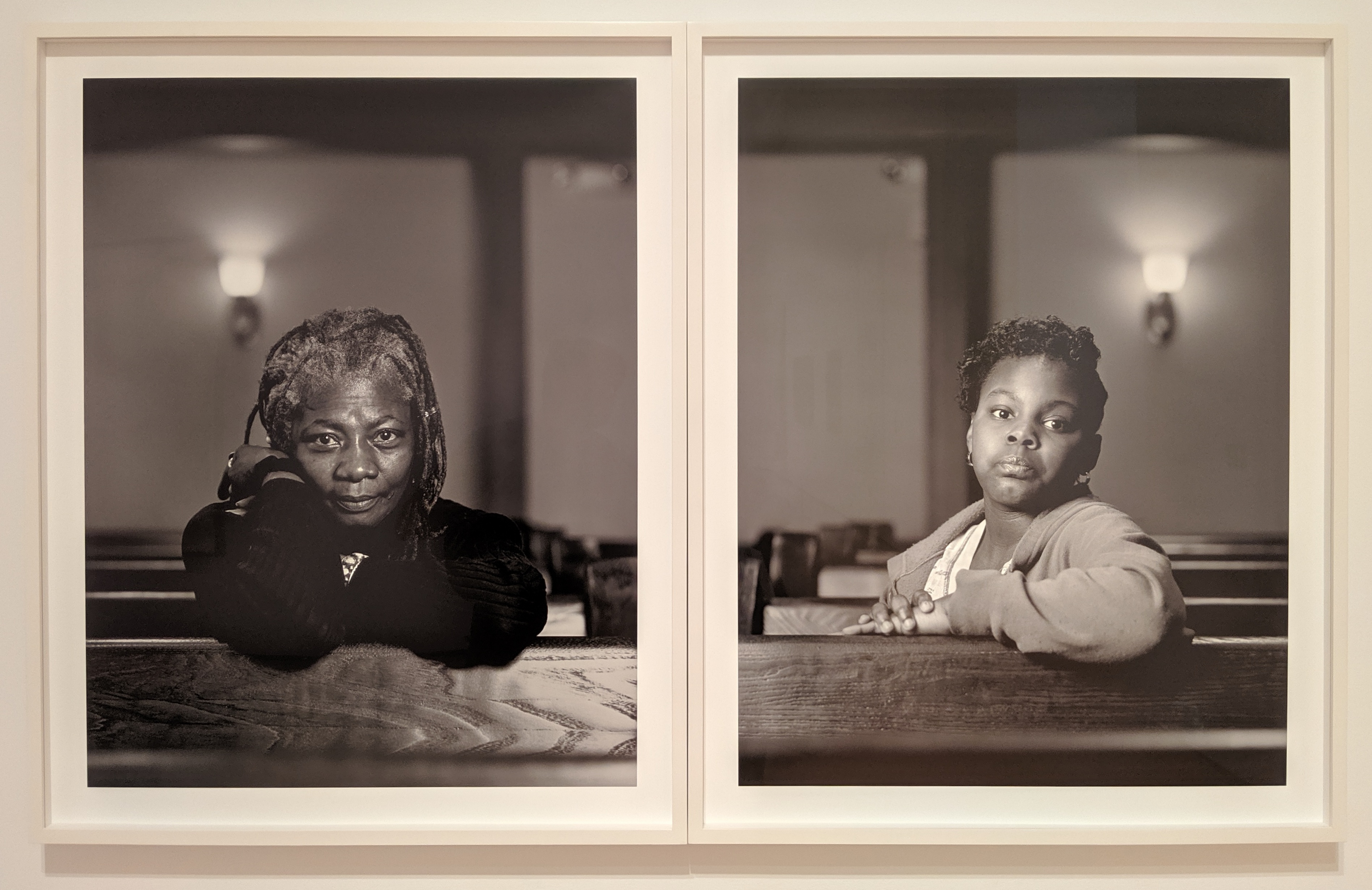
Bey, Dawoud_Mathes Manafee and Cassandra Griffen
Dawoud Bey (American, 1953–), The Birmingham Project: Mathes Manafee and Cassandra Griffen, 2012. Inkjet prints, pigment-based, 40 × 32 in. each. Baltimore Museum of Art, Maryland. Photo: Victoria Emily Jones.

In the same gallery as the previous four pieces was a photograph diptych by Dawoud Bey, from his Birmingham Project series.

On September 15, 1963, four young black girls—Addie Mae Collins, Denise McNair, Carole Robertson, and Cynthia Wesley—were killed when white supremacists bombed the Sixteenth Street Baptist Church in Birmingham, Alabama. Fifty years later, Dawoud Bey worked with Birmingham residents to memorialize them, to pay “tribute to those who were in Birmingham at that difficult moment and those who have been born since.” He photographed adolescents the same ages as those who had died, and men and women in the fifties and sixties, the ages those young people would be had they lived.

+++

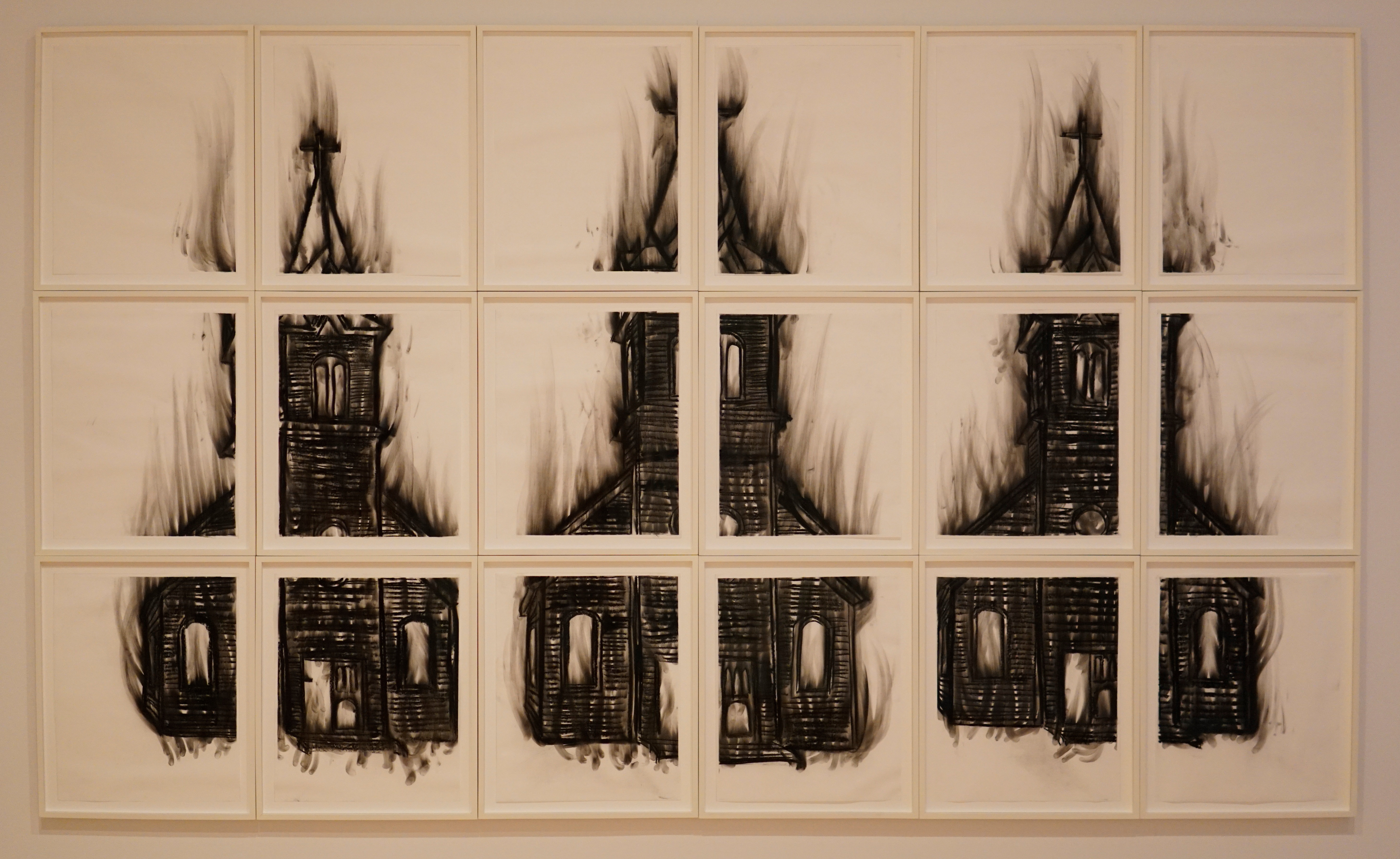
Simmons, Gary_Triple Burn
Gary Simmons (American, 1964–), Triple Burn, 2003. Charcoal with smudging on paper, 66 3/4 × 110 1/4 in. Baltimore Museum of Art, Maryland. Photo: Victoria Emily Jones.

Over and over again, white supremacists have sought to terrorize black communities by setting fire to black churches. The 1990s saw an increase in such terrorist acts and images circulated widely of burning churches, past and present. In this drawing, Gary Simmons blended his recollections of these images into a composite picture of a single church, repeated three times. He used his fingers to smudge trails of charcoal dust across the paper, creating ghostly impressions of flames of smoke. “I do this as a way of creating a feeling of something familiar but displaced,” the artist explains. “The image is intended to hang in one’s memory . . . the further one gets from an experience, the more it becomes abstracted.”

Ernest Shaw, a local artist and art educator, points out how the white frames around the paper create crosses, representing crossroads as well as Black spirituality:

+++

How long is a chain?
How long is a change?
How heavy is a chain?
How heavy is a change?

—Melvin Edwards, 1970

Edwards, Melvin_Scales of Injustice
Melvin Edwards (American, 1937–), Scales of Injustice, 2017/2019. Barbed wire, chain, and steel. Baltimore Museum of Art, Maryland. Photo: Victoria Emily Jones.

In Scales of Injustice, a steel platform resembling one half of a weighted scale holds a tangle of barbed wire. It is suspended over a length of chain sprawled out on the floor, and the whole scene, sited in a corner, is separated from the viewer by a barbed-wire barrier. This conceptual sculpture by Melvin Edwards is an adaptation of a site-responsive work he exhibited at the Whitney Museum in 1970, Corner for Ana, the title a reference to his young daughter and to the notion of “timeout.”

The materials—steel chain, barbed wire—evoke brutality and oppression. Perhaps it’s change, in a larger sense, that hangs in the balance, precarious and unsure.

Edwards, Melvin_Scales of Injustice (detail)

Edwards, Melvin_Scales of Injustice (detail)

Edwards said this re-creation was in response to the death of Pateh Sabally, a twenty-two-year-old Gambian refugee who drowned in the Grand Canal of Venice on January 21, 2017, as onlookers taunted and filmed his struggles and offered no help.

+++

Simpson, Lorna_Easy to Remember
Lorna Simpson (American, 1960–), Easy to Remember (still), 2001. 16 mm film transferred to DVD (black and white, sound); 2:35 min. Baltimore Museum of Art, Maryland.

For this video, Lorna Simpson recorded fifteen professional singers separately humming along to jazz saxophonist John Coltrane’s haunting interpretation of Rogers and Hart’s “It’s Easy to Remember.” Simpson then combined the recordings to create a choir of voices. This layered tune becomes the soundtrack for a grid of moving images, each focused tightly on one singer’s lips. The individuality of each participant emerges in variations among the mouths, a part of the body integrally linked to expression and physicality. The video demonstrates that even within a collective experience, including one of songs and the emotions they conjure, independent voices persist and disrupt.

+++

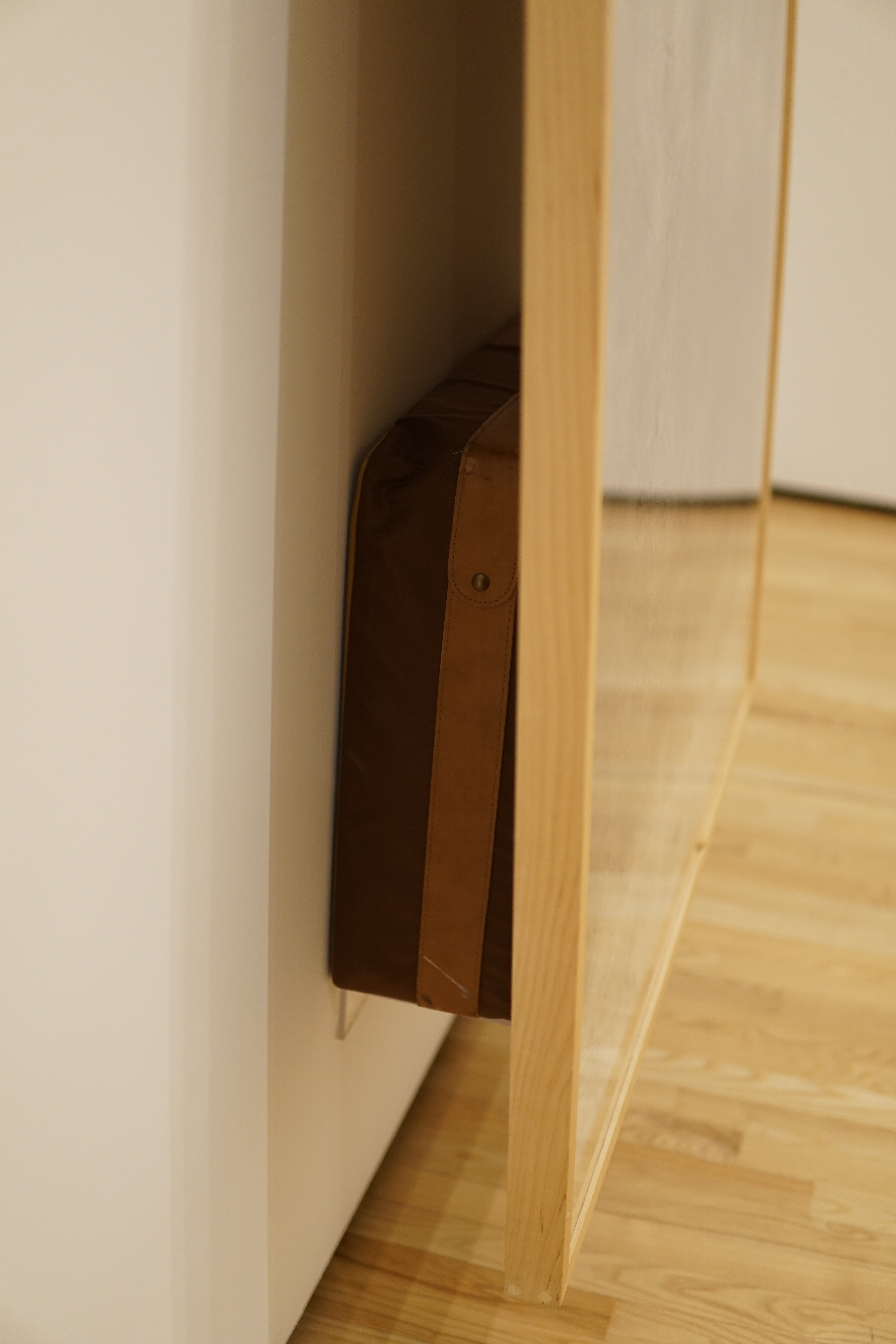
David Hammons grew up in Springfield (Illinois), studied art in Los Angeles, and then settled in New York City in 1974, where he still lives. Traveling is one of his many “basketball drawings,” which he made by bouncing a Spalding around the streets of Harlem and onto a nine-foot-tall sheet of paper, creating atmospheric gray pebbling that resembles clouds in the sky or light and shadow on the ground.

Hammons, David_Traveling
David Hammons (American, 1943–), Traveling, 2001–2. Harlem dirt on paper and suitcase, 109 5/16 × 41 3/4 × 9 1/2 in. Baltimore Museum of Art, Maryland. Photo: Victoria Emily Jones.

I love the love of place this piece promotes. “Harlem dirt” is listed as the primary material! Hammons is sanctifying the dust of his neighborhood (“the ephemeral stuff of black urban experience”) by bringing it into a high-art context, essentially saying, “My background, my experiences, are worthy.” Martin Herbert, writing for Frieze, discusses the multivalence of the title:

The title of this work, Traveling, evokes many things: the eponymous rule of basketball that says you can’t take the ball and run with it; Hammons’ own movement across the Atlantic and that of the grimy orange sphere across the room; the upward mobility of dirt-into-art, and its direct social analogue—the ‘coming up from the streets’ dream/boast of a million aspiring rappers and pro-court players in environments where, as hip-hopper Mos Def put it, ‘you can either get paid or get shot’.

The artwork juts out from the wall at a slight angle, and one discovers propped behind it a thin brown suitcase.

Hammons, David_Traveling (detail)

+++

Like Stephen Towns, Amy Sherald lives in Baltimore. She is known for her large-scale portrait paintings that use grisaille to portray skin tones as a way of “challenging the concept of color-as-race,” and was chosen to paint the official portrait of First Lady Michelle Obama.

Sherald, Amy_Planes, rockets, and the spaces in between
Amy Sherald (American, 1973–), Planes, rockets, and the spaces in between, 2018. Oil on canvas, 100 × 67 in. Baltimore Museum of Art, Maryland. Photo: Victoria Emily Jones.

About Planes, rockets, and the spaces in between, Sherald writes,

I wanted the environment to be in what would be perceived as an American landscape. These two figures are witnesses of a very American moment in history. . . . One key thing to note in all of my paintings is that the figures in the work will never be passive participants. Eye contact plays an extraordinary and crucial role in human connection. The figure gazing off at the rocket as she holds her friend’s hand solidifies the moment, as the second figure looks back to meet the gaze of the viewer.

Read more of Sherald’s commentary on this painting in Ursula magazine.

+++

I’ve appreciated how conscientious the Baltimore Museum of Art has been, in the past two years especially, in expanding its collection to better reflect the city it’s in. In 2018 it deaccessioned redundancies in its contemporary holdings to enable the purchase of new works by female artists and artists of color. Such acquisitions “enhance our ability to tell the uniquely varied and layered narratives that exist across the history of art and into the present,” said BMA director Christopher Bedford in a press release.

I also appreciate the video interviews with artists that the museum has been producing, which I hope to see more of.

https://artbma.org/
https://www.facebook.com/artbma
https://twitter.com/artbma
https://www.instagram.com/baltimoremuseumofart/

“Stephen Towns: A Migration” exhibit

On September 12 my husband and I attended a reception at the Rosenberg Gallery at Goucher College in Baltimore County, where mixed media artist Stephen Towns discussed the work in his solo show A Migration. The twenty-three paintings curated by Laura Amussen continue Towns’s exploration of the African diaspora and related issues, including slavery, resistance, and the loss of ancestral roots. He wants to tell history, he said, and to make beautiful images.

Stephen Towns
At the opening for A Migration, artist Stephen Towns talked about his new series, “Sunken,” inspired by a trip to Ghana in May. Photo via the artist.

Towns is not a Christian (he said he is ambivalent about religion), but he draws extensively on Christian iconography, most notably the halo, which he uses to denote the sanctity of black life. When I met him Tuesday I told him I can’t help but read his work through a Christian lens, and he said that’s great, that he welcomes diverse and particularized readings.

Joy Cometh in the Morning

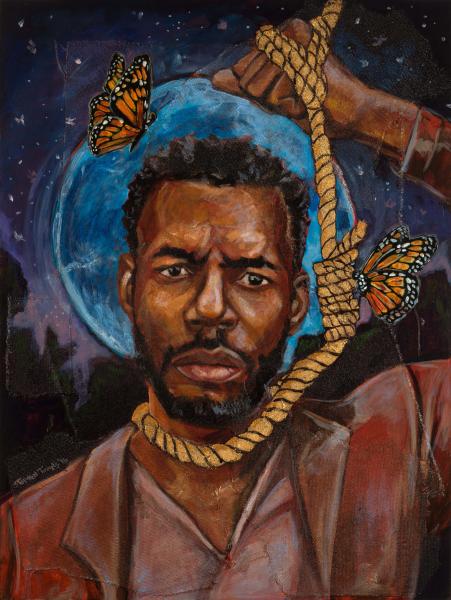
The most conspicuous wall in the exhibition space is the blank one where blue-tape outlines demarcate the spots where six paintings used to hang before a controversy led to their removal. From the series “Joy Cometh in the Morning,” these absent works are head-and-shoulder portraits of unnamed participants in the 1831 slave rebellion in Southampton County, Virginia, led by Nat Turner, who was inspired by his reading of scripture and his discernment of God’s voice. Each figure is noosed around the neck, harking to the method of their execution, but clenches the rope in a raised fist, staring straight ahead at the viewer with a look of defiance. While shadows of violence flare behind them, a butterfly alights on the knot of each rope, and a silent blue moon forms a halo around the subjects’ heads.

What Profit Is There in My Blood by Stephen Towns
Stephen Towns (American, 1980–), What Profit Is There in My Blood?, 2016. Acrylic, oil, metal leaf, Bristol board, canvas, and paper on panel, 24 × 18 in. Photo via the artist.

Just prior to the show’s opening, an African American employee at the gallery complained that these paintings made her work environment feel abusive and uncomfortable. Out of sensitivity, Towns decided to take down the paintings and instead present photos of them in a binder for optional viewing. An artist’s statement is displayed next to the empty frames, which says, in part,

The original intent of the work was to honor the countless black men and women that fought against slavery, with the knowledge that their very fight may end their lives. . . . Though I am saddened to see the work go, I value Goucher’s Black employees’ concern. The intent of my work is to examine the breadth and complexity of American history, both good and bad. It is not to fetishize Black pain, nor to diminish it.

The overwhelming response to this action among viewers at Tuesday’s reception was frustration: commending Towns’s empathy but questioning whether self-censorship was the right way to go. Both white and black attendees spoke about how one of the powers of art is precisely to make us uncomfortable. Art awakens us to reality, even if that reality is painful. Removing offensive work prevents people from having meaningful encounters with it. Towns expressed his mixed feelings about not wanting to trigger trauma but also wanting to shine a light on hard truths. He said he was intentional about not making the images graphic.

To paraphrase his comments, his aim is to comfort the afflicted and afflict the comfortable—and when his work has the reverse effect of afflicting the afflicted, he feels guilty.   Continue reading ““Stephen Towns: A Migration” exhibit”