Advent, Day 8: Vision

LOOK: Peace Window by Marc Chagall
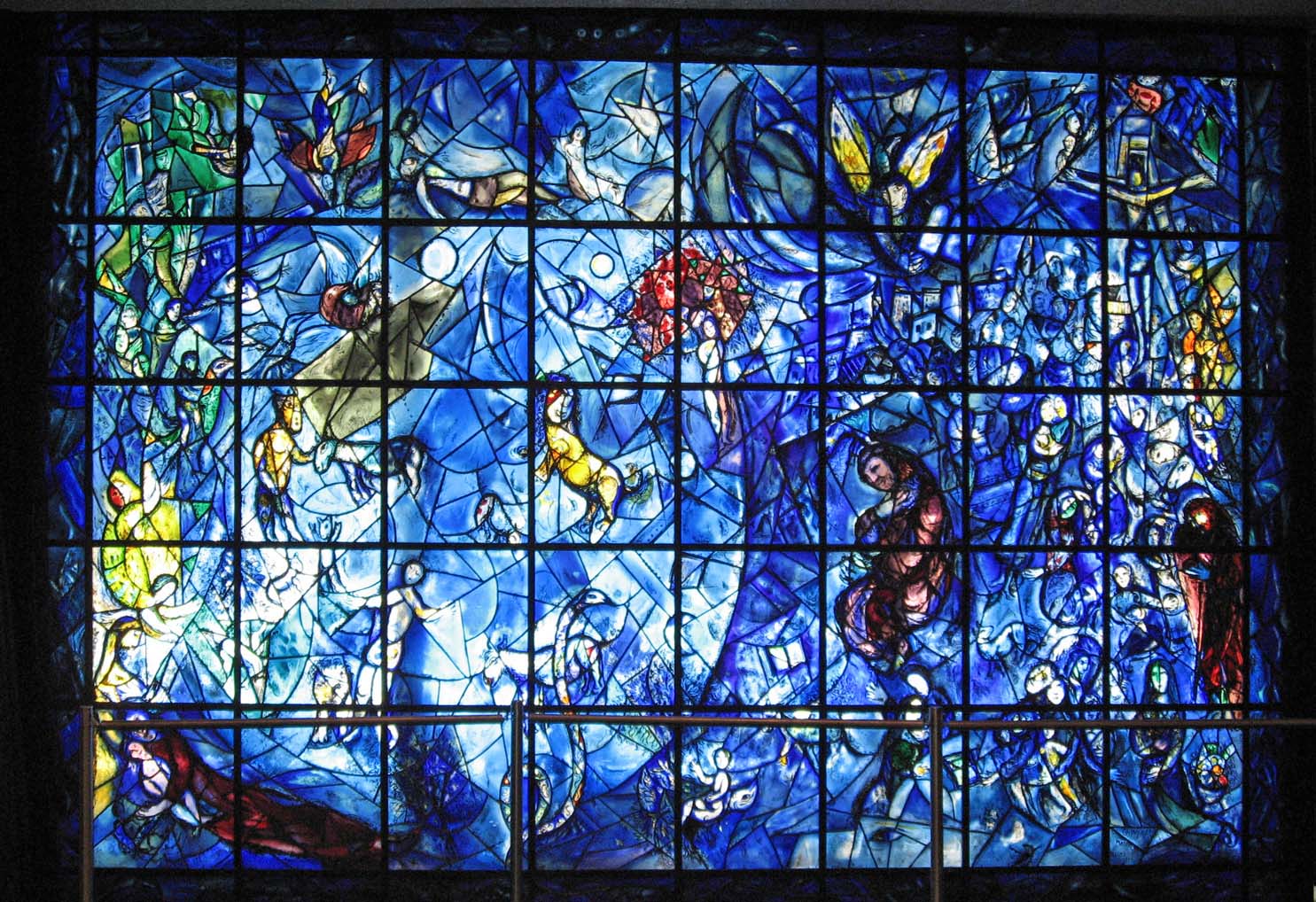
Chagall, Marc_Peace Window
Marc Chagall (Russian/French, 1887–1985), Peace Window, 1964. Stained glass, 12 × 15 ft. Public lobby, General Assembly Building, United Nations Headquarters, New York. Manufactured by Brigitte Simon and Charles Marq.

This stained glass window by Marc Chagall was commissioned as a memorial for the Swedish diplomat Dag Hammarskjöld (1905–1961), who served as the second secretary-general of the United Nations, and for the fifteen other UN staff and peacekeepers who died with him when their plane crashed on the way to a peace negotiation for the Congo Crisis in Northern Rhodesia. The artist’s handwritten dedication reads, “A tous ceux qui ont servi les buts et principes de la Charte des Nations Unies et pour lesquels Dag Hammarskjöld a donné sa vie” (To all who served the purposes and principles of the United Nations Charter, for which Dag Hammarskjöld gave his life).

Chagall’s design was executed by master glassmakers Brigitte Simon and Charles Marq of Atelier Simon-Marq.

Chagall was born in 1887 into a Hasidic Jewish family in Vitebsk, Russia (now Belarus). He moved to Paris in 1910 to develop his art, becoming a French citizen in 1937. When Nazis took over the country, threatening Chagall’s safety, he was successfully extricated to the United States with the help of Alfred Barr, director of the Museum of Modern Art in New York. He returned to France for good in 1948. His impressive body of work, marked by a spiritual vivacity, includes—in addition to stained glass—paintings, drawings, book illustrations, stage sets, ceramics, and tapestries.

His 1964 Peace Window in New York City—not to be confused with his similar but much larger Peace Window of 1974 in the Chapel of the Cordeliers in Sarrebourg, France—is full of biblical allusions.

My eyes are drawn first to the red and purple bouquet in the center, under which stands an amorous couple. Who are they? What do they represent? I can think of several possibilities:
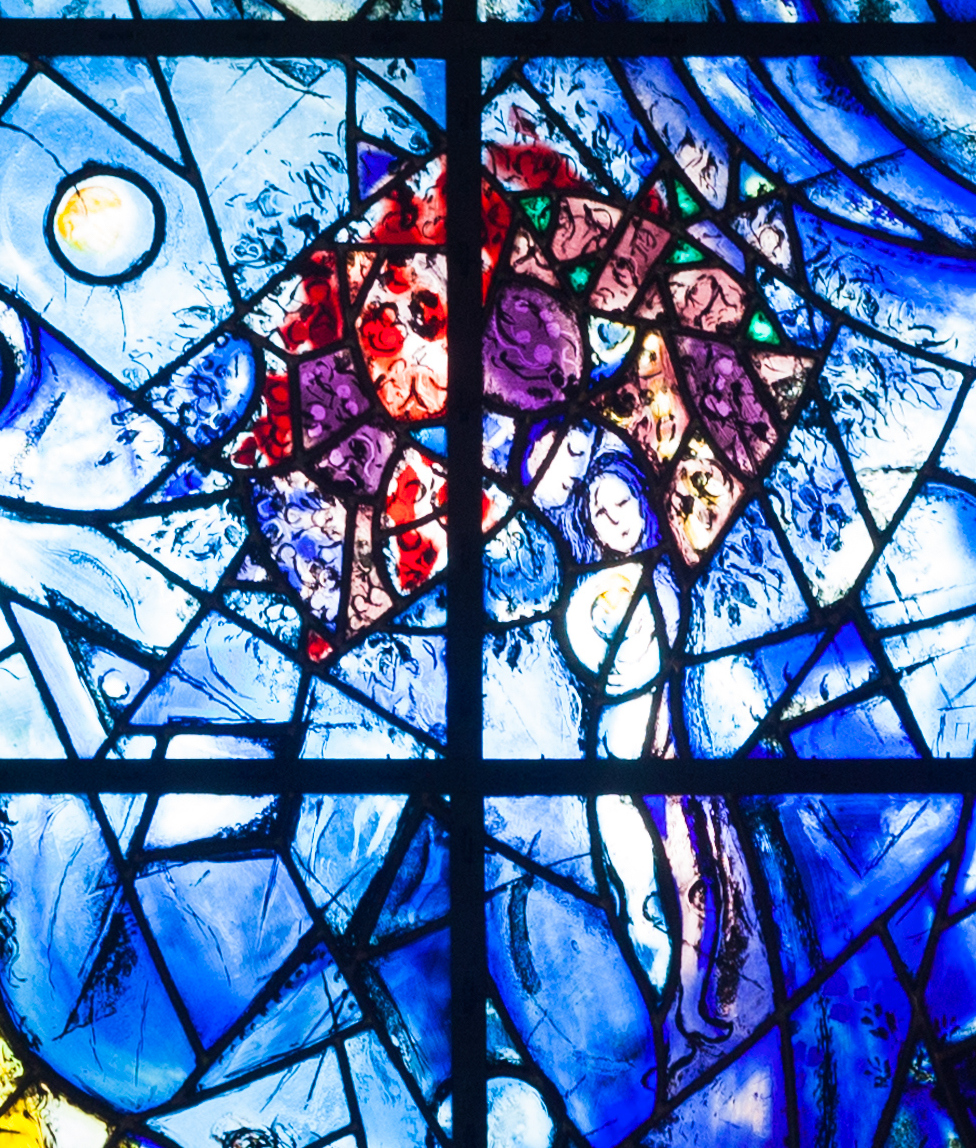
Lovers detail

1. Adam and Eve. In the sketch Chagall made for the window, the woman is very clearly naked, though she’s less obviously so in the final window. That Eve, pre-fall, is traditionally portrayed unclothed, and that Chagall’s later Peace Window unequivocally portrays Adam and Eve within a red tree, lends credence to the interpretation of these figures as our primordial foreparents, in which case the flowering mass would stand for the tree of life in the garden of Eden (Gen. 2:9).

2. The Annunciation—the angel Gabriel coming to Mary to announce that she had been chosen to birth and mother God’s Son. The male head is bodiless, emerging from the crimson bloom (suggesting, perhaps, a supernatural entity), and there’s a yellow glow at the woman’s breast, perhaps signifying the conception of Christ. What’s more, the woman appears to be cradling something—her pregnant belly?

3. God and the human soul, or Christ and his church. One traditional Jewish interpretation of the poetic book of scripture known as the Song of Solomon is that it celebrates the love between humanity and the Divine. Medieval Christians, similarly, spoke of the book as an allegory of the future marriage of Christ and the church, his bride, drawing too on the New Testament book of Revelation, which culminates in a mystical union, a picture of cosmic harmony, heaven and earth inseparably joined.

4. The kiss of Justice and Peace. Psalm 85:8–11, a common Advent text, speaks of the divine attributes that coalesce to accomplish salvation (in the Christian reading, in the Incarnation):

Let me hear what God the LORD will speak,
    for he will speak peace to his people,
    to his faithful, to those who turn to him in their hearts.
Surely his salvation is at hand for those who fear him,
    that his glory may dwell in our land.

Steadfast love and faithfulness will meet;
    righteousness and peace will kiss each other [emphasis mine].
Faithfulness will spring up from the ground,
    and righteousness will look down from the sky.

5. The kiss of Joy. Beethoven’s Ninth Symphony was a favorite of Dag Hammarskjöld’s, and its performance, at least the “Ode to Joy” chorus in its final movement, is a United Nations Day concert tradition. Hammarskjöld described the work as “a jubilant assertion of life,” championing universal peace and brotherhood. One of the lines from Friedrich Schiller’s text that Beethoven set exclaims that “Joy . . . kiss[es] . . . the whole world!”

I suspect some or all of these ideas were at play when Chagall designed the window. Or even just romantic love in general (with other types of love portrayed elsewhere in the composition), as he often painted himself and his wife Bella kissing or embracing.

After this tableau, my eyes go to the large male figure cloaked in purple just right of center. I take him to be the prophet Isaiah, beholding a vision of wild animals and children cavorting together in harmony (see Isaiah 11). A boy, for example, reaches his hand out toward a viper and is not harmed.
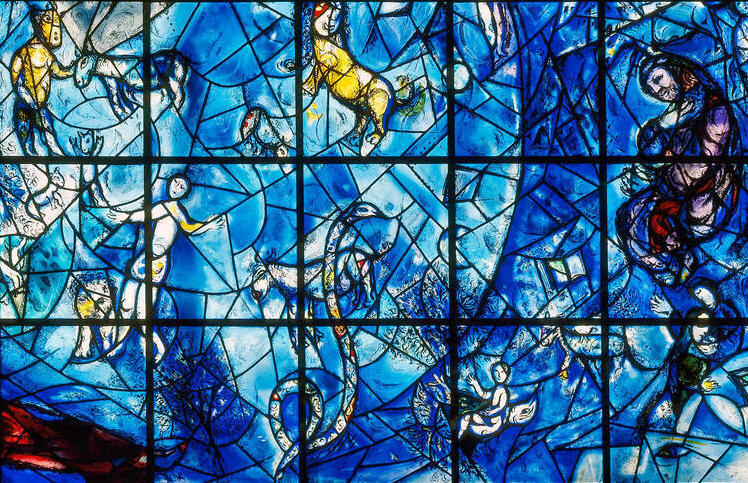
Peaceable Kingdom detail

But it’s also possible that’s meant to be Isaiah at the bottom left of the window, his face illumined by the beauty spread out before him, which an angel gestures to, guiding the prophet’s imagination:
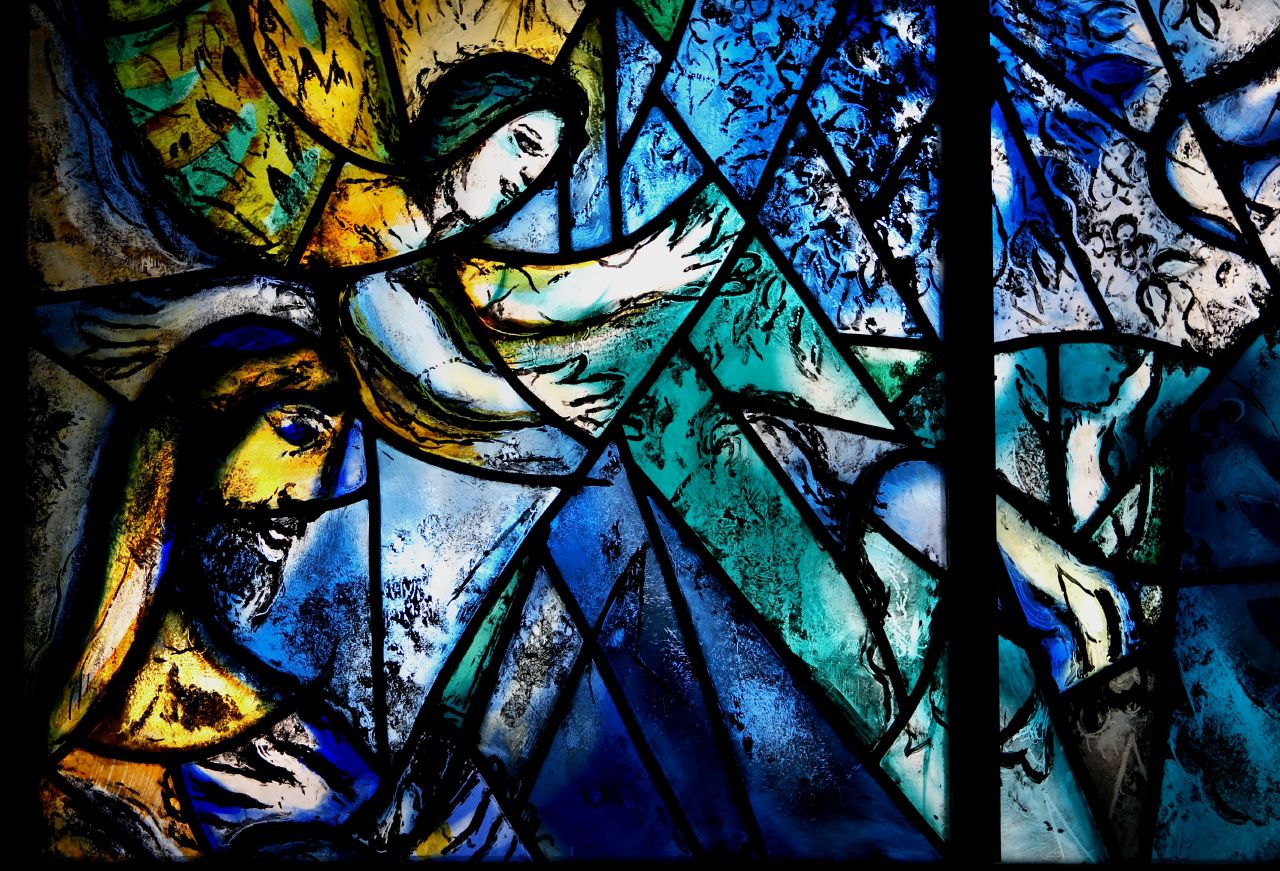
Detail (of Isaiah?)

On the top right, another angel delivers the Ten Commandments to the people of God.
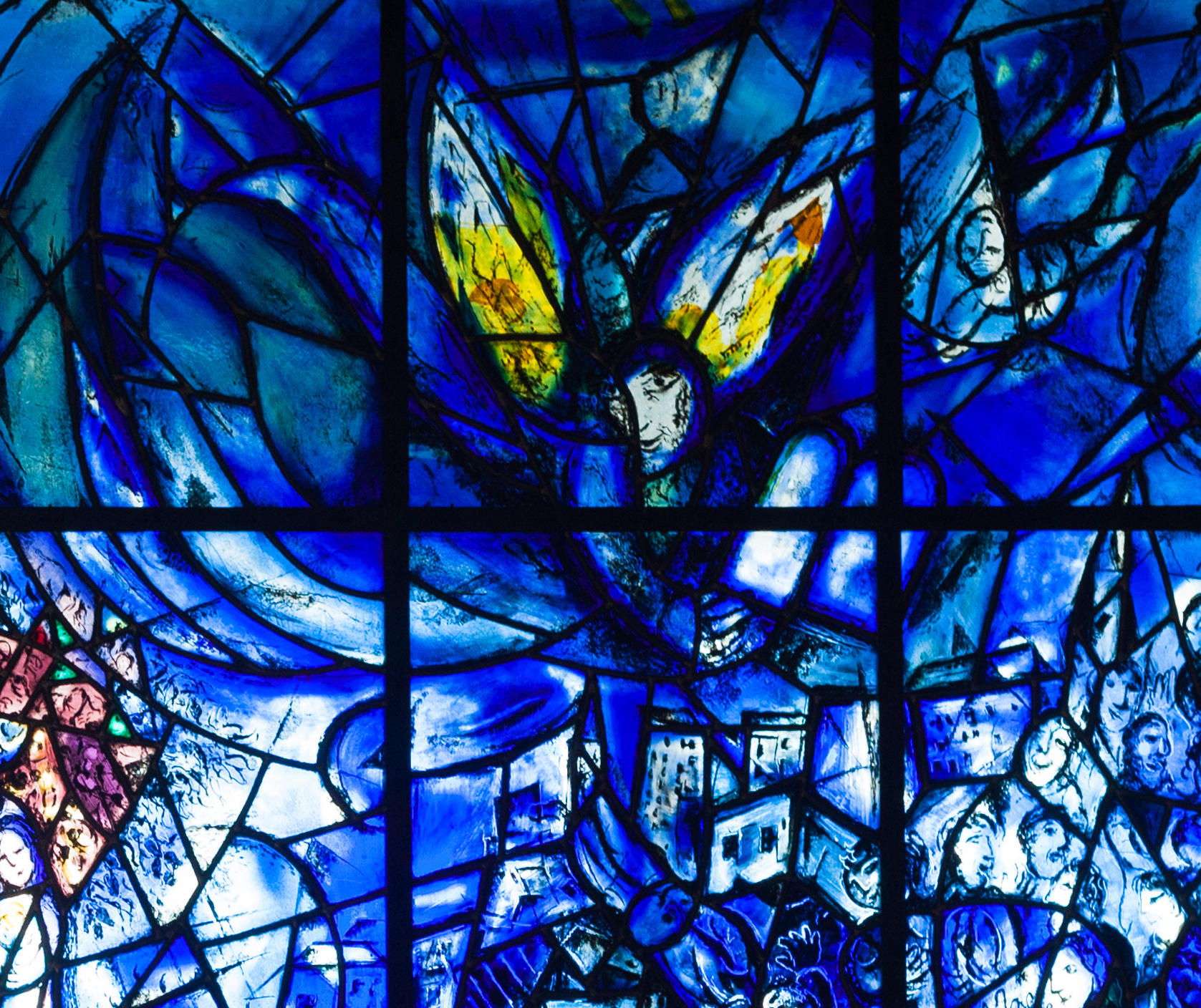
Ten Commandments detail

Next to this communication of God’s word is the death of God’s Word in the flesh, Jesus Christ, around whom the crowds have gathered. A man ascends a ladder propped against the cross, the ladder being a multivalent symbol harking back to Jacob’s dream at Bethel and evoking notions of descent and ascent.
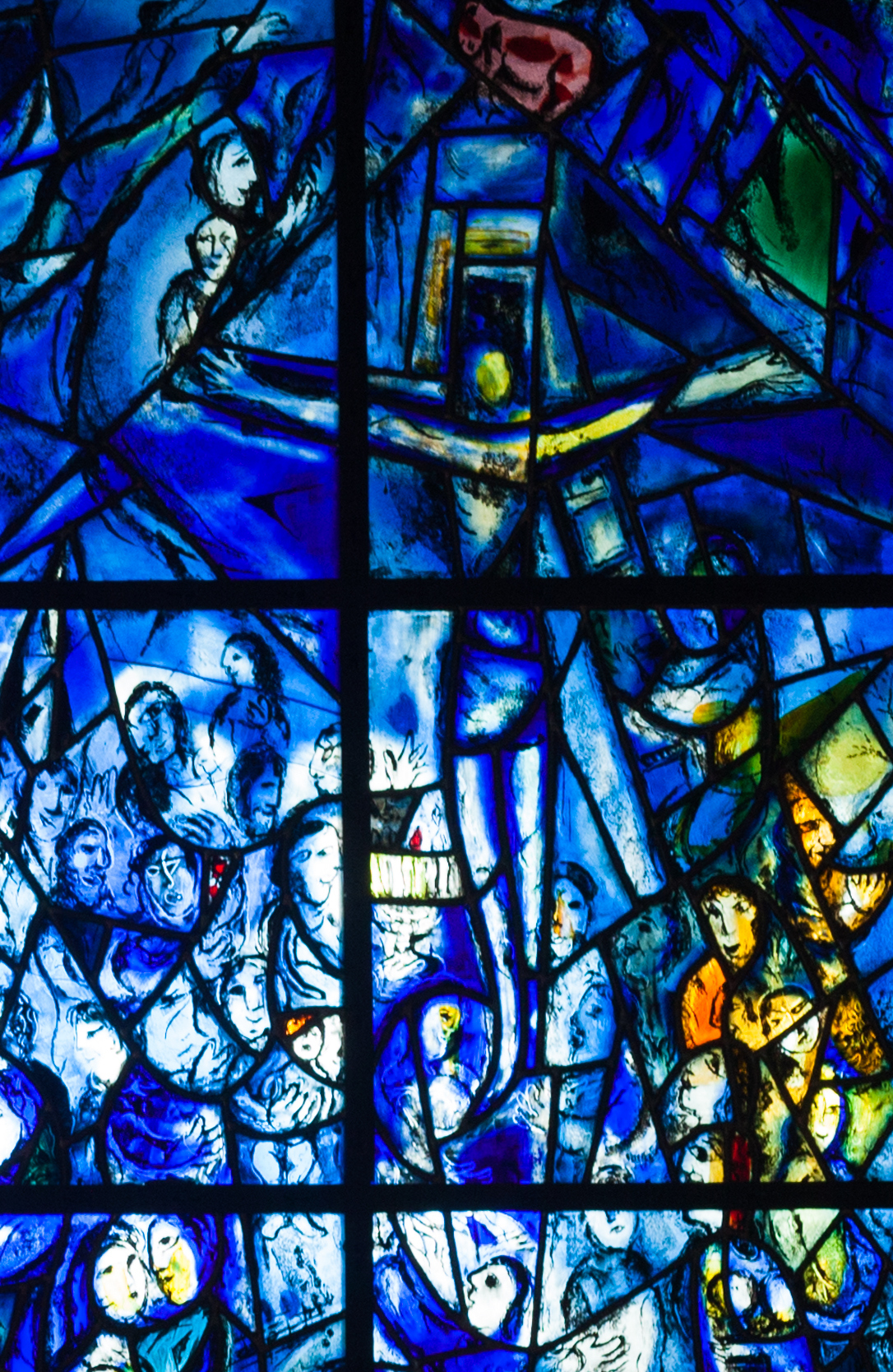
Crucifixion detail

Vignettes below include a couple embracing with an infant in hand, a woman being fed at a table (the Eucharist?), a family reading a book (probably the Bible), a woman making music, and another bearing flowers.

At the top left is a lamentation scene that evokes those of Christ deposed from the cross. A man in a loincloth lies dead or wounded on the ground, his head cradled by a loved one, while at his feet another mourner throws her arms up in grief. This is the cost of human violence.
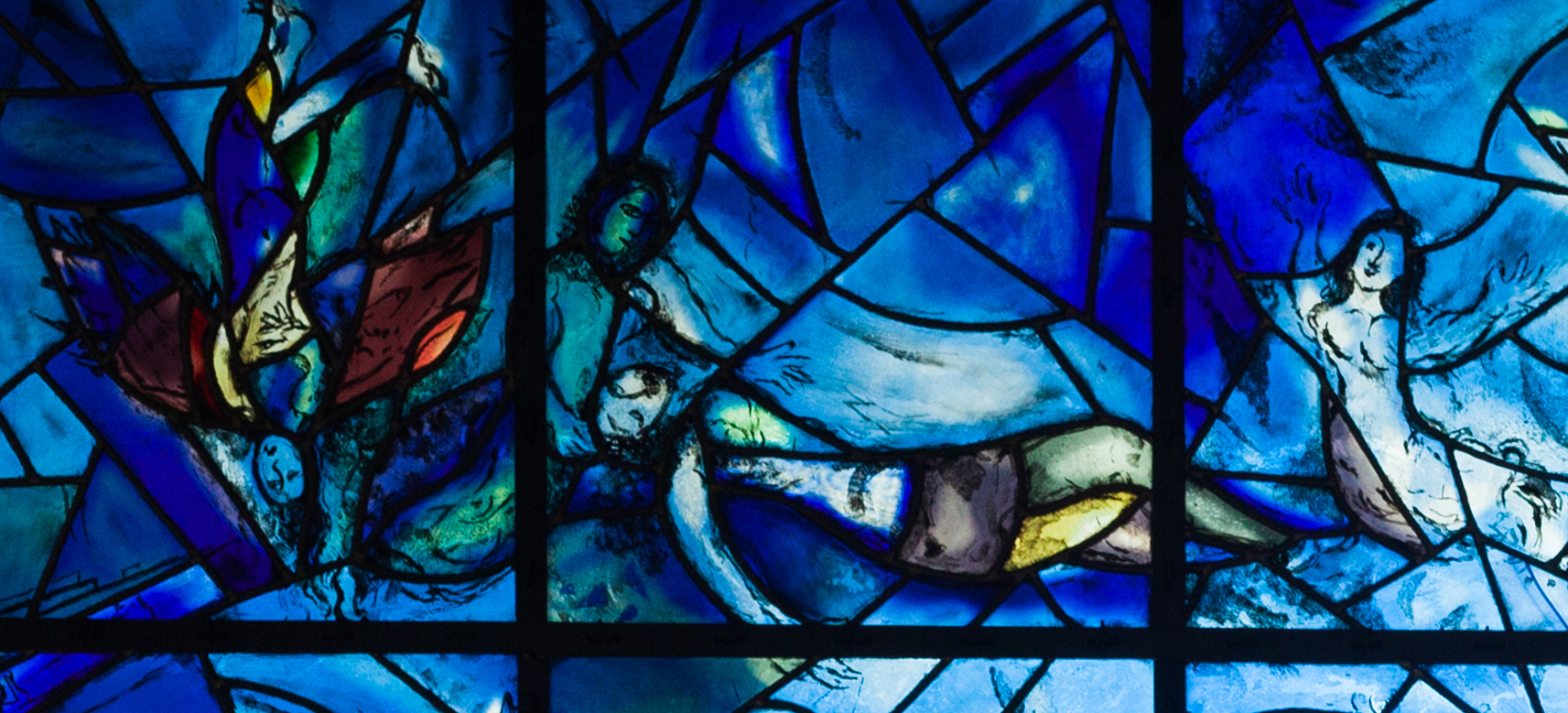
Lamentation detail

By contrast, in the bottom left corner, a mother cradles her child, evoking scenes of the nativity of Christ—of Mary with her newborn son.
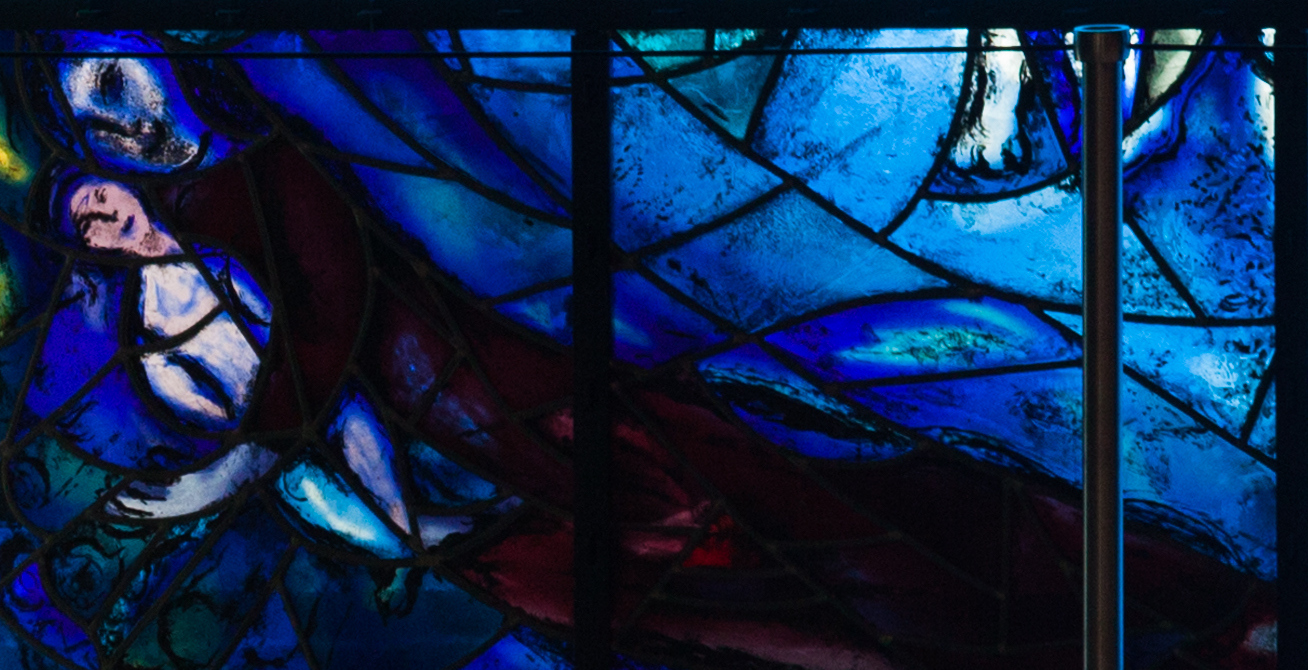
Mother and Child detail

All these characters—human, animal, and divine—are sprawled across a warm azure background, playing out love, suffering, death, peace, joy, and reconciliation.

When I visited the United Nations Headquarters last year, Chagall’s Peace Window was unlit and surrounded by construction, but a UN Facebook post from this September suggests that it is on view again. I’d love to see it in person and get some high-resolution photos of it. The majority of the detail shots I’ve posted here are cropped from a photo that Addison Godel (Flickr user Doctor Casino) took in 2016 when six of the forty panels were out for cleaning.

LISTEN: “Oracles” by Steve Bell, on Keening for the Dawn (2012)

O ancient seer, your vision told
Of desert highways streaming home
To the mountain of the Lord
Where nations sound a righteous song forevermore

And on that mountain men will forge
From cruel implements of war
The tools to till and garden soil
The rose will bloom and faces shine with gladdening oil

And it will surely come to pass
Justice will reign on earth at last
The wolf will lie down with the lamb
No beast destroy, no serpent strike the child’s hand

And God himself will choose the sign
A frightened woman in her time
Will bear a son and name him well
God with us! O come, O come, Emmanuel!
Roundup: Multilingual Paschal greeting, Easter sermon by N. T. Wright, the Myrrhbearers and the Magi, and more

VIDEO: “The Lord is Risen! Proclaimed by people from 29 countries”: This video was put out in 2020 by ICF Rotterdam, an intercultural church in the Netherlands whose congregation consists of members from over forty nations! They asked a handful of them to recite the Paschal greeting in their native tongue, so represented here are Indonesian, Chinese, Zulu, Igbo, Urdu, Nepali, Kurdish, Romanian, and more. [HT: Global Christian Worship]

Wycliffe Bibliafordítók (Wycliffe Bible Translators) in Hungary produced a similar video last year:

+++

SERMON: “Let Beauty Awake” by N. T. Wright: One of the things I love about the Anglican cleric N. T. Wright’s preaching and teaching is the importance he places on beauty. (I actually met Wright once—and it was at an arts conference.) In this sermon, which he preached at Durham Cathedral on Easter Sunday 2009, he takes as his text what I’ve heard him say is his favorite chapter in the Bible, John 20, and discusses how in Jesus’s rising, the glory of God was let loose in all the world.

“Easter carries with it a strange and powerful beauty,” he says. “I hope that, by exploring the biblical roots of why this is so, I may have surprised some of you at least into asking, afresh, What can we do to celebrate, more consciously and deliberately, the reawakening of beauty which comes with the light of Easter Day? How can we take this forward, as an explicit project, so that a world so full of ugliness and functionality, and in consequence so full of unbelief or false belief, can once again be wooed into belief and love?”

He opens the sermon by quoting a stanza from a poem by Robert Louis Stevenson, and near the close, he reprises it in his own words, which were developed into a song by Steve Bell:

Let Beauty awake in the morn from the cool of the grave,
Beauty awake from death;
Let Beauty awake,
For Jesus’ sake,
In the hour when the angels their silence break
And the garden is bright with His Breath.

+++

RECIPE: “Tsoureki: The Symbolic Greek Easter Bread”: On her blog The Liturgical Home (and on Instagram), Ashley Tumlin Wallace shares a recipe for tsoureki, a brioche-like sweet bread made by many Greek Christians on Easter. It is soft and fluffy, flavored with citrus, and decorated with red-dyed eggs!

+++

SPOKEN WORD + SONG: “Because He Lives” by Sharon Irving: Singer-songwriter, worship leader, and spoken word artist Sharon Irving [previously] recorded this video for City First Church Spring Creek’s virtual worship service for Easter 2020. It begins with an original spoken word piece, and then is followed by her singing the Gaither classic “Because He Lives.”

+++

SONG: “Sbab Dia Hidup” (Because He Lives) by Prison Akustik: The song “Because He Lives,” written in 1971 by Bill and Gloria Gaither, has made its way all around the world and has been translated into many languages. Here is the group Prison Akustik [previously] singing it in Indonesian.

+++

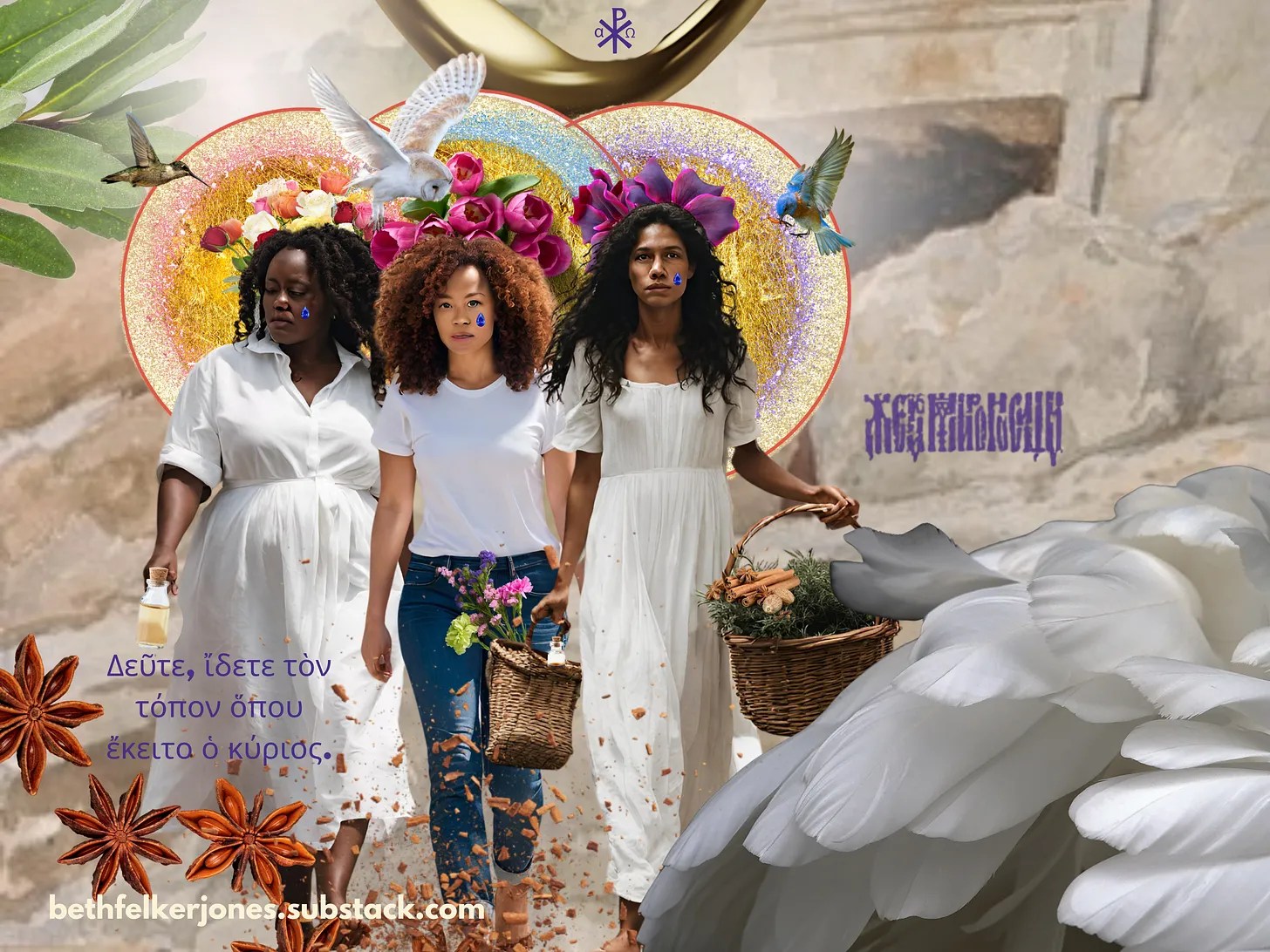
SUBSTACK POST: “Myrrhbearers & Magi” by Beth Felker Jones: In her Church Blogmatics post from last week, theologian Beth Felker Jones [previously] shares three new digital collages she made: one of the three myrrh-bearing women who discovered Jesus’s empty tomb, one of the three magi who brought gifts to the newborn Christ, and one that combines both groups of devoted witnesses. She provides descriptions of each and two original prayers, including the one below.

Myrrhbearers
Digital collage (with AI-generated elements) by Beth Felker Jones, 2025

Holy Father, who accompanied your daughters on their way to the tomb, and in the power of your Spirit, turned their sorrow into joy, bring us too into the joy of those who found the tomb empty, and incorporate us, with them, into your resurrection life. With our sisters at the tomb that day, help us to say, “I have seen the Lord!” Amen.

Roundup: Guite-Bell live event, Sister Corita Kent, and more

FREE LIVE EVENT: “Faith and the Imagination: Poetry, Song, and Inspiration with Steve Bell and Malcolm Guite,” June 4–7, 2022, Greater Seattle area: Join hundreds of Seattle artists and ministry leaders for four days of poetry, vocal performances, and conversation about the gift of the human imagination for the flourishing of our world, hosted by Cambridge’s distinguished poet Malcolm Guite and award-winning Canadian musician Steve Bell.

Sessions are free and open to the public and will not be livestreamed (and the conversations require advance registration):

  • June 4, 7–9pm: Live Concert (Seattle, WA)
  • June 5, 9:45–11am: Worship Service (Normandy Park, WA)
  • June 5, 7–9:30pm: A Conversation on: Faith and the Arts (Seattle, WA)
  • June 6, 6:30–8:30pm: A Conversation on: Faith and Technology (Bellevue, WA)
  • June 7, 7–9pm: A Conversation on: Faith and Work (Seattle, WA)

Guite and Bell have been collaborating for years. Below are two snippets of them performing together. In the first video Guite comedically performs (to rhythmic accompaniment!) a villanelle he wrote in response to something a woman who worked at the venue of one of his poetry talks exasperatedly said to him when his hurried photocopying caused a paper jam. The second video showcases a sonnet by Guite on the baptism of Christ, from his collection Sounding the Seasons: Seventy Sonnets for the Christian Year, and the song that Bell adapted it into, released on Keening for the Dawn.

+++

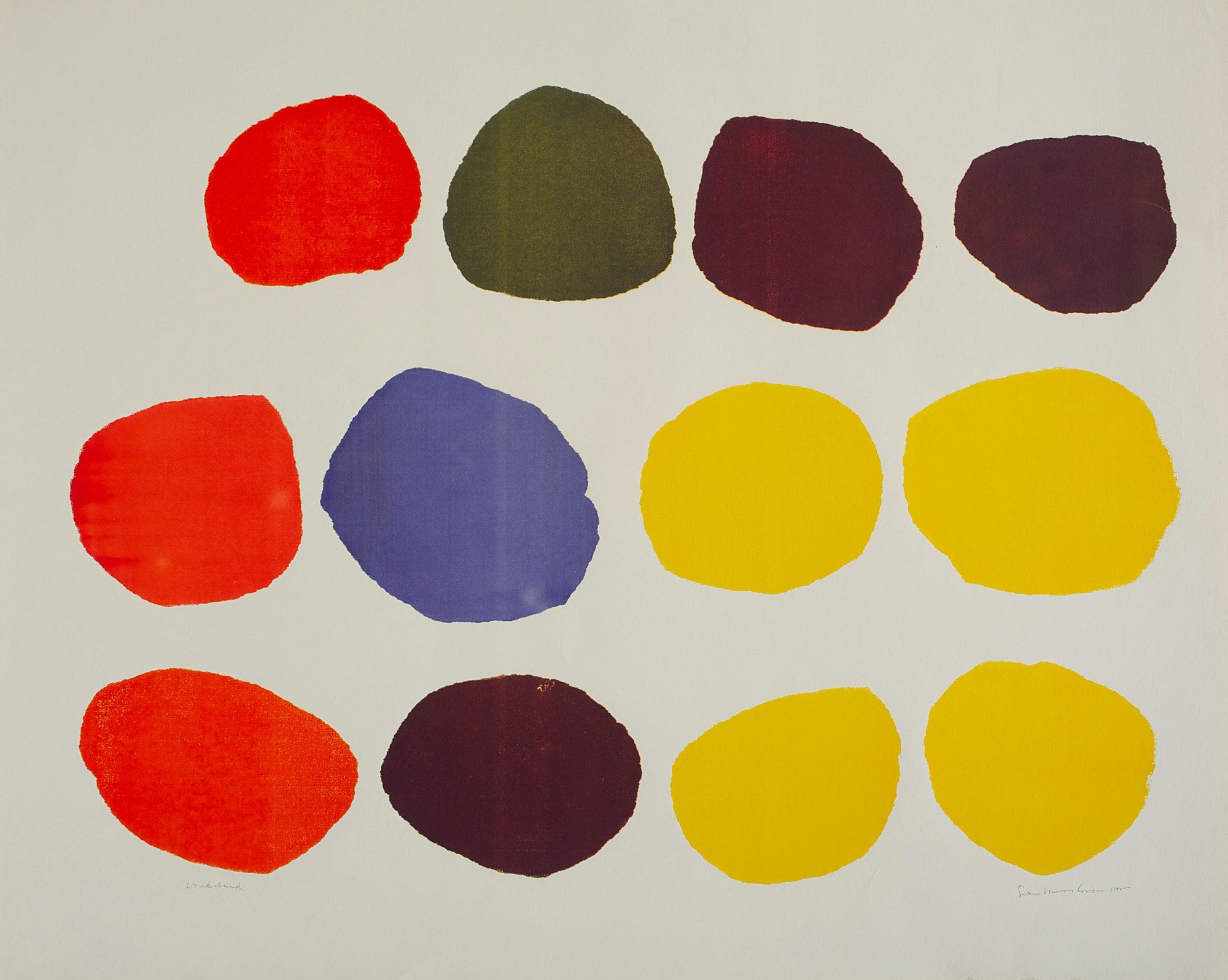
ESSAY: “The Listening Heart: Corita Kent’s Reforming Vision” by Michael Wright: Corita Kent (1918–1986) [previously] was an American pop artist who was also, for over three decades, a nun. Michael Wright writes about how “she became interested not just in depicting scenes from the Bible but answering this: what might happen if a Christian imagination engaged the world around us through the arts? That art might look less like an illustration from a children’s Bible and more like exploring seeing the stuff of life—even a bread bag—as dialogue partners with mysteries of faith.” wonderbread is one of four works he discusses—“a playful meditation on sacred time, wonder, and communion.”

Kent, Corita_wonderbread
Corita Kent (American, 1918–1986), wonderbread, 1962. Serigraph, 25 1/2 × 30 1/2 in.

While I do think even Kent’s biblical artworks push the genre of religious art forward, I appreciate how Wright challenges Christians to give a chance to her works that are less straightforwardly religious, as these are often the most imaginative and profound. And they, too, are “deeply Christian work.” Let’s not think so narrowly about what “Christian art” must look like!

+++

LIVING PRAYER PERIODICAL: Pentecost 2022: One of the organizations I work for is the Daily Prayer Project [previously], which publishes seven ecumenical Christian prayer periodicals a year, structured around the liturgical calendar. I do the curation for the Gallery section, which comprises three art images with written reflections, and the editing. Our latest edition covers June 5 (the feast of Pentecost) through August 6, and it includes prayers from India, Japan, Korea, Algeria, Italy, the Choctow Nation, and more. I’m excited to feature on the cover Corita Kent’s word picture: gift of tongues! As many of her screenprints do, it integrates image and text—in this case Acts 2:1–2a, which sprawls out through the sky and onto a billowing banner, like a sail, over a crowd of people aflame with the fire of the newly descended Spirit of God.

Pentecost LPP 2022

On the website there are options for one-time purchase or group subscription, and for digital only or print and digital.

+++

PRAYER: “The Lord’s Prayer, Extended Dance Mix” by Nadia Bolz-Weber: In March, actor Jennifer Garner asked Lutheran pastor and author Nadia Bolz-Weber if she could offer a prayer and a benediction on her InstaLive. Bolz-Weber vamped on the traditional words of the Lord’s Prayer, the text of which you can read at the boldface link.

Such a beautiful prayer.

One of the things I appreciate about Bolz-Weber’s spiritual teaching is her avoidance of clichés. She gives fresh language to the experiences of faith and life in general and to theology, which often reawakens me to the beauty of God and of Christ’s gospel. Describing why she regularly turns to prayer, she says in the Instagram video:

When I don’t have enough—like if I don’t have enough patience, if I don’t have enough compassion for myself or other people, when I don’t have enough resources—prayer is this way in which I can remind myself that there is enough. That I have a connection to my own divine source. I have a connection to God. And in the heart of God there’s enough forgiveness when I don’t have enough. In the heart of God there’s enough compassion when I don’t have enough. And so for me, it’s about reminding myself of that connection.

+++

SONG: “Dry Bones” by Gregory Porter: From Gregory Porter’s 2021 album Still Rising, this song was inspired by Ezekiel 37. The official music video features dancing skeletons in yellow cowboy boots(!), animated by L’Incroyable Studio. The song’s bridge quotes the African American spiritual “Dem Bones.”

The first verse goes,

I won’t die, won’t bury, won’t sink
’Cause love is the spirit I drink
I’ll be free in the morning light
’Cause your touch is the medicine of life
There’s a dance to this beat, let’s shake
Every move—feel my body awake
There’s a sound—you and me are one
And your hope is the rhythm I drum

Songs about the Flight to Egypt

On the heels of Jesus’s birth came his frantic flight, with parents Mary and Joseph, from the sword of an egomaniacal politician who swore death to all the male children of Bethlehem under the age of two. To secure his own power and advantage, Herod had to squash all potential threats.

Thus the birthday festivities were cut short as the Holy Family packed up what little they had and hit the road running, seeking asylum in another country.

Flight to Egypt by Jean-Francois Millet
Jean-François Millet (French, 1814–1875), The Flight into Egypt, ca. 1864. Conté crayon, pen, ink, and pastel over gray washes on paper, 31.1 × 39.4 cm. Art Institute of Chicago.

Many families are still making this difficult journey today: fleeing home in order to escape persecution and/or death.

Even though the Flight to Egypt is a part of the Christmas story, it’s often omitted from present-day nativity pageants and carol services because we prefer to bask in that which is quaint and cozy and cute and joyful, and we want that happy ending. We don’t want the darkness to rain on all the Christmas light. This is a real shame. By leaving out this event from our retellings of Jesus’s birth narrative, not only do we do a disservice to his memory, we neglect an opportunity to see Christ in our refugee neighbors.

(Related post: “Maria von Trapp, plus seven artists, on Jesus the refugee”)

To help remedy this omission, I’ve compiled a list of songs based on the Flight to Egypt so that churches can consider using them (or be inspired to write their own!) as part of their Christmas observances. I’ve purposely excluded “The Cherry-Tree Carol,” a centuries-old ballad derived from an apocryphal story about the Flight to Egypt from the Gospel of Pseudo-Matthew (chapter 20); I did so not only because the anonymous lyricist reset the episode during the Journey to Bethlehem, when Jesus was still in the womb, but because, though charming, there’s nothing historic, spiritually valuable, or socially conscious about it, and it perpetuates a popular stereotype of Joseph as stubborn and unkind that I believe scripture itself does not bear.

Also excluded are the several carols about the Massacre of the Innocents—the episode that prompted the Flight to Egypt. The two episodes are obviously related, but I want to focus here on the Flight.

CONGREGATIONAL HYMNS

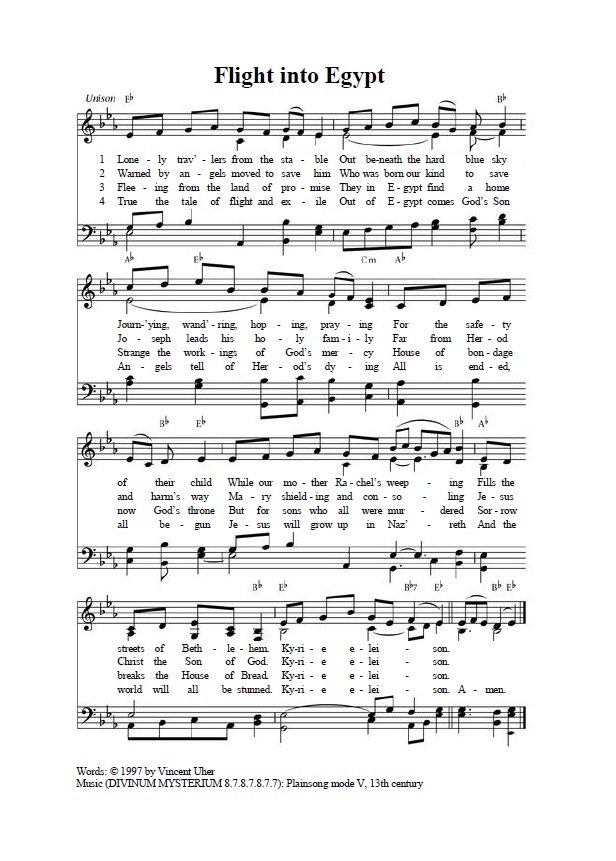
I could find only one song on the topic that was written with congregational singing in mind, and that is “Flight into Egypt” by the Rev. Vincent William Uher III (1963–). It’s made up of four verses and the refrain “Kyrie eleison” (Lord, have mercy), a common prayer in Christian liturgies. Because the hymn uses a plainchant tune, it has an irregular meter and may therefore be a little tricky for congregations to pick up right away. But the words are so beautifully crafted and set, and Rev. Uher gives his permission for noncommercial use, as long as credit is given. I put together a printable hymn sheet, reproduced below the lyrics. (Click on the image to open up the sheet as a PDF in a new tab.)

“Flight into Egypt” (1997) – Words: Vincent Uher | Music: Plainchant mode V, 13th century

Lonely travelers from the stable
Out beneath the hard blue sky
Journeying, wandering, hoping, praying
For the safety of their child
While our mother Rachel’s weeping
Fills the streets of Bethlehem.
Kyrie eleison.

Warned by angels moved to save him
Who was born our kind to save
Joseph leads his holy family
Far from Herod and harm’s way
Mary shielding and consoling
Jesus Christ the Son of God.
Kyrie eleison.

Fleeing from the land of promise
They in Egypt find a home
Strange the workings of God’s mercy
House of bondage now God’s throne
But for sons who all were murdered
Sorrow breaks the House of Bread.
Kyrie eleison.

True the tale of flight and exile
Out of Egypt comes God’s Son
Angels tell of Herod’s dying
All is ended, all begun
Jesus will grow up in Nazareth
And the world will all be stunned.
Kyrie eleison.

flight-into-egypt-by-vincent-uher

Because of the scarcity of carols referencing the Flight to Egypt, I took to writing some verses of my own, using already-popular hymn tunes. Each of these verses is intended not as an additional stanza to the carol whose tune it shares (that would render the narrative structure incoherent) but as a standalone reprise of sorts. I envisioned any one of them being sung as part of a Christmas Eve service following the reading, as part of the total Christmas story, of Matthew 2:13–14.   Continue reading “Songs about the Flight to Egypt”