Advent, Day 10: Lo, He Comes

To him who loves us and freed us from our sins by his blood and made us a kingdom, priests serving his God and Father, to him be glory and dominion forever and ever. Amen.

Look! He is coming with the clouds;
    every eye will see him,
even those who pierced him,
    and all the tribes of the earth will wail on account of him.

So it is to be. Amen.

—Revelation 1:5b–7

LOOK: The Last Judgment by Jan van Eyck  

van Eyck, Jan_Last Judgment
Jan van Eyck (Netherlandish, ca. 1390–1441), The Last Judgment, ca. 1436–38. Oil on canvas, transferred from wood, 22 1/4 × 7 2/3 in. (56.5 × 19.7 cm). Metropolitan Museum of Art, New York.

What is your reaction to this image? Terror? Awe? Gratitude? Disgust? Intrigue? Indifference?

I’m often repulsed by how the Last Judgment was interpreted by medieval and Renaissance artists, with graphic displays of torture intending to compel people to righteous living through fear. To be sure, the subject has made for some truly remarkable paintings, full of fantastical grotesqueries and masterfully executed—like this one—but I worry that the scare tactics such paintings use are not helpful and are even harmful.

Nonetheless, the Last Judgment is an unavoidable topic in scripture. The Bible refers several times to God as judge and describes a final accounting of sin upon Christ’s return, resulting in reward for the righteous and punishment for the unrighteous. It’s also in our creeds: “He [Jesus Christ] will come again to judge the living and the dead” (see 2 Tim. 4:1; 1 Pet. 4:5). Those who seek to be faithful to scripture must reckon with the idea of the Last Judgment. Advent, which is penitential in character, has historically been a period for the church to do that. As the Episcopal priest and author Fleming Rutledge points out in her published collection of Advent sermons, judgment is one of the four traditional themes of the season—the other three being death, heaven, and hell.

The early Northern Renaissance master Jan van Eyck’s Last Judgment from ca. 1436–38 is one of history’s most famous and most gruesome. “The diabolical inventions of Bosch and Brueghel,” writes art historian Bryson Burroughs, “are children’s boggy lands compared to the horrors of the hell [van Eyck] has imagined.”

The midground portrays the resurrection of the dead, who rise up out of their graves on land or at sea to be judged by Christ. One of the inscriptions on the frame is Revelation 20:13: “And the sea gave up the dead which were in it; and death and hell delivered up the dead which were in them: and they were judged every man according to their works.”

In the center Saint Michael the Archangel, dressed in his jewel-studded armor and with sword unsheathed, stands atop the giant batlike wings of Death personified, which are inscribed with the words CHAOS MAGNVM (“great chaos”) and UMBRA MORTIS (“shadow of death”). Death is a skeletal figure who excretes the damned through his bowels into hell’s dark slime, where bestial demons tear at, choke, devour, crush, and impale them. One man’s legs are being ripped apart at the anus.

Even kings and clergymen are part of the tragic death-heap—see the bishop’s miter, the cardinal’s galero, the royal crown. Not all who say, “Lord, Lord,” will enter heaven (Matt. 7:21); even the most outwardly pious will have their sins exposed on the last day, and those who prove to be hypocrites, who have harmed others and shamed God without repentance, will be thrown into the pit.

Shooting down like arrows into this pit is the double inscription ITE VOS MALEDICTI IN IGNEM ETERNAM (“Go, ye cursed, into everlasting fire”), taken from Matthew 25:41. And Deuteronomy 32:23–24, a warning from God via Moses to the people of God in their disobedience, is one of the inscriptions on the frame:

I will heap mischiefs upon them; I will spend mine arrows upon them. They shall be burnt with hunger, and devoured with burning heat, and with bitter destruction: I will also send the teeth of beasts upon them, with the poison of serpents of the dust.

Perhaps your chest is tightening right now, your stomach churning. How does this picture cohere with the God of love and mercy?

Look up.

See Jesus Christ, the Son of Man, coming in glory. See his glowing stigmata, beacons of love and mercy. He is dressed in a long, red, open mantle and is barefoot, revealing all five wounds. All around him, angels bear the instruments of his passion: the cross, the three nails, the crown of thorns, the lance, the sponge-tipped reed. See him flanked by all the ranks of the redeemed, including, on a larger scale, the Virgin Mary and John the Baptist, the first two witnesses of Jesus’s divinity.

VENITE BENEDICTI PATRIS MEI, read the inscriptions fanning out from Christ’s elbows: “Come, ye blessed of my Father” (Matt. 25:34). This good word is taken from Jesus’s parable of the sheep and the goats, in which he teaches that those who feed the hungry, clothe the naked, shelter the immigrant, care for the sick, and visit the imprisoned will be honored by God on the last day.

Another benediction is inscribed on the picture’s frame:

And I heard a loud voice from the throne saying,

“See, the home of God is among mortals.
He will dwell with them;
they will be his peoples,
and God himself will be with them and be their God;
he will wipe every tear from their eyes.
Death will be no more;
mourning and crying and pain will be no more,
for the first things have passed away.” (Rev. 21:3–4 NRSV)

Van Eyck’s Last Judgment does not stand alone. For centuries it has been configured as a diptych (two-paneled artwork) with a Crucifixion on the left and is thus intended to be read in light of God’s supreme act of vulnerable love and self-giving:

van Eyck, Jan_Crucifixion and Last Judgment
Jan van Eyck (Netherlandish, ca. 1390–1441), The Crucifixion; The Last Judgment (with recently conserved frame), ca. 1436–38. Oil on canvas, transferred from wood, each panel 22 1/4 × 7 2/3 in. (56.5 × 19.7 cm). Metropolitan Museum of Art, New York.

Originally these two paintings very likely served as the wings of a triptych with a painted or sculpted centerpiece, or as the doors to a tabernacle or reliquary shrine. In 2019 the Metropolitan Museum of Art had the frames restored from their modern brass color to their original red.

So, what are we to make of this image today? Is there value in meditating on it?

I’ve presented it here, so I think it’s definitely worth knowing about. It’s a stunning art object that gives us a glimpse into the religious imagination of late medieval Christians. But I would also advise caution, especially to those who have been traumatized by hell teachings in the past. While Christians are called to cultivate a holy fear of God, a soberness around the weight of our sin and the power of God’s justice, this fear is not supposed to be the kind of fear that induces anxiety or paralyzes. That kind of fear will never lead us to love God.

We are never meant to think on hell apart from the grace Christ extends to us with his pierced and outstretched hands, which plead our case before God. Van Eyck holds both together in this painting, but the more visually immersive bottom half seems to indulge some pretty sick fantasies that could well generate an unhealthy fear of God if one were to stay stuck there, not to mention create the false impression that God is monstrously vindictive.

There is debate within Christianity, and has been since the patristic era, whether Jesus’s justice is merely punitive or ultimately restorative—that is, whether hell is a place of eternal conscious torment or a place where one is purged of evil and that will in the end be emptied. (There is biblical support for both views, which I won’t get into here.) There is also disagreement as to whether the Bible’s language about hell, such as its being a place of “fire” and “brimstone” (sulfur) (e.g., Rev. 21:8), is meant to be taken literally or figuratively.

Whatever the duration, physical nature, and ultimate purpose of hell, I want to emphasize that biblical passages about the Last Judgment ought not drive us to despair; they should drive us into the arms of Christ, who receives into his presence all those who trust in his merits and turn from their wickedness. The wounds that Christ so prominently displays in van Eyck’s painting are tokens of divine forgiveness as well as a model of the kind of selfless love we are to follow, a love vulnerable enough to receive injury but never to inflict it. Those who tumble into the depths of the underworld to be ravaged by externalizations of their own destructive evils have rejected the call to “do justice, love mercy, and walk humbly with [their] God” (Mic. 6:8). Many of them are ones who on earth bore much power but used it to abuse others or were neglectful.

For more on the characterization of Jesus as judge in the art and theology of the Middle Ages (whose influence was felt in the Renaissance and later eras), see chapter 2, “The Judge,” of Jesus through Medieval Eyes by Grace Hamman. “The promise of answering unanswered evil, acknowledging the recognized and unrecognized wrongs of the mortal world—everlasting justice and compassion—is ultimately what Christ the Judge signifies. It’s a promise, a prophecy, and a call for action now,” Hamman writes (28). She discusses how neighborliness and fear of God are twinned: “Am I seeing the immortal being, the image of God, Jesus himself, in every person I encounter?” medieval imagery prompted viewers to ask (37). “Jesus the Judge reminds us of our divine community and invites a fear that guides us to love our neighbor as we love ourselves. . . . Fear of Jesus the Judge becomes a gift for our practice of justice, in the radiant light of his justice. Such a fear softens flinty hearts” (21, 36). In the chapter Hamman does also acknowledge the complications and misuses of fear in the medieval church and its legacy today.

I urge you to consider the van Eyck diptych in light of the retuned hymn below as you meditate on Christ’s return and his role as judge.

LISTEN: “Lo! He Comes with Clouds Descending” | Words by Charles Wesley, 1758 | Music by Thomas Vito Aiuto, 2012 | Performed by the Welcome Wagon on Precious Remedies Against Satan’s Devices, 2012

Lo! he comes with clouds descending,
once for favored sinners slain;
thousand, thousand saints attending
swell the triumph of his train.

Ev’ry eye shall now behold him,
robed in dreadful majesty;
those who set at naught and sold him,
pierced, and nailed him to the tree,
deeply wailing, deeply wailing,
shall the true Messiah see.

Ev’ry island, sea, and mountain,
heav’n and earth, shall flee away;
all who hate him must, confounded,
hear the trump proclaim the day:
Come to judgment, come to judgment!
Come to judgment, come away!
Alleluia, alleluia!
God appears on earth to reign.

The dear tokens of his passion
Still his dazzling body bears,
Cause of endless exultation
To his ransomed worshippers.
With what rapture, with what rapture
Gaze we on those glorious scars!
Alleluia, alleluia!
God appears on earth to reign.

Yea, amen! Let all adore thee,
high on thine eternal throne;
Savior, take the pow’r and glory,
claim the kingdom for thine own.
O come quickly, O come quickly;
everlasting God, come down.
O come quickly, O come quickly;
everlasting God, come down.
O come quickly, O come quickly;
everlasting God, come down.

I’m struck by the bright, celebratory, homey tone of the new tune Rev. Vito Aiuto gave this old Wesley hymn about Christ’s second coming. One might expect, with its verses about judgment, to have a dark or foreboding tone. But for those who are in Christ, his return, and even the day of judgment, will be an occasion of rejoicing!

Note that “dreadful” here is used in the archaic sense of inspiring awe or reverence.


This post is part of a daily Advent series from December 2 to 24, 2023 (with Christmas to follow through January 6, 2024). View all the posts here, and the accompanying Spotify playlist here.

Alfred Conteh’s “Float” and other recent CAUAM acquisitions

In September 2019 I visited Atlanta, Georgia, and one of the two art stops I made was the Clark Atlanta University Art Museum, whose purpose is “to collect, preserve, research, and exhibit fine art works that document the role of African Americans in American history and culture.” When I got there I was bummed to see that the museum was closed in preparation for three exhibitions that were to open that Sunday. But graciously, even though the signage and lighting hadn’t been installed and some of the objects were still being moved around, the curator allowed me in for a little glimpse.

I was stopped in my tracks by a mixed media sculpture in the gallery of recent acquisitions: Float by Alfred Conteh.  

Conteh, Alfred_Float
Alfred Conteh (American, 1975–), Float, 2014. Steel, epoxy dough, thermoadhesive plastic, atomized steel dust, atomized bronze dust, urethane plastic, steel chain, 93 × 46 × 35 in. Clark Atlanta University Art Museum, Atlanta, Georgia. Photo: Victoria Emily Jones.

Conteh, Alfred_Float (detail)

It shows a Black female Christ figure rising up in a whirl of energy, her hat blown aloft. Wounds are visible on her hands and feet, but these are taken up into new, greening life. At the bottom is a broken chain, indicating that she has been set free. The piece expresses the exhilaration of emancipation, of being shackled no more.

(Related posts: “Contemporary Black artists at the Baltimore Museum of Art”; “Christ figure in Justin Dingwall’s Albus series”)

I would classify Float as a resurrection image, which its staging reinforces. To its far left is a wooden crucifix by Dilmus Hall, followed by The Mourners by Frederick C. Flemister, from 1942. (Note that the two crucifix photos in this post are courtesy of the Souls Grown Deep Foundation, who donated the pieces to the museum.)

Clark Atlanta U aquisitions
Hall, Dilmus_Untitled (Crucifixion)
Dilmus Hall (American, 1896–1987), Untitled, n.d. Wood, wood putty, plastic beads, and paint, 12 × 9 in. Clark Atlanta University Art Museum, Atlanta, Georgia. Photo: Stephen Pitkin / Pitkin Studio.

Flemister, Frederick C._The Mourners
Frederick C. Flemister (American, 1916–1976), The Mourners, 1942. Oil on canvas, 39 3/4 × 31 1/4 in. Clark Atlanta University Art Museum, Atlanta, Georgia. Photo: Victoria Emily Jones.

Drawing on iconography of the Lamentation over the Dead Christ, Flemister’s The Mourners shows a mother holding the corpse of her grown son, who has just been deposed from a lynching tree. Behind her a woman in a pink dress throws up her arms in grief, and a preteen boy runs into his own mother’s arms for comfort. Like many artists before and after him, Flemister connects the killings of innocent Black men to the killing of Jesus—not because their deaths are salvific but because both they and Jesus were unjustly “crucified,” and because Black men bear God’s image, which the visual conflation reminds us of. As Jesus told his disciples, “Truly, I say to you, as you did it to one of the least of these my brothers, you did it to me” (Matt. 25:40).

Death and resurrection, suffering and hope, are the theme of this temporary exhibition. A second wooden crucifix, by Thornton Dial Jr., adorns the opposite wall. It’s titled I’ll Be Back, which, as the sculpture was made a few years after The Terminator came out, may be a playful reference to Arnold Schwarzenegger’s famous line, but it is first and foremost an affirmation that Jesus will return to earth, as promised, to fully set things right. (By the way, I wonder if Conteh, in making Float, was inspired by the hubcap component of another of Dial’s crucifixes . . .)

Dial Jr., Thornton_I'll Be Back
Thornton Dial Jr. (American, 1953–), I’ll Be Back, 1988. Wood, metal, barbed wire, string, fabric, industrial sealing compound, enamel, nails, 35 × 32 × 6 3/4 in. Clark Atlanta University Art Museum, Atlanta, Georgia. Photo: Stephen Pitkin / Pitkin Studio.

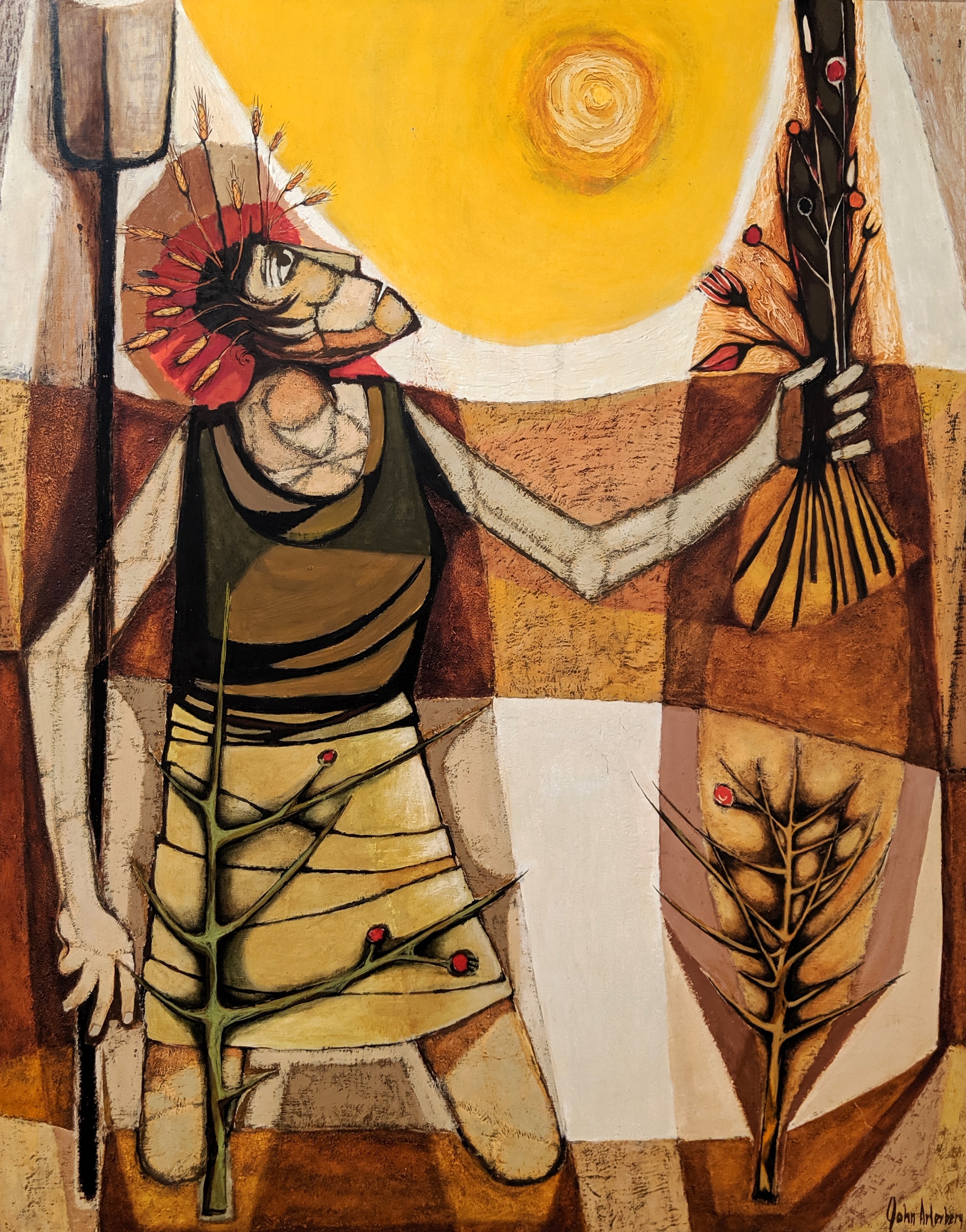
The last piece in the room is Ceres by John W. Arterbery. Ceres was the Roman goddess of agriculture, grain crops, and fertility, the equivalent of the Greek mother-goddess Demeter. In Arterbery’s painting she wears a crown of sprouting wheat stalks and holds a pitchfork in one hand and a leafless plant with buds and berries in the other. I think the flowers may be poppies, as Ceres is associated with those.

Arterbery, John W._Ceres
John W. Arterbery (American, 1928–1977), Ceres, 1963. Oil on Masonite, 60 × 47 1/2 in. Clark Atlanta University Art Museum, Atlanta, Georgia. Photo: Victoria Emily Jones.

It appears as though Arterbery is depicting the imminence of spring, when Ceres will be reunited with her daughter Proserpine (Persephone) and life will grow and flourish. It shows Ceres looking toward the sun in anticipation of such a time. Read in conjunction with the other pieces in the room, Ceres could be interpreted as an Advent image—a waiting for the final fulfillment of God’s good purposes for his creation, which includes a definitive end to suffering and oppression and a universal thriving.

The Clark Atlanta University Art Museum is typically open Tuesday through Friday from 11 a.m. to 4 p.m., as well as by appointment, but you may want to email ahead of time (cauArtMuseum@gmail.com) to confirm. It’s definitely worth a visit, though I can’t guarantee that the works featured here will be on display. If you wish to browse photos of pieces from the museum’s collection, see In the Eye of the Muses: Selections from the Clark Atlanta University Art Collection (2012).

Choose (Artful Devotion)

Jackson, Cindy_(Not Quite) Salvation
Cindy Jackson (American, 1960–2017), (Not Quite) Salvation, 2014. Mixed media installation.

“Now therefore fear the LORD and serve him in sincerity and in faithfulness. Put away the gods that your fathers served beyond the River and in Egypt, and serve the LORD. And if it is evil in your eyes to serve the LORD, choose this day whom you will serve, whether the gods your fathers served in the region beyond the River, or the gods of the Amorites in whose land you dwell. But as for me and my house, we will serve the LORD.”

—Joshua 24:14–15

In this excerpt from Sunday’s lection, Joshua, Moses’s successor, admonishes the people of Israel to serve the one true God, Yahweh, but if they don’t, to choose between their ancestral gods from Mesopotamia or the gods worshipped by the peoples of Canaan, whose land they have taken over. Joshua unequivocally states his own allegiance to Yahweh, who had proven himself faithful to his promises.

Joshua’s imperative may seem irrelevant to life today, but it could actually be extrapolated to apply even to those who are not theistic, because all humans are worshipping beings. Those who don’t worship a god or gods, as the word is conventionally conceived, are giving their ultimate love and devotion to someone or something else, be it power, money, popularity or fame, intellect, a career, a political party, a social cause, a sports team, television, social media following, physical attractiveness or fitness, a romantic partner, a child, or what have you. The American writer David Foster Wallace, who was not a Christian (that I’m aware of) but who had a spiritual sensibility, spoke incisively about this in his “This Is Water” commencement speech, delivered at Kenyon College on May 21, 2005. He said,

In the day-to-day trenches of adult life, there is actually no such thing as atheism. There is no such thing as not worshipping. Everybody worships. The only choice we get is what to worship. And an outstanding reason for choosing some sort of God or spiritual-type thing to worship—be it J.C. or Allah, be it Yahweh or the Wiccan mother-goddess or the Four Noble Truths or some infrangible set of ethical principles—is that pretty much anything else you worship will eat you alive. If you worship money and things—if they are where you tap real meaning in life—then you will never have enough. Never feel you have enough. It’s the truth. Worship your own body and beauty and sexual allure and you will always feel ugly, and when time and age start showing, you will die a million deaths before they finally plant you. . . . Worship power—you will feel weak and afraid, and you will need ever more power over others to keep the fear at bay. Worship your intellect, being seen as smart—you will end up feeling stupid, a fraud, always on the verge of being found out. And so on.

Look, the insidious thing about these forms of worship is not that they’re evil or sinful; it is that they are unconscious. They are default-settings. They’re the kind of worship you just gradually slip into, day after day, getting more and more selective about what you see and how you measure value without ever being fully aware that that’s what you’re doing. And the world will not discourage you from operating on your default-settings, because the world of men and money and power hums along quite nicely on the fuel of fear and contempt and frustration and craving and the worship of self. Our own present culture has harnessed these forces in ways that have yielded extraordinary wealth and comfort and personal freedom. The freedom to be lords of our own tiny skull-sized kingdoms, alone at the center of all creation.

In his book Counterfeit Gods: The Empty Promises of Money, Sex, and Power, and the Only Hope That Matters, Tim Keller says that idols (false gods) are usually good things that we turn into ultimate things: “anything more important to you than God, anything that absorbs your heart and imagination more than God, anything you seek to give you what only God can give, . . . anything so central and essential to your life that, should you lose it, your life would feel hardly worth living” (xvii–xviii). He identifies some idols that Christians may be unlikely to consider as such, including doctrinal accuracy, ministry success, and moral rectitude.

Who or what do you live for? Where do you place your primary identity? How do you define your worth?

“Choose this day whom you will serve.”

+++

SONG: “Gotta Serve Somebody” by Bob Dylan, on Slow Train Coming (1979)

“Gotta Serve Somebody” is the first song Bob Dylan released after his conversion to Christianity in the late seventies. (It came out as a single before appearing on Slow Train Coming.) In it he lists various occupational titles—rock musician, businessman, doctor, athlete, ambassador, police officer, homebuilder, politician, barber, preacher, etc.—and other roles, saying that all, rich and poor, are “gonna have to serve somebody, yes / You’re gonna have to serve somebody / Well, it may be the devil or it may be the Lord / But you’re gonna have to serve somebody.” As in Sunday’s lectionary passage from Joshua, and as in David Foster Wallace’s famous speech, Dylan suggests that the choice to not worship God is in itself a choice to worship something/someone else in God’s place. Some atheists are at least honest enough to recognize that they worship themselves—like John Lennon, who wrote “Serve Yourself” as a riposte to Dylan.

Dylan won a Grammy for Best Rock Vocal Performance by a Male for “Gotta Serve Somebody.” The song has been covered by many artists, including Mavis Staples, Etta James, Judy Collins, and Willie Nelson.

+++

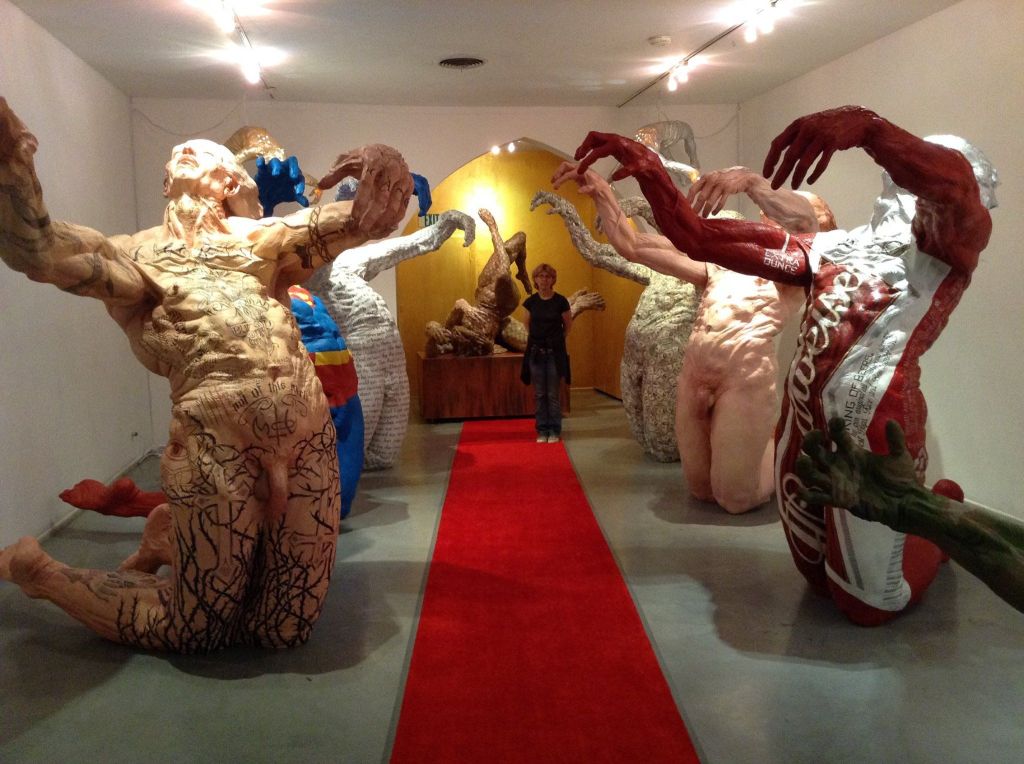
The gallery installation pictured above is by the late Cindy Jackson. It’s discussed extensively, along with her other art, in the article “Cindy Jackson’s Bevy of Boisterous Bodies” by Gordon Fuglie, published in issue 92 of Image journal. And Eric Minh Swenson has made a short film where he interviews the artist in her studio as she works on these pieces:

In (Not Quite) Salvation, six twice-life-size urethane sculptures of nude men, cast from the same mold but painted differently, form a sort of tunnel over a red carpet that leads to a “chapel.” Their supersize arms are extended outward in a state of—rapture? torment? dead stupor? The installation “explores the various ways redemption and meaning are sought in society,” says Jackson. “What we worship indicates how we hope to be saved from our suffering. What we yearn for are the symbols of our perceived exoneration.”

The first two in line, arranged opposite each other, are Beer Man, his body overlaid with Budweiser branding, and Tattoo Man, whose inked skin, an amalgamation of various signs and slogans, is a “critique of a lazy American pop pluralism run amok,” as Fuglie says. The next duo is Super Man, in all his muscly righteousness, and Sex Man, lusty and sporting a condom. The final pair is, on the left, Dogma Man, who is inscribed with words from various sacred texts, poems, and song lyrics—a “smorgasbord of pop spirituality.” And on the right, Money Man, who is papered over with (photocopies of) dollar bills.

“They have betrayed their true spiritual identity and are damaged souls,” Fuglie writes. “Jackson affirms this by inscribing a hopeful poetic aphorism, [attributed to] the Sufi mystic Rumi, on the invisible interior surfaces of each hollow figure: ‘The wound is the place where the light enters you.’ These words imply that spiritual grounding is attainable only when the sufferer acknowledges the injuries inflicted by his false persona and begins to nurture his inner life, the locus of genuine illumination.” Only when their veneer cracks is the light/Light able to get in.

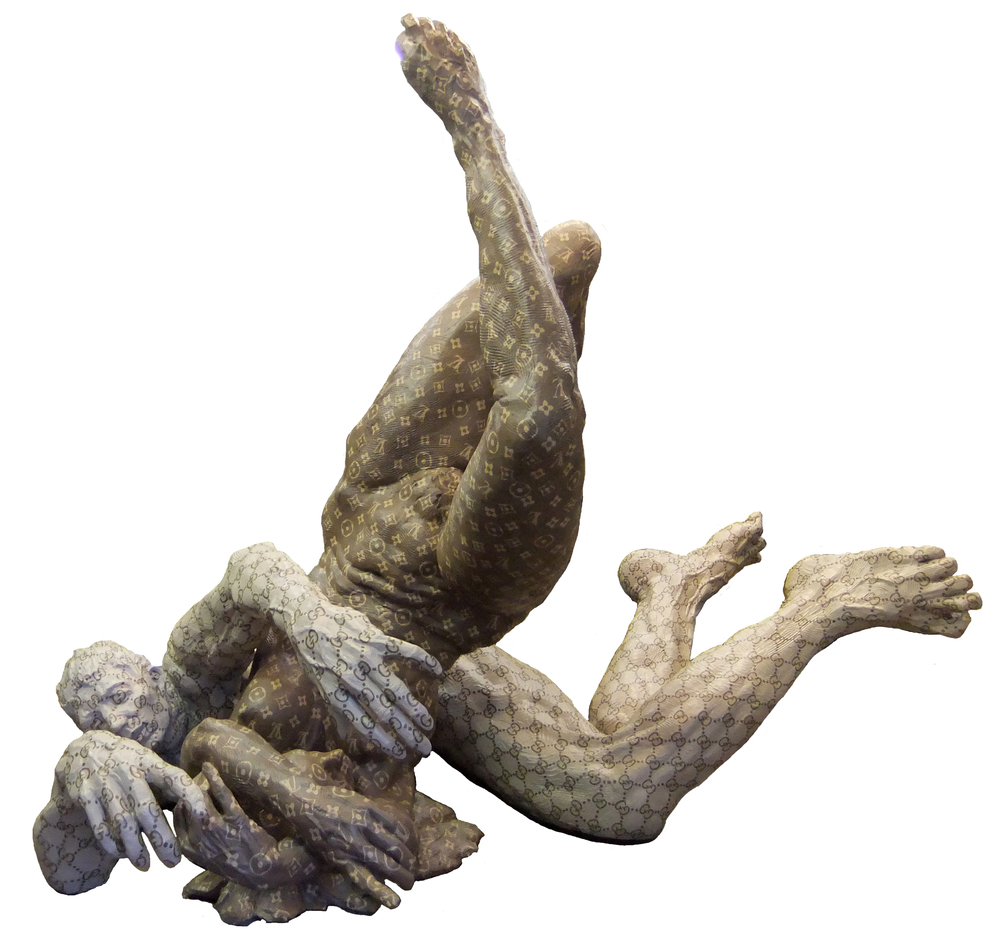
In the room at the end of the installation is one more sculpture pair, titled Always Wanting/Never Enough: a man and a woman covered in Gucci and Louis Vuitton logos and wrestling each other on an altar-like pedestal, signifying consumerism.

Jackson, Cindy_Always Wanting, Never Enough
Cindy Jackson (American, 1960–2017), Always Wanting/Never Enough, 2014. Acrylic on polyurethane.

Jackson, Cindy_Falling Jesus Swag Lamp
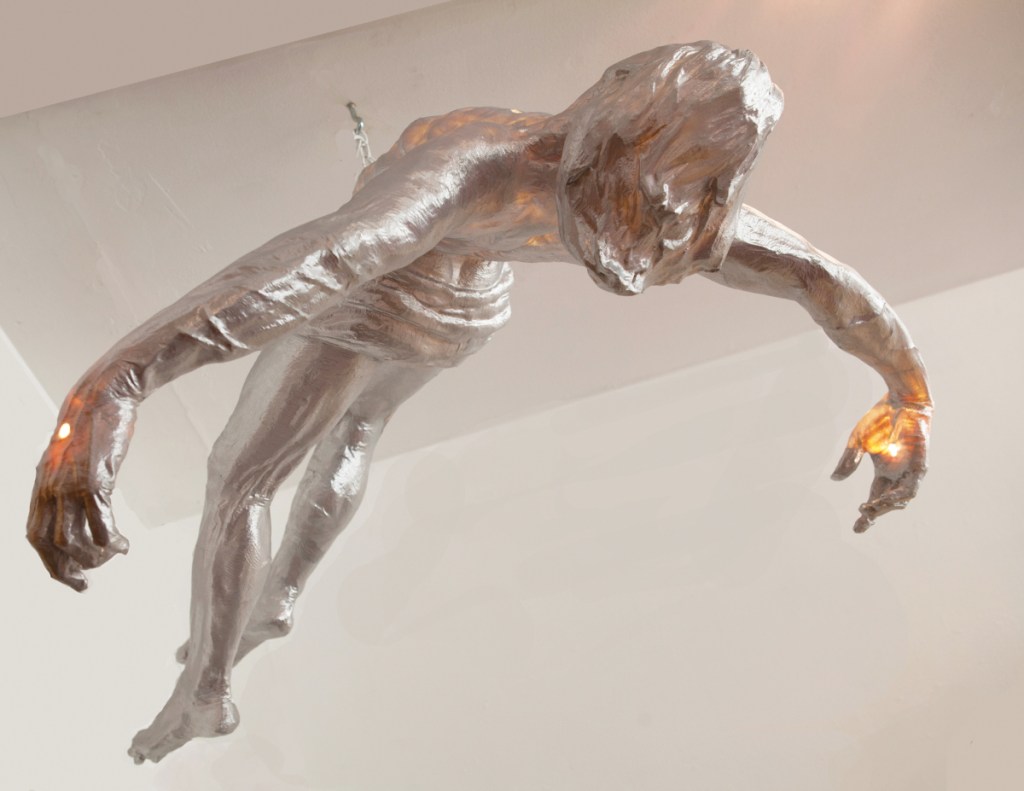
Cindy Jackson (American, 1960–2017), Falling Jesus Swag Lamp, 2014. Polyurethane, tulle fabric, and LED lights.

Hanging above them—the interpretive key, at least in my reading—is a Christ figure deposed from the cross, whose wounds glow with LED lights. In a clever visual riff on the Rumi quote, “the light of divine sacrifice and surrender exits him,” through his stigmata, “shining on the desperately entangled couple,” offering redemption, Fuglie writes.

Jesus, the light of the world, seeks to penetrate our false selves, our false loves, and make us more ourselves, revealing to us our true identity as children of the living God. This God is far greater and more ultimately satisfying than sex, money, chemical substances, designer brands, and any other god we might worship. And I daresay that’s precisely because he’s not a megaman but rather is vulnerable—a wounded healer.

+++

Another lectionary reading for Sunday is the wonderfully evocative Amos 5: “Let justice roll down like waters . . .” I feature this passage in a previous Artful Devotion and in a post on my old blog, where I discuss a batik by Solomon Raj that draws on that prophetic image.


This post belongs to the weekly series Artful Devotion. If you can’t view the music player in your email or RSS reader, try opening the post in your browser.

To view all the Revised Common Lectionary scripture readings for Proper 27, cycle A, click here.