Book Review: Accumulated Lessons in Displacement: Poems by Rachel E. Hicks

. . . each day a misery and a marvel, each person also.

—Rachel E. Hicks, from “Accumulated Lessons in Displacement”

A white American born in the foothills of the Himalayas to international school educators, Rachel E. Hicks is a second-generation third-culture kid (TCK) whose writing reflects decades of living as a global nomad, exploring themes of memory, connection, suffering, exile (both physical and spiritual), hospitality, and hope. She grew up in six countries—India, Pakistan, the United States, Jordan, the Democratic Republic of the Congo, and Hong Kong—and spent seven years as an adult in Chengdu, China, where she worked for the relief and development organization Food for the Hungry.

In 2013, she, her husband, and their two kids repatriated to the US, settling in Baltimore, where they live today. Hicks has lived in Baltimore longer than in any other city. But even with this rootedness, “the soil of each place in which I’ve lived still clings,” she says.
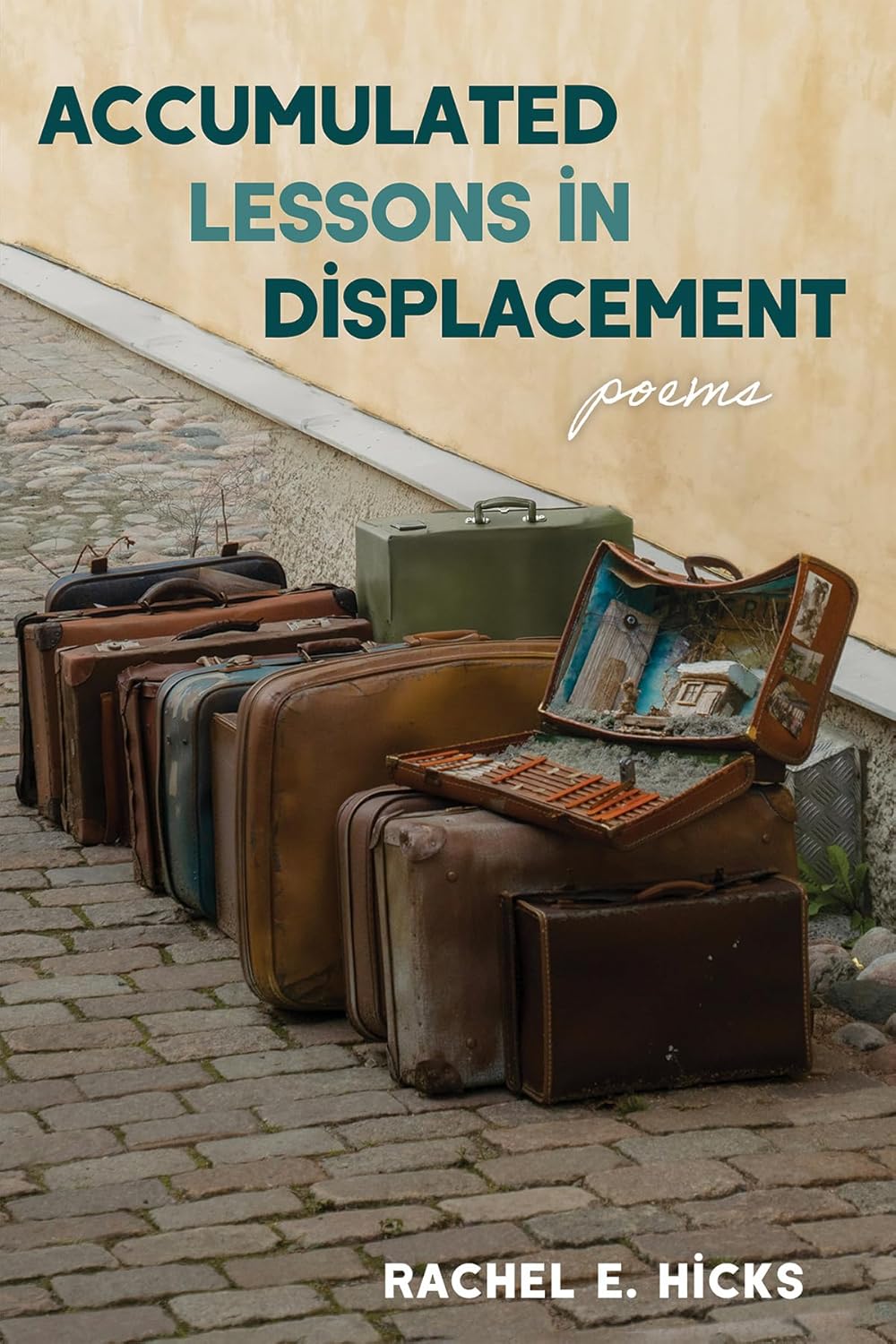
Accumulated Lessons in Displacement

In her debut poetry collection, Accumulated Lessons in Displacement (Wipf & Stock / Resource Publications, 2025), Hicks grapples with the experience of being a “perpetual pilgrim”—on her way to a particular place but also attuned to the significance of each moment along the way. “Pilgrims learn to walk a life of paradox: even though their hearts are set on their final destination, they walk through each day alive to its possibilities, people and lessons,” she wrote in a 2014 blog post.

What is “home”? How can we bear to leave home, whether forced to do so by war, famine, or natural disaster, or we choose to for opportunity or ministry? What do we do with feelings of alienation when we find ourselves in a culture not our own or in which we don’t fit well? How do we live cross-culturally? How do we make a home where we’re at? What are our responsibilities to place? Who is our neighbor?

“I believe that many—all?—of us live our lives with some sense of exile,” Hicks writes on her blog. “We experience it and are aware of it to varying degrees, but it’s there. So many of our quests, our longings, our purpose-seeking, and the stories we create and tell are about trying to find our way home. Home being that place—literal or figurative—in which we feel wholeness and true belonging.”

Accumulated Lessons is divided into two parts: “Bright Sadness, Bitter Joy” and “A Deeper Knowing.” The term “bright sadness”—a translation of the Greek word charmolypê—comes from the Eastern Orthodox tradition, and it describes the paradoxical state of mourning over sin while rejoicing in God’s grace. It can also describe the paradox of living a life of joy amid suffering.

I was trying to learn the word for joy

that settles awkwardly in grief’s nest, an oversized bird.
I didn’t want to scare it away.

So says the speaker in the book’s title poem, “Accumulated Lessons in Displacement.” Unfolding over eight sections, this persona poem draws on Hicks’s own experience of abrupt displacement from Kinshasa as a teenager, as well as the experiences of Bosnian refugee friends, and Syrian refugees she had only read about in the news.

It opens with a reflection on “home” in all its ordinariness—the yellow coffee cup, the dusty houseplant, the sunlit window seat—and laments that “no footpath exists leading back to these things,” which, the reader is led to presume, have been destroyed by armed conflict, or its residents blocked from returning by threat of death.

The poem contains several arresting images, like the green threads of a sweater on barbed wire tracing a path across miles. A boy who collects bullet casings to make a necklace for his sister. Charred diary pages dancing around a blown-out living room, “ma[king] a strange poem in my heart.”

Hicks wrestles with the savage violence humans are capable of:

It makes no sense that a soldier can press a button

and somewhere a baby ignites into flame.
And he goes home and brushes his teeth.

What we do to each other, to other created souls.
Always I carry this burden like a child on my hip.

Another powerful poem in the collection is “Visit to Sarajevo,” where Hicks describes visiting the Bosnian-Herzegovinan capital with her friend Dragan, who was forced to flee it as a young married adult with a child in the 1990s after the city was besieged by Serbian forces. Hicks had met Dragan and his family in 2000 through her husband, Jim, who worked alongside him at a refugee resettlement agency in Phoenix, Arizona, and the families became close. Meeting up years later in Dragan’s hometown, Dragan leads Hicks through the once-familiar streets “in a haze of pride, nostalgia, nightmare,” giving her a tour of sites both historically significant and deeply personal.

Hicks’s passport country too has its national traumas, one of which was precipitated by 9/11, when in 2001, terrorists flew planes into the World Trade Center in New York City, killing almost three thousand people. In “Disaster Chaplaincy Training,” she describes a course she took, taught by a Ground Zero worker, to become further equipped for her work in China, which was focused on disaster preparedness and response. In the course, she learned how to “loiter with intent” in zones of disaster, “acclimat[ing] to [suffering’s] pungency.” Make sure, said the instructor, to “let them see you cupping a small ball / of hope—toss it up, catch it.”

Nationwide crisis struck the US again when on April 12, 2015, a young Black man from Baltimore, Freddie Gray, died of a spinal cord injury while in police custody, allegedly due to police brutality—though none of the six involved officers was ultimately held responsible. Gray’s death led to civil unrest in Baltimore (which Hicks had recently made her home) and throughout the country, as citizens demanded recognition, in word and practice, that “Black lives matter.”

Hicks wrote “The Morning After Freddie Gray’s Funeral” while Baltimore was on lockdown. Fumbling for words, she tries to explain to her children what’s going on as she, too, tries to educate herself more deeply about the history of racism in America and the longstanding grievances of the Black community she lives in. In the poem, she harvests mint from her garden to brew a gallon of black mint tea to share with her neighbor—

             as what? An offering, apology?

A way to say I’m trying—learning
about all that fuels these fires still
smoldering this hushed morning?

The staining of the clear water as the tea steeps becomes a metaphor.

Accumulated Lessons in Displacement addresses global suffering, more localized suffering, as well as personal and family suffering.

One example of the latter has to do with Hicks’s daughter’s diagnosis, following an ankle sprain, with complex regional pain syndrome (CRPS), Ehlers-Danlos syndrome (EDS), and postural orthostatic tachycardia syndrome (POTS), chronic conditions that cause extreme nerve pain. “Bright Sadness” describes a return car ride from a fruitless medical visit, her daughter crying and gasping in agony in the back seat, when offhandedly, Hicks insists, “Turn your cries into opera!” This unexpected and ridiculous suggestion defuses, if for just a moment, the intense situation, resulting in “joy-laughing” amid plaintive contralto tones all the way home.

“Post-Miracle (I)” celebrates her daughter’s miraculous healing, holds the strange, tentative, empty-handed feeling of a fervent prayer request graciously granted. But then comes “Post-Miracle (II),” written when, after two months of her daughter being pain-free, the CRPS returned. Hicks wrestles with gratitude for the brief reprieve and anger at God’s “undoing” the miracle. She wonders about some of the healings Jesus performed in the Gospels, and whether they stuck.

“Post-Miracle (II)” is one of the few poems in the collection with end rhyme, each quatrain following an abba pattern. Perhaps the choice to work with a rhyme scheme for this particular subject represents, consciously or subconsciously, her attempt to make things rhyme again, to harmonize the reality of chronic pain with a good and loving God, to impose structure on the chaos.

Several of Hicks’s poems engage with biblical stories: the Suffering of Job, the Parable of the Prodigal Son, the Massacre of the Innocents, Zacchaeus encountering Jesus, the Walk to Emmaus. She performs poetic midrash, imaginatively interpreting and expanding the texts to connect with them on a deeper level.

Besides the biblical authors, some of her literary conversation partners in this collection are Frederick Buechner, Henri Nouwen, Simone Weil, Czesław Miłosz, Dostoevsky, G. K. Chesterton, Gregory of Nyssa, Paul Kingsnorth, and Karen Blixen.

Although there’s a heaviness to much of the material, it’s not overwhelming, as small graces are woven throughout: complimentary walnuts from a fruit shop owner on a winter Sunday; laughter over language barriers; refreshment from a water hose; the scent of turmeric and cardamom at a Punjab store in Baltimore, reminders of the poet’s birthplace; “the comfort of the priest’s thick thumb / upon my forehead, the signature of / Jesus,” on Ash Wednesday; dandelions and buttercups brushing ankles; a cairn at West Clear Creek; the monks at Great Lavra, Greece, making room for the dispossessed; bundles of sheep ascending limestone slopes at dawn in the Cotswolds; the delightful word cusp; her son’s euphoria upon gliding down a mountain on skis; the slow labor of opening a pomegranate and obtaining its ruby-red seeds for her daughter to eat.

The book is shot through with joy—a joy that coexists with suffering and that is sustained through faith.

“These are poems to live by—to help you stay human, love people, find joy in sorrow, pay attention to the world around you, open yourself to God, welcome mystery, and understand our times at a deeper level,” Hicks wrote in an email announcing the launch of the book. “You’ll journey all around the world and find it—in spite of its sorrow—full of beauty and worth loving.”

One of my favorite poems is “Just Before,” a perfect reading for the upcoming Advent season. It spans four cities of the world—places where people work, play, pray, and rest; places of economic disparity, of spiritual longing as well as mundane concerns—in each imagining the moment just before Jesus returns. In the midst of our threshing corn or lighting a lamp or settling a legal dispute or herding sheep, Jesus will come with a beauty that blossoms all the way out to the horizon, calling all nomads home.

“Just Before” by Rachel E. Hicks

When Jesus comes again
in all his glory, somewhere in
the Sichuan mountains tires will crackle
over corn spread out on the road—
easy threshing—while a small child
urinates in the gutter, absorbed
in watching the car shoot by.

As the first rent opens
a fingernail tear in the hazy sky,
a woman in the foothills above Rishikesh
will lay down her firewood burden
and light the clay Diwali lamp
in the chilling dusk,
circling her cupped hands in blessing.

In the pause before the clamor
of heaven’s trumpets,
the jurors’ waiting room in Baltimore’s
civic court will throb with the quiet
turning of pages, a buzzing phone
in the hand of a tired man, berating
himself for forgetting to bring coffee.

Just before we are aware of him,
Jesus will pause to survey the view;
two shepherd boys amidst boulders
in the Wadi Rum hills south of Amman
wipe sleep from their eyes and stand amazed
at the blood-red poppies at their feet
stretching to the eastern horizon.


Purchase Accumulated Lessons in Displacement here. (Update, 11/14/25: Wipf & Stock is offering a 50% discount through November 30, 2025; use code CONFSHIP at checkout. Media mail shipping is free.)

“Just Before” is reproduced with permission from Wipf and Stock Publishers, www.wipfandstock.com.
Kolumba and KMSKA: Medieval and contemporary art in conversation (part 2)

This a continuation of yesterday’s article. In part 1 I shared three room highlights from my visit to Kolumba museum in Cologne, Germany, run by the city’s Catholic archdiocese; in this final part I will do the same for KMSKA in Antwerp, Belgium, whose Old Masters galleries received a “contemporary injection” in an exhibition that wrapped this week. All photos are my own.

[Content warning: This article contains female nudity: a controversial Renaissance painting of the Virgin Mary, and three photographs of women who have just given birth.]

KMSKA, Antwerp

The Royal Museum of Fine Arts Antwerp, or KMSKA for short, is a world-famous museum whose collection spans seven centuries, from the Flemish Primitives to the Expressionists.

When I was there last month, the featured exhibition was Collected with Vision: Private Collections in Dialogue with the Old Masters, which ran from April 4 to October 12, 2025. Organized in conjunction with Geukens & De Vil Projects, it interwove postwar and contemporary works by internationally renowned artists from Belgian private collections with the existing museum collection, “expanding the transhistorical approach already in place. The exhibition offers a reflection on the history of art collecting and asks probing questions about social issues such as gender, power and identity. The role of museums and collectors is the focal point. Do the interventions create a harmonious dialogue with 700 years of art history, or do they give rise to challenging contrasts?” Featured artists included Cindy Sherman, Olafur Eliasson, David Claerbout, Francis Alys, Christian Boltanksi, Tracey Emin, Marlene Dumas, Luc Tuymans, and Louise Bourgeois.

The galleries of the exhibition were organized by theme: Holy, Impotence, Horizon, Image, Entertainment, Profusion, Lessons for Life, Fame, The Salon, Heroes, Evil, The Madonna, Suffering, Redemption, Prayer, Heavens, and Power.

I’ll spotlight what I consider the most successful and intriguing pairings.

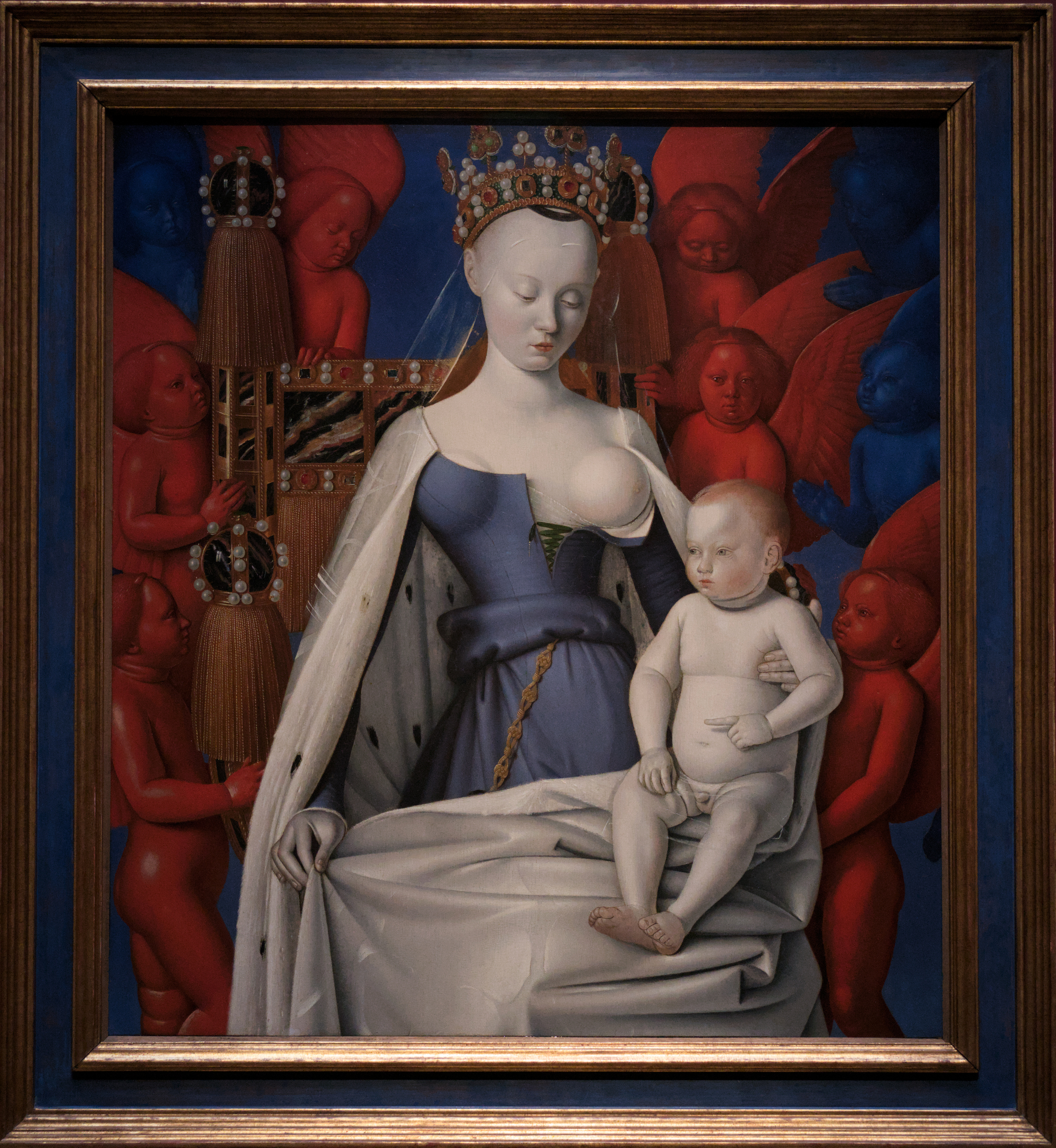
First, the “Madonna” room, anchored by the famous Madonna Surrounded by Seraphim and Cherubim by the late medieval French court painter Jean Fouquet. It’s the right wing of a diptych that originally hung above an altar at the Collegiate Church of Notre-Dame in Melun.

Fouquet, Jean_Madonna Surrounded by Seraphim and Cherubim
Jean Fouquet (French, 1410/30–1477/81), Madonna Surrounded by Seraphim and Cherubim, ca. 1450. Oil on panel, 92 × 83.5 cm. Koninklijk Museum voor Schone Kunsten Antwerpen (KMSKA, Royal Museum of Fine Arts Antwerp).

The painting is historically significant—I first encountered it in a college art history course. Commissioned by Etienne Chevalier, treasurer to King Charles VII of France, it portrays the Virgin Mary as the Queen of Heaven, baring her breast ostensibly to nourish the Christ child with her milk. She was probably modeled after Agnès Sorel, the king’s recently deceased mistress and mother of three of his daughters, considered the ideal of feminine beauty at that time in western Europe: pale-skinned, with a high forehead, and fashionable in her ermine cloak.

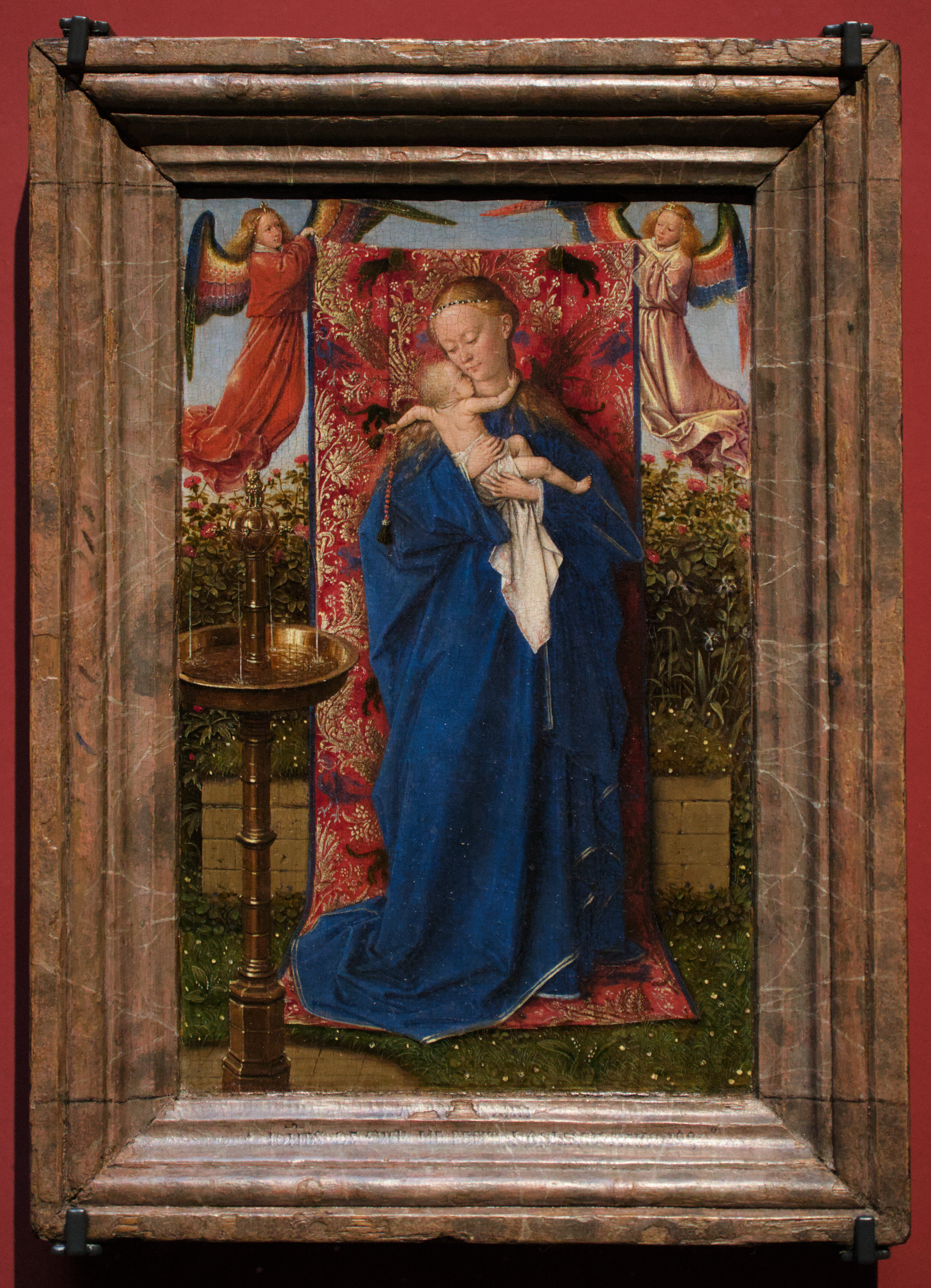
Though I can appreciate the technical excellence of this painting and the intense reds and blues of the angels, I don’t really like it. Mary seems cold, not very maternal. There’s also an eroticization of her body—not because her breast is exposed, which was common in Marian art, but because it seems to be on display for the viewer; her son’s not interested in feeding—that’s wholly inappropriate for the subject. Why you’d want to memorialize your boss’s sex partner in such a way is beyond me. I’m no prude, but I much prefer Jan van Eyck’s Madonna at the Fountain, on display in the same room:

van Eyck, Jan_Madonna at the Fountain
Jan van Eyck (Flemish, 1390/99–1441), Madonna at the Fountain, 1439. Oil on panel, 19 × 12 cm. Koninklijk Museum voor Schone Kunsten Antwerpen (KMSKA, Royal Museum of Fine Arts Antwerp).

This small painting originally hung not in a church but in someone’s house. Though there’s still an air of formality, it has all the tenderness and connection that the other one lacks. Mother and son embrace in a garden of roses, irises, and lilies of the valley, he reaching round her neck and holding a string of prayer beads, she gazing adoringly at him. They stand beside a fountain, recalling Jesus’s discussion in John 4 about the “living water” he gives to those who thirst. The original wood frame bears the artist’s motto: “As well as I can.”

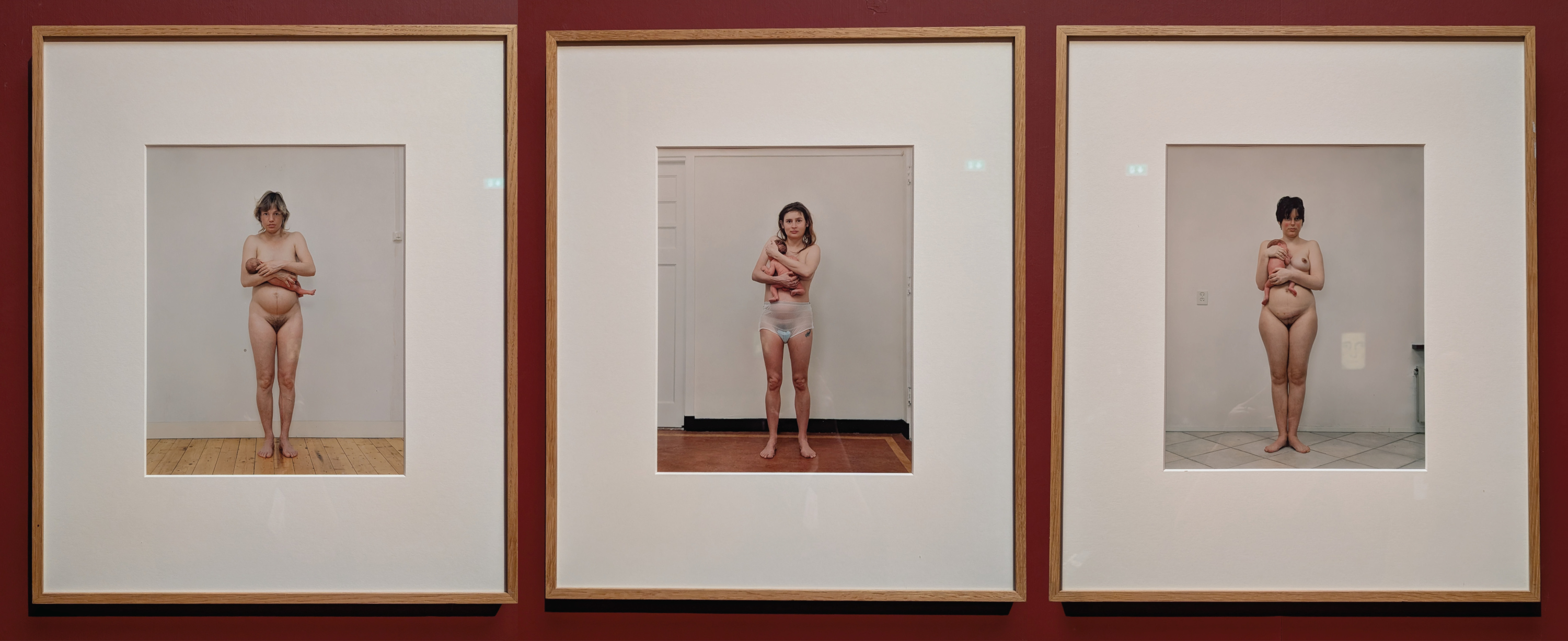
The deeply engrained portrait of motherhood embodied by the Virgin Mary is juxtaposed most potently with a series of three black-and-white portraits of new mothers by the Dutch photographer Rineke Dijkstra.

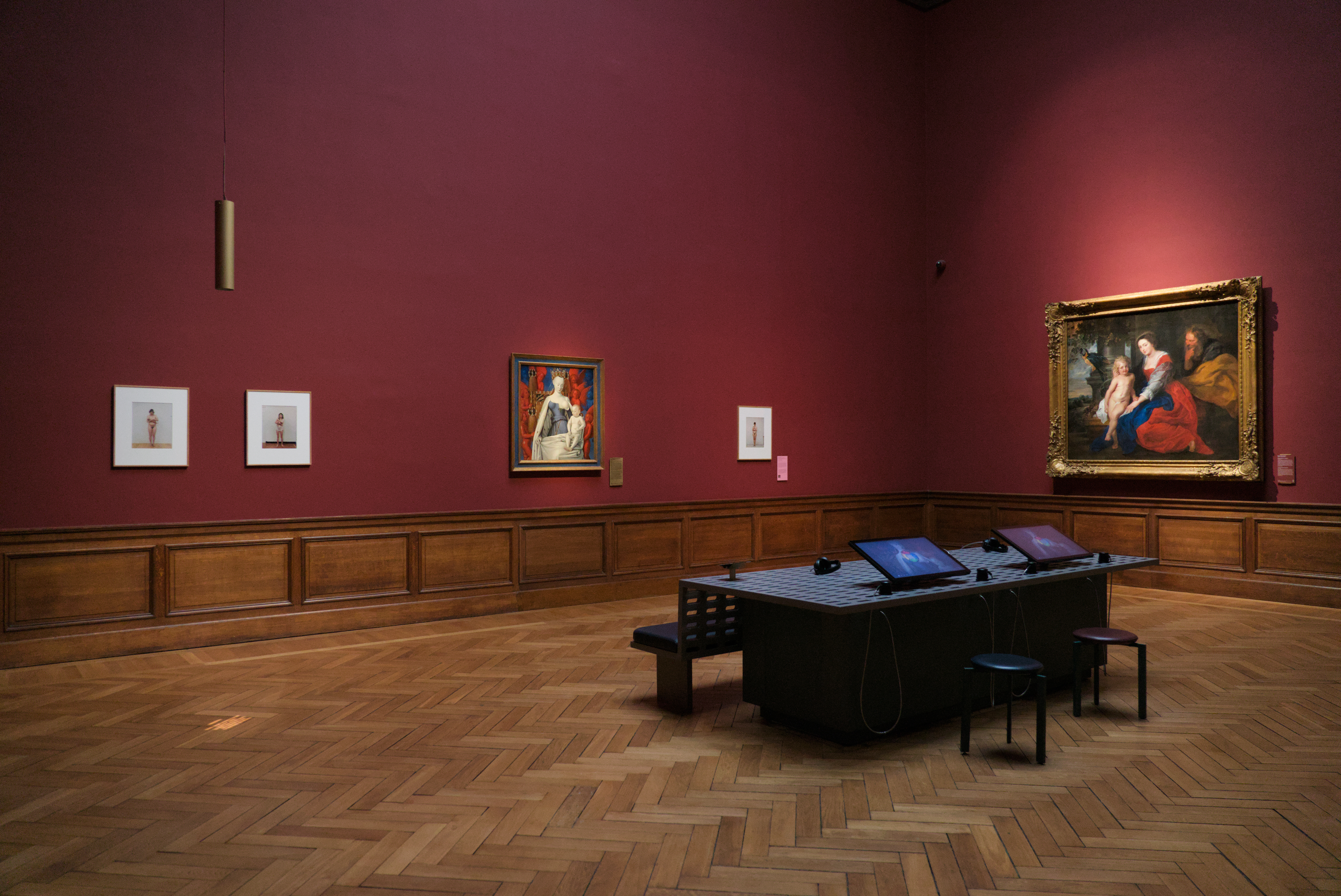
"Madonna" gallery
Gallery 2.17 (“The Madonna”) from the KMSKA exhibition Collected with Vision: Private Collections in Dialogue with the Old Masters

The accompanying text read:

Jean Fouquet portrays motherhood as something sacred. Mary as a symbol of purity and devotion is richly dressed in cool colours. Rineke Dijkstra homes in on the vulnerable reality. Her mothers are scantily clad and marked by childbirth. Both works are innovative: Fouquet may have painted his Mary for the first time from a real person, and in its day the painting was regarded as ‘modern’. Dijkstra shows motherhood in all its rawness, a taboo usually withheld from view.

Dijkstra, Rineke_New Mothers
Rineke Dijkstra (Dutch, 1959–), Tecla (Amsterdam, The Netherlands), Julie (Den Haag, The Netherlands), and Saskia (Harderwijk, The Netherlands), 1994. Digital prints. Private collection. [Composite photo by author]

Julie wears hospital pads and mesh underwear, which women often do for several weeks after giving birth to manage postpartum bleeding and urinary incontinence. As for Tecla, blood is running down her leg. And Saskia bears a scar from her cesarean section. A linea nigra (dark line) zips down the abdomen of all three, a temporary pigmentation increase caused by increased hormone levels. I love this triptych that shows motherhood’s glorious, messy, alterative impact on the body—the real physicality of the vocation of bearing children into the world.

I wish there were more imagery of Mary like this, as it would, I think, deepen the wonder of the Incarnation and enhance women’s ability to identify with Mary and thus further enliven her story.

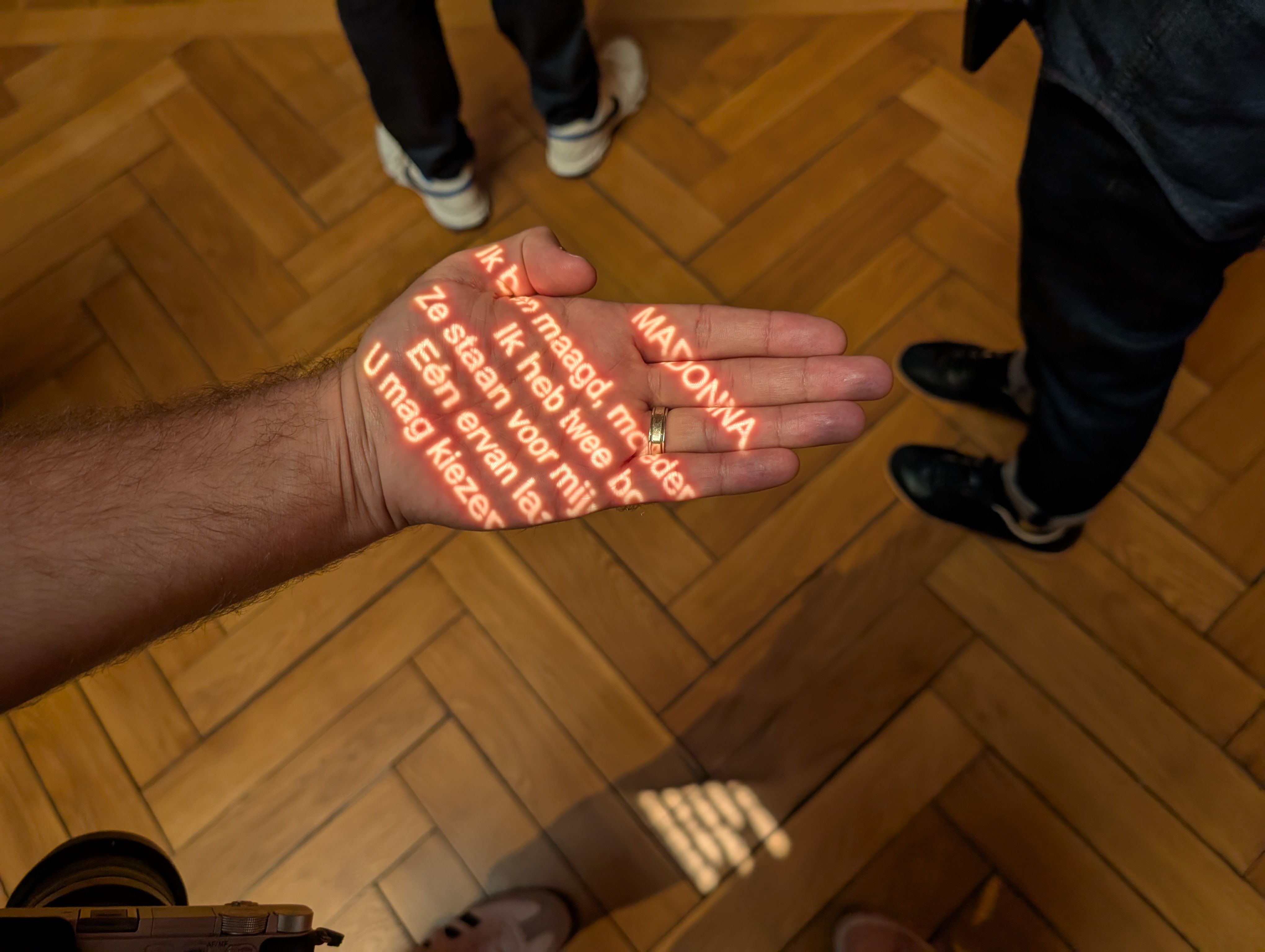
Also in the Madonna gallery was a unique “light poetry” installation by Nick Mattan and Angelo Tijssens—one of seventeen spread throughout the second floor, collectively titled Licht dat naar ons tast (Light that reaches for us). KMSKA had commissioned this couple to bring to life the short verses the museum’s late writer-in-residence Bernard Dewulf had written in response to the galleries’ stated themes.

“Inspired by the museum’s many reading and praying figures, as well as James Ensor’s expressive hand sketches, [Mattan and Tijssens] sought a subtle way to make [Dewulf’s] words tangible,” the museum writes. Their solution was to project them onto the gallery floors from brass cylinders suspended from the ceiling. The words shine like faint specks of light, becoming legible only when a visitor holds their hands, a sweater, or something else up to the light.

Here my husband “holds” a poem written in the voice of Mary:

Light that reaches for us
Nick Mattan (Belgian, 1987–) and Angelo Tijssens (Belgian, 1986–), Licht dat naar ons tast (Light that reaches for us), 2023, featuring seventeen poems by Bernard Dewulf. Commissioned by and permanently installed at the Koninklijk Museum voor Schone Kunsten Antwerpen (KMSKA, Royal Museum of Fine Arts Antwerp).

“Madonna” by Bernard Dewulf

Virgin, mother, wife –
I have two breasts
that stand for my three souls.
I show you one of them,
and whose it is is yours to choose.

Translated from the original Dutch by David Colmer

Kind of cheeky! Dewulf speaks of Mary’s three identities and lets us decide if the breast she bares in Fouquet’s painting represents her naked innocence, her nurturing impulse, or her desire to please her husband. (Traditionally in art, it has always stood for the second.)

Though I can’t read Dutch and thus had to consult the KMSKA app for translations of the poems, the thrill of discovery was there in each room. View other visitor engagements with Licht dat naar ons tast on Instagram.

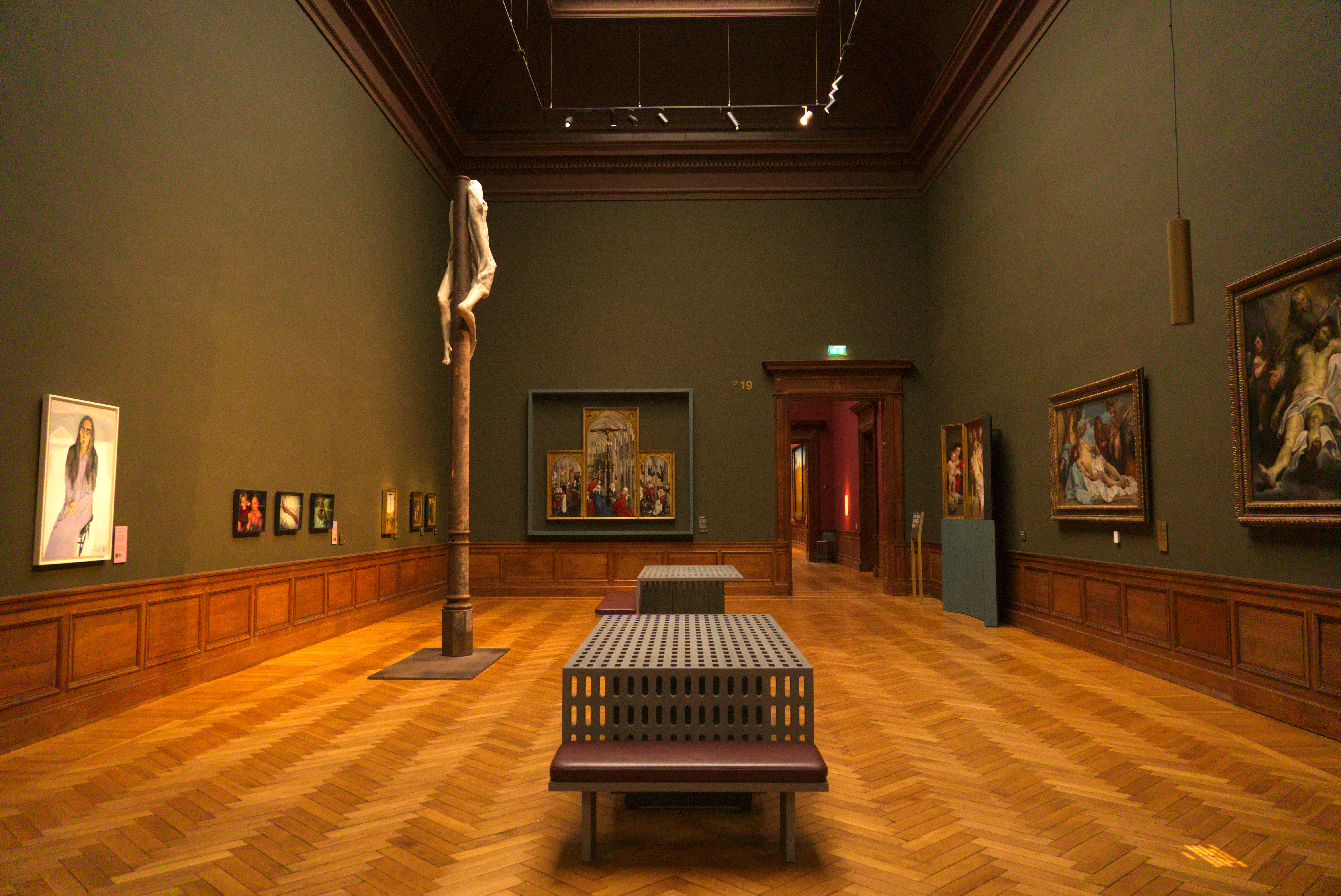
The next gallery I entered was themed “Suffering.”

Suffering gallery
Gallery 2.19 (“Suffering”) from the KMSKA exhibition Collected with Vision: Private Collections in Dialogue with the Old Masters

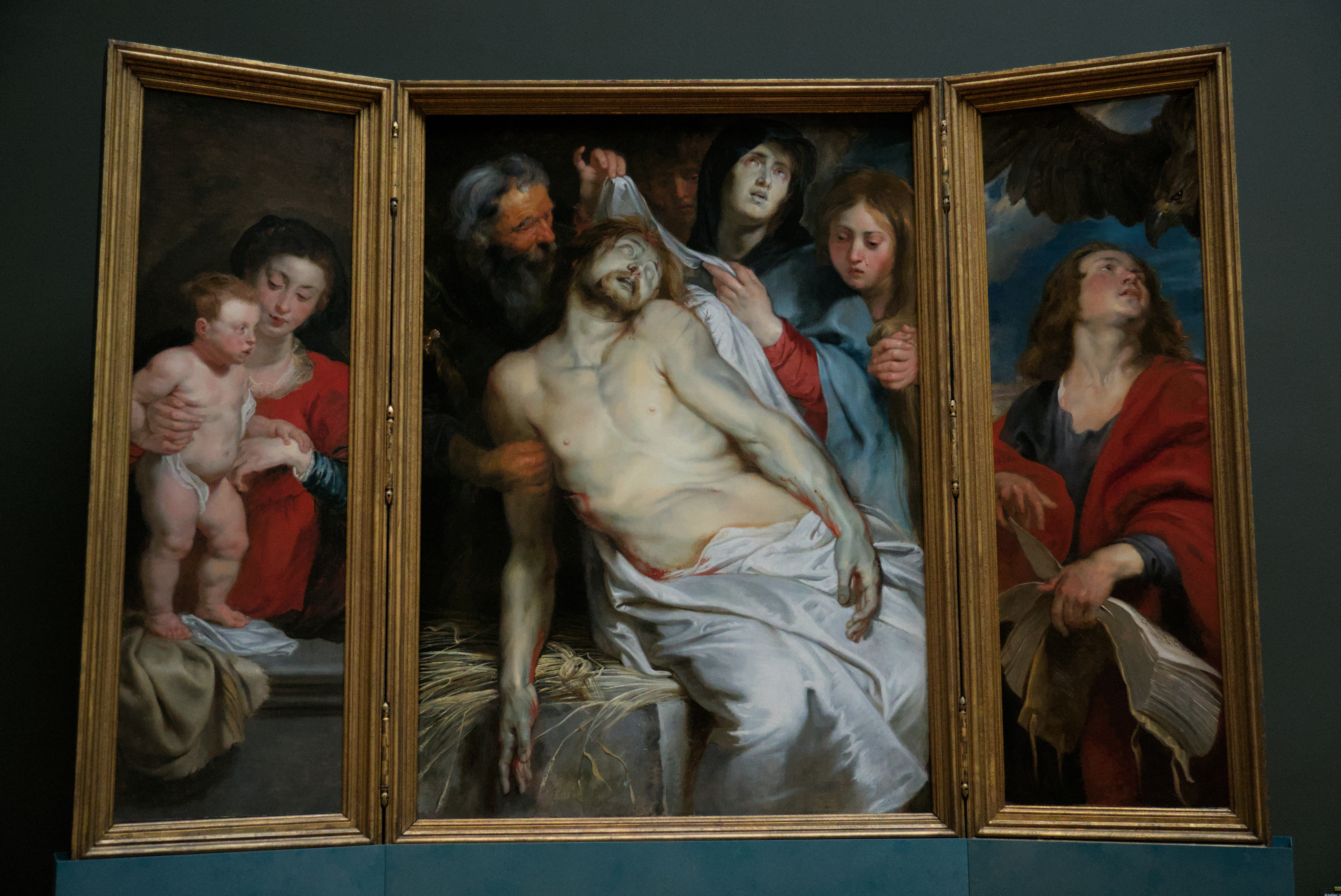
As one would expect, it’s inhabited by several Old Master paintings of Christ’s passion, most notably a triptych by the Flemish Baroque artist Peter Paul Rubens.

Rubens, Peter Paul_Christ on the Straw
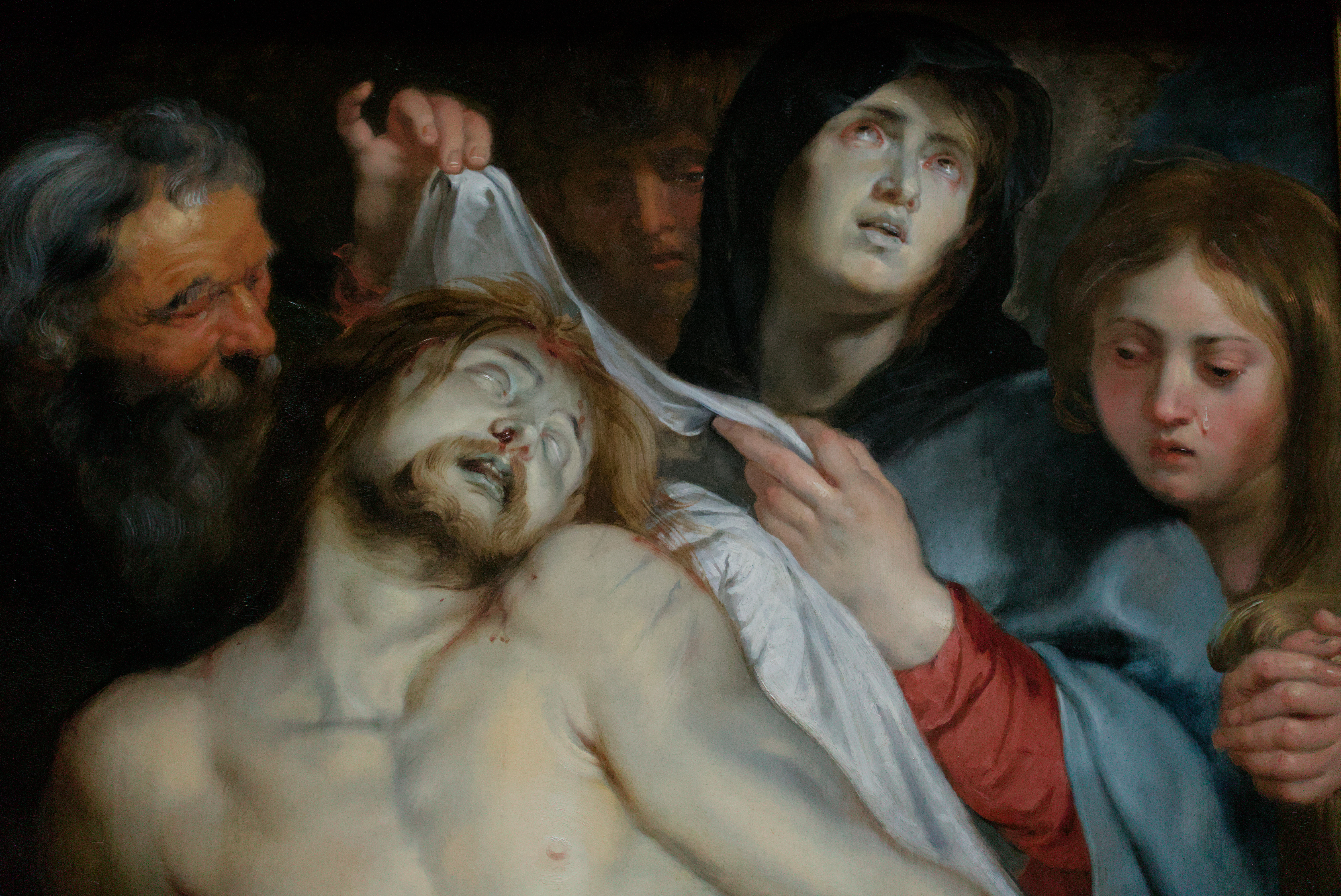
Peter Paul Rubens (Flemish, 1577–1640), Epitaph of Jan Michielsen and His Wife Maria Maes (aka Christ on the Straw, Madonna, and Saint John), 1618. Oil on panel, 138 × 178 cm. Koninklijk Museum voor Schone Kunsten Antwerpen (KMSKA, Royal Museum of Fine Arts Antwerp).

Rubens, Peter Paul_Christ on the straw (detail)

The central panel shows the dead Christ being laid out on a marble slab and wrapped in a shroud by Joseph of Arimathea, while his mother and Mary Magdalene (and the apostle John in the background) mourn him. The left wing shows Mary supporting the pudgy little baby Jesus as he takes some of his first steps, while the right wing shows John, whose symbol is the eagle, writing his Gospel that will place Jesus’s death in the context of the larger story of his life of ministry and his resurrection.

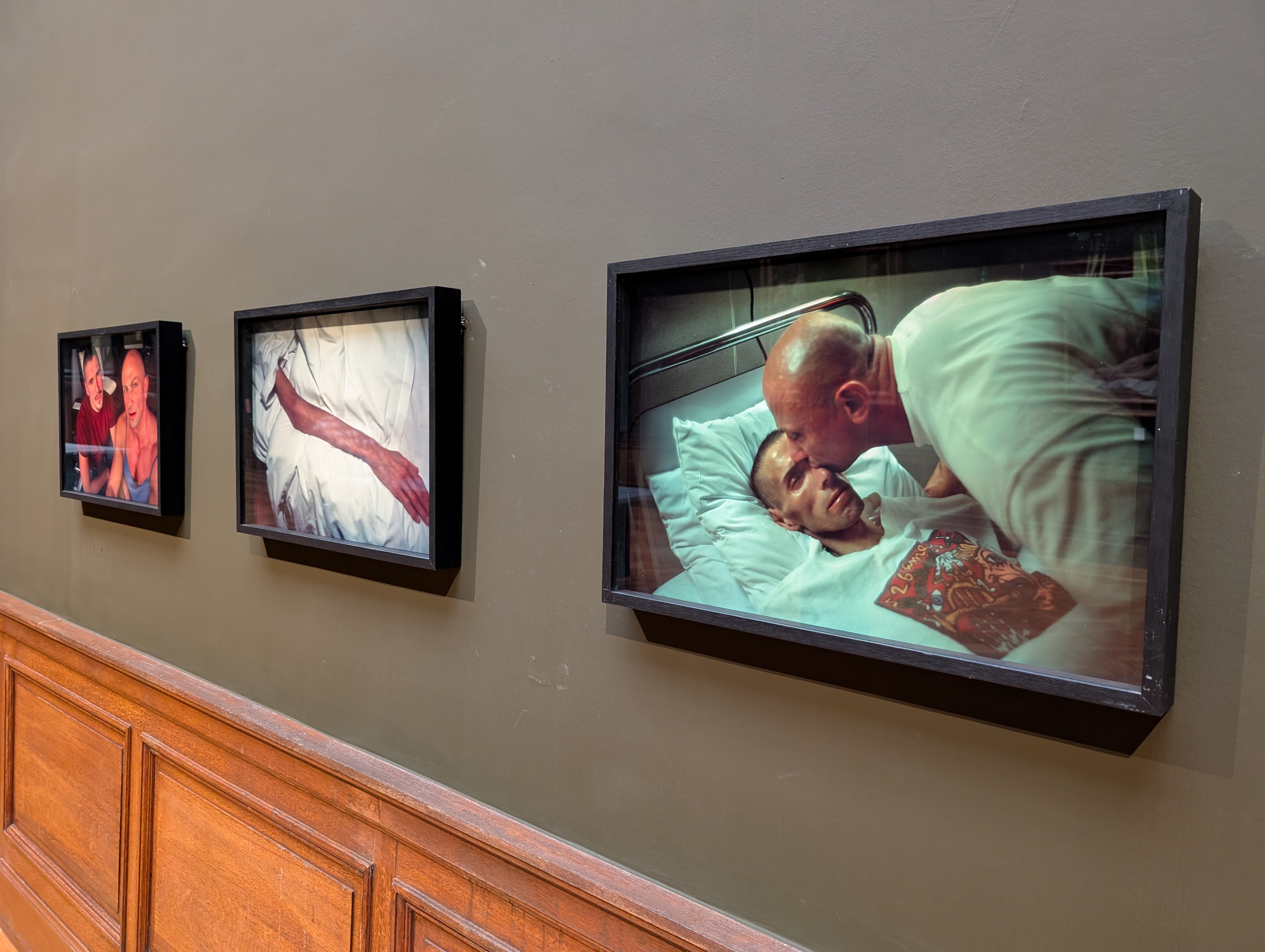
This painting, along with Anthony van Dyck’s Lamentation over the Dead Christ and The Holy Trinity by a follower of Rubens’s (which shows God the Father cradling the dead body of God the Son in an image type sometimes referred to as the Mystic Pietà), are juxtaposed with three photographs by Nan Goldin that show the impact of AIDS on her friend, the Parisian gallery owner Gilles Dusein, and his partner, the artist Gotscho.

Photos by Nan Goldin
Nan Goldin (American, 1953–), Gilles in Hospital, Gilles’ Arm, and Gotscho Kissing Gilles, 1993. C-prints. Private collection.

Dusein’s emaciated arm, resting weakly on a hospital sheet, recalls the limp arm of Christ in paintings of the Deposition and Entombment; and Gotscho’s kiss, the love and grief of Jesus’s mother and friends as they watched their loved one suffer and succumb to death.

By displaying these disparate artworks from vastly different contexts across from each other, we are encouraged to draw connections between the suffering of Christ and that of the LGBTQ+ community. While Christians in Rubens’s day would sit before images of Jesus in pain or sorrow or having died a torturous and untimely death, and deepen their empathy and love, so too might we do well to sit prayerfully, humbly, empathetically, with contemporary images of suffering, seeking to enter the stories they tell.

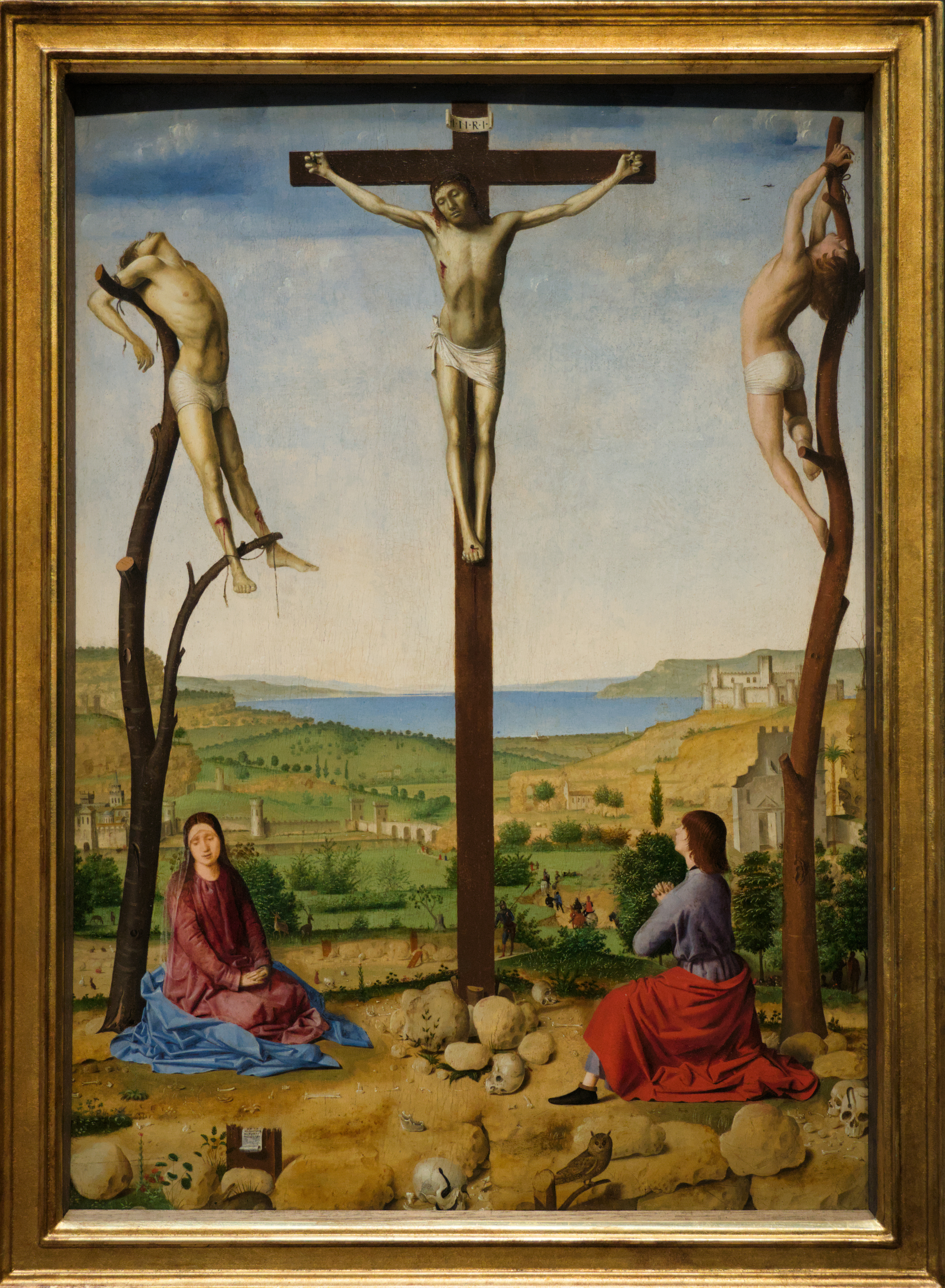
Calvary by Antonello da Messina (another version of which is at the National Gallery in London) also hangs in this gallery. While the crucified Christ seems at peace with his death, the other two on their crosses writhe in pain.

Antonello da Messina_Calvary
Antonello da Messina (Italian, 1430–1479), Calvary, 1475. Oil on panel, 52.5 × 42.5 cm. Koninklijk Museum voor Schone Kunsten Antwerpen (KMSKA, Royal Museum of Fine Arts Antwerp).

Antonello da Messina_Calvary (detail)

Compare these figures to contemporary Belgian artist Berlinde de Bruyckere’s Schmerzensmann (Man of Sorrows), on loan from the collection of David and Indré Roberts (see wide-view photo above). The piece consists of a wax and resin mold of a contorted human form, its skin stretched and broken, its legs wrapped around a tall rusty pole.

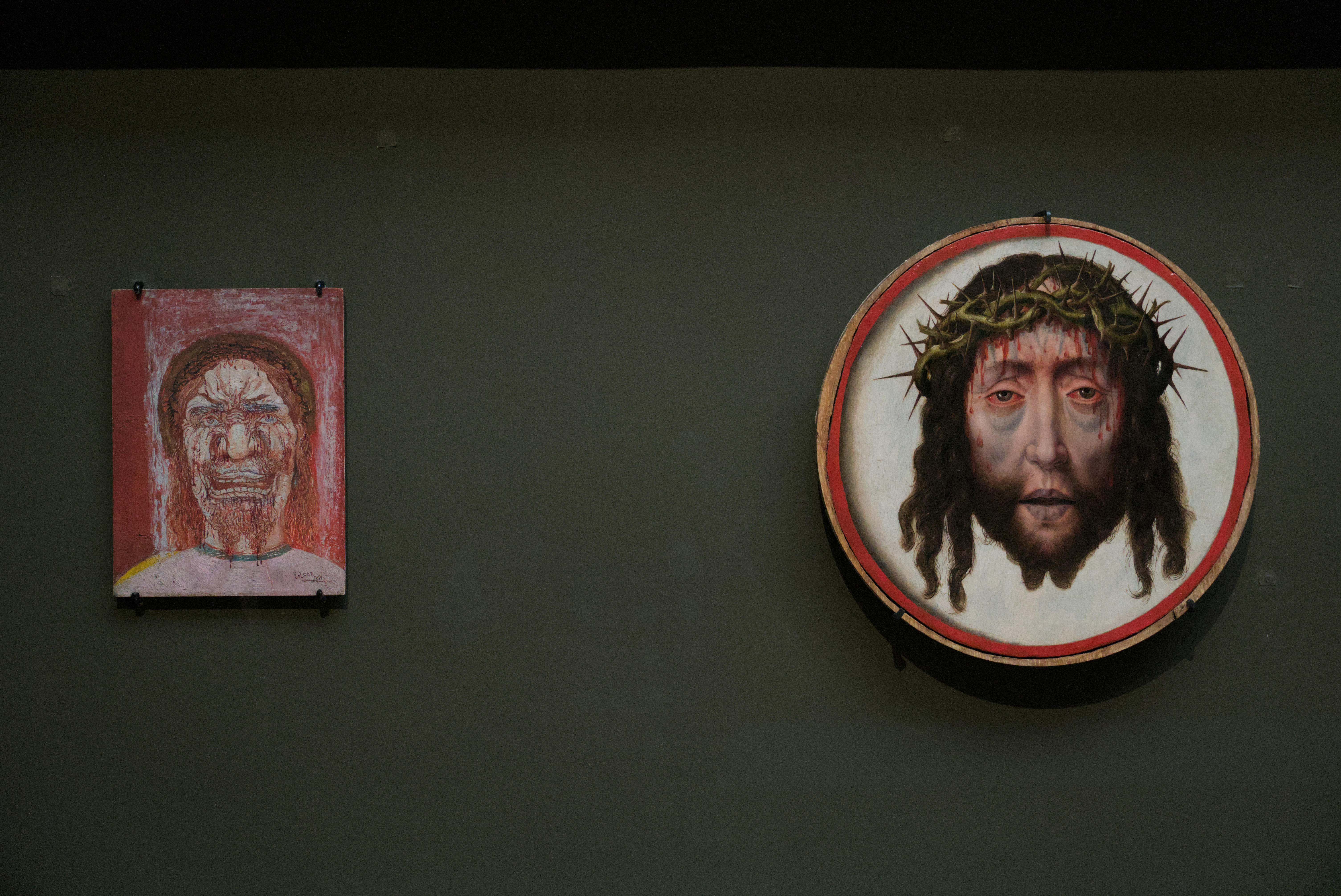
“Man of Sorrows” is also the title of an Early Netherlandish painting by Albrecht Bouts and a modern painting by James Ensor, which KMSKA displays side-by-side.

Bouts, Albrecht_Man of Sorrows
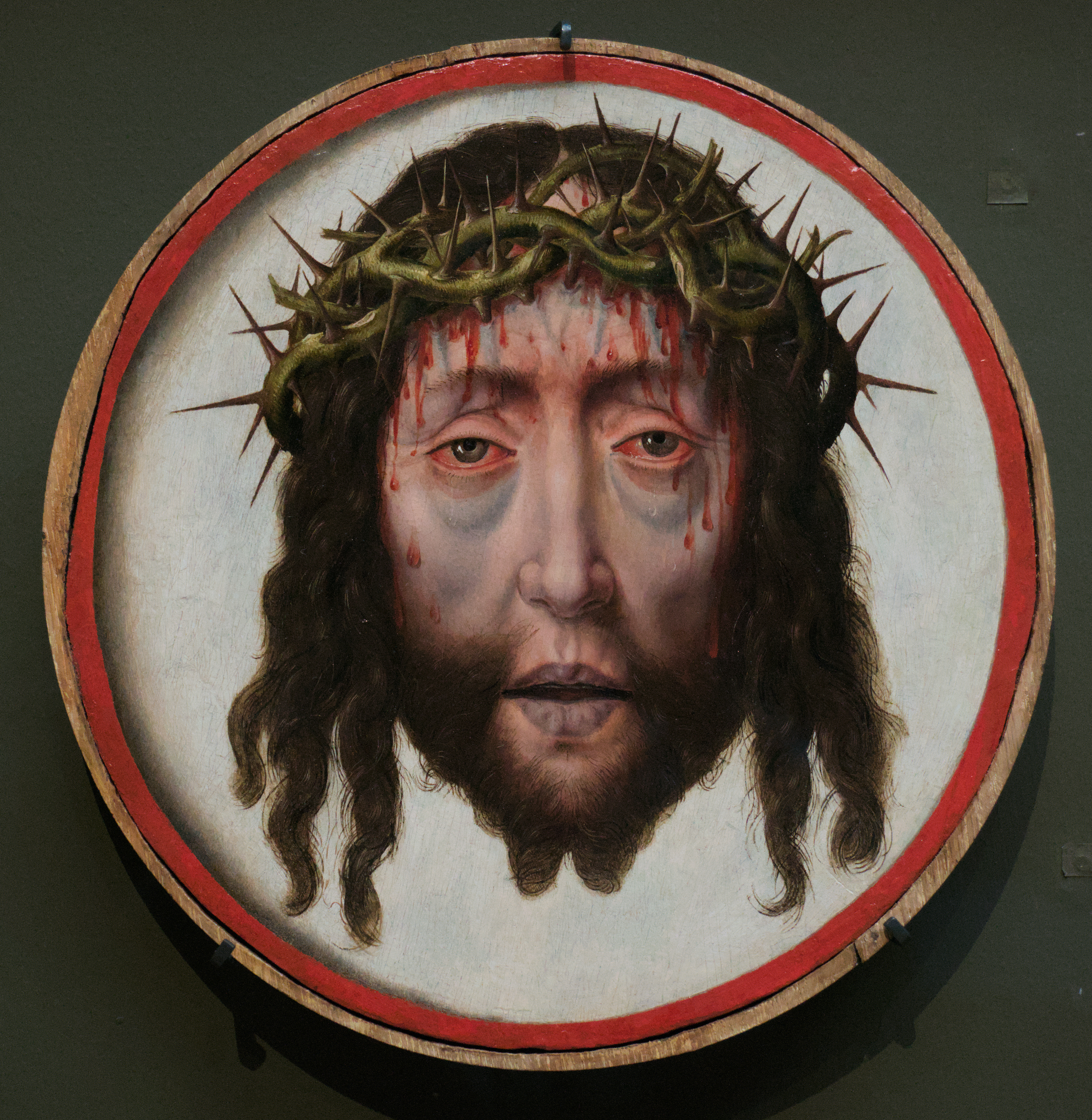
Albrecht Bouts (Flemish, 1451/55–1549), Man of Sorrows, 1500–1525. Oil on panel, diameter 29 cm. Koninklijk Museum voor Schone Kunsten Antwerpen (KMSKA, Royal Museum of Fine Arts Antwerp).

The earlier one is an incredibly moving image of pathos. Christ wears a thick, twisted, mock crown whose thorns dig holes into his forehead and draw blood. His eyes are red with tears and sunken in, and his lips are turning blue with the pallor of death. I find it quite beautiful, insofar as an image of suffering can be beautiful. (That’s a topic for another day.)

Ensor, James_Man of Sorrows
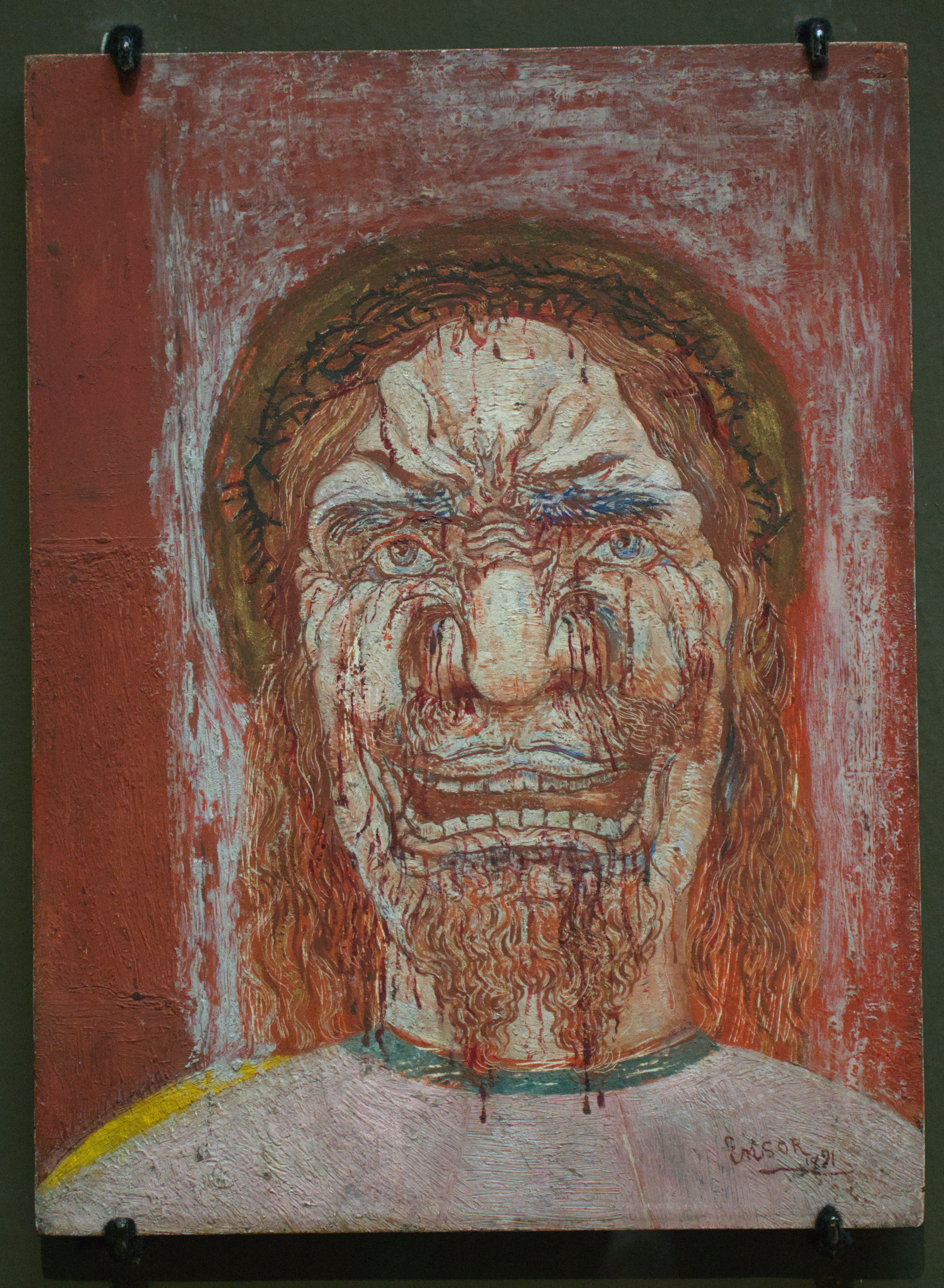
James Ensor (Belgian, 1860–1949), Man of Sorrows, 1891. Oil on panel, 20 × 15.5 cm. Koninklijk Museum voor Schone Kunsten Antwerpen (KMSKA, Royal Museum of Fine Arts Antwerp).

The Ensor painting, on the other hand, is decidedly not beautiful. In fact, I think it’s the ugliest image of Christ I’ve ever seen, with his crumpled face, scraggly hair, and bared teeth. There’s something very unsettling about his expression, and no wonder, as the curatorial text informs that Ensor drew inspiration from the masks of demon characters in Japanese theater. “His [Ensor’s] Jesus screams with rage about the injustice inflicted on him,” the label says. Is that what that expression is? To me he looks sinister. Like he’s growling at us. And I dislike his dinky crown that he wears like a headband; give me Bouts’s gnarly one instead.

I’m in favor of Christ images that show the rage he must have felt, but I don’t think Ensor is successful if that was his aim. To name a few modern artists who were: Guido Rocha (Tortured Christ, 1975) and David Mach (Die Harder, 2011), both of whom capture Jesus’s cry of dereliction on the cross.

The final themed gallery I’ll call out is “Heavens.”

Heavens gallery
Gallery 2.22 (“Heavens”) from the KMSKA exhibition Collected with Vision: Private Collections in Dialogue with the Old Masters

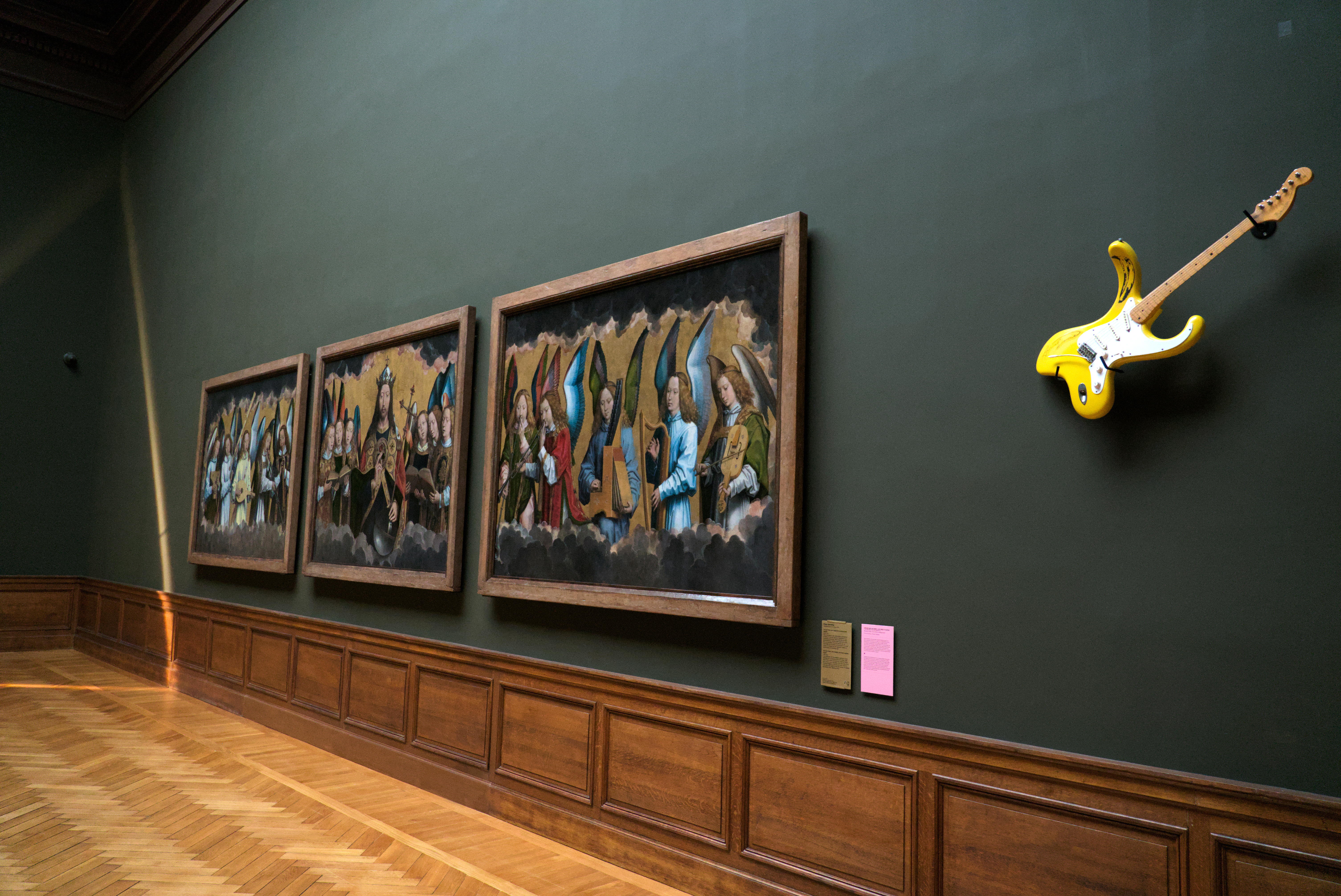
The dominant Old Master work is a set of three panels from the upper tier of a colossal altarpiece that Hans Memling painted for the church at the Benedictine Abbey of Santa Maria la Real in Najera in northern Spain. All the other panels are lost.

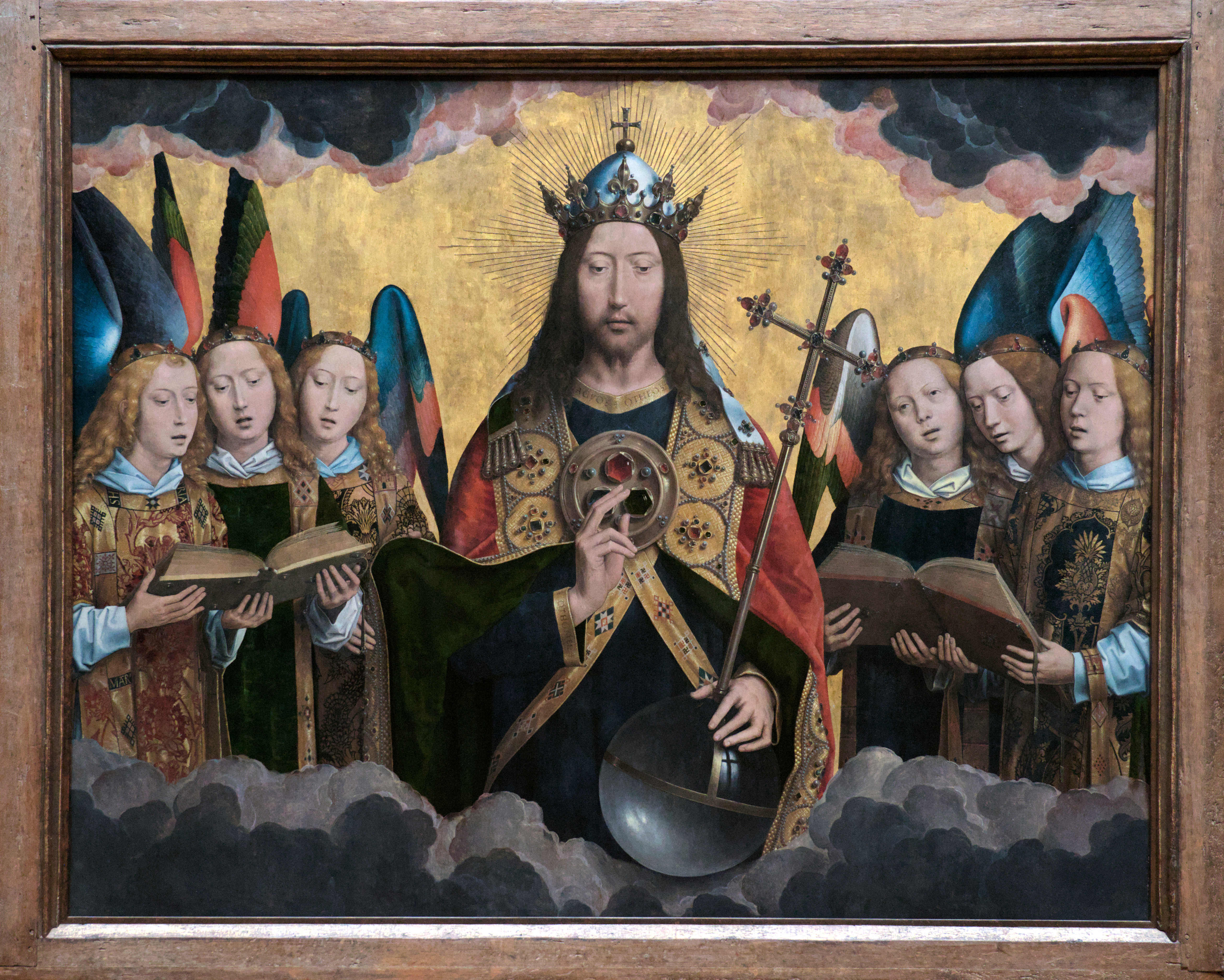
The museum titles the central panel God the Father with Singing Angels—but I think the figure is more properly God the Son, Jesus Christ, portrayed as Salvator Mundi (Savior of the World). In his left hand he holds a cross-surmounted crystal globe, signifying his dominion over the earth, and with the other hand he gestures blessing. He wears a tiara and a red cope decorated with gold-thread embroidery, pearls, and precious stones, and his collar bears the words Agyos Otheos (Holy God).

Memling, Hans_God the Father with Singing Angels
Hans Memling (German Flemish, ca. 1430–1494), God the Father with Singing Angels, 1483–94. Oil on panel, 164 × 212 cm. Koninklijk Museum voor Schone Kunsten Antwerpen (KMSKA, Royal Museum of Fine Arts Antwerp).

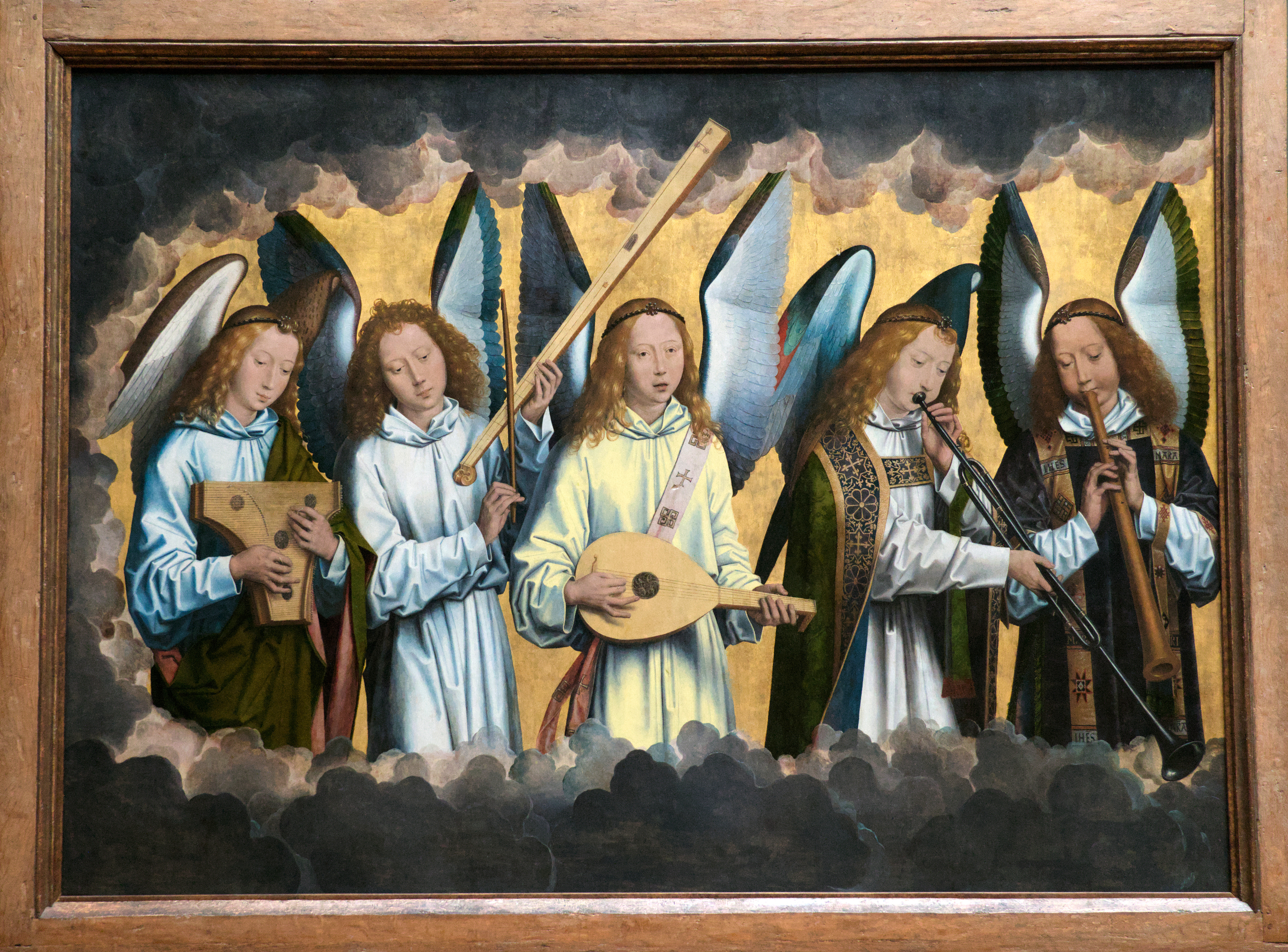
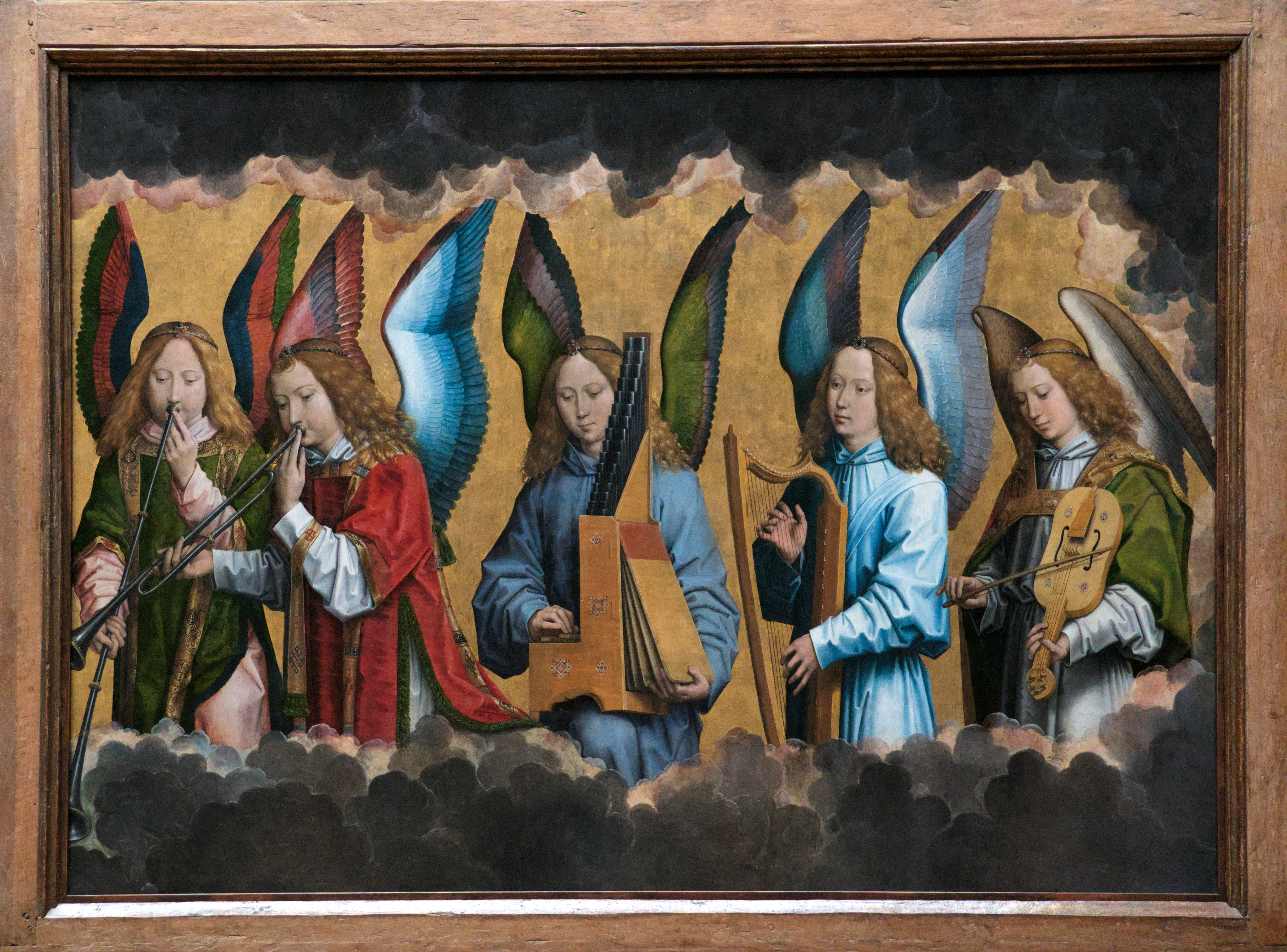
Surrounding him is a musical band of angels, singing his praises from songbooks and, in the flanking panels, playing a variety of wind and string instruments: (from left to right) a psaltery, a tromba marina, a lute, a trumpet, a shawm, a straight trumpet, a looped trumpet, a portative organ, a harp, and a fiddle.

Memling, Hans_Music-Making Angels
Hans Memling (German Flemish, ca. 1430–1494), Music-Making Angels (left), 1483–94. Oil on panel, 165 × 230 cm. Koninklijk Museum voor Schone Kunsten Antwerpen (KMSKA, Royal Museum of Fine Arts Antwerp).

Memling, Hans_Music-Making Angels
Hans Memling (German Flemish, ca. 1430–1494), Music-Making Angels (right), 1483–94. Oil on panel, 165 × 230 cm. Koninklijk Museum voor Schone Kunsten Antwerpen (KMSKA, Royal Museum of Fine Arts Antwerp).

This ensemble probably evokes for you a particular sound—something like Tallis or Palestrina—soaring polyphonic vocals, a gentle yet majestic accompaniment. But instead, a different soundtrack played, audibly, in the room: songs from the 1967 debut album of the American rock band the Velvet Underground, several of which use religious language to describe the experience of doing drugs. “Heroin” opens like this:

I don’t know just where I’m going
But I’m gonna try for the kingdom, if I can
’Cause it makes me feel like I’m a man
When I put a spike into my vein

And I’ll tell you things aren’t quite the same
When I’m rushing on my run
And I feel just like Jesus’ son

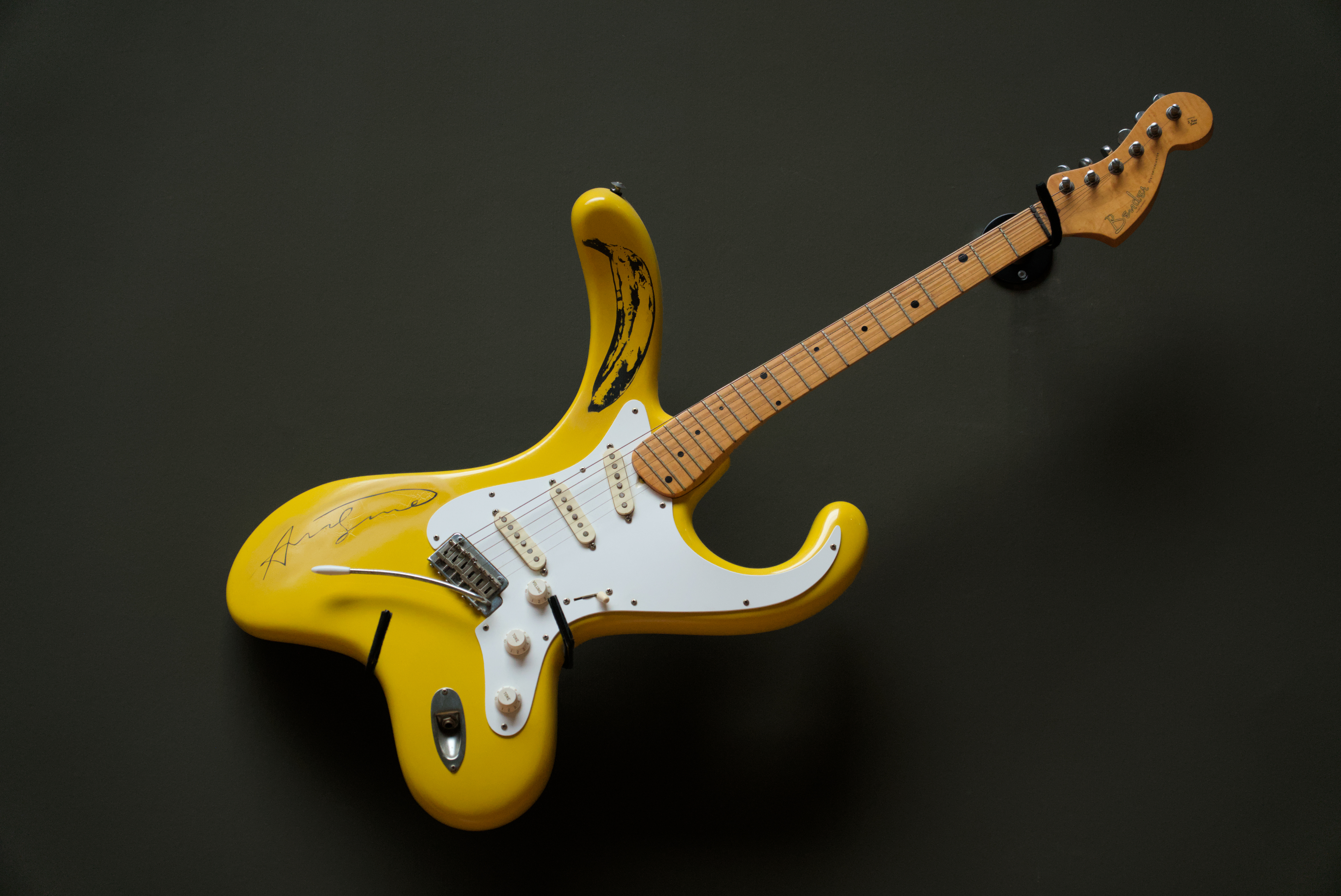
This aural element was complemented, on the gallery wall, by the guitar of Lou Reed, the band’s lead singer and songwriter. It’s signed by Andy Warhol, who produced and championed the Velvet Underground & Nico album and made its banana cover art, replicated on the instrument.

Lou Reed's guitar
Lou Reed’s “Banana Guitar,” from a private collection

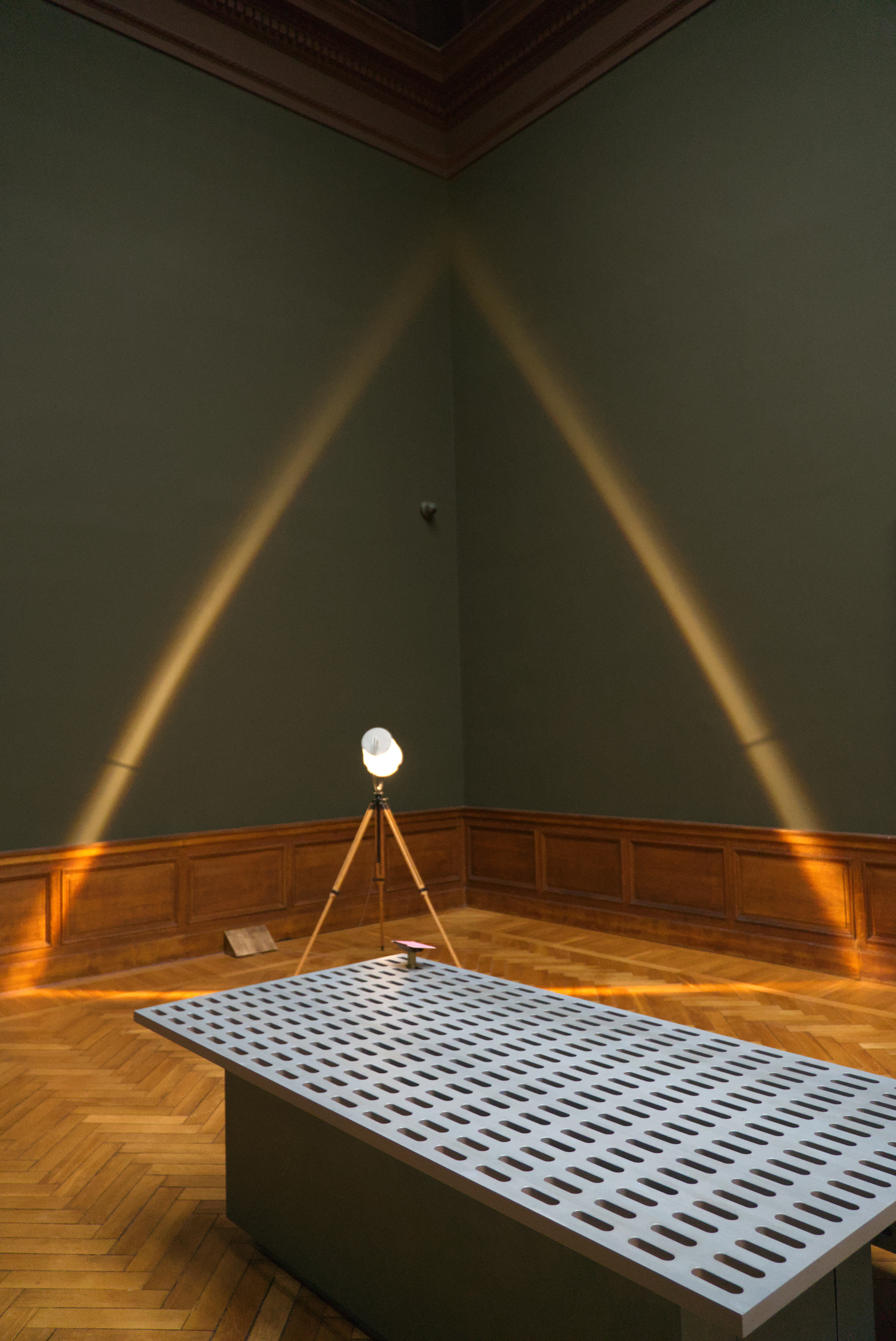
Adding to the mix, in the corner of the room was an installation by the Copenhagen-born and -based artist Olafur Eliasson, called Lighthouse Lamp. “Affixed to a tripod, a lamp situated within a Fresnel lens—a compact lens which was developed for lighthouses—emits a band of white light in 360 degrees,” the artist’s website explains. In this space, the beam takes on a triangular shape.

Eliasson, Olafur_Lighthouse Lamp
Olafur Eliasson (Icelandic Danish, 1967–), Lighthouse Lamp, 2004. Mixed media. Collection of Filiep and Mimi Libeert.

There was also an altarpiece of The Last Judgment and the Seven Acts of Mercy by Bernard van Orley, which references Jesus’s teaching in Matthew 25 about one’s entry into heaven being contingent on whether, in this life, you feed the hungry, give shelter to the homeless, visit the prisoner, and so on.

The “Heavens” gallery begs the question: How does one define “heaven”? Is it a physical place? A state of mind? An encounter? I think of related words like bliss, beatitude, communion, the sublime.

The celestial scene painted by Memling—and remember, it’s only partial, as the rest is missing—is beautifully rendered, but it also encapsulates what has become the popular cliché of heaven: angels on clouds, strumming harps, and a regal God swaying his scepter. Music-making, angelic beings, and the reign of God are all certainly a part of how the Bible describes heaven. But it’s also so much more. It’s a garden and a city. It’s healing and restoration. It’s the righting of wrongs. It’s all things made new. It’s jubilee. It’s a wedding—deep and lasting union between God and humanity. It’s an eternal interlocking of God’s space and ours (earth). It’s a global, transhistorical community of faith, gathered together around Christ their head, worshipping him in diverse languages, musical styles, dances, and other cultural expressions. It’s the culmination of the greatest story ever told.

Today, Memling’s vision of heaven probably fails to captivate most people, even Christians. So it’s an interesting experiment to compare it to how others conceive of the concept.

Eliasson’s Lighthouse Lamp wasn’t a commission on or explicit treatment of the theme, but the curator saw fit to place it beside Memling, because heaven is often conceived of as a light-filled space, and light can evoke the divine. For this reason, Memling painted his background gold. What’s more, the three-sidedness of Eliasson’s light beam may, for some, evoke the Trinity, the classical Christian doctrine of Father, Son, and Holy Ghost that Memling alludes to with the three precious stones on the fibula of Christ’s mantle.

Still, other folks experience what could be termed “heavenly” transcendence through the use of mind-altering substances, as did the members of the Velvet Underground, whose drug trips gave birth to their experimental music—which, in turn, has taken others to a transcendent place.


Whether in special exhibitions or displays of their permanent collections, I want to see more of this in museums: bringing old and new artworks into conversation with one another around universal themes, in the same room. (In some museums, the labels sometimes cross-reference works in other galleries, but that’s not the same.) Although there are benefits to the traditional approach of laying out art chronologically to give you discrete pictures of different historical eras and allow you to progress by time period, a thematic approach that compiles works from across time also has its benefits.

I’ve found cross-temporal art displays to be especially vitalizing, because instead of trying to tell history, they more naturally invite personal reflection and tend to be less academic in tone. Such an approach makes the art accessible to a larger number of people, especially those who don’t frequent museums. It helps us see the relevance of the Old Masters (or whatever the museum’s collection focus) for today—how the subjects they depicted often address topics or questions we still ask or wonder about or that reflect aspects of the common human experience, such as joy, suffering, family, death, betrayal, or festivity. Creating relationships between works made centuries apart, highlighting similarities and differences, can give us a broader perspective.

And for this museumgoer (pointing at myself) who is attracted to medieval and early Renaissance art and sometimes bypasses the contemporary galleries, the integrative approach is more engaging. Giving contemporary works a point of connection with the works I’m already inclined to like helps me enter into them more easily and fruitfully, and I’m more likely to spend time with them than if they were segregated.

New and old don’t have to be equally represented—Kolumba skews heavily contemporary, whereas KMSKA lets its strengths shine with the Old Masters, and yet the occasional unexpected intervention from years past or future always caused me to pause and be curious. Over the last several years I’ve been noticing other museums engaging in similar playful exchange—plopping a contemporary work into the medieval section, or vice versa, in a way that provides some kind of illumination.

This was my first and only visit to KMSKA, and as I understand, there’s not the same degree of intermixing of old and new year-round; this was a special exhibition that brought in contemporary works from outside, as the institution itself owns very few. But they did do something similar last year with the exhibition What’s the Story?, and the dangling light poems by Bernard Dewulf are a permanent fixture in the Old Masters galleries.

Have you been to a museum where works from different time periods were displayed side-by-side to create a discourse, and if so, did that choice enhance your engagement, insight, or appreciation? I’d love to hear what other museums are doing this!


This article took me some forty hours to write and to select and edit photos for. If you appreciate learning about my museum experiences and having access to high-resolution, downloadable art images, would you please consider adding to my “tip jar” (PayPal), or sponsoring a book from my Amazon wish list? Thank you!

Kolumba and KMSKA: Medieval and contemporary art in conversation (part 1)

One of the delightful surprises of my recent trip to Germany and Belgium was to find, in two of the museums I visited, an integration of the old and new in the curated galleries. Typically, art museums choose to arrange their collections chronologically, grouping together artworks from a particular era, and within each era, like styles. But in Kolumba museum in Cologne and the Koninklijk Museum voor Schone Kunsten Antwerpen (KMSKA) in Antwerp, medieval art from each museum’s collection (and in the case of KMSKA, Renaissance and Baroque art too) is displayed alongside contemporary pieces, creating a vibrant dialogue.

With the exception of the exterior shot of Kolumba, all photos in this post are my own.

Kolumba Kunstmuseum, Cologne

Originally called the Diözesanmuseum (Diocesan Museum), Kolumba was founded in 1853 by the fledgling Christlicher Kunstverein für das Erzbisthum Köln (Christian Art Association for the Archbishopric of Cologne), making it the city’s second oldest museum after the Wallraf-Richartz-Museum. Its collection focus for the majority of its history was late medieval art from Cologne and the Lower Rhine.

Kolumba’s first permanent home, just south of Cologne Cathedral, was a former sugar factory, but the building was destroyed in World War II, though much of the art had been safely evacuated beforehand. After the war, Kolumba relocated its art to a grammar school, then to rented rooms in the Gereonstraße, then to the Curia building at Roncalliplatz 2. But the limited space was an issue.

In 1989, ownership of the museum was transferred to the Archdiocese of Cologne, who decided to expand the collection to include modern and contemporary art, not only by German artists but by international artists as well. The museum shifted its approach from displaying traditional sacred works only, to placing those works in juxtaposition with newer ones by artists who aren’t necessarily Christian but whose works can converse fruitfully with their core collection. They also secured funding to construct a new permanent building.

In 2004, the museum’s name was changed to Kolumba in honor of the history of the site on which the new (and current) building would stand: atop the ruins of the medieval St. Kolumba church, destroyed in an air raid in 1943. St. Columba of Sens was a third-century virgin martyr who was born in Spain but lived mostly in France. The church dedicated to her in Cologne once housed Rogier van der Weyden’s St. Columba Altarpiece (now at the Alte Pinakothek in Munich), a triptych with scenes of the Annunciation, the Adoration of the Magi, and the Presentation in the Temple.

Kolumba museum
Kolumba museum, Cologne. Photo: HP Schaefer / Wikimedia Commons.

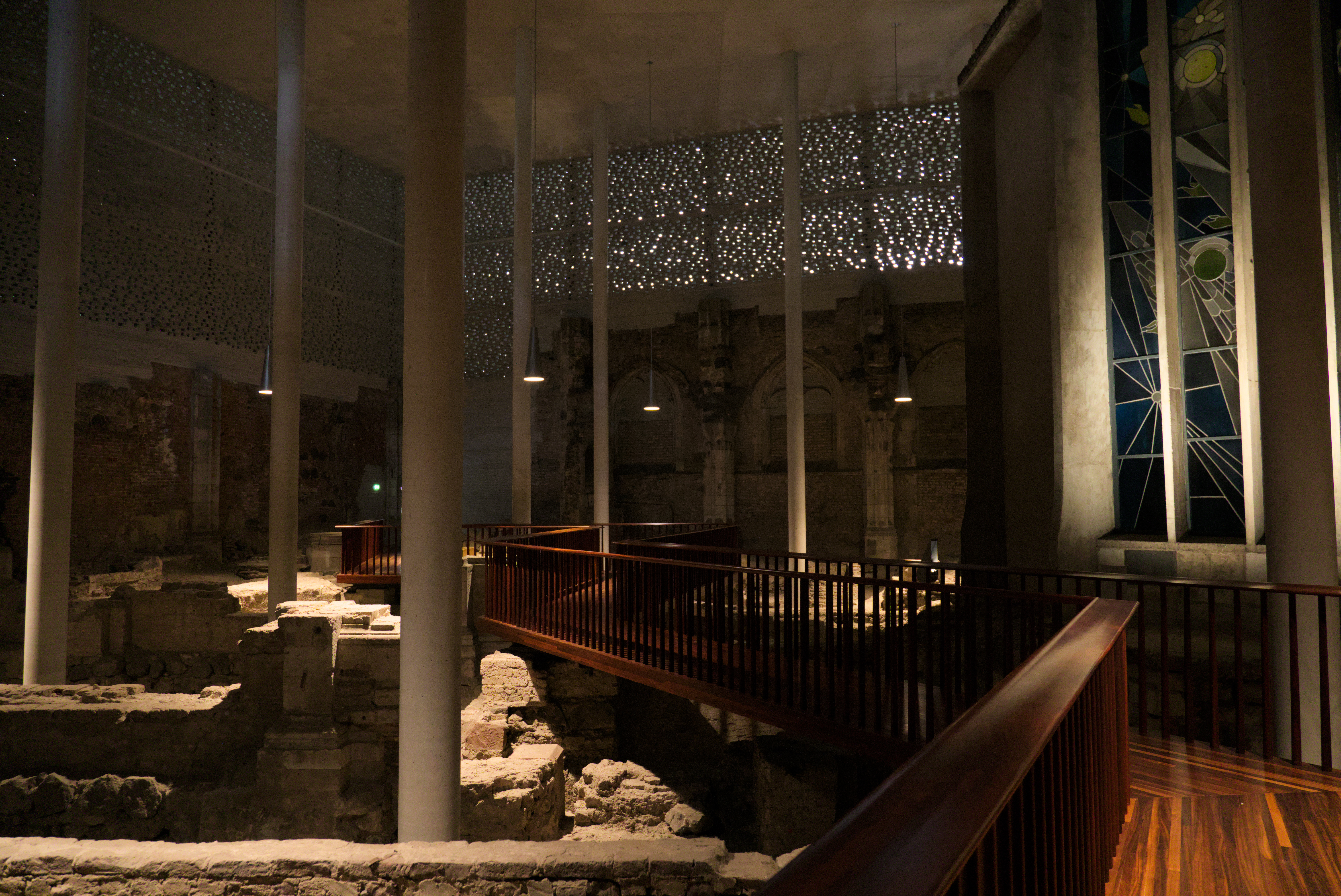
Kolumba museum’s permanent home opened in 2007 at Kolumbastraße 4. Designed by the Swiss architect Peter Zumthor (view more architectural photos here), the building encapsulates the bombed-out Gothic ruins of St. Kolumba with forty-foot-high, porous concrete walls, above which sit the floors of the museum.

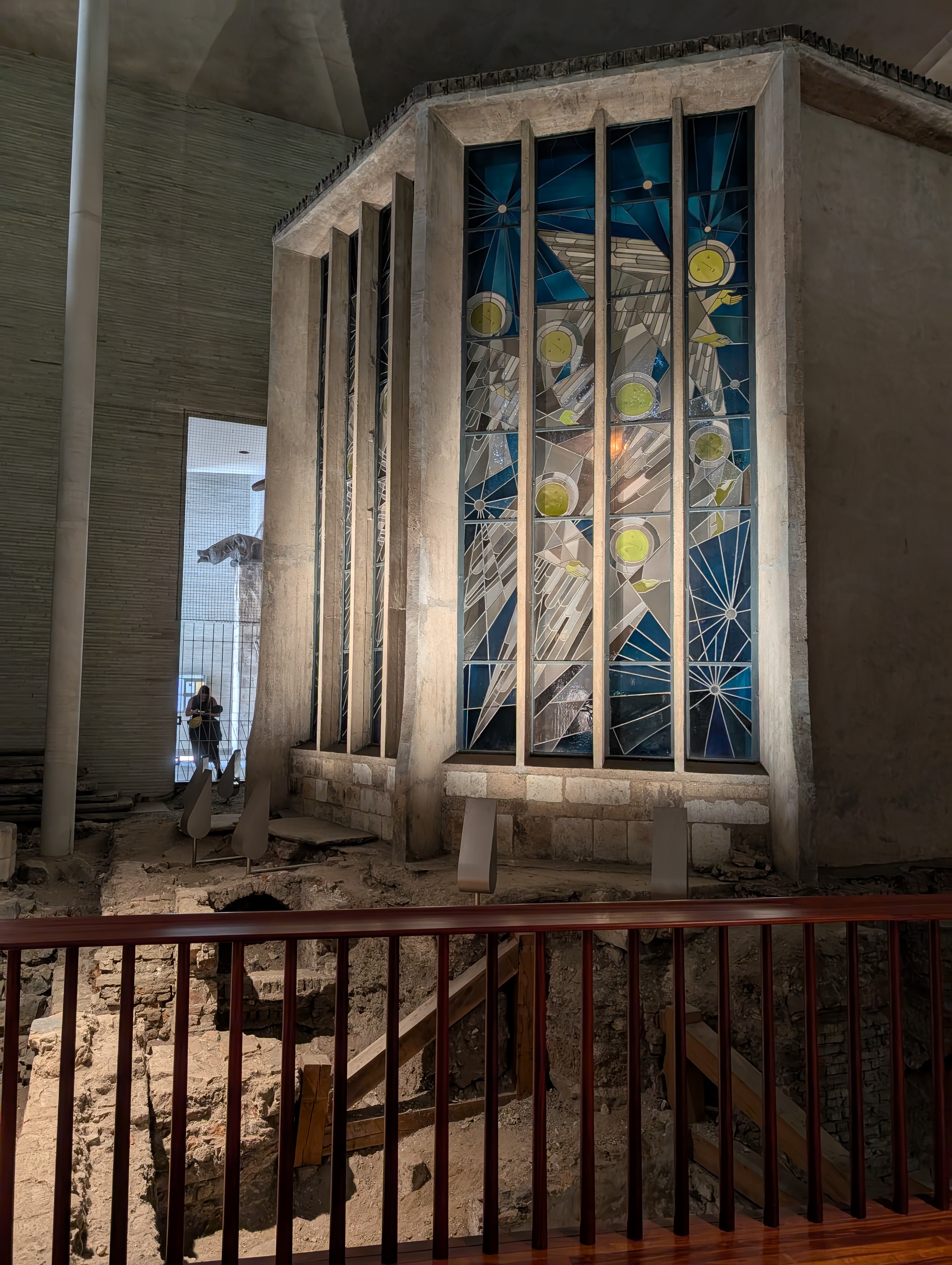
It also incorporates the Madonna in den Trümmern (Madonna in the Ruins) chapel, an octagonal tent-like structure built by Gottfried Böhm in 1947–50 to house a late Gothic statue of the Madonna and Child that miraculously survived the Allied bombings and for the liturgical use of the small Kolumba parish, which continues today.

Ruins of St. Kolumba
The ruins of St. Kolumba church, which dates back to the tenth century (with subsequent expansions and a Gothic-style rebuilding), are integrated into the architecture of Kolumba museum.

Madonna in the Ruins chapel
Exterior of the “Madonna in the Ruins” chapel, dedicated 1950, underneath Kolumba museum in Cologne, with stained glass designed by Ludwig Gies (1887–1966), installed 1954.

The postwar chapel is not accessible from inside the museum; it has its own separate entrance, which, as I found out after I had already left, is on the south side of the building, along Brückenstraße.

But I did cross over the excavation site of St. Kolumba to which the written museum guide directs visitors (it’s labeled “room 3”), and through which a walkway has been constructed. As I took in the war-wrought devastation, I wondered about the sounds I was hearing from an audio system. Turns out it was a sound installation called Pigeon Soundings by the American artist Bill Fontana. In 1994, he made a series of eight-channel sound map recordings of the pigeons that were inhabiting the St. Kolumba ruins at the time, particularly the rafters of the temporary wooden roof that had been erected. The recordings picked up not just the birds’ cooing and flapping, but also the ambient sounds outside.

Above this darkened space, Kolumba has sixteen exhibition rooms. The museum reinstalls its collection annually, each fall opening a new exhibition. I was there for the first day of “make the secrets productive!” Art in Times of Unreason, which runs from September 15, 2025, to August 14, 2026. The lack of art signage throughout is deliberate, to promote a more meditative experience; instead, visitors are given a (German-language) booklet, organized by room, that identifies the pieces on display and provides commentary for some.

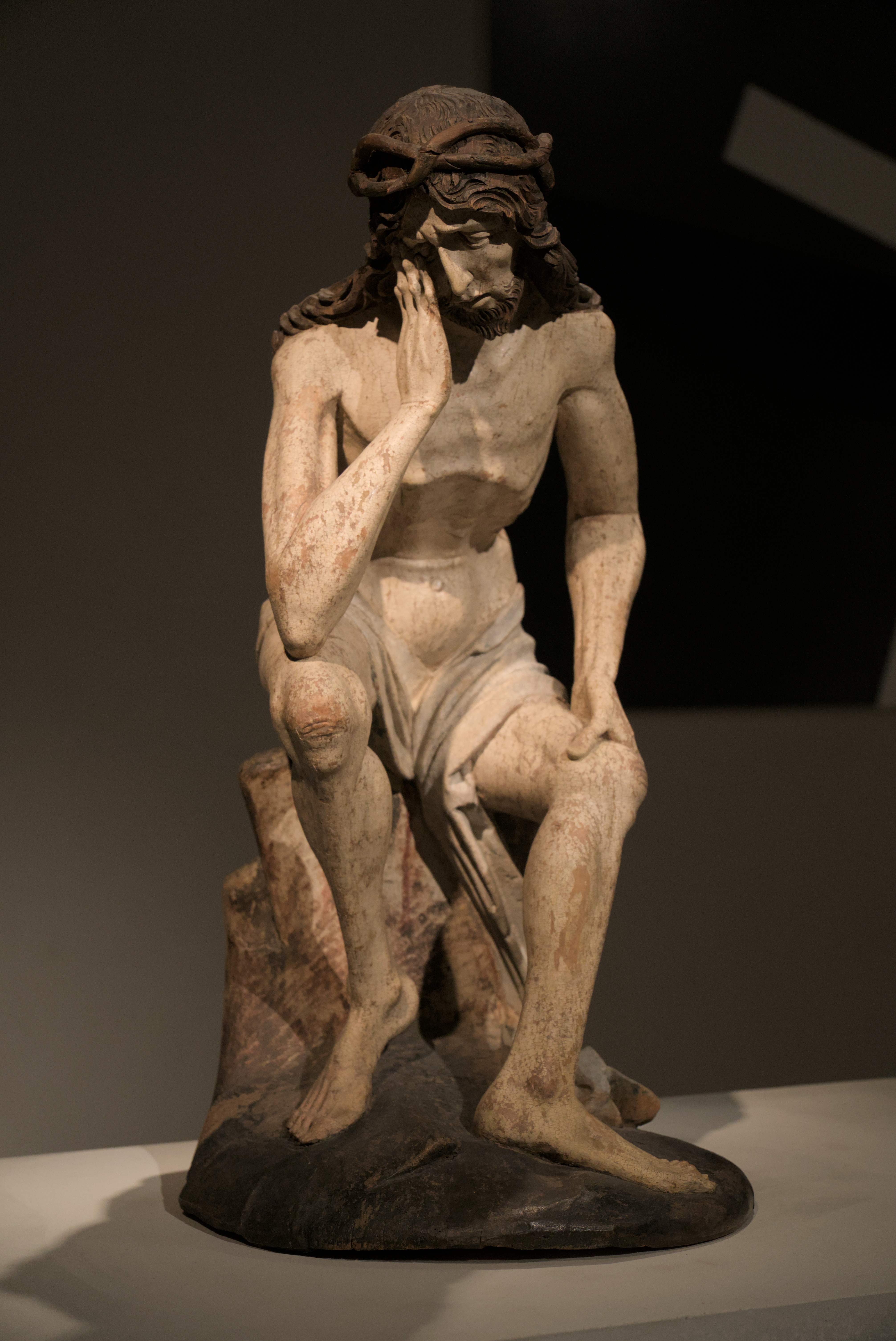
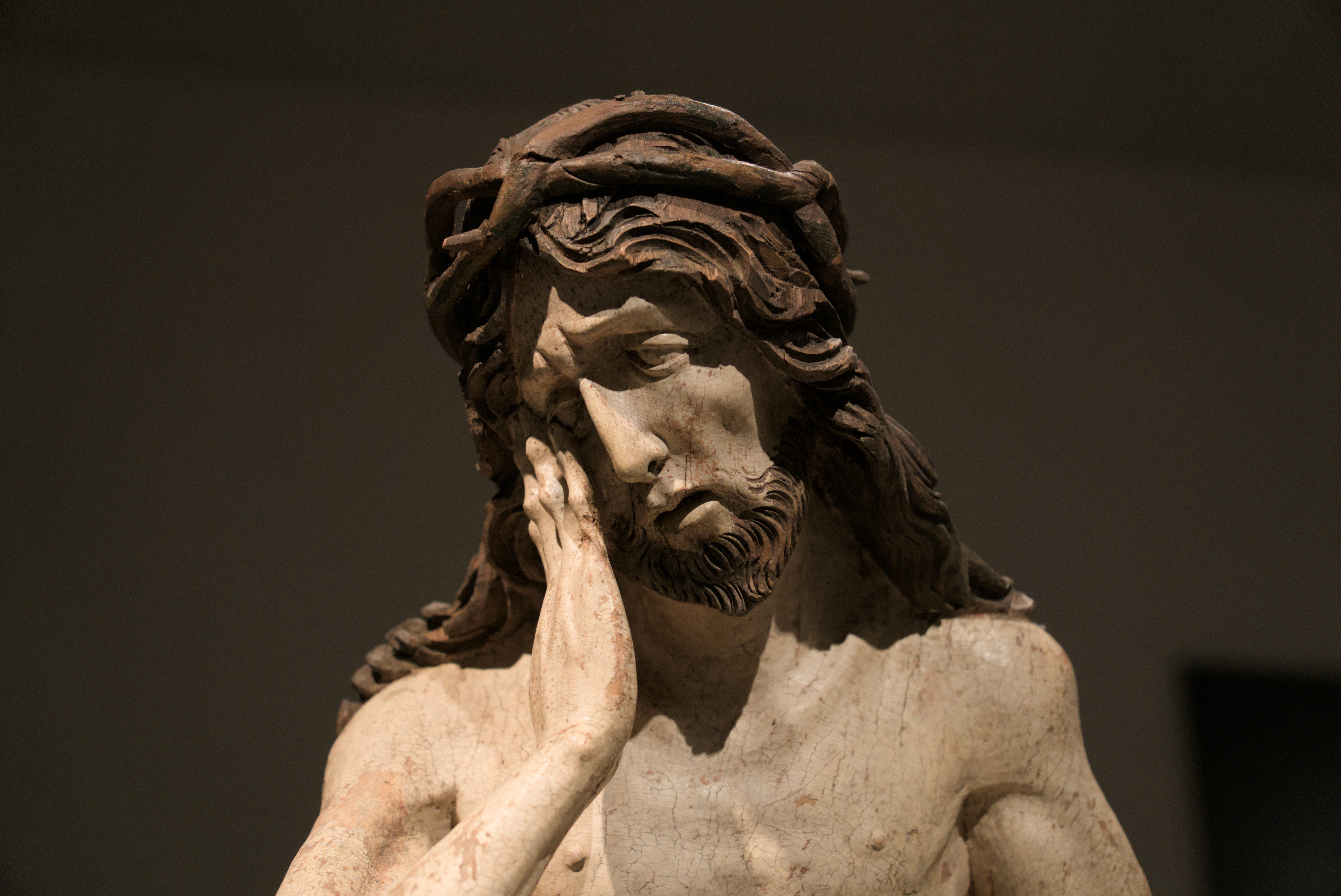
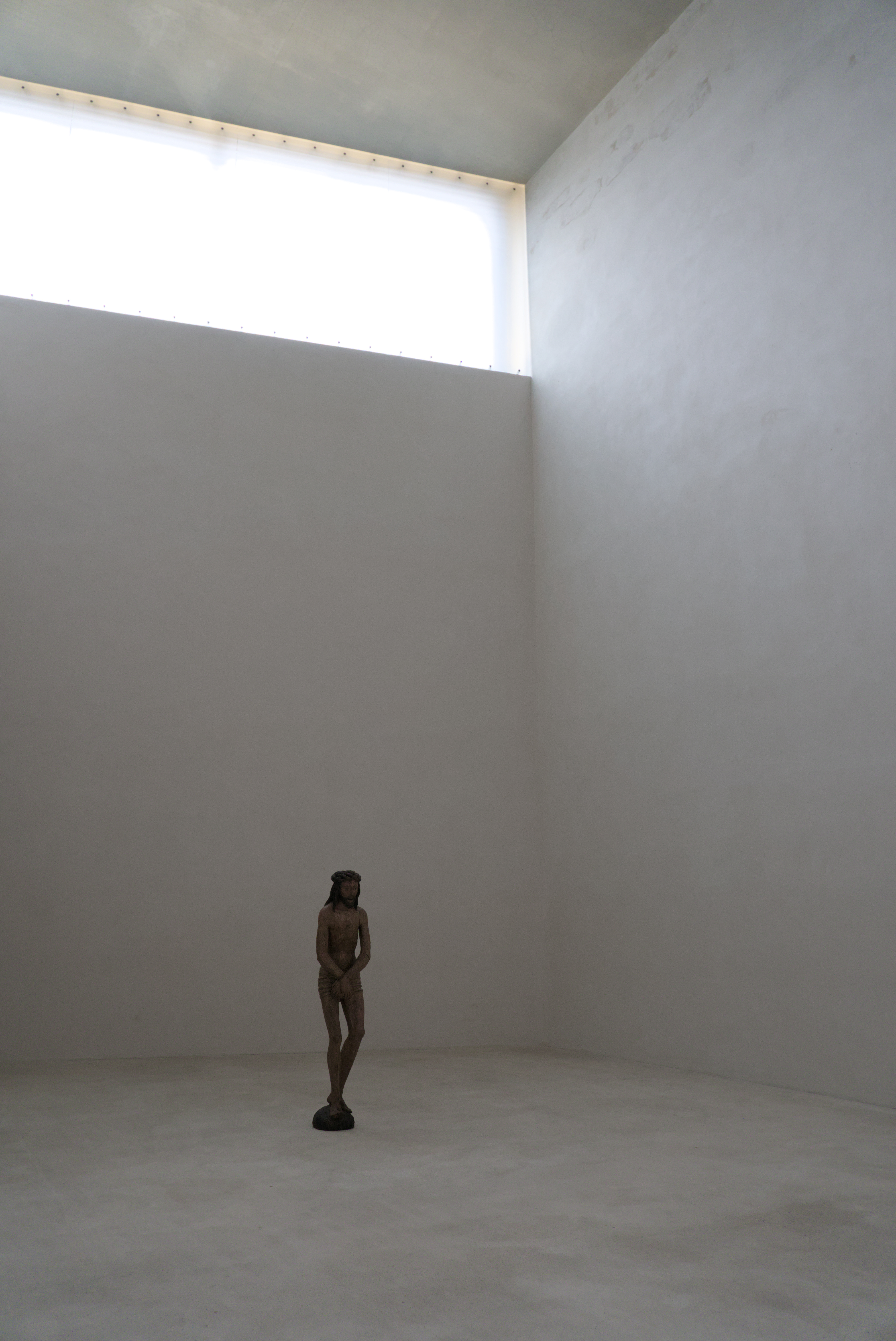
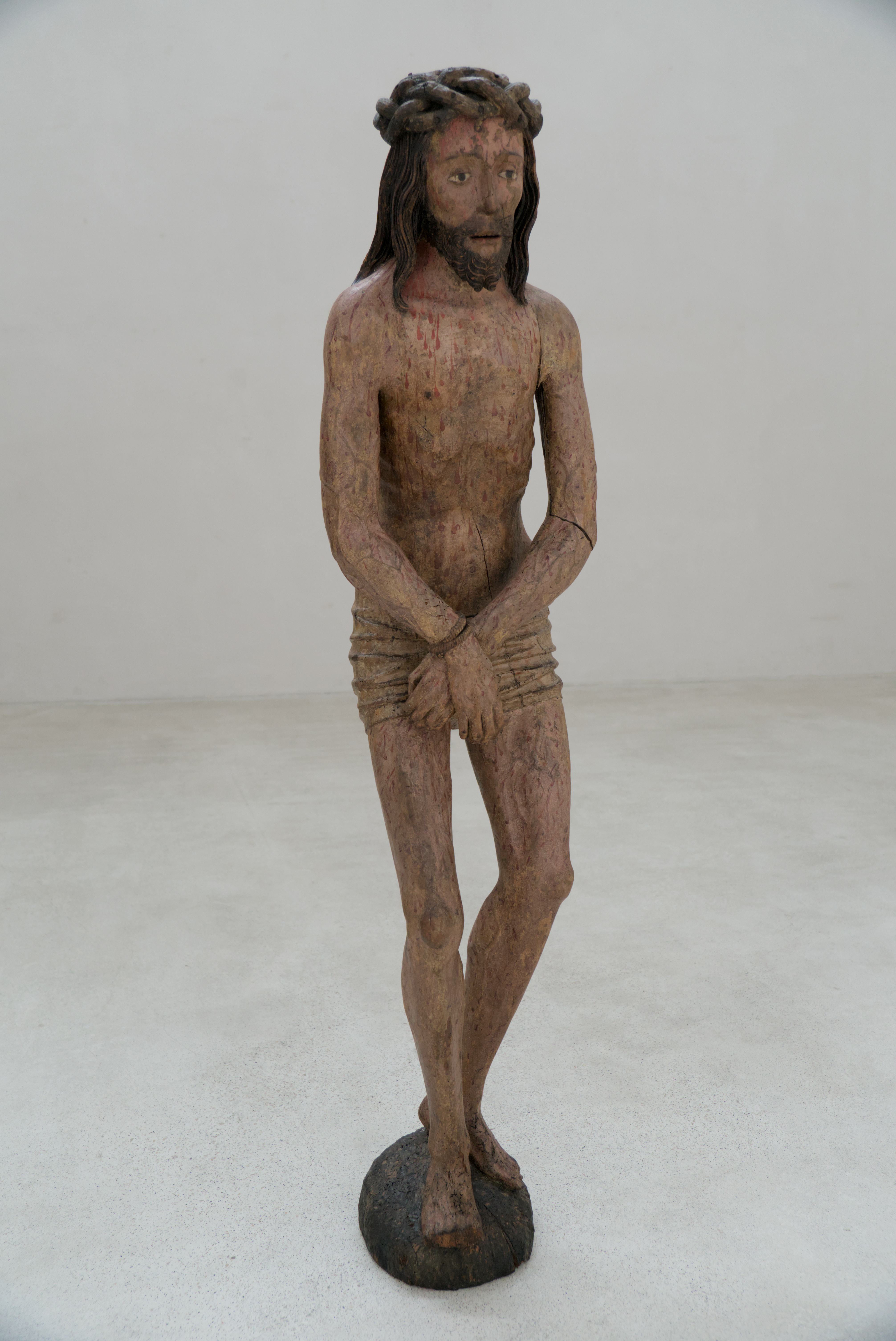
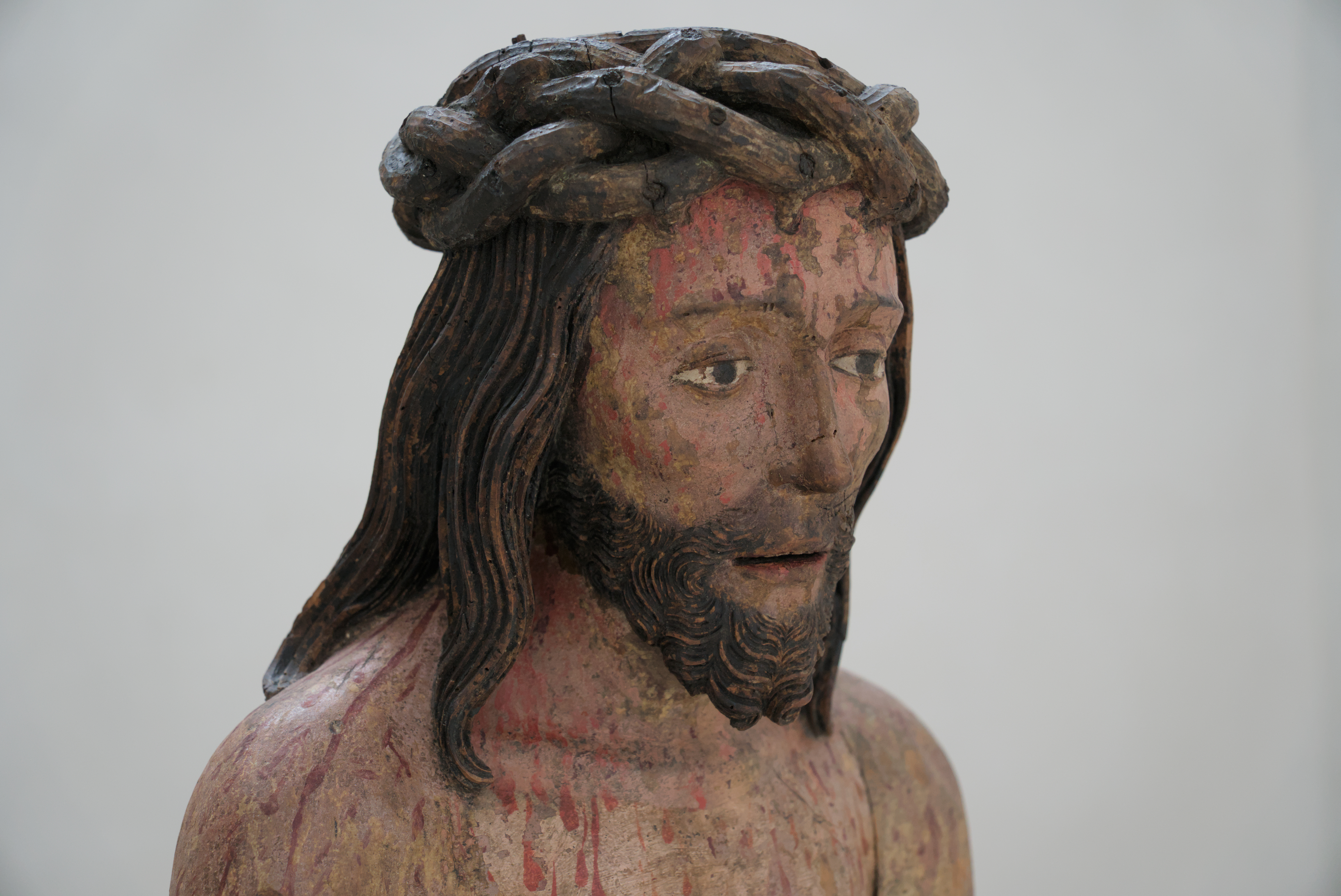
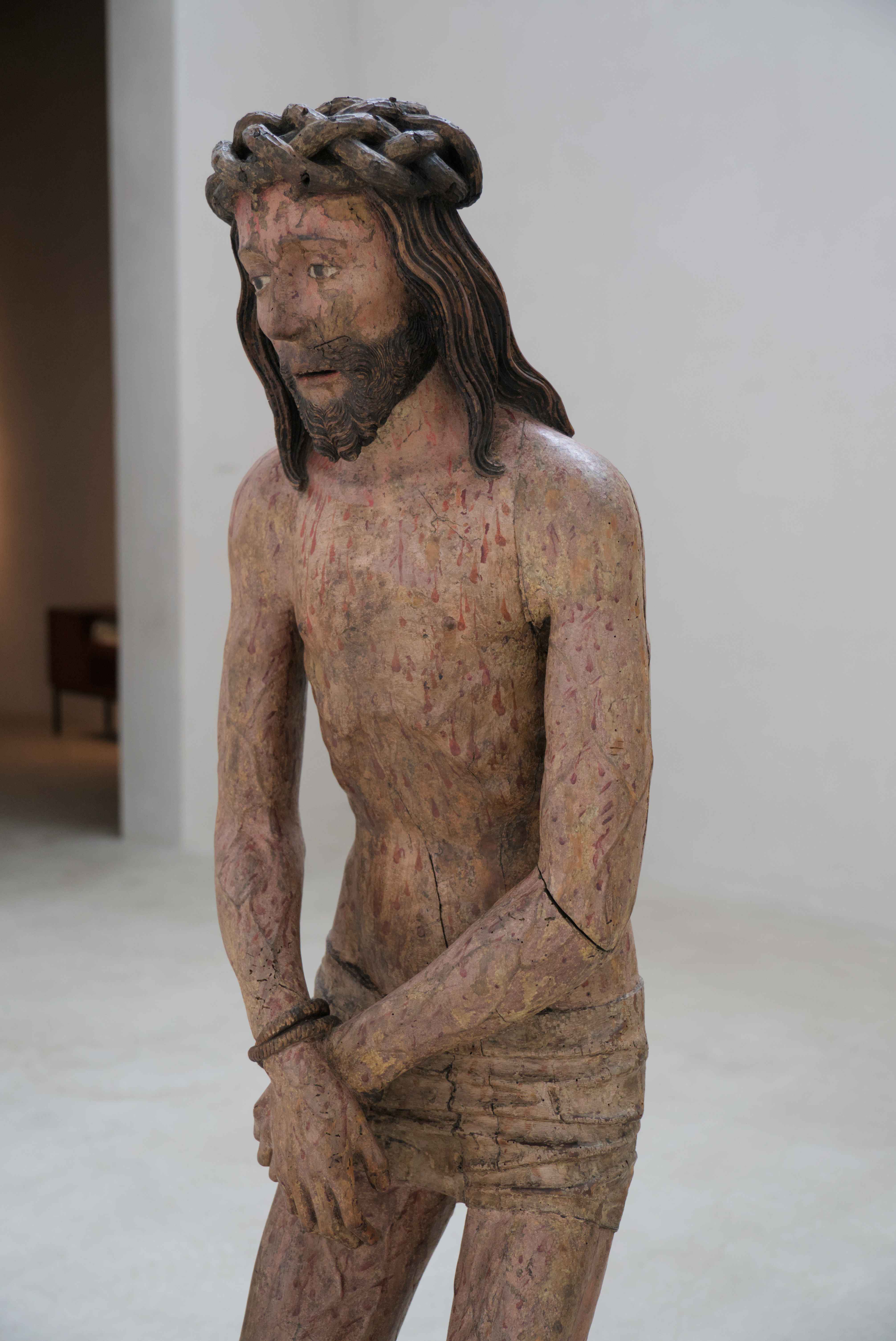
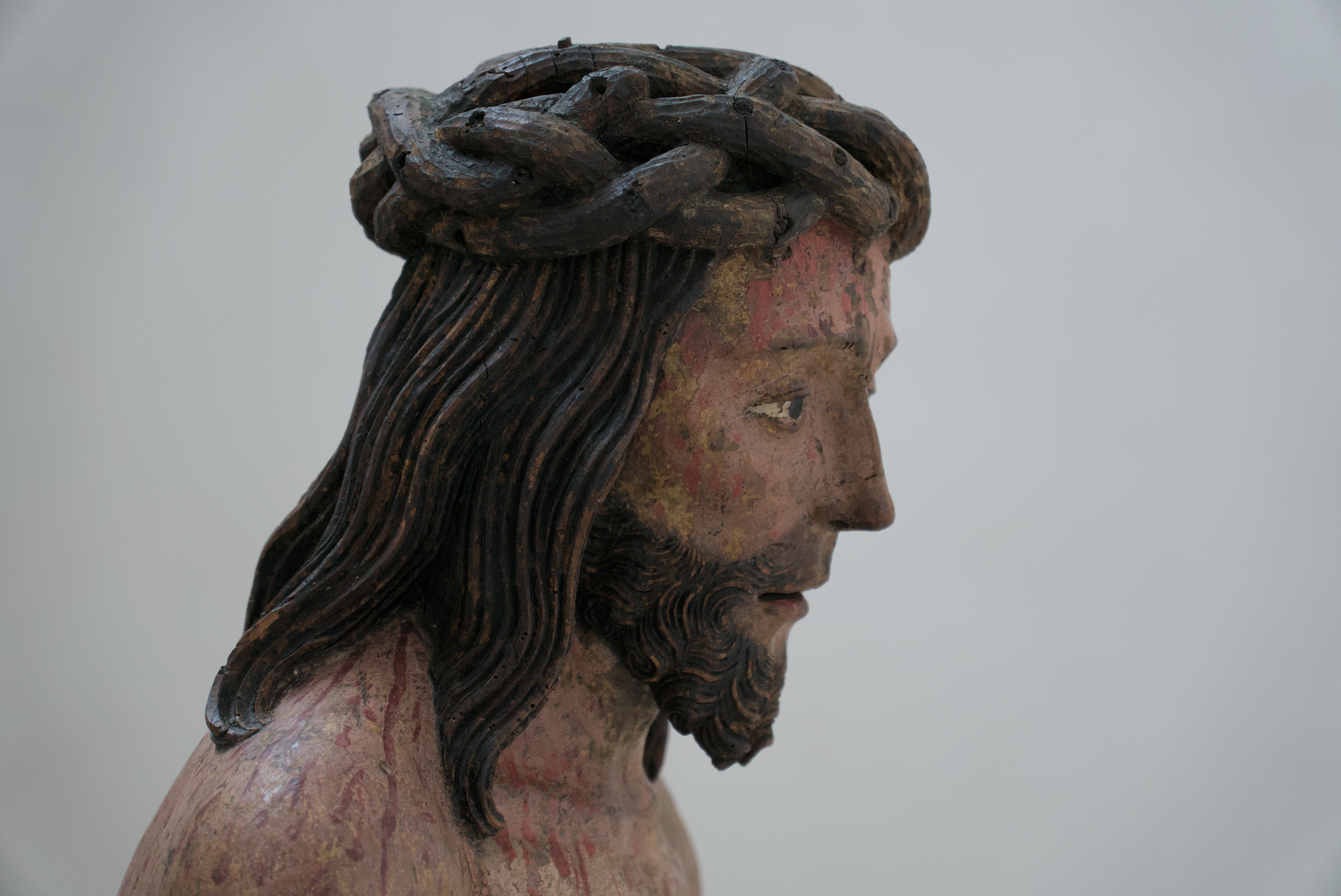
Room 8 features a fifteenth-century sculpture of Christ at Rest—“at rest” not in the sense of being at peace in mind or spirit (he is visibly troubled), but rather in a bodily state of motionlessness or inactivity. Sometimes also called Christ in Distress, Christ on the Cold Stone, or Pensive Christ, the iconography shows an interior moment during Christ’s passion in which, having just been flogged, he sits awaiting his final torture: crucifixion.

Christ at Rest (Upper Rhine)
Christus in der Rast (Christ at Rest), Upper Rhine, ca. 1480. Linden wood with visible primer and remnants of colored paint. Kolumba museum, Cologne.

Christ at Rest (detail)

Though the Gospels don’t mention a moment of seated pause in the narrative, artists were influenced by the figure of Job, an innocent sufferer who in that way prefigured Christ, and in particular the description in Job 2:8 of him sitting on a dung heap. The image of Jesus preparing to meet his death was meant to inspire feelings of pity. Isolated from the action and from all the other characters, the lone figure invites viewers to enter empathetically into the emotional anguish he suffered on his way to the cross.

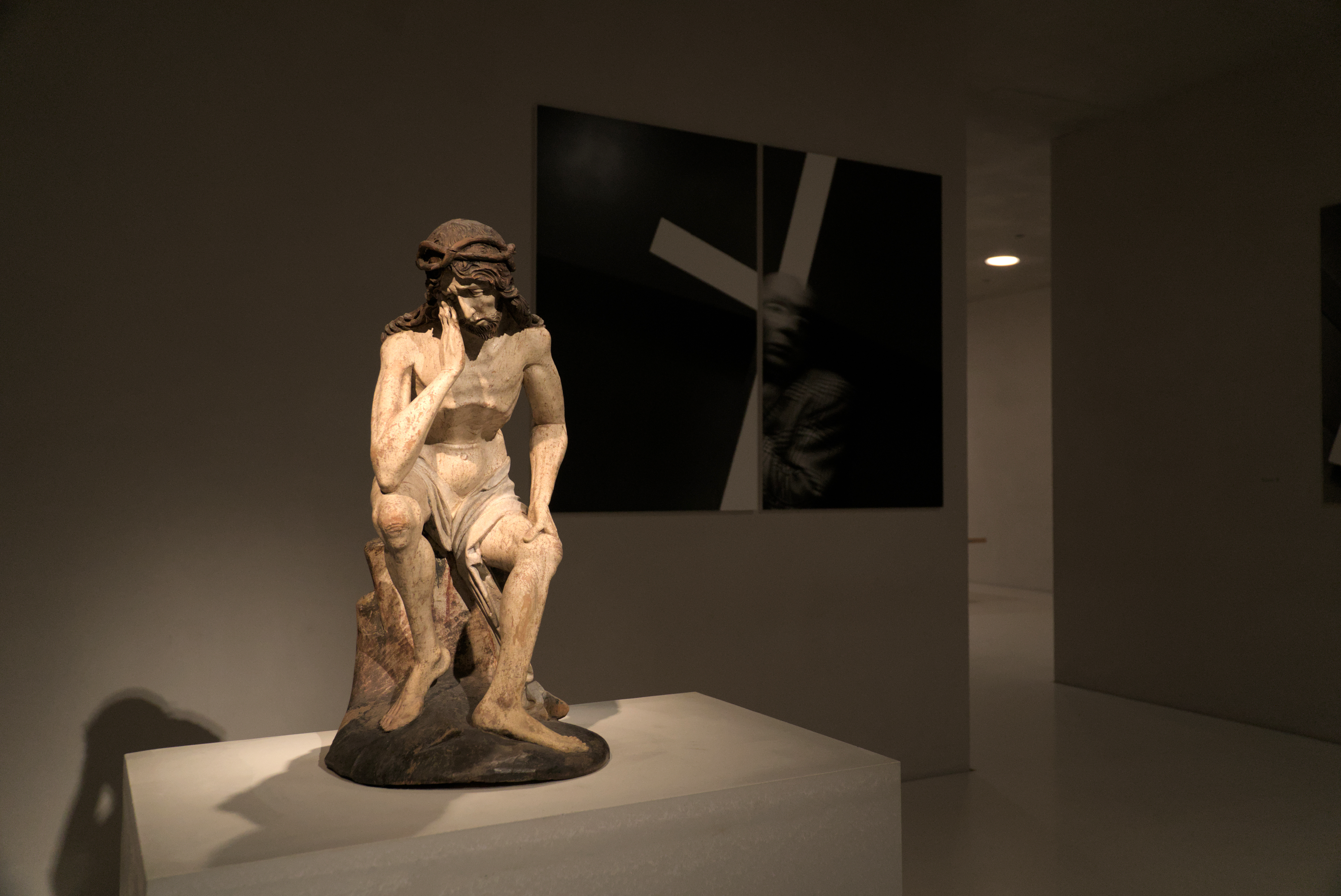
At Kolumba, this sculpture is surrounded by large-scale, black-and-white photographs from the Transzendentaler Konstruktivismus (Transcendental Constructivism) series by the collaborative duo of German neo-dadaist artists Anna and Bernhard Blume. In the series the couple is threatened by white geometric objects that are unleashed on them in a blur of motion.

Christ at Rest and Transcendental Constructivism
Foreground: Christ at Rest, Upper Rhine, ca. 1480. Background: Anna Blume (1936–2020) and Bernhard Blume (1937–2011), photograph from the Transcendental Constructivism series, 1992–94.

The diptych that hangs behind the Christ sculpture appears to show a man carrying a cross, disoriented by its weight.

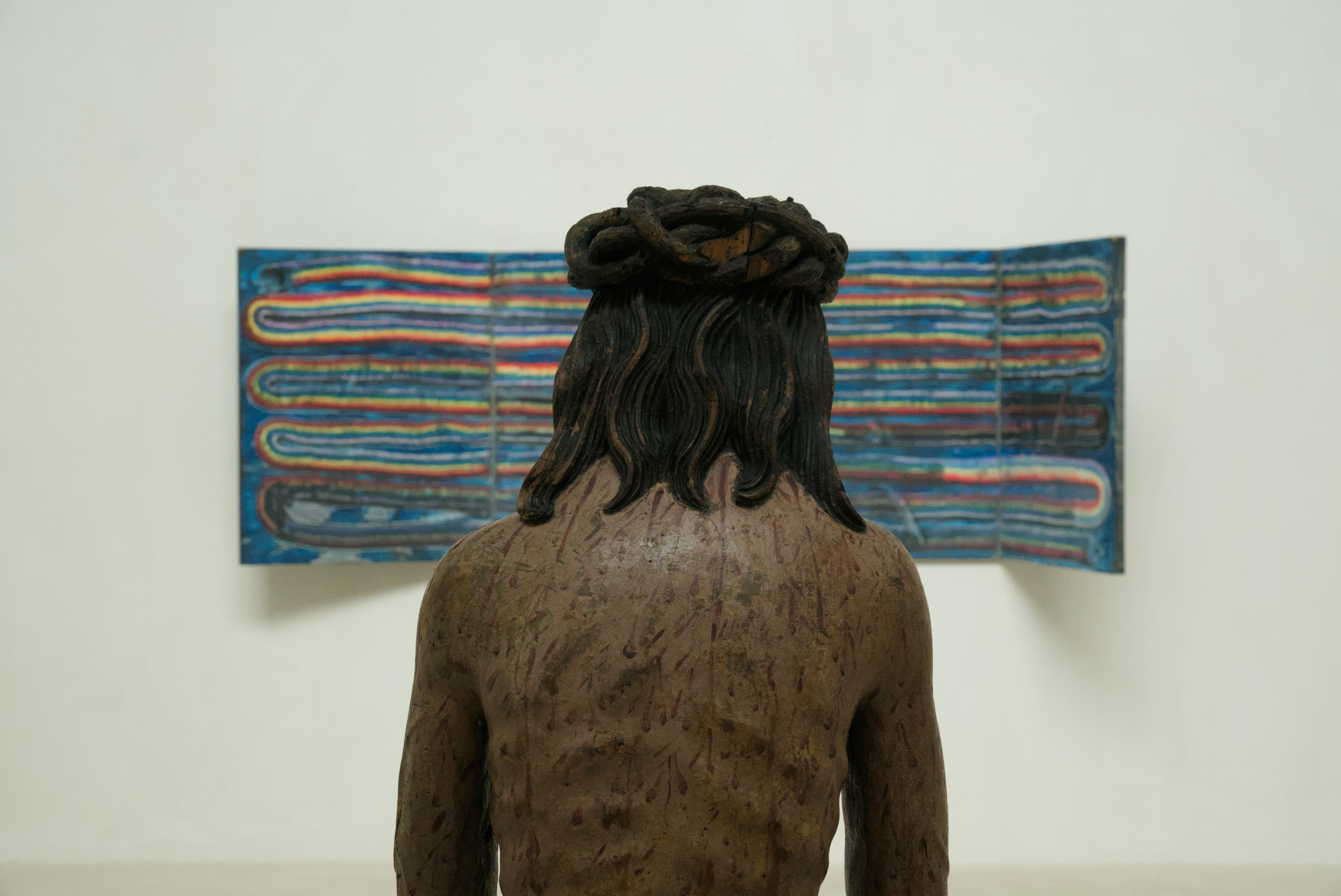
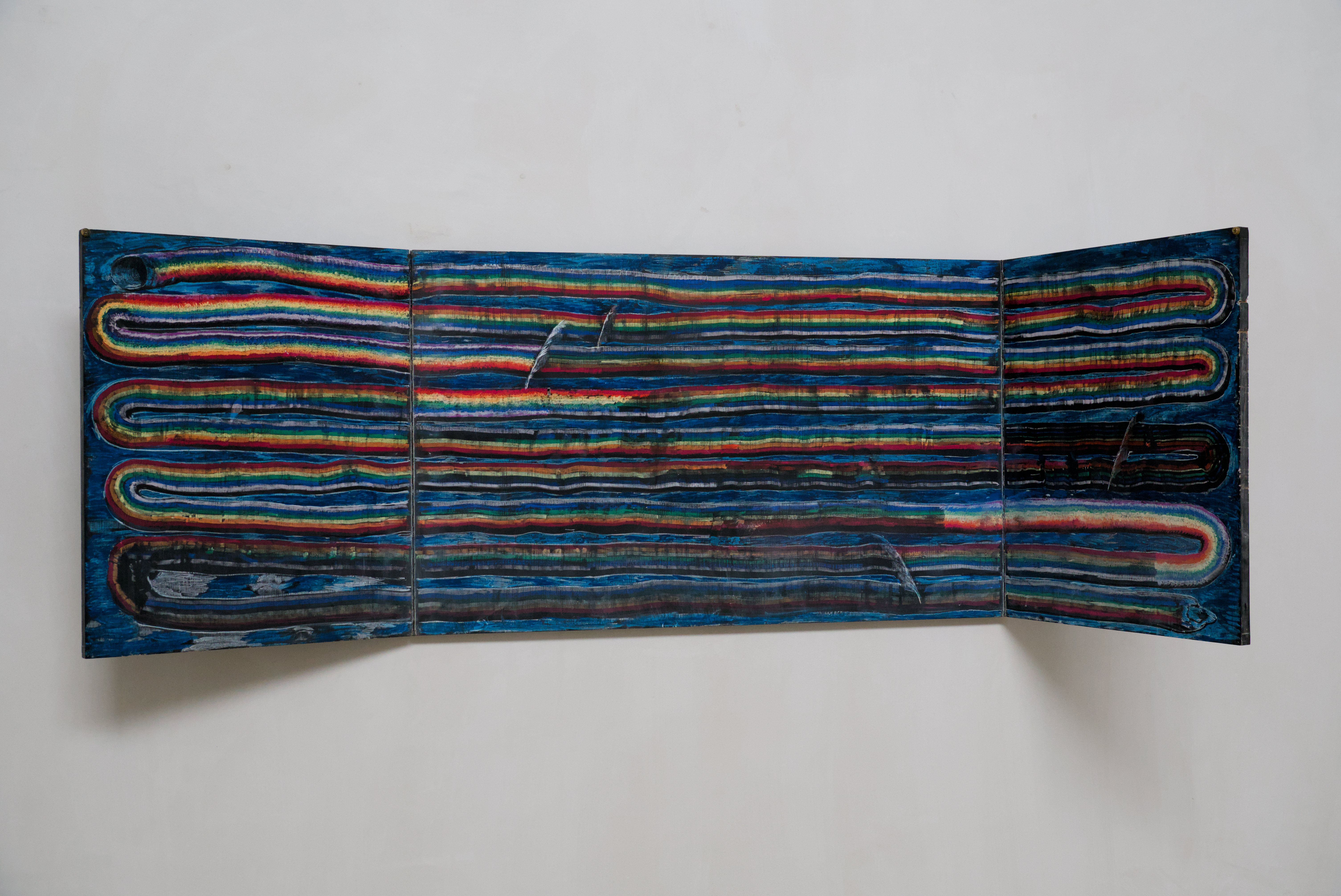
One of the other resonant pairings at Kolumba is in room 21, which stages a fifteenth-century Ecce homo sculpture across from a colored chalk drawing on a three-paneled blackboard.

Ecce Homo and Plumed Serpent

The title Ecce homo, Latin for “Behold the man,” comes from John 19:5, where the Roman governor Pilate presents a scourged, thorn-crowned Jesus to a mob that demands his execution. Like Christ on the Cold Stone, this too is a devotional image intended to stir the affections of the viewer, who is called, like the crowds on that fateful day, to gaze upon the wounded God-man. His hands are bound in front of him, evoking a sacrificial sheep tied up for slaughter. What have we done?

Ecce Homo
Ecce Homo
Ecce Homo, Cologne, ca. 1460–1500. Linden wood. Kolumba museum, Cologne.

Ecce Homo
Ecce Homo
Ecce Homo

While I instantly recognized this subject, the drawing was more of a mystery.

Thek, Paul_Plumed Serpent
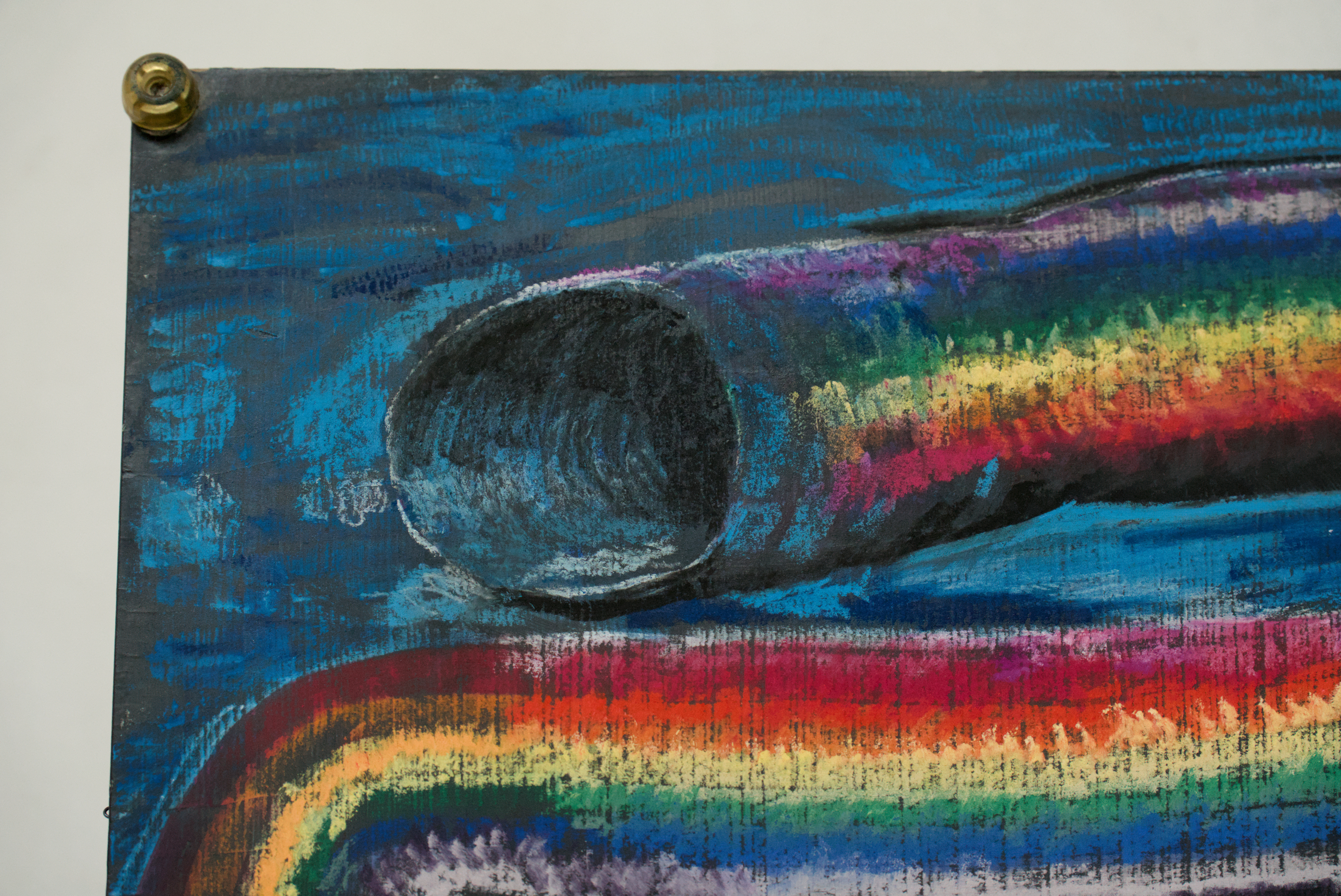
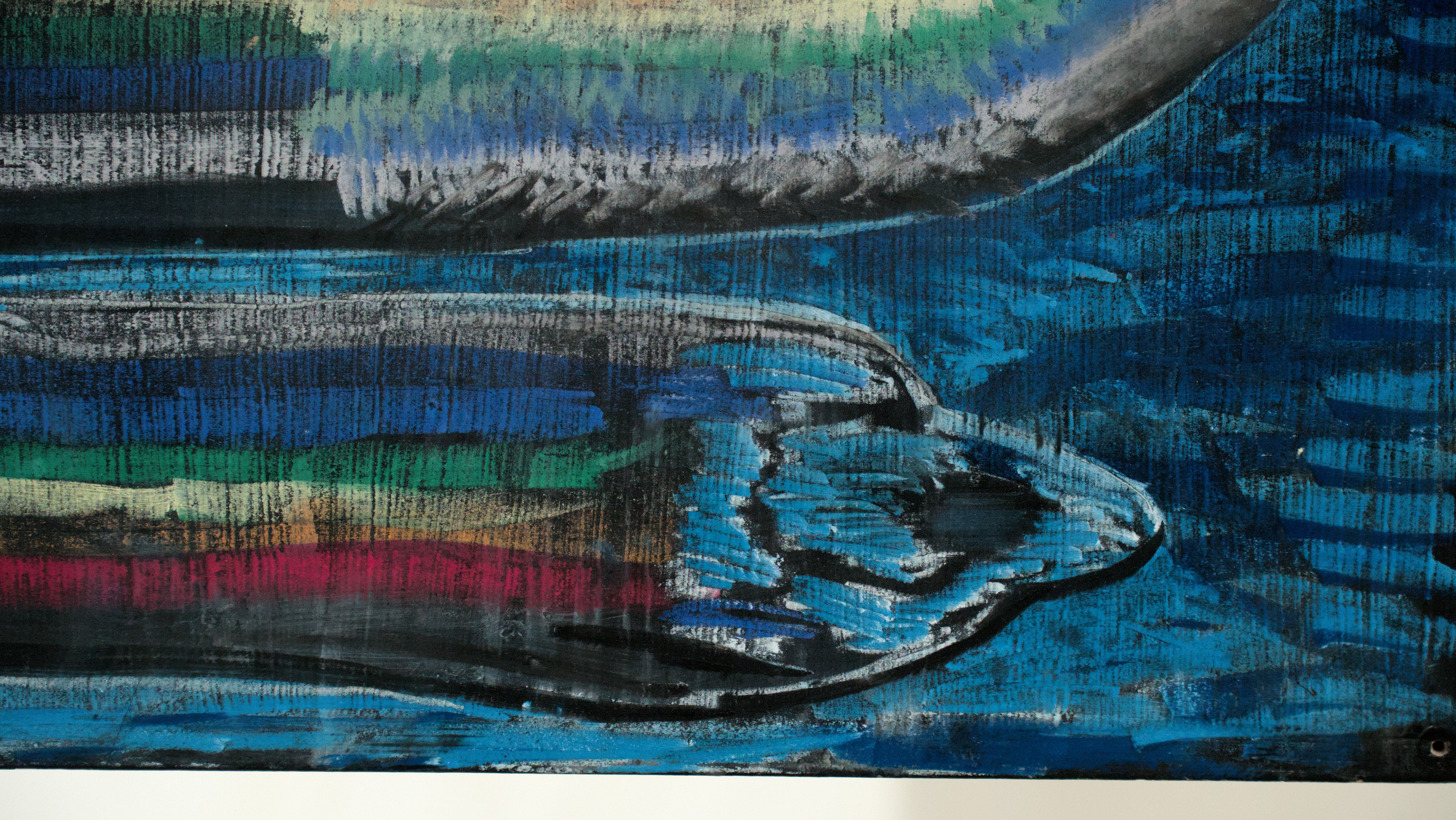
Paul Thek (American, 1933–1988), Plumed Serpent, 1969. Colored chalk on blackboard, 110 × 358 cm. Kolumba museum, Cologne.

Plumed Serpent (detail)

Not having any wall text to clue me in, I had to simply observe and intuit. I saw a winding chute, rainbow-colored, with a few white feathers sticking out of it. And is that water in the background?

I noticed, too, that it’s a triptych, a common format for altarpieces.

Water, birds, rainbows—those all play into the story of Noah’s flood, in which the rainbow signifies God’s promise to never again destroy the earth and all its inhabitants. It’s a symbol of grace and reconciliation.

There are also two prophetic texts in scripture that associate the rainbow with Christ and his glory: Ezekiel’s and John’s recorded visions of the divine throne (Ezek. 1:28; Rev. 4:3).

The curator has positioned Jesus facing the rainbow road, across a fairly large gap. Since, as the museum states, the artworks are arranged to interpret each other, at least in part, then it’s possible this room conveys Jesus following the path of promise, even as it takes dark turns. Or choosing to endure the judgment of the cross to secure a glorious inheritance for his beloveds.

After these ruminations, I looked up the work in the booklet: Plumed Serpent by Paul Thek.

Hmm. In the Christian tradition serpents are often associated with the devil. However, in Numbers 21:1–9, Moses lifts one up on his staff in the wilderness and it becomes an agent of healing and even a symbol of Christ himself, lifted up on the cross for the salvation of the world (John 3:14–15).

The description in the booklet informed me that “plumed serpent” is the English translation of the Nahuatl name Quetzalcoatl, an Aztec creator-god. I don’t know much about pre-Columbian mythologies, so I looked him up when I got home. Apparently he represents the union of earth (reptile) and sky (feathers), and he is also known as the god of the morning star. (Jesus also calls himself the bright morning star!) Although he was initially portrayed as a large snake covered in quetzal feathers, from 1200 onward, he often appeared in human form, wearing shell jewelry and a conical hat. What I find most striking about his story is that he gave new life to humankind by gathering their bones from the land of the dead, grinding them down, and mixing them with his own blood from self-inflicted wounds.

I also did some research on the artist, of whose work Kolumba has the most comprehensive holdings. Paul Thek was a devout Catholic, an identity complicated by the fact that he was also gay. He rose to fame in the 1960s with his “Technological Reliquaries,” hyperrealistic wax sculptures depicting severed body parts and chunks of flesh in vitrines, inspired by his visit to the Capuchin catacombs in Palermo. Much of his art deals with death and rebirth, divinity and decay, mystical transformation.

Feathers feature in another piece of his from the same year as Plumed Serpent: Feathered Cross. (See it against the wall in a photo from the 2021 exhibition Paul Thek: Interior/Landscape at the Watermill Center in Water Mill, New York.) The feathers’ softness, their weightlessness, seem to contradict the reality of crucifixion. But I think it’s Thek’s way of conveying the transcendent meaning of that act of self-giving. I also think of how down feathers fill pillows on which we rest. “Come to me, all you who are weary,” Christ says (Matt. 11:28); we can rest on his finished work.

But back to Plumed Serpent. Chalk is its material—its ephemerality must be a nightmare for conservators, and indeed it seems like some of the drawing has partially rubbed away. But this choice of material plays into the artist’s interest in the enduring versus the perishable, and the transitory dimensions of death.

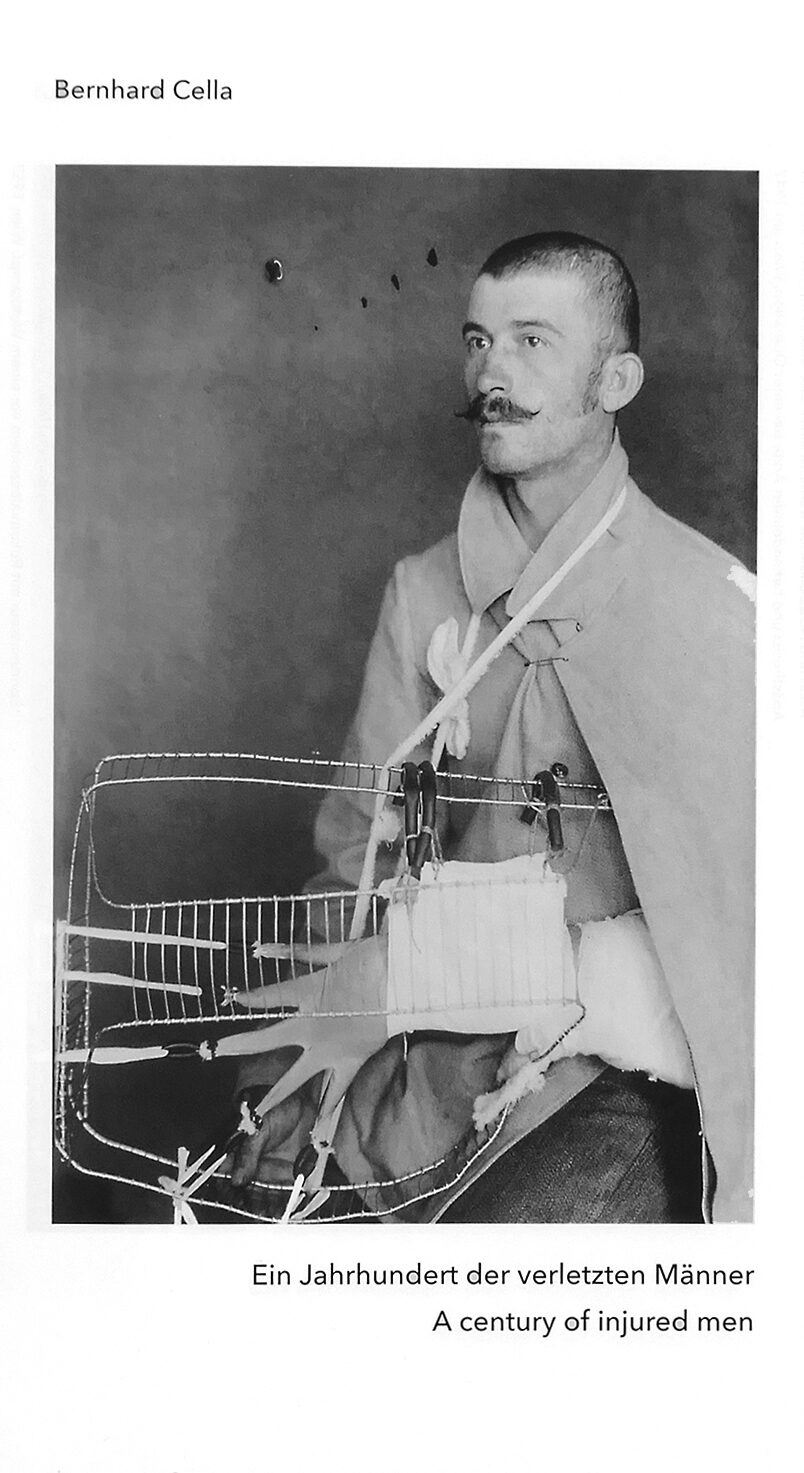
On the right side of room 21, against the wall, are three identical offset-printed artist’s books by Bernhard Cella titled Ein Jahrhundert der verletzten Männer (A Century of Injured Men). Published in 2022, the 152-page book contains photographs of convalescent men over the course of the twentieth century, questioning heroic images of masculinity. I’m assuming many of the injuries were caused by the two world wars.

I neglected to get a photo of the book, but here’s the cover image, and you can view sample pages here and here, as well as two photos of the books in situ at Kolumba on Cella’s Instagram page:

A Century of Injured Men

Vulnerability, injury, sacrifice, healing, the transmutation of pain, new life—these are the themes I gathered from this room.

The current Kolumba exhibition features much more contemporary art than medieval—there are some 175 contemporary works on display, compared to six from the Middle Ages—and I suspect that is now their modus operandi. So, the cross-temporal dialogue isn’t happening in every room, at least not explicitly.

I appreciate the uniqueness of this ecclesiastically run museum, acquiring and showing contemporary works by artists from a range of backgrounds while not shunning its own history as collectors and preservers of medieval German religious art.

As a Christian, I found myself latching on to the imagery that was familiar to me, like Jesus as the Man of Sorrows, and interpreting the surrounding works in light of that. But it seems to me the interpretive process could also move in the other direction, and I wonder how a visitor who doesn’t share my Christian vantage point would respond to the two rooms I’ve highlighted.

For two additional artworks I photographed at Kolumba, an ivory crucifix and an installation with coat, hat, and oil lamp, see my Instagram shares here and here.

Part 2, my reflections on my KMSKA visit, will be published tomorrow.

Roundup: Ellsworth Kelly’s “Austin,” new book by Jonathan Anderson, religion in pop art, and more

PRINT INTERVIEWS:

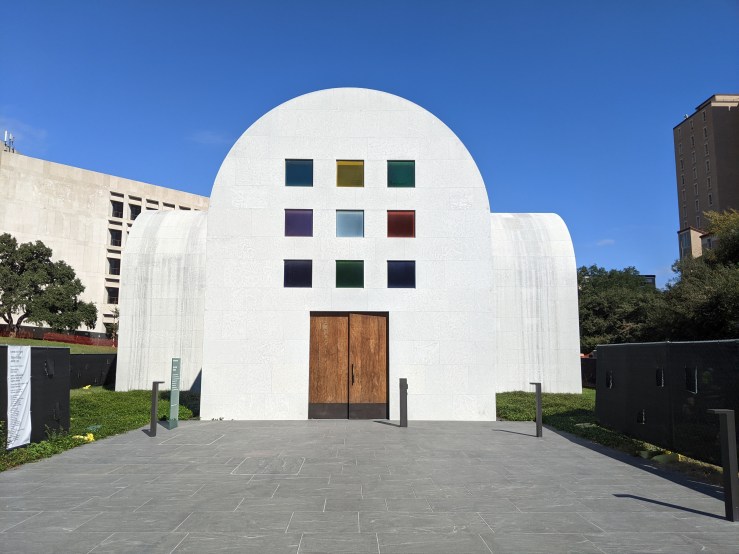
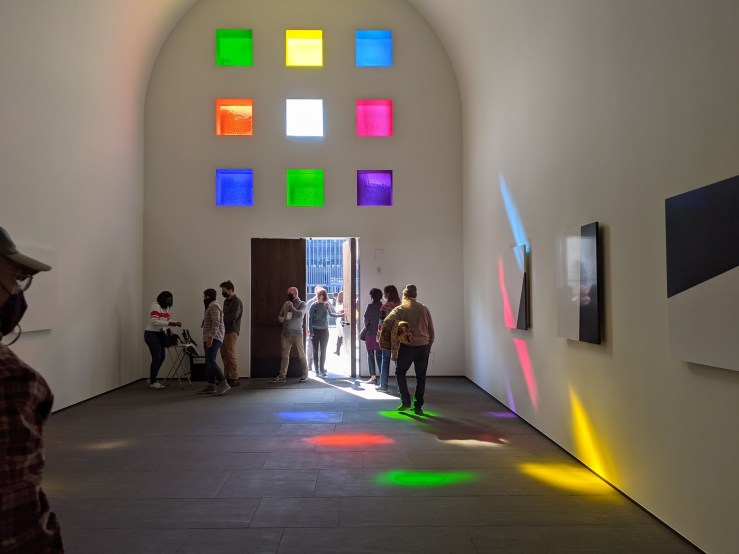
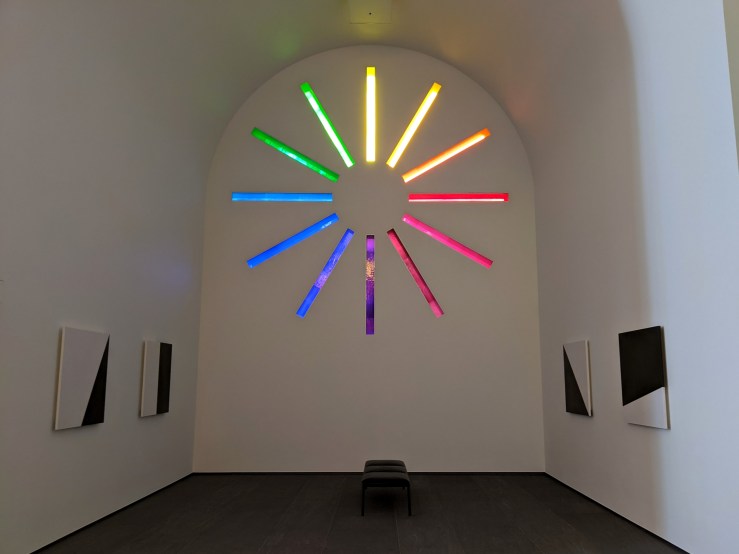
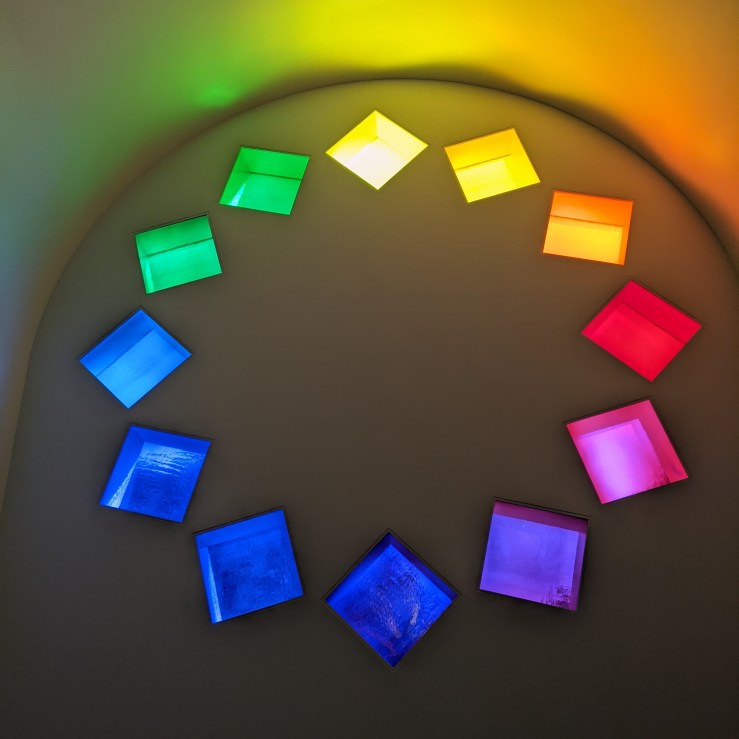
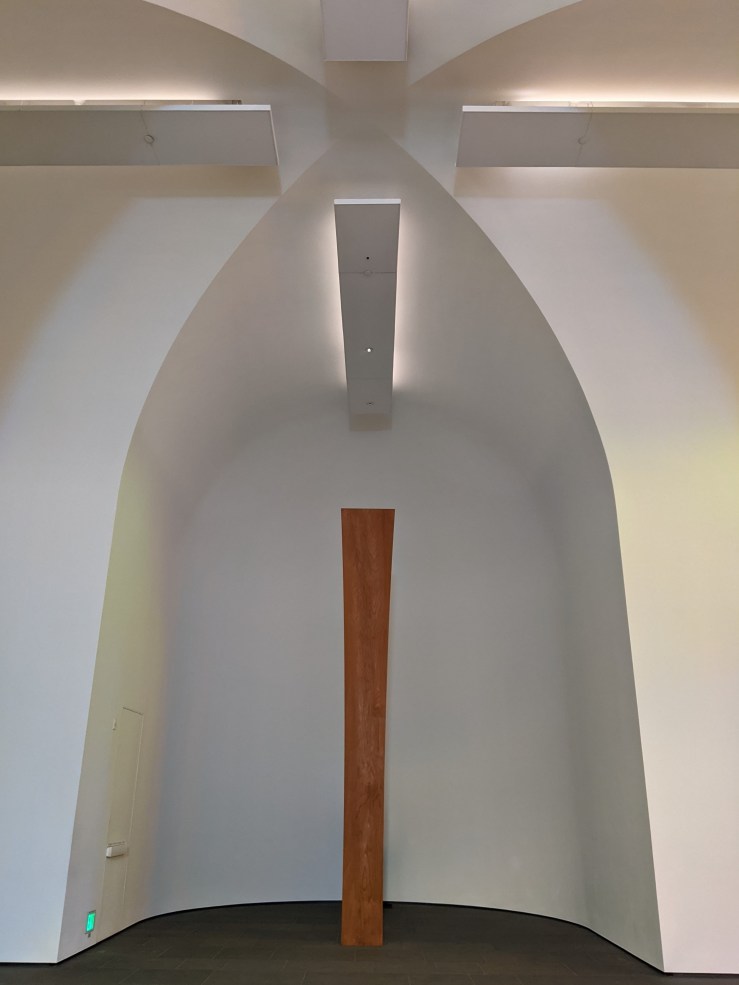
>> “What Remains: The Making of Ellsworth Kelly’s Last Work,” Image interview with Rick Archer: I got to experience Ellsworth Kelly’s Austin—a modernist “chapel” containing three stained glass windows, fourteen black-and-white marble panels (Stations of the Cross), and a redwood totem—while in Texas for a CIVA conference in 2021; see some of my photos below. Kelly was an atheist inspired by Romanesque church architecture, and the architect he chose to collaborate with on Austin, Rick Archer, is a Christian. In this wonderful new interview by Bruce Buescher, Archer discusses his working relationship with Kelly, Kelly’s desire for randomization and form over meaning, the technical and architectural challenges of bringing Kelly’s vision to life, religious references, and the artist’s objective for the space. “I hope when people go in here, they will experience joy,” Archer remembers Kelly saying.

  • Austin by Ellsworth Kelly
  • Austin by Ellsworth Kelly
  • Austin by Ellsworth Kelly
  • Austin by Ellsworth Kelly
  • Austin by Ellsworth Kelly

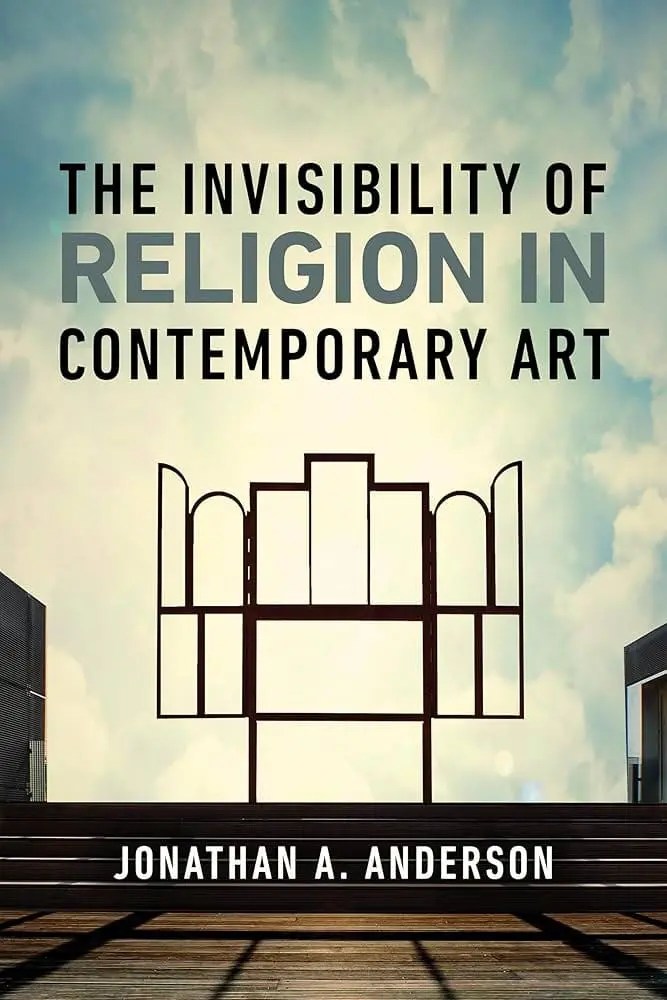
>> “The Invisibility of Religion in Contemporary Art: An interview with Jonathan A. Anderson” by Matthew J. Milliner: Jonathan Anderson [previously] is one of the most important people working across the disciplines of art and theology, and I’m thrilled that his book The Invisibility of Religion in Contemporary Art is now available from the University of Notre Dame Press!

Invisibility of Religion in Contemporary Art

In this recent interview for Comment magazine, Anderson explains his purpose in writing the book:

I have become increasingly convinced that so many pivotal artists and artworks over the past century are deeply shaped by religious traditions and seriously engaged in theological questioning, but this remains severely under-interpreted or misinterpreted in the scholarship about these artists. One might see these threads running through an artist’s artworks and personal writings and even discuss these topics with the artist in their studio, but when one moves to the scholarly writing and teaching about that same artist, that language consistently disappears or is transposed into another register—usually politics, occasionally a highly esoteric spirituality. I wanted to understand, at a non-superficial level, why this was the case, and I wanted to see how other ways of speaking and writing about this topic might be possible.

Don’t miss, at the end of the article, his three hopes for the field of “art and theology,” which I very much share!

+++

LECTURE: “The Problems and Possibilities of Visual Theology: The Ascension as a Case Study” by Jonathan A. Anderson: With Ascension Day coming up on May 29, it’s timely to share this talk given by Jonathan Anderson (see previous roundup item) a few years ago at Duke Divinity School, where he worked as a postdoctoral associate of theology and the visual arts from 2020 to 2023. Anderson explores a handful of images depicting the Ascension of Christ, a particularly challenging subject because of the spatial ambiguity. The scriptural accounts of the event (Luke 24:50–53 and Acts 1:6–11) beg the question, “What does ‘lifted up’ mean? Where is Jesus?” Attempting to work out these spatial difficulties visually can be theologically and exegetically productive, Anderson claims—even if it sometimes leads to unsatisfying results, as, Anderson says, it often does in Western art from the Renaissance onward. By contrast, when artists foster intertextual readings across the biblical canon and focus not so much on what the Ascension looks like as a historical event but rather on what it means, they are generally more successful.

Here are some time stamps, with links to the artworks discussed:

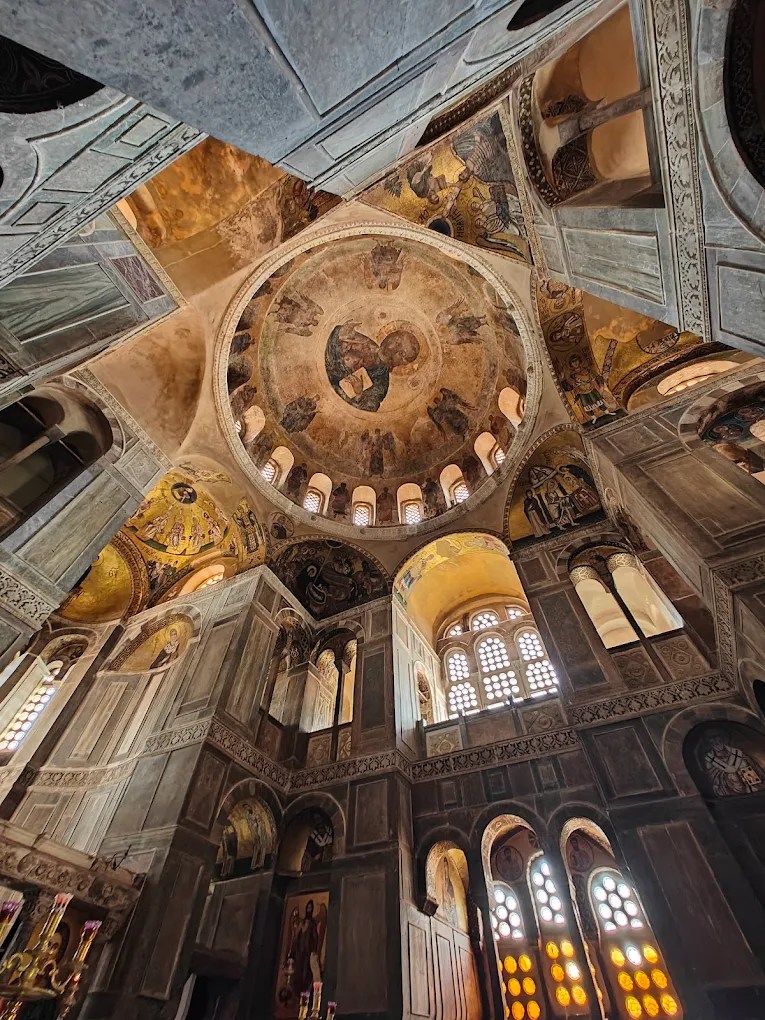
Hosios Loukas
Katholikon of Hosios Loukas monastery, Boeotia, Greece, 1011–12

+++

INSTRUMENTAL JAZZ: “Prayer” by Cory Wong: This video shows a live performance of Cory Wong’s “Prayer” on July 4, 2023, at Gesù music hall in Montreal. Wong, on guitar at far left, is joined by Ariel Posen on guitar, Victor Wooten on bass, and Nate Smith on drums. I learned about Wong through his collaborative album with Jon Batiste, Meditations (2020), which includes a version of this piece featuring Batiste’s piano playing.

+++

EXHIBITION: OMG! Reli Popart, Museum Krona, Uden, Netherlands, April 5–September 7, 2025: This exhibition at Museum Krona (housed in the complex of the still-active Birgittine Abbey of Maria Refugie in Uden, Netherlands) explores the connection between the pop art movement and Christianity through works by artists such as Andy Warhol, Corita Kent, Niki de Saint Phalle, and especially Dutch artists, including Woody van Amen and Wim Delvoye. Pop art is characterized by the use of imagery from popular culture, sourced from television, magazines, comic books, ads—and sometimes from the trash bin.

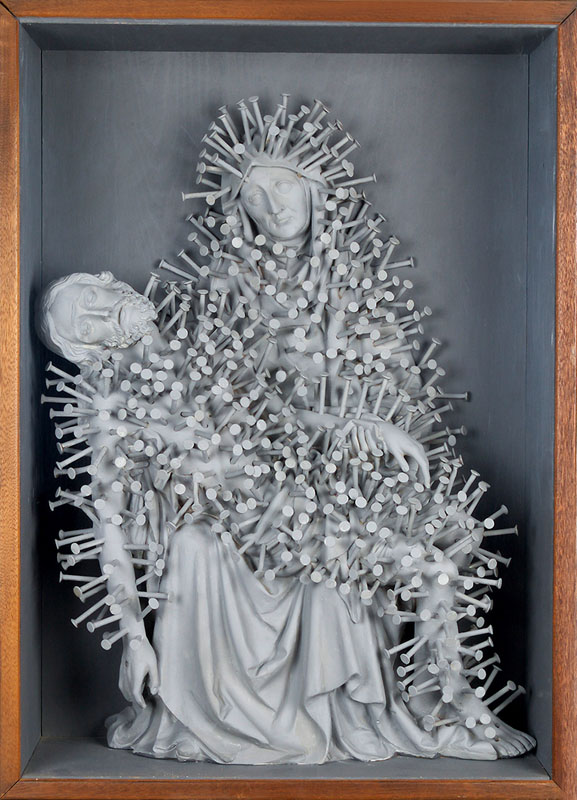
Jacques Frenken [previously], for example, built a body of work by salvaging discarded plaster sculptures of Christ and the saints—mass-produced for Catholic devotional use—and reconstructing them into assemblages. For his Spijkerpiëta, he “brought the Pietà back into our midst and accentuated the pain it radiates with nails,” the artist said.

Frenken, Jacques_Spijkerpieta
Jacques Frenken (Dutch, 1929–2022), Spijkerpiëta (Nail Pietà), 1967. Plaster, paint, iron, wood. Museum Krona, Uden, Netherlands.

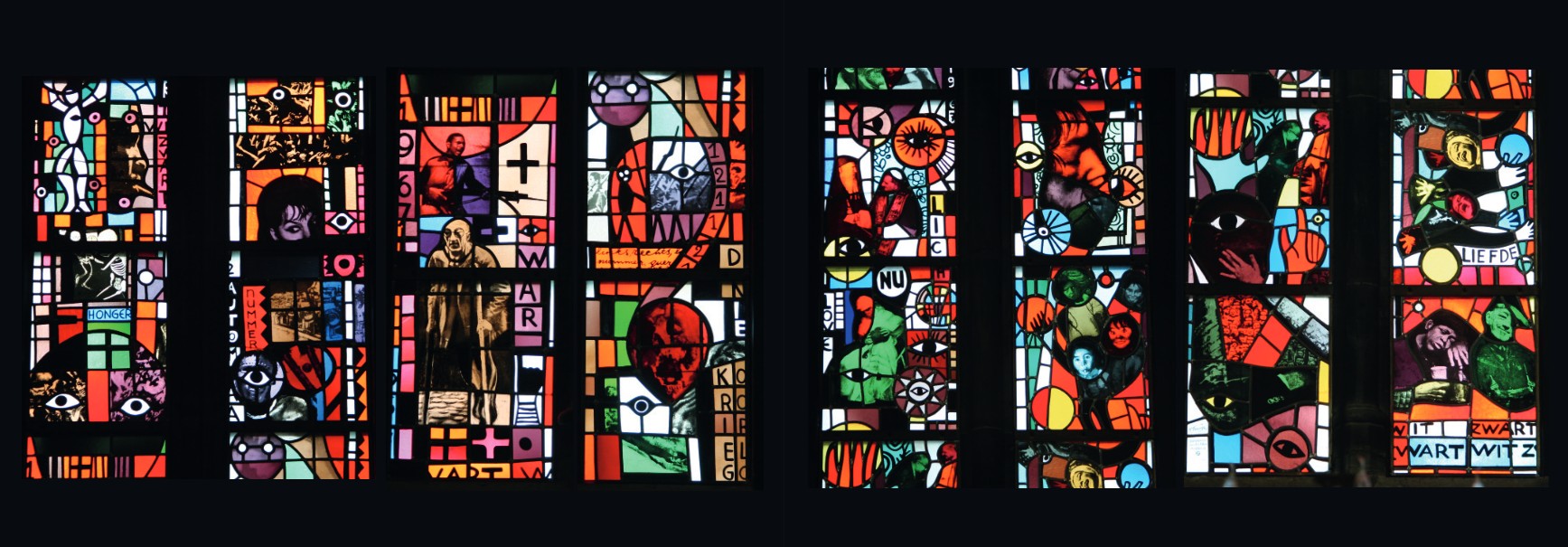
Another artist represented in the exhibition is Hans Truijen, who was commissioned in the 1960s by St. Martin’s Church in Maastricht to design eight stained glass windows for their worship space. The four along the left aisle of the nave depict human and divine suffering, whereas those on the right express hope, love, freedom, and happiness. He chose photographic images from various periodicals, including ones of the Vietnam War, and transferred them to glass using a special screen-printing process.

Truijen, Hans_Stained glass
Hans Truijen (Dutch, 1928–2005), Studies for the eight stained glass windows commissioned by St. Martinuskerk, Wyck-Maastricht, Netherlands, 1966–68. Courtesy of the artist’s son, Marc Truijen.

“Pietà” by Robert Fagles (poem)

van Gogh, Vincent_Pieta
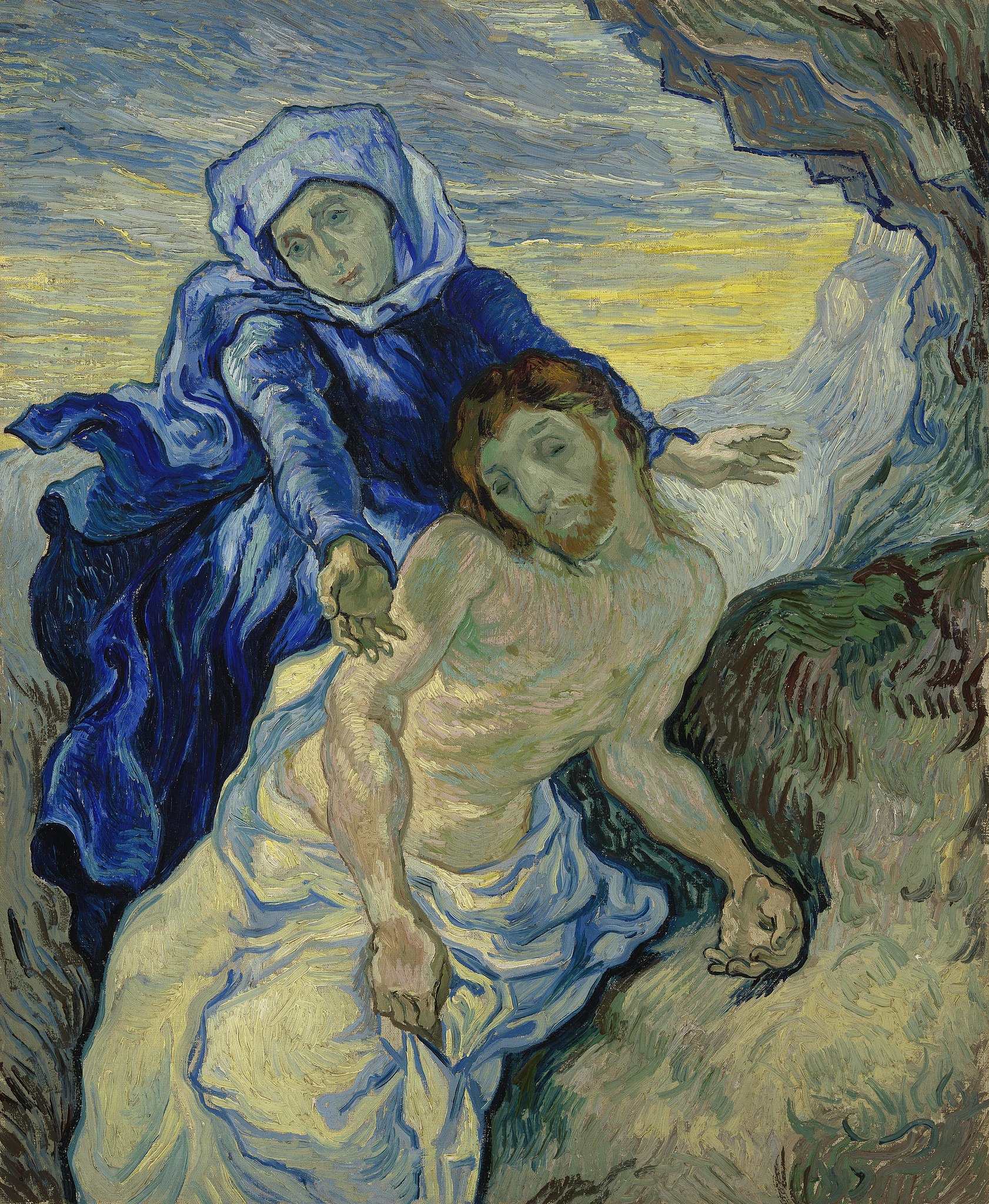
Vincent van Gogh (Dutch, 1853–1890), Pietà (after Delacroix), 1889. Oil on canvas, 73 × 60.5 cm. Van Gogh Museum, Amsterdam.

“Poor fighter, poor sufferer,” 
my brother’s words for me.
Self-pity—
I have to beat it down. But how, exactly?
Never know when the next attack will come.
How to suppress religion?
Down the cloisters of the sick it beckoned—
I abused my God . . . that lithograph of Delacroix’s,
irredeemable sheets I flung in the paint and oil,
his Pietà in ruins.
Reconstruct it from memory.
Good technical exercise. Start with the hands,
there were four hands, four arms in the foreground—
mother and son, and the torsions of their bodies
almost impossible, draw them out—
painfully . . . no measurements—
into a great mutual gesture of despair.

Delacroix and I, we both discovered painting
when we no longer had breath or teeth.
Work into his work, strain for health,
the brain clearing, fingers firmer,
brush in the fingers going like a bow,
big bravura work—pure joy! I copy—
no, perform his masterwork of pain.

Genius of iridescent agony, Delacroix,
help me restore your lithograph with color.
I mortify before your model—
how to imitate my Christ? The bronze
of my forelock shadows his, the greatest artist:
stronger than all the others, spurning marble,
clay and paint, he worked in living flesh.

Living and yet immortal, Lord, revive me—
let me inhale the blue of Mary’s cape
billowing hurricanes of hope, clothe me
in your cerements gold with morning—
mother and son, from all your sorrow
all renewal springs, the earth you touch
turns emerald as your hand that burgeons green.

from I, Vincent: Poems from the Pictures of Van Gogh by Robert Fagles (Princeton University Press, 1978)

Robert Fagles (1933–2008) (PhD, Yale) was an award-winning American translator, poet, and academic. He is best known for his many translations of ancient Greek and Roman classics, especially the epic poems of Homer. He taught English and comparative literature at Princeton University from 1960 until his retirement in 2002, chairing the department from 1975 onward.


Vincent van Gogh (1853–1890) was raised in the Dutch Reformed Church, the son of a small-town minister—and even worked himself as a lay preacher in the Borinage mining region of southwestern Belgium for two years in his mid-twenties. While there, he gave away all his possessions and lived in poverty like those he served, eating a spare diet, wearing rough garments, and sleeping on the floor. Ironically, his sponsoring evangelical committee deemed such behavior unbecoming of a minister of the gospel, and, due also to his lack of eloquence and theological refinement, they withdrew their support.

This rejection soured Vincent on institutional Christianity. But it didn’t squash his faith. After moving back in with his parents in Nuenen, the Netherlands, he wrote to his brother and close confidante, Theo:

Life [. . .] always turns towards one an infinitely meaningless, discouraging, dispiriting blank side on which there is nothing, any more than on a blank canvas.

But however meaningless and vain, however dead life appears, the man of faith, of energy, of warmth, and who knows something, doesn’t let himself be fobbed off like that. He steps in and does something, and hangs on to that, in short, breaks, ‘violates’ – they say.

Let them talk, those cold theologians. [Letter 464]

Although Vincent left the church and developed conflicted feelings about the Bible, he maintained a reverence for Christ to the end of his days. His time in the Borinage was not for nothing, as it’s there that he discovered, through sketching his parishioners and the surrounding landscapes, his calling to be an artist.

This new vocation was one he ascribed metaphorically to Christ. In a letter to his friend and fellow artist Émile Bernard dated June 26, 1888, Vincent wrote that Jesus’s masterworks are human beings made fully and eternally alive:

Christ – alone – among all the philosophers, magicians, &c. declared eternal life – the endlessness of time, the non-existence of death – to be the principal certainty. The necessity and the raison d’être of serenity and devotion. Lived serenely as an artist greater than all artists disdaining marble and clay and paint – working in LIVING FLESH. I.e. – this extraordinary artist, hardly conceivable with the obtuse instrument of our nervous and stupefied modern brains, made neither statues nor paintings nor even books . . . he states it loud and clear . . . he made . . . LIVING men, immortals. [Letter 632]

In the same letter, he contended that “the figure of Christ has been painted – as I feel it – only by Delacroix and by Rembrandt…….. And then Millet has painted…. Christ’s doctrine.”

These are the three artists Vincent admired most. He mentions them many times throughout his ample correspondence with family and friends, and he made paintings after all three.

The only painting Vincent ever made of Christ was his Pietà, which he painted in two versions in September 1889, both after the French artist Eugène Delacroix (1798–1863). These are among the many works Vincent painted at a psychiatric hospital in Saint-Rémy-de-Provence in southern France, to which he had voluntarily committed himself after suffering an acute mental breakdown that resulted in his infamous severing of his left ear on December 23, 1888. Theo had rushed to Arles, where Vincent was living in “the Yellow House” at the time, and on December 28 reported on Vincent’s condition in a letter to his wife, Jo van Gogh-Bonger:

I found Vincent in the hospital in Arles. The people around him realized from his agitation that for the past few days he had been showing symptoms of that most dreadful illness, of madness, and an attack of fièvre chaude, when he injured himself with a razor, was the reason he was taken to hospital. Will he remain insane? The doctors think it possible, but daren’t yet say for certain. It should be apparent in a few days’ time when he is rested; then we will see whether he is lucid again. He seemed to be all right for a few minutes when I was with him, but lapsed shortly afterwards into his brooding about philosophy and theology. It was terribly sad being there, because from time to time all his grief would well up inside and he would try to weep, but couldn’t. Poor fighter and poor, poor sufferer. Nothing can be done to relieve his anguish now, but it is deep and hard for him to bear. [Letter 728]

Vincent returned to the Yellow House in January 1889 but over the next few months experienced recurring bouts of mania and depression and was in and out of the hospital. Some of the people of Arles grew increasingly frightened by his erratic behavior, and they essentially ran him out of town. That’s when he made his way twenty miles northeast to the town of Saint-Rémy to check in to Saint-Paul-de-Mausole, a former monastery that then, as now, served as a hospital for the mentally ill.

(Related post: “Three poems about Vincent van Gogh”)

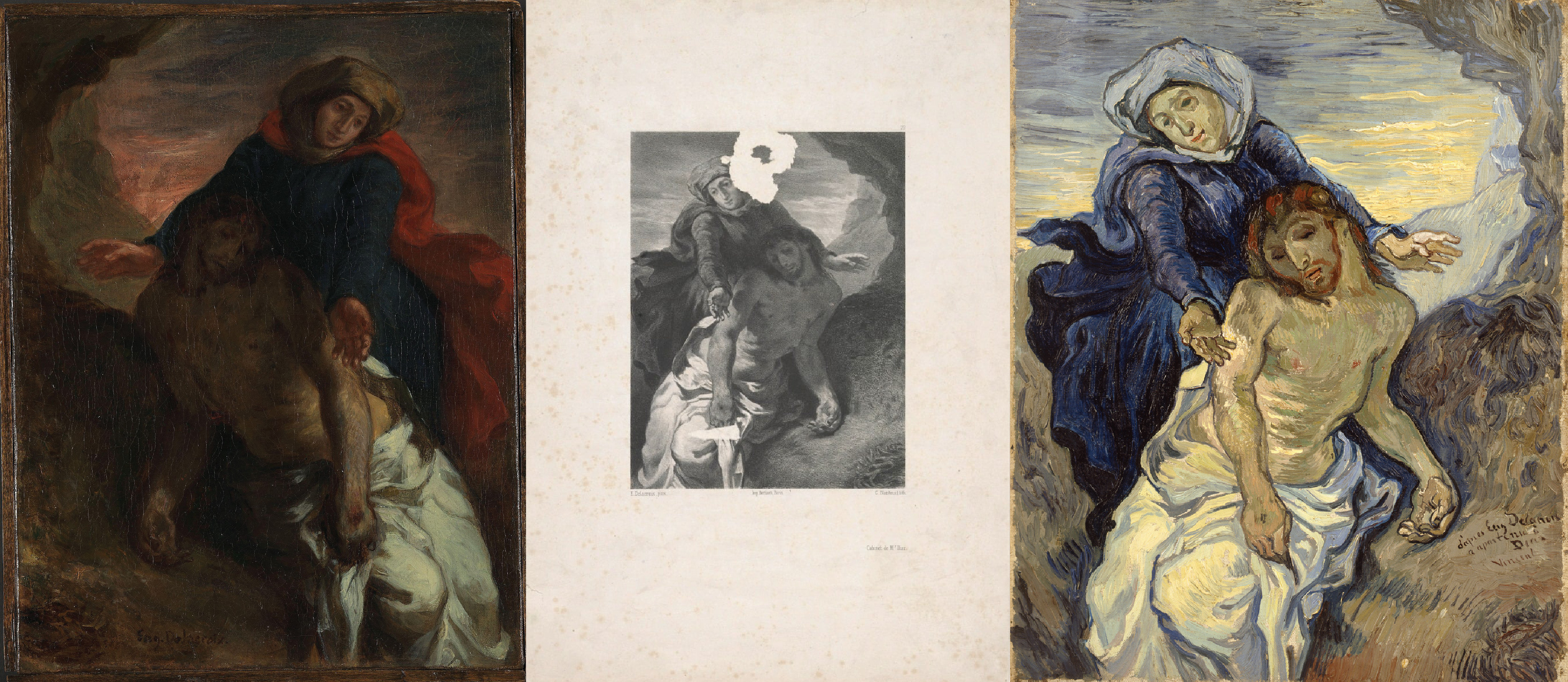
Vincent had two rooms there, one of which he used as a studio, setting up the various print copies he owned of acclaimed paintings. One was a lithograph by Célestin François Nanteuil-Leboeuf after Delacroix’s Pietà, from the portfolio Les artistes anciens et modernes. (Theo had bought and sent him this litho at his request.) Vincent lamented to his brother that he accidentally damaged it with spilled paint—but that impelled him to paint his own copy of Delacroix. On September 10, 1889, he wrote:

Work is going very well, I’m finding things that I’ve sought in vain for years, and feeling that I always think of those words of Delacroix that you know, that he found painting when he had neither breath nor teeth left. Ah well, I myself with the mental illness I have, I think of so many other artists suffering mentally, and I tell myself that this doesn’t prevent one from practising the role of painter as if nothing had gone wrong.

[. . .] In the very suffering, religious thoughts sometimes console me a great deal. Thus this time during my illness a misfortune happened to me – that lithograph of Delacroix, the Pietà, with other sheets had fallen into some oil and paint and got spoiled.

I was sad about it – then in the meantime I occupied myself painting it, and you’ll see it one day, on a no. 5 or 6 canvas I’ve made a copy of it which I think has feeling. [. . .] My fingers [are] so sure that I drew that Delacroix Pietà without taking a single measurement, though there are those four outstretched hands and arms – gestures and bodily postures that aren’t exactly easy or simple. [Letter 801]

Pieta
LEFT: Eugène Delacroix, Pietà, ca. 1850, oil on canvas, 35.6 × 27 cm, National Museum of Art, Architecture and Design, Oslo. CENTER: Célestin François Nanteuil-Leboeuf, Pietà (after Delacroix), 1853, lithograph, Van Gogh Museum, Amsterdam. RIGHT: Vincent van Gogh, Pietà (after Delacroix), 1889, oil on canvas, 42 × 34 cm, Vatican Museums.

The painted copy he refers to here is the smaller of the two, which he gifted to his sister Willemien and is now in the collection of the Vatican Museums in Vatican City. In another letter, from September 19, he tells Wil “this little copy of course has no value from any point of view,” but “you’ll be able to see in it that Delacroix doesn’t draw the features of a Mater Dolorosa [sorrowing Mother of God] in the manner of Roman statues – and that the pallid aspect, the lost, vague gaze of a person tired of being in anguish and in tears and keeping vigil is present in it.”

The other Pietà that Vincent painted—which is similar to the first but larger and brighter—he kept for himself, hanging it in his bedroom at Saint-Rémy. He describes the painting to Wil:

The Delacroix is a Pietà, i.e. a dead Christ with the Mater Dolorosa. The exhausted corpse lies bent forward on its left side at the entrance to a cave, its hands outstretched, and the woman stands behind. It’s an evening after the storm, and this desolate, blue-clad figure stands out – its flowing clothes blown about by the wind – against a sky in which violet clouds fringed with gold are floating. In a great gesture of despair she too is stretching out her empty arms, and one can see her hands, a working woman’s good, solid hands. With its flowing clothes this figure is almost as wide in extent as it’s tall. And as the dead man’s face is in shadow, the woman’s pale head stands out brightly against a cloud – an opposition which makes these two heads appear to be a dark flower with a pale flower, arranged expressly to bring them out better. [Letter 804]

van Gogh, Vincent_Pieta
Vincent van Gogh (Dutch, 1853–1890), Pietà (after Delacroix), 1889. Oil on canvas, 73 × 60.5 cm. Van Gogh Museum, Amsterdam.

Although Vincent may have at one time seen Delacroix’s Pietà painting in person, at Saint-Rémy he had only a grayscale image, the lithograph by Nanteuil-Leboeuf, to reference. For his version, he invented his own color scheme—bold blues and yellows.

On September 20, Vincent described to Theo his process of “copying,” or interpreting, the masters:

What I’m seeking in it, and why it seems good to me to copy them, I’m going to try to tell you. We painters are always asked to compose ourselves and to be nothing but composers.

Very well – but in music it isn’t so – and if such a person plays some Beethoven he’ll add his personal interpretation to it – in music, and then above all for singing – a composer’s interpretation is something, and it isn’t a hard and fast rule that only the composer plays his own compositions.

Good – since I’m above all ill at present, I’m trying to do something to console myself, for my own pleasure.

I place the black-and-white by Delacroix or Millet or after them in front of me as a subject. And then I improvise colour on it but, being me, not completely of course, but seeking memories of their paintings – but the memory, the vague consonance of colours that are in the same sentiment, if not right – that’s my own interpretation.

Heaps of people don’t copy. Heaps of others do copy – for me, I set myself to it by chance, and I find that it teaches and above all sometimes consoles.

So then my brush goes between my fingers as if it were a bow on the violin and absolutely for my pleasure. [Letter 805]

Some art historians believe the Christ figure in the painting is a self-portrait—Vincent identifying himself with the suffering Christ, or recognizing Christ’s presence with him in his suffering, and expressing his longing to be cradled in loving arms and for resurrection from the grave of psychosis. In Vincent van Gogh: The Complete Paintings, Ingo F. Walther and Rainer Metzger write,

Nothing could convey more clearly his need to record his own crisis in the features of another than these two copies [of Delacroix’s Pietà]. The face of the crucified Christ in the lap of a grieving Mary quite unambiguously has van Gogh’s own features. In other words, a ginger-haired Christ with a close-trimmed beard was now the perfect symbol of suffering, the (rather crude) encoding of van Gogh’s own Passion. The painter was to attempt this daring stroke once more, in his interpretation of Rembrandt’s The Raising of Lazarus. Here, van Gogh gave his own features to a Biblical figure who, like Christ, passed through Death into new Life. It was as if, in his work as a copyist, van Gogh was pursuing the kind of oblique allegory he disapproved of in Bernard and Gauguin [see Letter 823]. Five weeks of mental darkness demanded artistic expression – and even that incorrigible realist Vincent van Gogh could not be satisfied with landscape immediacy alone. (542)

On May 16, 1890, Vincent left the hospital at Saint-Rémy, bringing his Pietà painting with him. He moved to Auvers-sur-Oise, a suburb of Paris, placing himself under the care of the homeopathic doctor Paul Gachet, who became a friend. Dr. Gachet admired the painting very much and requested his own copy. (As far as we know, Vincent never got around to making one.)

Vincent was incredibly prolific in Auvers, but his mental health continued to decline, and he died a little over two months after relocating there, on July 29, 1890, from a gunshot wound to the lower chest that was likely self-inflicted.


In his poem “Pietà” from an ekphrastic collection based entirely on Vincent’s paintings, Robert Fagles draws on Vincent’s biography and letters in addition to the titular painting to voice the spiritual and emotional yearnings of Vincent’s final year. The last stanza is a prayer that the poetic speaker Vincent addresses to God—for hope, renewal, light:

Living and yet immortal, Lord, revive me—
let me inhale the blue of Mary’s cape
billowing hurricanes of hope, clothe me
in your cerements gold with morning—
mother and son, from all your sorrow
all renewal springs, the earth you touch
turns emerald as your hand that burgeons green.      

In Vincent’s Pietà, the dead Christ’s limp hand rests on a grassy boulder or knoll, which Fagles reads as signifying life awakening from death. You can even see the green reflected in Christ’s face and chest, not to mention the golden sun (“after the storm,” as the historical Vincent wrote) glinting on his right arm, abdomen, and shroud, a faint promise of resurrection.

Roundup: Fractured series, the Darkling Psalter, “Parce mihi Domine” with sax, and more

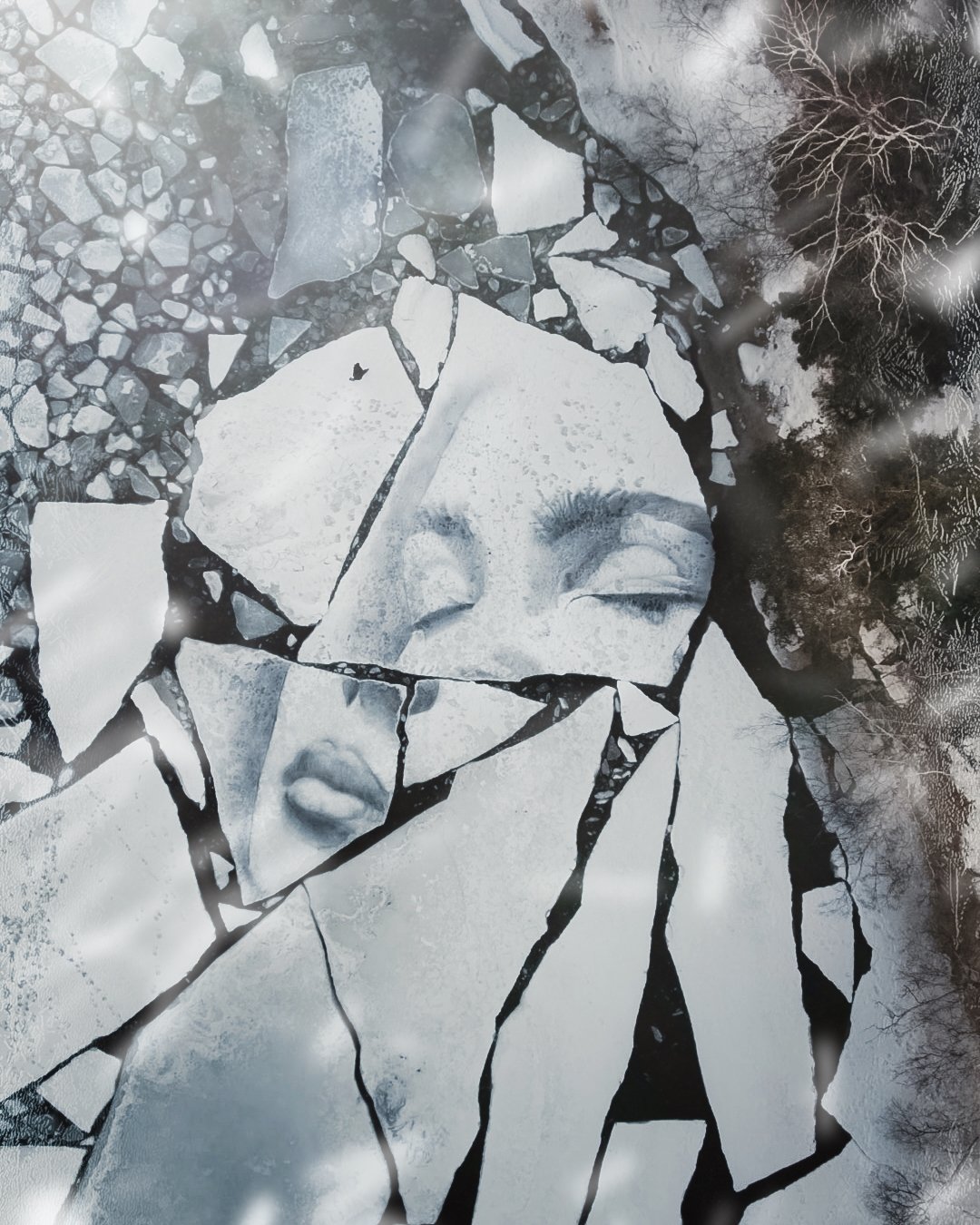
ART PROJECT: Fractured by David Popa:Fractured is a project located on various ice floes in southern Finland. By use of only earth, charcoal and the source water, a series of portraits were created on fractured ice floes that remained for only a brief time. The pieces were documented via aerial drone video, photography and photogrammetry and hold a tactile form as limited-edition prints as well as in digital form through 1/1 NFTs. The project evolved as a response to the ongoing conflict in Ukraine, which has only further highlighted the fractured state of the world in which we live. During the project, the ice fractured completely unexpectedly at unpredictable times, leaving the artist at odds as to whether continuing the work was even worthwhile. From the ground, one would never be able to decipher any silver linings within the chaos; however, from above, the fragments hold a harmony and beauty that is imperceptible from any other perspective. The work offers a means to point the viewer not to despair and chaos, but rather questions where we must look to mend the broken fragments of our lived reality and perhaps how the fragments can be used to create an entirely new mosaic from the scattered vestiges.”

David Popa (American, 1997–), from the Fractured series, 2023. Iron oxide black earth pigment and charcoal on floating ice.

Explore more of the artist’s work at www.davidpopaart.com. For a printed interview with Popa (featuring many of his amazing photos of his amazing land art), see www.yatzer.com/david-popa.

+++

POEMS: Seven Reimagined Psalms from the Darkling Psalter by Andy Patton: The Darkling Psalter is a project by Andy Patton (MA, Trinity Evangelical Divinity School) to write new creative renditions of the Bible’s 150 psalms. The Rabbit Room recently featured seven of these: Psalms 5, 10, 12, 14, 25, 27, 30.

+++

PODCAST INTERVIEW: “Van Gogh Has a Broken Heart, with Russ Ramsey,” Makers & Mystics: I appreciated this recent conversation in which pastor, writer, and arts enthusiast Russ Ramsey discusses his latest book, exploring the struggles and sorrows of a handful of historical artists and how they are reflected in their art.

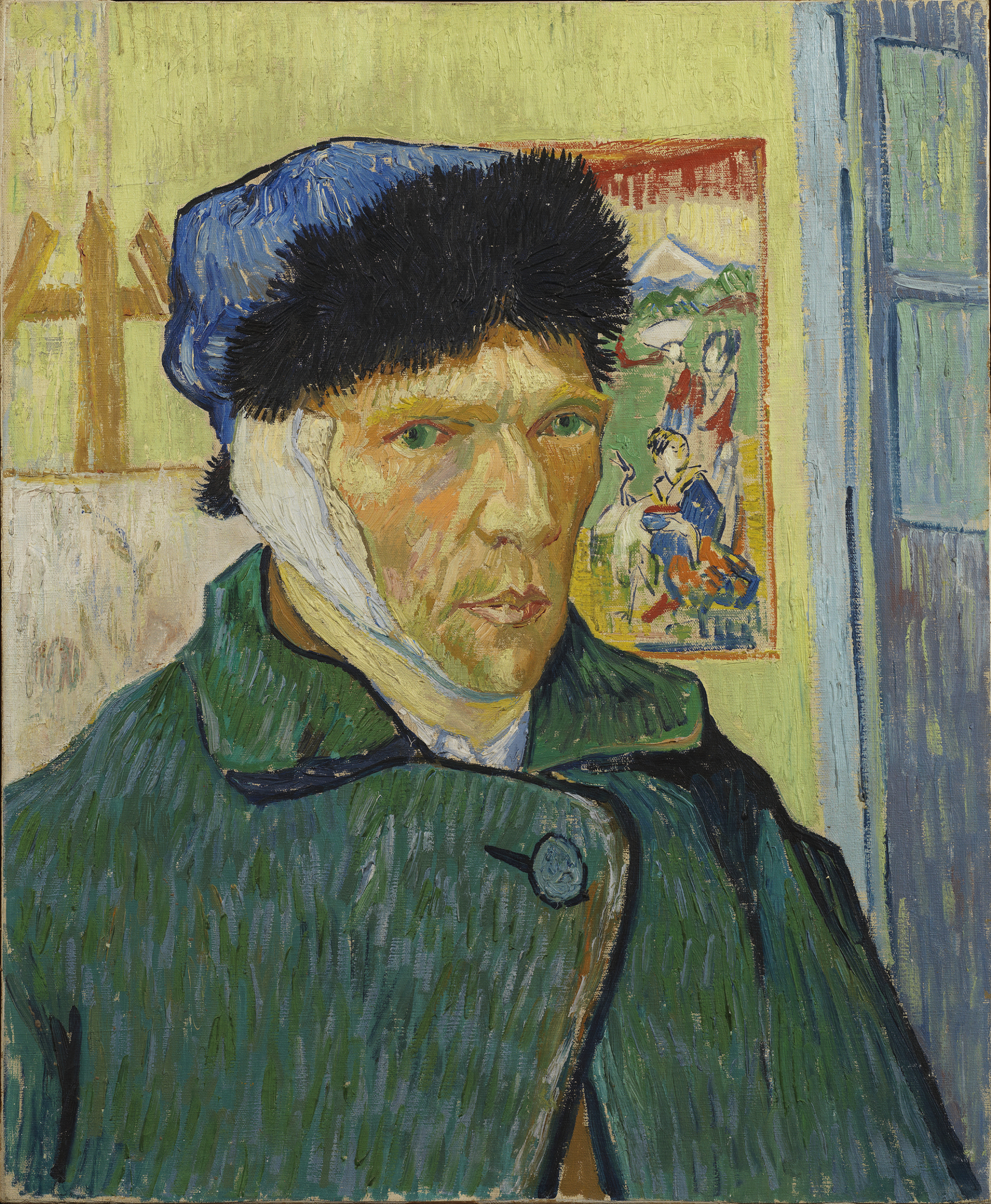
van Gogh, Vincent_Self-Portrait with Bandaged Ear
Vincent van Gogh (Dutch, 1853–1890), Self-Portrait with Bandaged Ear, 1889. Oil on canvas, 60 × 49 cm. Courtauld Gallery, London.

If you’re interested to learn more about Vincent van Gogh, check out the Artist Profile I was commissioned to create for the same podcast, which I expand on here. I spent two months doing intensive research to write this seventeen-minute script!

+++

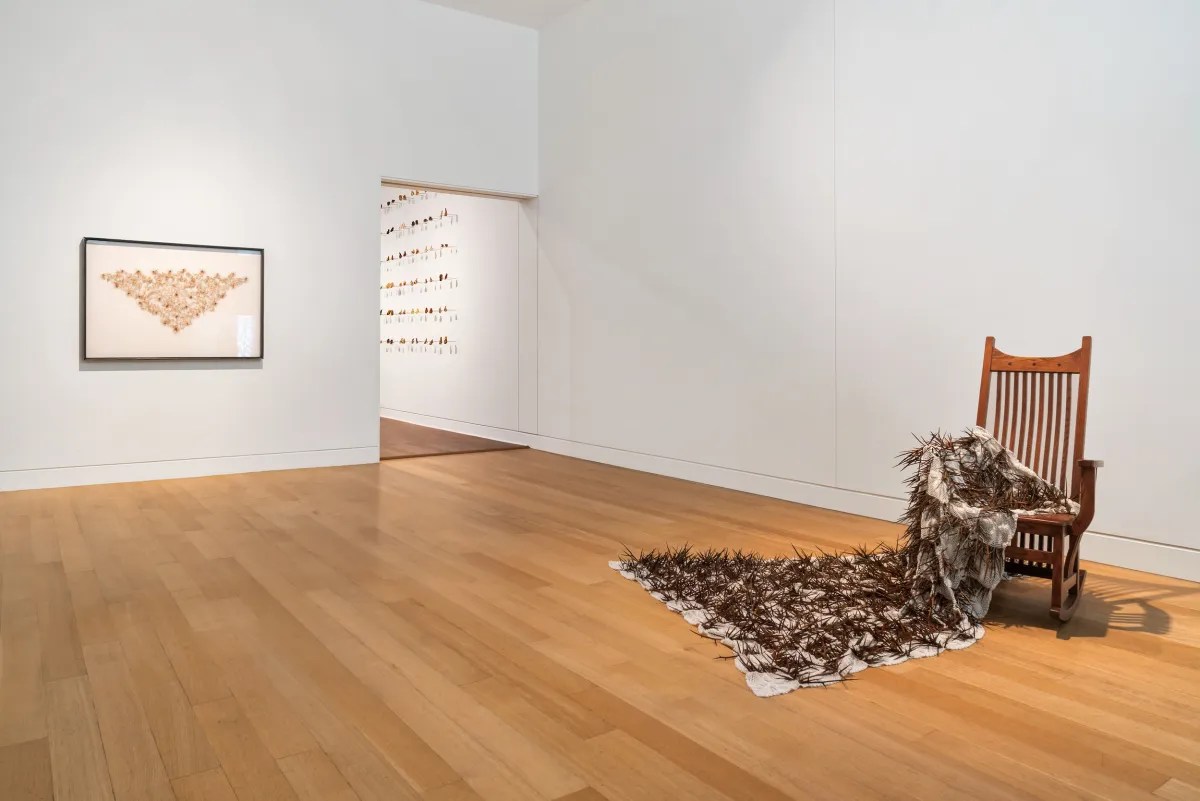
EXHIBITION REVIEW: “Selva Aparicio’s Memorials to Loss and Renewal” by Lori Waxman, Hyperallergic: Mounted last year by the DePaul Art Museum in Chicago, the first solo show of the Barcelona-born artist Selva Aparicio featured works that “offer a merciful focal point for grief.” Aparicio, Waxman writes, “treats unwanted things with extreme sensitivity, personally gathering and storing them over many years, eventually renewing them with remarkable vision.” She reproduced the twice-destroyed rose window of the Basilica de Santa Maria del Pi using lettuce leaves discarded by her neighborhood market; she filled the interior of an upright piano with wasp nests; she constructed over two dozen pairs of decorative ears out of moss, shells, seed pods, animal hair, and other materials for her late cat, Momo, whose ears were removed due to illness; using strands of hair from herself, her mother, and her niece, she sewed a mourning veil, the kind traditionally worn by widows, out of 1,365 cicada wings.

Selva Aparicio exhibition view
Exhibition view: Selva Aparicio: In Memory Of, DePaul Art Museum, Chicago, 2024. Left: Velo de luto (Mourning Veil) (2020), formed from 1,365 Magicicada wings; right: Solace (2023–24), crochet cotton blanket woven through with honey locust thorns.

I didn’t get to see this exhibition in person, but I’m compelled by what I saw and read of it online—how it deals so tenderly with suffering, death, remembrance, and hope.

+++

SONGS:

>> “Parce mihi Domine” (Spare Me, O Lord): A musical setting of the Latin translation of Job 7:16b–21, this motet by the Spanish Renaissance composer Cristòbal de Morales “captures the sense of desolation and abandonment that is expressed by Job, a dark condition akin to the forsakenness that our Lord experienced on the cross,” writes church music director Ken Myers. In 1994 the Hilliard Ensemble recorded the piece in collaboration with the Norwegian saxophonist Jan Garbarek for their album Officium, a jazz-classical fusion that became one of ECM’s most successful releases, selling over 1.5 million copies.

The video below features a different set of musicians paying tribute to this “unexpected . . . alliance of austere vocal music and wandering saxophone” (Elodie Olson-Coons). Filmed December 18, 2015, at the Chiesa di Sant’Anna (Church of St. Anne) in Cagliari, Italy, the performance is by the vocal ensemble Cantar Lontano (under the direction of Marco Mencoboni) and saxophonist Gavino Murgia. [HT: Global Christian Worship]

After losing his health, wealth, and children, the Old Testament character Job laments openly before God. “I will not restrain my mouth,” he says. “I will speak in the anguish of my spirit; I will complain in the bitterness of my soul” (Job 7:11). He views God as his tormentor and begs God to leave him alone (“spare me”). Adopting Job’s voice, the four singers of the Morales piece sing the following biblical passage:

Parce mihi Domine, nihil enim sunt dies mei.
Quid est homo, quia magnificas eum?
Aut quid apponis erga eum cor tuum? Visitas cum diluculo, et subito probas illum.
Usquequo non parcis michi, nec dimittas me, ut glutiam salivam meam? Peccavi.
Quid faciam tibi, o custos hominum? Quare posuisti me contrarium tibi, et factus sum michimet ipsi gravis?
Cur non tollis peccatum meum, et quare non aufers iniquitatem meam?
Ecce nunc in pulvere dormio; et si mane me quesieris, non subsistam.

English translation (NRSVUE):

    Let me alone, for my days are a breath.
What are humans, that you make so much of them,
    that you set your mind on them,
visit them every morning,
    test them every moment?
Will you not look away from me for a while,
    let me alone until I swallow my spittle?
If I sin, what do I do to you, you watcher of humanity?
    Why have you made me your target?
    Why have I become a burden to you?
Why do you not pardon my transgression
    and take away my iniquity?
For now I shall lie in the earth;
    you will seek me, but I shall not be.

>> “Lamb of God” by The Many: From the EP Have Mercy (2021) by The Many [previously], “an uncommon, intentionally diverse collective making music for people to sing together about peace and justice and a world where all belong.” This song is an adaptation of the ancient Christian liturgical prayer known as the Agnus Dei. The music is by Gary Rand, and the lyrics are by Gary Rand and his daughter, Lenora Rand. Click here to purchase an individual MP3 recording or sheet music, or visit the group’s Bandcamp page.

Lamb of God, with love poured out
you suffer with the world.
Have mercy. Have mercy.
Lamb of God who suffers with the world,
grant us peace, grant us peace.

Holy Week: Jesus Prays in Gethsemane

When they had sung the hymn, they went out to the Mount of Olives.

Then Jesus said to [his disciples], “You will all fall away because of me this night, for it is written, ‘I will strike the shepherd, and the sheep of the flock will be scattered.’ But after I am raised up, I will go ahead of you to Galilee.”

Peter said to him, “Even if all fall away because of you, I will never fall away.”

Jesus said to him, “Truly I tell you, this very night, before the cock crows, you will deny me three times.”

Peter said to him, “Even though I must die with you, I will not deny you.” And so said all the disciples.

Then Jesus went with them to a place called Gethsemane, and he said to his disciples, “Sit here while I go over there and pray.” He took with him Peter and the two sons of Zebedee and began to be grieved and agitated. Then he said to them, “My soul is deeply grieved, even to death; remain here, and stay awake with me.” And going a little farther, he threw himself on the ground and prayed, “My Father, if it is possible, let this cup pass from me, yet not what I want but what you want.”

Then he came to the disciples and found them sleeping, and he said to Peter, “So, could you not stay awake with me one hour? Stay awake and pray that you may not come into the time of trial; the spirit indeed is willing, but the flesh is weak.”

Again he went away for the second time and prayed, “My Father, if this cannot pass unless I drink it, your will be done.” Again he came and found them sleeping, for their eyes were heavy.

So leaving them again, he went away and prayed for the third time, saying the same words. Then he came to the disciples and said to them, “Are you still sleeping and taking your rest? Now the hour is at hand, and the Son of Man is betrayed into the hands of sinners. Get up, let us be going. Look, my betrayer is at hand.”

—Matthew 26:30–46

LOOK: Exceeding Sorrowful by Douglas Porter

Porter, Doug_Exceeding Sorrowful
Douglas Porter (Canadian, 1949–), Exceeding Sorrowful, 2023. Acrylic on canvas, 36 × 24 in.

Doug Porter is a painter, video artist and editor, and graphic designer from Orillia, Ontario. His painting Exceeding Sorrowful portrays the religious subject known as the Agony in the Garden. The painting’s title comes from the King James Version of Matthew 26:38, where Jesus tells his inner circle of disciples (Peter, James, and John), “My soul is exceeding sorrowful, even unto death: tarry ye here, and watch with me.”

He had just eaten the Passover seder with them and the rest of the Twelve, pronouncing some strange words at the table: “Take, eat; this is my body,” he said as he broke the bread. And as he raised the wineglass, he commanded them, “Drink from it, all of you, for this is my blood of the covenant, which is poured out for many for the forgiveness of sins . . .”

Singing a hymn and going out to the Mount of Olives, he then foretold his disciples’ desertion of him. Adapting God’s words from Zechariah 13:7, he told them that he, their shepherd, would be struck, and they, his sheep, would be scattered. They all protested, but their faithlessness would soon be revealed.

Using rich hues reminiscent of stained glass, Porter shows Christ with his eyes closed as if a wave of pain is passing over him, and his brow anxiously furrowed. (The head of Christ is based on a painted wood crucifix by Coppo di Marcovaldo of Italy, from around 1260.) He is broken, shattered; the three jagged shards of him pull away to reveal a dark void. At the top the rim of the cup of suffering is just visible, which he pleads with God to remove. But as he communes with the Father, he becomes increasingly bolstered in his resolve to carry out his mission to the very end.

On the right is a shepherd’s staff, also broken, representing Christ’s words about his being struck. Three of his “sheep” are sprawled out on the ground. The figures of Peter, James, and John are based on a fifteenth-century icon of the Transfiguration by Theophanes the Greek. These three disciples on the Mount of Olives had been privileged earlier to see their Lord gloriously transfigured on another mount: Tabor. And yet despite having received that divine vision, in Gethsemane they fall asleep, failing to support Jesus in his final hours.

In a few days, Jesus’s exceeding sorrow and pain would be transfigured. But on that Thursday and Friday, he drank that cup to its dregs.

You can read Porter’s statement about this painting on his website (scroll down to fifth entry).

LISTEN: “Miracle” by Dave Von Bieker, on Bridge Songs ONE by Urban Bridge Church (2007) | MP3 provided by permission of the artist

Update, 3/28/24: Von Bieker told me my interest in the song has spurred him on to remake it! Here’s his new recording from this week:

This garden grows death
And it’s damp and it’s dark
Your three closest friends
Are asleep on the bark
Of a tree that once grew tall
Offering its shade
But it’s dead and it’s mourning
It’s black and decayed

And you search for a place
That is far enough out
So your voice won’t be heard
When you cry and you shout
Have you come here to bargain?
Have you come to ask why?
Is that fear or pure sorrow
Buried in your eyes?

And isn’t it time
To turn water into wine?
To drink a different cup?
To forget what’s on your mind?
It seems a good time
To take up Satan’s deal
To leap from tall buildings
Without bruising a heel

But now’s not the time for miracles
Now’s not the time for trap doors and way outs
Oh, now’s not the time for miracles
Everything comes in its time

It’s a strange sort of prayer
More a fight to the death
You walk back to your watchmen
There isn’t one left
They’ve all slept through this spiritual
Solar eclipse
They don’t get it, how could they
Who would have guessed this?

And you drop to your knees
There’s no way out, not yet
And your pores are still dripping
With blood, oh, with sweat
Jacob left with a limp
Moses’ tongue couldn’t find
An excuse, Paul be blinded
Why fight him when you know it’s no use?
When you know, well

That now’s not the time for miracles
Now’s not the time for trap doors and way outs
No, now’s not the time for miracles
Everything comes in its time

You sit at her bedside
And cry to the roof
I don’t know why I hold on
When I have no proof
But there’s something in knowing
You knew how this felt
Yeah, there’s something in sharing
This hand that we’re dealt

And isn’t it time to say,
“Wake up, arise! Come on,
Take up your mat! Come on
And open your eyes!”
Isn’t it time now?
He’s sick, close to death
He’s been in the grave for four days
Why not yet?

But now’s not the time for miracles
Now’s not the time for trap doors and way outs
No, now’s not the time for miracles
And everything comes in its time

Dave Von Bieker is a singer-songwriter from Edmonton, Alberta, Canada, who performs and records under the artist name “Von Bieker.” He wrote “Miracle” while part of a songwriting group connected to Urban Bridge Church, a Pentecostal Assemblies of Canada church plant in downtown Edmonton that existed from 2006 to 2015. “We [were] writing songs that dance around the edges of the sacred and songs that wade right through it,” he said. “We [were] questioning and shouting with our songs.”

Starting in 2007, each year the collective shared some of their work at a live concert event they dubbed Bridge Songs and released an album. “Miracle” is from the first such album, Bridge Songs ONE. This album is no longer available, but Von Bieker gave me permission to share this song from it, which I learned about last year as a subscriber to his newsletter, Von Bieker Backstage.

The narrator of the song observes Christ’s distress in the garden of Gethsemane and questions why he doesn’t work a miracle to avoid the cross. Then the refrain comes in—perhaps in Christ’s voice, perhaps in the voice of the concessionary narrator—saying that “now’s not the time for miracles” but suggesting that the miracle of resurrection will come in its time.

A bloody crucifixion is probably not the path to victory we would have imagined, but it’s the path God in his wisdom laid out and took and by doing so showed com-passion (literally “suffering with”) on humanity. The physical, mental, and spiritual anguish that God in Christ endured speaks to God’s awesome love, which comes alongside us in our own suffering.

In the third verse “Miracle” appears to shift to a contemporary scene of a loved one (daughter? wife? mother? friend?) lying gravely ill in bed. Why doesn’t God intervene to miraculously heal? It then moves back again in time to the story of Lazarus, who died. His sister Martha chastises Jesus for his delayed arrival to Lazarus’s bedside. Upon seeing the four-days-dead body of his friend in the tomb, “Jesus began to weep” and was “greatly disturbed” (John 11:35, 38). Then, after giving space to his grief, he calls into the dark cavern, “Lazarus, come out!”—and wouldn’t you know, Lazarus comes stumbling out alive! A delayed miracle.

I love how this song enfolds the story of Christ into our own and that of the Old and New Testament saints, who wrestled with God and stammered their doubts and had their obstinacy obliterated by blinding light, or their fervent belief validated by a brother’s sudden awakening from the grave.

In addition to writing songs, in September 2011 Von Bieker founded Bleeding Heart Art Space, a community space dedicated to exploring art, faith, and justice. He served as director, or “arts chaplain,” until June 2018. Bleeding Heart started as a ministry of Urban Bridge Church, and when that church closed, Bleeding Heart was grafted into St. Faith’s Anglican Church, under whose aegis it remains active today, organizing pop-up solo and group exhibitions and hosting ArtLucks for local artists to share what they’ve been working on.

Advent, Day 6: Tears

LOOK: the heavens wept with me by Caitlin Connolly

Connolly, Caitlin_the heavens wept with me
Caitlin Connolly (American, 1986–), the heavens wept with me, 2018. Oil on canvas.

LISTEN: “A Dream / On Another’s Sorrow” | Words by William Blake, from Songs of Innocence, 1789, adapt. | Music by David Benjamin Blower, on Innocence & Experience, 2022

Once a dream did weave a shade
O’er my Angel-guarded bed,
That an Emmet lost its way
Where on grass methought I lay.

Troubled, ’wildered, and forlorn,
Dark, benighted, travel-worn,
Over many a tangled spray,
All heart-broke I heard her say:

“O my children! do they cry?
Do they hear their father sigh?
Now they look abroad to see:
Now return and weep for me.”

Pitying, I dropped a tear;
But I saw a glow-worm near,
Who replied: “What wailing wight
Calls the watchman of the night?

“I am set to light the ground,
While the beetle goes his round:
Follow now the beetle’s hum;
Little wanderer, hie thee home.”

*

Can I see another’s woe,
And not be in sorrow too?
Can I see another’s grief,
And not seek for kind relief?

Can I see a falling tear,
And not feel my sorrow’s share?
Can a father see his child
Weep, nor be with sorrow filled?

Can a mother sit and hear
An infant groan, an infant fear?
No, no! never can it be!
Never, never can it be!

And can They who smile on all
Hear the wren with sorrows small,
Hear the small bird’s grief and care,
Hear the woes that infants bear,

And not sit beside the nest,
Pouring pity in their breast;
And not sit the cradle near,
Weeping tear on infant’s tear;

And not sit both night and day,
Wiping all our tears away?
O no! never can it be!
Never, never can it be!

They do give Their joy to all;
They become an infant small;
They become a one of woe;
They do feel the sorrow too.

Think not thou canst sigh a sigh,
And thy Maker is not by;
Think not thou canst weep a tear,
And thy Maker is not near.

The lyrics of this song comprise two poems from William Blake’s Songs of Innocence: “A Dream” and “On Another’s Sorrow.”

In “A Dream,” the poetic speaker dreams about a lost ant (an emmet) who is trying to find her way back to her children and husband. The speaker is moved by the ant’s distress and weeps for her. But then a glowworm (“the watchman of the night,” as he’s lit like a lantern) graciously intervenes, telling the ant to listen to the sound of the beetle walking and to follow that sound home while he lights the way.

“Told from a trusting, childlike perspective, the poem”—a fable—“suggests that those who ask for help will get it: the world is a naturally compassionate place, and guidance and protection are always at hand, even in difficult times.” (LitCharts)

Aren’t we all “little wanderers”? Many of us troubled, bewildered, lonely, and worn by our seeking and striving?

There is empathy for us not only from fellow travelers but also from the Divine.

“On Another’s Sorrow” is about how God lovingly enters into our woes through the Incarnation. He becomes a participant in the project of being human, experiencing firsthand the many trials, hurts, and vulnerabilities that come with the territory.  

In the first three stanzas, the speaker expresses how keenly he feels the sorrows of others. In the fourth stanza, he reflects on how God does the same—only God is perfectly present to all, weeping with those who weep, sighing with those who sigh. Having “become an infant small,” the Creator has demonstrated solidarity with his creation. It is a comfort to know that God is so intimately acquainted with the griefs that afflict us and is keen to companion us through them.

In his creative visioning, British singer-songwriter David Benjamin Blower brought together Blake’s “A Dream” and “On Another’s Sorrow” with a single, spare musical setting, linking the two poems with an instrumental interlude but keeping the same tune throughout. The first poem is about the feeling of weariness or lostness; the second, grief. Both have to do with compassion—we owe it to one another and often receive it from others, and it is always available to us in Christ, who is God brought near.

In “On Another’s Sorrow,” Blower changed the pronouns for God in the fourth and seventh stanzas from “He/His” to “They/Their,” since God is neither male nor female. He also omitted the final stanza in Blake’s original:

O! He gives to us His joy
That our grief He may destroy:
Till our grief is fled and gone,
He doth sit by us and moan.


This post is part of a daily Advent series from December 2 to 24, 2023 (with Christmas to follow through January 6, 2024). View all the posts here, and the accompanying Spotify playlist here.

Prayer-poems by George MacDonald

George MacDonald (1824–1905) was a Scottish preacher, poet, essayist, and writer of both realist and fantasy fiction. He was a great influence on J. R. R. Tolkien and C. S. Lewis, the latter of whom published, in 1946, a compilation of MacDonald’s theological writings excerpted from his sermons, novels, and other sources. “I know of hardly any other writer who seems to be closer, or more continually close, to the Spirit of Christ Himself,” Lewis wrote in the preface to George MacDonald: An Anthology.

MacDonald is best known for his fairy tales, such as The Princess and the Goblin (my entrée to the author as a child, via a 1991 animated film adaptation from Wales) and Phantastes. But more recently I have been appreciating his devotional poetry.

George MacDonald
George MacDonald, as photographed by his friend and fellow writer Lewis Carroll, 1863

While in his fifties, MacDonald published A Book of Strife in the Form of the Diary of an Old Soul (1880), a collection of 366 short, original, untitled devotional poems, one for each day of the year. (Read it for free online.) Addressed to God, these poems voice discouragement, weariness, restlessness, desire, doubt, and trust. MacDonald asks God for healing and refreshment; for a vulnerable, stripped-down soul, clothed anew in Christ; for salvation from his stubbornness and folly; for guidance through his dark night of the soul; for rightly ordered loves; for Christian growth. He searches for God, confesses his sinful tendencies, praises God for God’s love and faithfulness, and prays for words when words fail him.

Below are my favorite selections—some full poems, some just single lines or excerpts—from MacDonald’s Diary of an Old Soul, which is in the public domain. The headings are my own, to aid in navigating more easily to different topics, and the trifold dividers mark separate entries.

When the book was printed privately in 1880, all the left-hand pages were left blank to encourage thoughtful reader responses; “Let your white page be ground, my print be seed,” MacDonald wrote in the dedication. I’d encourage you, too, to grab a journal and record your own prayers and reflections prompted by any of these verses, or simply to copy out the lines that resonate. And songwriters and composers: I can see potential for musical settings here!

A New Song

Barb thou my words with light, make my song new.

Seeing with the Inner Eye

That thou art nowhere to be found, agree
Wise men, whose eyes are but for surfaces;
Men with eyes opened by the second birth,
To whom the seen, husk of the unseen is,
Descry thee soul of everything on earth.
Who know thy ends, thy means and motions see:
Eyes made for glory soon discover thee.

+++

Lord, in the land of things that swell and seem,
Help me to walk by the other light supreme,
Which shows thy facts behind man’s vaguely hinting dream.

God Transcends All Imagining

What the heart’s dear imagination dares,
Thou dost transcend in measureless majesty
All prayers in one—my God, be unto me
Thy own eternal self, absolutely.

+++

Oh, let me live in thy realities,
Nor substitute my notions for thy facts,
Notion with notion making leagues and pacts;
They are to truth but as dream-deeds to acts,
And questioned, make me doubt of everything.—
“O Lord, my God,” my heart gets up and cries,
“Come thy own self, and with thee my faith bring.”

Be My All

Be thou the well by which I lie and rest;
Be thou my tree of life, my garden ground;
Be thou my home, my fire, my chamber blest,
My book of wisdom, loved of all the best;
Oh, be my friend, each day still newer found,
As the eternal days and nights go round!
Nay, nay—thou art my God, in whom all loves are bound!

In Him and by Him All Things Consist

Thy fishes breathe but where thy waters roll;
Thy birds fly but within thy airy sea;
My soul breathes only in thy infinite soul;
I breathe, I think, I love, I live but thee.
Oh breathe, oh think,—O Love, live into me;
Unworthy is my life till all divine,
Till thou see in me only what is thine.

Practicing the Presence of God at Work

Two things at once, thou know’st I cannot think.
When busy with the work thou givest me,
I cannot consciously think then of thee.
. . . . . . . . . . . . . . . . . . . . . . . . . . . . . . . . . .

Therefore I make provision, ere I begin
To do the thing thou givest me to do,
Praying,—Lord, wake me oftener, lest I sin.
Amidst my work, open thine eyes on me,
That I may wake and laugh, and know and see,
Then with healed heart afresh catch up the clue,
And singing drop into my work anew.

“The life is more than meat, the body more than raiment”

Thy will be done. I yield up everything.
“The life is more than meat”—then more than health;
“The body more than raiment”—then than wealth;
The hairs I made not, thou art numbering.
Thou art my life—I the brook, thou the spring.
Because thine eyes are open, I can see;
Because thou art thyself, ’tis therefore I am me.

On Prayer

Sometimes, hard-trying, it seems I cannot pray—
For doubt, and pain, and anger, and all strife.
Yet some poor half-fledged prayer-bird from the nest
May fall, flit, fly, perch—crouch in the bowery breast
Of the large, nation-healing tree of life;—
Moveless there sit through all the burning day,
And on my heart at night a fresh leaf cooling lay.

+++

In my dead moments, master, stir the prayers.

+++

My prayer-bird was cold—would not away,
Although I set it on the edge of the nest.
Then I bethought me of the story old—
Love-fact or loving fable, thou know’st best—
How, when the children had made sparrows of clay,
Thou mad’st them birds, with wings to flutter and fold:
Take, Lord, my prayer in thy hand, and make it pray.

Prayers in Times of Spiritual Destitution

When I no more can stir my soul to move, 
And life is but the ashes of a fire;
When I can but remember that my heart
Once used to live and love, long and aspire,—
Oh, be thou then the first, the one thou art;
Be thou the calling, before all answering love,
And in me wake hope, fear, boundless desire.

+++

There is a misty twilight of the soul,
A sickly eclipse, low brooding o’er a man,
When the poor brain is as an empty bowl,
And the thought-spirit, weariful and wan,
Turning from that which yet it loves the best,
Sinks moveless, with life-poverty opprest:—
Watch then, O Lord, thy feebly glimmering coal.

A Prayer for Joy in All Circumstances

Do thou, my God, my spirit’s weather control;
And as I do not gloom though the day be dun,
Let me not gloom when earth-born vapours roll
Across the infinite zenith of my soul.
Should sudden brain-frost through the heart’s summer run,
Cold, weary, joyless, waste of air and sun,
Thou art my south, my summer-wind, my all, my one.

A Prayer for Victory over Temptation

Haste to me, Lord, when this fool-heart of mine
Begins to gnaw itself with selfish craving;
Or, like a foul thing scarcely worth the saving,
Swoln up with wrath, desireth vengeance fine.
Haste, Lord, to help, when reason favours wrong;
Haste when thy soul, the high-born thing divine,
Is torn by passion’s raving, maniac throng.

Fair freshness of the God-breathed spirit air,
Pass through my soul, and make it strong to love;
Wither with gracious cold what demons dare
Shoot from my hell into my world above;
Let them drop down, like leaves the sun doth sear,
And flutter far into the inane and bare,
Leaving my middle-earth calm, wise, and clear.

A Prayer for Endurance through Trials

Thou wouldst not have thy man crushed back to clay;
It must be, God, thou hast a strength to give
To him that fain would do what thou dost say;
Else how shall any soul repentant live,
Old griefs and new fears hurrying on dismay?
Let pain be what thou wilt, kind and degree,
Only in pain calm thou my heart with thee.

A Prayer for Sanctification

Lord, in my silver is much metal base,
Else should my being by this time have shown
Thee thy own self therein. Therefore do I
Wake in the furnace. I know thou sittest by,
Refining—look, keep looking in to try
Thy silver; master, look and see thy face,
Else here I lie for ever, blank as any stone.

But when in the dim silver thou dost look,
I do behold thy face, though blurred and faint.
Oh joy! no flaw in me thy grace will brook,
But still refine: slow shall the silver pass
From bright to brighter, till, sans spot or taint,
Love, well content, shall see no speck of brass,
And I his perfect face shall hold as in a glass.

A Prayer against Workaholism

Help me to yield my will, in labour even,
Nor toil on toil, greedy of doing, heap.

“My yoke is easy, and my burden is light”

I cannot see, my God, a reason why
From morn to night I go not gladsome, free;
For, if thou art what my soul thinketh thee,
There is no burden but should lightly lie,
No duty but a joy at heart must be:
Love’s perfect will can be nor sore nor small,
For God is light—in him no darkness is at all.

God Our Mother

. . . Weary and worn,
Why not to thee run straight, and be at rest?
Motherward, with toy new, or garment torn,
The child that late forsook her changeless breast,
Runs to home’s heart, the heaven that’s heavenliest . . .

Faith and Doubt

Doubt swells and surges, with swelling doubt behind!
My soul in storm is but a tattered sail,
Streaming its ribbons on the torrent gale;
In calm, ’tis but a limp and flapping thing:
Oh! swell it with thy breath; make it a wing,—
To sweep through thee the ocean, with thee the wind
Nor rest until in thee its haven it shall find.

+++

Ever above my coldness and my doubt
Rises up something, reaching forth a hand:
This thing I know, but cannot understand.
Is it the God in me that rises out
Beyond my self, trailing it up with him,
Towards the spirit-home, the freedom-land,
Beyond my conscious ken, my near horizon’s brim?

New Life

If thou hadst closed my life in seed and husk,
And cast me into soft, warm, damp, dark mould,
All unaware of light come through the dusk,
I yet should feel the split of each shelly fold,
Should feel the growing of my prisoned heart,
And dully dream of being slow unrolled,
And in some other vagueness taking part.

And little as the world I should foreknow
Up into which I was about to rise—
Its rains, its radiance, airs, and warmth, and skies,
How it would greet me, how its wind would blow—
As little, it may be, I do know the good
Which I for years half darkling have pursued—
The second birth for which my nature cries.

+++

“Wake, thou that sleepest; rise up from the dead,
And Christ will give thee light.” I do not know
What sleep is, what is death, or what is light;
But I am waked enough to feel a woe,
To rise and leave death. Stumbling through the night,
To my dim lattice, O calling Christ! I go,
And out into the dark look for thy star-crowned head.

+++

Lord, wake me up; rend swift my coffin-planks;
I pray thee, let me live—alive and free.

Rooted in Christ

Thou in my heart hast planted, gardener divine,
A scion of the tree of life: it grows;
But not in every wind or weather it blows;
The leaves fall sometimes from the baby tree,
And the life-power seems melting into pine;
Yet still the sap keeps struggling to the shine,
And the unseen root clings cramplike unto thee.

Dying to Self

Lord, I have fallen again—a human clod!
Selfish I was, and heedless to offend;
Stood on my rights. Thy own child would not send
Away his shreds of nothing for the whole God!
Wretched, to thee who savest, low I bend:
Give me the power to let my rag-rights go
In the great wind that from thy gulf doth blow.

+++

Lord of essential life, help me to die.
To will to die is one with highest life,
The mightiest act that to Will’s hand doth lie—
Born of God’s essence, and of man’s hard strife:
God, give me strength my evil self to kill,
And die into the heaven of thy pure will.—
Then shall this body’s death be very tolerable.

+++

With every morn my life afresh must break
The crust of self, gathered about me fresh;
That thy wind-spirit may rush in and shake
The darkness out of me, and rend the mesh
The spider-devils spin out of the flesh—
Eager to net the soul before it wake,
That it may slumberous lie, and listen to the snake.

Lost Sheep

Things go not wrong when sudden I fall prone,
But when I snatch my upheld hand from thine,
And, proud or careless, think to walk alone.
Then things go wrong, when I, poor, silly sheep,
To shelves and pits from the good pasture creep;
Not when the shepherd leaves the ninety and nine,
And to the mountains goes, after the foolish one.

“Forgive us our debts, as we forgive our debtors”

Keep me from wrath, let it seem ever so right:
My wrath will never work thy righteousness.
Up, up the hill, to the whiter than snow-shine,
Help me to climb, and dwell in pardon’s light.
I must be pure as thou, or ever less
Than thy design of me—therefore incline
My heart to take men’s wrongs as thou tak’st mine.

Spiritual Riches

Lord, in thy spirit’s hurricane, I pray,
Strip my soul naked—dress it then thy way.
Change for me all my rags to cloth of gold.
Who would not poverty for riches yield?
A hovel sell to buy a treasure-field?
Who would a mess of porridge careful hold
Against the universe’s birthright old?

The Prodigal God

Gloriously wasteful, O my Lord, art thou!
Sunset faints after sunset into the night,
Splendorously dying from thy window-sill—
For ever. Sad our poverty doth bow
Before the riches of thy making might:
Sweep from thy space thy systems at thy will—
In thee the sun sets every sunset still.

God’s Stability

Father of me, thou art my bliss secure.
Make of me, maker, whatsoe’er thou wilt.
Let fancy’s wings hang moulting, hope grow poor,
And doubt steam up from where a joy was spilt—
I lose no time to reason it plain and clear,
But fly to thee, my life’s perfection dear:—
Not what I think, but what thou art, makes sure.

God’s Universality

Where should the unknown treasures of the truth
Lie, but there whence the truth comes out the most—
In the Son of man, folded in love and ruth?
Fair shore we see, fair ocean; but behind
Lie infinite reaches bathing many a coast—
The human thought of the eternal mind,
Pulsed by a living tide, blown by a living wind.

Searching for Pleasure

Ah, me, my God! in thee lies every bliss
Whose shadow men go hunting wearily amiss.

+++

I see a little child whose eager hands
Search the thick stream that drains the crowded street
For possible things hid in its current slow.
Near by, behind him, a great palace stands,
Where kings might welcome nobles to their feet.
Soft sounds, sweet scents, fair sights there only go—
There the child’s father lives, but the child does not know.

Perfect Love

Thou dost demand our love, holy Lord Christ,
And batest nothing of thy modesty;—
Thou know’st no other way to bliss the highest
Than loving thee, the loving, perfectly.
Thou lovest perfectly—that is thy bliss:
We must love like thee, or our being miss—
So, to love perfectly, love perfect Love, love thee.

+++

Lord, with thy breath blow on my being’s fires,
Until, even to the soul with self-love wan,
I yield the primal love, that no return desires.

Surrender

O Christ, my life, possess me utterly.
Take me and make a little Christ of me.

+++

O Master, my desires to work, to know,
To be aware that I do live and grow—
All restless wish for anything not thee
I yield, and on thy altar offer me.
Let me no more from out thy presence go,
But keep me waiting watchful for thy will—
Even while I do it, waiting watchful still.

+++

My Lord, I have no clothes to come to thee;
My shoes are pierced and broken with the road;
I am torn and weathered, wounded with the goad,
And soiled with tugging at my weary load:
The more I need thee! A very prodigal
I stagger into thy presence, Lord of me:
One look, my Christ, and at thy feet I fall!

Freedom

So bound in selfishness am I, so chained,
I know it must be glorious to be free
But know not what, full-fraught, the word doth mean.
By loss on loss I have severely gained
Wisdom enough my slavery to see;
But liberty, pure, absolute, serene,
No freest-visioned slave has ever seen.

+++

So shall abundant entrance me be given
Into the truth, my life’s inheritance.
Lo! as the sun shoots straight from out his tomb,
God-floated, casting round a lordly glance
Into the corners of his endless room,
So, through the rent which thou, O Christ, hast riven,
I enter liberty’s divine expanse.

Receptivity to the Spirit

Faith opens all the windows to God’s wind.

Aging

O Life, why dost thou close me up in death?
O Health, why make me inhabit heaviness?—
I ask, yet know: the sum of this distress,
Pang-haunted body, sore-dismayed mind,
Is but the egg that rounds the winged faith;
When that its path into the air shall find,
My heart will follow, high above cold, rain, and wind.

+++

Thou, healthful Father, art the Ancient of Days,
And Jesus is the eternal youth of thee.
Our old age is the scorching of the bush
By life’s indwelling, incorruptible blaze.
O Life, burn at this feeble shell of me,
Till I the sore singed garment off shall push,
Flap out my Psyche wings, and to thee rush.

+++

My harvest withers. Health, my means to live—
All things seem rushing straight into the dark.
But the dark still is God. I would not give
The smallest silver-piece to turn the rush
Backward or sideways. Am I not a spark
Of him who is the light?—Fair hope doth flush
My east.—Divine success—Oh, hush and hark!

Death

God, thou from death dost lift me. As I rise,
Its Lethe from my garment drips and flows.
Ere long I shall be safe in upper air,
With thee, my life—with thee, my answered prayer,
Where thou art God in every wind that blows,
And self alone, and ever, softly dies,
There shall my being blossom, and I know it fair.

+++

I was like Peter when he began to sink.
To thee a new prayer therefore I have got—
That, when Death comes in earnest to my door,
Thou wouldst thyself go, when the latch doth clink,
And lead him to my room, up to my cot;
Then hold thy child’s hand, hold and leave him not,
Till Death has done with him for evermore.

The Diary of an Old Soul represents only a fraction of the poetry George MacDonald wrote. To explore more, see The Poetical Works of George MacDonald, vols. 1 and 2 (1893). Seeing as next year is the bicentenary of his birth, I expect to be hearing his name a lot more!

Roundup: Via Dolorosa with medical X-rays, hope in the night, and more

PRINT SUITE: Via Dolorosa by William Frank: Commissioned by SSM Saint Louis University Hospital for their chapel, this set of Stations of the Cross prints by William Frank combines depictions of Christ’s passion with diagnostic X-ray imaging of patients from the hospital’s archives. “The human body, and the community, act as the landscape,” he told me. A bullet in the spine, a kidney stone, a wrist fracture, a tumor, tuberculosis of the bones—Jesus’s suffering unfolds against the backdrop of these specific, tangible forms of suffering. But the rainbow color scheme transforms the stark black-and-white medical images into something a little less scary, suggesting hope and promise—maybe healing, maybe not, but at the very least, divine accompaniment along the path of sorrow.

Frank, William_Via Dolorosa
William Frank (American, 1984–), Via Dolorosa (installation detail), 2020. Etching, archival inkjet, chin collé, with embossment, suite of fourteen prints, overall 4 × 16 ft. SSM Saint Louis University Hospital Chapel, St. Louis, Missouri. Photo: Lisa Johnston, courtesy of the artist.

This year, the Catholic Health Association of the United States created a set of video reflections around Frank’s Stations, one for each piece, which you can find at https://www.chausa.org/prayers/lent-reflections. They also shot a video conversation with the artist:

The suite won a Faith & Form International Award for Religious Architecture & Art.

+++

NEW SONG: “Spooling” by Rev. Matt Simpkins: Diagnosed with stage 4 skin cancer, the Rev. Matt Simpkins [previously] of Lexden in Colchester, an Anglican vicar and a rock musician, said the only way he could calm his nerves enough to get through his next MRI scan was by writing a song from inside the machine. He composed some words and harmonies in his head to the “groovy,” sonorous beeps of the scanner, recording the song afterward using sampling, thus turning a typically threatening, antiseptic medical sound into a party vibe. He was interviewed on the BBC about it last month:

And here’s the bizarre music video, with special effects!

“I’m in a difficult situation with stage 4 cancer, but again, you’ve got a choice, and this song is a good example of that—how you can take something up into song and live,” he says. He hopes the song will minister to those who are undergoing cancer treatment or facing a possible diagnosis—that it is a small oasis, a source of silly laughter, comfort, and strength, for those in dire health.

“Spooling” is the first single from Simpkins’s forthcoming album Pissabed Prophet, a collaboration with his friend Ben Brown. The album is available for preorder on Bandcamp.

+++

ART COMMENTARY: The Apostle Judas by Adrienne Dengerink Chaplin: As part of the Visual Commentary on Scripture project, Dr. Adrienne Dengerink Chaplin has selected three artworks that in some way interpret Matthew 26:20–25 (and parallel passages), when at the Last Supper Jesus announces that someone there will betray him. Rather than featuring the more common portrayals of Judas as malevolent, halo-less, and/or segregated from the group at the far end of the table, Dengerink Chaplin has chosen works that show him integrated and indistinct, one of twelve betrayers, whose treachery, she boldly proposes, we might construe as “a happy fault.”

  • Ofili, Chris_The Upper Room
  • Duccio_Last Supper
  • Ofili, Chris_Iscariot Blues

With the Duccio panel, she points out something I’ve often contemplated as well: that Jesus feeds Judas with the element he calls his body, keeps communion with him, and is there not a preemptive forgiveness implicit in that act?

+++

SONG: “In the Night” by Andrew Peterson: At a Laity Lodge retreat in 2015, Andrew Peterson of Nashville performed one of the songs from his album Counting Stars (2010) with fellow musicians Buddy Greene, Jeff Taylor, and Andy Gullahorn. “In the Night” rehearses “dark night” stories from scripture: Israel wrestles with God, is enslaved by Egypt, is pressed in by Syria; a prodigal son must resort to eating pig slop; the Son of Man is beaten and killed. But in each of these stories, deliverance comes. Hence the refrain: “In the night, my hope lives on.”

+++

VISUAL MEDITATION: On The Holy Women at the Tomb by George Minne, commentary by Marleen Hengelaar-Rookmaaker: Marleen Hengelaar-Rookmaaker, the creator of ArtWay, writes about a nineteenth-century bronze sculpture by the Belgian artist George Minne, which shows the three women who went to Jesus’s tomb on Easter morning in an attitude of grief—bent backs, bowed heads—drawing on the gothic pleurants, or weepers, of late medieval tombs. The women are “totally enwrapped in mourning their beloved,” Hengelaar-Rookmaaker writes. “This is in fact the very last moment of the passion, the last moment of suffering past the Pietà and the burial of Christ. It will only be a minute before their hoods will come off and the news of the resurrection will enter their numbed minds.”

Minne, George_The Holy Women at the Tomb
George Minne (Belgian, 1866–1941), Les saintes femmes au tombeau (The Holy Women at the Tomb), 1896. Bronze, 44.5 × 62 × 20.5 cm. Groeningemuseum, Bruges, Belgium.

This composition by Minne also exists in granite, wood, and plaster versions.

+++

NEW PLAYLIST: April 2023 (Art & Theology): Includes an excerpt from the psychedelic rock–style Mass in F Minor by the Electric Prunes, “The Outlaw” by Jesus Movement icon Larry Norman, a chuckle-inducing bluegrass song first recorded in 1926 by Gid Tanner and Faith Norris and covered here by the Local Honeys, a choral setting of Psalm 128 (“Happy is everyone who fears the Lord, who walks in his ways . . .”) by the Italian Jewish Renaissance composer Salomone Rossi, Whitney Houston’s rendition of “His Eye Is on the Sparrow,” and a short Kiowa Apache church song that translates to “Son of our Father will set up a cedar tree / Now he is calling to us / He’s going to heal our minds / That’s why he is calling to us.”