
Advent, Day 22: The King of Glory, Drawing Near

LOOK: Journey to Bethlehem mosaic from the former Chora Church
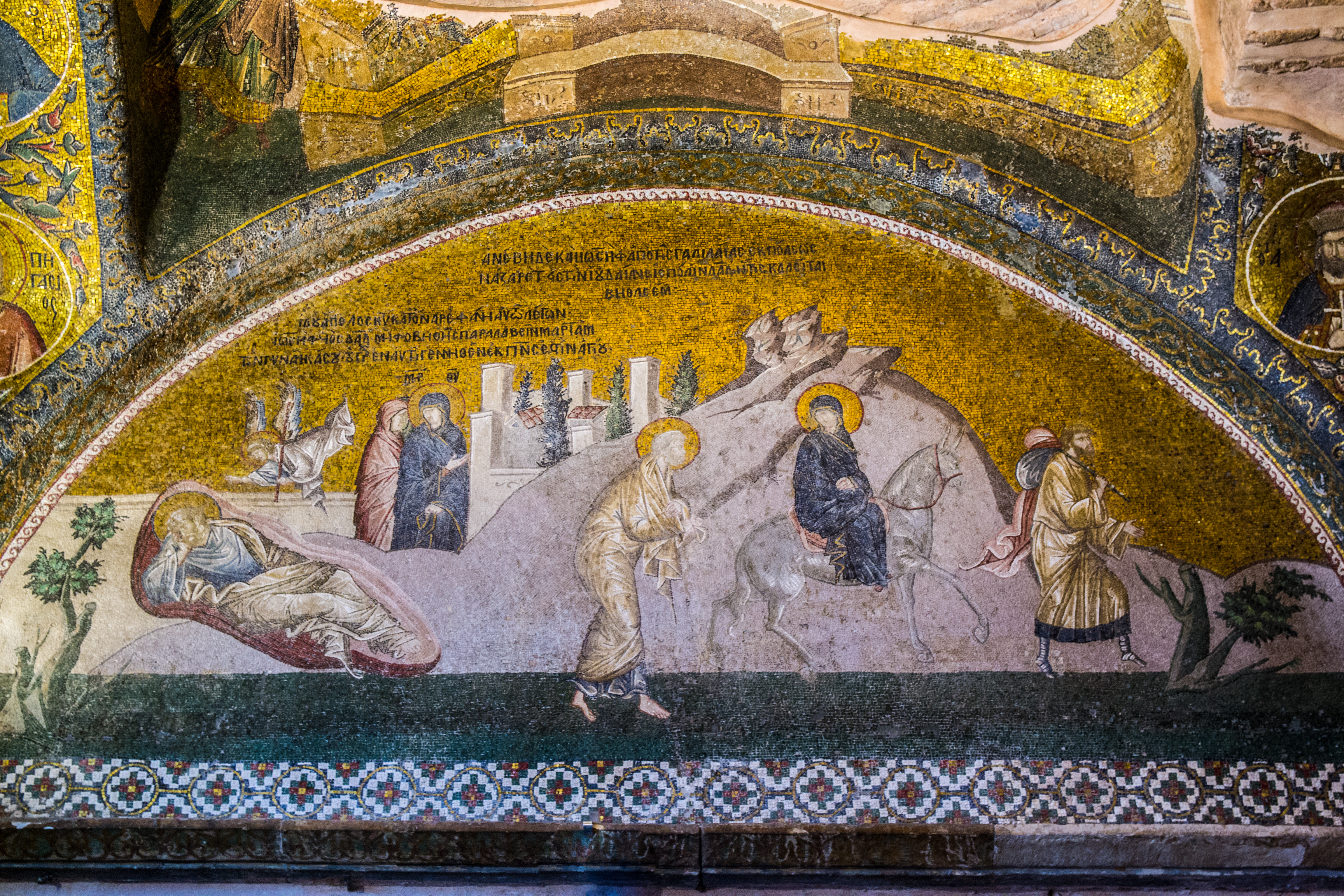
Journey to Bethlehem (Chora Church)
Joseph’s Dream and the Journey to Bethlehem, 1315–20. Mosaic, outer narthex, Kariye Camii (Chora Mosque) (formerly Chora Church), Istanbul, Turkey.

Among the finest artworks of the Palaeologan Renaissance, this Late Byzantine mosaic is in the lunette directly above the north door of a thirteenth-century church in Istanbul (formerly Constantinople), through which the clergy would have entered. It shows on the left an angel appearing to Joseph in a dream to corroborate Mary’s story of the miraculous conception of the son in her womb, and on the right the couple traveling to Bethlehem to register for the census, their donkey led by one of Joseph’s sons from a previous marriage (an apocryphal character from the Protoevangelium of James 17:1–2 and the Gospel of Pseudo-Matthew 13). I believe the scene in the middle background is the Visitation, in which Mary visits her older cousin Elizabeth in the hill country for support during her early months of pregnancy.

The building the mosaic was made for has changed possession and uses over the centuries. Originally a Byzantine church called the Church of the Holy Savior at Chora, it was converted to a mosque in 1511, over a half century after the Ottoman conquest of Constantinople. Because of the important cultural heritage it contains—namely, its Christian mosaics and frescoes—the secular Turkish Republic turned it into a museum in 1945 by court decree. In 2019 that decree was overturned, and the following year it was reconsecrated as a mosque.

It just reopened to the public May 6 of this year. Visitors are allowed daily, excluding Fridays, from 9 a.m. to 6 p.m. except during Muslim prayer times, which vary based on the sun but last for an hour in the early afternoon and an hour in the late afternoon. During prayer, the mosaics and frescoes in the “naos” (nave) are covered with curtains to honor the prohibition in the hadith against visual representations of human beings. But the images in the exonarthex, like the one shown here, remain uncovered at all times.

Chora mosaic in situ

LISTEN: “Lift Up Your Heads” (original title: “Macht hoch die Tür”) | Original German words by Georg Weissel, 1623; translated into English by Catherine Winkworth, 1855 | Tune: TRURO, Anon., from Thomas Williams’s Psalmodia Evangelica, 1789 | Performed by Sufjan Stevens and friends on Silver & Gold, 2012

1. Lift up your heads, ye mighty gates!
Behold, the King of Glory waits;
The King of kings is drawing near,
The Savior of the world is here.
Life and salvation he doth bring,
Wherefore rejoice and gladly sing:
We praise thee, Father, now,
Creator, wise art thou!

2. A Helper just he comes to thee,
His chariot is humility,
His kingly crown is holiness,
His scepter, pity in distress,
The end of all our woe he brings;
Wherefore the earth is glad and sings:
We praise thee, Savior, now,
Mighty in deed art thou!

3. O blest the land, the city blest,
Where Christ the Ruler is confessed!
O happy hearts and happy homes
To whom this King in triumph comes!
The cloudless Sun of joy he is,
Who bringeth pure delight and bliss.
We praise thee, Spirit, now,
Our Comforter art thou!

4. Fling wide the portals of your heart;
Make it a temple set apart
From earthly use for heaven’s employ,
Adorned with prayer and love and joy.
So shall your Sovereign enter in
And new and nobler life begin.
To thee, O God, be praise
For word and deed and grace!

5. Redeemer, come! I open wide
My heart to thee; here, Lord, abide!
Let me thy inner presence feel,
Thy grace and love in me reveal;
Thy Holy Spirit guide us on
Until our glorious goal is won!
Eternal praise and fame
We offer to Thy name!

(Related post: https://artandtheology.org/2022/12/03/advent-day-7-lift-up-your-heads/)

Georg Weissel (1590–1635) was a German Lutheran minister and hymn writer. He wrote “Macht hoch die Tür” (Lift Up Your Heads) in 1623 for the dedication, during Advent, of the newly built Altroßgärter Kirche in Konigsberg, where he served as pastor until his death. The hymn is rooted in Psalm 24, especially verses 9–10:

Lift up your heads, O gates!
    and be lifted up, O ancient doors,
    that the King of glory may come in!
Who is this King of glory?
    The LORD of hosts,
    he is the King of glory. Selah

Likely written by King David on the occasion of the ark of the covenant’s coming to Jerusalem after being taken back from the Philistines (2 Sam. 6), this psalm directs its hearers to open wide the city gates to welcome in God’s presence, symbolized by this precious gold-plated chest. In his hymn, Weissel turns this directive into a metaphor, telling worshippers to open the gates of their hearts so that God can enter in and abide there.

Weissel’s hymn has an odd meter of 88.88.88.66—six lines of eight syllables, followed by two lines of six syllables. Many hymnals of the past century have modified the hymn’s structure to create four-line stanzas instead, each line of equal measure, nixing the shorter ending couplets and combining what remains.

On his 2012 Christmas album, Silver & Gold, Sufjan Stevens and a small vocal ensemble sing what in the original hymn is stanzas 1a and 3a. The group sings the four-part harmonies to a simple piano accompaniment for the first verse and a cappella the second.

For a contemporary arrangement that covers more lyrical ground, see Josh Bales’s 2018 recording of the hymn, from his album Come Away from Rush and Hurry:

I’ve paired this hymn with an artwork of the Journey to Bethlehem to show how “the King of kings is drawing near,” bringing life and salvation. Will you “fling wide the portals of your heart” to receive him?
Roundup: “Soul Food Love,” call for Sufjan Stevens papers, and more

LECTURES:

Calvin University’s January Series is an annual fifteen-day series of lectures and conversations that “aims to cultivate deep thought and conversations about important issues of the day, to inspire cultural renewal and make us better global citizens in God’s world.” It brings in various scholars on various topics, but the two lectures I want to call out in particular are both about food!

Also note: upcoming events in the series include “Neurodivergent Storytelling” with Daniel Bowman Jr., a novelist and professor with autism; a live recording of the Poetry for All podcast featuring guest poet Marilyn Nelson; and “Tuning Our Minds, Ears, and Hearts to Sing God’s Grace: Reflections of a Conductor” with Pearl Shangkuan.

>> “Soul Food and the Collective Cultural Memory” by Caroline Randall Williams (available through Feb. 15): Caroline Randall Williams is a multigenre writer (of poems, YA fiction, essays, recipes), educator, activist, and home cook in Nashville whom Southern Living recognized as one of “50 People Changing the South” for her work around food justice. She’s the coauthor (with her mother, Alice Randall) of Soul Food Love: Healthy Recipes Inspired by One Hundred Years of Cooking in a Black Family and host of the TV show Hungry for Answers. I enjoyed this wonderful introduction to her work—though frustratingly, the sound cuts in and out several times. The introduction starts at 14:05, and the Q&A starts at 1:04:40. She opens with a reading of the delicious poem “When the Burning Begins” by Patricia Smith.

>> “Table Conversations: Building Community as We Eat” by Kendall Vanderslice: Kendall Vanderslice is a baker, writer, and the founder of the Edible Theology Project, an educational nonprofit connecting the Communion table to the kitchen table. She earned her master’s of theological studies from Duke Divinity School and master’s in gastronomy from Boston University. . . . Through her work in food studies and theology, Vanderslice explores the ways God uses the table to restore communities and creation. In her most recent book, By Bread Alone: A Baker’s Reflection on Hunger, Longing, and the Goodness of God, she discusses her faith journey, shares recipes, and dives into the role of bread in church history.” Introduction starts at 11:45; Q&A, at 50:33.

+++

CALLS FOR PAPERS:

>> For inclusion in the forthcoming book My Impossible Soul: The Metamodern Music of Sufjan Stevens: Dr. Tom Drayton and Greg Dember are compiling essays for a new book on Sujan Stevens, and they’re seeking contributing writers from across academic disciplines. “My Impossible Soul will be the first academic volume dedicated to the work of multi-instrumentalist singer-songwriter Sufjan Stevens. A staple of the indie/alternative music scene since 2000, Stevens’ work transcends genres – ranging from minimalist folk to maximalist electronica. His prolific discography blends “stories of his own life with ancient mythology and religious references” (McKinney 2015), interweaving themes of grief (Minton 2023), nostalgia, queer relationships (Postelli 2016; Glow 2021), Christianity, disease, problematic families, and the apocalypse with intricately produced compositions. . . . This volume aims to provide the first international and interdisciplinary analysis of the music, lyrics, performance process and cultural impact of Sufjan Stevens, through the framework of metamodernism . . .” Proposal deadline: March 1, 2024.

>> On Religion and Film: The International Conference on Religion and Film is held every two years, gathering leading scholars in the fields of religious studies and film; 2022’s was in Amsterdam, and this year’s (June 27–28, 2024) is in Hollywood! The Brehm Center at Fuller Seminary is soliciting papers for the conference. “We invite papers exploring Hollywood films from their origins in the 1890s through the silent film era as well as the Classic Hollywood studio film era from the 1930s through the end of the Hays Code (1968). How did religion influence the creative process, production, reception, and distribution of these films? How might the intersection of religion and film in this historic era inform our conversations about religion and film today? We are especially interested in contemporary films that deal with the future and the role of religion in the future. In addition, we seek papers exploring how advances in film technologies and our collective experience of film (in-theater technologies, VR, Streaming) will influence the future of filmmaking. Additionally, how might AI change storytelling and human creativity? How will those who work in Religion and Film Studies adapt/respond to these changes?” Abstracts are due by February 10, 2024.

+++

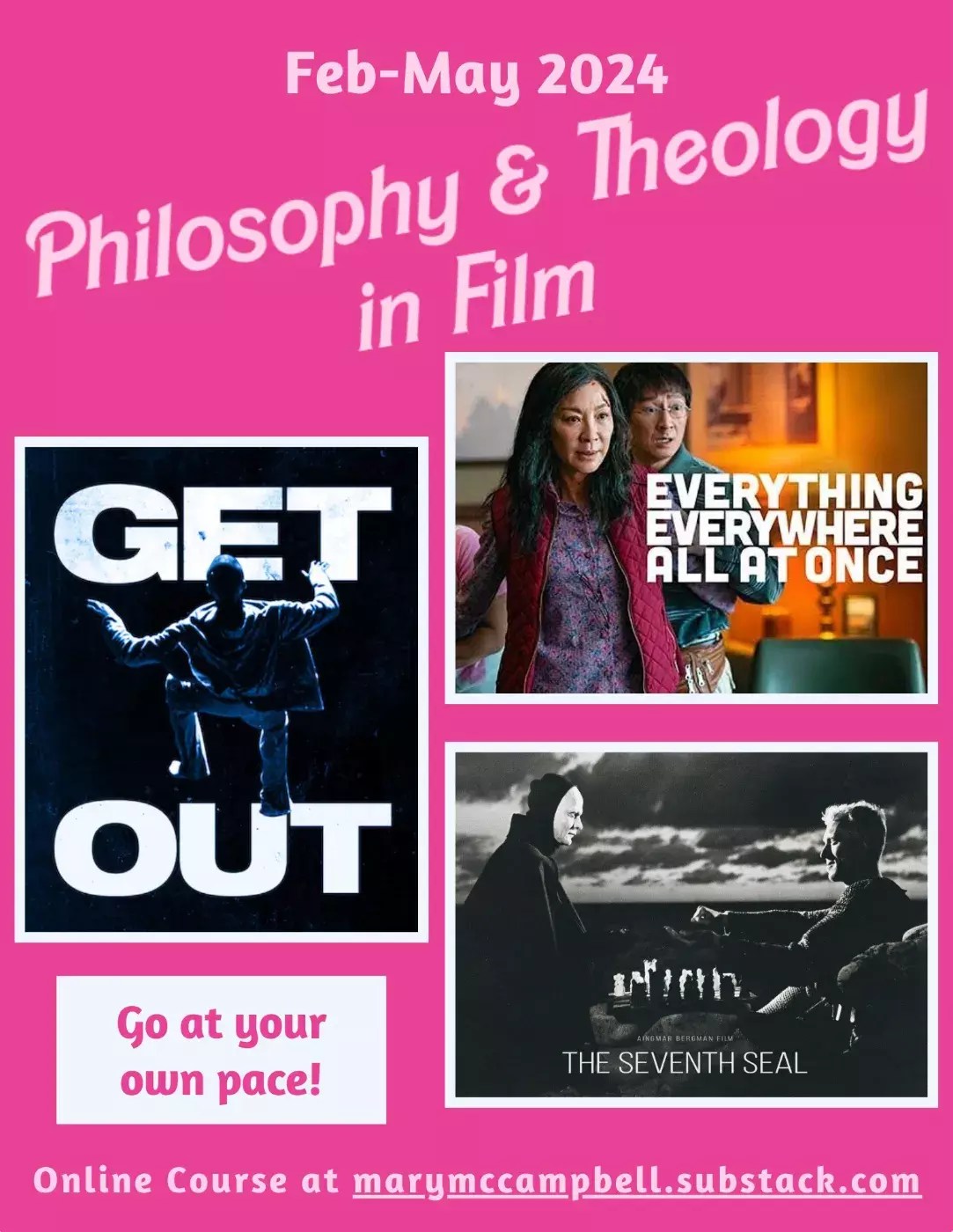
ONLINE COURSE: “Philosophy and Theology in Film” with Dr. Mary McCampbell, February–May 2024: Mary McCampbell [previously] is a writer and educator on film, literature, and popular culture whose Substack, The Empathetic Imagination, is one of my favorites! In December she and nine other professors lost their jobs at Lee University because the university’s humanities major has been suspended due to financial difficulties—and this despite her being tenured and having taught there for fourteen years.

So, she won’t be in a traditional classroom this spring, but the course she had prepared to teach undergraduates she is adapting for online and opening up to the public! It costs just $20 (a four-month paid subscription to The Empathetic Imagination), which is a real steal. Beginning near the end of February and running through May, the course will include:

  • An introductory video for each of ten films, including a lesson on the main philosophical influences and parallels (including intro lectures on Marx, Nietzsche, Freud, Sartre, Descartes, and more)
  • A live Zoom discussion of each film
  • A written Substack post of McCampbell’s analysis of each film, hopefully followed by a lively discussion in the comments section

I’ll be participating!

+++

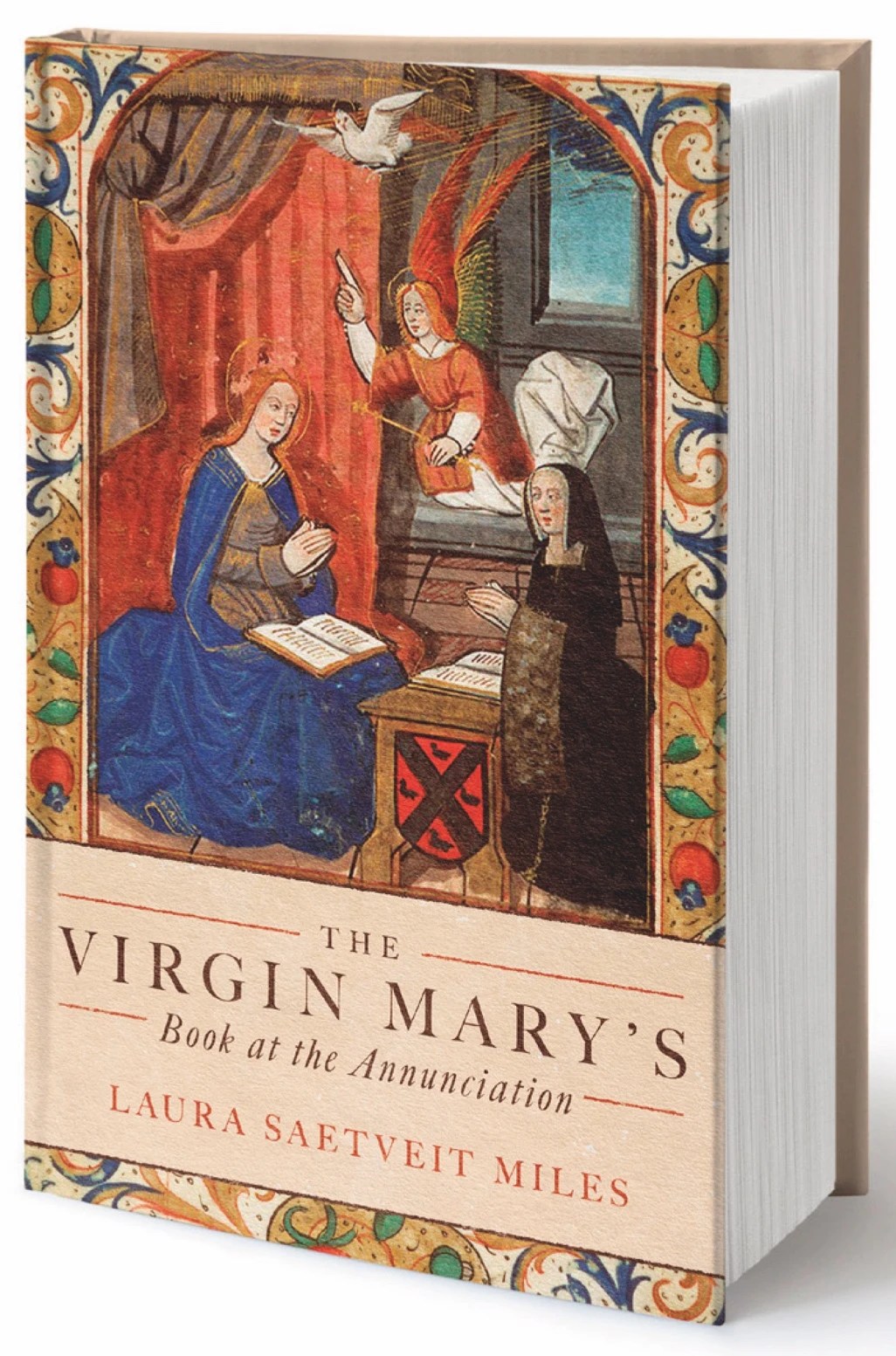
UPCOMING (ONLINE) LECTURE: “Reading alongside the Virgin Mary in Late Medieval Books of Hours Annunciation Scenes” by Laura Saetveit Miles, February 1, 2024: Professor Laura Saetveit Miles’s book The Virgin Mary’s Book at the Annunciation (Boydell & Brewer, 2020) has been one of my favorite reads of the last several years—so I was delighted to see she’ll be giving a free online talk on the topic next week! Organized by the Centre for Marian Studies at St Mary’s University in Twickenham, Miles’s lecture “will focus on two rare and fascinating versions of the standard Annunciation scene, as they are developed in both devotional literature and illuminations in Books of Hours. One type of representation captures the moment before Gabriel arrives; the other type depicts the reader herself as part of the scene. Some versions even combine these two. Where do these variations come from, and what do they mean? This neglected story of imitatio Mariae sheds new light on what Mary’s role in the Incarnation meant for medieval Christians across Europe.” (Update, 2/2: Here’s the recording.)