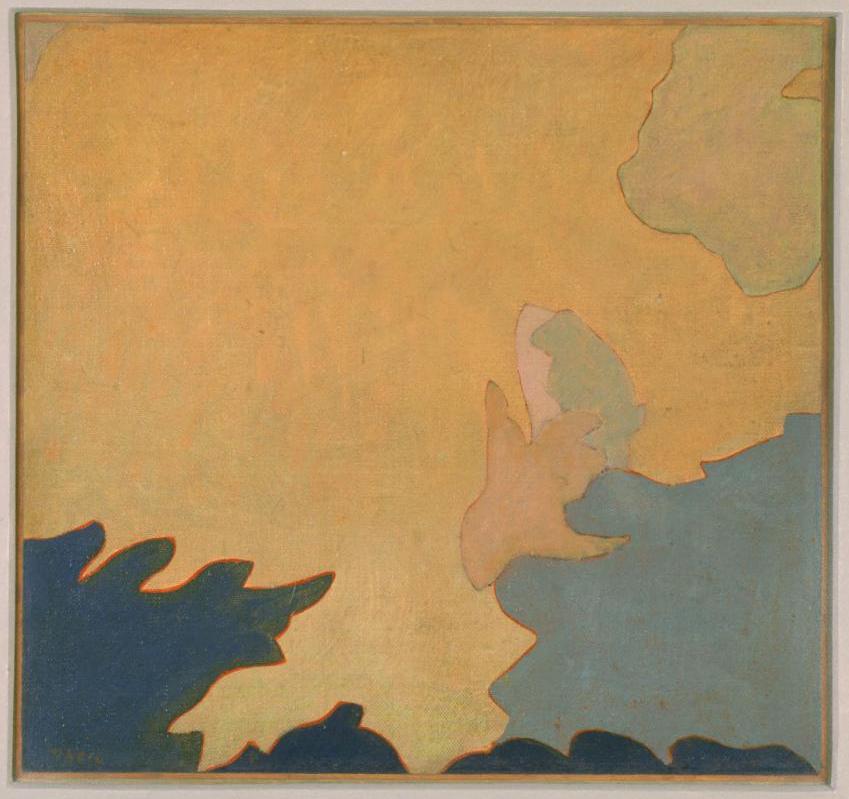
Augustus Vincent Tack (American, 1870–1949), Dawn, 1934–36. Oil on canvas mounted on hardboard, 23 3/4 × 24 3/4 in. (60.3 × 62.9 cm). Phillips Collection, Washington, DC.
Darkness
as black as your eyelid,
poketricks of stars,
the yellow mouth,
the smell of a stranger,
dawn coming up,
dark blue,
no stars,
the smell of a lover,
warmer now
as authentic as soap,
wave after wave
of lightness
and the birds in their chains
going mad with throat noises,
the birds in their tracks
yelling into their cheeks like clowns,
lighter, lighter,
the stars gone,
the trees appearing in their green hoods,
the house appearing across the way,
the road and its sad macadam,
the rock walls losing their cotton,
lighter, lighter,
letting the dog out and seeing
fog lift by her legs,
a gauze dance,
lighter, lighter,
yellow, blue at the tops of trees,
more God, more God everywhere,
lighter, lighter,
more world everywhere,
sheets bent back for people,
the strange heads of love
and breakfast,
that sacrament,
lighter, yellower,
like the yolk of eggs,
the flies gathering at the windowpane,
the dog inside whining for food
and the day commencing,
not to die, not to die,
as in the last day breaking,
a final day digesting itself,
lighter, lighter,
the endless colors,
the same old trees stepping toward me,
the rock unpacking its crevices,
breakfast like a dream,
and the whole day to live through,
steadfast, deep, interior.
After the death,
after the black of black,
this lightness—
not to die, not to die—
that God begot.
“The Fury of Sunrises” is the last of fifteen poems from Anne Sexton’s “The Furies” cycle, published in The Death Notebooks (Houghton Mifflin, 1974).Copyright is held by the Estate of Anne Sexton, represented by Sterling Lord Literistic.
Anne Sexton (1928–1974) was a Pulitzer Prize–winning confessional poet from New England who wrote in starkly personal terms about her psychiatric struggles (she suffered from bipolar disorder and died by suicide), sexuality, and other taboo subjects. Much of her poetry expresses a yearning for the ecstatic and sublime and explores religious questions, referencing God and faith—even though she characterized herself, in a 1968 BBC interview, as an atheist, albeit one who was “rather attracted to Catholicism.”
The heavens bespeak the glory of God.
The firmament ablaze, a text of his works.
Dawn whispers to sunset.
Dark to dark the word passes: glory glory.

All in a great silence,
no tongue’s clamor—
yet the web of the world trembles
conscious, as of great winds passing.

The bridegroom’s tent is raised,
a cry goes up: He comes! a radiant sun
rejoicing, presiding, his wedding day.
From end to end of the universe his progress.
No creature, no least being but catches fire from him.
This paraphrase of Psalm 19:1–6 by Daniel Berrigan is from Uncommon Prayer: A Book of Psalms(University of Michigan Press, 1978; Orbis, 1998).Used by permission of the Daniel Berrigan Literary Trust. www.danielberrigan.org
The first section of Psalm 19 is about how the natural world declares the glories of its Maker. The night sky, the psalmist describes, is like a tent that spreads its cover over the sun, parting open every morning to release it on the world. The sun is compared to a bright-eyed, handsome, and happy bridegroom emerging from his chamber, and to a vigorous runner who tracks a massive course.
I like to read Psalm 19:1–6 for Advent, especially the poet-priest Fr. Daniel Berrigan’s paraphrase of it, as his use of he/him/his pronouns instead of it/its draws out a Christological connection I hadn’t seen before in this text, made even more pronounced by the apocalyptic tone Berrigan adopts and the sense of excitement he conveys. The poem can, of course, be read as simply the glorious waking of a day, as the psalmist intended. But there’s another layer I want to explore: signs in the heavens, and the coming of Christ.
In the Christian tradition, Jesus is compared to both a sun and a bridegroom, and he, too, like the skies, “bespeak[s] the glory of God.” “Oriens”—Dawn or Dayspring—is one of the traditional titles of Christ, typically invoked in liturgies on December 21 as part of the O Antiphons cycle. From the Church of England’s Common Worship: “O Morning Star, splendor of light eternal and sun of righteousness: come and enlighten those who dwell in darkness and the shadow of death” (cf. Luke 1:78–79; John 8:12; Mal. 4:2). The coming of Jesus—in Bethlehem, in human hearts, and on the last day—illuminates and sets ablaze, revealing who God is and who we ourselves most truly are and exciting the world, flinging abroad the divine light.
As for the bridegroom, Jesus uses this metaphor for himself in his parable of the ten bridesmaids (Matt. 25), as God does in Isaiah 62:5, and indeed one of the major motifs in the book of Revelation is a wedding between Christ and his people. Christ will return to us, scripture suggests, like a husband coming to bring home his new bride.
One of the antiphons for First Vespers of Christmas, I’ve just learned, sung the evening of December 24, connects the bridegroom of Psalm 19 with Jesus. Cum ortus fuerit sol de caelo, the church chants, videbitis Regem regum procedentem a Patre, tanquam sponsum de thalamo suo. (“When the sun shall have risen in the heavens, ye shall see the King of kings coming from the Father, as a Bridegroom from his bride-chamber.”)
Tanja Butler (American, 1955–), Woman Clothed with the Sun, 2008. Acrylic paint, collaged painted paper, and cotton fabric on gessoed acid-free paper, 14 × 5 in. Collection of Victoria Emily Jones.
Artist Tanja Butler further extends Psalm 19’s fittingness for Advent by drawing the passage into conversation with Revelation 12:1–6. This section of John’s Apocalypse introduces us to “a woman clothed with the sun, with the moon under her feet, and on her head a crown of twelve stars”; she gives birth to a baby boy “who is to rule all the nations” but whom a great dragon seeks to devour. In most Christian interpretations, this Woman of the Apocalypse is associated with the Virgin Mary, and there’s a robust iconographic tradition in this vein.
Butler innovates on that tradition with her mixed-media work Woman Clothed with the Sun by showing the infant Jesus busting out of his mother’s womb like the strong athlete of Psalm 19:5. (Ready. Set. Go!) He has a race to run, a mission to fulfill. He is also shown as the sun that clothes his mother and that emerges from a dark (uterine) tent. He is the source and center point of the explosive rays of colorful light in the painting.
In an ArtWay profile, Butler describes her piece as follows:
Mary is represented with the unborn Christ, Light of the World, ready to “come forth from his pavilion, like a champion rejoicing to run his course” (Psalm 19:5). She holds a ladder, referencing both Jacob’s vision and the cross, the ladder of ascent between earth and heaven.
This is a cosmic birth necessitated by a cosmic struggle that will resolve in a cosmic victory: the reunion of God and humanity.
Daniel Joseph Berrigan, SJ, (1921–2016) was an American Jesuit priest, peace activist, award-winning poet, and professor of theology and biblical studies. Through his writings and public witness, he endorsed a consistent life ethic, opposing war, nuclear armament, abortion, capital punishment, and the causes of poverty in the name of Jesus Christ and his holy gospel. Fr. Berrigan, along with his brother Philip, was one of the Catonsville Nine, imprisoned in 1968 for destroying draft files in a protest against the Vietnam War. Later, he spent much of the eighties ministering to AIDS patients in New York City. He is the author of some fifty books.
Tanja Butler (born 1955) is a painter and liturgical artist based in the Albany, New York, area. Her subjects are devotional in character, and her sources of inspiration include Byzantine icons, medieval art, and folk art. Her work is included in the collections of the Vatican Museums, the Hammer Museum in Los Angeles, the Portland Museum of Art in Maine, and the Boston Public Library. “My aim is to develop imagery that has the simplicity and clarity of a child-like vision,” she says, “required, we’re told, if we are to see the kingdom of God.”
Be attentive to this [God’s message] as to a lamp shining in a dark place, until the day dawns and the morning star rises in your hearts.
—2 Peter 1:19b
LOOK: Bridge of Glory by Nicholas Roerich
Nicholas Roerich (Russian, 1874–1947), Bridge of Glory, 1923. Tempera on canvas, 82 × 163 cm. Nicholas Roerich Museum, New York.
LISTEN: “Yonder Come Day,” African American spiritual | Performed by the Schola Cantorum of St. Peter’s in the Loop, dir. J. Michael Thompson, on Music for Advent II (2005)
Yonder come day, day is a-breakin’ Yonder come day, O my soul Yonder come day, day is a-breakin’ Sun is a-risin’ in my soul
This spiritual originated in the nineteenth century in the enslaved Black communities of St. Simons Island off the coast of Georgia. Daybreak here can be read as a metaphor for salvation, happiness, death/beatification, or possibility. The latter was an especially common application, as the song was typically sung at Watch Night services, a New Year’s Eve tradition of Christian prayer, worship, song, and dance lasting from around 7 p.m. until midnight.
Recorded in 1963 in Los Angeles, the performance below is from the short film Georgia Sea Island Singers (1964), available on the DVD The Films of Bess Lomax Hawes (2003) and streaming on Kanopy:
The singers are, from left to right, John Davis, Bessie Jones, Emma Ramsay, Henry Morrison, and Mabel Hillary. They sing these lyrics:
Yonder come day (O day) Yonder come day (O day) Yonder come day Day done broke Into my soul
Yonder come day (I was on my knees) Yonder come day (I was on my knees) Yonder come day (I was on my knees) Yonder come day Day done broke Into my soul
. . . I heard him say . . .
. . . It’s a New Year’s day . . .
. . . Come on, child . . .
In 2016, Paul John Rudoi arranged “Yonder Come Day” together with “Hush, Hush,” “Steal Away,” and “Swing Low, Sweet Chariot,” creating a medley of spirituals in which “Yonder” is the through line. The medley is performed in the following video by the University of Oregon Chamber Choir, featuring soloist Alexa McCuen:
The coming of Christ is often described as the rising of a new day. That goes for his first advent in Bethlehem; his second, future advent; and his advent in the human heart, as people receive him and are flooded with spiritual light. “Yonder Come Day” is an apt song for remembering with gratitude one’s own conversion, that moment when Christ came to you and transformed you from the inside out.
This post is part of a daily Advent series from December 2 to 24, 2023 (with Christmas to follow through January 6, 2024). View all the posts here, and the accompanying Spotify playlist here.
. . . the sun of righteousness shall rise, with healing in its wings . . .
—Malachi 4:2
The people who walked in darkness have seen a great light; those who lived in a land of deep darkness— on them light has shined.
—Isaiah 9:2
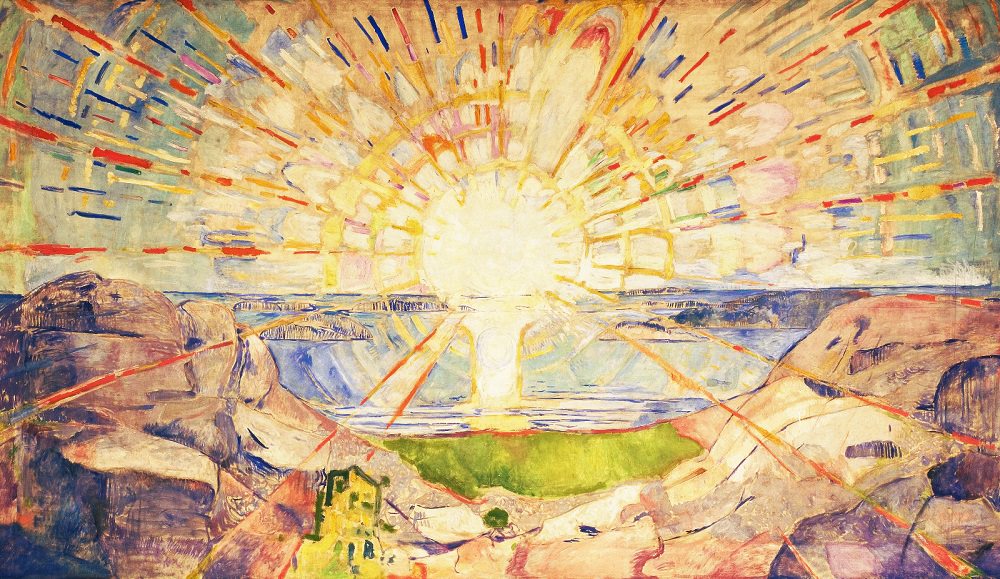
LOOK: The Sun by Edvard Munch
Edvard Munch (Norwegian, 1863–1944), The Sun, 1911. Oil on canvas, 455 × 780 cm (14.9 × 25.5 ft.). The Aula, University of Oslo, Norway.
Over twenty-five feet across, Edvard Munch’s The Sun is the centerpiece of an eleven-piece cycle of oil paintings on the theme of enlightenment commissioned for, and still located in, the Aula (assembly hall) at the University of Oslo. It shows a blazing sunrise over the coastline of Kragerø in Norway, its multicolored rays extending to adjacent canvases, which portray men and women reaching up toward the light.
Though he didn’t have an explicitly Christological meaning in mind, Munch did see the sun as the source of all life, as he wrote about in his notebooks, and in his work it is often read as a symbol of the eternal.
LISTEN:“Again the Lord” | Words by Anna L. Barbauld, 1772 | Music by Ben Thomas, 2015 | Performed by Ben Thomas on Bring Forth, 2015
Again the Lord of light and life Awakes the kindling ray Unseals the eyelids of the morn And pours increasing day
O what a night was that which wrapped The sleeping world in gloom O what a Sun which rose this day Triumphant from the tomb
This day be grateful homage paid And loud hosannas sung Let gladness dwell in every heart And praise on every tongue
Ten thousand different lips shall join To hail this welcome morn Which scatters blessing from its wings To nations yet unborn
Nancy Holt (American, 1938–2014), Sun Tunnels, 1973–76. Concrete, steel, and earth, each cylinder 18 feet long and 9 feet in diameter. Great Basin Desert, Utah. Owned by the Dia Art Foundation. Photo: Will Thompson.
A large-scale outdoor installation in northwestern Utah, Sun Tunnels by land artist Nancy Holt
consists of four large concrete cylinders, arranged on the desert floor in a cruciform pattern that aligns with the sunrise and sunset during the summer and winter solstices. In addition to this perfect solar framing, each of the cylinders is pierced with smaller holes representing the stars of four constellations: Draco, Perseus, Columba, and Capricorn. Holt’s design allows for an ever-changing play of celestial light and shadow upon the resolutely material surfaces of her work. Part timepiece and part compass, Sun Tunnels is also a “camera” of sorts, dependent on natural light, with the concrete tubes acting as viewfinders that frame precise images which, in Holt’s words, “bring the vast space of the desert back to human scale.” [source]
LISTEN: “Light Upon the Mountains” | Words by Henry Burton, 1910 | Music by Jackson T. Maust and Seth Thomas Crissman, 2015 | Performed by The Walking Roots Band on Hark! A Walking Roots Band Christmas, 2017
There’s a light upon the mountains and the day is at the spring, When our eyes shall see the beauty and the glory of the king: Weary was our heart with waiting, and the night-watch seemed so long, But his triumph-day is breaking and we hail it with a song.
In the fading of the starlight we may see the coming morn; And the lights of all are paling in the splendors of the dawn: For the eastern skies are glowing as with light of hidden fire, And the hearts of all are stirring with the throbs of deep desire.
He is breaking down the barriers, he is gathering up the way; He is calling for his angels to build up the gates of day: But his angels here are human, not the shining hosts above; For the drumbeats of his army are the heartbeats of our love.
Hark! we hear a distant music, and it comes with fuller swell; ’Tis the triumph song of Jesus, of our king, Immanuel! Go ye forth with joy to meet Him! And, my soul, be swift to bring All thy sweetest and thy dearest for the glory of our king!
Come, thou long-expected Jesus, Born to set thy people free; From our fears and sins release us, Let us find our rest in thee.
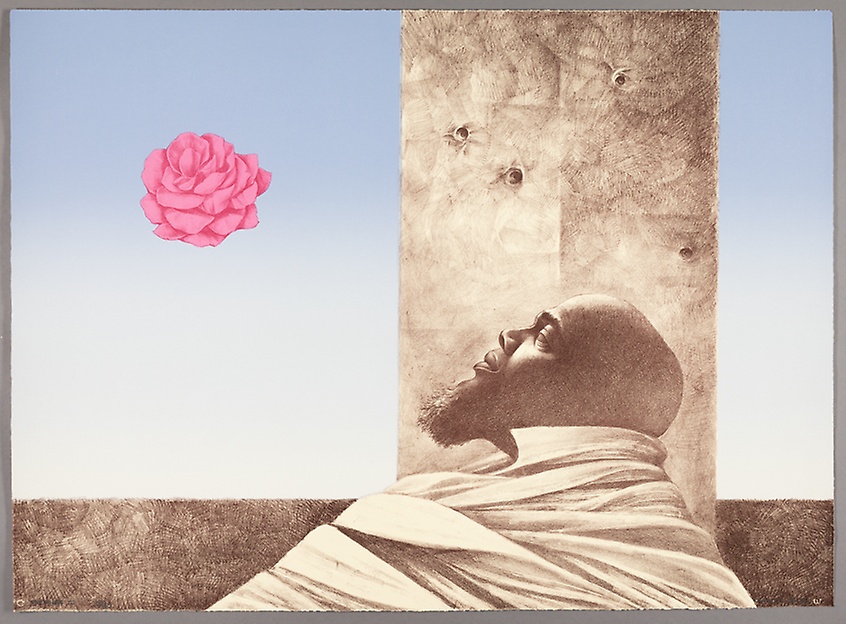
Charles White (American, 1918–1979), Prophet I, 1975. Color lithograph on white wove paper, 68.7 × 94.2 cm. Art Institute of Chicago.
Isaiah is the definitive Old Testament prophet of Advent, as he anticipates more than any other the coming of the Messiah and the renewal he will usher in. In chapter 35 he foresees deserts flowing with water and vegetative abundance: “the wilderness and the solitary place shall be glad; and the desert shall rejoice, and blossom as the rose” (v. 1).
Perhaps the modern Black artist Charles White had this scripture in mind when he created the lithograph Prophet I. It shows a robed man, who appears to be blind, gazing up at a pink rose suspended in the sky. (The blind prophet with keen inner sight is a common trope in ancient mythology.) On the cross-hatched wall he stands against are four eyes, which White said are there because the prophet sees more than the rest of us.
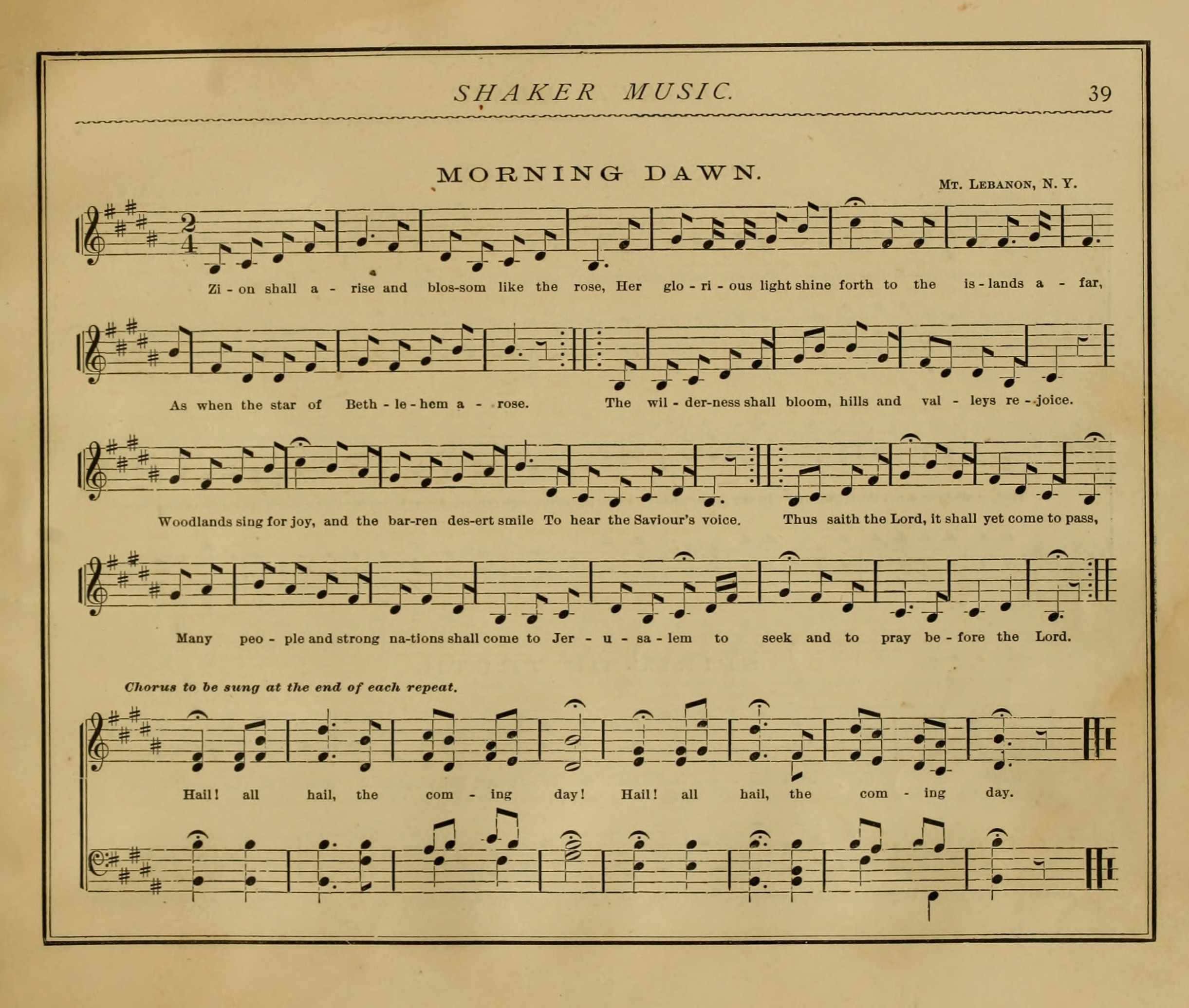
LISTEN: “Morning Dawn,” a Shaker hymn from New Lebanon, New York, 19th century | Performed by The Rose Ensemble on And Glory Shone Around: Early American Carols, Country Dances, Southern Harmony Hymns, and Shaker Spiritual Songs (2014)
Zion shall arise and blossom like the rose Her glorious light shine forth to the islands afar As when the Star of Bethlehem arose
Hail, all hail the coming day! Hail, all hail the coming day!
The wilderness shall bloom, hills and valleys rejoice Woodlands sing for joy, and the barren desert smile To hear the Savior’s voice
Hail, all hail the coming day! Hail, all hail the coming day!
Thus saith the Lord, it shall yet come to pass Many people and strong nations shall come to Jerusalem To seek and to pray before the Lord
Hail, all hail the coming day! Hail, all hail the coming day!
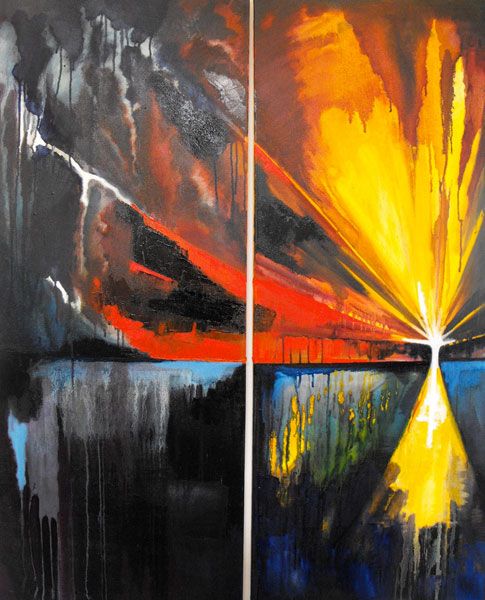
Judith Tutin (Irish, 1979–), Breaking, 2011. Diptych, St. Aidan’s Cathedral, Enniscorthy, County Wexford, Ireland.
But there will be no gloom for her who was in anguish. In the former time he brought into contempt the land of Zebulun and the land of Naphtali, but in the latter time he has made glorious the way of the sea, the land beyond the Jordan, Galilee of the nations.
The people who walked in darkness have seen a great light;
those who dwelt in a land of deep darkness,
on them has light shone.
You have multiplied the nation;
you have increased its joy;
they rejoice before you
as with joy at the harvest,
as they are glad when they divide the spoil.
For the yoke of his burden,
and the staff for his shoulder,
the rod of his oppressor,
you have broken as on the day of Midian.
For every boot of the tramping warrior in battle tumult
and every garment rolled in blood
will be burned as fuel for the fire.
—Isaiah 9:1–5
Now when he heard that John had been arrested, he withdrew into Galilee. And leaving Nazareth he went and lived in Capernaum by the sea, in the territory of Zebulun and Naphtali, so that what was spoken by the prophet Isaiah might be fulfilled:
“The land of Zebulun and the land of Naphtali,
the way of the sea, beyond the Jordan, Galilee of the Gentiles—
the people dwelling in darkness
have seen a great light,
and for those dwelling in the region and shadow of death,
on them a light has dawned.”
From that time Jesus began to preach, saying, “Repent, for the kingdom of heaven is at hand.”
This song was recorded live in 1998 at the Resurrection Youth Convention in Gatlinburg, Tennessee. The MP3 can be downloaded for free, along with sheet music, at http://ncfmusic.com/resource/dawning-light/.
For a previously featured James Ward song, see the Artful Devotion “Death Is Ended.”
+++
The Jewish prophet Isaiah was active during the Assyrian captivity in the second half of the eighth century B.C. The Israelite lands of Zebulun and Naphtali were, along with Gilead in Transjordan, the first to fall to Assyria; the people were deported, and their lands became Assyrian provinces. But these three areas, according to Isaiah 9:1, would also be the first to see the dawning of a glorious new era, where the people step out of darkness and desolation into the fruits of God’s victory, and all military equipment is cast once and for all into an enormous bonfire, for war is over, and oppression is no more.
The future is written as something which has already happened, for it belonged to the prophetic consciousness of men like Isaiah to cast themselves forward in time and then look back on the mighty acts of God, saying to us: ‘Look forward to it, it is certain, he has already done it!’ Because of this confidence, Isaiah can place the light of 9:1ff. in immediate proximity to the darkness of 8:22, not because it will immediately happen but because it is immediately evident to the eye of faith; those walking in the darkness can see the light ahead and are sustained by hope. . . .
Isaiah insists here that hope is a present reality, part of the constitution of the ‘now’. The darkness is true but it is not the whole truth and certainly not the fundamental truth. (98–99)
This post belongs to the weekly series Artful Devotion. If you can’t view the music player in your email or RSS reader, try opening the post in your browser.
To view all the Revised Common Lectionary scripture readings for the Third Sunday after Epiphany, cycle A, click here.





 Art & Theology